
Judge, 1937-05 · page 26 of 37
Judge — May 1937 — page 26: what you’re looking at
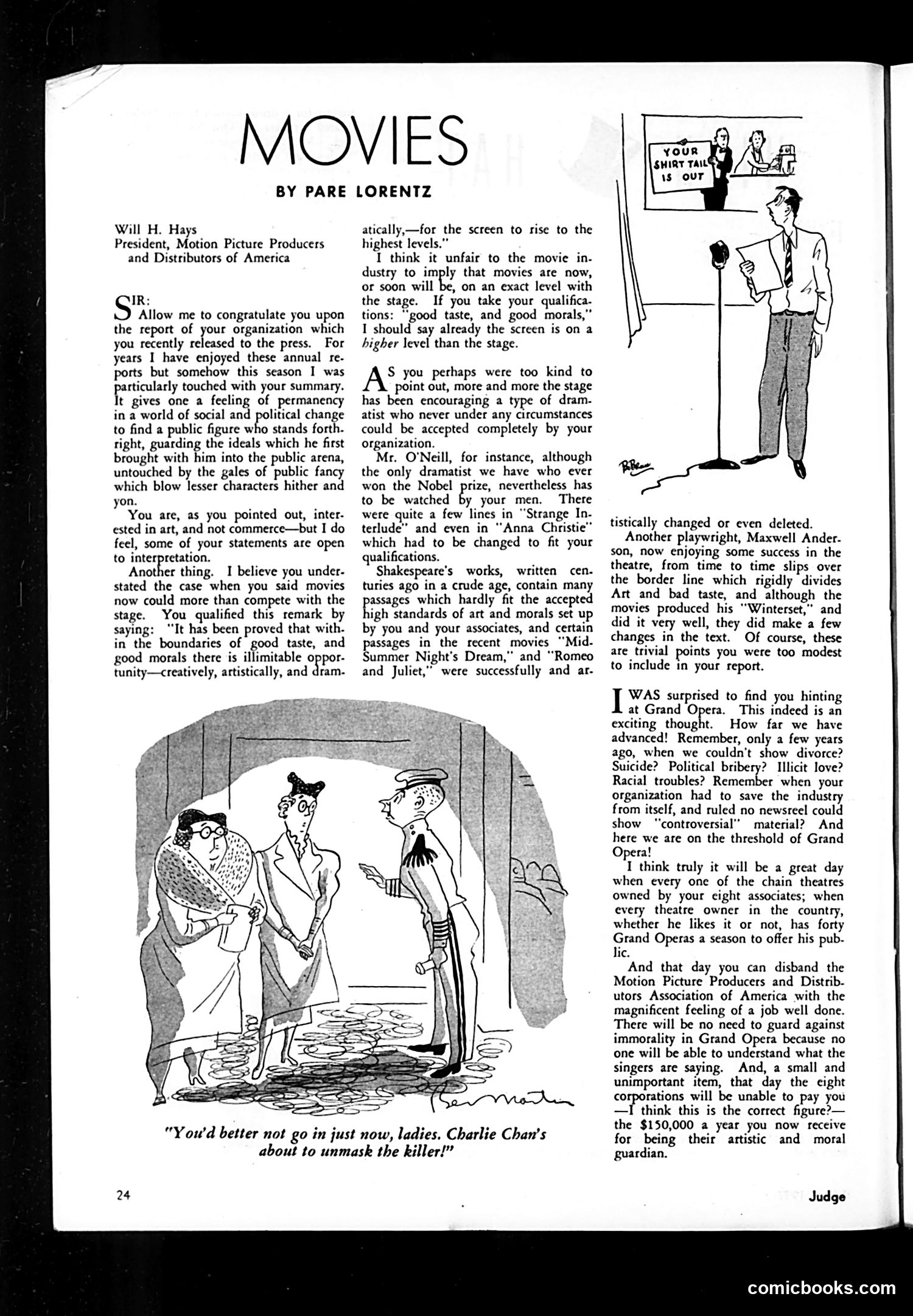
A restored page from Judge, 1937-05. Page through the whole issue in the reader above.
📄 Transcribed text from this page (OCR, searchable)
Machine-transcribed from the original scan — historical spelling and the odd misread are preserved.
MOVIES BY PARE LORENTZ Will H. Hays President, Motion Picture Producers and Distributors of America IR: Allow me to congratulate you upon the report of your organization which you recently released to the press. For years I have enjoyed these annual re- ports but somehow this season I was rticularly touched with your summary. Fe gives one a feeling of permanency in a world of social and political change to find a public figure whe stands forth. right, guarding the ideals which he first brought with him into the public arena, untouched by the gales of public fancy which blow lesser characters hither and yon. You are, as you pointed out, inter- ested in art, and not commerce—but I do feel, some of your statements are open to interpretation. Another thing. I believe you under- stated the case when you said movies now could more than compete with the stage. You qualified this remark by saying: “It has been proved that with. in the boundaries of good taste, and good morals there is illimitable Oppor- tunity—creatively, artistically, and dram- atically,—for the screen to rise to the highest levels.” I think it unfair to the movie in- dustry to imply that movies are now, or soon will be on an exact level with the stage. If you take your qualifica- tions: “good taste, and good morals,” I should say already the screen is on a higher level than the stage. AS you perhaps were too kind to point out, more and more the stage has been encouraging a type of dram. atist who never under any circumstances could be accepted completely by your organization. Mr. O'Neill, for instance, although the only dramatist we have who ever won the Nobel prize, nevertheless has to be watched by your men. There were quite a few lines in “Strange In- terlude” and even in “Anna Christie” which had to be changed to fit your qualifications. Shakespeare's works, written cen. turies ago in a crude age, contain many assages which hardly fit the accepted Fish standards of art and morals set up by you and your associates, and certain passages in the recent movies “Mid- Summer Night's Dream," and “Romeo and Juliet,” were successfully and ar- "You'd better not go in just now, ladies. Charlie Chan's about to unmask the killer!” tistically changed or even deleted. Another playwright, Maxwell Ander. son, now enjoying some success in the theatre, from time to time slips over the border line which rigidly divides Art and bad taste, and although the movies produced his “Winterset,” and did it very well, they did make a few changes in the text. Of course, these are trivial points you were too modest to include in your report. ]%* surprised to find you hinting at Grand Opera. This indeed is an exciting thought. advanced! Remember, only a few years ago, when we couldn't show divorce? How far we have Suicide? Political bribery? Illicit love? Racial troubles? Remember when your organization had to save the industry from itself, and ruled no newsreel could show “controversial material? And here we are on the threshold of Grand Opera! I think truly it will be a great day when every one of the chain theatres owned by your cight associates; when every theatre owner in the country, whether he likes it or not, has forty Gand Operas a season to offer his pub- IC. And that day you can disband the Motion Picture Producers and Distrib- utors Association of America with the magnificent feeling of a job well done. There will be no need to guard against immorality in Grand Opera because no one will be able to understand what the singers are saying. And, a small and unimportant item, that day the eight Ba ce will be unable to pay you —I think this is the correct figure?— the $150,000 a year you now receive for being their artistic and moral guardian. Judge comicbooks.com