
A complete issue · 36 pages · 1928
Judge — September 22, 1928
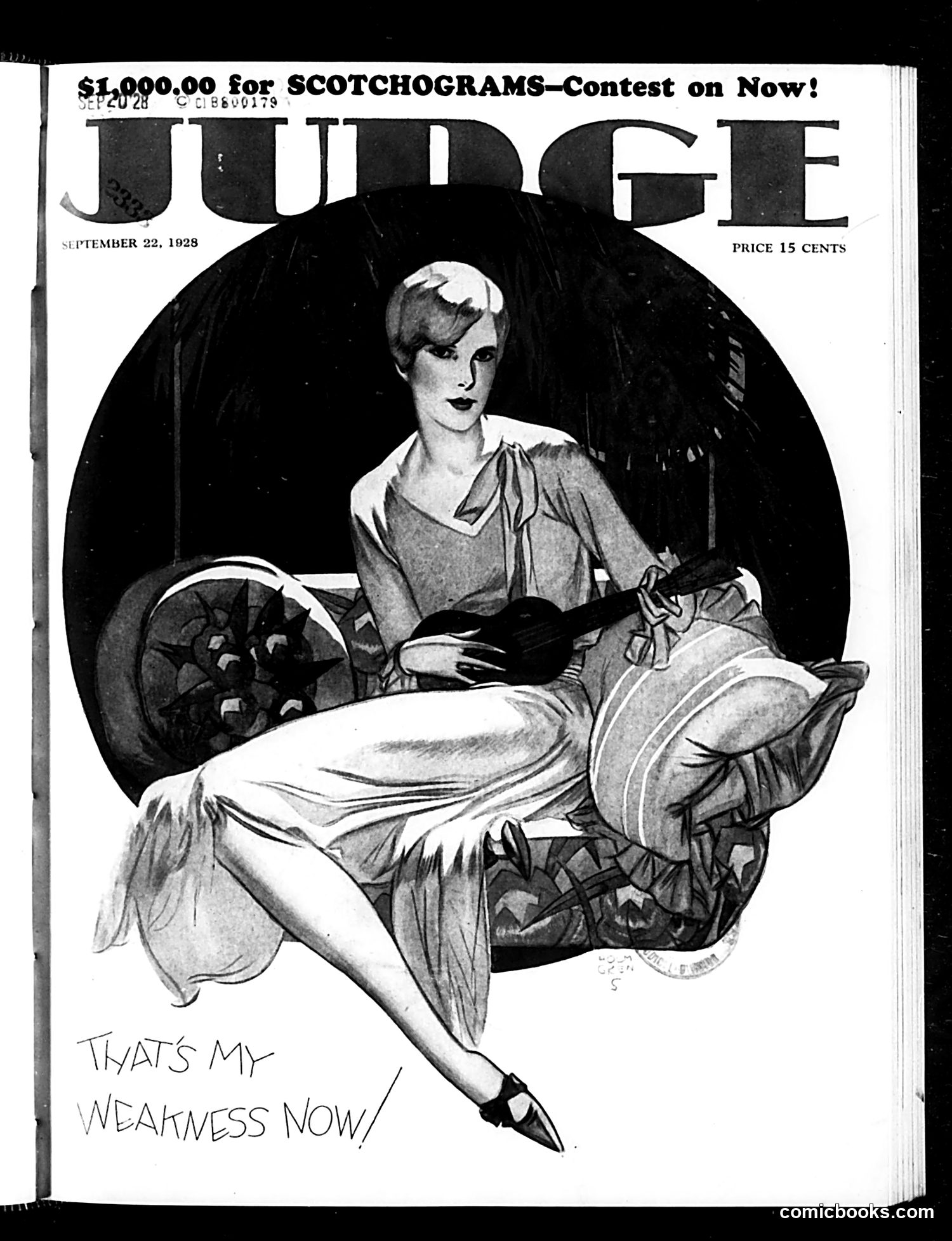
**Date & Source:** September 22, 1928 issue; price 15 cents **Main Image:** An illustration of a fashionable 1920s woman in a chair with an umbrella, holding what appears to be a basket. Her pose and styling reflect the "flapper" aesthetic of the era. **Handwritten Caption:** "THAT'S MY WEAKNESS NOW!" - suggests the illustration comments on contemporary romantic or consumer desires. **Context:** This appears to be primarily a cover illustration rather than political satire. Judge mixed humorous commentary on modern life, fashion, and social trends with actual political cartoons. The 1928 timeframe places this during the Jazz Age and just before the stock market crash. The emphasis on a woman's appearance and leisure likely reflects Judge's satirical observations about 1920s consumer culture and changing gender roles.
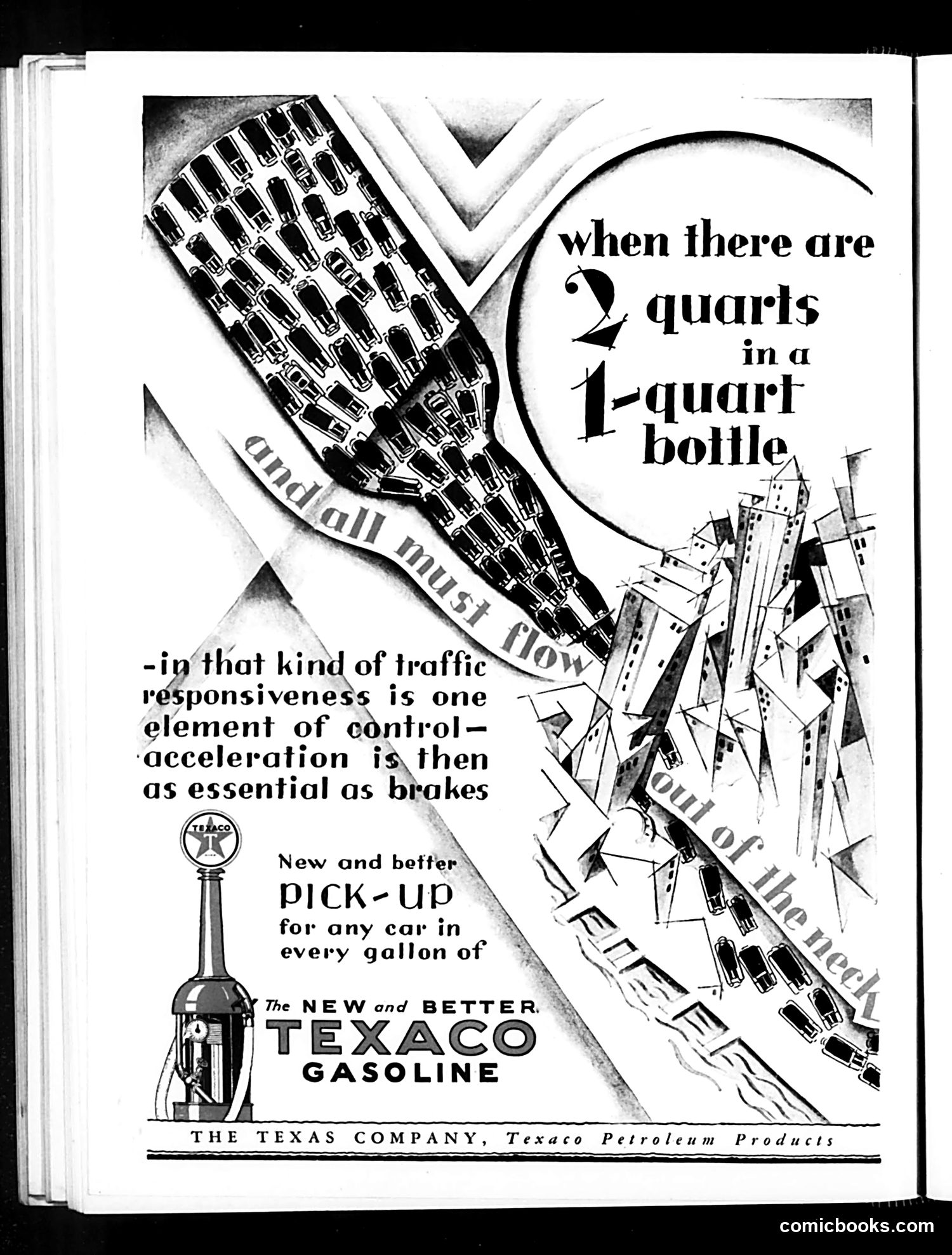
This is primarily a **Texaco gasoline advertisement**, not political satire. The ad uses a visual metaphor comparing fuel flow to traffic control: a large bottle of gasoline pours into a cityscape illustration below. The text emphasizes that Texaco's "pick-up" (engine acceleration) is "as essential as brakes" for managing traffic responsiveness. The ad references a practical concern: in congested urban traffic, quick acceleration matters for safety and control—a selling point for their "new and better" gasoline formulation. The imagery—with buildings shown in cross-section and the dramatic pouring motion—creates visual impact typical of 1920s-1930s advertising design. There are no identifiable political figures or satirical commentary; this is straightforward commercial messaging appealing to automobile owners.
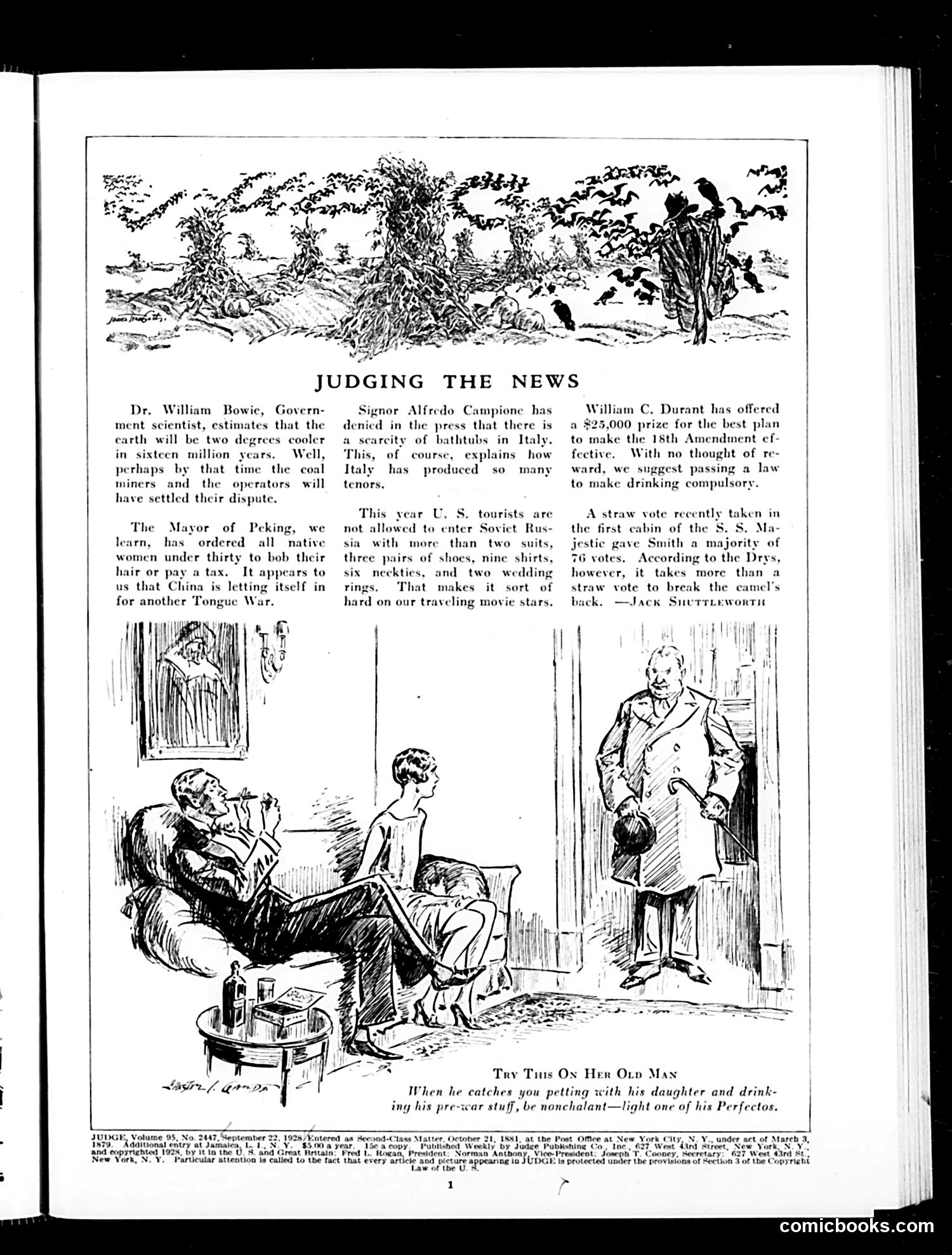
This page contains brief satirical news commentary and one cartoon. The main cartoon, titled "Try This On Her Old Man," depicts a well-dressed older man entering a room where a younger man lounges with a woman, drinking. The caption suggests the scenario satirizes parental disapproval of courtship behavior. The text items mock various contemporary issues: Dr. William Bowie's coal estimates, Italy's bathtub shortage, the Mayor of Peking's hair-tax policy, American tourists' excessive luggage in Switzerland, and a camel-breaking voting straw poll. The humor relies on absurdist exaggeration of real situations to criticize social pretensions and bureaucratic oddities of the Jazz Age era.
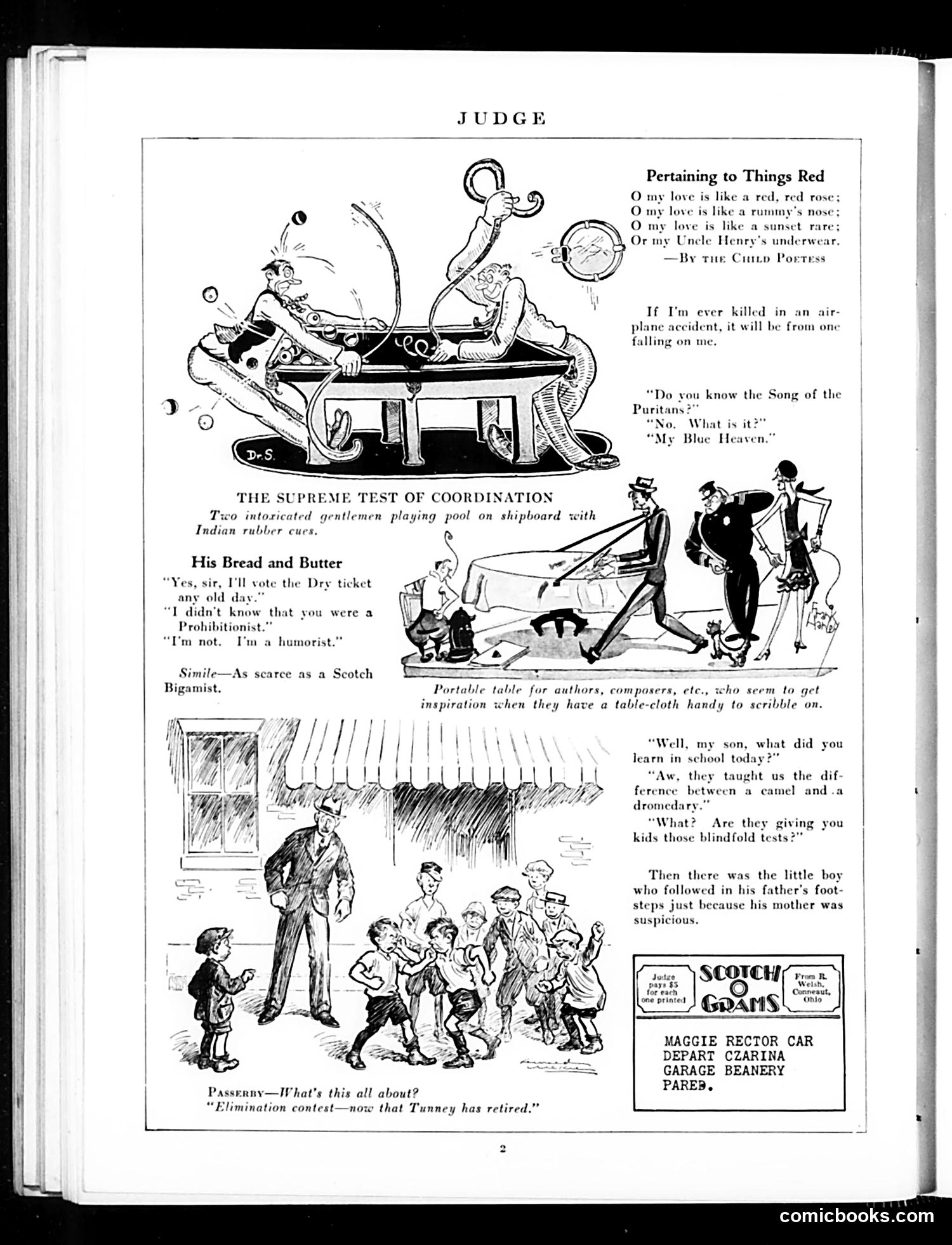
This page contains several unrelated humorous items typical of Judge's format: **"The Supreme Test of Coordination"** depicts two intoxicated men attempting to play pool on a ship using Indian rubber cues—the joke being that their drunken state makes coordination impossible, a common early-20th-century humor subject. **"His Bread and Butter"** is a brief joke about a Prohibitionist claiming to be a "humorist" instead—likely satirizing Prohibition advocates during the temperance movement era. **"Passerby"** shows a crowd scene with a caption about "Tanney's retirement" from an elimination contest, though the specific reference is unclear without additional context. The remaining items are brief anecdotes and an advertisement for Scotch Grahs products. The humor relies on wordplay and situational comedy rather than political commentary.
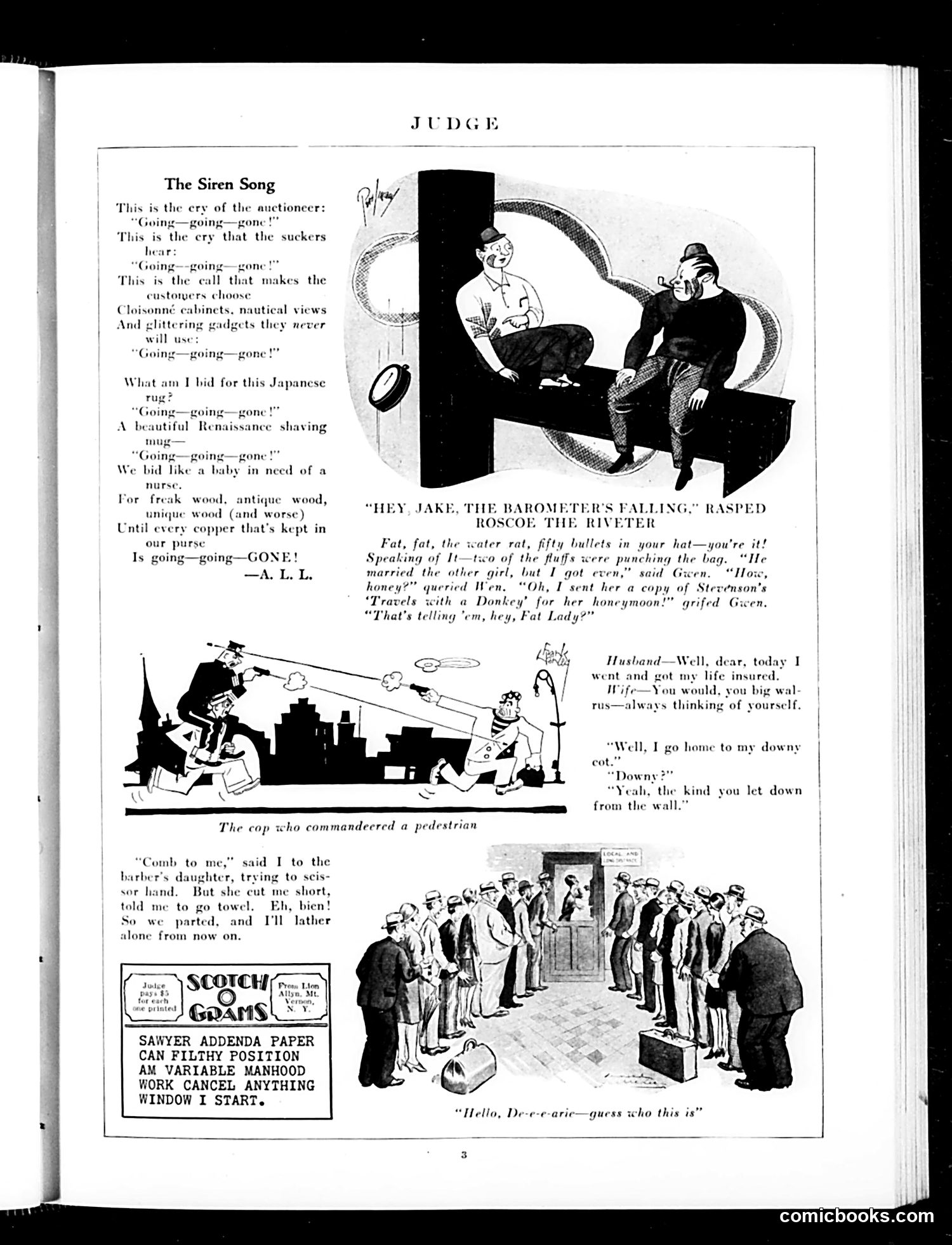
This page contains three distinct pieces of satire: 1. **"The Siren Song"** (poem): Mocks auctioneers' repetitive "going-going-gone" chant, satirizing both their sales tactics and consumers' susceptibility to purchasing useless items. 2. **"Hey Jake, the Barometer's Falling"** (top cartoon): Two men discuss domestic life, with one bragging about getting life insurance while his wife complains he's self-centered. The barometer reference appears to be wordplay about falling circumstances. 3. **"The cop who commandeered a pedestrian"** (middle cartoon): Depicts a police officer using a citizen as a human shield against danger—satirizing police abuse of authority. 4. **Bottom cartoon**: Shows a crowd gathering around someone, with caption "Hello, De-e-arie—guess who this is," likely mocking a social encounter or reunion. The page also contains a **Scotch Grams advertisement** for Sawyer addenda paper.
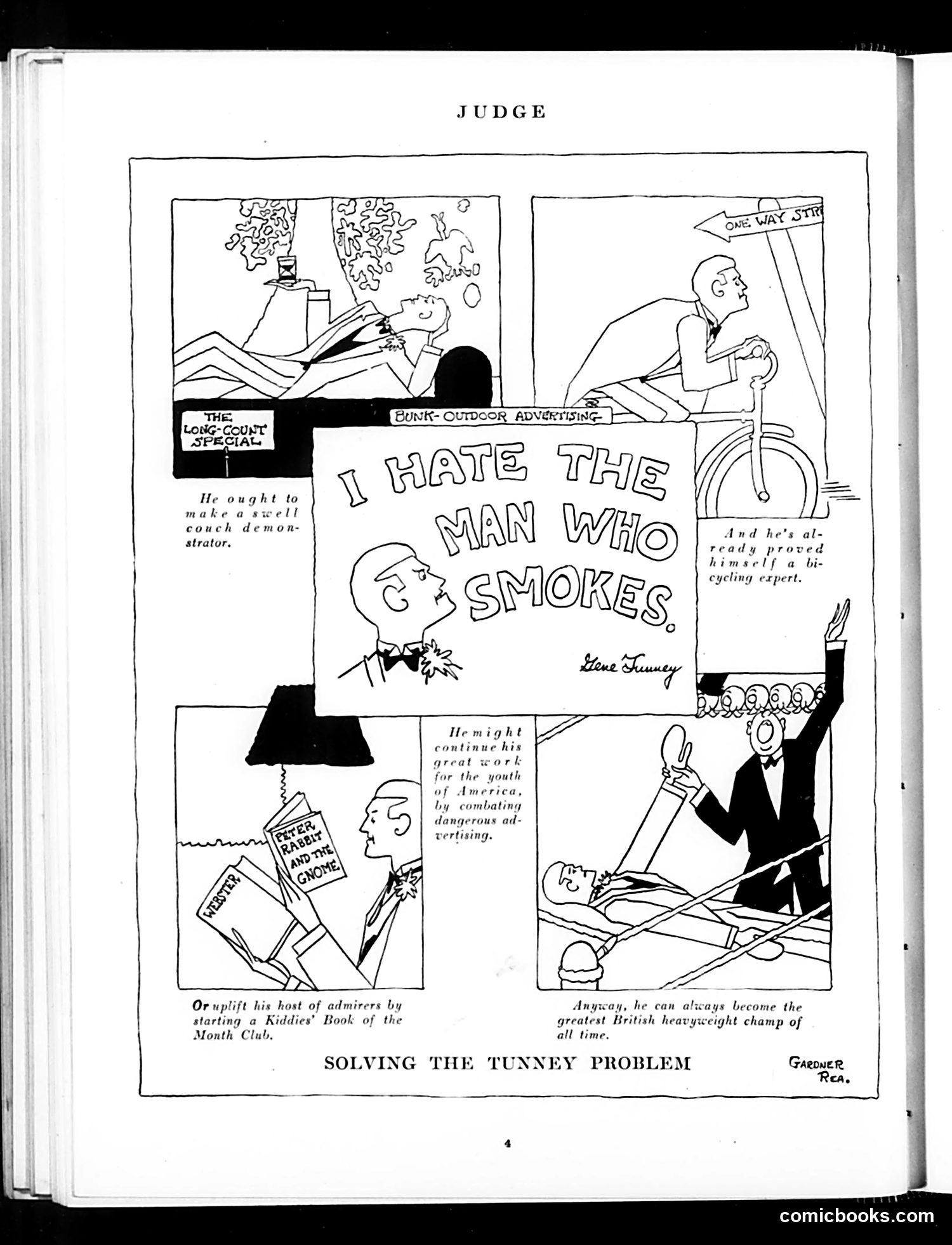
This cartoon satirizes efforts to promote boxer Gene Tunney (likely after his 1926 victory over Jack Dempsey) as a wholesome public figure. The four panels mock the absurdity of various schemes to build Tunney's image: 1. **"Punk Outdoor Advertising"** – a long-court official attempts demonstrating Tunney's sophistication 2. **Central message** – "I hate the man who smokes" – positioning Tunney as a moral exemplar 3. **Kiddies' Book promotion** – trying to appeal to youth through anti-smoking messaging 4. **Final panel** – suggesting Tunney could become "the greatest British heavyweight champ" The satire ridicules the over-engineered, artificial nature of celebrity image-making and the desperation of handlers trying to transform a boxer into a morally upstanding public idol. The humor lies in the increasingly absurd promotional tactics.
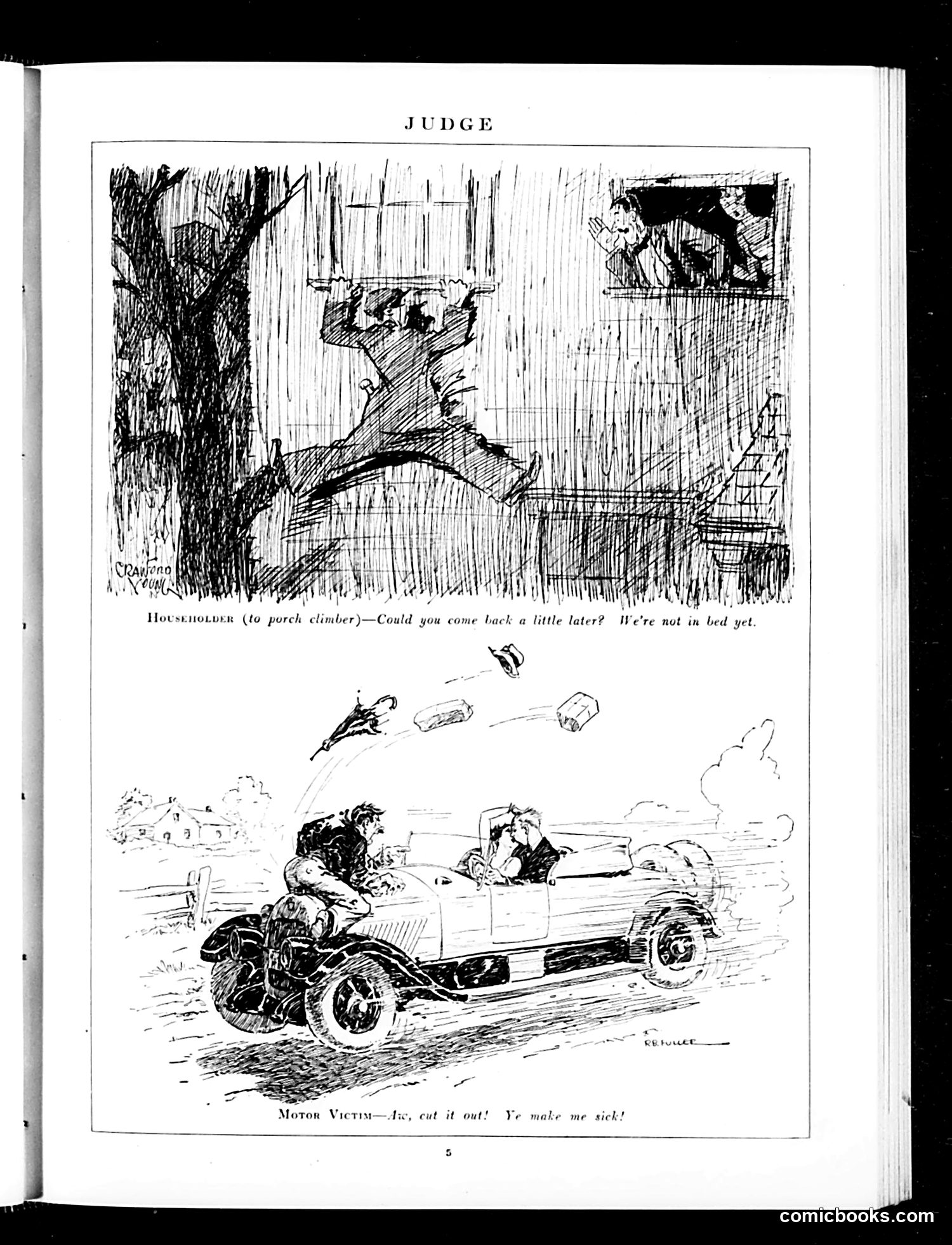
This page contains two unrelated cartoons satirizing different subjects: **Top cartoon** ("Householder"): A man frantically climbs through a window while a woman calls from inside, saying they're not in bed yet. This is a domestic humor joke about infidelity or sneaking out—the man appears to be leaving (or returning) illicitly. **Bottom cartoon** ("Motor Victim"): Shows a car accident victim being thrown from a vehicle, exclaiming "Ice, cut it out! Ye make me sick!" This satirizes early automobile accidents and their violent nature. The joke appears to mock both reckless driving and the victim's casual complaint despite serious injury. Both cartoons use exaggerated linework typical of Judge's satirical style. The magazine frequently targeted modern social anxieties—domestic scandal and dangerous new technology (automobiles) being prominent concerns of the era.
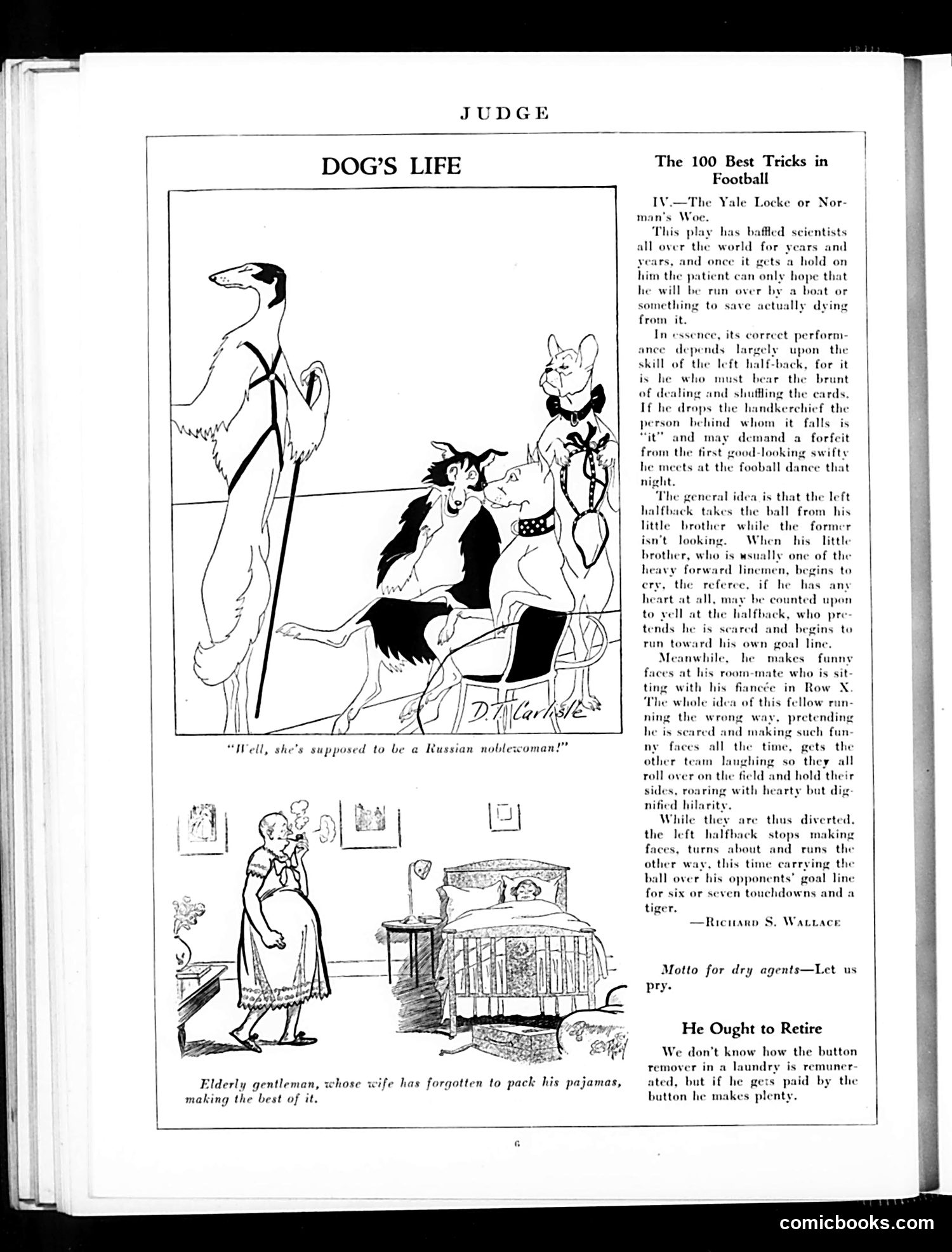
This *Judge* page contains two unrelated satirical pieces: **"Dog's Life"** (top): A cartoon showing animals in human situations. The caption reads "Well, she's supposed to be a Russian noblewoman!" The humor derives from the absurdity of dressing a dog in human clothing and presenting it as aristocracy—typical early 20th-century social satire mocking pretension. **"The 100 Best Tricks in Football"** (right): A humorous essay by Richard S. Wallace that parodies overly complex football play explanations. It describes an intentionally ridiculous and nonsensical play (the "Yale Locke") involving card-shuffling, dropped handkerchiefs, and the left halfback deliberately running the wrong direction while making funny faces to distract opponents. The joke satirizes how incomprehensibly complicated football strategy was presented to readers. **"He Ought to Retire"** (bottom): A brief joke about laundry workers being paid per button removed, implying they profit from buttons coming off clothes during washing.
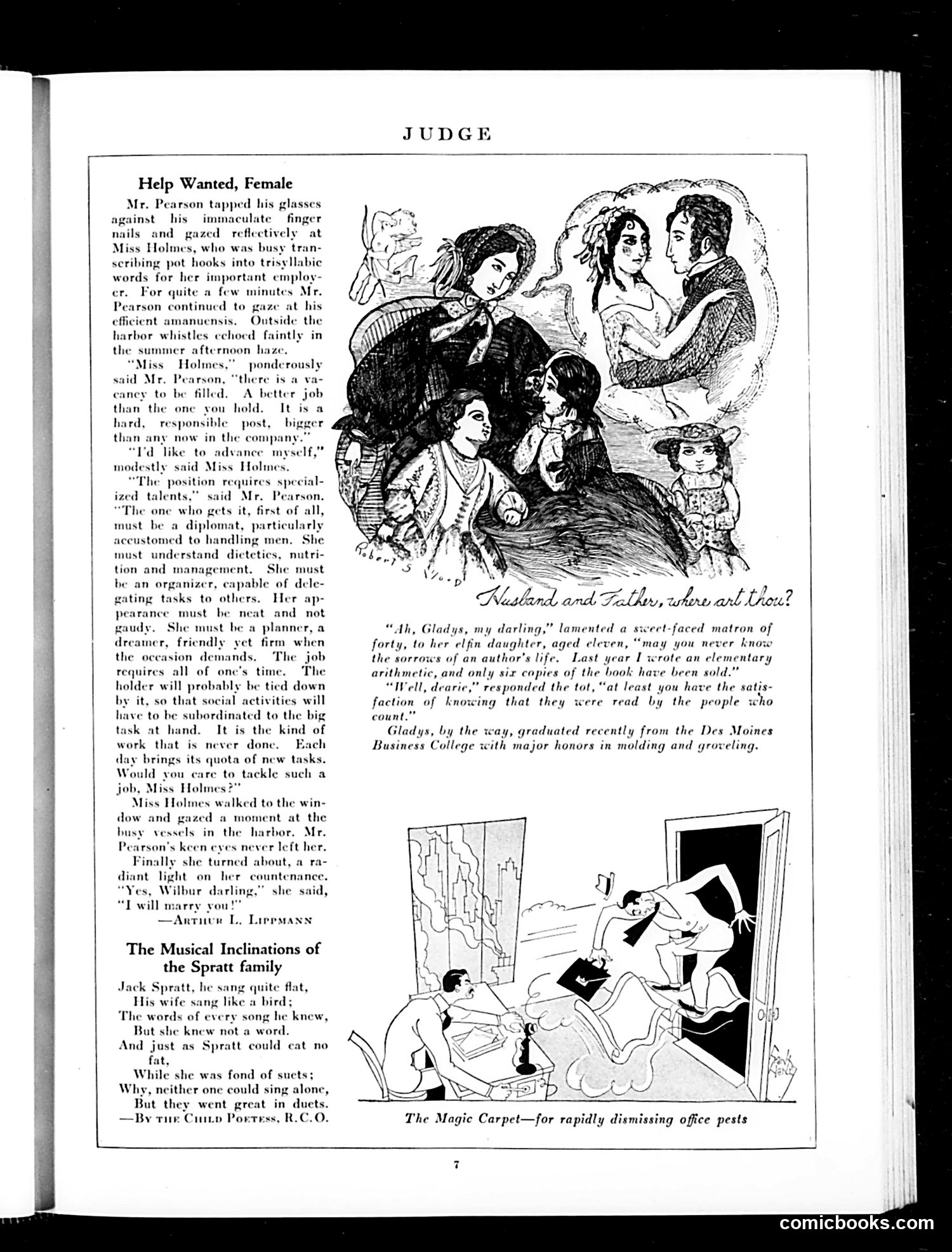
This page satirizes **gender roles and marriage expectations** in early 20th-century America. The main cartoon mocks the absurdity of job requirements for women. Mr. Pearson describes an exhausting position demanding diplomacy, nutrition expertise, organization, and constant availability—then reveals the "job" is actually **marriage**. Miss Holmes accepts immediately ("Yes, Wilbur darling, I will marry you!"), the joke being that women were expected to perform all these demanding tasks unpaid as wives. The accompanying text presents this as a "Help Wanted" ad, treating domestic labor as employment while highlighting how society undervalued women's work. The secondary items (musical duets, author lamenting low book sales, the "Magic Carpet") are lighter filler pieces typical of Judge's format—humorous observations on everyday life rather than pointed social commentary. The satire targets how marriage was presented to women as their primary "career" while requiring extraordinary skills and total self-sacrifice.
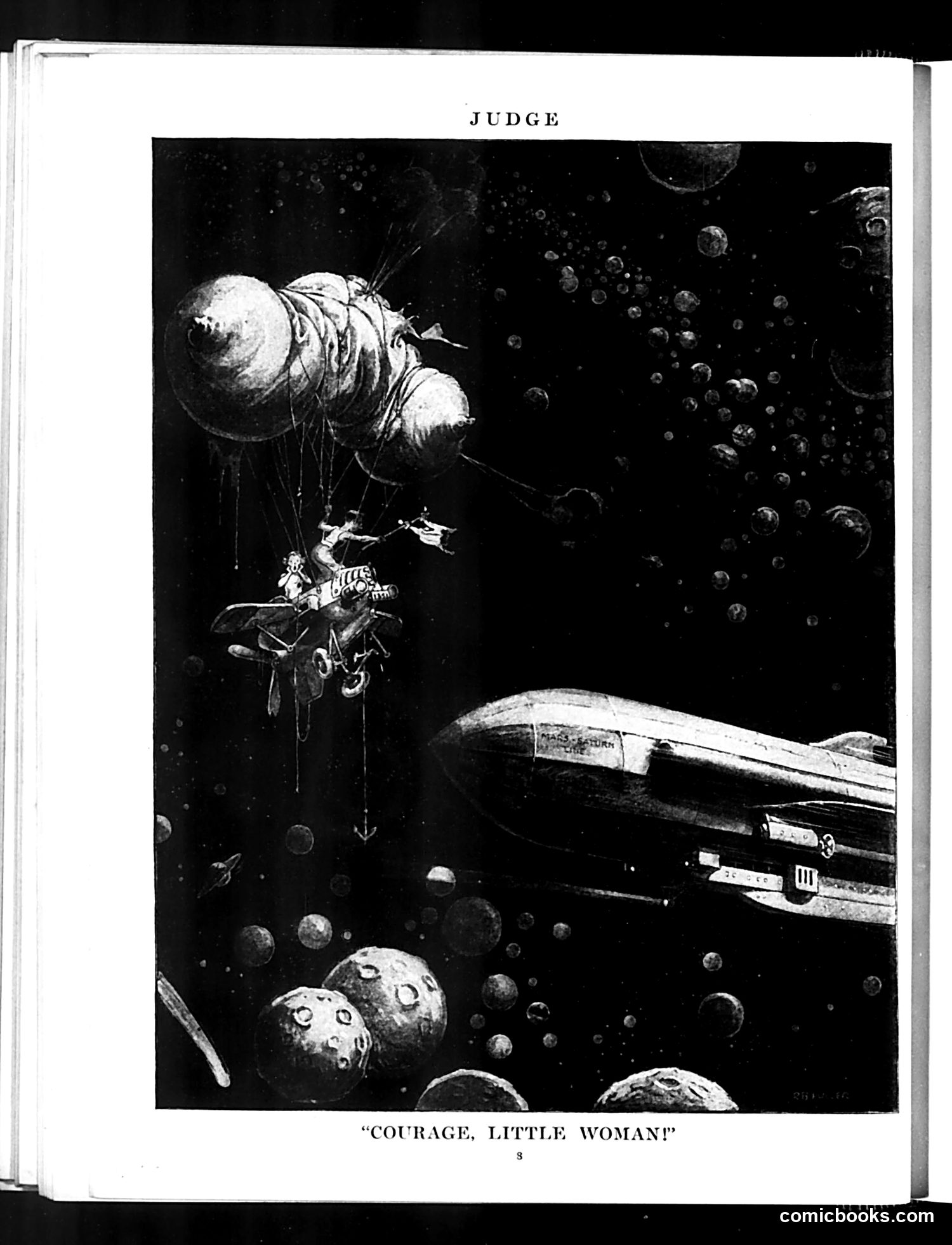
This is a satirical cartoon from *Judge* magazine titled "Courage, Little Woman!" The image depicts a dramatic space scene with a tiny uniformed figure (appearing to be a military officer) suspended by ropes above a spacecraft, surrounded by planets and celestial bodies. The figure appears to be encouraging or addressing someone unseen. The cartoon's meaning is unclear without additional context about the specific historical moment. It appears to reference either: - A space exploration narrative (given the spacecraft and planets) - A military or political situation requiring bravery from a woman - Possibly a contemporary news event from *Judge's* publication era The exact satirical point—whether mocking military courage, space ambitions, gender dynamics, or a specific political figure—cannot be definitively determined from the image and limited text alone.
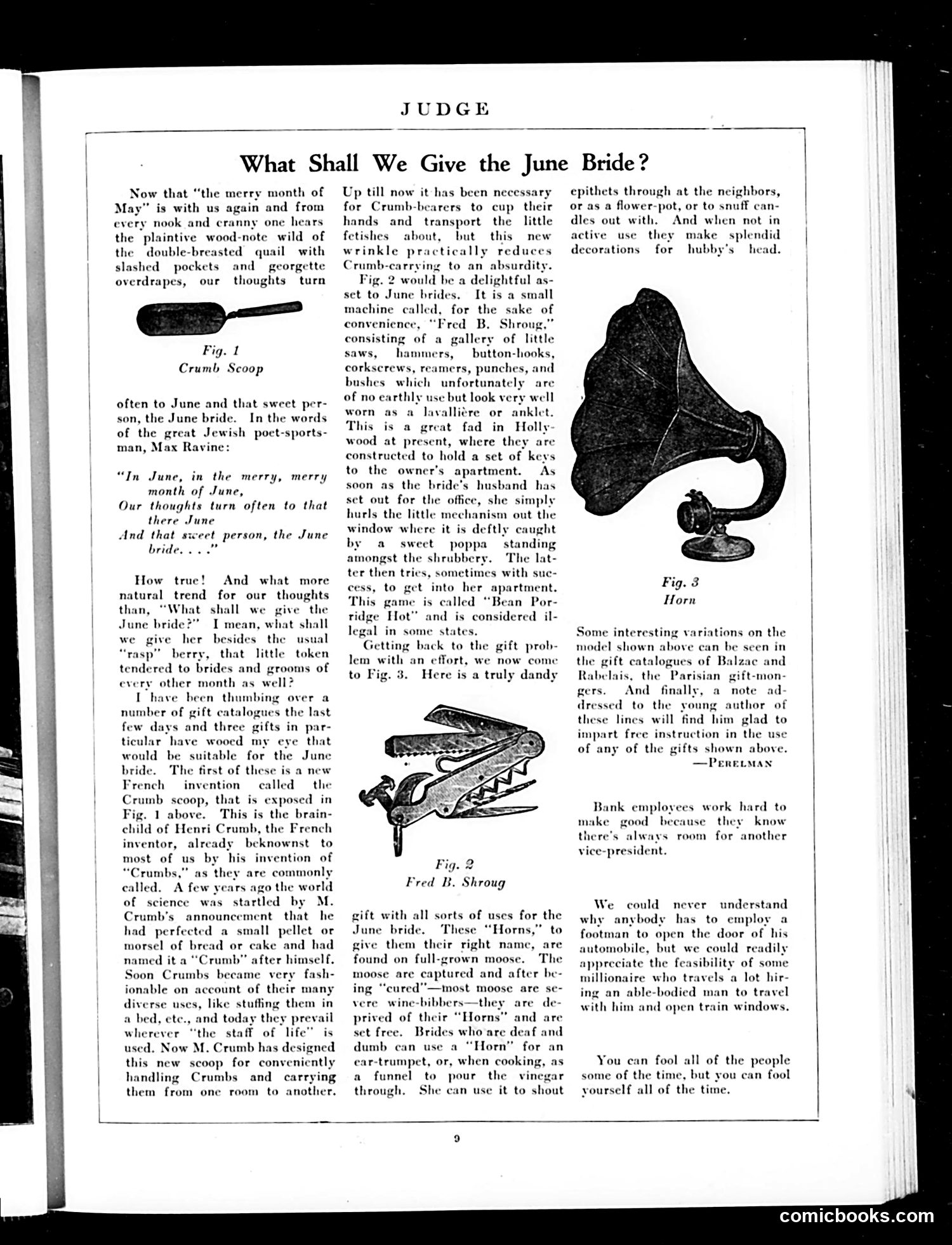
This is a humorous gift guide satirizing both absurd French inventions and frivolous consumer culture. The satirist invents ridiculous "gifts" supposedly suitable for June brides: **The three "gifts":** 1. A "Crumb Scoop" — credited to fictional inventor Henri Crumb, who supposedly invented "crumbs" themselves. The absurdity mocks both pretentious French design and useless household gadgets. 2. The "Fred B. Shroug" — a decorative device of useless tiny tools worn as jewelry. The text absurdly claims it's a Hollywood fad for holding apartment keys, with an illegal game ("Bean Porridge Hot") involving infidelity. 3. A moose horn — presented with deliberately ridiculous uses: ear trumpet, cooking funnel, flower pot, candle snuffer, or hat decoration. **The satire targets:** consumer culture's obsession with novelty gifts, pretentious French design trends, and the arbitrary nature of fashion ("fads"). The mock-serious tone and escalating absurdity make the point that much marketed merchandise serves no genuine purpose—it's all performance and status.
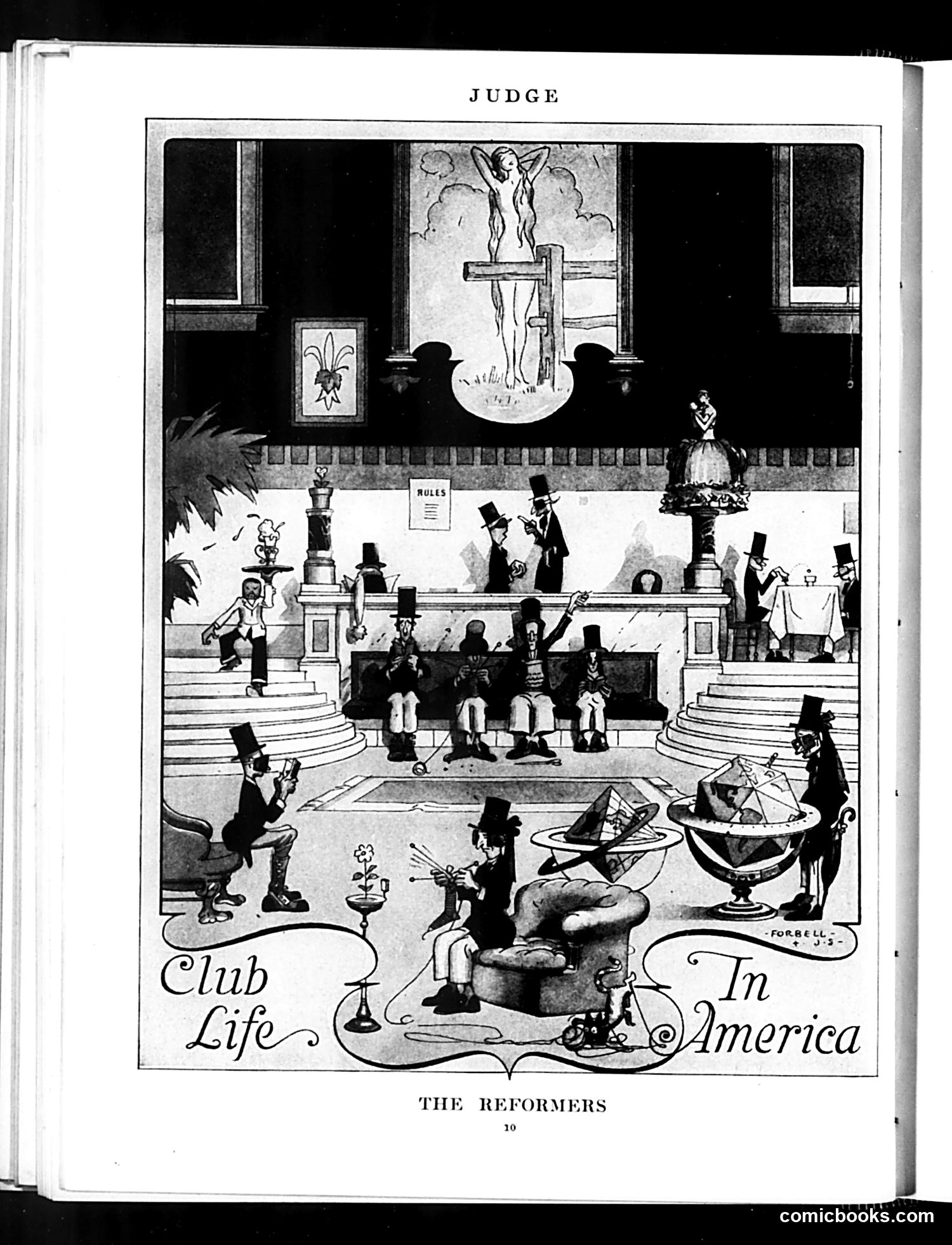
This Judge cartoon satirizes American social reformers of the early 20th century. The image depicts an elaborate clubhouse scene where well-dressed men in top hats conduct their reform activities. The satire appears to mock the contradiction between reformers' high ideals (symbolized by the crucifix and religious imagery prominently displayed) and their actual practice—shown as an exclusive, privileged club where wealthy men gather in leisure rather than engaged in genuine reform work. The various activities depicted—gambling devices, smoking, socializing—suggest these "reformers" pursue self-indulgent pleasures while claiming moral authority. The cartoon critiques how reform movements of the era were often led by privileged elites whose commitment to social change was questionable, existing more as fashionable club activities than genuine social activism.
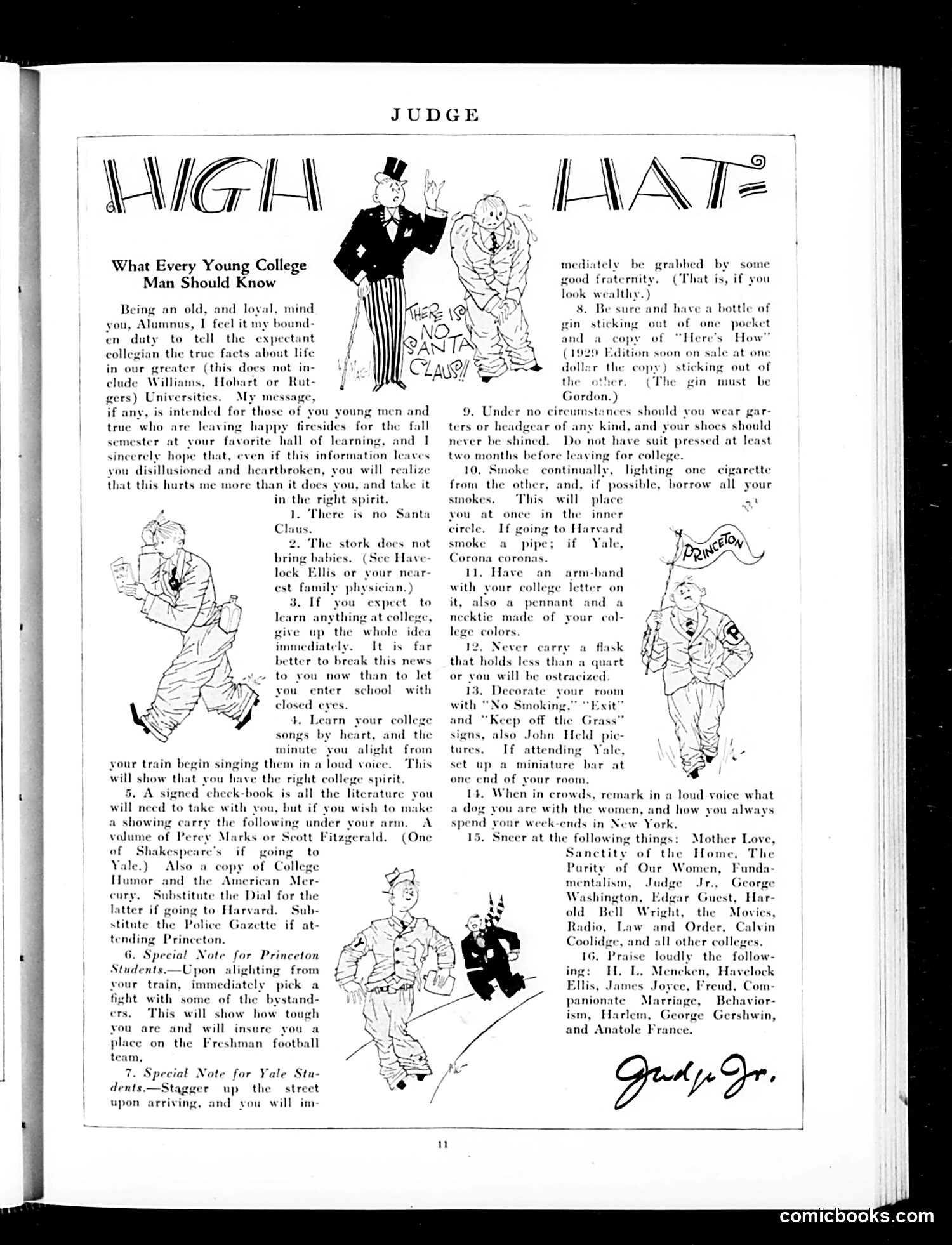
This Judge magazine piece satirizes 1920s college culture through mock "advice" to incoming freshmen. The humor targets the pretentious, rebellious affectations of Jazz Age collegians. The satire mocks: - **False sophistication**: Carrying Fitzgerald or Shakespeare to appear cultured while learning nothing - **Prohibition-era excess**: Flaunting gin bottles and large flasks as status symbols - **Manufactured rebellion**: Smoking constantly, disparaging respectability (Mother Love, Calvin Coolidge, "all other colleges") - **School-specific stereotypes**: Princeton students fighting, Yale students staggering drunk and needing fraternity rescue - **Shallow modernism**: Praising H.L. Mencken, Freud, and Jazz Age figures while sneering at traditional values The accompanying cartoons depict disheveled, unrefined young men—the opposite of the sophistication they're attempting. The piece criticizes how college freshmen adopted cynicism, hedonism, and affected intellectualism as markers of belonging, rather than genuine learning or character development.
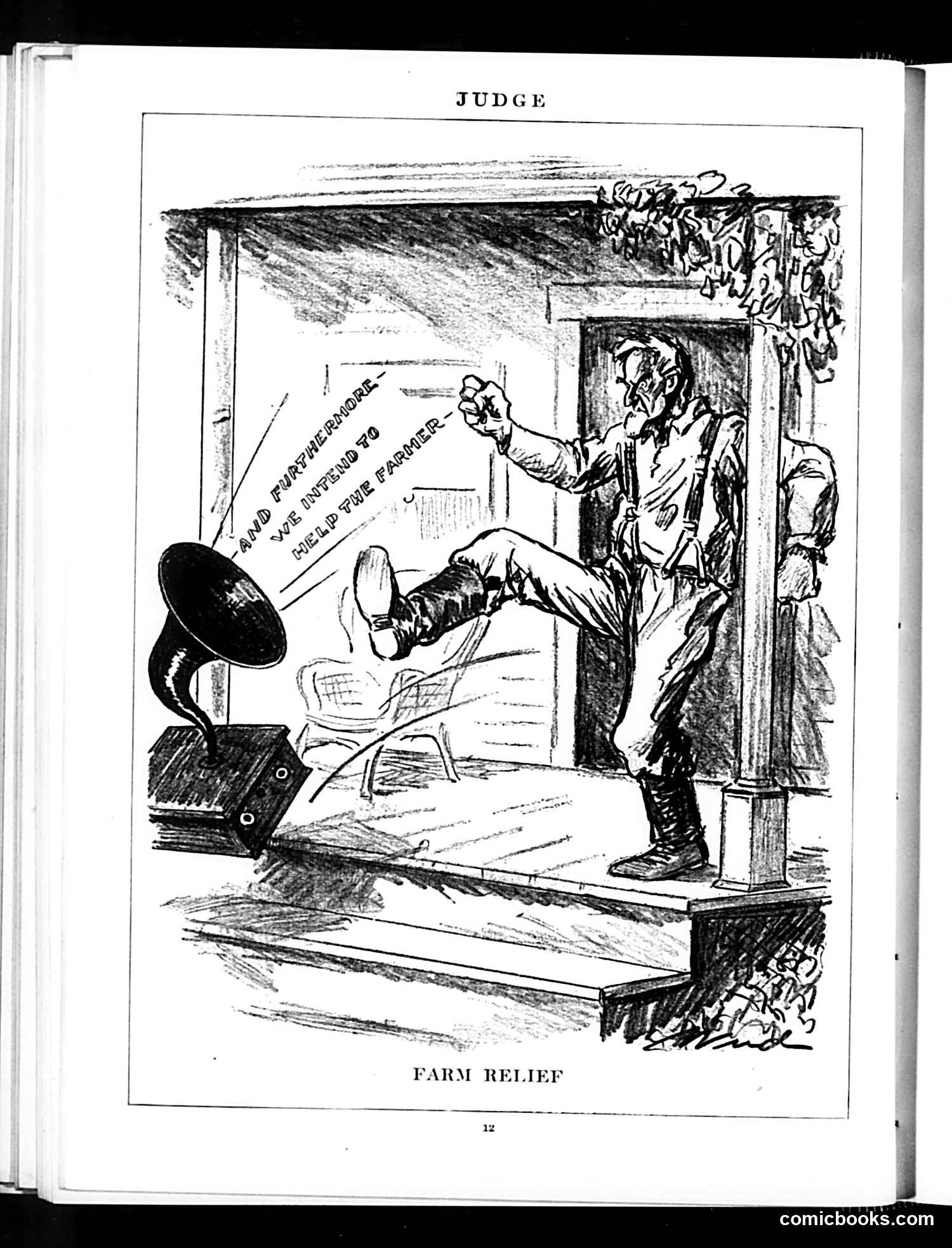
This political cartoon depicts a farmer lying in bed while a doctor or official points to a sign reading "BURY THE PATIENT / GIVE UP THE FARMER." A megaphone broadcasts this message, while officials and onlookers gather in the background. The satire criticizes government policy toward agricultural relief during economic hardship (likely the Depression era). Rather than implement genuine aid programs, the cartoon suggests authorities are essentially telling farmers to abandon hope—a harsh commentary on inadequate or non-existent farm assistance. The patient metaphor portrays farming as dying, with the system offering no real cure, only surrender. This reflects contemporary frustration with federal response to agricultural crisis.
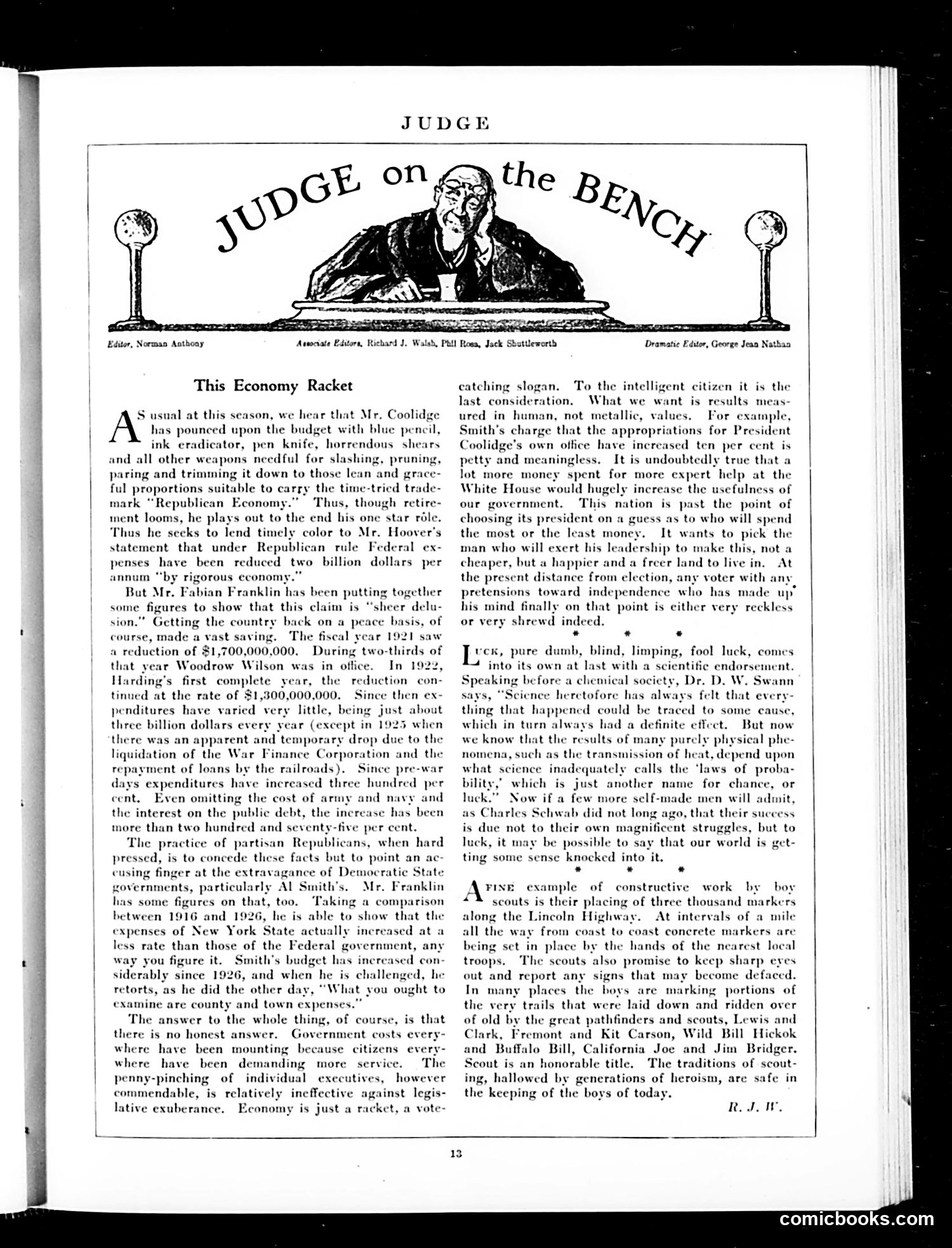
This Judge magazine page satirizes Republican claims about federal budget cuts. The article mocks President Coolidge's budget-slashing theatrics and challenges the GOP's claim of reducing federal spending by two billion dollars annually. The satire points out that under Democrat Woodrow Wilson (1921), the budget actually fell by $1.7 billion—before Coolidge and Harding took office. The Republicans take credit anyway. The piece further notes that since pre-war, overall spending has doubled, and even excluding military/debt costs, spending increased 275 percent. The article critiques Al Smith's (Democratic governor of New York) predictable counter-argument: shifting blame to city/county spending. It argues that voters shouldn't choose presidents based on penny-pinching rhetoric alone—they should demand actual results and effective leadership. Budget economy, the author concludes, is merely a political "racket" used by both parties to attract votes.
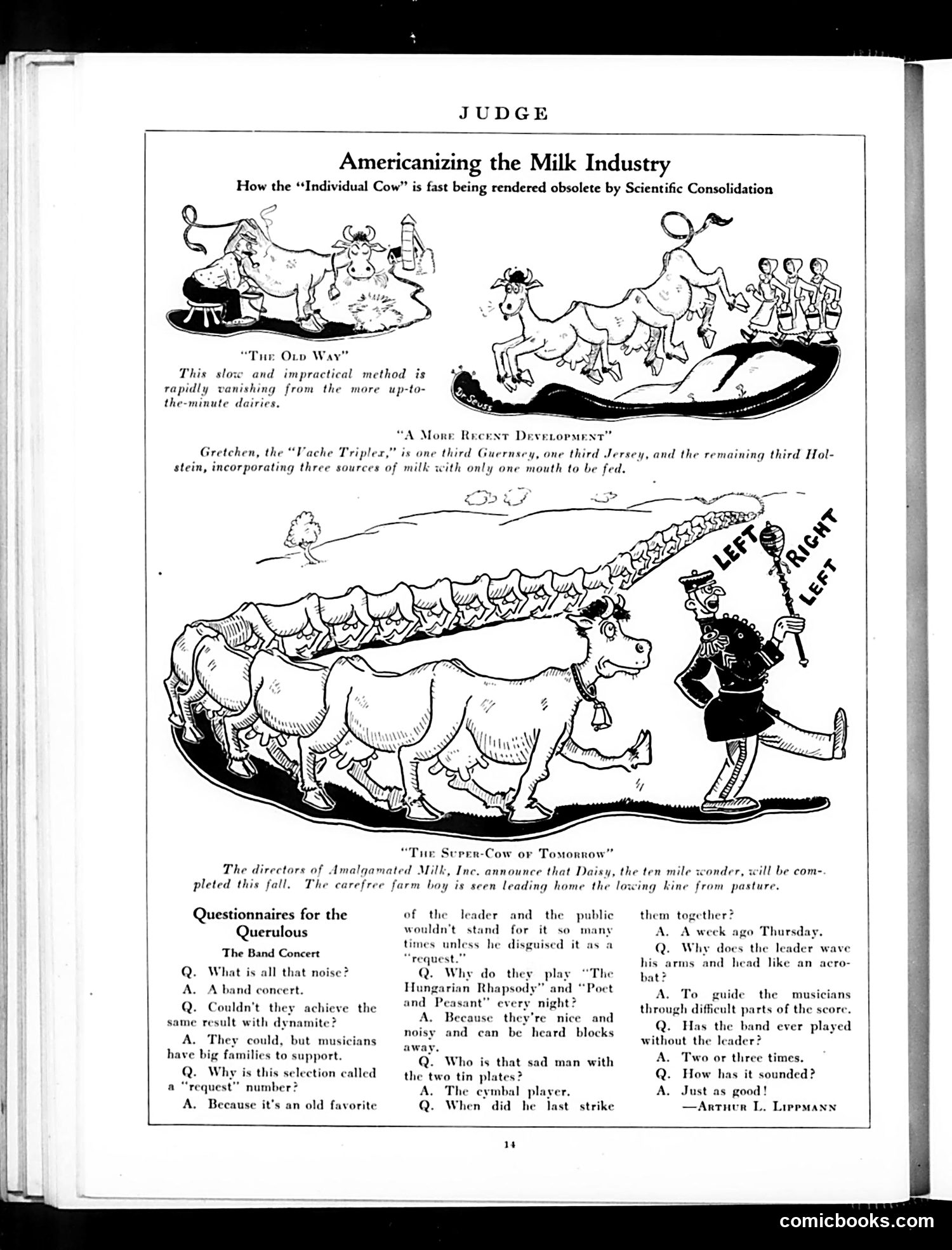
This satirical cartoon mocks the early 20th-century trend toward industrial consolidation and "scientific" efficiency in American agriculture. The three panels show the evolution from traditional small-scale dairy farming ("The Old Way") to increasingly absurd industrial solutions. The middle panel depicts "Gretchen, the 'Vache Triplex'"—a hybrid cow combining three breeds to produce milk from multiple sources with "only one mouth to be fed." The final panel shows the ultimate vision: "The Super-Cow of Tomorrow," a grotesque ten-mile-long creature that consolidates numerous cows into one impossibly elongated animal, led home by a hapless farm boy. The joke targets corporate merger mania and the faith in mechanical/scientific "progress" that often produced ridiculous results. By taking consolidation logic to absurd extremes, Judge satirizes the era's obsession with eliminating "inefficiency" in traditional industries, regardless of practical reality. The page also includes an unrelated "Questionnaires for the Querulous" humor column about a band concert.
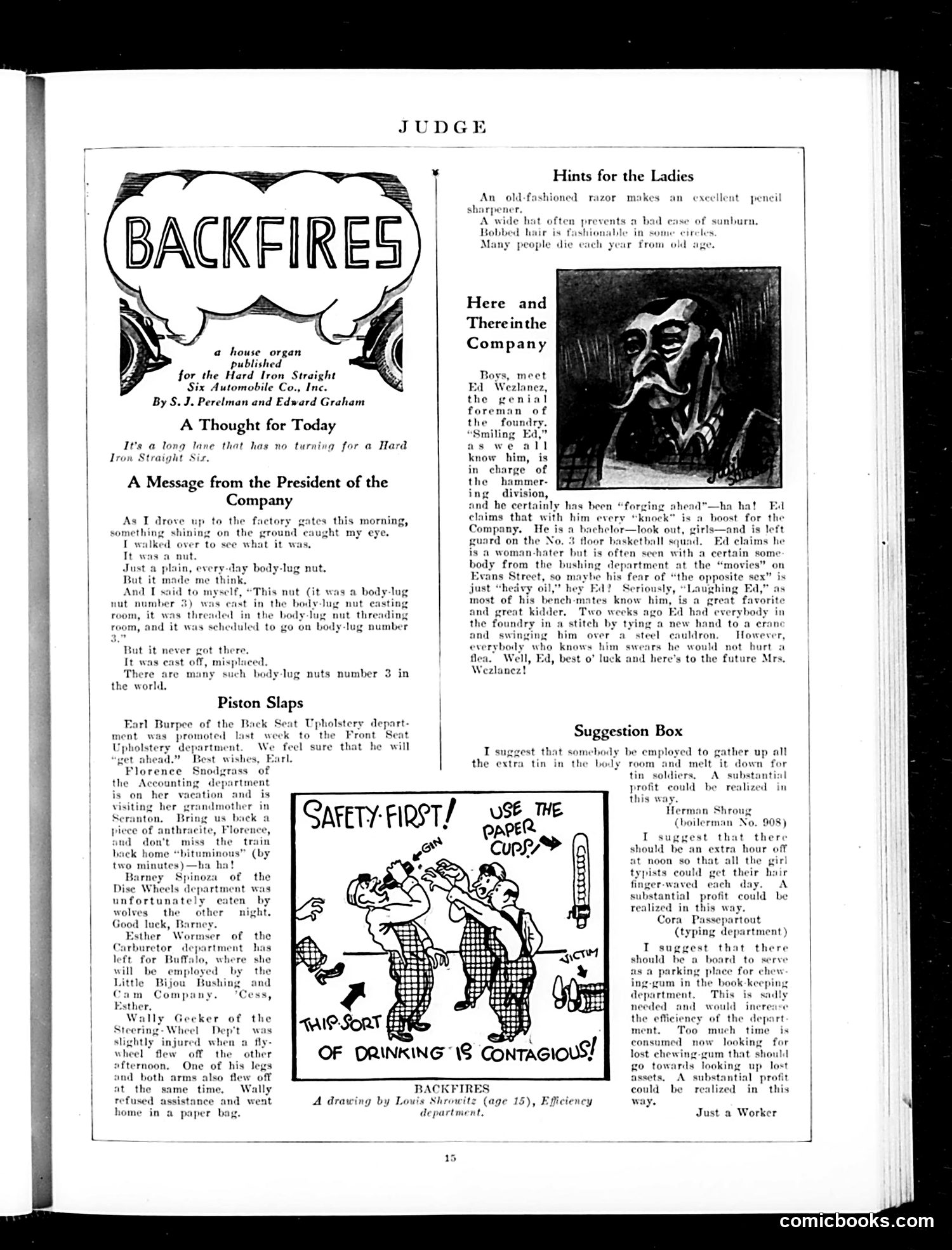
This page from *Judge* magazine showcases company-internal content and social humor from the early 20th century. The main cartoon, "Safety First," uses exaggerated caricatures of factory workers to mock workplace safety messaging. The joke plays on the irony that workers are simultaneously warned about drinking causing contagion while they're depicted huddled together unsafely—suggesting the real danger isn't contagion but crowded, unsafe working conditions. The surrounding text includes genuine company announcements and humorous "Hints for the Ladies" (outdated domestic advice), alongside employee gossip and a "Suggestion Box" with satirical employee proposals—like melting down tin scraps to make toy soldiers or extending lunch breaks for women workers' hair appointments. This reflects both period workplace culture and early 20th-century attitudes toward gender roles and factory labor.
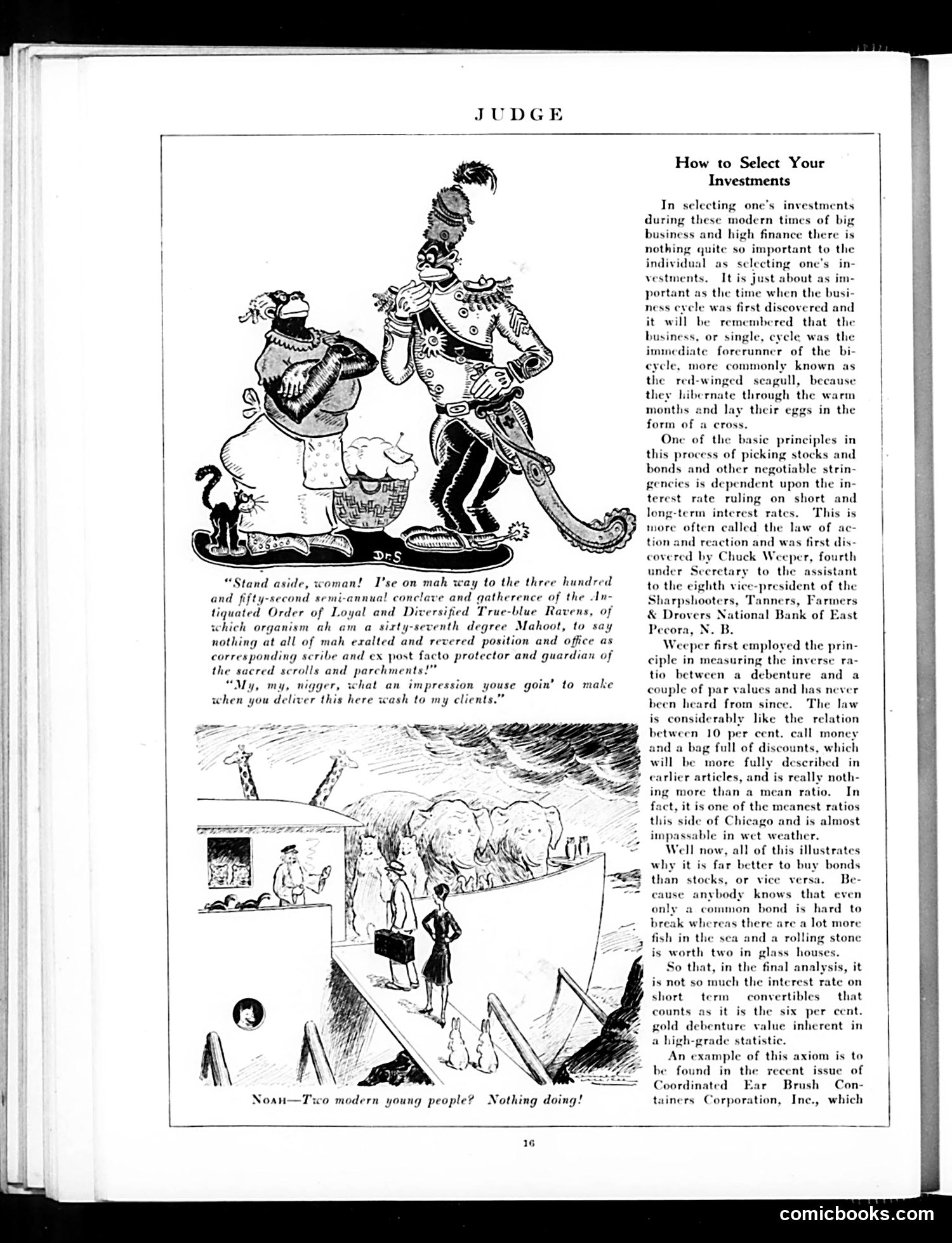
The page contains two distinct pieces: **Top Cartoon**: A racial stereotype caricature depicting a Black man in servant's clothing, addressed with dehumanizing dialect, being sent to deliver laundry. The "joke" relies on minstrel-show racism, portraying the figure as subservient and dim-witted. The woman's line about the "impression" he'll make is sarcastic mockery. **"How to Select Your Investments"**: This is absurdist satire of financial advice writing. The text deliberately strings together nonsensical financial jargon, mixing real terms (debentures, call money) with deliberate nonsense (comparing bonds to seagulls laying eggs in crosses). It mocks overwrought investment columns that obscure rather than clarify, suggesting financial writing is fundamentally meaningless corporate double-talk designed to confuse readers. The contrast juxtaposes crude racial humor with satirical attacks on financial pretension—both were considered acceptable Judge content of this era.
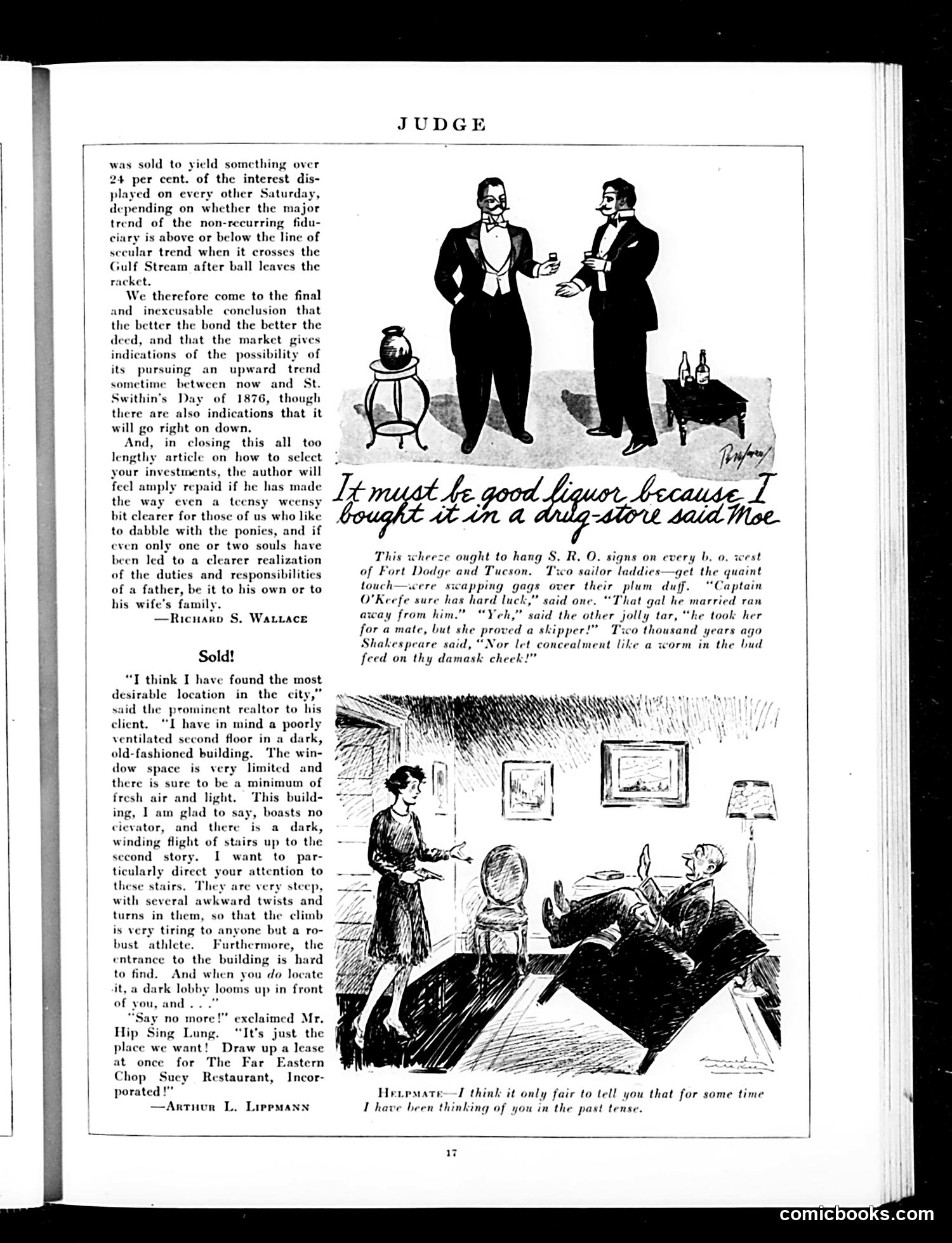
This page contains two distinct satirical pieces: **"Sold!"** mocks real estate sales tactics. A realtor enthusiastically pitches an apartment with every conceivable drawback—poor ventilation, no elevator, dark, steep stairs, hard-to-find entrance—as desirable features. The joke's punch line: a Chinese restaurant owner (Mr. Hip Sing Lung) immediately accepts it, apparently because he expects poor conditions. This reflects period prejudice stereotyping Chinese immigrants as accepting substandard living/working conditions. The satire targets unscrupulous realtors, though the humor relies on ethnic caricature. **The upper cartoon** shows two well-dressed men discussing alcohol quality, likely referencing Prohibition-era concerns about bootleg liquor's reliability. The caption suggests that quality depends on source reliability. **The bottom anecdote** is a simple joke about a sailor's unfaithful girlfriend, with a pun on "mate" versus "skipper," framed as timeless humor comparable to Shakespeare. The page primarily satirizes business fraud and ethnic stereotypes common in 1870s-era American humor.
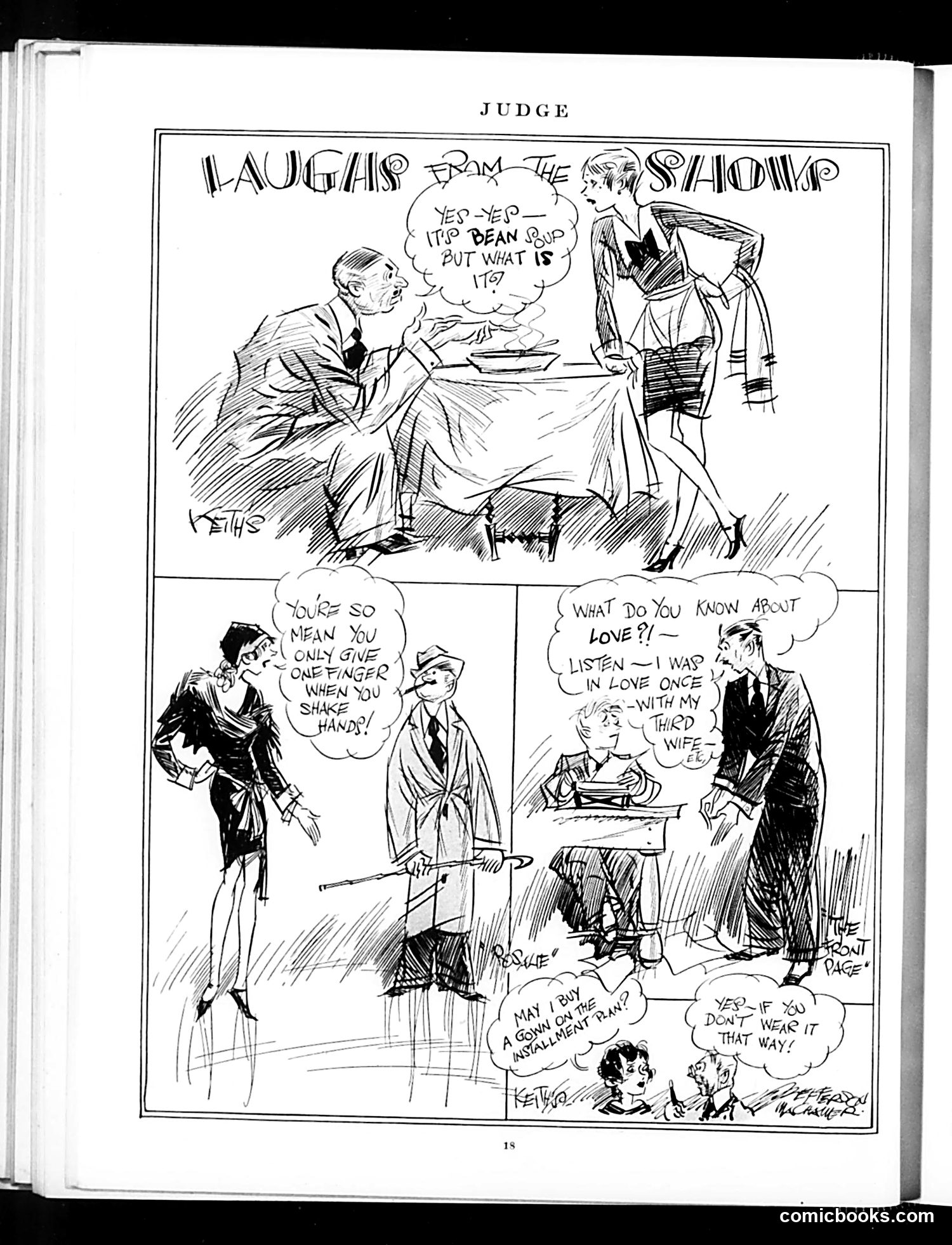
This is a multi-panel satirical comic about dating and romance advice. The top panel shows a man and woman at a table discussing what "love" actually is. The lower panels feature men giving contradictory relationship advice to each other. The humor stems from the absurdity of different perspectives on romance: one man claims you can tell a woman's feelings by her handshake, another brags about past romantic conquests, and a third discusses buying "a good installment plan" (suggesting women are commodities to be purchased). The final exchange mocks this commercialized view of relationships. The satire critiques how men of the era discussed romance—reducing it to either physical tells, conquest narratives, or financial transactions—rather than genuine emotional connection. The title "Laughs from the Shop" suggests these are workplace conversations, satirizing masculine banter about relationships as shallow and self-deceiving.
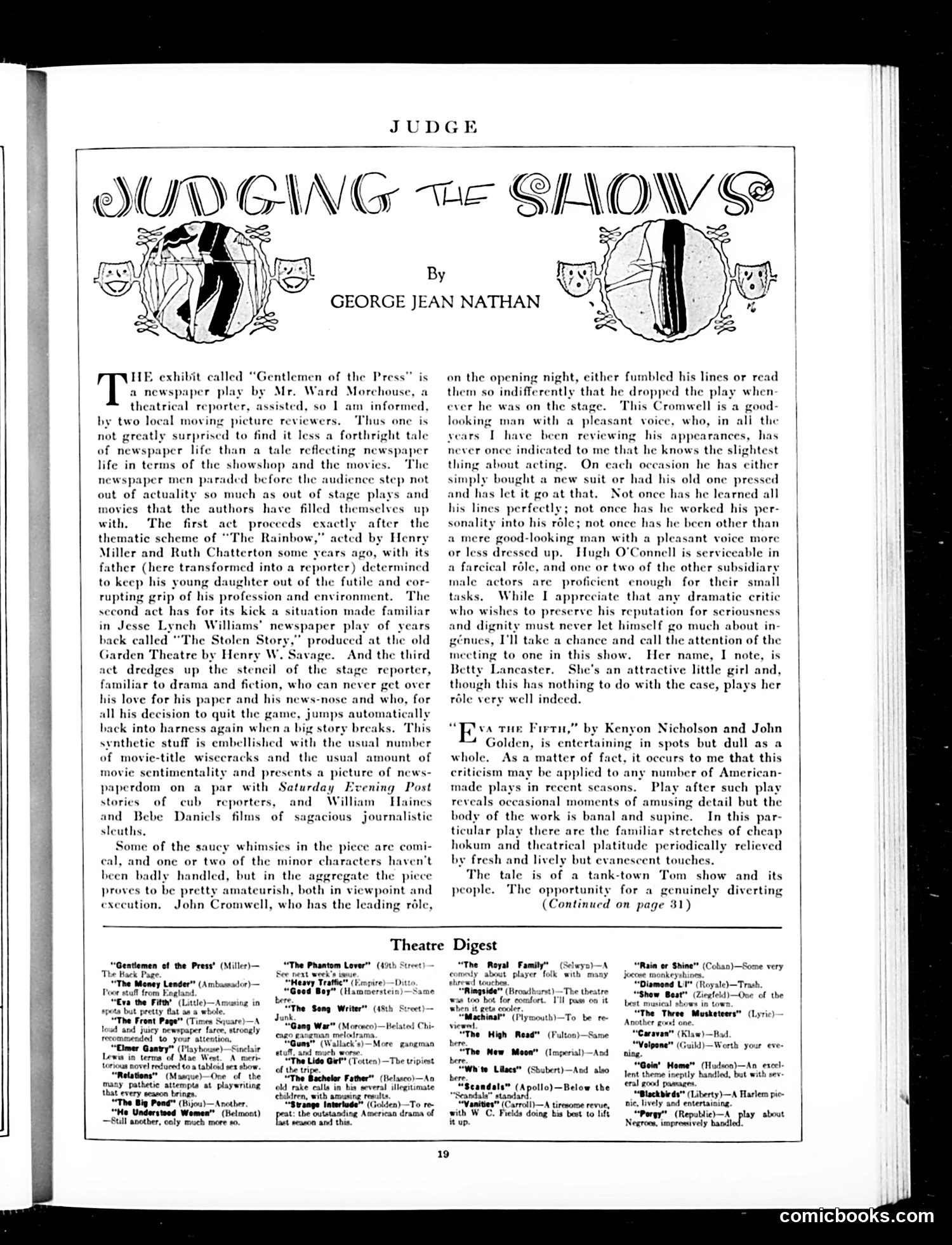
This page contains **theatre reviews** by critic George Jean Nathan, not political cartoons. It critiques three Broadway plays: 1. **"Gentlemen of the Press"** — Nathan dismisses this newspaper-themed play as derivative, borrowing plots from earlier successful shows. He particularly criticizes lead actor John Cromwell as merely a "good-looking man" who doesn't understand acting, praising only a minor actress, Betty Lancaster. 2. **"Eva the Fifth"** — Described as entertaining but ultimately dull, exemplifying a broader problem Nathan sees: recent American plays contain occasional clever moments but are fundamentally "banal and supine." The page also includes a "Theatre Digest" — a reference guide listing shows currently running. Nathan's tone is **caustic and dismissive**, reflecting early 20th-century theatrical criticism's emphasis on originality and genuine craft over superficial appeal. His comments about actors "simply buying new suits" to succeed reflects cynicism about Broadway's commercialism.
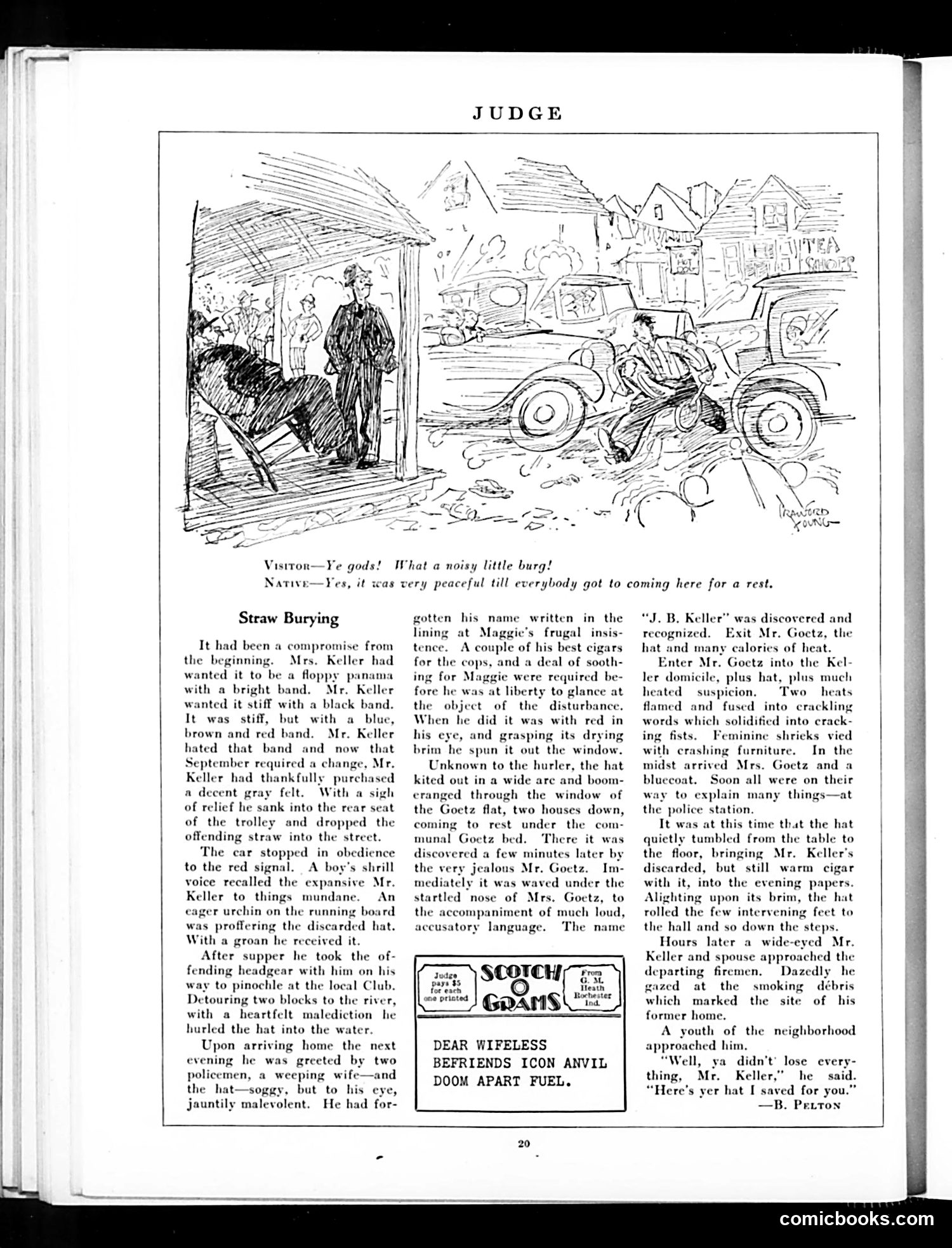
This story-cartoon satirizes the inescapability of fate and the futility of trying to discard one's problems. Mr. Keller repeatedly attempts to rid himself of an ugly compromise hat—first into a street, then a river—only to have it return each time with escalating consequences. The hat becomes a literal boomerang of misfortune: it lands in neighbor Goetz's bedroom, sparking a jealousy-fueled domestic brawl that brings police intervention. A discarded cigar ignites a fire that destroys Keller's home. The final irony: a neighborhood boy saves the indestructible hat while everything else burns. The satire mocks middle-class marital compromise, male stubbornness, and the lesson that avoidance solves nothing—your mistakes literally come back to haunt you. The "noisy little burg" framing suggests rest-seekers bring their own chaos with them, making tranquility impossible.
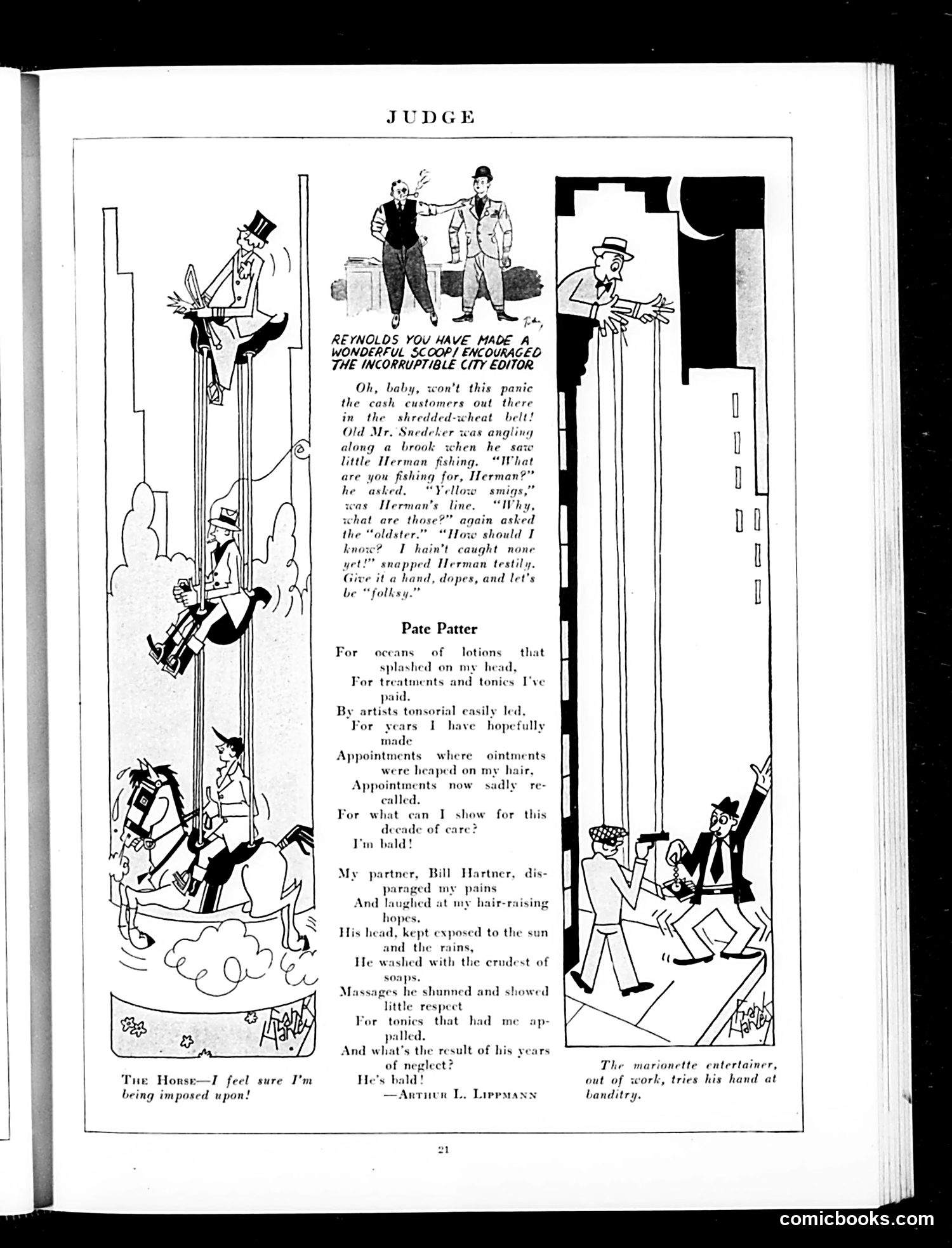
This page contains three distinct satirical pieces from Judge magazine (a humor/satire publication): 1. **"The Horse" cartoon (left)**: A visual gag about someone feeling "imposed upon"—likely mocking naive trust or gullibility, shown through exaggerated physical comedy of figures stacked precariously. 2. **"Reynolds" cartoon (center-top)**: References a newspaper "scoop" by someone named Reynolds that excites a "city editor," satirizing sensationalist journalism and how editors eagerly pursue scandalous stories to attract readers ("panic the cash customers"). 3. **"Pate Patter" (center & right)**: A poem by Arthur L. Lippmann lampooning baldness treatments and vanity. The narrator spent years on expensive hair tonics, appointments, and treatments while his partner Bill Hartner ignored all this—yet Hartner ended up bald anyway. The joke: excessive grooming and expensive remedies are pointless. The right cartoon shows a jobless marionette entertainer resorting to banditry—satirizing economic desperation. The page mocks vanity, journalistic sensationalism, and the gap between effort and outcomes.
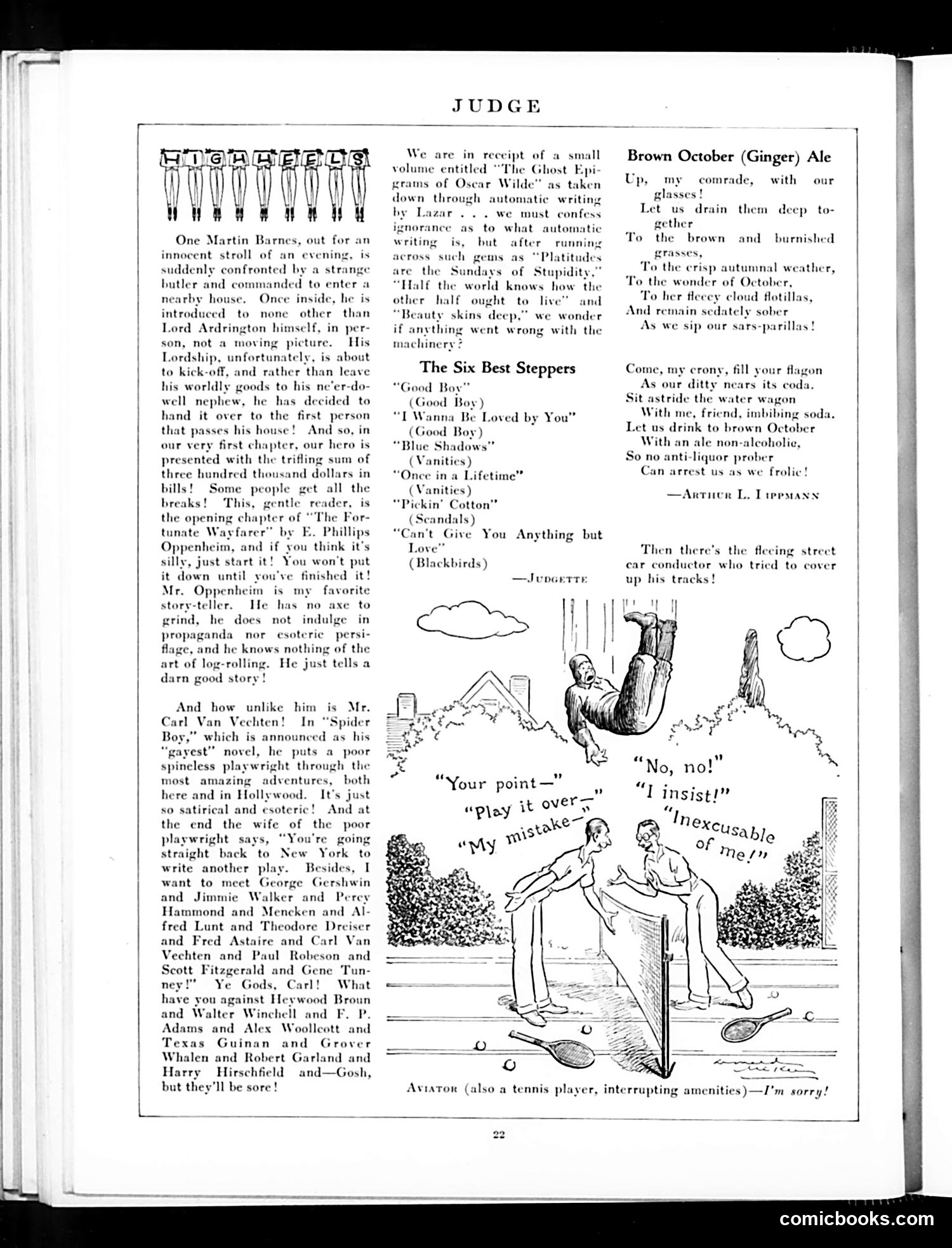
This page contains two main elements: **book reviews** and **a cartoon about tennis etiquette**. ## Book Reviews Section The critic discusses E. Phillips Oppenheim's "The Fortunate Wayfarer" (praised as straightforward storytelling) versus Carl Van Vechten's "Spider Boy" (mocked as pretentious and satirical). The joke culminates in Van Vechten's fictional character wanting to meet famous 1920s-30s celebrities—Gershwin, Mayor Jimmy Walker, various literary and entertainment figures—prompting the critic to sarcastically ask why Van Vechten excluded other famous New Yorkers like Heywood Broun and Walter Winchell, predicting they'll be offended. ## Tennis Cartoon The cartoon shows two tennis players mid-argument. One insists "My mistake," while the other refuses: "No, no! I insist! Inexcusable of me!" The caption identifies one as an aviator interrupting the match, apologizing for his interference. The satire targets **social pretension**—both characters performing exaggerated courtesy over a genuine disagreement, the joke being their theatrical politeness masks the actual dispute.
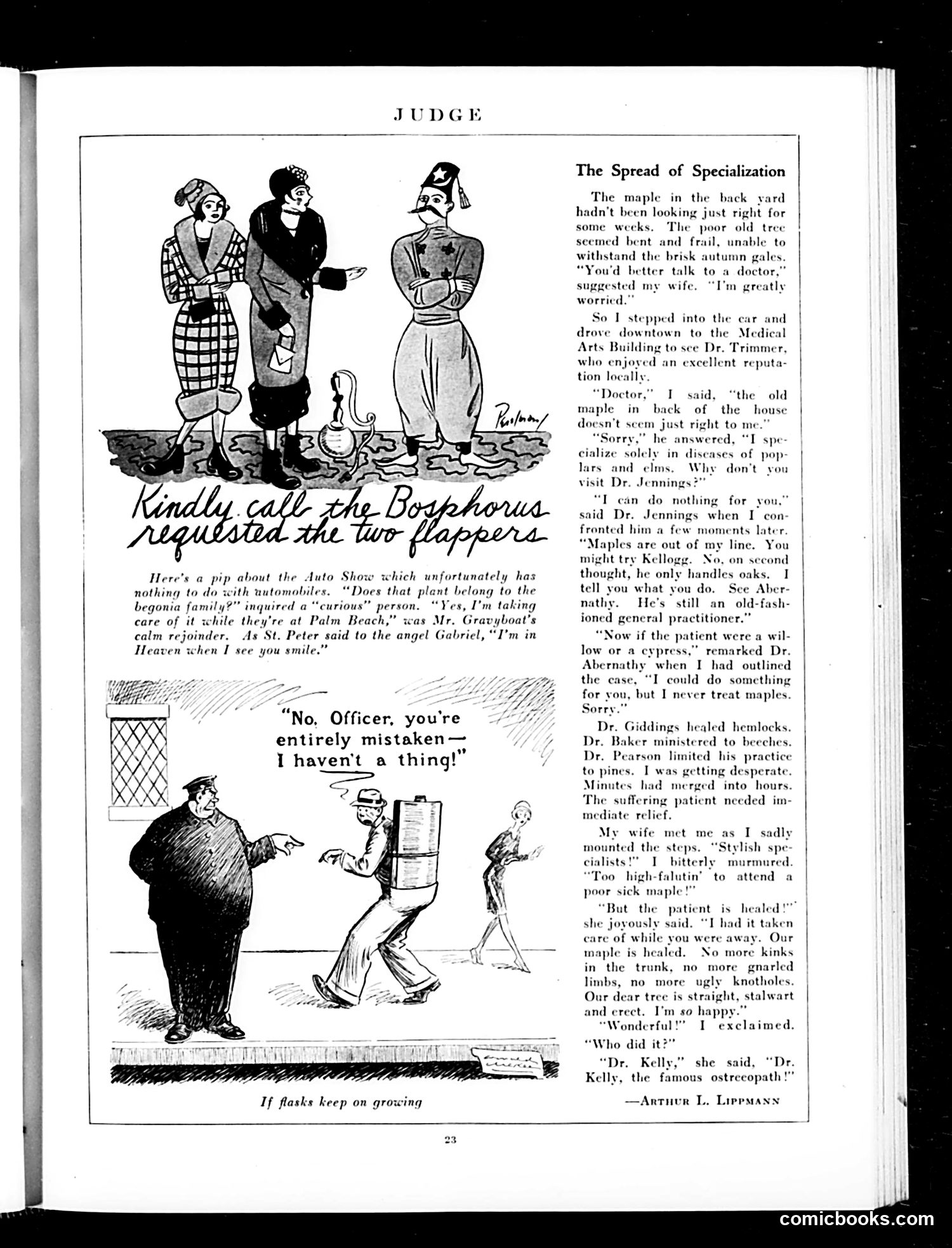
This page contains two satirical pieces about early 20th-century American society. **Top cartoon**: A visual joke about Prohibition-era flask smuggling. A man insists to a police officer he "hasn't a thing," while clearly concealing contraband. The caption "If flasks keep on growing" suggests that illegal alcohol containers are proliferating despite enforcement efforts. **Main story** ("The Spread of Specialization"): A humorous narrative by Arthur L. Lippmann mocking over-specialization in medicine. The narrator seeks treatment for his ailing maple tree and encounters absurdly specialized "doctors"—each treating only one tree species (poplars, maples, oaks, etc.). Only a general practitioner helps, but the wife ultimately solves the problem by consulting "Dr. Kelly, the famous osteopath." The satire critiques professional specialists becoming so narrow-focused they're useless for practical problems, suggesting even non-medical practitioners (osteopaths) might provide better real-world solutions.
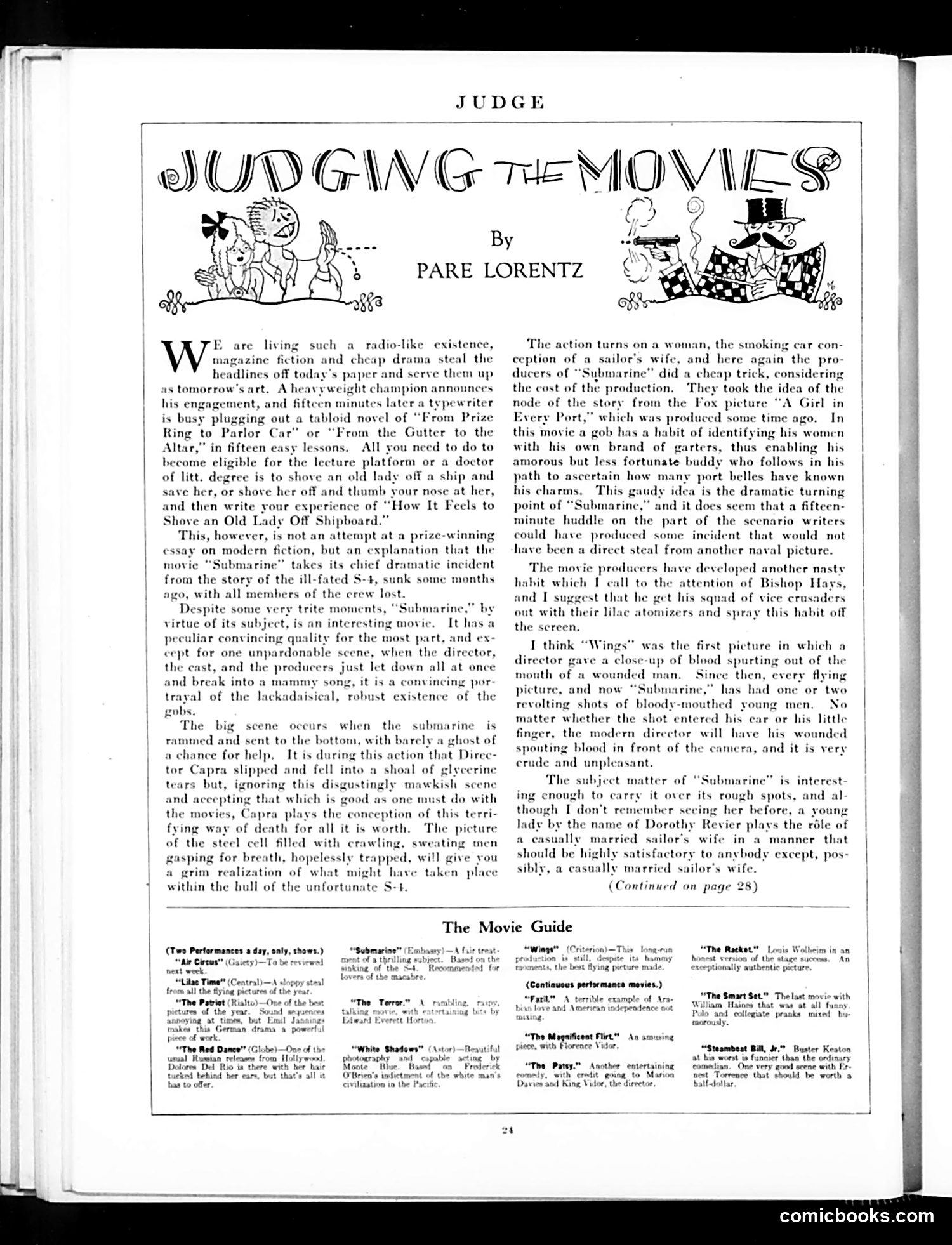
This is a film review column, not a political cartoon. Lorentz critiques the movie "Submarine," based on the real 1921 sinking of the USS S-4 submarine where the entire crew perished. Lorentz praises the film's dramatic power but attacks several choices as cheap shortcuts: the inclusion of a "mammy song," the borrowed plot device of a sailor identifying conquests by garters (stolen from the Fox film "A Girl in Every Port"), and—what particularly bothers him—gratuitous close-ups of bloodied young men's faces during combat scenes, a trend he traces back to "Wings." He calls on Bishop Hays (head of film industry censorship) to intervene against producers' increasingly graphic violence, sardonically suggesting Hays deploy "vice crusaders" with "lilac atomizers" to censor such content from screens. The piece reflects 1920s anxieties about commercial Hollywood sensationalism exploiting tragedy and escalating graphic violence.
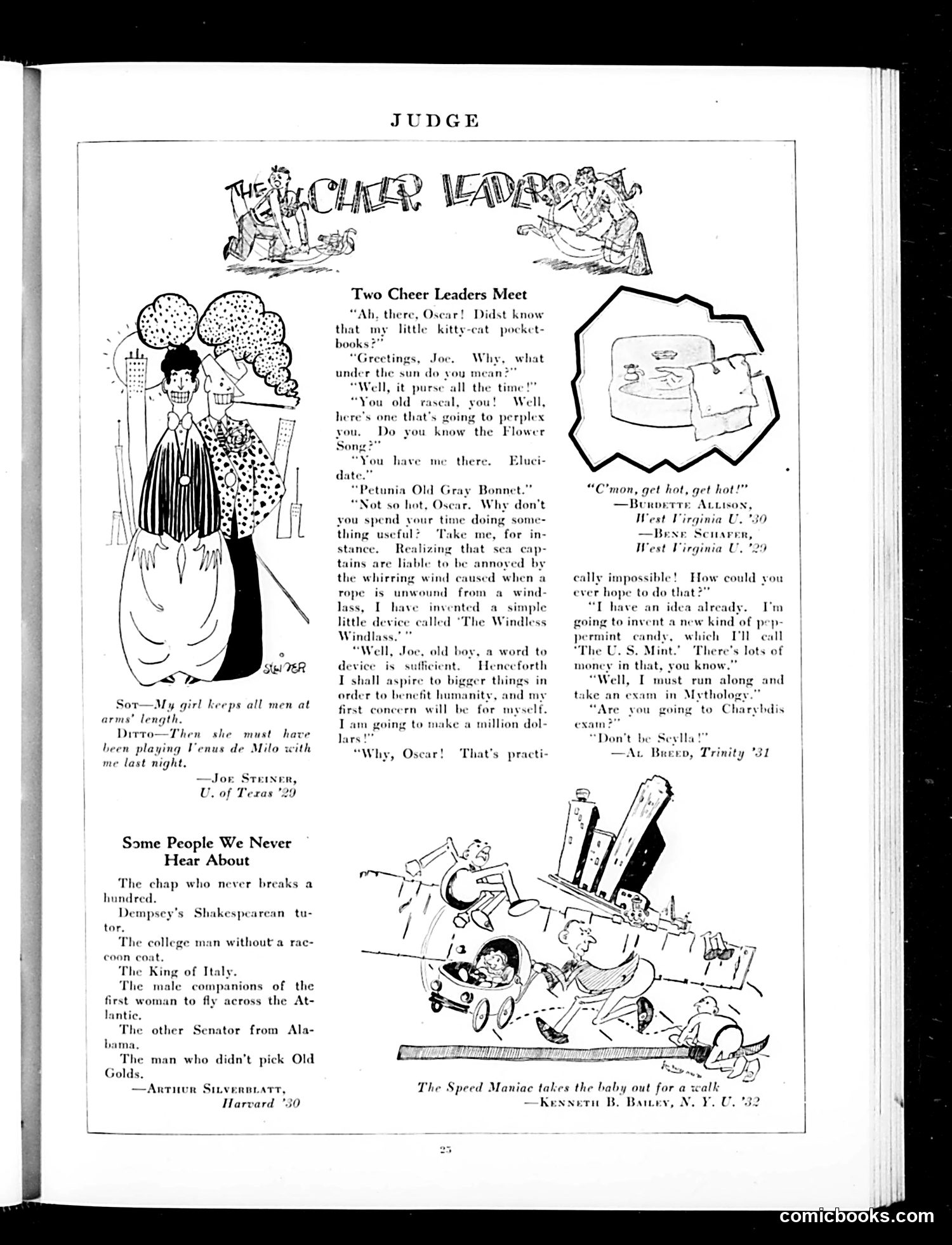
This 1920s humor page from *Judge* contains several short comedy pieces targeting college students and contemporary social attitudes. **"Two Cheer Leaders Meet"**: Two male college cheerleaders engage in wordplay about pocket-books and flower songs, attempting to out-clever each other with invented products like "U.S. Mint" candy. The humor relies on dated slang and puns typical of collegiate humor of the era. **"Some People We Never Hear About"**: A list of absurdist non-entities, including "Dempsey's Shakespearean tutor" (referencing boxer Jack Dempsey's rough image) and references to contemporary events like the first woman's transatlantic flight—poking fun at unlikely combinations and forgotten figures. **"The Speed Maniac"**: An illustration satirizing reckless drivers by showing a maniac taking a baby carriage on a chaotic joyride, commenting on 1920s automobile culture and dangerous driving habits. The overall tone reflects Jazz Age college culture, with emphasis on witty banter, modern inventions, and social commentary on contemporary fads and personalities.
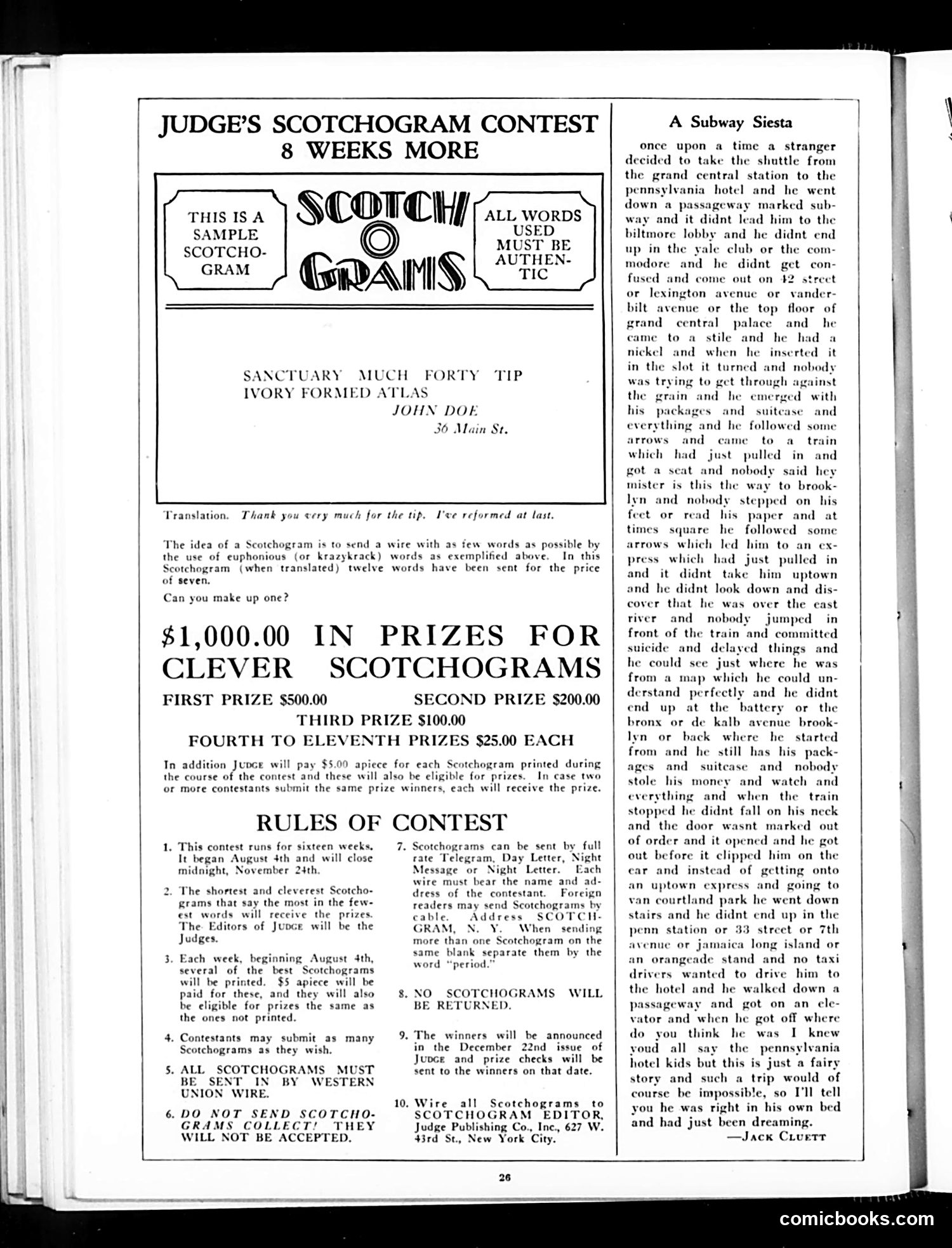
This page is primarily a **contest advertisement**, not political satire. Judge magazine is running a "Scotchogram" competition—a word game where contestants create economical telegraph messages using authentic but creative word combinations to say more with fewer words, thus saving on wire costs. The sample shows: "SANCTUARY MUCH FORTY TIP / IVORY FORMED ATLAS / JOHN DOE / 36 Main St." translating to "Thank you very much for the tip. I've reformed at last." The page also features a humorous short story, "A Subway Siesta," mocking the chaotic New York City subway system—listing absurd scenarios of things that *didn't* happen to a fortunate stranger (no confusion, no theft, no delays, no accidents), contrasting sharply with actual subway experiences. The contest offers **$1,000 in total prizes** and detailed submission rules via Western Union wire.
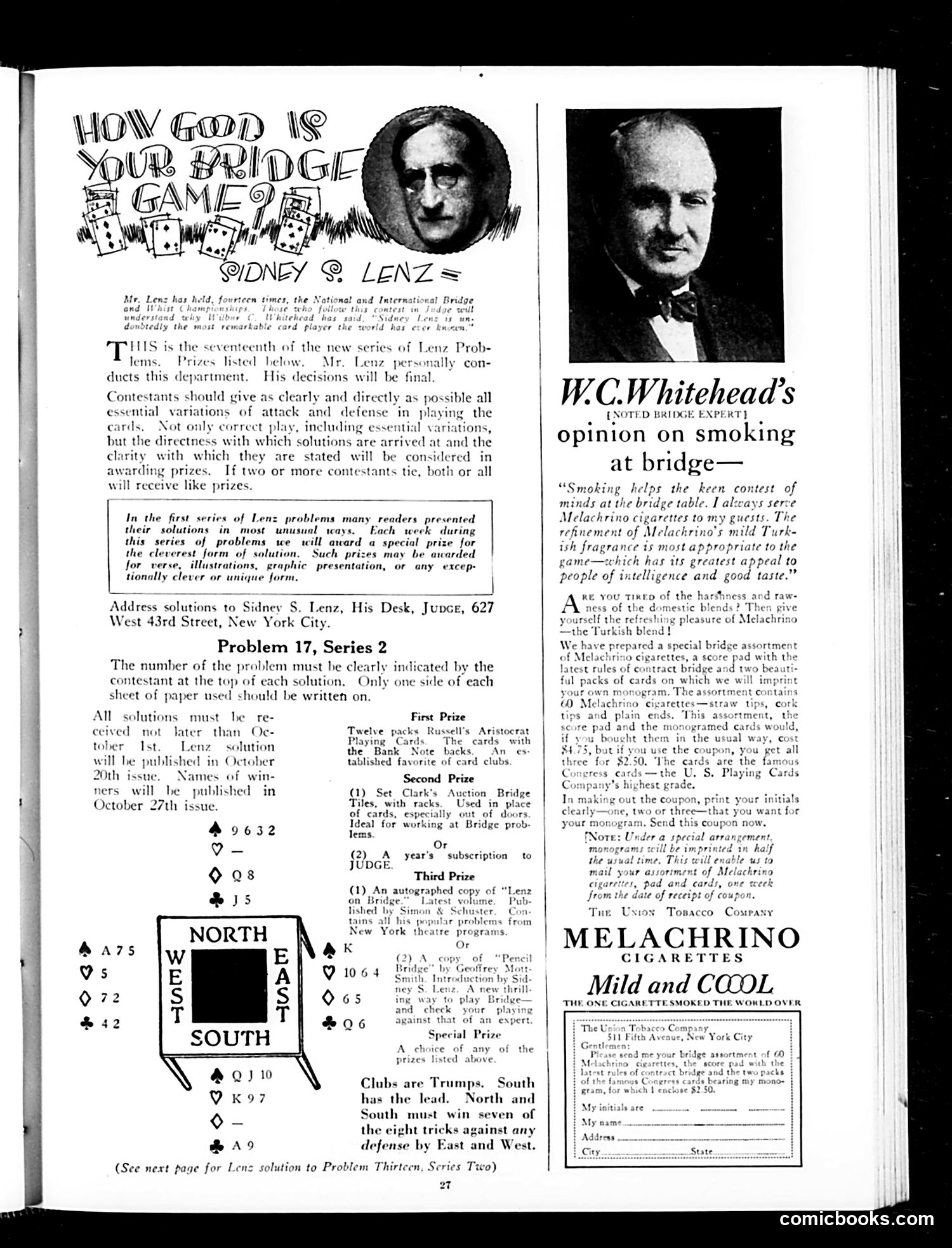
This page combines a bridge card problem contest with advertising. **Sidney Lenz**, identified as a famous card player who held fourteen national bridge titles, hosts a weekly problem-solving competition in Judge magazine. Readers submit strategic solutions to bridge hands, competing for prizes like card decks and Judge subscriptions. The satire appears subtle here—it's primarily a **sponsored content arrangement**. W.C. Whitehead, a "noted bridge expert," endorses Melachrino cigarettes by claiming smoking "helps the keen contest of minds at the bridge table." This is classic early-20th-century advertising rhetoric: linking a luxury product to intellectual sophistication and good taste. The irony for modern readers is that smoking is now understood as harmful, yet it was then positioned as enhancing mental clarity during competitive play—a claim that would seem absurd today.
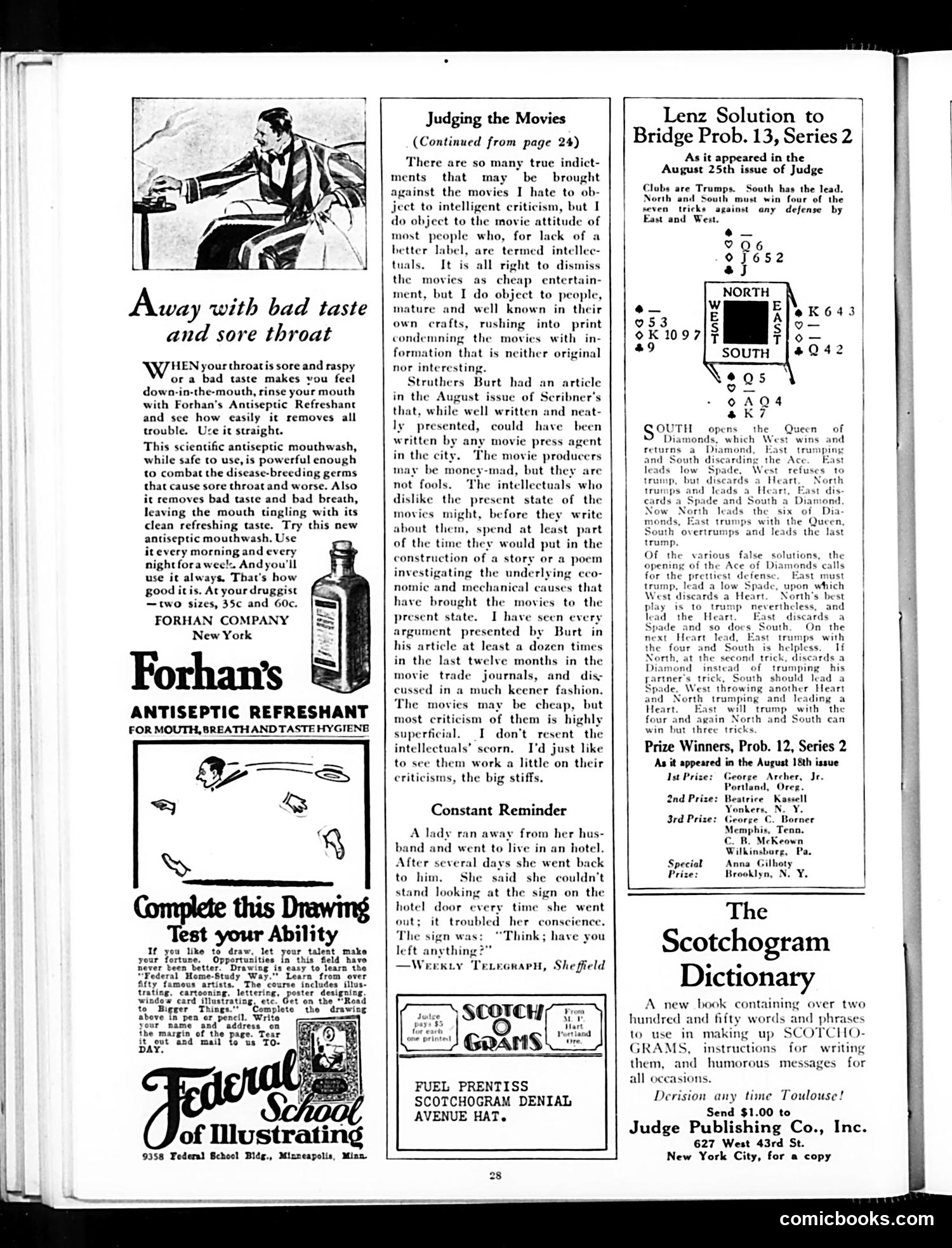
This page from Judge (an American satirical magazine) contains mostly **advertisements and puzzle content** rather than political satire. The main editorial piece, "Judging the Movies," critiques intellectuals who dismiss movies as cheap entertainment. The author argues such critics haven't bothered investigating cinema's actual economic and mechanical challenges before condemning it—they're merely repeating arguments already circulating in movie trade journals. The other content includes: a Forhan's mouthwash advertisement; a Federal School of Illustrating recruitment ad; a bridge puzzle solution; and a brief joke about a woman who abandoned her husband but returned because a hotel sign saying "Think; have you left anything?" troubled her conscience. The "Scotchogram Dictionary" advertises a book of Scottish phrases and humorous messages. Nothing here addresses specific politicians or major political events—it's primarily commercial and recreational content typical of Judge's lighter sections.
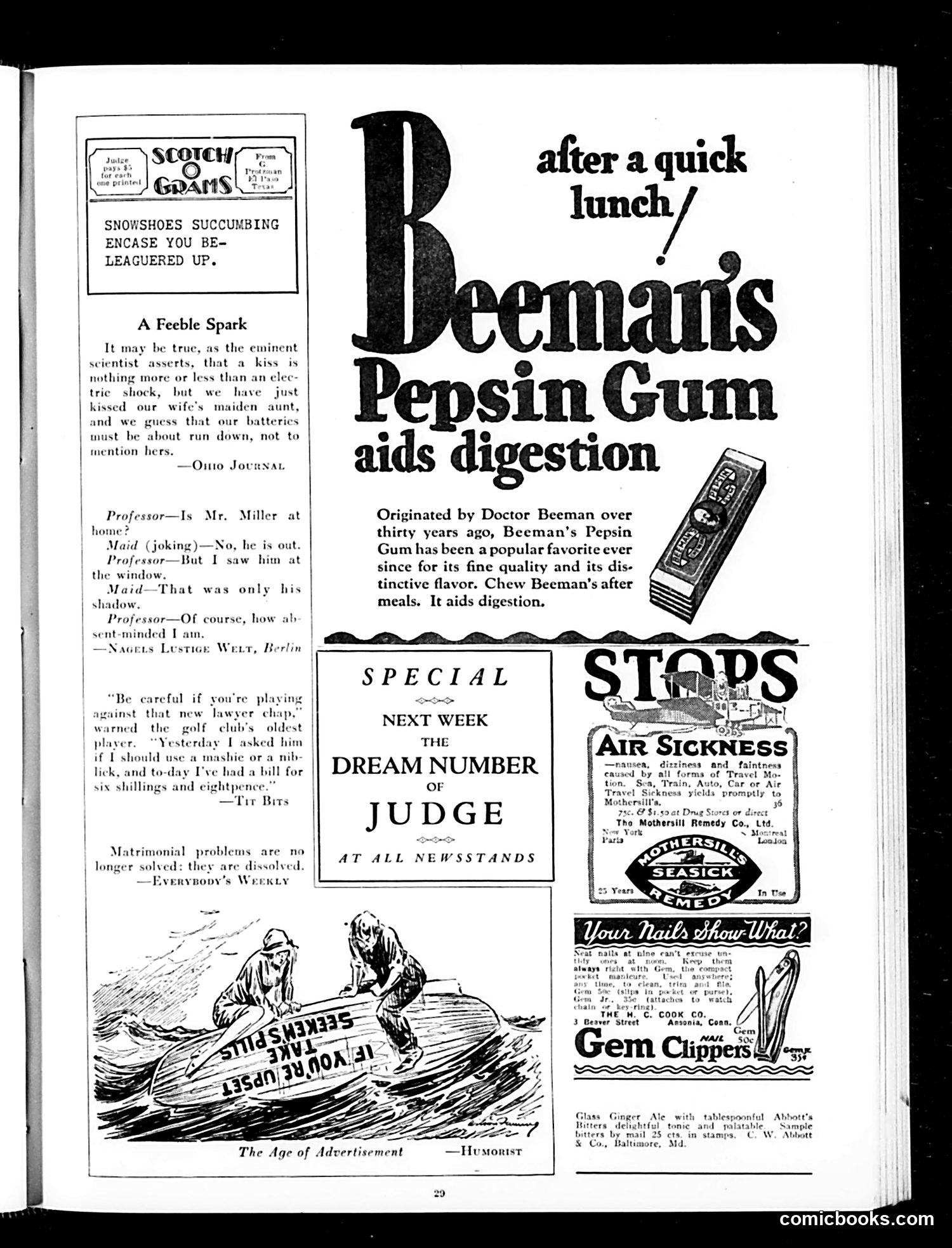
This page is primarily **advertising with supporting humor content**. The main feature is a large advertisement for **Beeman's Pepsin Gum**, claiming it aids digestion after meals—a common health claim of early 20th-century patent medicines and consumer goods. The surrounding content consists of brief jokes and humorous observations typical of Judge magazine: - A scientific joke about kisses and electrical shock (referencing contemporary scientific discourse) - A professor/maid dialogue playing on absent-mindedness - A golf anecdote about a deceptive lawyer - A quip about marriage dissolution These are light, social humor pieces with no apparent political content. The page also advertises other period products: **Mothersill's Remedy** (for travel sickness), **M.C. Cook's Gem Clippers** (nail clippers), and a "Dream Number" future issue. The small cartoon at bottom ("The Age of Advertisement" by Humorist) appears to satirize how advertising dominates modern life, showing figures drowning in commercial messaging—a meta-commentary on the very advertisement-heavy page itself.
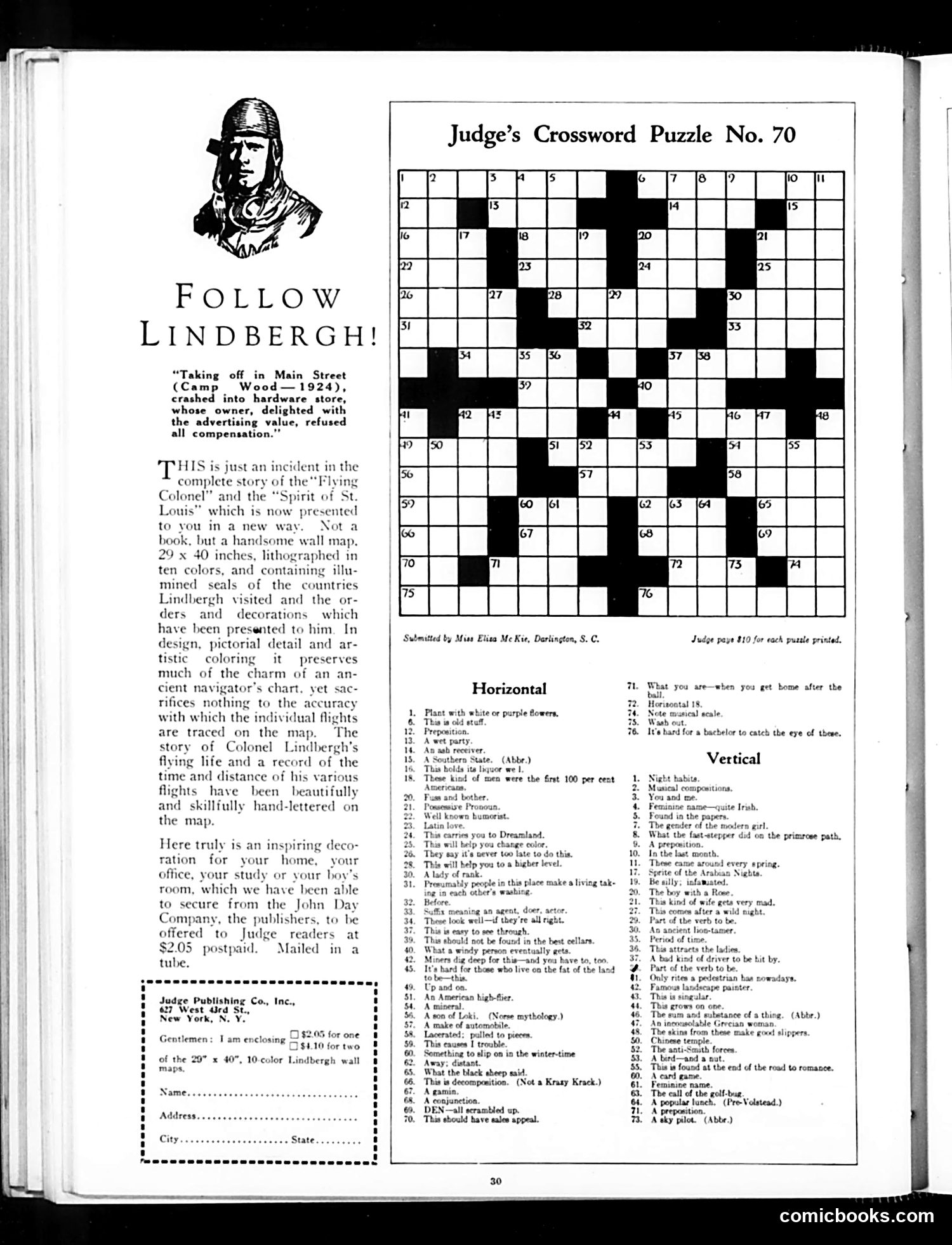
This page is primarily **advertising and a crossword puzzle**, not political satire. The main content is a sales pitch for a decorative wall map of Charles Lindbergh's aviation achievements. The brief anecdote ("Follow Lindbergh!") describes a 1924 incident where Lindbergh crashed his plane into a hardware store in Camp Wood—the store owner was so pleased with the publicity that he refused compensation. This humorous story serves as hook to sell readers an ornate 29x40-inch wall map tracing Lindbergh's famous flights, including his 1927 transatlantic journey on the Spirit of St. Louis. Below is Judge's crossword puzzle No. 70, with horizontal and vertical clues. The puzzle appears unrelated to Lindbergh—standard wordplay fare. The page reflects 1920s American enthusiasm for Lindbergh as a celebrity hero, while using that popularity to market merchandise to Judge's readers.
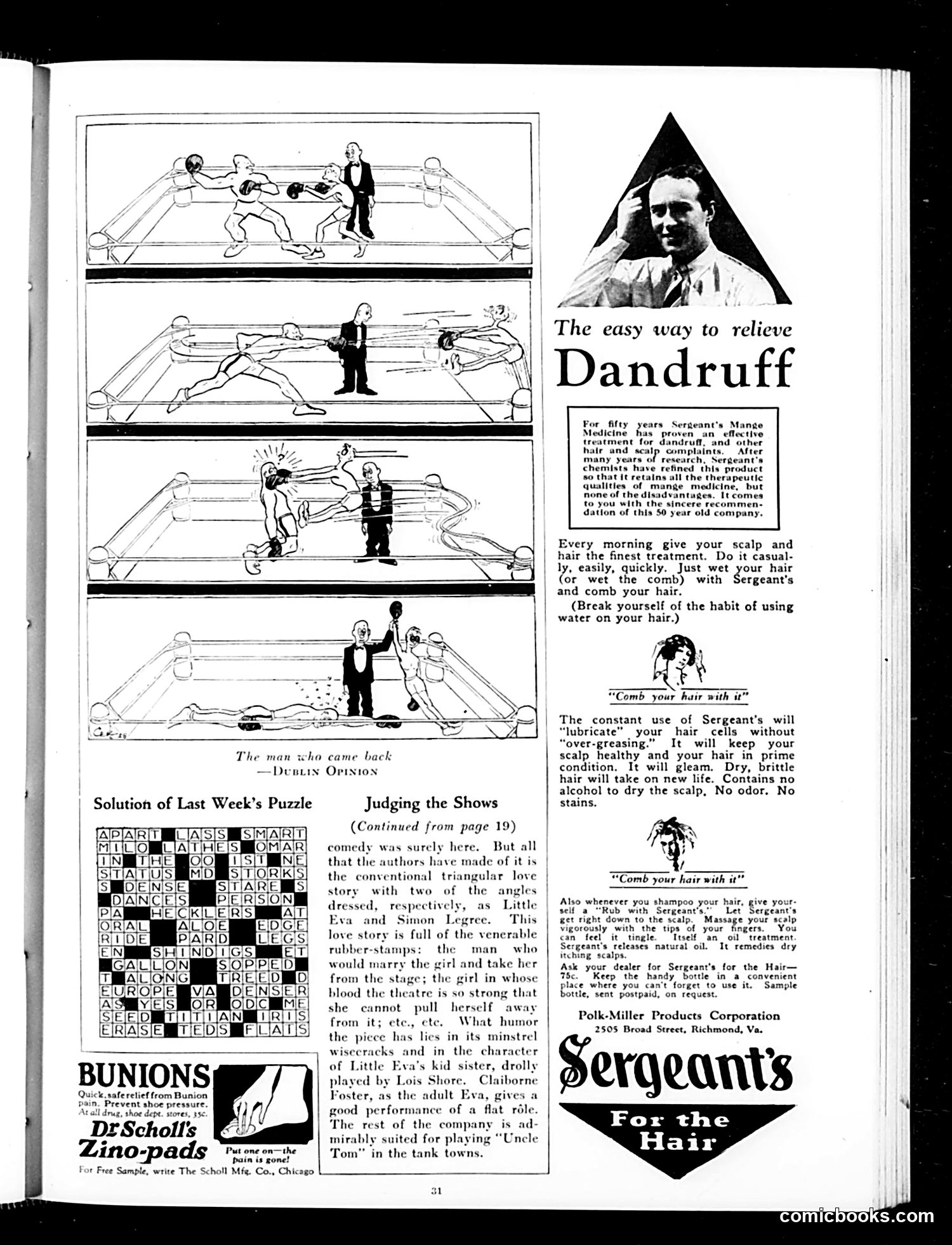
This page is primarily **advertising** rather than political satire. The dominant content consists of: 1. **"The man who came back"** - A cartoon strip (top left) showing wrestling or boxing moves, likely illustrating a narrative about someone's return, though the specific reference is unclear without more context. 2. **Dandruff/Hair Product Ads** - The majority of the page advertises Sergeant's hair treatment and Dr. Scholl's foot pads, featuring product testimonials and usage instructions typical of early 20th-century advertising. 3. **Theater Review** - A brief section titled "Judging the Shows" discusses a theatrical production featuring characters from *Uncle Tom's Cabin* (Little Eva, Simon Legree), critiquing the performance quality. The page reflects **early 1900s consumer culture** with emphasis on personal grooming products marketed through detailed instructions and celebrity endorsements. There is no apparent political satire or social commentary visible in the visual content.
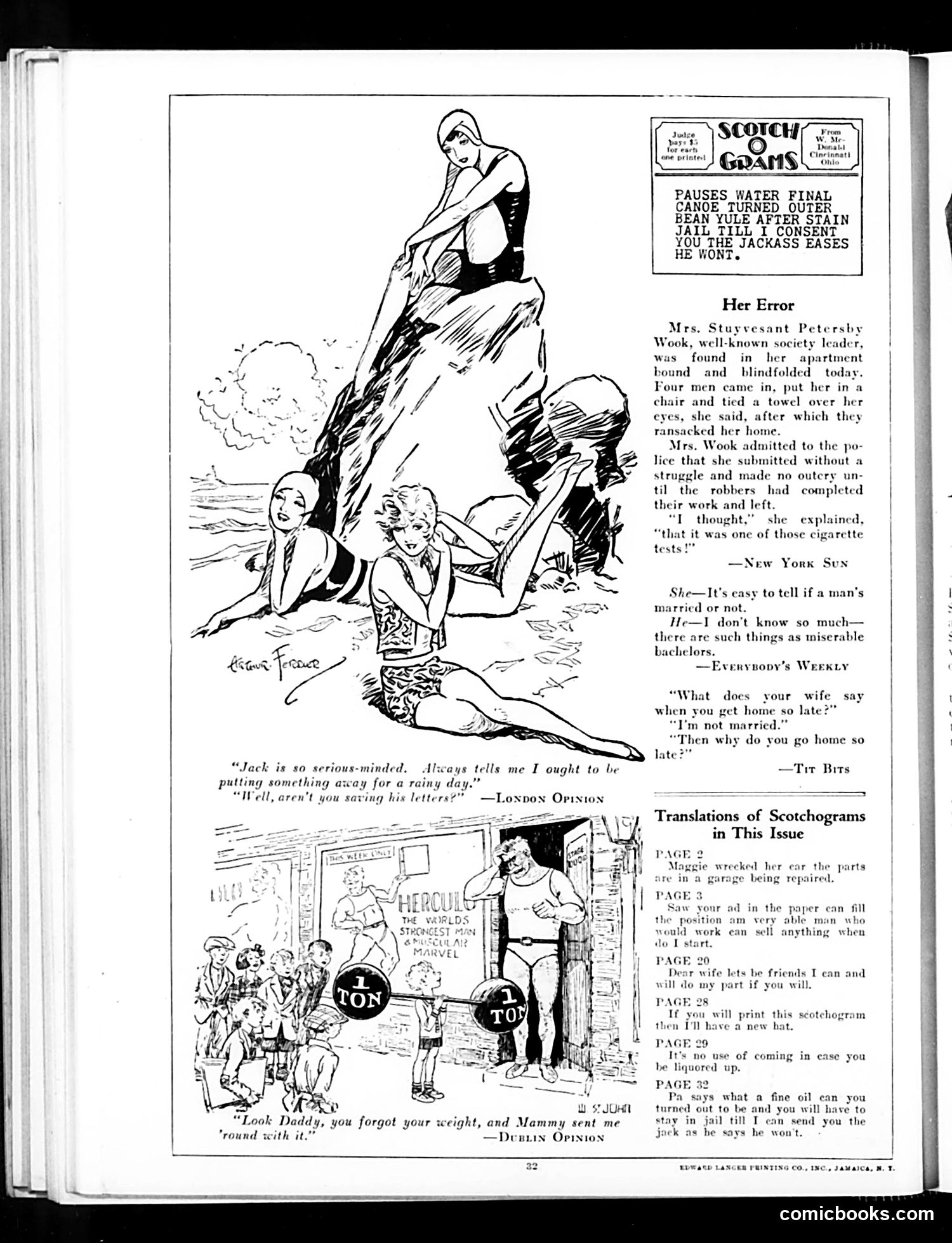
This page contains multiple short humor pieces typical of early 20th-century Judge magazine: **"Her Error"** mocks upper-class society woman Mrs. Stuyvesant Petersby, who was robbed but passively submitted, mistaking the crime for a "cigarette test"—likely referring to fashionable dare games among wealthy socialites. The satire ridicules both her vapid obliviousness and the triviality of high-society pastimes. **The shorter jokes** mock marital relations and gender roles—women questioning men's fidelity, husbands complaining about domestic expectations. **The illustrated cartoons** depict beach/leisure scenes and what appears to be a circus strongman attraction, typical Judge visual humor. **"Scotchograms"** are brief humorous messages readers could submit, reflecting the magazine's participatory nature. The overall tone is lighthearted social satire targeting wealth, domesticity, and gender dynamics—concerns of early 20th-century American middle and upper-class audiences. The humor relies on recognizing these social conventions and their absurdities.
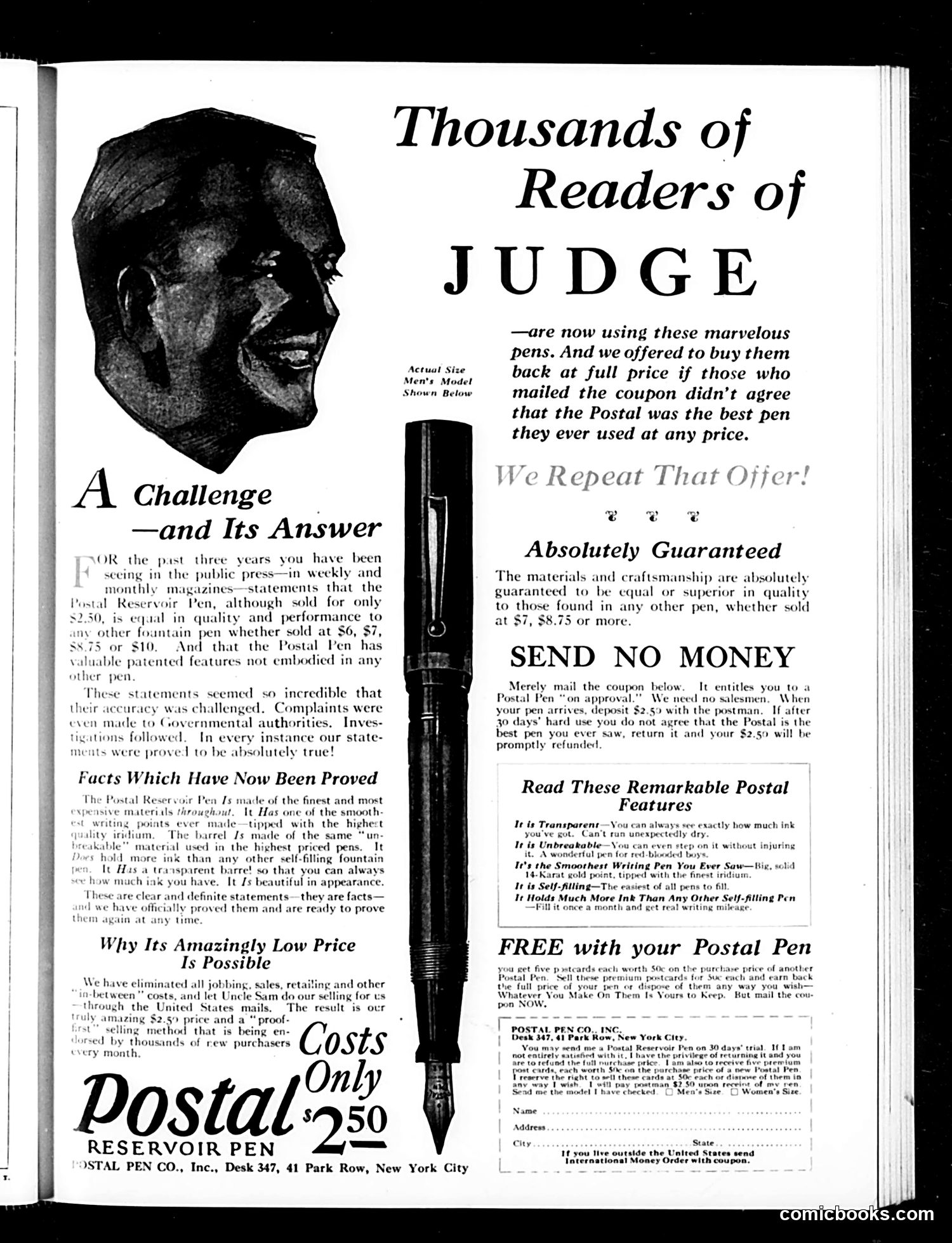
This page is primarily a **direct-mail advertisement** for the Postal Reservoir Pen ($2.50), not a satirical cartoon. The image shows a life-sized pen illustration alongside marketing copy. The "challenge and answer" framing addresses consumer skepticism: magazines had claimed this cheap pen matched expensive models ($6-$10), prompting government investigations. The ad emphasizes that these claims were "proved...absolutely true," listing features like transparent barrel, unbreakable material, and high ink capacity. The appeal uses the familiar early-20th-century mail-order tactic: "send no money," try for 30 days, pay postman on delivery. Notably, it appeared in **Judge**, a satirical magazine, likely because humor publications were popular advertising venues with educated readers. The ad's placement here suggests either Judge accepted advertisements or this represents sponsored content—common practice when magazines relied heavily on ad revenue.
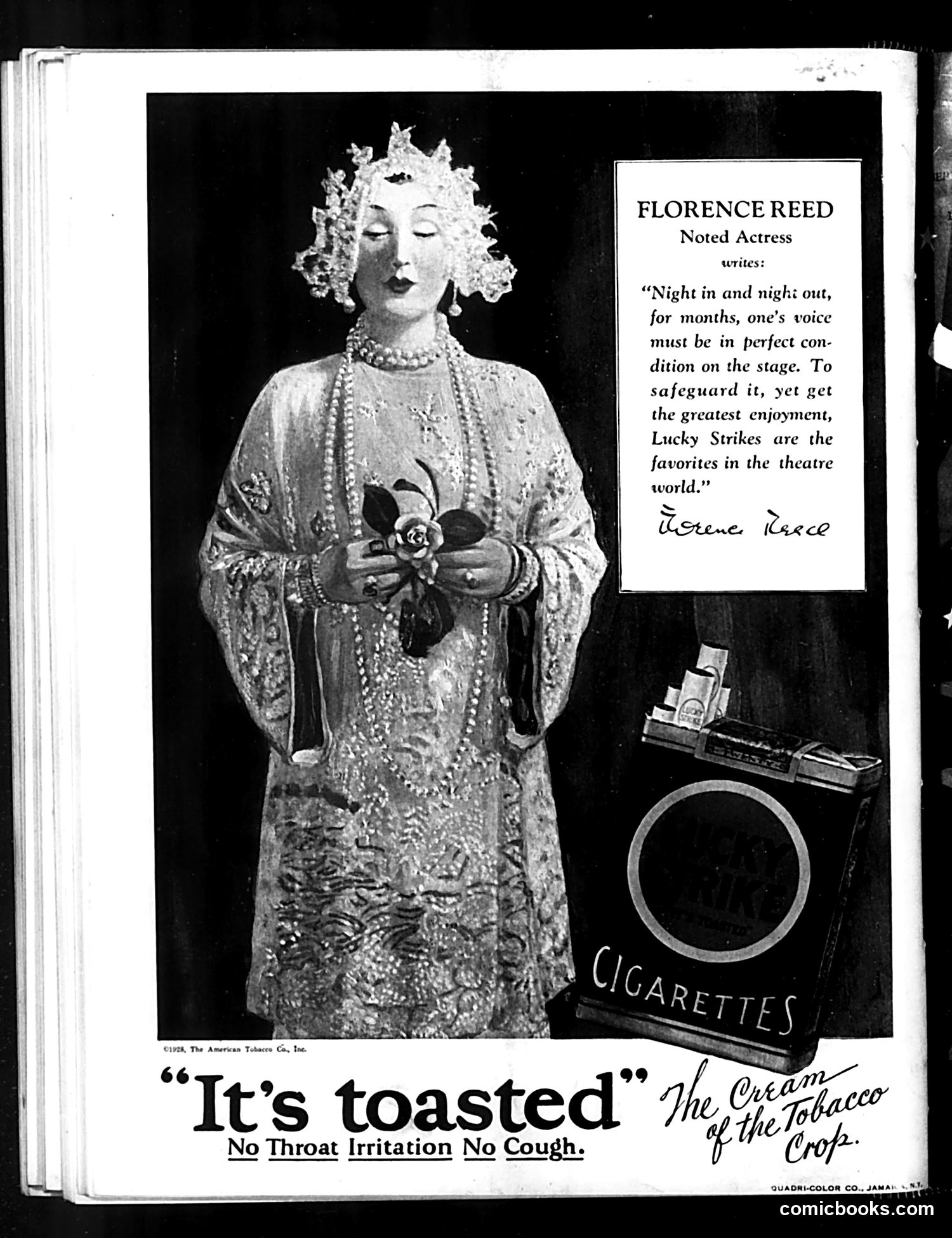
This is a **cigarette advertisement**, not a cartoon or satire. It features Florence Reed, a noted actress of the era, endorsing Lucky Strike cigarettes. The ad claims the cigarettes are "toasted" to prevent "No Throat Irritation No Cough," addressing health concerns that were emerging about smoking. The endorsement leverages Reed's theatrical credibility—she testifies that actors depend on voice quality and choose Lucky Strikes to protect their vocal health while smoking. This represents early cigarette marketing targeting specific professions and concerns, before widespread understanding of smoking's actual health dangers. The advertisement exploits celebrity influence and pseudo-scientific claims ("toasted") to market an addictive product as safe.