
Judge, 1928-09-22 · page 21 of 36
Judge — September 22, 1928 — page 21: what you’re looking at
What you’re looking at
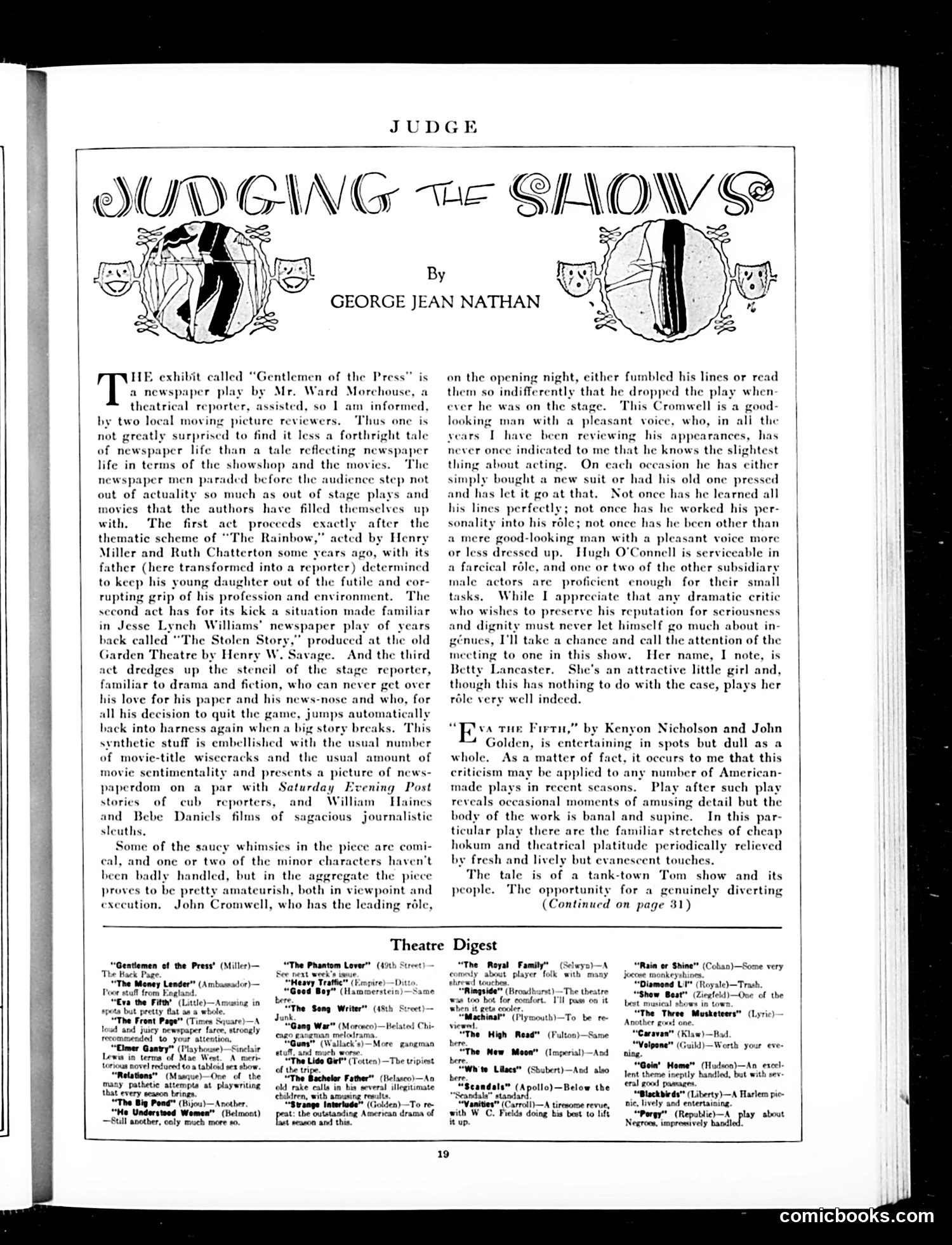
This page contains **theatre reviews** by critic George Jean Nathan, not political cartoons. It critiques three Broadway plays: 1. **"Gentlemen of the Press"** — Nathan dismisses this newspaper-themed play as derivative, borrowing plots from earlier successful shows. He particularly criticizes lead actor John Cromwell as merely a "good-looking man" who doesn't understand acting, praising only a minor actress, Betty Lancaster. 2. **"Eva the Fifth"** — Described as entertaining but ultimately dull, exemplifying a broader problem Nathan sees: recent American plays contain occasional clever moments but are fundamentally "banal and supine." The page also includes a "Theatre Digest" — a reference guide listing shows currently running. Nathan's tone is **caustic and dismissive**, reflecting early 20th-century theatrical criticism's emphasis on originality and genuine craft over superficial appeal. His comments about actors "simply buying new suits" to succeed reflects cynicism about Broadway's commercialism.
📄 Transcribed text from this page (OCR, searchable)
Machine-transcribed from the original scan — historical spelling and the odd misread are preserved.
ibaa nt om JUD GE By HE exhibit called “Gentlemen of the Press" is I 1 newspaper play by Mr. Ward Morchouse, a theatrical reporter, assisted, so 1 am informed, hy two local moving picture reviewers. ‘Thus one is not greatly surprised to find it less a forthright tale of newspaper life than a tale reflecting newspaper life in terms of the showshop and the movies. The newspaper men paraded before the audience step not out of act ; so much as out of stage plays and movies that the authors have filled themselves up with. The first act proceeds exactly after the thematic scheme of “The Rainbow,” acted by Henry Miller and Ruth Chatterton some rs ago, with its father (here transformed into a reporter) determined to keep his young daughter out of the futile and cor- rupting grip of his profession and environment. The second act has for its kick a situation made famili in Jesse Lynch Williams’ new. back called “The Stolen Story,” produced at the old Garden Theatre by Henry W. Savage. And the third act dredges up the stencil of the stage reporter, familiar to drama and fiction, who c his love for his paper and his news-nose and who, for all his decision to quit the game, jumps automatically back into harness again when a big story breaks. ‘This synthetic stuff is embellished with the usual number of movie-title wisecracks and the usual amount of movie sentimentality and presents a picture of news- paperdom on a par with Saturday Evening Post stories. of cub reporters, and William Haines and Bebe Daniels films of sagacious journalistic sleuths. saper play of years n never get over Some of the saucy whims’ re comi- s in the pic cal, and one or two of the minor characters haven't been badly handled, but in the aggre proves to be pretty amateurish, both in viewpoint and execution, John Cromwell, who has the leading réle, e the piece eI GING te GEORGE JEAN NATHAN on the opening night, cither fumbled his lines or read them so indifferently that he dropped the play when ever he was on the stage. This Cromwell is a good- looking man with a pleasant voice, who, in all the years I have reviewing his appearances, has never once indicated to me that he knows the slightest thing about acting. On each occasion he has cither simply bought a new suit or had his old one pressed and has let it go at that. Not once has he learned all his lines perfectly; not once has he worked his per- sonality into his réle; not once has he been other than a mere good-looking man with a pleasant voice more or less dressed up. Hugh O'Connell is serviceable in a farcical role, and one or two of the other subsidiary male actors are proficient enough for their small tasks. While I appreciate that any dramatic critic who wishes to preserve his reputation for seriousness and dignity must never let himself go much about in- génues, I'll take a chance and call the attention of the mecting to one in this show. Her name, I note, is Betty Lancaster. She's an attractive little girl and, though this has nothing to do with the case, plays her role very well indeed. va tHe Fieri,” by Kenyon Nicholson and John Golden, is entertaining in spots but dull as a whole. As a matter of fact, it occurs to me that this criticism may be applied to any number of American- made plays in recent seasons. Play after such play reveals occasional moments of amusing detail but the body of the work is banal and supine. In this par- ticular play there are the familiar stretches of cheap hokum and theatrical platitude periodically relieved by fresh and lively but evanescent touches. The tale is of a tank-town Tom show and _ its people. The opportunity for a genuinely diverting (Continued on page 31) Theatre “The Phantom Lever” (40th Street “Gentlemen ef the Press’ (Miller)— The Hack Page. “The Money Lender” (A mbamacor)— Toor stuff from England. “Eva the Fitth’ (Little)—Amasing in be spats but pretty flat an a whole. “The Front Page” (Times Square)—A loud and juicy newspaper farce, stroagly “The Song Writer’? (48: Junk. o)—Belated Chi- recommended to your attention, “Elmer Gantry” (Playhouse) Lewis in term More gangman Sinelair hore: eee of Mae West. A mere ced to a tabloid sex show. (Masque)—One of the pathetie attempta at playwriting that every season brings. “The Big Pond” (Bijou)—Another. “He Understood Women” (Belmont) —Still another, only much more #0. Totten) —The tripiest of the tr “The Bachelor Father" ([elasco)—Ao old rake calla in bis several illegitimate ren, with amusing remults iwange Interlude” (Golden) —To re- \t: the outstanding American drama of t season and this. Digest “The Royal Family” comely about player fol threwd touches. Ringside” (Broulbarst)—The th as too bot for comfort. I'll pam o eta conler, ‘Machinal” (Ilymou “Rain or Shine" (Cohan)—Some very jocoue monkeyshioes “Diamond Li (Royale)—Trash. at” (Ziegleld)—Ove of the ws int “The Three Musketeers” (Lyric) Another gond one. )—To be te ewe, “The High Read” (Fulton)—Same (Klaw)—Rad. uild)—Worth your eve- ial) bere. beth te Lilees™ (Sbubert)—And also Seandals” (Apollo)—Below the odals” standard, fanities” (Carroll) —A tiresome revue, with WC. Fields doing bis best to lift it up. And “Gein’ Home” (Hutson)—An_excel- lent theme ineptly handled, but with sev eral goo pamages “Blackbirds” (Liberty)—A Harlem pic- nic, lively and entertaining. “Porgy” (Repotlie)—A play about Negroanimprentvely handled. comicbooks.com