
Judge, 1928-09-22 · page 15 of 36
Judge — September 22, 1928 — page 15: what you’re looking at
What you’re looking at
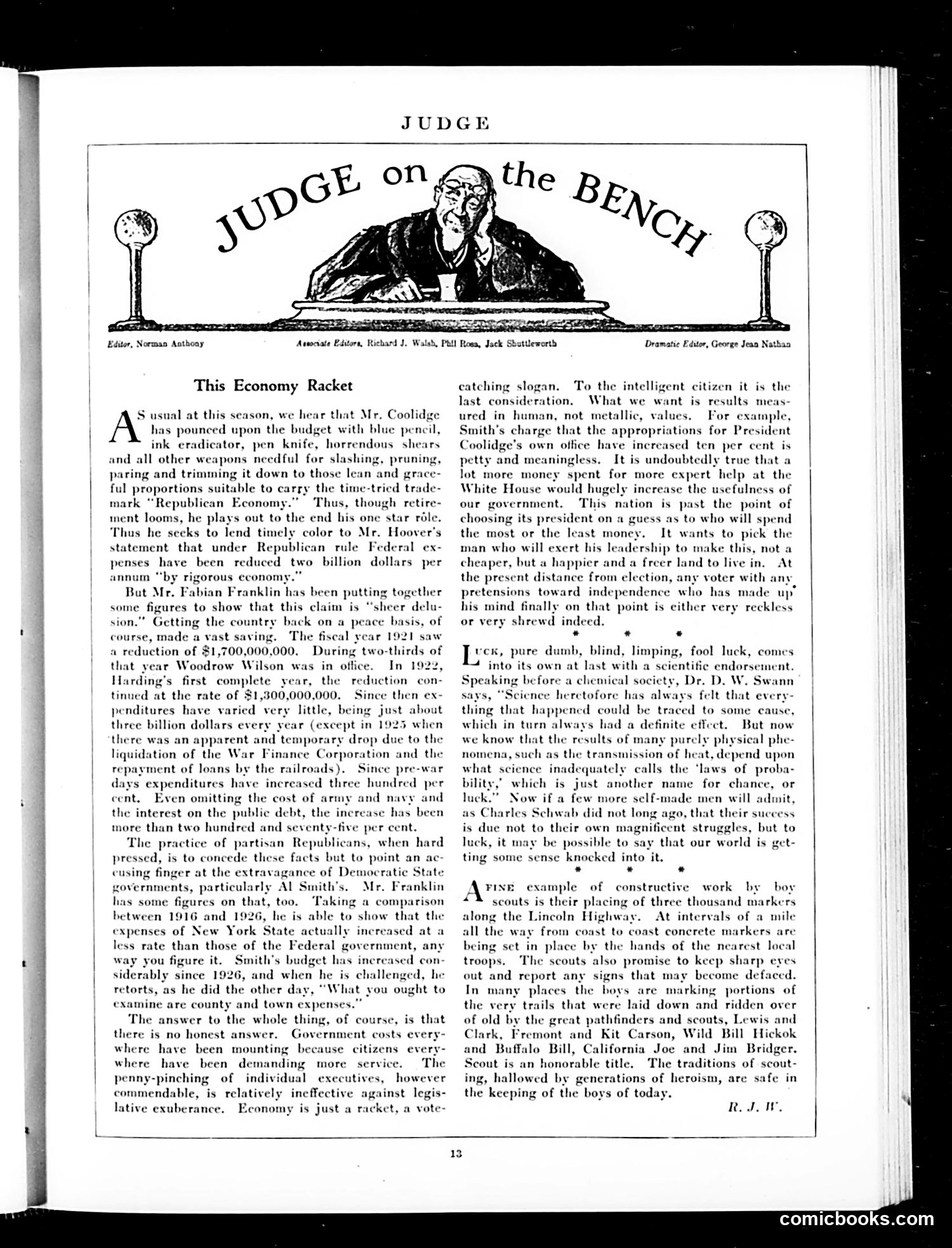
This Judge magazine page satirizes Republican claims about federal budget cuts. The article mocks President Coolidge's budget-slashing theatrics and challenges the GOP's claim of reducing federal spending by two billion dollars annually. The satire points out that under Democrat Woodrow Wilson (1921), the budget actually fell by $1.7 billion—before Coolidge and Harding took office. The Republicans take credit anyway. The piece further notes that since pre-war, overall spending has doubled, and even excluding military/debt costs, spending increased 275 percent. The article critiques Al Smith's (Democratic governor of New York) predictable counter-argument: shifting blame to city/county spending. It argues that voters shouldn't choose presidents based on penny-pinching rhetoric alone—they should demand actual results and effective leadership. Budget economy, the author concludes, is merely a political "racket" used by both parties to attract votes.
📄 Transcribed text from this page (OCR, searchable)
Machine-transcribed from the original scan — historical spelling and the odd misread are preserved.
| ; i | JUDGE Editor, Norman Anthony This Economy Racket 3 usual at this season, we hear that Mr. Coolidge has pounced upon the budget with blue pencil, ink eradicator, pen knife, horrendous shears and all other weapons needful for slashing, pruning, paring and trimming it down to those lean and grace ful proportions suitable to carry the time-tried trade- mark “Republican E Thus, though retire- ment looms, he plays out to the end his one star réle. Thus he secks to lend timely color to Mr. Hoover's statement that under Republi rule Federal ex- penses have been reduced two billion dollars per annum “by rigorous economy But Mr. an Franklin some figures to show tl sion.” Getting the countr. > basis, of course, made a vast saving. The fiscal ye ar 1921 saw a reduction of $1,700,000,000. During two-thirds of that yes ar Woodrow Wilson was in office. In 1922, Harding’s first complete year, the reduction. con- tinued at the rate of $ ,300,000,000, Since then ex- penditures have varied very little, being just about three billion dollars eve: aur (except in 1925 when there was an apparent and temporary drop due to the liquidation of the War Finance Corporation and the ment of loans by the railroads). Since pre-war days expenditures have incre: hundred per cent. Even omitting the cost ¢ yoand navy and the interest on the public debt, the increase has been more than two hundred and seventy-five per cent. The practice of partisan Republicans, when hard pressed, is to concede these facts but to point an cusing finger at the extra f Democrati wernments, particularly AL Smith's, Mr. F 18 some figures on that, too. Taking a comparison between 1916 and 1926, he is r to show that the expenses of New York State actually increased at a less rate than those of the Federal government, any way you figure it. Smith’s budget has increased con- siderably since 1926, and when he is challenged, he retorts, as he did the other day, “What you ought to examine are county and town expenses. ther is been putting te im i r delu- ac: ate anklin thing, of course, is that Government costs every- have been mounting because citizens every- have been demanding -pinching of individual executives, lable, is relatively ineffective against legis- lative exuberance. Economy is just a racket, a vote- The answer to the wh there is no honest ansv where where service. The more however Auociate Editors, Richard J. Walsh, Phil Rosa, Jack Sb: buttleworth Dramatic Editor, George Jean Nathan To the intelligent citizen it is the What we want is results me ured in human, not metallic, values. Smith's charge that the appropri office have inc catching slogan. last consideration. For ¢ npl ions for President Coolidge’s ow used ten per cent is petty and meaningless. It is undoubtedly true that a lot more money spent for more expert help at the White House would hugely increase the usefulness of our government. This nation is past the point of choosing its president on a guess as to who will spend the most or the least money. It wants to pick the man who will exert his leadership to make this, not a cheaper, but a happier and a freer land to live in. At the present distance from election, any voter with any pretensions toward independence who has made up" his mind finally on that point is cither very reckless or very shrewd indeed. * * . veK, pure dumb, blind, limping, fool luck, comes ~ into its own at last with a scientific endorsement. Speaking before a chemi Dr. D. W. Swann “Science heretofore has always felt that every- al society, Ss thing that happencd could be traced to some cause, which in turn always had a definite effect. But now we know that the results of many purely physical phe- nomena, such as the transmission of heat, depend upon what science inadequately calls the ‘laws of proba- bility,’ which is just another name for chance, or luck.” Now if a few more self-made men will admit, as Charles Schwab did not lon that their success is due not to their own magnificent struggles, but to luck, it may be possible to say that our world is get- ting some sense knocked into it. * * * A vine example of constructive work by boy + scouts is their placing of three thousand markers along the Lincoln Highway. At intervals of a mile all the way from coast to coast concrete markers are being set in pla the hands of the nearest local troops. The scouts also promise to keep sharp ey out and report any signs that may become defaced. aces the boys are marking portions of the very trails that were laid down and ridden over of old by the great pathfinders and scouts, Lewis and Clark, Fremont and Kit Carson, Wild Bill Hickok nd Buffalo Bill, California Joe and Jim Bridger. Scout an honorable title. The traditions of scout- 1 by generations of heroism, are safe in ing, hallow the keeping of the boys of today. RIL, comicbooks.com