
A complete issue · 36 pages · 1927
Judge — December 17, 1927
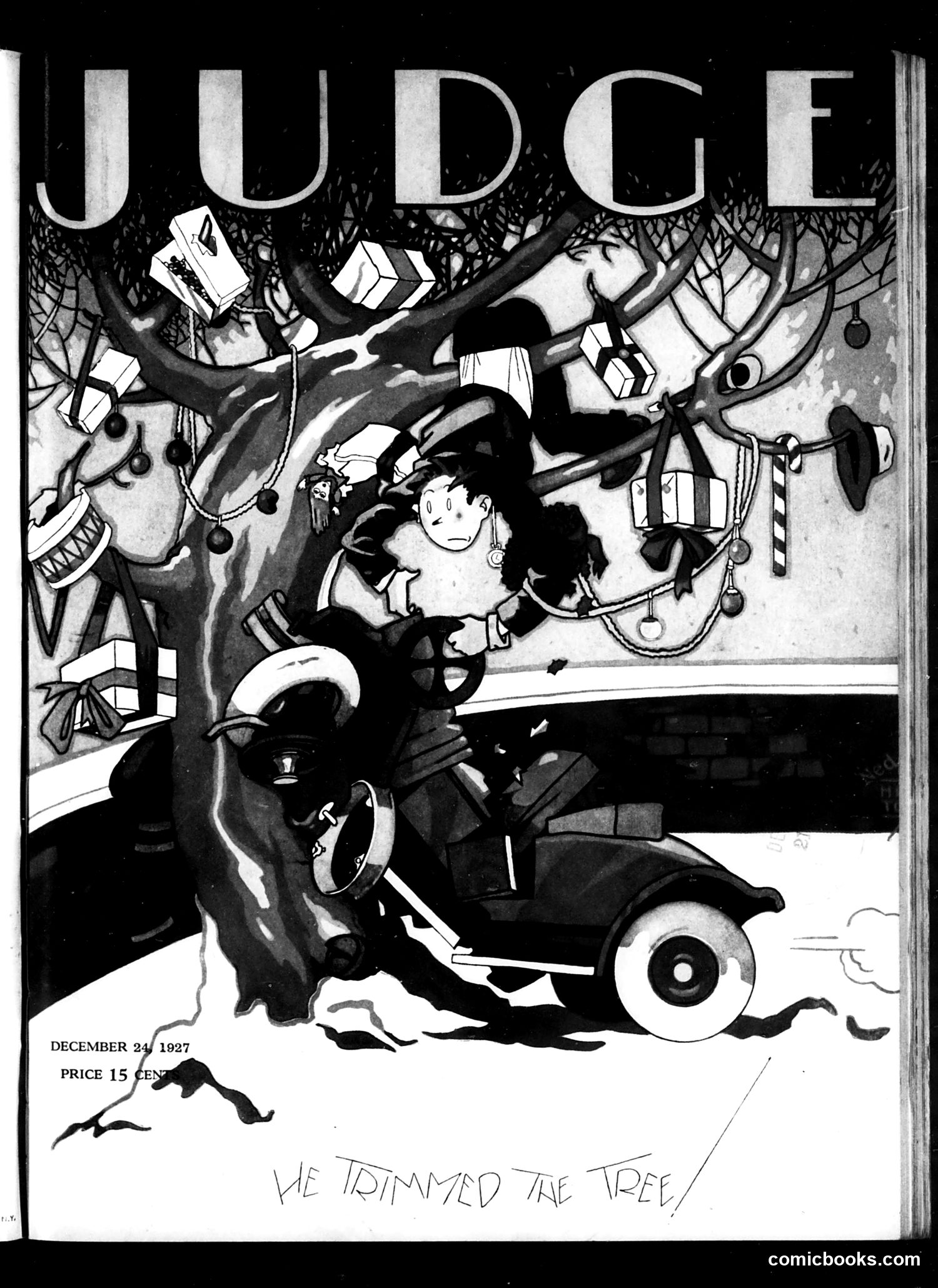
This Christmas-themed cover depicts a chaotic winter scene where a child in an automobile has crashed into a decorated tree, scattering presents everywhere. The caption "We Trimmed the Tree" is a dark pun—playing on the phrase "trimming a Christmas tree" (decorating it) with the literal damage done by the car collision. The satire likely reflects 1920s anxieties about automobile safety and reckless driving, presented as holiday humor. The image captures a moment of comedic destruction rather than peaceful Christmas celebration. The juxtaposition of festive imagery (decorated tree, gifts, holiday wreath) with vehicular disaster creates satirical commentary on modern traffic dangers during an era when automobiles were still relatively new and accident rates were rising.
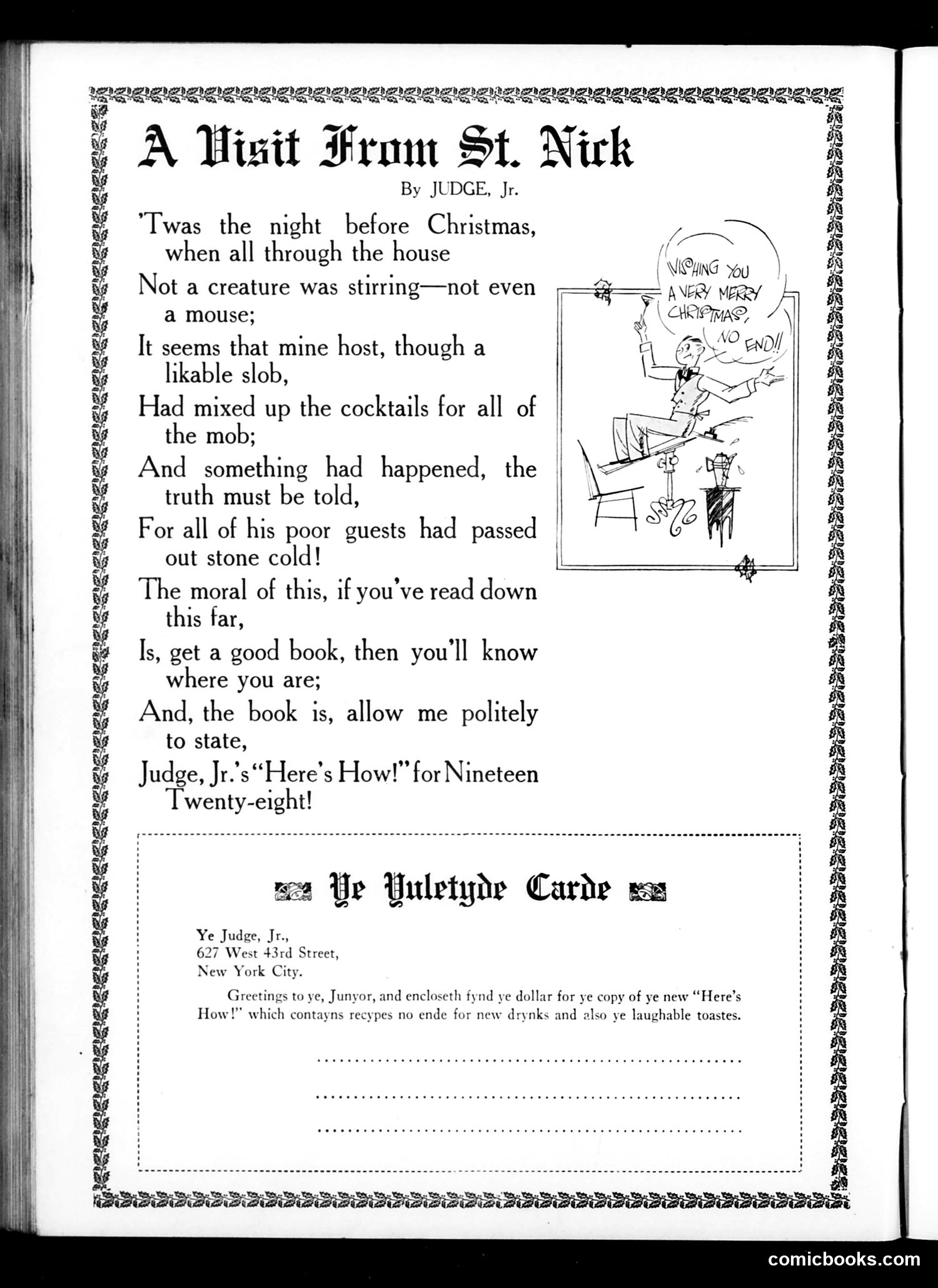
This page contains a humorous parody of Clement Clarke Moore's famous Christmas poem, credited to "Judge, Jr." The joke is straightforward: a host has mixed cocktails so strong that all his Christmas party guests have passed out cold before midnight—a dark comedy about Prohibition-era drinking (the 1920s context). The accompanying illustration shows a figure holding a sign reading "WISHING YOU A VERY MERRY CHRISTMAS! NO END!" next to unconscious party-goers, reinforcing the gag about excessive alcohol consumption. The "Yuletide Cards" section below is an advertisement promoting Judge magazine's book "Here's How!" (a cocktail recipe collection), capitalizing on the drinking humor above. This was standard advertising content for the satirical publication.
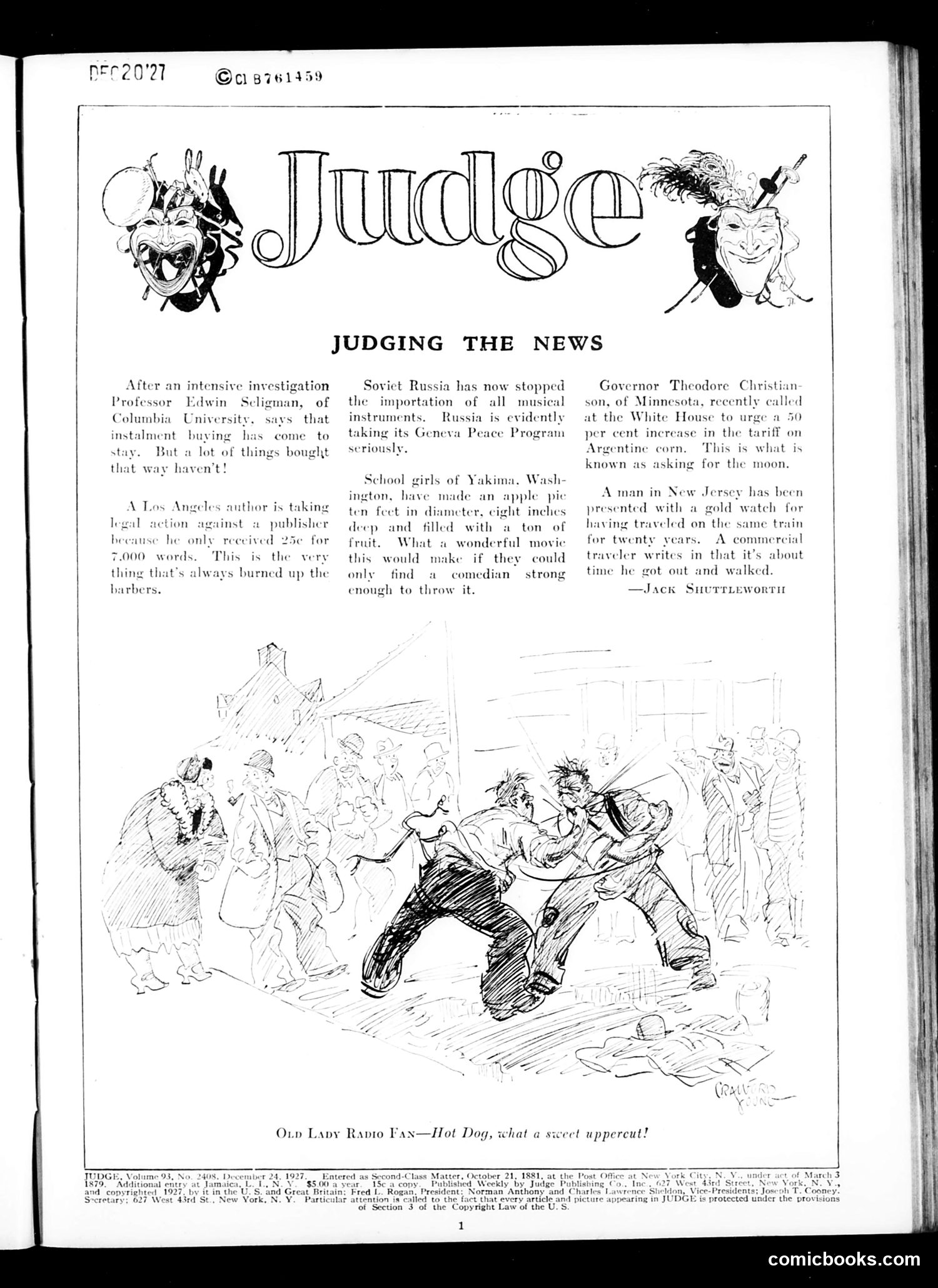
This page contains satirical news commentary and a cartoon. The main items reference: 1. **Professor Edwin Seligman** (Columbia University) claiming a "indictment having lost some stay" — the exact meaning is unclear from the OCR. 2. **Soviet Russia stopping musical instrument imports** — satirized as taking its "Geneva Peace Program seriously." 3. **Yakima schoolgirls' apple pie** — a humorous item about a ten-foot diameter pie filled with a ton of fruit. 4. **Governor Theodore Christianson of Minnesota** — criticized for requesting a tariff increase on Argentine corn (described as asking "for the moon"). 5. **A New Jersey man's gold watch** — a joke about receiving it as a travel reward after twenty years, then walking away after one trip. The bottom cartoon, captioned "Old Lady Radio Fan—Hot Dog, what a sweet uppercut!," depicts a street brawl, likely satirizing radio listeners' dramatic reactions to popular programming.
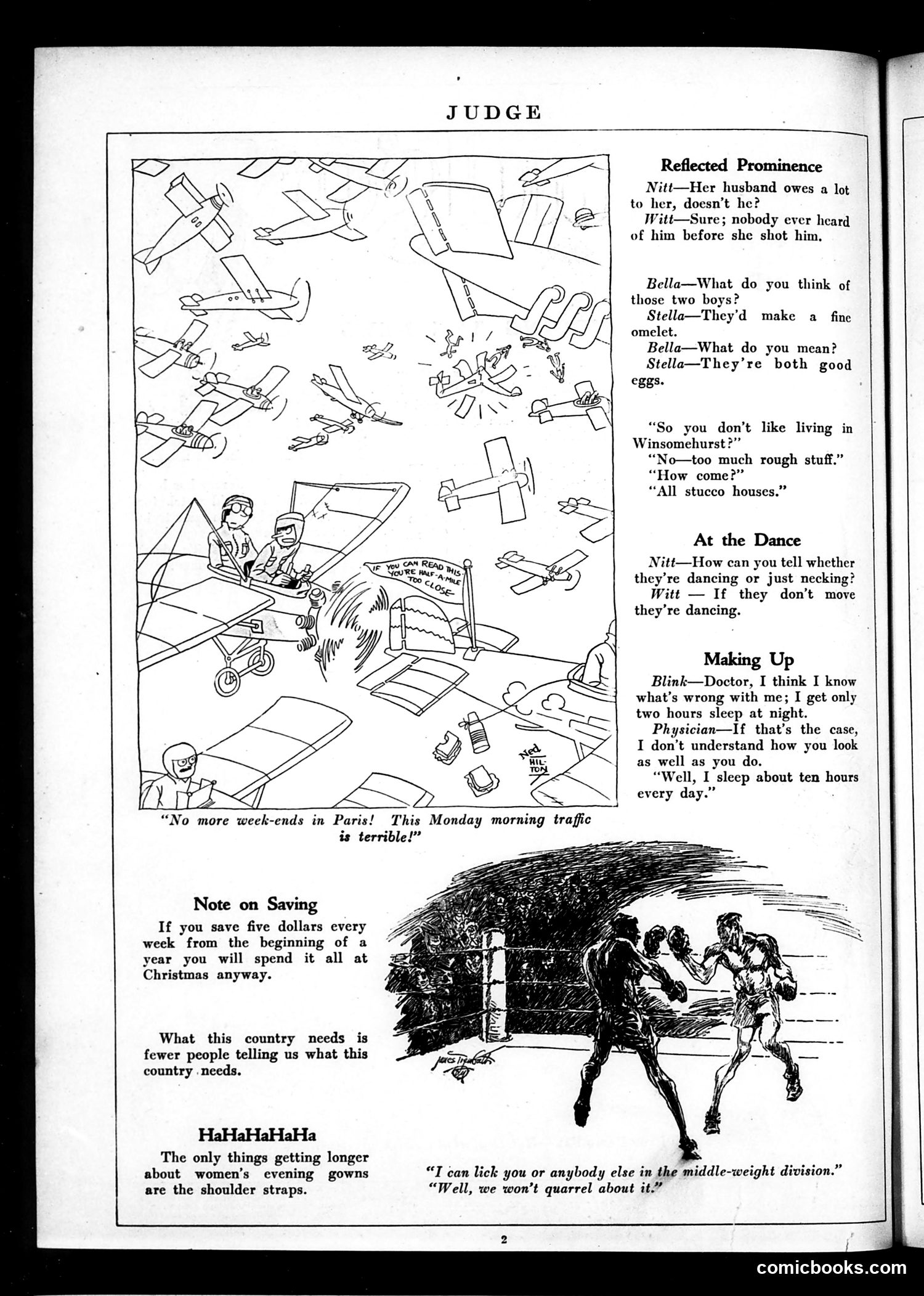
This page contains several unrelated humor pieces rather than a unified political cartoon. The main illustration depicts air traffic congestion over Paris, captioned "No more week-ends in Paris! This Monday morning traffic is terrible!" — satirizing early aviation's growing popularity and the traffic problems it might create. The text sections contain scattered jokes on various topics: marital dynamics ("Reflected Prominence"), romantic advice ("At the Dance"), medical humor ("Making Up"), and social commentary ("Note on Saving," "HaHaHaHaHa"). A boxing illustration appears at bottom with competitive dialogue. The content reflects 1920s-era concerns: weekend travel, romance, personal health, and financial habits — typical Judge magazine fare mixing gentle social satire with domestic humor rather than hard political commentary.
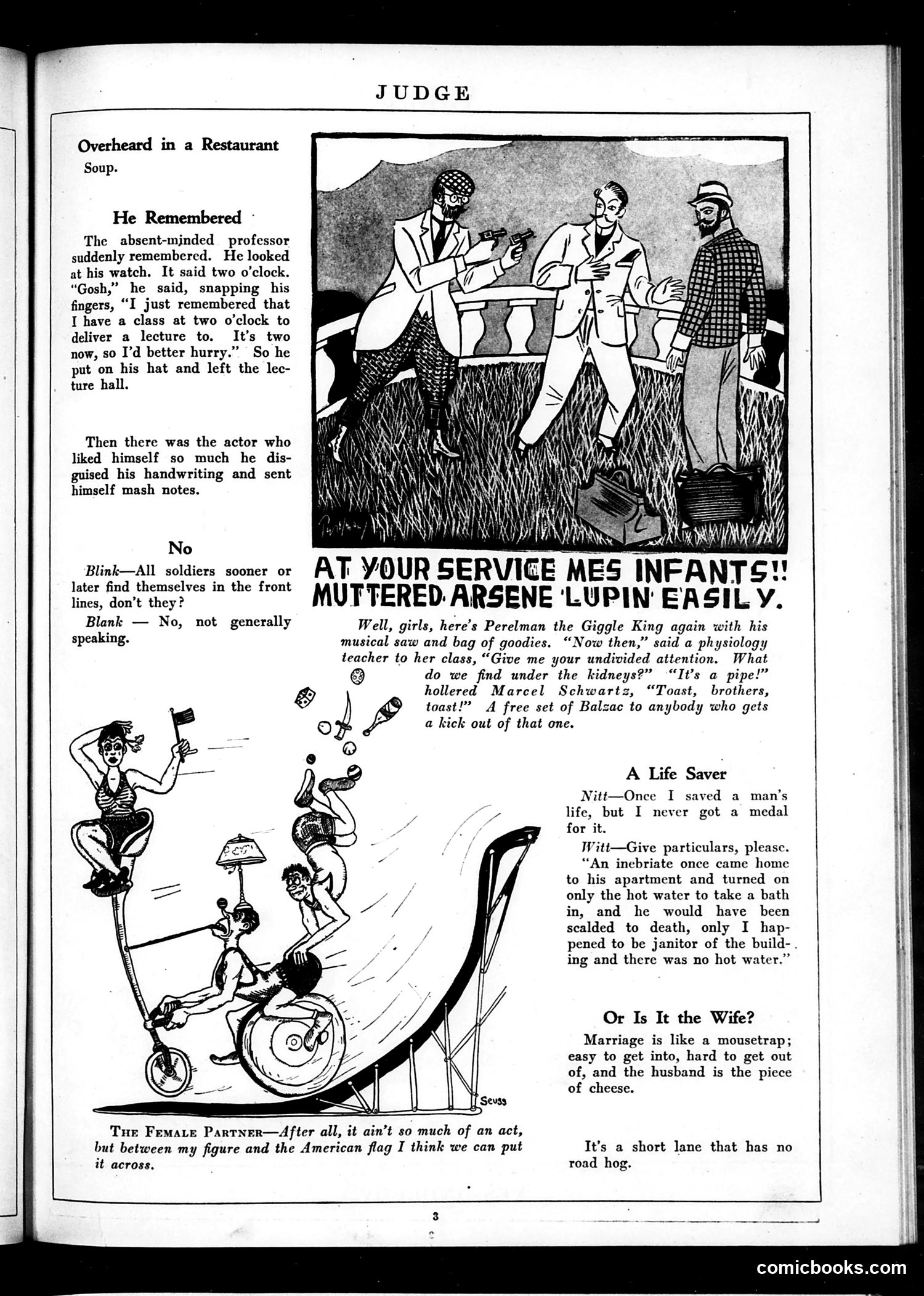
This page contains several unrelated humor pieces typical of early-20th-century satirical magazines: **Top cartoon** shows three men in a field discussing a military matter. The dialogue references soldiers reaching "the front lines"—likely referencing World War I combat experiences. **Main cartoon** titled "At Your Service Mes Infants!!" depicts Perelman the "Giggle King" performing for a physiology class. The satire mocks entertainment acts and physical comedy of the era. **Lower cartoon** shows acrobats performing dangerous stunts on a curved ramp, captioned "The Female Partner," with a joke about American patriotism. **Text pieces** include humorous anecdotes: one about an absent-minded professor, another mocking marriage as a "mousetrap," and a cynical joke about saving lives. The overall tone is cynical, slapstick humor typical of pre-1930s American satire.
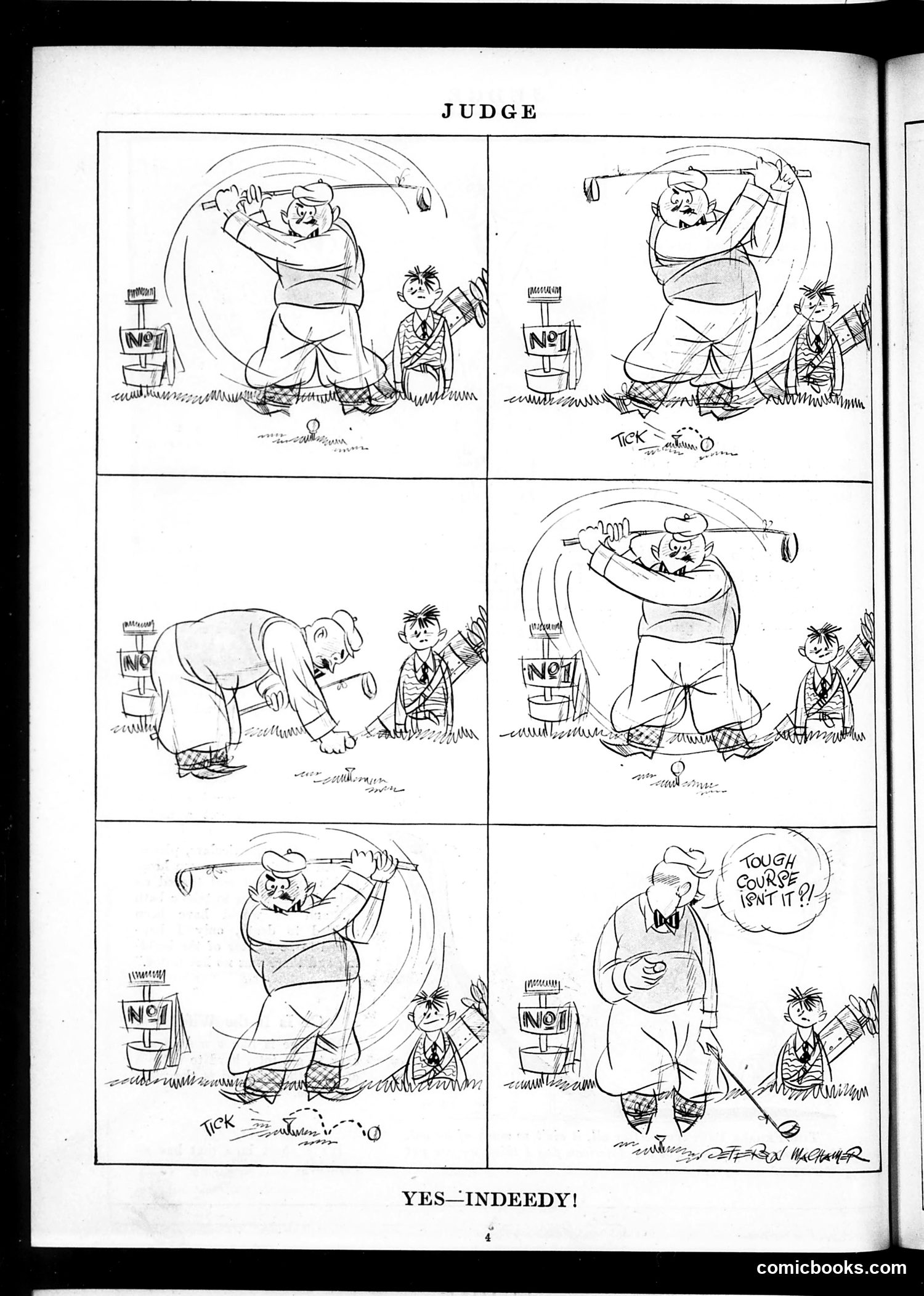
This six-panel Judge comic satirizes a golfer's persistent attempts to make a difficult shot at a course marked "NO!" (likely a restricted or private area). The sequence shows: 1. A rotund golfer preparing an ambitious swing 2. His follow-through, with sound effect "TICK" 3. Him bending to retrieve the ball 4. Another swing attempt 5. His continued effort, marked "TICK" 6. His conclusion: "Tough course, isn't it?" The humor derives from the golfer's stubborn refusal to respect the "NO!" sign's prohibition. The repeated "TICK" sounds suggest multiple failed attempts. The final panel's deadpan response mocks his obtuseness—he attributes his failure to course difficulty rather than acknowledging he's breaking the rules. This likely satirizes broader social or political defiance of authority or regulations during the era when Judge magazine was published.
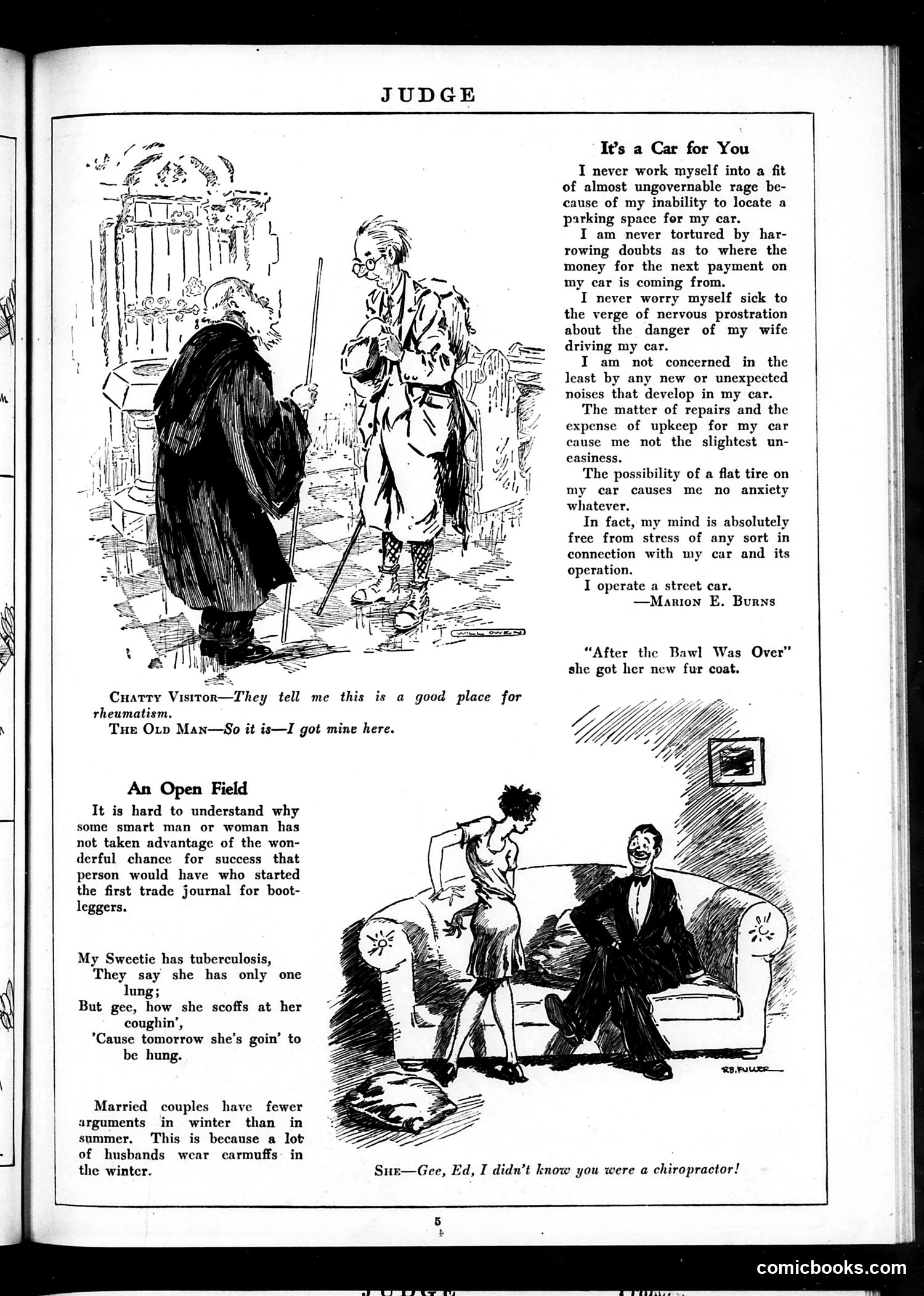
This page contains three satirical pieces from an early 20th-century American humor magazine: 1. **"It's a Car for You"** - A monologue by Marion E. Burns humorously lists all the things that *don't* worry her about car ownership (parking, repairs, tire blowouts, wife's safety). The satire is that she's either obliviously unconcerned or being sarcastic about genuine automotive problems of the era. 2. **"Chatty Visitor" cartoon** - An old man with rheumatism meets a visitor in what appears to be a run-down location, joking that it's a "good place for rheumatism." 3. **"An Open Field"** - Satirizes a woman's nagging boyfriend about his health while ignoring her own tuberculosis, then humorously notes married couples argue less in winter because husbands wear carmuffs (can't hear complaints). The humor relies on period-specific concerns: early automobile unreliability, tuberculosis prevalence, and domestic relationship stereotypes.
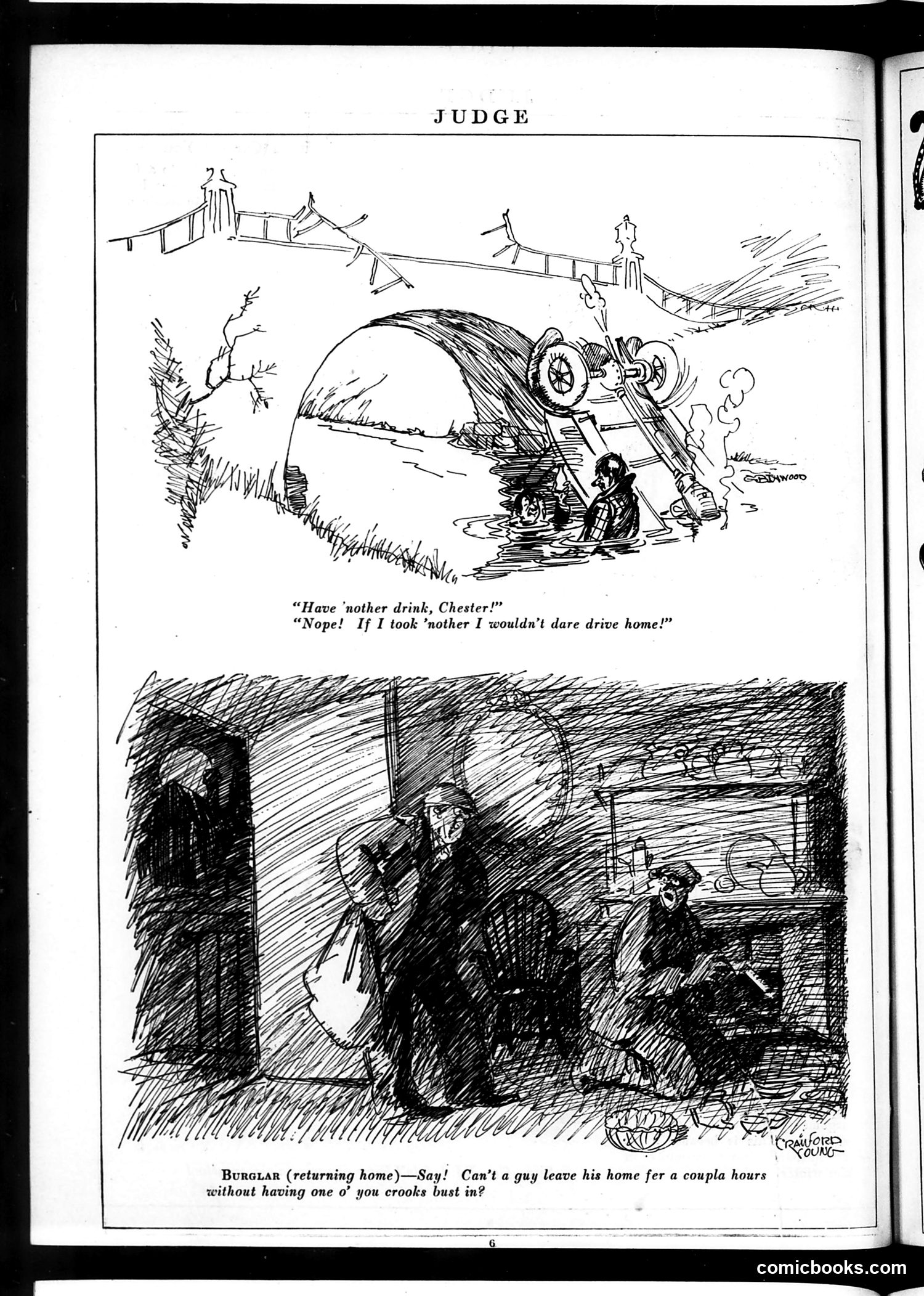
This page contains two cartoons satirizing drunk driving and burglary. The **top cartoon** jokes about responsible drinking: a man named Chester refuses another drink because he wouldn't "dare drive home" intoxicated—suggesting awareness of driving dangers while drunk. The **bottom cartoon** shows a burglar returning home to find *his own* house robbed. The irony is the punchline: a criminal complains about being victimized by other criminals, unable to leave his home unattended "for a coupla hours" without being burglarized himself. The satire mocks the burglar's sense of grievance—he expects safety and security despite his own profession involving theft. It's darkly comic commentary on criminal hypocrisy. The cartoons appear from an early-to-mid 20th century publication, given the art style and language ("coupla").
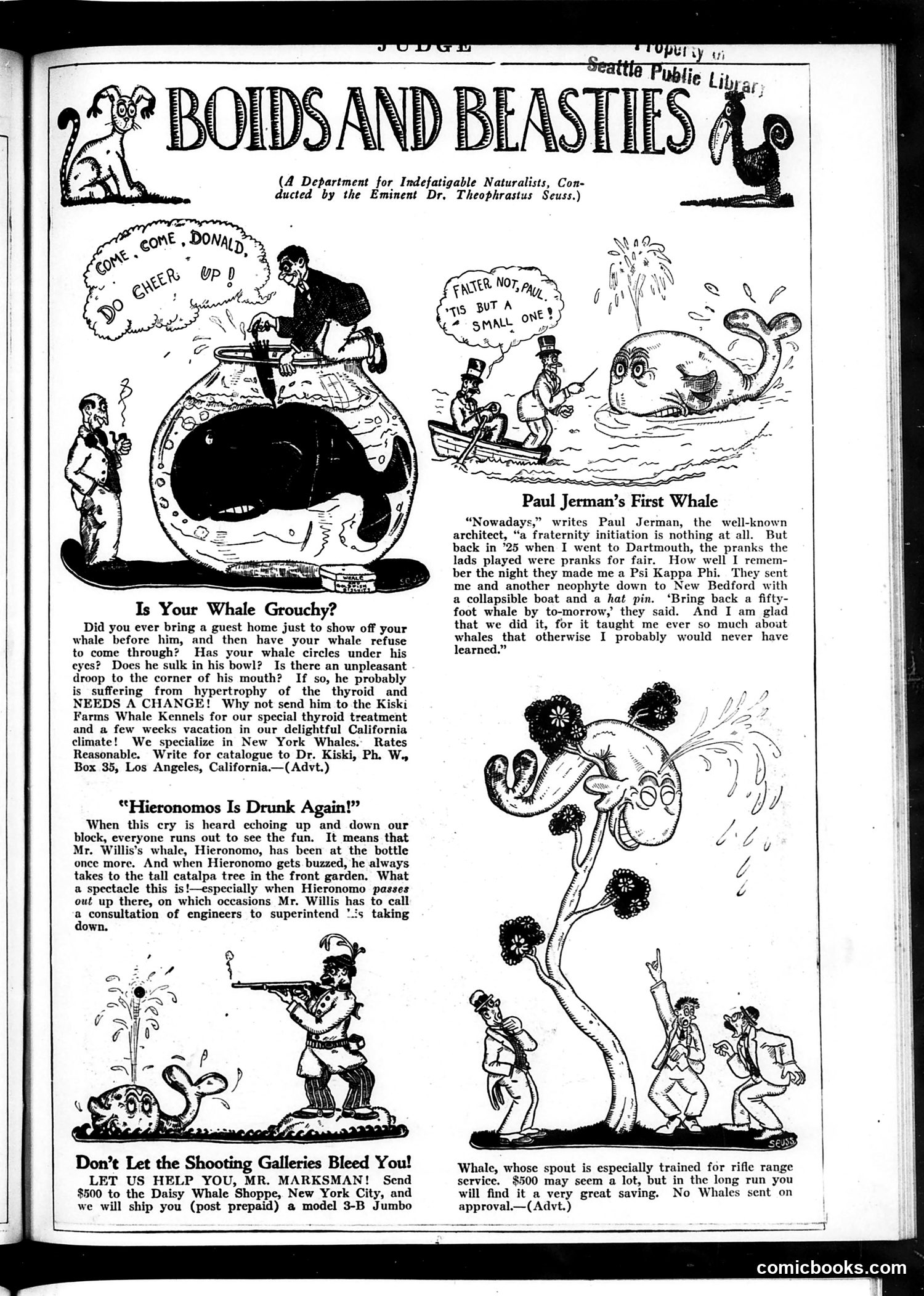
This page satirizes the absurdity of keeping whales as pets—a ridiculous premise that anchors multiple joke advertisements. Written under the fictional authority of "Dr. Theophrastus Seuss" (an early pen name of Dr. Seuss), it mocks the era's fad culture and consumer excess. The satire includes: **"Is Your Whale Grouchy?"** — Parodies pet-care advice columns, offering thyroid treatment and California vacation "kennels" for depressed whales, absurdly treating massive sea creatures like house pets. **"Hieronomos Is Drunk Again!"** — A supposed neighbor's drunken whale that climbs trees, mocking both pet anecdotes and urban eccentricity. **"Paul Jerman's First Whale"** — Spoofs fraternity initiation stories by claiming the prank involved capturing a 50-foot whale with a hat pin. **Fake advertisements** for whale shops and rifle-range-trained whales complete the mock-earnest tone. The humor relies on readers recognizing the complete implausibility of whale domestication while the text maintains a straight, advice-column voice.
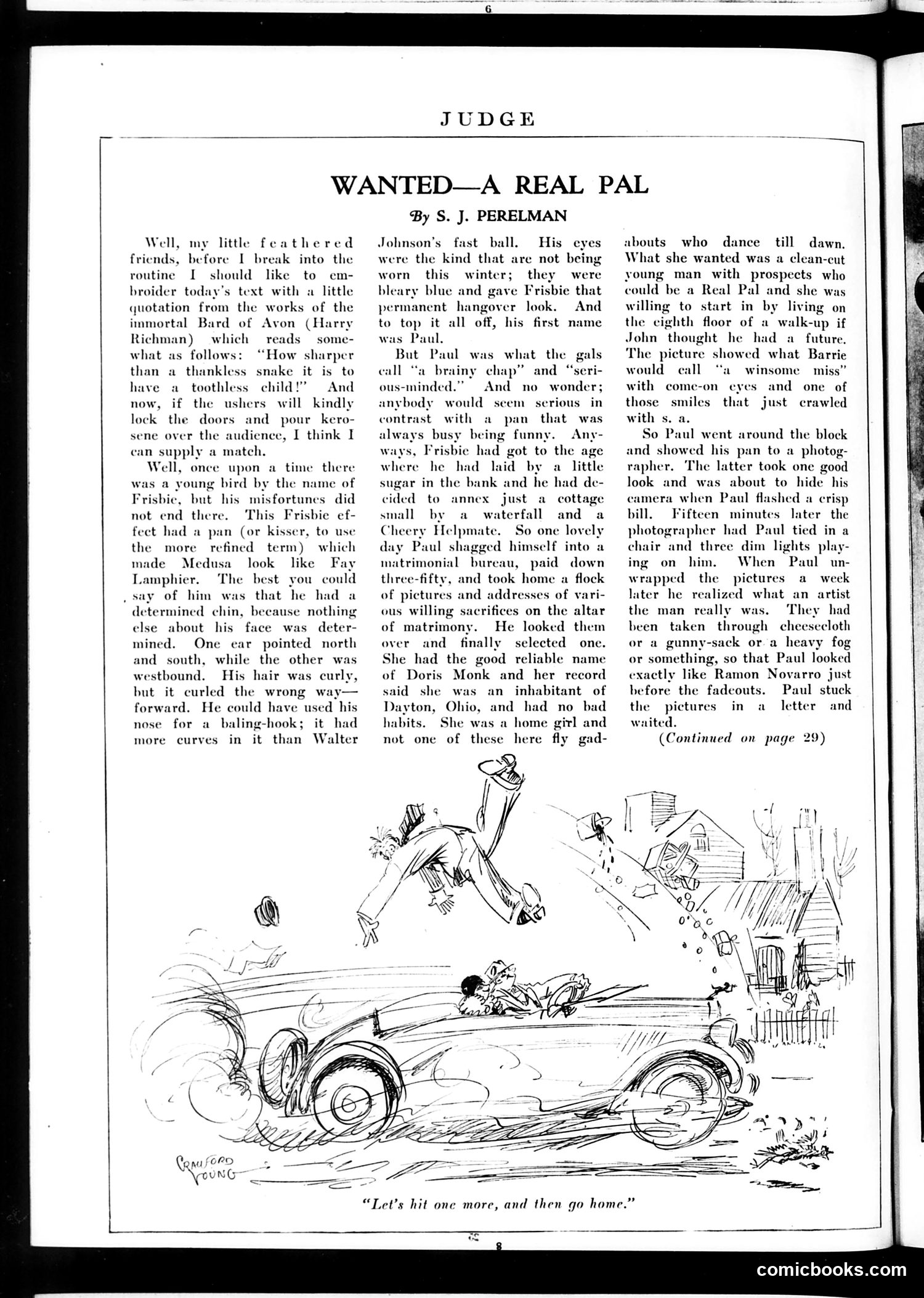
This is a humorous short story (illustrated with a cartoon of a speeding car), not political satire. The narrative mocks a homely young man named Paul Frisbie who decides to marry. Despite his deeply unattractive appearance—described with exaggerated grotesqueness (misaligned ears, curved nose, wrong-way hair)—he attracts a "winsome miss" named Doris Monk through a matrimonial bureau. The satire targets early 20th-century dating conventions and advertising deception: Paul hires a photographer who uses heavy filters and tricks to make him resemble handsome movie star Ramon Navarro, then sends the falsified photos in his marriage proposal letter. The cartoon's caption—"Let's hit one more, and then go home"—appears unrelated to the text, suggesting either a separate comic or editorial art. The overall piece satirizes vanity, fraudulent self-presentation in courtship, and the emerging "matrimonial bureau" industry of the era.
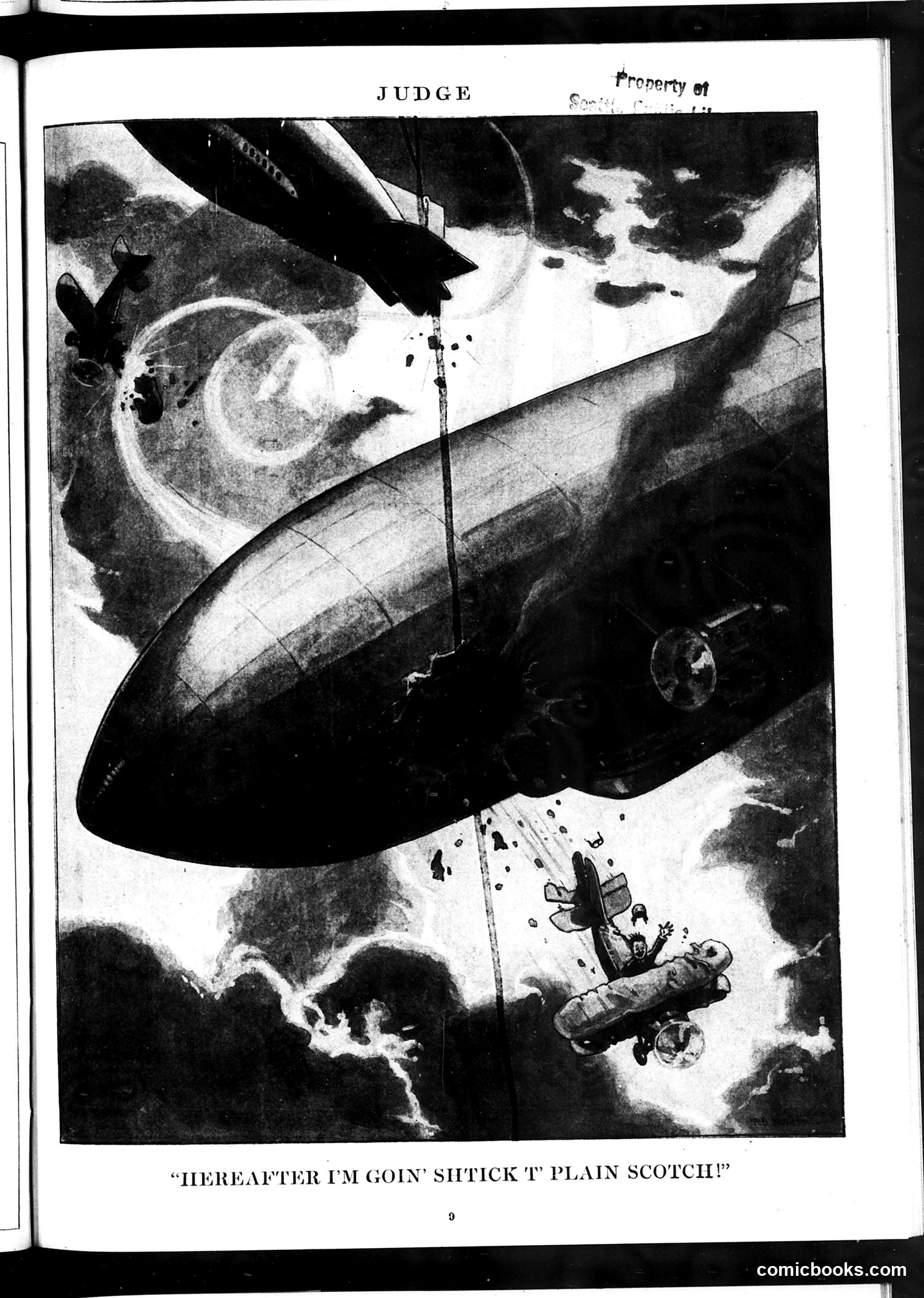
This page features an aviation-themed cartoon with the caption "Hereafter I'm Goin' Sittick T' Plain Scotch!" The image depicts a large military aircraft (appears to be a bomber or transport plane) in an aerial dogfight or combat scenario with smaller biplanes amid clouds and explosions. The satire appears to reference **Prohibition era** concerns about alcohol consumption and sobriety. The joke suggests that witnessing dangerous aerial combat—likely referencing World War I military aviation—is so harrowing that even someone committed to avoiding alcohol ("plain scotch") would abandon their resolve. The cartoon mocks both aviation dangers and contemporary debates about alcohol prohibition by implying extreme situations justify breaking temperance commitments. Without a visible date, the exact historical moment remains unclear, though the aircraft style suggests early 20th century.
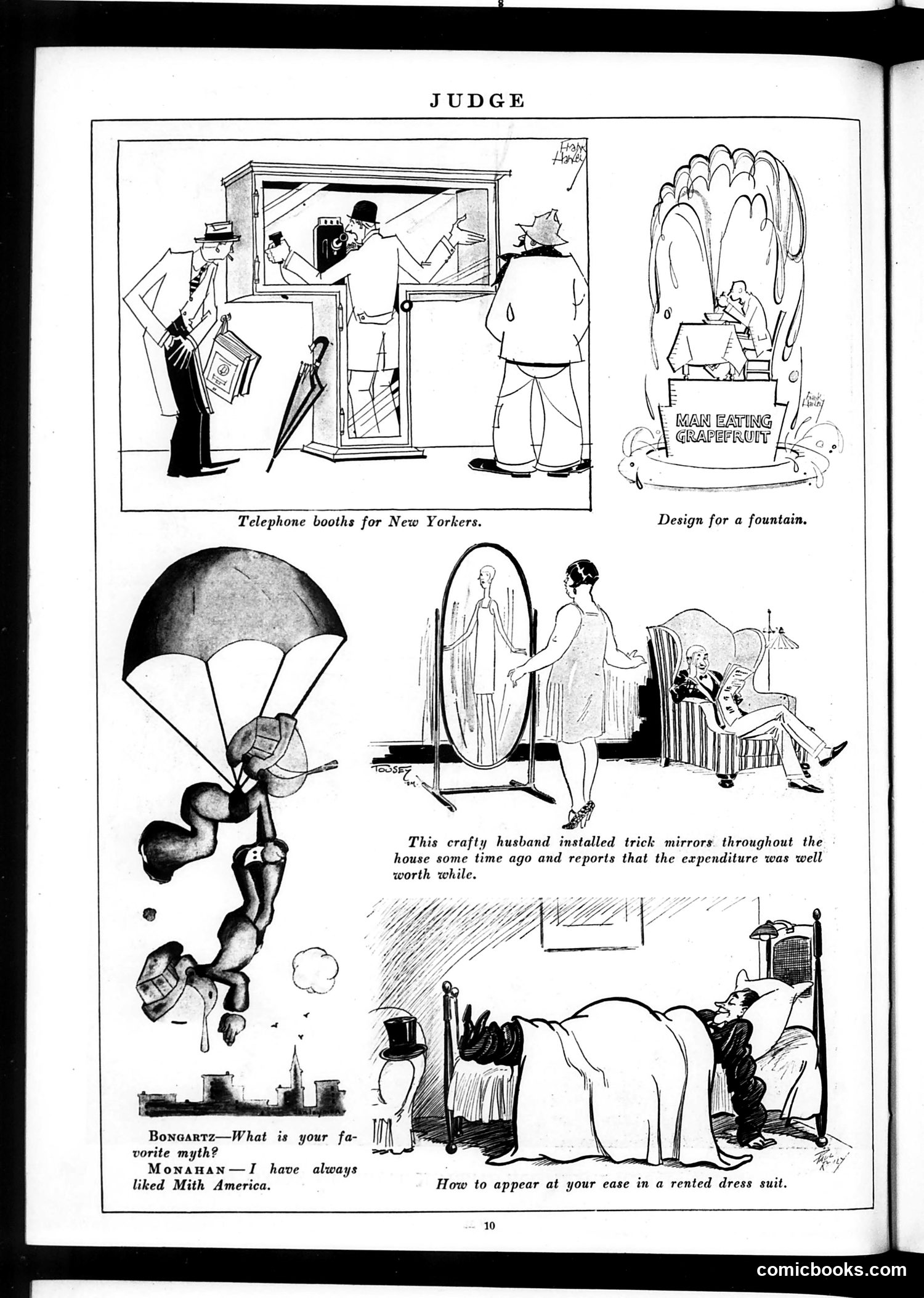
This page contains five unrelated comic panels satirizing early 20th-century American life: 1. **"Telephone booths for New Yorkers"** mocks cramped NYC public phone booths by showing figures squeezed into a tiny structure. 2. **"Design for a fountain"** jokes about a man eating grapefruit—likely satirizing nouveau riche or pretentious dining habits. 3. **Trick mirrors cartoon** ridicules a husband who installed deceptive mirrors throughout his house, claiming the expense was "worthwhile"—the humor likely refers to marital discord or vanity. 4. **"Myth America" joke** plays on "Myth" vs. "Mith," a simple pun about American mythology or tall tales. 5. **"Rented dress suit" cartoon** depicts someone struggling awkwardly in formal wear, satirizing social pretension or the discomfort of dressing above one's station. The overall theme addresses contemporary anxieties about class, urban life, and social performance in Jazz Age America.
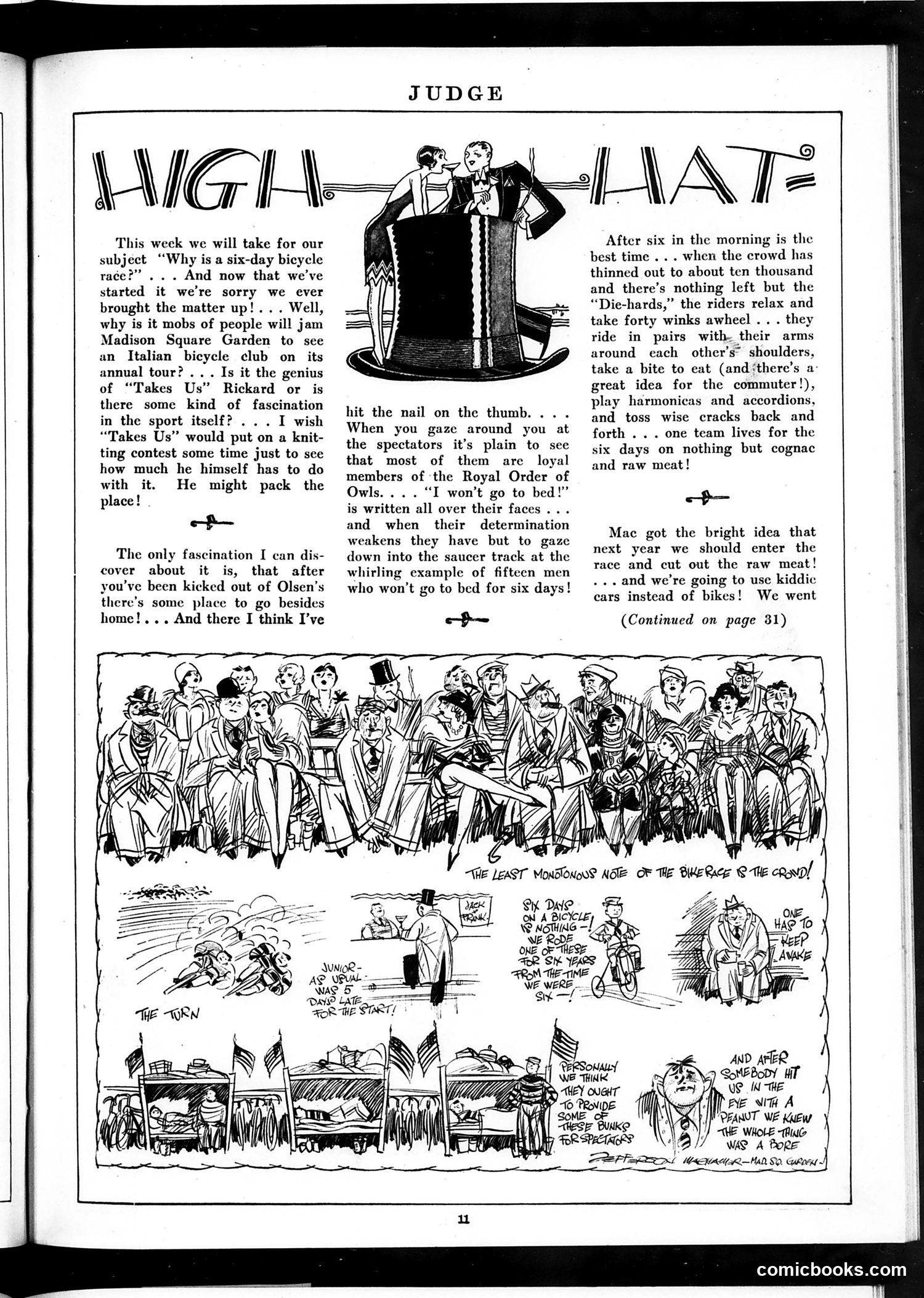
This column satirizes the popularity of six-day bicycle races at Madison Square Garden, organized by promoter Tex Rickard ("Takes Us" Rickard). The author questions why crowds jam the venue for this Italian cycling event, speculating the fascination lies not in the sport itself but in the spectators—described as members of the "Royal Order of Owls," a reference to all-night social clubs where members famously refused to go to bed. The humor targets both the endurance sport and the nocturnal lifestyle it represents. The accompanying comic strip mockingly depicts the "least monstrous note" of the event, showing exhausted riders sleeping mid-race while paired together, sustained only on cognac and raw meat—absurdly exaggerating the race's grueling demands. A closing joke suggests replacing bicycles with kiddie cars, ridiculing the spectacle's inherent absurdity. The satire fundamentally questions why New Yorkers find entertainment in watching men deliberately deprive themselves of sleep for six consecutive days.
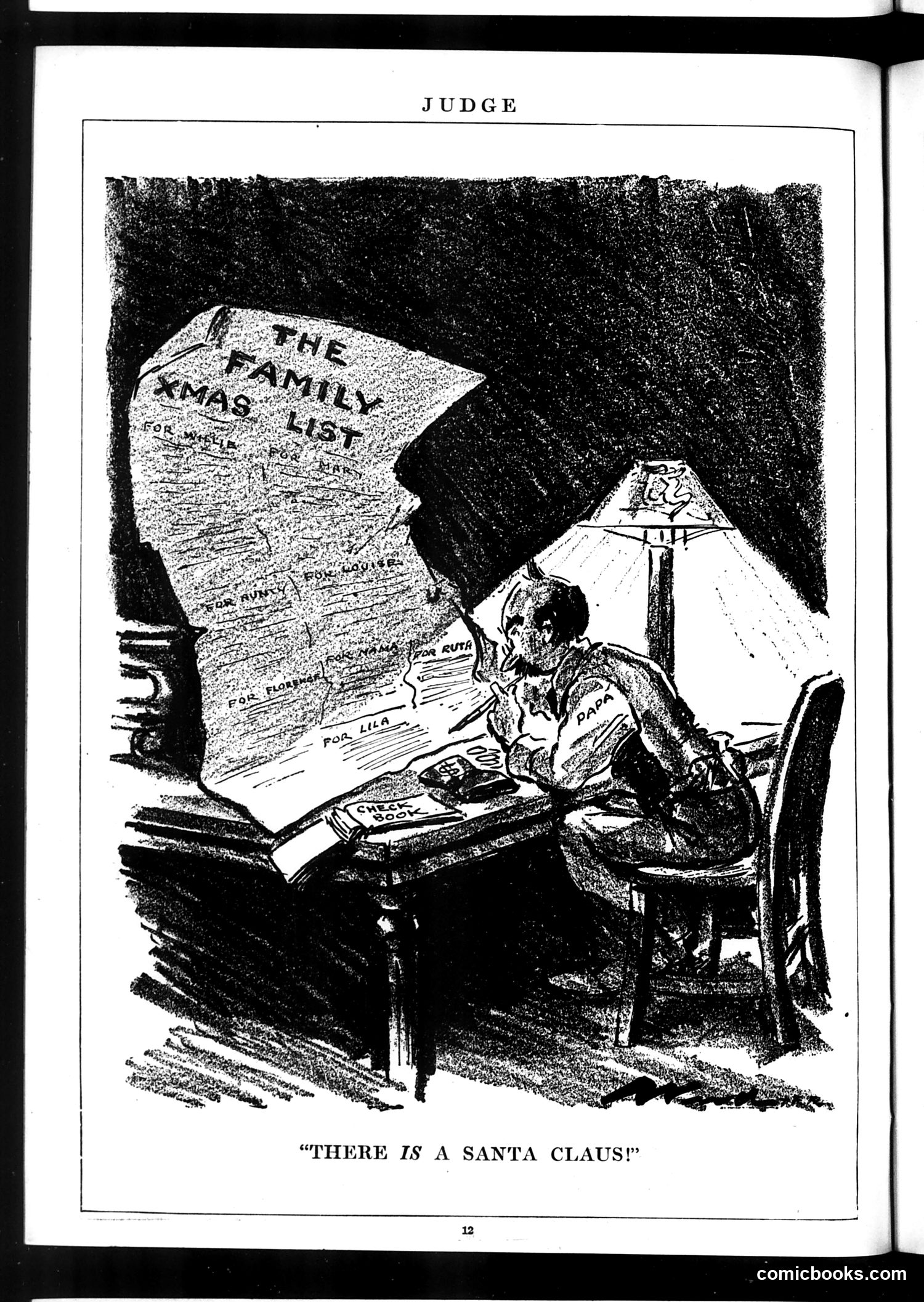
This cartoon depicts a judge or authority figure at a desk examining "The Family List"—a large document listing names with gift allocations (visible names include "FOR RUTH," "FOR PAPA," "FOR LILA"). A lamp illuminates the scene. The satire appears to critique materialism and commercialism around Christmas gift-giving, particularly the gap between idealistic notions of Santa Claus and the reality of parental burden in purchasing presents. The "judge" examines this list with apparent concern or resignation, suggesting the financial strain of meeting family expectations during the holiday season. The title's ironic tone—"There IS a Santa Claus!"—undercuts childhood innocence by revealing the adult reality: parents must financially deliver on Christmas promises, making them the actual "Santa."
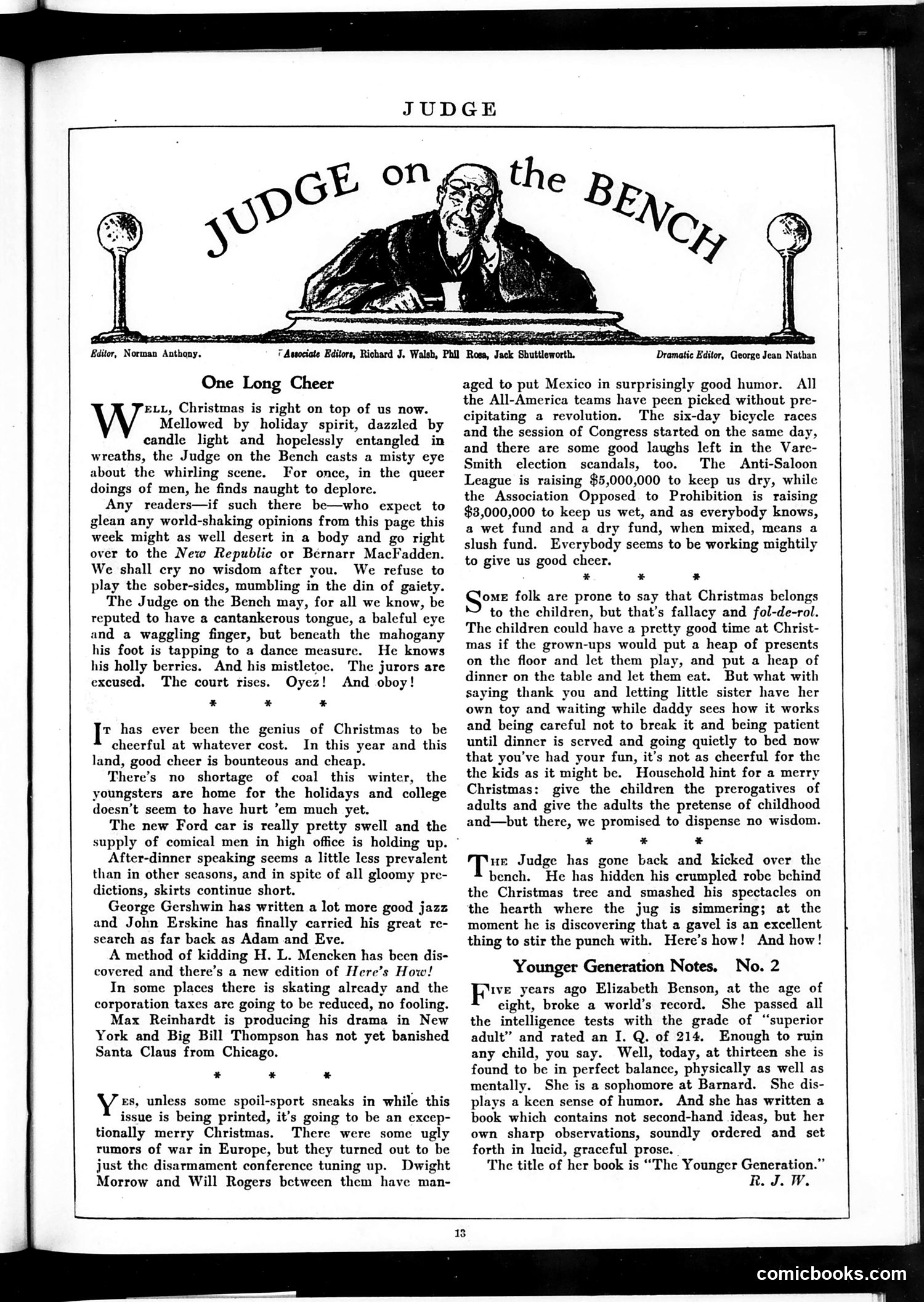
This is an editorial column (not a political cartoon) from *Judge* magazine's Christmas issue. The masthead illustration shows a jovial judge relaxing at the bench rather than dispensing criticism. The piece is a tongue-in-cheek holiday meditation rejecting serious social commentary. The author sarcastically refuses to offer wisdom, instead celebrating that Christmas 1924 offers genuine reasons for cheer: no coal shortage, affordable holiday spirits (post-Prohibition debate), new cars, good entertainment (Gershwin, theater), and even Mexico relations improving thanks to diplomat Dwight Morrow and Will Rogers. The satire targets contemporary concerns—Prohibition funding battles, Vare-Smith election scandals, corporation taxes—but dismisses them as minor annoyances next to seasonal joy. References to *The New Republic* and Bernarr Macfadden indicate competing magazines with weightier pretensions. The tone is distinctly anti-serious, celebrating American prosperity and popular culture over political hand-wringing.
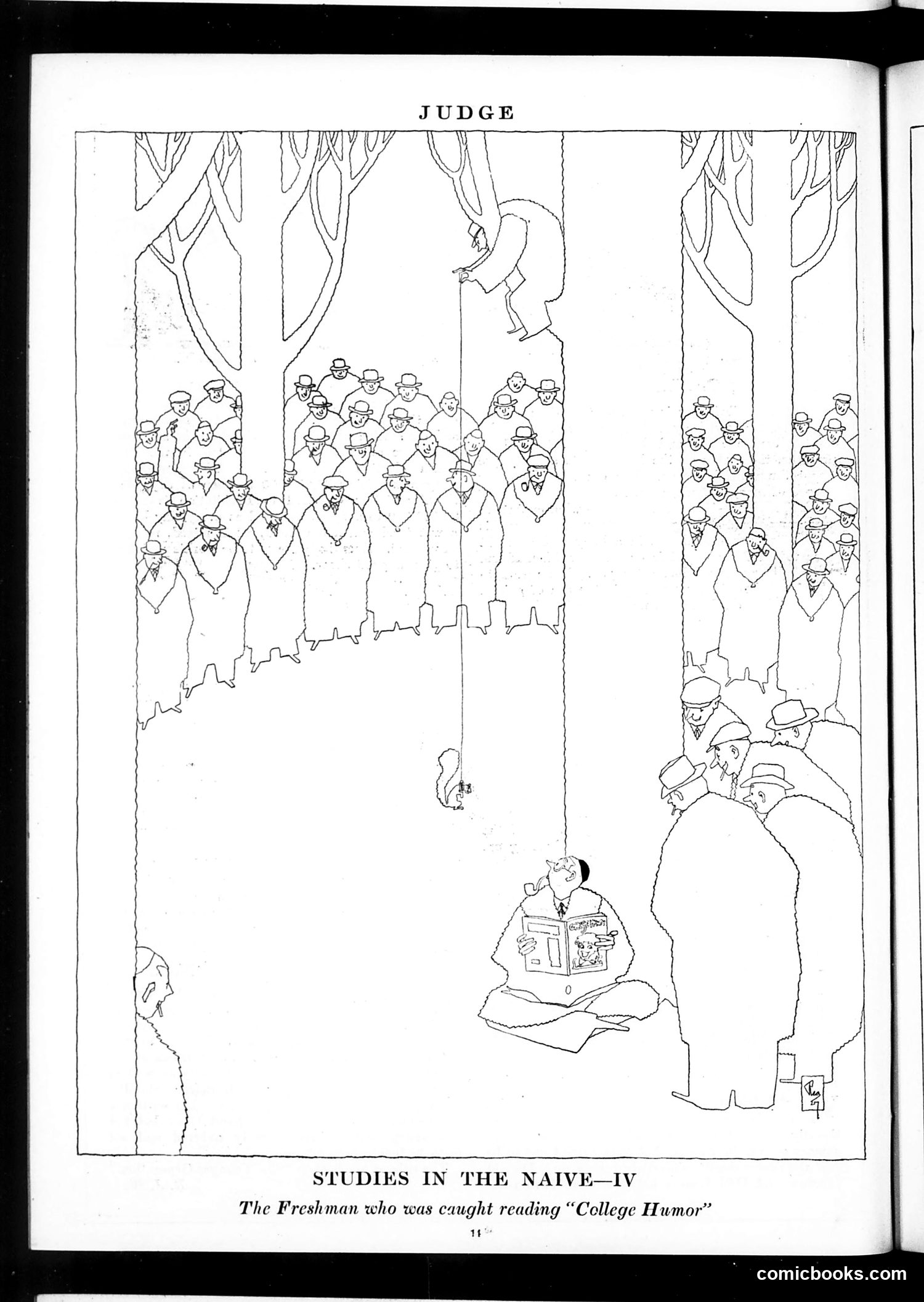
This is a satirical cartoon about a college freshman caught reading *College Humor* magazine. The joke relies on the contrast between the serious, formal setting and the frivolous activity. The scene shows the freshman sitting alone in a forest clearing, absorbed in reading *College Humor*—depicted as an undignified, lowbrow publication. Above and around him, numerous stern-faced men (likely professors, administrators, or authority figures) observe from the trees, looking down disapprovingly. One figure even hangs from a branch above. The satire targets college freshmen for their naïveté and poor taste in entertainment, while also mocking the pretentious judgment of academic institutions. The title "Studies in the Naive" suggests this is part of a series examining foolish college behavior. The humor comes from depicting a student's innocent magazine reading as something worthy of widespread condemnation and surveillance.
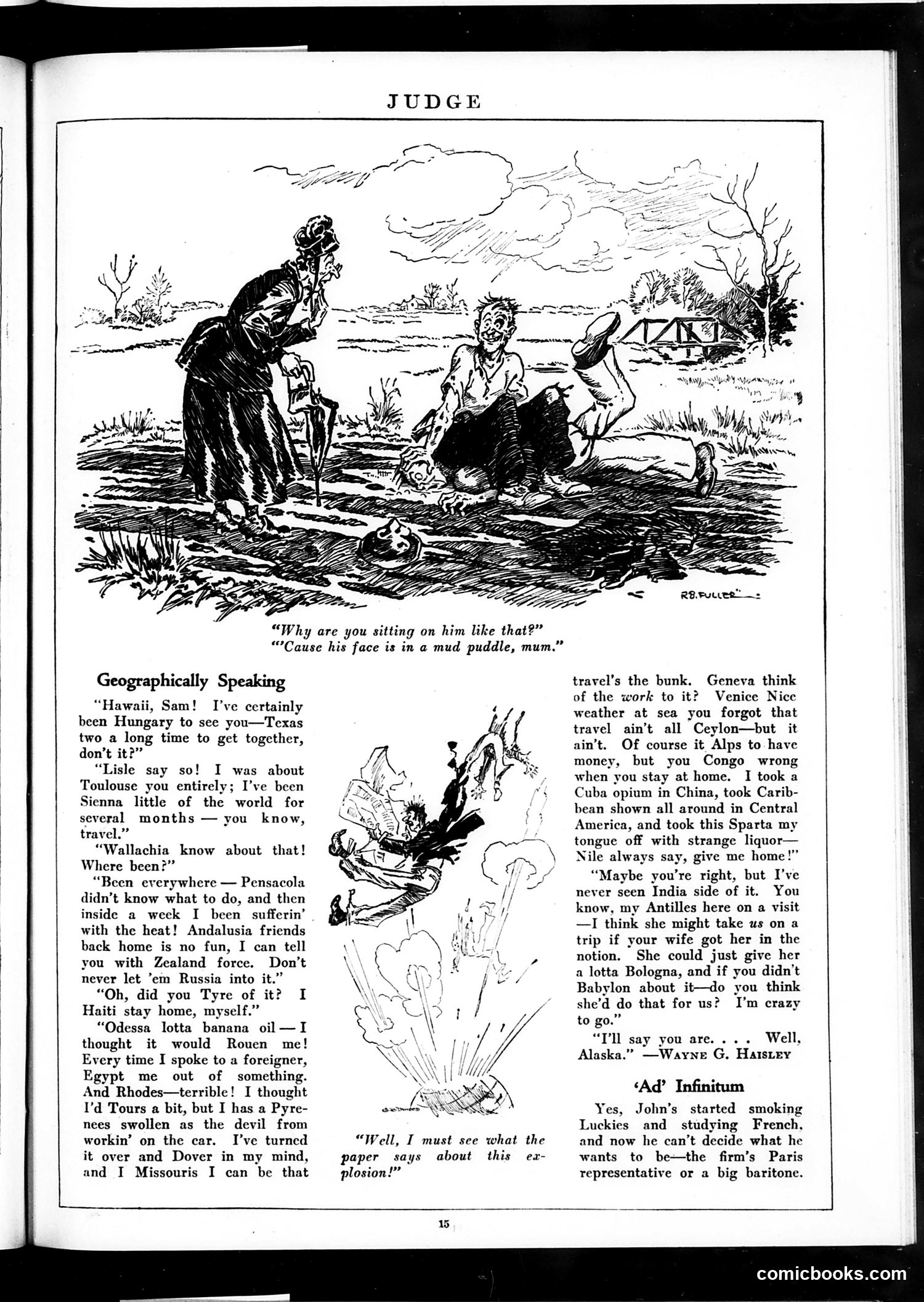
The top cartoon depicts a child sitting on a muddy man's face—a literal visualization of the idiom "sitting on someone," mocking childish literalism. The main text, "Geographically Speaking," is a elaborate pun-based comedy sketch where two characters discuss travel using place names as homophones. Examples: "Hungary" (hungry), "Toulouse" (tell you), "Zealand force" (zeal and force), "Tyre of it" (tire), "Egypt" (egg it), "Rhodes" (roads), "Dover" (do over). This wordplay humor was typical of early-to-mid 20th century American magazines—relying on audience familiarity with world geography to recognize the puns. The joke's sophistication assumes educated readers who know place names well enough to appreciate the linguistic substitutions. The bottom item, "'Ad' Infinitum," briefly notes a young man named John now smokes cigarettes and studies French, unable to decide between becoming a Paris representative or baritone—a light joke about youthful indecision and affectation.
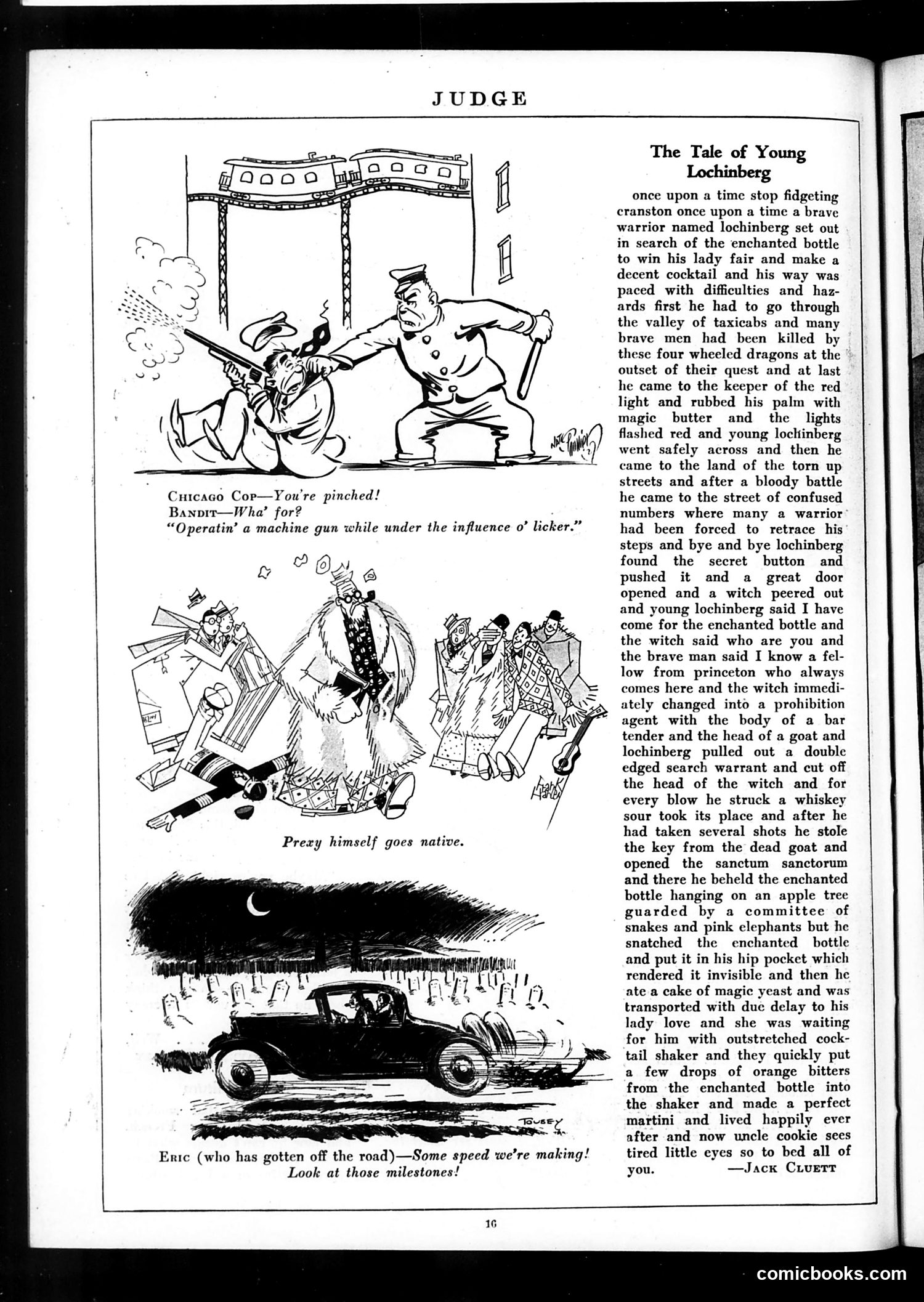
This page contains Prohibition-era humor (1920s-1933). "The Tale of Young Lochinberg" is a mock-heroic parody mocking Prohibition enforcement through fantasy adventure tropes. Young Lochinberg's quest for an "enchanted bottle" (alcohol) satirizes the lengths people went to obtain illegal liquor. The journey through "valley of taxicabs," "street of confused numbers," and encounters with a "prohibition agent" with a goat's head ridicules both Prohibition's absurdity and law enforcement's incompetence. The smaller cartoons mock enforcement more directly: a Chicago cop arrests a bandit for "operating a machine gun while under the influence of licker," and Eric drives recklessly while drunk ("Some speed we're making!"). The satire targets both Prohibition laws and the criminals/drinkers who flouted them—suggesting the entire system was farcical. This reflects Judge's satirical stance during this unpopular era of American policy.
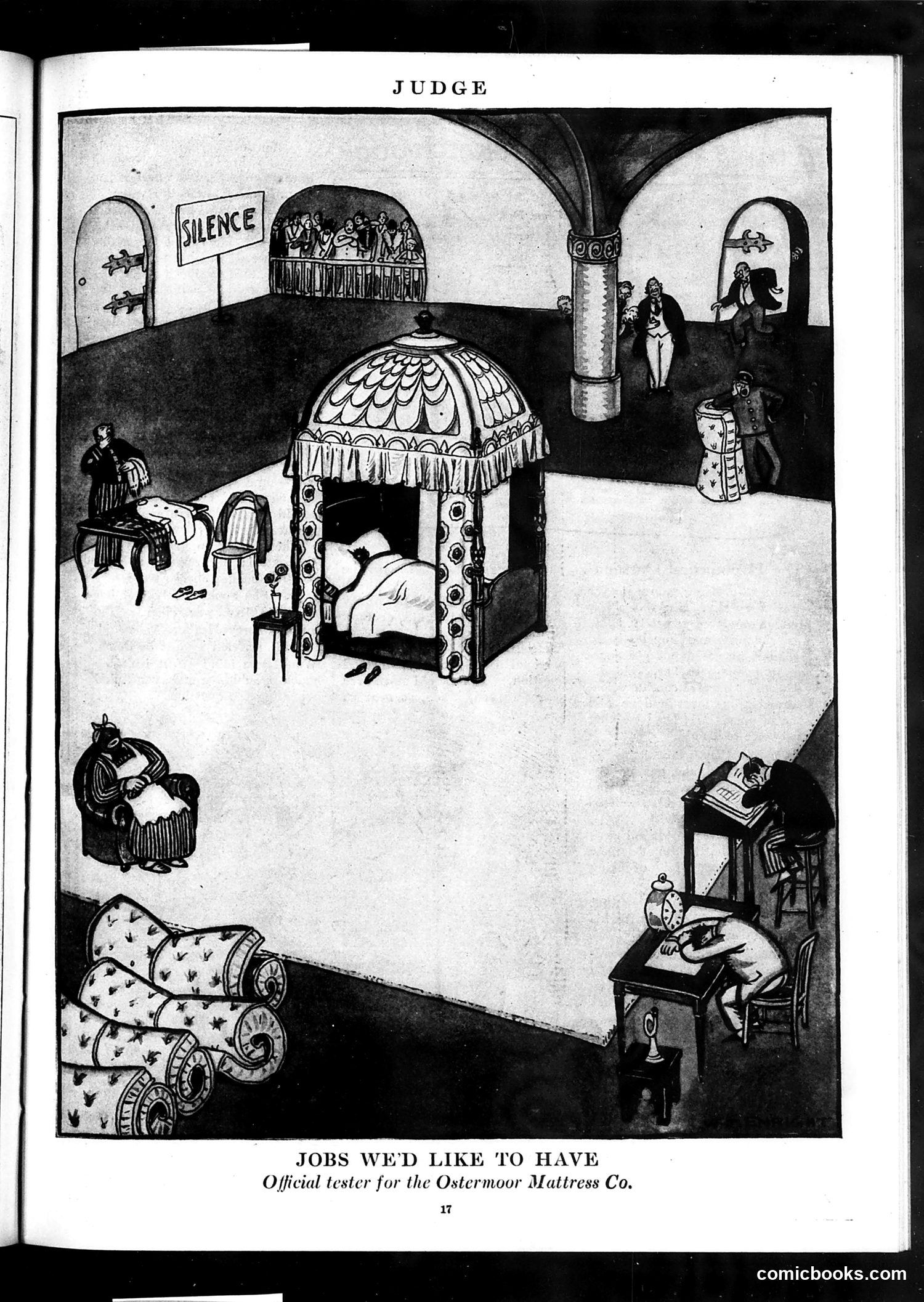
This is an advertisement disguised as humor for the Ostermoor Mattress Company. The cartoon depicts a luxurious bedroom scene where a person sleeps peacefully in an ornate canopied bed while various *Judge* magazine staff members (identifiable by period dress and office settings around the room) work at desks, conduct business, and observe courtroom proceedings—all labeled with a "SILENCE" sign. The joke is straightforward: the advertiser is claiming the job of "official mattress tester" would be so desirable that *Judge* employees would eagerly abandon their actual work to sleep on an Ostermoor mattress all day. It's a tongue-in-cheek endorsement playing on the mattress company's quality and comfort. The architectural grandeur and the contrast between restful sleep and ongoing labor emphasizes luxury and escape from work.
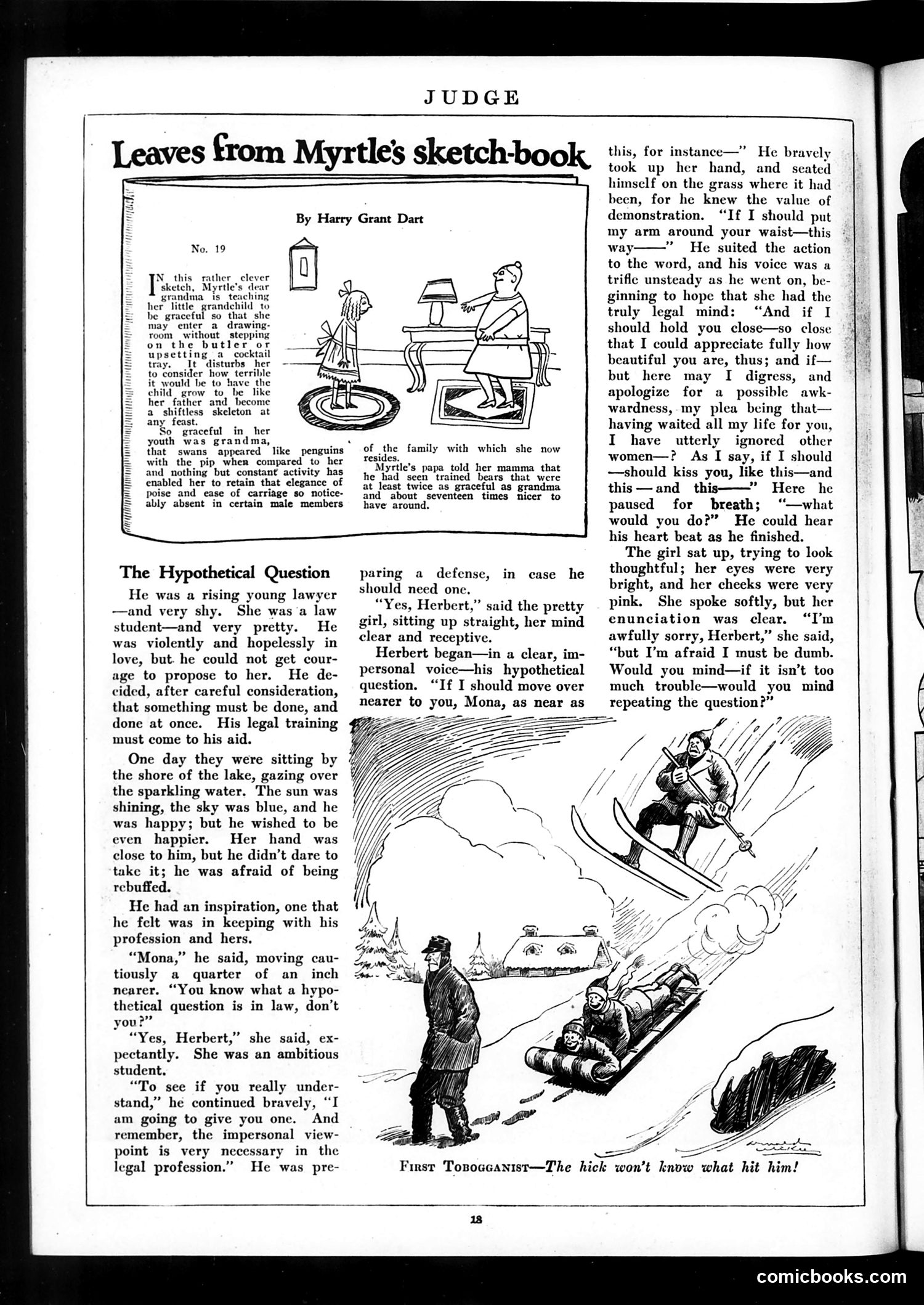
This humorous story satirizes the timidity of young professionals in the early 20th century. A shy young lawyer, unable to directly propose to a female law student, uses a legal device—the "hypothetical question"—as cover to physically advance his romantic intentions. He poses increasingly intimate scenarios (moving closer, embracing, kissing) as theoretical legal examples rather than direct actions. The joke's payoff relies on the girl's response: she requests he repeat the question, implying she either didn't understand his actual intent or is playing coy herself. The satire targets both the lawyer's awkward professorial approach to romance and the pretense of "impersonal" academic discussion as a socially acceptable way to bypass courtship conventions. The cartoon gently mocks how educated young men attempted intellectual workarounds for emotional directness.
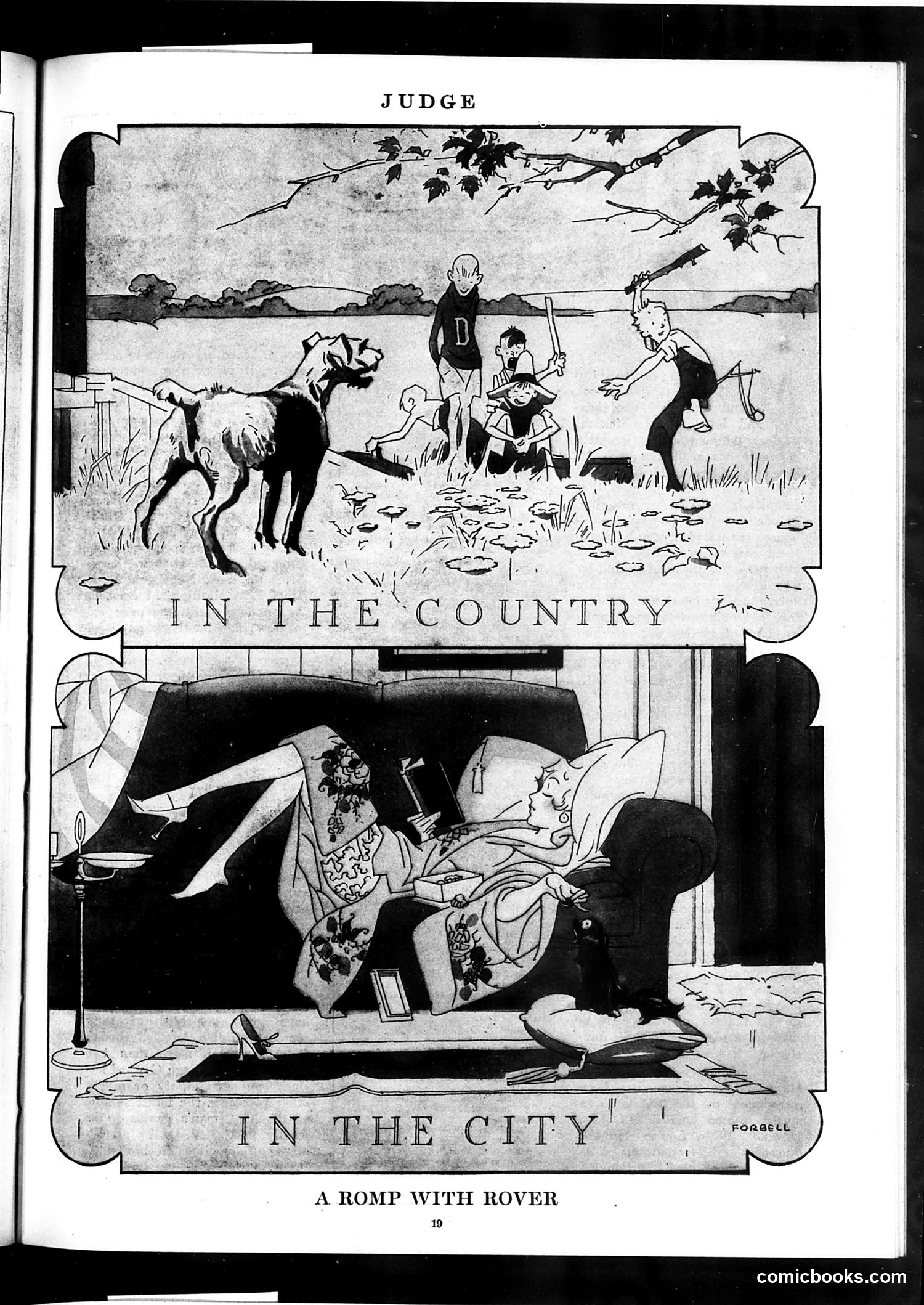
This cartoon contrasts rural and urban life through the figure of a dog (Rover). The top panel shows carefree children playing outdoors in the countryside with an energetic dog—depicting rural life as wholesome, active, and natural. The bottom panel shows the same scenario transposed to a city apartment, where a woman reclines on a sofa reading while the dog disrupts the refined domestic space, scattering papers and creating chaos. The joke satirizes the clash between a dog's natural exuberance and the constraints of urban, bourgeois indoor living. The cartoon mocks city dwellers' pretensions to genteel leisure while their pets (and perhaps their own instincts) resist such artificial confinement. It's a commentary on the tension between natural behavior and civilized urban restraint—a common Judge magazine theme.
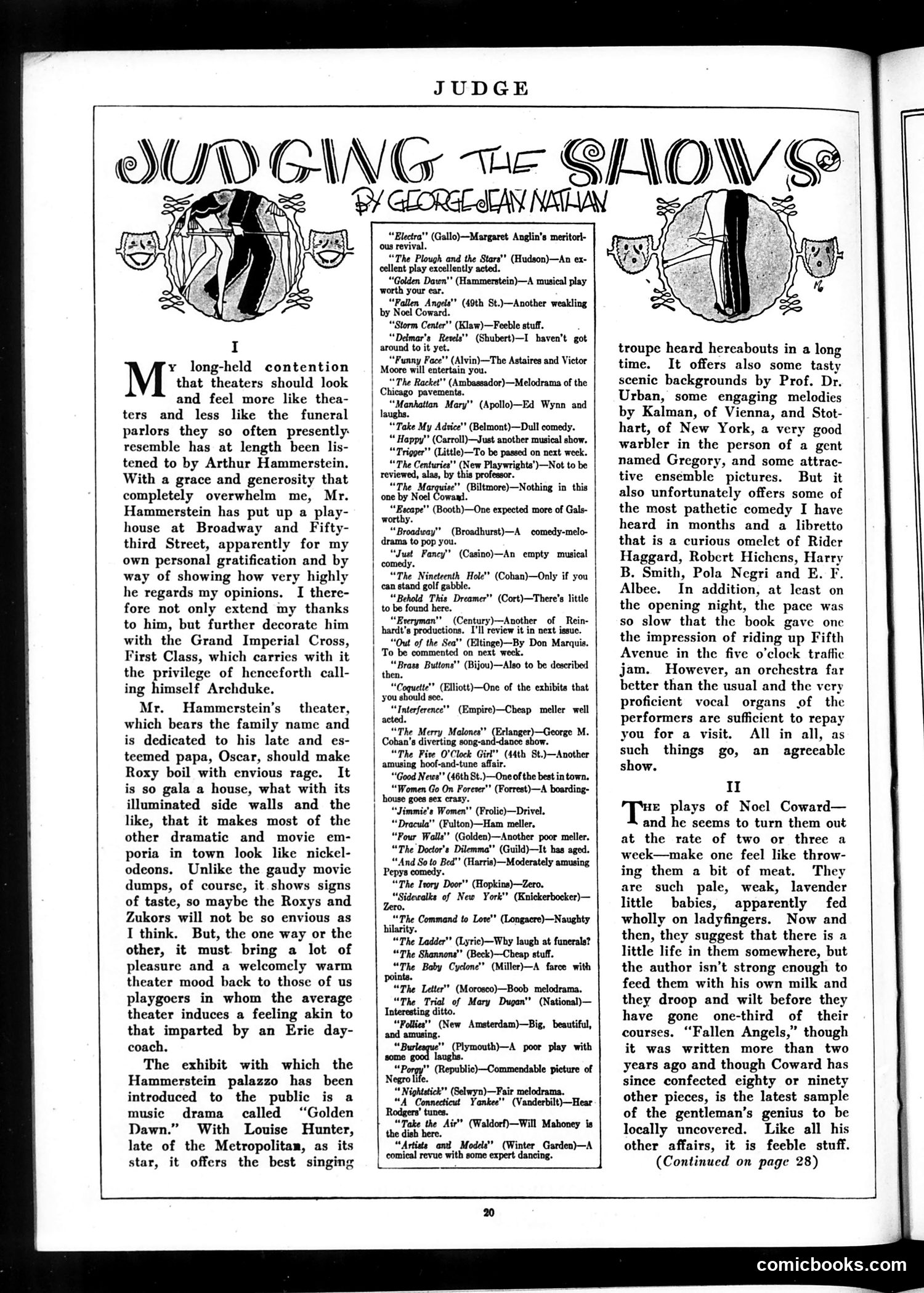
This page contains George Jean Nathan's theater column "Judging the Shows," reviewing Broadway productions of what appears to be the mid-1920s. **Key Content:** The main article praises Arthur Hammerstein's new Broadway theater (at 53rd Street) as genuinely elegant—a welcome contrast to the dreary "funeral parlor" aesthetic of most contemporary theaters. Nathan sarcastically "decorates" Hammerstein with a "Grand Imperial Cross" for building a tasteful venue rather than a gaudy movie palace. The featured show is the musical *Golden Dawn*, starring Metropolitan Opera singer Louise Hunter, which Nathan endorses as worthwhile. **The Satire:** Nathan's exaggerated gratitude mocks theater owners generally while genuinely praising Hammerstein's restraint. He contrasts Hammerstein's refined approach with competitors like Roxy and Ziegfeld, whose ornate movie palaces prioritized spectacle over substance. The extensive theatrical listing that follows represents Nathan's typical snappy, often dismissive reviews of current Broadway shows—ranging from praise to brutal brevity ("Feeble stuff," "Drivel").
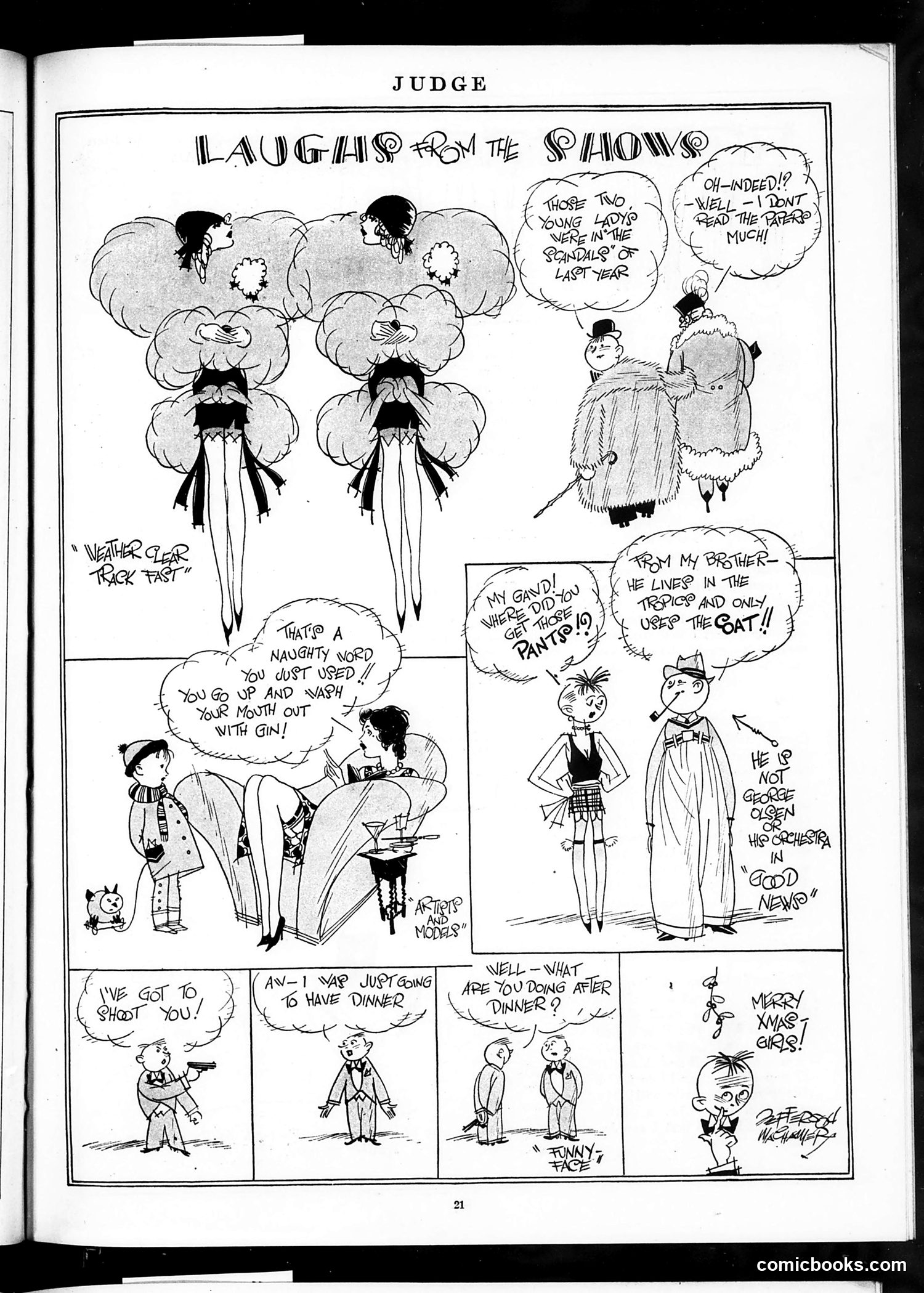
This is a satirical comic about theatrical/vaudeville performers and their social pretensions. The main joke centers on **"weather girl" and "back East"** characters—likely vaudeville or Broadway performers discussing their sophistication and earnings. The humor targets: 1. **Class pretension**: Performers claiming refinement while using crude language ("naughty word," gin references) 2. **Show business gossip**: References to performers' scandals, with mentions of "George Olsen and his orchestra" (a real 1920s-30s bandleader), suggesting real theatrical figures are being mocked 3. **Family embarrassment**: One character mentions his brother using the cat in the tropics—crude humor about performers' unseemly behavior 4. **Holiday season satire**: The final panels show awkward post-dinner small talk, ending with a character saying "Merry Xmas Girls!" The overall point: theatrical people affect sophistication but reveal themselves as vain, gossipy, and morally questionable through their chatter. This reflects Jazz Age anxieties about entertainment industry morality.
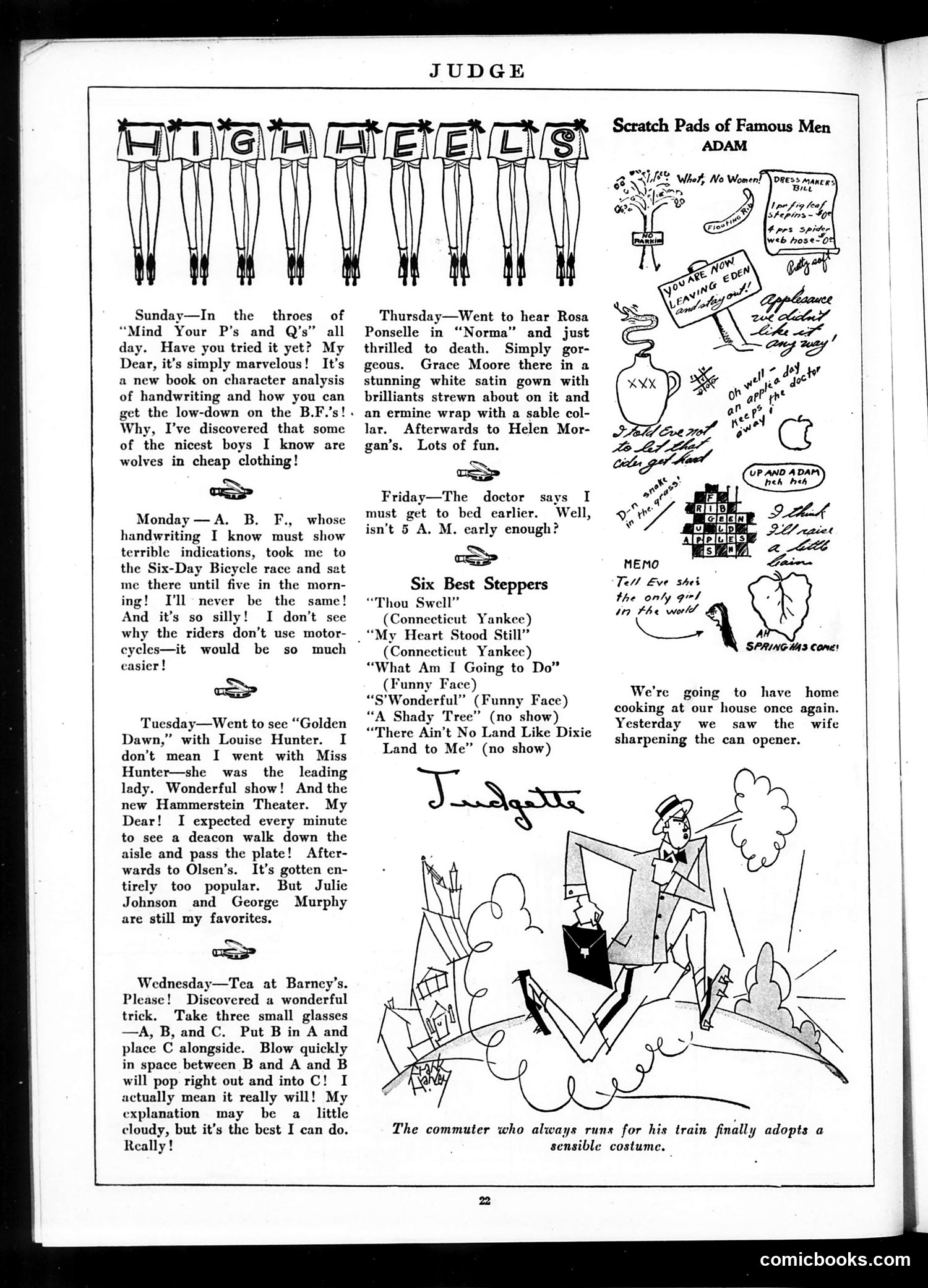
This is a humorous weekly diary by a frivolous young woman chronicling her leisure activities. The satire targets upper-class social pretensions and vacuous celebrity culture of the Jazz Age. Key references: "Mind Your P's and Q's" (a popular graphology book); the Six-Day Bicycle race (a real endurance spectacle); Broadway shows ("Golden Dawn," "Connecticut Yankee," "Funny Face"); and name-dropping of opera singer Rosa Ponselle and performers Grace Moore, Julie Johnson, and George Murphy. The joke is her shallow observations—complaining about a 5 a.m. bicycle race, marveling at a parlor trick with glasses, and treating theater as mere backdrop for observing wealthy women's fashions. The cartoon satirizes the social butterfly lifestyle of young, wealthy women for whom culture and entertainment are purely superficial pursuits. The "Scratch Pads of Famous Men" section (Adam's doodles) provides additional period humor about male pastimes.
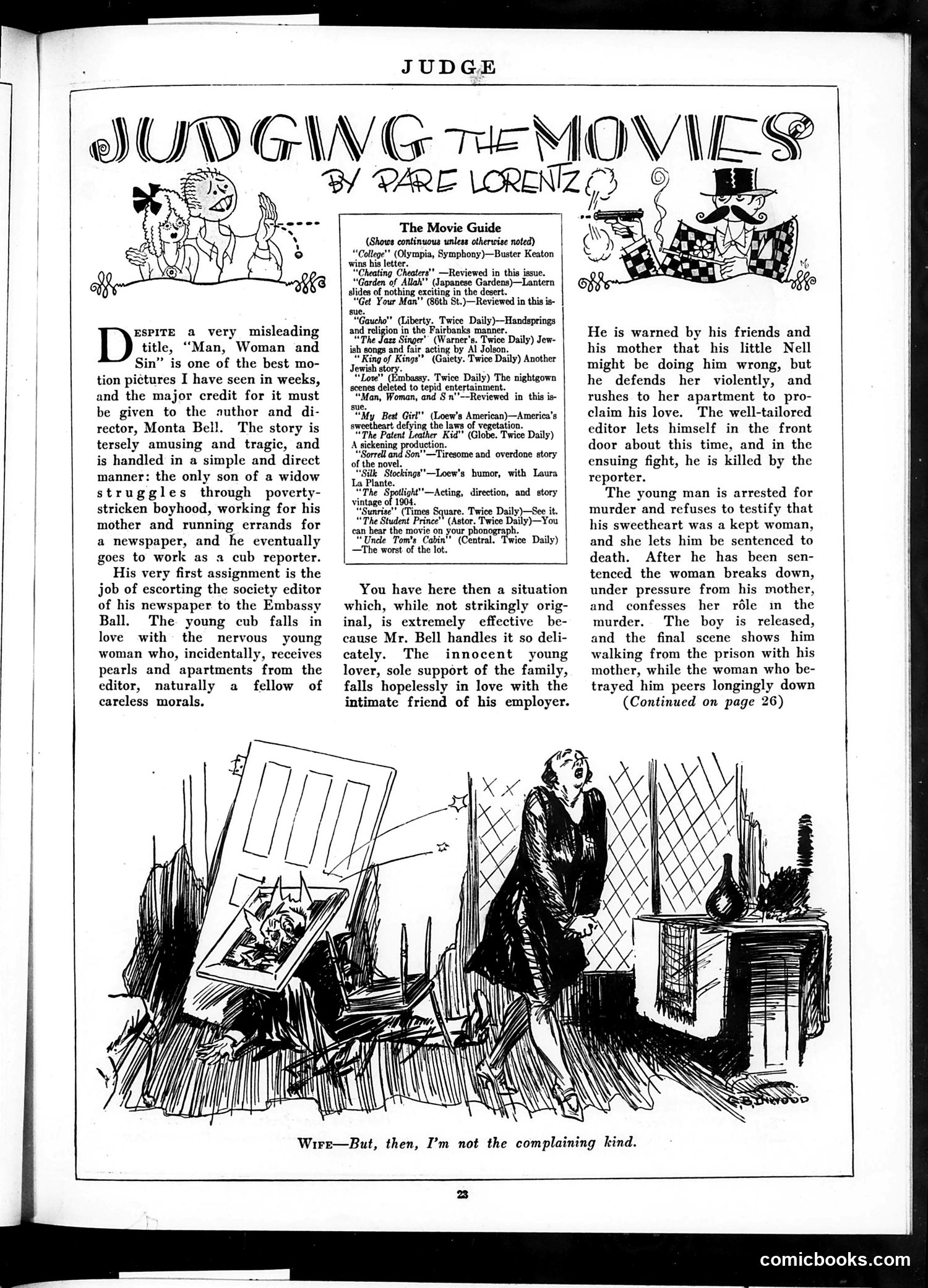
This is a film review column, not a political cartoon. Lorenz critiques "Man, Woman and Sin," directed by Monta Bell, praising it as surprisingly effective despite its familiar plot: a poor young newspaper reporter falls for a society woman kept by his editor, kills the editor in a fight, refuses to implicate her, gets sentenced to death, but is freed when she confesses under his mother's pressure. The accompanying illustration depicts a domestic scene—likely the reporter confronting his love interest—with the caption "Wire—But, then, I'm not the complaining kind," suggesting resignation to romantic betrayal. The "Movie Guide" sidebar lists contemporary films with satirical one-liners ("Gaucho!"—"Handsprings and religion in the Fairbanks manner"), offering Judge's irreverent commentary on 1920s cinema. The content reflects 1920s attitudes toward melodrama, moral compromise, and entertainment value.
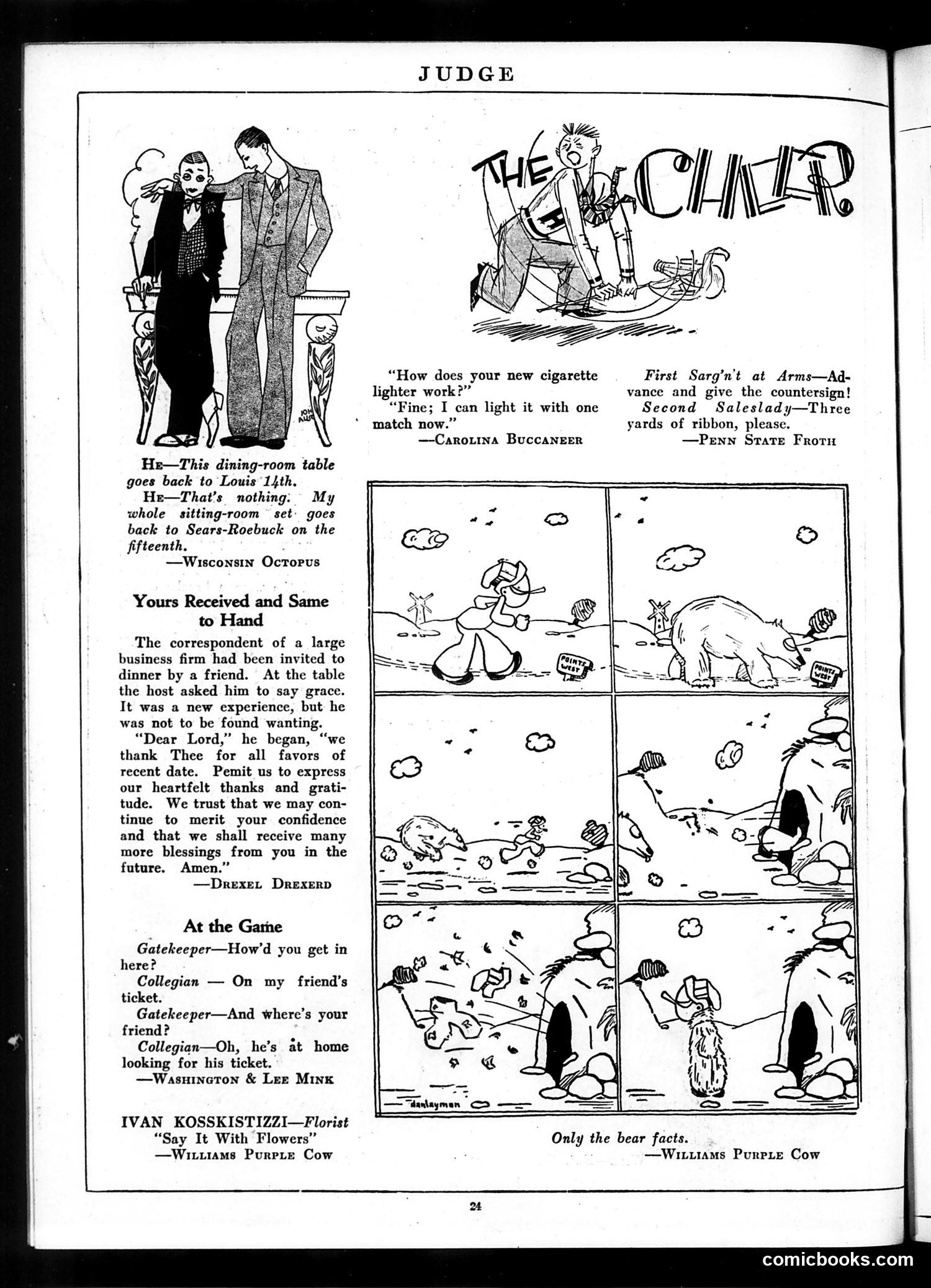
This page contains several short humor pieces typical of early 20th-century American satire magazines: **"The Child" comic strip** (right side) shows a child repeatedly getting into mischief with household items and animals—the humor relies on physical comedy and the child's obliviousness to danger. **The text jokes** mock various social situations: - Debt and installment buying (furniture "going back" to stores on payment due dates) - Business formality bleeding into personal life (a businessman delivering grace like a corporate memo) - Ticket scalping at sporting events - Novelty cigarette lighters **The advertisements/taglines** include florist services and what appears to be military or institutional humor. The satire targets middle-class anxieties about consumer debt, social pretension, and changing modern conveniences. The humor is gentle and observational rather than biting—typical of Judge's mainstream appeal to educated readers concerned with etiquette and social climbing during this era (likely 1920s-1930s based on style).
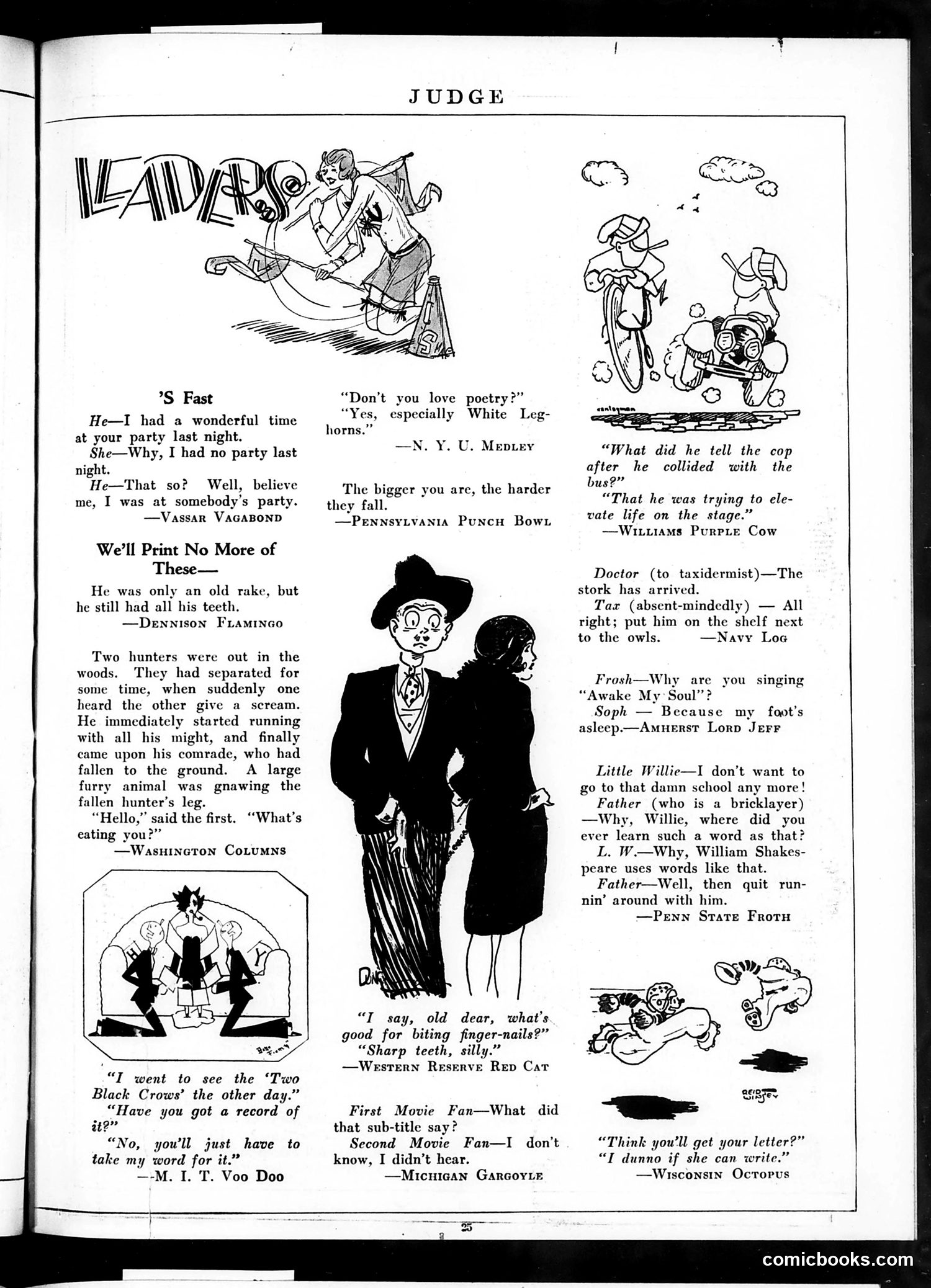
This page collects brief jokes and quips from college humor publications and regional sources, typical of Judge's format. The humor targets include: **Social commentary**: A joke about party-crashing suggests casual deception in social circles; another mocks movie-goers who can't read film subtitles, reflecting anxieties about the transition to sound cinema. **Gender/relationship humor**: Multiple jokes play on male-female misunderstandings and stereotypes—women's intelligence, writing ability, and romantic interest are all treated as punchlines. **Class humor**: One joke features a bricklayer father shocked his son learned crude language, implying working-class surprise at literary knowledge. **College culture**: Several jokes source from college publications (M.I.T., Penn State, etc.), reflecting campus-centered humor about inexperienced freshmen and romantic pursuits. The cartoons are simple, decorative line drawings. Overall, the page reflects 1920s-30s American humor emphasizing misogyny, class assumptions, and light social satire rather than sharp political commentary.
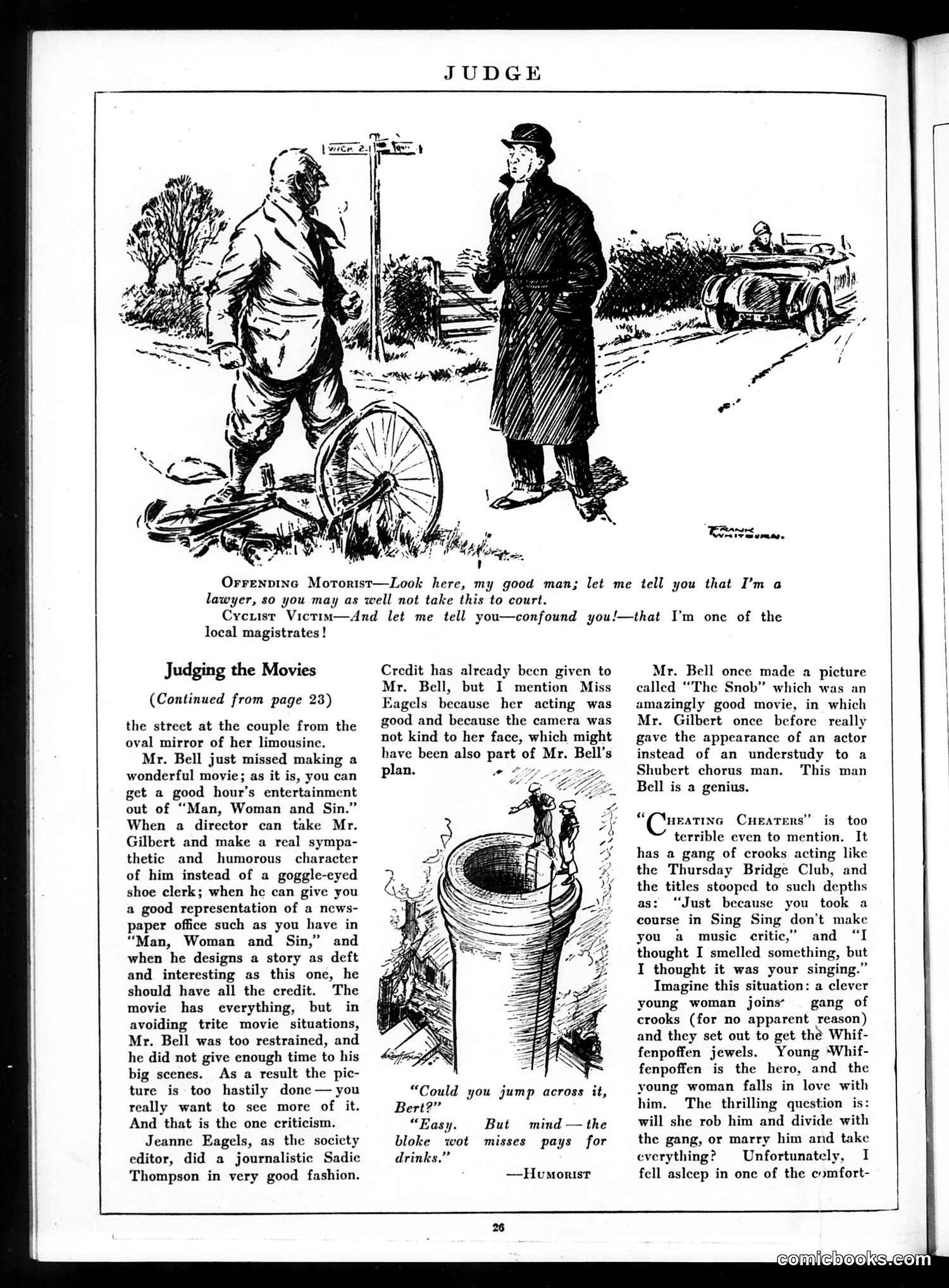
The page contains two distinct pieces: **Top Cartoon**: A motorist and cyclist dispute after a collision. The motorist (representing the wealthy, powerful class) warns the cyclist victim not to take legal action, claiming his lawyer status makes him untouchable. The cyclist responds that he's a local magistrate—reversing the power dynamic. This satirizes the era's class tensions: the assumption that wealth and profession could intimidate ordinary people into dropping legitimate grievances. **"Judging the Movies" Column**: A film critic reviews recent movies, praising director Bell's "Man, Woman and Sin" and actress Jeanne Eagels' performance, while harshly dismissing "Cheating Cheaters" as absurdly plotted nonsense. The humor comes from the critic's exasperated description of implausible melodrama typical of 1920s silent films—a gang of criminals pursuing jewels while a woman decides between crime and romance. The page reflects early cinema criticism and 1920s social anxieties about class and morality.
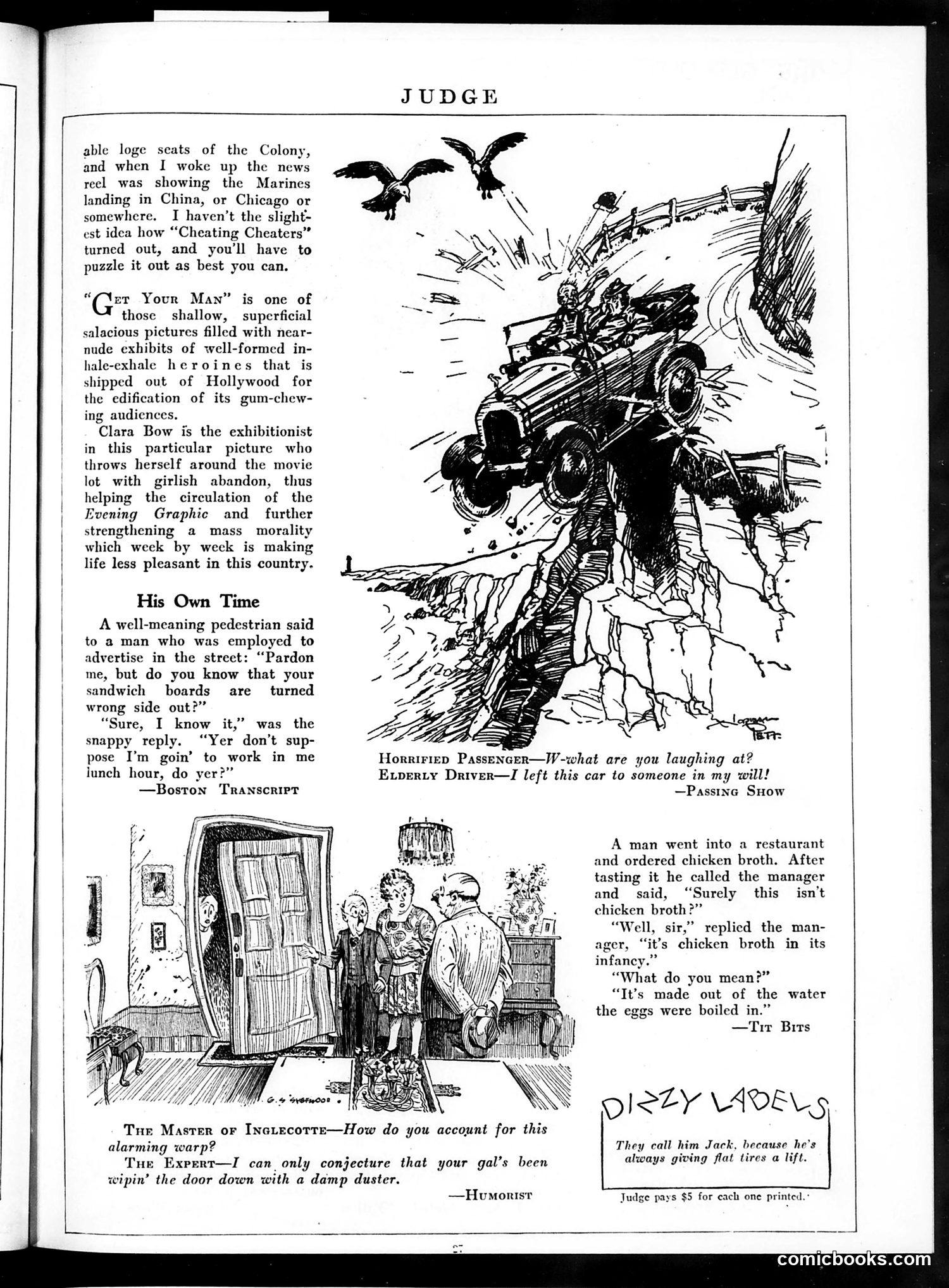
This page from Judge satirizes early 1920s American popular culture and social attitudes. **Main Cartoon**: The top illustration mocks reckless driving and silent films. An elderly driver has apparently left his car to someone "in my will," suggesting dangerous, inherited incompetence behind the wheel—a commentary on the era's automobile safety concerns. **Clara Bow Reference**: The text critiques the actress and the shallow "flapper" films Hollywood produced, arguing they corrupted public morality through near-nude exhibition and sensationalism. This reflects conservative concerns about Jazz Age entertainments. **Humor Sections**: The remaining jokes mock working-class attitudes ("His Own Time"), restaurant quality ("chicken broth in its infancy"), and domestic mishaps. They're gentle social observations typical of Judge's middlebrow readership. **Overall Tone**: The page expresses anxiety about modern life—unsafe automobiles, degraded entertainment standards, and moral decline—wrapped in lighthearted ridicule aimed at urban, contemporary behaviors Judge's educated audience would recognize.
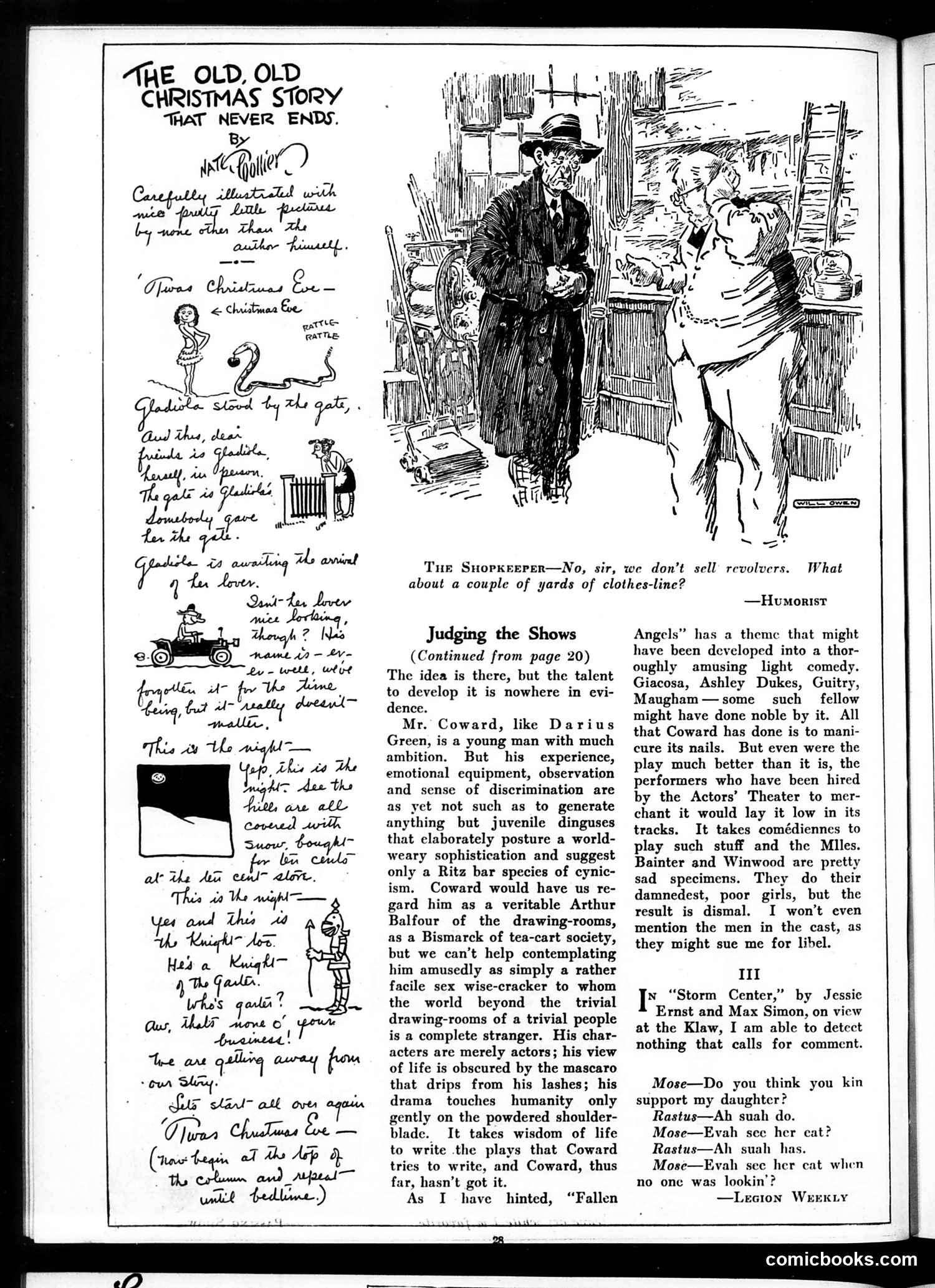
This cartoon satirizes a recurring seasonal gag: a poor man seeking to buy a rope, presumably for suicide, but a shopkeeper misunderstands or deflects the request. The handwritten narrative traces this "story" through multiple iterations—the man returns "year after year," asking different shopkeepers, always getting rebuffed or redirected. The joke's dark humor relies on the audience recognizing a familiar vaudeville/popular comedy bit about economic desperation during hard times. The accompanying theater review criticizes playwright Noël Coward's "Fallen Angels," dismissing him as a shallow "wise-cracker" lacking life experience to write meaningful drama. The reviewer contrasts Coward unfavorably with established playwrights like Maugham and Guitry, claiming his characters are superficial and his performers inadequate. The page also includes an unrelated racial dialect joke typical of era publications.
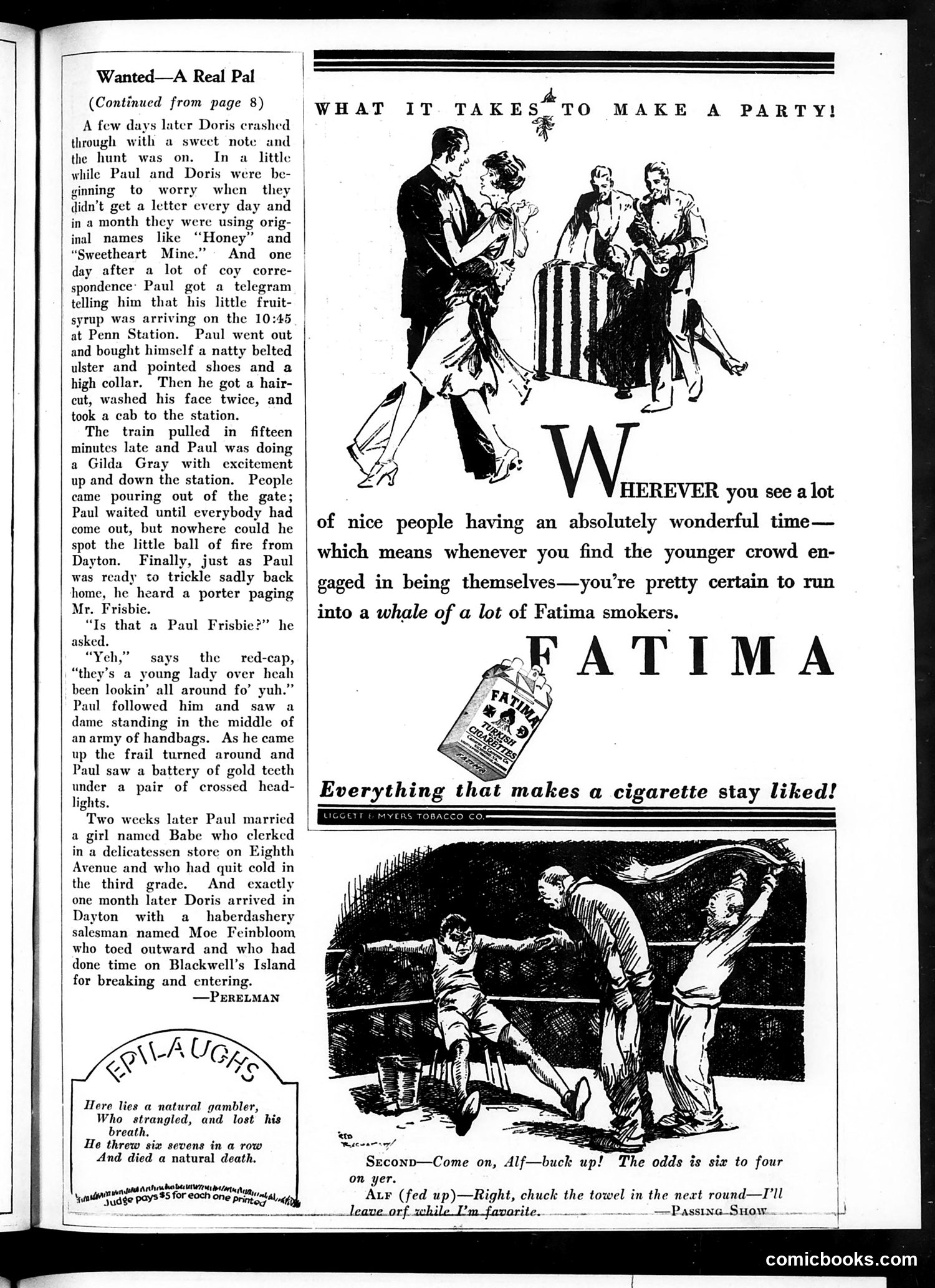
This page contains two distinct pieces: **Left side:** S. J. Perelman's humorous short story "Wanted—A Real Pal," about a man named Paul who corresponds with a woman named Doris via mail, builds romantic expectations, meets her at Penn Station, finds her unattractive (with prominent gold teeth), and instead marries an unrelated woman named Babe. Doris simultaneously arrives in town with an ex-convict. The satire targets romantic pen-pal fantasies and the gap between idealized correspondence and disappointing reality—a relevant concern in an era before telephones were ubiquitous. **Right side:** A Fatima cigarette advertisement disguised as editorial content, featuring young people at a party. The ad claims that wherever young people are enjoying themselves, Fatima smokers appear—essentially linking cigarette smoking to social success and youthful fun. The small illustration below shows men gambling/playing cards while smoking. This represents vintage tobacco advertising that directly marketed cigarettes to young audiences by associating them with social desirability and leisure activities.
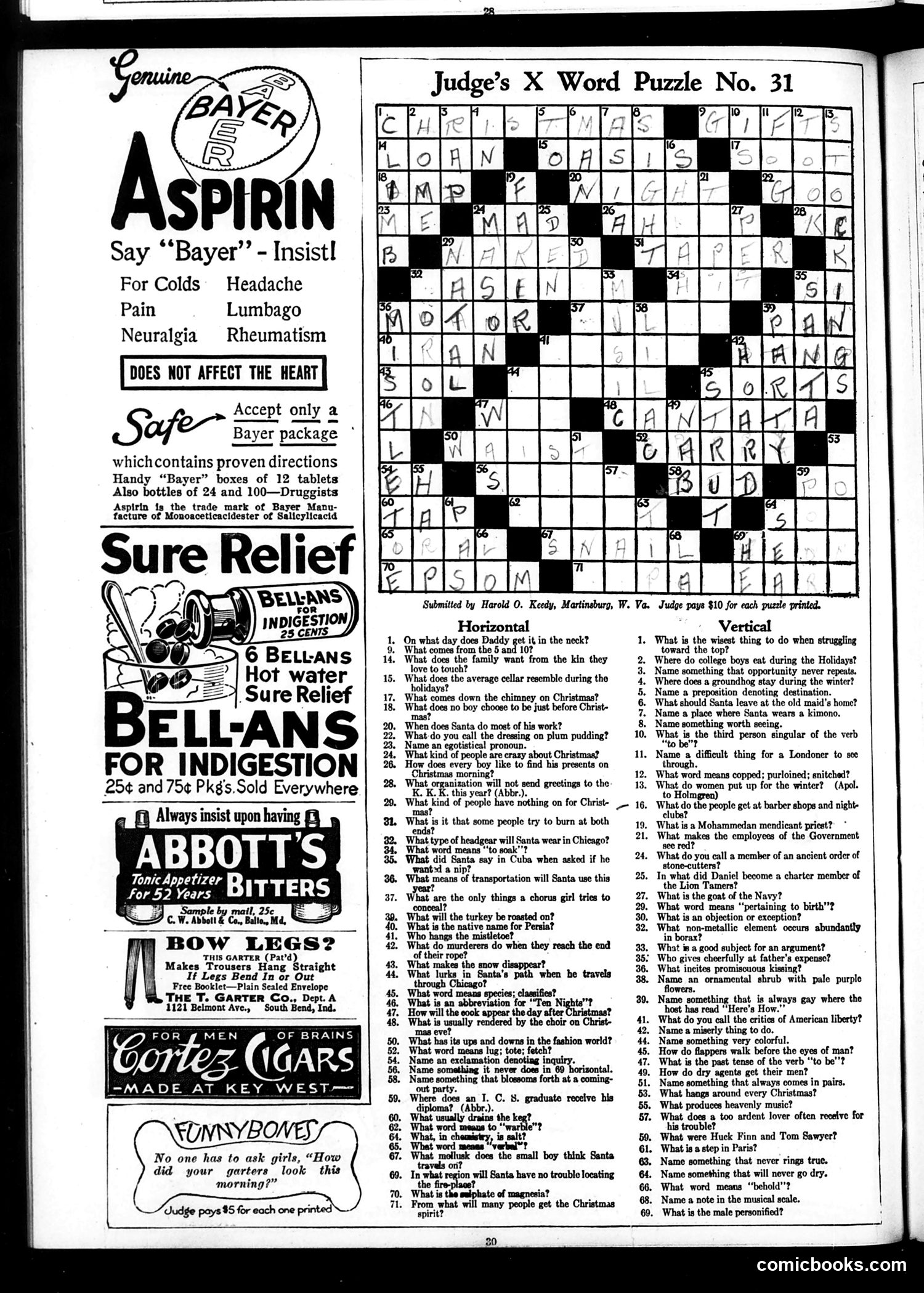
This page is primarily **advertisements and a crossword puzzle**, not political satire. The ads promote patent medicines and medical devices popular in the early 20th century: Bayer Aspirin (emphasizing it "does not affect the heart"), Bellans for indigestion, Abbott's Bitters, and a "Bow Legs" corrective garter. These reflect period anxieties about health and appearance. The main content is "Judge's X Word Puzzle No. 31"—a Christmas-themed crossword with holiday and riddle clues ("What does Santa say in Cuba when asked if he wanted a nip?"). It's a reader-participation feature; Judge paid $10 for submitted puzzles. The "Funny Bones" cartoon at bottom is a mild joke about garters and modesty, typical of contemporary humor. **Context for modern readers**: This reflects an era before FDA regulation, when medicines made broad health claims. The crossword puzzle was a popular entertainment format that Judge used to engage readers.
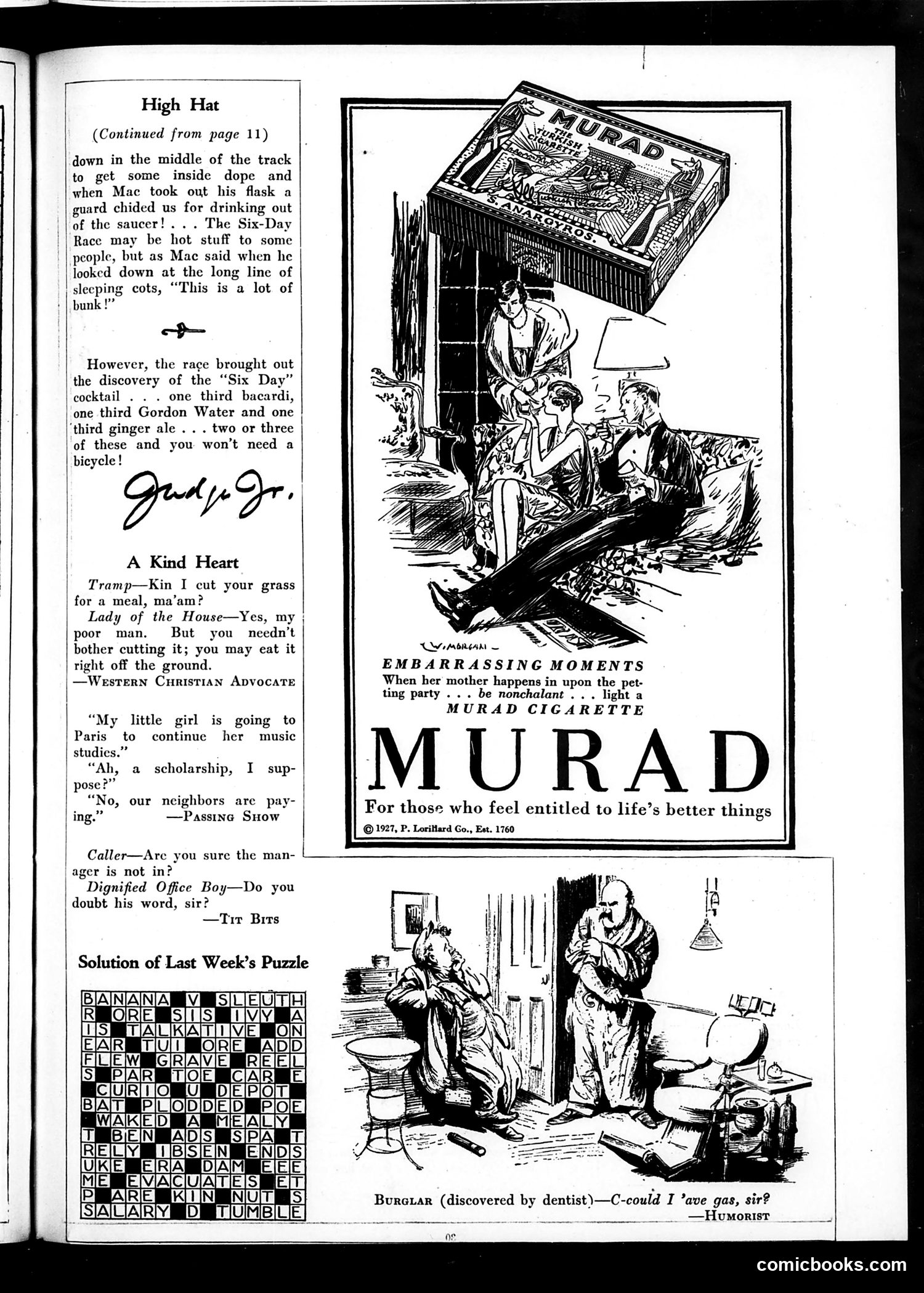
This page contains several humor pieces and an advertisement typical of 1927 Judge magazine. **"High Hat"** continues a story about attending a Six-Day Race (a popular endurance cycling event of that era). The humor involves spectators drinking illicitly during Prohibition and their discovery of a cocktail recipe disguised as innocent ingredients. **"A Kind Heart"** is a brief joke about a vagrant asking to cut grass for food, with the homeowner cruelly suggesting he eat the uncut grass directly—satirizing false charity. **"Embarrassing Moments"** shows a couple being discovered in a compromising situation by the woman's mother, with the Murad cigarette advertisement positioned as the solution to awkwardness—reflecting 1920s attitudes about smoking as sophisticated behavior. **The burglar joke** plays on dental anesthesia ("gas") as a pun. The page mainly showcases period humor reflecting Prohibition-era attitudes, courtship norms, and consumer advertising conventions rather than political satire.
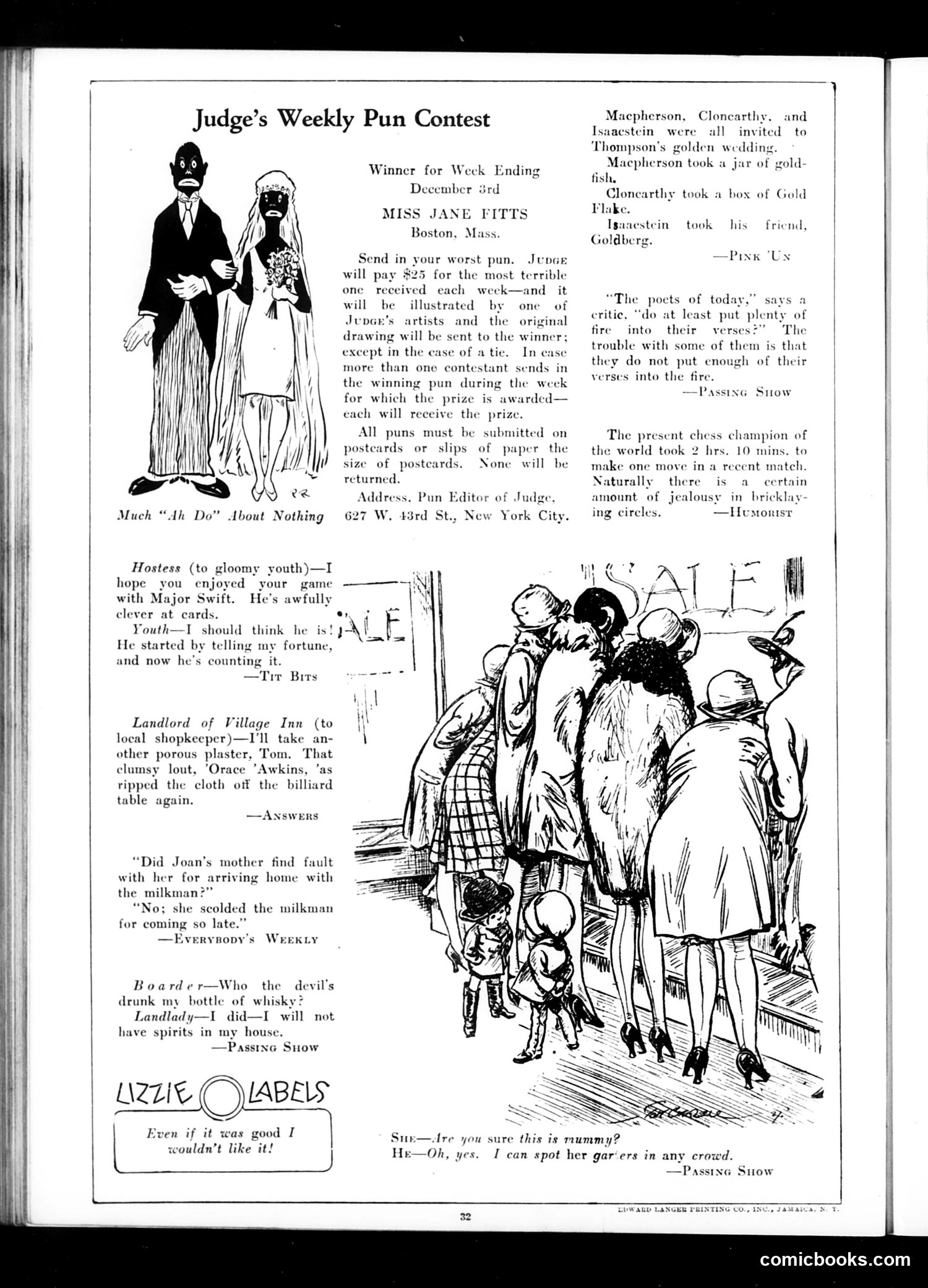
This is a humor page from *Judge*, featuring several joke categories typical of early 20th-century American magazines: **Judge's Weekly Pun Contest** solicits intentionally bad puns from readers, offering $25 prizes. Winner Miss Jane Fitts's entry plays on "Much Ado About Nothing." **"Lizzie Labels"** appears to be a recurring comic feature with brief captioned jokes about everyday situations—a maid complaining about unwanted food, a landlord about a clumsy tenant, parents about a daughter arriving late with the milkman (implying impropriety), and a landlady who drinks her boarder's whisky. **Right-side humor column** includes quips about chess players' jealousy and a crude joke about recognizing a mummy by her garters—typical of the era's casual, somewhat ribald humor. **The illustration** shows well-dressed figures at what appears to be a wedding, referencing a "golden wedding" gift-giving story with ethnic-stereotyped names (Goldberg, etc.) suggesting a satirical commentary on social pretension or gift-giving customs. The overall tone is light, domestic, and mildly risqué by Victorian standards.
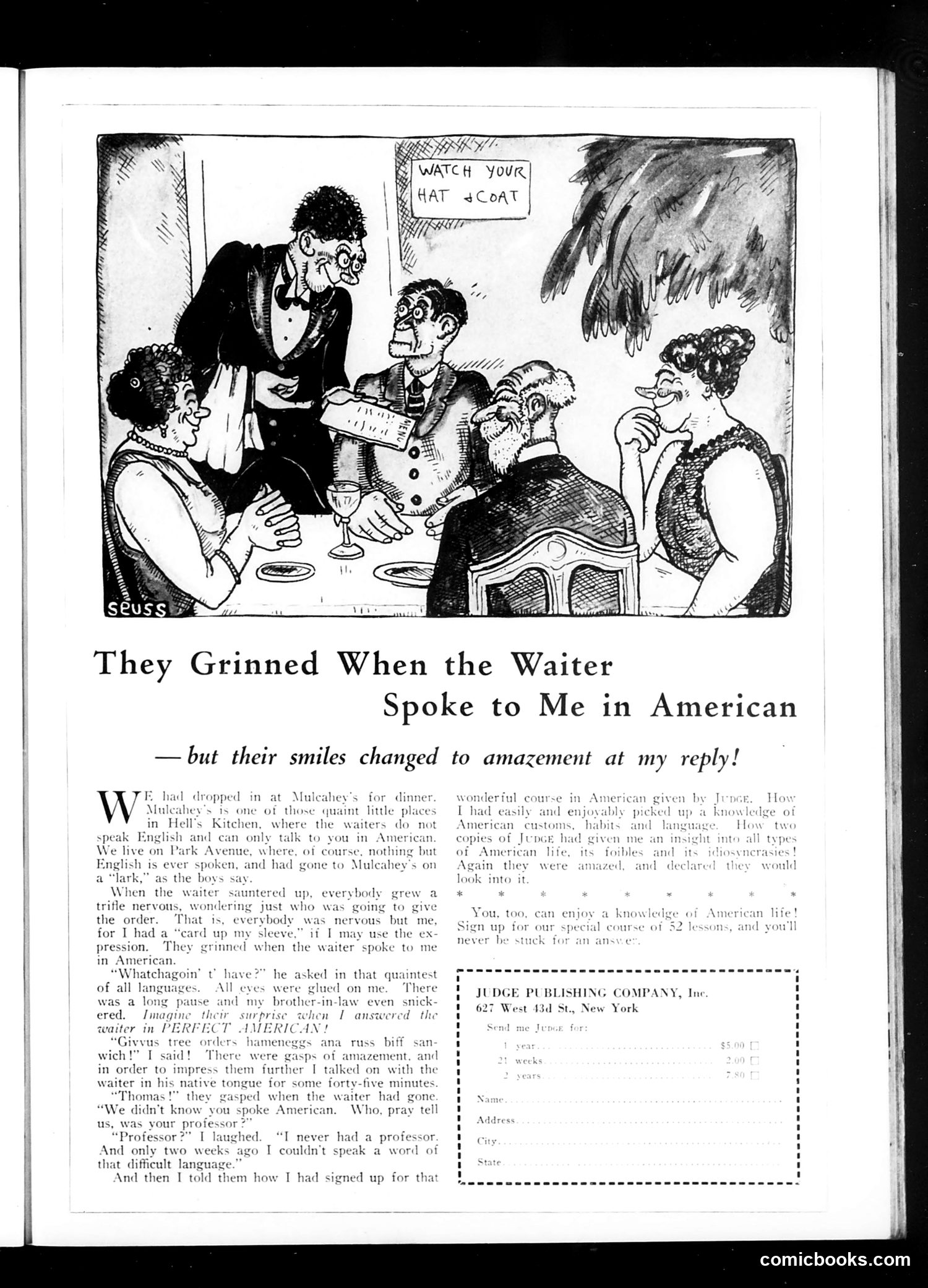
This is a satirical advertisement disguised as a humorous anecdote, drawn by Dr. Seuss. The joke mocks American linguistic pretension and class anxiety in the early 20th century. **The Setup:** An upper-class Park Avenue resident dines at "Mulcahey's," a working-class Hell's Kitchen restaurant where waiters speak only in colloquial "American" (working-class New York dialect). His sophisticated companions are nervous, assuming he won't understand. **The Satire:** The narrator astounds them by fluently speaking the waiter's dialect—revealing he's taken a correspondence course in "American" offered by Judge Publishing. The humor lies in treating vernacular speech as a foreign language requiring formal study, mocking both: - Upper-class snobbery about "proper" English - The absurdity of marketing courses that teach what immigrants and working people already speak **The Punchline:** The advertisement then recruits readers to buy the same course, suggesting even they might need lessons in understanding "American." It's gentle satire on class divisions and linguistic pretension in Depression-era America.
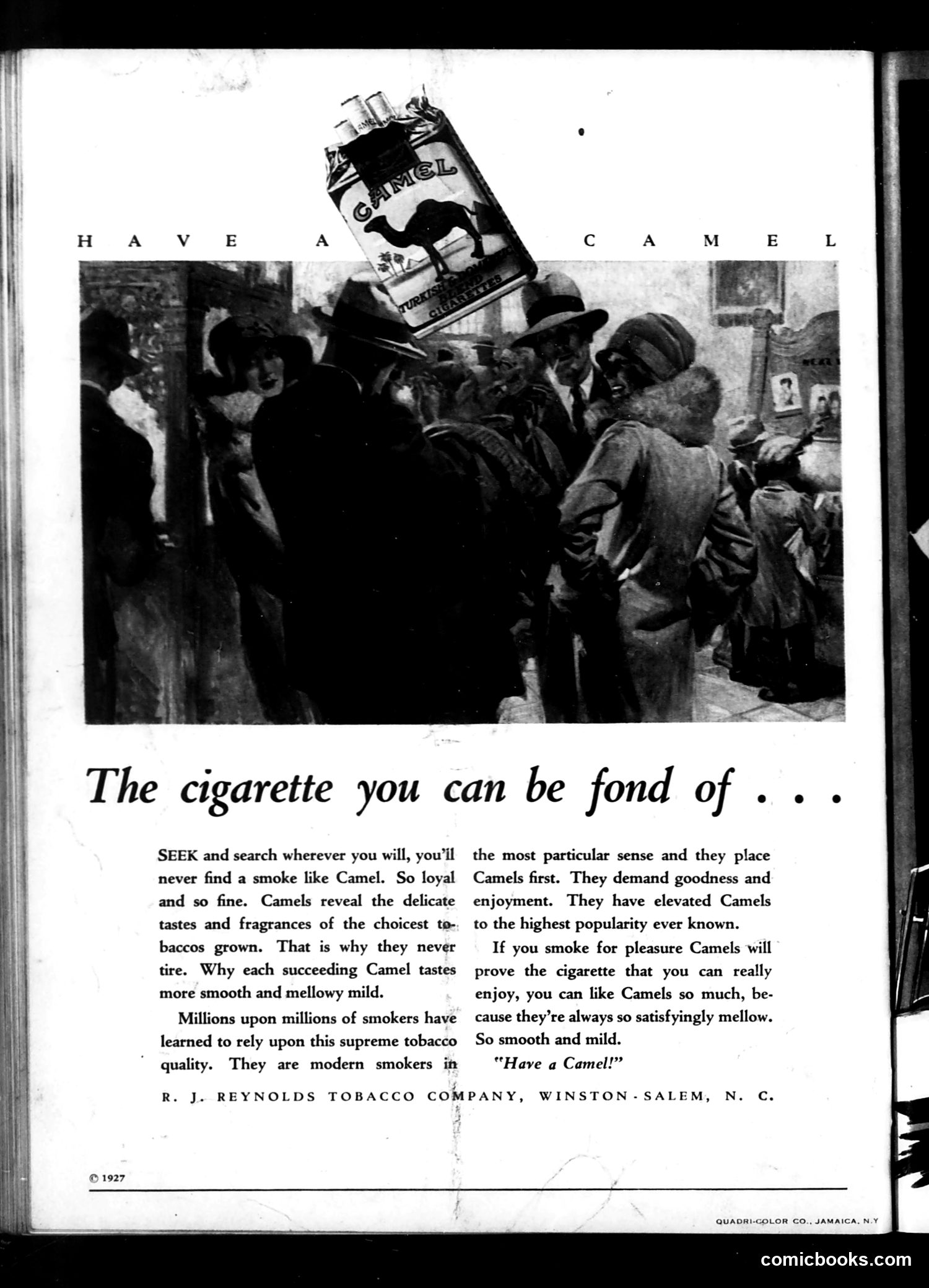
This is a **cigarette advertisement**, not satire or political commentary. It's a 1927 Camel cigarettes ad from R.J. Reynolds Tobacco Company. The image shows a crowd of people gathered around an enormous Camel cigarette package, apparently promoting the product. The ad uses typical marketing language of the era: "smooth and mellow mild," appeals to "modern smokers," and claims superiority through "supreme tobacco quality." **Historical context for modern readers:** This predates the surgeon general's 1964 warning about smoking's health dangers. Cigarette advertising was then considered legitimate consumer marketing, often appearing in general-interest magazines like *Judge*. The ad's emphasis on smoothness and sophistication was standard for the era—there's no acknowledgment of any health concerns. This represents an industry that operated without the regulatory restrictions, health warnings, or social stigma that would later develop.