
Judge, 1927-12-17 · page 30 of 36
Judge — December 17, 1927 — page 30: what you’re looking at
What you’re looking at
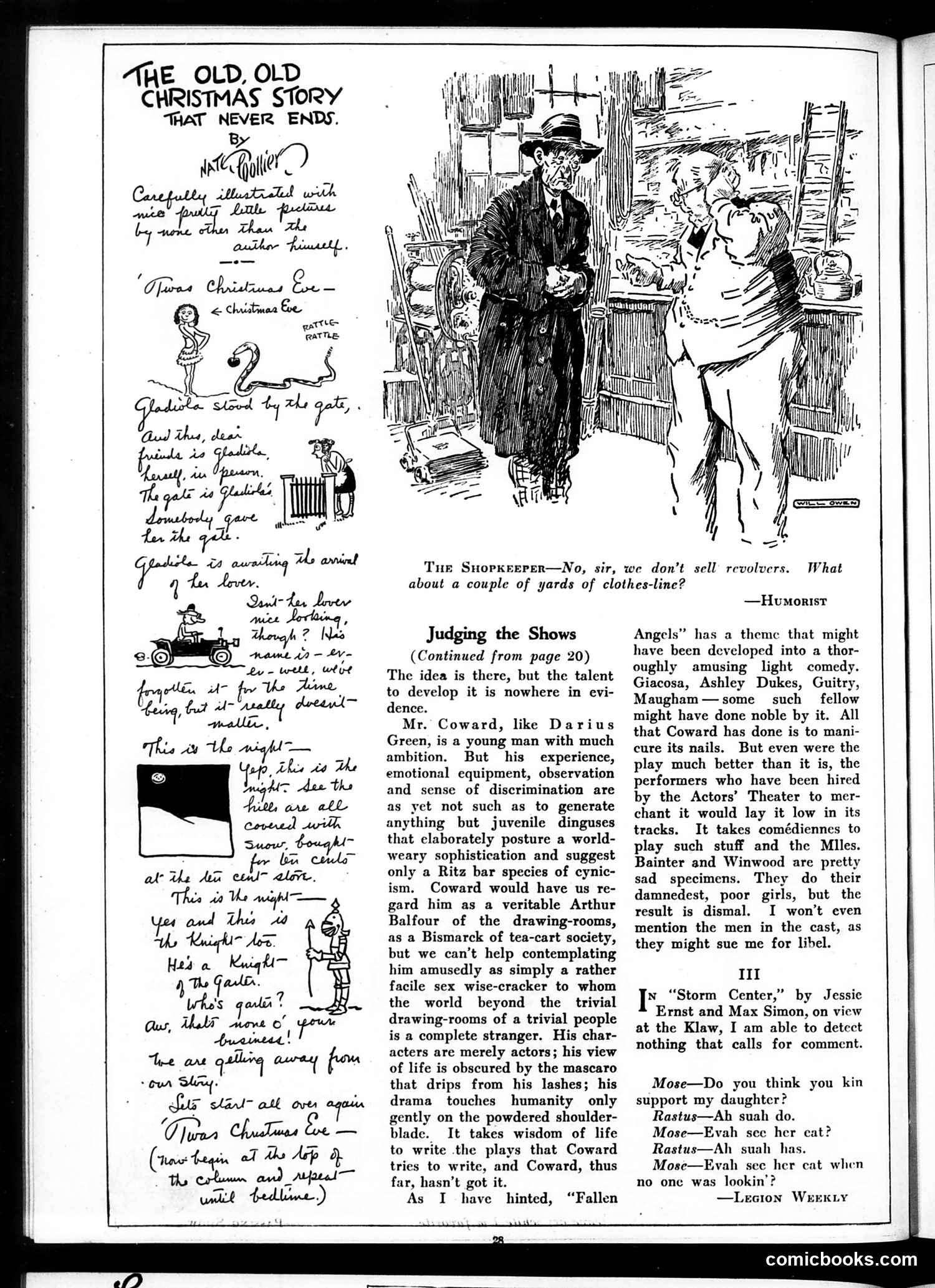
This cartoon satirizes a recurring seasonal gag: a poor man seeking to buy a rope, presumably for suicide, but a shopkeeper misunderstands or deflects the request. The handwritten narrative traces this "story" through multiple iterations—the man returns "year after year," asking different shopkeepers, always getting rebuffed or redirected. The joke's dark humor relies on the audience recognizing a familiar vaudeville/popular comedy bit about economic desperation during hard times. The accompanying theater review criticizes playwright Noël Coward's "Fallen Angels," dismissing him as a shallow "wise-cracker" lacking life experience to write meaningful drama. The reviewer contrasts Coward unfavorably with established playwrights like Maugham and Guitry, claiming his characters are superficial and his performers inadequate. The page also includes an unrelated racial dialect joke typical of era publications.
📄 Transcribed text from this page (OCR, searchable)
Machine-transcribed from the original scan — historical spelling and the odd misread are preserved.
CHRISTMAS STORY THAT NEVER ENDS. E OLD, OLD Poy oth % aga : Tue Suopkeerer—No, sir, we don’t sell revolvers. What about a couple of yards of clothes-line? Judging the Shows (Continued from page 20) The idea is there, but the talent to develop it is nowhere in evi- dence. Mr. Coward, like Darius Green, is a young man with much ambition. But his experience, emotional equipment, observation and sense of discrimination are as yet not such as to generate anything but juvenile dinguses that elaborately posture a world- weary sophistication and suggest only a Ritz bar species of cynic- ism. Coward would have us re- gard him as a veritable Arthur Balfour of the drawing-rooms, as a Bismarck of tea-cart society, but we can’t help contemplating him amusedly as simply a rather facile sex wise-cracker to whom the world beyond the trivial drawing-rooms of a trivial people is a complete stranger. His char- acters are merely actors; his view of life is obscured by the mascaro that drips from his lashes; his drama touches humanity only gently on the powdered shoulder- blade. It takes wisdom of life to write the plays that Coward tries to write, and Coward, thus far, hasn’t got it. As I have hinted, “Fallen —Hononrist Angels” has a theme that might have been developed into a thor- oughly amusing light comedy. Giacosa, Ashley Dukes, Guitry, Maugham—some such fellow might have done noble by it. All that Coward has done is to mani- cure its nails. But even were the play much better than it is, the performers who have been hired by the Actors’ Theater to mer- chant it would lay it low in its tracks. It takes comédiennes to play such stuff and the Mlles. Bainter and Winwood are pretty sad specimens. They do their damnedest, poor girls, but the result is dismal. I won’t even mention the men in the cast, as they might sue me for libel. III Ik “Storm Center,” by Jessie Ernst and Max Simon, on view at the Klaw, I am able to detect nothing that calls for comment. Mose—Do you think you kin support my daughter? Rastus—Ab suah do. Mose—Evah sec her eat? Rastus—Ah suah has. Mose—Evah sec her cat when no one was lookin’? —Lecion WEEKLY comicbooks.com