
Judge, 1927-12-17 · page 28 of 36
Judge — December 17, 1927 — page 28: what you’re looking at
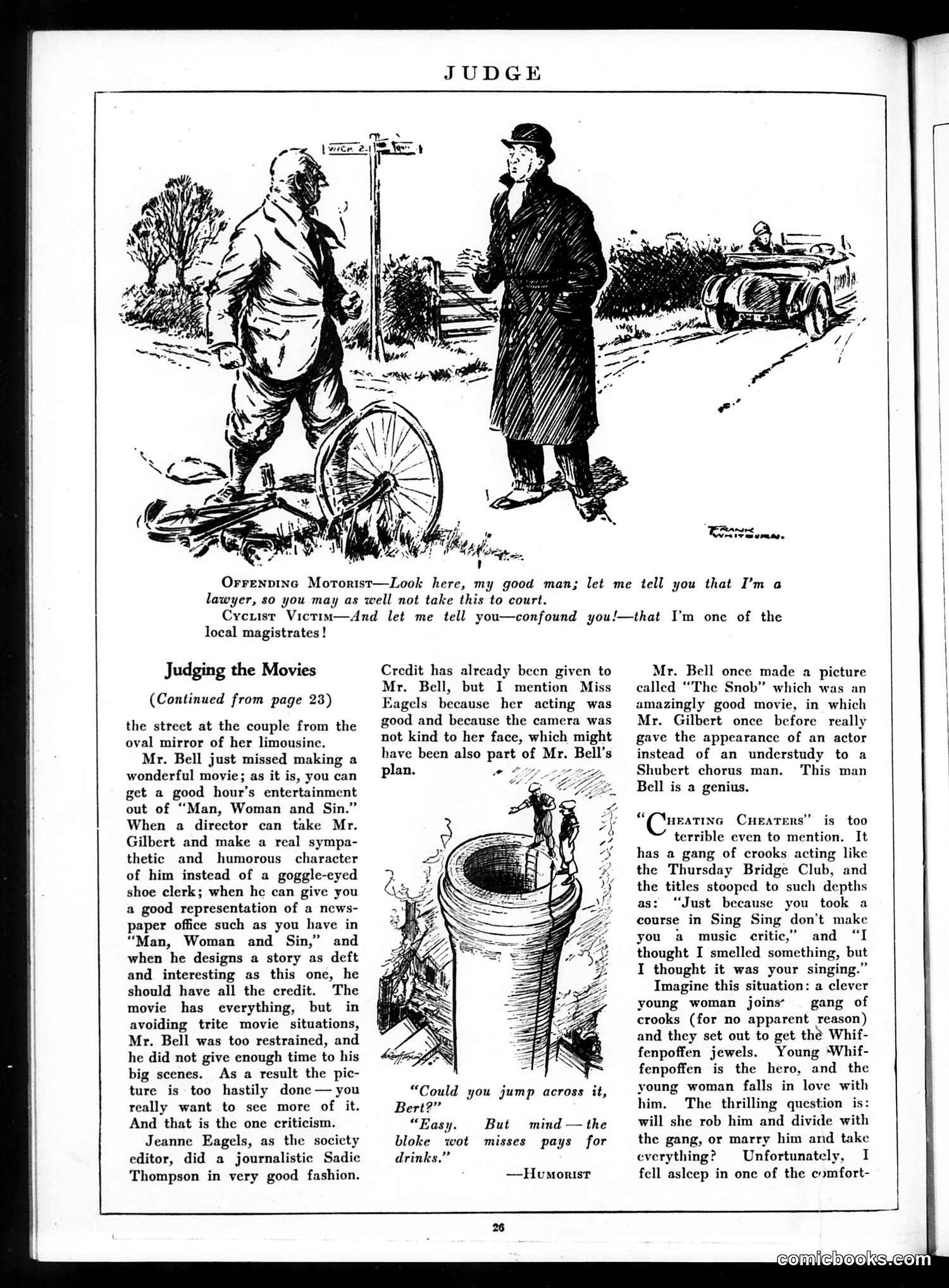
What you’re looking at
The page contains two distinct pieces: **Top Cartoon**: A motorist and cyclist dispute after a collision. The motorist (representing the wealthy, powerful class) warns the cyclist victim not to take legal action, claiming his lawyer status makes him untouchable. The cyclist responds that he's a local magistrate—reversing the power dynamic. This satirizes the era's class tensions: the assumption that wealth and profession could intimidate ordinary people into dropping legitimate grievances. **"Judging the Movies" Column**: A film critic reviews recent movies, praising director Bell's "Man, Woman and Sin" and actress Jeanne Eagels' performance, while harshly dismissing "Cheating Cheaters" as absurdly plotted nonsense. The humor comes from the critic's exasperated description of implausible melodrama typical of 1920s silent films—a gang of criminals pursuing jewels while a woman decides between crime and romance. The page reflects early cinema criticism and 1920s social anxieties about class and morality.
📄 Transcribed text from this page (OCR, searchable)
Machine-transcribed from the original scan — historical spelling and the odd misread are preserved.
Orrenpinc Mororist—Look here, U lawyer, so you may as well not take this to court. Cycuist Victim local magistrates ! Judging the Movies (Continued from page 23) the street at the couple from the oval mirror of her limousine. Mr. Bell just missed making a wonderful movie; as it is, you can get a good hour’s entertainment out of “Man, Woman and Sin.” When a director can take Mr. Gilbert and make a real sympa- thetic and humorous character of him instead of a goggle-eyed shoe clerk; when he can give you a good representation of a news- paper office such as you have in “Man, Woman and Sin,” and when he designs a story as deft and interesting as this one, he should have all the credit. The movie has everything, but in avoiding trite movie situations, Mr. Bell was too restrained, and he did not give enough time to his big scenes. As a result the pic- ture is too hastily done — you really want to see more of it. And that is the one criticism. Jeanne Eagels, as the society editor, did a journalistic Sadie Thompson in very good fashion. Credit has already been given to Mr. Bell, but I mention Miss Eagels because her acting was good and because the camera was not kind to her face, which might have been also part of Mr. Bell’s plan. oe 5 “Could you jump across it, Bert?” “Easy. bloke ‘wot drinks.” But mind — the misses pays for —Hovnonist Ta Somas my good man; let me tell you that I’m a And let me tell you—confound you!—that I’m one of the Mr. Bell once made a picture called “The Snob” which was an amazingly good movie, in which Mr. Gilbert once before really gave the appearance of an actor instead of an understudy to a Shubert chorus man. This man Bell is a genius. “Curate Cueaters” is too terrible even to mention. It has a gang of crooks acting like the Thursday Bridge Club, and the titles stooped to such depths as: “Just because you took a course in Sing Sing don’t make you a music critic,’ and “I thought I smelled something, but I thought it was your singing.” Imagine this situation: a clever young woman joins gang of crooks (for no apparent reason) and they set out to get the Whif- fenpoffen jewels. Young ‘Whif- fenpoffen is the hero, and the young woman falls in love with him. The thrilling question is: will she rob him and divide with the gang, or marry him and take everything? Unfortunately, I fell asleep in one of the comfort-