
Judge, 1927-12-17 · page 22 of 36
Judge — December 17, 1927 — page 22: what you’re looking at
What you’re looking at
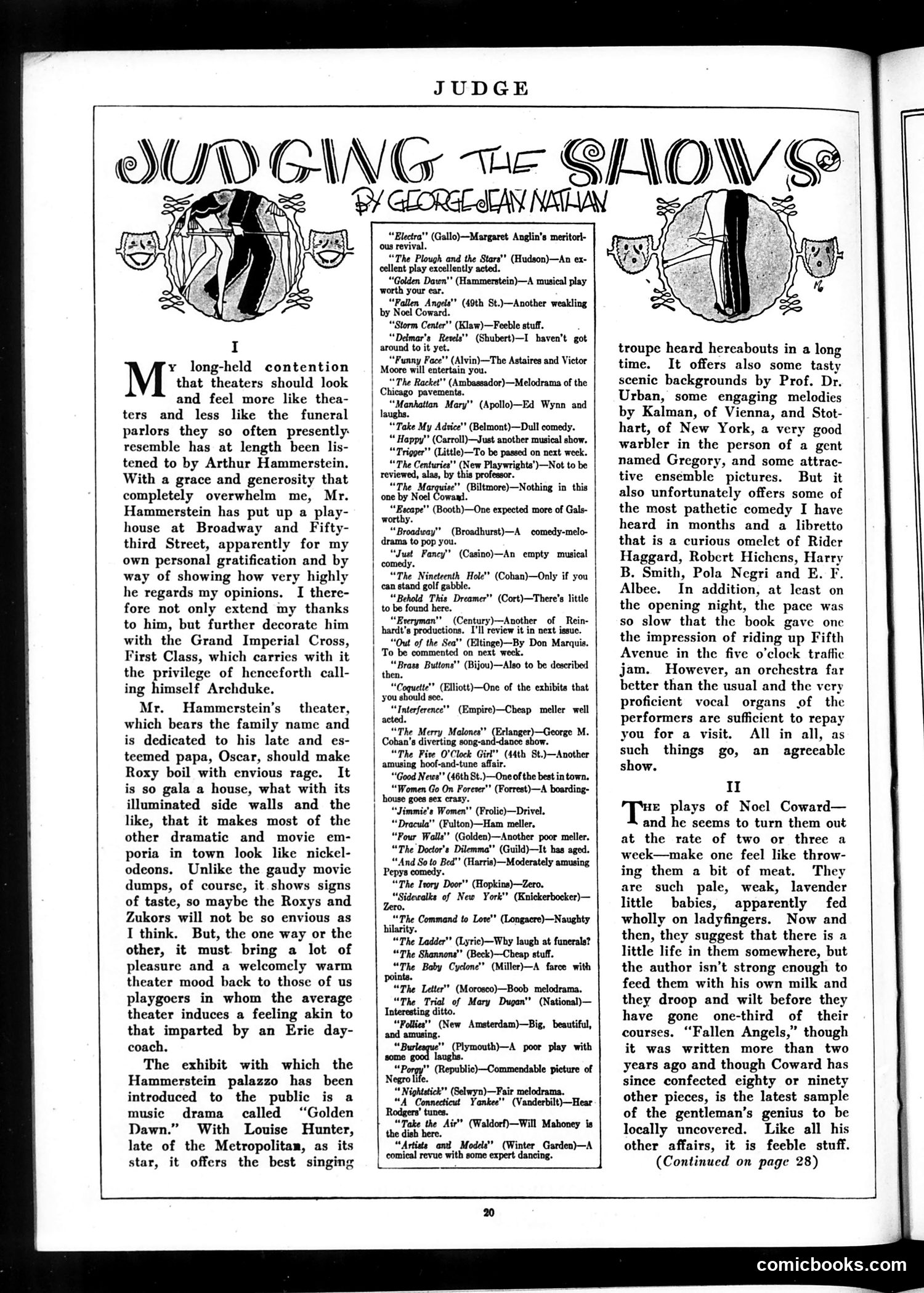
This page contains George Jean Nathan's theater column "Judging the Shows," reviewing Broadway productions of what appears to be the mid-1920s. **Key Content:** The main article praises Arthur Hammerstein's new Broadway theater (at 53rd Street) as genuinely elegant—a welcome contrast to the dreary "funeral parlor" aesthetic of most contemporary theaters. Nathan sarcastically "decorates" Hammerstein with a "Grand Imperial Cross" for building a tasteful venue rather than a gaudy movie palace. The featured show is the musical *Golden Dawn*, starring Metropolitan Opera singer Louise Hunter, which Nathan endorses as worthwhile. **The Satire:** Nathan's exaggerated gratitude mocks theater owners generally while genuinely praising Hammerstein's restraint. He contrasts Hammerstein's refined approach with competitors like Roxy and Ziegfeld, whose ornate movie palaces prioritized spectacle over substance. The extensive theatrical listing that follows represents Nathan's typical snappy, often dismissive reviews of current Broadway shows—ranging from praise to brutal brevity ("Feeble stuff," "Drivel").
📄 Transcribed text from this page (OCR, searchable)
Machine-transcribed from the original scan — historical spelling and the odd misread are preserved.
y long-held contention M that theaters should look and feel more like thea- ters and less like the funeral parlors they so often presently. resemble has at length been lis- tened to by Arthur Hammerstein. With a grace and generosity that completely overwhelm me, Mr. Hammerstein has put up a play- house at Broadway and Fifty- third Street, apparently for my own personal gratification and by way of showing how very highly he regards my opinions. I there- fore not only extend my thanks to him, but further decorate him with the Grand Imperial Cross, First Class, which carries with it the privilege of henceforth call- ing himself Archduke. Mr. Hammerstein’s _ theater, which bears the family name and is dedicated to his late and es- teemed papa, Oscar, should make Roxy boil with envious rage. It is so gala a house, what with its illuminated side walls and the like, that it makes most of the other dramatic and movie em- poria in town look like nickel- odeons. Unlike the gaudy movie dumps, of course, it shows signs of taste, so maybe the Roxys and Zukors will not be so envious as I think. But, the one way or the other, it must. bring a lot of pleasure and a welcomely warm theater mood back to those of us playgoers in whom the average theater induces a feeling akin to that imparted by an Erie day- coach. The exhibit with which the Hammerstein palazzo has been introduced to the public is a music drama called ‘Golden Dawn.” With Louise Hunter, late of the Metropolitan, as its star, it offers the best singing JUDGE ‘Electra’ (Gallo)—Margaret Anglin's meritorl- ous revival. “The Plough and the Stars’’ (Hudson)—An ex- cellent play excellently acted. “Golden Dawn’ (Hammerstein)—A musical play worth your ear. “Fallen Ai "* (49th St.)\—Another weaklis by Noel Comune ‘ id “Storm Center’ (Klaw)—Feeble stuff. “Delmar’s Revels"? (Shubert)—I haven't got around to it yet. “Funny Face’’ (Alvin)}—The Astaires and Victor Moore will entertain you. “The Racket” Uoteseies) -Maacnms of the Chicago pavements. we Mary” (Apollo)—Ed Wynn and la “Take My Adsice"’ (Belmont)—Dull comedy. “ Happy” (Carroll)—Just another musical show. “Trigger"” (Little)—To be passed on next week. “The Centuries” Abed pare) Ne tobe reviewed, alas, he is professor “The Me one by Noel “ Bucape* (Booth) One expected more of Gals worthy. “Broadway (Broadhurst)—A comedy-melo- drama to pop you. “Just Fancy” (Casino)—An empty musical | comedy. | “The Nineteenth Hi can stand golf gabble. “Behold This Dreamer’’ (Cort)—There’s little to be found here. “Ei " (Century)—Another of | Rein- hardt's productions, I'll review it in next iaaue. “Out of the Sea" (Eltinge)—By Don Marquis. To be commented on next week. “Brass Buttons’’ (Bijou)—Also to be described then. ‘Coquette’ (Elliott)—One of the exhibits that should see. * (Bltmore)—Notbing in this * (Cohan)—Only if you | we (Empire)—Cheap meller well “The Merry Malones"’ (Erlanger)—George M. Coban’s diverting pedis sie show. “The Five O'Clock Girl” (44th St.)—Another amusing hoof-and-tune affair. “Good News'’ (46th St.)\—One of the best in town. “Women Go On Forever"’ (Forrest)—A boarding- house goes sex crazy. “‘Jimmie's Women" (Frolic)—Drivel. “Dracula” (Fulton)—Ham meller. “Four Walls’ (Golden)—Another poor meller. “The Doctor's Dilemma’ (Guild)—It bas aged. “And Soto Bed" (Harris)—Moderately amusing Pepys comedy. “The Ivory Door'’ (Hopkins)—Zero. we of New York’ (Knickerbocker)— the Command to Love" (Longacre)—Naughty oe Ladder” (Lytic)—Why laugh at funerale? “The Shannons” (Beck)—Cheap stuff. “The Baby Cyclone’ (Miller)—A farce with pointe. “The Letter" (Morosco)—Boob melodrama. “The Trial of Mary Dugan" (National)— Interesting ditto. “ollie” (New Amsterdam)—Big, beautiful, and amusing. ¢ (Plymouth) —A ith afer lymout poor play wit warn” (Repellie)—Compendable picture of life. “ Nightetick” (Selwyn)—Pair melodrama. “A Connecticut Yankee" (Vanderbilt)—Hear Rodgers’ tunes. “Take the Air” (Waldorf}—Will Mahoney is the dish here. “Article ant, Modes!" (Winter Garden)—A comical revue with some expert dancing. hilarit sy GING x (wx ad want NOM SP troupe heard hereabouts in a long time. It offers also some tasty scenic backgrounds by Prof. Dr. Urban, some engaging melodies by Kalman, of Vienna, and Stot- hart, of New York, a very good warbler in the person of a gent named Gregory, and some attrac- tive ensemble pictures. But it also unfortunately offers some of the most pathetic comedy I have heard in months and a libretto that is a curious omelet of Rider Haggard, Robert Hichens, Harry B. Smith, Pola Negri and E. F. Albee. In addition, at least on the opening night, the pace was so slow that the book gave one the impression of riding up Fifth Avenue in the five o'clock traffic jam. However, an orchestra far better than the usual and the very proficient vocal organs of the performers are sufficient to repay you for a visit. All in all, as such things go, an agreeable show. II T= plays of Noel Coward— and he seems to turn them out at the rate of two or three a week—make one feel like throw- ing them a bit of meat. They are such pale, weak, lavender little babies, apparently fed wholly on ladyfingers. Now and then, they suggest that there is a little life in them somewhere, but the author isn’t strong enough to feed them with his own milk and they droop and wilt before they have gone one-third of their courses. “Fallen Angels,” though it was written more than two years ago and though Coward has since confected eighty or ninety other pieces, is the latest sample of the gentleman’s genius to be locally uncovered. Like all his other affairs, it is feeble stuff. (Continued on page 28) comicbooks.com