
A complete issue · 36 pages · 1927
Judge — May 7, 1927
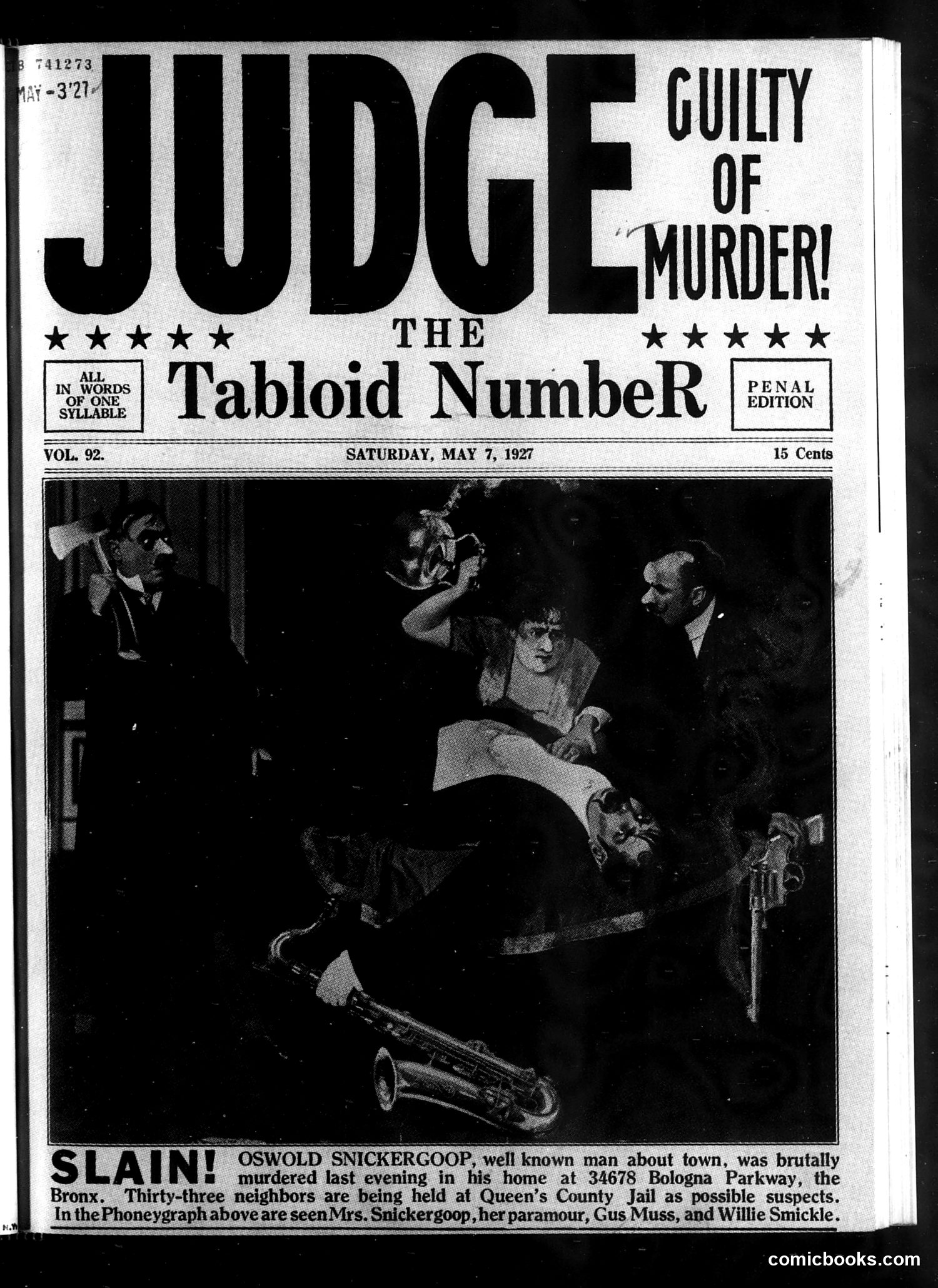
This is **not a satirical cartoon**, but rather a **sensational true-crime tabloid cover** masquerading as a Judge magazine issue from May 7, 1927. The headline "JUDGE GUILTY OF MURDER!" refers to the actual murder of Oswald Snickergoop in the Bronx. The large photograph shows what appears to be a crime scene or police investigation, with several men in suits and a woman examining evidence or the scene. The caption identifies Mrs. Snickergoop, her paramour Gus Muss, and Willie Smickle as suspects being held at Queen's County Jail. This represents Judge magazine's descent into **sensationalist true-crime coverage**—using dramatic language and real crime photography rather than satirical commentary on politics or social issues, which was the magazine's original purpose.
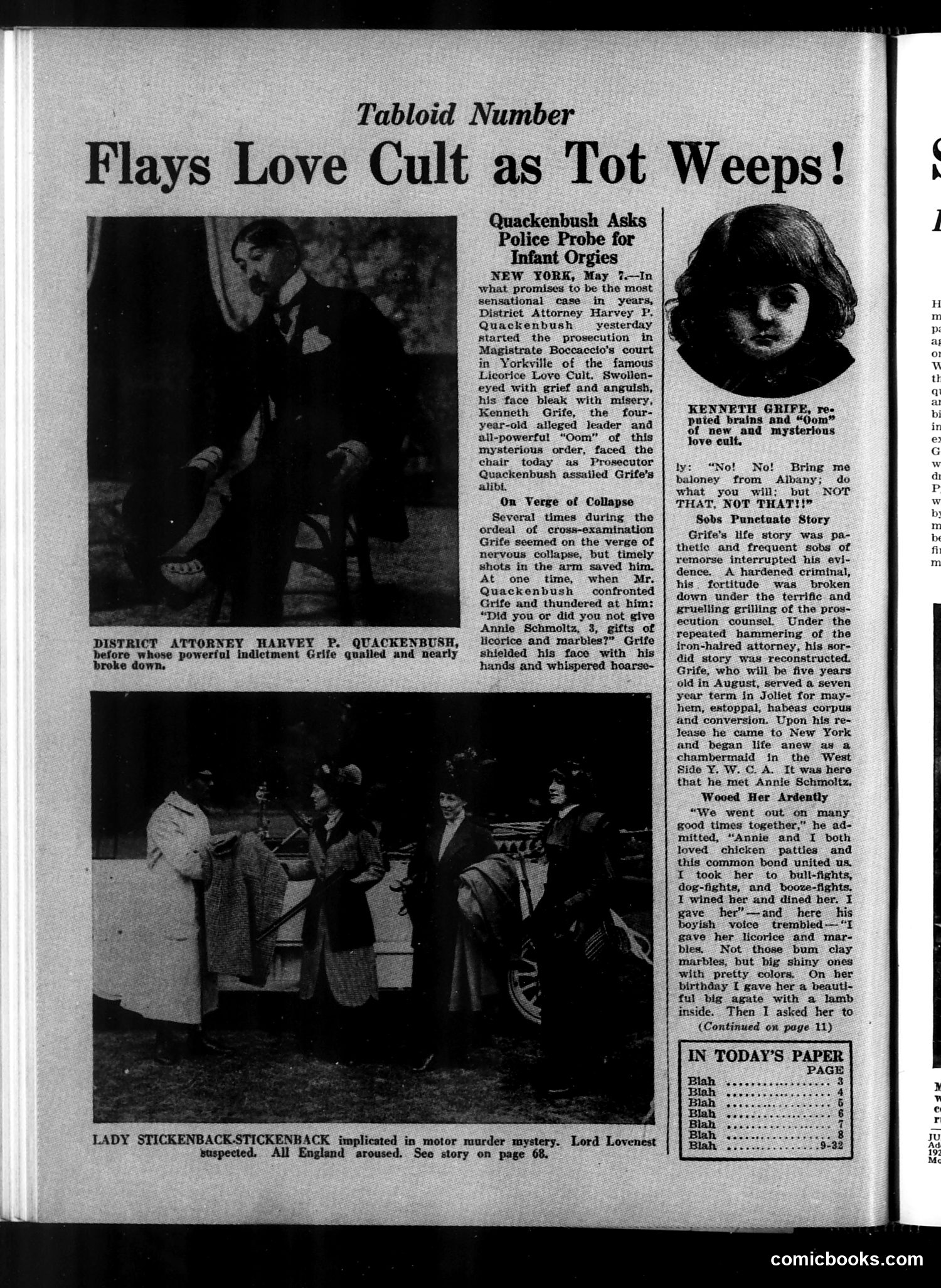
This tabloid page reports on the "Licorice Love Cult," a sensational 1920s scandal involving Kenneth Grife, identified as a cult leader. District Attorney Harvey P. Quackenbush is prosecuting what appears to be a criminal case involving alleged improper conduct. The page combines serious journalism with the satirical tone typical of Judge magazine. The photographs show Grife and courtroom scenes. The headline uses exaggerated language ("Tot Weeps") to sensationalize the proceedings. The "Quackenbush" name appears to be satirical—Judge is mocking the district attorney's actual name through their word choice, a common practice in this magazine. The overall effect presents a genuine scandal through a lens of ridicule and sensationalism, reflecting Judge's satirical approach to contemporary news.
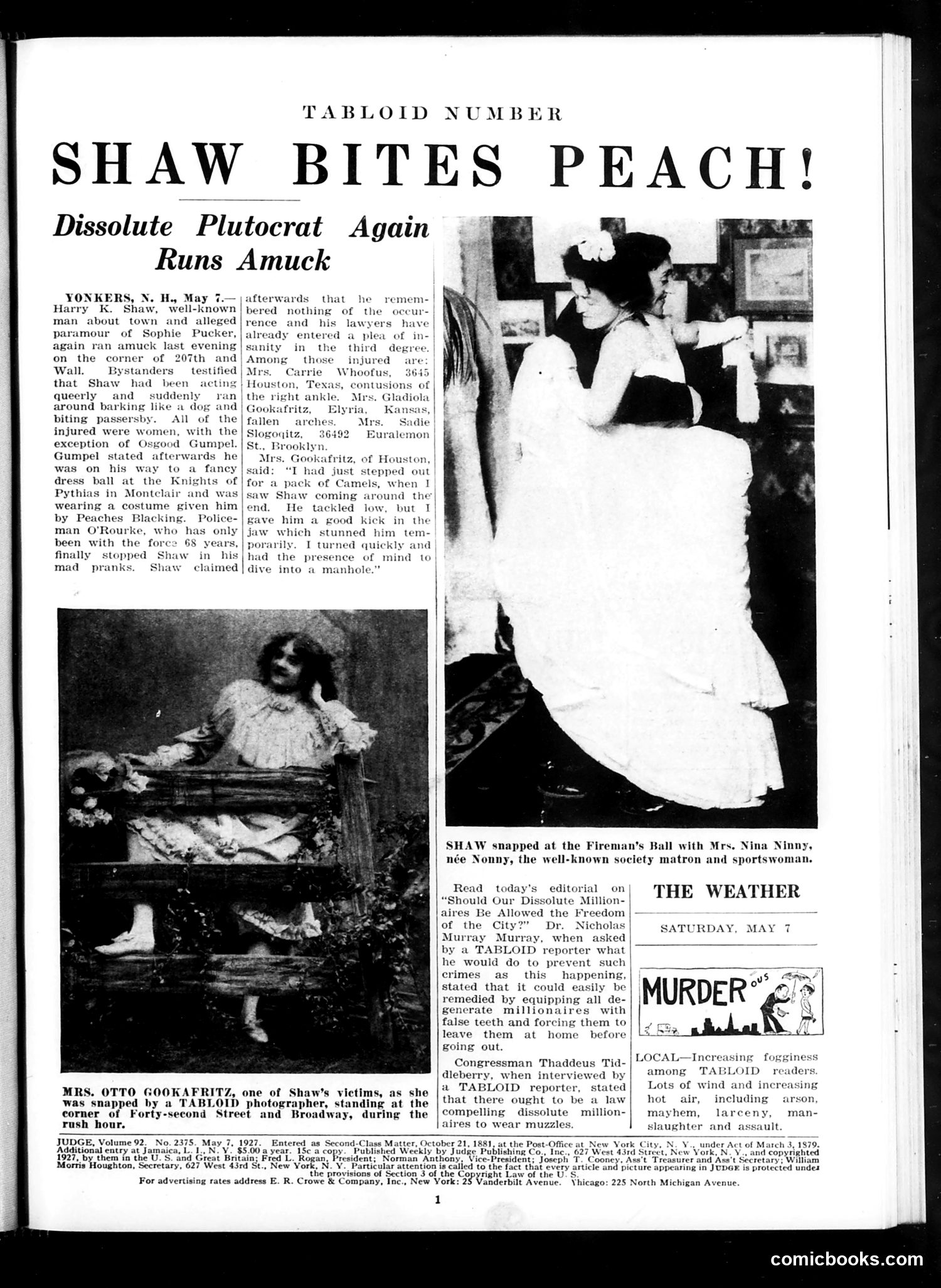
This page reports on a scandal involving **Harry K. Shaw**, a well-known Yonkers man accused of biting a woman named **Peaches Blacking** during a costume ball. The headline "Shaw Bites Peach! Dissolute Plutocrat Again Runs Amuck" presents Shaw as a wealthy man behaving scandalously. The photographs show Shaw and an injured woman, documenting the incident. Multiple women testified Shaw had acted "queerly and suddenly," biting Peaches Blacking while in costume. The article includes witness accounts describing Shaw's violent behavior and his removal by police. This appears to be straightforward crime reporting presented as sensational tabloid content—using wealthy misbehavior to entertain readers—rather than political satire. The "Plutocrat" label suggests class commentary on elite lawlessness.
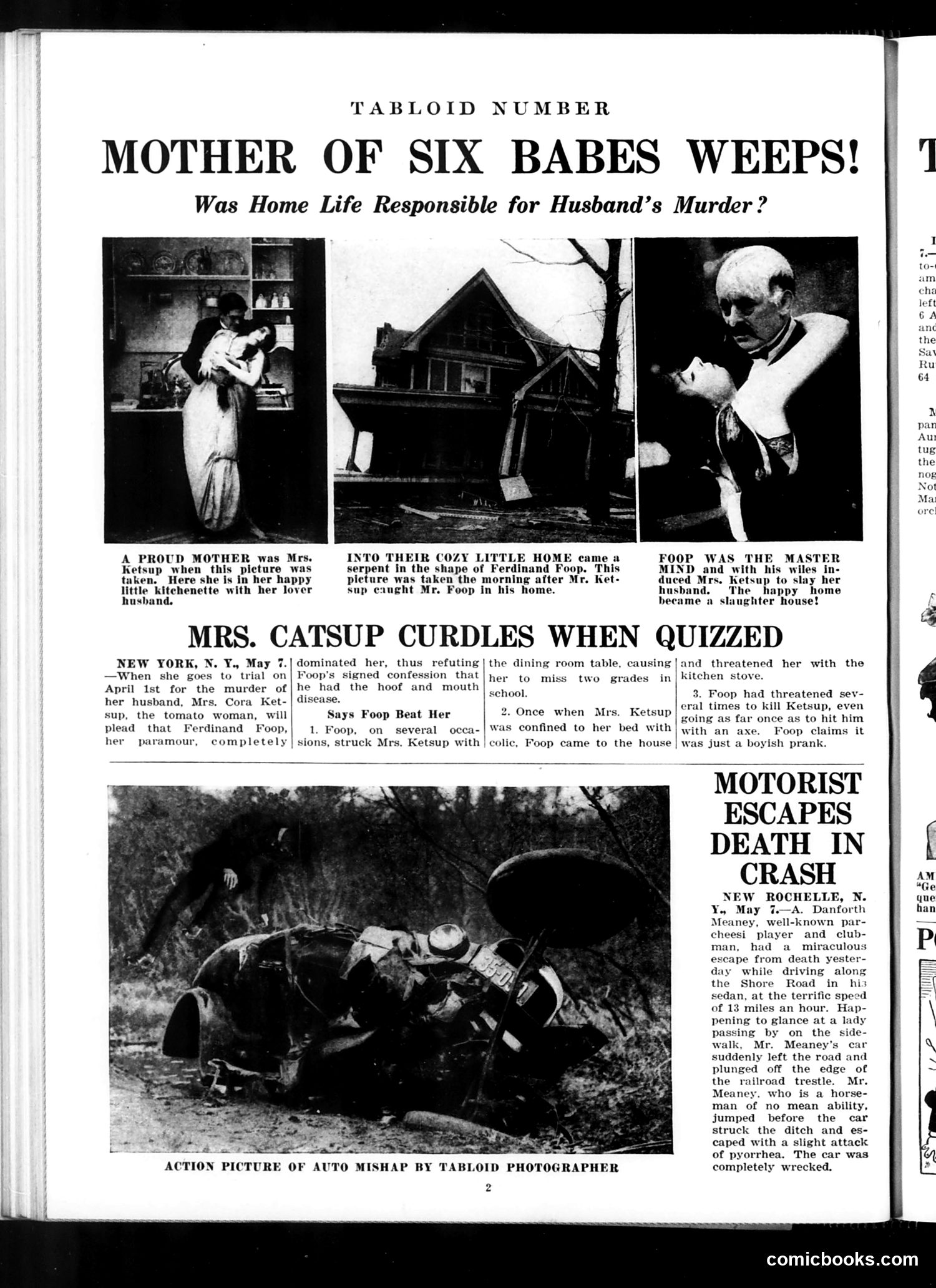
This appears to be a **tabloid-style sensationalist page** rather than political satire. The content focuses on a murder case involving Mrs. Cora Ketsup and Ferdinand Foop. The headline asks whether "home life" caused the husband's murder. Three photographs show: a mother with a baby, a house (allegedly where Ferdinand Foop was found), and an older man (Foop himself). The text describes Mrs. Ketsup's testimony at trial, including alleged domestic violence—Foop struck her, confined her to bed, and threatened her with a kitchen stove and axe. A separate story covers a motorist's car crash on the Shore Road. **This is genuine crime reporting presented sensationally**, not political commentary or satire. Judge magazine here functions as a scandal publication rather than its typical satirical role.
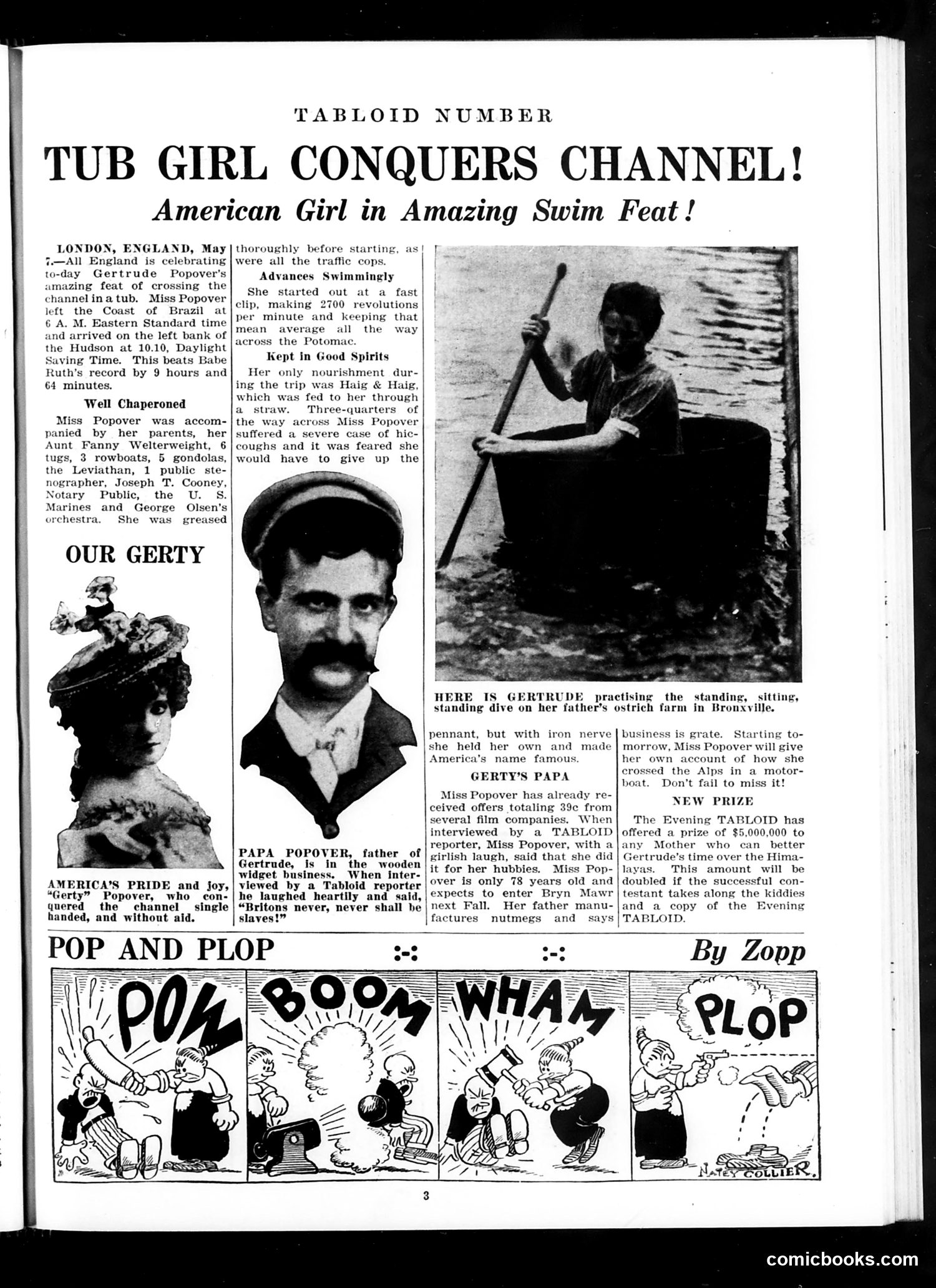
This page celebrates Gertrude Ederle's 1926 Channel crossing—the first woman to swim the English Channel. The main article reports her achievement, accomplished faster than previous male record-holder Captain Matthew Webb. The portrait labeled "PAPA POPOVER" appears to be her father, identified as a nutmeg/spice businessman. The accompanying images show Gertrude practicing her swimming technique. The "Pop and Plop" comic strip at bottom, by Zopp, uses onomatopoeia (POW, BOOM, WHAM, PLOP) to depict slapstick action—likely unrelated to the main story. The satirical angle appears gentle: celebrating American female achievement while the headline's pun ("Tub Girl Conquers Channel") playfully reduces this athletic feat to bathtub-scale humor, typical of Judge's comedic tone.
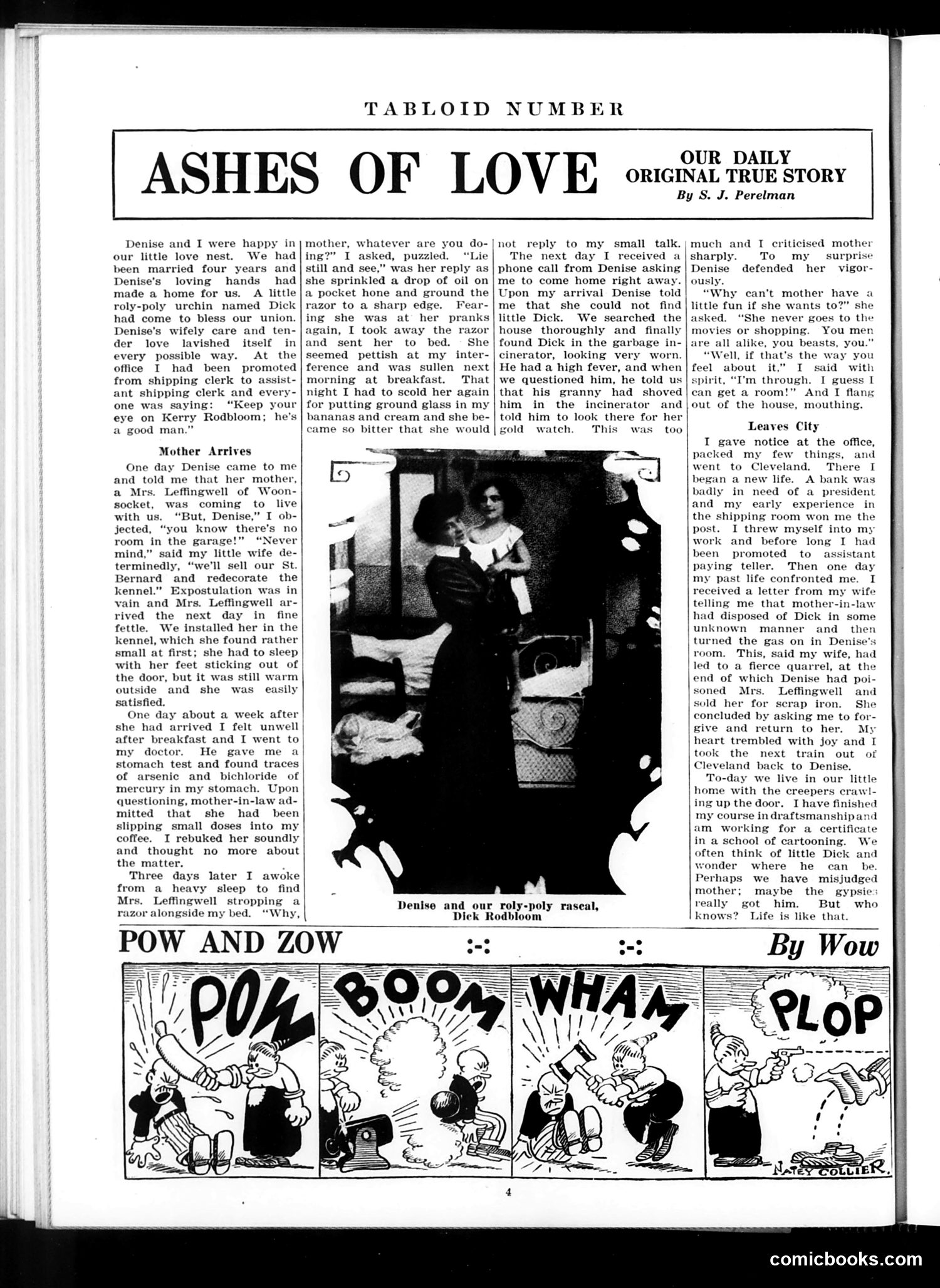
This page contains two distinct pieces: **"Ashes of Love"** is a serialized melodramatic story by S.J. Perelman about marital discord, infidelity, and a missing child named Dick. The narrative text describes domestic turmoil—the narrator's wife Denise, her mother's interference, poisoning accusations, and the couple's separation. The accompanying photograph shows two people in what appears to be a domestic scene, labeled "Denise and our poly-poly rascal, Dick Bodbloom." **"Pow and Zow"** is a comic strip by Wow depicting physical slapstick comedy. Four panels show characters engaged in violent action—punching, explosions, and shooting—with onomatopoeia ("POW," "BOOM," "WHAM," "PLOP") emphasizing the impacts. This appears to be straightforward comedic violence typical of early 20th-century humor, requiring no particular political or social context.
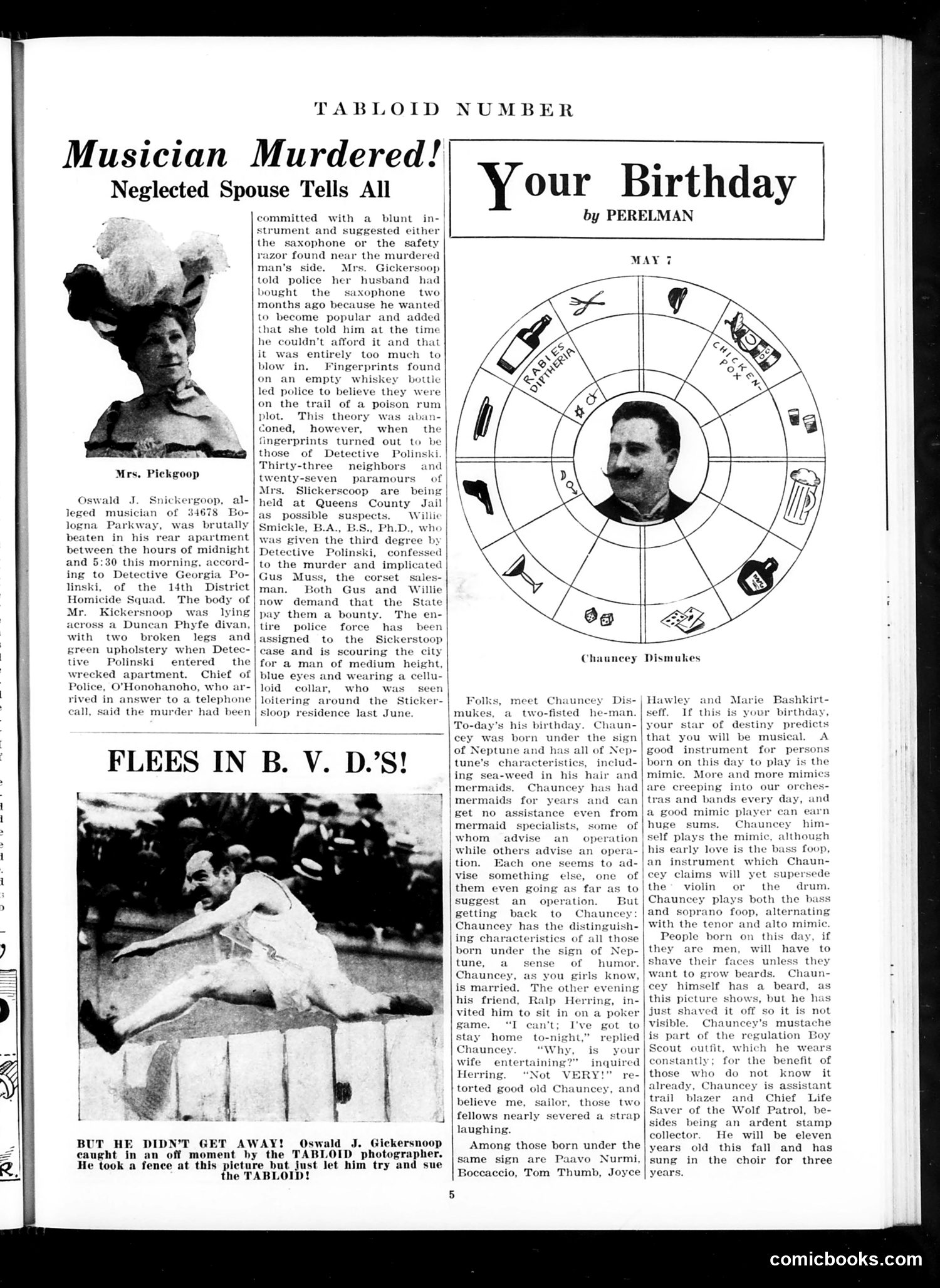
This page combines sensational crime reporting with astrological entertainment. The main stories cover: **"Musician Murdered"**: A crime story about Oswald J. Gickersoop, an allegedly neglected musician killed in his apartment. His wife reportedly confessed, implicating another woman. The piece satirizes tabloid sensationalism through dramatic language and photographs. **"Flees in B.V.D.'s"**: A humorous follow-up showing Gickersoop escaping (despite supposedly being murdered), emphasizing tabloid unreliability and exaggeration. **"Your Birthday by Perelman"**: An astrological chart for May 7 births, humorously describing someone born under Neptune—apparently a musician prone to mimicry and wearing Boy Scout uniforms. This likely parodies both astrology's vagueness and pretentious character readings popular in the era. The page satirizes tabloid sensationalism and pseudoscience simultaneously.
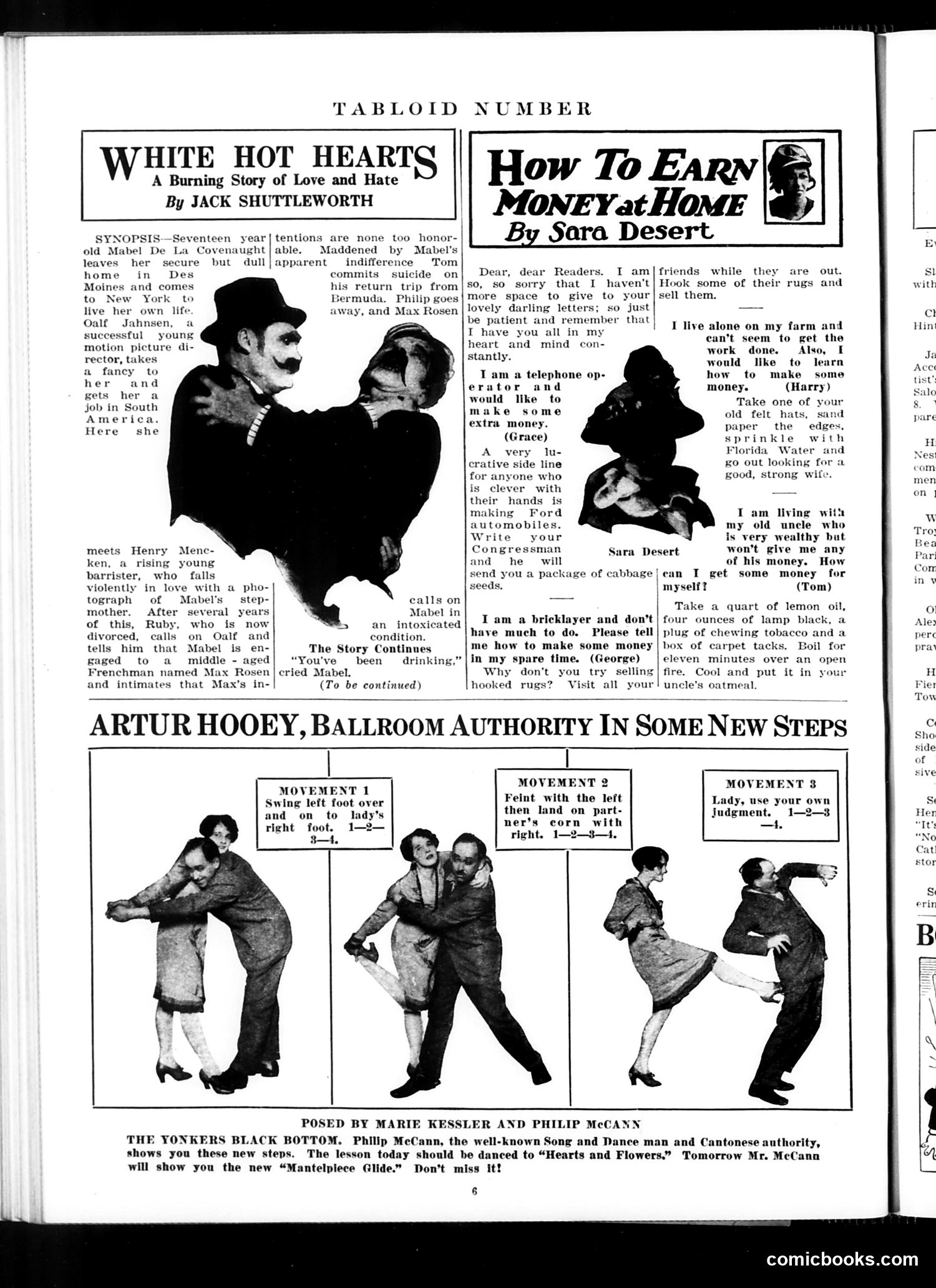
This page contains three distinct features typical of early 20th-century Judge magazine: **"White Hot Hearts"** (top left): A serialized melodramatic film synopsis by Jack Shuttleworth, featuring stock romantic-drama plot elements—a young woman, competing suitors, betrayal, and attempted suicide. The accompanying photo shows two men in dramatic confrontation, likely depicting a scene from this serialized story. **"How to Earn Money at Home"** (top right): An advice column by Sara Desert offering readers humorous (often absurd) money-making schemes in response to letters. The humor derives from impractical suggestions—selling neighbors' rugs, adding lemon oil and tobacco to oatmeal, selling hooked rugs. This satirizes both get-rich-quick schemes and advice-column conventions. **"Arthur Hooey, Ballroom Authority"** (bottom): A comedic dance instruction feature showing exaggerated ballroom steps with deliberately unhelpful captions (movement 3 instructs the lady to "use your own judgment"). The final line mentions the "Yonkers Black Bottom," likely referencing contemporary dance crazes. The page is primarily entertainment and satire rather than political commentary.
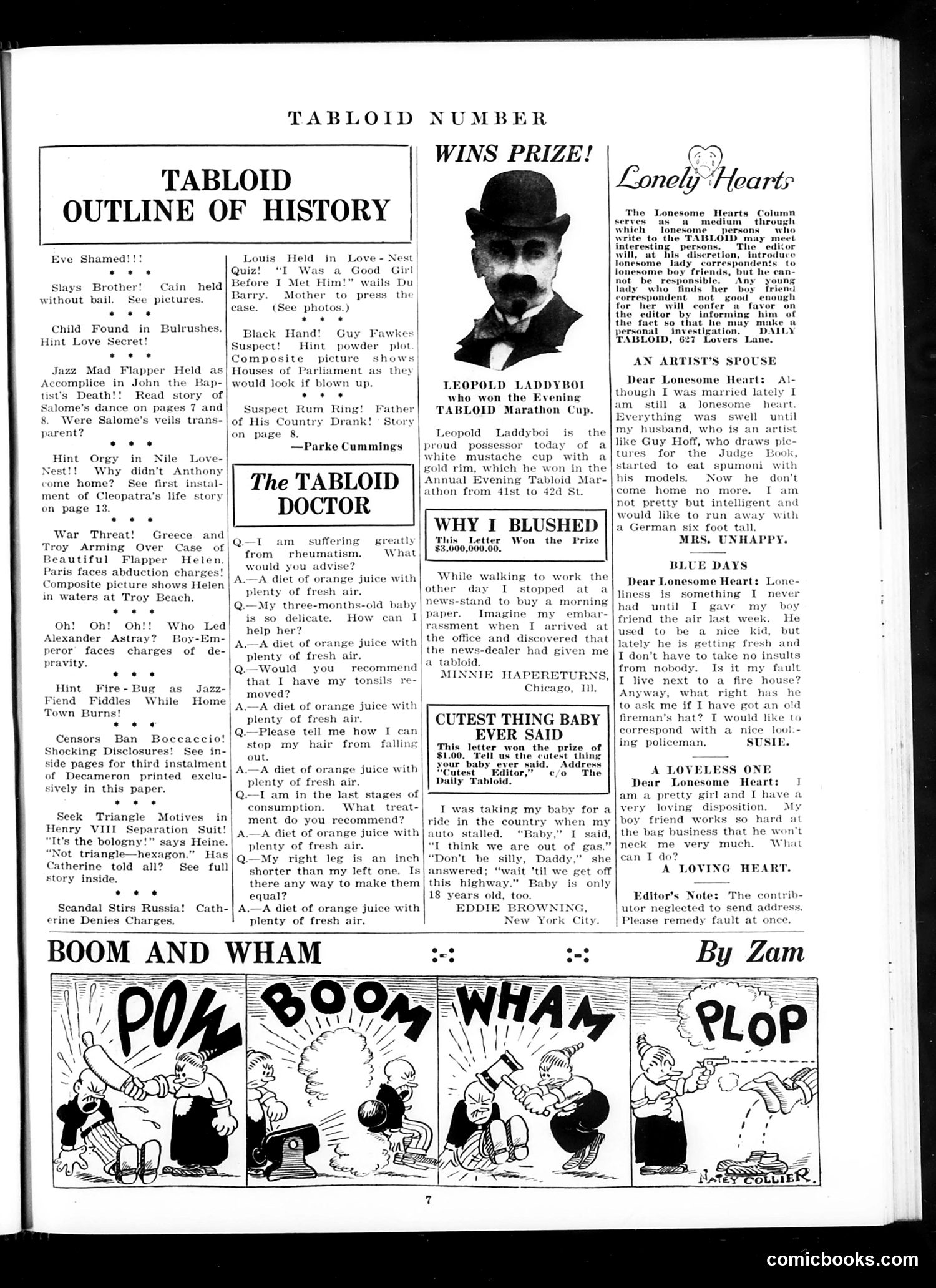
This is a **parody issue of Judge magazine mocking tabloid journalism**—specifically the sensationalism and invented scandals of 1920s tabloids. The "Tabloid Outline of History" ridicules how tabloids sensationalize mundane or historical events as scandals ("Eve Shamed!", "Slays Brother!", "Child Found in Bulrushes"). **"The Tabloid Doctor"** satirizes tabloid advice columns, where every question receives the identical absurd answer: "a diet of orange juice with plenty of fresh air"—mocking the generic, useless advice such columns dispensed. **"Boom and Wham"** (bottom) is a comic strip by Zam showing slapstick violence—likely parodying how tabloids sensationalized crime and accidents. The "Lonely Hearts" column parodies personals ads while poking fun at marital infidelity scandals tabloids covered. **Leopold Laddyboi** appears to be a fictional character invented to mock celebrity profiles tabloids created around minor events (winning a "marathon" between two city blocks). Overall, the page satirizes how tabloid journalism manufactured drama from nothing and exploited readers' appetite for scandal.
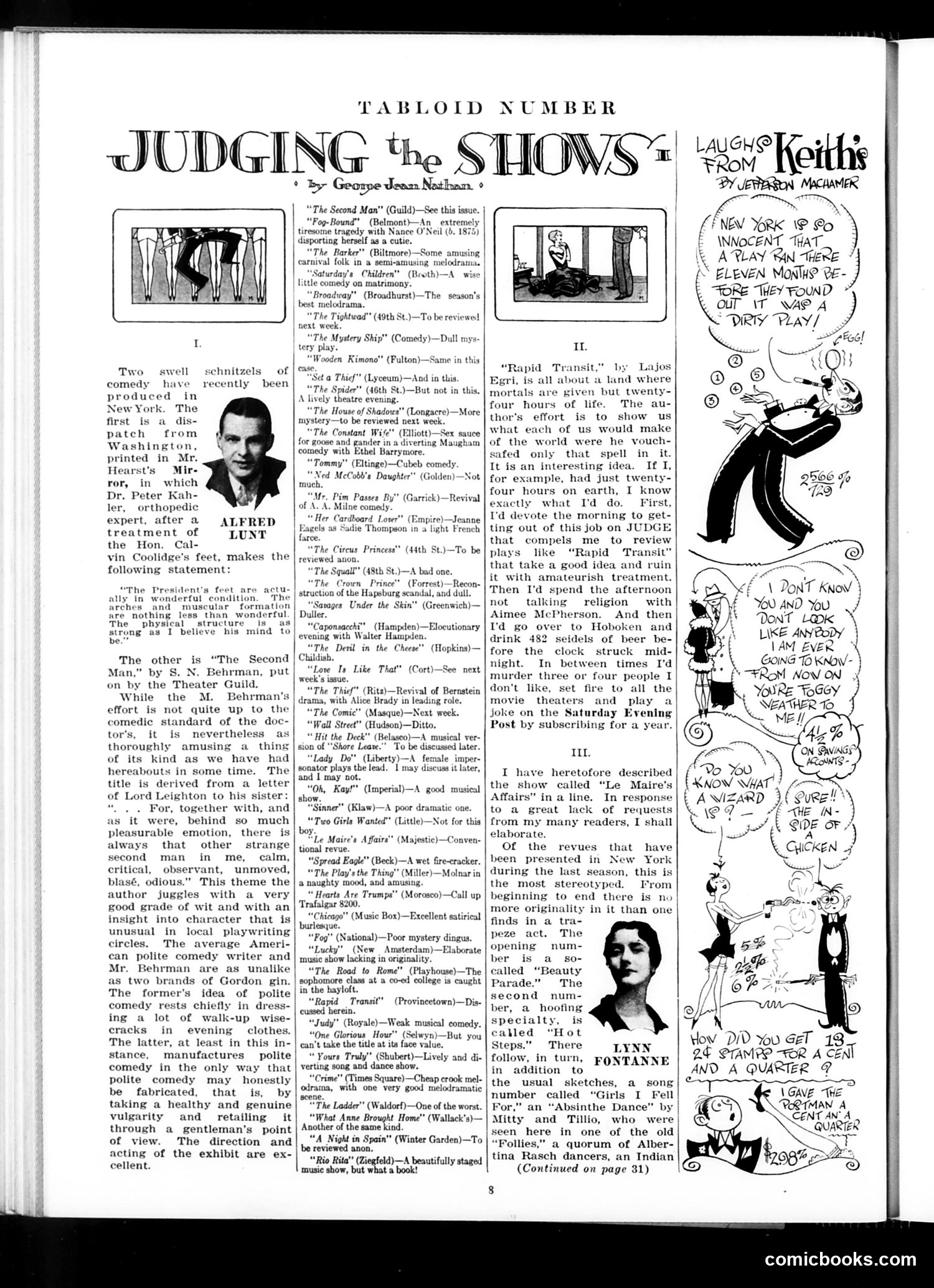
This is a theater review column by critic George Jean Nathan evaluating Broadway productions. The page contains two main elements: **Left side:** Text reviews of recent shows, including "The Second Man" by S.N. Behrman (Theater Guild production starring Alfred Lunt) and brief mentions of other plays. **Right side:** A cartoon by Keith featuring a character discussing a "play" that ran eleven months before audiences discovered it was "dirty." The cartoon satirizes naive or gullible theatergoers who fail to recognize obvious theatrical quality (or lack thereof). **Key satire:** Nathan's reviews employ sophisticated critical wit, contrasting genuine theatrical craftsmanship with pedestrian "polite comedy" writing. The cartoon reinforces this—mocking audiences slow to recognize poor entertainment. **Context for modern readers:** This reflects 1920s Broadway's vibrant theatrical scene and critical discourse about what constitutes legitimate comedy versus vulgar entertainment.
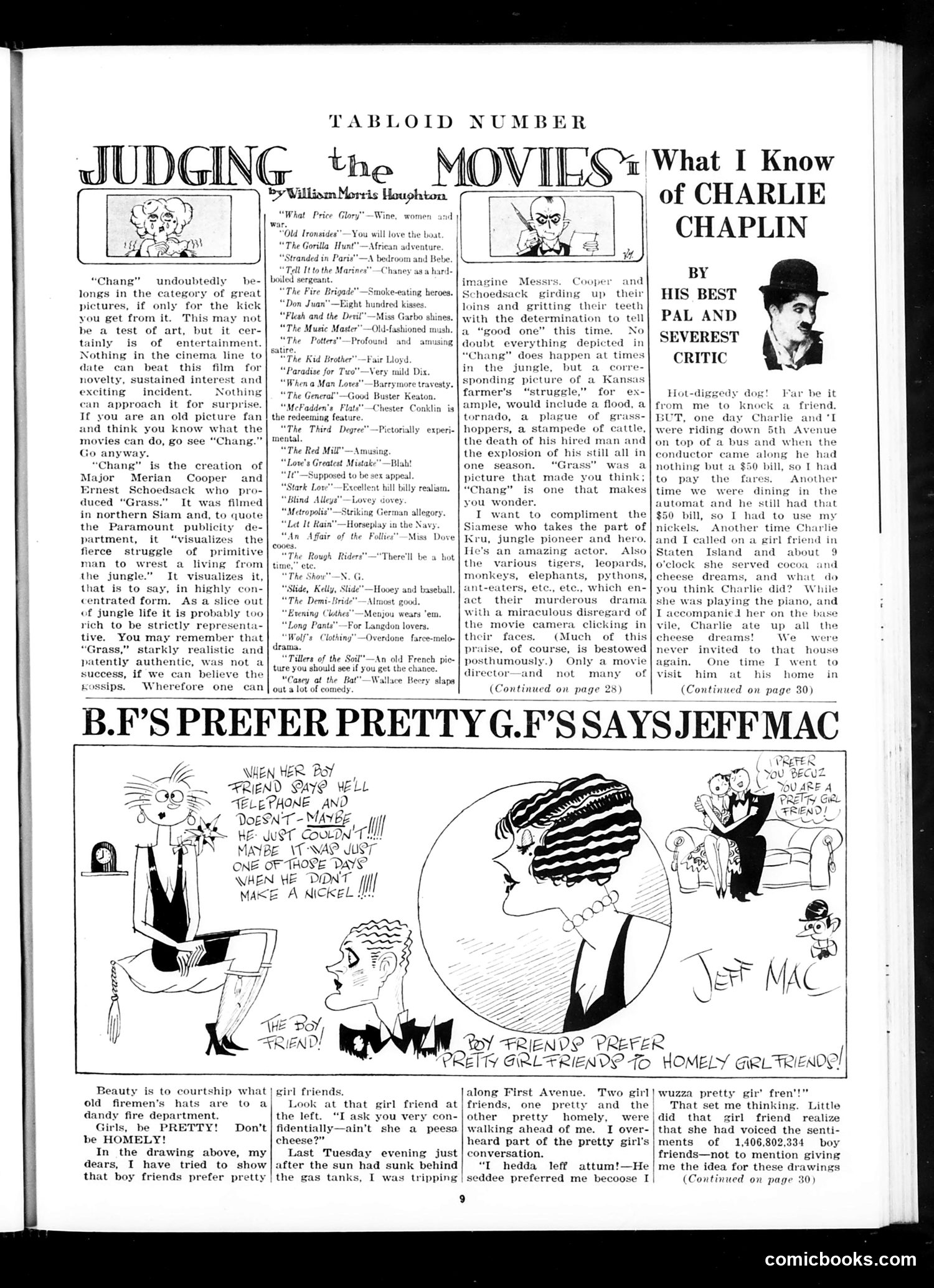
This page from Judge magazine contains film reviews and a satirical cartoon about social class and friendship. **"Judging the Movies"** section reviews contemporary 1920s films, including *Chang* (a jungle adventure film by Merian Cooper and Ernest Schoedsack), praising its novelty and entertainment value while critiquing other releases. **The main cartoon** by Jeff Mac satirizes class differences in female friendships. The drawing shows contrasting "friend types": the text explains that working-class men prefer "homely" girlfriends, while wealthy men prefer "pretty girls." The cartoon depicts a snobbish "pretty girl friend" who looks down on a "homely girl friend," illustrating social pretension and the superficiality of friendship based on appearance and status. The accompanying anecdotes about Charlie (Chaplin) illustrate class comedy—his inability to pay bus fare with a $50 bill, the expense of dining at automats, and his eating all the cheese dreams at a girl's house, suggesting both humor and gentle mockery of financial awkwardness.
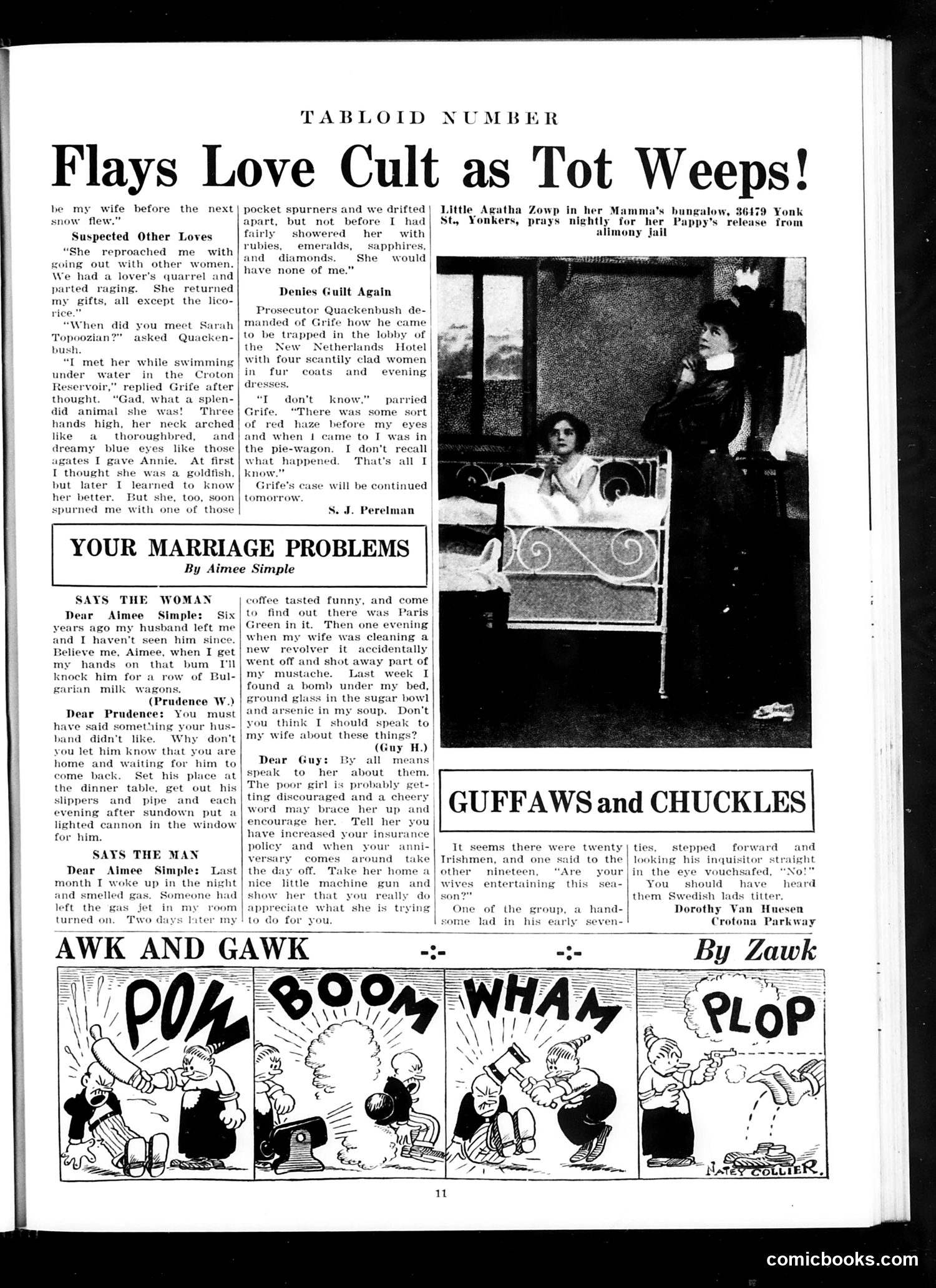
This page from *Judge* magazine contains satirical content mocking sensationalist tabloid journalism and domestic life advice columns. **Main Features:** The headline "Flays Love Cult as Tot Weeps!" parodies tabloid sensationalism—exaggerated, melodramatic stories about scandals and love affairs. The text describes absurd romantic entanglements with overwrought language ("dreamy blue eyes," "splendid animal"). **"Your Marriage Problems" by Aimee Simple** satirizes advice columnists by offering deliberately terrible counsel: a husband should be reminded of his wife's presence by placing a "lighted cannon in the window." The letters describe domestic chaos (bombs under beds, arsenic in soup) presented as ordinary marriage complaints. **"Awk and Gawk" comic strip** by Zawk uses sound effects (POW, BOOM, WHAM, PLOP) to depict slapstick violence—typical lowbrow humor of the era. The overall satire targets the public's appetite for sensational gossip, cheap relationship advice, and crude entertainment masquerading as serious journalism—cultural trends *Judge* viewed as degrading public discourse.
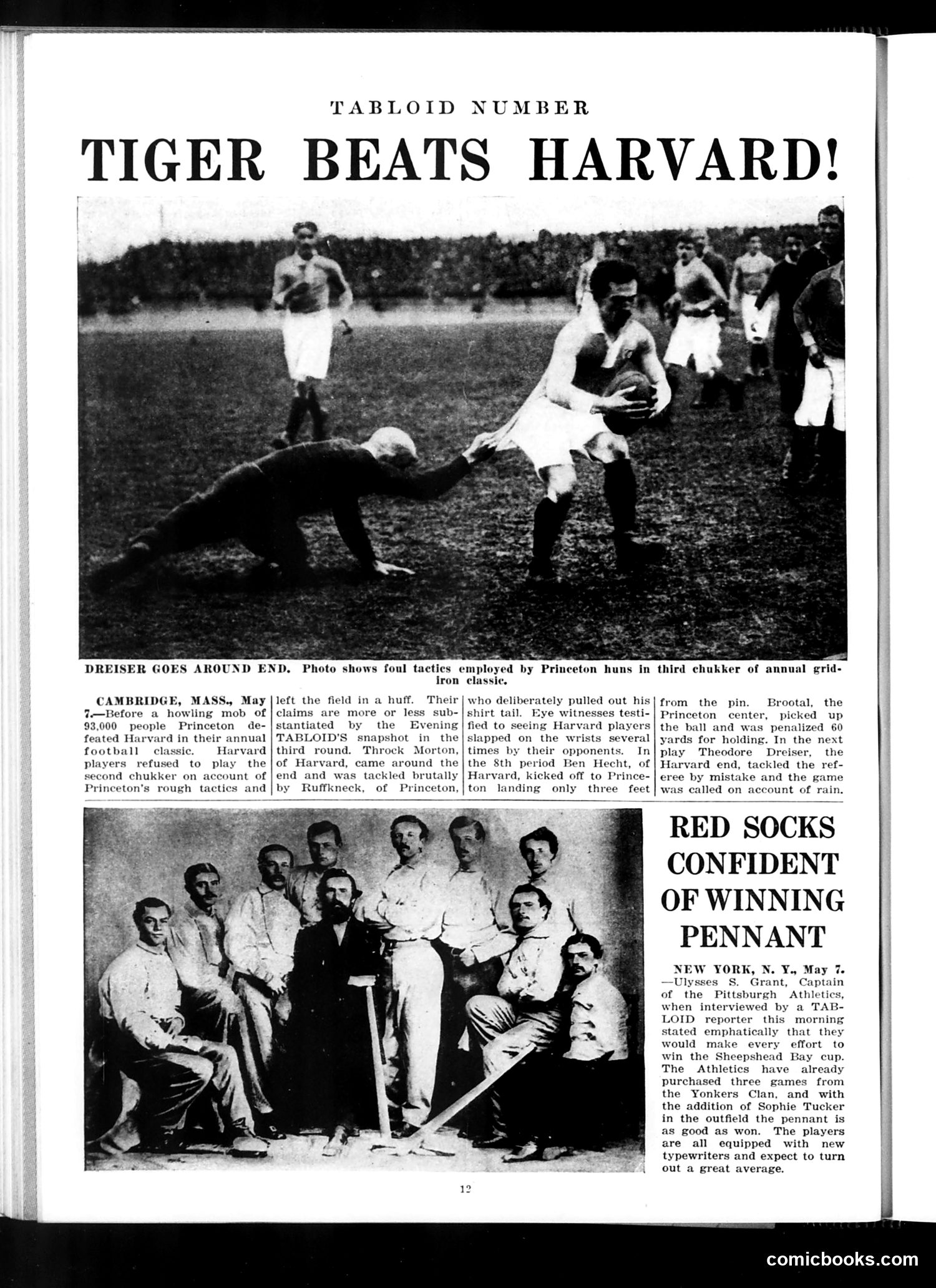
This is a satirical sports page mocking both football and baseball coverage. The main cartoon shows **Princeton defeating Harvard** in their annual football game, with the text sarcastically describing "foul tactics" and "rough play" by Princeton. The photograph caption humorously refers to football plays as "chukkers" (a polo term), and names real literary figures like **Theodore Dreiser** as participants, adding absurdist humor. The joke relies on exaggeration: claiming 93,000 spectators attended, referencing players being "penalized" like in polo, and naming famous author Dreiser as a football player. The bottom section satirizes sports journalism itself, with the **Red Socks** (likely the Boston Red Sox) claiming confidence in winning via absurd means: "purchasing" games from competitors, adding entertainer **Sophie Tucker** to baseball, and equipping players with typewriters to write about their own "great average." The overall satire mocks both overly dramatic sports reporting and the corruption implied in early professional sports.
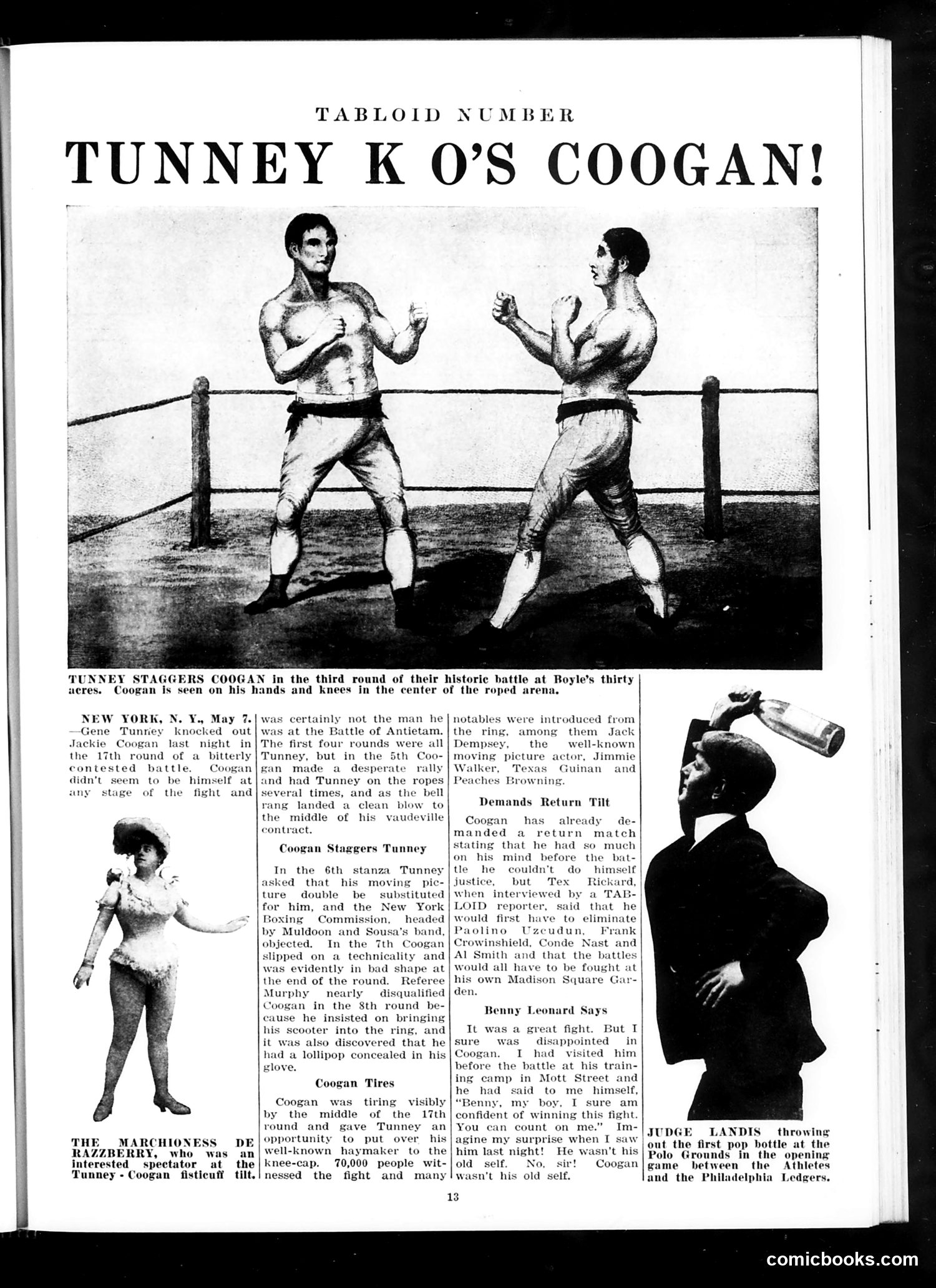
This is a satirical tabloid piece mocking a fake boxing match between Gene Tunney (a real, famous boxer of the 1920s) and Jackie Coogan (a child film star). The "fight" is absurdist humor—Coogan is depicted as exhausted, attempting to bring his scooter into the ring, and hiding a lollipop in his glove, establishing him as a child playing at boxing. The satire targets celebrity culture and tabloid sensationalism. Real 1920s figures appear as commentators: Tex Rickard (boxing promoter), Jack Dempsey (boxer-turned-actor), Texas Guinan (nightclub hostess), and others. Judge Landis, baseball's commissioner, is shown at a baseball game, mixing sports absurdly. The joke mocks how tabloids manufacture drama around celebrities and how 1920s New York society obsessed over boxing and entertainment figures. Coogan, a child star, is treated as a legitimate fighter—ridiculous on its face, which is precisely the point.
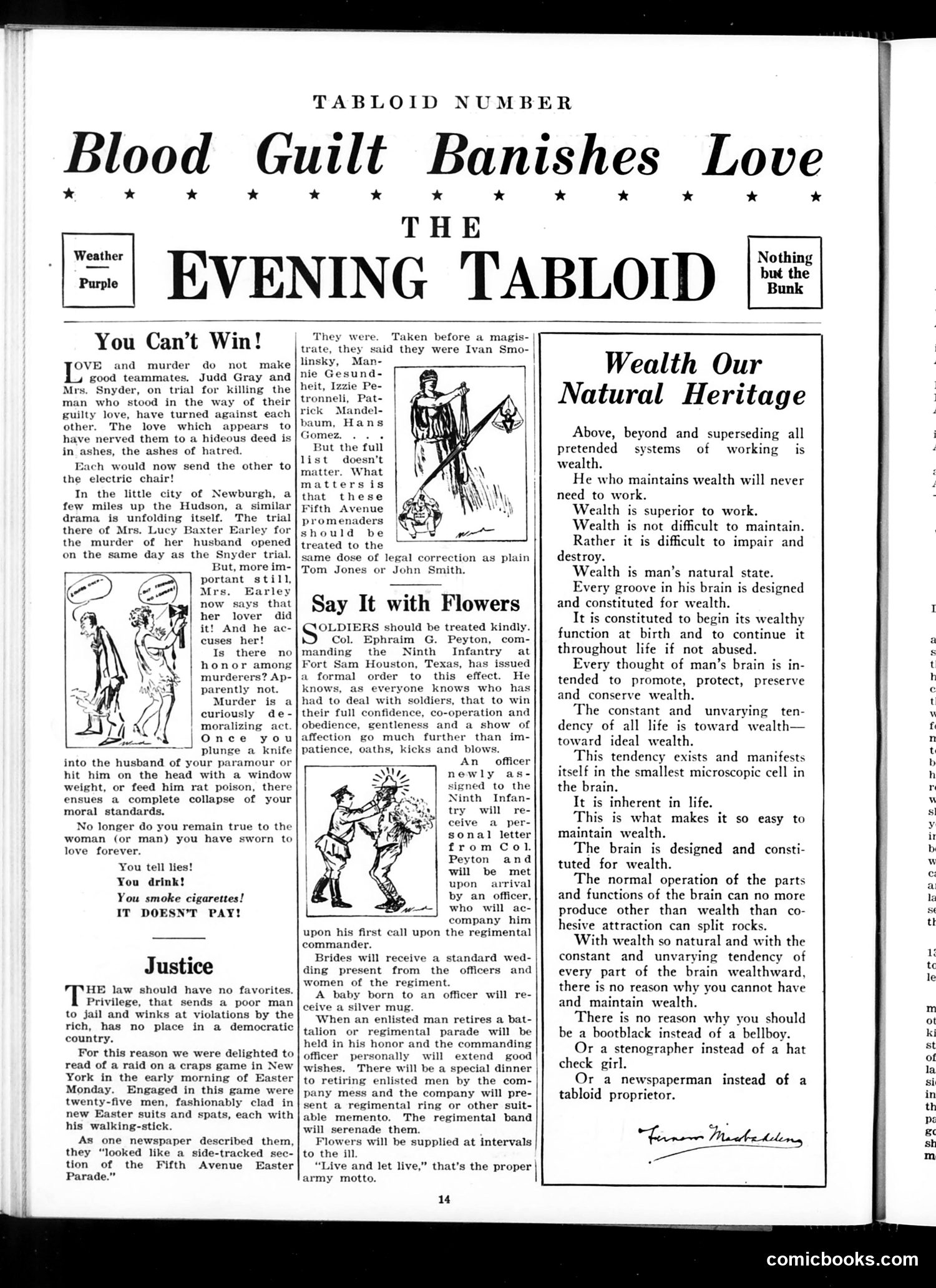
This 1927 *Judge* magazine page satirizes contemporary criminal scandals and social hypocrisy. **"You Can't Win!"** references the notorious Snyder-Gray murder case (a real 1927 trial), where Ruth Snyder and Judd Gray killed her husband. The satire mocks how their romantic "love" instantly dissolved into mutual blame—they turned on each other immediately. The piece sarcastically catalogs moral collapse: murderers lie, drink, and smoke cigarettes. **"Justice"** critiques unequal law enforcement: wealthy Fifth Avenue men arrested for gambling receive the same charges as poor laborers (ethnic names like Smolensky and Gesundheit suggest working-class defendants), yet privilege usually shields the rich. **"Say It with Flowers"** praises Col. Ephraim Peyton's kindness policy toward soldiers—treating enlisted men with respect, providing flowers to the sick, honoring retirements. It's sincere rather than satirical. **"Wealth Our Natural Heritage"** appears to be ironic social commentary suggesting wealth (not work) is man's "natural state"—likely mocking the wealthy's self-justifying ideology during the Jazz Age prosperity. The overall tone: cynical about human nature and systemic injustice, while celebrating genuine kindness.
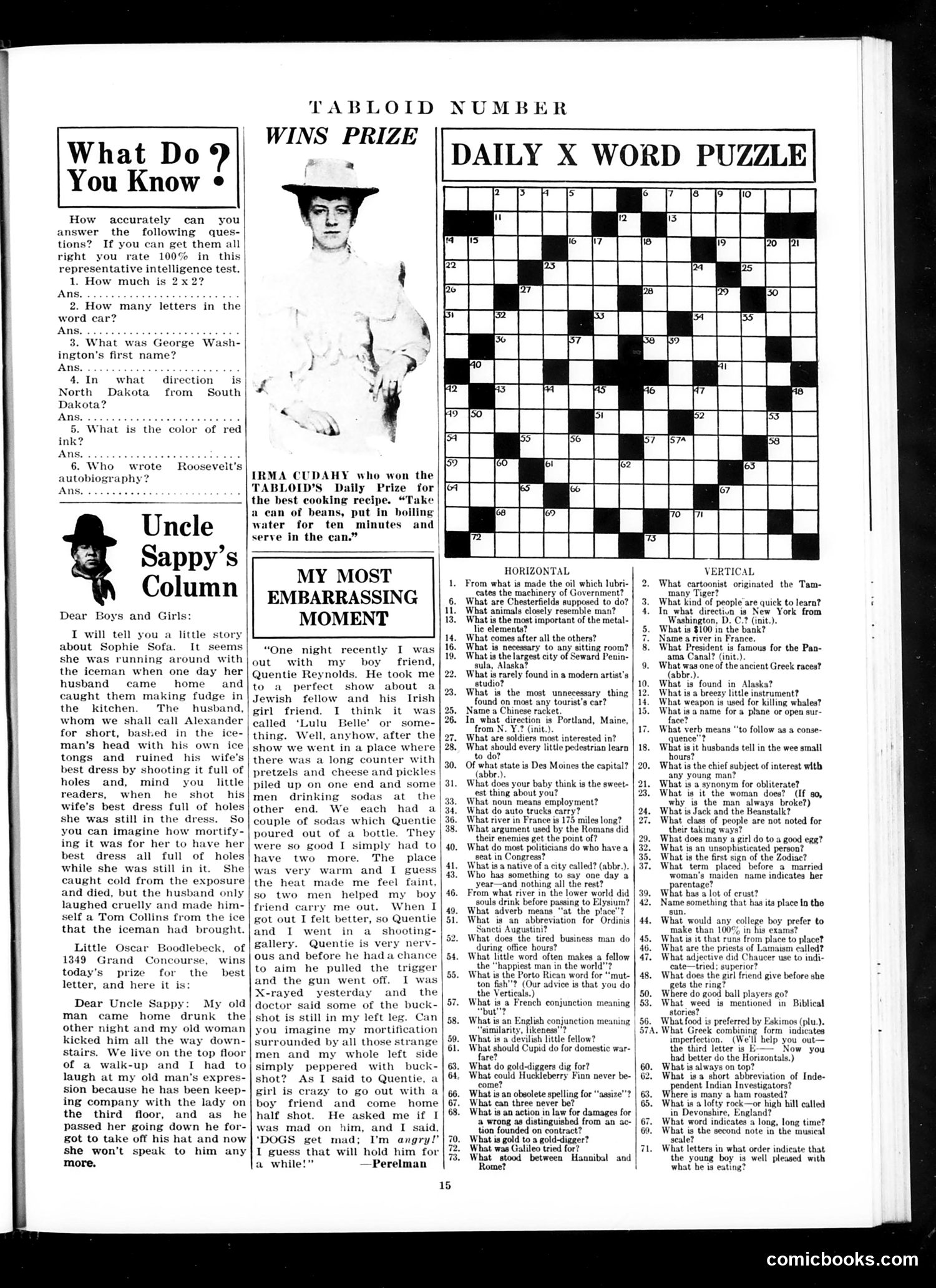
This is a humor page from *Judge* magazine featuring three distinct comedic sections: **"What Do You Know?"** - A mock "intelligence test" with absurdly simple questions (e.g., "How much is 2×2?") satirizing pop psychology and IQ tests that were trendy in the 1920s. **"Uncle Sappy's Column"** - A advice column where readers submit embarrassing personal anecdotes. The featured letter is from a woman describing a humiliating date with "Quentie Reynolds" (likely a reference to the real gossip columnist/raconteur Quentin Reynolds). She gets drunk on soda, faints, gets shot in a shooting gallery, and is X-rayed—all while trying to maintain composure. The humor mocks both romantic mishaps and the fashion of confessional "embarrassing moment" stories. **"Daily X Word Puzzle"** - A standard crossword puzzle. The page is light entertainment—no overt political satire. It targets 1920s fads (intelligence testing, advice columns, dating culture) and physical comedy. The writing, credited to "Perelman," likely means S.J. Perelman, the famous humorist.
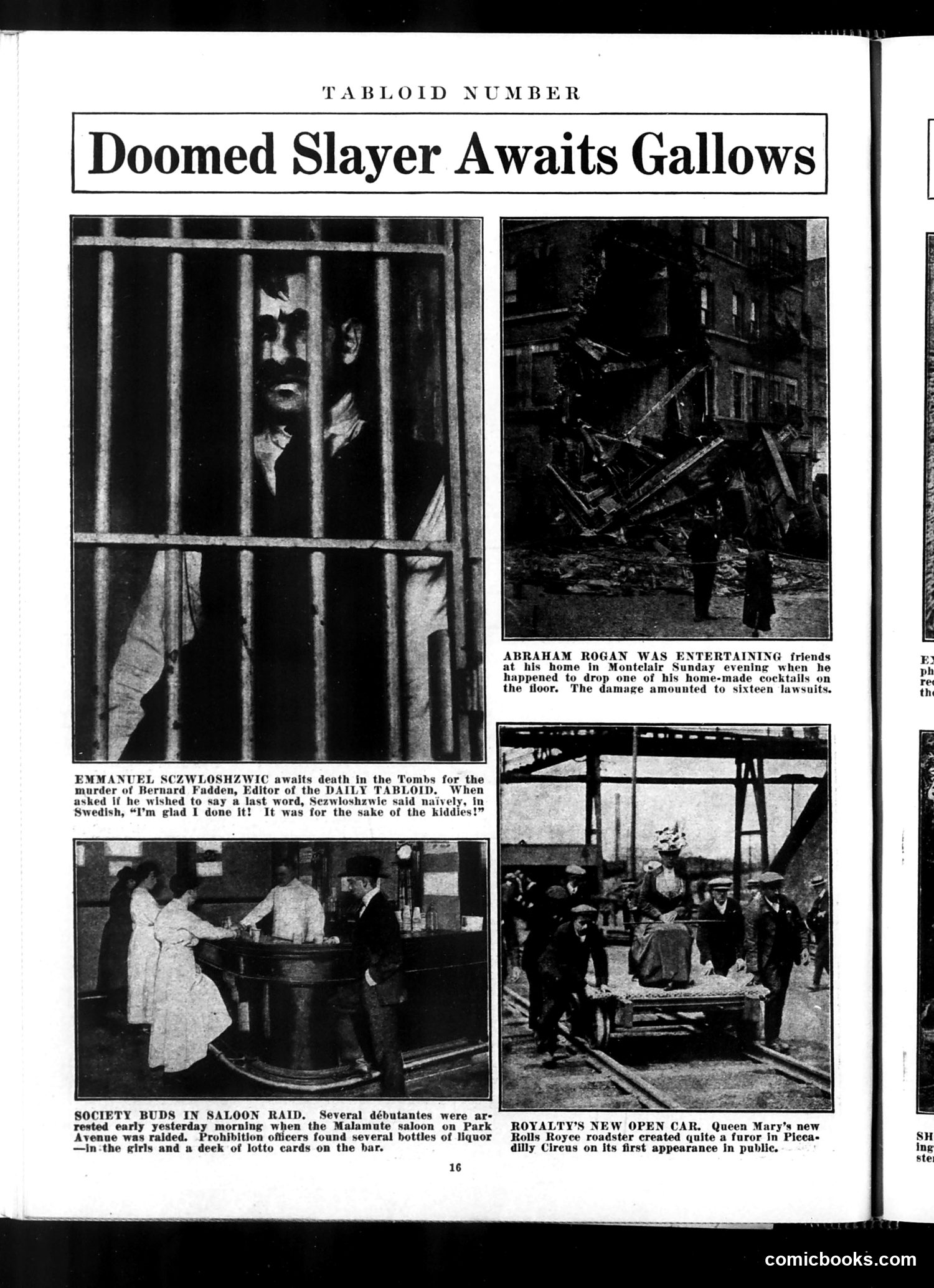
This is a satirical tabloid-style page mocking sensationalist newspaper coverage popular in the 1920s. The content parodies lurid crime and society stories: **"Doomed Slayer"**: A mock headline about a convicted murderer (Emmanuel Szczwloshzwic) awaiting execution for killing a tabloid editor. The satire lies in the prisoner's naive, unapologetic quote claiming he killed "for the sake of the kiddies"—likely mocking how criminals justify heinous acts. **"Society Buds in Saloon Raid"**: Ridicules wealthy young women arrested during Prohibition enforcement, caught with liquor and gambling cards. **"Abraham Rogan" anecdote**: A wealthy man's broken cocktail supposedly generating "sixteen lawsuits"—absurdist humor mocking frivolous litigation. **"Queen Mary's Open Car"**: Satirizes excessive society coverage of minor royal events. The page collectively lampoons how tabloids sensationalize crime, Prohibition violations, and trivial society gossip with breathless, exaggerated reporting.

This is a photojournalistic page documenting violence during a Chicago election, likely from the 1920s Prohibition era. The four photographs show: 1. **City Hall voting booth** during chaos 2. **Loop District voters** with bandaged heads, attempting to vote despite injuries from violence 3. **Shock troops** (military/police) repelling gangsters in the Lake Shore area; "103 doughboys" (soldiers) held position for three hours 4. **Silk Stocking District** polling place under armed guard; Mayor Thompson cast his vote amid heavy bombardment The page documents electoral intimidation and violence—gangsters physically preventing voters from casting ballots. The satire lies in the absurdity: soldiers deployed to protect voting, voters injured but persisting, and the casual framing of an election requiring military intervention. This reflects Chicago's notorious gang violence and corrupt politics of the Prohibition period, when organized crime effectively controlled city elections through force.
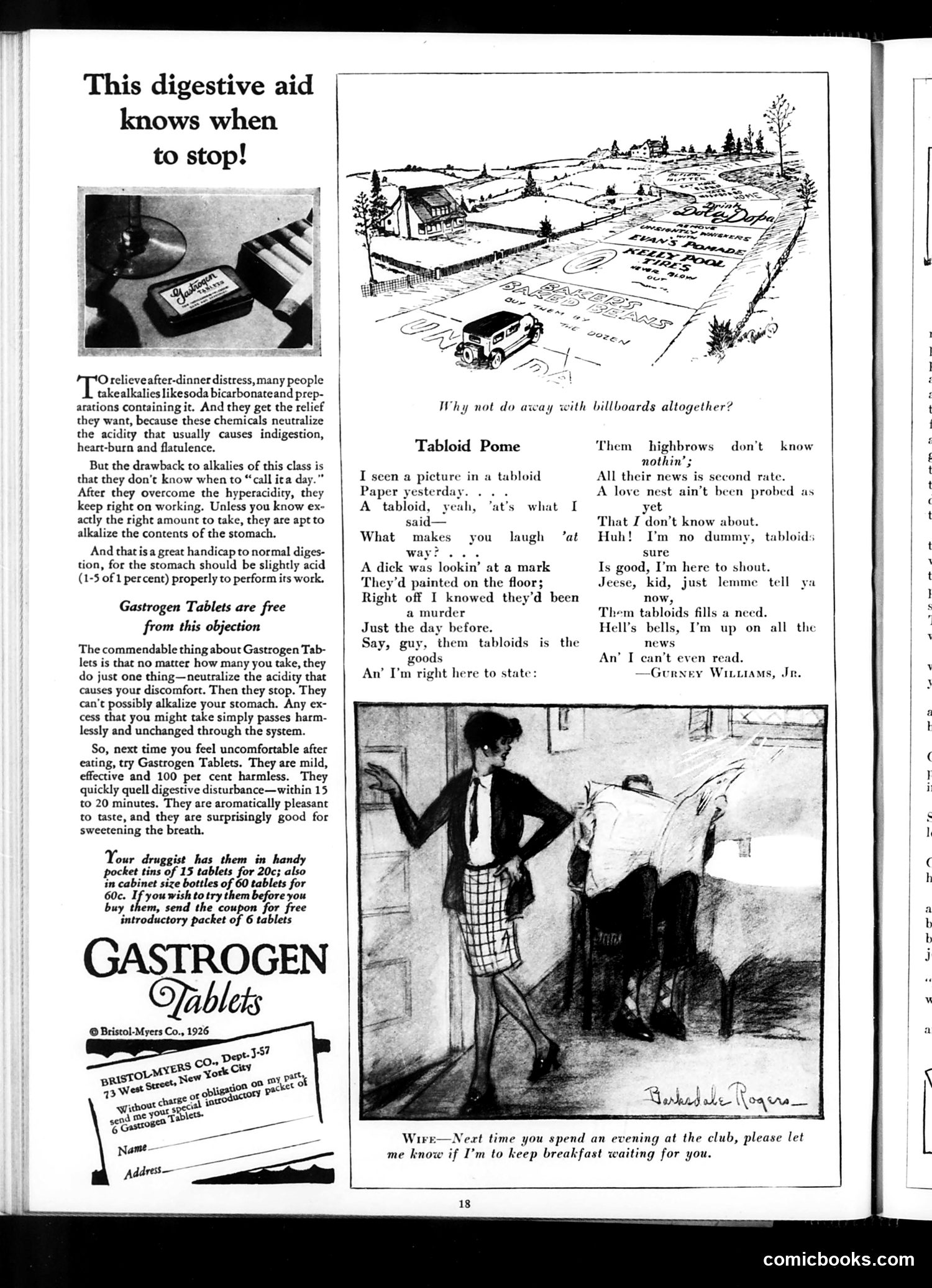
This page contains two distinct items: **Left side:** A Gastrogen Tablets advertisement positioning the product as a digestive aid superior to common alkalies like baking soda. The ad claims Gastrogen neutralizes stomach acid without over-alkalizing, a claimed medical advantage. This reflects 1920s consumer anxieties about digestive health and patent medicine marketing. **Right side:** "Tabloid Pome," a humorous verse by Gurney Williams Jr. mocking tabloid newspaper readers and sensationalist journalism. The poem's narrator—portrayed as an illiterate working-class man—boasts of following tabloid coverage of crimes and scandals ("love nests," murders) despite being unable to read, suggesting tabloids rely on visual spectacle and lurid content rather than substantive news. **Bottom cartoon:** A domestic scene showing a wife confronting her husband about late club nights, with the caption suggesting marital tension over his social activities—a standard humor trope of the era. The page reflects 1920s attitudes toward mass media, consumer products, and class differences in taste and literacy.
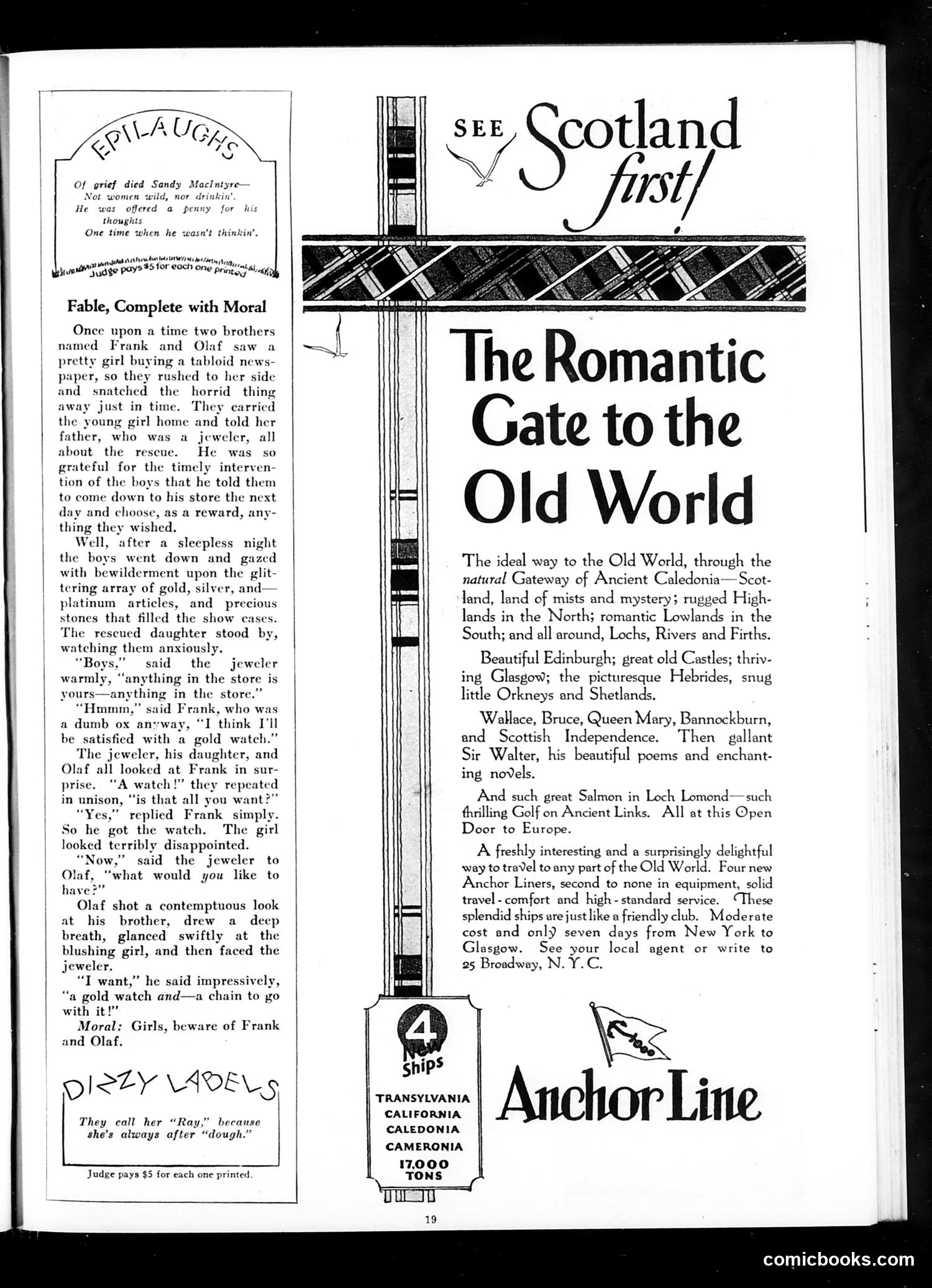
This page contains three distinct elements: **"Epiloghs" & "Fable"**: Two brief humorous pieces. The fable mocks male obtuseness through brothers Frank and Olaf, who are rewarded by a jeweler after rescuing his daughter. Frank unimaginatively chooses a gold watch; Olaf, trying to impress the girl, asks for the same watch *plus a chain*—presented as the height of cleverness. The moral sardonically warns girls against such dim-witted suitors. "Dizzy Labels" is a one-liner joke about a woman nicknamed "Ray" because she always chases money ("dough"). **Anchor Line Advertisement**: The dominant content is a travel ad promoting Scottish tourism and transatlantic steamship service. It romanticizes Scotland as an "Old World" gateway featuring historical sites (Wallace, Bruce, Bannockburn) and literary associations (Sir Walter Scott), positioning Scotland as an exotic, cultured destination. The ad emphasizes the new Anchor Liner ships' comfort and seven-day journey from New York to Glasgow. The page mixes satirical humor with commercial promotion—typical Judge magazine content.
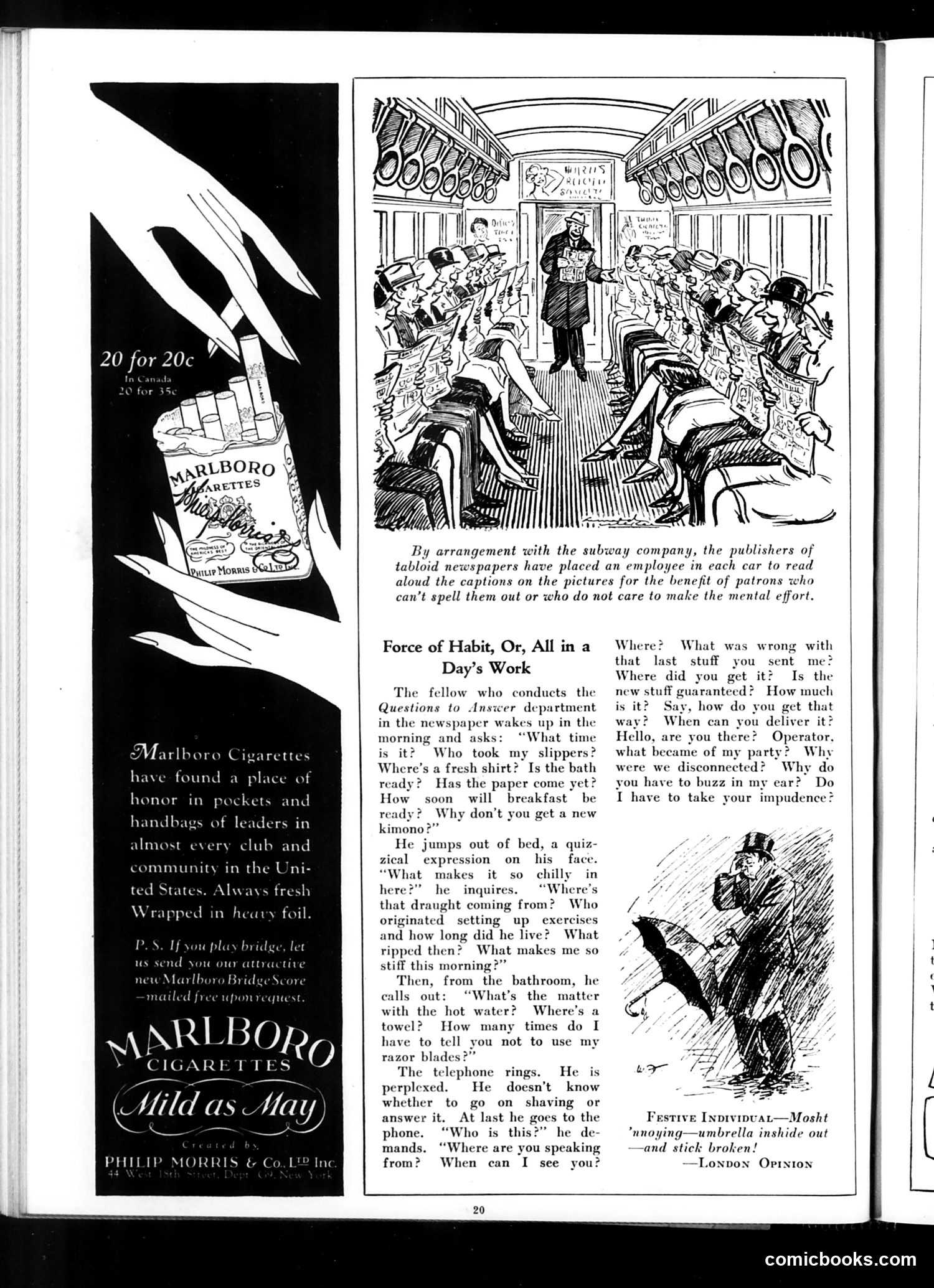
This cartoon satirizes a newspaper advice columnist (who answers reader questions) by showing how his relentless questioning habit pervades his entire day. The joke traces his morning routine—pestering his wife about the time, his slippers, breakfast timing—then extends through his bathroom complaints, phone call interrogations with a business contact, and operator interactions. The satire suggests that newspaper advice-givers are so accustomed to asking questions professionally that they've become insufferable in daily life, constantly demanding answers about trivial matters. The accompanying illustration shows a chaotic subway car where tabloid newspapers have stationed employees to read photo captions aloud to passengers who "can't spell them out"—mocking both mass-market newspapers and their less-educated readership. The page is primarily advertising for Marlboro cigarettes.
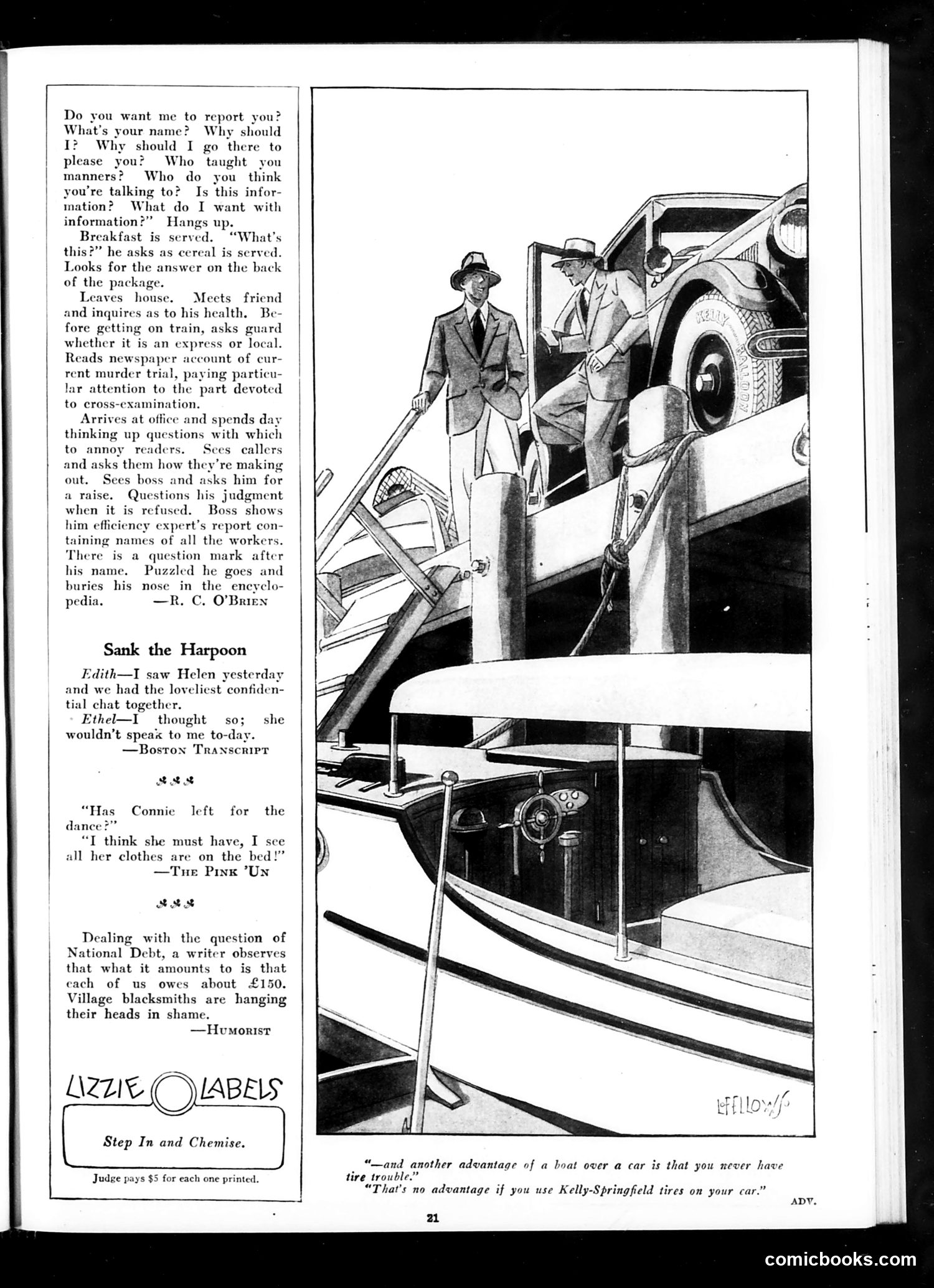
This page contains several brief satirical pieces typical of Judge magazine's humor: **Main cartoon**: Shows a man and woman at a boat, discussing advantages of boats over cars. The joke relies on a Kelly-Springfield tire advertisement at the bottom—the punchline suggests their tires are so reliable that boats lose their advantage. **Text pieces** (attributed to various writers) mock modern social behavior: - A character who constantly asks annoying questions and complains - Office workers pestering their boss for raises - Social gossip about women's activities **Context**: These pieces reflect early 20th-century anxieties about white-collar work, changing social manners, and emerging consumer culture. The humor is observational rather than political—satirizing everyday frustrations with bureaucracy, efficiency experts, and intrusive questioning. **Advertisement**: "Lizzie Labels" promotes a product where judges award $5 for printed entries, typical of period promotional contests. The page primarily showcases Judge's signature style: gentle satirical observations about middle-class American life, interspersed with paid advertising.
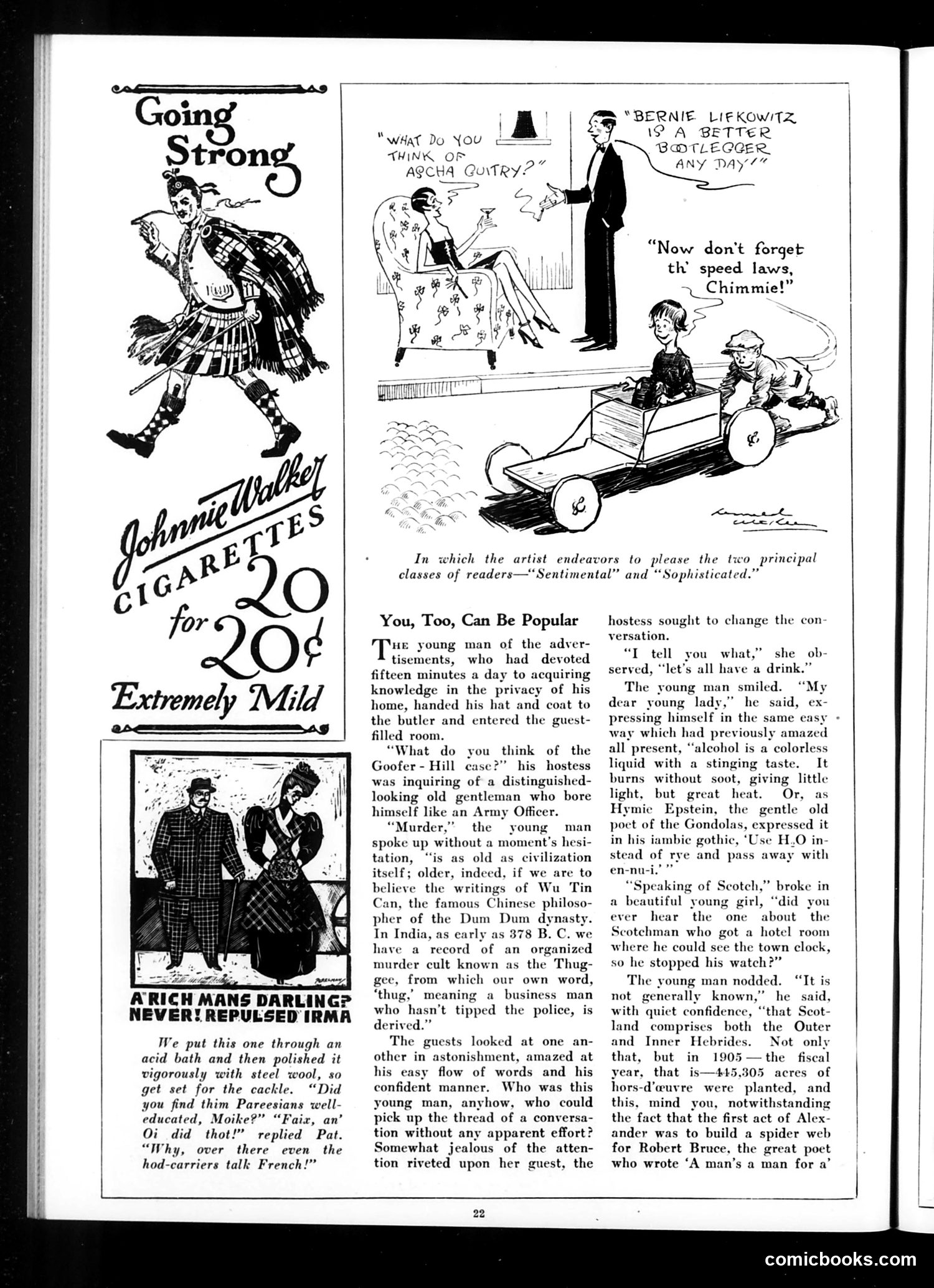
This page from *Judge* magazine satirizes social climbing and pretentious intellectualism through two distinct pieces: **"You, Too, Can Be Popular"** (main story): A young man impresses dinner guests by spouting seemingly erudite but ultimately meaningless facts—citing obscure historical references, pseudo-scholarly observations about alcohol chemistry, and non sequiturs about Scotland. The satire targets both the speaker's transparent fakery and the guests' gullible admiration. The joke exposes how people can appear sophisticated by merely name-dropping exotic sources and delivering confident-sounding nonsense. **The cartoon at top right**: Shows a man lecturing children about "speed laws" while they race in a homemade soapbox car—satirizing hypocrisy about rule-following. **The side panel**: A crude ethnic joke (appearing to mock Irish immigrants' accents and education levels). The central message: in the 1920s, Americans were anxious about appearing cultured, making them vulnerable to phonies. Genuine knowledge matters less than confident delivery.
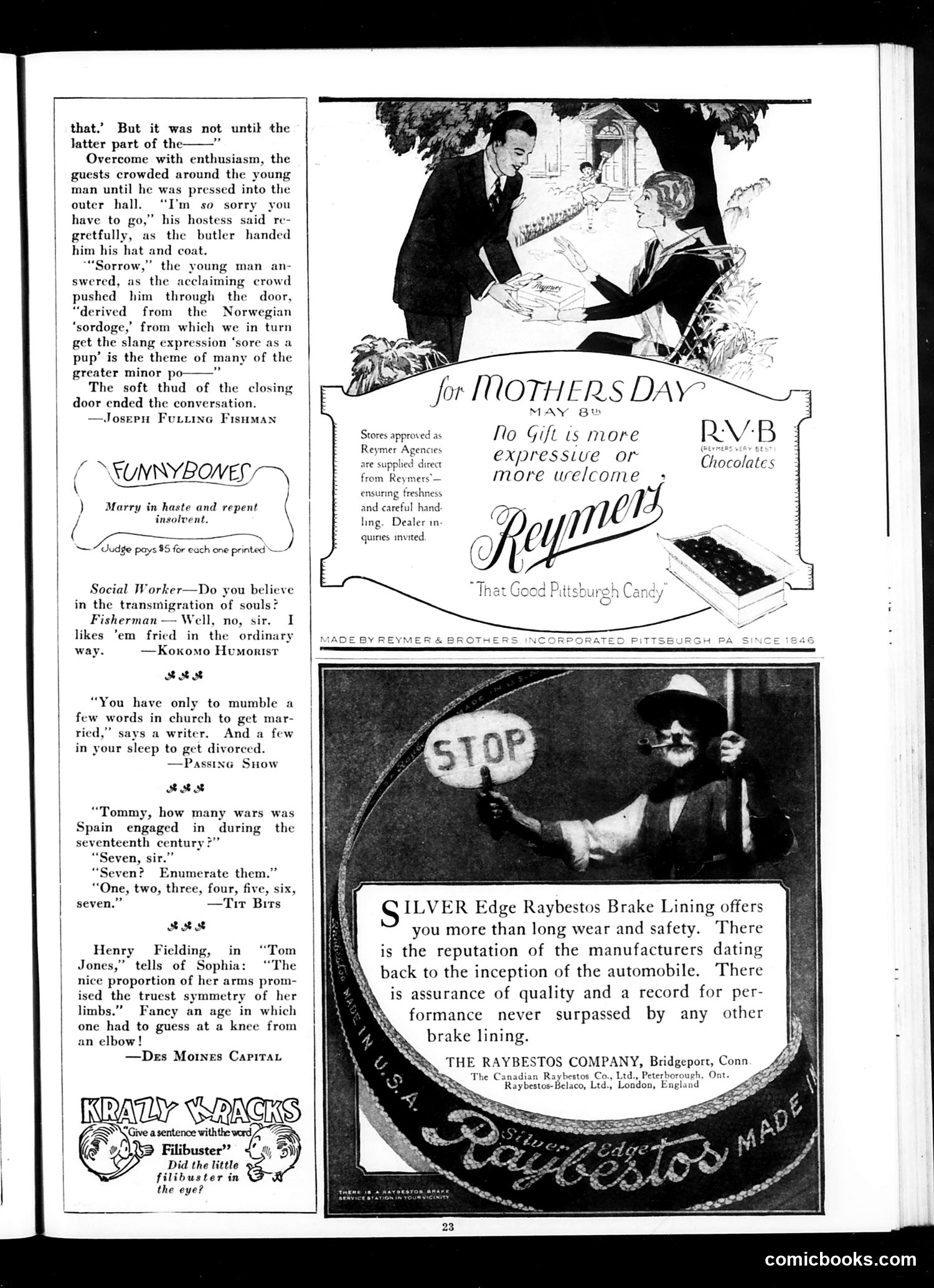
This page contains short satirical pieces typical of Judge magazine's humor section, plus period advertisements. **Main content:** Several brief comic anecdotes mock everyday situations. One jokes about a young man being physically pushed out of a party by enthusiastic guests. Another presents a fisherman's literal misunderstanding of "transmigration of souls" (a philosophical concept)—he thinks it's about cooking methods. A third shows a student comically "enumerating" seven Spanish wars by simply counting "one, two, three..." **The humor style** relies on wordplay, puns, and deliberate misinterpretations—standard vaudeville-influenced comedy of the era. **Advertisements** promote Reymer's chocolates for Mother's Day and Raybestos brake linings, emphasizing quality and safety—reflecting early automotive industry marketing. The illustrated story at top (by Joseph Fuelling Fisherman) appears to conclude a longer narrative about a young man at a social gathering. These pieces reflect 1920s-era popular humor: relatively innocent, domestic-focused, and heavy on linguistic jokes.
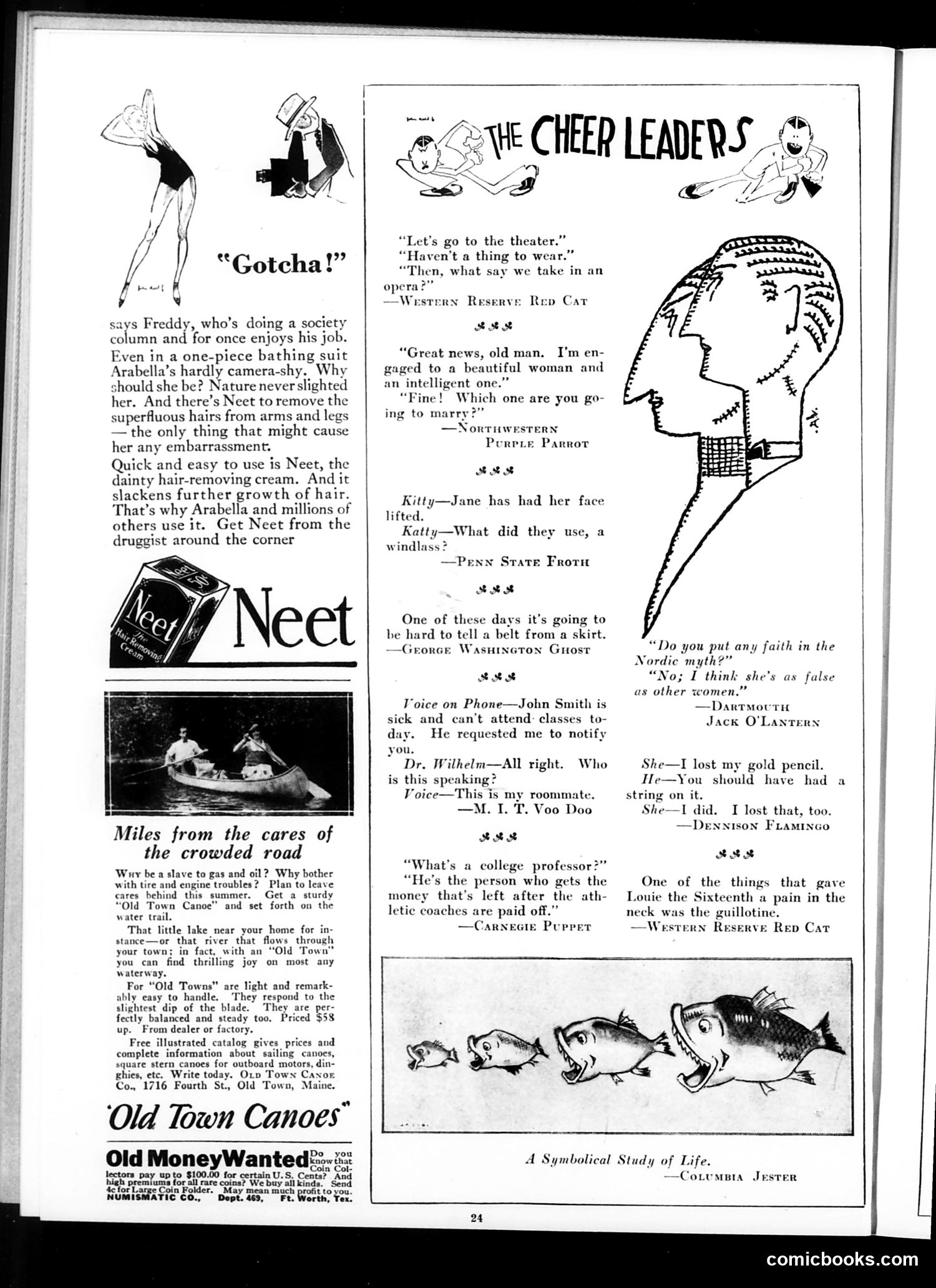
This is primarily a **humor/joke page** from Judge magazine featuring short quips attributed to various college publications and mascots (Northwestern Purple Parrot, Penn State Froth, M.I.T. Voo Doo, etc.). The jokes reflect **1920s-era social anxieties**: women's changing appearance (face lifts, hair removal), fashion ("hard to tell a belt from a skirt"), and gender relations. One recurring theme mocks women's intelligence and truthfulness ("No; I think she's as false as other women"). The page also includes **period advertisements** for Neet hair-removal cream (marketed to women concerned about visible body hair) and Old Town Canoes (leisure/escape advertising). The bottom cartoon—"A Symbolical Study of Life" by Columbia Jester—uses fish of increasing size swallowing smaller fish, likely depicting social hierarchy or "survival of the fittest" philosophy popular in that era. The overall tone is **lighthearted collegiate humor** rather than political satire, capturing Jazz Age social commentary through student wit.
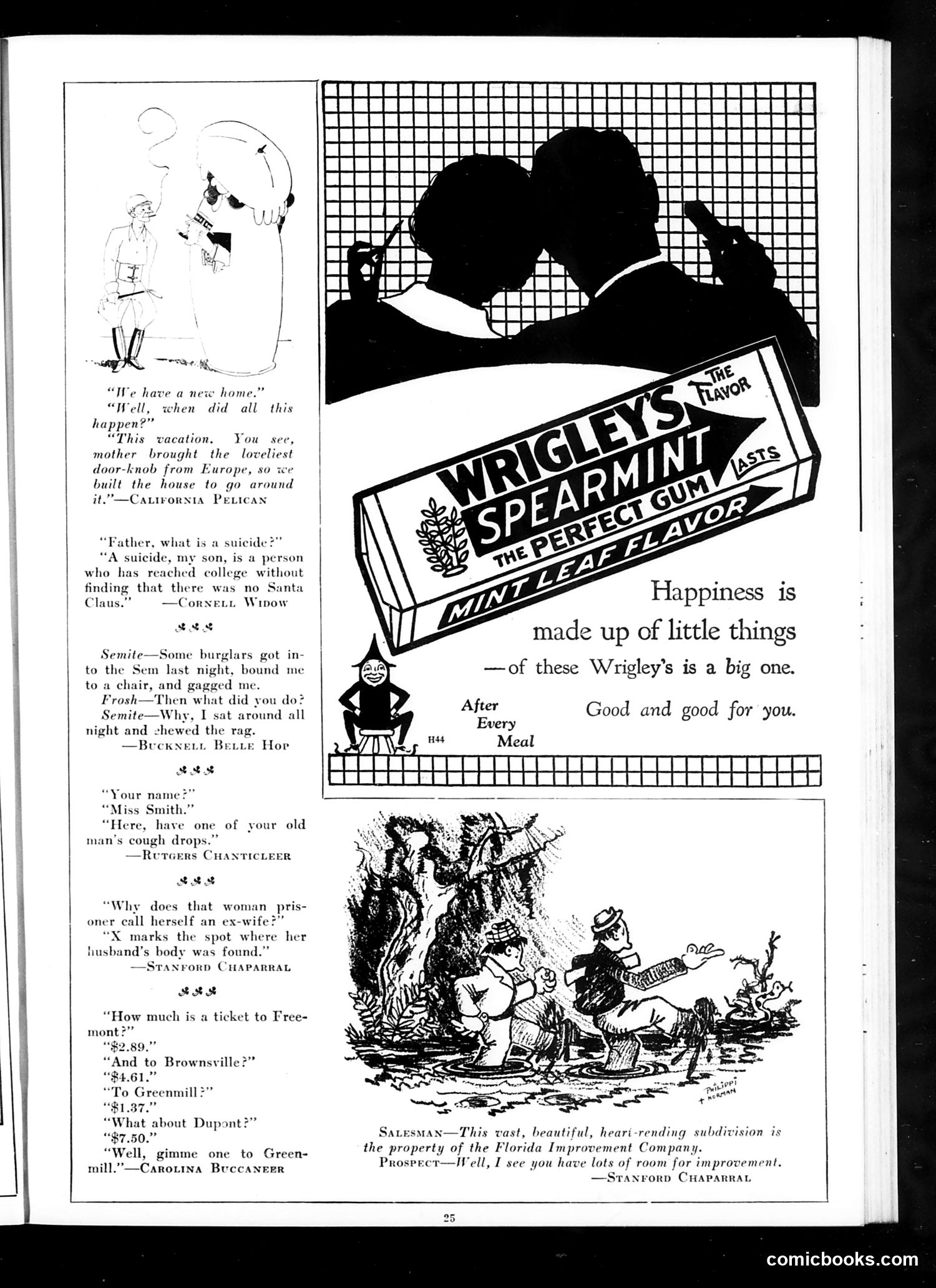
This page collects student humor from college publications (California Pelican, Cornell Widow, Rutgers Chanticleer, Stanford Chaparral, Carolina Buccaneer). The jokes target early 20th-century college life and attitudes: **Key humor themes:** - The "new home" joke satirizes wealthy Americans' obsession with European luxury goods - The "suicide" definition mocks loss of religious faith among college students - The "Semite" joke appears to contain an ethnic stereotype about Jewish students - References to "ex-wife" and disappearing husbands reflect period anxieties about marriage and infidelity - A Wrigley's spearmint gum advertisement emphasizes modest daily pleasures ("happiness is made up of little things") - The final real-estate joke mocks Florida's boom-era subdivision development as requiring "lots of room for improvement" The page reflects Jazz Age sensibilities: irreverent toward authority, focused on consumer culture, and casually incorporating period prejudices alongside conventional college humor about romance and travel.
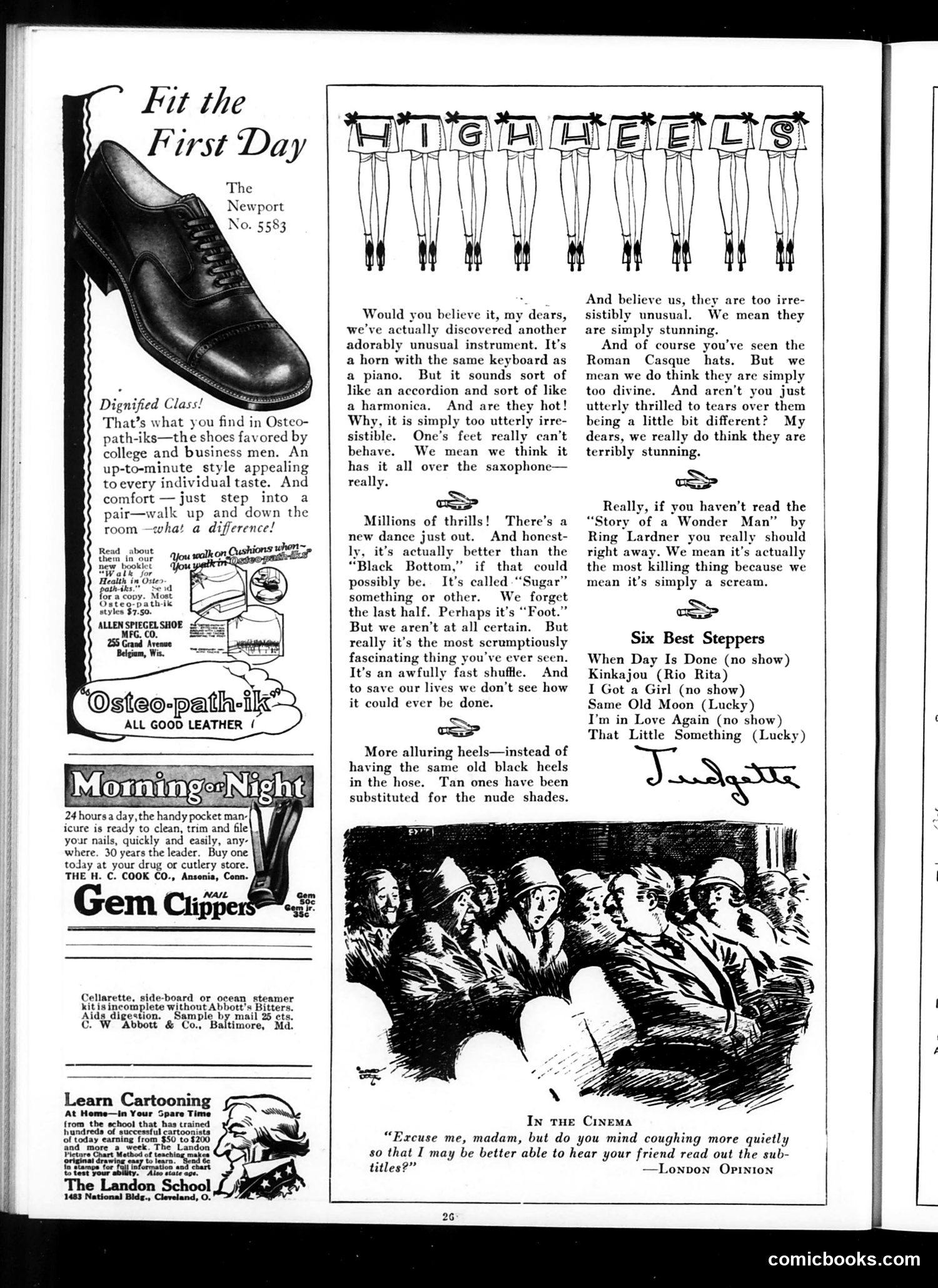
This page mixes advertisements with satirical commentary on 1920s fashion and entertainment trends. The main cartoon depicts women in a chorus line labeled "High Heels," with accompanying text mocking the era's obsession with unusual fashions. The satire targets how enthusiastically upper-class women embrace frivolous new trends—a newly invented musical instrument with keyboard and horn, exotic hat styles (Roman Casque), and a new dance called "Sugar" (apparently rivaling the "Black Bottom"). The tone is gently mocking: the authors affect breathless enthusiasm while simultaneously poking fun at how "utterly irresistible" and "divine" these items are deemed. The cinema cartoon at bottom satirizes theater etiquette—a woman loudly coughs during a film, blocking someone's ability to hear dialogue being read aloud (films still required live narration/subtitle reading in the silent era). The page is primarily advertising-driven, promoting shoes, manicure tools, and correspondence courses, with inserted satirical commentary reflecting Jazz Age consumer culture and fashion obsession.
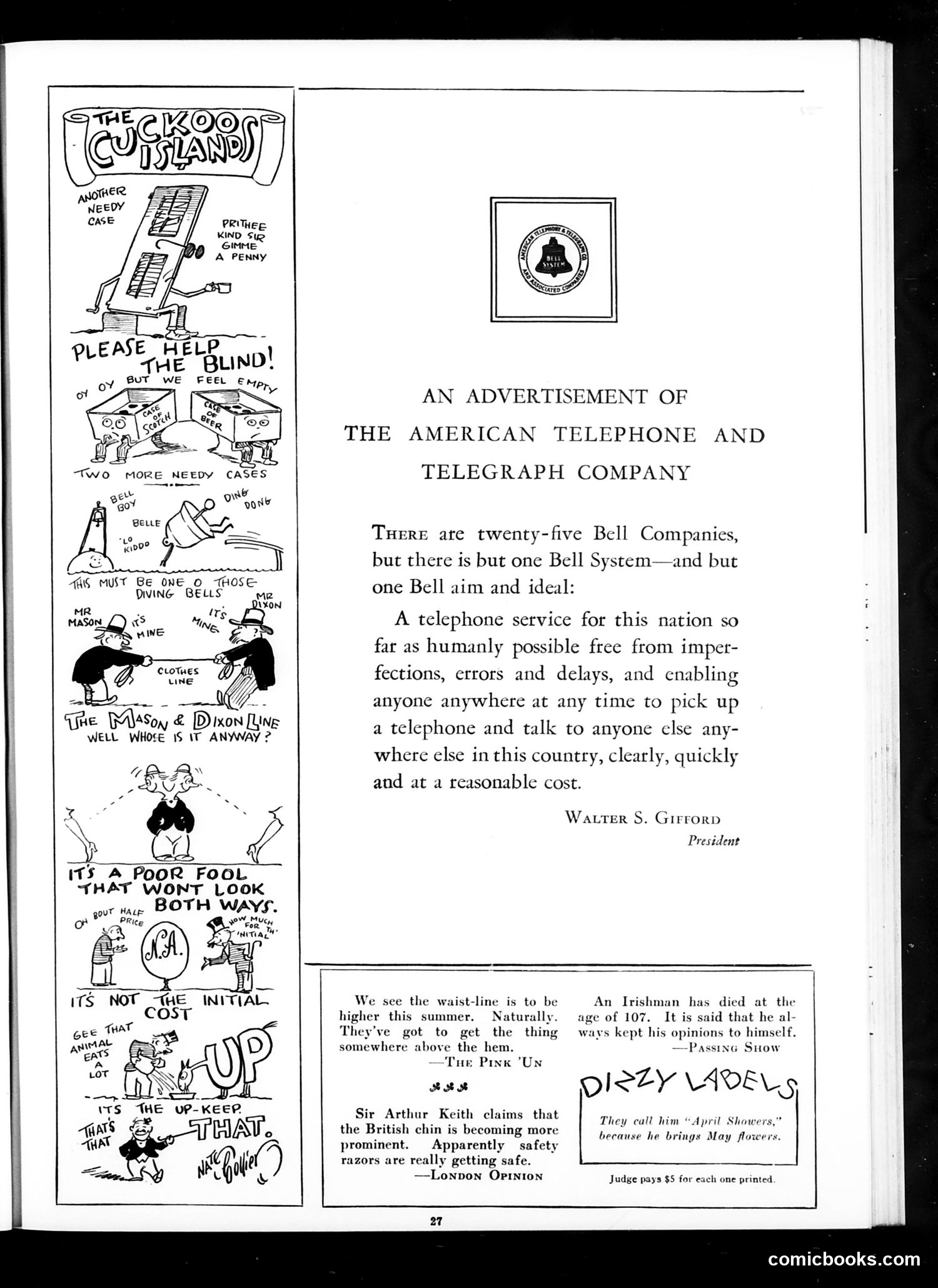
This page combines satirical cartoons with an AT&T advertisement. **Left side ("The Cuckoo Island"):** A series of sight gags mocking charity appeals and social problems of the era. References include "blind" charity drives (depicted with collection boxes), the Mason-Dixon Line (the historical North-South boundary), and various absurdist humor about poverty and foolishness—typical Judge magazine fare of visual puns and wordplay. **Right side:** An AT&T corporate advertisement touting the "Bell System's" unified national telephone network. President Walter S. Gifford emphasizes reliable, affordable service "anywhere at any time." This reflects early 20th-century corporate messaging about technological progress and monopoly consolidation. **Bottom section:** Brief humorous items unrelated to the cartoons—fashion commentary, an Irish longevity anecdote, and a quip about chin prominence and safety razors (contemporary consumer products). The page juxtaposes frivolous satire with earnest corporate advertising, typical of Judge's mixed content approach.
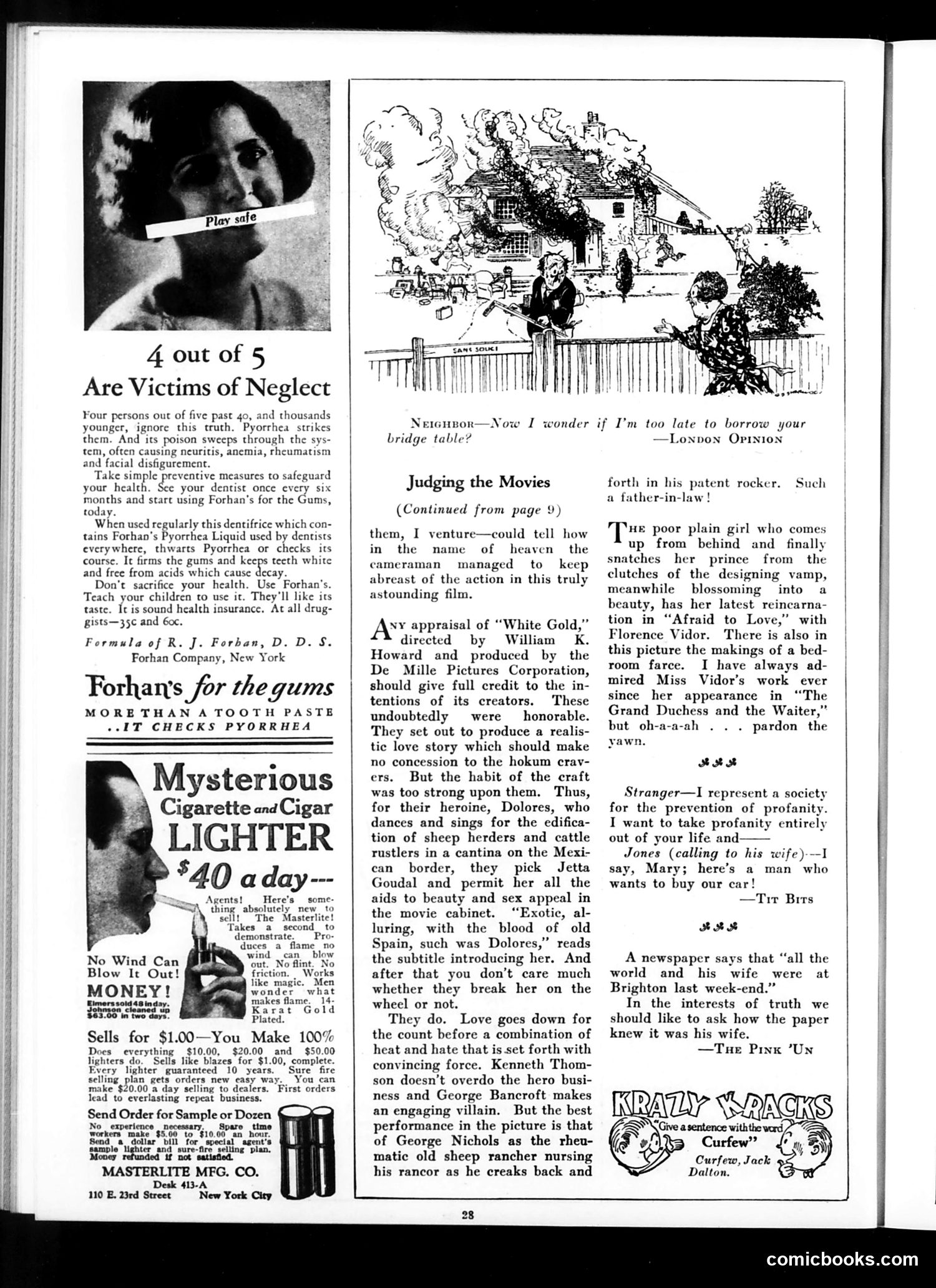
This page is primarily **advertising** with a small cartoon and film review section. The main cartoon (top right) depicts a neighbor asking to borrow a bridge table—a satirical jab at wealthy social pretension. The woman's elaborate home and the caption's affected tone mock upper-class convention and neighborly etiquette around 1920s leisure activities. The advertisements reveal period consumer anxieties: **Forhan's toothpaste** warns that pyorrhea (gum disease) affects "four persons out of five" past 40, linking dental neglect to systemic illness—a common early-20th-century health scare. The **Masterlite lighter** ad appeals to salesmen with get-rich-quick promises ("Make 100%"). The "Judging the Movies" section reviews 1920s silent films, critiquing their dramatic conventions and casting choices—here praising character actor George Nichols while mocking the "hokum" of exotic heroines and contrived love triangles typical of the era's melodramatic filmmaking.
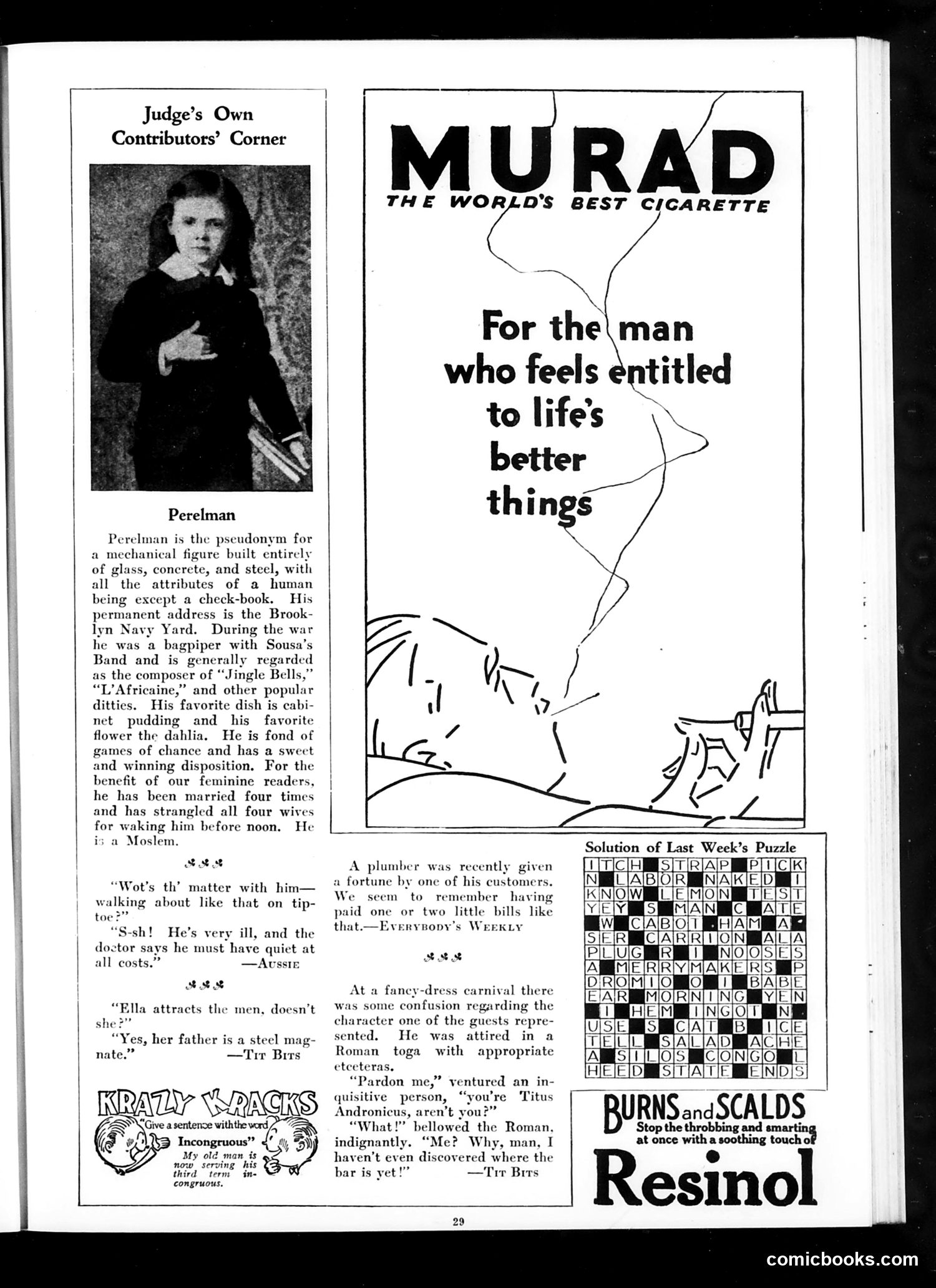
This page contains **humor content and advertisements** from Judge magazine (a satirical publication). The main feature is "Judge's Own Contributors' Corner," which presents **Perelman**—a fictional pseudonymous contributor described as a mechanical figure made of glass, concrete, and steel with human attributes "except a check-book." The satirical biography mocks his Brooklyn Navy Yard address and claims he composed "Jingle Bells" and other pieces. The final detail—that he's married four times and "strangled all four wives for waking him before noon" because he's "a Moslem"—uses crude ethnic stereotype humor typical of early 20th-century American magazines. Below are several brief comic anecdotes with punchlines about illness, attraction, and mistaken identity (a man at a costume party dressed as a Roman isn't "Titus Andronicus" but rather doesn't know where the bar is). The page is primarily filled with **period advertisements**: a Murad cigarette ad and Resinol burn treatment product. These were standard magazine filler content.
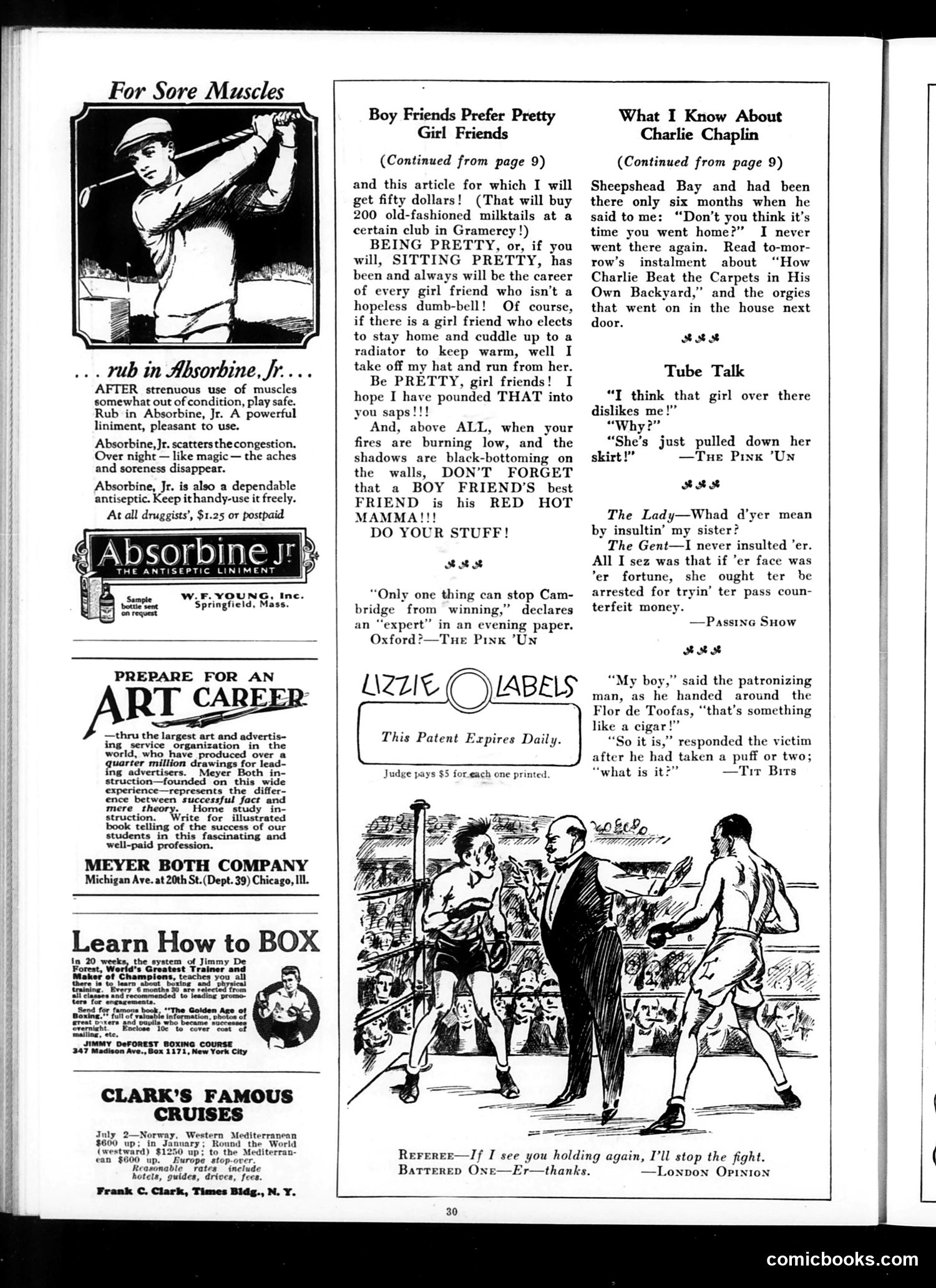
This page is primarily **advertisements and humor columns** rather than political satire. The main content includes: **Advertisements**: Absorbine Jr. liniment, art career training, boxing lessons, and cruise vacations dominate the layout. **Humor Columns**: Multiple brief jokes and anecdotes titled "Boy Friends Prefer Pretty Girl Friends," "What I Know About Charlie Chaplin," and "Tube Talk"—typical of Judge's light satirical style. **The Boxing Cartoon**: The central illustration depicts a referee stopping a fight, with the caption suggesting the beaten boxer thanks the referee for intervention. This is gentle sports humor, not political commentary. **Social Context**: The content reflects 1920s attitudes—emphasis on feminine beauty as women's primary asset, casual ethnic humor, and references to Prohibition-era speakeasies ("milktails" at Gramercy clubs). The page lacks substantive political or social critique; it's entertaining filler typical of Judge's lighter editorial moments.
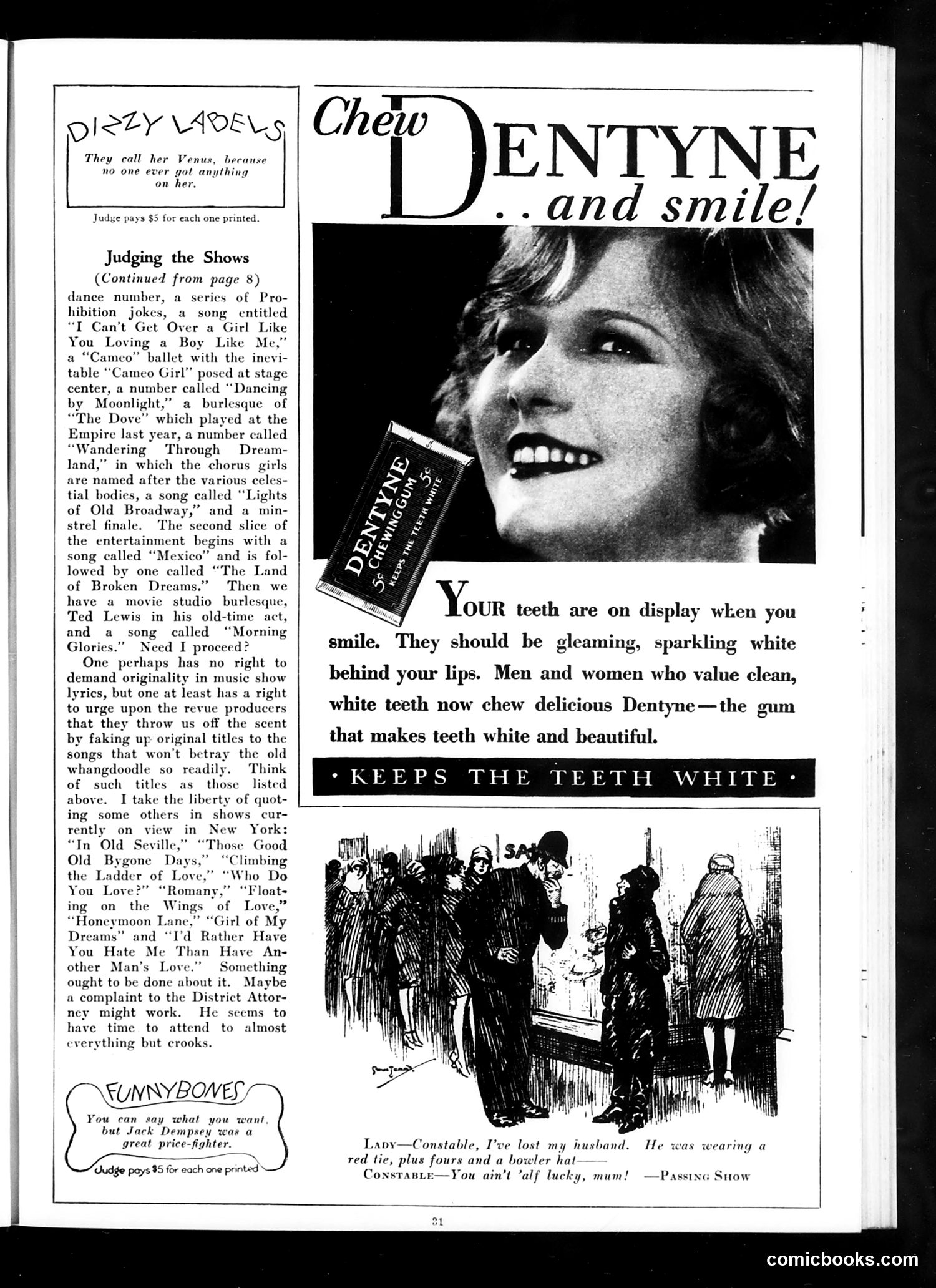
This page contains three distinct elements: 1. **"Dizzy Labels"** (top left): A reader-submitted joke captioned "They call her Venus, because no one ever got anything on her"—a sexual innuendo playing on the goddess of love. 2. **Dentyne Gum Advertisement** (center/right): The dominant content is a commercial featuring a glamorous woman's photograph promoting chewing gum that "keeps the teeth white." This reflects 1920s advertising's emphasis on dental hygiene and cosmetic appearance as markers of sophistication and desirability. 3. **"Funny Bones"** (bottom): Two brief jokes—one about boxer Jack Dempsey, another a British music-hall style comedy exchange about a constable helping a woman find her lost husband. The page is primarily **advertising-driven rather than satirical**. The "Judging the Shows" article discusses Broadway revue theater. The humor relies on wordplay and period-specific references (Prohibition-era theater, British constabulary comedy) rather than political satire. This represents Judge's shift toward mainstream entertainment and commercial content.
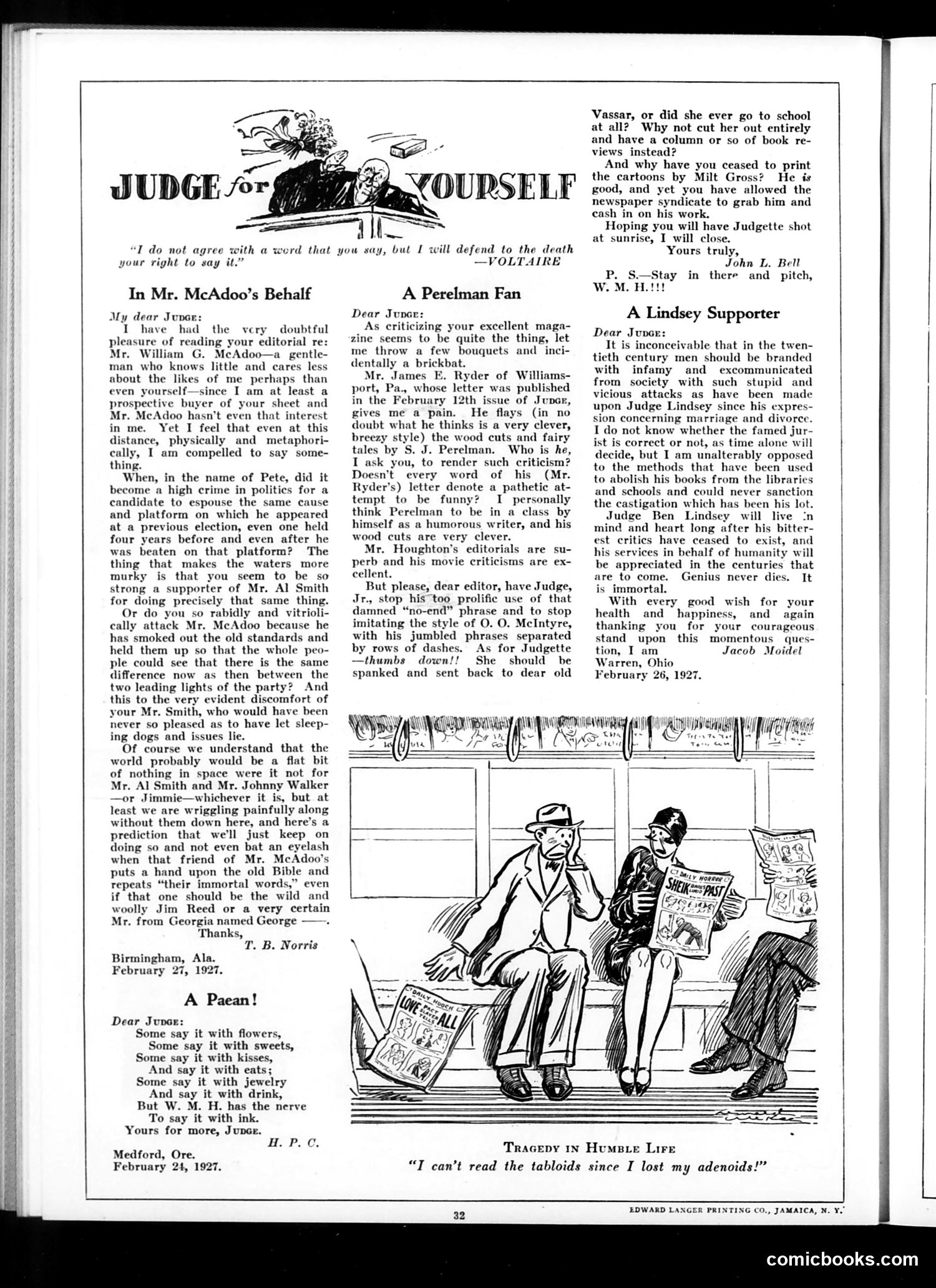
This is the letters-to-the-editor section of *Judge* magazine (February 1927), featuring reader responses to editorial content. **Main political reference:** The first letter defends William G. McAdoo, a Democratic politician, against Judge's editorial criticism. The writer challenges Judge's apparent hypocrisy: the magazine attacks McAdoo for repeating his previous political platform while simultaneously supporting Al Smith for doing the same thing. This suggests 1920s Democratic Party factional disputes. **Other content:** Remaining letters praise S.J. Perelman's humor writing and criticize other Judge columnists (Judgette, Judge Jr.). One letter humorously notes W.M. (likely a cartoonist) "says it with ink." **The cartoon** depicts people reading newspapers on public transportation—satirizing humble life's small tragedies ("I can't read the tabloids since I lost my adenoids"). The page primarily showcases reader engagement with Judge's editorial positions rather than standalone satire.
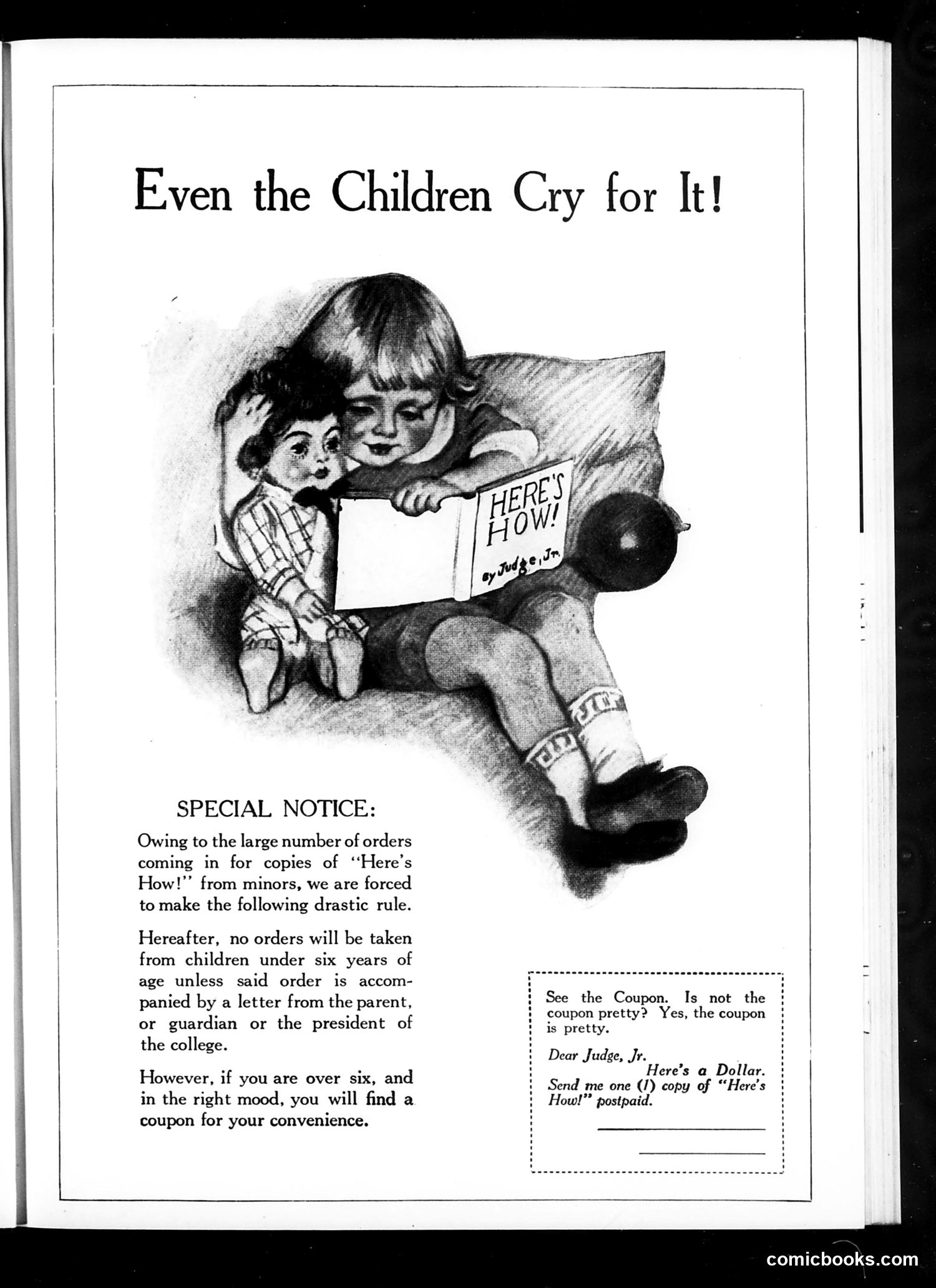
This is a humorous advertisement for a book titled *"Here's How!"* — likely a cocktail recipe book, given the Prohibition-era context and the self-aware joke about "minors" ordering it. The satire works on multiple levels: The headline "Even the Children Cry for It!" mimics vintage patent medicine advertising while suggesting the book is so desirable even kids want it. The "Special Notice" mock-seriously restricts sales to children under six, creating absurdist humor by treating a cocktail guide as something children would legitimately desire. The coupon and "Dear Judge, Jr." section continue the joke, presenting children as eager consumers of drinking instructions. This reflects 1920s anxieties about Prohibition's ineffectiveness — the satire suggests that even children are aware of and interested in alcohol, mocking both the law's futility and American consumer culture's reach into every demographic.
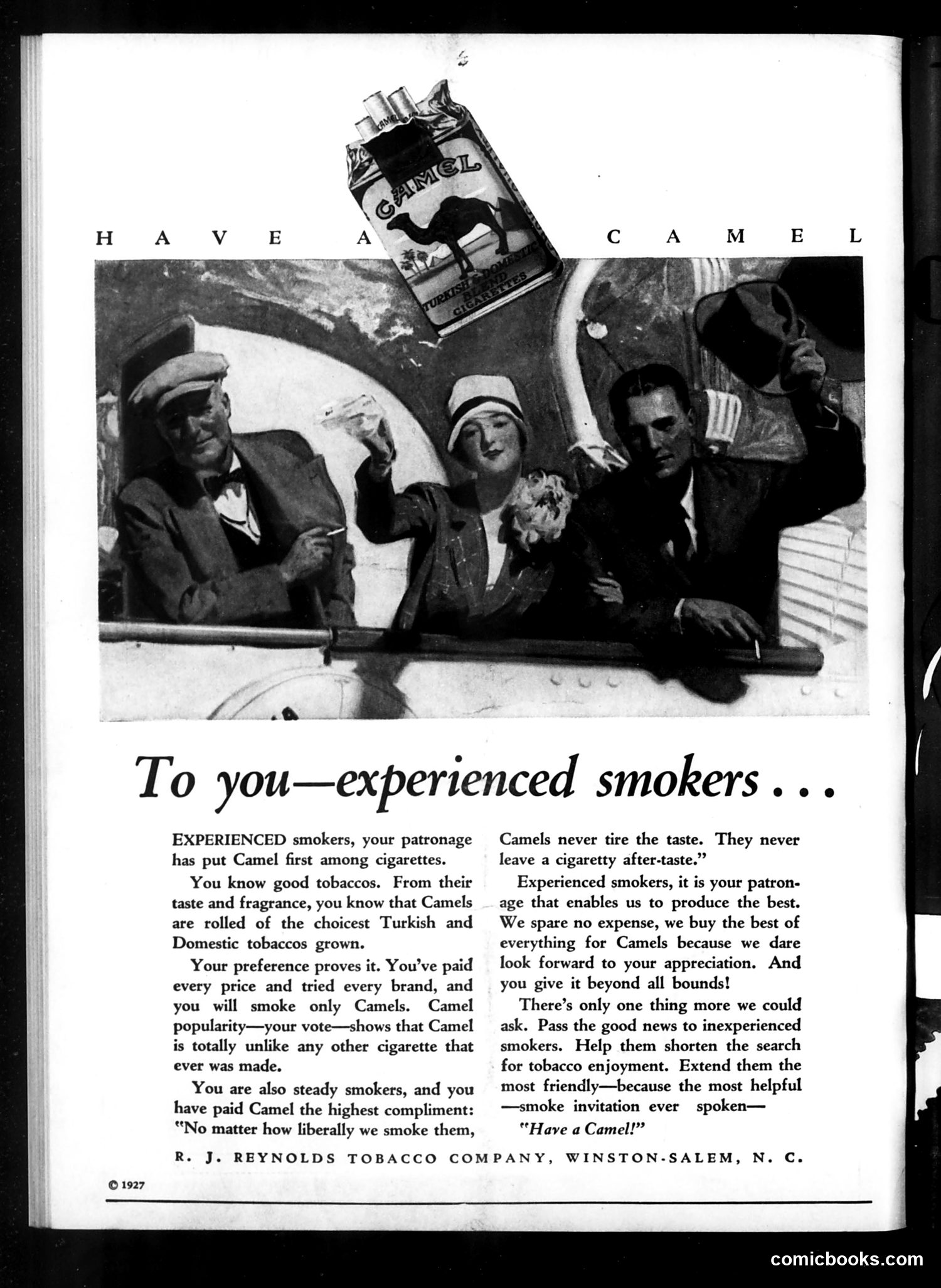
This is a **1927 cigarette advertisement**, not satire or political commentary. The R.J. Reynolds Tobacco Company uses the Judge magazine platform to market Camel cigarettes to "experienced smokers." The image shows five men in casual period dress sharing cigarettes, presumably representing satisfied, seasoned smokers. The ad's pitch flatters the target audience: experienced smokers possess refined taste, have "tried every brand," and naturally prefer Camels for their Turkish and domestic tobacco blend. The social message—asking smokers to evangelize by offering cigarettes to "inexperienced smokers"—reflects 1920s marketing that explicitly encouraged spreading smoking habits, particularly to newcomers. By modern standards, this is notable primarily for its brazen promotion of nicotine addiction and the casual normalization of smoking as a social good worth promoting to others. The advertisement contains no health disclaimers whatsoever.