
Judge, 1927-05-07 · page 10 of 36
Judge — May 7, 1927 — page 10: what you’re looking at
What you’re looking at
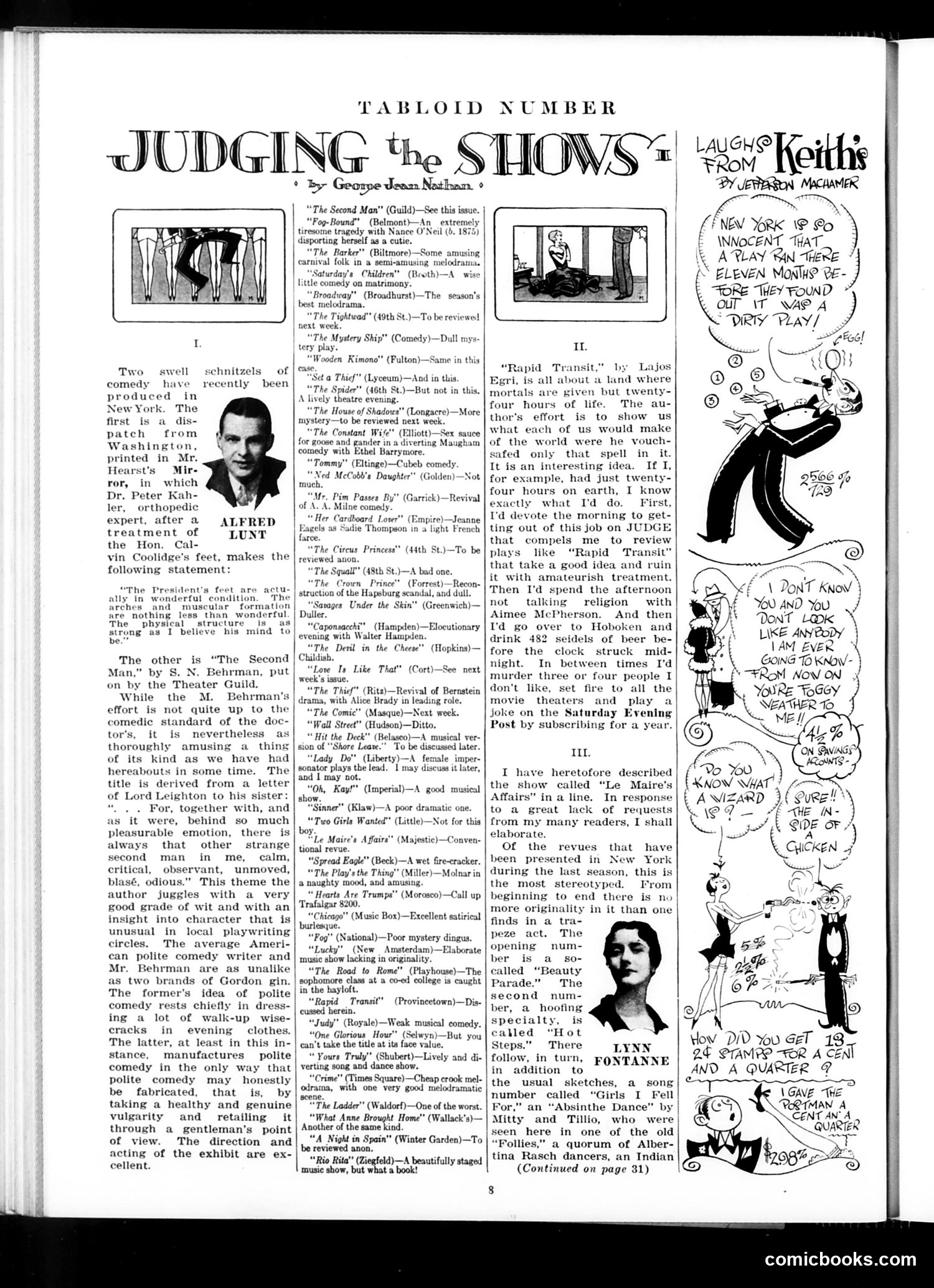
This is a theater review column by critic George Jean Nathan evaluating Broadway productions. The page contains two main elements: **Left side:** Text reviews of recent shows, including "The Second Man" by S.N. Behrman (Theater Guild production starring Alfred Lunt) and brief mentions of other plays. **Right side:** A cartoon by Keith featuring a character discussing a "play" that ran eleven months before audiences discovered it was "dirty." The cartoon satirizes naive or gullible theatergoers who fail to recognize obvious theatrical quality (or lack thereof). **Key satire:** Nathan's reviews employ sophisticated critical wit, contrasting genuine theatrical craftsmanship with pedestrian "polite comedy" writing. The cartoon reinforces this—mocking audiences slow to recognize poor entertainment. **Context for modern readers:** This reflects 1920s Broadway's vibrant theatrical scene and critical discourse about what constitutes legitimate comedy versus vulgar entertainment.
📄 Transcribed text from this page (OCR, searchable)
Machine-transcribed from the original scan — historical spelling and the odd misread are preserved.
schnitzels of recently been Two swell comedy have produced in New York. The first is a dis- patch from Washington, printed in Mr. Hearst's Mir- ror, in which Dr. Peter Kah- ler, orthopedic expert, after a treatment of the Hon. Cal- vin Coolidge’s feet, makes the following statement: ALFRED LUNT muscular are nothing less. the The physical strong as I believe be." structure is as his mind to The other “The Second Man,” by S. N. Behrman, put on by the Theater Guild. While the M. Behrman effort is not quite up to the comedic standard of the doc- tor it is nevertheless a thoroughly amusing a thing of its kind as we have had hereabouts in some time. The title is derived from a letter of Lord Leighton to his e] For, together with, and were, behind so much as it pleasurable emotion, there is always that other second man in me, unmoved, blasé, theme the author juggles with a very good grade of wit and with an insight into character that is unusual in local playwriting circles. The average Ameri- can polite comedy writer and Mr. Behrman are as unalike | as two bra nds of rdon gin. The former's idea of polite | i the & 7 . comedy rests chiefly in dress- |. “Ranid | Transit” (Provineetown)—Dis- : cussed herein. ing a lot of walk-up wise-| “ «jyay" (Royale)—Weak musical comedy. in ev § clothes.) «One Glorious Hour” (Selwyn)—But you The latter, at least in this in-| can't take the title at its face value. stance, manufactures polite |“ Yours Truly" (Shubert)—Lively and di- comedy in the only way that | verting song and dance show. polite comedy may honestly | “Crime” (Times Square)—Cheap crook mel- be fabricated, that is, by taking a healthy and genuine vulgarity and _ retailing it through a gentleman's point of view. The direction and acting of the exhibit are ex- cellent. | struction of the Hapsburg sc ABLOID NUMBER NG ‘he SHOWS® Geonpe Jeam Nathan. ¢ “The Second Man" (Guild)—See this issue. | 'Fog-Bound" (Belmont}—An extreme! | tiresome tragedy with Nance O'Neil (b. 1875 | disporting herself as a cutie. The Barker" (Biltmore)—Some carnival folk in a semi-amusing melodrama. turday's Children" (Broth)—A_ wi nedy on matrimony. “Broadway” (Broadhurst)—The season's best melodrama. "The Tightwad" (49th St.)—To be reviewed next week. “The Mystery Ship" (Com play. Wooden Kimono" (Fulton)—Same in this case Set @ Thief" (Lyceum)—And in this The Spider’* (46th St.)—But not in this. ly theatre evening. The House of Shadores" (Longacre) —More mystery—to be reviewed next week. “The Constant Wife” (Elliott)—Sex sauce d gander in a diverting Maugham Ethel Barrymore. “Tommy” (Eltinge)—Cubeb comedy. musing | dy)—Dull mys- te Ali “Ned McCobb's Daughter” (Golden)—Not much. “Mr. Pim Passes By" (Garrick)—Revival of A. A. Mil ** (Empire) fe Thompson in a light The Circus Princess” reviewed anon. “The Squall” (48th St.)—A bad one. “The Crown Prince’ (Forrest) —Recon- idal, and dull. (Greenwich) — (44th St.)—To be | ages Under the Skin | Duller. | “Caponsacchi" (Hampden)—Elocutionary evening with Walter Hampde “The Deril in the Cheese” Childish, (Hopkins) — Like That" (Cort)—See next “The Thief” (Ritz)—Revival of Bernstein drama, with Alice Brady in leading role, “The Comic” (Masque)—Next week. Wall Street” (Hudson)—Ditto. “Hit the Deck” (Belasco)—A musical ver- sion of “Shore Leave.’ To be discussed later. “Lady Do" (Liberty)—A female imper- sonator pla uss it later, and I may not. “Oh, Kay!" (Imperial)—A good musical show. “Sinner” (Klaw)—A poor dramatic one. F “Tuo Girls Wanted” (Little) —Not for this boy “Le Maire's Affairs" tional revue “Spread Eagle" (Beck)—A wet fire-cracker. “The Play's the Thing" (Miller)—Molnar in a naughty mood, and amusing. " Hearts Are Trumps” (Moroseo)—Call up falgar 8200. “Chicago” (Music Box)—Excellent sa burlesqu “Fog"’ (National)—Poor mystery dingus. “Lucky” (New | Amsterdam)—Ela music show lacking in originality “The Road to Rome’ (Playhouse)—The sophomore class at a co-ed college is caught in the hayloft. (Majestic)—Conven- ical orate oirama, with one very good melodrama tie whe Lodder” (Waldor!)—One of the worst. “What Anne Brought Home’ (Wallack’s)— Another of the same kind. “A Night in Spain" (Winter Garden)—To be reviewed anon. “Rio Rita’ (Ziegfeld)—A beautifull, red music show, fie Seeger ae IL. apid Transit,” by Lajos Sgri, is all about a land where mortals given but twenty- four hours of life. The thor’ effort is to show us what each of us would make of the world were he vouch- safed only that spell in it. It an int for example, had just twenty- four hours on earth, I know ictly what I'd do. First, I'd devote the morning to get- ting out of this job on JUDGE that compels me to review plays like “Rapid Transit" that take a good idea and ruin it with amateurish tr tment. Then I'd spend the afternoon not talking religion with Aimee McPherson. And then V'd go over to Hoboken and drink 482 seidels of beer be- fore the clock struck mid night. In between times I'd murder three or four people I don't like, set fire to all the movie theaters and play a joke on the Saturday Evening Post by subscribing for a year. Ill. I have heretofore described the called “Le Maire’s Affair: In re: to a gr of from my many readers, I shall elaborate. Of the revues that have been presented in New York during the last season, this is the most stereotyped. From beginning to end there is no more originali finds in a peze act. opening num- ber is a so- called “Beauty Parade.” The second num- ber, a hoofing pecialty, is Med “Hot Steps.” There LY follow, in turn, FONTANNE in addition to the usual sketch a song number called “Girls I Fell For,” an “Absinthe Dance” by Mitty and Tillio, who were seen here in one of the old a quorum of Alber- tina Rasch dancers, an Indian (Continued on page 31) Vo vu KNOW WHAT ANIZARD n it than one | Yow DID You GeT 13 24 STAMPP OR A CENT ] AND A QUARTER @ ] oC MECHAMER F NEV YORK \© €o \NNoceNT. THAT & APLAY AN THERE / ‘ ELEVEN MoslHe? PE- FORE WEY FOUND ” oul \T WAP A ) DIRTY VLAY/ DONT Know } YOU AND YoU _/ DonT LOK LIKE ANY Rody | AM EVER GOING TO KNoW “FRoM Now ON YOURE ToGcy VEATHER To ‘ } yee ll \ _ (ee uCKEN a Nese | ral comicbooks.com