
A complete issue · 36 pages · 1927
Judge — April 23, 1927
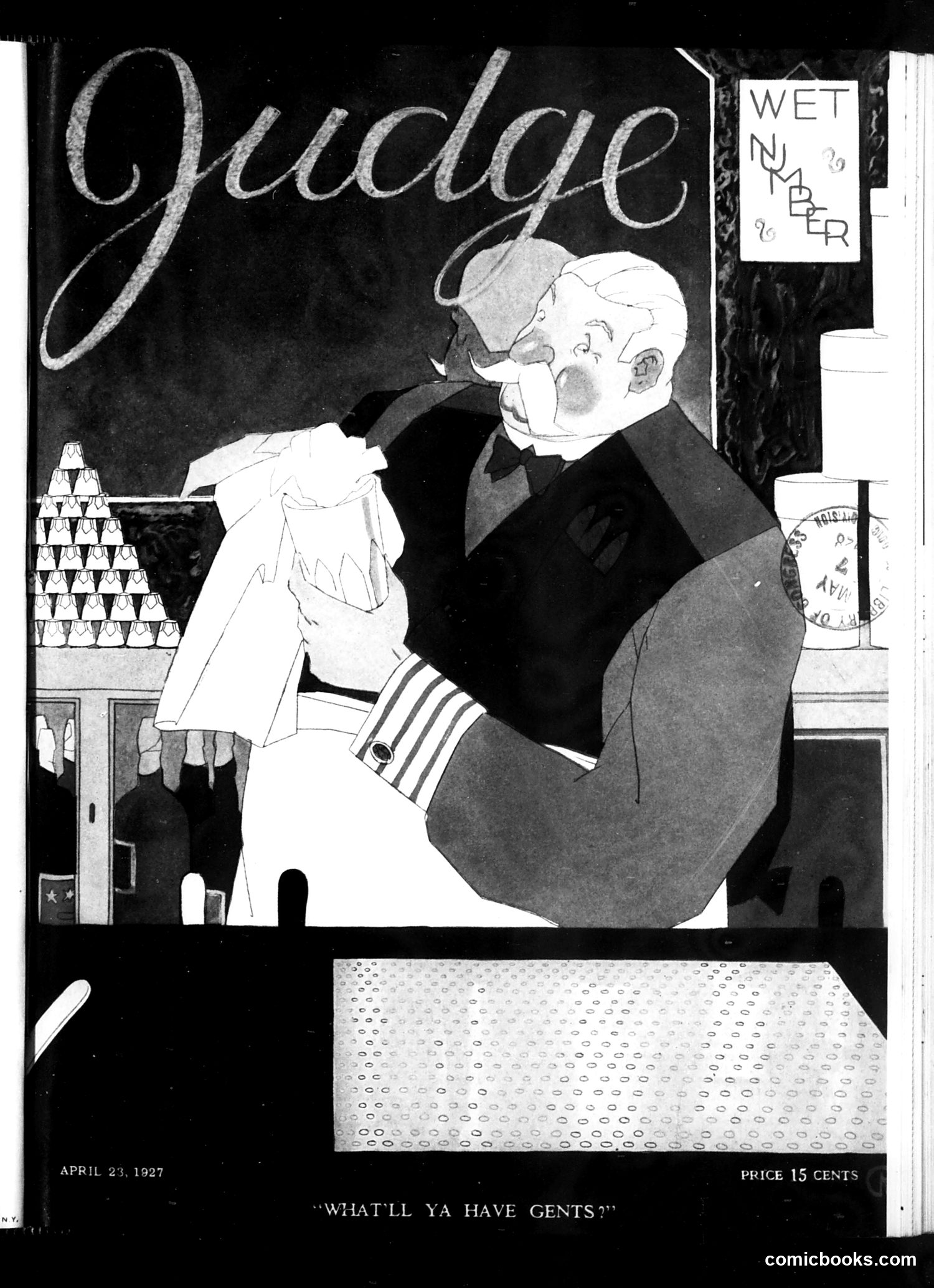
This cover depicts a man examining fabric or clothing with the caption "What'll Ya Have Gents?" The title "Quidge" appears at top—likely a play on "judge" or a character name. The satire appears to reference the wet/dry debate of Prohibition era (note "WET NABER" marking visible). The merchant character is presumably offering goods, possibly suggesting commerce or black-market dealings during Prohibition enforcement. The pyramid of stacked items (left side) and various containers suggest commercial activity or trade. The striped cuffs and formal dress indicate this is meant as social commentary on commerce, fashion, or consumer culture during the 1920s. The specific political reference remains unclear without additional context, though the Prohibition-era dating is evident.
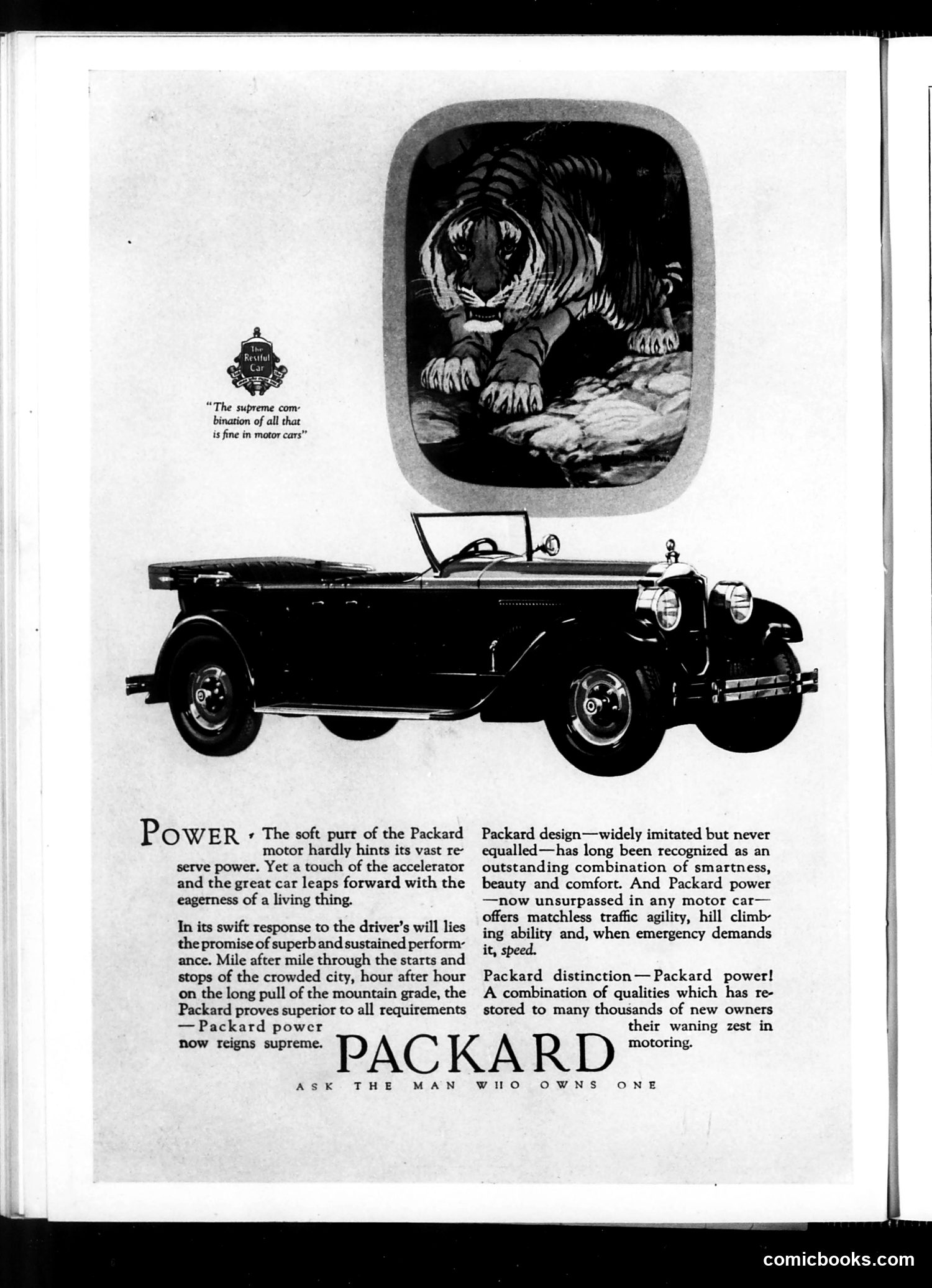
This is a **Packard automobile advertisement**, not a political cartoon. The page promotes Packard motor cars using an unusual juxtaposition: a fierce tiger emerges from the car's window, accompanied by the slogan "The supreme combination of all that is fine in motor cars." The advertisement attempts to convey **power and aggressive capability** through the tiger imagery. The text emphasizes the car's performance—its "vast reserve power," responsiveness to the accelerator, and ability to handle city traffic and mountain grades. The tiger serves as a metaphor for the vehicle's strength and dominance on the road. The Packard brand is positioned as superior through qualities of "smartness, beauty and comfort," targeting affluent buyers seeking prestige. This is commercial messaging, not satire.
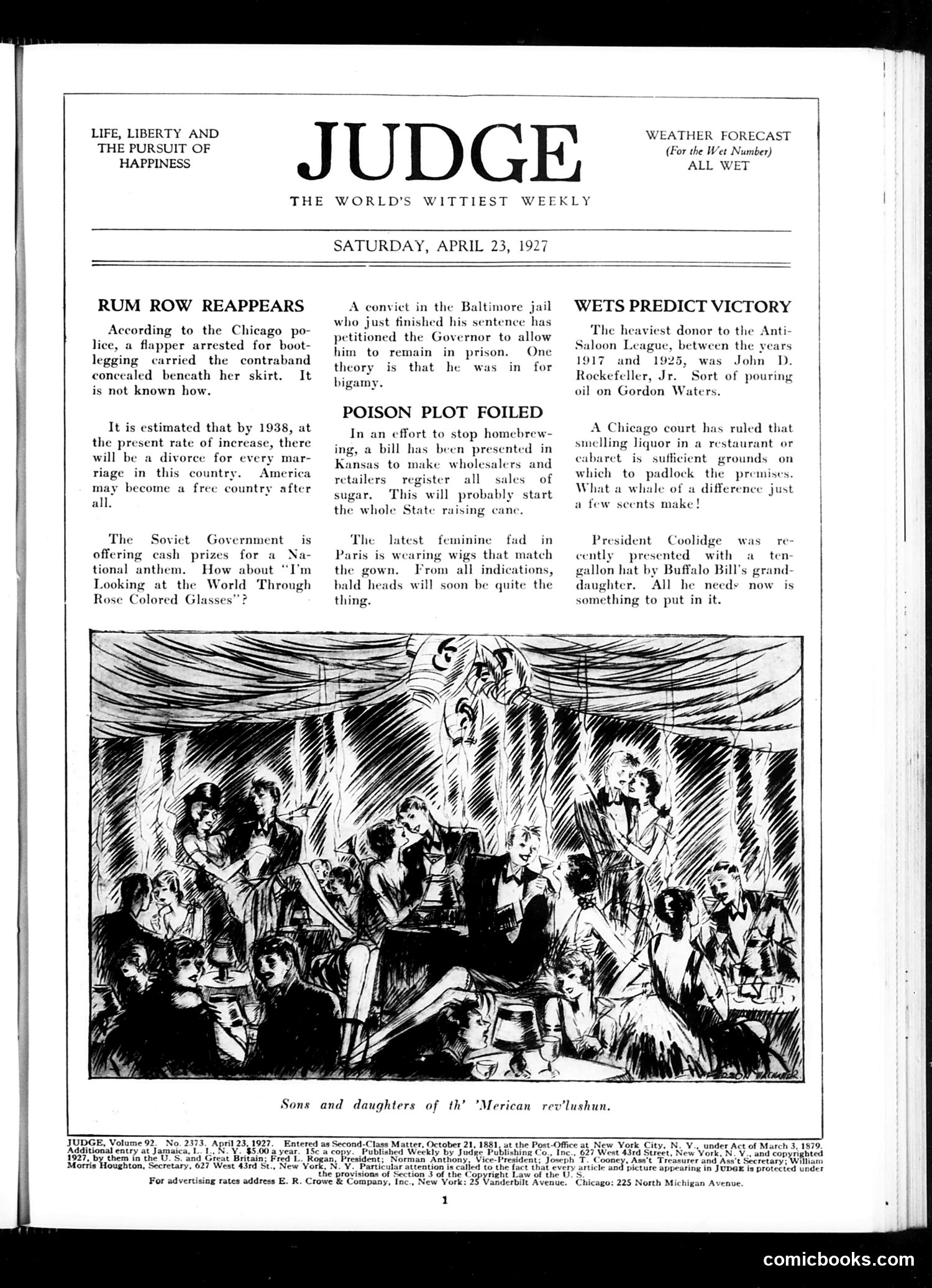
The main illustration depicts "Sons and daughters of the 'Merican rev'lushin'"—a satirical scene of what appears to be a fancy social gathering or speakeasy, likely mocking Prohibition-era hypocrisy. During Prohibition (1920-1933), wealthy Americans openly violated the alcohol ban at underground bars while claiming patriotic respectability. The accompanying articles reference contemporary scandals: bootlegging arrests, proposed sugar-sales registrations to prevent home alcohol production, and restaurant speakeasies operating despite legal restrictions. One item jokes about President Coolidge receiving a ten-gallon hat from Buffalo Bill's granddaughter—likely mocking his taciturn public image. The satire targets wealthy Americans' blatant disregard for Prohibition laws while maintaining an appearance of moral respectability, a central Judge theme during this era.
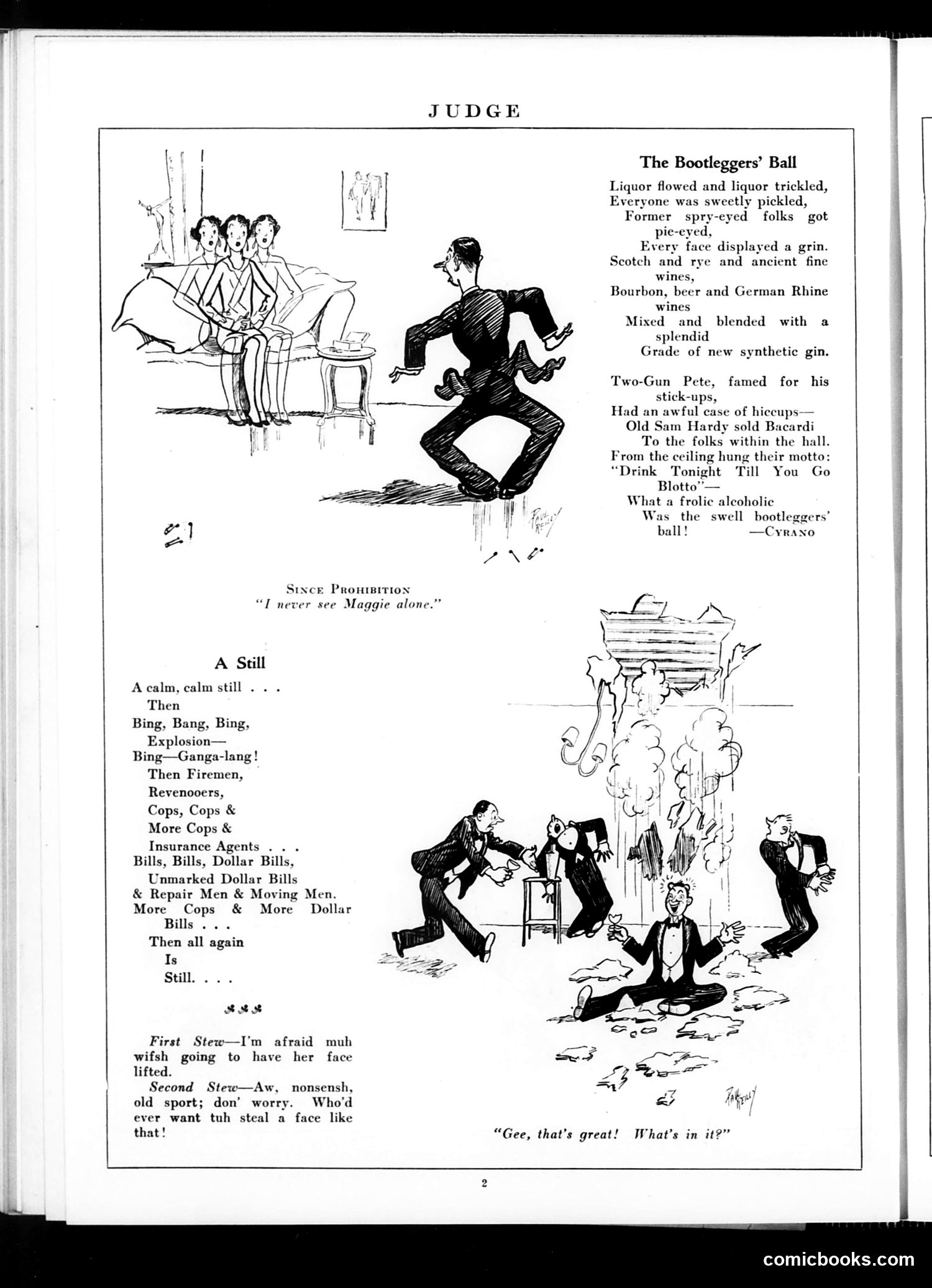
This page contains two satirical pieces from Judge magazine, likely from the Prohibition era (based on "Since Prohibition" heading). **"The Bootleggers' Ball"** depicts an illegal drinking party. The cartoon mocks the absurdity of Prohibition enforcement: despite the law, people freely consumed various alcohols while bootleggers profited. References to "Two-Gun Pete" and the motto "Drink Tonight Till You Go Blotto" satirize the lawlessness and excess characterizing speakeasies. **"A Still"** uses word-play, describing a sequence of events following a silent still (illegal alcohol distillery): explosion, then chaos as firemen, cops, insurance agents, and repair workers descend. The joke critiques how Prohibition's enforcement created bureaucratic absurdity and collateral damage, with the "still" returning to calm afterward—implying the cycle repeats. Both pieces mock Prohibition's ineffectiveness and unintended consequences.
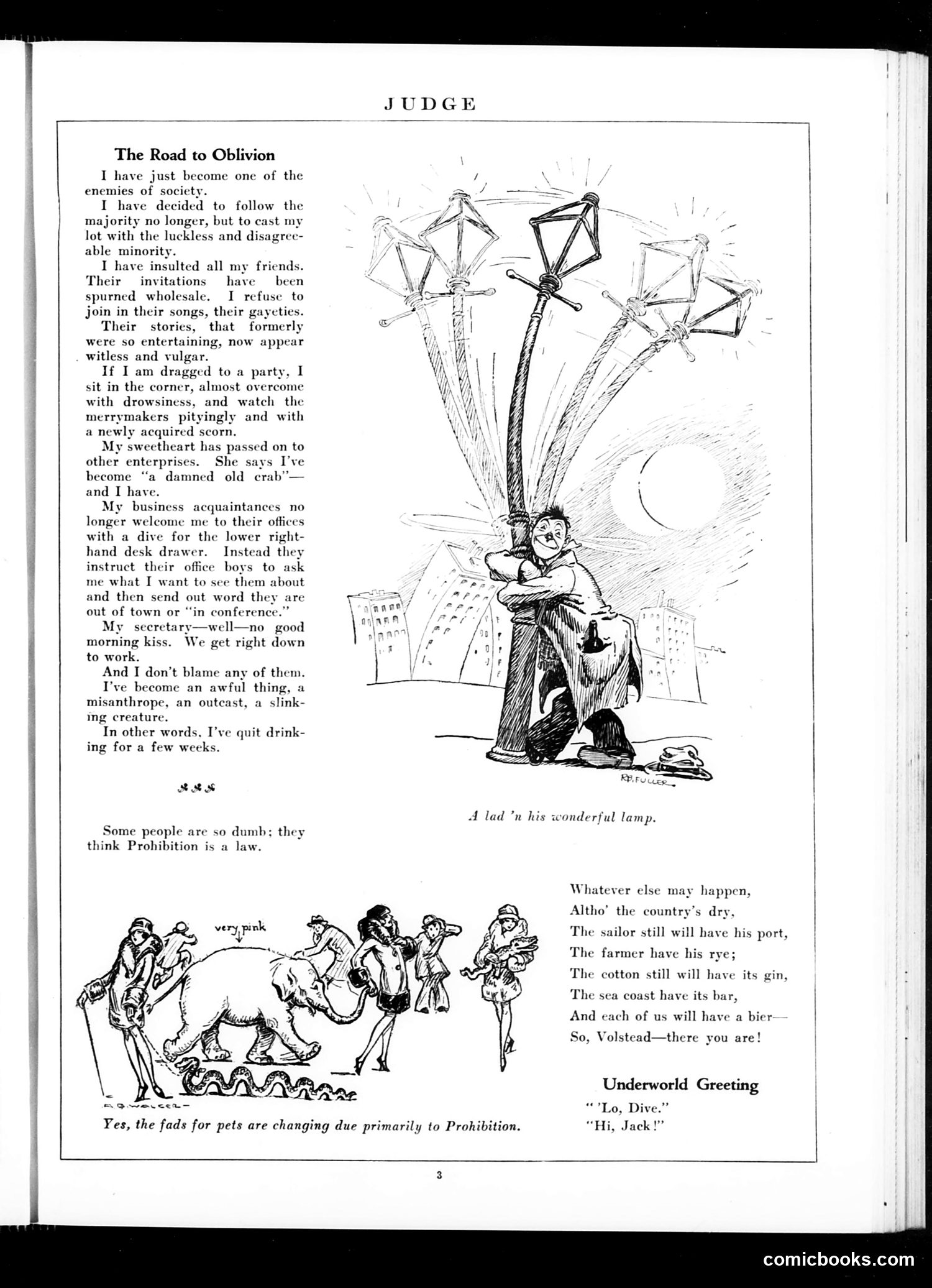
This page satirizes Prohibition's social effects. "The Road to Oblivion" depicts a man who's quit drinking and become a social outcast—rejected by friends, withdrawn from parties, abandoned by his sweetheart (who calls him "a damned old crab"). The illustration shows him surrounded by magical lamps, suggesting his isolation is self-inflicted yet fantastical. The bottom cartoon mocks pet fad changes, attributing them to Prohibition's enforcement. The poem "Underworld Greeting" sarcastically suggests that despite alcohol bans, various groups (sailors, farmers, cotton workers, coastal residents) will still access alcohol—implying Prohibition's futility. The overall message: Prohibition creates social dysfunction and won't actually eliminate drinking; it only drives consumption underground while punishing abstainers socially.
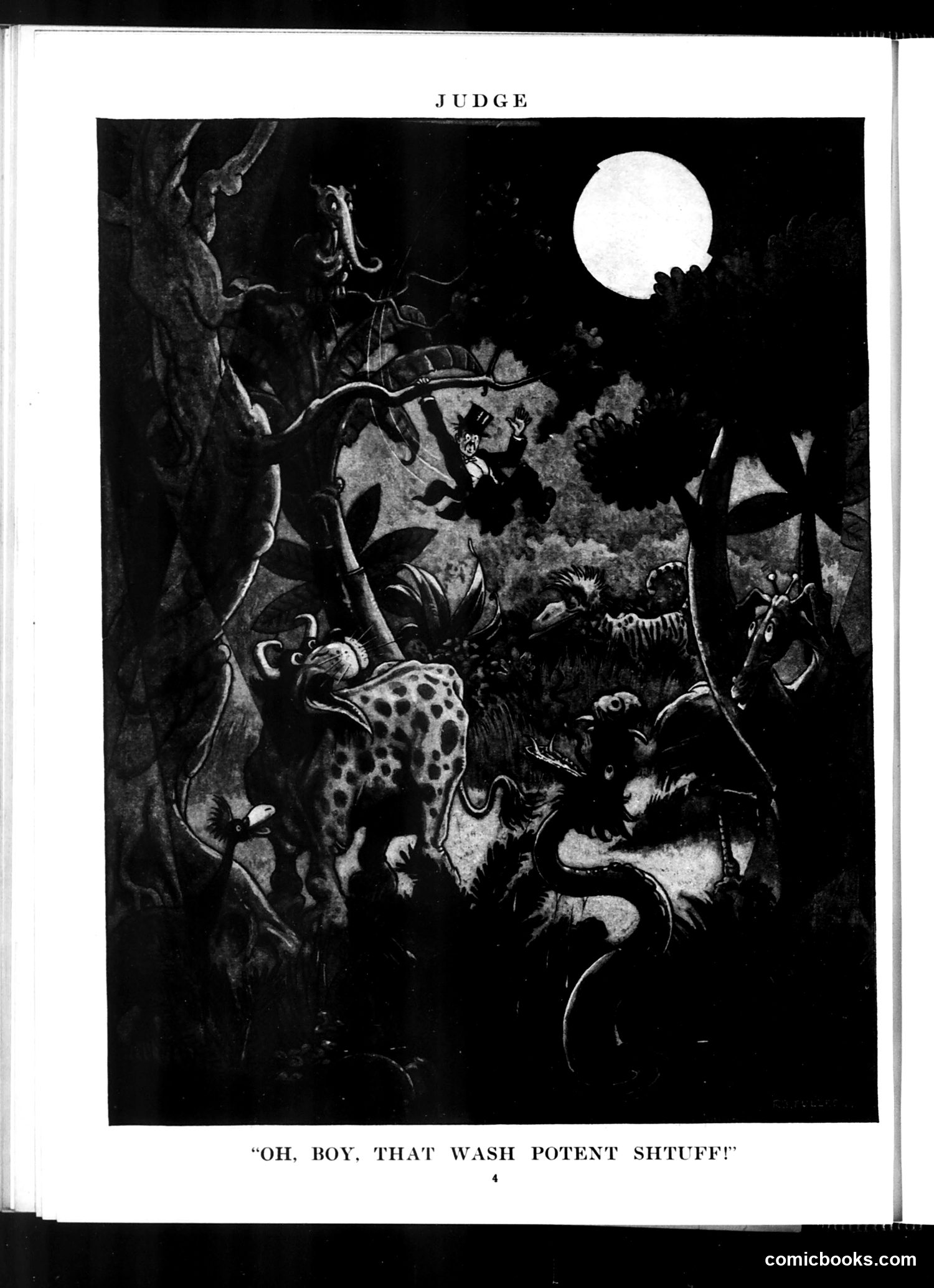
This is a satirical illustration from Judge magazine titled "Oh, Boy, That Wash Potent Shtuff" depicting a nighttime forest scene under a full moon. The cartoon appears to satirize alcohol consumption, likely referencing Prohibition-era bootleg liquor or illegally produced spirits. The grotesque, demonic figures and wild animals suggest the delirious or hallucinatory effects of drinking bad-quality alcohol. The "potent shtuff" in the caption uses exaggerated dialect, common in early 20th-century satirical depictions. The chaotic, nightmarish imagery—with distorted creatures and supernatural elements—conveys Judge's critical commentary on the dangers of illicit drinking, a recurring concern during Prohibition (1920-1933). The style and tone suggest this is a moralistic critique of alcohol abuse rather than pro-drinking satire.
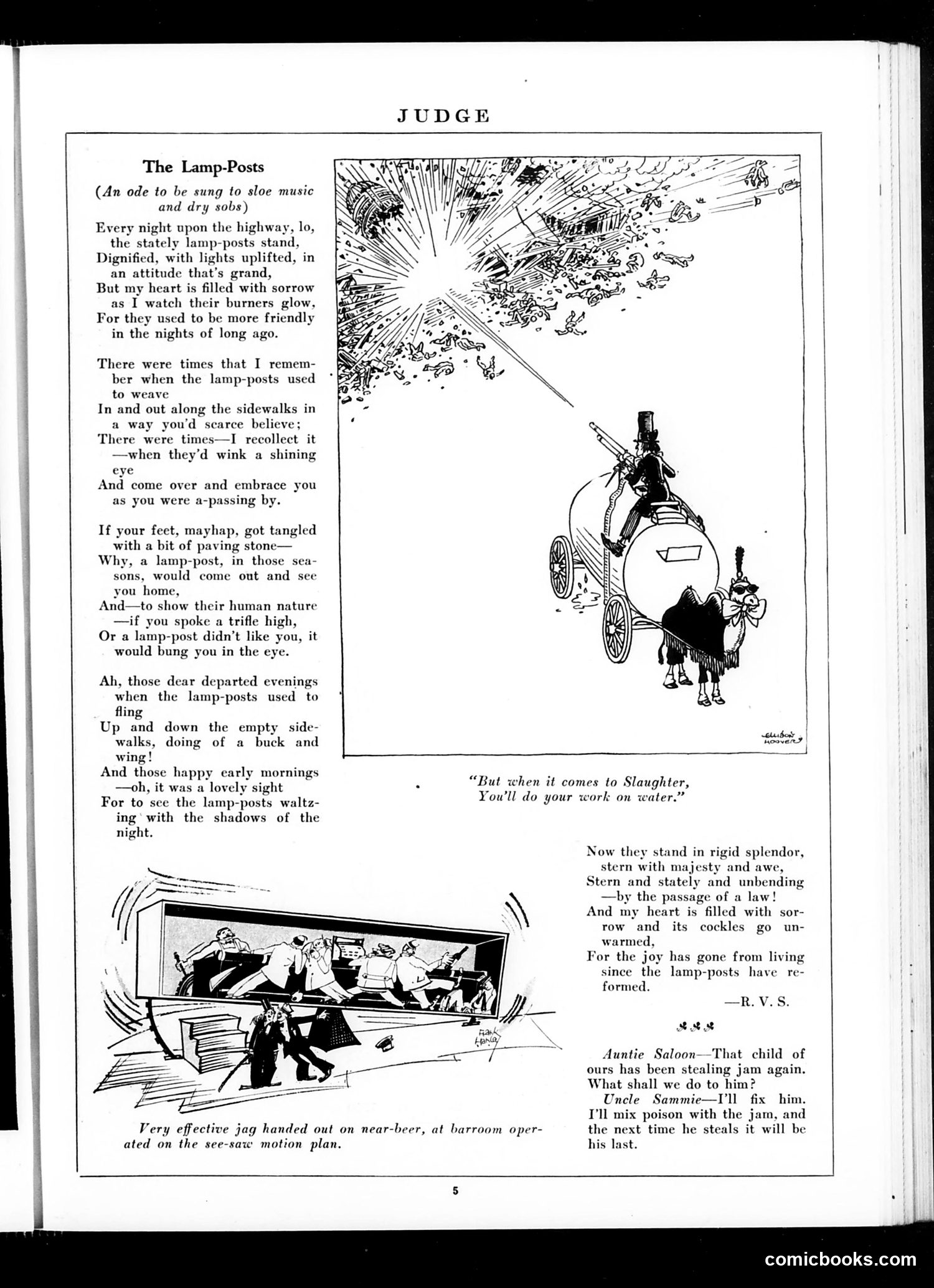
This page contains a nostalgic poem titled "The Lamp-Posts" lamenting the disappearance of gas street lamps—once friendly fixtures that "used to weave in and out along the sidewalks" and would "come over and embrace you." The author recalls their human-like qualities and the joy they brought. The accompanying cartoons illustrate this loss: one shows an old-fashioned carriage scene under streetlamp illumination; another depicts a modern industrial/mechanical setup, contrasting past warmth with present coldness. The final dialogue between "Auntie Saloon" and "Uncle Sammie" appears unrelated—a domestic joke about stealing jam. **Context**: This satirizes early 20th-century urbanization and mechanization, using the lamp-post as a metaphor for lost community warmth displaced by industrial progress.
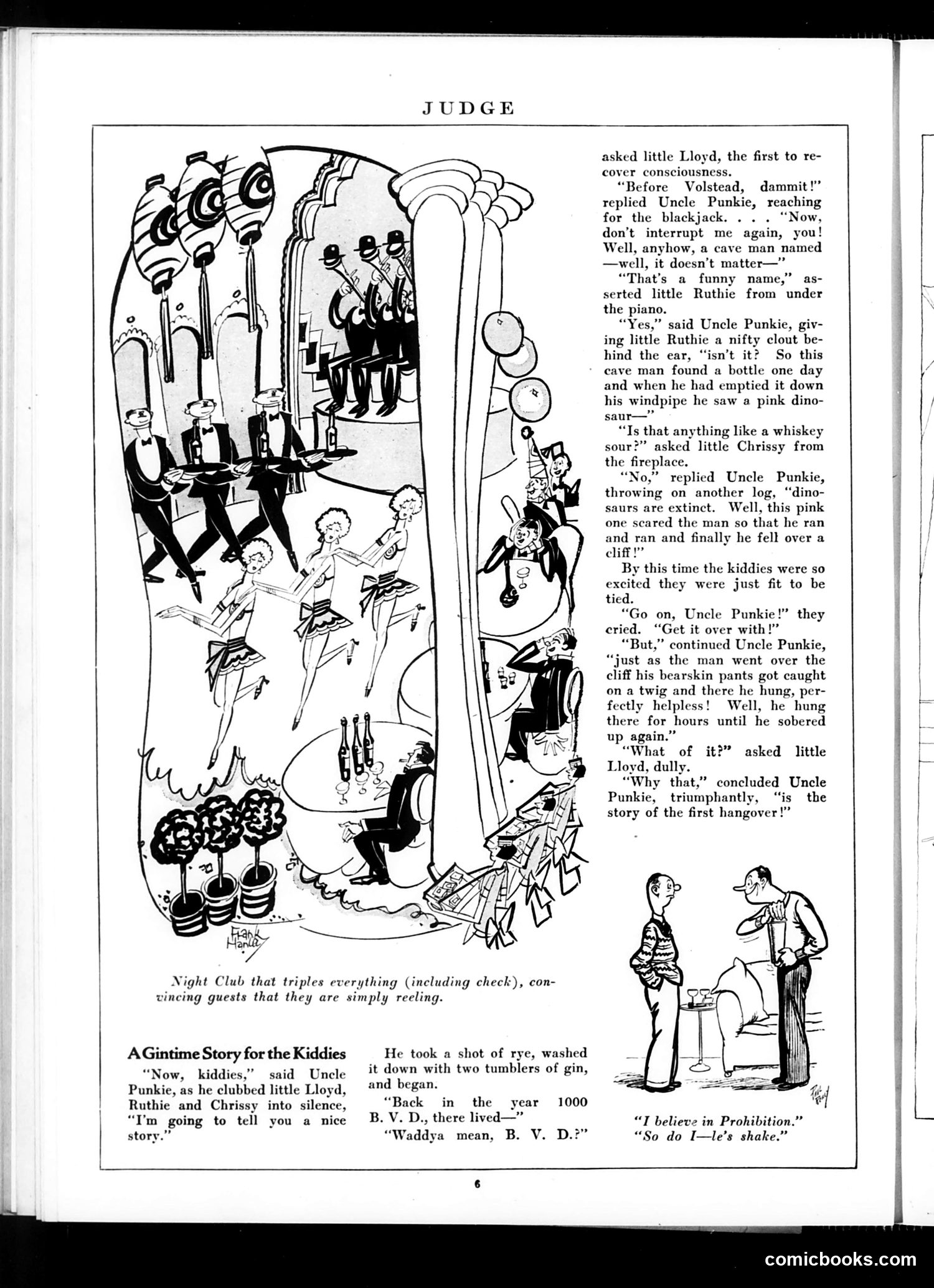
This page satirizes Prohibition-era excess and hypocrisy. "Uncle Punkie" is a caricatured drunk who tells children a nonsensical story while consuming rye and gin—openly flouting Prohibition laws (enacted 1920). The joke hinges on "B.V.D." (Before Volstead), referencing the Volstead Act that enforced Prohibition. The satire works on multiple levels: an adult telling crude stories to children while drinking heavily, the absurd narrative structure, and the punchline equating the caveman's hangover to humanity's "first hangover"—suggesting Prohibition itself is the real hangover society must endure. The top cartoon shows a nightclub "tripling everything (including check)," mocking how establishments inflated prices during Prohibition while serving illegal alcohol. The bottom cartoon's two figures claiming belief in Prohibition while shaking hands ironically suggests widespread hypocrisy—public support masking private consumption. The satire criticizes both Prohibition's unpopularity and widespread defiance of it.
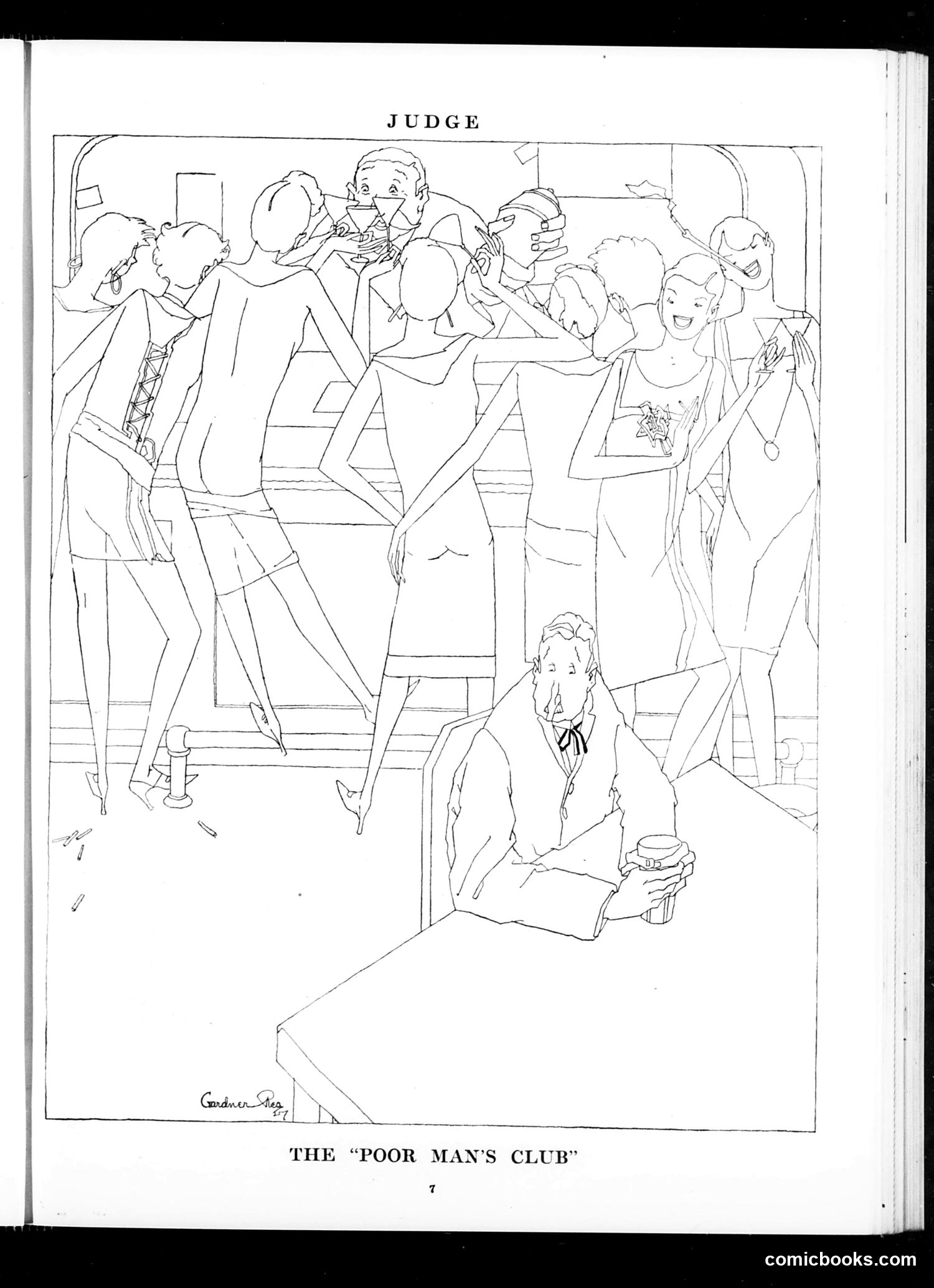
This cartoon satirizes wealth disparity and class exclusivity. A well-dressed man sits alone and dejected at the bottom, while above him a group of fashionably-dressed women and men celebrate boisterously at what appears to be an exclusive club or party venue. The title's irony is key: the "Poor Man's Club" shows a solitary poor man excluded from the gaiety above—suggesting that exclusive clubs marketed as accessible to ordinary people are actually inaccessible or unwelcoming to them. The contrast between the jubilant crowd and the isolated figure below critiques the false promises of social mobility or inclusion during the period when Judge magazine was active (likely early-to-mid 20th century). The satire targets class barriers and the pretense of egalitarian institutions.
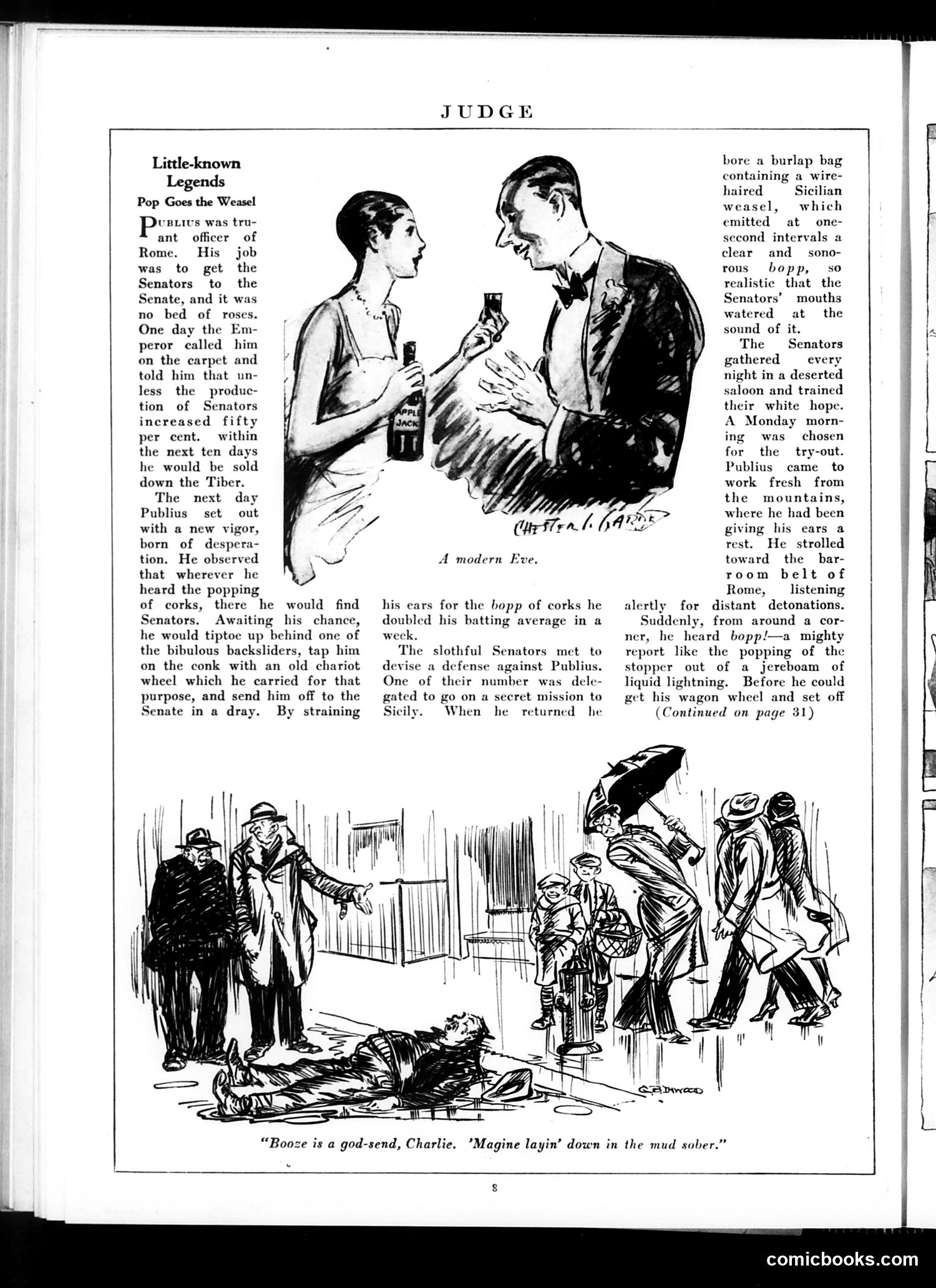
This satirical piece mocks Roman senators as chronic drunks. "Publius," a truant officer tasked with getting senators to sessions, discovers they congregate wherever cork pops—signaling wine. He exploits this by attacking them with a chariot wheel and hauling them to the Senate. When senators devise a defense, they obtain a Sicilian weasel trained to emit cork-popping sounds to lure Publius away. The satire targets 1920s American politicians as inveterate alcoholics who prioritize drinking over duty. The "modern Eve" cartoon above appears to show a woman offering liquor, connecting the theme to Prohibition-era anxieties about alcohol's corrupting influence. The bottom cartoon's caption—"Booze is a god-send, Charlie"—reinforces the message: alcohol is presented as society's curse, reducing men to unconscious, degraded states. The satire suggests political leadership itself is compromised by widespread drunkenness.
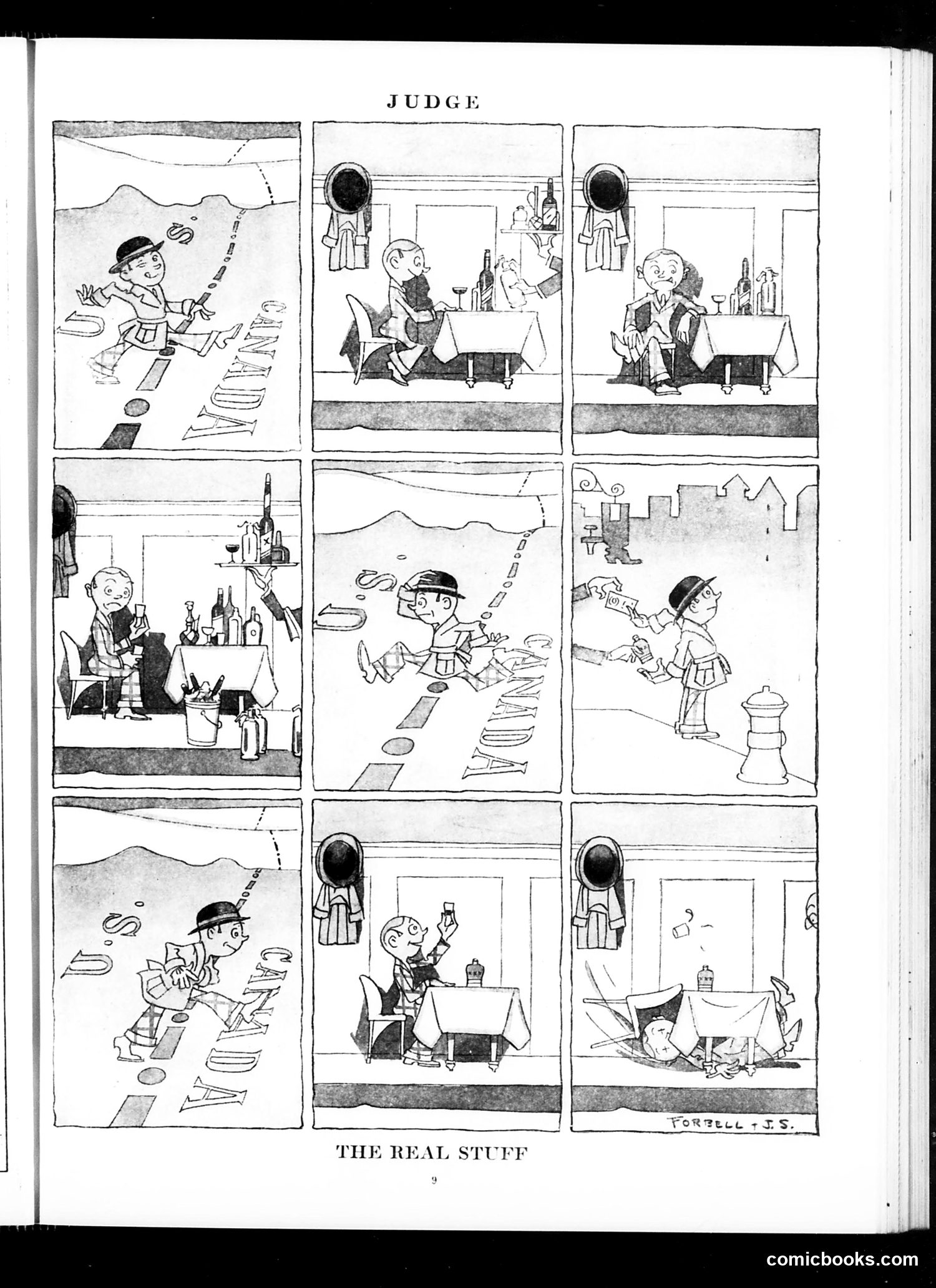
This comic strip, signed by Fortell, satirizes judicial corruption or incompetence. The narrative follows a judge character through nine panels arranged in a 3x3 grid. The sequence appears to show the judge repeatedly choosing alcohol (visible bottles throughout) over proper judicial duties. In the courtroom scenes (center and right panels), the judge sits at his bench surrounded by liquor bottles instead of legal documents. The outdoor panels show him literally stumbling and juggling papers and dishes while intoxicated. The title "The Real Stuff" likely refers ironically to alcohol, suggesting the cartoon mocks judges who prioritize drinking over administering justice. This reflects early 20th-century concerns about judicial ethics and courtroom corruption. The exaggerated physical comedy emphasizes the judge's incompetence and moral failings.
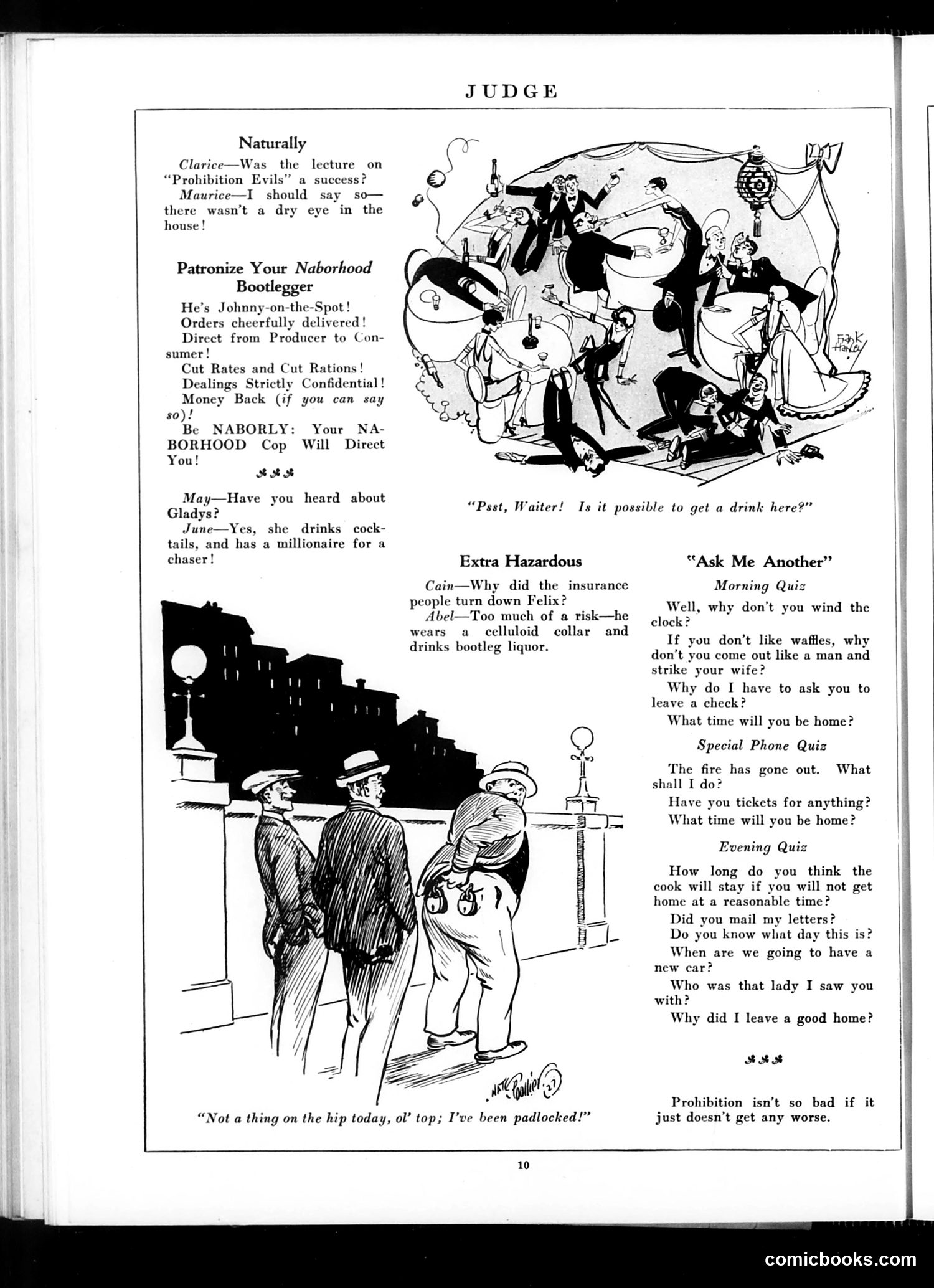
This page satirizes American Prohibition (1920-1933) through multiple angles: **Main cartoon (top)**: Depicts a chaotic speakeasy or illicit drinking establishment, mocking how Prohibition created underground drinking culture rather than eliminating it. **"Patronize Your Naborhood Bootlegger"**: Parodies legitimate business advertising to mock the normalization of illegal alcohol sales. The bootlegger is portrayed as offering convenient "customer service"—undercutting legal businesses while operating confidentially. **"Extra Hazardous" joke**: Insurance refuses coverage for someone wearing a celluloid collar who drinks bootleg liquor, suggesting bootleg alcohol's danger and unreliability. **Bottom cartoon**: Three men discuss being "padlocked"—referring to authorities literally padlocking speakeasies closed. **"Ask Me Another" quizzes**: Domestic humor listing nagging spousal questions, implying husbands drink at speakeasies to escape home life. **Overall message**: The page ridicules Prohibition as ineffective—it spawned organized crime, unsafe homemade alcohol, and speakeasy culture while failing to stop drinking.
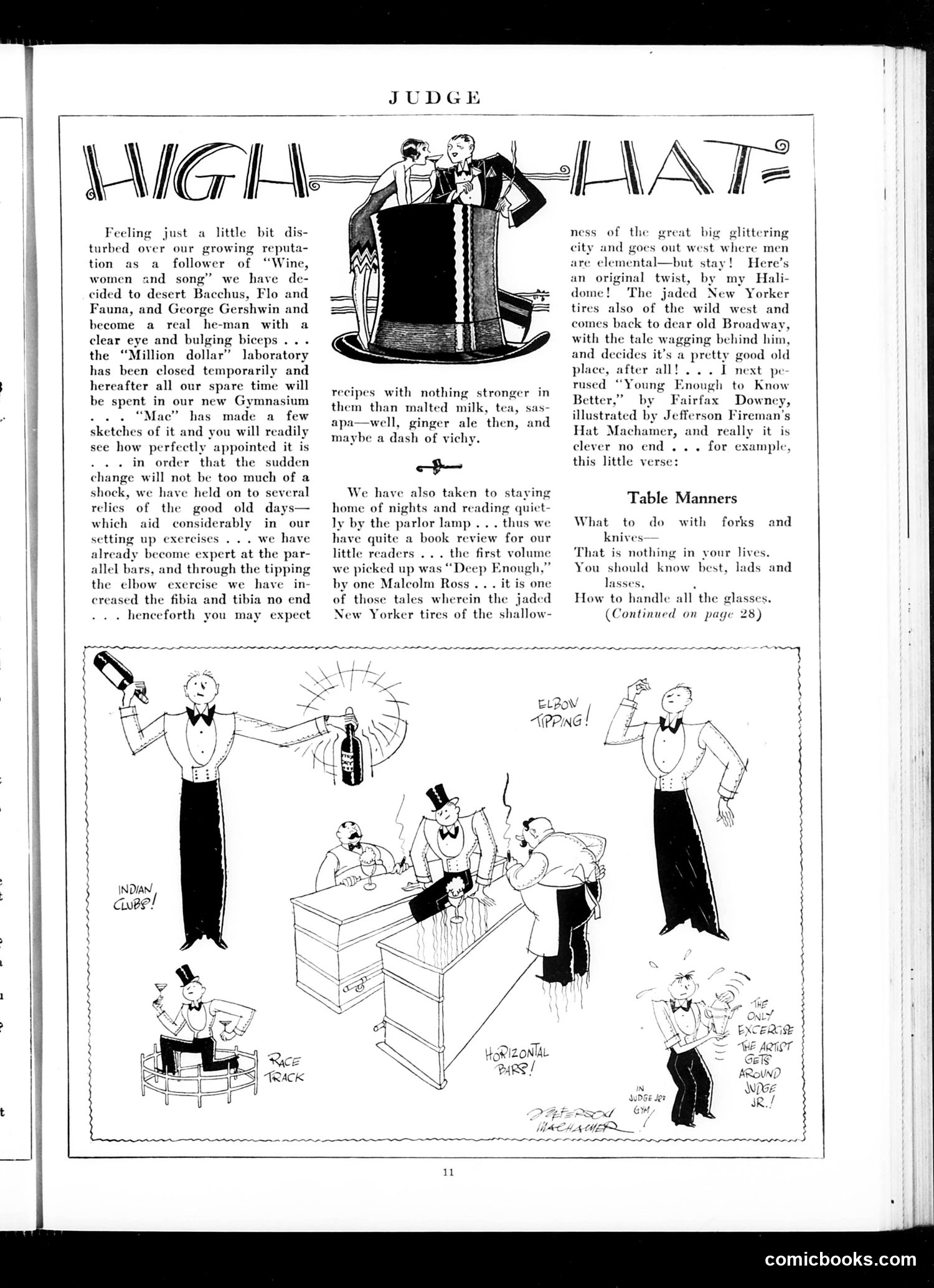
This page satirizes Judge magazine's own public image. The editorial opens by acknowledging the publication's reputation for promoting "Wine, women and song" — a dissolute lifestyle — and announces a humorous self-reformation: they're closing their "Million dollar laboratory" to build a gymnasium and pursue physical fitness instead. The accompanying cartoons mock this supposed moral makeover through exaggerated etiquette humor. Labeled sketches show gentlemen in various states of dining mishap: spilling drinks ("Indian clubs!"), holding utensils incorrectly ("Elbow tipping!"), and generally botching table manners. The irony is clear: while Judge claims refined self-improvement, these illustrations depict the sophisticated reader as hopelessly clumsy and uncouth. The "Table Manners" section reinforces this—lecturing readers on proper fork and knife usage "for lads and lasses" who apparently need basic instruction. The joke targets Judge's own audience: wealthy, urbane New Yorkers who consider themselves cultured but are portrayed as socially inept buffoons.
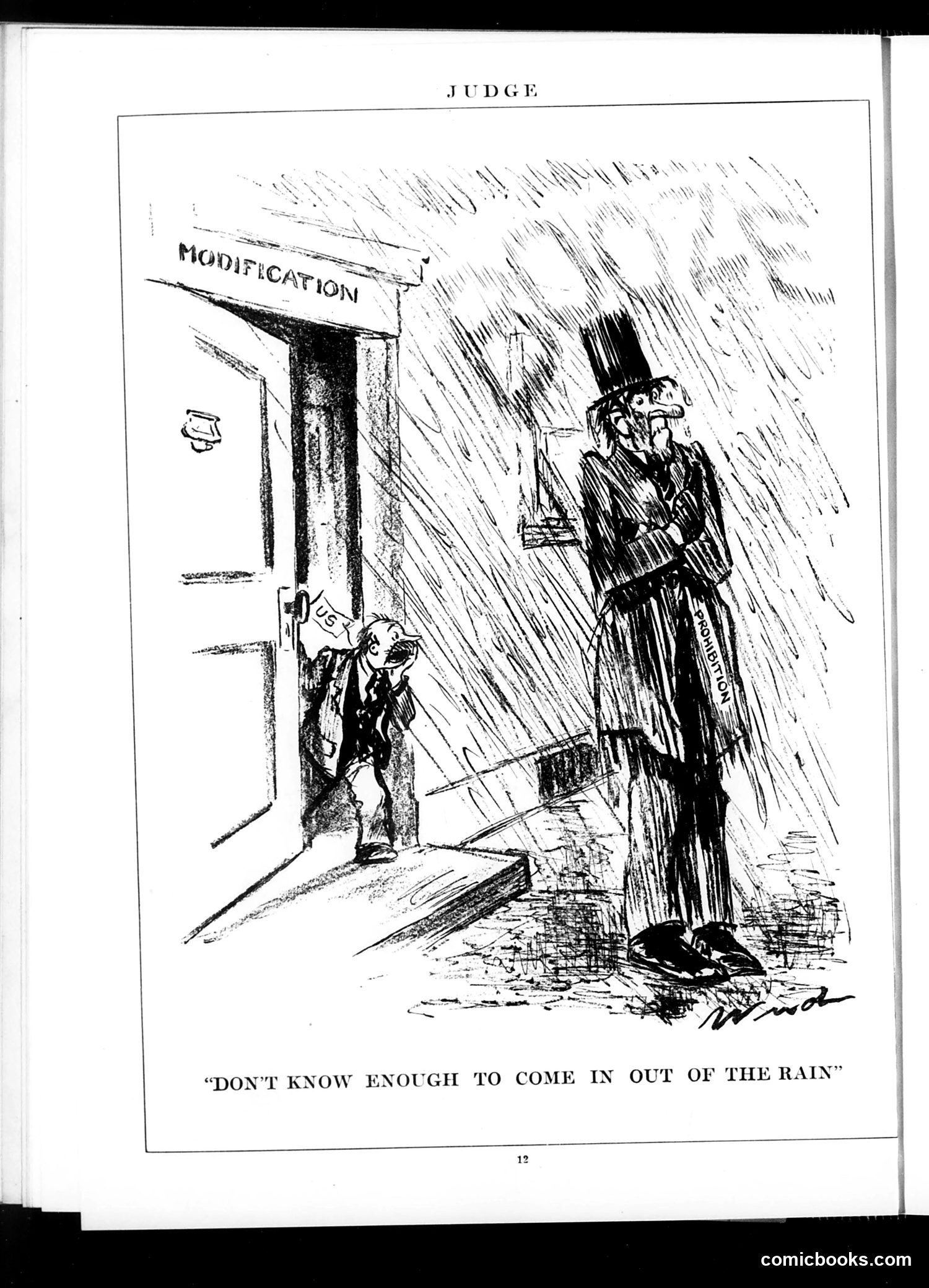
This Judge magazine cartoon satirizes judicial incompetence or lack of common sense. A well-dressed figure labeled "MODIFICATION" stands in heavy rain, appearing oblivious or unwilling to seek shelter despite being soaked. A smaller figure peers from a doorway marked "MODIFICATION," seemingly bewildered by this behavior. The caption—"Don't know enough to come in out of the rain"—is a common idiom meaning someone lacks basic intelligence or judgment. The cartoon likely critiques a specific legal modification or court decision of the era as fundamentally foolish or counterproductive. Without knowing the exact historical moment, the precise legal matter remains unclear, but the satire targets judicial reasoning as absurdly incompetent, choosing harmful action over obvious protective measures.
This page contains two editorial pieces, no illustrated cartoon. The header shows a judge figure at a bench—the magazine's mascot framing satirical commentary. **"American Civilization"** critiques Chicago's 1920s bootlegging violence during Prohibition. The satire notes that Chicago police claimed the recent election was "orderly"—yet Democratic clubs were bombed and polling places shot up, with 4,000 police and machine-gun squads deployed. The writer argues Prohibition created a corrupt system where bootlegging profits go to politically-connected criminals, turning municipal elections into organized warfare over lucrative illegal liquor franchises. Other cities (New York, Philadelphia, Boston) avoid such spectacle only because one political machine already monopolizes bootlegging, eliminating competition. Chicago's violence stems from multiple factions fighting for control. **"Moving Day"** shifts tone, satirizing American restlessness—frequent job changes, relocations, and high divorce rates. The writer attributes this to frontier optimism and machine-age thinking: belief that external changes solve internal problems. Both pieces critique American society under Prohibition-era conditions and modern industrial culture.
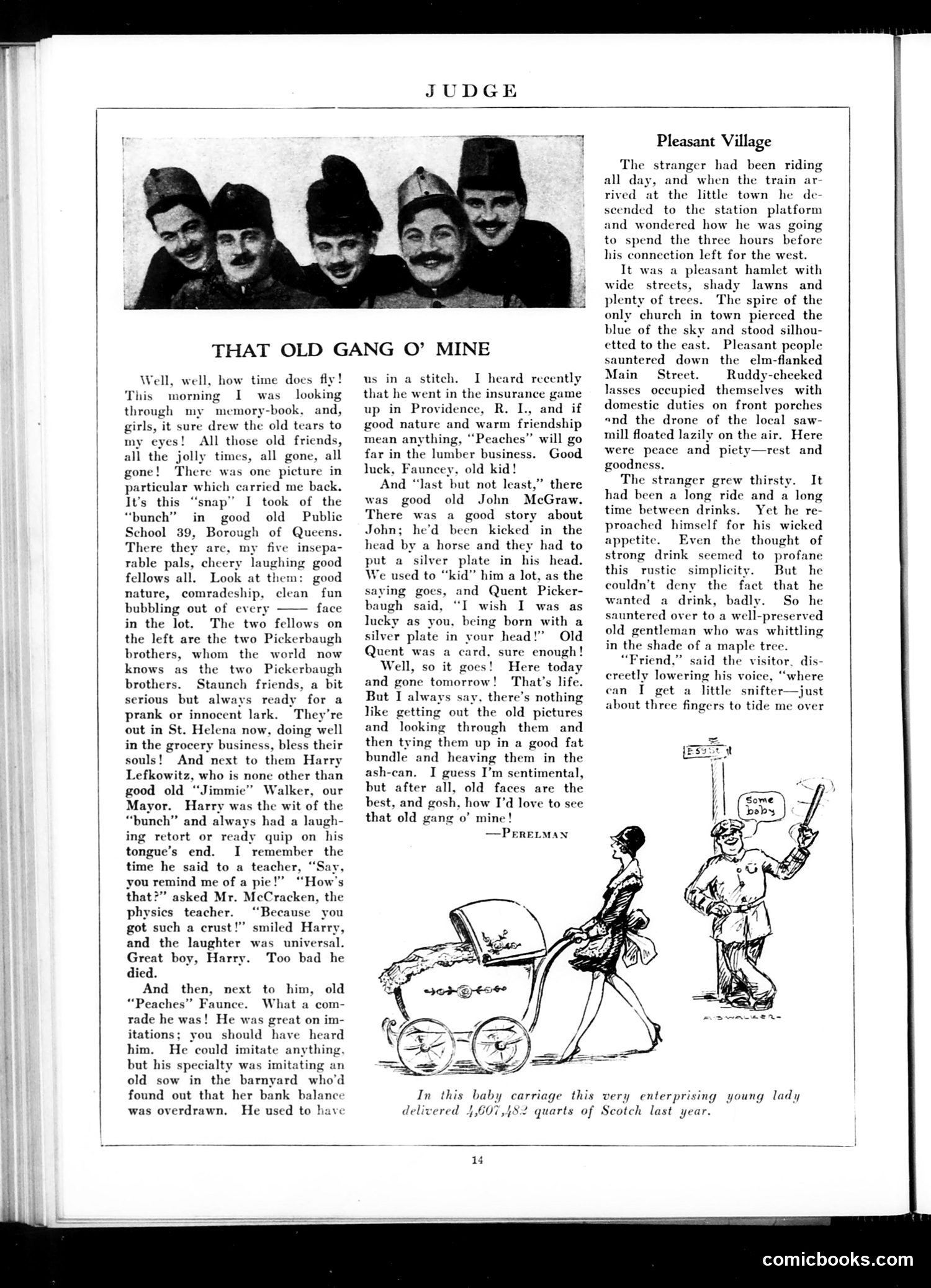
This page contains two satirical pieces from Judge magazine. **"That Old Gang O' Mine"** is a nostalgic essay by S. J. Perelman (credited as "Perelman") about reuniting with childhood friends from Public School 39 in Queens. The humor lies in the disconnect between sentimental memory and reality: the narrator rhapsodizes about these "jolly" companions, then reveals their actual fates—they're doing mundane work (grocery business, insurance), and he notes parenthetically that Harry Lefkowitz (identified as Mayor "Jimmie" Walker) "died." The piece gently mocks both nostalgic sentimentality and the ordinary lives of the supposedly remarkable. **"Pleasant Village"** describes a stranger arriving in an idyllic small town—peaceful, moral, church-spired—who immediately craves alcohol despite the piety surrounding him. The satire targets American small-town virtue as superficial, suggesting hypocrisy beneath the wholesome facade. The piece is incomplete on this page, likely building toward a comedic reveal about the town's actual character.
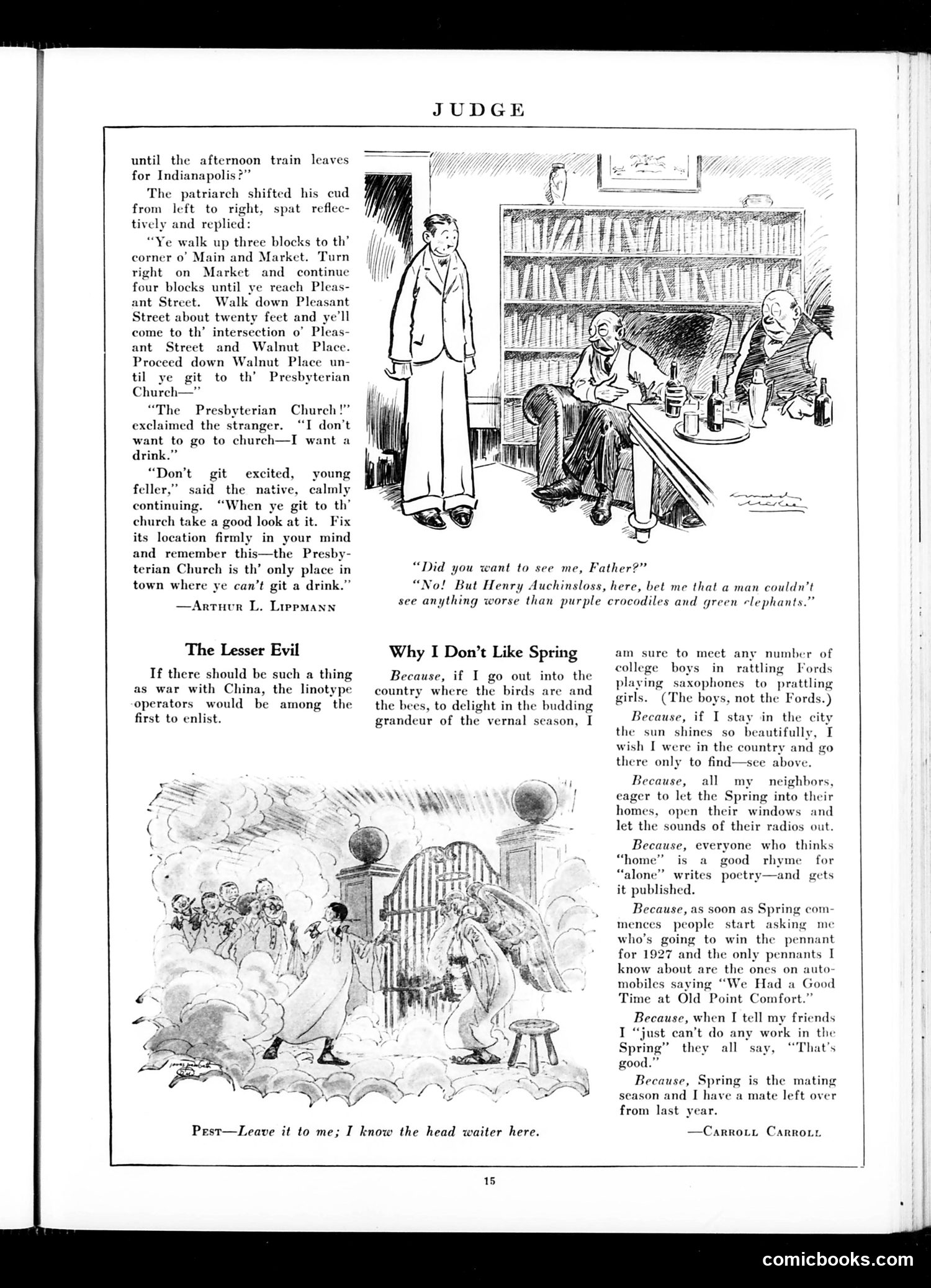
This page contains three separate satirical pieces: **Top cartoon**: A stranger asks a local for directions to a bar. The old man deliberately directs him to the Presbyterian Church, then reveals the joke: it's "the only place in town where ye can't git a drink." The humor mocks Prohibition-era hypocrisy—suggesting even churches couldn't escape alcohol culture, or that the church was so strict it stood out. **"The Lesser Evil"**: A brief item joking that if war with China occurred, linotype operators (newspaper workers) would enlist first—likely because war coverage would create job security and heavy printing demands. **"Why I Don't Like Spring"**: Carroll Carroll's humorous essay lists spring complaints: encountering college boys with saxophones and girls in cars, radio noise from open windows, amateur poetry from "home/alone" rhymers, and baseball pennant questions. It satirizes spring's clichés and urban crowding rather than celebrating the season. All reflect 1920s urban American life, Prohibition, and emerging consumer culture (automobiles, radios).
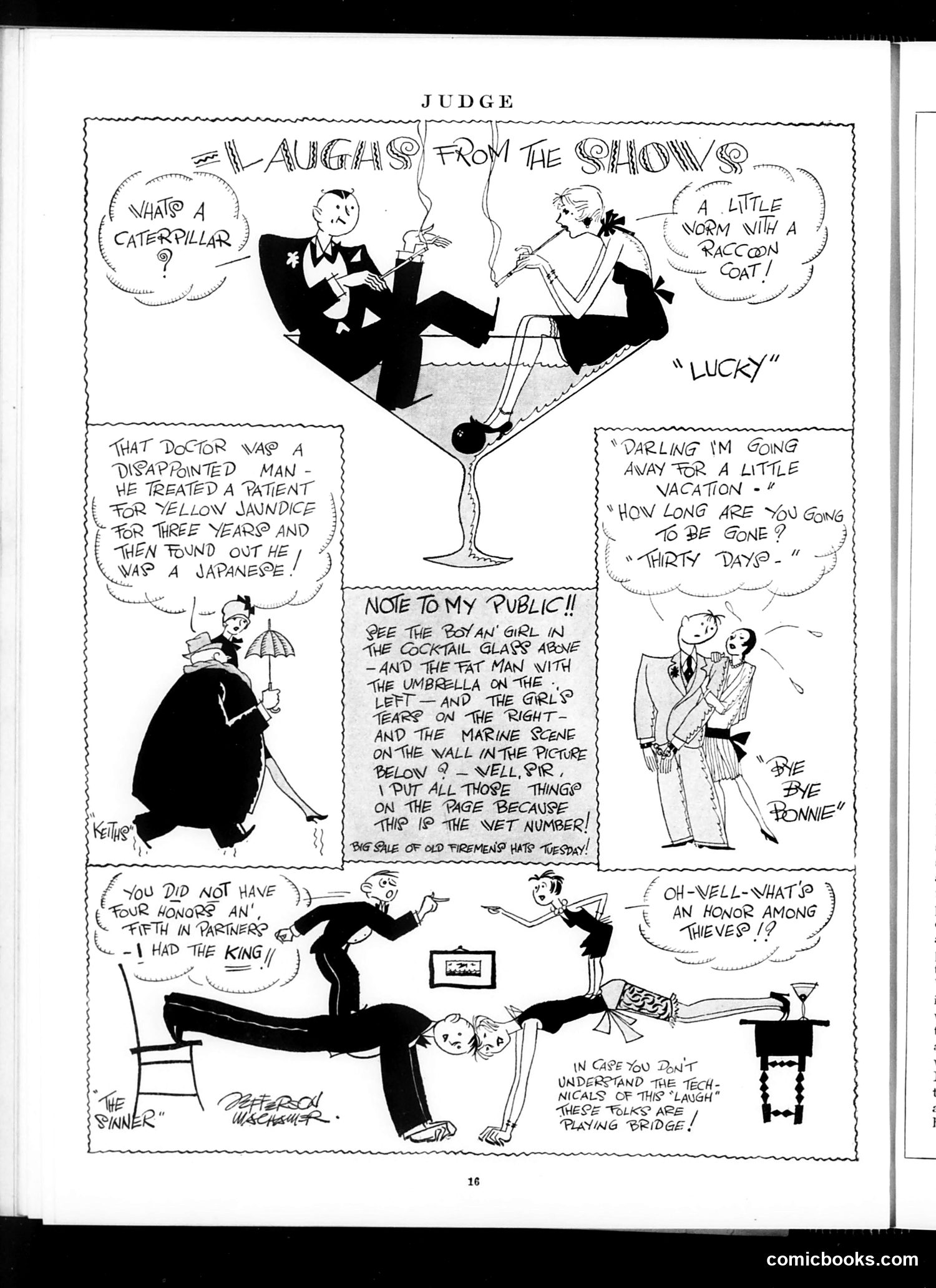
This page presents multiple satirical vignettes about social pretension and moral hypocrisy among the upper classes. The title "Laughs from the Shows" suggests these reference theatrical or entertainment scenes. The central cocktail-glass scene depicts a couple on vacation, with the man boasting about treating a "disappointed" patient for yellow jaundice for three years before discovering he was Japanese—implying the patient's ethnicity somehow invalidates the doctor's accomplishment or makes it laughable. Below, a large middle section parodies show-business bragging, with the cartoonist explaining staged elements he included "because this is the wet number"—mocking how entertainment relies on superficial spectacle. The bottom panel jokes about honor among thieves, showing characters "playing bridge" while engaged in apparently disreputable dealings, satirizing how polite social conventions mask moral compromise. Overall, the page mocks upper-class pretension, professional vanity, and the gap between social respectability and actual ethics—common targets for Judge magazine's satirical commentary.
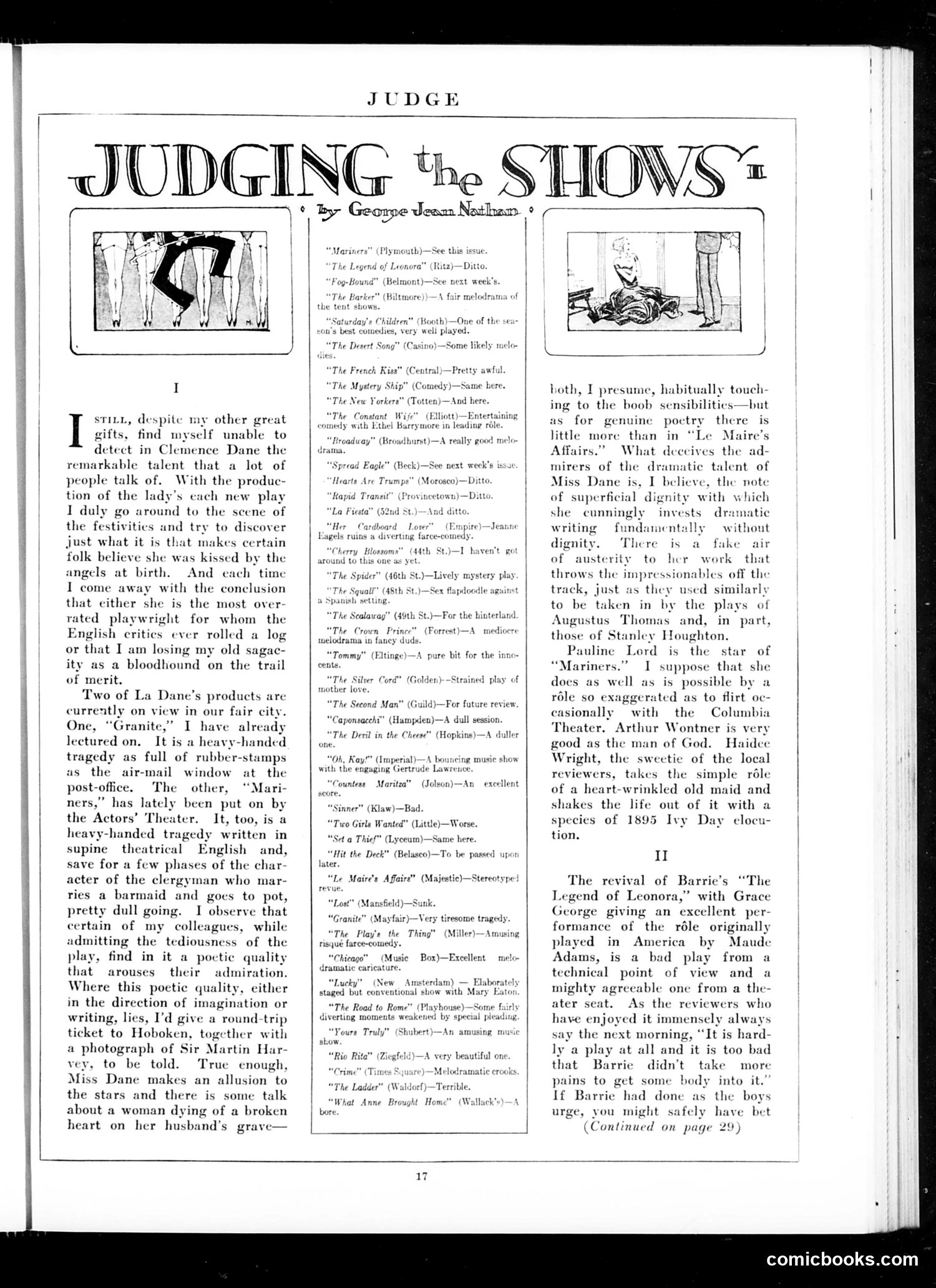
This is a theater criticism column, not a political cartoon. The page features two small illustrations but is primarily text—a review of Broadway productions by prominent drama critic George Jean Nathan. The column attacks English playwright Clemence Dane, dismissing her work as heavy-handed and tedious despite critical acclaim. Nathan sarcastically questions why other critics praise her plays, suggesting either she's vastly overrated or he's losing his judgment. He compares her to contemporary playwrights Augustus Thomas and Stanley Houghton, implying her work shares their dated theatrical conventions. The bulk of the page lists current New York theater productions with brief, often caustic reviews. Nathan's tone throughout is acerbic—he finds most plays dull or derivative. This reflects the column's purpose: providing witty, contrarian theater criticism for Judge's educated readership.
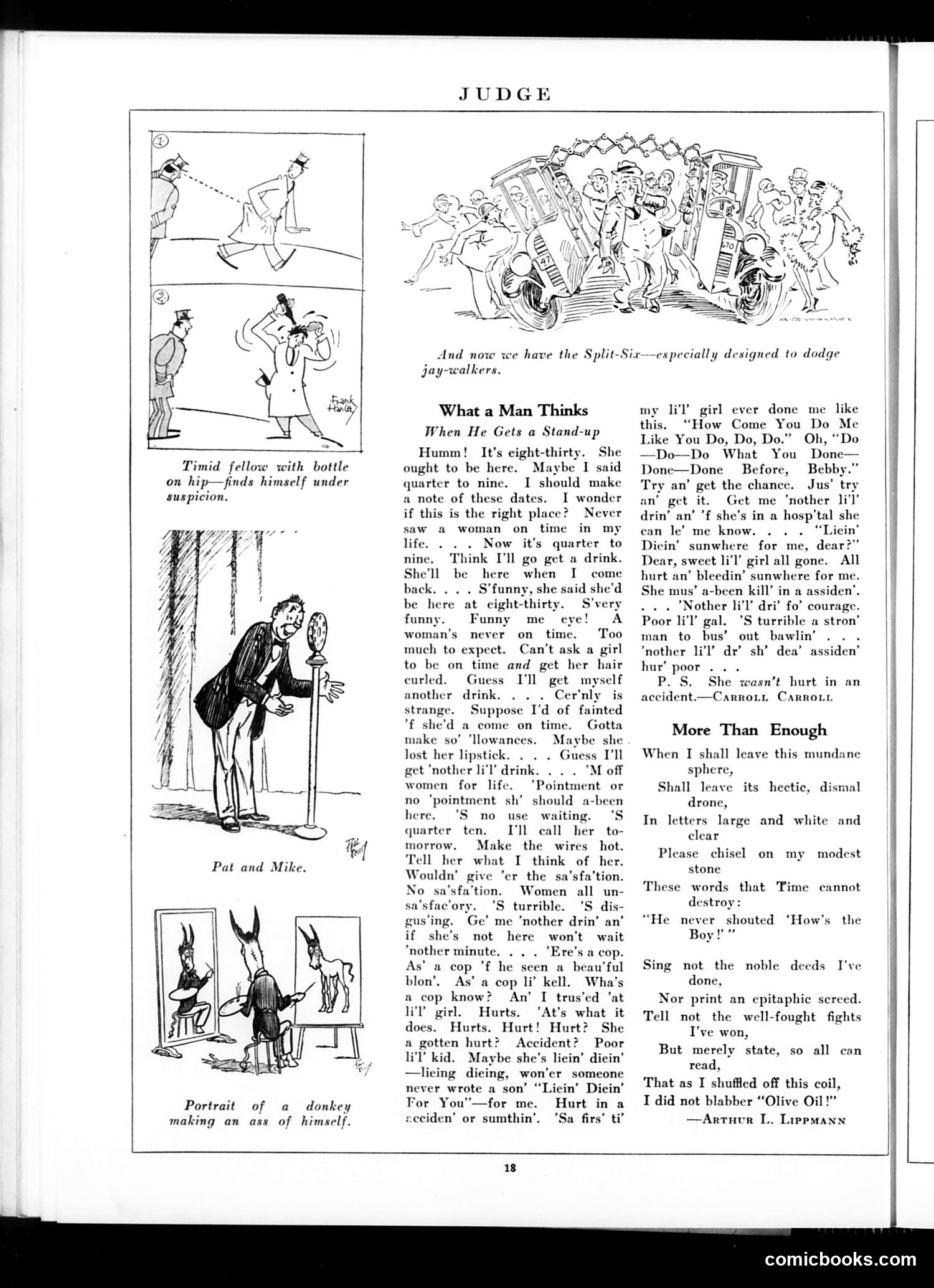
This page contains satirical humor typical of early 20th-century American magazines: **"What a Man Thinks When He Gets a Stand-up"** is the main feature—a monologue depicting a man stood up on a date. As time passes and his date doesn't arrive, his internal thoughts spiral from irritation to panic, imagining she's been hit by a car or seriously injured. The humor lies in the exaggerated emotional volatility and the final reveal (via editor's note): she wasn't hurt at all. The phonetic spelling ("li'l'," "drin'") represents his increasingly drunk state as he waits. The smaller cartoons mock social types: a "timid fellow" getting caught with a bottle, and a donkey "making an ass of himself." **"More Than Enough"** is a brief poem mocking men who constantly use the phrase "How's the Boy?"—satirizing annoying conversational habits of the era. The page reflects period anxieties about dating, punctuality, and masculine behavior, using alcohol consumption and emotional excess as comedy devices.
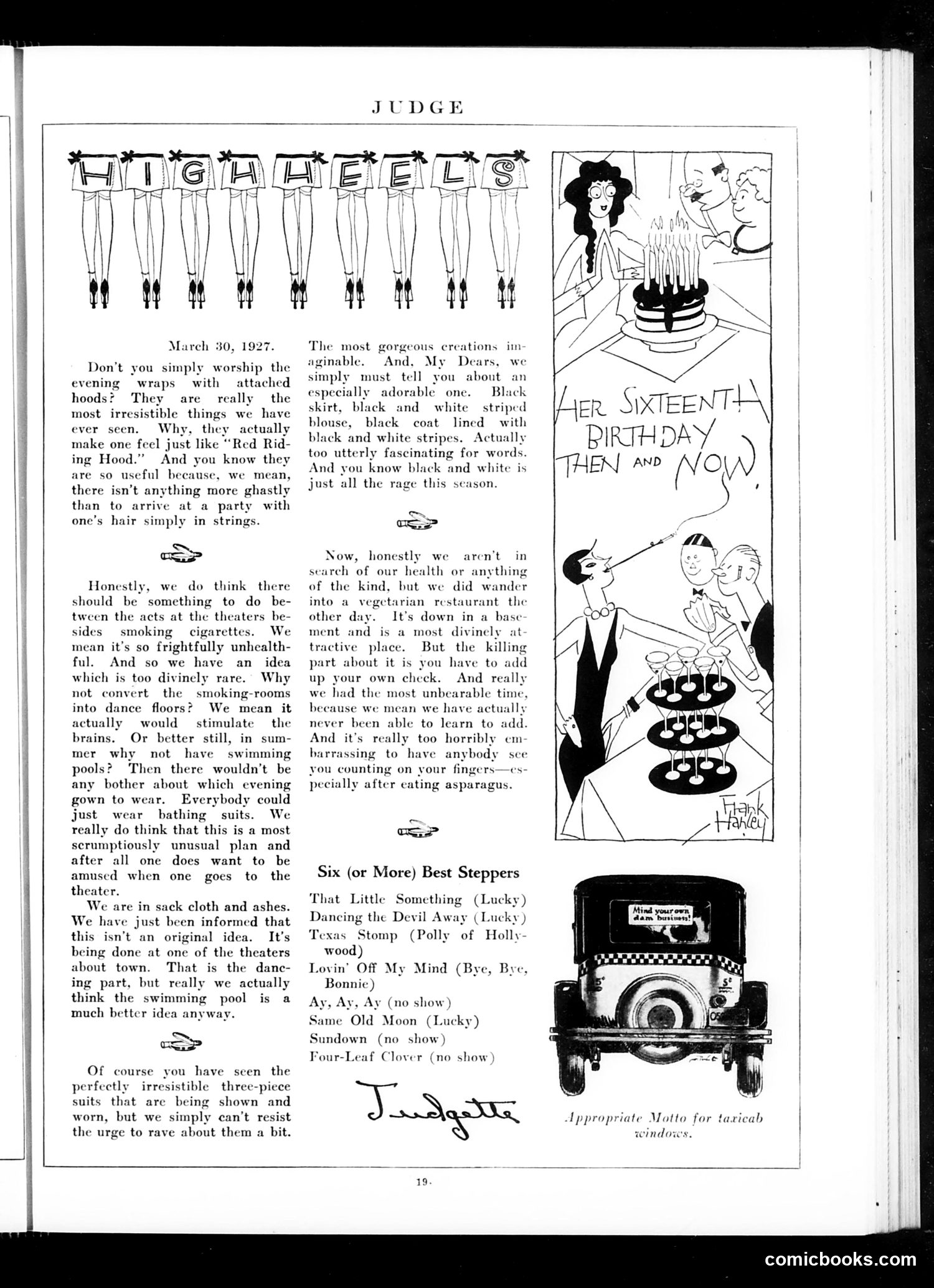
This page satirizes 1920s upper-class leisure culture through mock advice columns and entertainment reviews. The column adopts an exaggerated tone of frivolous sophistication ("My Dears," "divinely rare") to mock wealthy women obsessed with fashion—particularly the season's black-and-white color scheme and "evening wraps with attached hoods." The satire targets both vanity and impracticality: suggesting theaters convert smoking rooms to dance floors, or better yet, add swimming pools so guests needn't worry about evening gowns. The vegetarian restaurant anecdote mocks privileged complaints—the author's embarrassment at being unable to add up a check, a basic arithmetic skill. The accompanying cartoon shows a sixteenth birthday celebration, likely satirizing excessive indulgence. The "Six (or More) Best Steppers" lists popular dance songs of the era, reflecting the Jazz Age's dance-obsessed culture. The taxi window motto ("Mind your own business") suggests urban rudeness. Overall, the page ridicules wealthy 1920s society's superficiality and disconnect from ordinary competencies.
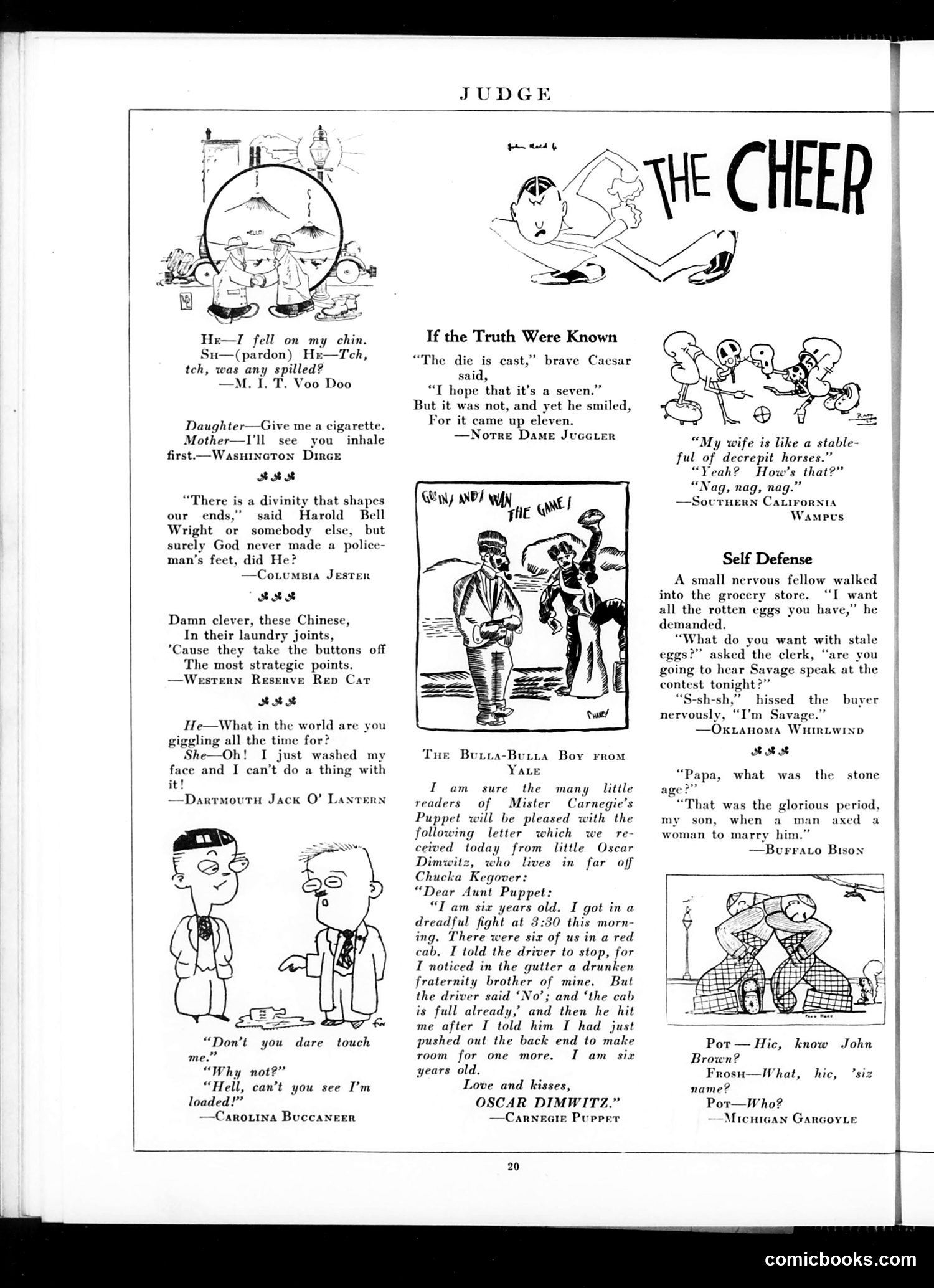
This page from the satirical magazine *Judge* contains multiple brief jokes and cartoons typical of early 20th-century American humor. Key content includes: **Political/Social References:** - A joke about Caesar and dice-rolling (gambling/fate) - References to Harold Bell Wright (popular novelist) and philosophy - A critique of police ("surely God never made a policeman's feet") - A jab at Chinese laundries taking buttons from clothes—a common immigrant stereotype - A reference to "Savage" speaking at a contest (unclear who this is) **Recurring Joke Types:** - Gender dynamics (daughter smoking, wife nagging) - Drunkenness and fraternity behavior - Class commentary (grocery stores, taxi drivers) - Wordplay and puns **The Cartoons:** Small illustrated vignettes accompany jokes about physical comedy, domestic situations, and social awkwardness. The overall tone is lighthearted rather than biting political satire. The humor relies heavily on period-specific references and social observations now requiring historical context to fully appreciate.
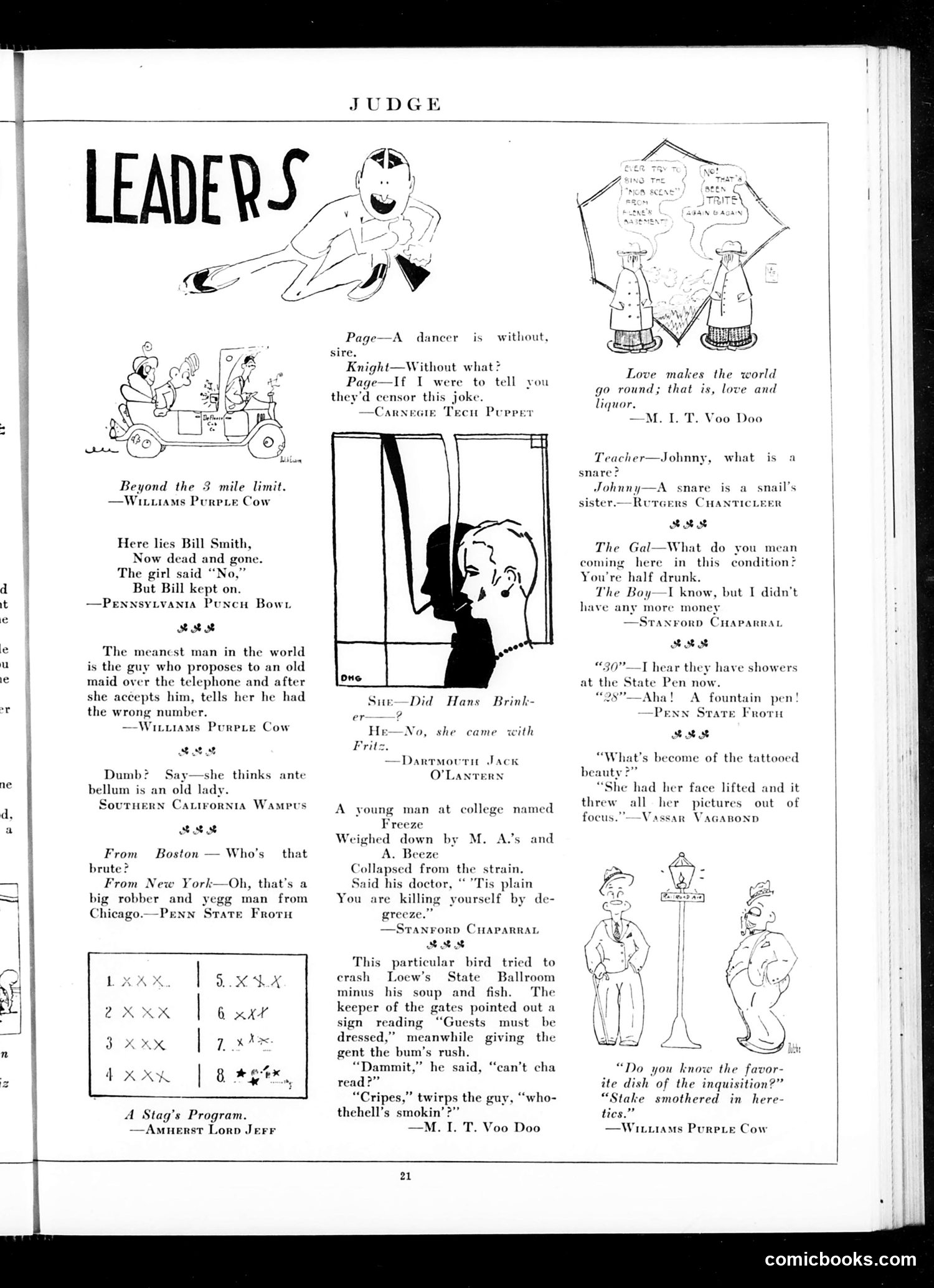
This is a humor page from Judge magazine featuring miscellaneous jokes and one-liners attributed to various college publications. The content reflects early 20th-century American collegiate humor. Key items: **"Beyond the 3 mile limit"** appears to reference Prohibition-era speakeasies outside city jurisdiction. **The "Stag's Program"** is a coded drinking game (X's and stars representing drinks), poking fun at male social gatherings during Prohibition. **College humor dominates**: Penn State Froth, M.I.T. Voo Doo, Amherst Lord Jeff, and others contributed jokes typical of the era—dating mishaps, drunk students, academic pretension, and flirtation. **Social references**: One joke mocks proposing by telephone (then novel technology), another criticizes formal dress codes at dance halls, and several involve intoxication as humor. The cartoons are light, satirical sketches typical of Judge's style—poking gentle fun at college life, romance, and social conventions rather than targeting specific political figures or serious issues.
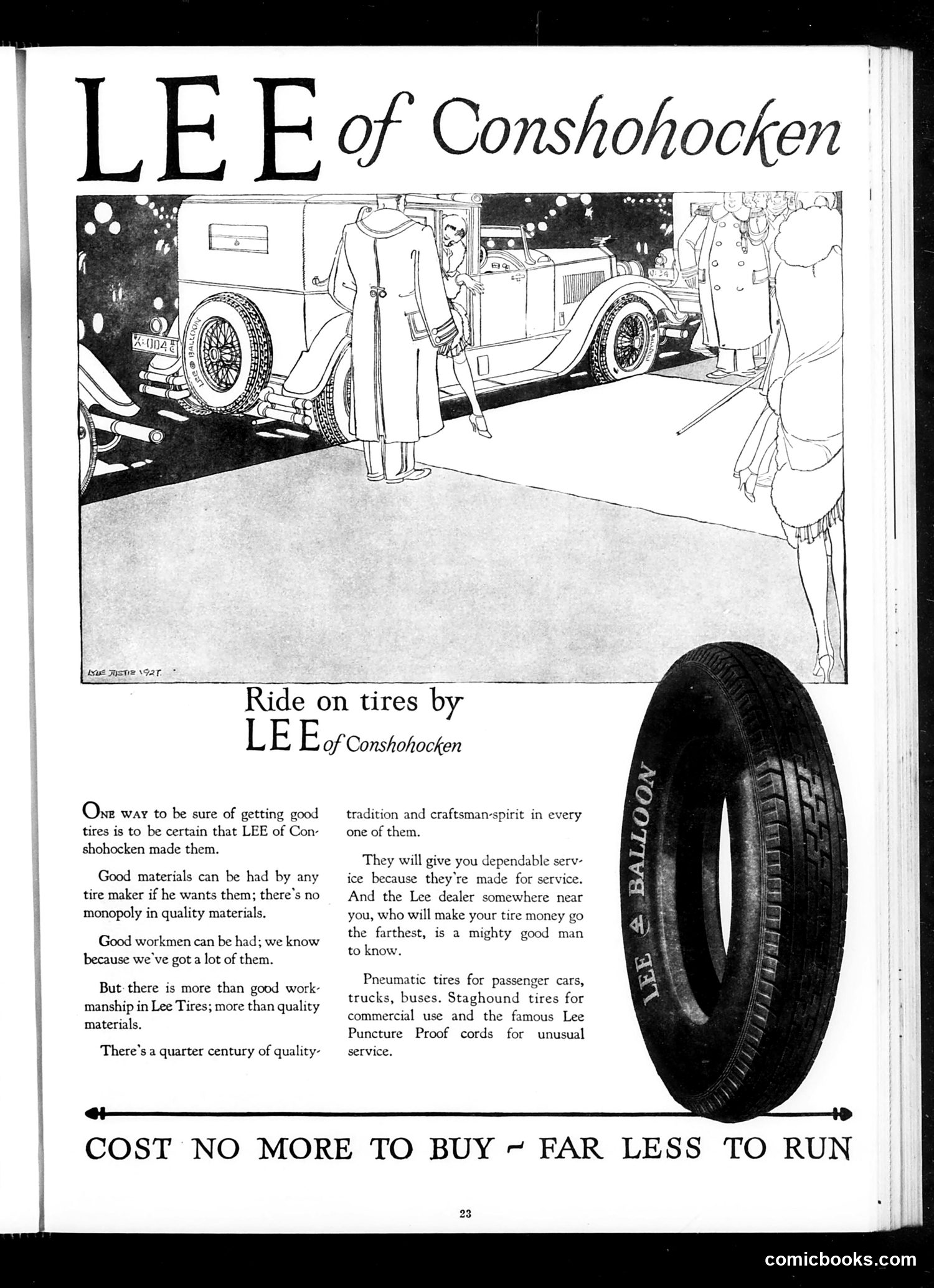
This is a full-page advertisement, not political satire or editorial cartoon. It promotes LEE tires, manufactured in Conshohocken (Pennsylvania). The illustration depicts a 1920s scene: well-dressed women and men examining automobiles, establishing an aspirational lifestyle context for the product. The actual tire is displayed prominently on the right. The ad's argument emphasizes Lee's competitive advantages through quality materials, skilled workers, and "a quarter century of quality tradition"—positioning the brand as reliable and trustworthy rather than the cheapest option. The tagline "Cost No More to Buy ~ Far Less to Run" suggests durability justifies the price. For modern readers: this represents early automotive advertising's strategy of linking product quality to lifestyle prestige and longevity value—a direct ancestor to contemporary car advertising. The gendered presentation (fashionably-dressed women) targets middle-class consumers with purchasing power.
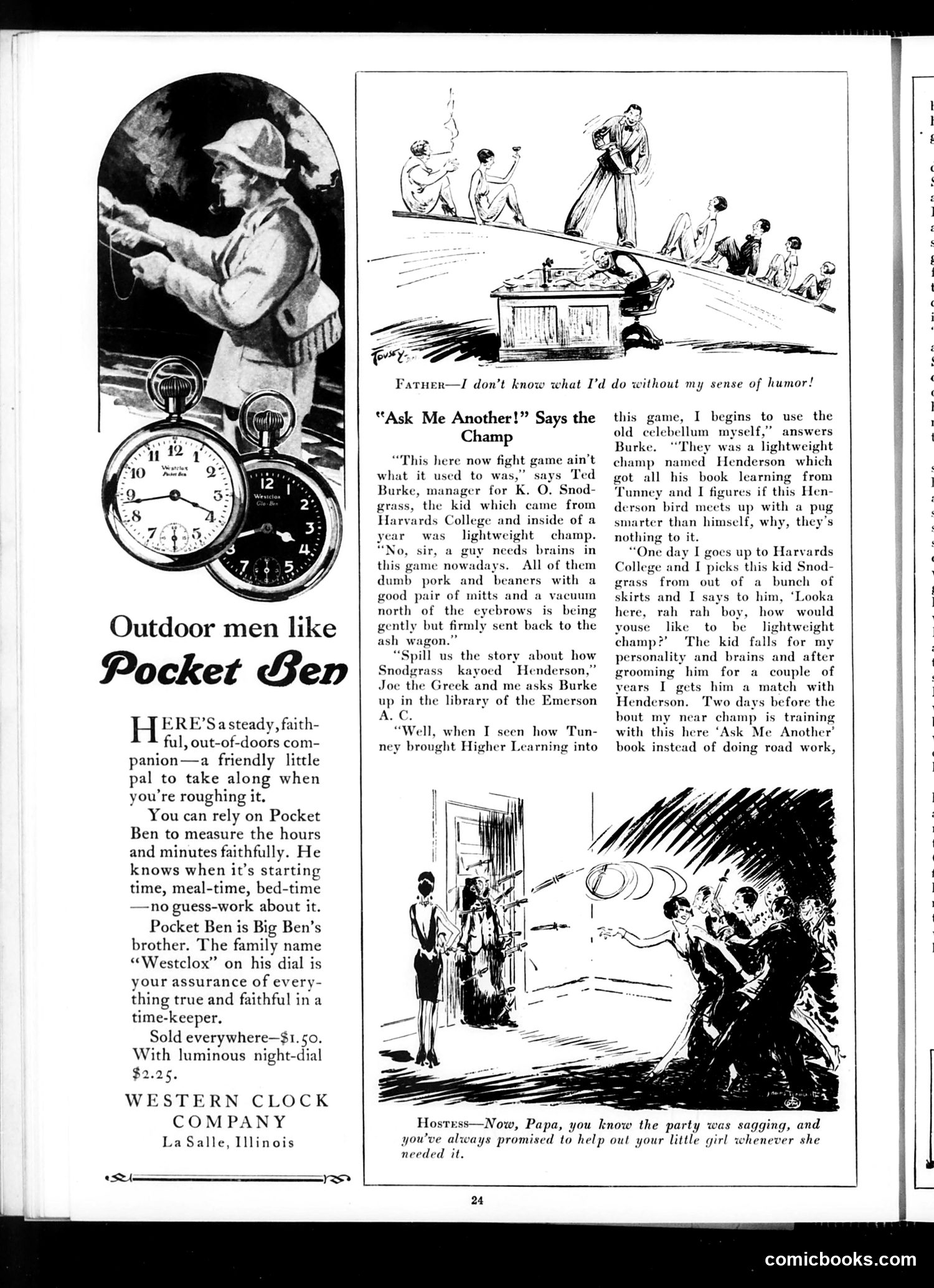
This page contains two distinct pieces: **Left side:** A Western Clock Company advertisement for "Pocket Ben," a pocket watch marketed to outdoorsmen as reliable and faithful—playing on period-appropriate masculinity and product reliability. **Right side:** A satirical cartoon about modern boxing and education. The story, told by a fight manager named Ted Burke, mocks the intellectualization of boxing. Burke describes how he selected a Harvard-educated boxer (K.O. Snodgrass) specifically because he'd read the "Ask Me Another!" educational book series, believing brains now matter more than brute strength in fighting. The satire targets the early 20th-century trend of educational self-improvement books and their enthusiastic adoption. It suggests that such learning materials have become so ubiquitous and absurd that even boxers are expected to study them—implying both mock admiration for widespread education and skepticism about its practical value in fields like prizefighting. The cartoon humorously deflates contemporary faith in education as a universal solution.
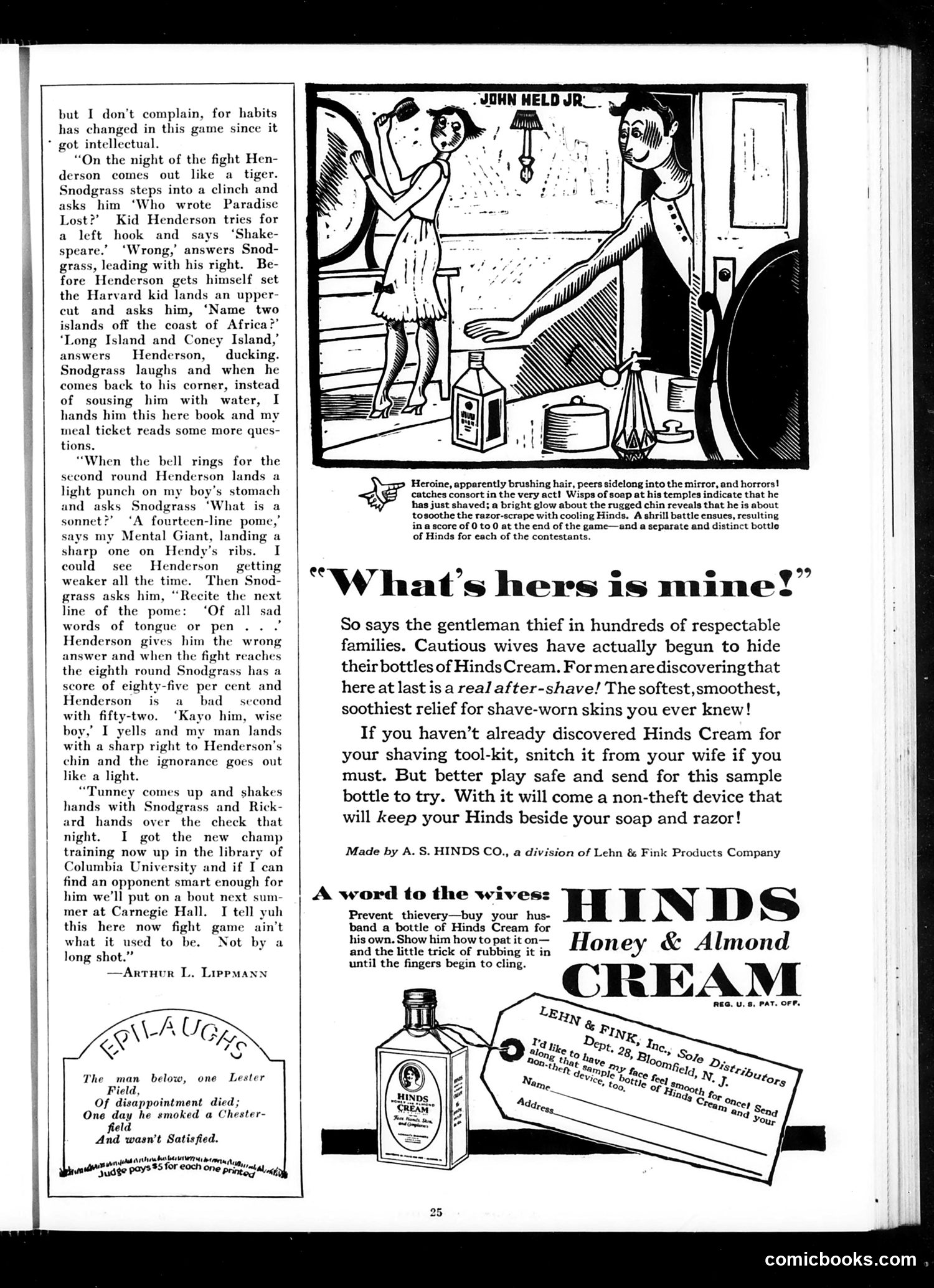
This page contains a short story by Arthur L. Lippmans and an advertisement for Hinds Cream (a shaving product). **The Story**: A boxing manager describes training his fighter using intellectual challenges instead of traditional boxing drills. During fights, the opponent is asked literary trivia questions (Paradise Lost, Shakespeare, geography) while fighting. This satirizes the 1920s cultural obsession with appearing "intellectual"—the manager has moved his boxer's training to Columbia University library. The joke is that despite this absurd intellectual approach, the fighter still wins through basic boxing skill. **The Advertisement**: Frames Hinds Cream as an "after-shave" product (apparently novel at the time) by presenting a humorous domestic scenario: a wife catches her husband shaving, suggesting wives should buy their husbands the cream to prevent theft—joking that men steal their wives' bottles. The ad emphasizes softness and soothing relief for shaved skin. **Context**: This reflects 1920s preoccupations with intellectual culture and emerging consumer products marketed through domestic humor.
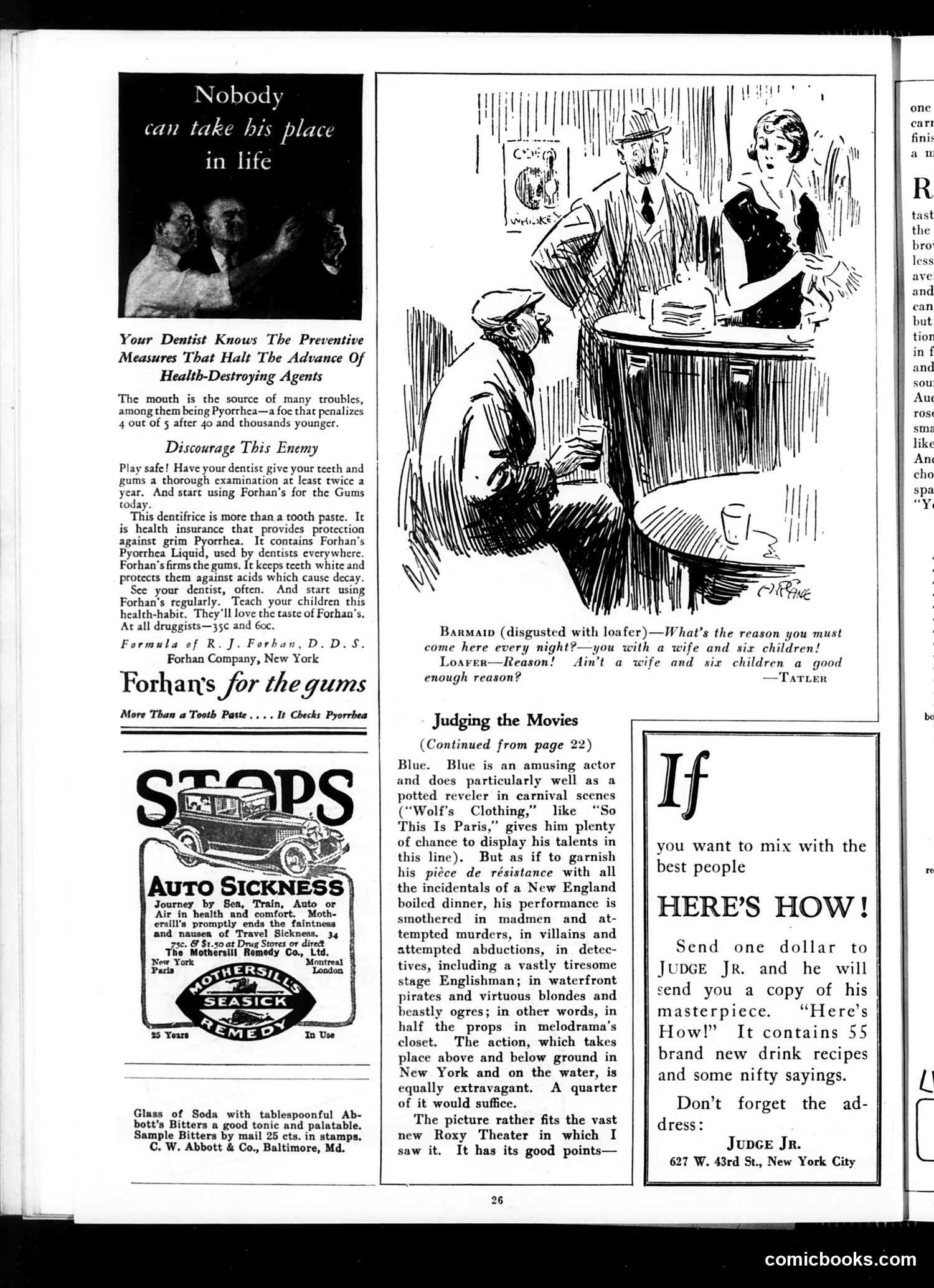
This page is primarily **advertising and filler content** with one cartoon. **The Main Cartoon:** A bartender confronts a regular customer (labeled "Loafer") who visits nightly despite having a wife and six children at home. The loafer's response—that a wife and six children *is* reason enough to escape to a bar—is the joke's punch line. This satirizes domestic frustration and men's use of bars as refuge from family obligations, a common theme in early 20th-century humor. **Advertisements:** The page features multiple product ads (Forhan's toothpaste for pyorrhea/gum disease, Mothersill's travel sickness remedy, Abbott's Bitters, and others) typical of Judge's revenue model. **Also included:** A film review of an actor named Blue in a melodrama, and a promotional offer for "Judge Jr." drink recipes—reflecting the magazine's mix of satire, entertainment commentary, and commercial content aimed at middle-class readers.
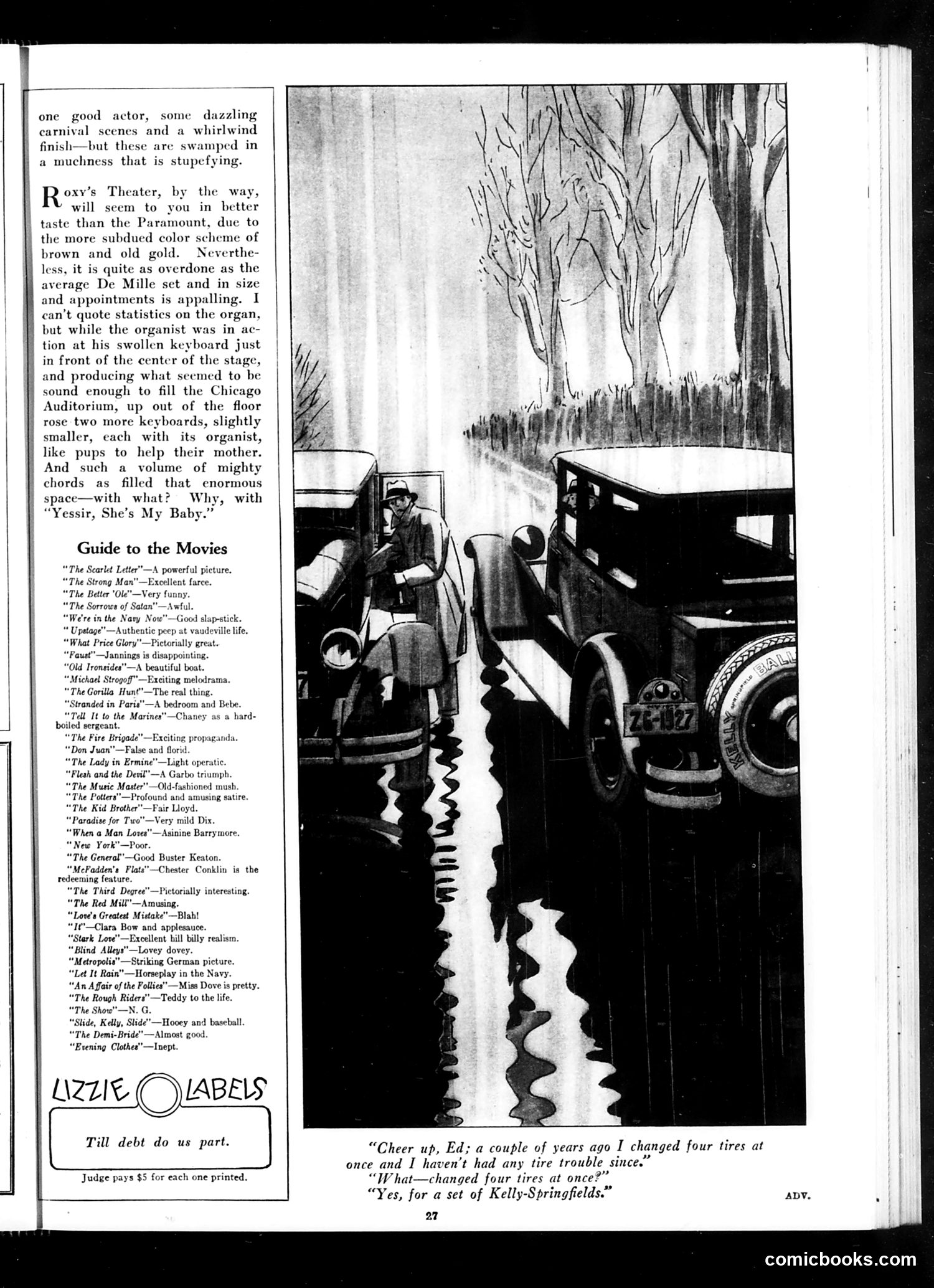
This page mixes movie criticism with advertising. The main editorial content discusses theater architecture and a film organ setup at Roxy Theater, contrasting it with the Paramount's design. The writer critiques how an organist's "swollen keyboard" produces mighty chords—but for the trivial song "Yessir, She's My Baby," exemplifying excess without substance. The "Guide to the Movies" lists brief reviews of 1920s silent films, naming stars like Lillian Gish, Greta Garbo, and Buster Keaton, with terse judgments ("powerful," "amusing," "inept"). The cartoon below depicts a tire-change conversation, serving as a Kelly-Springfield advertisement. One man boasts he changed four tires years ago without trouble since, promoting the tire brand's durability—a straightforward product endorsement rather than political satire.
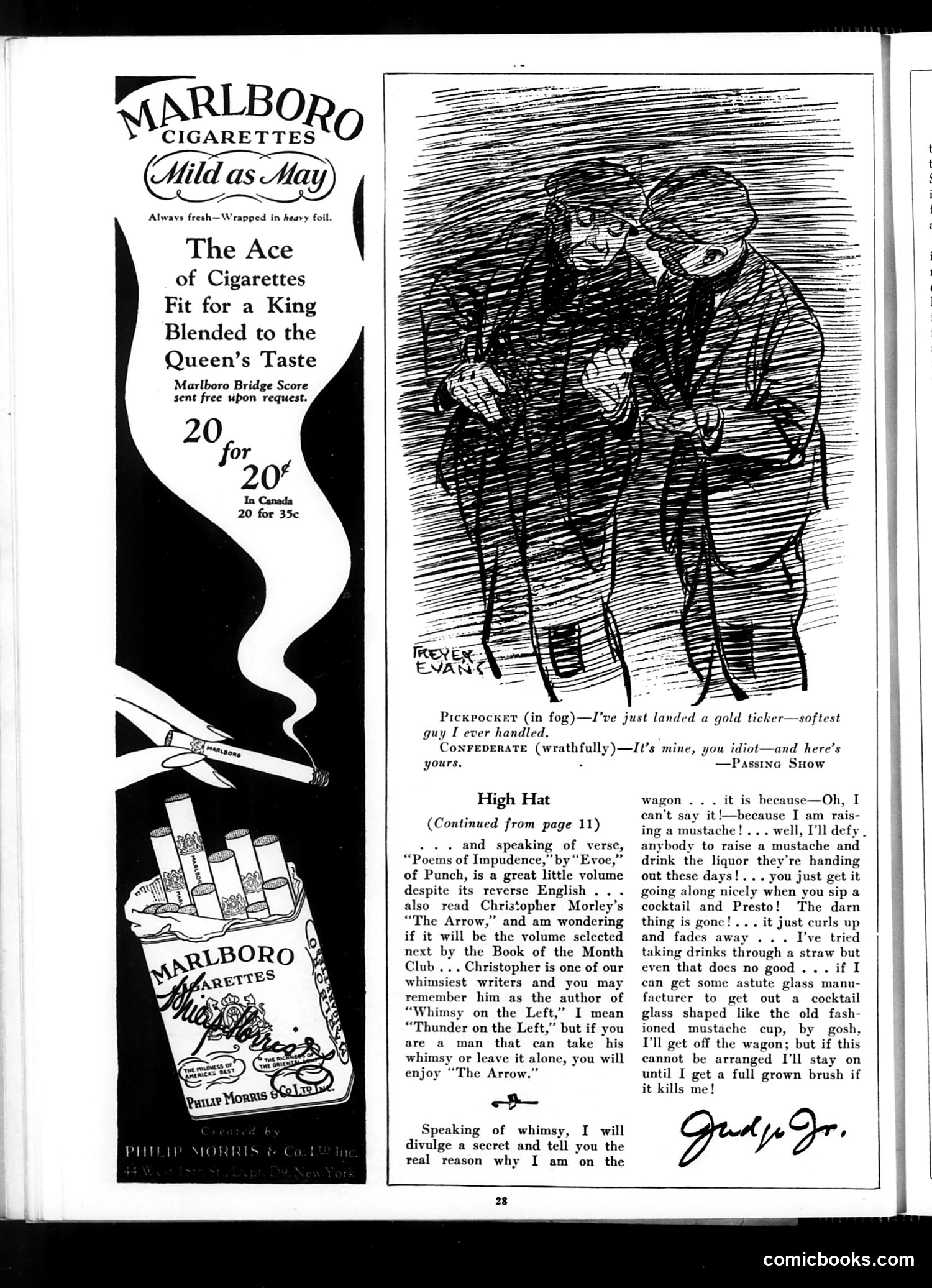
This page contains two distinct elements: a **Marlboro cigarette advertisement** (left) and **editorial content** (right). The advertisement promotes Marlboro cigarettes as "Mild as May," emphasizing freshness and quality ("Fit for a King / Blended to the Queen's Taste"). Pricing is listed as "20 for 20¢" with bulk options. The right side features a cartoon sketch by Reeves Evans showing what appears to be street criminals in fog—a "pickpocket" and "confederate" executing a theft, with dialogue about stealing a watch ("gold ticker"). Below this is a book review column titled "High Hat," discussing recent publications including Christopher Morley's "The Arrow." The author (signed "Gluyas Jor," likely Gluyas Jordan) concludes with a humorous personal anecdote about raising a mustache and struggling to drink cocktails without ruining it—satirizing the impracticality of facial hair maintenance during the drinking era (Prohibition's end or shortly after). The satire is gentle and lifestyle-focused rather than political.
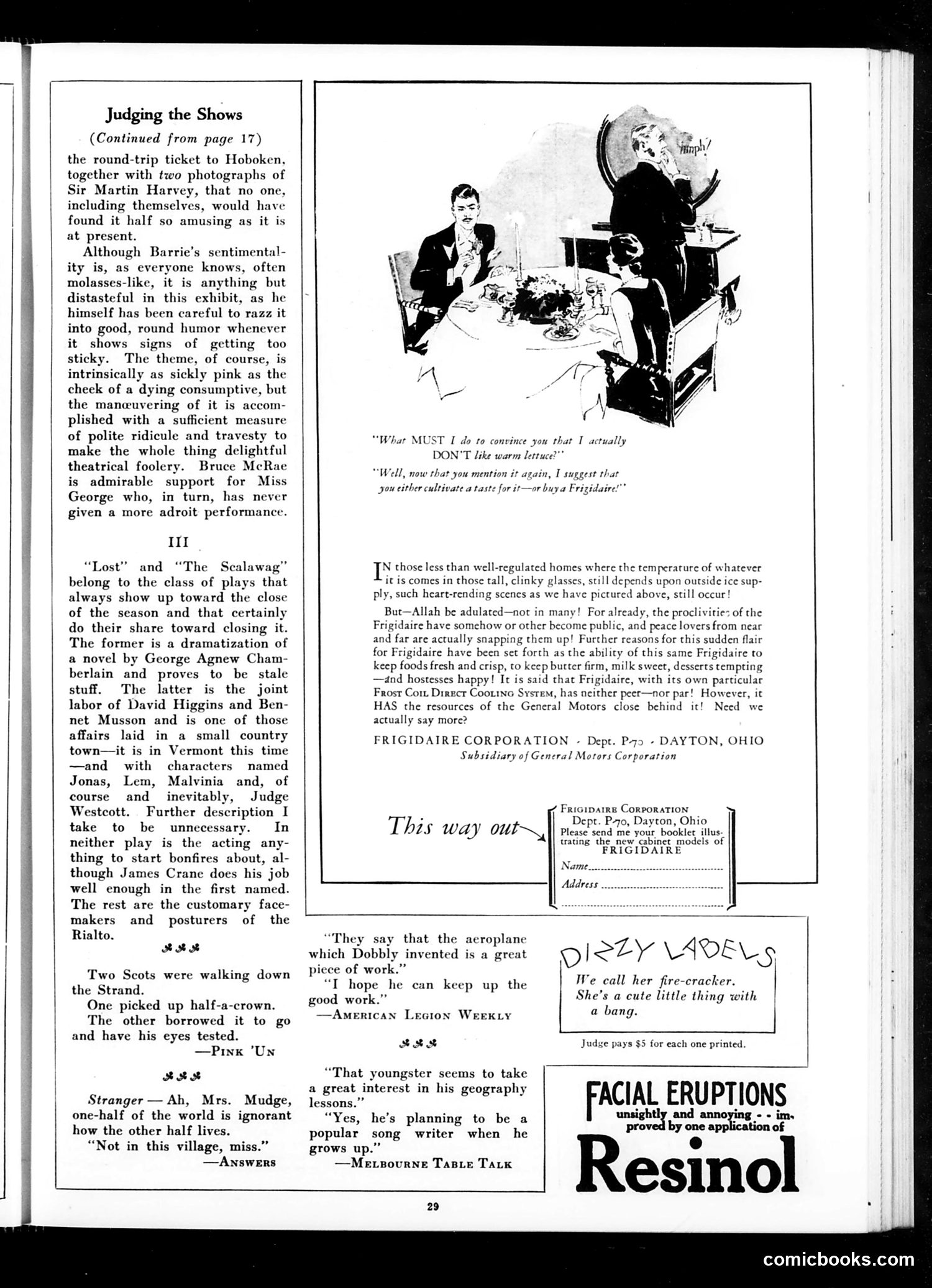
This page contains theater reviews and advertisements rather than political cartoons. The main content is a critique of recent Broadway productions, including plays like "Lost" and "The Scalawag," praising performances by actors Bruce McRae and James Crane. The cartoon illustration depicts a domestic dispute over warm lettuce—a setup for advertising Frigidaire refrigerators. A husband confronts his wife about serving cold food, and she sarcastically suggests he either accept warm lettuce or buy a Frigidaire. The ad emphasizes the appliance's ability to keep food fresh and maintain proper temperatures, contrasting modern refrigeration with older "ice supply" methods. The page also includes brief humor items (like the Scottish joke about borrowing money for eye tests) typical of Judge's miscellaneous content. The Dizzy Ladies cartoon at bottom appears unrelated. Overall, this is a standard early-20th-century satirical magazine page mixing consumer advertising with entertainment criticism and light comedy.
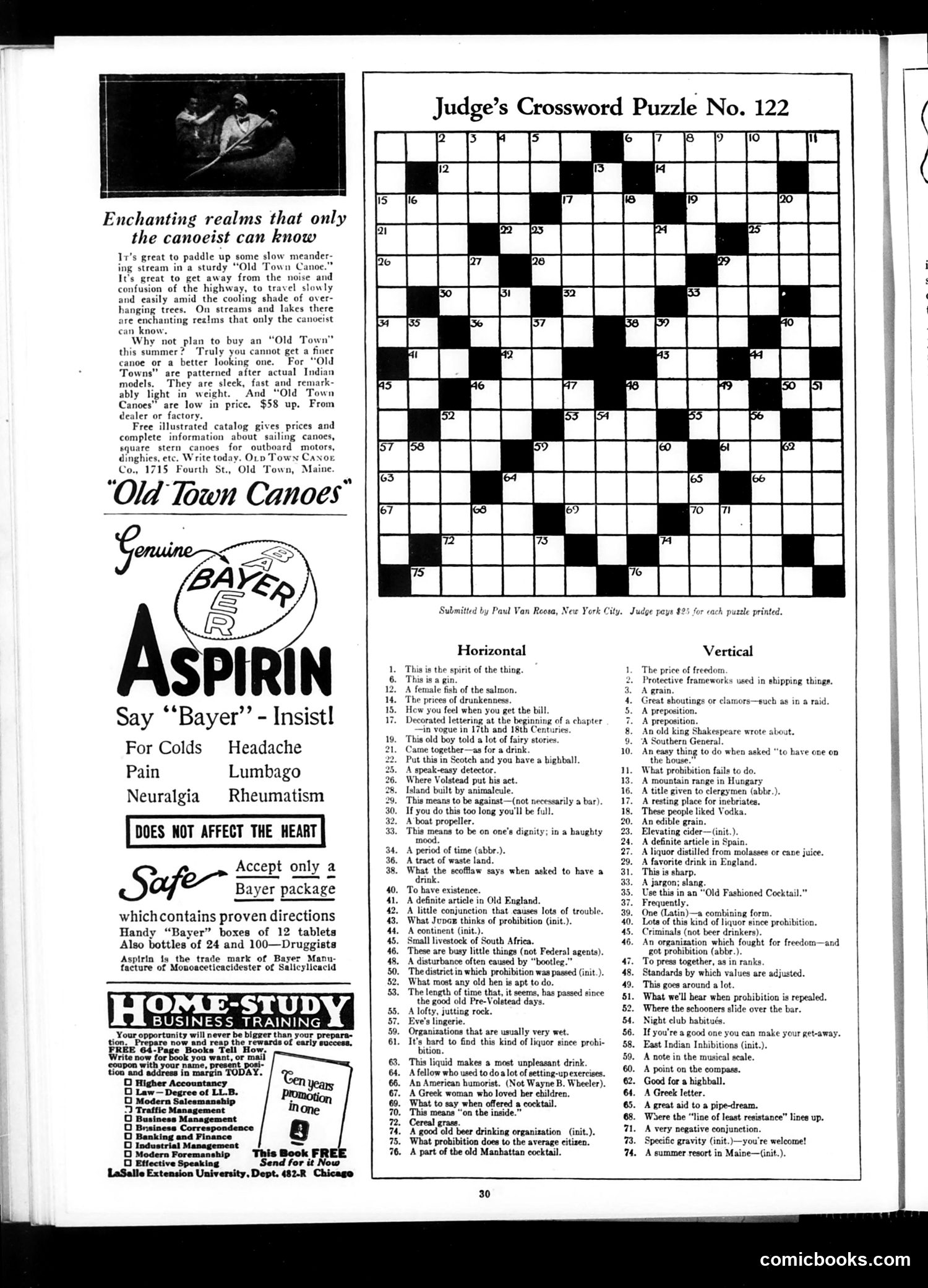
This page from Judge magazine (a satirical publication) contains primarily **advertisements and a crossword puzzle** rather than political cartoons. The advertisements—for Old Town Canoes, Bayer Aspirin, and LaSalle Extension University correspondence courses—are straightforward commercial pitches typical of 1920s magazines. The notable content is **Judge's crossword puzzle**, whose clues are heavily themed around **Prohibition**. References include "bootleg," "speak-easy detector," "the district in which prohibition was passed," and "A good 'old beer drinking organization." The puzzle satirizes Prohibition-era America by making alcohol and anti-Prohibition sentiment the central joke framework—treating the illegal drinking culture as common knowledge readers would immediately recognize. This reflects Judge's satirical stance: mocking Prohibition's unpopularity and the widespread public disregard for the law, presenting speakeasies and bootlegging as amusing, normalized aspects of contemporary life rather than crimes.
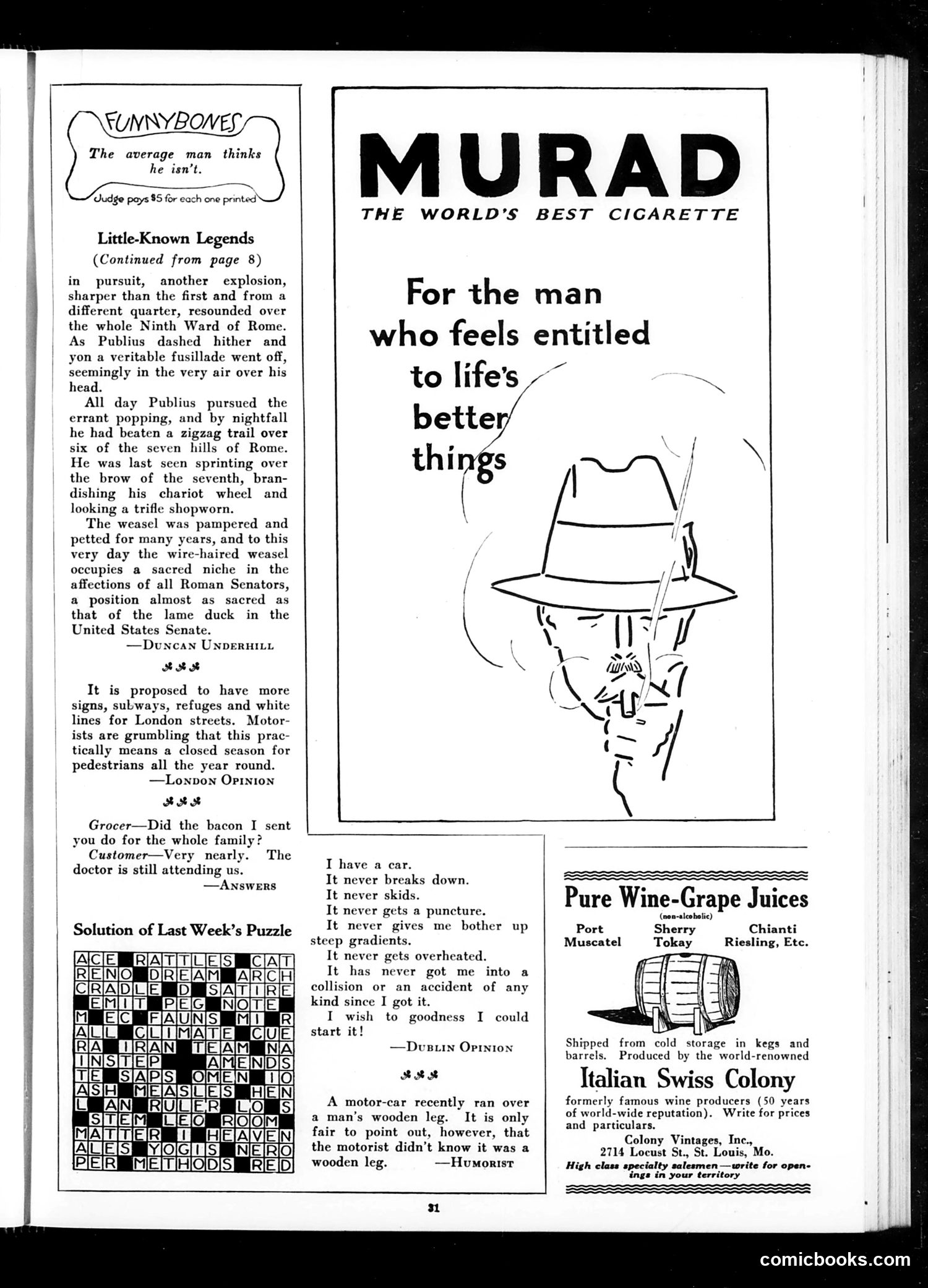
This page mixes humor columns with advertisements typical of 1920s-era Judge magazine. **Left side content:** "Little-Known Legends" is a humorous fictional piece about a Roman named Publius chasing mysterious explosions across Rome's hills. The satirical point appears to be absurdist comedy—the elaborate setup leads nowhere meaningful. The page also includes brief joke items (grocer/bacon, motorist/wooden leg) playing on dark or ironic humor common to the era. **Right side:** A Murad cigarette advertisement targeting affluent men who feel "entitled to life's better things," paired with ads for wine juices and Italian Swiss Colony wines. **Context for modern readers:** This reflects pre-Depression consumer culture marketing luxury goods to aspirational men. The cigarette ad's appeal to entitlement is notably direct by modern standards. The wine ads reference Prohibition-era "grape juice" sales, which were often fronts for home winemaking. The page is primarily entertainment and advertising rather than political satire.
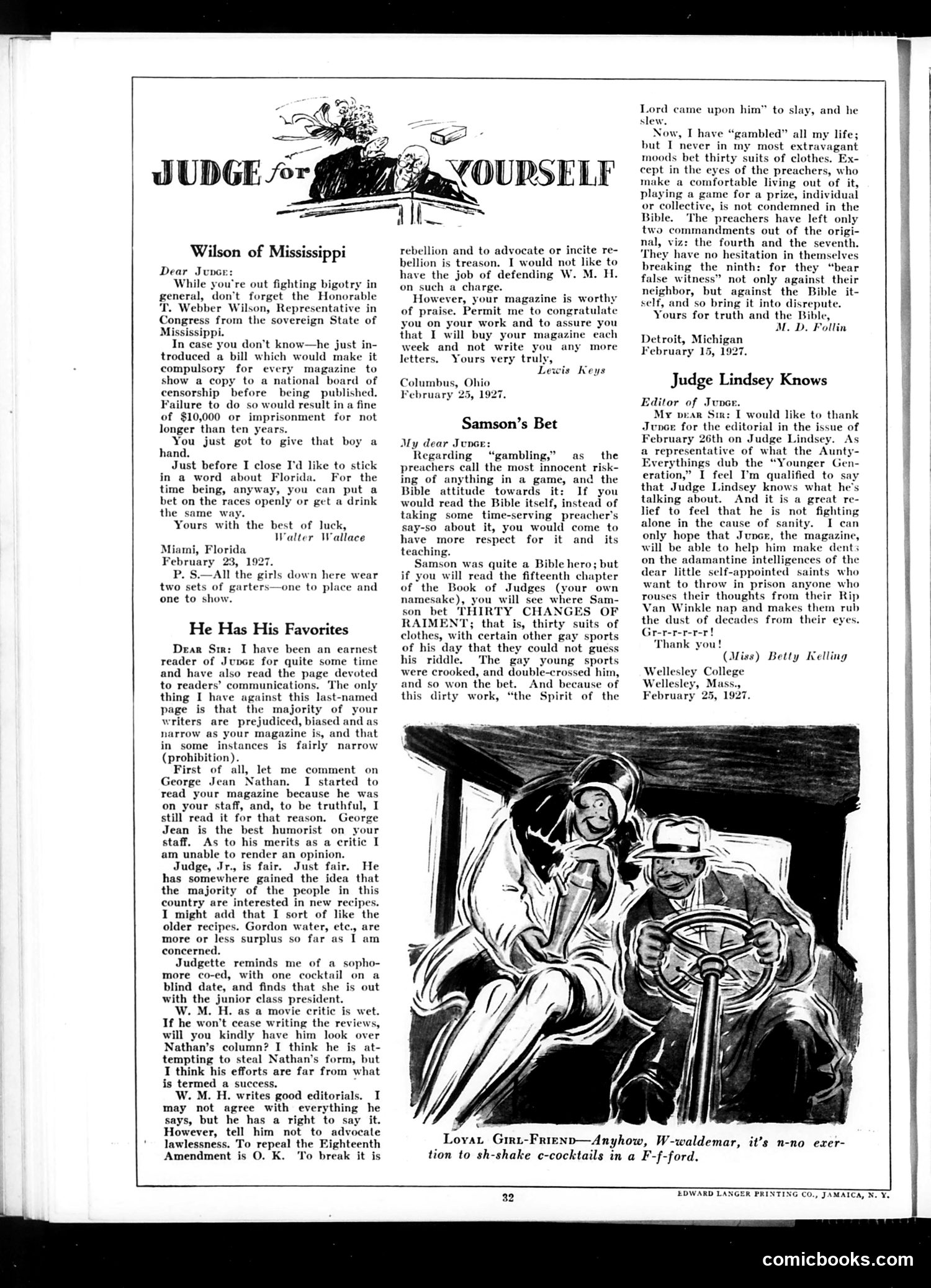
This page contains readers' letters to Judge magazine's "Judge for Yourself" section, commenting on the magazine's content and staff. **Key references:** - **T. Webber Wilson (Mississippi congressman)**: A real figure who proposed a censorship bill requiring magazines to submit to government review before publication, with harsh penalties ($10,000 fines or imprisonment). The letter sarcastically praises him—Judge opposes this censorship. - **Staff criticism**: Readers evaluate Judge's regular columnists: George Jean Nathan (drama critic, praised as "best humorist"), W.M.H. (movie critic, called "wet"/ineffective), and others. The magazine apparently published reader commentary on its own editorial quality. - **Prohibition debate**: References to alcohol availability in Florida and criticism of those advocating for the Eighteenth Amendment's repeal—relevant since Prohibition was active (1920-1933). - **"Samson's Bet"**: A letter defending gambling by biblical example, arguing preachers misrepresent scripture. The page shows Judge as an outlet for public debate on censorship, prohibition, and editorial standards during the 1920s.
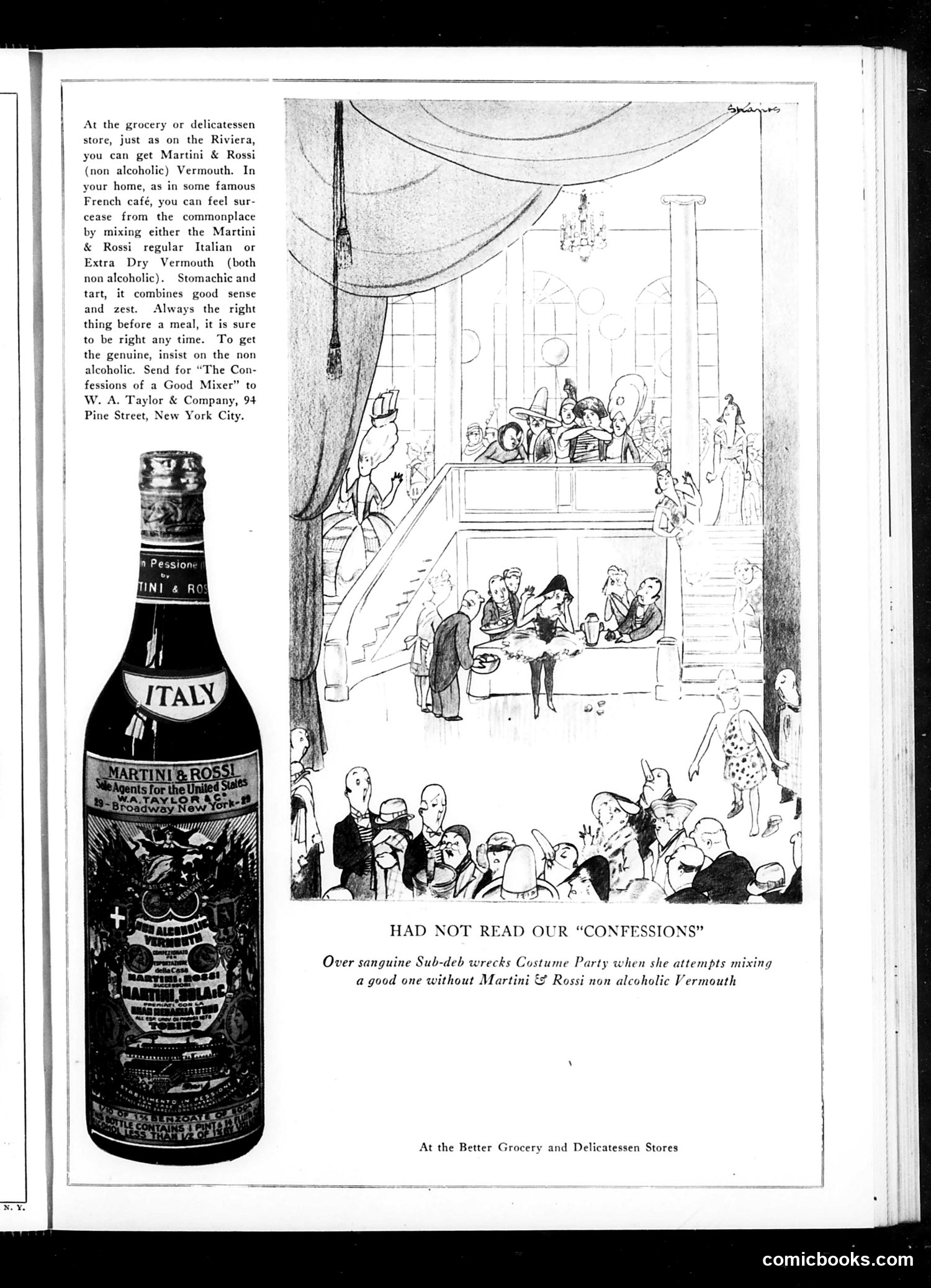
This is primarily a **Martini & Rossi advertisement** masquerading as editorial content in Judge magazine. The cartoon depicts a chaotic costume party at an upscale venue where a young "sub-deb" (debutante—an unmarried upper-class woman making her social debut) has attempted to mix drinks without proper guidance. The scene shows the party in disarray: people fighting, spilling drinks, general mayhem—implying her homemade cocktail was a disaster. The satire is subtle: the ad suggests that even sophisticated young women from wealthy families cannot successfully mix drinks without commercial vermouth. The "Confessions of a Good Mixer" booklet is positioned as instructional material she should have consulted. The joke relies on Prohibition-era context: non-alcoholic vermouth was marketed as a legitimate product during the 1920s alcohol ban, though the ad's emphasis on it being "non alcoholic" appears designed to skirt legal restrictions while implying users could mix it with alcohol at home.
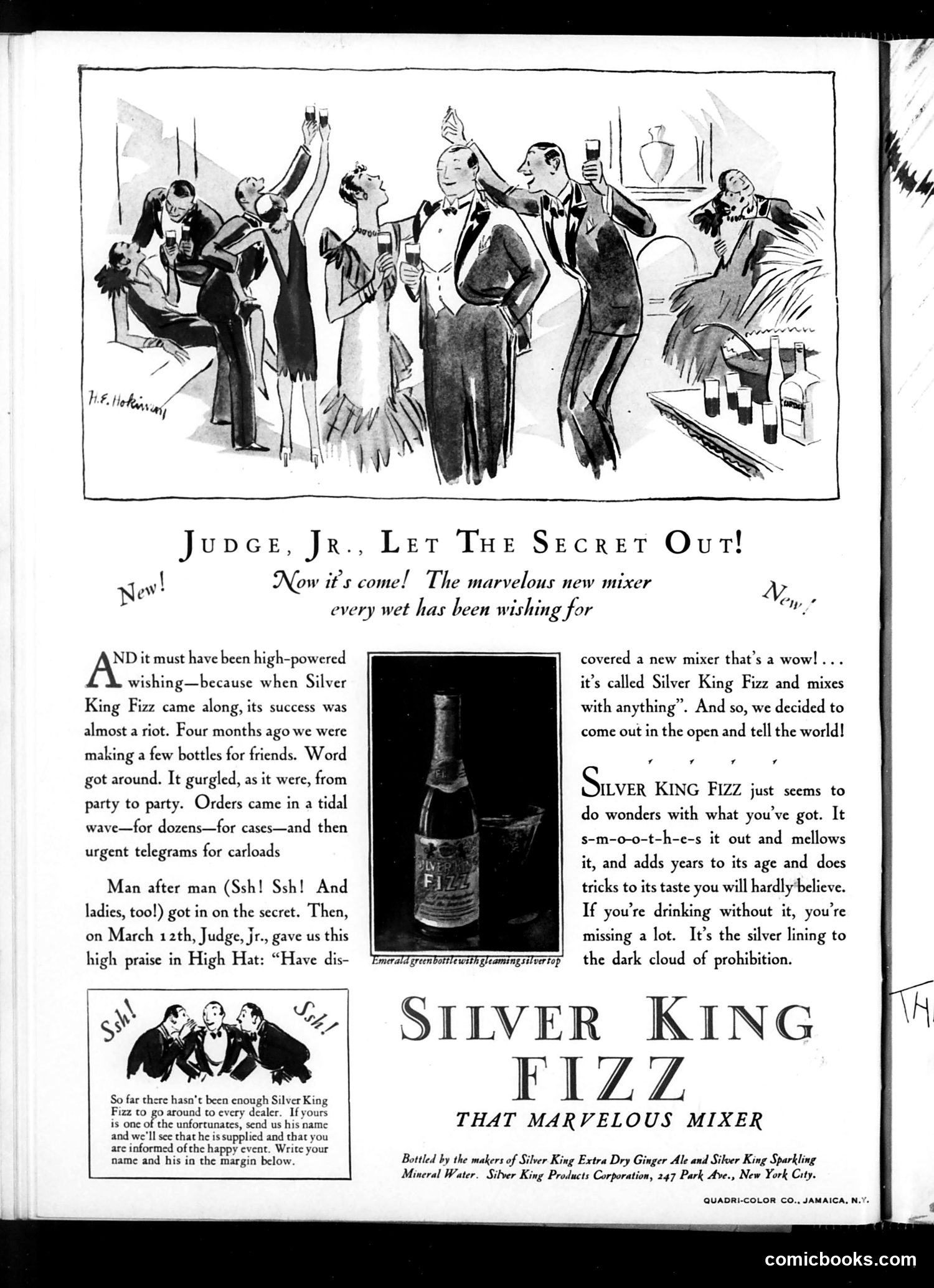
This is primarily a **liquor advertisement disguised as editorial content**, not political satire. It appeared during Prohibition (1920-1933), when alcohol sales were illegal in the U.S. The ad uses Judge magazine's credibility to market "Silver King Fizz," a mixer presented as a secret product that's become wildly popular through word-of-mouth. The cartoon shows a fancy cocktail party where guests celebrate the mixer's arrival. The satire is **anti-Prohibition**: the text explicitly calls the mixer "the silver lining to the dark cloud of prohibition," openly mocking the law by promoting a product designed to enhance alcoholic drinks. By framing it as a "marvelous mixer," the ad acknowledges Prohibition's existence while encouraging readers to circumvent it. The phrase "Judge, Jr., let the secret out!" suggests the magazine itself is breaking the silence on illegal alcohol production—a bold editorial stance against federal law during this period.