
Judge, 1927-04-23 · page 29 of 36
Judge — April 23, 1927 — page 29: what you’re looking at
What you’re looking at
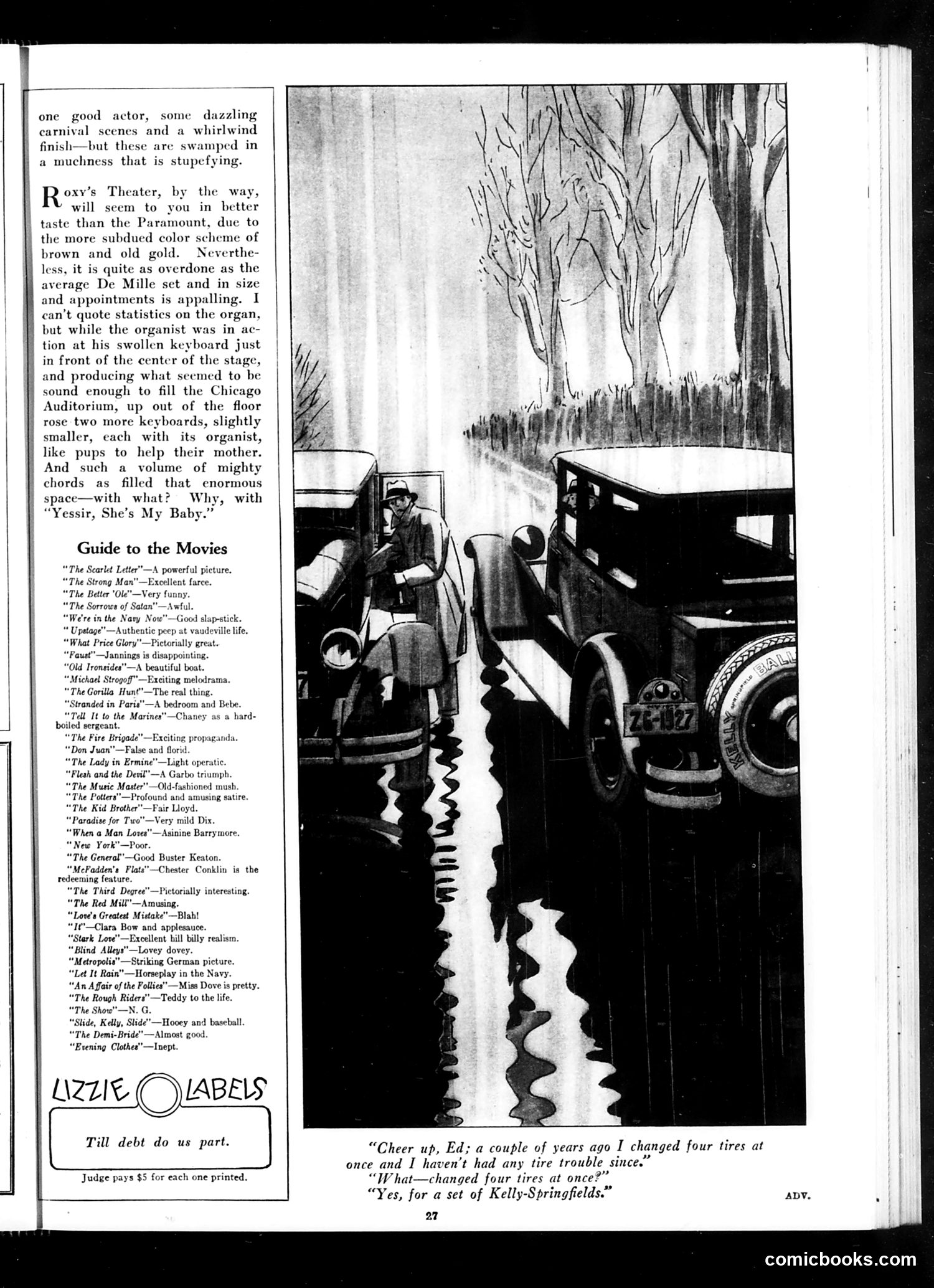
This page mixes movie criticism with advertising. The main editorial content discusses theater architecture and a film organ setup at Roxy Theater, contrasting it with the Paramount's design. The writer critiques how an organist's "swollen keyboard" produces mighty chords—but for the trivial song "Yessir, She's My Baby," exemplifying excess without substance. The "Guide to the Movies" lists brief reviews of 1920s silent films, naming stars like Lillian Gish, Greta Garbo, and Buster Keaton, with terse judgments ("powerful," "amusing," "inept"). The cartoon below depicts a tire-change conversation, serving as a Kelly-Springfield advertisement. One man boasts he changed four tires years ago without trouble since, promoting the tire brand's durability—a straightforward product endorsement rather than political satire.
📄 Transcribed text from this page (OCR, searchable)
Machine-transcribed from the original scan — historical spelling and the odd misread are preserved.
one good actor, some dazzling carnival scenes and a whirlwind finish—but these are swamped in a muchness that is stupefying. Ros Theater, by the way, will seem to you in better taste than the Paramount, due to the more subdued color scheme of brown and old gold. Neverthe- less, it is quite as overdone as the average De Mille set and in size and appointments is appalling. I can’t quote statistics on the organ, but while the organist was in ac- tion at his swollen keyboard just in front of the center of the stage, and producing what seemed to be sound enough to fill the Chicago Auditorium, up out of the floor rose two more keyboards, slightly smaller, each with its organist, like pups to help their mother. And such a volume of mighty chords as filled that enormous space—with what? Why, with “Yessir, She’s My Baby.” Guide to the Movies "—A powerful picture. ery funny. “The Sorrows of Satan” “Were in the Naty Now Jpetage"—Authentic peep at “What Price Glory""—Pictorially gre “Faust” —Jannings is disappointing. beautiful boat. “Michael Strogoff"—Exciting melodrama. The Gorilla Hunt"—The real thing. “Stranded in Paris"—A bedroom and Bebe. It to the Marines"—Chaney as a hard- boiled sergeant. jgade" —Exciting False and florid. “The Lady in Ermini “Fleah and the Devil"—A Garbo triumph “The Music Master”—Old-fashioned mush, “The Potters"—Profound and amusing satire. “The Kid Brother"—Fair Lloyd. “Paradise for Two" —Very mild Dix. “When a Man Loves"—Asinine Barrymore. “New York"—Poor. “The General"—Good Buster Keaton. “McPadden's Flats"—Chester Conklin is the redeeming feature. “The Third Degree—Pictorially interesting. “The Red Mill"—Amusing. “Love's Greatest Mistake"—Blab! “I¢’—Clara Bow and applesauce. “Stark Love"—Excellent hill billy realism. “Blind Alleys”—Lovey dovey “Medtropoli. ‘Striking German picture. “Let It Rain"—Horseplay in the Navy. “An Affair of the Follies" —Miss Dove is pretty. “The Rough Riders" —Teddy to the life. “The Show" —N. G. “Slide, Kelly, Slide’—Hovey and baseball. “The Demi-Bride"—Almost good. “Evening Clothes"—Inept. UZLIE @ IABELS Till debt do us part. op '—Light operatic. Judge pays $5 for each one printed. “Cheer up, Ed; a couple of years ago I changed four tires at once and I haven’t had any tire trouble since.’ “What—changed four tires at once?” “Yes, for a set of Kelly-Springfields.” 27 ADV. comicbooks.com