
Judge, 1927-04-23 · page 15 of 36
Judge — April 23, 1927 — page 15: what you’re looking at
What you’re looking at
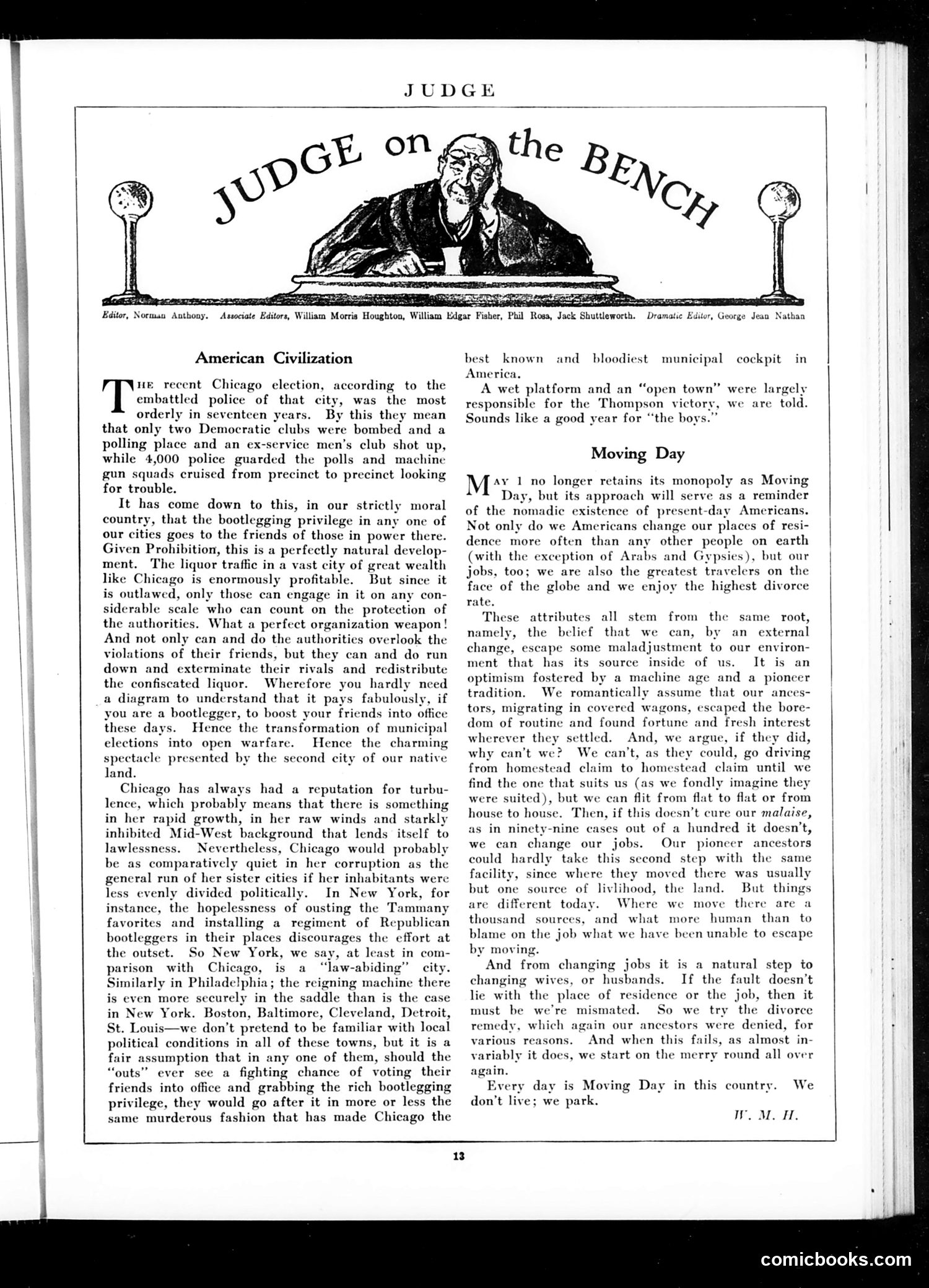
This page contains two editorial pieces, no illustrated cartoon. The header shows a judge figure at a bench—the magazine's mascot framing satirical commentary. **"American Civilization"** critiques Chicago's 1920s bootlegging violence during Prohibition. The satire notes that Chicago police claimed the recent election was "orderly"—yet Democratic clubs were bombed and polling places shot up, with 4,000 police and machine-gun squads deployed. The writer argues Prohibition created a corrupt system where bootlegging profits go to politically-connected criminals, turning municipal elections into organized warfare over lucrative illegal liquor franchises. Other cities (New York, Philadelphia, Boston) avoid such spectacle only because one political machine already monopolizes bootlegging, eliminating competition. Chicago's violence stems from multiple factions fighting for control. **"Moving Day"** shifts tone, satirizing American restlessness—frequent job changes, relocations, and high divorce rates. The writer attributes this to frontier optimism and machine-age thinking: belief that external changes solve internal problems. Both pieces critique American society under Prohibition-era conditions and modern industrial culture.
📄 Transcribed text from this page (OCR, searchable)
Machine-transcribed from the original scan — historical spelling and the odd misread are preserved.
Editor, Norman Anthony. American Civilization i le recent Chicago election, according to the embattled police of that city, was the most orderly in seventeen years. By this they mean that only two Democratic clubs were bombed and a polling place and an ex-service men’s club shot up, while 4,000 police guarded the polls and machine gun squads cruised from precinct to precinct looking for trouble. It has come down to this, in our strictly moral country, that the bootlegging privilege in any one of our cities goes to the friends of those in power there. Given Prohibition, this is a perfectly natural develop- ment. The liquor traffic in a vast city of great wealth like Chicago is enormously profitable. But since it is outlawed, only those can engage in it on any con- siderable scale who can count on the protection of the authorities. What a perfect organization weapon! And not only can and do the authorities overlook the violations of their friends, but they can and do run down and exterminate their rivals and_ redistribute the confiscated liquor. Wherefore you hardly need a diagram to understand that it pays fabulously, if you ate a bootlegger, to boost your friends into office these days. Hence the transformation of municipal elections into open warfare. Hence the charming spectacle presented by the second city of our native Jand. Chicago has always had a reputation for turbu- lence, which probably means that there is something in her rapid growth, in her s and starkly inhibited Mid-West background that lends itself to lawlessness. rtheless, Chicago would probably be as comparatively quiet in her corruption as the general run of her sister cities if her inhabitants were 1 evenly divided politically. In New York, for favorites and installing a regiment of Republican bootleggers in their places discourages the effort at the outset. So New York, we say, at least in com- parison with Chicago, is iw-abiding” city. Similarly in Philadelphia; the reigning machine there is even more securely in the saddle than is the case in New York. Boston, Baltimore, Cleveland, Detroit, St. Louis—we don’t pretend to be familiar with local conditions in all of these towns, but it is a ever see a fighting chance of voting their friends into office and grabbing the rich bootlegging privilege, they would go after it in more or less the same murderous fashion that has made Chicago the 13 Associate Editors, William Morris Houghton, William Kdgar Fisher, Phil Ross, Jack Shuttleworth. Dramatic Editor, George Jean Nathan best known and bloodiest America. A wet platform and an “open town” were largely responsible for the Thompson victory, we are told. Sounds like a good year for “the boys.” municipal cockpit in Moving Day M* 1 no longer retains its monopoly as Moving Day, but its approach will serve as a reminder of the nomadic existence of present-day Americans. Not only do we Americans change our places of resi- dence more often than any other people on earth (with the exception of Arabs and Gypsies), but our jobs, too; we are also the greatest travelers on the face of the globe and we enjoy the highest divorce rate. These namely attributes all stem from the same root, the belief that we can, by an external escape some maladjustment to our environ- ment that has its source inside of us. It is an optimism fostered by a machine age and a pioncer tradition. We romantically assume that our ances- tors, migrating in covered wagons, escaped the bore- dom of routine and found fortune and fresh interest wherever they settled. And, we argue, if they did, why can’t we? We can’t, as they could, go driving from homestead claim to homestead claim until we find the one that suits us (as we fondly imagine they were suited), but we can flit from flat to flat or from house to house. Then, if this doesn’t cure our malaise, as in ninety-nine cases out of a hundred it doesn’t, we can change our jobs. Our pioneer anc could hardly take this second step with the facility, since where they moved there was usually but one source of livlihood, the land. But things are different today. Where we move there are a thousand sources, and what more human than to blame on the job what we have been unable to es by moving. ape And from changing jobs it is a natural step to changing wives, or husbands. If the fault doesn’t lie with the place of residence or the job, then it must be we're mismated. So we try the divorce remedy, which again our ancestors were denied, for various reasons. And when this fails, as almost in- variably it does, we start on the merry round all over again. Every day is Moving Day in this country. We don’t live; we park. W. M. H. comicbooks.com