
A complete issue · 36 pages · 1927
Judge — April 16, 1927
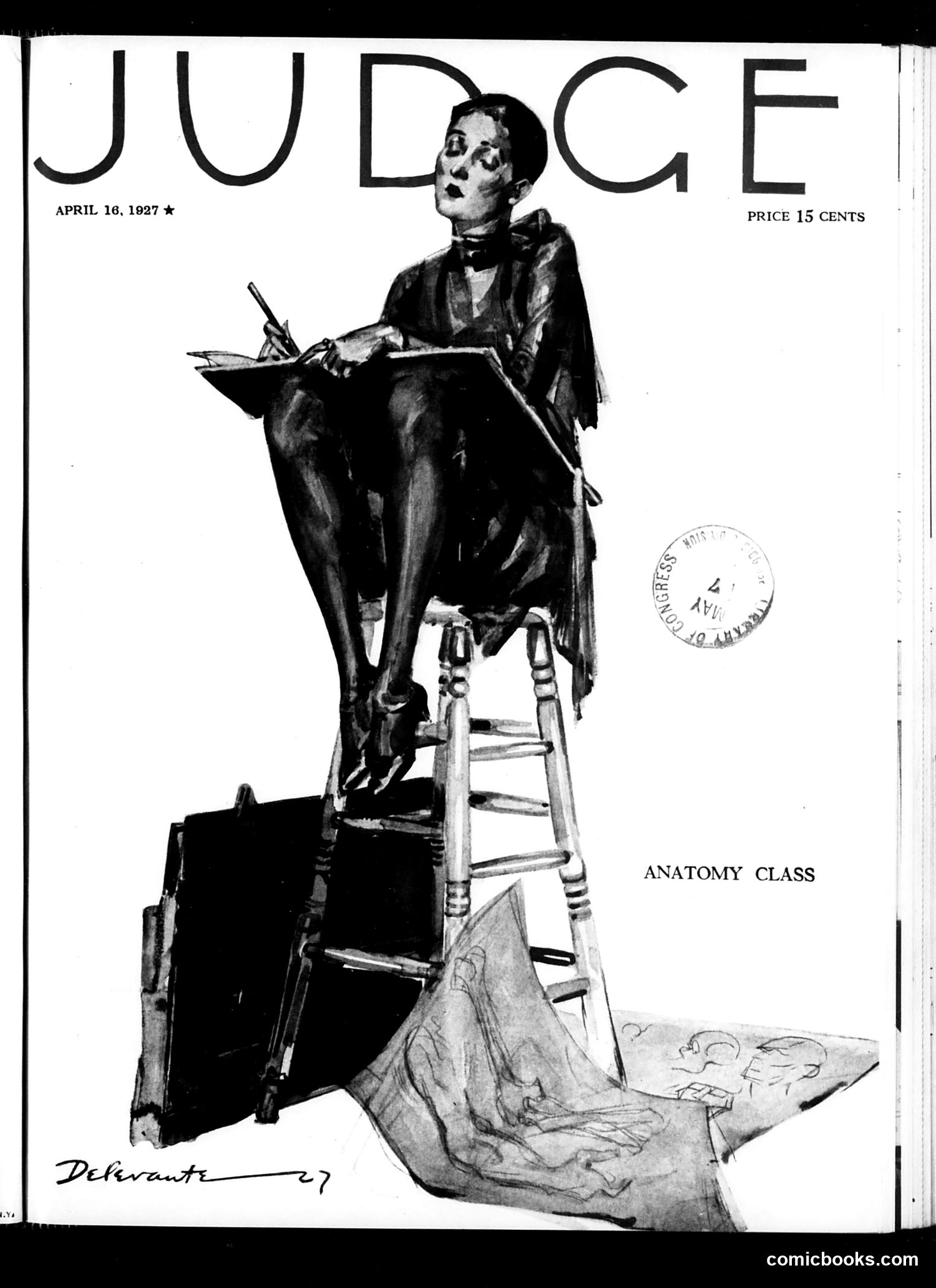
This satirical cover depicts an artist or anatomy student perched on a stool, sketching from a live model. The figure is studying anatomical proportions—a standard practice in art instruction. The title "Anatomy Class" appears to be tongue-in-cheek commentary on 1920s artistic practice. The illustration, signed by Delevante, uses the somewhat exaggerated proportions typical of 1920s magazine humor. Without additional context from the magazine's interior, the precise satirical target remains unclear—it may reference contemporary debates about artistic freedom, academic versus modern art methods, or social attitudes toward figure drawing. The cover's humor likely resonated with Judge's educated, urban readership familiar with art world controversies of the Jazz Age era.
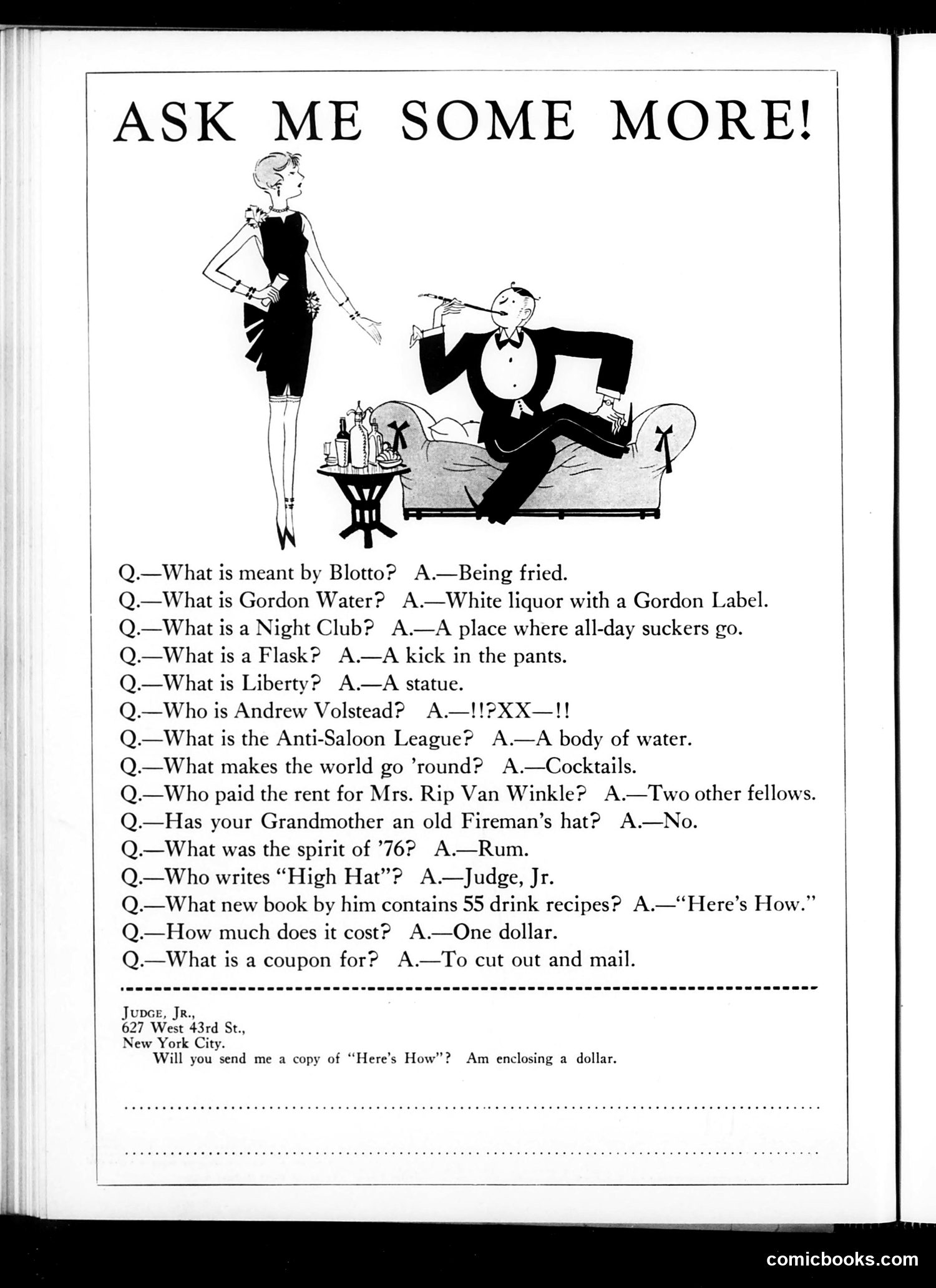
This is primarily an advertisement disguised as humorous Q&A content, promoting Judge Jr.'s book "Here's How" (a cocktail recipe collection). The illustration shows a flapper-era couple in 1920s attire, reflecting Prohibition-era drinking culture. The jokes mock contemporary social institutions and figures through alcohol references: - "Gordon Water" and cocktails as life's focus - Night clubs as places for "suckers" - A "flask" as a kick in the pants - "Andrew Volstead" (the congressman who authored Prohibition) gets a crude response The humor relies on readers' familiarity with 1920s speakeasy culture and anti-Prohibition sentiment. The coupon at bottom solicits one dollar for the drink recipe book—a direct sales mechanism using entertainment as bait. The satire targets both Prohibition itself and the social pretensions of Jazz Age nightlife.
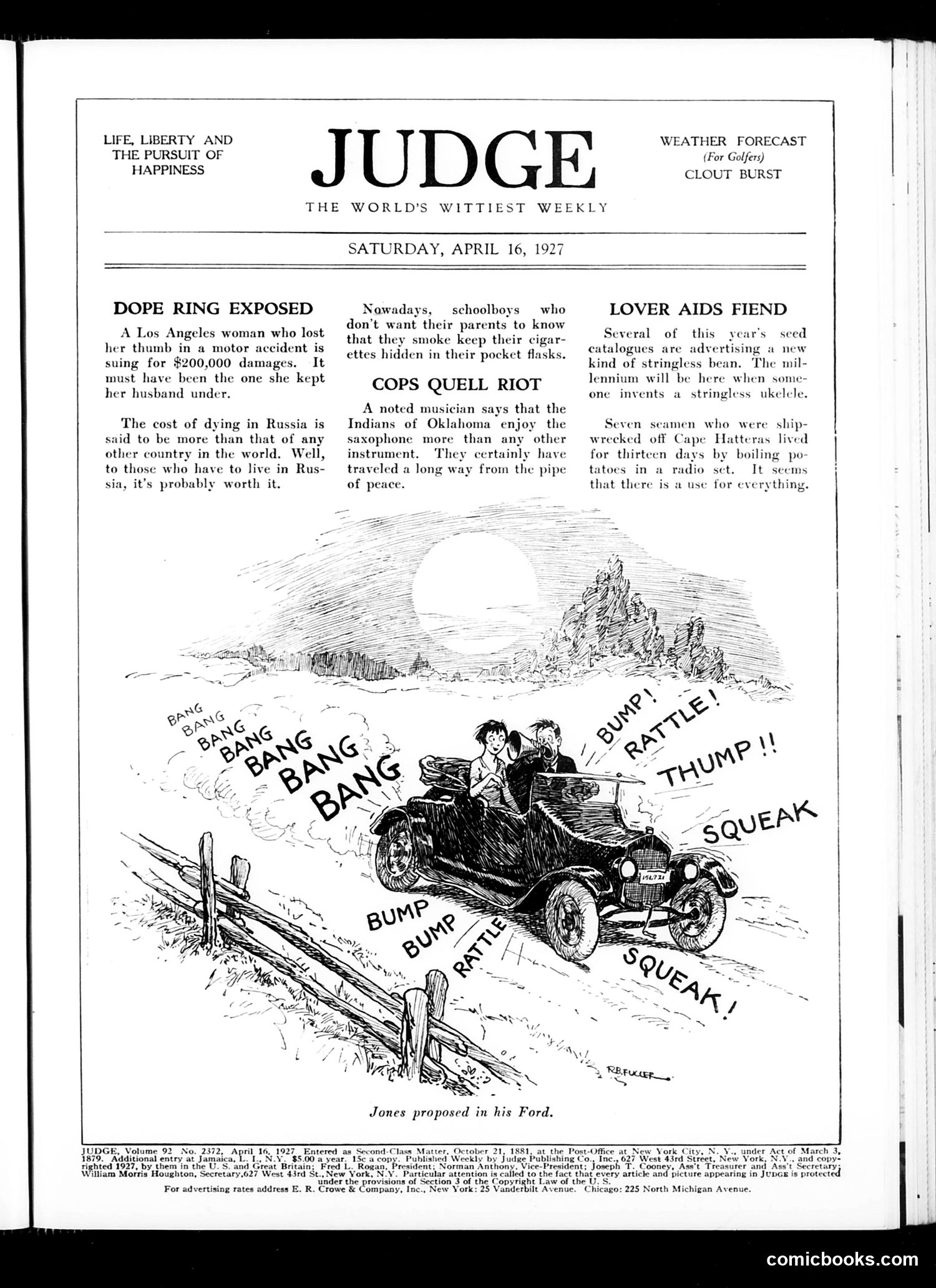
The main cartoon satirizes courtship in the automobile age. A couple in a rattletrap Ford bounces violently down a rural road, producing various sound effects ("BANG," "BUMP," "RATTLE," "SQUEAK," "THUMP"). The caption indicates "Jones proposed in his Ford"—suggesting the jarring, uncomfortable ride itself prompted a marriage proposal, either as escape from the chaos or as romantic desperation. This reflects 1920s anxiety about how mass-produced cars were transforming social rituals. The Ford Model T, affordable for ordinary Americans, enabled dating away from parental supervision, yet Judge presents this "modern" courtship as chaotic and undignified compared to traditional courtship. The worn-out vehicle symbolizes both democratic access to mobility and social degradation.
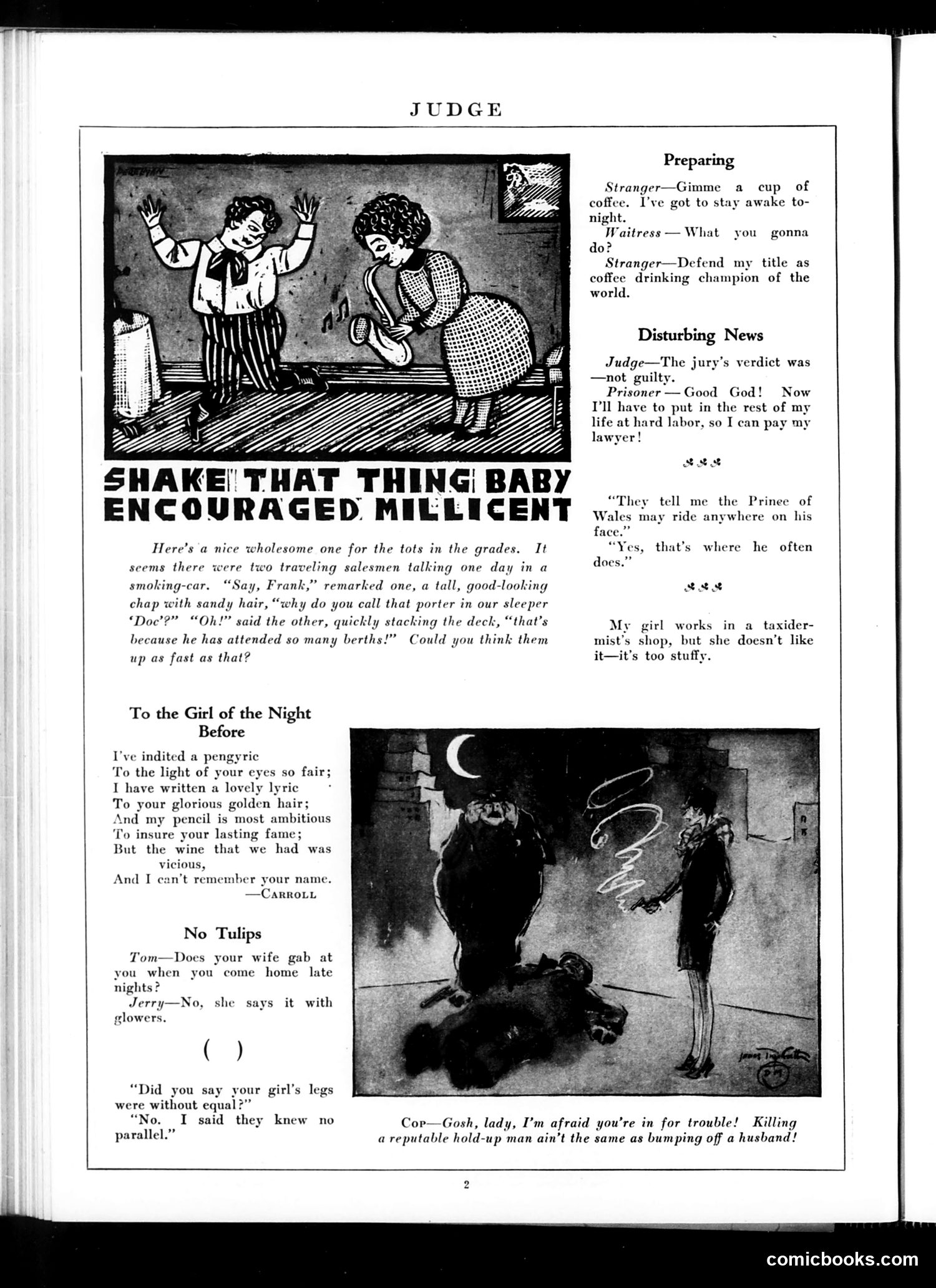
This page contains several unrelated humor pieces typical of Judge magazine's format: **Top cartoon** ("Shake That Thing Baby Encouraged Millicent"): Shows two traveling salesmen discussing a porter's frequent berths. The joke plays on "shake that thing"—likely a reference to 1920s jazz dance slang—applied absurdly to a porter's sleeping accommodations. **Poetry and short jokes** fill the remaining space, including "To the Girl of the Night Before" (a humorous poem about a forgettable romantic encounter) and brief one-liners about domestic situations. **Bottom illustration**: Shows what appears to be a woman confronting a shadowy figure at night, captioned with a joke about a "reputable hold-up man" objecting to being compared to a husband. The page reflects Judge's typical satirical style: brief, disconnected jokes mixing wordplay, innuendo, and observations about contemporary social life, rather than focused political commentary.
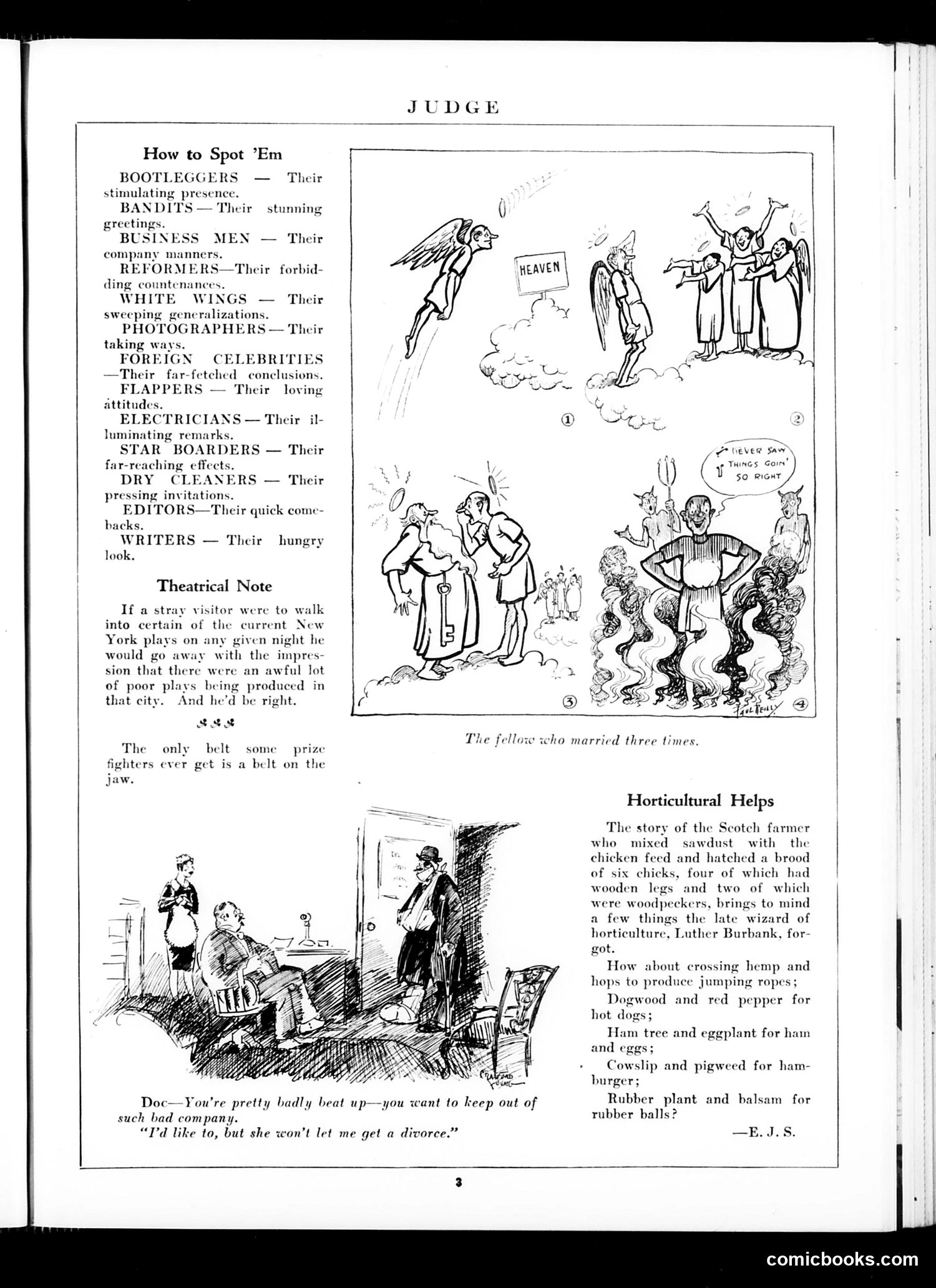
This page contains satirical humor targeting various professions and social types. The "How to Spot 'Em" section mockingly catalogs recognizable traits of bootleggers, bandits, businessmen, reformers, and others—typical Judge magazine social commentary. The four-panel cartoon titled "The fellow who married three times" appears to show a man progressing through marital situations, likely satirizing serial marriage or divorce (common Judge topics during the era). The lower cartoon depicts a domestic dispute where a beaten man tells his wife he'd like a divorce but she won't permit it—humor based on the then-controversial topic of divorce difficulty and female legal authority in marriage. The "Horticultural Helps" section offers absurdist farming advice, typical of Judge's nonsensical humor.
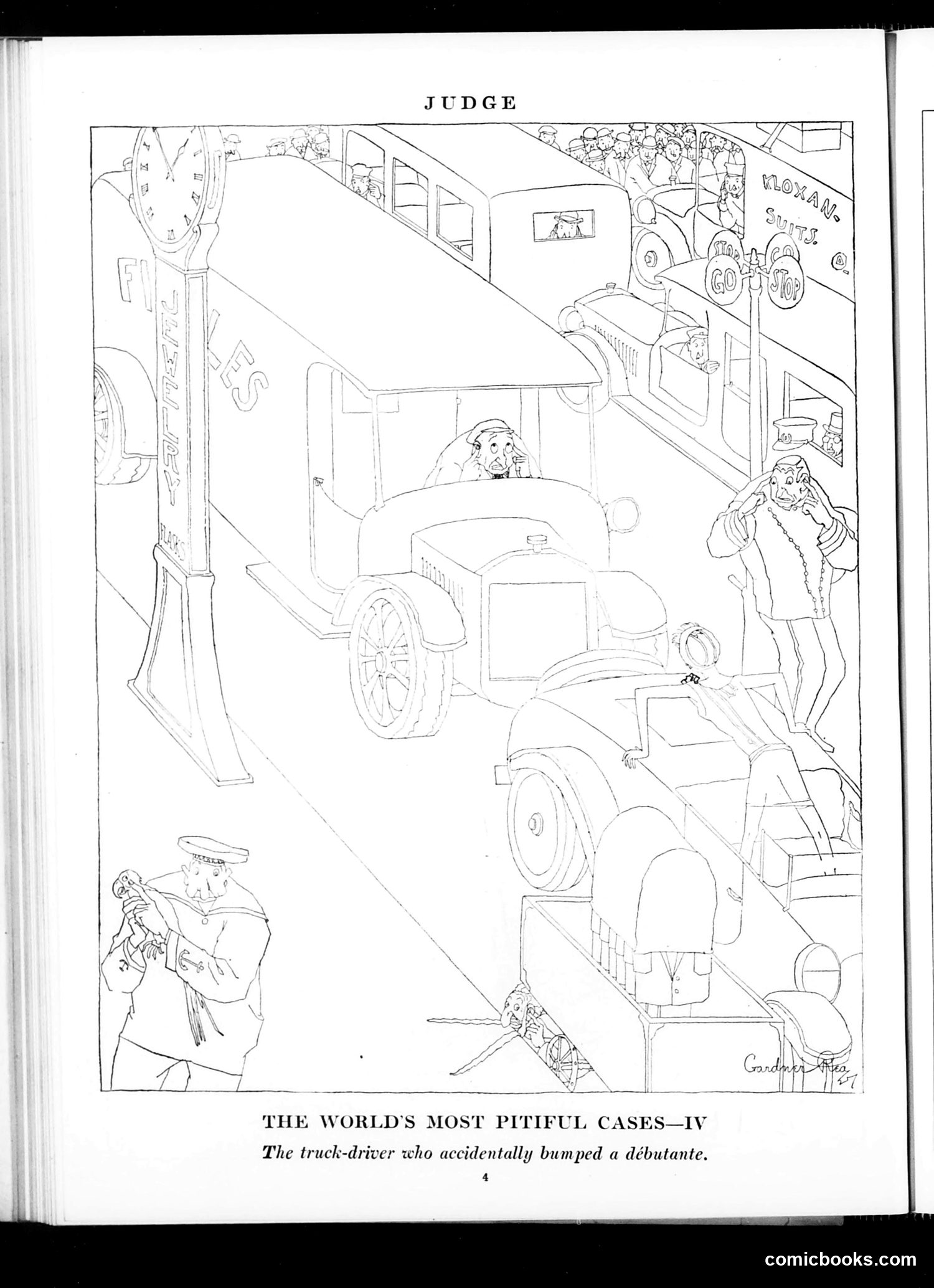
This Judge cartoon depicts a garage or repair shop scene, captioned "The track-driver who accidentally bumped a débutante." The humor plays on class contrast: a working-class truck driver has had a minor collision with a young woman from high society (a "débutante"—a wealthy young woman presented to society). The cartoon satirizes the exaggerated legal and social consequences such a working-class person might face from even a minor incident with someone of privileged status. The clock and formal setting emphasize the gravity with which this trivial matter is being treated. The title series suggests this represents one of society's most absurd predicaments, mocking both the defendant's precarious position and the disproportionate power differential between social classes in the early 20th-century justice system.
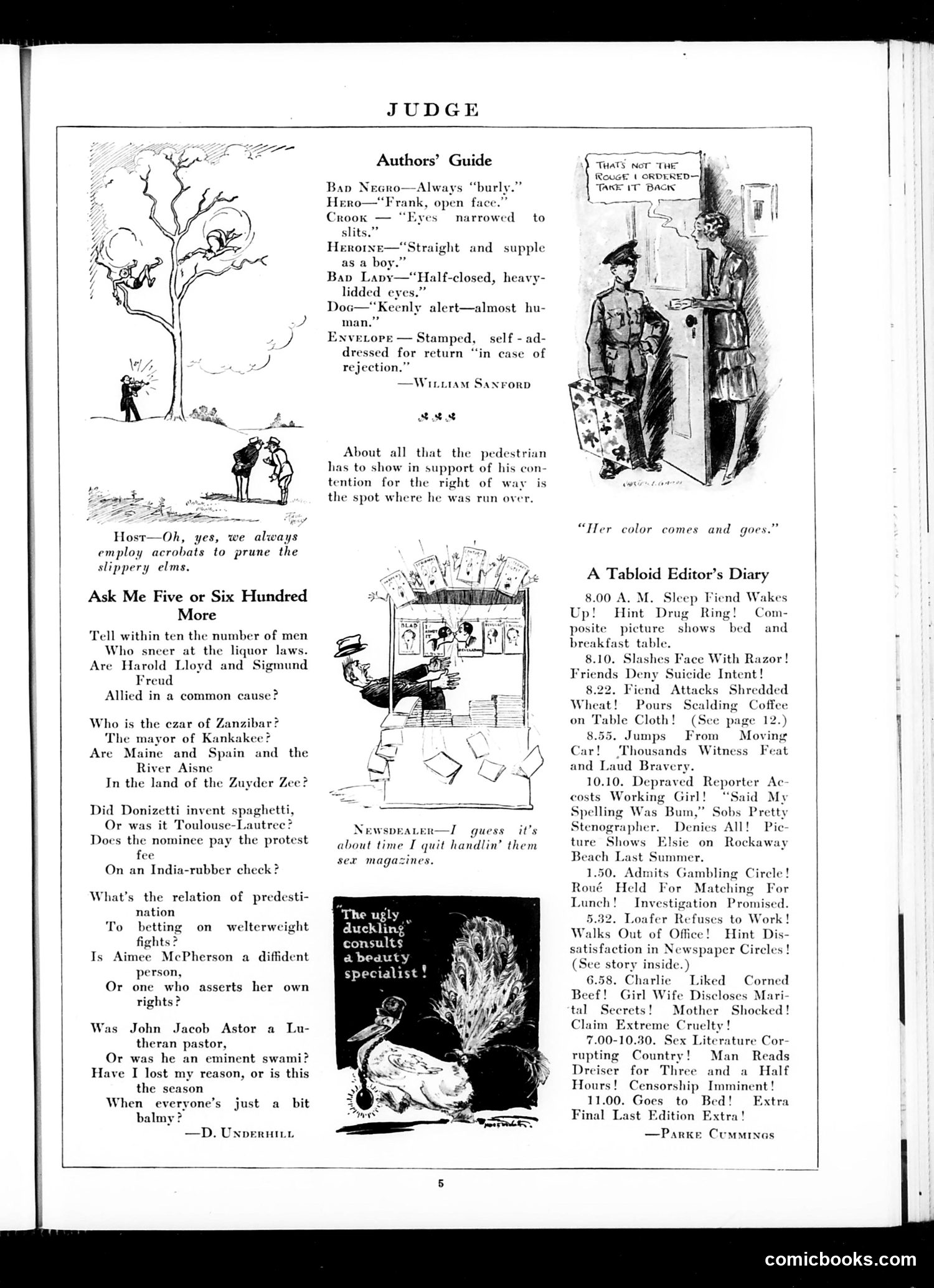
This page from Judge magazine contains several distinct satirical pieces: **"Authors' Guide"** provides humorous character type definitions in William Sanford's style—stock literary figures like the "Bad Negro" and "Bad Lady." **"Ask Me Five or Six Hundred More"** is a poem by D. Underhill listing absurd trivia questions, mocking pedantic knowledge and contemporary gossip (references to figures like Aimee McPherson and John Jacob Astor). **The right panel** shows a soldier at a door with text "Her color comes and goes"—likely satirizing wartime romance or emotional anxiety. **"A Tabloid Editor's Diary"** parodies sensationalist newspaper headlines of the era, mocking tabloid journalism's obsession with scandal, crime, and celebrity gossip through exaggerated, stacked headlines. The "ugly duckling" advertisement appears unrelated commercial content. Overall, the page satirizes literary conventions, journalistic excess, and popular culture of the period.
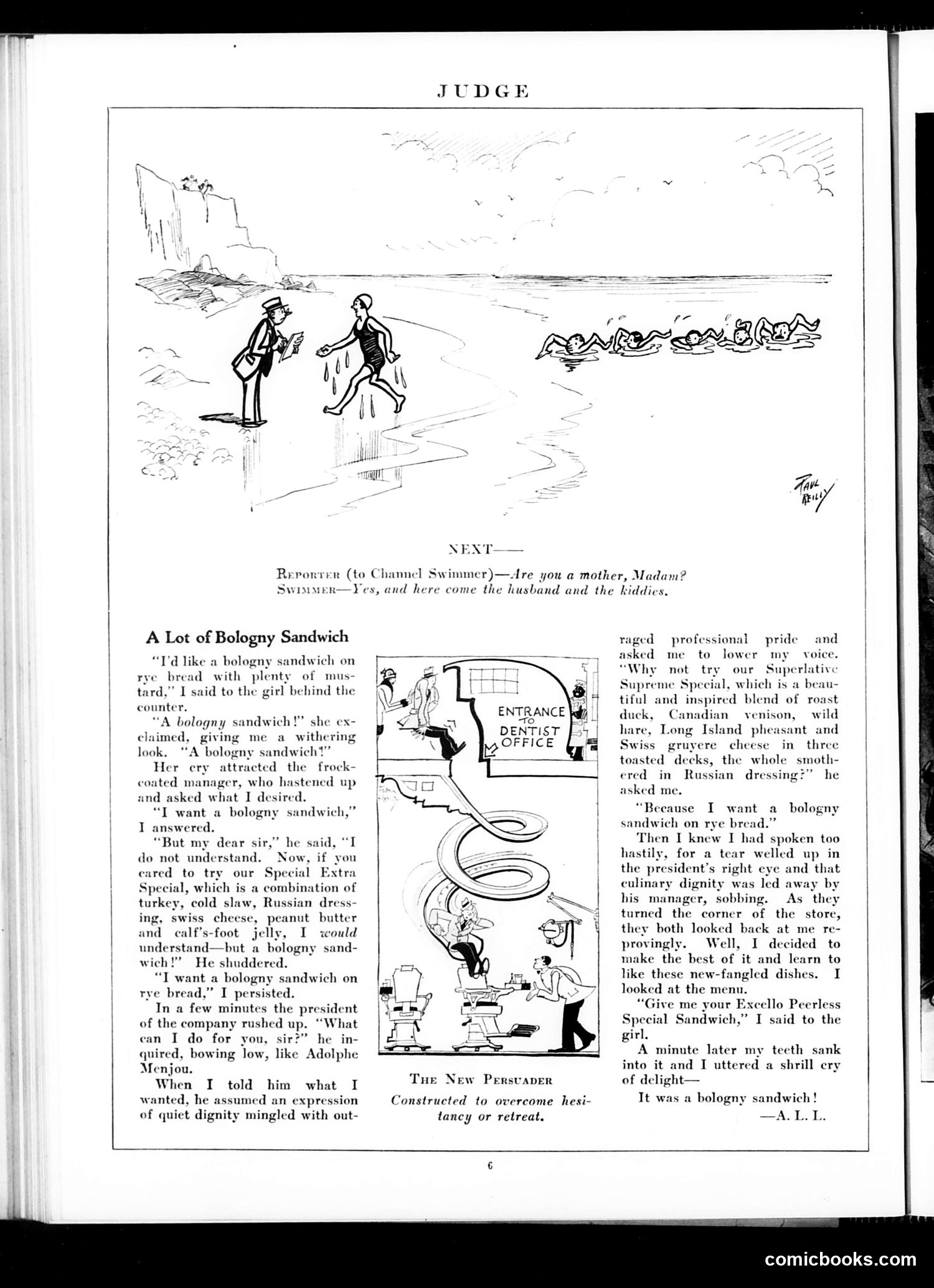
This satirical story mocks pretentious restaurant culture and snobbish service. A customer simply requests a basic bologna sandwich on rye, but encounters escalating absurdity: a dismissive waitress, then a manager, then the company president—each treating the simple request as an affront to their "culinary dignity." They desperately try upselling him elaborate "Special" sandwiches with fancy ingredients (roast duck, venison, pheasant, etc.). The joke's punchline: after all this theatrical resistance and the customer's capitulation to their "Excello Peerless Special Sandwich," it turns out to be—just a bologna sandwich. The satire targets restaurant pretension and the American trend of disguising ordinary items with fancy names to justify higher prices. It reflects early 20th-century consumer frustration with unnecessary complexity and false sophistication in dining.
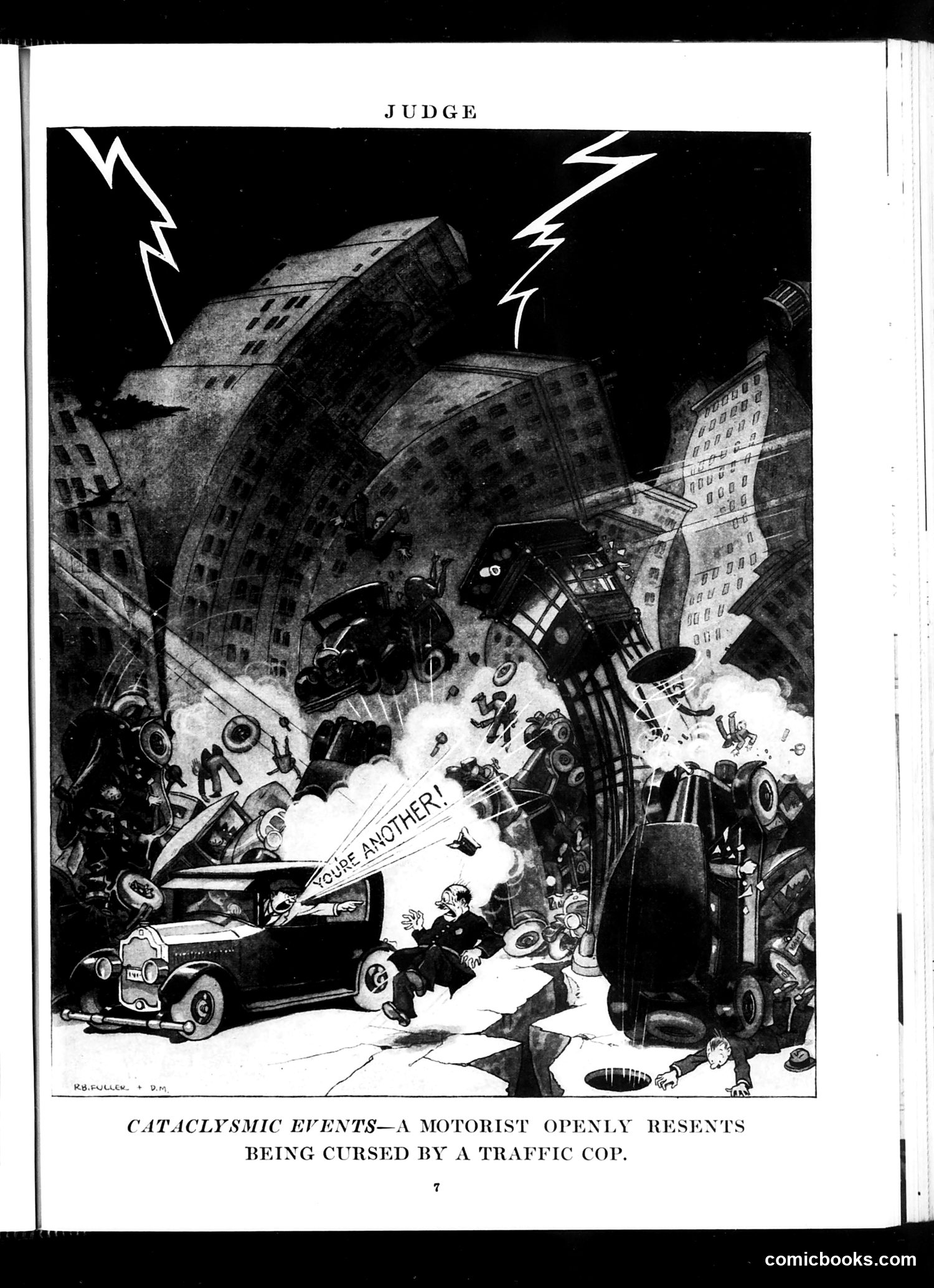
This satirical cartoon depicts a motorist being confronted by a traffic cop amid massive urban destruction—collapsing buildings and explosive chaos surround them. The motorist appears to be receiving a citation or verbal rebuke ("YOU'RE ANOTHER!") despite the catastrophic scene. The joke satirizes the absurdity of traffic enforcement priorities. Even as the city literally crumbles around them, the traffic cop focuses on ticketing the driver for a traffic violation. This reflects early 20th-century frustration with rigid bureaucratic enforcement that ignores context or proportionality. The lightning bolts emphasize the dramatic, almost divine scale of the disaster, making the cop's concern with traffic rules seem comically petty and misplaced. It's social commentary on how officials rigidly enforce minor regulations regardless of circumstances.
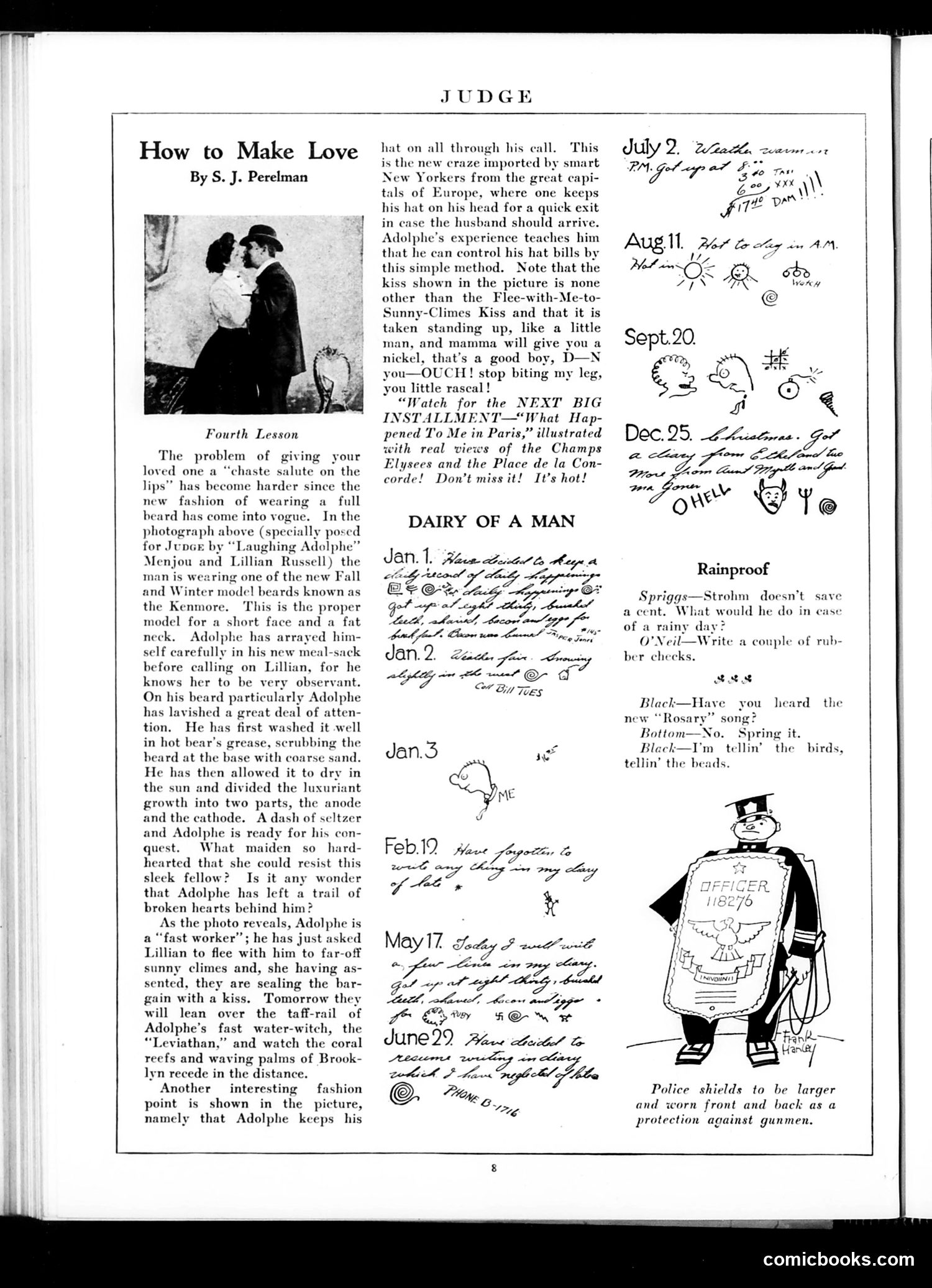
This page contains humorous content by S.J. Perelman satirizing courtship fashions and modern romance. **"How to Make Love" (left):** Perelman mocks the trendy full beards worn by fashionable men, featuring "Laughing Adolphe" (a character/persona) and the famous actress Lillian Russell. The satire targets the impracticality of the "Kenmore" beard style for kissing, describing absurd grooming rituals (washing with bear grease, dividing it into "anode and cathode"). The joke culminates in Adolphe's rapid seduction of Lillian—asking her to elope within his visit—suggesting bearded "fast workers" successfully deceive women. References to keeping hats on and controlling "hot bills" add innuendo. **"Diary of a Man" (center):** Sketchy diary entries with childish drawings, apparently mocking sentimental love journals. **"Rainproof" (right):** A brief joke about keeping dry in rain. **"Police shields" (bottom):** A practical note about larger protective gear against gunmen—reflecting contemporary urban crime concerns. The overall tone is lighthearted mockery of dating customs and masculine pretension.
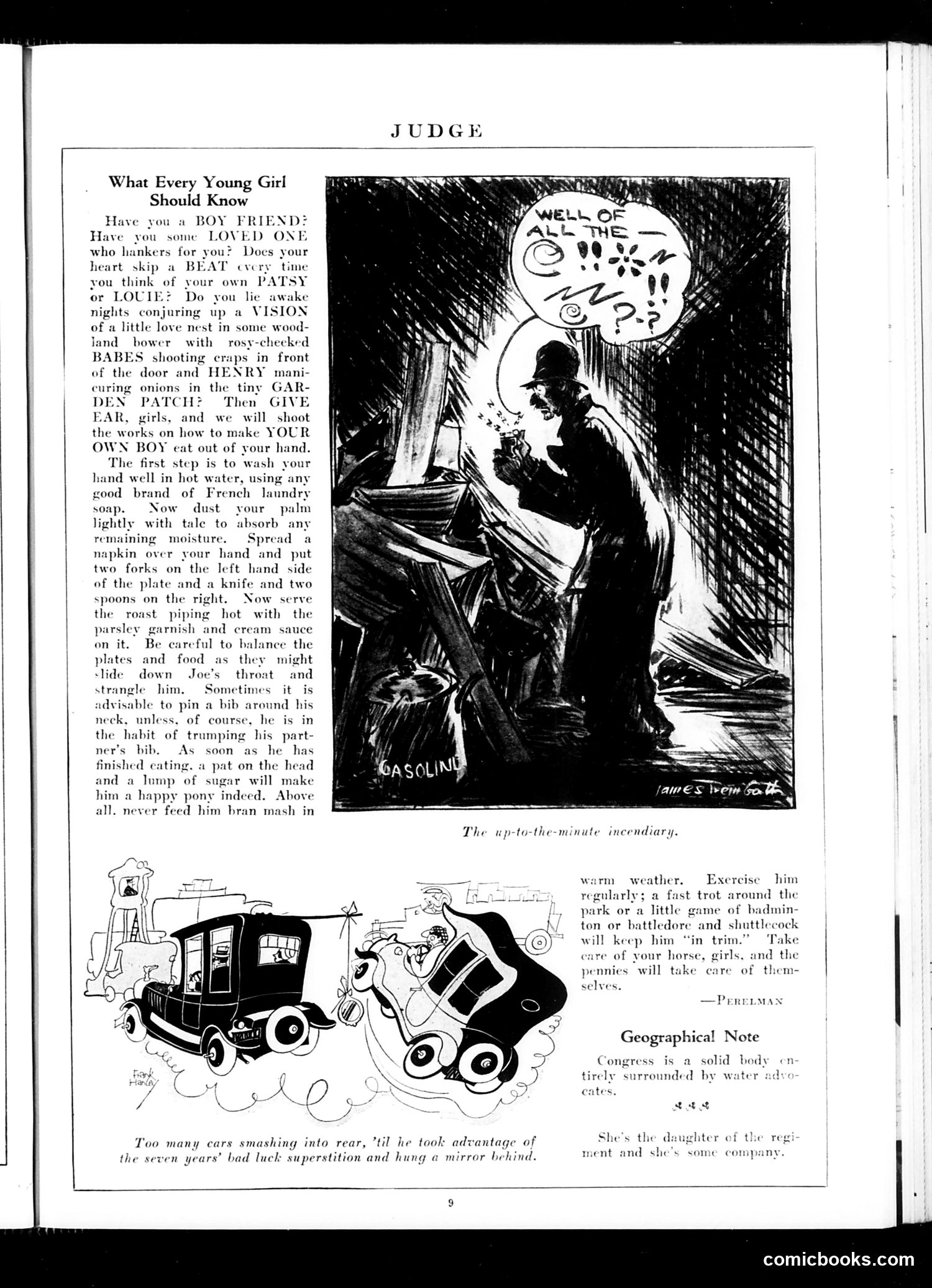
This Judge satire mocks advice columns aimed at young women, which were popular in early 20th-century magazines. The piece pretends to offer romantic guidance but deliberately treats a boyfriend like a domesticated animal—instructing girls to "wash your hand" before serving him dinner, then rewarding him with "a pat on the head and a lump of sugar" like a pony. The humor relies on reducing courtship and marriage to animal husbandry: exercise him regularly, keep him "in trim," and manage his behavior with treats. The accompanying cartoon illustration depicts a woman in domestic servitude, reinforcing the satirical point. The satire targets both the condescending tone of contemporary women's advice literature and the limited domestic roles prescribed for women. By literalizing the metaphor of women "training" husbands through food and attention, Judge exposes the absurdity of contemporary gender expectations—though the satire's actual critique of women's limited agency remains ambiguous.
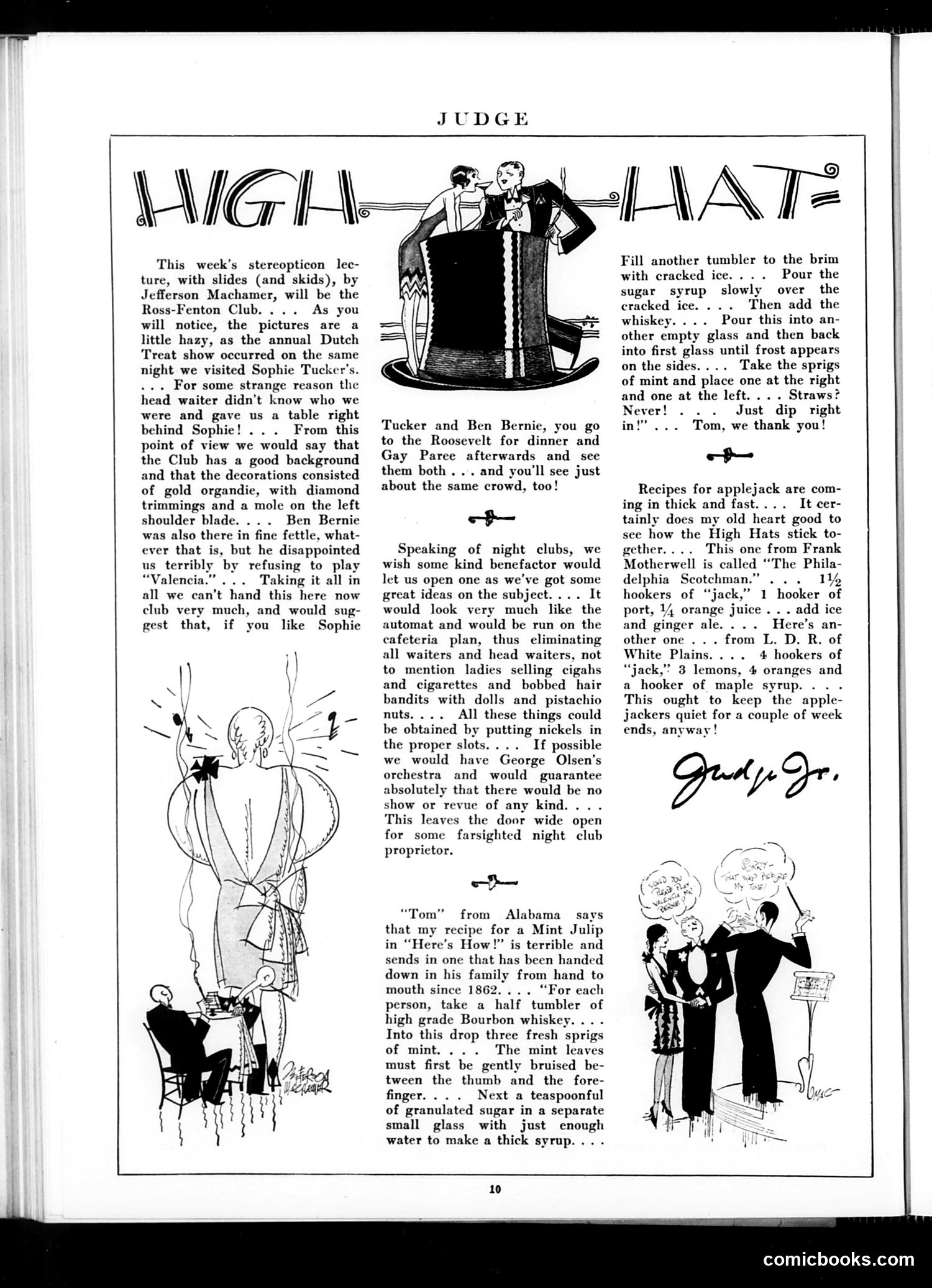
This page satirizes 1920s nightclub culture during Prohibition. The main commentary mocks the pretentiousness of elite social clubs like the Ross-Fenton Club, mentioning real performers **Sophie Tucker** and **Ben Bernie** as draws for the wealthy. The author jokes about attending one of these venues and being seated poorly despite the club's supposed sophistication. The piece proposes an absurdist alternative: an automat-style nightclub eliminating waiters and staff entirely, run by orchestra leader **George Olsen**—suggesting the real appeal of these venues is superficial. The page also features **Prohibition-era cocktail recipes** ("High Hats"), including an elaborate Mint Julep formula supposedly from 1862 Alabama, and applejack recipes. These mock the elaborate, ritualistic preparation of illegal alcohol that wealthy Americans consumed despite the ban. The cartoons depict the social excess and absurdity of this underground drinking culture.
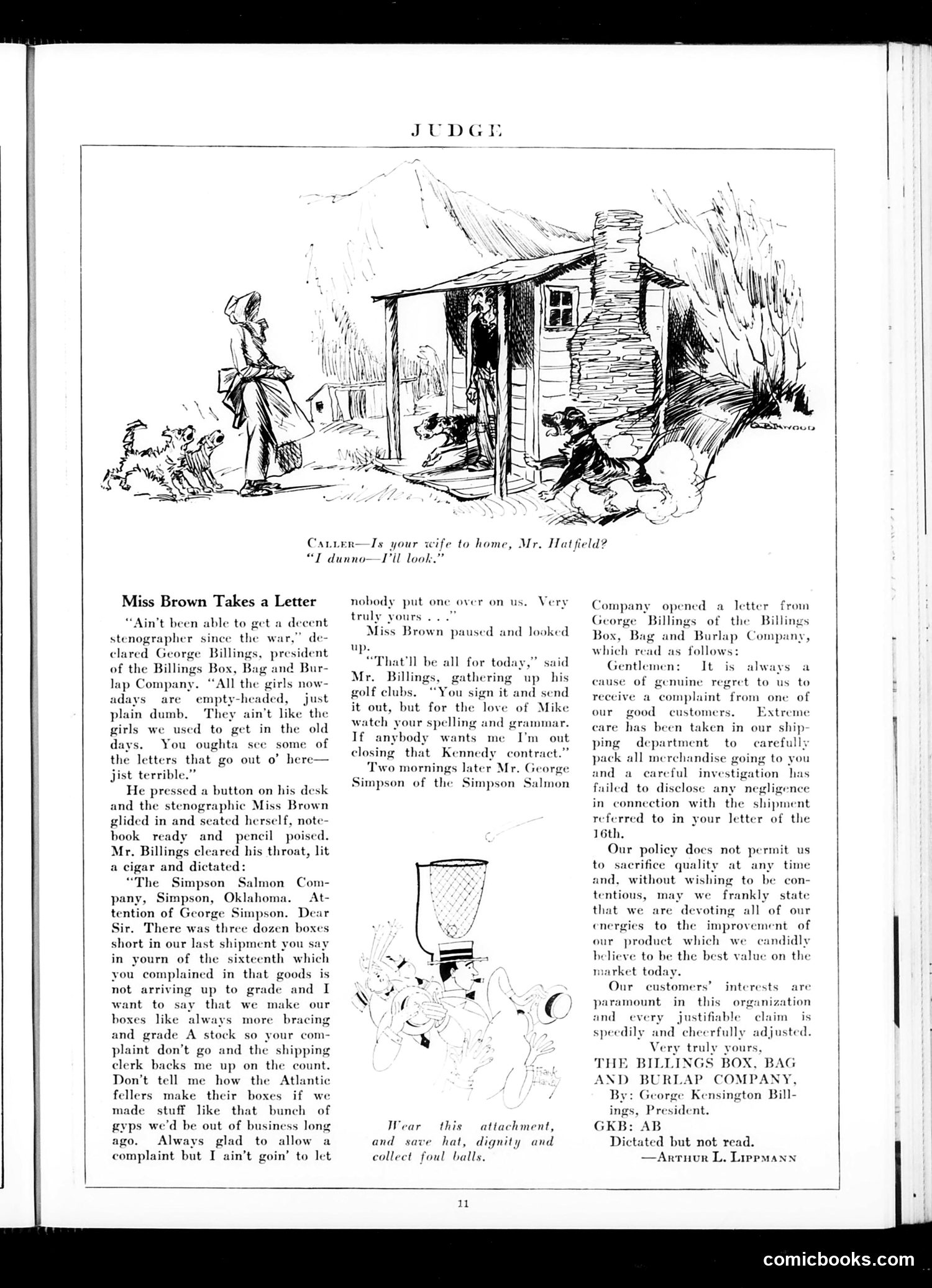
The cartoon satirizes the gap between a boss's careless dictation and the polished letter his stenographer produces. **The Setup:** Mr. Billings, president of a box company, complains that modern stenographers are "empty-headed" and "dumb"—unlike girls from "the old days." He then dictates a rambling, grammatically mangled letter full of colloquialisms ("There was three dozen boxes," "gyps," incomplete thoughts) to a client about a shipment complaint. **The Joke:** Miss Brown, the stenographer he's just insulted, transforms his incoherent dictation into a professional, eloquent business letter. The client receives something polished and diplomatic—the opposite of what Billings actually said. **The Satire:** The humor cuts both ways: it mocks Billings' arrogance and poor communication skills while simultaneously demonstrating the stenographer's competence and intelligence—directly contradicting his dismissal of modern office workers. The implication is that any improvement in company communication comes *despite* the boss, not because of him.
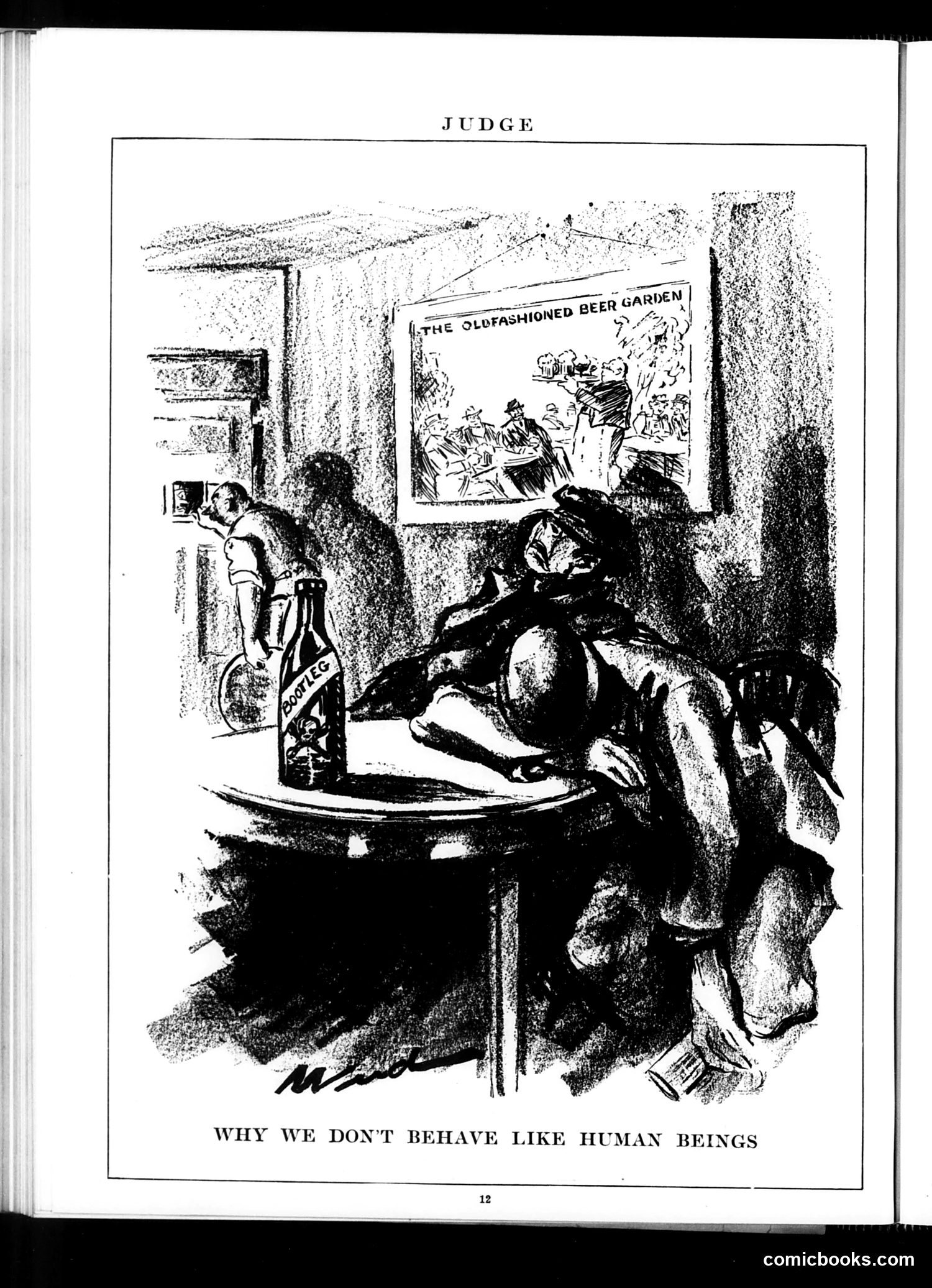
This cartoon depicts a man lounging in a chair at what appears to be a bar or establishment, with a beer bottle nearby. On the wall behind him is a poster advertising "THE OLDFASHIONED BEER GARDEN," showing people socializing in a more wholesome, communal setting. The satire suggests that alcohol consumption—particularly in solitary, indulgent settings—prevents people from behaving with civility and restraint. The contrast between the idealized beer garden (community, moderation) and the actual behavior shown (lounging idleness, excess) critiques how drinking culture corrupts proper conduct. This likely reflects Prohibition-era anxieties about alcohol's moral dangers, or pre-Prohibition concerns about working-class drinking habits and their social consequences.
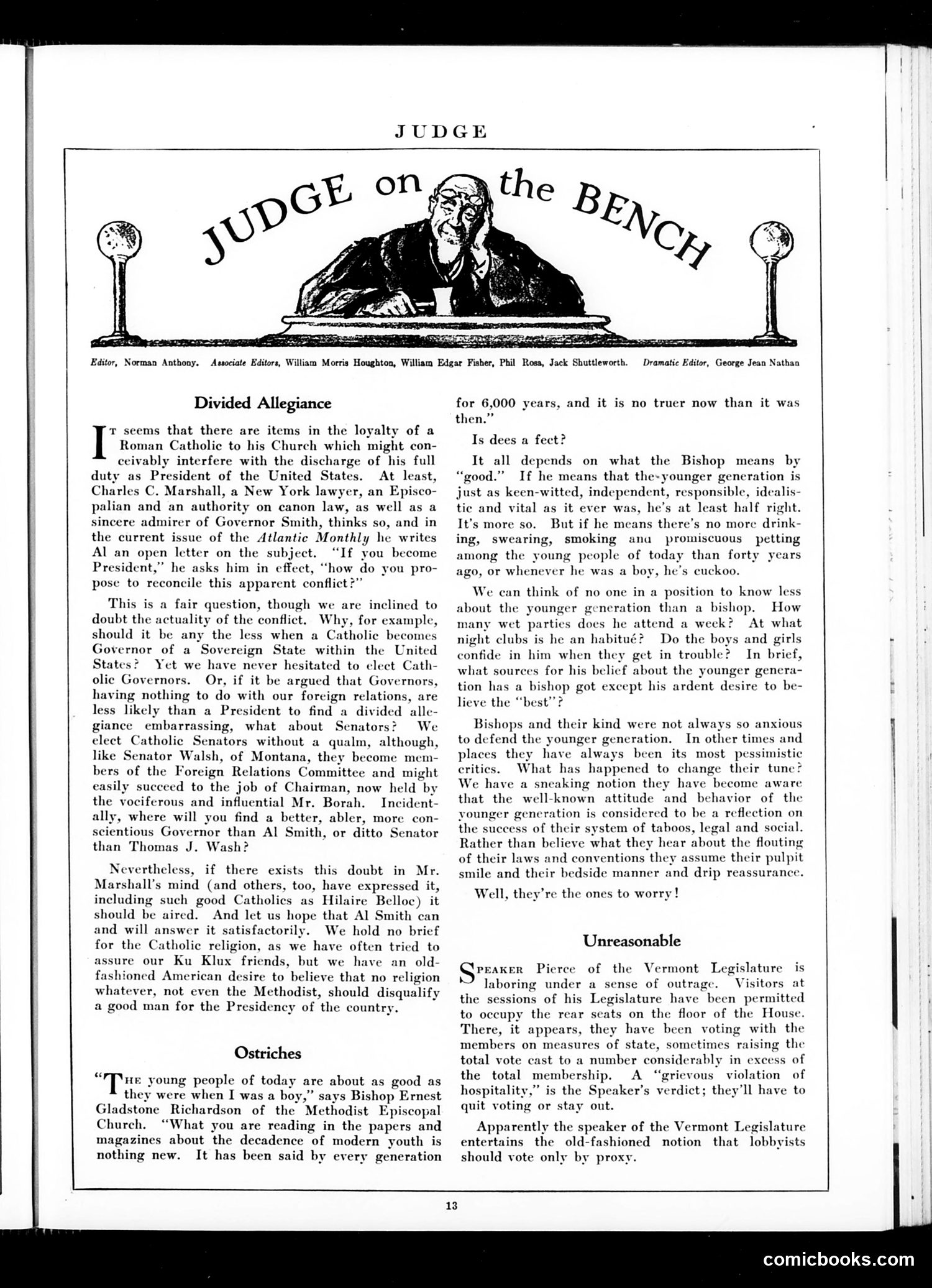
This page from Judge magazine contains two satirical opinion pieces addressing contemporary social issues: **"Divided Allegiance"** critiques concerns about Catholic loyalty, specifically referencing Charles C. Marshall's open letter questioning whether Al Smith (the Catholic New York governor and likely 1928 presidential candidate) could reconcile Church and state duties. Judge defends Smith by pointing out Catholics already serve as governors and senators without controversy, while subtly mocking anti-Catholic prejudice (sarcastically reassuring "Ku Klux friends"). The piece argues religious affiliation shouldn't disqualify qualified candidates. **"Ostriches"** satirizes Bishop Ernest Gladstone Richardson's claim that modern youth are no worse than previous generations. Judge agrees partially but mocks the bishop's naivety—he lacks firsthand knowledge of young people's actual behavior (drinking, smoking, "promiscuous petting"). The satire suggests bishops conveniently defend youth to maintain authority rather than from genuine observation. Both pieces employ Judge's characteristic irreverent tone toward institutions and authority figures.
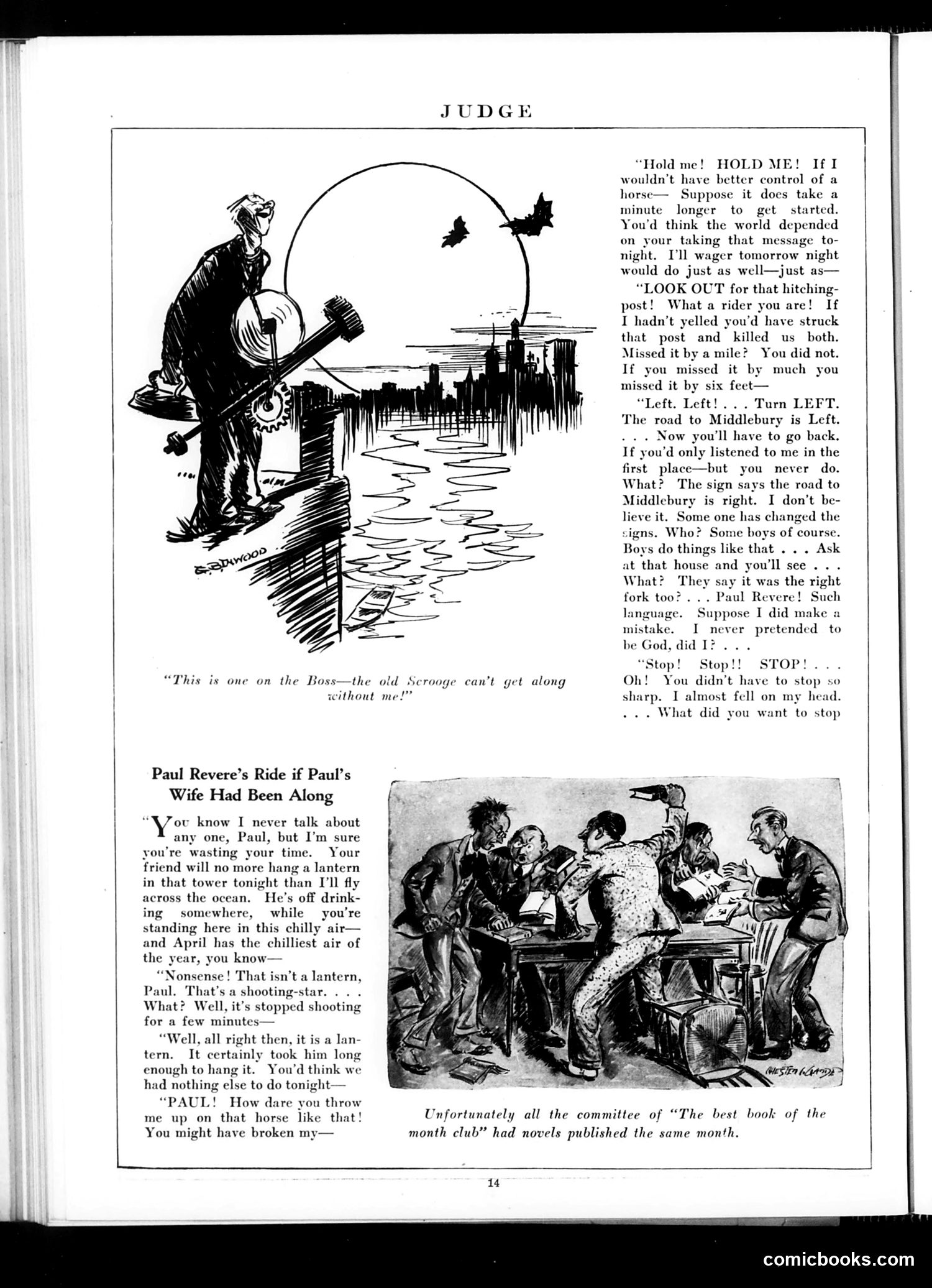
This page contains two related satirical pieces mocking Paul Revere's famous midnight ride by imagining his wife accompanying him. **Top cartoon**: Shows a man operating some kind of mechanical device while perched on a post overlooking a colonial town, illustrating the disruption caused by a nagging wife's presence during a historically significant moment. **Bottom section**: A humorous fictional account where Paul's wife constantly complains, second-guesses directions, criticizes his horsemanship, and generally undermines the urgency of his revolutionary mission. She misreads signs, doubts the lantern signal, and nags about minor discomforts ("April has the chilliest air"). **The satire**: Judge magazine mocks both nagging wives and the romanticized "heroic man on important mission" trope by showing how domestic complaint and backseat-driving would trivialize even America's founding moment. The joke assumes readers find wives' practical concerns and fault-finding inherently comedic and obstructive to male achievement. The accompanying illustration shows committee members apparently unable to agree, likely satirizing book club selections.
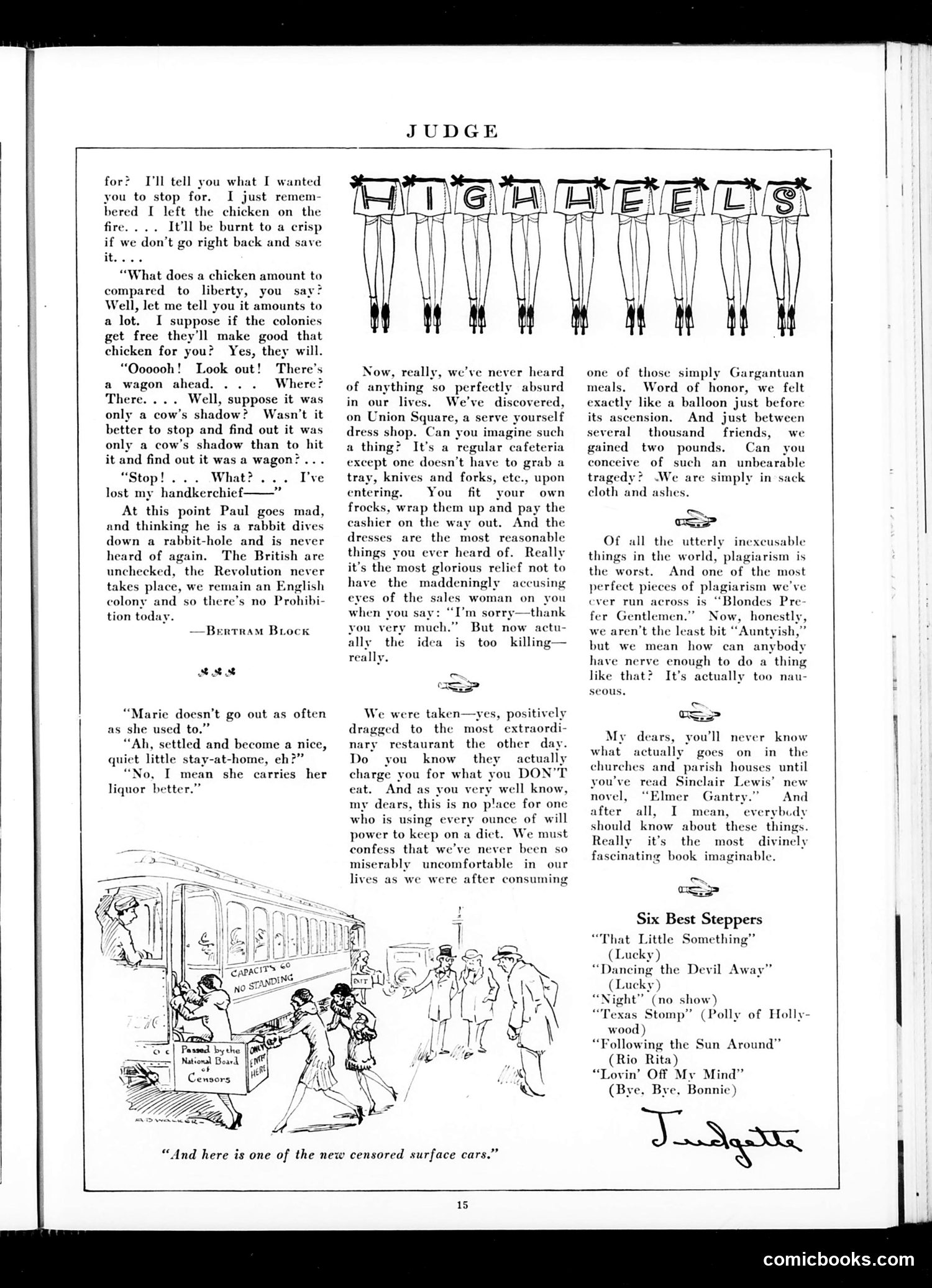
This *Judge* page satirizes American social attitudes of the Prohibition era (likely 1920s-early 1930s). **The main cartoon** by Bertram Block mocks Paul Revere's famous midnight ride. A woman repeatedly stops him with trivial concerns (a forgotten chicken, seeing shadows, a lost handkerchief), causing him to go mad and abandon his mission. The joke: without Revere's warning, the Revolution fails, America remains British—and therefore has no Prohibition. The satire suggests Americans wouldn't have Prohibition if they could redo history, critiquing the unpopular alcohol ban. **The surrounding text** comprises gossipy social commentary typical of the era: women discussing self-serve dress shops, restaurants charging for uneaten food, complaints about plagiarism in popular songs, and recommendations for Sinclair Lewis's novel *Elmer Gantry* (a critique of religious hypocrisy). **The illustration** of a "censored surface car" appears to reference post-Prohibition vehicle modifications—possibly mocking enforcement efforts. The overall tone is frivolous upper-class gossip masking broader social commentary about Prohibition's unpopularity among the magazine's sophisticated audience.
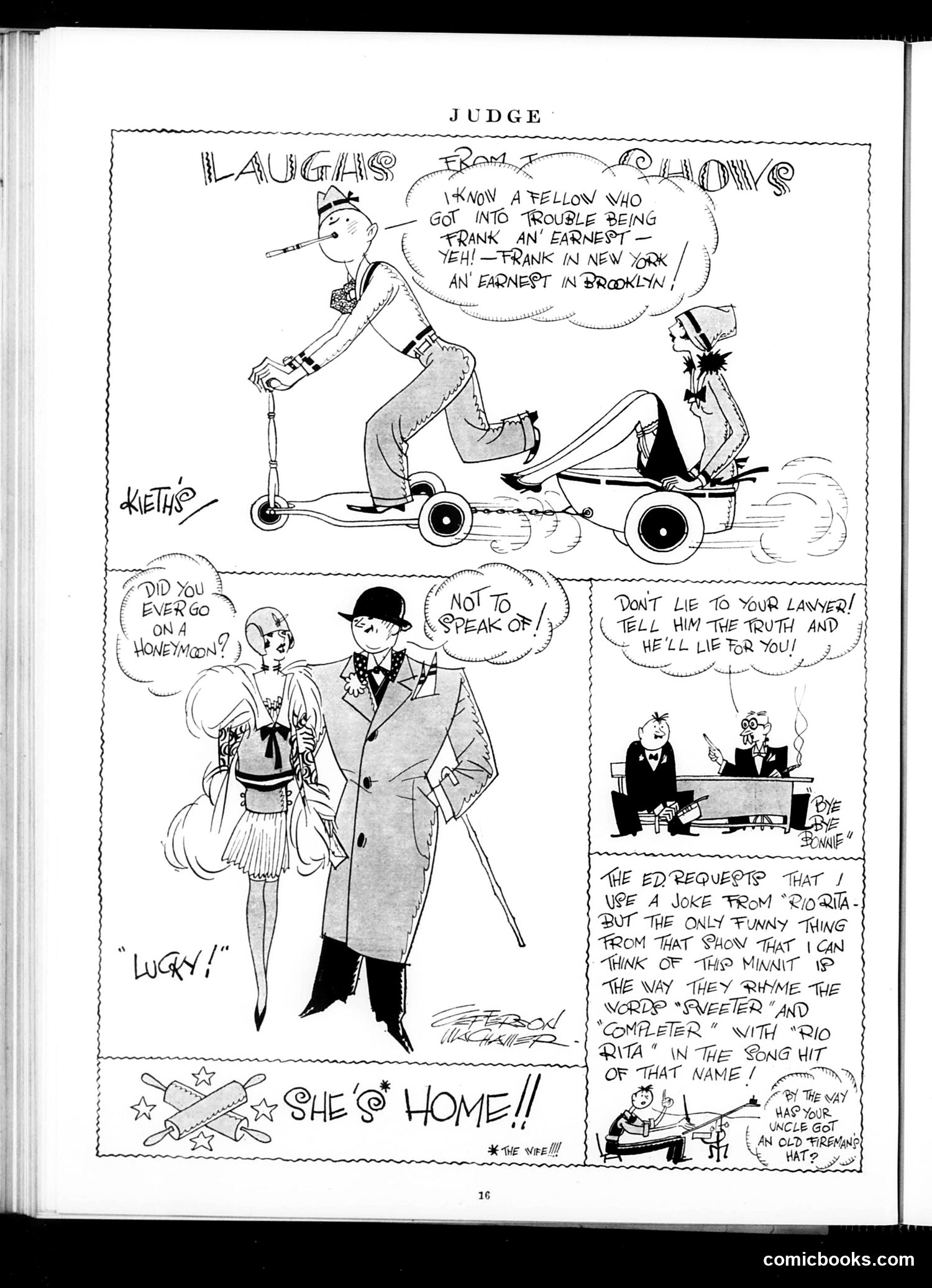
This page contains two satirical cartoons mocking early 1920s urban life and legal/theatrical culture. **Top cartoon:** Shows a man on a scooter boasting about knowing a "Frank an' Earnest" in trouble—one in New York, one in Brooklyn. This appears to reference the popular play or cultural figure "Frank and Ernest," using them as generic exemplars of common troublemakers. **Bottom cartoon:** Depicts a couple and a lawyer, with dialogue about honeymoons and legal advice. The right panel features a theatrical joke: the cartoonist mocks a musical show (likely "Rio Rita," a 1927 Broadway hit) for its forced rhyming of "sweeter" with "Rio Rita"—suggesting the show's lyrics are absurdly contrived. The humor targets how contemporary musical theater prioritizes rhyme schemes over natural language. The overall tone satirizes both street-level delinquency and high-culture theatrical pretension, typical of Judge's class-conscious humor.
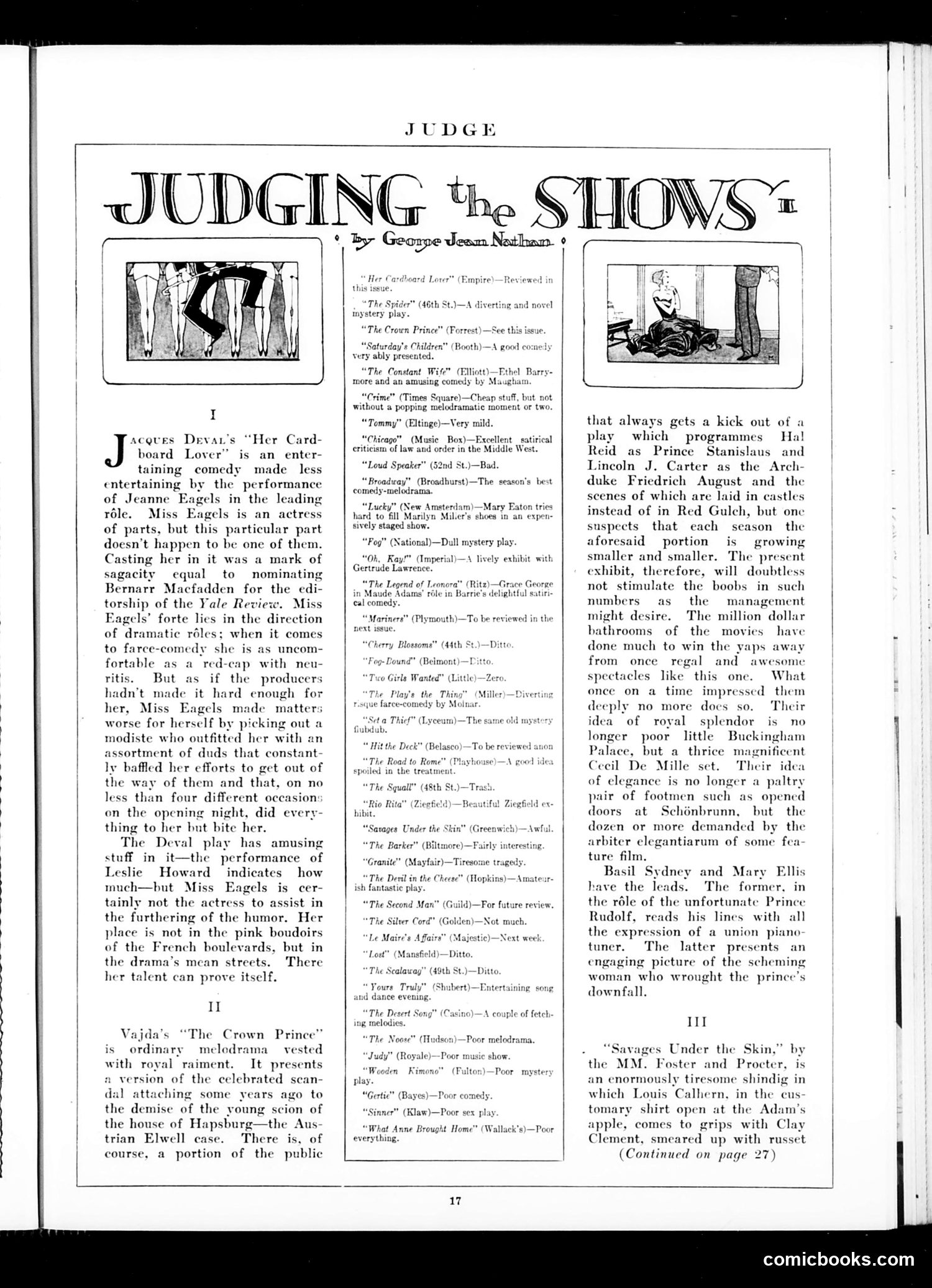
This is a theater criticism page from Judge magazine reviewing Broadway productions. The main content critiques recent plays rather than presenting political satire. The lead review discusses Jacques Deval's "Her Cardboard Lover," faulting actress Jeanne Eagels for her miscast performance in a farce-comedy—her talents lie in dramatic roles, not light comedy. The critic compares her miscasting to nominating Bernarr Macfadden (a famous physical fitness promoter) as editor of Yale Review, emphasizing how absurdly wrong the choice is. A secondary review covers Vajda's "The Crown Prince," described as ordinary melodrama with royal trappings, apparently referencing a real Austro-Hungarian scandal involving the Hapsburg family's young heir (compared to the "Austrian Elwell case"). The bulk of the page lists brief capsule reviews of other current Broadway shows with one or two-line assessments—mostly negative ("Poor," "Dull," "Trash").
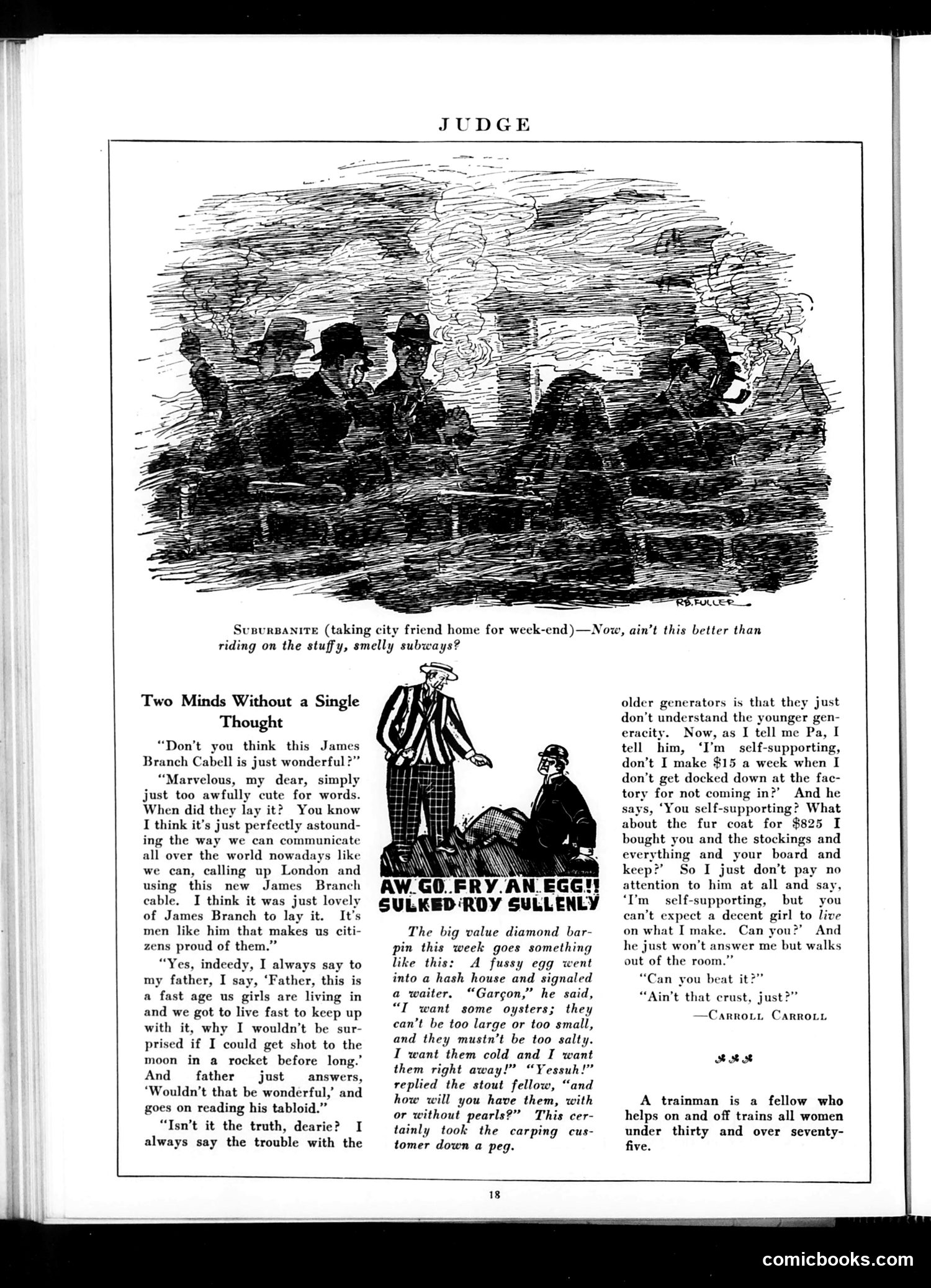
This page satirizes the superficiality and ignorance of young women through two pieces: **"Two Minds Without a Single Thought"** depicts two socialites discussing James Branch Cabell, apparently confusing the author with a transatlantic telegraph cable ("James Branch cable"). The joke exposes their pretense at cultural sophistication—they praise something they don't understand, merely echoing fashionable opinions. **The accompanying dialogue** mocks generational conflict: a working young woman claims self-sufficiency earning $15/week while accepting her father's $825 fur coat and full support, unable to grasp the contradiction. **"Aw Go Fry an Egg! Sulked Roy Sullenly"** (center) presents a joke about an overly demanding customer at a diner who's finally humbled when the waiter asks if he wants his oysters "with or without pearls"—a ridiculous response that shuts down the complainer. The page targets upper and lower-class women's illogic, materialism, and shallow discourse—typical satirical fodder for 1920s Judge magazine.
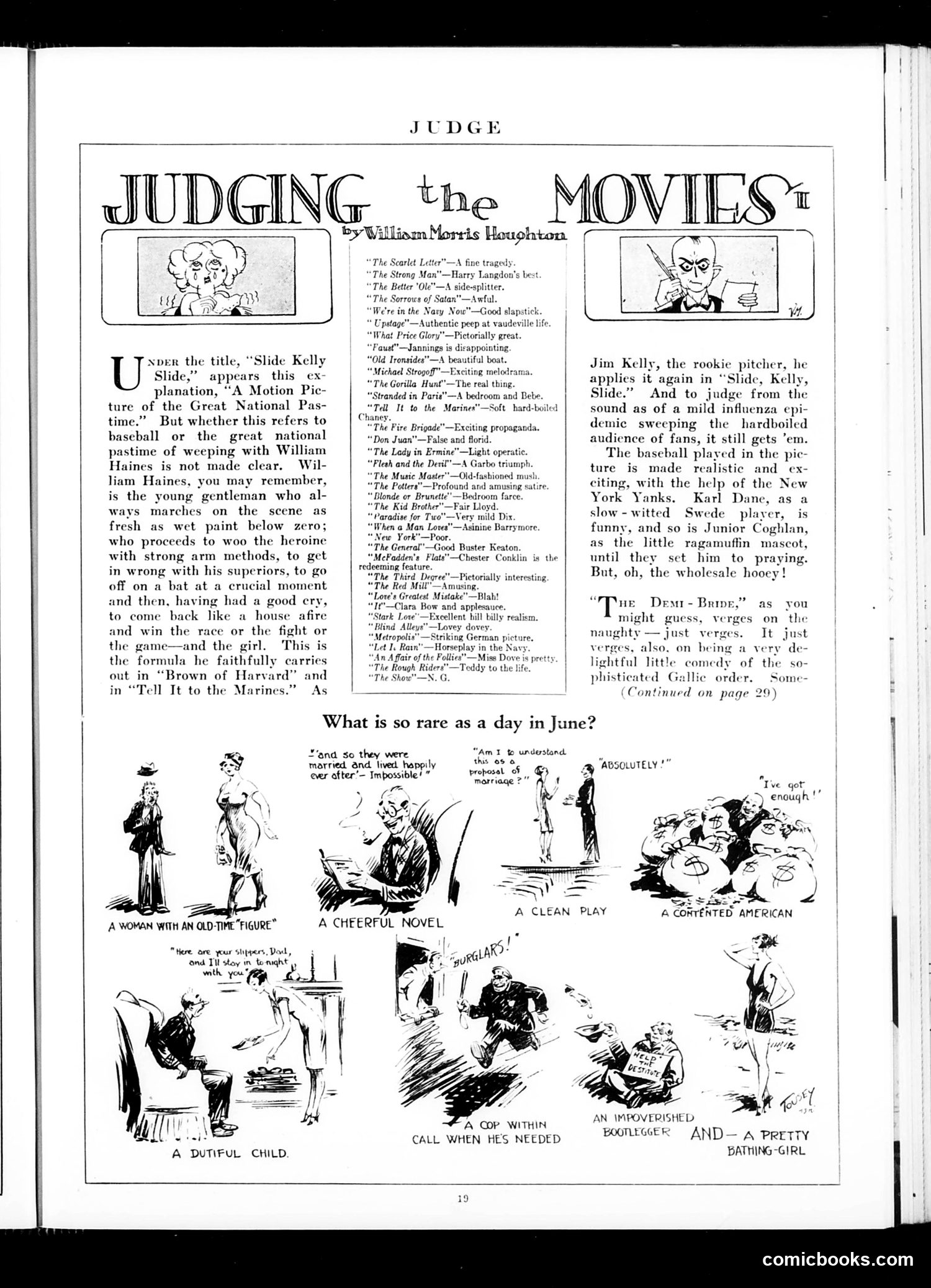
This is a film criticism column by William Morris Houghton reviewing current movies. The top section lists recent releases with brief verdicts (mostly positive: "fine tragedy," "best," "exciting," etc.). The main text discusses actor **William Haines**, a popular silent-film star known for playing charming rogues who get into trouble, alienate superiors, go on drinking binges, then heroically redeem themselves to win the girl and the day. The columnist notes Haines follows this formula reliably in films like *Brown of Harvard* and *Tell It to the Marines*. The review then covers "Slide, Kelly, Slide," a baseball picture featuring Jim Kelly (rookie pitcher) and actor Karl Dane as a slow-witted Swedish player. It's described as realistic and crowd-pleasing. The bottom section contains unrelated single-panel gag cartoons about common June occurrences: women with outdated figures, cheerful novels, dutiful children, clean plays, contentious Americans, corrupt cops, impoverished bootleggers, and pretty bathing girls—typical 1920s social humor reflecting Prohibition-era attitudes.
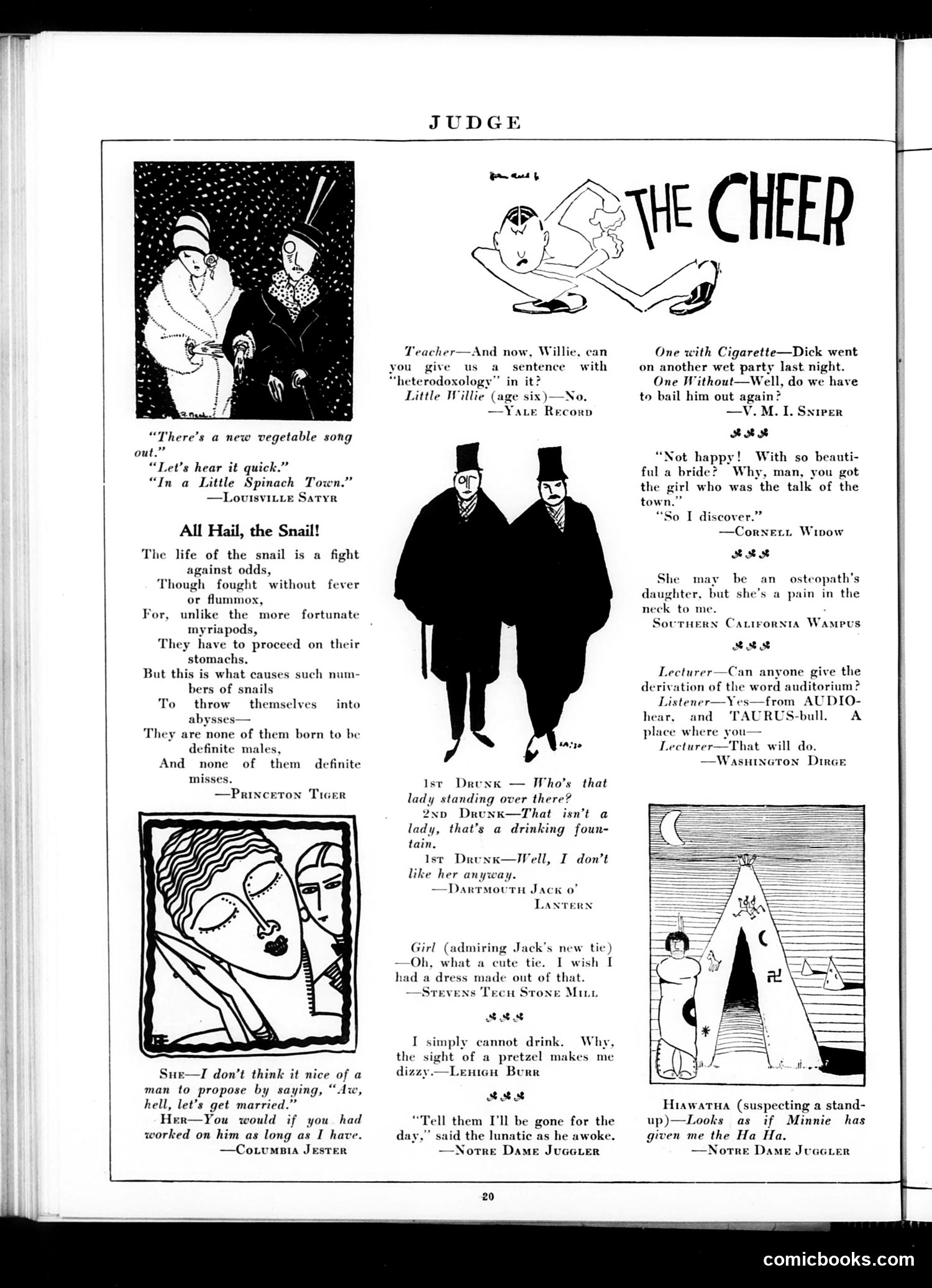
This is a humor page from *Judge*, featuring miscellaneous jokes and quips rather than unified political cartoons. The content reflects early-20th-century collegiate and social humor. Key elements include: **Joke subjects:** Romantic mishaps ("propose by saying 'Aw, hell, let's get married'"), drunkenness, classroom comedy (a six-year-old unable to use "heterodoxology"), and absurdist humor (mistaking a drinking fountain for a woman). **References:** Credits cite colleges (Yale, Princeton, Notre Dame, Washington, Cornell, Stevens Tech, V.M.I.), suggesting this appeals to educated readers. One joke riffs on Longfellow's "Hiawatha." **Social satire:** Light mockery of courtship customs, academic pretension, and male social behavior (wet parties, drinking). The tone is genteel and whimsical rather than sharp political critique. The illustrations show stylized 1920s fashions and are decorative rather than narrative. Overall, this reflects *Judge*'s role as sophisticated entertainment for educated audiences rather than hard-hitting satire.
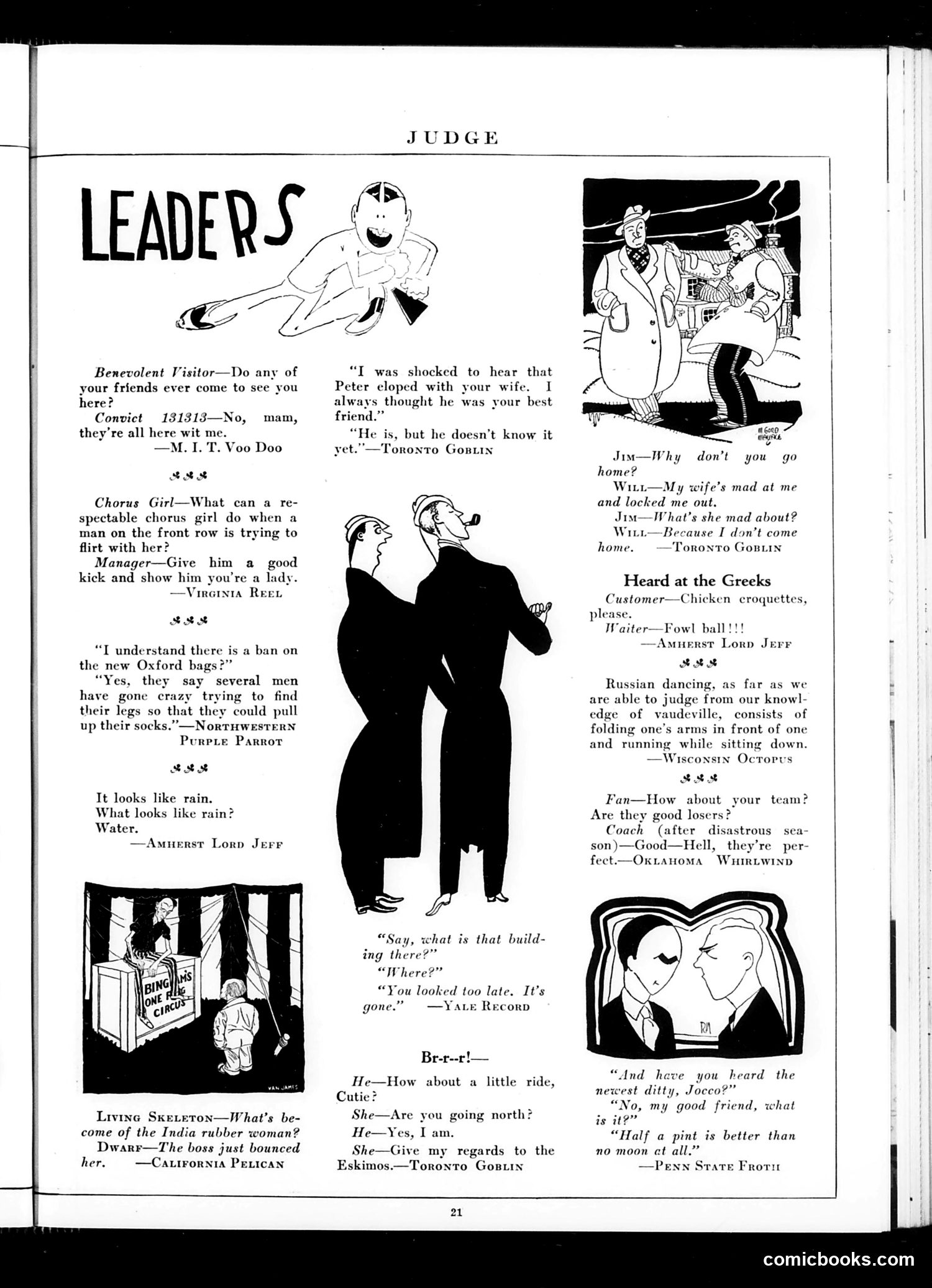
This page collects brief humorous jokes and quips organized under "LEADERS"—likely meaning social commentary on contemporary figures and situations. Key satirical content includes: **Social commentary**: A chorus girl joke mocking workplace harassment; Oxford bags (baggy 1920s trousers) humor about men struggling to keep their socks up—poking fun at a fashion trend. **Domestic life**: Multiple jokes about marital discord (wives locking husbands out, coaches blamed for team losses) reflecting common 1920s-era relationship stereotypes. **Ethnic humor**: References to "Eskimos" and vaudeville "Russian dancing" employ period stereotypes typical of early-20th-century American humor. **Wordplay**: A waiter's "fowl ball" pun on "foul ball" (baseball term) when a customer orders chicken. The magazine credits various college humor publications (MIT Voo Doo, Wisconsin Octopus, etc.), indicating this collects student comedy. The humor relies on recognizable social situations—dating etiquette, marriage tensions, restaurant service—that would resonate with contemporary Judge readers.
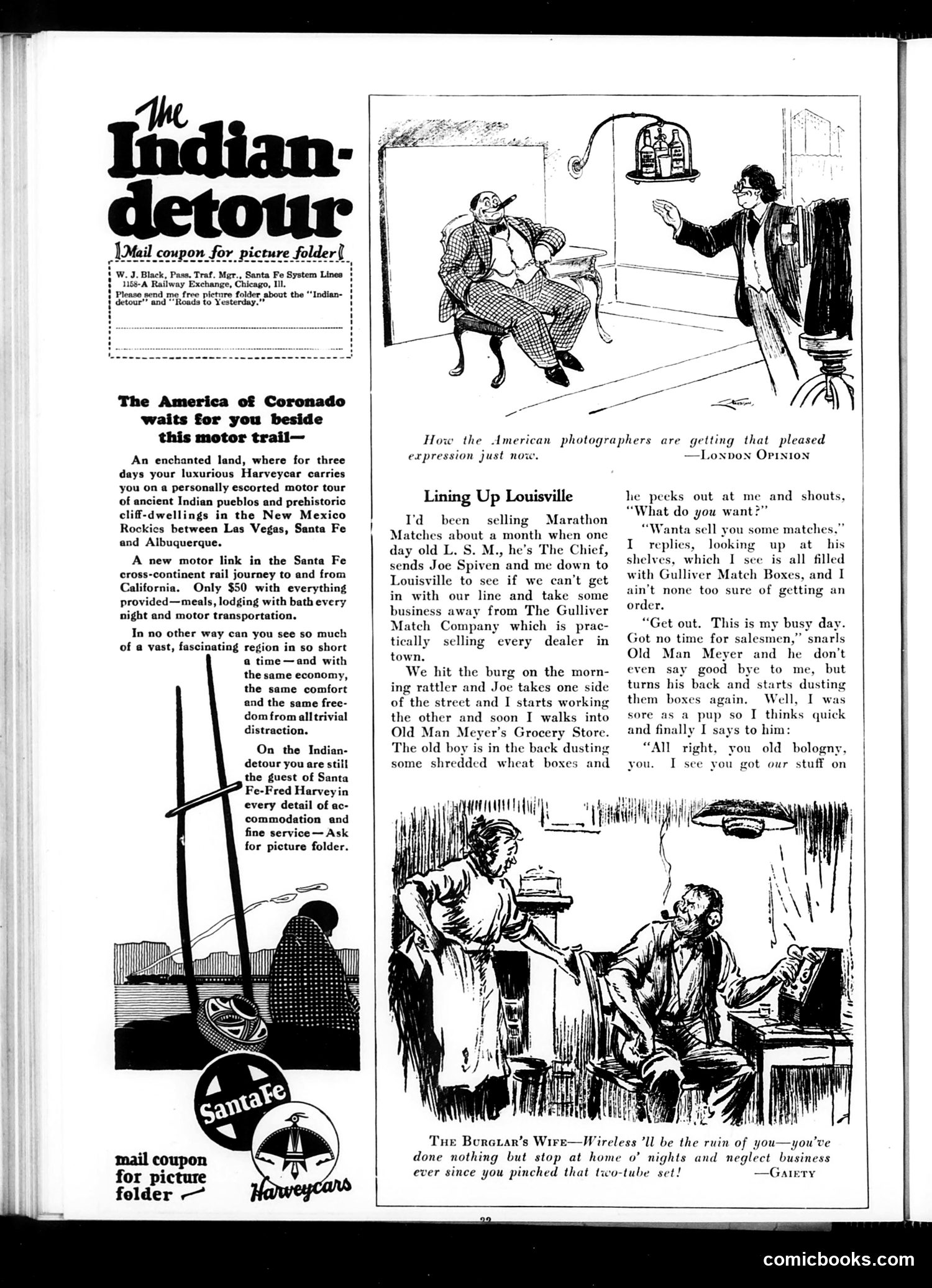
This page contains two distinct elements: **Left side**: A Santa Fe Railway advertisement for "The Indian-detour," a tourist package offering three-day motor tours through New Mexico pueblos and cliff-dwellings for $50, hosted by Fred Harvey's company. It's purely commercial content. **Right side**: Two cartoon jokes from *Judge* magazine's humor section: 1. **Top cartoon** (London Opinion): Satirizes American photographers who appear overly eager or pleased. The image shows photographers being chased or directed, mocking their enthusiasm or staged expressions. 2. **Bottom cartoon** (Gaiety): "The Burglar's Wife" depicts a domestic quarrel where a wife complains her husband has neglected business since acquiring a wireless radio set (early radio receiver), staying home instead. It's satire about new technology creating domestic conflict and distraction from work. Both jokes rely on contemporary anxieties: photography's growth as a profession and radio's disruptive social impact in the early 20th century.
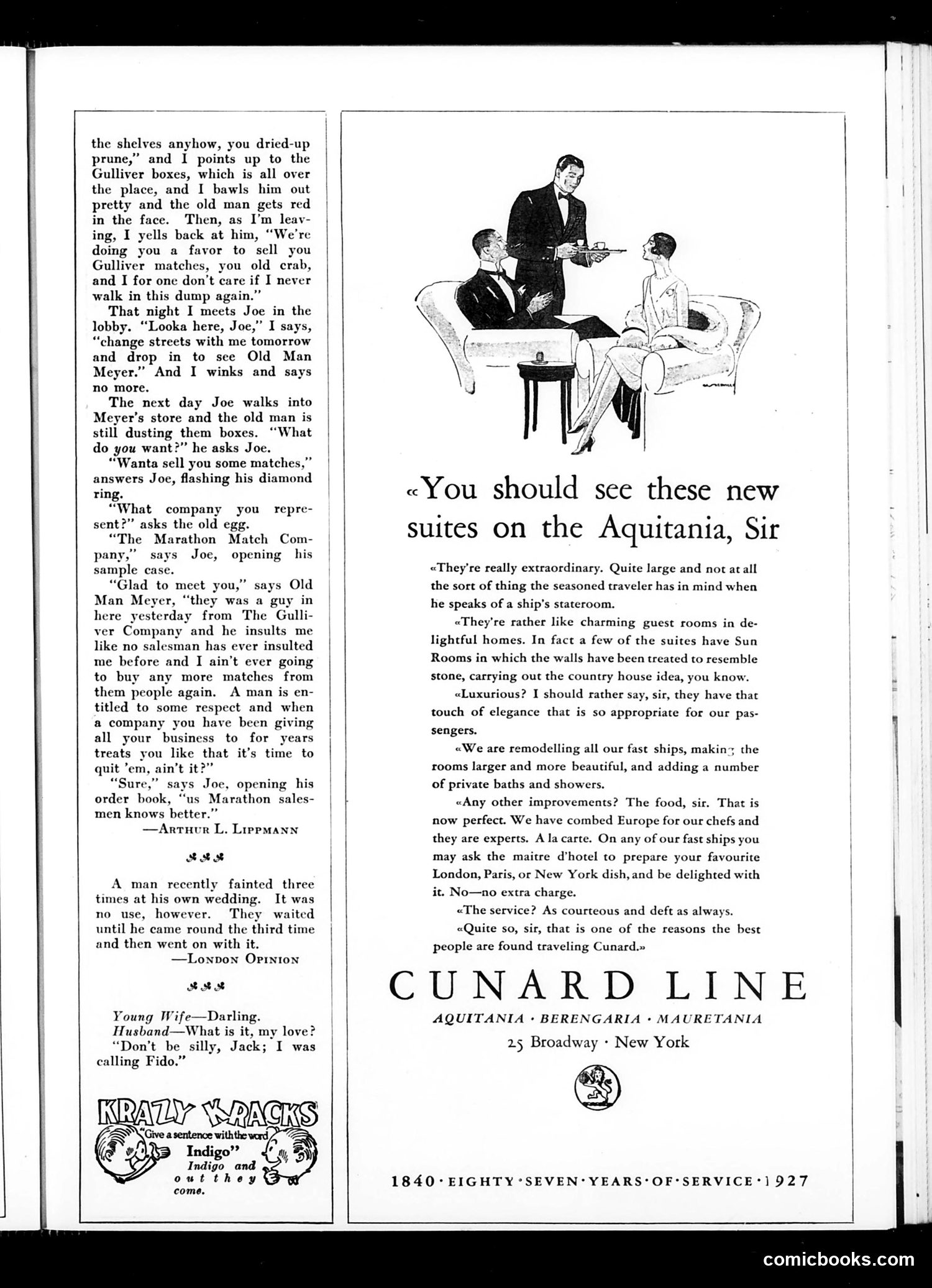
This page contains two distinct elements: **Left Column – Satirical Story:** A humorous anecdote about sales competition. A Gulliver Match Company salesman insults a store owner (Old Man Meyer), who then refuses future business. The next day, a Marathon Match Company salesman (Joe) arrives and gets the sale by treating Meyer with respect. The joke satirizes business ethics: competitors win through courtesy rather than quality, and loyalty evaporates when dignity is wounded. **Right Column – Advertisement:** A Cunard Line cruise ship advertisement promoting the RMS Aquitania, highlighting luxury suites designed like elegant guest rooms, superior food, and attentive service. The ad emphasizes that wealthy travelers ("the best people") choose Cunard for its refinement and hospitality. The page also includes minor jokes about marriage and a "Krazy Whacks" word puzzle at bottom left. The content reflects 1920s consumer culture and the importance placed on customer service as a business differentiator.
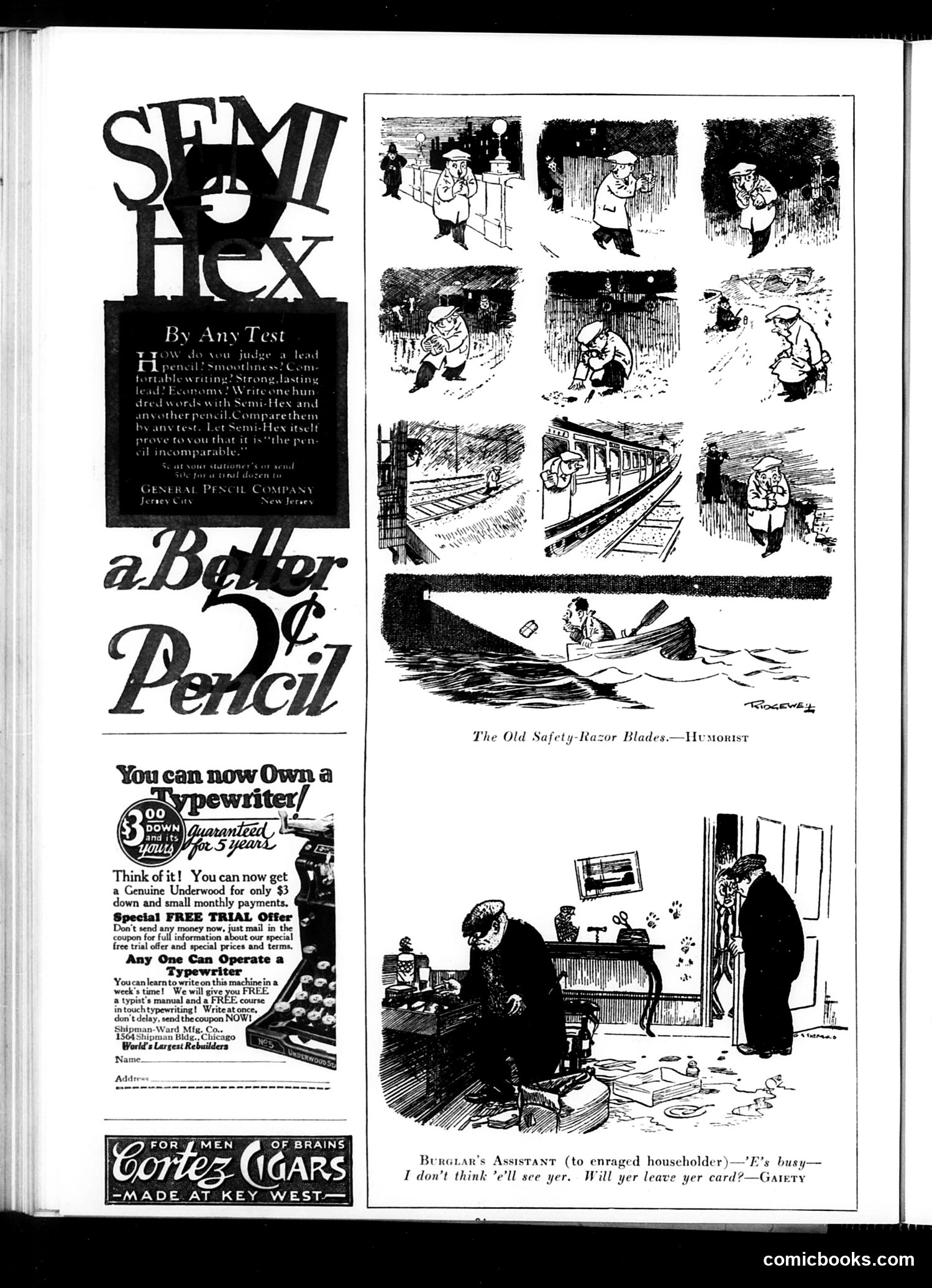
This page mixes humor with period advertising. The main cartoon depicts a burglar's assistant apologizing to an angry homeowner, suggesting the burglar is "busy" and asking if he'll leave his card—a humorous inversion of normal social etiquette applied to criminal activity. The joke satirizes the absurdity of treating a burglary with polite formality. The surrounding content includes: - "Semi-Hex" pencil advertisement (top left) - "Better Pencil" promotion - Underwood typewriter advertisement emphasizing affordability ($3 down, monthly payments) - A series of sketch illustrations showing various everyday scenes - Cortez cigars advertisement (bottom) The humor relies on incongruity and understated British wit ("Gaiety" credited), characteristic of Judge magazine's satirical style. The page reflects early 20th-century American commercial culture alongside genteel humor about social conventions.
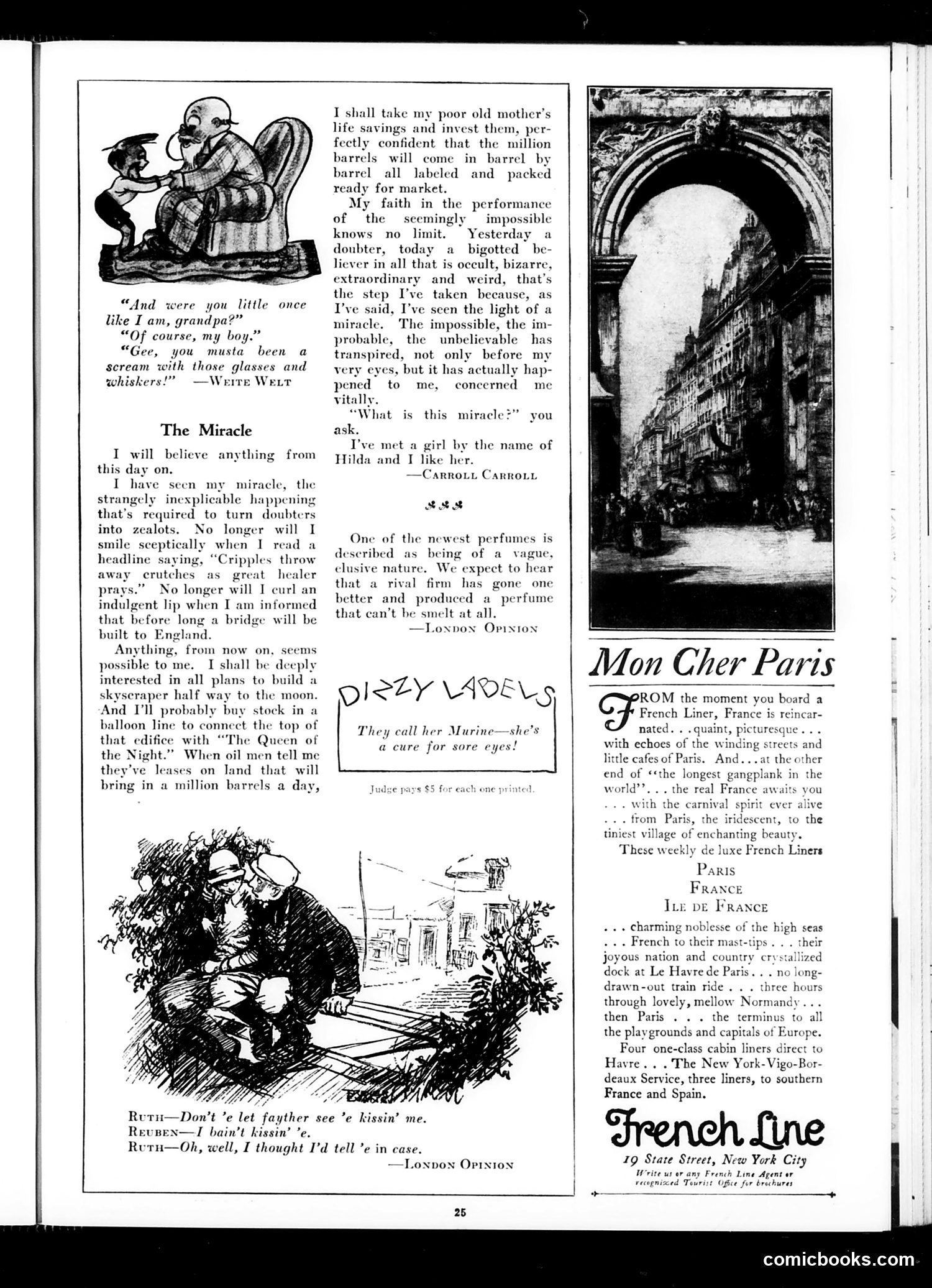
This page contains three distinct pieces: **"The Miracle"** — A humorous essay by Carroll Carroll mocking gullibility. The author claims meeting and liking a girl named Hilda has converted him from skeptic to believer in the impossible, making him willing to invest in absurd schemes (skyscrapers to the moon, oil wells on land). The satire targets people who abandon rational thinking based on emotional experience, likely referencing contemporary miracle-workers and faith healers popular in the early 20th century. **"Dizzy Labels"** — A brief pun advertisement for Murine eye drops, playing on a woman's name/appearance as a "cure for sore eyes." **"Mon Cher Paris"** — A French Line steamship advertisement romanticizing travel to Paris, emphasizing charm, culture, and luxury accommodations. The page is primarily satirical commentary on human irrationality, paired with period travel advertising.
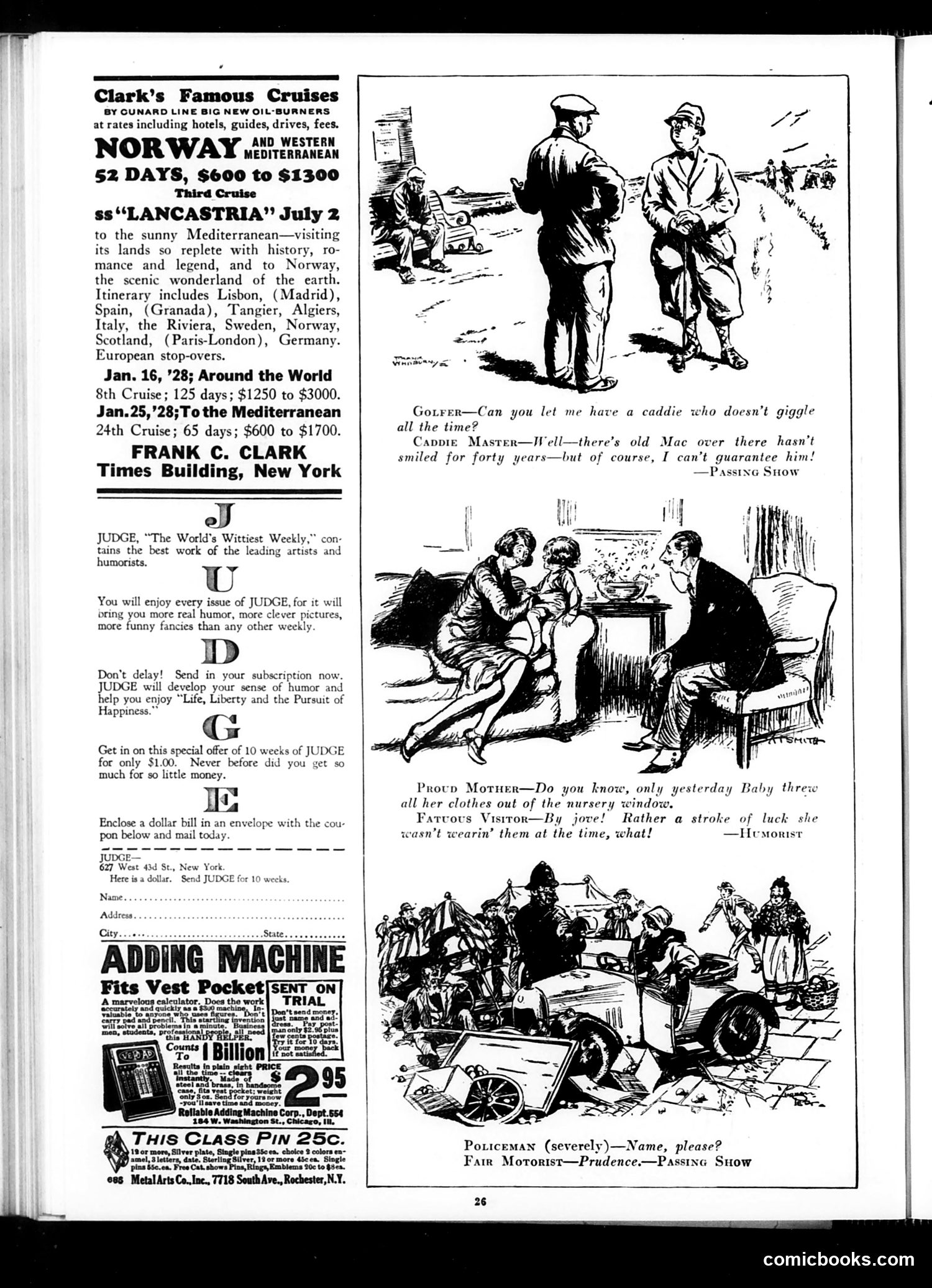
This page is primarily **advertising and comic cartoons** rather than political content. The main advertisements promote luxury ocean cruises and consumer products (adding machine, class pins). The three cartoons are **genteel humor** typical of 1920s Judge magazine: 1. **Golf caddie joke**: A golfer requests a caddie who won't giggle; the caddie master offers "old Mac" who hasn't smiled in forty years—humor based on the caddie's dour personality. 2. **Nursery window joke**: A mother mentions her baby threw clothes out the window; a visitor calls it "luck" she wasn't wearing them—absurdist humor about the child's mischief. 3. **Traffic stop cartoon**: Titled "Fair Motorist—Prudence," depicts a policeman stopping a female driver named Prudence, likely satirizing women drivers as a novelty or joke subject of the era. These represent **mainstream, apolitical social humor** aimed at middle and upper-class readers—no satire of specific political figures or events is evident on this page.
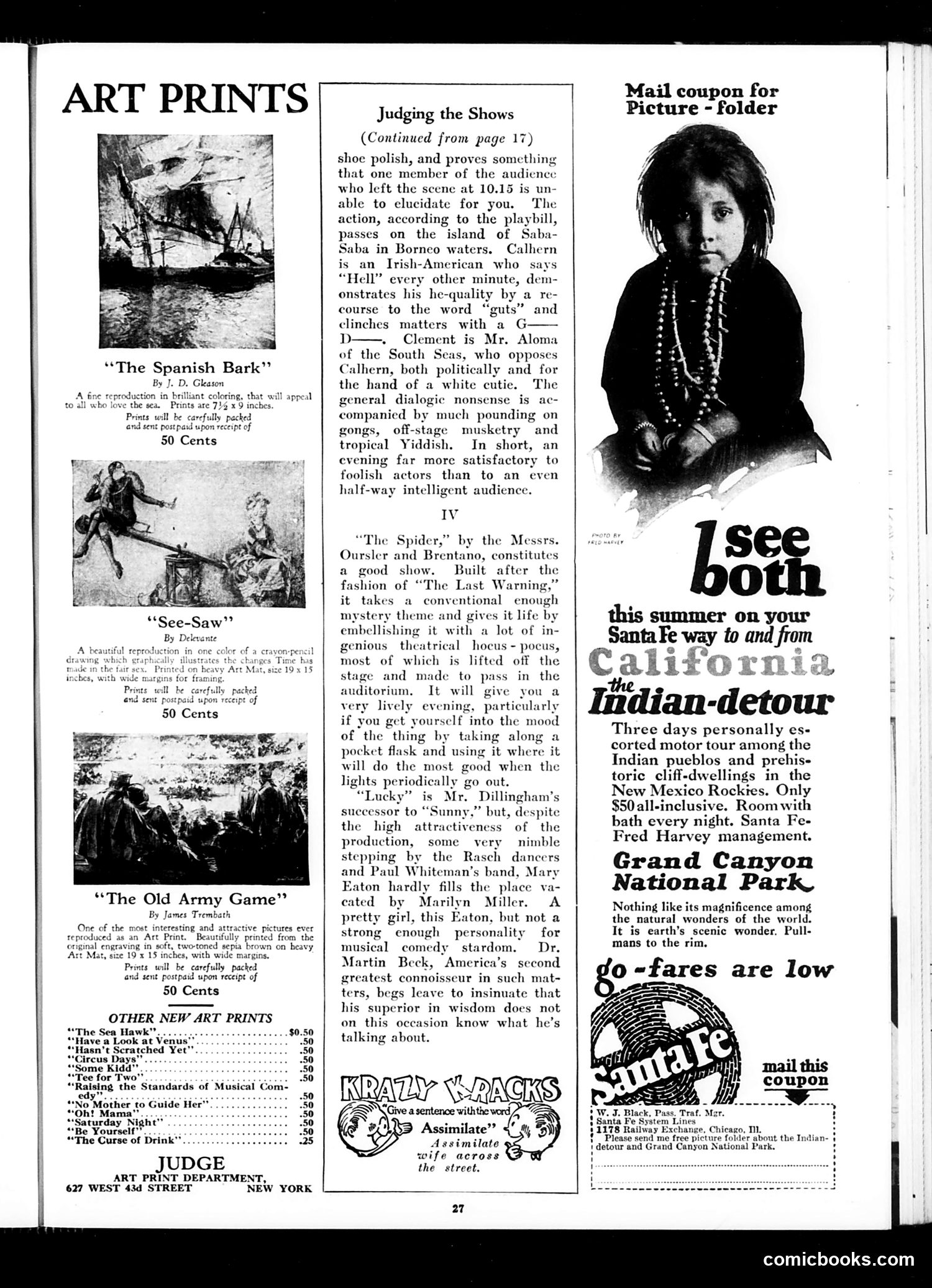
This page contains theater criticism evaluating recent Broadway productions. The reviewer critiques "The Old Army Game" (likely a melodrama set in Borneo), finding it overwrought—the Irish-American lead character constantly invokes "Hell" and "guts," accompanied by excessive gong-pounding and "tropical Yiddish," pandering to foolish actors rather than intelligent audiences. "The Spider" receives better marks as a competent mystery thriller with effective theatrical tricks. "Lucky," despite attractive production values and Paul Whiteman's band, fails because star Mary Eaton lacks sufficient personality for musical comedy, unlike her predecessor Marilyn Miller. The critic dismissively notes that even Dr. Martin Beck, "America's second greatest connoisseur," misjudges the show's quality. The page also advertises Judge's art prints and a Santa Fe railway tour promotion—standard magazine filler of the era.
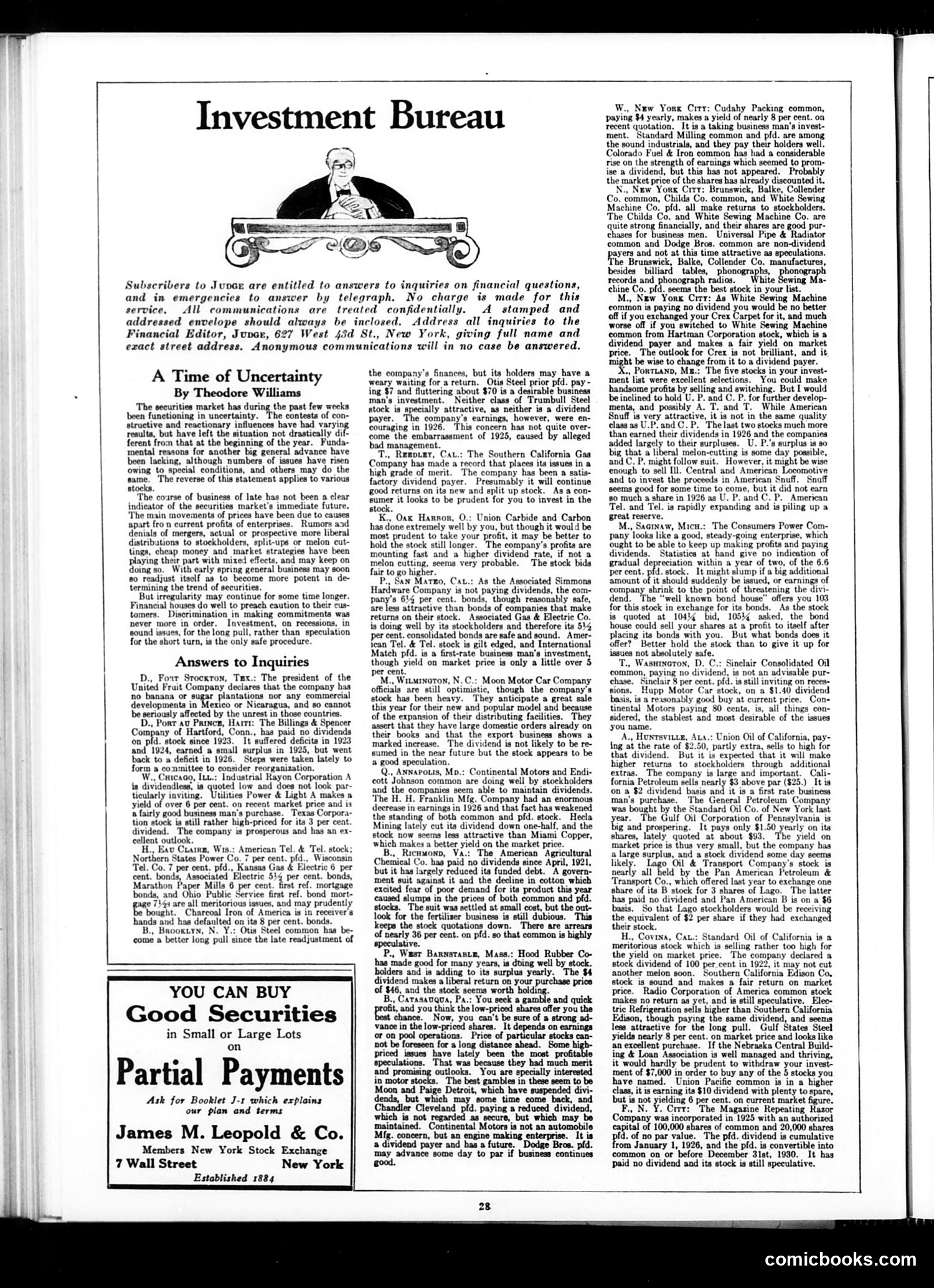
This page from Judge magazine contains **no political cartoons or satire**—it is primarily financial advice and advertising. The main content is Theodore Williams's column "A Time of Uncertainty," analyzing the 1920s stock market's irregular behavior, followed by an "Answers to Inquiries" section providing investment recommendations to readers. The sole illustration shows an older gentleman reviewing financial documents—a generic representation of investment counsel, not a caricature or satirical figure. The page advertises James M. Leopold & Co.'s brokerage services, emphasizing they offer small-lot purchases with partial payments. Context for modern readers: This reflects the 1920s investment culture before the 1929 crash, when financial advice columns and stock tips were common magazine features. The emphasis on caution and "sound issues" suggests some market nervousness, though full economic context remains unclear from this page alone.
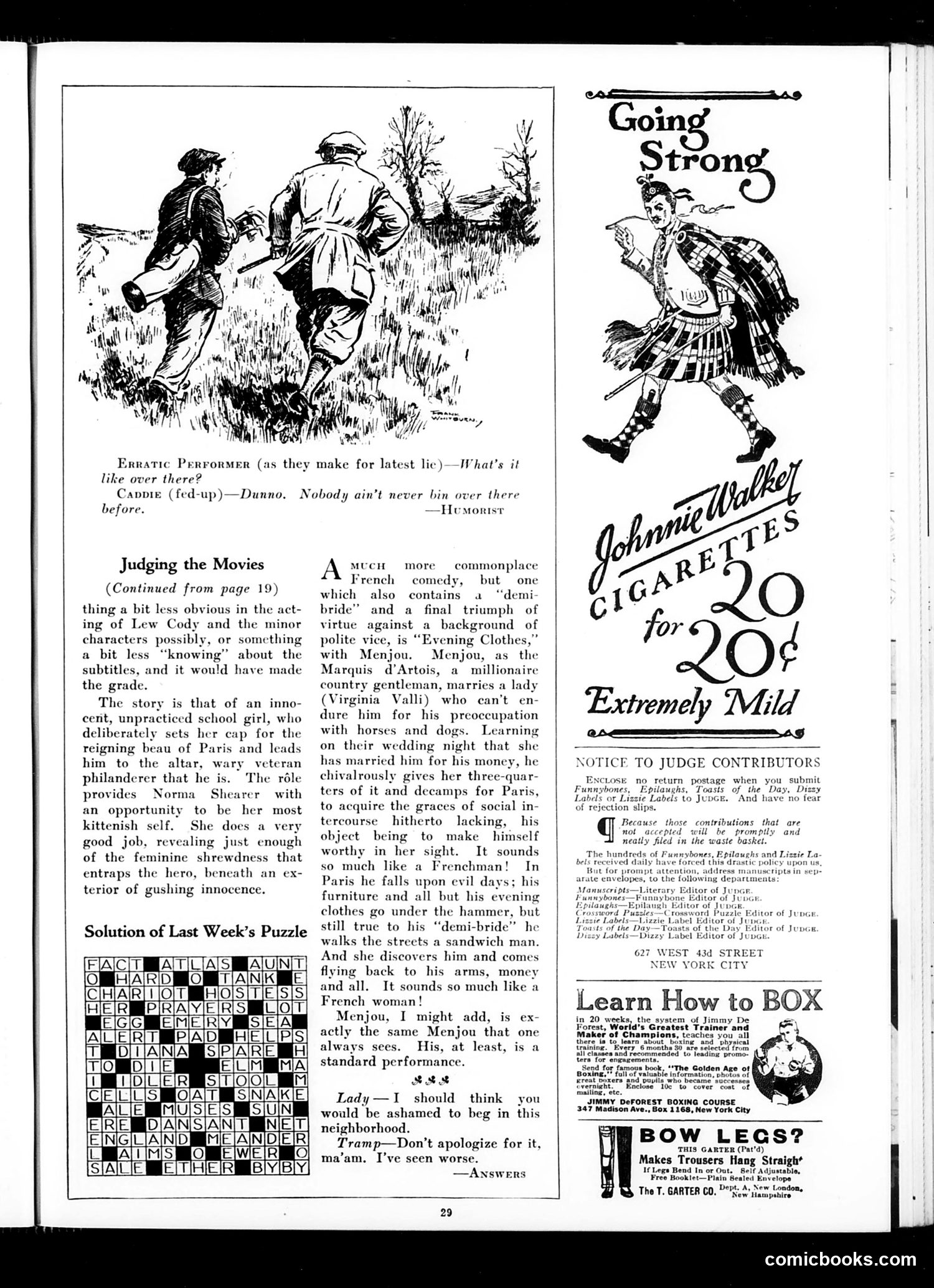
**The Main Cartoon** (top left): Shows two soldiers in a field. The caption references "Lew Cody" and the dialogue is a WWI-era joke—a soldier asks what it's like "over there" (Europe/the war), and gets the deflating response "Nobody ain't never bin over there before." This satirizes soldiers' lack of actual combat experience or knowledge, puncturing romantic notions of warfare. **The Movie Review**: The page critiques recent films, particularly praising Norma Shearer's performance as a cunning schoolgirl who manipulates a Parisian suitor. It also reviews a French comedy where actor Adolphe Menjou plays a wealthy gentleman who becomes a "sandwich man" (street advertiser) after losing his fortune, yet maintains his dignity through devotion to his wife. **The Rest**: The page is primarily **advertisements**—cigarettes, boxing courses, and garter products—typical of Judge magazine's revenue model. The humor and references are largely period-specific, centering on silent-film actors and post-WWI cynicism about military experience.
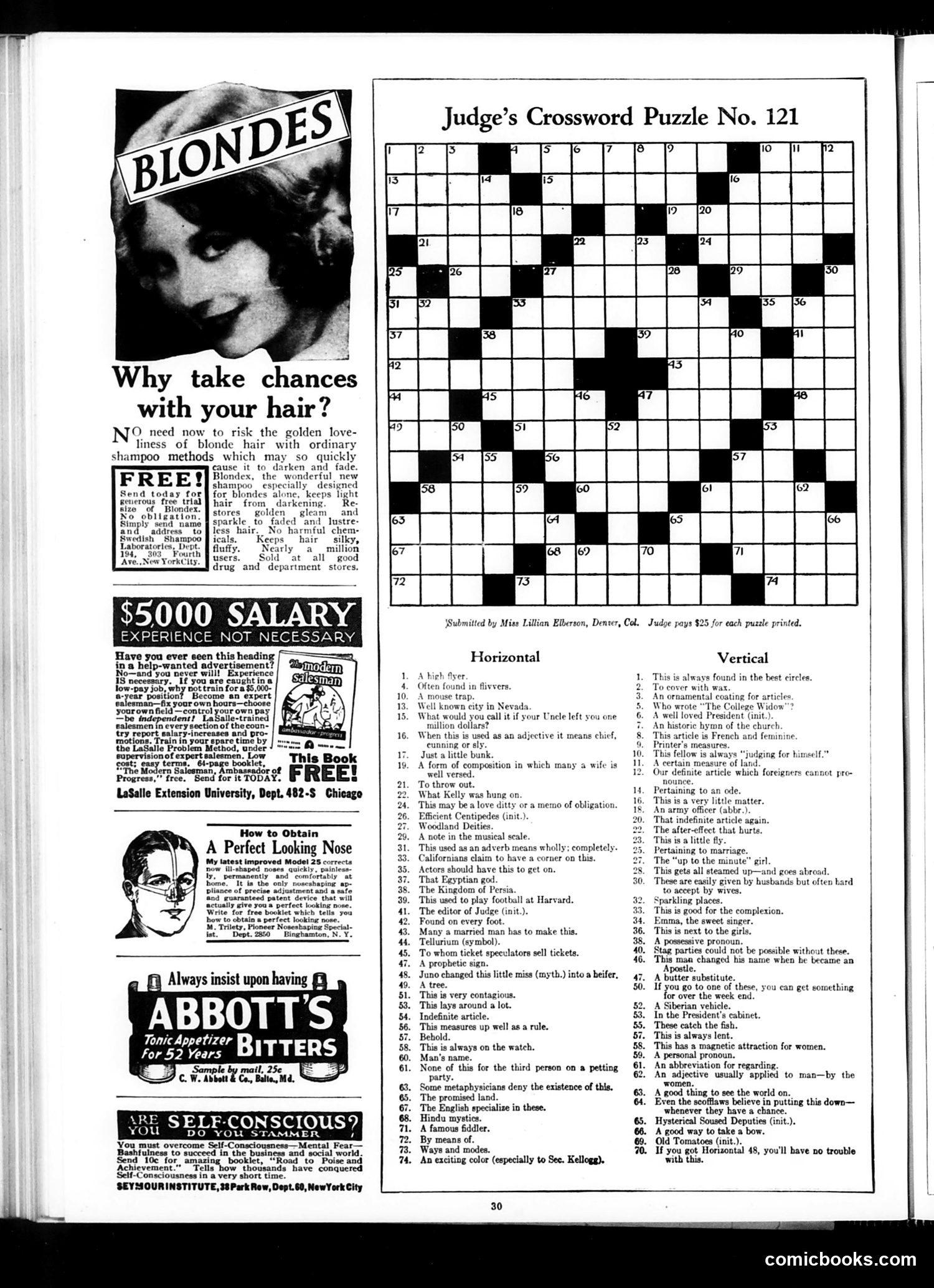
This page from Judge magazine is primarily **advertising and a crossword puzzle**, not satirical editorial content. The left side features period advertisements typical of early 20th-century magazines: - **Blondex shampoo**: marketed to prevent blonde hair from darkening—reflecting contemporary beauty standards valuing pale blonde hair - **LaSalle Extension University**: promoting correspondence-course sales training for a "$5,000 salary" (substantial income for the era) - **Noseshaping device**: home apparatus promising to "correct" poorly-shaped noses without surgery—revealing anxieties about physical appearance - **Abbott's Bitters**: a patent medicine tonic - **Seymour Institute**: offering to cure "self-consciousness" and bashfulness These ads collectively target insecurities about appearance, social anxiety, and economic advancement—common marketing tactics of the period. The right side contains **Judge's Crossword Puzzle No. 121**, a standard puzzle with clues referencing contemporary culture, including references to Judge magazine's own editor (by initials). The page reflects Judge's dual function: satirical commentary in editorial content, combined with revenue-generating advertisements and entertainment features.
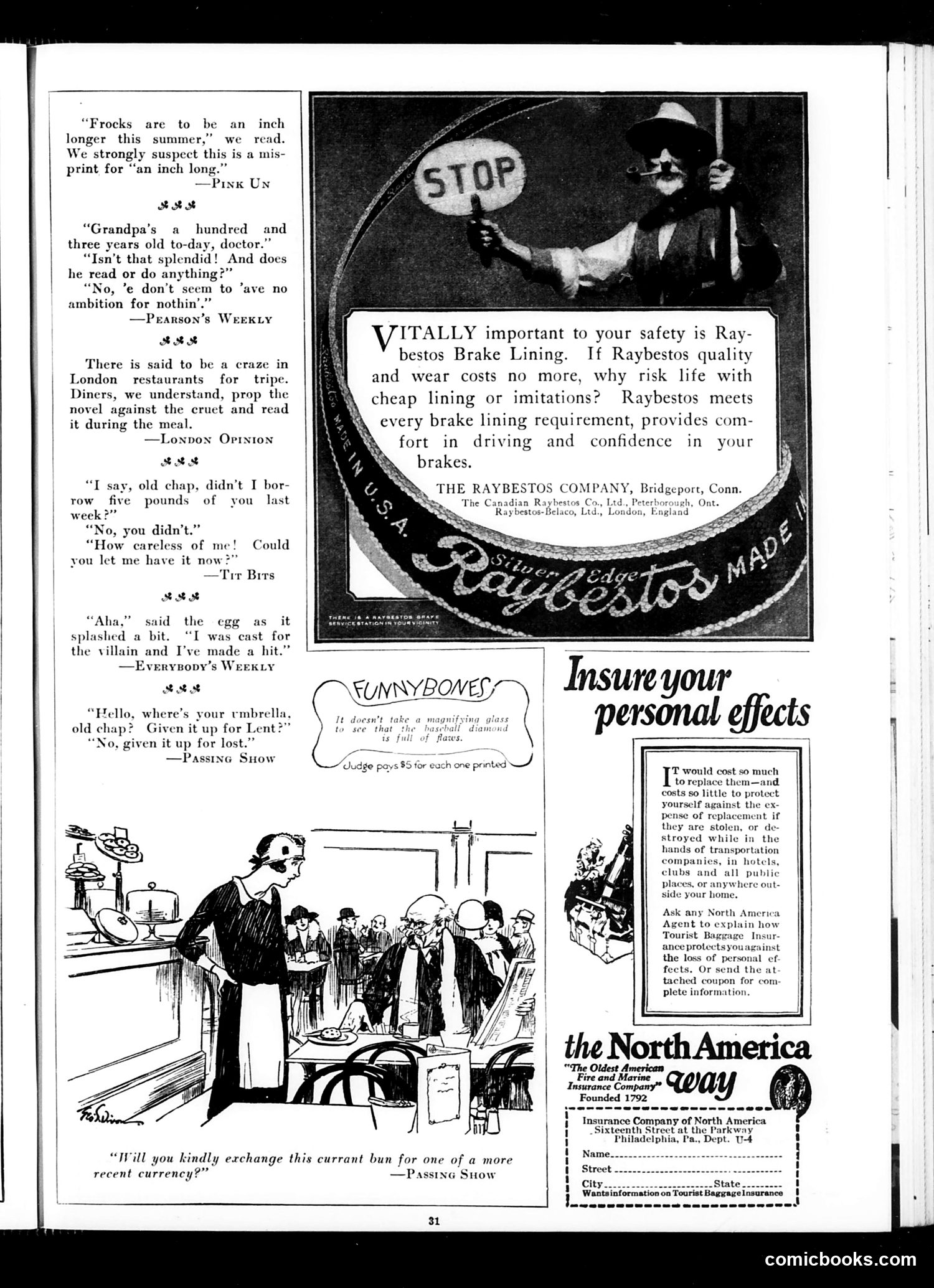
This page contains humor columns and advertisements typical of early 20th-century Judge magazine. The left side features brief comedic quips on various topics: - **Fashion satire**: A joke about women's hemlines getting longer, suggesting the fashion prediction is exaggerated - **Age and vitality**: Humor about a centenarian with no ambition - **London dining trends**: A quip about restaurants where patrons read during meals - **Forgetfulness and borrowing**: A dialogue about unpaid debts - **Egg as actor**: Wordplay where an egg metaphorically "cast" as a villain performs well The right side features two advertisements: **Raybestos Brake Lining** (emphasizing safety) and **North America Insurance** (promoting tourist baggage insurance). The cartoons illustrate the humorous anecdotes. There's no overt political content—this is primarily entertainment and advertising typical of the era's middle-class magazine humor, focusing on domestic situations, fashion, and consumer products.
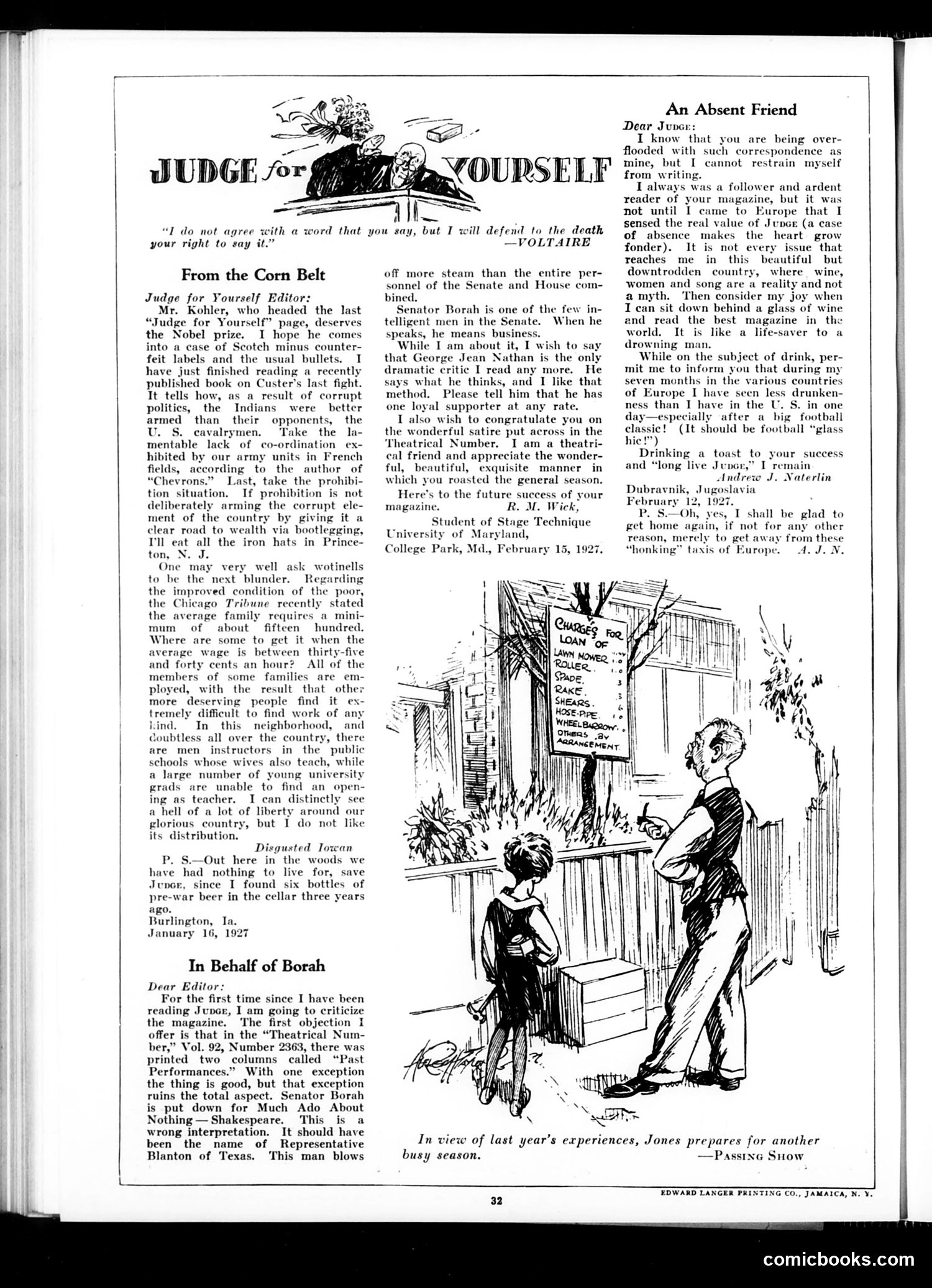
This page contains reader letters to Judge magazine's "Judge for Yourself" advice column, plus one cartoon. **The Main Cartoon** depicts a landlord or property manager showing a tenant a list of charges for apartment damages—likely a humorous commentary on post-rental disputes and the nickel-and-diming of tenants. **The Letters** address: 1. **"From the Corn Belt"**: A reader criticizes Prohibition as arming criminals with bootlegging profits, compares it to military corruption, and complains about economic inequality—families needing $1,500 minimum income while workers earn only 30-40 cents hourly. 2. **"In Behalf of Borah"**: A reader defends Senator William Borah (described as intelligent) against Judge's recent theatrical satire that listed him as performing "Much Ado About Nothing," arguing Representative Blanton of Texas better fits that description. The writer praises dramatic critic George Jean Nathan. 3. **"An Absent Friend"**: A European reader expresses newfound appreciation for Judge magazine while abroad. The page reflects 1920s American concerns: Prohibition enforcement failures, economic hardship, and Senate personalities.
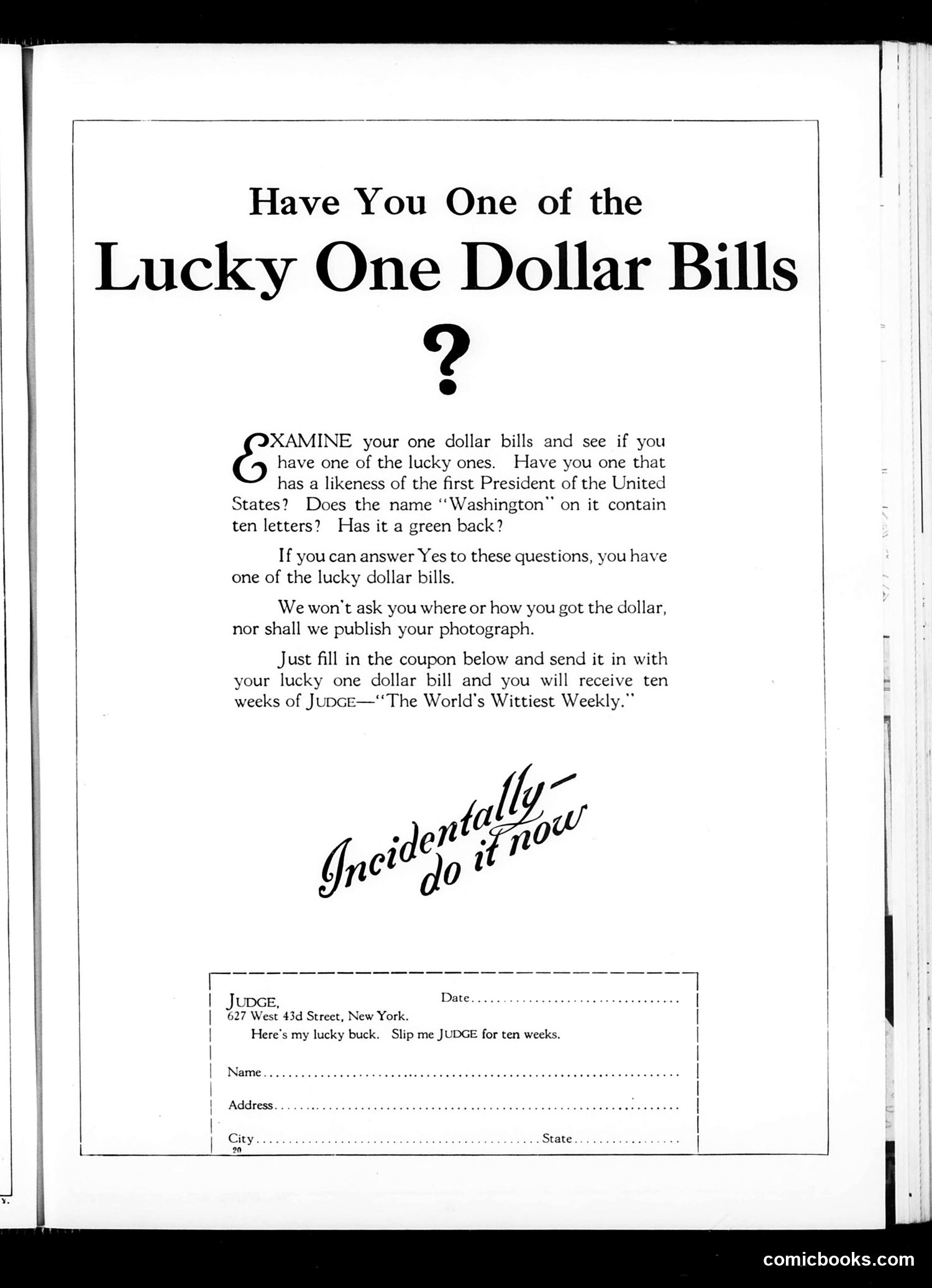
This is a **promotional advertisement**, not a political cartoon. Judge magazine is soliciting readers to send in one-dollar bills in exchange for a ten-week subscription to the publication (subtitled "The World's Wittiest Weekly"). The "lucky" criteria are facetious: the bill must feature George Washington (the first U.S. President), have "Washington" spelled with ten letters, and display a green back—essentially describing a standard, ordinary one-dollar bill. The joke is that there's nothing actually "lucky" about these bills; the magazine is humorously asking readers to send in regular currency as payment. The phrase "Incidentally do it now" urges immediate action. This appears to be a vintage advertisement exploiting the playful appeal of a contest or treasure-hunt concept to drive magazine subscriptions.

This is a **cigarette advertisement**, not satire or political commentary. It's a 1927 Camel cigarettes ad by R.J. Reynolds Tobacco Company. The image shows two well-dressed men and a woman in 1920s attire examining a Camel cigarette pack. The ad's rhetoric is purely commercial: it claims Camel's "goodness"—quality tobacco, skillful blending, consistency, and honesty—makes it the world's leading cigarette. **For modern readers:** This represents pre-regulation tobacco advertising, when cigarette companies could make health and quality claims freely without scientific evidence or health warnings. The emphasis on "goodness," "truthfulness," and "sincerity of purpose" is notably ironic from a contemporary perspective, given what we now know about tobacco's dangers. The aspirational imagery (fashionable people, sophisticated setting) was typical marketing that associated smoking with status and desirability—tactics later restricted by advertising regulations.