
Judge, 1927-04-16 · page 19 of 36
Judge — April 16, 1927 — page 19: what you’re looking at
What you’re looking at
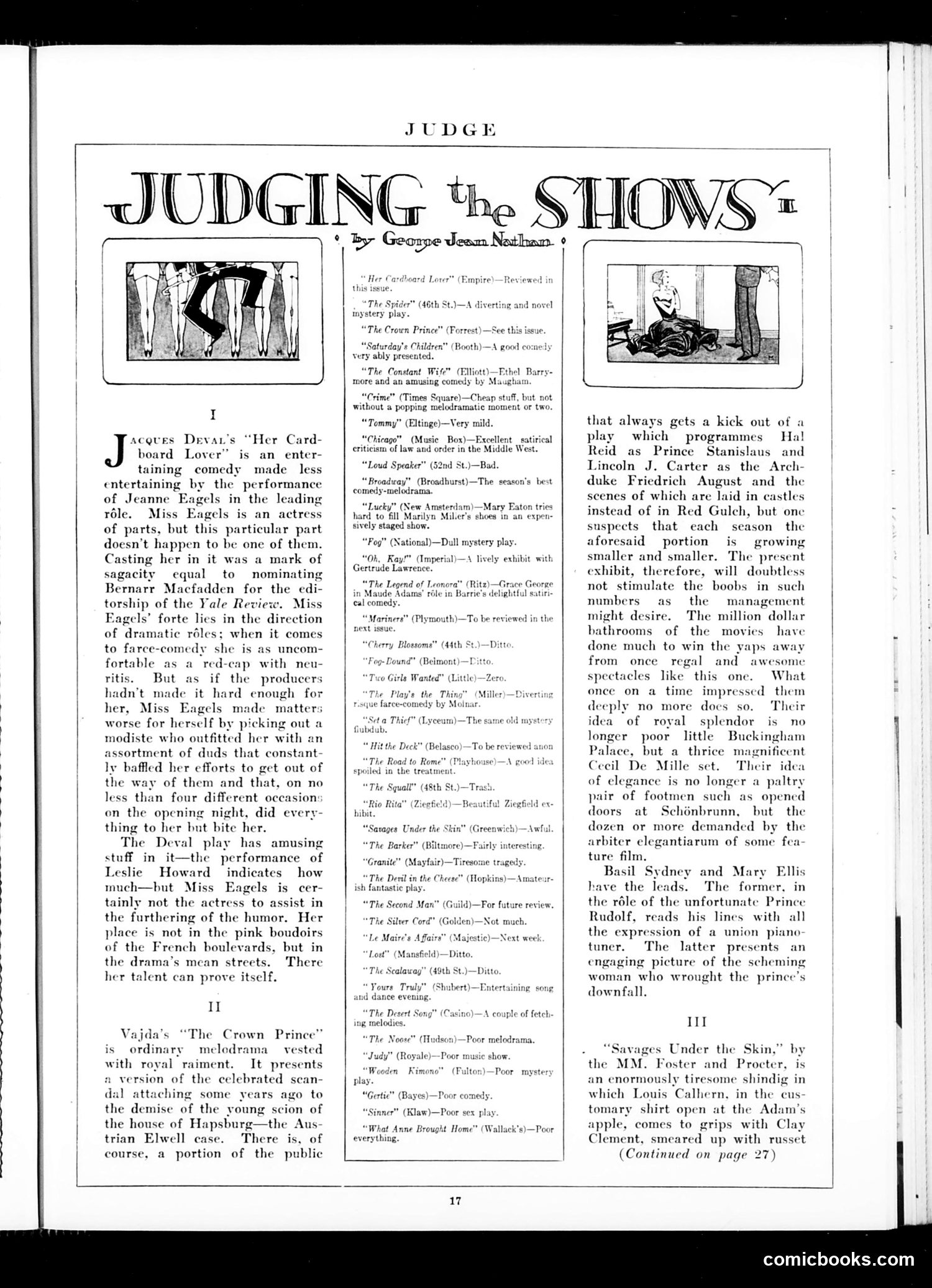
This is a theater criticism page from Judge magazine reviewing Broadway productions. The main content critiques recent plays rather than presenting political satire. The lead review discusses Jacques Deval's "Her Cardboard Lover," faulting actress Jeanne Eagels for her miscast performance in a farce-comedy—her talents lie in dramatic roles, not light comedy. The critic compares her miscasting to nominating Bernarr Macfadden (a famous physical fitness promoter) as editor of Yale Review, emphasizing how absurdly wrong the choice is. A secondary review covers Vajda's "The Crown Prince," described as ordinary melodrama with royal trappings, apparently referencing a real Austro-Hungarian scandal involving the Hapsburg family's young heir (compared to the "Austrian Elwell case"). The bulk of the page lists brief capsule reviews of other current Broadway shows with one or two-line assessments—mostly negative ("Poor," "Dull," "Trash").
📄 Transcribed text from this page (OCR, searchable)
Machine-transcribed from the original scan — historical spelling and the odd misread are preserved.
JUDGE J acgves Devat’s “Her Card- J board Lover” is an enter- taining comedy made less entertaining by the performance of Jeanne Eagels in the leading role. Miss Eagels is an actress of parts, but this particular part doesn’t happen to be one of them. Casting her in it was a mark of sagacity equal to nominating Bernarr Macfadden for the ed torship of the Yale Revie Miss gels’ forte lies in the direction of dramatic réles; when it comes to farce-comedy she is as uncom- fortable as a red-cap with neu- ritis. But as if the producers hadn't made it hard enough for her, Miss Eagels made matters worse for herself by picking out a modiste who outfitted her with an assortment of duds that constant- ly baffled her efforts to get out of the way of them and that, on no less than four different oc on the opening night, did ev thing to her but bite her. The De play has amusing stuff in it—the performance of Leslie Howard indicates how much—but Miss Eagels is cer- tainly not the actress to assist in the furthering of the humor. Her place is not in the pink boudoirs of the French boulevards, but in the drama’s mean streets. There her talent can prove itself. ion: II Vajda’s “The Crown Prince” is ordinary melodrama vested with royal raiment. It presents version of the celebrated scan- dal attaching some years ago to the demise of the young scion of the house of Hapsburg—the Aus- trian Elwell case. There is, of course, a portion of the public “The Spider" (40th St.)—A divert nd novel Inystery pla “The Crown Prince” (Forrest) —See this issue “Saturday's Children’ very ably presented. “The Constant Wife” (Elliott)—Fthel Barry- more and an amusing comedy by Maugham Booth)—A good “Crime” (Times Square)— without a popping melodramatic mc stuff, but not or two. "Tommy" (Eltinge)—Very mild. “Chicago” (Music Box)—E criticism of law and order in the lent _ satirical Middle Wes “Loud Speaker” (52nd St.)—Bad. “Broadway” (Broadhurst)—The season's best comedy-melodrama. “Lucky” (New Amsterdam)—Mary Eaton tries hard to fill Marilyn Milier's shoes in an expen- sively staged show. “Fog” (National) —Dull mystery play. “Oh, Kay!" (Imperial)—A lively exhibit with Gertrude Lawrence. “The Legend of Leonora” (Ritz)—Grace G in Maude Adams’ role in Barrie's delightful satiri- cal comed} “Mariners” (Plymouth)—To be reviewed in the next issue y Blossoms” (44th © Fog-Dound" (Beimont)—T (Lit Play's the Thin ue farce-comedy by Molnar “Seta Thief” (Lyce flubdub. “H “The Road to Rome" led in the treatment “The Squall” (48th St.)—Tras' ‘Rio Rita” (Ziegf hibit “Two Girls Wanted Miller he Deck" (Belasco) —To be reviewed au A good ide Beautiful Ziegsi “Savages Under the Skin" (Greenwich)—Awful, rly 07 interest “Granite (Mayfair)—Tiresome tragec “The Devil in the Chee ish fantastic play. “The Second Man ¢” (Hopkins) —Ams iuild)—For future view. “The Silver Cord” (Go “Le Maire’s Affairs” Lost” (Mansfield)—Ditto. fen)—Not mueb, ajestic)—Next week “The Scalawag” (49th St.)—Ditto. “Yours Trul and dance evening. The Desert Si ing melodies, “The Noose” (Hudson “Judy bert)—Entertaining song no)—A couple of fetch Poor melodrama, Poor music show (Fulton)—Poor myster “Gertic’ (Bayes)—Poor comedy. “Sinner” (Klaw)—Poor sex pla; “What Anne Brought Home" (\ everything. J s gets a kick out of a which programmes Hal as Prince Stanislaus and Lincoln J. Carter as the Arch- duke Friedrich August and the scenes of which are laid in castles instead of in Red Gulch, but one suspects that each season the aforesaid portion is growing smaller and smaller. The present xhibit, therefore, will doubtless not stimulate the boobs in such numbers as the management might desire. The million dollar bathrooms of the movies have done much to win the yaps away from once regal and awesome spectacles i this one. What once on a time impressed them deeply no more docs so. Their idea of royal splendor is no longer poor little Buckingham Palace, but a thrice magnificent y De Mille set. Their idea of eleg: nee is no longer a paltry pair of footmen such as opened doors at Schénbrunn, but the dozen or more demanded by the arbiter elegantiarum of some fea- ture film, Basil Sydney and Mary Ellis have the leads. The former, in the réle of the unfortunate Prince Rudolf, reads his lines with all the expression of a union piano tuner. The latter presents an engaging picture of the scheming woman who wrought the prince’s downfall. III vages Under the Skin,” by the MM. Foster and Procter, is an enormously tiresome shindig in which Louis Calhern, in the eus- tomary shirt open at the Adam’s apple, comes to grips with Cl Clement, smeared up with russet (Continued on page 27) ‘ | | comicbooks.com