
Judge, 1927-04-16 · page 15 of 36
Judge — April 16, 1927 — page 15: what you’re looking at
What you’re looking at
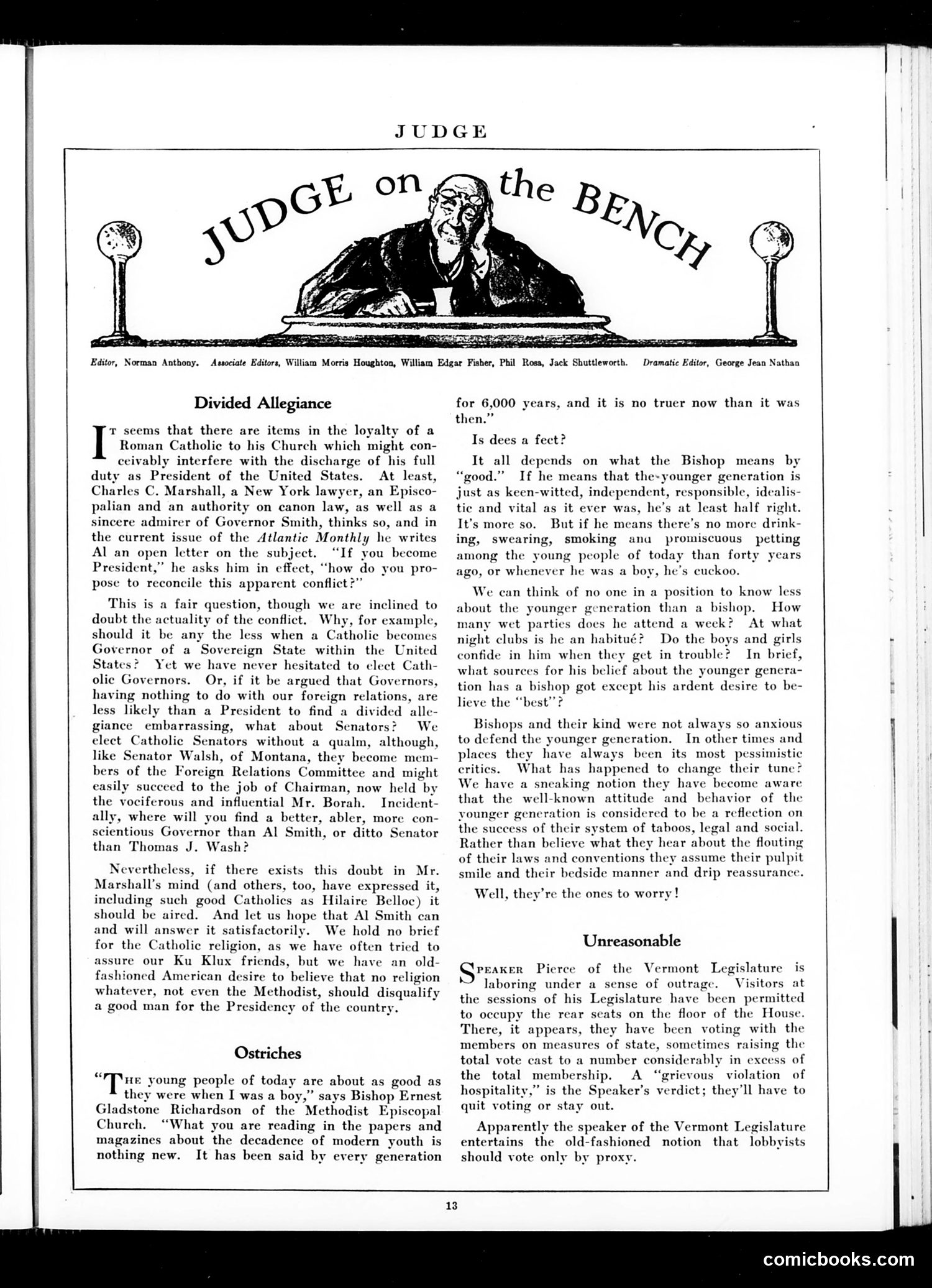
This page from Judge magazine contains two satirical opinion pieces addressing contemporary social issues: **"Divided Allegiance"** critiques concerns about Catholic loyalty, specifically referencing Charles C. Marshall's open letter questioning whether Al Smith (the Catholic New York governor and likely 1928 presidential candidate) could reconcile Church and state duties. Judge defends Smith by pointing out Catholics already serve as governors and senators without controversy, while subtly mocking anti-Catholic prejudice (sarcastically reassuring "Ku Klux friends"). The piece argues religious affiliation shouldn't disqualify qualified candidates. **"Ostriches"** satirizes Bishop Ernest Gladstone Richardson's claim that modern youth are no worse than previous generations. Judge agrees partially but mocks the bishop's naivety—he lacks firsthand knowledge of young people's actual behavior (drinking, smoking, "promiscuous petting"). The satire suggests bishops conveniently defend youth to maintain authority rather than from genuine observation. Both pieces employ Judge's characteristic irreverent tone toward institutions and authority figures.
📄 Transcribed text from this page (OCR, searchable)
Machine-transcribed from the original scan — historical spelling and the odd misread are preserved.
JUDGE Editor, Norman Anthony. Associate Editors, William Morris Houghton, William Edgar Fisher, Phil Ross, Jack Shuttleworth. Dramatic Editor, George Jean Nathan Divided Allegiance v seems that there are items in the loyalty of a Roman Catholic to his Church which might con- ceivably interfere with the discharge of his full as President of the United States. At least, rles C. Marshall, a New York lawyer, an Episco- n and an autho on canon law, as well as sincere admirer of Governor Smith, thinks so, a the current issue of the Atlantic Monthly he w Al an open letter on the subject. “If you become President,” he asks him in effect, “how do you pro- pose to reconcile this apparent conflict?” This is a fair question, though we are inclined to doubt the actuality of the conflict. Why, for example, should it be any the less when a Catholic becomes Governor of a Sovereign State within the United States? Yet we have never hesitated to elect Cath- olic Governors. Or, if it be argued that Governors, having nothing to do with our foreign relations, are s likely than a President to find a divided alle- nee embarrassing, what about Senators? We elect Catholic Senators without a qualm, although, like Senator Walsh, of Montana, they become mem- bers of the Foreign Relations Committee and might easily succeed to the job of Chairman, now held by the vociferous and influential Mr. Borah. Incident- ally, where will you find a better, abler, more con- scientious Governor than Al Smith, or ditto Senator than Thomas J. Wash? Nevertheless, if there exists this doubt in Mr. Marshall's mind (and others, too, have expressed it, including such good Catholics as Hilaire Belloc) it should be aired. And let us hope that Al Smith can and will answer it satisfactorily. We hold no brief for the Catholic religion, as we have often tried to assure our Ku Klux friends, but we have an old- fashioned American desire to believe that no religion whatever, not even the Methodist, should disqualify a good man for the Presidency of the country. Ostriches “Tne young people of today are about as good as they were when I was a boy,” says Bishop Ernest Gladstone Richardson of the Methodist Episcopal Church. “What you are reading in the papers and magazines about the decadence of modern youth is nothing new. It has been said by every generation for 6,000 years, and it is no truer now than it was then.” Is dees a fect? It all depends on what the Bishop means by “good.” If he means that the-younger generation is just as keen-witted, independent, responsible, idealis- tic and vital as it ever was, he’s at least half right. It’s more so. But if he means there’s no more drink- ing, swearing, smoking ana promiscuous petting among the young people of today than forty years ago, or whenever he was a boy, he’s cuckoo. We can think of no one in a position to know less about the younger generation than a bishop. How many wet parties does he attend a weck? At what night clubs is he an habitué? Do the boys and girls confide in him when they get in trouble? In brief, what sources for his belie about the younger genera- tion has a bishop got except his ardent desire to be- lieve the “best”? Bishops and their kind were not always so anxious to defend the younger generation. In other times and places they have always been its most pessimistic critics. What has happened to change their tune? We have a sneaking notion they have become aware that the well-known attitude and behavior of the younger generation is considered to be a reflection on the success of their system of taboos, legal and social. Rather than believe what they hear about the flouting of their laws and conventions they assume their pulpit smile and their bedside manner and drip reassurance. Well, they’re the ones to worry! Unreasonable PEAKER Pierce of the Vermont Legislature is laboring under a sense of outrage. Visitors at the sessions of his Legislature have been permitted to occupy the rear seats on the floor of the House. There, it appears, they have been voting with the members on measures of state, sometimes raising the total vote cast to a number considerably in excess of the total membership. A “grievous violation of hospitality,” is the Speaker’s verdict; they'll have to quit voting or stay out. Apparently the speaker of the Vermont Legislature entertains the old-fashioned notion that lobbyists should vote only by proxy. comicbooks.com