
Judge, 1927-04-16 · page 30 of 36
Judge — April 16, 1927 — page 30: what you’re looking at
What you’re looking at
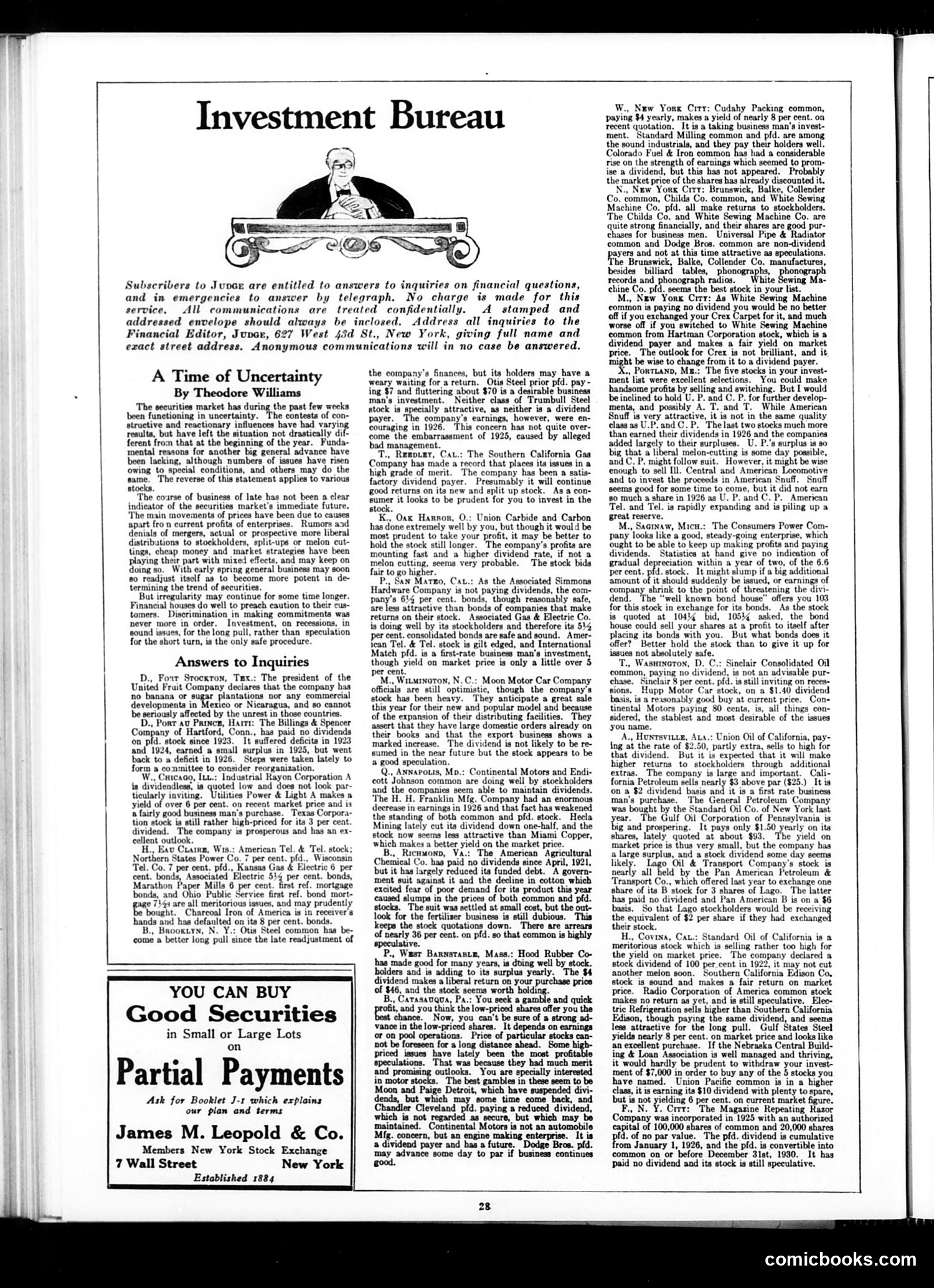
This page from Judge magazine contains **no political cartoons or satire**—it is primarily financial advice and advertising. The main content is Theodore Williams's column "A Time of Uncertainty," analyzing the 1920s stock market's irregular behavior, followed by an "Answers to Inquiries" section providing investment recommendations to readers. The sole illustration shows an older gentleman reviewing financial documents—a generic representation of investment counsel, not a caricature or satirical figure. The page advertises James M. Leopold & Co.'s brokerage services, emphasizing they offer small-lot purchases with partial payments. Context for modern readers: This reflects the 1920s investment culture before the 1929 crash, when financial advice columns and stock tips were common magazine features. The emphasis on caution and "sound issues" suggests some market nervousness, though full economic context remains unclear from this page alone.
📄 Transcribed text from this page (OCR, searchable)
Machine-transcribed from the original scan — historical spelling and the odd misread are preserved.
and servi A Time of Uncertainty By Theodore Williams The securities market has during the past few weeks been funetioning in uncertainty. The contest of con- structive and reactionary influences have had varying resulta, but have left the situation not drastically di ferent from that at the beginning of the year. Fund: mental reasons for another big general advance have been lacking, although numbers of issues have risen ‘owing to special conditions, and others may do the same. The reverse of this statement applies to various stocks. ‘The coarse of business of late has not been a clear indicator of the securities market's immediate future. ‘The main movements of prices have been due to causes art fron current profits of enterprises. Rumors and denials of mergers, actual or prospective more liberal distributions to stockholders, split-ups or melon cut- tings, cheap money and market strategies have been playing their part with mixed effects, and may keep on doing so. With early spring general business may soon #0 readjust itself as to become more potent in de- termining the trend of securities. But irregularity may continue for some time longer. Financial houses do well to preach caution to their cus- tomers. Discrimination in making commitments was never more in order. Investment, on recessions, in sound issues, for the long pull, rather than speculation for the short turn, is the only safe procedure. Answers to Inquiries D., Fort Stockrox, Tax.: The president of the United Fruit Company’ declares that the company has no banana or sugar plantations nor any commercial developments in Mexico or Nicaragua, and so cannot be seriously affected by the unrest in those countries. D., Port av Paice, Harri: The Billings & Spencer Company of Hartford, Conn., has paid no dividends on pfd. stock since 1923. It suffered deficits in 1923 and 1924, earned a small surplus in 1925, but went back to a deficit in 1926. Steps were taken lately to fori a committee to consider reorganization. W., Cutcadg, Iu.: Industrial Rayon Corporation A is dividendl juoted low and does not look par- ticularly inviting. Uuiities Power & Light A makes a yield of over 6 per cent. on recent market price and is 8 fairly good business man’s purchase. Texas Corpora- tion stock is still rather high-priced for its 3 per cent. dividend. ‘The company is prosperous and has an ex- cellent outlook. H., Eav Caine, Wis.: American Tel. & Tel. stock; Northern States Power Co. 7 per cent. pfd., Wisconsin Tel. Co. 7 per cent. pfd., Kansas Gas & Electric 6 per cent. bonds, Associated Electric 514 per cent. bonds, hon Paper Mills 6 per cent. first ref. mortgage and Ohio Public Service first ref. bond mort- 43 are all meritorious issues, and may prudently bought. Charcoal Iron of America is in receiver's hands and has defaulted on its 8 per cent. bonds. B., Brooxtrn, N. Y.: Otis Steel common has be- come a better long pull since the late readjustment of YOU CAN BUY Good Securities in Small or Large Lots Partial Payments Ask for Booklet J-1 which explains our plan and terms James M. Leopold & Co. Members New York Stock Exchange 7 Wall Street New York Established 1884 Investment Bureau Subscribers to Juvex are entitled to answers to inquiries on financial questions, emergencies to answer by telegraph. No charge is made for this ¢. All communications are treated confidentially. A stamped and addressed envelope should always be inclosed. Address all inquiries to the Financial Editor, Juvar, 627 West 43d St., New York, giving full name and exact street address, Anonymous communications will in no case be answered. the company’s finances, but its holders may have a weary waiting for a return. Otis Steel prior pfd. pay - ing $7 and fluttering about $70 is a desirable business man’s investment. Neither class of Trumbull Steel stock is specially attractive, as neither is a dividend payer. ‘The company's earnings, however, were en- couraging in 1926. This concern has not quite over- come the embarrassment of 1925, caused by alleged bad management. T., Rerourr, Cat.: The Southern California Gas Company has made a record that places its issues in a high grade of merit. e company has been a satis- factory dividend payer. Presumably it will continue good returns on its new and split up stock. Asa con- sumer it looks to be prudent for you to invest in the stock. K., Oak Hannon, O.: Union Carbide and Carbon has done extremely well by you, but though it would be most prudent to take your profit, it may be better to hold the stock still longer. The company's profits are mounting fast and a higher dividend rate, if not a melon cutting, seems very probable. The stock bids fair to go higher. P., San Mateo, Cat.: As the Associated Simmons Hardware Company is not paying dividends, the com- pany’s 6'4 per cent. bonds, though reasonably safe, are less attractive than bonds of companies that make returns on their stock. Associated Gas & Electric Co. is doing well by its stockholders and therefore its 544 per cent. consolidated bonds are safe and sound. Amer- iean Tel. & Tel. stock is gilt edged, and International Match pfd. is a first-rate business’ man's investment, though yield on market price is only a little over 5 per cent. M., Witarnaton, N.C.: Moon Motor Car Company officials are still optimistic, though the company’s stock has been heavy. They anticipate a great sale this year for their new and popular model and because of the expansion of their distributing facilities. They assert that they have large domestic orders already on their books and that the export business shows a marked inerease. The dividend is not likely to be re- sumed in the near future but the stock appears to be a good speculation. NNavotis, Mp.: Continental Motors and Endi- eott Johnson common are doing well by stockholders and the companies seem able to maintain dividends. ‘The H. H. Franklin Mfg. Company had an enormous decrease in earnings in 1926 and that fact has weakened the standing of both common and pfd. stock. Hecla Mining lately cut its dividend down one-half, and the stock now seems less attractive than Miami Copper, which makes a better yield on the market price. B., Ricumonp, Va.: The American Agricultural Chemical Co. has paid no dividends since April, 1921, but it has largely reduced ita funded debt. A govern- ment suit against it and the decline in cotton which excited fear of poor demand for its product this year caused slumps in the prices of both common and pfd. stocks. The suit was settled at small cost, but the out- look for the fertilizer business is still dubious. This keeps the stock quotations down. There are arrears of nearly 36 per cent. on pfd. so that common is highly speculative. P., Wast Barnstasue, Mass.: Hood Rubber Co- has made good for many years, is doing well by stock. holders and is adding to its surplus yearly. The $4 dividend makes a liberal return on your purchase price of $46, and the stock seems worth holding. B., Catasauqua, Pa.: You seek a gamble and quick and you think the low-priced shares offer you the chance. Now, you can't be sure of a strong ad- vance in the low-priced shares. It depends on earnings cor on pool operations. Price of particular stocks can- not be foreseen for a long distance ahead. Some hii priced issues have lately been the most profitable speculations. ‘That was because they had much merit and promising outlooks. You are specially interested in motor st }. The best gambles in these seem to be Moon and Paige Detroit, which have suspended divi- dends, but which may some time cot Chandler Cleveland pfd. paying a reduced divid which is not regarded as secure, but which may be ee Costinactal Motors is not an Ca . concern, but an engine making enterprise. It is a divideod payer and has a future. Dodge Bros. pfd. may advance some day to par if business continues 8 f BE W., Naw Yore Crrr: Cudahy Packing common, paying $4 yearly, makes a yield of nearly 8 per cent. on Fecent quotation. It is a taking business man's invest- ment. Standard Milling common and pfd. are among ‘the sound industrials, and they pay their holders well. Colorado Fuel d Iron common bas had a considerable rise on the strength of earnings which seemed to prom- ioe a dividend, but this bas not appeared, Probably the market price of the shares has already discounted it. N., New York Cirr: Brunswick, Balke, Collender Co. common, Childs Co. common, and White Sewing Machine Co. pfd. all make returns to stockholders. The Childs Co. and White Sewing Machine Co. are quite strong financially, and their shares are good pur- chases for business men. Universal Pipe & Radiator common and Dodge Bros. common are non-dividend pagers and not af this time attractive as speculations. ‘he Brunswick, Balke, Collender Co. manufactures, besides billiard tables, phonographs, phonograph records and phonograph radios. Vhite Sewing Ma- chine Co. pfd. seems the best stock in your list. M., New Yor« Crrr: As White Sewing Machine common is paying no dividend you would be no better off if you exchanged your Crex Carpet for it, and much worse off if you switched to White Sewing Machine common from Hartman Corporation stock, which is a dividend payer and makes a fair yield on market Price. The outlook for Crex is not brilliant, and it ight be wise to change from it to a dividend payer. ™X., Ponttano, Mu.: ‘The five stocks in your invest- ment list were excellent selections. You could make handsome profits by selling and switching. But I would be inclined to hold U. P. and C. P. for further develop- ments, and possibly A. T. and T. While American Snuff is very attractive, it is not in the same quality class as U.P.and C. P. "The last two stocks much more than earned their dividends in 1926 and the companies added largely to their surpluses. U. P.’s surplus is 80 big that a liberal melon-cutting is some day possible, and C. P. might follow suit. However, it might be wise enough to sell Ill. Central and American Locomotive and to invest the proceeds in American Snuff. Snuff seems good for some time to come, but it did not earn 80 much a share in 1926 as U. P. and C. P. American Tel. and Tel. is rapidly expanding and is piling up a great reserv' M., Saginaw, Micu.: The Consumers Power Com- pany looks like a good, steady-going enterprise, which ‘ought to be able to keep up making profits and payiny dividends. Statistics at hand give no indication of gradual depreciation within a year of two, of the 6.6 per cent. pfd. stock. It might slump if a big additional amount of it should suddenly be issued, or earnings of company shrink to the point of threatening the divi- dend.- ‘The “well known bond house” offers you 103 for this stock in exchange for its bonds. As the stock is quoted at 10434 bid, 10514 asked, the bond house could sell your shares at a profit to itself after placing its bonds with you. But what bonds does it offer?” Better hold the stock than to give it up for issues not absolutely safe. T., Wasutxato inclair Consolidated Oil ying no dividend, is not an advisable pur- : air 8 per cent. pfd. is still inviting on reces- sions. Hupp Motor Car stock, on a $1.40 dividend basis, is a reasonably good buy at current price. Con= tinental Motors paying 80 cents, is, all things con- sidered, the stablest and most desirable of the issues you name. A., Huntsvitte, ALA.: Union Oil of California, pay- ing at the rate of $2.50, partly extra, sells to high for that dividend. But it ‘is expected that it will make higher returns to stockholders through additional extras. The company is large and important. Cali- fornia Petroleum sells nearly $3 above par ($25.) It is on a $2 dividend basis and it is a first rate business man’s purchase. The PERE, Ihe Gulf Oil Corporation of Penney big and prospering. It pays only $1.50 yearly on its shares, lately quoted at about he yield on market price is thus very small, but the company has a large surplus, and a stock dividend some day seems likely. Lago Oil & Transport Company's stock is nearly all held by the Pan American Petroleum é& Transport Co., which offered last year to exchange one share of its B'stock for 3 shares of Lago. The latter has paid no dividend and Pan American B is on a $6 basis, So that Lago stockholders would be receivin the equivalent of $2 per share if they had exchanged their stock. H., Covina, Ca Standard Oil of California is a ich is selling rather too high for the yield on market price. The company declared a stock dividend of 100 per.cent in 1922, it may not cut another melon soon. Southern California Edison Co, stock is sound and makes a fair return on market price. Radio Corporation of America common stock makes no return as yet, and is still speculative. Eleo- Aric Refrigeration sells higher than Southern California Edison, though paying the same dividend, and seems less attractive for the long pull. Gulf States Steel yields nearly 8 per cent. on market price and looks like an excellent purchase. If the Nebraska Central Build- ing & Loan Association is well managed and thriving, it would hardly be prudent to withdraw your invest- ment of $7,000 in order to buy any of the 5 stocks you have named. Union Pacific common is in a higher class, it is earning its $10 dividend with plenty to spare, but is not Yeiding 6 per cent. on current market figure. F., N. Y. Crrv: The Magazine Repeating Razor Company was incorporated in 1925 with an authorized copie of 100,000 shares of common and 20,000 shares pi . of no par value. The pfd. dividend is cumulative irom January 1, 1926, and the pfd. is convertible into common on or before December 3ist, 1930. It has paid no dividend and its stock is still speculative. comicbooks.com