
A complete issue · 36 pages · 1927
Judge — January 8, 1927
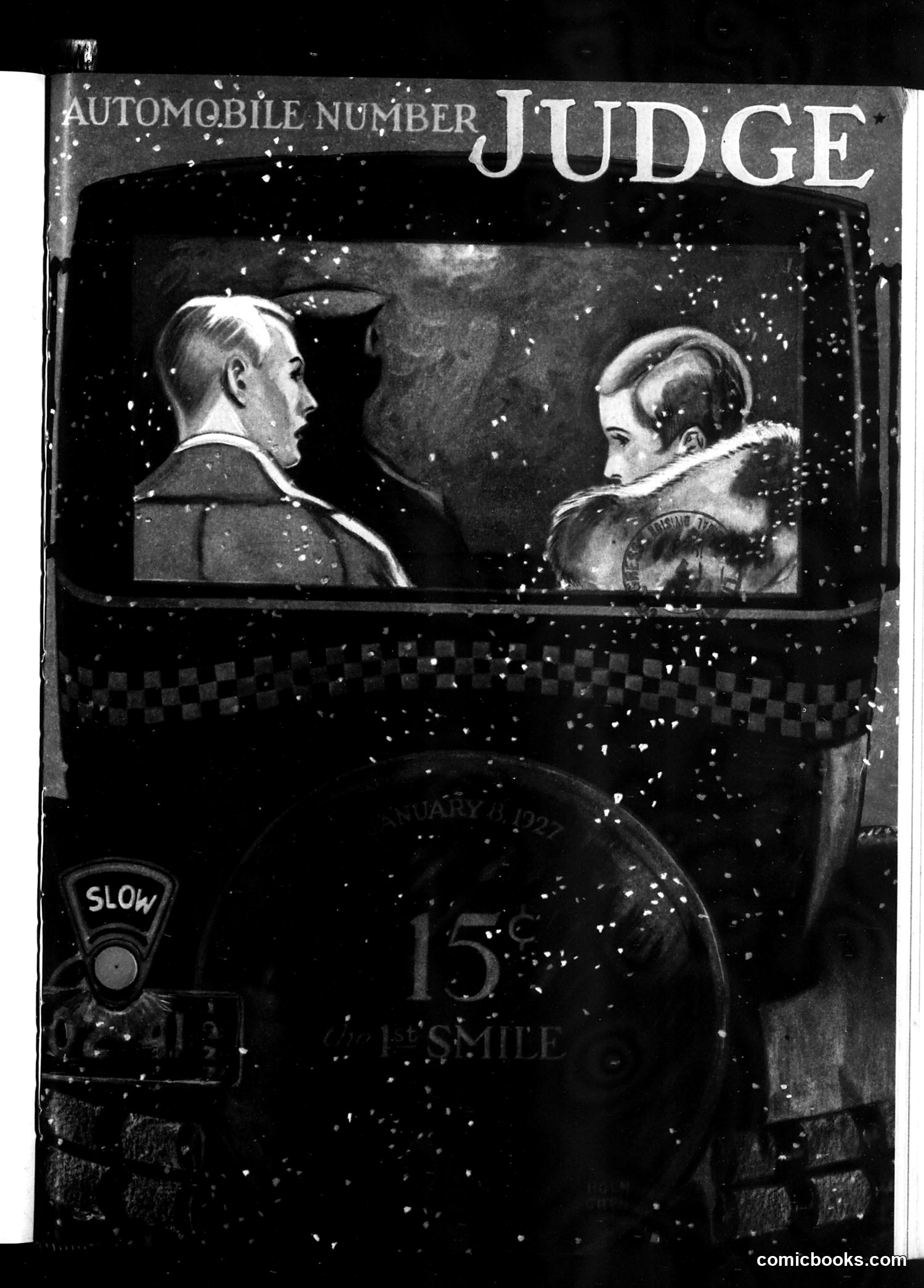
This appears to be a cover or illustration from *Judge* magazine, depicting two men in formal attire inside an automobile, with snow falling outside. The title "Automobile Number Judge" and a "SLOW" speedometer gauge suggest this is satirizing automotive safety or driving behavior. The two figures appear to be engaged in conversation or confrontation within the vehicle. Without clearer context or identifying details visible in the image, I cannot definitively identify who these specific men represent. The "slow" gauge and snowy conditions suggest commentary on winter driving caution or perhaps regulatory speed limits—issues relevant to early 20th-century automotive culture. The satirical point likely critiques driving habits or automotive regulation of that era, though the precise political or social target remains unclear from the visual evidence alone.
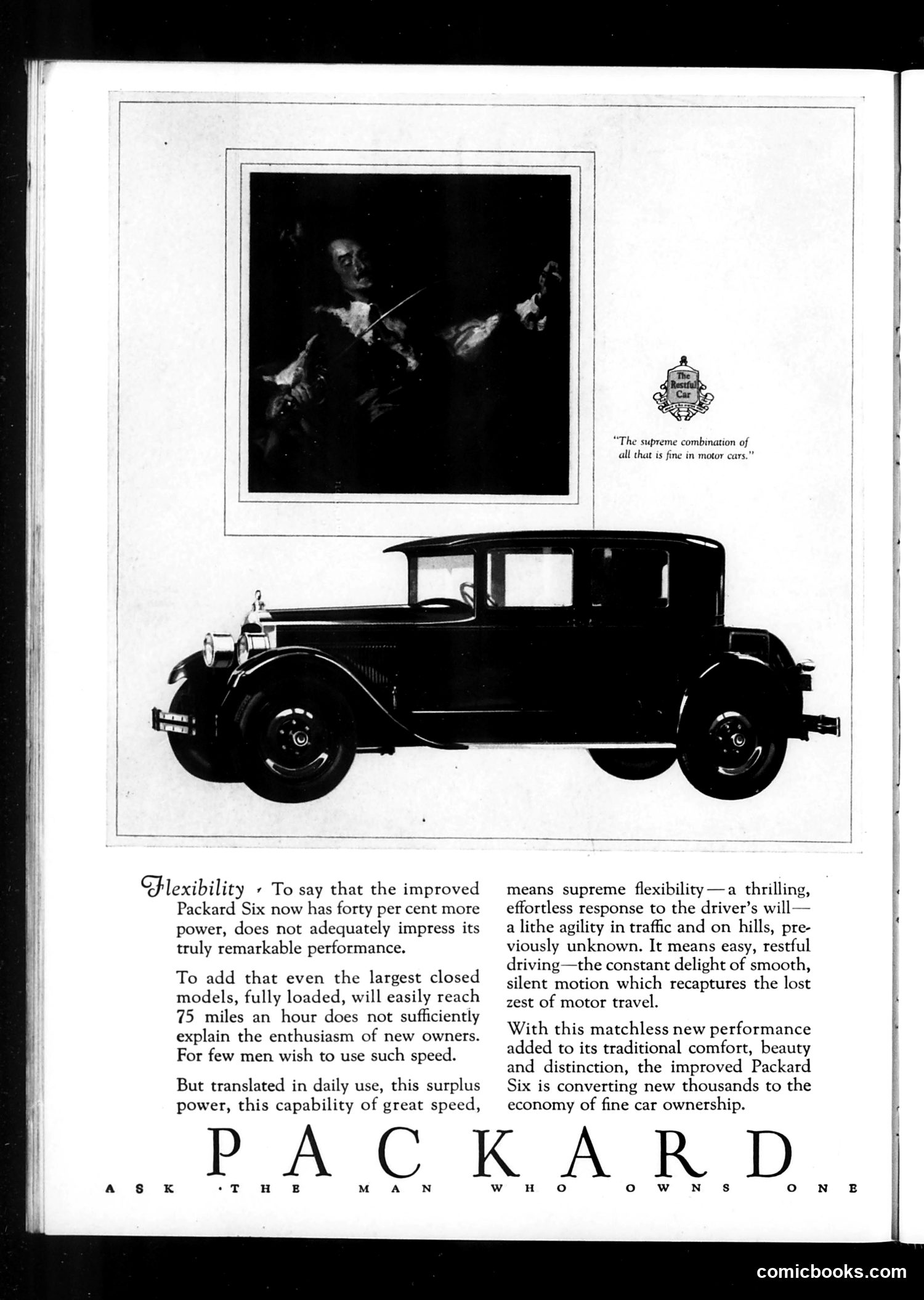
This page is primarily a **Packard automobile advertisement**, not political satire. The ad emphasizes the improved Packard Six's "flexibility" and performance capabilities—forty percent more power, ability to reach 75 mph fully loaded, and smooth, effortless driving responsiveness. The portrait at top appears to be a glamorous figure (possibly a celebrity or society figure of the era) endorsing the vehicle through the tagline: "The supreme combination of all that is fine in motor cars." The satirical element, if any, is subtle—possibly mocking the pretension of luxury car marketing or the association of fine automobiles with high society. However, this reads primarily as **straightforward advertising copy** rather than pointed social or political commentary typical of Judge magazine's satirical tradition.
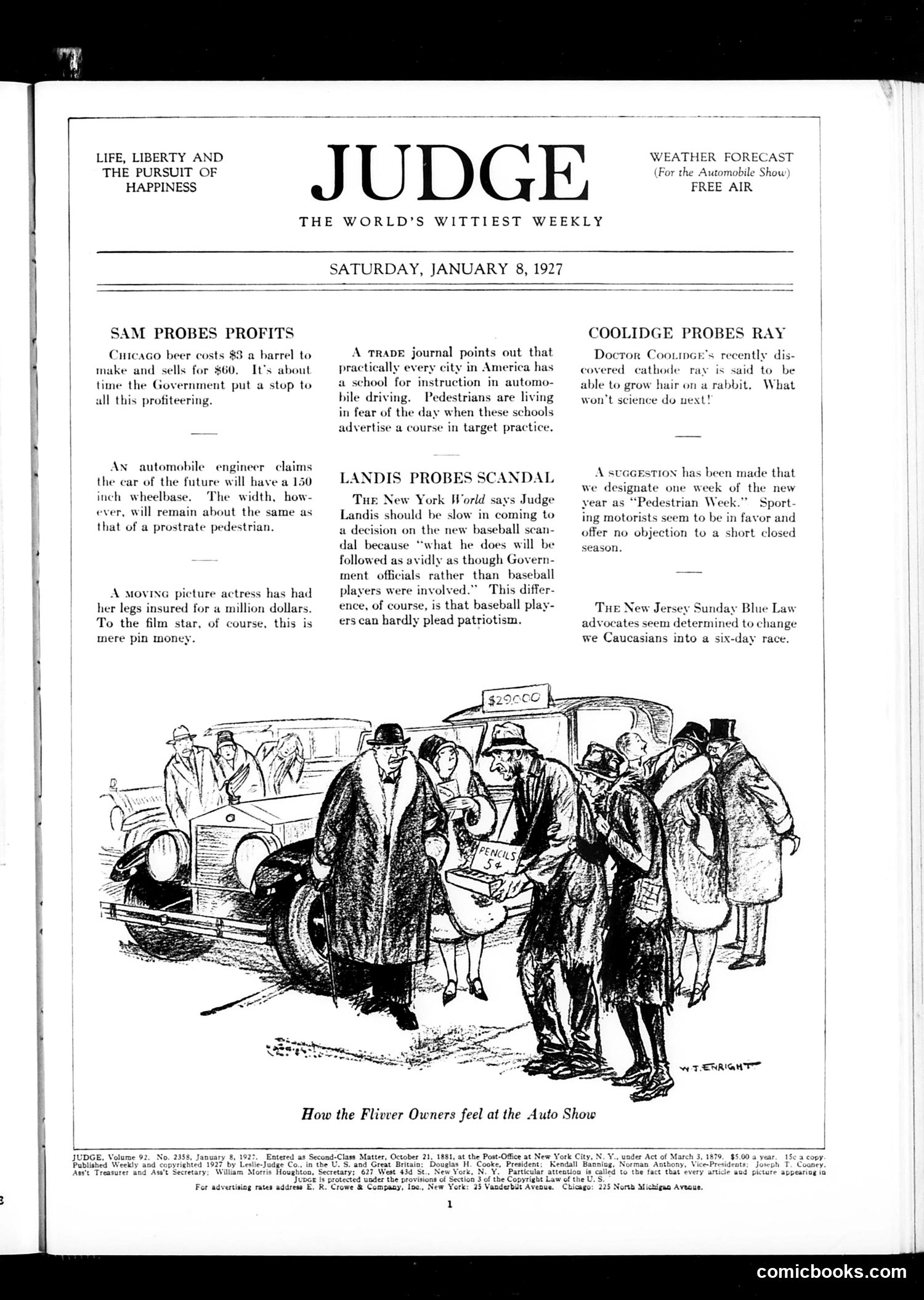
The main cartoon, titled "How the Flivver Owners feel at the Auto Show," depicts a crowd of working-class men in coats and hats gathered around an expensive automobile priced at $2,500—a fortune for ordinary Americans in 1927. The term "Flivver" refers to the Ford Model T, the affordable mass-market car. The satire targets the vast wealth gap: while common people drove cheap Fords, luxury automobiles remained impossibly expensive. The cartoon mocks the disconnect between what average car owners could afford and the extravagant vehicles displayed at auto shows, implying both amazement and bitter resentment at the financial gulf separating social classes during the prosperous 1920s.
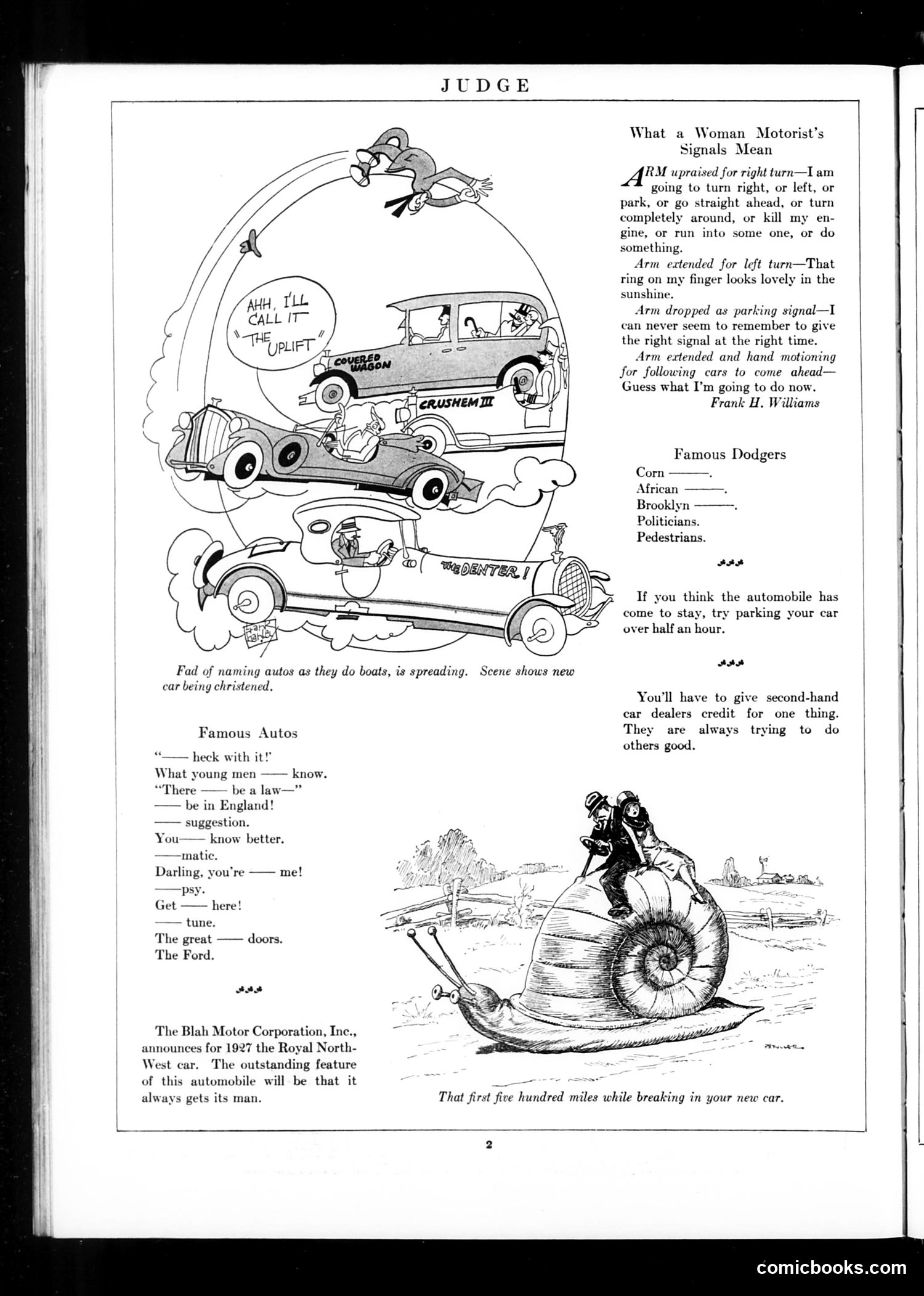
This page satirizes 1920s automobile culture through humor about driving, particularly women drivers. The main cartoon shows a chaotic car accident scene labeled "the uplift," mocking how women motorists communicate intentions through arm signals—which the accompanying text humorously interprets as fashion statements rather than safety signals (e.g., "That ring on my finger looks lovely in the sunshine"). The "Famous Dodgers" and "Famous Autos" sections are fill-in-the-blank jokes poking fun at common driving behaviors and car models (mentioning corn, Africans, Brooklyn, pedestrians, and the Ford). The bottom illustration depicts a couple on an oversized snail, captioning "That first five hundred miles while breaking in your new car"—mocking how carefully new car owners drive during break-in periods. The overall tone ridicules both reckless and overly cautious drivers.
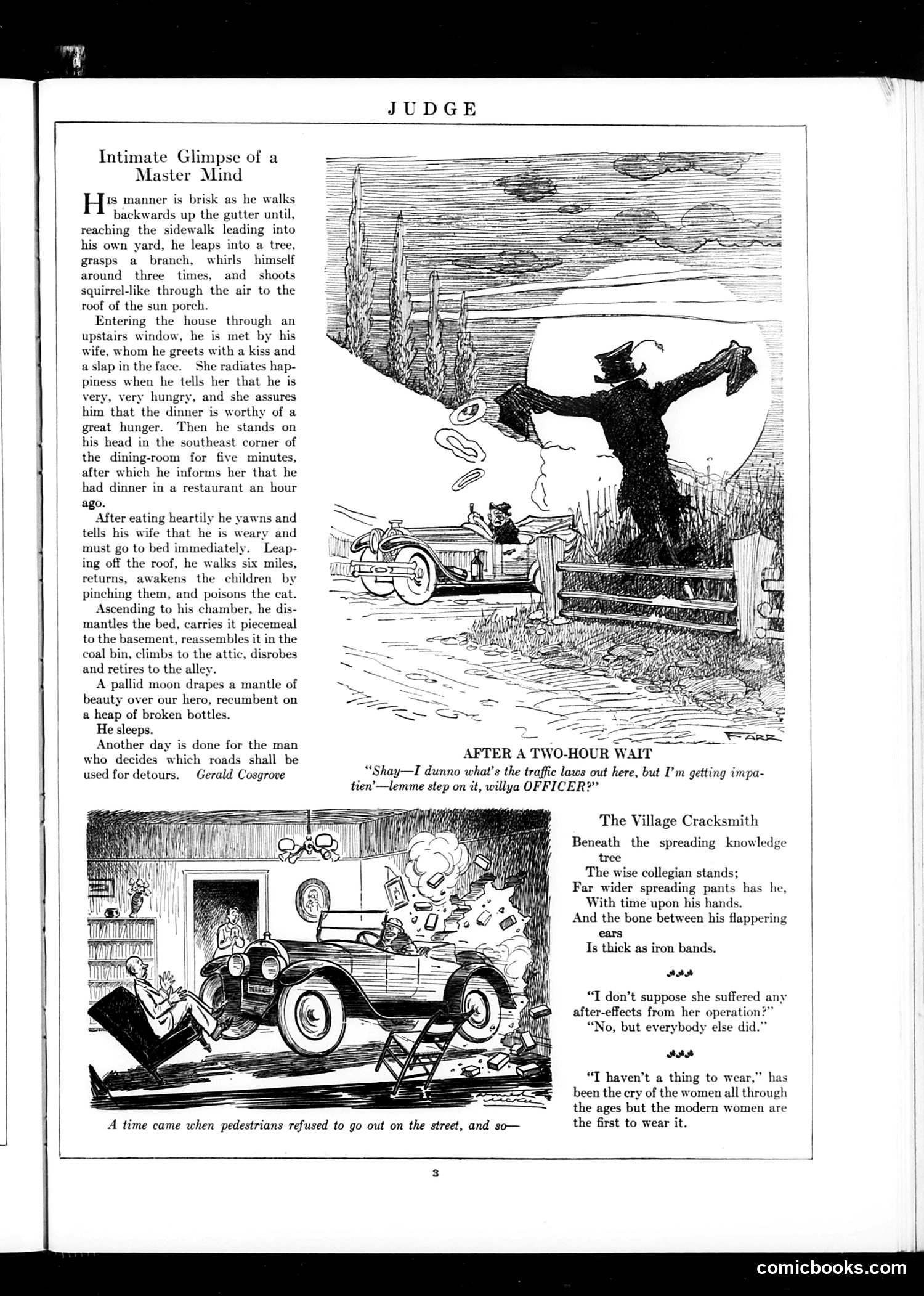
This page satirizes early 20th-century American life through three vignettes: **"Intimate Glimpse of a Master Mind"** mocks a busy executive who rushes through his day—eating quickly, ignoring his hungry family, managing household chaos—yet accomplishes nothing but exhaustion. The satire suggests his frantic activity masks actual incompetence. **"After a Two-Hour Wait"** depicts a driver impatiently confronting a traffic officer about road detours, implying frustration with urban automobile congestion and police authority—emerging concerns as cars became common. **"The Village Cracksmith"** celebrates rural wisdom through verse, contrasting the "wise collegian" with traditional craftsmen, likely reflecting nostalgic anxiety about modernization and loss of traditional skills. Overall, the page satirizes modern urban life's contradictions: busyness without accomplishment, technology creating new frustrations, and displacement of traditional knowledge.
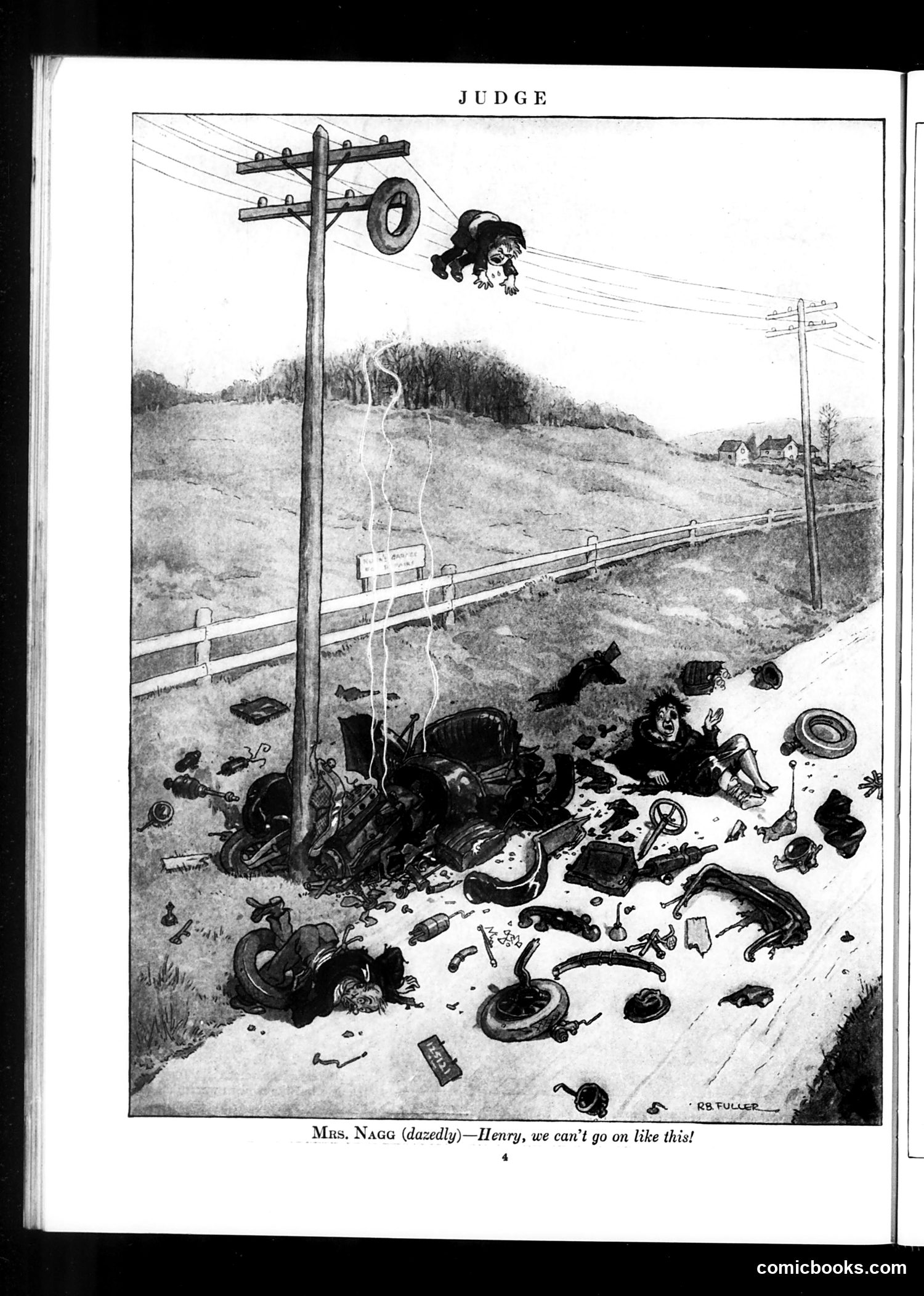
This cartoon satirizes dangerous automobile driving. The scene shows a catastrophic car crash with debris scattered around a utility pole, depicting mechanical parts, a wrecked vehicle, and injured or dead figures strewn about. A woman (labeled "Mrs. Nagg") exclaims to her husband Henry: "we can't go on like this!" The satire targets reckless motorists—particularly men—whose dangerous driving habits endangered passengers and pedestrians during the early automobile era. The cartoon appears to critique both the driver's negligence and the emerging automotive culture of the 1910s-1920s. The "dazed" notation suggests Henry is stunned or confused, implying he represents the typical careless driver oblivious to the consequences of speeding or poor vehicle control. The exaggerated wreckage emphasizes the era's genuine automobile safety concerns.
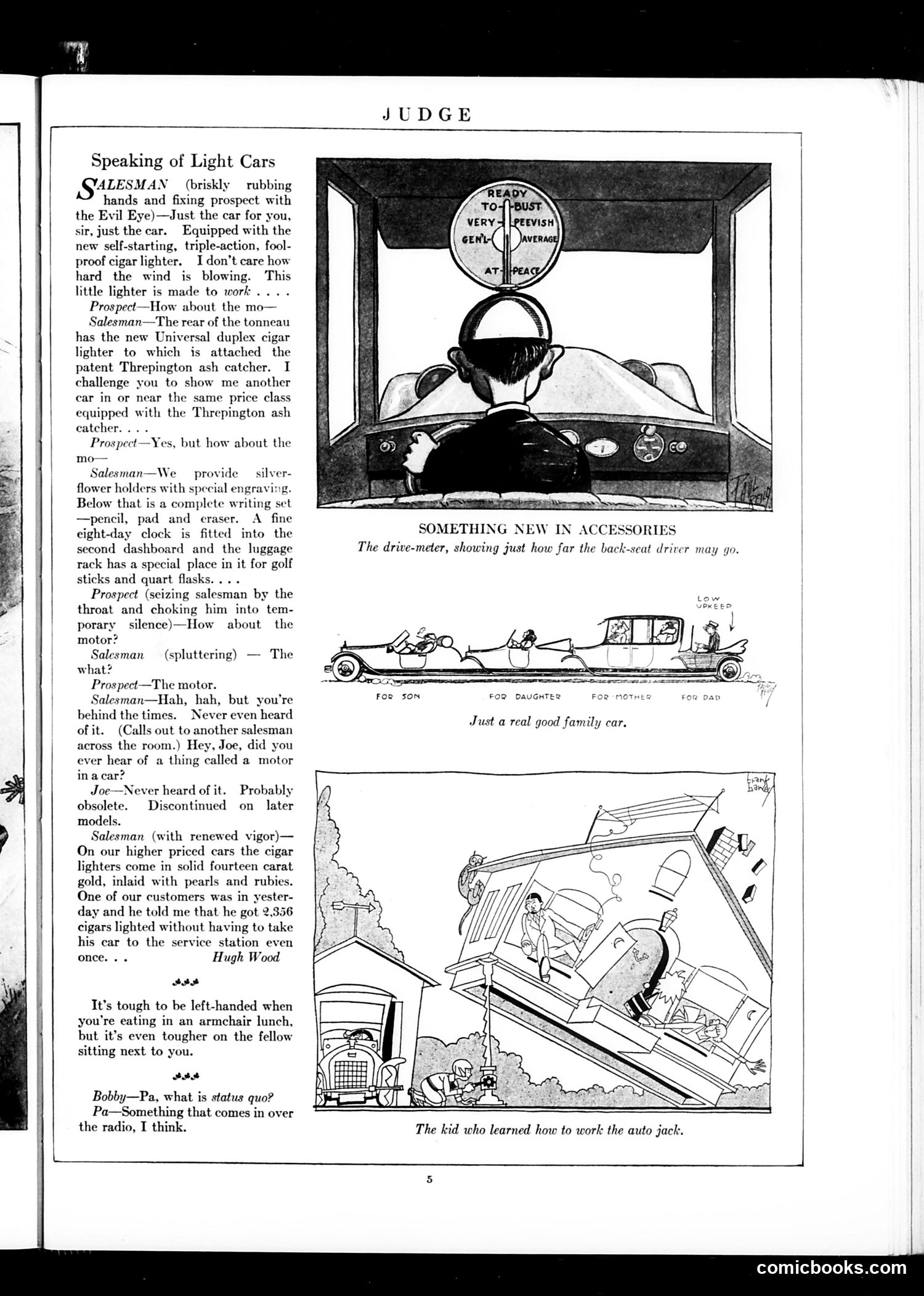
This page contains automotive humor and product advertisements from an unspecified era (likely early-to-mid 20th century based on car designs). **Main Content:** The left column features a humorous dialogue between a salesman and prospect about car accessories—cigar lighters, ash catchers, flower holders, and writing sets. The joke plays on the salesman's persistence and increasingly absurd feature claims. **Cartoons:** Three illustrated panels show: 1. A driver with various car accessories labeled above 2. A multi-seat family car concept labeled "Just a real good family car" 3. A child learning to use an auto jack **Satire:** The humor targets 1920s-30s car culture's excessive accessorization and salesmen's aggressive marketing tactics. The exaggerated features mock the automotive industry's push to sell unnecessary luxuries to consumers.
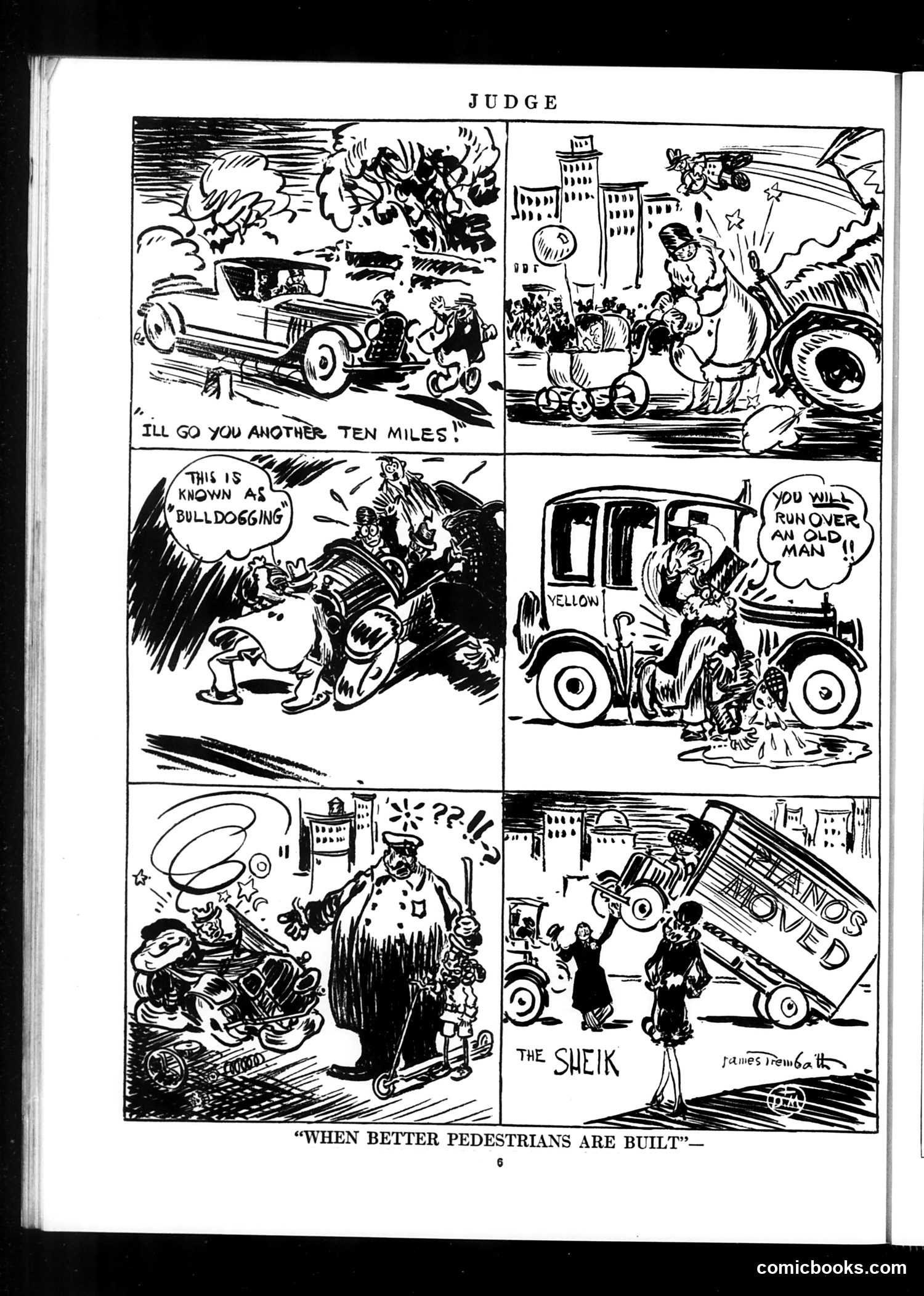
This satirical comic mocks reckless driving and traffic safety in the early automobile era. The narrative follows a driver who proposes increasingly dangerous "solutions" to pedestrian safety: 1. **"Bulldogging"** - aggressive driving tactics 2. A **yellow taxi** that will "run over an old man" 3. A tornado-like collision sequence 4. **"The Sheik"** - a wrecked vehicle labeled "RUINED" The title's ironic reference to "better pedestrians" suggests the cartoonist's actual point: rather than blaming pedestrians for accidents, drivers and automobiles themselves pose the danger. The escalating absurdity satirizes how drivers rationalize unsafe behavior, implying society should instead focus on safer driving practices and vehicle regulation rather than expecting pedestrians to simply avoid being hit.
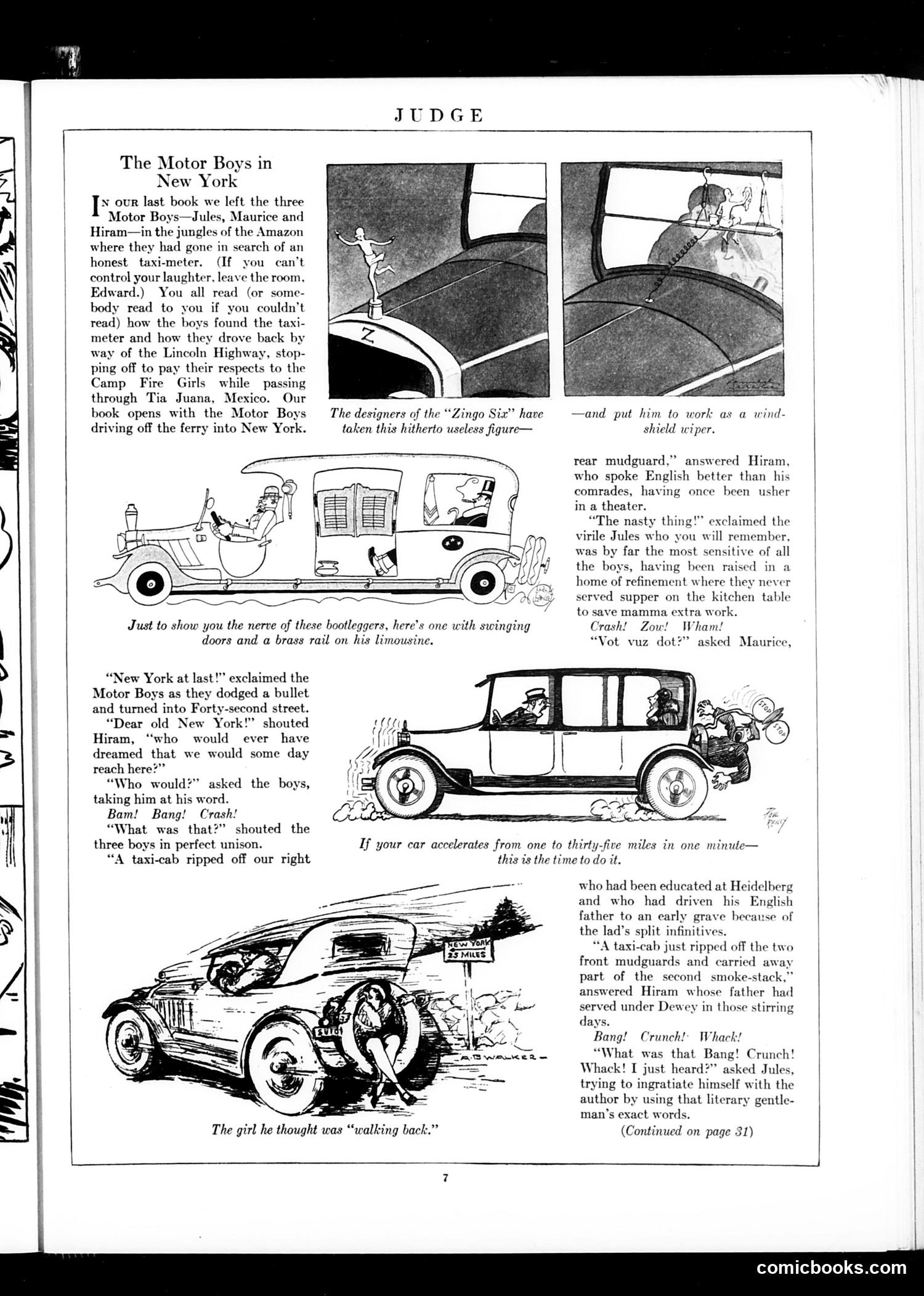
This is a humorous fictional narrative (not a political cartoon) from *Judge* magazine, satirizing early 1920s American urban life and motorcar culture. The "Motor Boys" are adventure-story protagonists arriving in New York City, where they immediately encounter the chaotic traffic and reckless taxi drivers that plagued the era—a well-known public nuisance. The satire targets several contemporary issues: the dishonesty of taxi-meter operators (they rigged meters to overcharge), Prohibition-era bootleggers (the joke about "swinging doors and a brass rail on his limousine"), and the general mayhem of unregulated automobile traffic in Manhattan. The cartoon also gently mocks the boys' contrasting national origins and speech patterns—Jules is oversensitive, Maurice speaks with a German accent, Hiram is patriotic. The core joke is that arriving in New York means immediately being battered by taxis, treating it as inevitable urban hazard rather than accident.
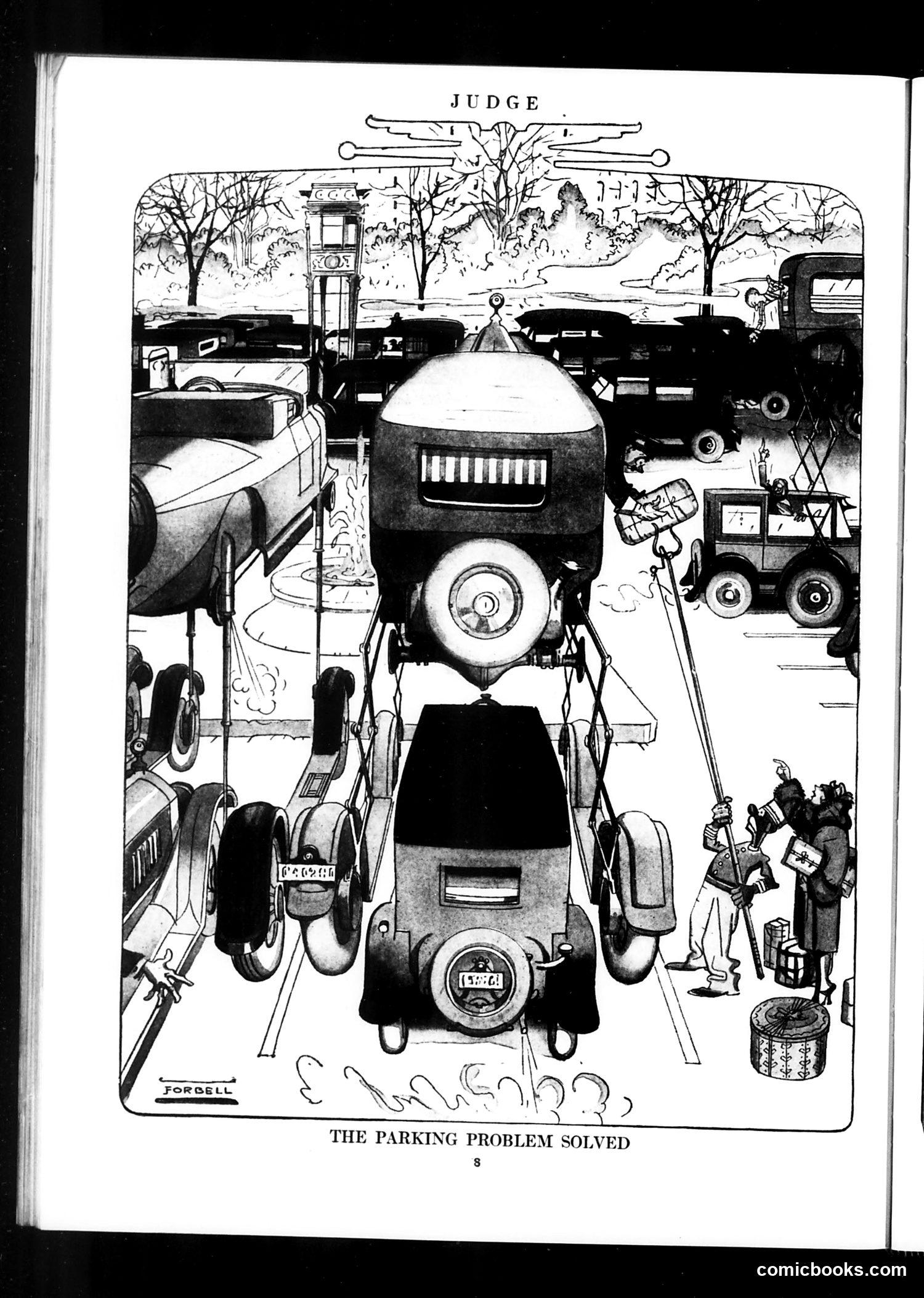
This Judge magazine cartoon satirizes the chronic urban parking shortage through absurdist humor. The illustration shows a car positioned vertically on a narrow street, surrounded by other parked vehicles in a crowded lot. The car appears to be balanced or suspended upright, suggesting an impossible "solution" to parking congestion. The cartoon mocks the era's growing automobile problem—as cars proliferated in American cities, finding parking spaces became increasingly difficult. By depicting a vehicle standing on end like an object rather than a functional car, the artist humorously suggests that traditional solutions are exhausted. The crowded street scene with various parked cars emphasizes how severe the problem had become. This reflects genuine urban frustration in the early-to-mid 20th century as automobile ownership expanded faster than parking infrastructure could accommodate.
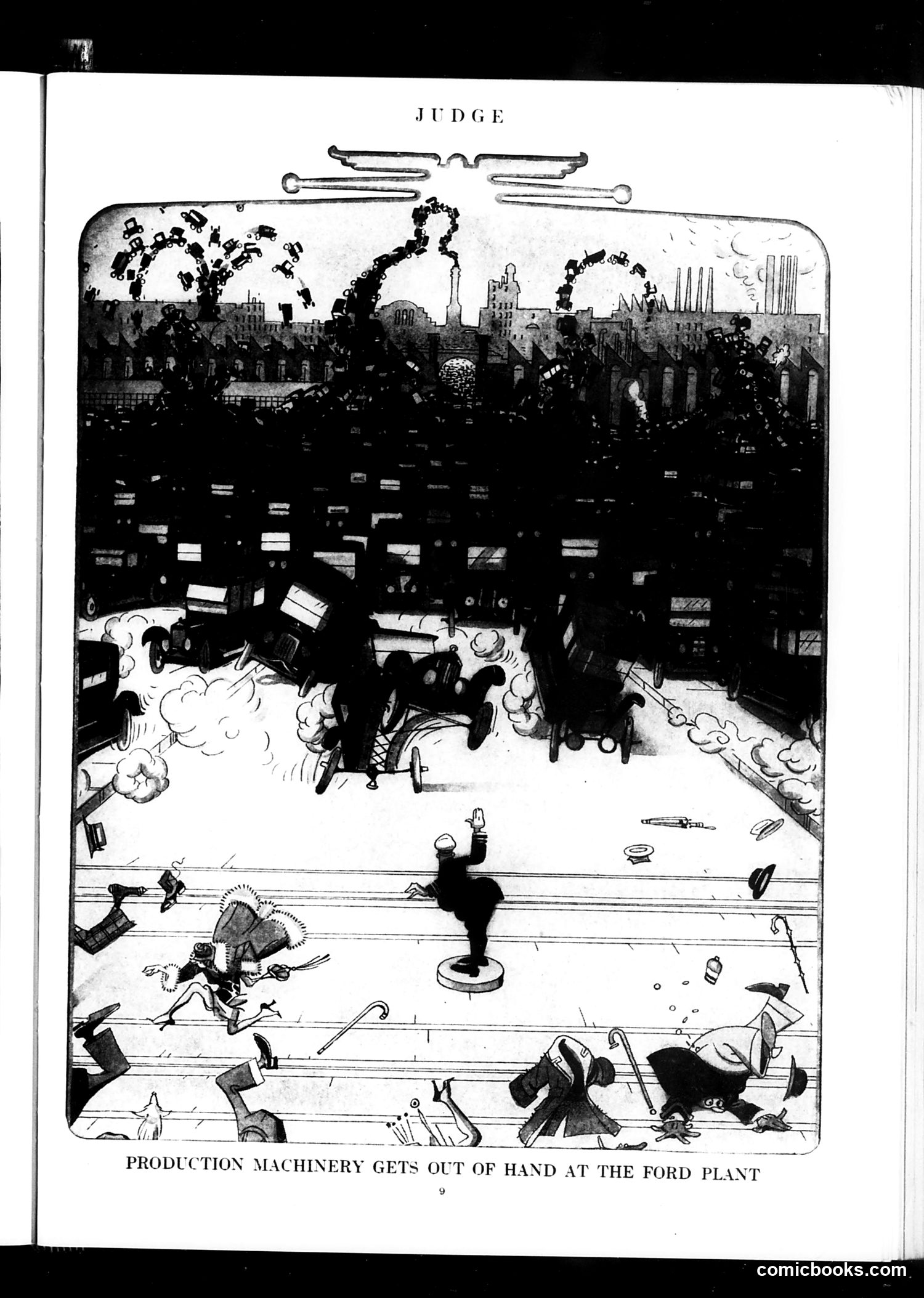
This satirical cartoon depicts chaos at a Ford Motor Company factory. Industrial machinery has apparently malfunctioned or broken free, with mechanical devices flying wildly through the air and striking workers below. The scene shows a judge or authority figure standing helplessly on a platform above, unable to control the mayhem. The satire likely critiques Ford's mass-production assembly line system—revolutionary but notorious for its dangerous working conditions and dehumanizing pace. By literalizing "machinery getting out of hand," the cartoon suggests that Ford's industrial ambitions have become uncontrollable and threaten worker safety. The helpless judge figure implies that legal authority cannot adequately regulate or protect workers from industrial hazards. This reflects early 20th-century anxieties about rapid industrialization and labor exploitation.
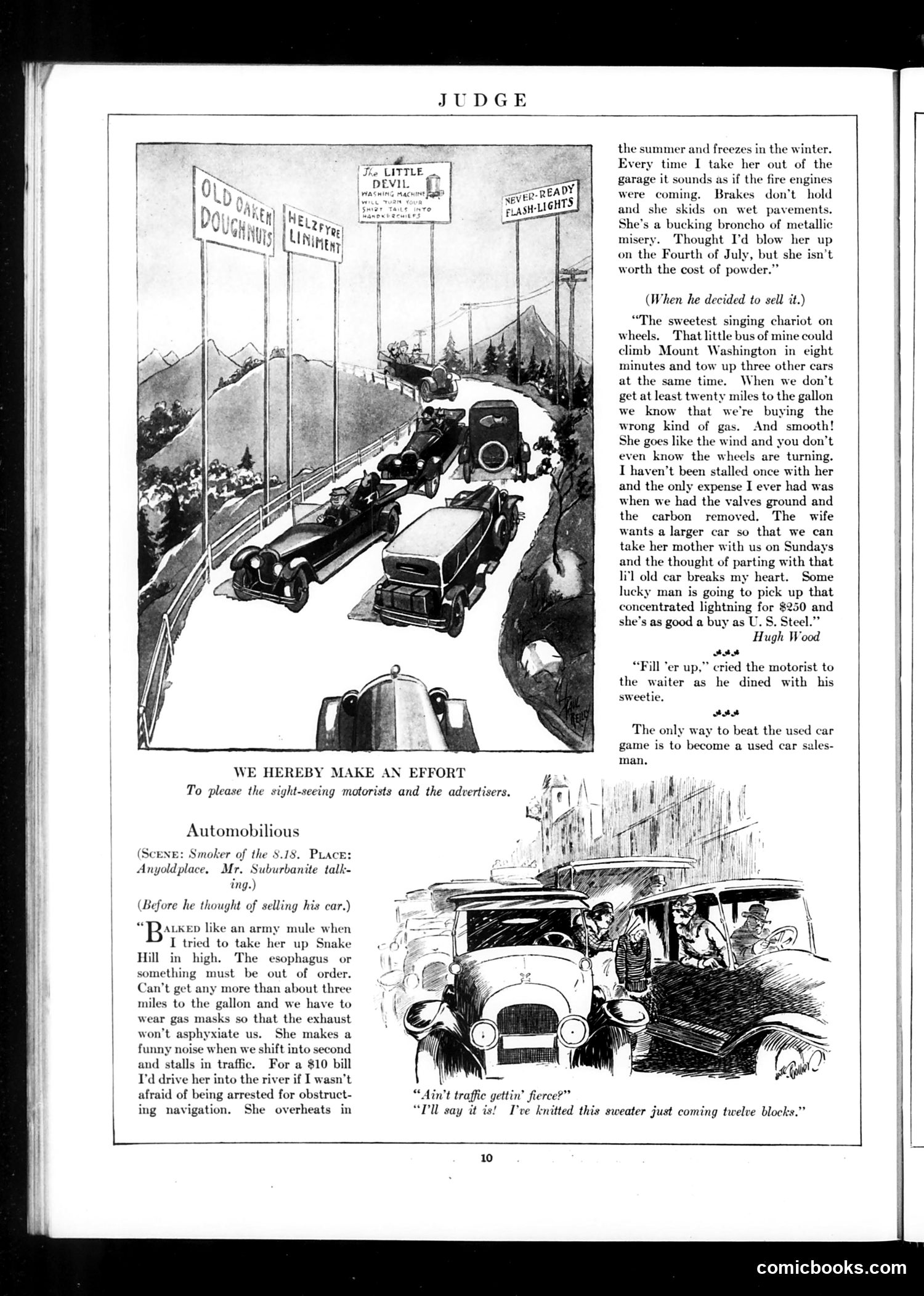
This page satirizes the used-car market and dishonest automobile salesmanship of the early automotive era. The top illustration shows various vehicles at roadside attractions, mocking the spectacle of motorist tourism. The main humor centers on a stark contrast: a suburban car owner delivers a brutal, honest assessment of his decrepit vehicle—it's unreliable, polluting, noisy, and barely functional. When he decides to *sell* it, his description completely reverses into exaggerated praise: suddenly the same car is a smooth, economical marvel worthy of $250. This satirizes the deceptive tactics of used-car dealers who misrepresent broken-down vehicles to unsuspecting buyers. The final caption—"The only way to beat the used car game is to become a used car salesman"—cynically suggests that profiting from this market requires participating in its fraud. The smaller cartoon about the motorist ordering "fill 'er up" at dinner mocks cars' notorious fuel consumption and the expense of early motoring.
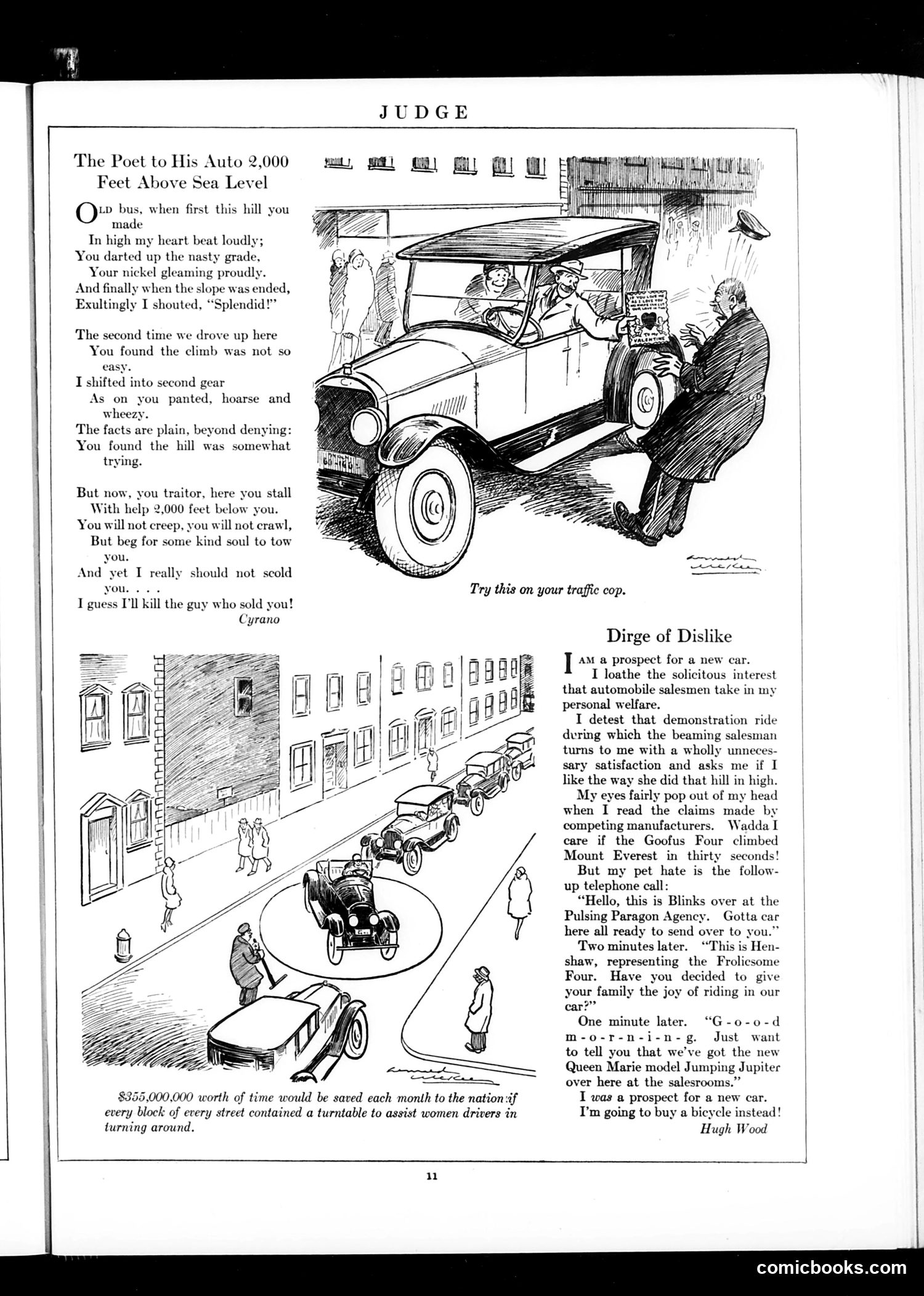
This page satirizes the automobile industry and car salesmen circa the 1920s-1930s. **"The Poet to His Auto"** is a humorous poem mocking a failing car that climbs a hill magnificently the first time but subsequently loses power. The speaker's affection turns to rage, threatening to kill the salesman who sold the defective vehicle. **"Dirge of Dislike"** by Hugh Wood targets aggressive automobile salesmen and their manipulative sales tactics—particularly unwanted follow-up phone calls from competing dealerships. The narrator, a prospective buyer, is bombarded by salesmen from agencies like "Pulsing Paragon" and "Frolicsome Four," each claiming superiority (absurdly boasting their cars climbed Mount Everest in thirty seconds). Exasperated by the harassment, he abandons his car-buying plans entirely, announcing he'll buy a bicycle instead. Both pieces mock early automotive marketing excess and the unreliability of early automobiles. The caption about turntables for "women drivers" reflects period sexism about driving ability.
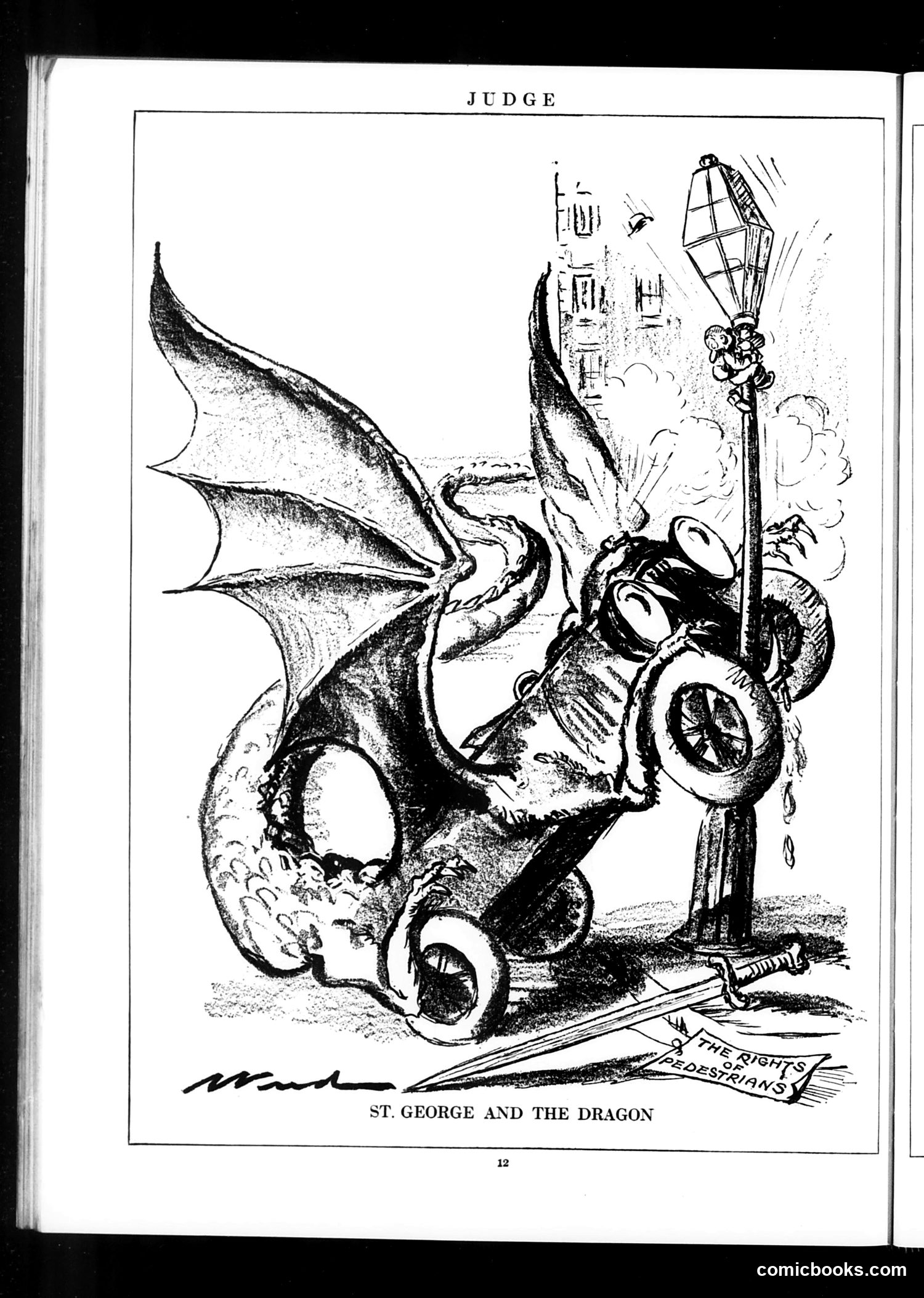
This is a political cartoon from *Judge* magazine reframing the medieval legend of St. George slaying the dragon as modern social commentary. The dragon appears to represent destructive forces—likely motorized traffic or automobiles, given the wheels visible on the creature's body. A figure (St. George) rides atop, wielding a lance topped with a parachute descending from above, suggesting divine intervention or modern technology as salvation. The banner reading "THE RIGHTS OF PEDESTRIANS" clarifies the satire: the cartoon depicts automobiles as a monstrous threat to pedestrians' safety and rights. This reflects early-20th-century anxieties about rapid motorization and its dangers to urban foot traffic—a contemporary social concern presented through classical heroic mythology.
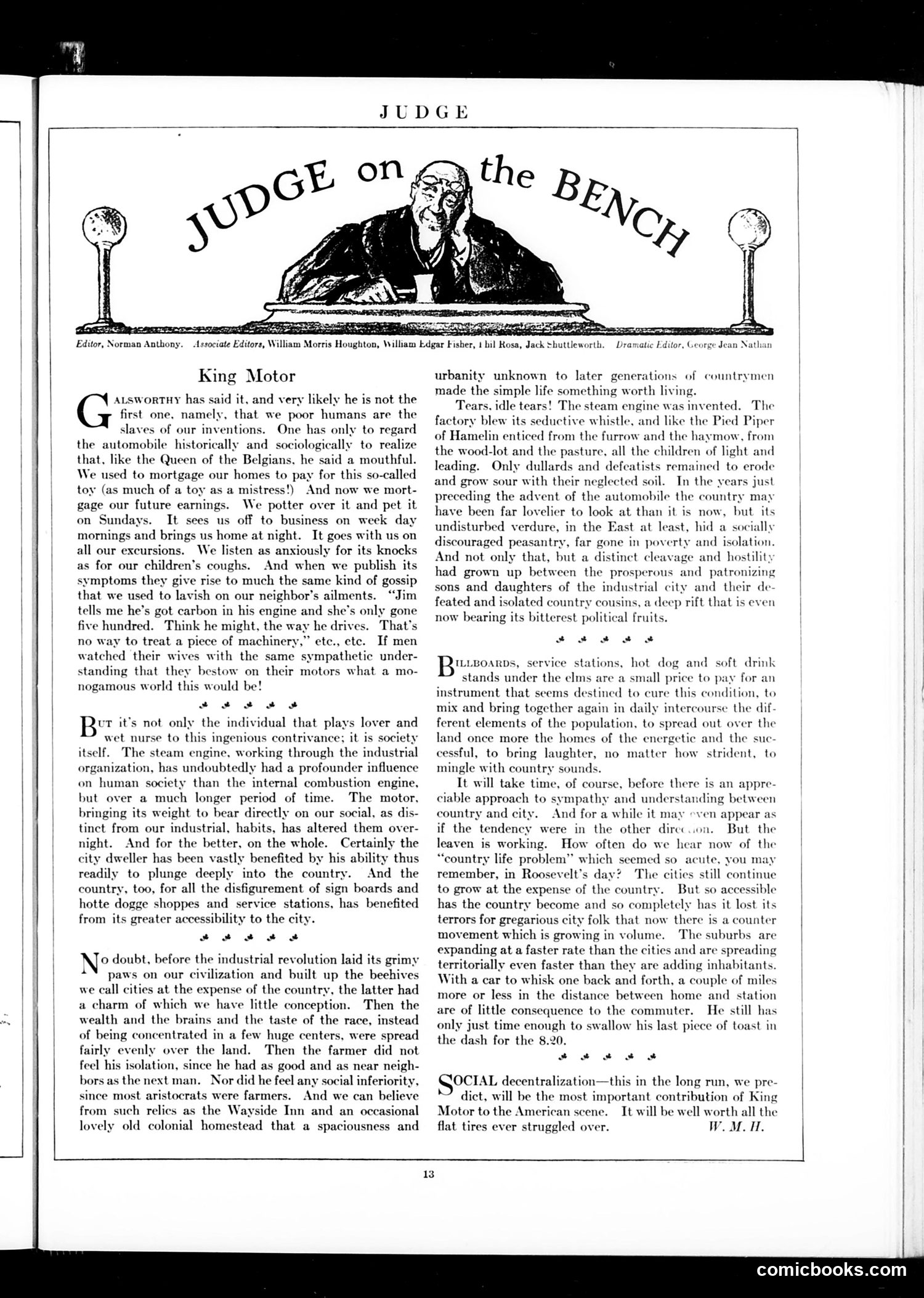
This is a lengthy editorial essay (not a political cartoon, despite the "Judge on the Bench" header) examining the automobile's profound social impact. The piece argues that cars have become central to human life—we obsess over them like romantic partners or children. The author (likely William Morris Houghton based on the byline) uses satire to critique this dependency while ultimately praising the automobile's social benefits. The main argument: pre-industrial rural life was idyllic but isolating and socially inferior. The steam engine and factories drew ambitious people cityward, creating class divisions and rural decline. However, the automobile—by providing easy access between city and country—is reversing this damage, reconnecting rural and urban life and restoring the countryside's appeal and vitality. The essay concludes that "social decentralization" via automobiles will be King Motor's greatest contribution to America. It's pro-technology modernism wrapped in nostalgic language about lost rural charm.
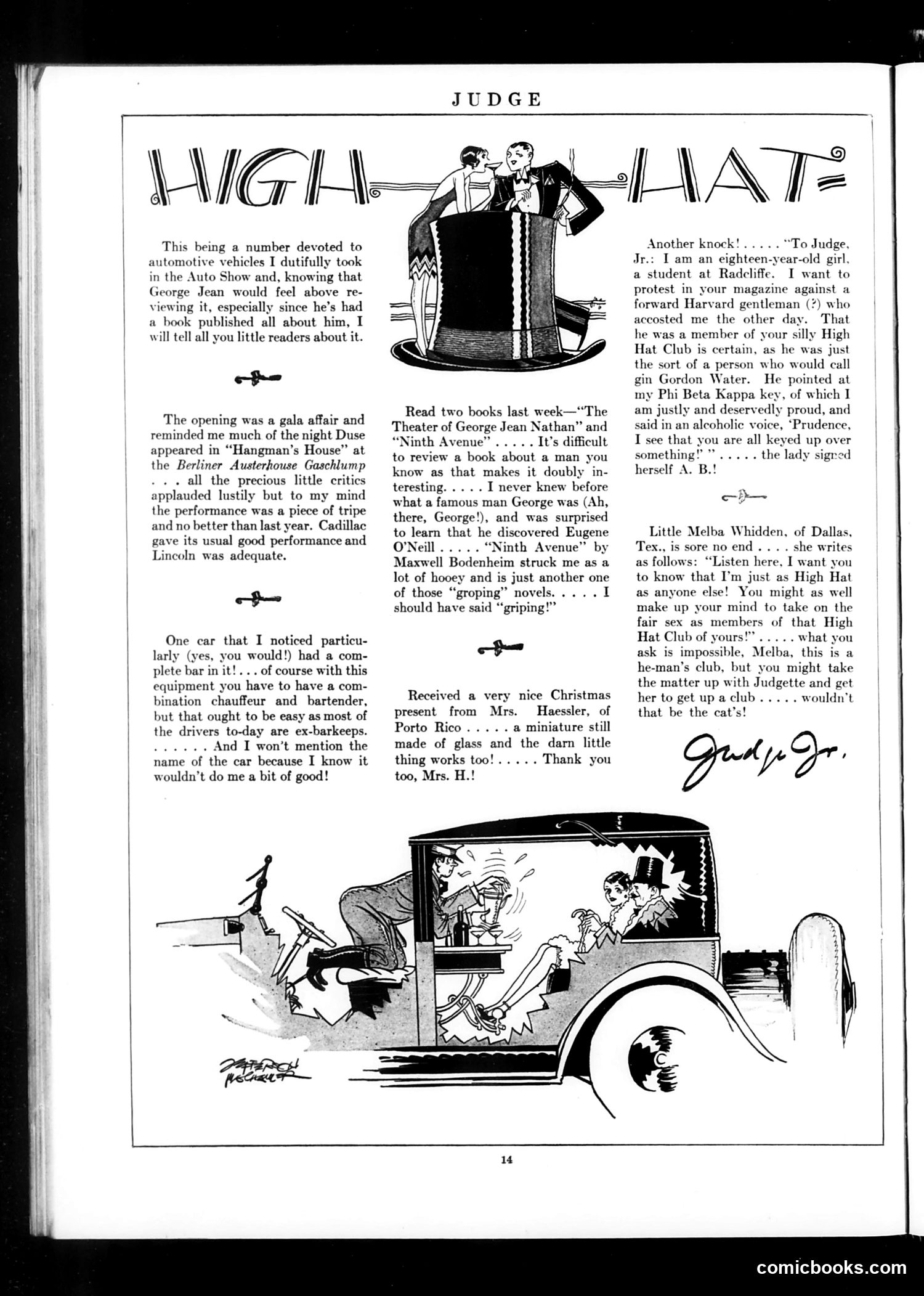
This is a "Judge" column where the editor responds to reader letters and comments on contemporary topics. The main content includes: **The Auto Show Review**: The editor sarcastically reviews the automobile exhibition, praising Cadillac and Lincoln while dismissing most performances as inferior to previous years. **Literary Commentary**: References to George Jean Nathan (a famous theater critic of the era) and books about him, plus Maxwell Bodenheim's "Ninth Avenue," which the editor dismisses as trivial. **Reader Letters**: Three complaints are published—one from a Radcliffe student protesting a forward Harvard man from the "High Hat Club" who made inappropriate remarks about her Phi Beta Kappa key; another from a Dallas woman wanting women admitted to the High Hat Club. **The Cartoon**: Shows a car full of rowdy passengers, likely satirizing the reckless behavior enabled by automobiles and Prohibition-era excess (the mention of "ex-barkeeps" as drivers is relevant here). The humor relies on insider references to Boston/Cambridge society, literary circles, and automobile culture of the 1920s.
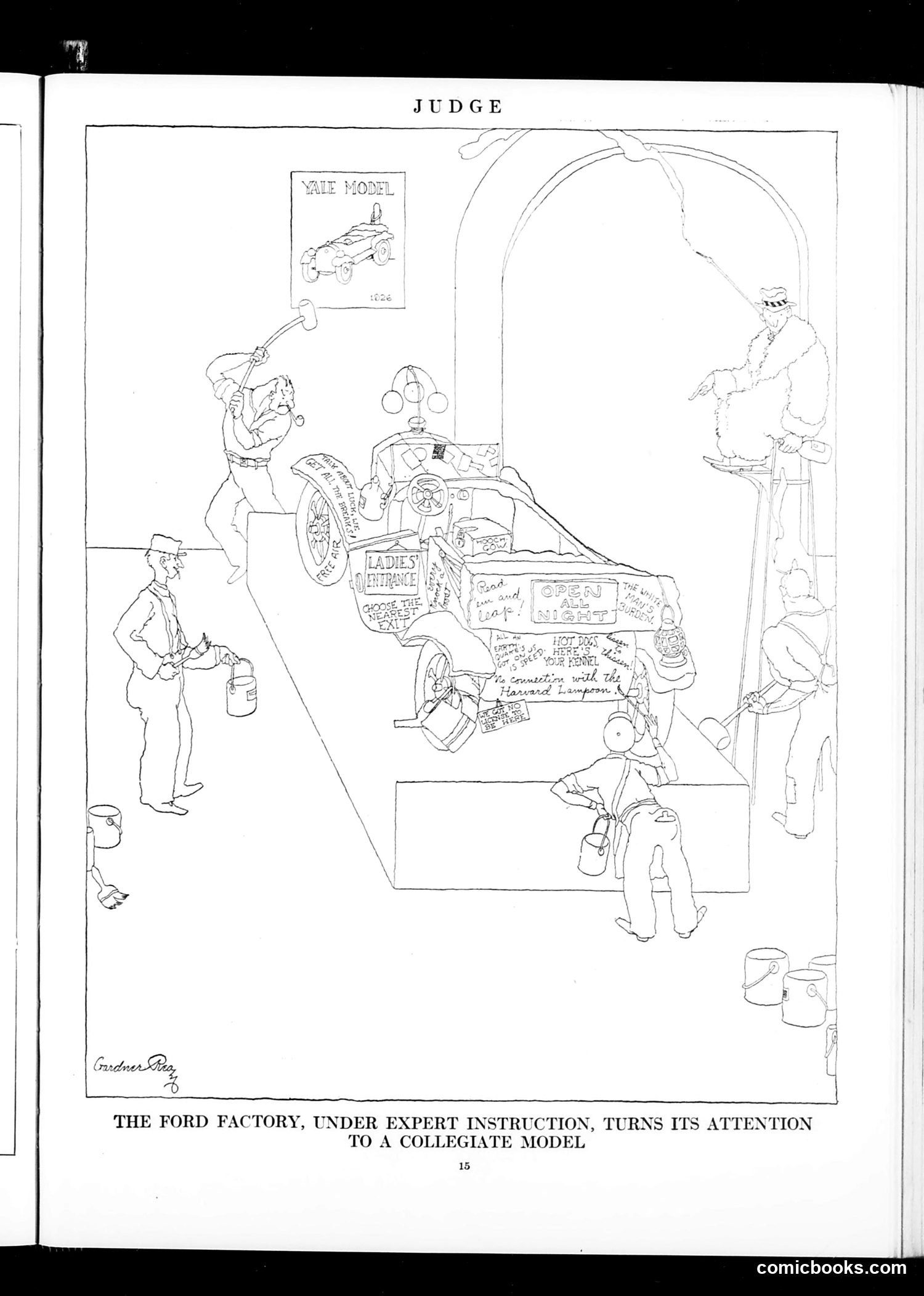
This Judge magazine cartoon satirizes Ford Motor Company's mass-production methods by imagining them applied to college education. The drawing shows a factory assembly line producing a "collegiate model" — literally assembling a student like a car. The humor works on multiple levels: it mocks both Ford's mechanized efficiency and American higher education's increasingly standardized, production-line approach to creating graduates. The "Yale Model" poster visible in the scene adds specificity, suggesting elite universities operate similarly to factories. The various figures (workers, supervisors, managers) represent the institutional machinery, while the student being "assembled" is the passive product. The satire suggests education had become dehumanized and formulaic — reducing individual learning to manufactured uniformity, much like Ford's assembly-line cars.
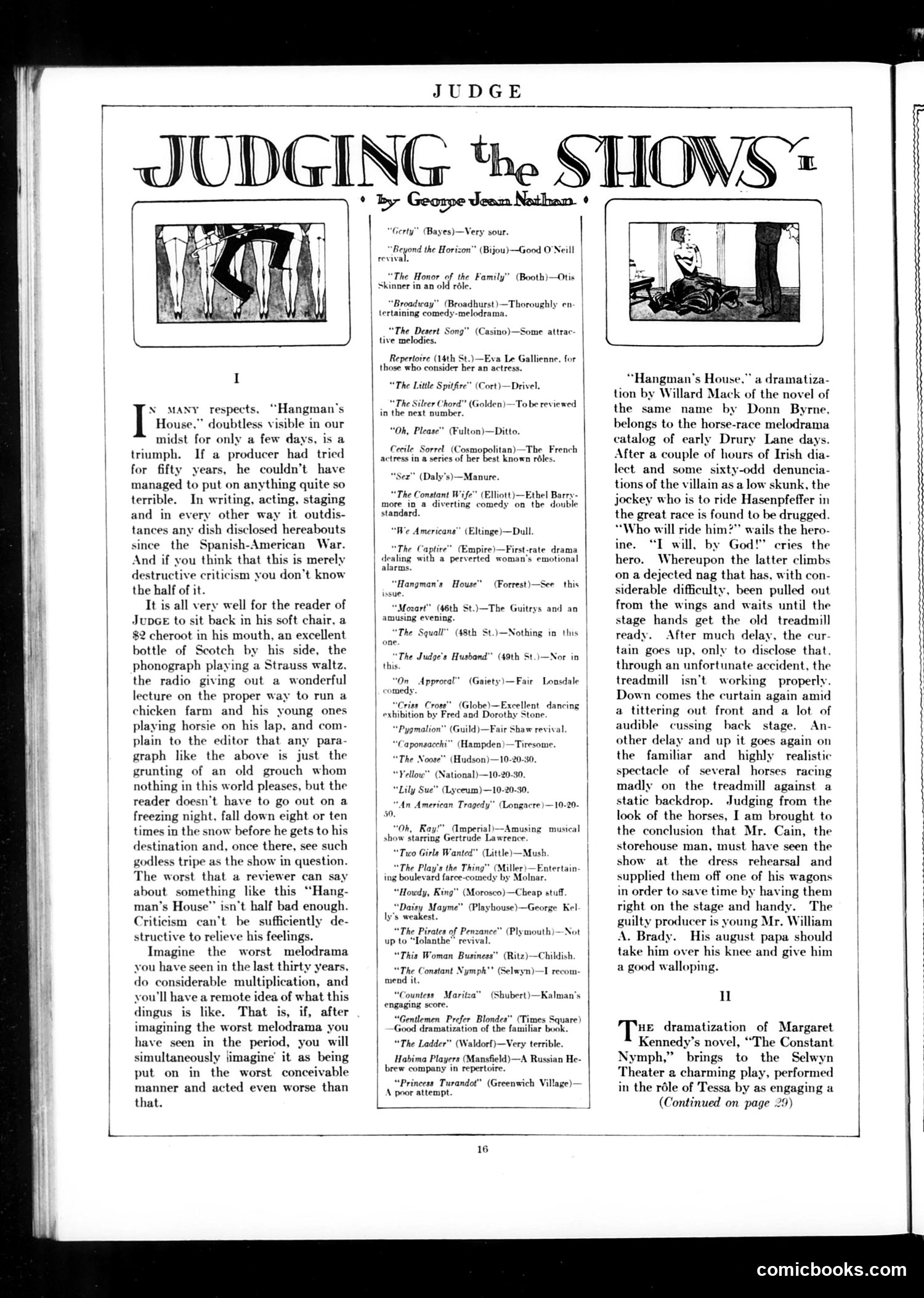
This page presents theater critic George Jean Nathan's brutal dismissal of the play "Hangman's House." The main text (Section I) isn't a cartoon but a scathing written review that dominates the page. Nathan uses exaggerated, almost absurdist language to convey the play's awfulness—comparing it unfavorably to the worst melodramas of thirty years, claiming it outdoes any theatrical disaster "since the Spanish-American War." He sarcastically addresses comfortable readers at home, suggesting they cannot truly judge unless they've suffered through it in person on a freezing night. The surrounding box lists brief reviews of current Broadway productions, using Nathan's characteristic caustic style ("Dull," "Ditto," "Manure," "Very terrible"). This was typical Judge content: sophisticated urban satire targeting middle-class theatergoers. The humor relies on hyperbolic cruelty toward performers and writers, reflecting 1920s entertainment journalism's personal, acerbic tone.
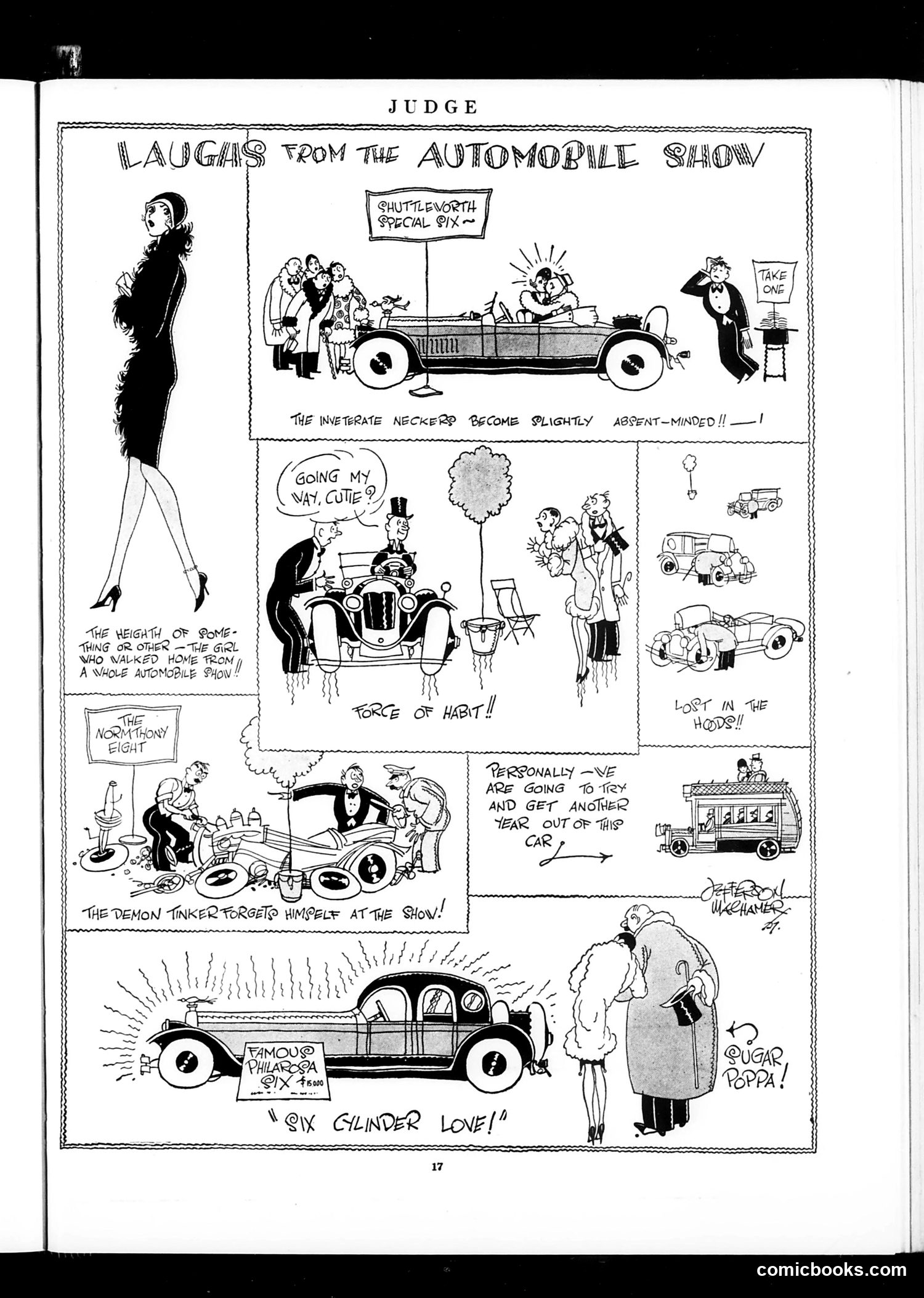
This satirical comic page mocks 1920s automobile culture and consumer behavior. The central joke involves people becoming obsessively attached to their cars—one character literally walks home from an auto show after becoming separated from a vehicle, while another couple plans to "get another year" out of their car through repairs rather than buying new. The "Shuttleworth Special Six" and "Six Cylinder Love" references play on the period's fascination with engine specifications as status symbols. The cartoon satirizes how Americans had developed an almost romantic relationship with automobiles, treating them as essential to social identity and leisure activities (picnics, shows). The final panel's "Sugar, Poppa!" suggests romantic entanglement with cars themselves—humorous exaggeration of how cars dominated social life and priorities in this early automotive era.
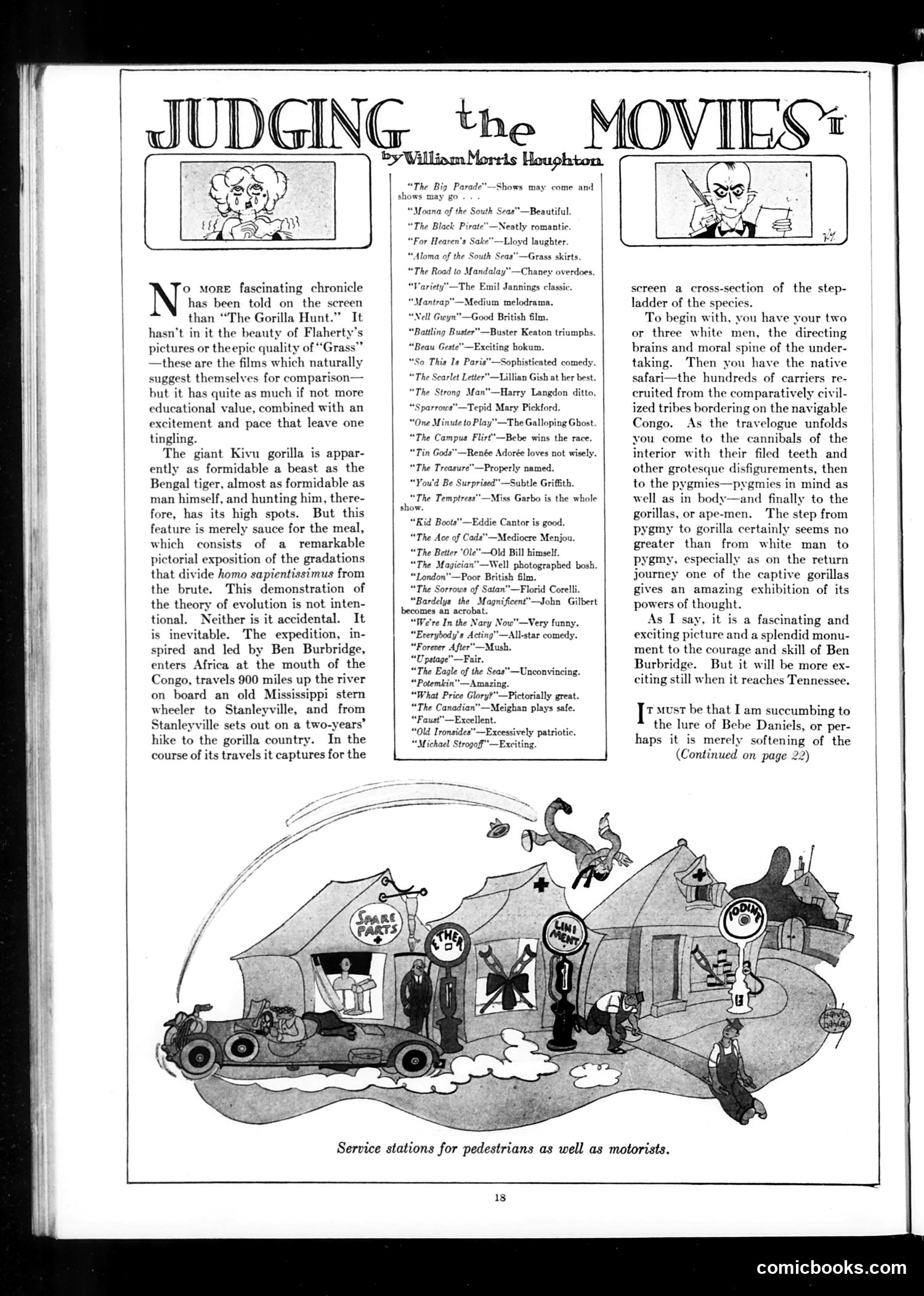
This page reviews contemporary films (likely mid-1920s based on titles like "The Big Parade" and "Beau Geste"). The main article praises "The Gorilla Hunt," a documentary-adventure film led by explorer Ben Burbridge into Congo. The reviewer notes the film presents an unintentional but "inevitable" visual argument for evolutionary theory—showing a "gradation" from white explorers to native carriers to pygmies to gorillas, arranging humans on a hierarchy from "civilized" to "savage" to animal. This reflects period pseudoscientific racism common in 1920s media. The closing quip—that the film "will be more exciting still when it reaches Tennessee"—appears to mock Southern segregationist attitudes, suggesting Tennesseans would find the racial hierarchy particularly appealing. The illustrated bottom section shows a fantastical "service station" for vehicles and pedestrians, unrelated to the film review.
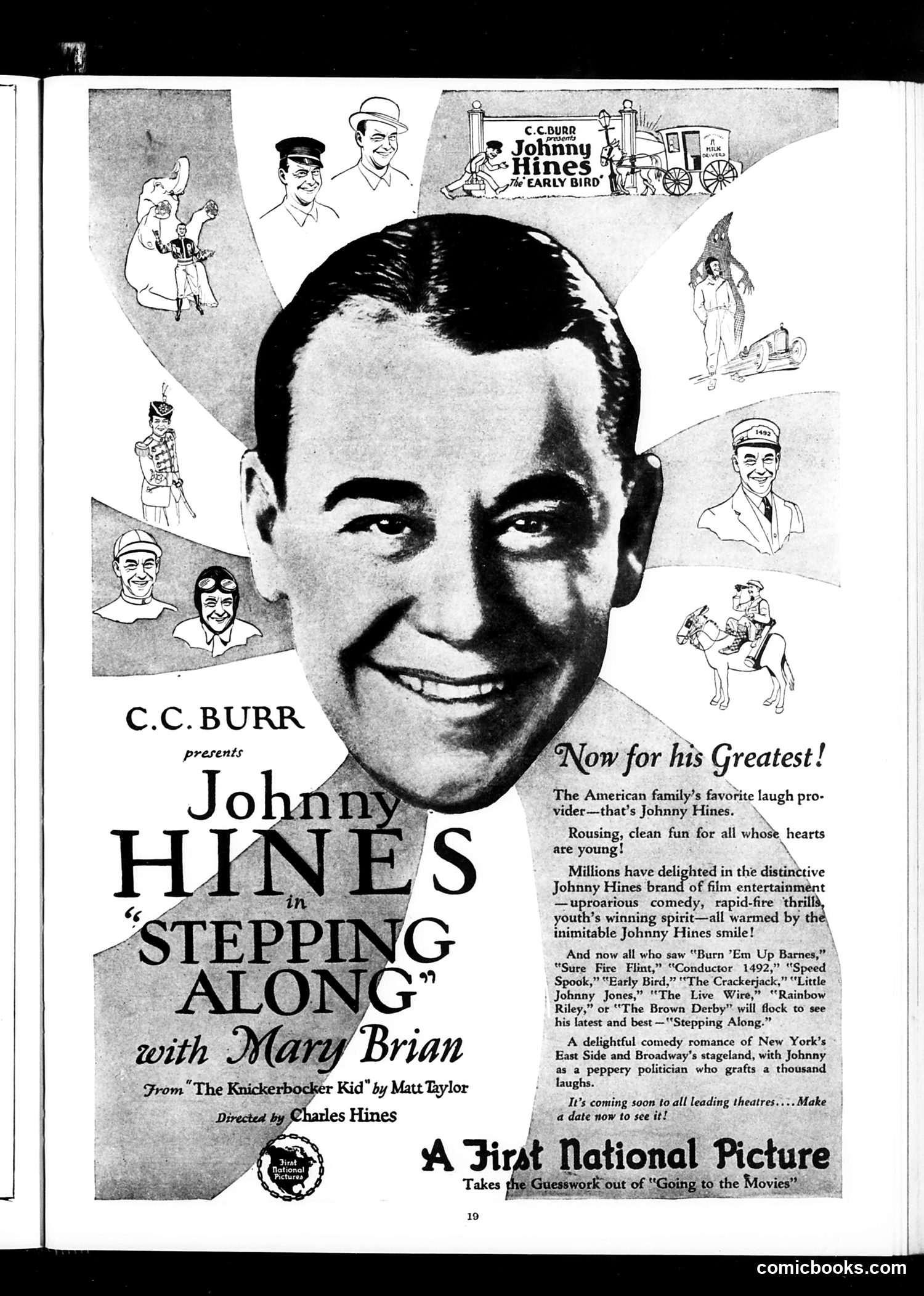
This is primarily a **film advertisement**, not political satire. It promotes Johnny Hines, a silent-film comedian, and his new picture "Stepping Along" (distributed by First National Pictures). The page advertises Hines as "The American family's favorite laugh provider," listing his previous film successes ("Burn 'Em Up Barnes," "Early Bird," etc.). The advertisement emphasizes his appeal as family-friendly entertainment featuring "rousing, clean fun" and "uproarious comedy." The smaller vignettes surrounding Hines's portrait showcase character types from his films—various comic personas wearing different hats and costumes. The film itself is described as "a delightful comedy romance" set in New York's East Side and Broadway, with Hines playing "a peppery politician who grafts a thousand laughs." This represents typical 1920s film promotion in Judge magazine, targeting the broadest possible audience by promising wholesome entertainment and star appeal—not satire or political commentary.
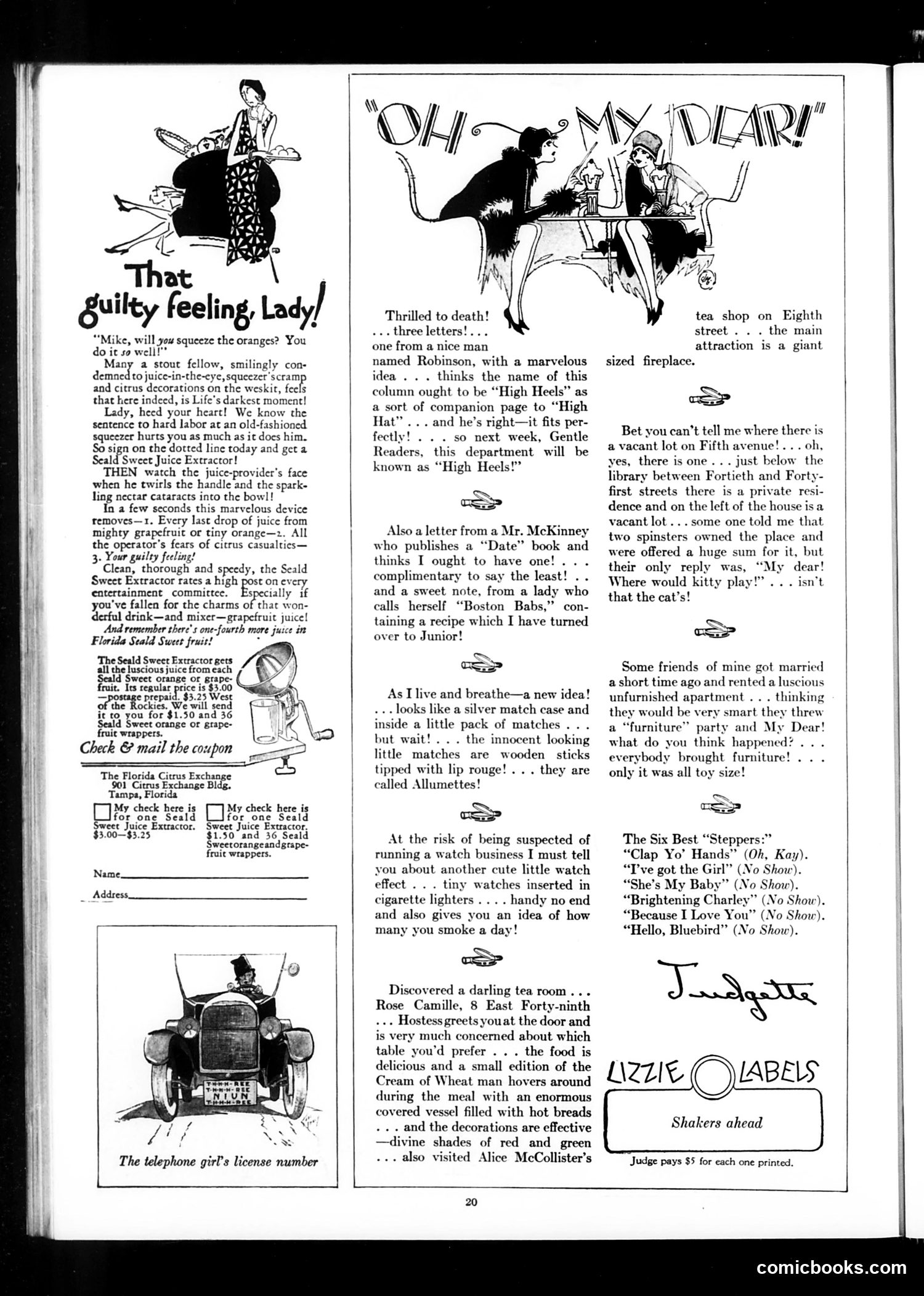
This page combines **advertisements with a gossip/social commentary column** titled "Oh, My Dear!" (soon to be renamed "High Heels"). **The Main Content:** The left side features a **Sealid Sweet orange juice extractor advertisement**, using humor to shame husbands into buying the device—the joke being that manually squeezing oranges is unpleasant domestic labor that emasculates men. **The Right Side—"Oh, My Dear!" Column:** This is a society gossip column discussing fashionable urban trends among wealthy New Yorkers. The writer catalogs novelty items and social discoveries: - Cute novelty watches in cigarette lighters - Wooden lip-rouge-tipped matches ("Allumettes") - Fashionable tea rooms in Manhattan **The Satire:** The column satirizes upper-class consumer culture and women's enthusiasm for frivolous novelties and trendy establishments. The tone is gossipy and tongue-in-cheek about the trivial pursuits of wealthy socialites. The page reflects 1920s jazz-age consumerism and the era's new emphasis on convenient appliances and leisure activities for the affluent.
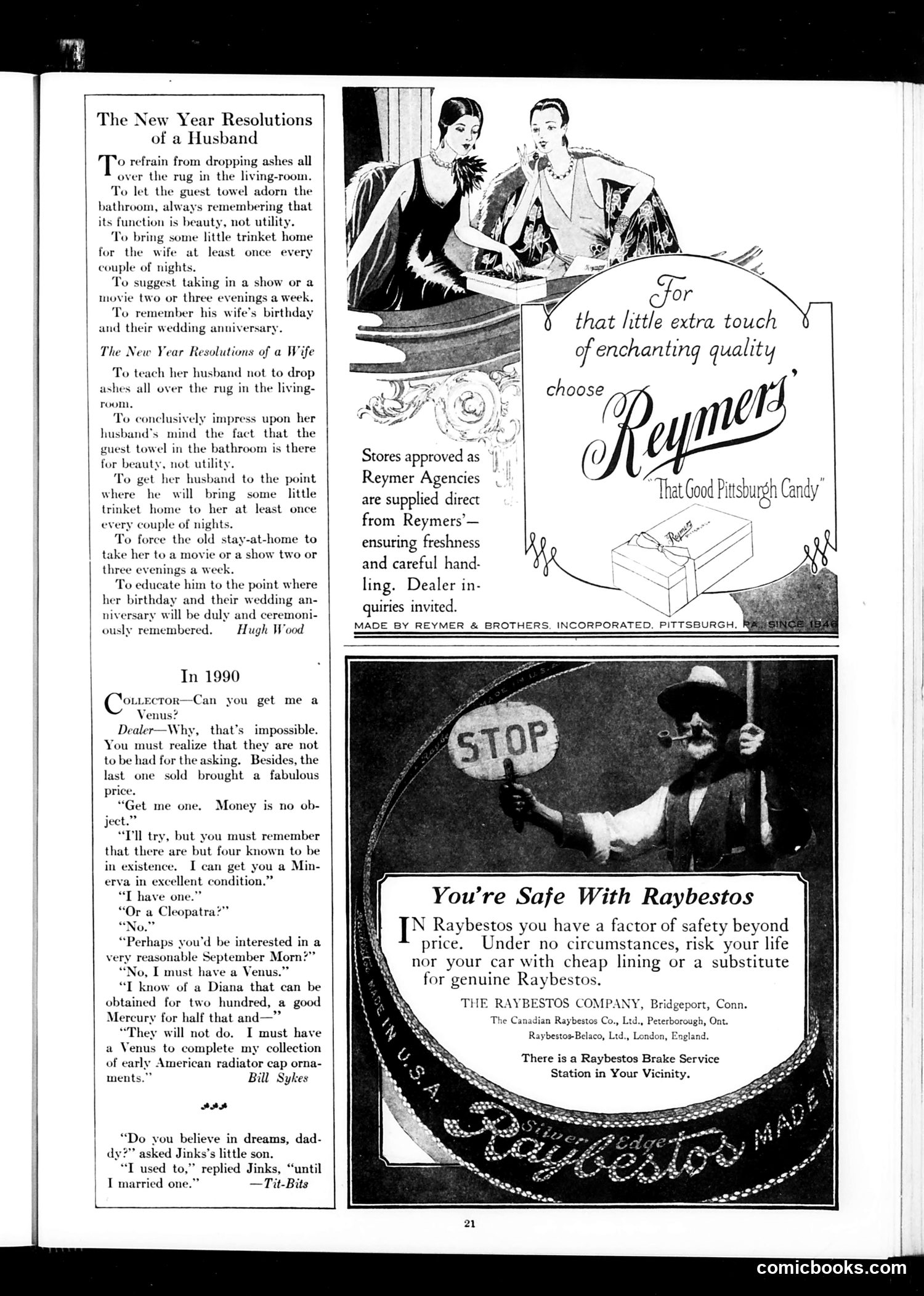
This page contains satirical humor and period advertisements from an early 20th-century American magazine. **"New Year Resolutions" Satire:** The left column presents parallel husband and wife resolutions for the new year, humorously illustrating marital discord. The husband's resolutions (bringing trinkets home, attending shows, remembering anniversaries) are identical to the wife's *goals for changing him*—suggesting these promises are perpetually broken. The joke mocks both husbands' inability to follow through on domestic commitments and wives' resigned acceptance of this pattern. **"In 1990" Joke:** A collector seeks rare Venus radiator cap ornaments from early American cars. The dealer indicates extreme scarcity, but the collector dismisses cheaper alternatives. The humor lies in the absurdity: treating mass-produced car ornaments as fine art objects worthy of serious collecting. **Bottom Joke:** A father claims he stopped believing in dreams after marriage—a cynical quip about matrimony destroying youthful idealism. The page is primarily advertising (Reymer's candy, Raybestos brake products), with these jokes interspersed as filler content typical of Judge's format.
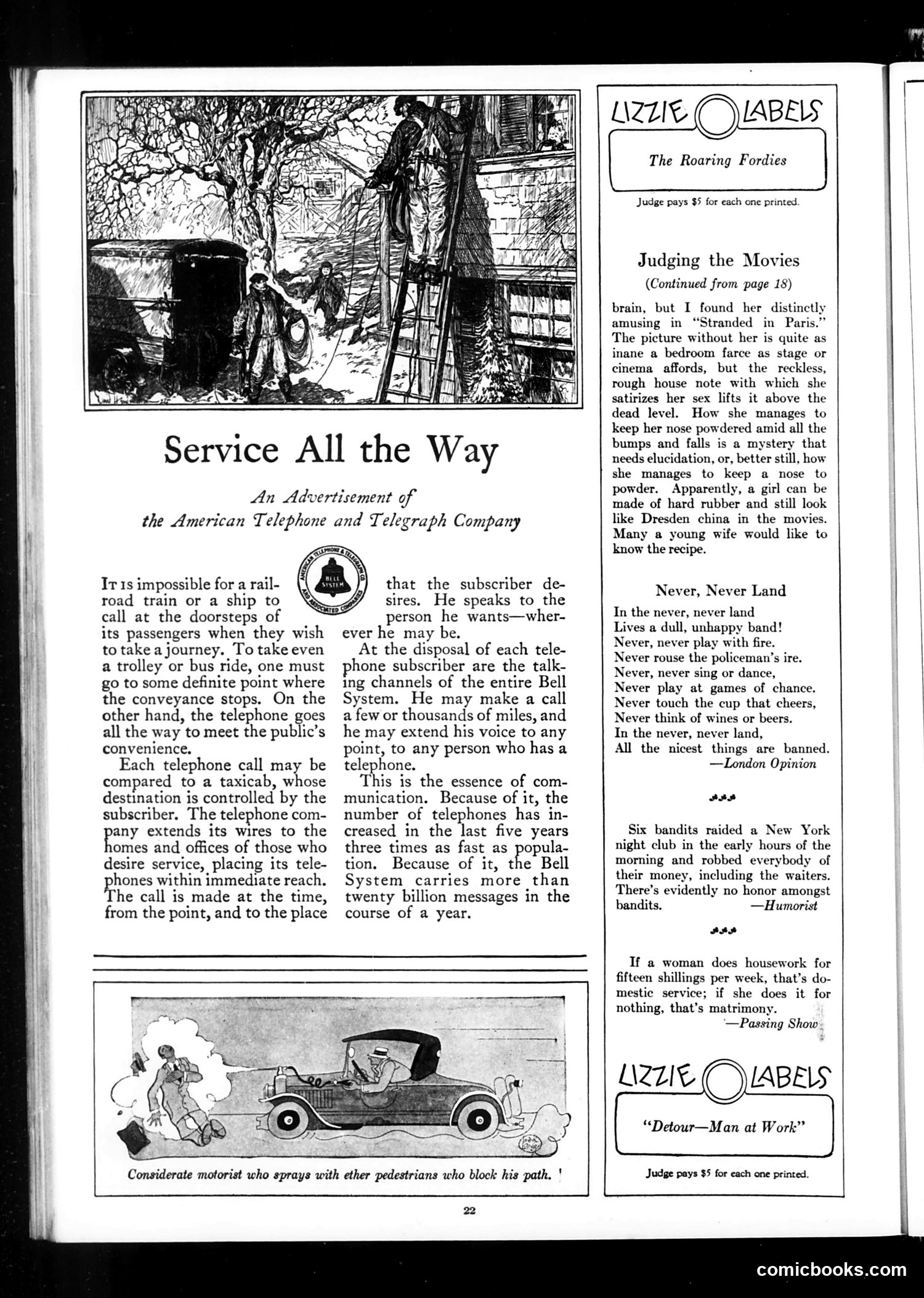
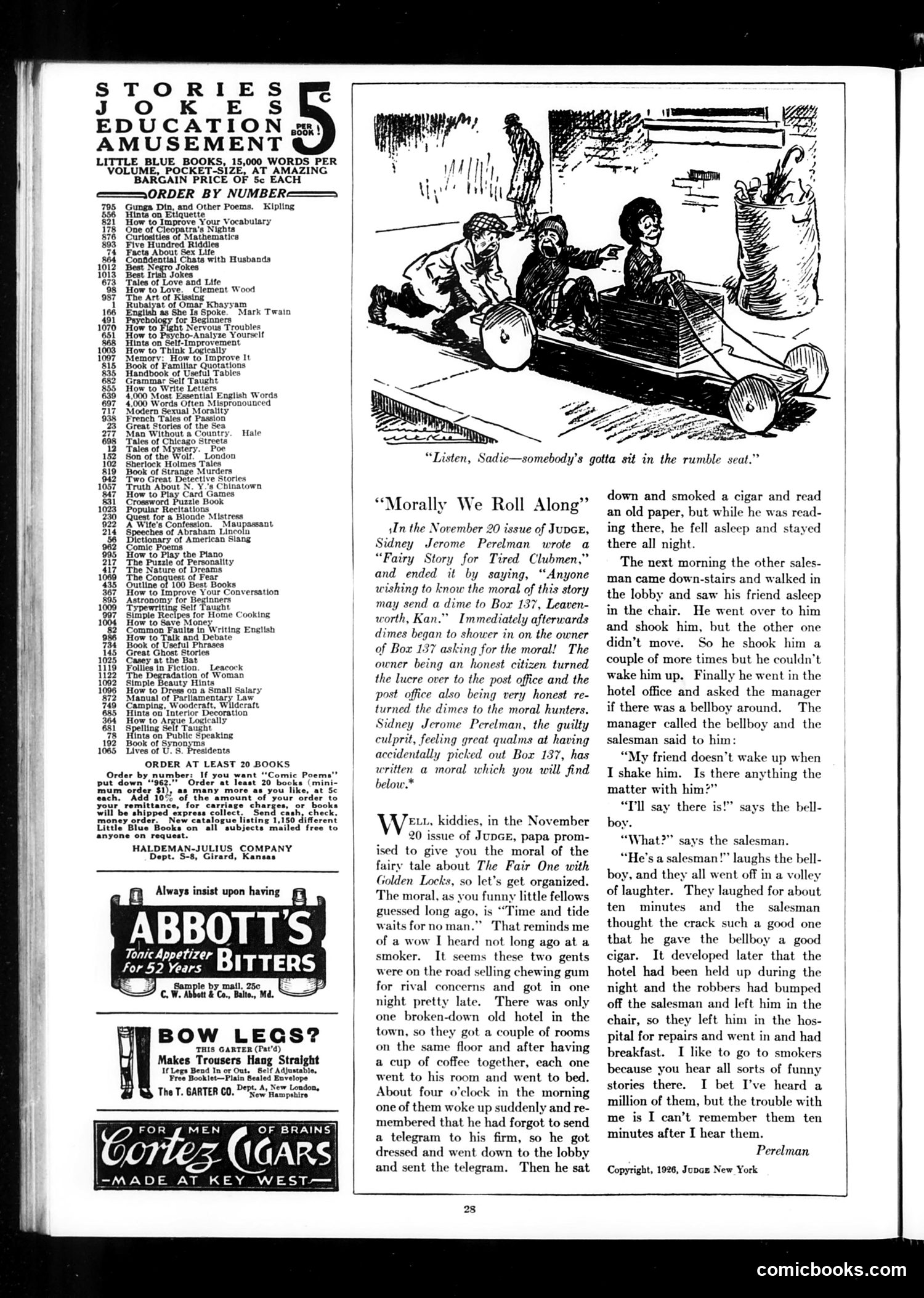
This page combines advertising and satirical content typical of 1920s Judge magazine. **"Service All the Way"** is a Bell Telephone advertisement presenting the telephone as superior to rail and trolley service—it comes to the customer's home rather than requiring travel to fixed stops. The copy emphasizes the Bell System's expansion and reliability. **The cartoon below** depicts a motorist spraying pedestrians with "ether" (anesthetic gas) to clear them from the street. The caption reads "Considerate motorist who sprays with ether pedestrians who block his path"—obvious satire mocking reckless drivers of the automobile-dominated 1920s. The term "Roaring Fordies" (referencing Ford automobiles and the "Roaring Twenties") reinforces the car-culture criticism. **Right column content** includes movie reviews, humorous verses on proper behavior ("Never Land"), and brief jokes about bandits and domestic service—typical filler humor for the period. The page demonstrates how Judge balanced commercial advertising with social satire about modern technology's impact on everyday life.
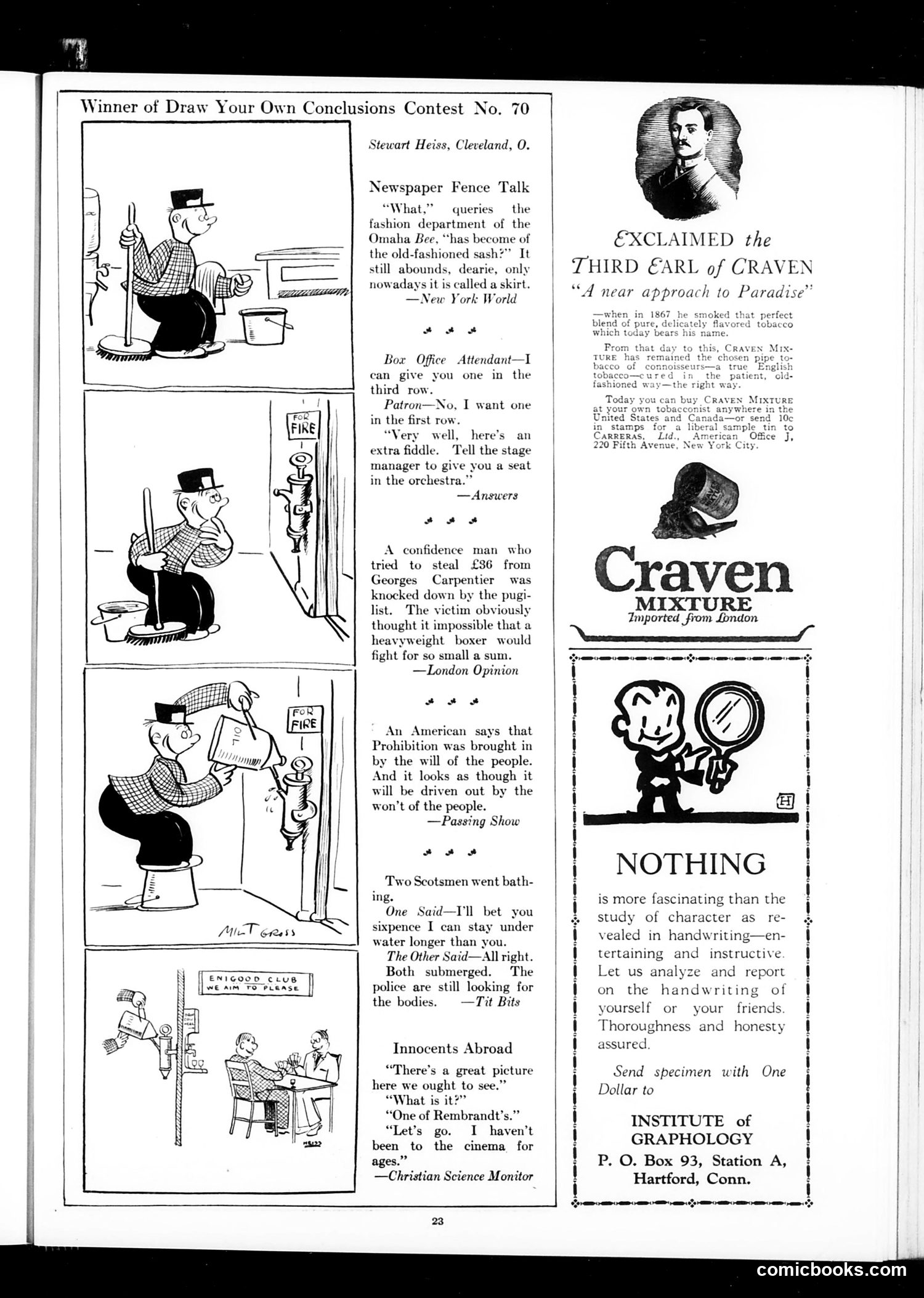
This page from *Judge* magazine features a contest-winning comic strip (top left) by Stewart Heiss, showing a man at a theater box office asking for better seating. The joke: when refused a front-row seat, he's offered a violin instead—a sardonic comment on theater orchestras of the era. Below are brief humorous quotes from various publications satirizing contemporary topics: fashion (the old sash is now called a "skirt"), Prohibition's unpopularity, and class assumptions about boxer Georges Carpentier. The right side is primarily **advertising**: a tobacco product endorsement featuring the Third Earl of Craven (a real historical figure whose name became associated with this blend), and an ad for handwriting analysis services—graphology, which was taken seriously in this period as a character-assessment tool. The cartoons mock everyday situations with dry wit typical of 1920s humor.
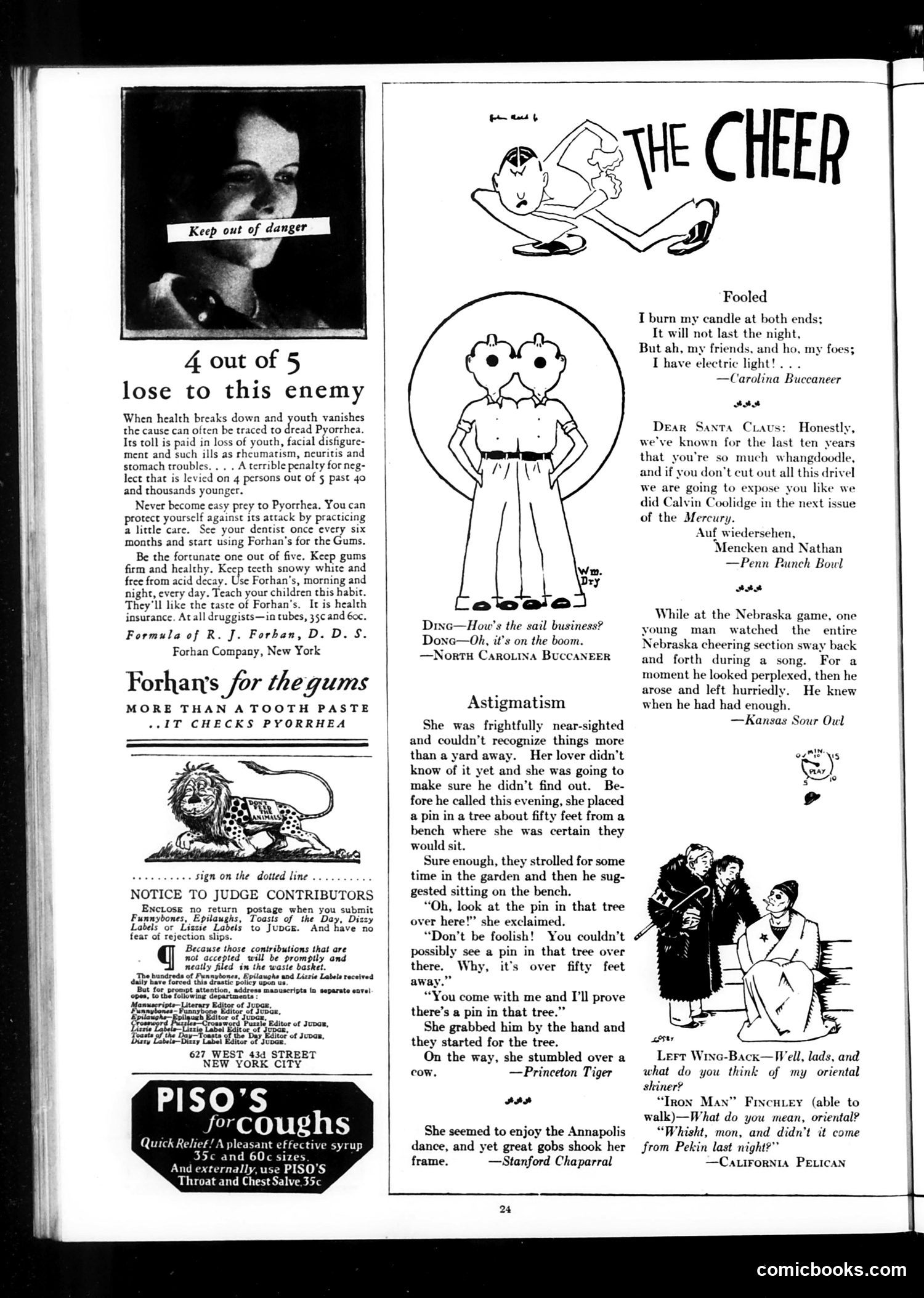
This page is primarily **advertisements and humor submissions** from college publications, not political cartoons. The main content includes: **Advertisements:** Forhan's toothpaste (targeting pyorrhea/gum disease), Piso's cough syrup, and dental health warnings typical of 1920s-30s marketing. **"The Cheer" section:** A collection of brief humorous anecdotes and jokes reprinted from college newspapers (Princeton Tiger, Stanford Chaparral, Penn Punch Bowl, etc.). **Notable joke:** The "Astigmatism" story satirizes a nearsighted woman who strategically places a pin fifty feet away to prove her vision to her lover—a mild romantic deception joke. **One topical reference:** A submission mocks Calvin Coolidge's credibility, suggesting he'd been "exposed" (unclear context without dating this issue, but likely references 1920s political skepticism toward Coolidge). The page reflects Judge's practice of collecting collegiate humor and advertising patent medicines—standard magazine filler of the era, not sophisticated political satire.
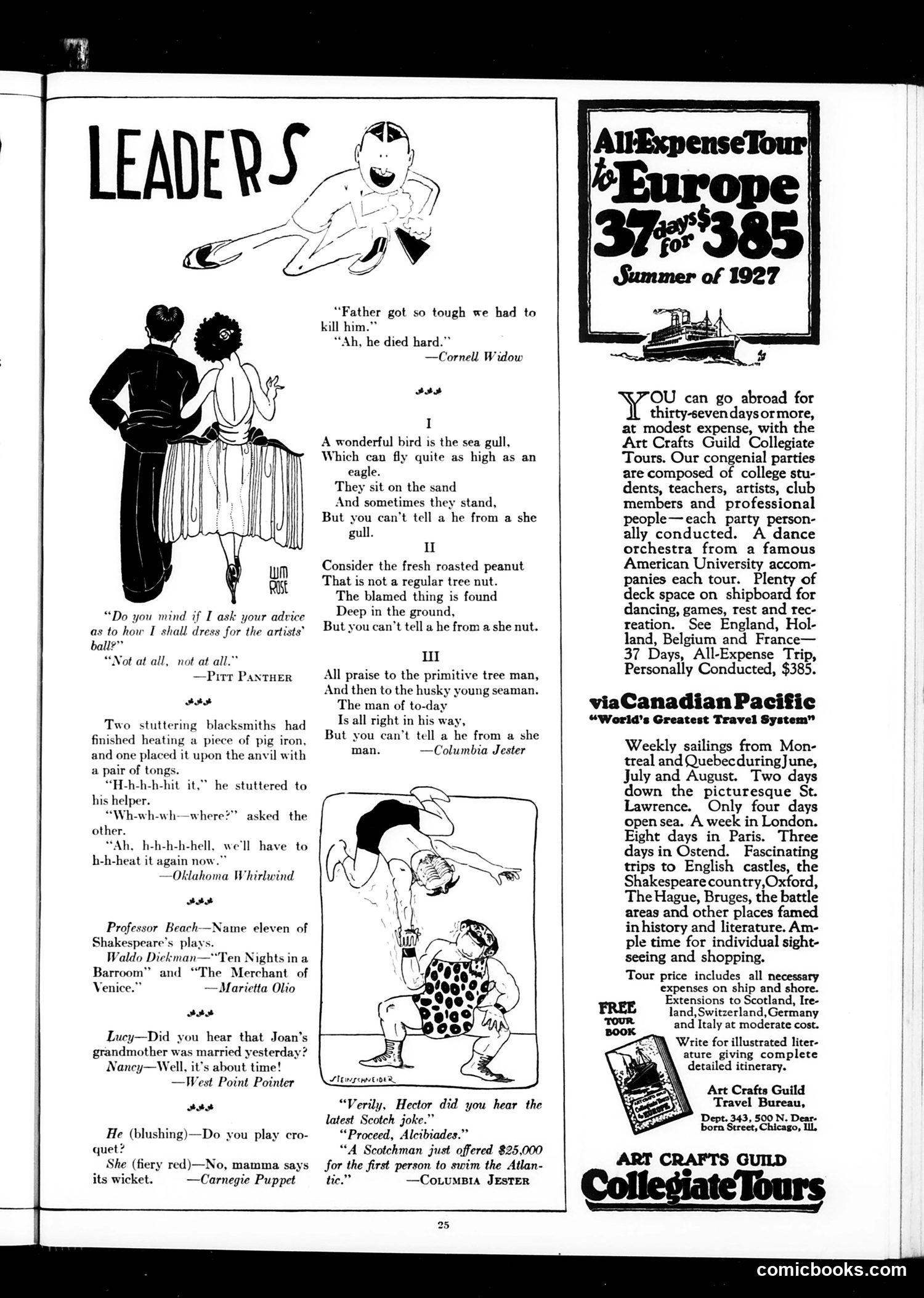
This page is primarily **advertising** for European travel tours (1927), with a secondary section of humor content. The "LEADERS" section contains **joke reprints from college humor magazines** (Cornell Widow, Columbia Jester, West Point Pointer, etc.)—a common feature in Judge. These are lightweight gags about stuttering blacksmiths, a professor's ignorance of Shakespeare, a woman's blush, and ethnic humor (a Scotsman's stinginess). The humor relies on wordplay, physical comedy, and mild social observation typical of 1920s college comedy. The cartoons show stylized flapper-era figures illustrating the jokes—no political content. The illustrations are generic and decorative rather than satirical. The dominant content is **the Art Crafts Guild travel advertisement** promoting a 37-day European tour for $385 (Summer 1927), emphasizing theater, sightseeing, and shipboard recreation. This reflects post-WWI prosperity and the Jazz Age's fascination with European tourism. No specific political figures or events are referenced.
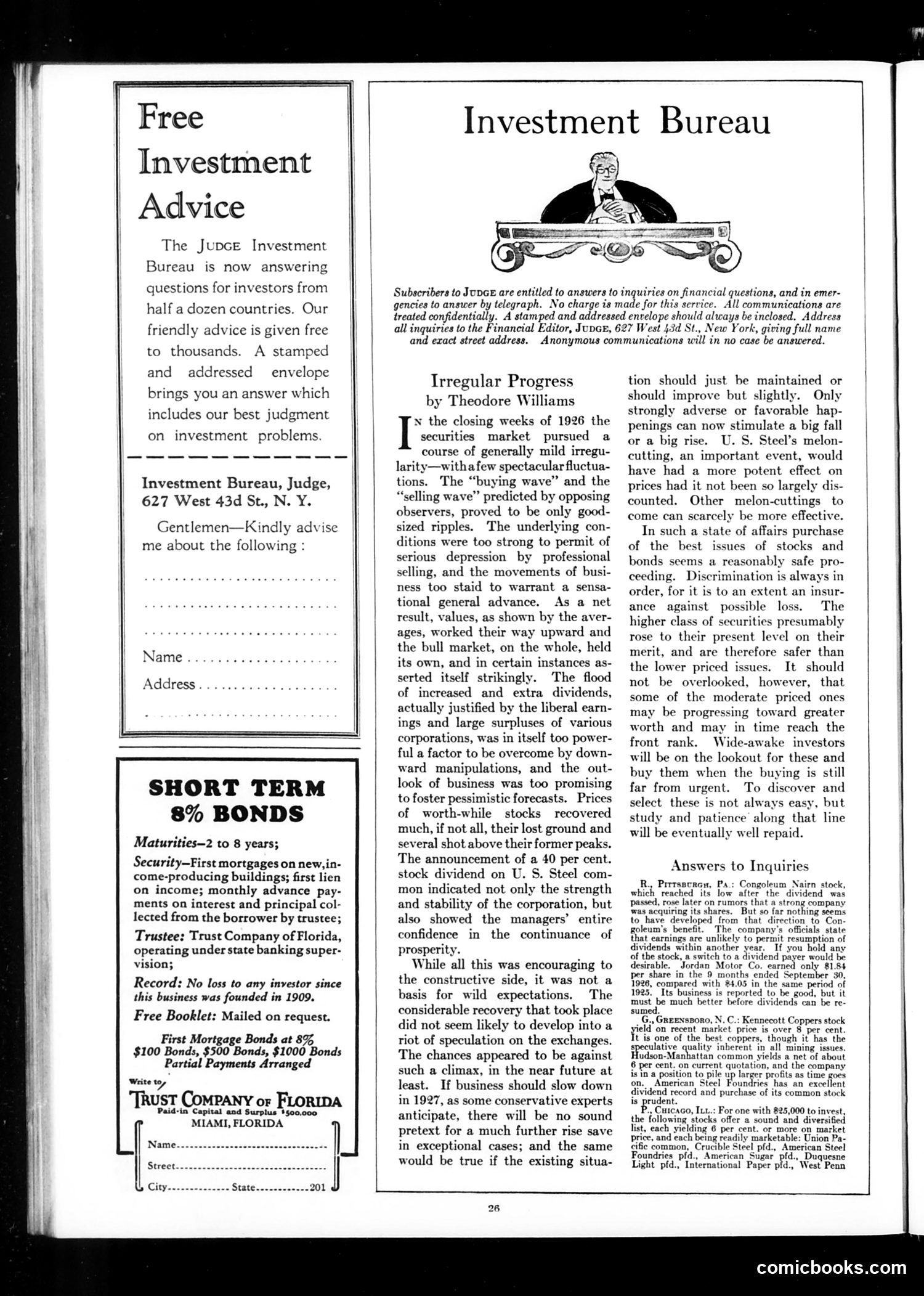
This page from Judge magazine (circa 1926) is primarily **advertising and financial advice content**, not political satire. The left side advertises Judge's "Investment Bureau"—a service answering investor questions free of charge. This promotes the magazine's credibility and audience reach across "half a dozen countries." The main article, "Irregular Progress" by Theodore Williams, analyzes the 1926 stock market. It discusses mild market fluctuations, strong underlying business conditions, and optimism about corporate dividends (notably U.S. Steel's 40% dividend announcement). Williams cautiously predicts continued moderate growth rather than wild speculation or collapse in 1927. The bottom advertises Florida mortgage bonds yielding 8%—typical of the era's investment opportunities and reflecting the 1920s real-estate boom. The overall tone reflects pre-1929 Crash optimism about continued prosperity and rational market behavior.
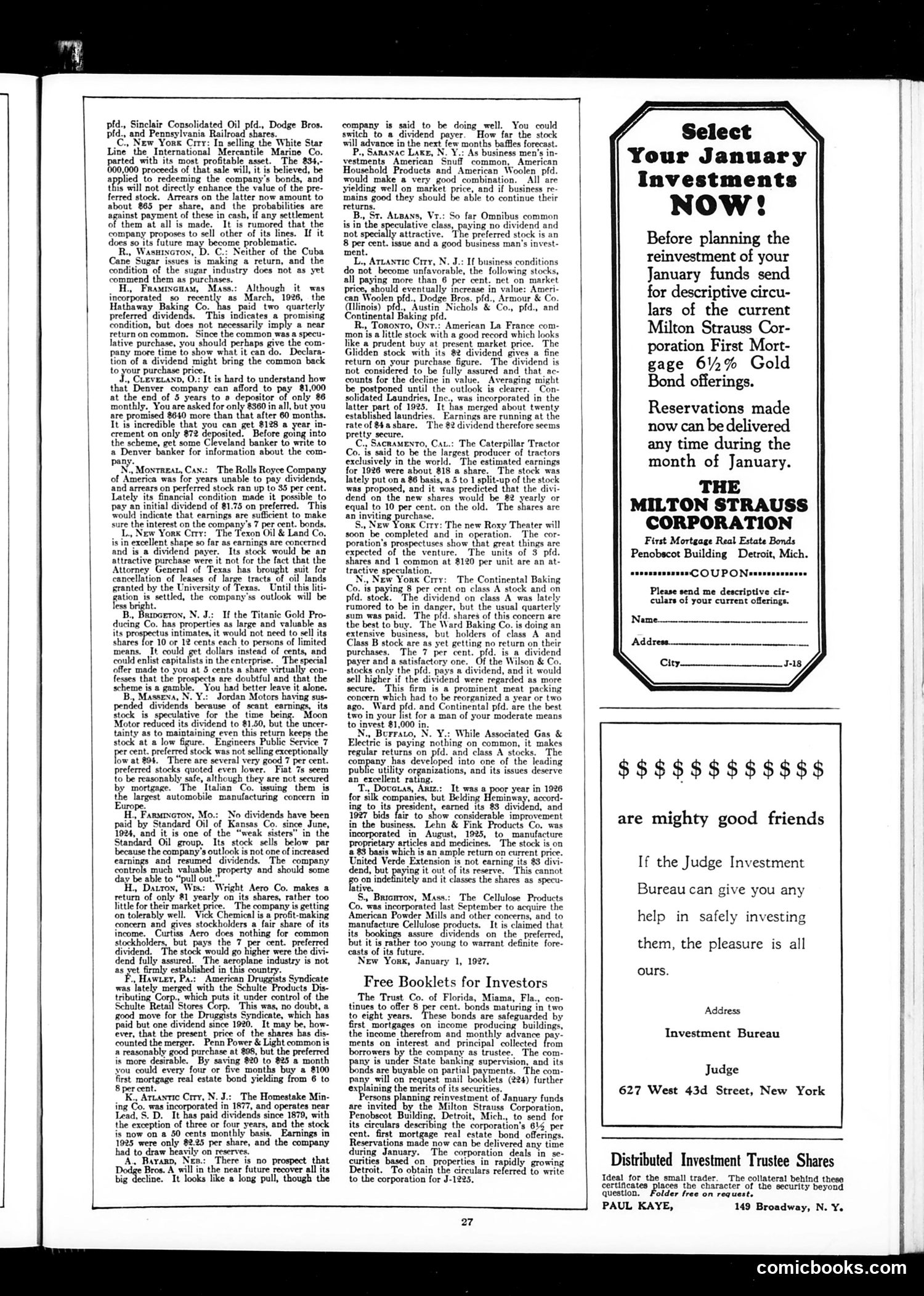
This page is primarily **investment advice**, not political satire. It consists of a financial advice column answering readers' questions about stock purchases and corporate investments. The content reflects 1920s economic concerns: readers ask about dividend payments, company earnings, and speculative schemes. Notable examples include skepticism toward the "Titanic Gold Producing Co." (offering shares at suspiciously low prices to ordinary people), questions about Cuban sugar stocks, and cautionary advice regarding get-rich-quick Denver schemes. The right sidebar advertises the Milton Strauss Corporation's real estate bonds and the Judge Investment Bureau—itself a form of financial guidance, suggesting the magazine positioned itself as a trustworthy source for ordinary investors during the pre-Depression era. The tone is protective of small investors, warning against speculative bubbles and dubious mining ventures—advice that would prove prescient before the 1929 crash.
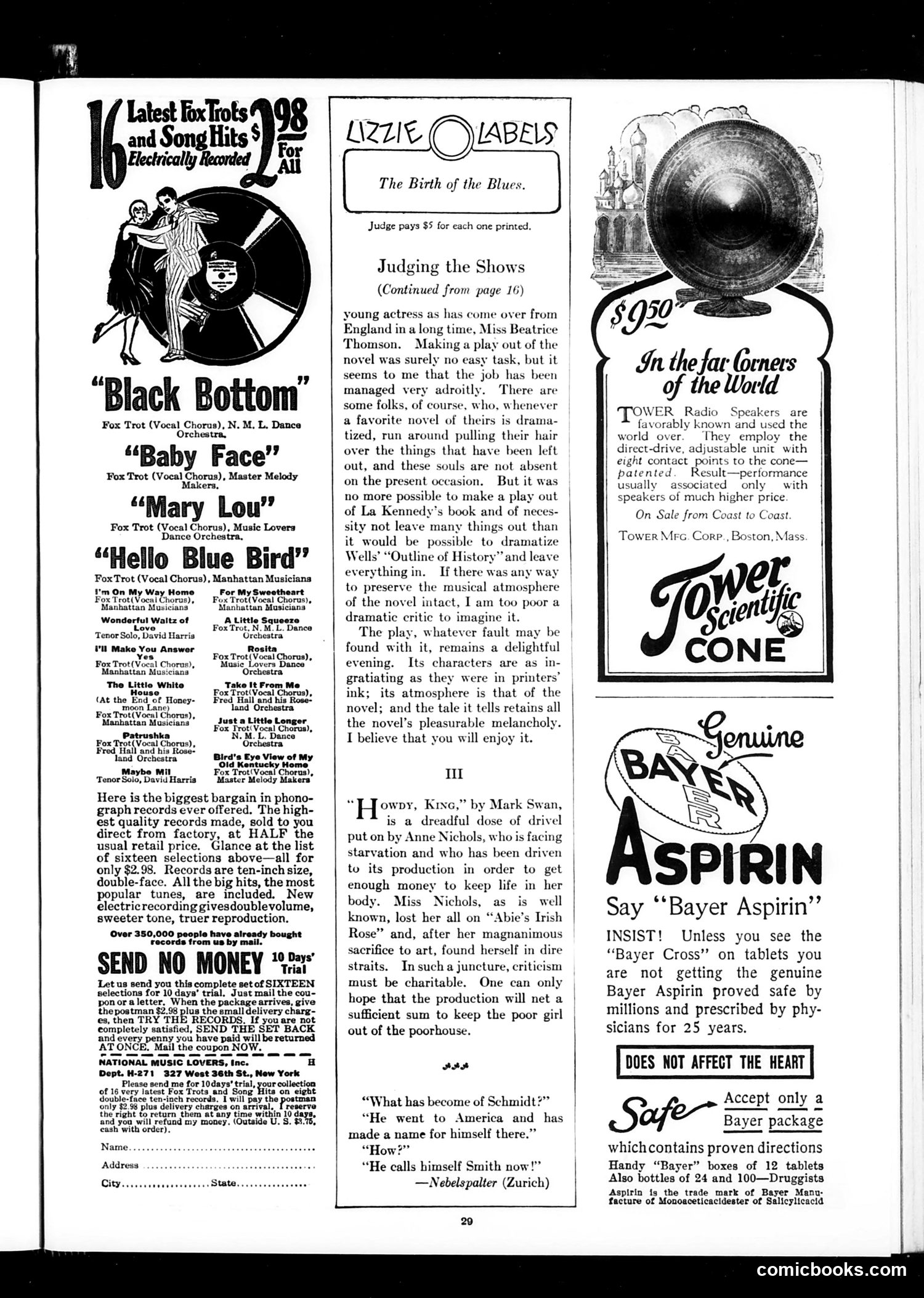
This page is primarily **advertising and record listings**, not political satire. The dominant content is a mail-order record offer selling 16 "Fox Trot" dance records—popular 1920s jazz-influenced music—for $2.98, with a "send no money" trial offer. The page includes a theater review column ("Judging the Shows") discussing a stage adaptation of a novel, praising actress Beatrice Thomson's performance and the play's fidelity to its source material. The only potentially satirical element is minimal: a small "Lizzie Labels" section offering custom labels for "The Birth of the Blues" for 5 cents each—a modest joke about music labeling rather than substantive commentary. The advertisements (Tower Scientific Cone speaker, Bayer Aspirin) are straightforward product promotions. This is fundamentally a **commercial page** with light entertainment content, not political or social satire requiring historical context.
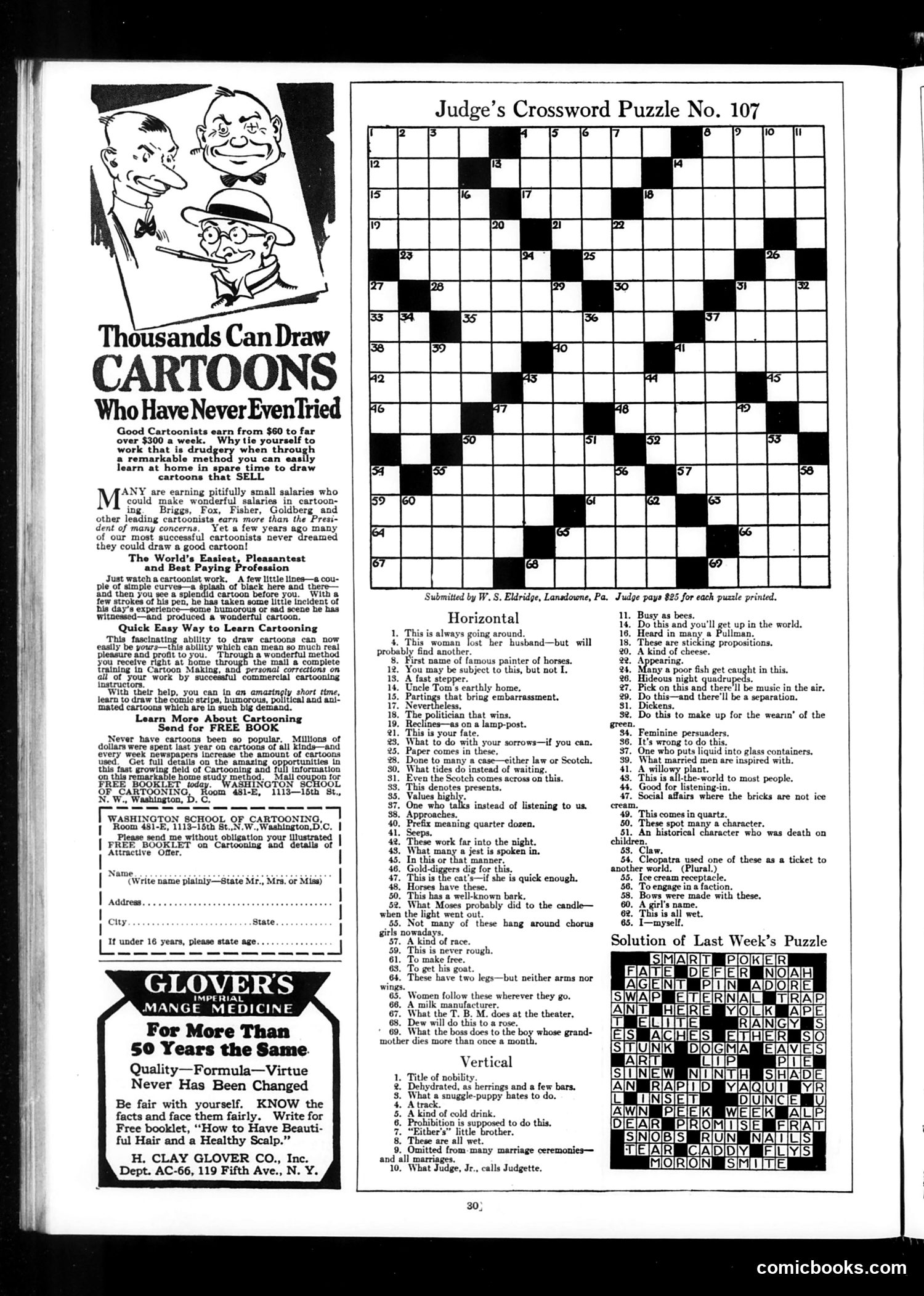
This page is primarily a **crossword puzzle** with advertising, not political satire. The cartoon at top-left shows three caricatured male faces in a simple drawing style—likely illustrating the adjacent advertisement. The main content advertises the "Washington School of Cartooning," promoting cartooning as a lucrative, easy-to-learn profession. It references famous cartoonists (Briggs, Fox, Fisher, Goldberg) earning substantial incomes and claims anyone can learn through their mail-based correspondence course. This reflects early 20th-century optimism about commercial cartooning as accessible, profitable work. The page also includes advertisements for Glover's mange medicine and other products. The crossword clues contain mild social humor typical of the era—references to gold-diggers, chorus girls, and various domestic situations—but no significant political commentary is evident.
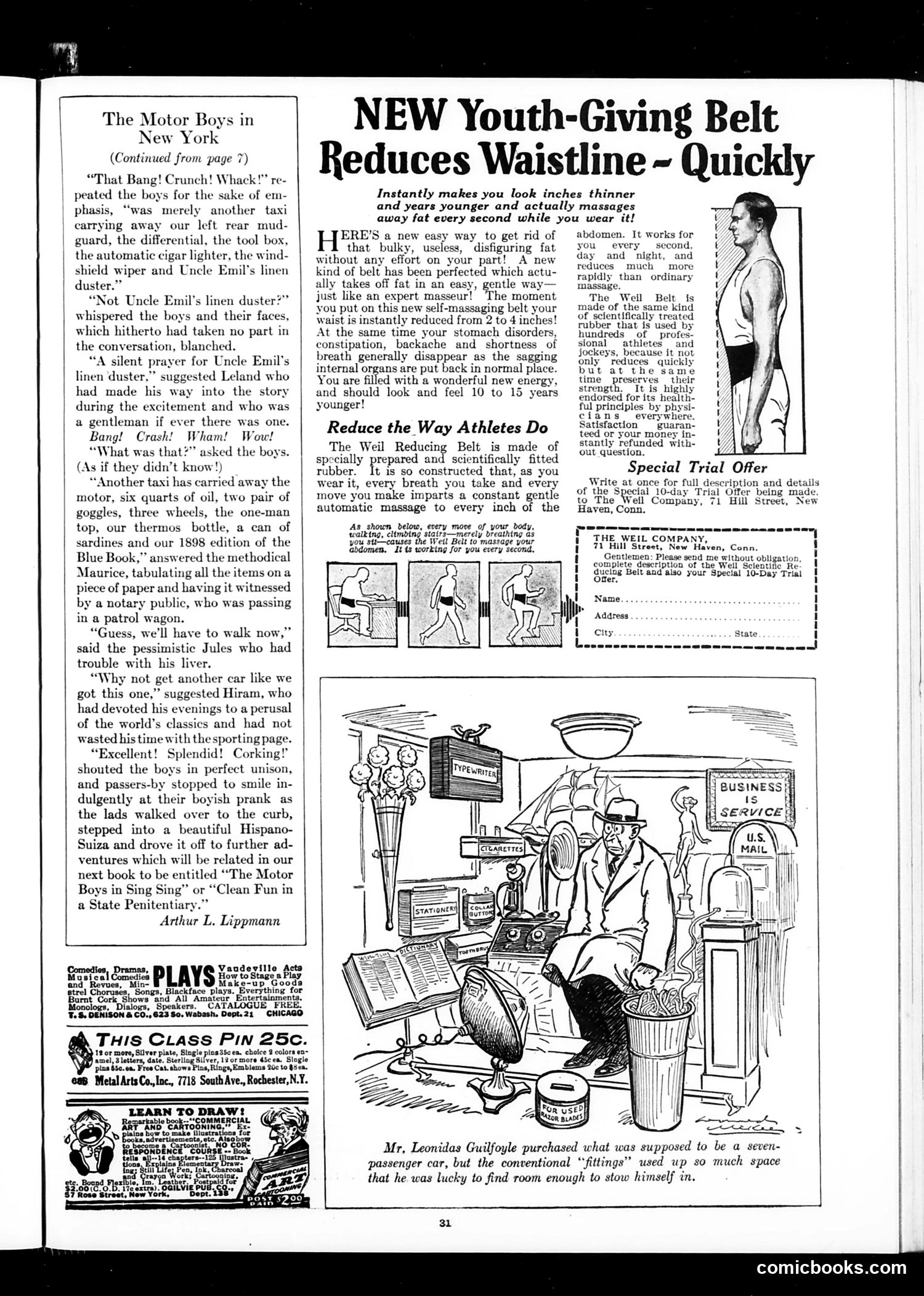
This page combines a serialized boys' adventure story with period advertising, reflecting early 20th-century magazine conventions. **"The Motor Boys in New York"** is a humorous continuation of a pulp fiction series about young men and their automobile misadventures. The satire mocks both the formulaic adventure genre (where protagonists casually steal a car after destroying another) and boys' entertainment that claimed wholesome values while depicting reckless behavior. The casual theft of a "beautiful Hispano-Suiza" and joke ending about "Sing Sing" (a famous prison) lampoon the unrealistic escapades typical of such stories. **The "Youth-Giving Belt" advertisement** exemplifies period quackery—a "scientific" reducing device promising instant weight loss through passive massage. The accompanying cartoon satirizes consumer gullibility: a man who bought what he thought was a "seven-passenger car" finds it impossibly cramped with junk, a visual joke about deceptive advertising and wasted consumer purchases. Together, the page satirizes American consumer culture: fraudulent products sold through exaggerated claims, and escapist fiction normalizing irresponsible behavior for young readers.
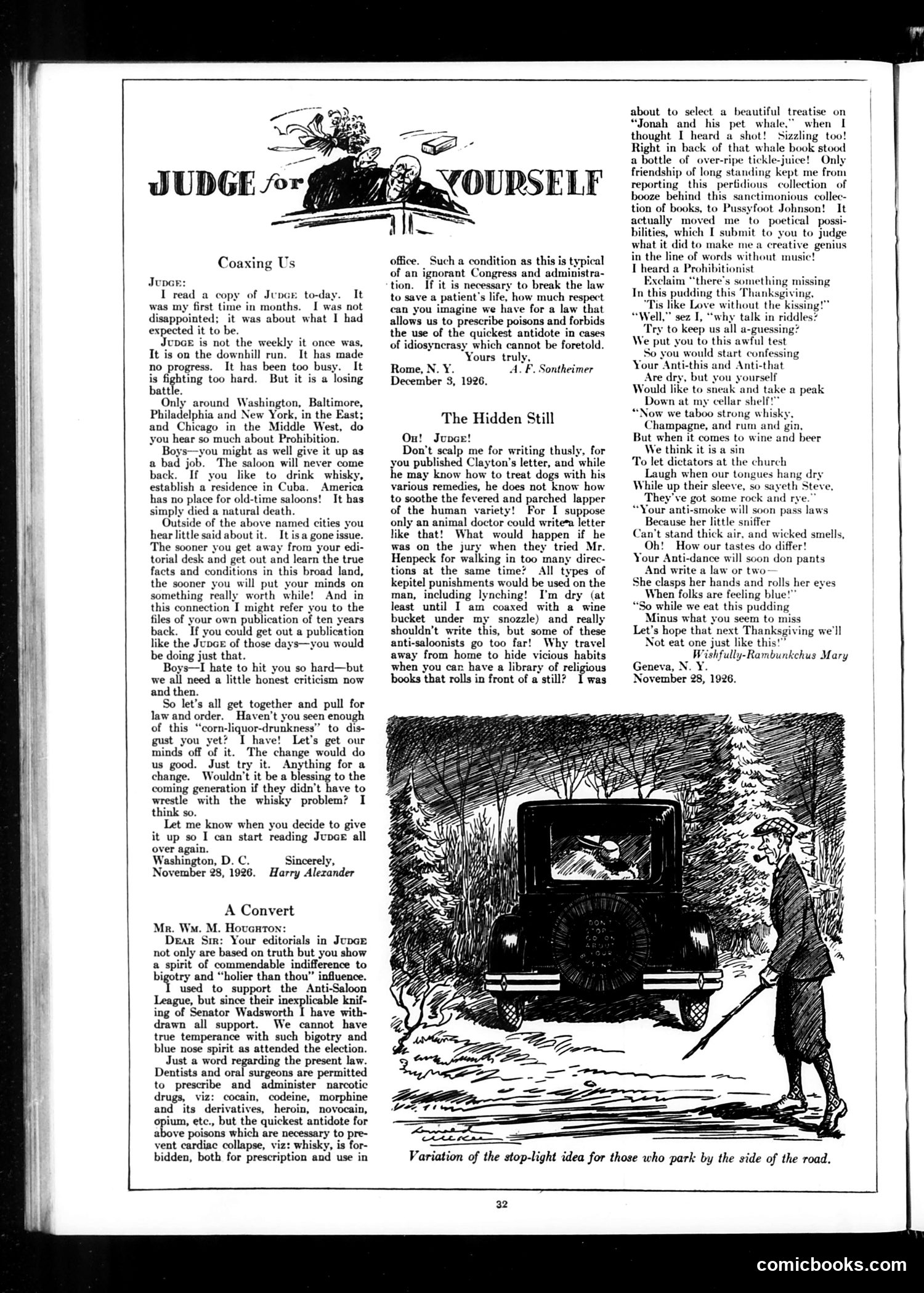
This page contains three opinion letters and editorial responses about Prohibition enforcement and temperance debates. The main cartoon illustrates "a variation of the stop-light idea for those who park by the side of the road"—showing a car parked in darkness with illuminated windows, satirizing illicit alcohol consumption during Prohibition. The letters debate whether laws against alcohol are enforceable and whether prescription drugs for "legitimate" purposes (cocaine, morphine, heroin) should be permitted while alcohol remains banned. One writer criticizes the hypocrisy of allowing dentists and surgeons access to narcotics while criminalizing whiskey. The satire targets Prohibition's ineffectiveness and the contradictions in American drug policy circa 1926.
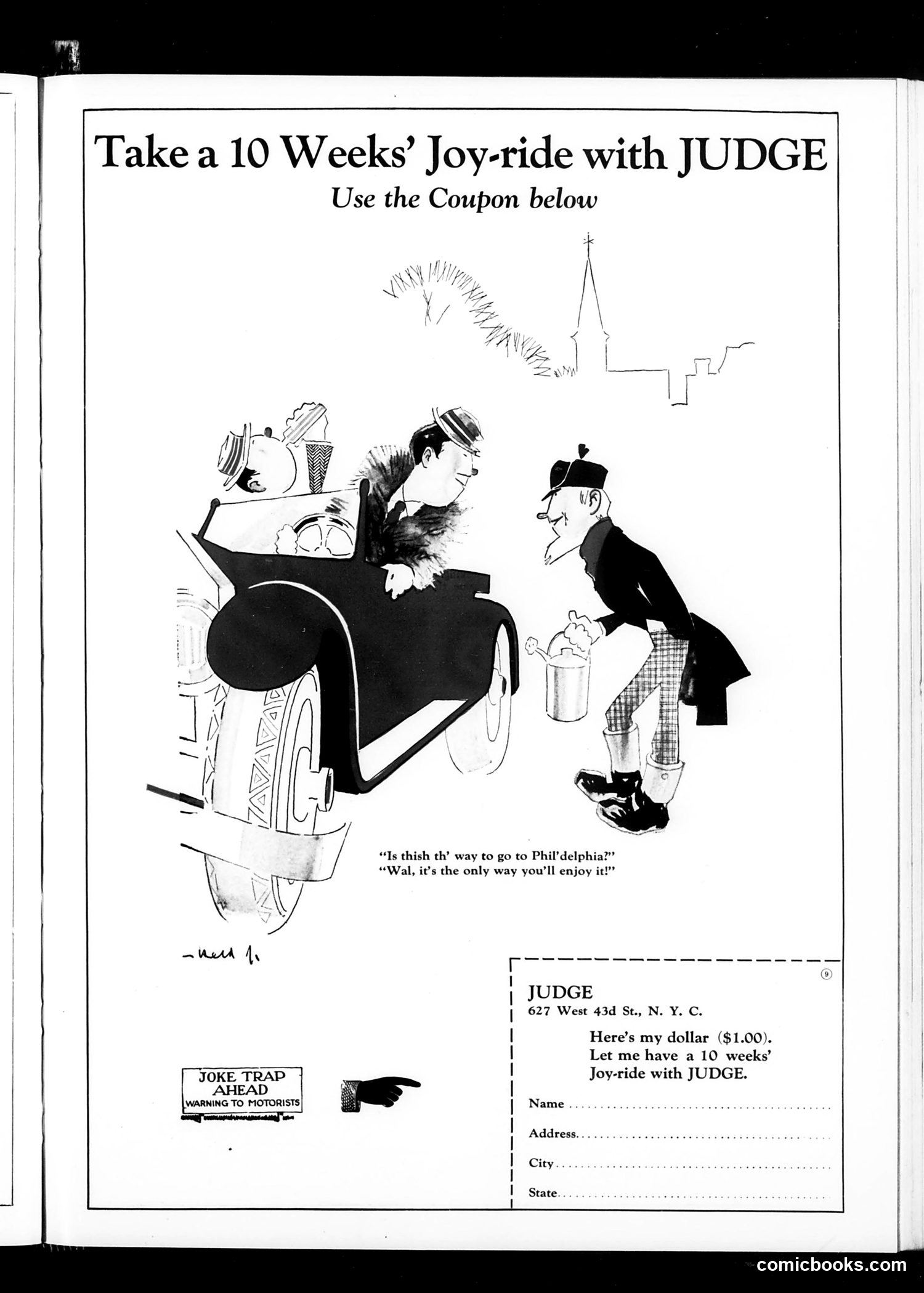
This is a subscription advertisement for *Judge* magazine disguised as humor. The cartoon depicts a motorist asking directions to Philadelphia, with a pedestrian suggesting the "only way you'll enjoy it" is taking a circuitous, chaotic route (shown by the wild vehicle path). The joke targets early automobile culture—specifically the novelty and unpredictability of motorcar travel in the early 20th century. The satirical point: driving was so unreliable and accident-prone that getting lost was practically guaranteed, making the journey itself the entertainment rather than reaching the destination. The "Joke Trap Ahead" warning reinforces the automotive theme. The coupon offers readers 10 weeks of *Judge's* satirical content ("joy-ride") for one dollar—positioning the magazine as similarly entertaining, chaotic entertainment. This advertisement-as-cartoon was typical of *Judge's* self-promotional style.
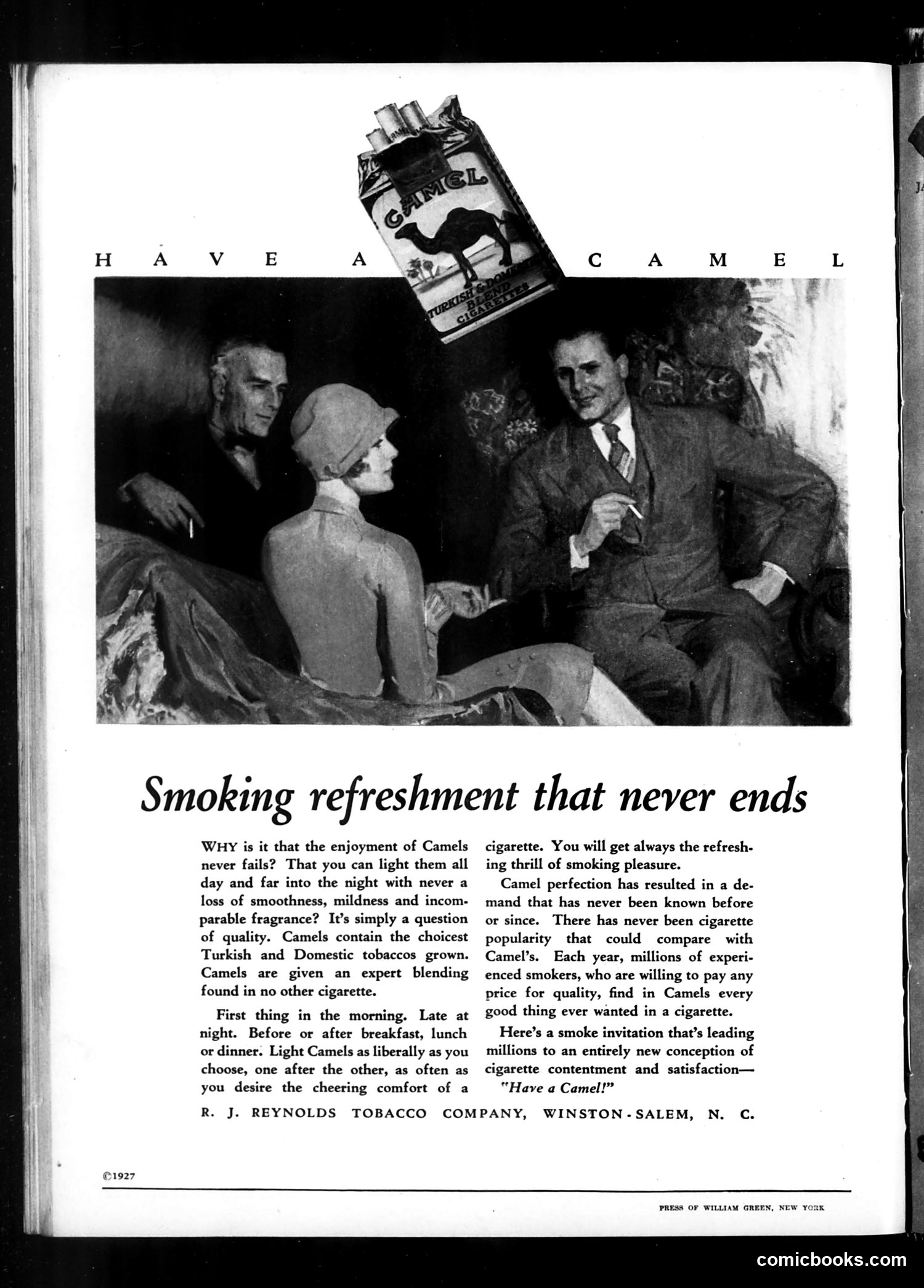
This is not a political cartoon or satire—it's a **cigarette advertisement** for Camel brand cigarettes from 1927. The page depicts a social scene (four well-dressed people in what appears to be a parlor or lounge) meant to convey sophistication and leisure. The ad emphasizes quality Turkish and domestic tobacco blends, promising consistent smoothness and mildness throughout the day. The catchphrase "Have a Camel!" frames smoking as an invitation to contentment and social comfort. There is no satire here. Judge magazine, while primarily satirical, also carried paid advertising. This is a straightforward product promotion targeting affluent consumers, typical of 1920s tobacco marketing that made health and quality claims now recognized as misleading.