
Judge, 1927-01-08 · page 15 of 36
Judge — January 8, 1927 — page 15: what you’re looking at
What you’re looking at
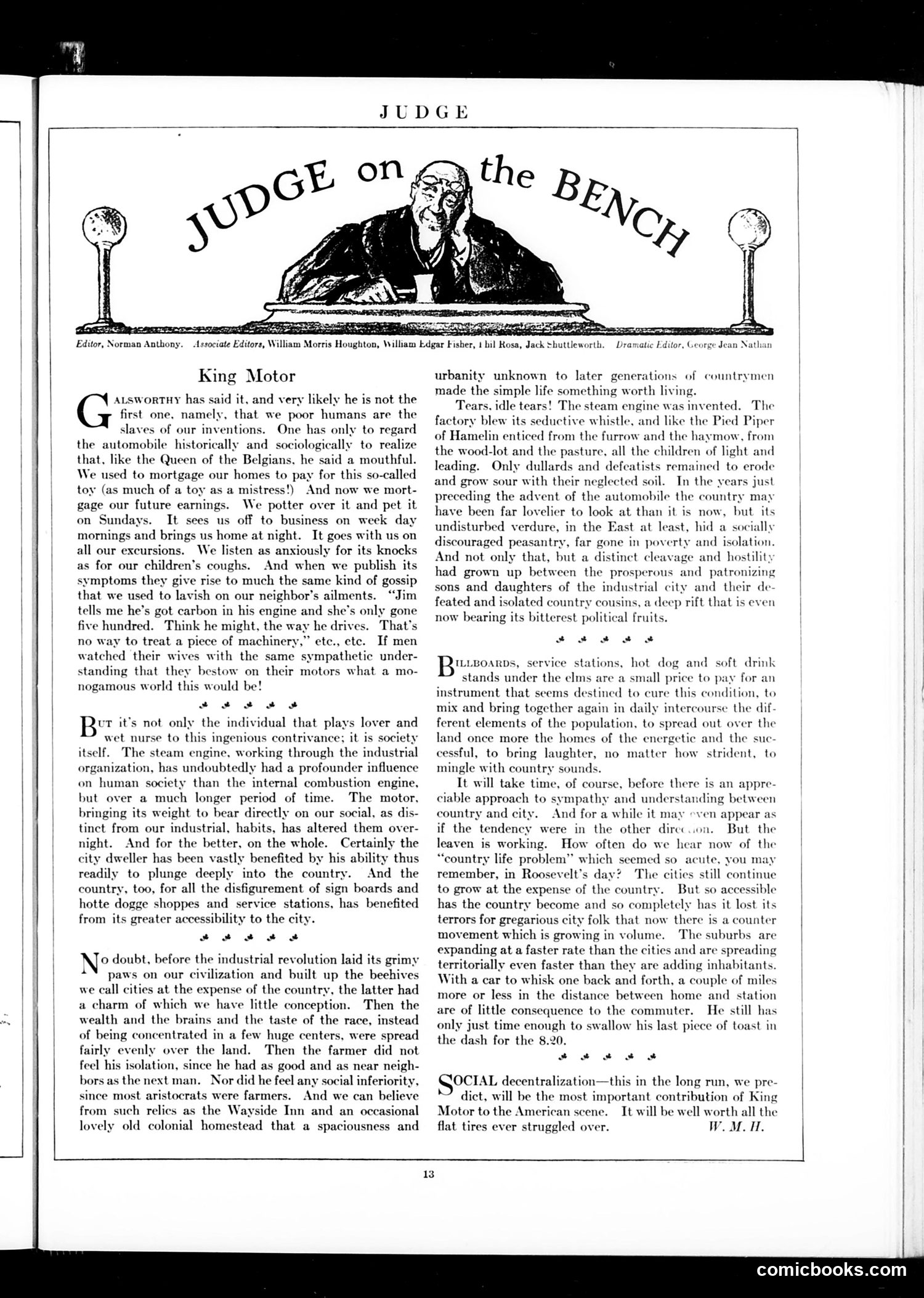
This is a lengthy editorial essay (not a political cartoon, despite the "Judge on the Bench" header) examining the automobile's profound social impact. The piece argues that cars have become central to human life—we obsess over them like romantic partners or children. The author (likely William Morris Houghton based on the byline) uses satire to critique this dependency while ultimately praising the automobile's social benefits. The main argument: pre-industrial rural life was idyllic but isolating and socially inferior. The steam engine and factories drew ambitious people cityward, creating class divisions and rural decline. However, the automobile—by providing easy access between city and country—is reversing this damage, reconnecting rural and urban life and restoring the countryside's appeal and vitality. The essay concludes that "social decentralization" via automobiles will be King Motor's greatest contribution to America. It's pro-technology modernism wrapped in nostalgic language about lost rural charm.
📄 Transcribed text from this page (OCR, searchable)
Machine-transcribed from the original scan — historical spelling and the odd misread are preserved.
JUDGE Editor, Norman Anthony. Associate Editors, William Morris Houghton, William kdgar Fisher, 1 bil Rosa, Jack Shuttleworth, King Motor G ALSWorTHy has said it, and very likely he is not the first one, namely, that we poor humans are the slaves of our inventions. One has only to regard the automobile historically and sociologically to realize that, like the Queen of the Belgians, he said a mouthful. We used to mortgage our homes to pay for this so-called toy (as much of a toy as a mistress!) And now we mort- gage our future earnings. We potter over it and pet it on Sundays. It sees us off to business on week day mornings and brings us home at night. It goes with us on all our excursions. We listen as anxiously for its knocks as for our children’s coughs. And when we publish its symptoms they give rise to much the same kind of gossip that we used to lavish on our neighbor's ailments. “Jim tells me he’s got carbon in his engine and she’s only gone five hundred. Think he might, the way he drives. That's no way to treat a piece of machinery,” etc., ete. If men watched their wives with the same sympathetic under- standing that they bestow on their motors what a mo- nogamous world this would be! ry 2 ad Bt it’s not only the individual that plays lover and wet nurse to this ingenious contrivance; it is society The steam engine, working through the industrial tion, has undoubtedly had a profounder influence on human society than the internal combustion engine, but over a much longer period of time. The motor, bringing its weight to bear directly on our social, as dis- tinct from our industrial, habits, has altered them over- night. And for the better, on the whole. Certainly the city dweller has been vastly benefited by his ability thus readily to plunge deeply into the country. And the country, too, for all the disfigurement of sign boards and hotte dogge shoppes and service stations, has benefited from its greater accessibility to the city et s+ st tH st No doubt, before the industrial revolution laid its grimy + paws on our civilization and built up the beehives we call cities at the expense of the country, the latter had a charm of which we have little conception. Then the wealth and the brains and the taste of the race, instead of being concentrated in a few huge centers, were spread fairly evenly over the land. Then the farmer did not feel his isolation, since he had as good and as near neigh- bors as the next man. Nor did he feel any social inferiority, since most aristocrats were farmers. And we can believe from such relics as the Wayside Inn and an occasional lovely old colonial homestead that a spaciousness and Dramatic Editor, George Jean Nathan urbanity unknown to later generations of countrymen made the simple life something worth living. Tears, idle tears! The steam engine was invented. The factory blew its seductive whistle, and like the Pied Piper of Hamelin enticed from the furrow and the haymow, from the wood-lot and the pasture, all the children of light and leading. Only dullards and defeatists remained to erode and grow sour with their neglected soil. In the years just preceding the advent of the automobile the country may have been far lovelier to look at than it is now, but its undisturbed verdure, in the East at least, hid a socially discouraged peasantry, far gone in poverty and isolation. And not only that, but a distinct cleavage and hostilit had grown up between the prosperous and patronizing sons and daughters of the industrial city and their de- feated and isolated country cousins, a deep rift that is even now bearing its bitterest political fruits. ry ry ey ry ey Burotes, service stations, hot dog and soft drink stands under the elms are a small price to pay for an instrument that seems destined to cure this condition, to mix and bring together again in daily intercourse the dif- ferent elements of the population, to spread out over the land once more the homes of the energetic and the suc cessful, to bring laughter, no matter how strident, to mingle with country sounds. It will take time, of course, before there is an appre- ciable approach to sympathy and understanding between country and city. And for a while it may even appear as if the tendency were in the other direcvon. But the leaven is working. How often do we hear now of the “country life problem” which seemed so acute, you may remember, in Roosevelt’s day? The cities still continue to grow at the expense of the country. But so accessible has the country become and so completely has it lost its terrors for gregarious city folk that now there is a counter movement which is growing in volume. The suburbs are expanding at a faster rate than the cities and are spreading territorially even faster than they are adding inhabitants. With a car to whisk one back and forth, a couple of miles more or less in the distance between home and station are of little consequence to the commuter. He still has only just time enough to swallow his last piece of toast in the dash for the 8.20. OCIAL decentralization—this in the long run, we pre- \" dict, will be the most important contribution of King Motor to the American scene. It will be well worth all the flat tires ever struggled over. W.M.H. 13 comicbooks.com