
Judge, 1927-01-08 · page 9 of 36
Judge — January 8, 1927 — page 9: what you’re looking at
What you’re looking at
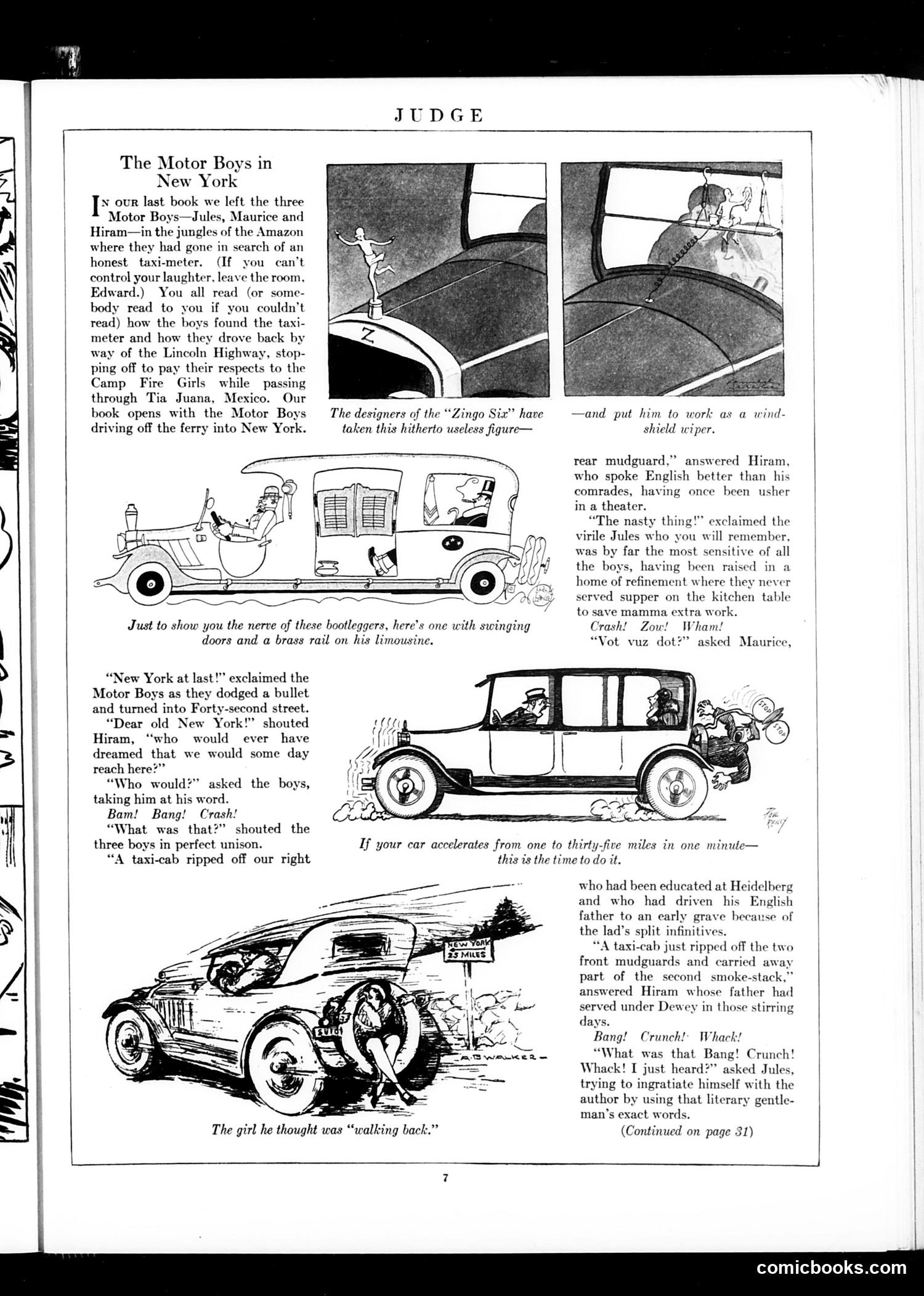
This is a humorous fictional narrative (not a political cartoon) from *Judge* magazine, satirizing early 1920s American urban life and motorcar culture. The "Motor Boys" are adventure-story protagonists arriving in New York City, where they immediately encounter the chaotic traffic and reckless taxi drivers that plagued the era—a well-known public nuisance. The satire targets several contemporary issues: the dishonesty of taxi-meter operators (they rigged meters to overcharge), Prohibition-era bootleggers (the joke about "swinging doors and a brass rail on his limousine"), and the general mayhem of unregulated automobile traffic in Manhattan. The cartoon also gently mocks the boys' contrasting national origins and speech patterns—Jules is oversensitive, Maurice speaks with a German accent, Hiram is patriotic. The core joke is that arriving in New York means immediately being battered by taxis, treating it as inevitable urban hazard rather than accident.
📄 Transcribed text from this page (OCR, searchable)
Machine-transcribed from the original scan — historical spelling and the odd misread are preserved.
JUDGE The Motor Boys in New York our last book we left the three Motor Boys—Jules, Maurice and Hiram—in the jungles of the Amazon where they had gone in search of an honest taxi-meter. (If you can’t control your laughter, leave the room, Edward.) You all read (or some- body read to you if you couldn't read) how the boys found the taxi- meter and how they drove back by way of the Lincoln Highway, stop- ping off to pay their respects to the Camp Fire Girls while passing through Tia Juana, Mexico. Our book opens with the Motor Boys driving off the ferry into New York. The designers of the ngo Six” have taken this hitherto useless figure— Just to show you the nerve of these bootleggers, here’s one with swinging doors and a brass rail on his limousine. “New York at last!” exclaimed the Motor Boys as they dodged a bullet and turned into Forty-second street. “Dear old New York!” shouted Hiram, “who would ever have dreamed that we would some day reach her “Who would?” asked the boys, taking him at his word. Bam! Bang! Crash! “What was that?” shouted the three boys in perfect unison. “A taxi-cab ripped off our right —and put him to work as a wind- shield wiper. rear mudguard,” answered Hiram, who spoke English better than his comrades, having once been usher in a theater. “The nasty thing!” exclaimed the virile Jules who you will remember, was by far the most sensitive of all the boys, having been raised in a home of refinement where they never served supper on the kitchen table to save mamma extra work. Crash! Zow! Wham! “Vot vuz dot?” asked Maurice, If your car accelerates from one to thirty-five miles in one minute— this is the time to do it. The girl he thought was “walking back.” who had been educated at Heidelberg and who had driven his English father to an early grave be the lad’s split infinitives. “A taxi-cab just ripped off the two front mudguards and carried away part of the second smoke-stack,” answered Hiram whose father had served under Dewey in those stirring days. Bang! Crunch!: Whack! “What was that Bang! Crunch! Whack! I just heard?” asked Jules, trying to ingratiate himself with the author by using that literary gentle- man’s exact words. (Continued on page 31) ause of comicbooks.com