
Judge, 1927-01-08 · page 18 of 36
Judge — January 8, 1927 — page 18: what you’re looking at
What you’re looking at
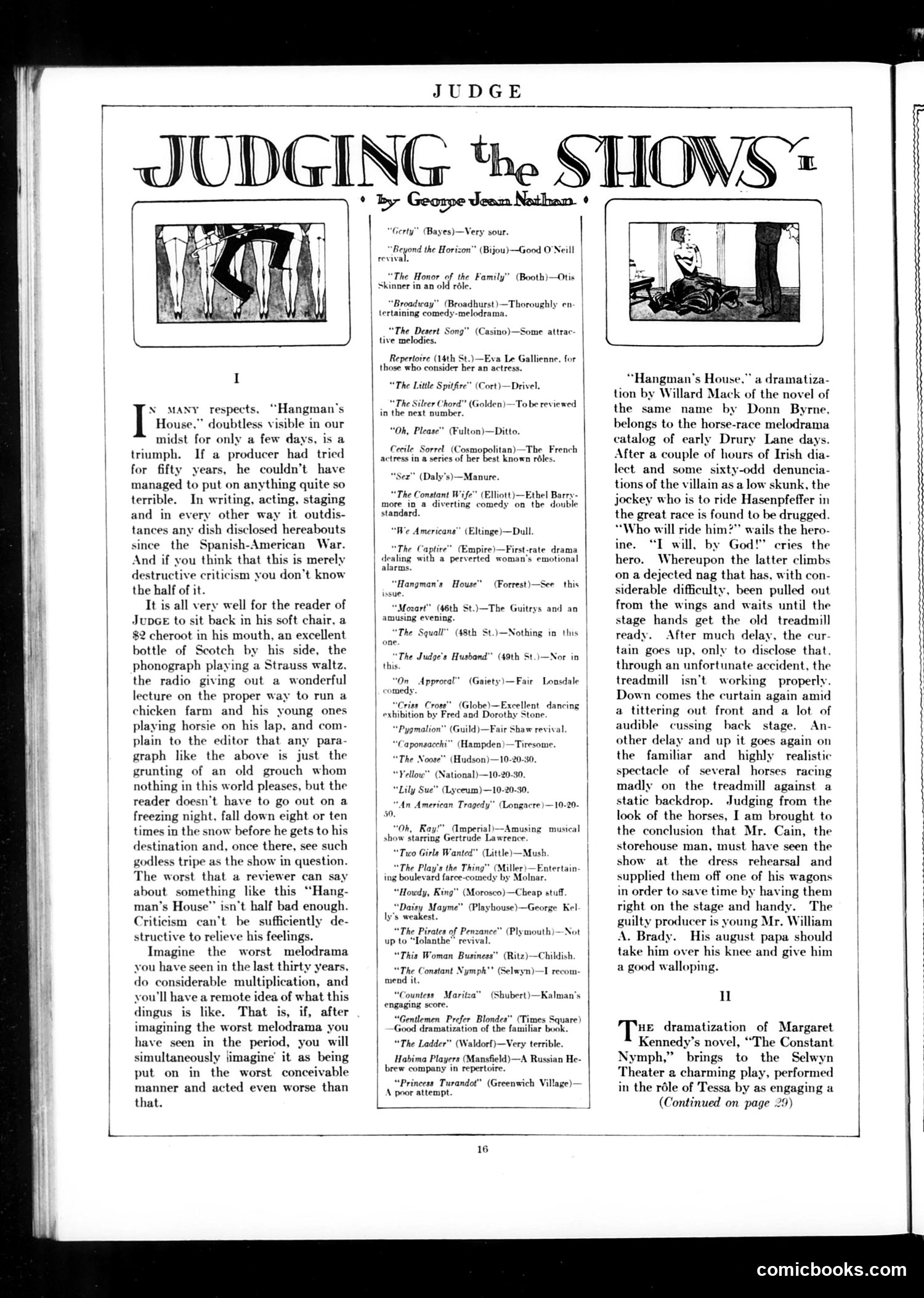
This page presents theater critic George Jean Nathan's brutal dismissal of the play "Hangman's House." The main text (Section I) isn't a cartoon but a scathing written review that dominates the page. Nathan uses exaggerated, almost absurdist language to convey the play's awfulness—comparing it unfavorably to the worst melodramas of thirty years, claiming it outdoes any theatrical disaster "since the Spanish-American War." He sarcastically addresses comfortable readers at home, suggesting they cannot truly judge unless they've suffered through it in person on a freezing night. The surrounding box lists brief reviews of current Broadway productions, using Nathan's characteristic caustic style ("Dull," "Ditto," "Manure," "Very terrible"). This was typical Judge content: sophisticated urban satire targeting middle-class theatergoers. The humor relies on hyperbolic cruelty toward performers and writers, reflecting 1920s entertainment journalism's personal, acerbic tone.
📄 Transcribed text from this page (OCR, searchable)
Machine-transcribed from the original scan — historical spelling and the odd misread are preserved.
JUDGE N MANY respects, “Hangman’s I House,” doubtless visible in our midst for only a few days, is a If a producer had tried years, he couldn’t have managed to put on anything quite so terrible. In writing, acting, staging and in every other way it outdis- tances any dish disclosed hereabouts since the Spanish-American War. And if you think that thi merely destructive criticism you don’t know the half of it. It is all very well for the reader of JupGE to sit back in his soft chair, a $2 cheroot in his mouth, an excellent bottle of Scotch by his side, the phonograph playing a Strauss waltz. the radio giving out a wonderful lecture on the proper way to run a chicken farm and his young ones playing horsie on his lap, and com- plain to the editor that any para- graph like the above is just the grunting of an old grouch whom nothing in this world pleases, but the reader doesn't have to go out on a freezing night, fall down eight or ten times in the snow before he gets to his destination and, once there, see such godless tripe as the show in question. The worst that a reviewer can say about something like this “Hang- man’s House” isn’t half bad enough. Criticism can’t be sufficiently de- structive to relieve his feelings. Imagine the worst melodrama you have seen in the last thirty years, do considerable multiplication, and you'll have a remote idea of what this dingus is like. That is, if, after imagining the worst melodrama you have seen in the period, you will simultaneously jimagine’ it as being put on in the worst conceivable manner and acted even worse than that. * by Geonpe Jeam Nathan. “Gerty” (Bayes)—Very sour. “Beyond the Horizon” (Bijou) —Good O'Neill skinner in an old réle. “Broadway” (Broadburst)—Thoroughly en tertaining comedy-melodrama. “The Desert Song” tive melodies. (Casino)—Some attrac Repertoire (14th St.)— Le Gallienne, for those who consider her an actress. “The Little Spitfire” (Cort)—Drivel. | _ “The Silrer Chord” (Golden)—Tobe reviewed in the next number. “Oh, Please” (Fulton)—Ditto. Cecile Sorrel {Cosmo pol itan)—The French actress in a series of her best known réles. “Sez” (Daly’s)—Manure. “The Constant Wife” (Elliott)—Ethel Barry- more in a diverting comedy on the double standard. “We Americans” (Eltinge)—Dull. “The Caplie” (Empire)—First-rate drama dealing with a perverted woman's emotional alarms. “Hangman's House” issue. “Mozart” (46th St.)—The Guitrys and an amusing evening. “The Squall” (48th St.)\—Nothing in this one. “The Judge's Husband” (49th St.)—Nor in this. (Forrest)—See this “On Approral” (Gaiety)—Fair Lonsdale |. comedy “Criss Cross” (Globe)—Excellent dancing exhibition by Fred and Dorothy Stone. “Pygmalion” (Guild) —Fair Shaw revival. “Caponsacchi” (Hampden) —Tiresome. “The Noose” (Hudson)—10-20-30. fellow" (National) —10-20-30. “Lily Sue” (Lyceum)—10-20-30. “An American Tragedy” (Longacte)—10-20- | 50. “Oh, Ray!” (mperial)—Amusing musical show starring Gertrude Lawrence “Two Girls Wanted” (Little) —Mush “The Play's the Thing” (Miller) —Entertain. ing boulevard farce-comedy by Molnar. “Howdy, King” (Morosco)—Cheap stuff. “Daisy Mayme” (Playhouse)—George Kel ly's weakest. “The Pirates of Penzance” (Plymouth) —N« up to “Tolanthe” revival “This Woman Business” (Ritz)—Childish. “The Constant Nymph** (Selwyn)—I recom- mend it. “Countess Maritza” engaging score. (Shubert)—Kalman’s “Gentlemen Prefer Blondes” (Times Square) Good dramatization of the familiar book. “The Ladder” (Waldorf)—Very terrible. Habima Players (Mansfield) —A Russian He- brew company in repertoire. “Princess Turandot” (Greenwich Village)— A poor attempt “The Honor of the Family” (Booth)—Otis | JUDGING ‘he SHOWS= | | | “Hangman’s Hou tion by Willard Mack of the novel of the same name by Donn Byrne, belongs to the horse-race melodrama catalog of early Drury Lane days. After a couple of hours of Irish dia- lect and some sixty-odd denuncia- tions of the villain as a low skunk, the jockey who is to ride Hasenpfeffer in the great race is found to be drugged. “Who will ride him?” wails the hero- ine. “I will, by God!” cries the hero. Whereupon the latter climbs on a dejected nag that has, with con- siderable difficulty, been pulled out from the wings and waits until the stage hands get the old treadmill ready. After much delay, the cur- tain goes up, only to disclose that through an unfortunate accident, the treadmill isn’t’ working properly. Down comes the curtain again amid a tittering out front and a lot of audible cussing back stage. An- other delay and up it goes again on the familiar and highly realistic spectacle of several horses racing madly on the treadmill against a static backdrop. Judging from the look of the horses, I am brought to the conclusion that Mr. Cain, the storehouse man, must have seen the show at the dress rehearsal and supplied them off one of his wagons in order to save time by having them right on the stage and handy. The guilty producer is young Mr. William A. Brady. His august papa should take him over his knee and give him a good walloping. i Te dramatization of Margaret Kennedy’s novel, “The Constant Nymph,” brings to the Selwyn heater a charming play, performed in the réle of Tessa by as engaging a (Continued on page 29) comicbooks.com 7