
A complete issue · 38 pages · 1926
Judge — December 25, 1926
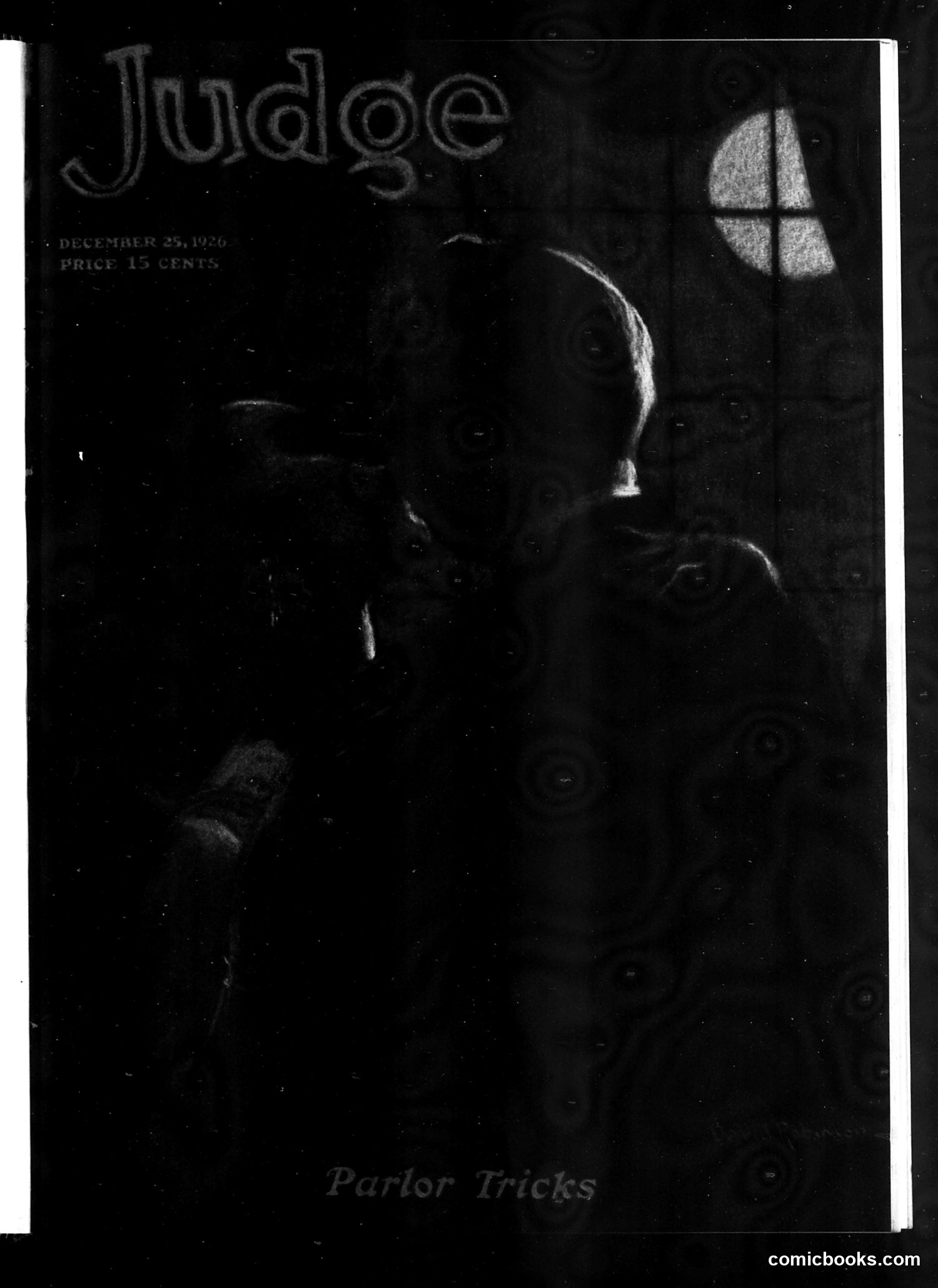
This is the cover of Judge magazine from December 25, 1926 (price 15 cents). The title "Parlor Tricks" appears at the bottom of a darkly-lit photograph showing what appears to be two figures in an interior setting with a window visible in the background. The image likely relates to spiritualism or séance activity—popular entertainments in the 1920s that Judge frequently satirized. The dramatic lighting and theatrical composition suggest the cover is mocking "parlor tricks" as sleight-of-hand deception performed in domestic settings. The dark, shadowy quality emphasizes the mysterious or fraudulent nature of such spiritualist performances, which were subjects of public skepticism and journalistic ridicule during this era.
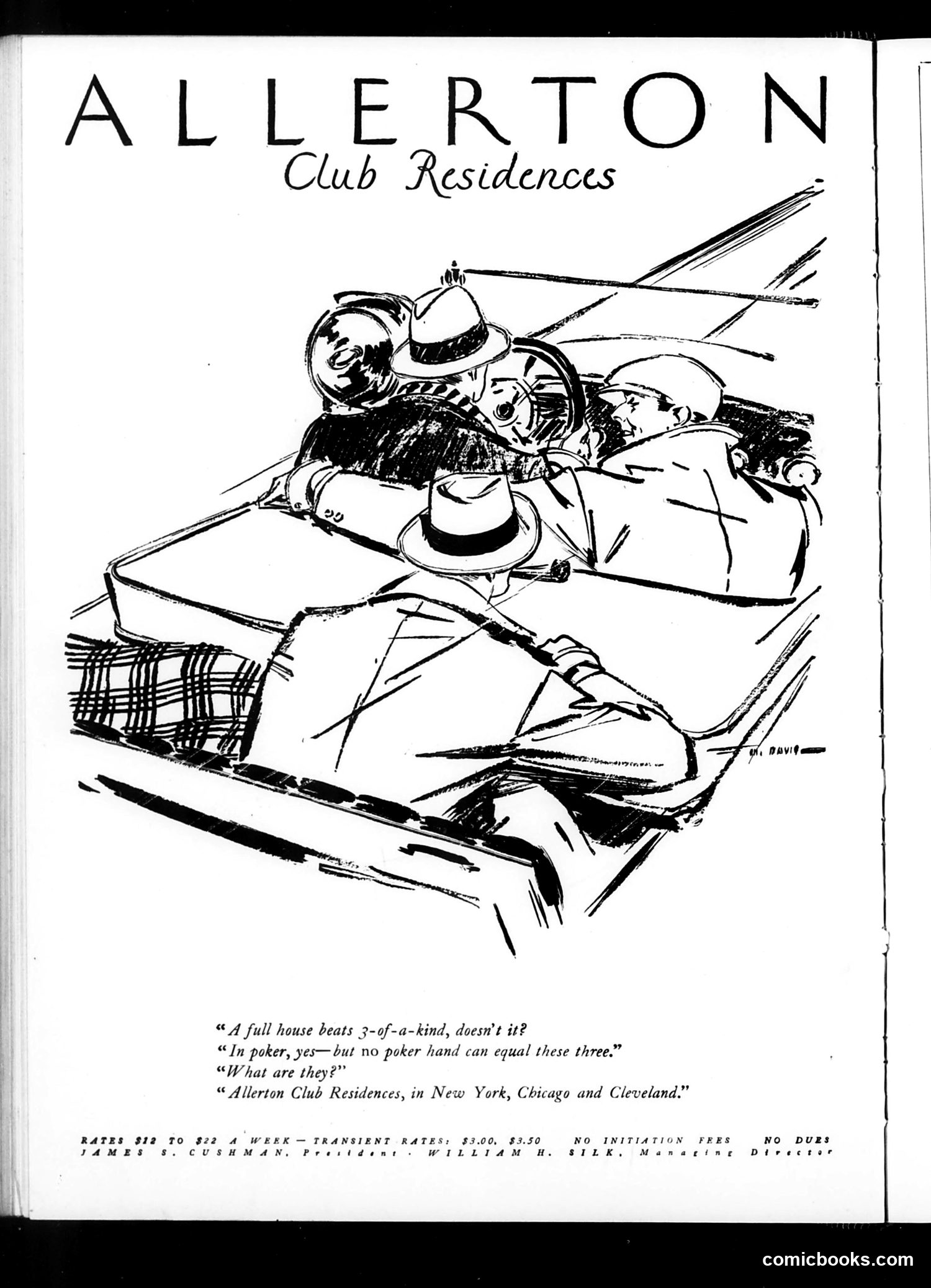
This is an advertisement for the Allerton Club Residences, upscale residential hotels in New York, Chicago, and Cleveland. The illustration depicts three men in a comedic scene with luggage and skis, suggesting winter travel or leisure. The accompanying dialogue plays on poker terminology as a sales pitch: "A full house beats 3-of-a-kind, doesn't it?" / "In poker, yes—but no poker hand can equal these three" / "What are they?" / "Allerton Club Residences, in New York, Chicago and Cleveland." The joke equates the three residence locations with an unbeatable poker hand, humorously arguing that access to multiple club locations across major cities is a superior "winning combination" for the resident. The rates ($12 to $22 weekly, $3.00, $3.50 transient rates) and "no initiation fees" are highlighted to emphasize value.
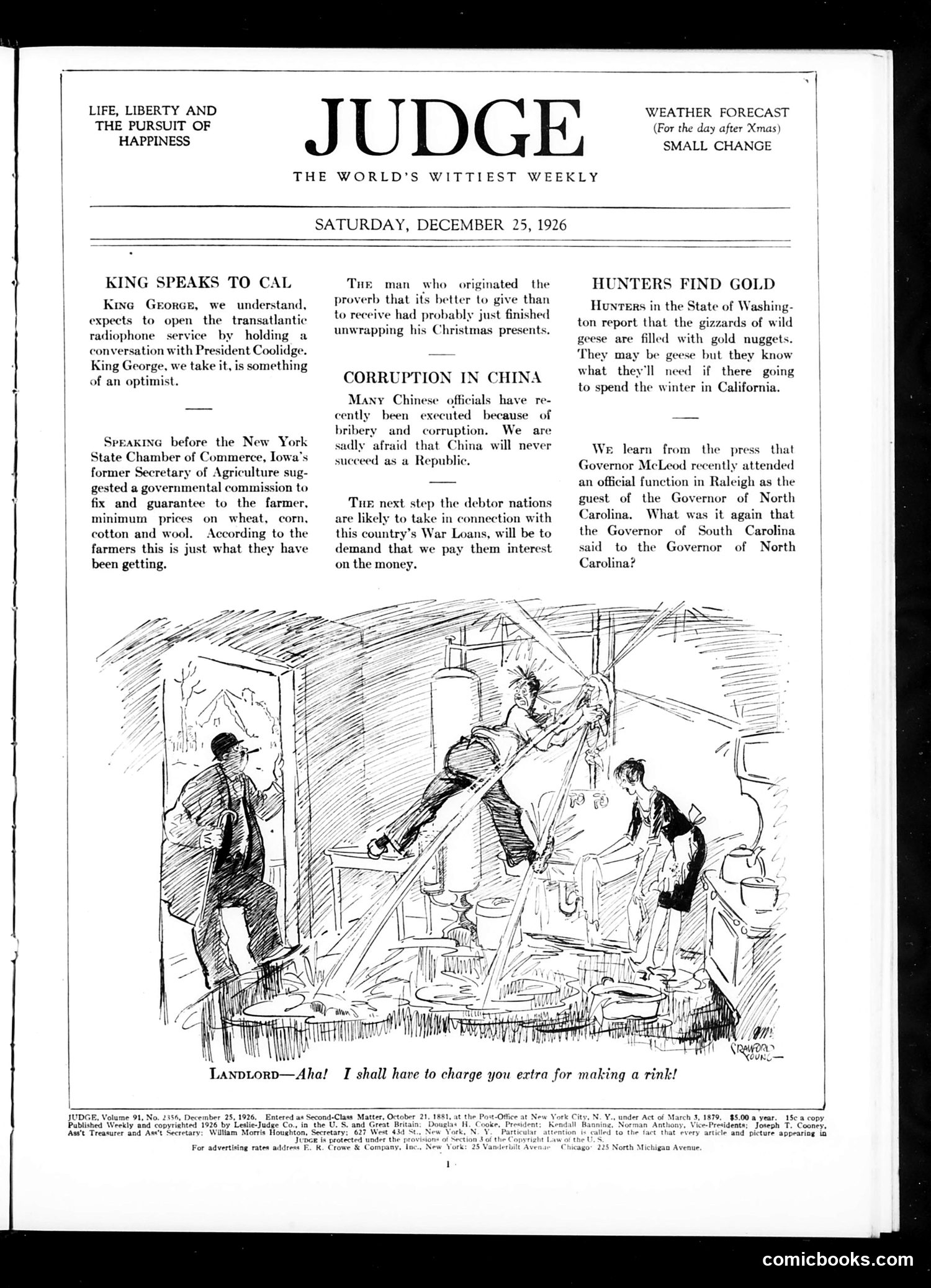
The main cartoon depicts a landlord confronting tenants about water damage, with the caption "Landlord—Aha! I shall have to charge you extra for making a rink!" **The Joke:** During winter, the apartment has frozen so badly that water has accumulated and turned to ice, creating an indoor skating rink. The landlord sarcastically threatens to charge extra rent for this accidental "amenity"—satirizing the poor heating conditions in tenement housing of the 1920s. The cartoon mocks both the inadequate maintenance of rental properties and landlords' exploitative tendency to profit from any circumstance, even those caused by their own negligence. The surrounding text items address unrelated political topics (King George, Chinese corruption, farm prices, gold discovery).
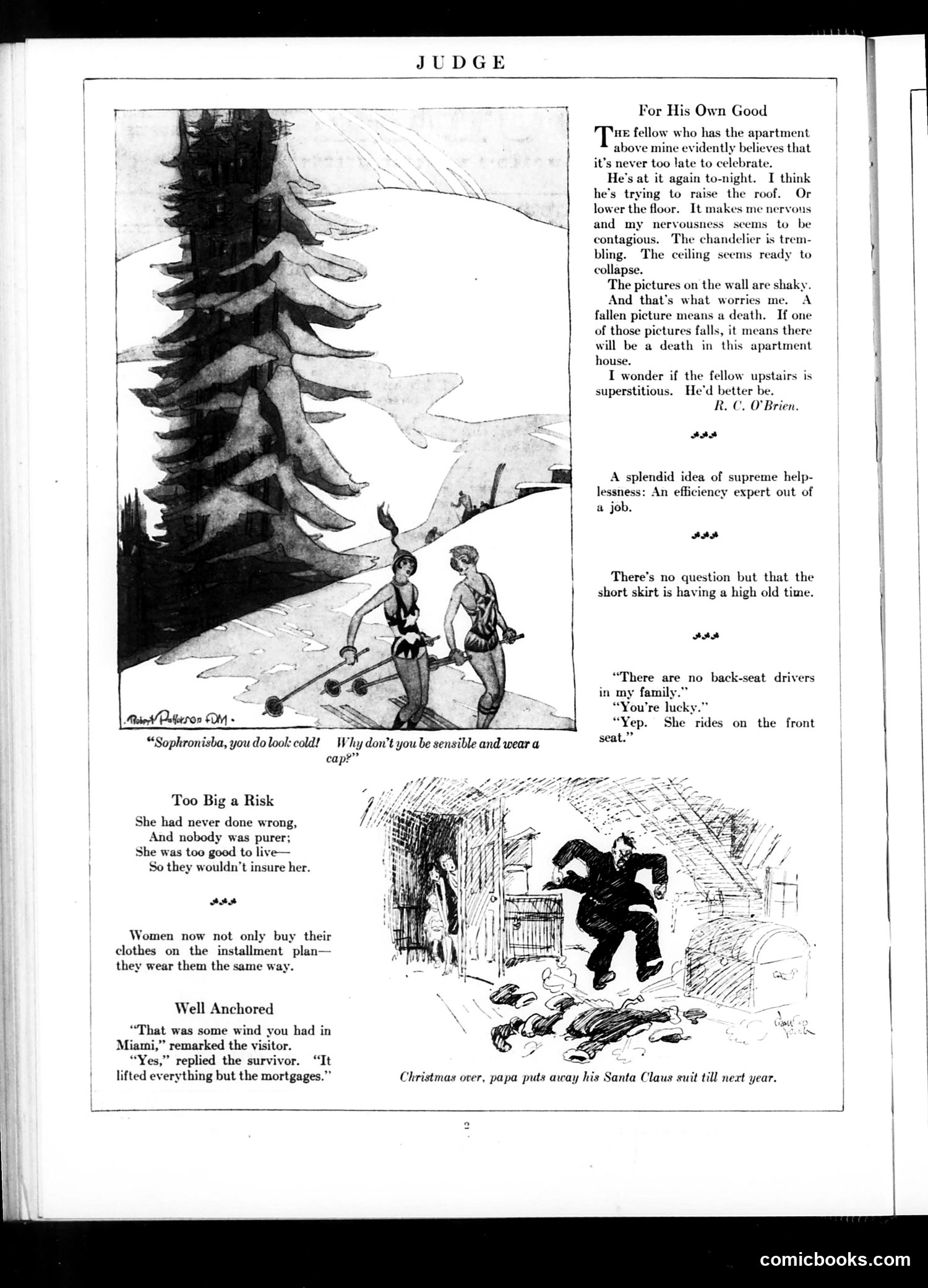
This page contains several short satirical pieces and cartoons typical of Judge's humor: 1. **"For His Own Good"** - A monologue about an anxious apartment dweller worried about a noisy neighbor above, fearing ceiling collapse and fallen pictures as omens of death. The satire mocks superstitious anxiety and urban living complaints. 2. **Top cartoon** - Shows two people in winter clothing near an enormous Christmas tree. The caption jokes about sensible winter dress, satirizing fashion choices. 3. **"Too Big a Risk"** - A brief verse about an uninsurable woman, likely satirizing insurance industry practices or women's legal/financial status. 4. **"Christmas over, papa puts away his Santa Claus suit"** - A cartoon showing a man storing holiday costume, humorously suggesting annual performance of fatherhood/Santa. The page reflects early-to-mid 20th century American middle-class concerns and humor conventions.
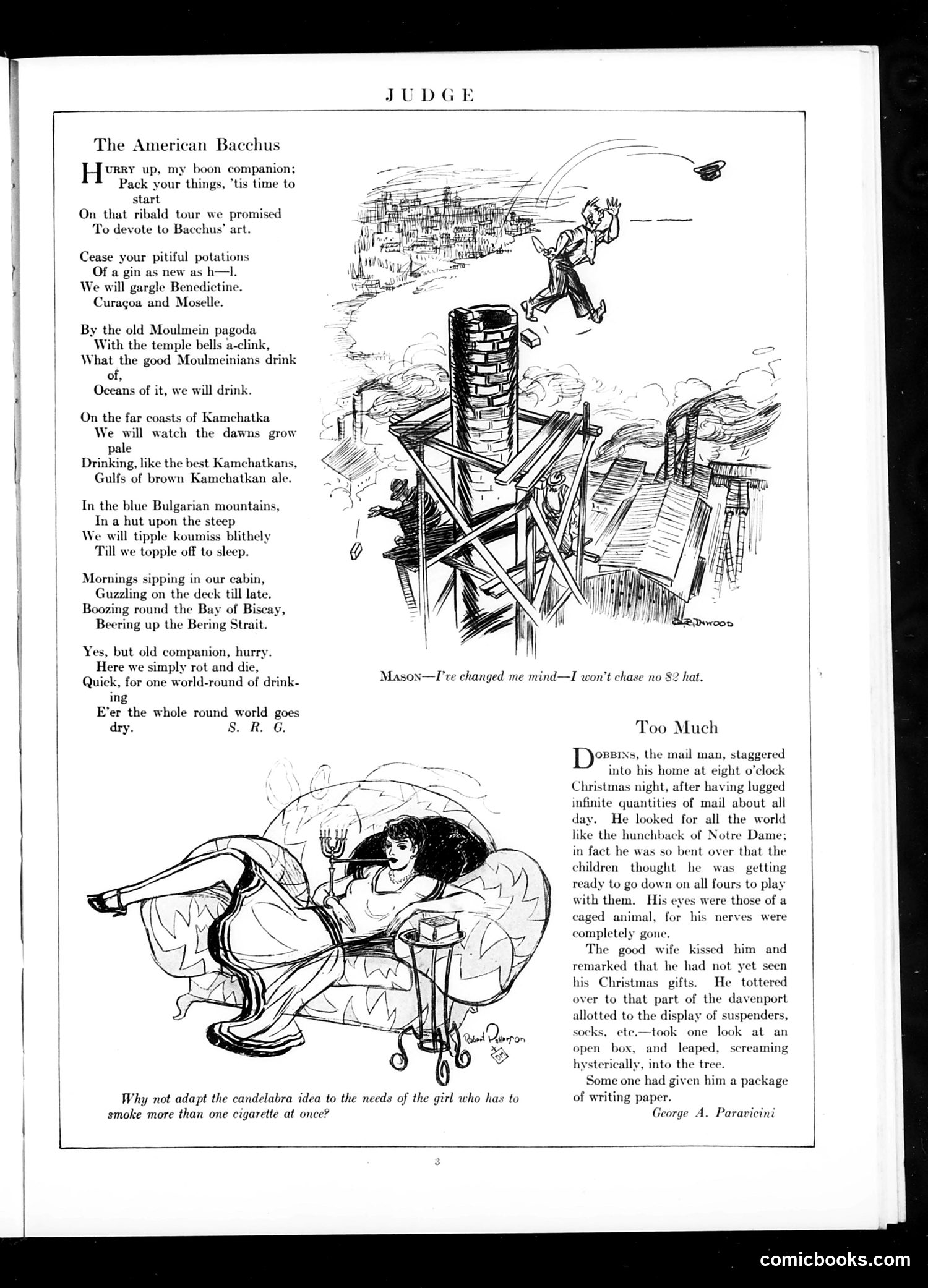
This page contains two unrelated pieces: **"The American Bacchus"** (top): A poem celebrating drinking culture, illustrated with a figure drinking from a large barrel while viewing various global locations. The satire mocks American excess and wanderlust, suggesting travelers will pursue drinking opportunities worldwide—from Bulgaria to Kamchatka to the Bering Strait. The phrase "Ever the whole round world goes dry" suggests prohibition concerns of the era. **"Too Much"** (bottom): A domestic humor piece about an overworked postal carrier arriving home Christmas Eve exhausted from delivering mail. The illustration shows him collapsed in an armchair. The joke critiques the volume of Christmas mail and commercialism, with his wife noting undelivered gifts remain in a package of writing paper—suggesting even his gift is impractical given his exhaustion. Both pieces satirize American consumer culture and excess.
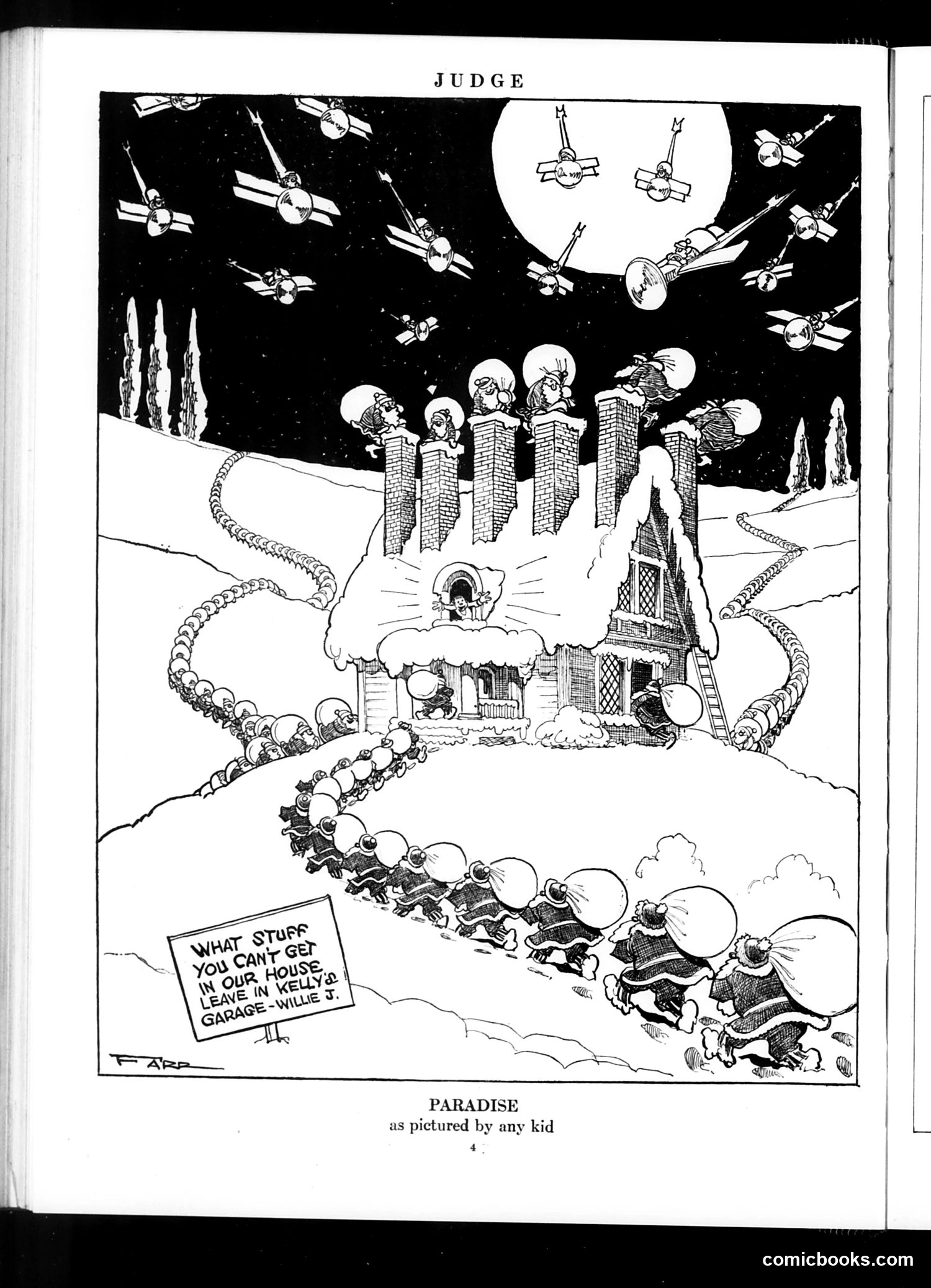
This cartoon by Farp satirizes children's imaginative depictions of heaven or paradise. The scene shows a whimsical, child-like conception featuring: - A fortified castle or mansion at the center - Tall brick towers with small figures (appearing to be children in helmets/space suits) - Flying vehicles or satellites overhead - A procession of small figures approaching the castle - A sign reading "WHAT STUFF YOU CAN'T GET IN OUR HOUSE LEAVE IN KELLY'S GARAGE—WILLIE" (a humorous reference to storing unwanted items at a neighbor's garage) The joke captures how children visualize paradise through their own experience—combining fantastic futuristic technology with mundane domestic concerns like storage space. It's gentle humor about childhood imagination and material desires rather than spiritual concepts.
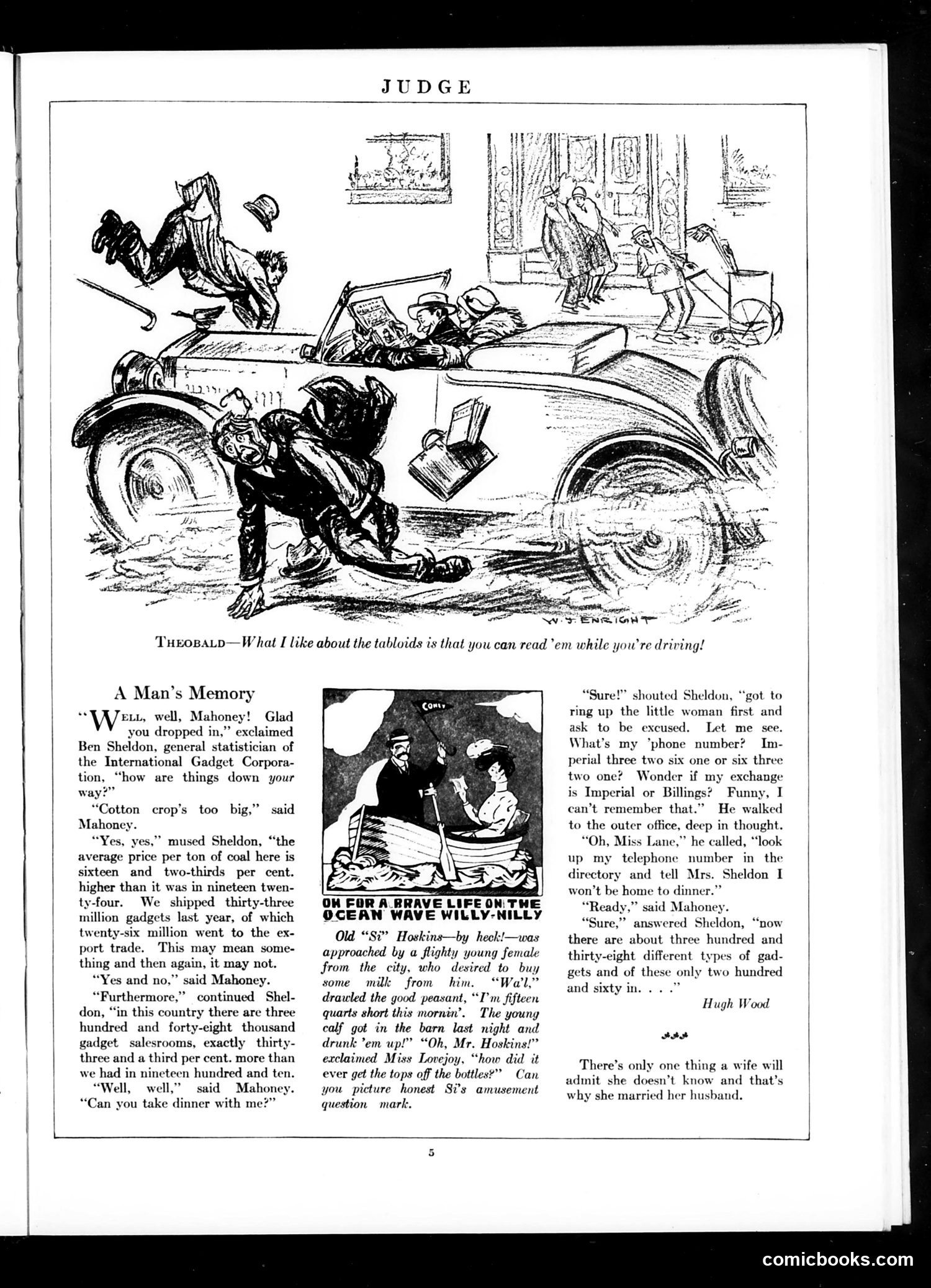
The top cartoon titled "THEOBALD" mocks the emerging automotive era by showing a chaotic traffic accident. The humor targets early cars' unpredictability and danger—the caption jokes that tabloids are useful while driving because you can read them during inevitable crashes. This satirizes both the novelty of automobiles and sensationalist journalism. Below, "A Man's Memory" features a conversation between Ben Sheldon and Mahoney about the International Gadget Corporation's sales statistics. The dialogue humorously illustrates how memory is unreliable and self-serving—numbers constantly shift depending on who's recounting them, suggesting business exaggeration and the gap between claimed and actual performance. The middle section shows an unrelated anecdote about "Old Si Hoskins" purchasing milk, which is disconnected advertising content.
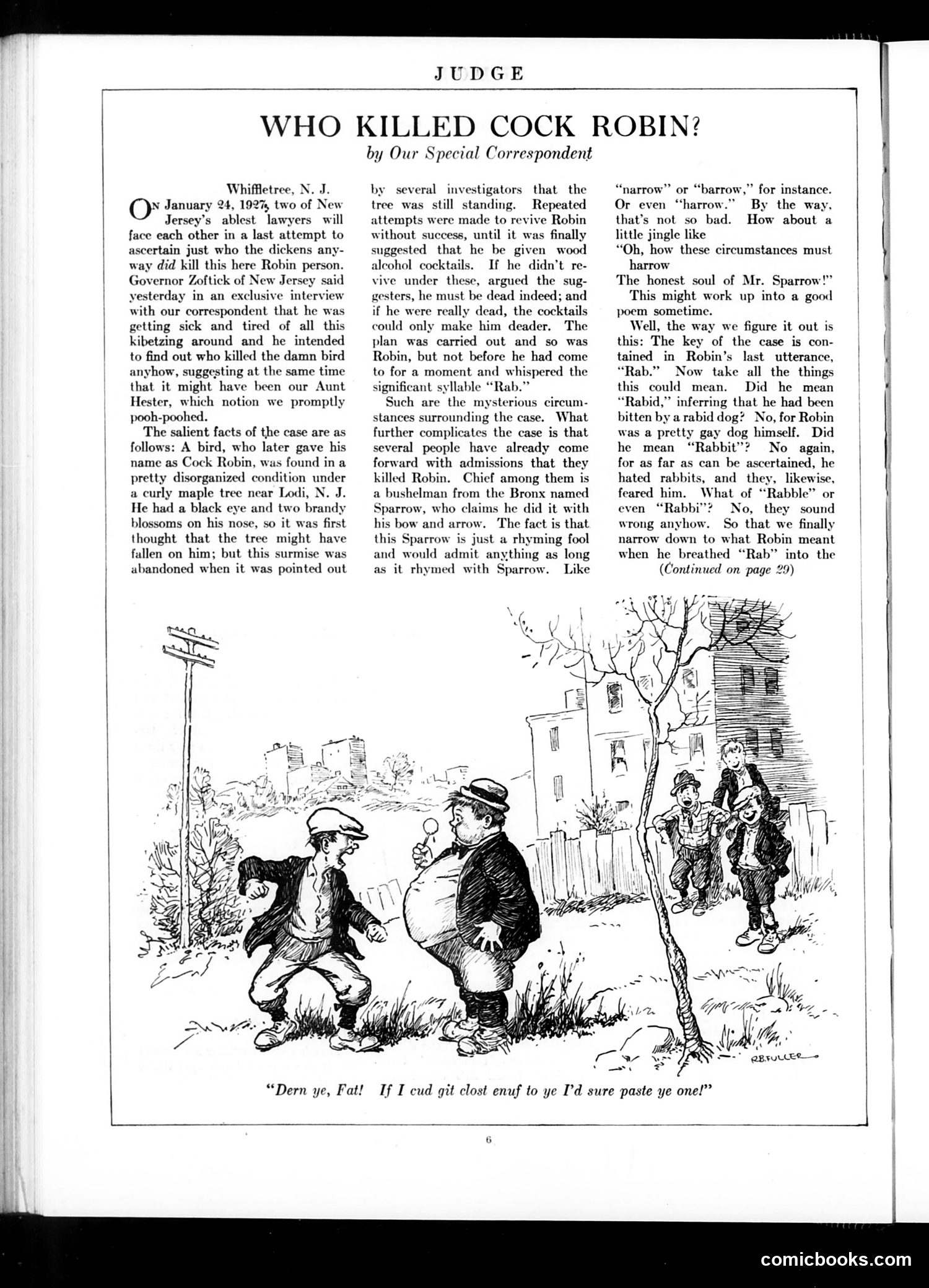
This article satirizes New Jersey's legal system and contemporary crime investigation methods through a mock-serious treatment of the nursery rhyme "Cock Robin." The setup: a dead robin found in Lodi, N.J., prompts Governor Zoltick to announce two "ablest lawyers" will investigate. The satire works by treating a children's rhyme as a real legal case, complete with "evidence" (brandy blossoms on the nose, wood alcohol cocktails) and confessions. A character named Sparrow admits killing Robin—but only because his rhyming name makes him confess to anything that rhymes with "Sparrow" (narrow, barrow, harrow). The joke mocks both pompous legal proceedings and the absurdity of circumstantial evidence. The illustration shows men in suits debating seriously over a trivial matter, emphasizing the ridiculousness of bureaucratic overreach. The phrase at bottom ("Dern ye, Fat! If I cud git clost enuf to ye I'd sure paste ye one!") suggests working-class exasperation with elite legal theater.
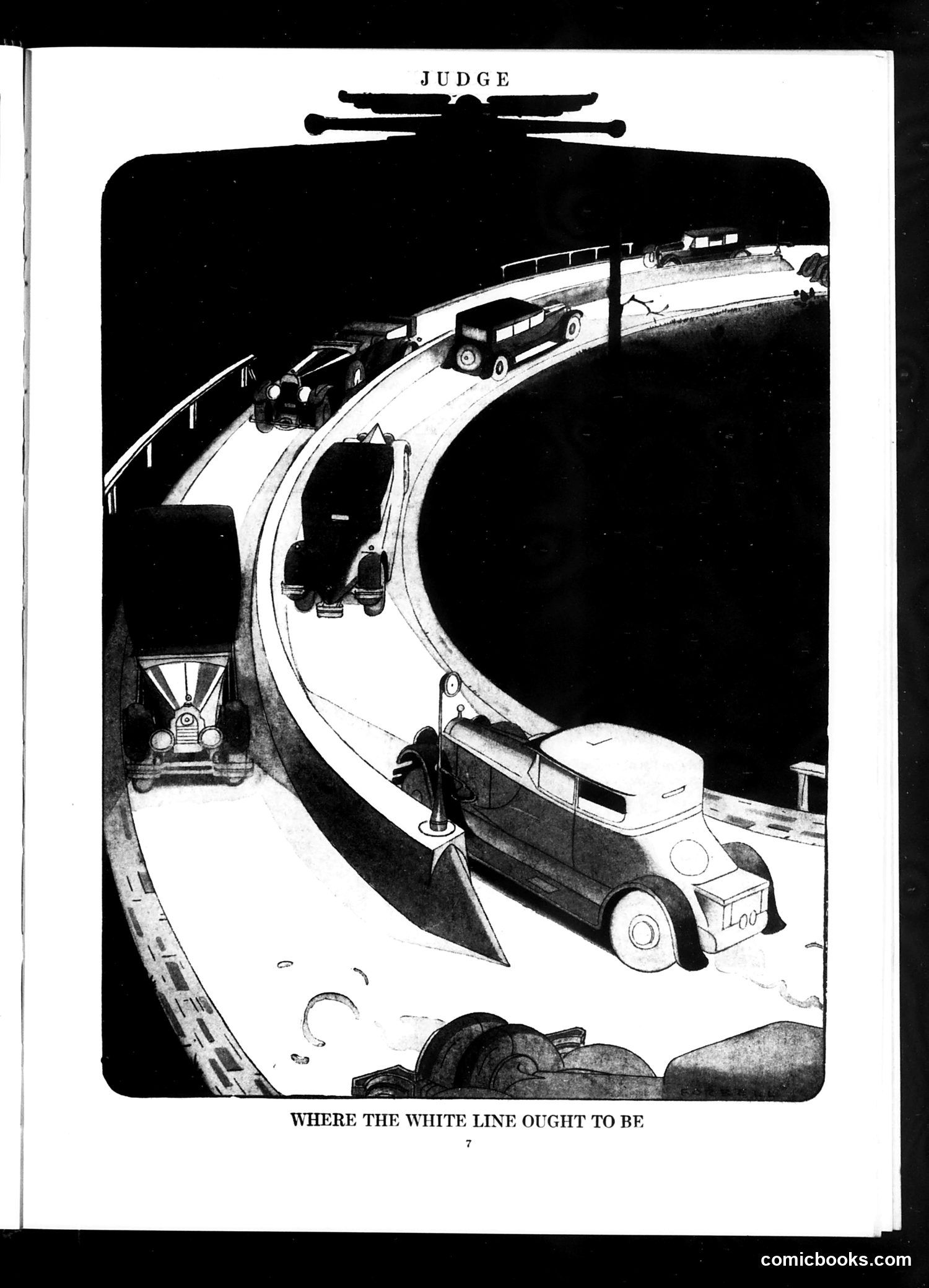
This cartoon uses a traffic/road safety metaphor to critique judicial decision-making. The image depicts various vehicles navigating a curved road, with the title suggesting debate over proper road markings—specifically where white lines (road boundaries) should be placed. The "Judge" header indicates this addresses court rulings. The cartoon likely satirizes judicial decisions about regulatory boundaries or legal limits that were controversial at the time. The vehicles of different sizes represent different parties or interests competing for road space, suggesting the court's role in establishing fair "boundaries" or rules. Without dating information visible, the specific legal case or controversy remains unclear, but the satire targets judges for potentially drawing boundaries (legal rulings) in places that seem arbitrary or unfair to some parties.
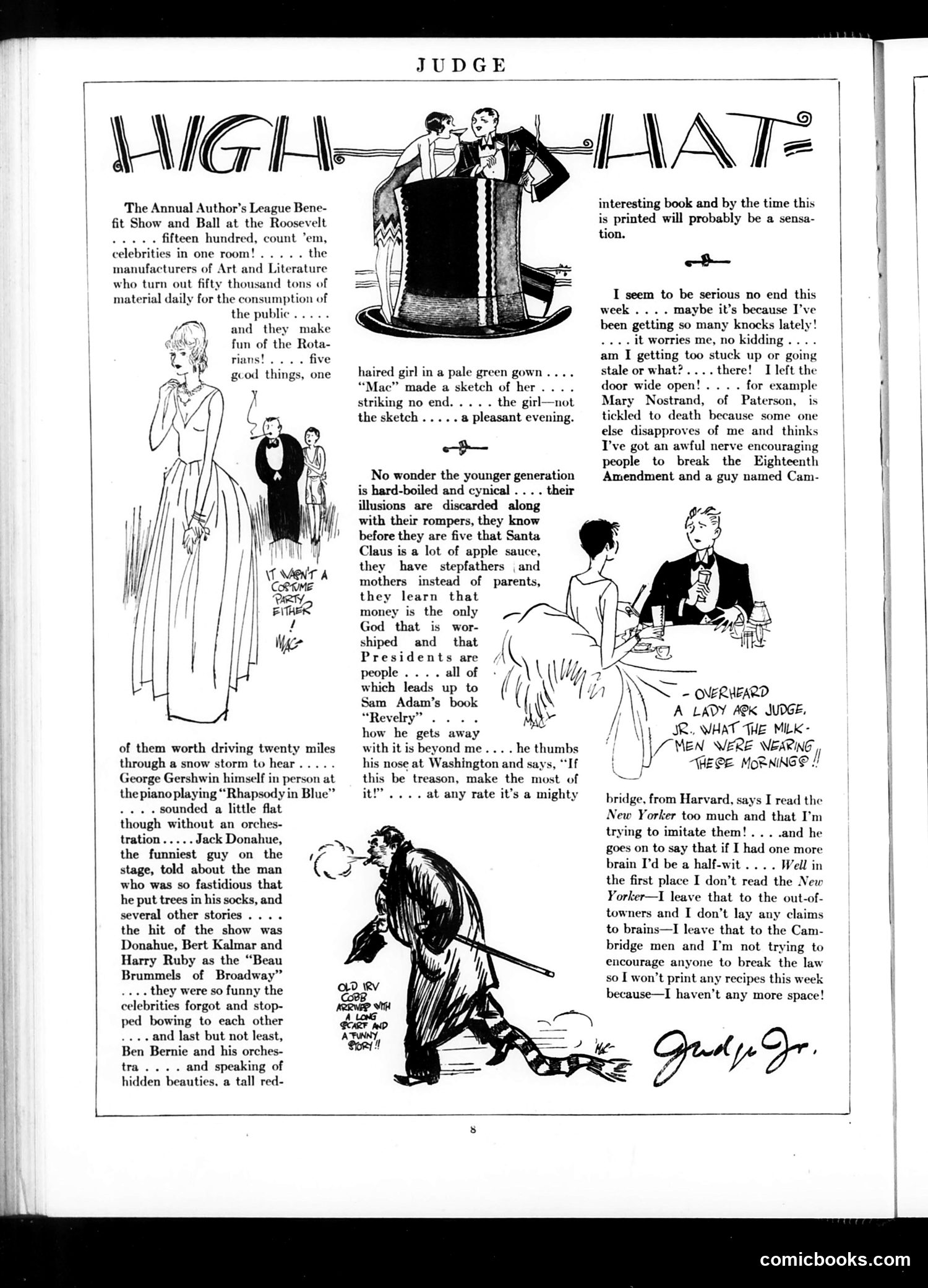
This is a satirical column by Judge's editor commenting on New York's cultural scene. The main targets include: **The Author's League Benefit Show**: A satirical account of celebrity culture, naming real entertainers (George Gershwin, Jack Donahue, Ben Bernie) who performed at this society event. The humor mocks how wealthy literati celebrate themselves while producing mass-market content. **Generational critique**: References Sam Adams's novel "Revelry" (about Jazz Age excess), satirizing how young people have become cynical—learning Santa isn't real and that money/power matter more than ideals. This critiques post-WWI disillusionment. **Prohibition**: The column defends criticism of the Eighteenth Amendment (Prohibition), with a reader named Mary Nostrand objecting to the editor's stance on alcohol. **Literary pretension**: A Harvard-educated critic attacks the editor for imitating *The New Yorker* magazine—suggesting rivalry between elite publications. The tone is self-aware and gossipy, typical of Judge's highbrow satire targeting urban literary and entertainment establishments.
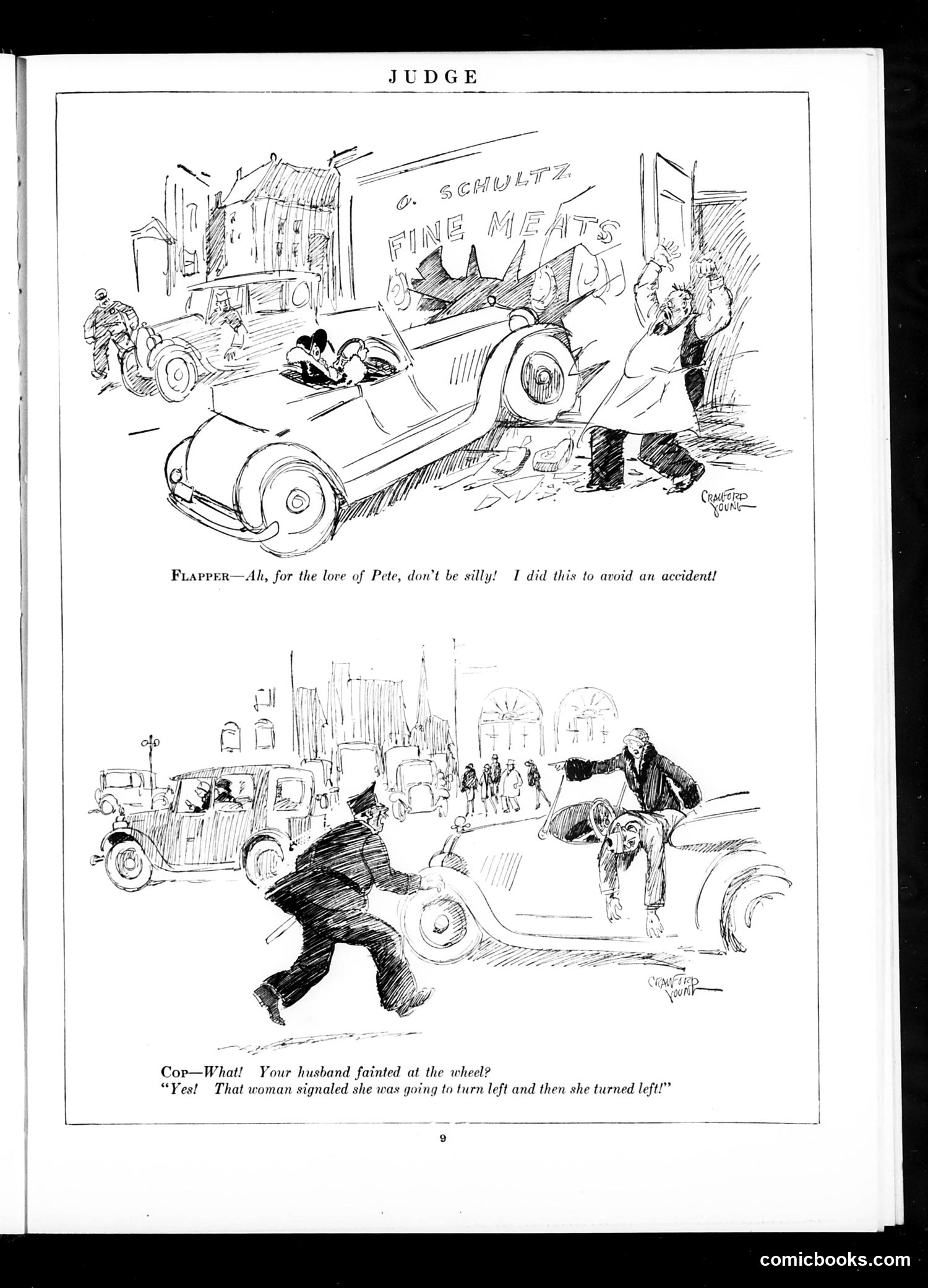
This page contains two automobile accident cartoons satirizing early 1900s driving hazards and gender relations. The **top cartoon** shows a man (Flapper's male companion) crashed into a butcher shop ("O. Schultz Fine Meats"), with the woman pleading he didn't cause it intentionally—suggesting reckless driving was normalized. The **bottom cartoon** is the core joke: A wife explains her husband fainted at the wheel because a female driver *actually followed* her turn signal. The satire targets incompetent driving, particularly mocking women drivers who were still relatively new to automobiles. The humor relies on the assumption that drivers—especially women—ignored safety signals, so when one actually signaled *and* turned correctly, it shocked the man into fainting. The joke reinforces 1920s-era stereotypes about women as dangerous, unreliable drivers.
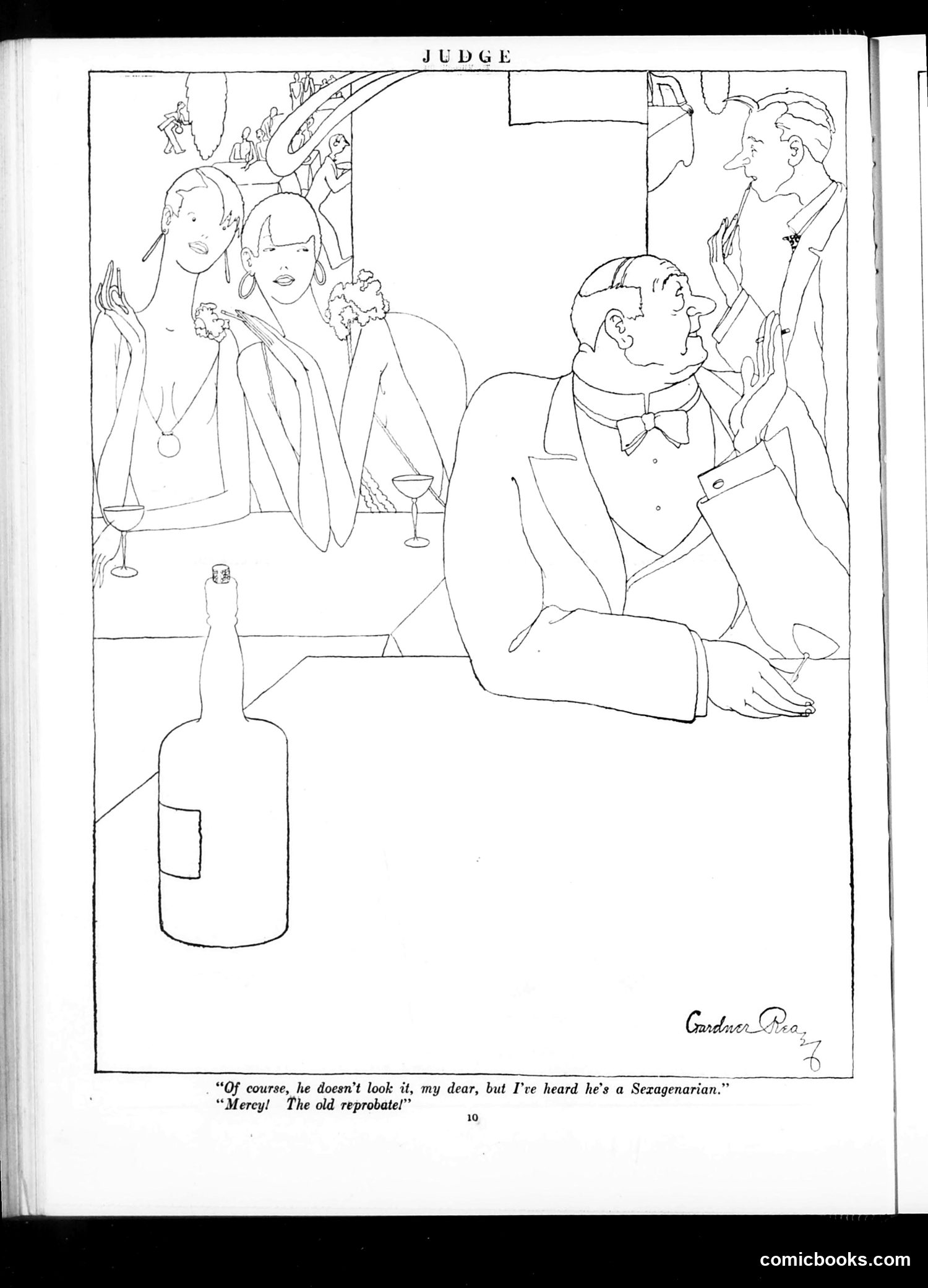
This cartoon satirizes social hypocrisy and age-related gossip among the wealthy. A portly, well-dressed man in formal attire sits amid cocktails and socializing women at what appears to be a party or social gathering. One woman whispers to another that despite his respectable appearance, he's a "Seragenarian" (likely meaning septuagenarian—someone in their seventies). Her companion responds with shock ("Mercy! The old reprobate!"), treating his advanced age as scandalous or morally disreputable. The joke targets how superficial socialites judge others based on appearance while condemning age itself as disreputable. The cartoon mocks both the man's attempt to appear younger and his female companions' cattiness and shallow moralizing in high society.
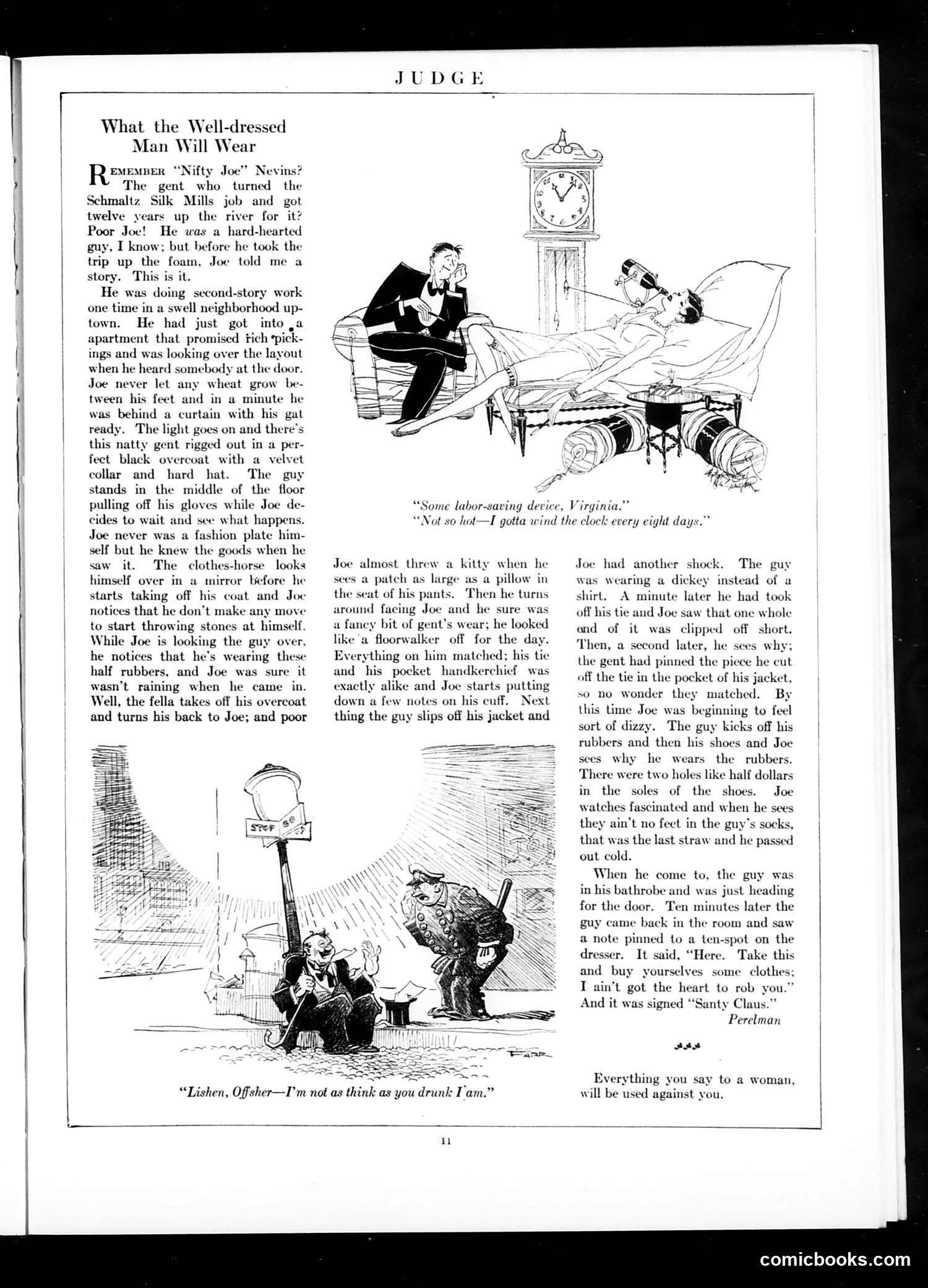
This is a humorous story by S.J. Perelman about a burglar ("Nifty Joe") who breaks into an apartment and encounters a well-dressed man—but discovers the man's fashionable appearance is entirely fake. His clothes are held together with safety pins, his shirt is replaced by a "dickey" (false front), his tie is partially clipped off and pinned as a pocket square, and his shoes have holes where feet should be. The satire mocks 1920s-30s fashion pretension: wealthy men who dress expensively to appear successful despite financial ruin (likely referencing post-Depression economic anxiety). The well-dressed figure represents hollow materialism—all facade, no substance. Joe, a hardened criminal, is so moved by this man's desperation that he leaves money for new clothes instead of robbing him. The joke's irony: even a thief has mercy for someone faking respectability so pathetically.
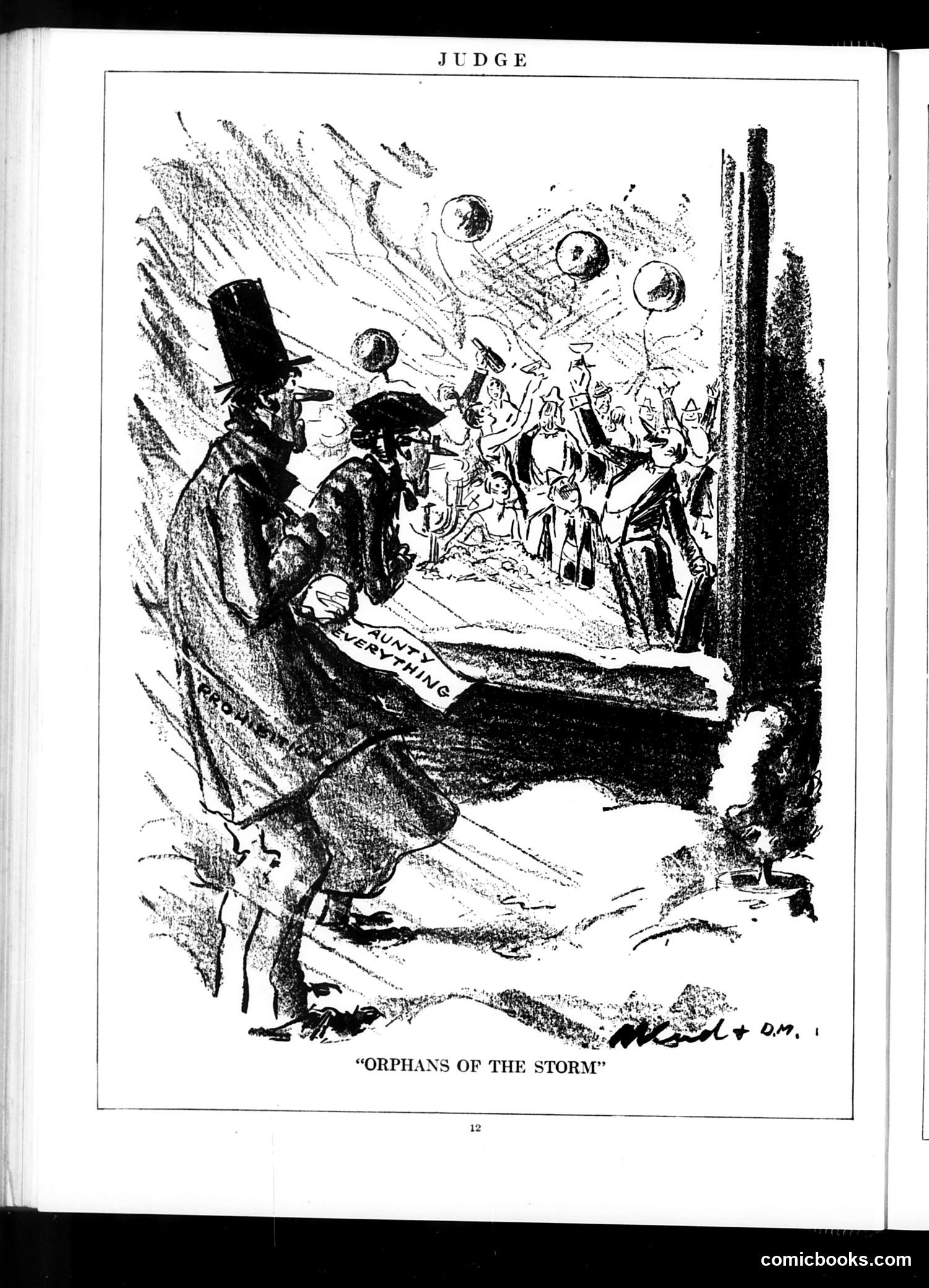
This political cartoon, titled "Orphans of the Storm," depicts a tall figure in a top hat holding a banner labeled "EVERYTHING" while presenting to a gathered crowd. The composition suggests a judge or authority figure distributing or controlling resources to many people below. The satire appears to criticize wealth or power concentration—the imposing figure at left controls "everything" while crowds of ordinary citizens gather hopefully or desperately. The "orphans" metaphor suggests vulnerable populations dependent on a powerful entity's benevolence. Without additional context about Judge magazine's publication date, the specific historical moment remains unclear, but the image critiques economic inequality and centralized control of resources, presenting the powerful as exploitative rather than generous toward the dependent masses.
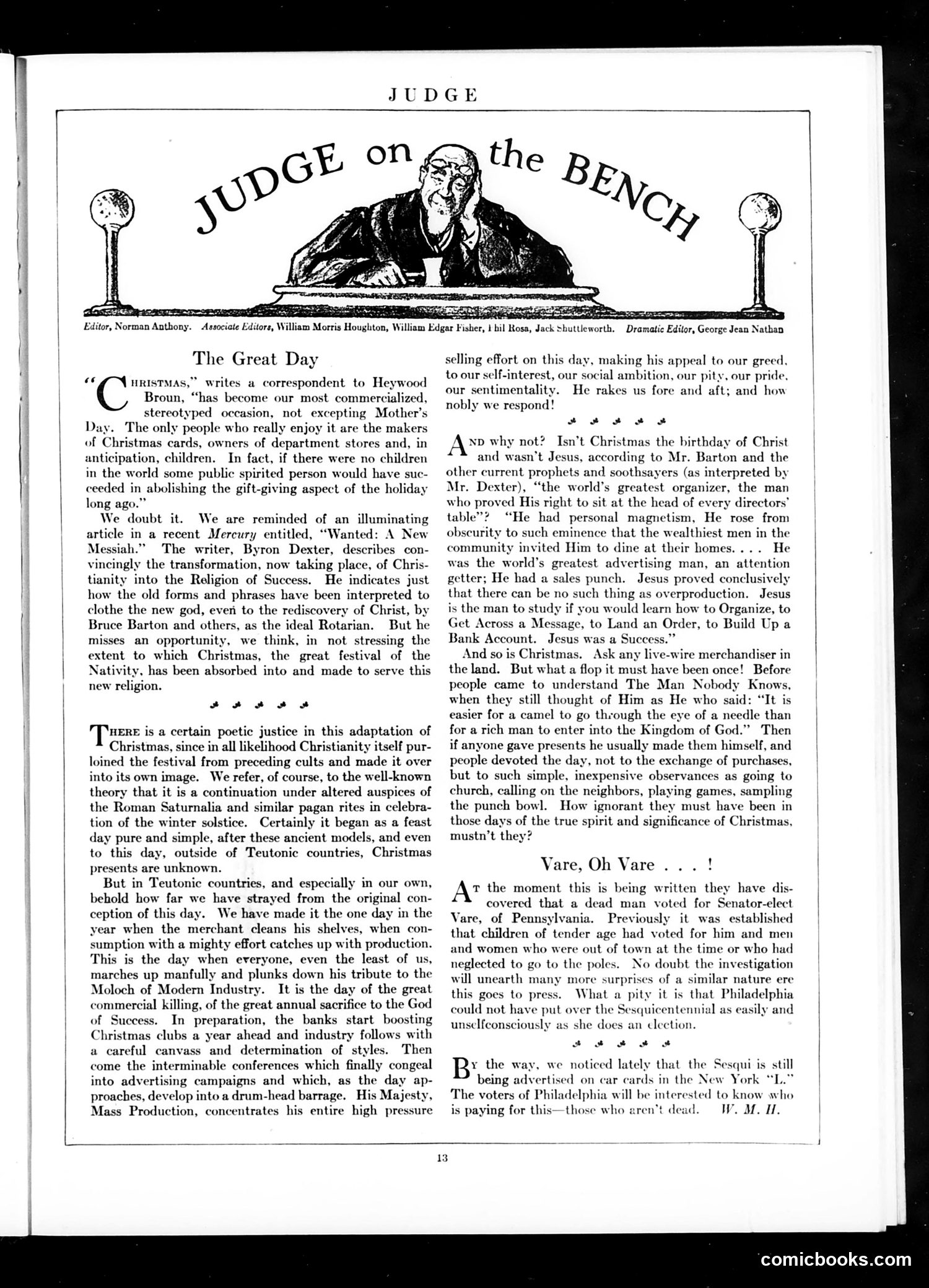
This editorial column satirizes the commercialization of Christmas in modern America. The writer critiques how Christmas has been transformed from a religious observance into a vehicle for consumer capitalism and "the Religion of Success." The satire targets **Bruce Barton** and similar "business gospel" advocates who reinterpret Jesus as the ideal businessman and organizer—a man who mastered "advertising," "sales punch," and "getting across a message." The piece mocks how this theology justifies Christmas as peak commercial season, when industry executes its "drum-head barrage" of advertising to manipulate consumers' "greed, self-interest, social ambition, pity, pride, sentimentality." The irony is sharp: Christmas, supposedly celebrating Christ's birth, has become a corporate holiday where consumers dutifully "plunk down" tribute to "the Moloch of Modern Industry." The author questions whether Jesus—presented as successful salesman—would endorse such naked materialism. This reflects 1920s-30s anxiety about advertising's psychological manipulation and capitalism's colonization of religious meaning.
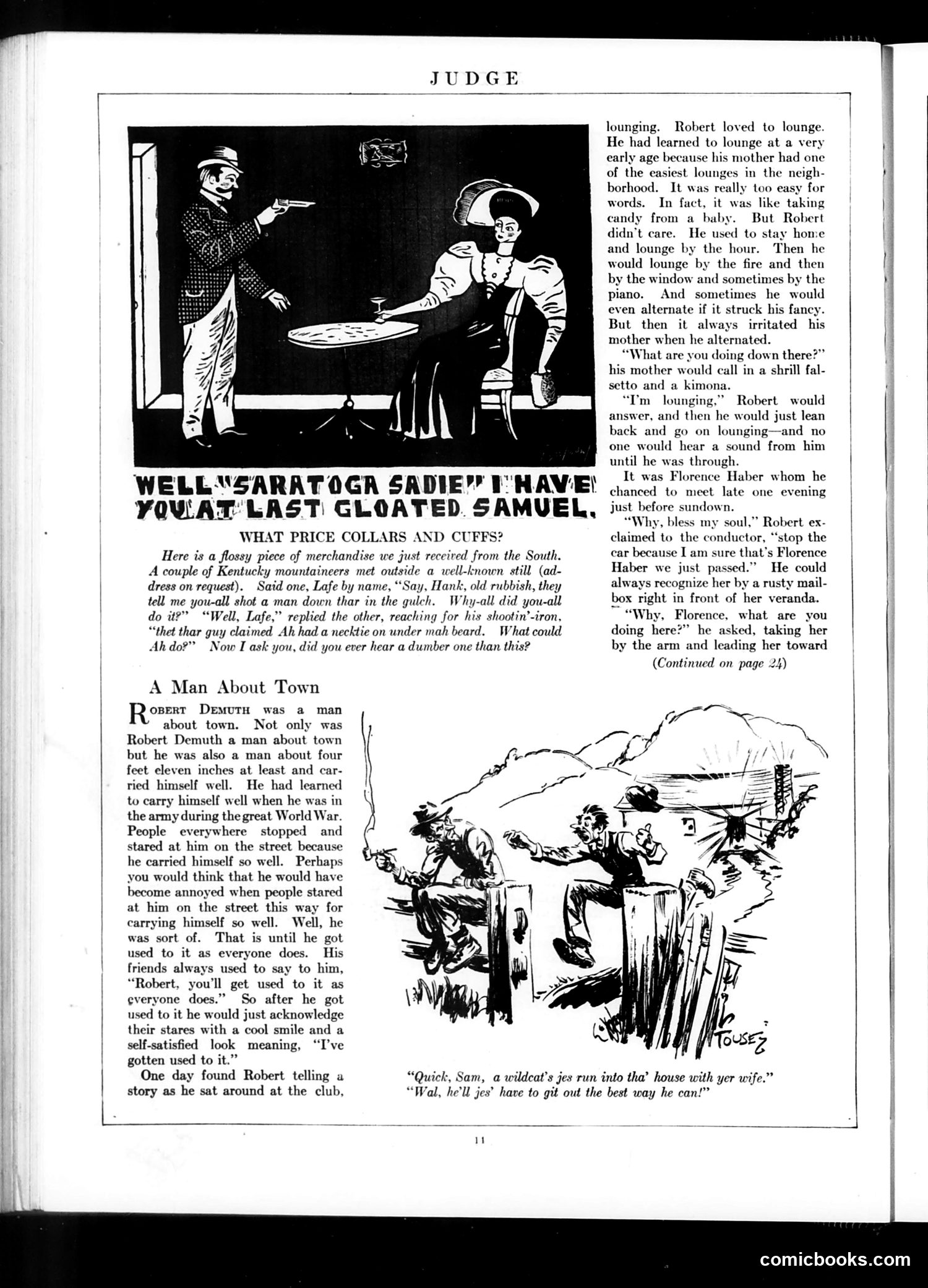
This page contains two satirical pieces typical of early 20th-century Judge magazine humor: **Top cartoon:** Mocks rural Appalachian stereotypes. Two "Kentucky mountaineers" discuss a shooting: one killed a man for claiming he wore a necktie under his beard—presented as absurdly thin justification. The joke relies on period caricatures of rural poor as violent and backwards, with exaggerated dialect ("thet thar guy," "mah beard"). The caption "What Price Collars and Cuffs?" suggests civilized society (fancy clothing) is incompatible with mountain culture. **"A Man About Town":** Gentle satire of an affected young man, Robert Demuth, obsessed with carrying himself well and "lounging"—activities he performs with self-conscious deliberation. The humor derives from his pretentious self-awareness and repetitive, mundane lifestyle. An ongoing story continues on page 24. Both pieces target social pretension and regional stereotypes common to satirical magazines of this era.
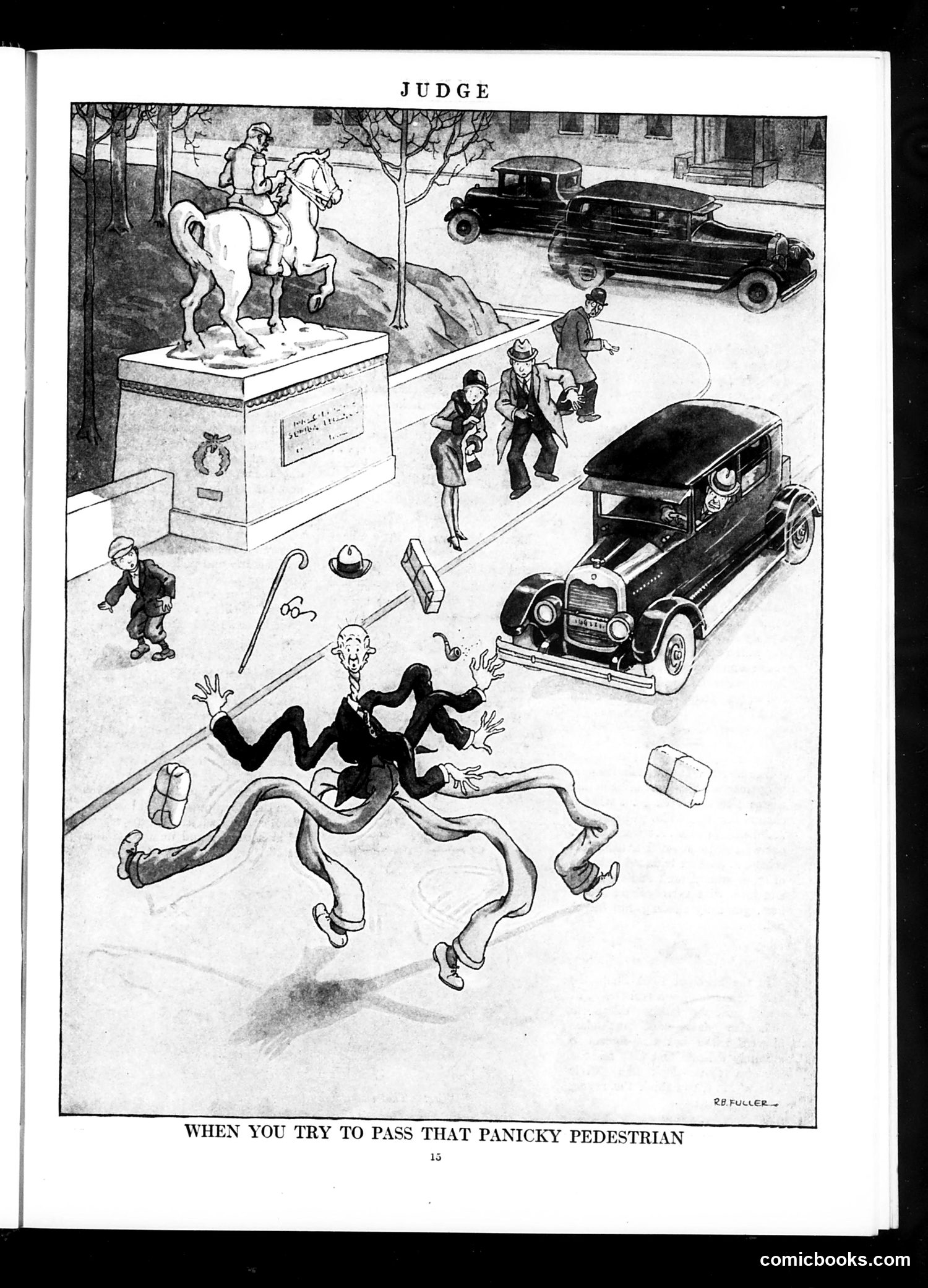
This Judge cartoon satirizes dangerous pedestrian behavior in traffic. The central figure is a panicked pedestrian with wildly flailing limbs and an expression of terror, depicted with exaggerated, contorted legs as they attempt to cross a street filled with automobiles. The joke targets pedestrians who freeze or panic when encountering traffic, creating hazardous situations. The chaotic pose and scattered scattered items (hat, packages) emphasize the comedic chaos of someone losing composure around vehicles. The equestrian statue visible in the upper left provides ironic contrast—a calm, controlled rider on horseback—suggesting that even an inanimate monument maintains more composure than this "panicky pedestrian." This appears to be social commentary on urban traffic safety during the automobile age, mocking those who cannot adapt to modern street hazards.
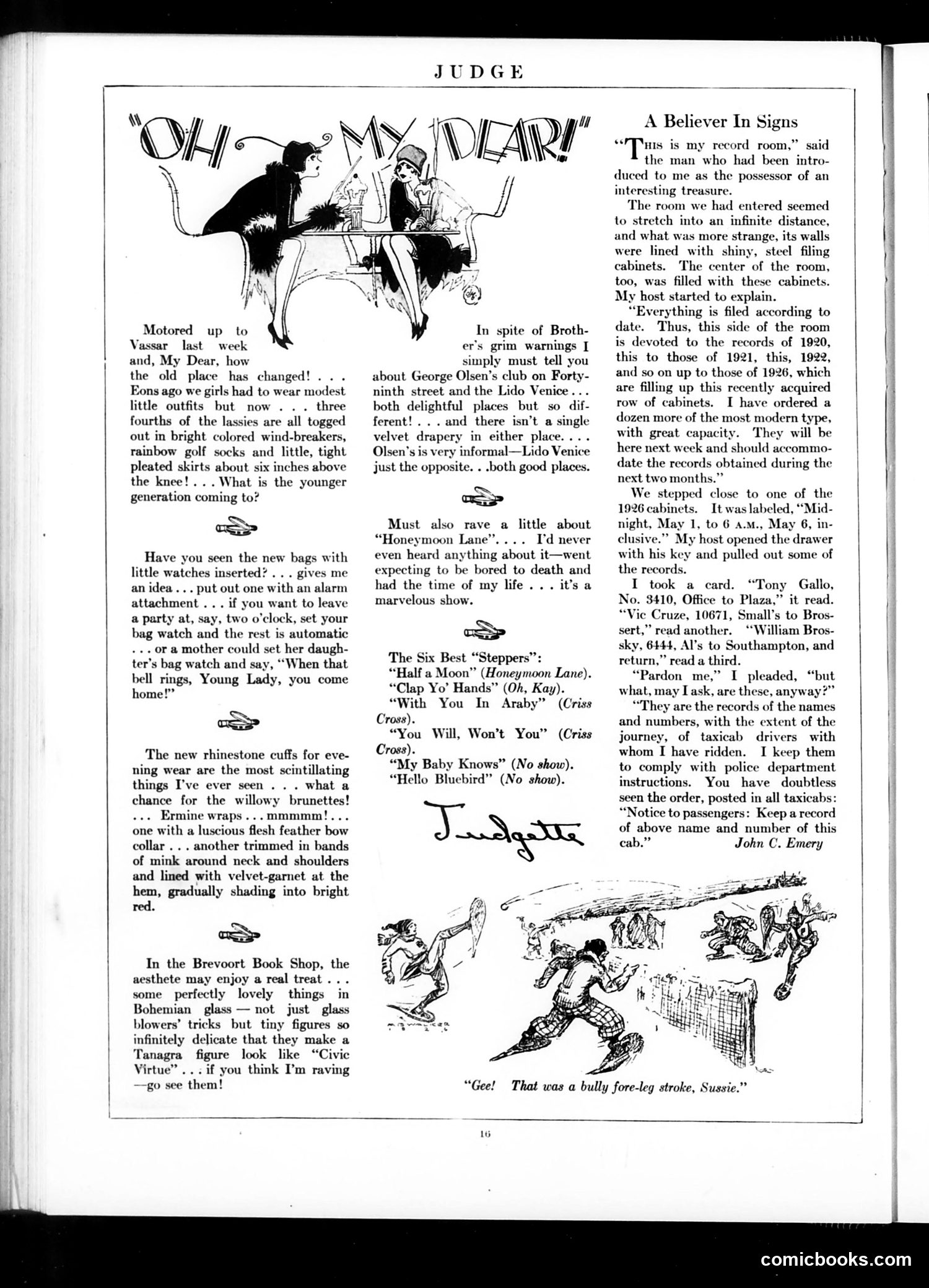
This page contains two distinct pieces of 1920s social satire: **"Oh, My Dear!" cartoon**: A woman gossips about shocking changes at Vassar College—young women now wear short skirts (six inches above the knee), colorful athletic wear, and tight pleated skirts instead of modest outfits. This mocks upper-class anxiety about flapper fashion and changing youth culture during the post-WWI era. **"A Believer in Signs" story**: A man obsessively files detailed records of every taxicab ride he takes, meticulously cataloging driver names, numbers, and routes. He justifies this compulsive behavior as "compliance with police department instructions." The satire targets paranoia and excessive bureaucratic compliance—likely referencing Prohibition-era concerns about surveillance and government regulation. The man's elaborate filing system for mundane taxi rides parodies both corporate efficiency culture and anxious over-compliance with vague authorities. Both pieces reflect 1920s tensions between traditional propriety and modern behavior.
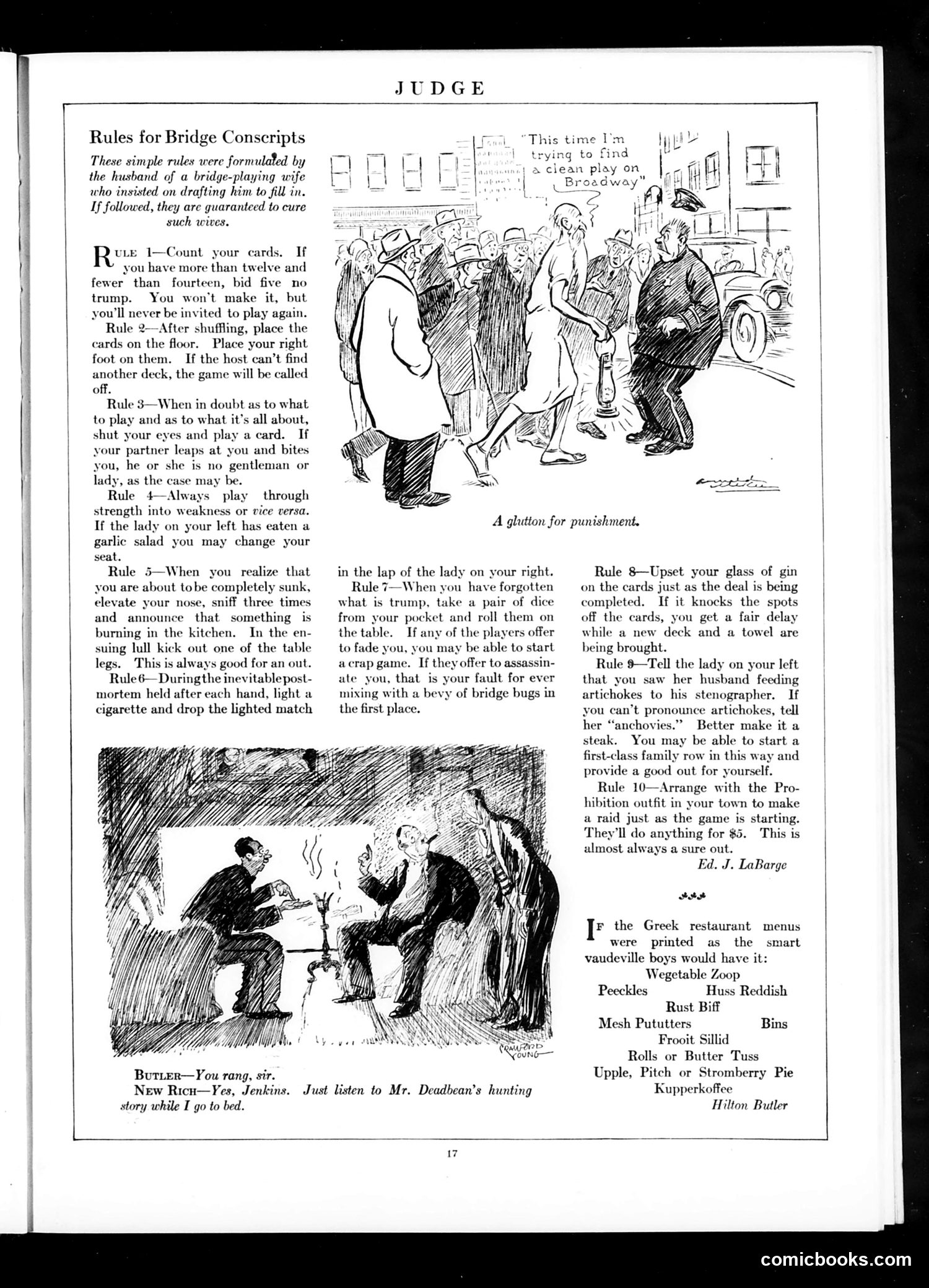
This page satirizes the widespread social phenomenon of bridge playing—a card game that became a cultural obsession among American middle and upper classes in the early 20th century. The humor targets husbands reluctantly dragged into their wives' bridge circles. The main article presents deliberately terrible "rules" for playing bridge as sabotage tactics: miscounting cards, stepping on the deck, lighting matches on the table, spilling gin, and even arranging Prohibition raids—all designed to make the husband so obnoxious he'll never be invited again. It's comedic advice on how to escape an unwanted social obligation. The cartoons depict the chaos of bridge culture: a crowded street scene suggesting bridge's social ubiquity, and a servant announcing a guest. The small section at bottom mocks immigrant or working-class speech patterns in Greek restaurant menus ("Wegetable Zoop," "Huss Reddish"), a common vaudeville stereotype of the era. The piece reflects class anxieties and gender tensions around leisure activities and social conformity in 1920s America.
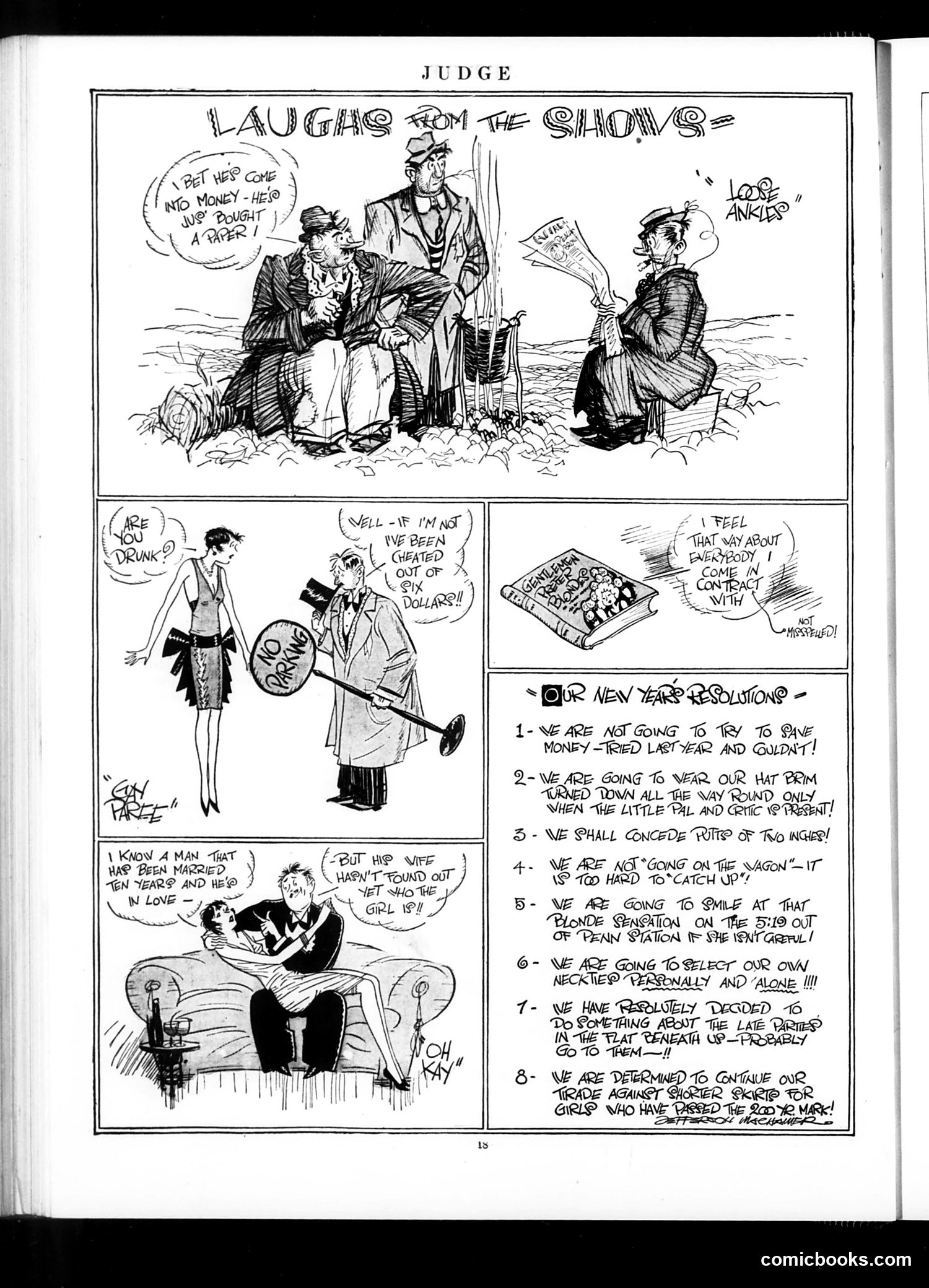
This page satirizes New Year's resolutions through three comic scenarios. The top panel shows theatrical performers making ironic vows about avoiding gambling and vice. The middle panels depict domestic situations: a drunk man and a woman discussing infidelity, and a couple arguing over money and control. The right side lists eight specific New Year's resolutions, likely mocking contemporary social attitudes. These include promises about financial restraint, fashion choices (wearing hats differently), restraining trade against "shorter skirts," and selecting neckties "personally and alone." The satire targets the absurdity of New Year's resolutions—particularly those about marriage fidelity, controlling women's fashion (the "short skirt" controversy of the era), and husbands asserting dominance through petty domestic decisions. The theatrical setting suggests this reflects broader cultural anxieties about changing gender roles and behavior during this period.
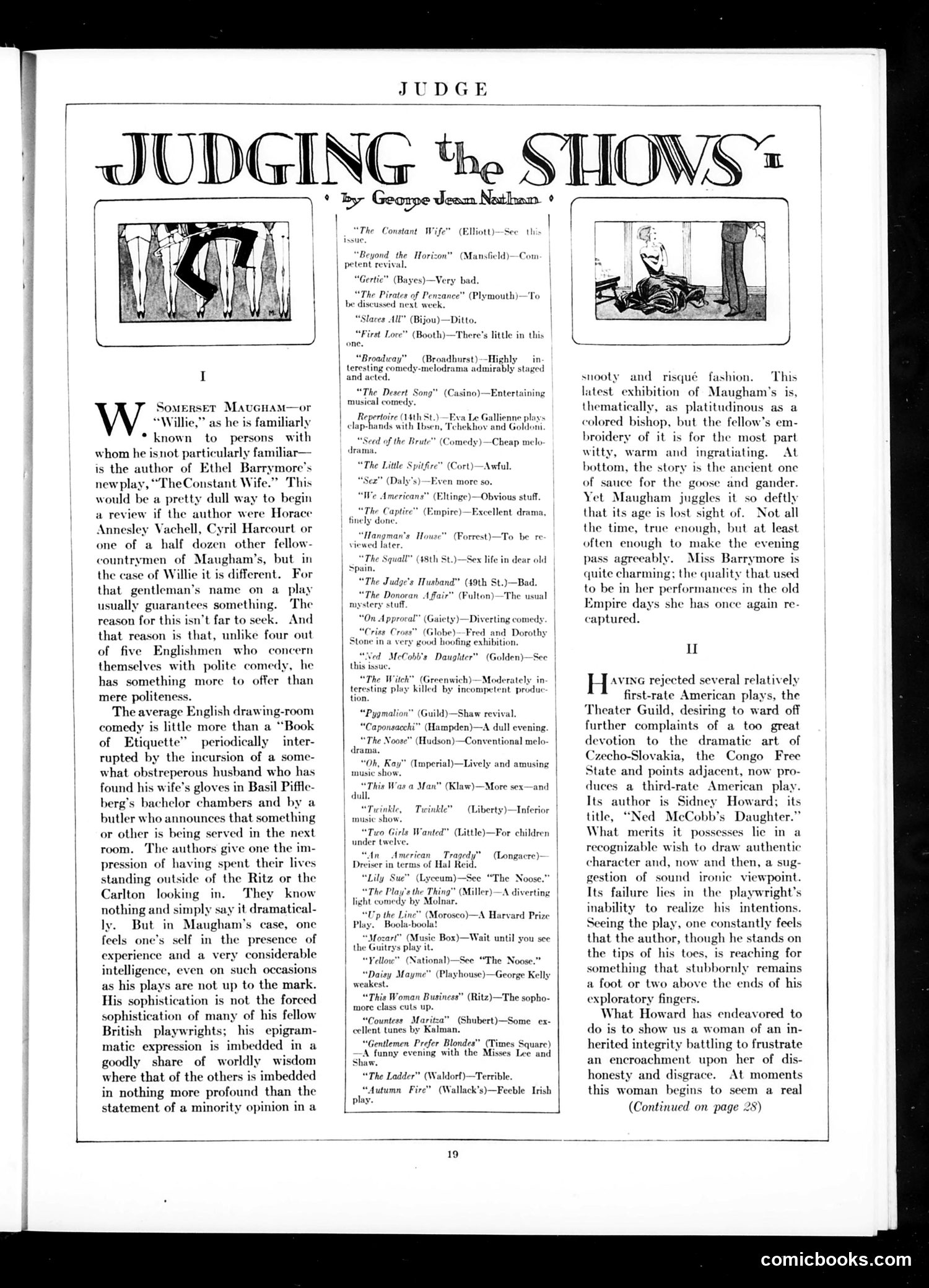
This page from Judge magazine presents theater critic George Jean Nathan's reviews of current Broadway productions. The left column features a lengthy essay praising Somerset Maugham, the British playwright ("Willie"), arguing that unlike most English drawing-room comedies—which Nathan dismisses as shallow, etiquette-focused entertainments written by authors who merely observe high society from outside the Ritz and Carlton hotels—Maugham brings genuine experience and intelligence to his work. The right column and center list brief, often caustic reviews of various contemporary plays, using a rating system of praise or dismissal. Nathan's satire targets both pretentious English playwrights and mediocre American theatrical offerings, while celebrating Maugham's sophistication and worldly wisdom as superior to his peers' forced sophistication and shallow epigrammatic expression.
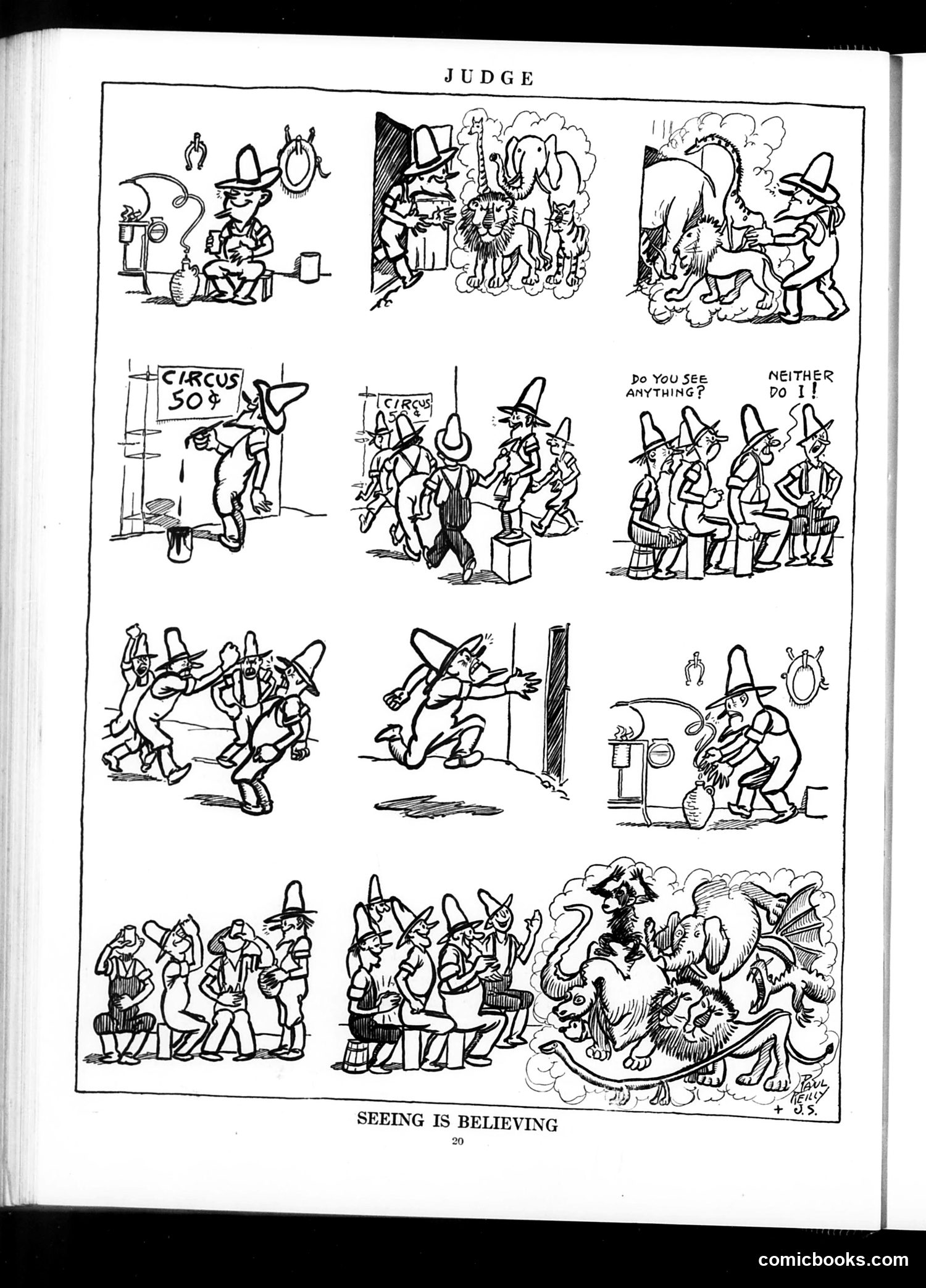
This page presents a visual narrative about circus performers (identifiable by their tall hats and acrobatic poses). The sequence depicts clowns or entertainers engaged in increasingly chaotic antics—juggling, tumbling, and creating mayhem. The caption "Seeing Is Believing" suggests the cartoon satirizes skepticism or disbelief. The dialogue bubble "Do You See Anything? Neither Do I!" indicates that despite the obvious spectacle unfolding, observers claim to see nothing—perhaps mocking willful ignorance or deliberate blindness to obvious events. The cartoon likely critiques public or political denial of visible reality, using circus chaos as metaphor for societal disorder that people refuse to acknowledge. Without additional context about Judge's publication date, specific political targets remain unclear.
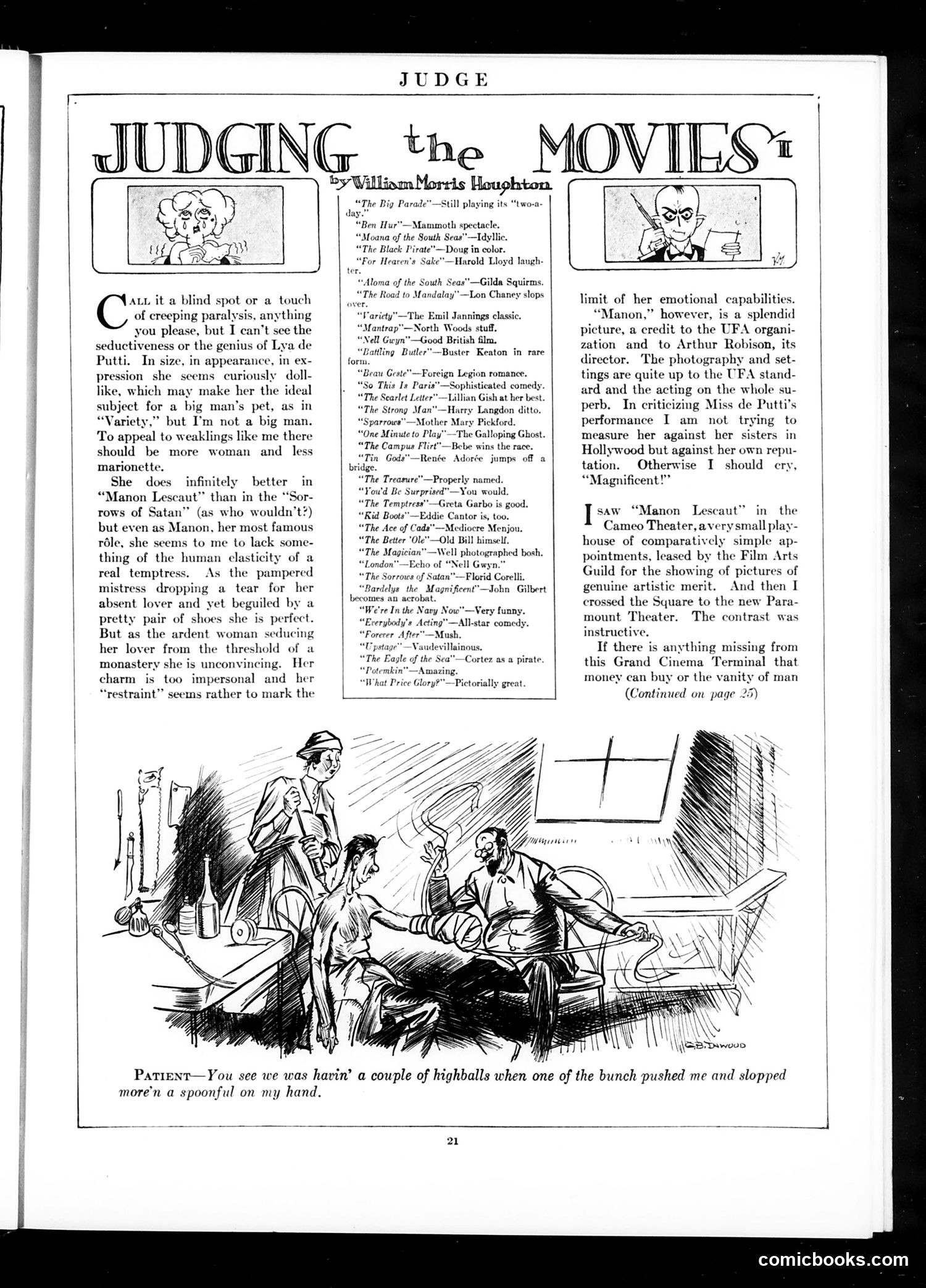
This is a film critic column reviewing 1920s silent movies. The page critiques actress Lya de Putti, comparing her performances in different films. Houghton argues she lacks genuine emotional depth—describing her as "doll-like" and too "impersonal"—though he praises her in "Manon Lescaut" over "The Sorrows of Satan." The column then contrasts two theatrical experiences: viewing the artistic "Manon Lescaut" at the small, curated Cameo Theater versus the palatial new Paramount Theater. This appears to satirize the contradiction between superior film artistry shown in modest venues versus lavish commercial moviehouses offering vanity over substance. The bottom cartoon jokes about a patient explaining an injury from being jostled during "highballs" (drinks)—likely mocking both the injury's triviality and Prohibition-era drinking culture.
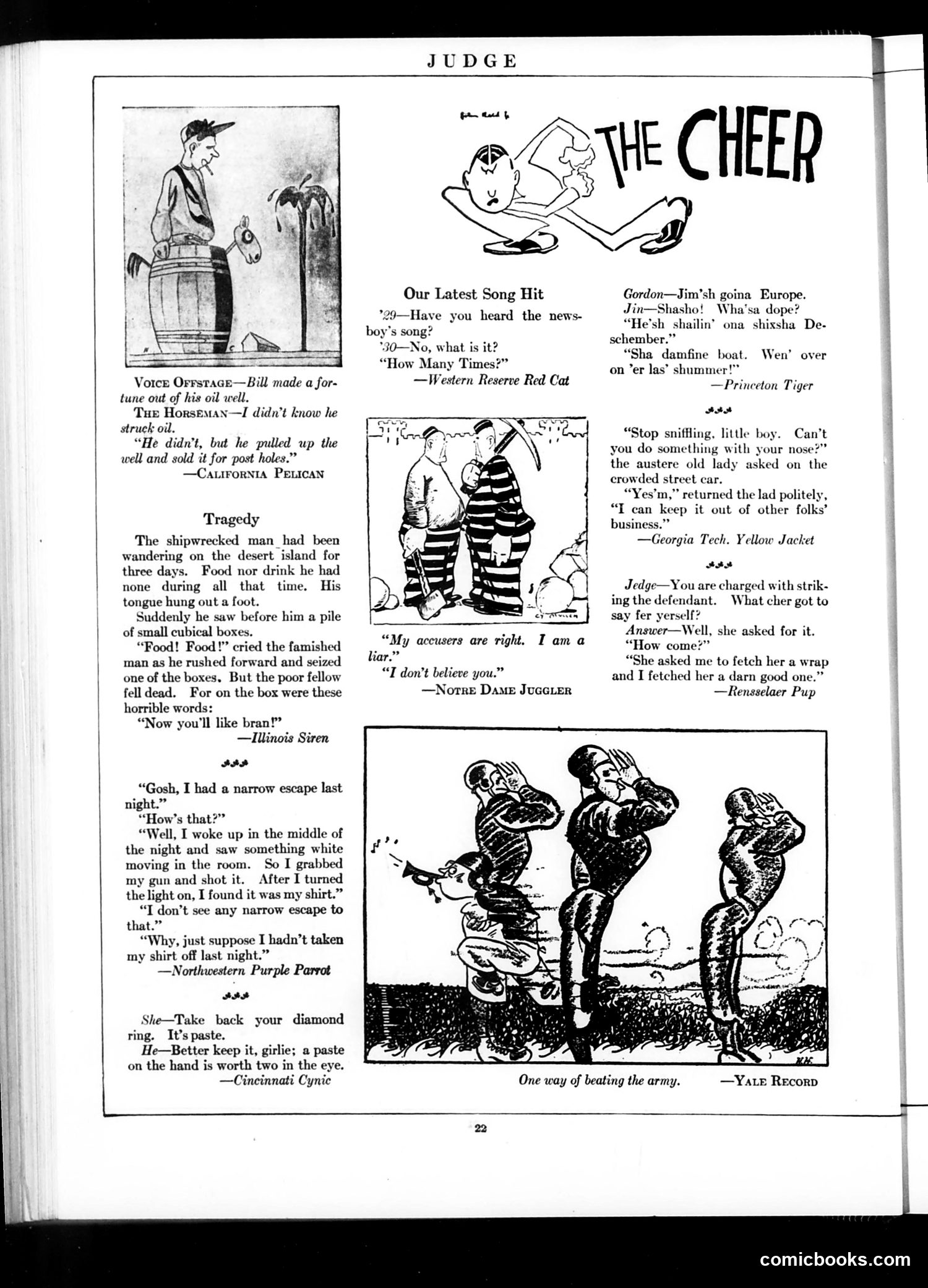
This page from *Judge* magazine contains humorous short jokes and cartoons typical of early 20th-century American humor. The content includes: **"The Cheer"** section features brief comedic exchanges, mostly playing on wordplay and misunderstandings. One joke involves a man selling an oil well as "post holes" (a scam). Another describes a starving shipwrecked man finding boxes labeled "Now you'll like bran!"—a cereal advertisement—and dying from disappointment rather than starvation. **Social humor** targets various subjects: a jeweler's deceptive paste diamond, drunken Irish characters discussing a boat trip to Europe, a boy using his nose to sniff on a street car, and a woman asking a man to fetch a "wrap" (clothing), which he interprets as a physical blow. The bottom illustration shows military recruits, captioned "One way of beating the army"—likely satirizing draft evasion tactics. The humor relies on puns, naive misinterpretations, and class/ethnic stereotypes common to period satire.
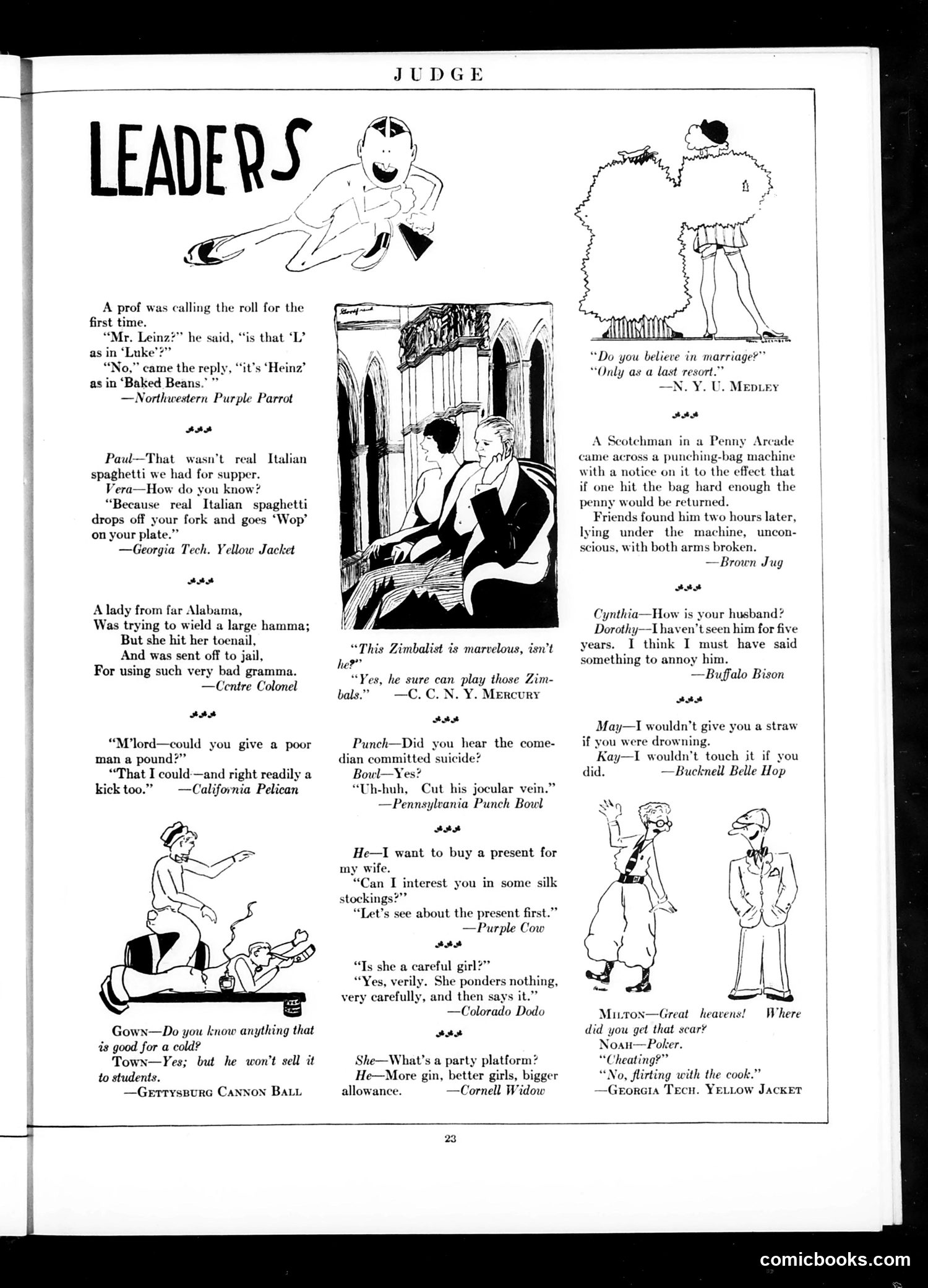
This is a collection of college humor jokes from various university publications, typical of early-20th-century collegiate magazines. The page contains no political cartoons—the title "Leaders" appears ironic, as the jokes mock authority figures and social pretensions. Key themes include ethnic humor (the "Wop" spaghetti joke relies on offensive Italian stereotypes), class commentary (poor men being refused charity), and gender dynamics (women portrayed as illogical or obsessed with marriage). Several jokes mock intellectual pretension—a professor mispronouncing a student's name, or Zimbalist (likely violinist Efrem Zimbalist) being overrated. The humor is generally juvenile and cruel by modern standards, reflecting period attitudes toward ethnicity, gender, and class. The Scotchman punching-bag joke and various domestic arguments exemplify the era's casual misanthropy dressed as wit. These appear sourced from college papers like Georgia Tech, Cornell, and NYU.
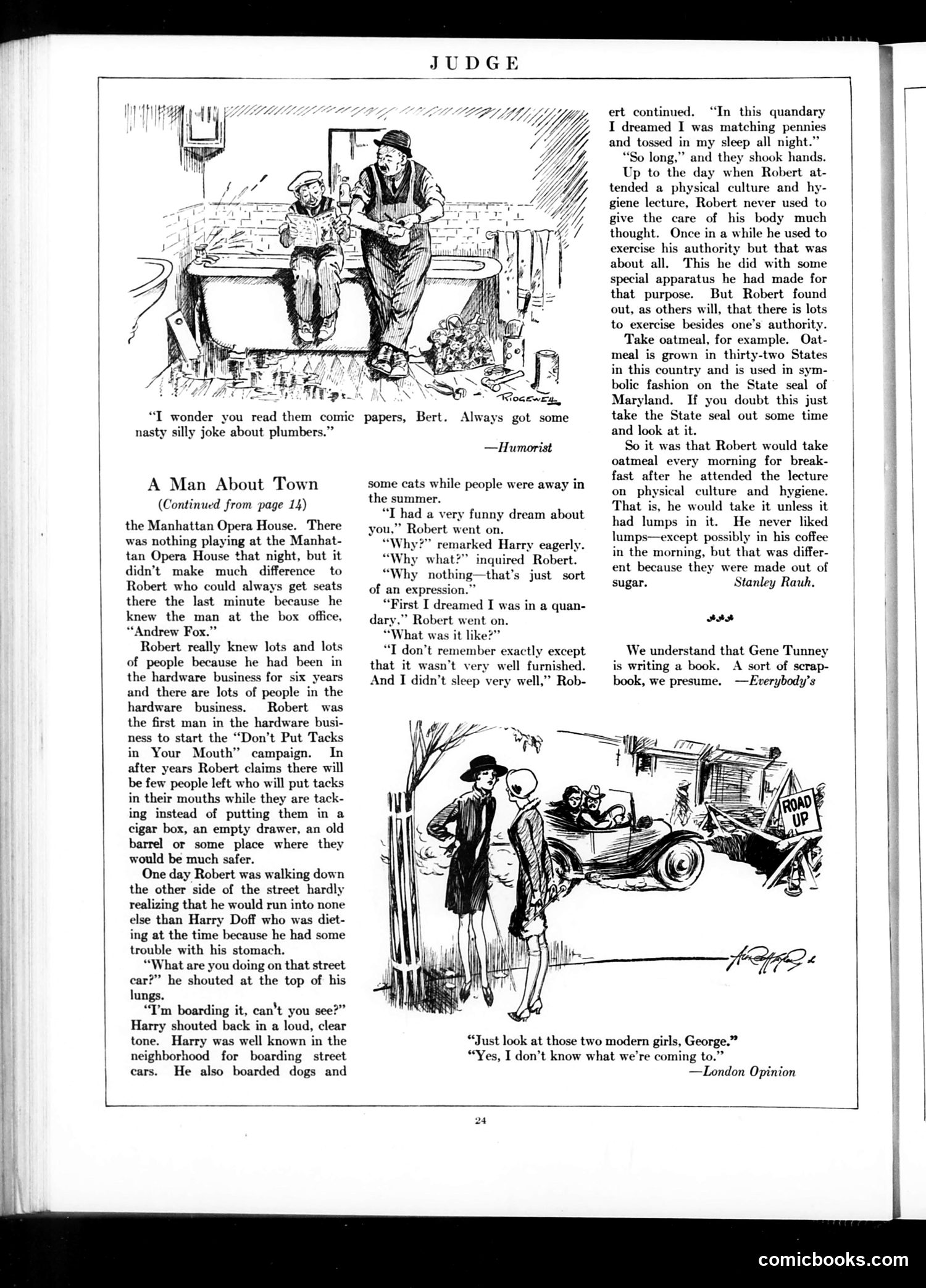
**Top Cartoon:** Two working-class men (plumbers, based on context) sit at a table. One criticizes the other for reading "comic papers," calling them "nasty silly joke[s] about plumbers." The satire targets *Judge*'s own audience—the irony being that *Judge* itself publishes jokes mocking various professions. It's self-aware humor about how satirical magazines ridicule ordinary workers. **"A Man About Town" Story:** A humorous narrative about Robert, a hardware businessman who attends lectures on physical culture (fitness/health). The joke satirizes newly fashionable health fads—specifically that Robert obsessively eats oatmeal after learning about hygiene, but refuses lumpy portions. It mocks the earnest adoption of trendy wellness advice by ordinary men. **Bottom Cartoon:** Two older men observe young women in modern dress near a car labeled "ROAD UP." They express disapproval of "modern girls," reflecting early 20th-century anxiety about changing female fashion and independence—a common Judge theme.
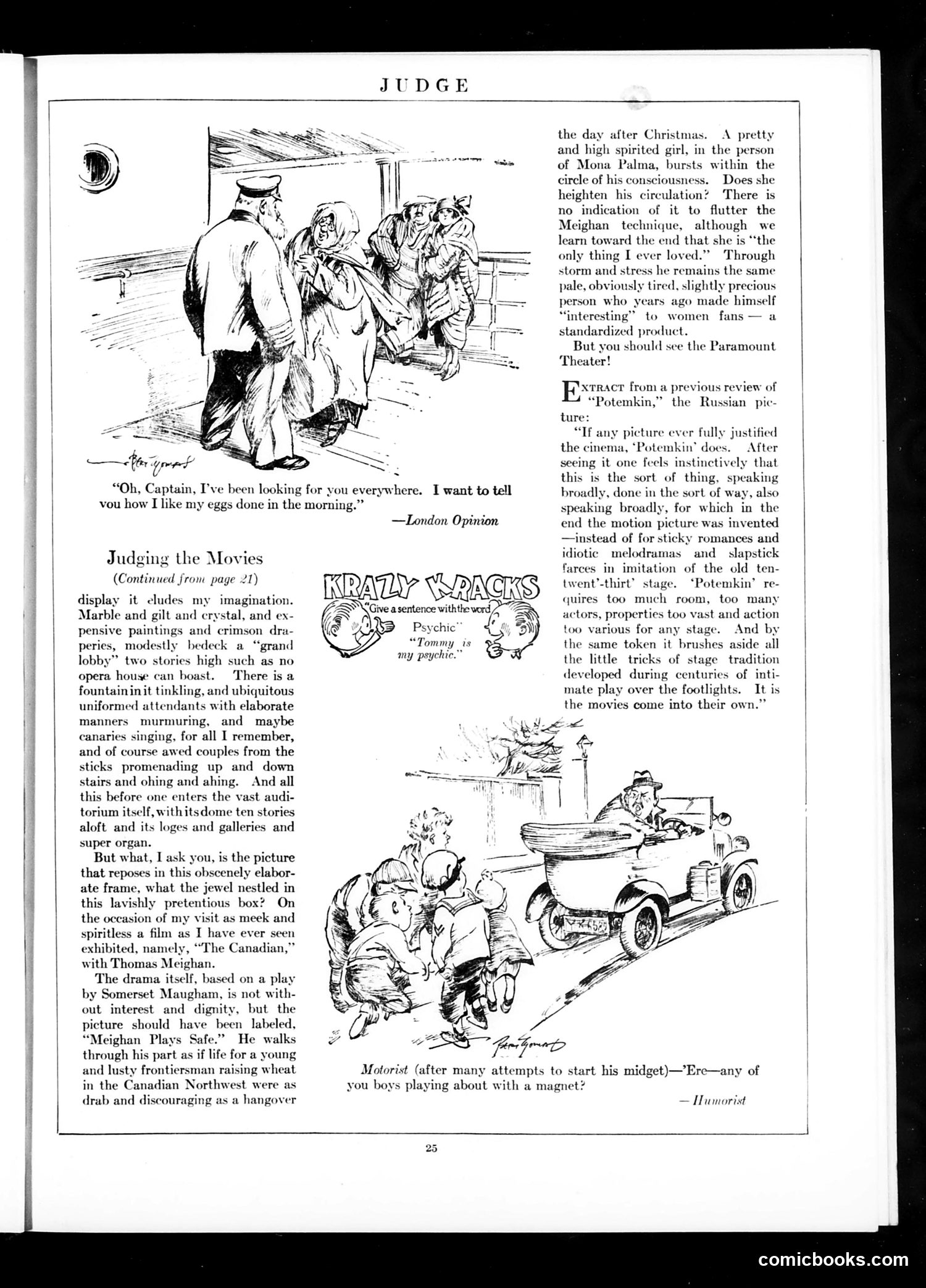
This page contains film criticism alongside humor cartoons. The main article critiques actor **Thomas Meighan** in "The Canadian," a film based on a Somerset Maugham play. The reviewer's complaint: despite the movie theater's lavish grandeur (ornate lobbies, fountains, organs), Meighan's performance is utterly listless and emotionally flat. He plays a "frontiersman" with all the vitality of a hungover man—even when discovering love, he remains "pale, obviously tired, slightly precious." The satire mocks both the disconnect between theatrical extravagance and mediocre content, and Meighan's standardized, unemotional acting style marketed to female fans. The cartoons below offer lighter humor: a woman pursuing a captain about breakfast preferences, and "Krazy Whacks" gags. A final cartoon shows a motorist whose tiny car won't start, suspecting children have stolen its magnet—a joke about the era's simple magnetic ignition systems.
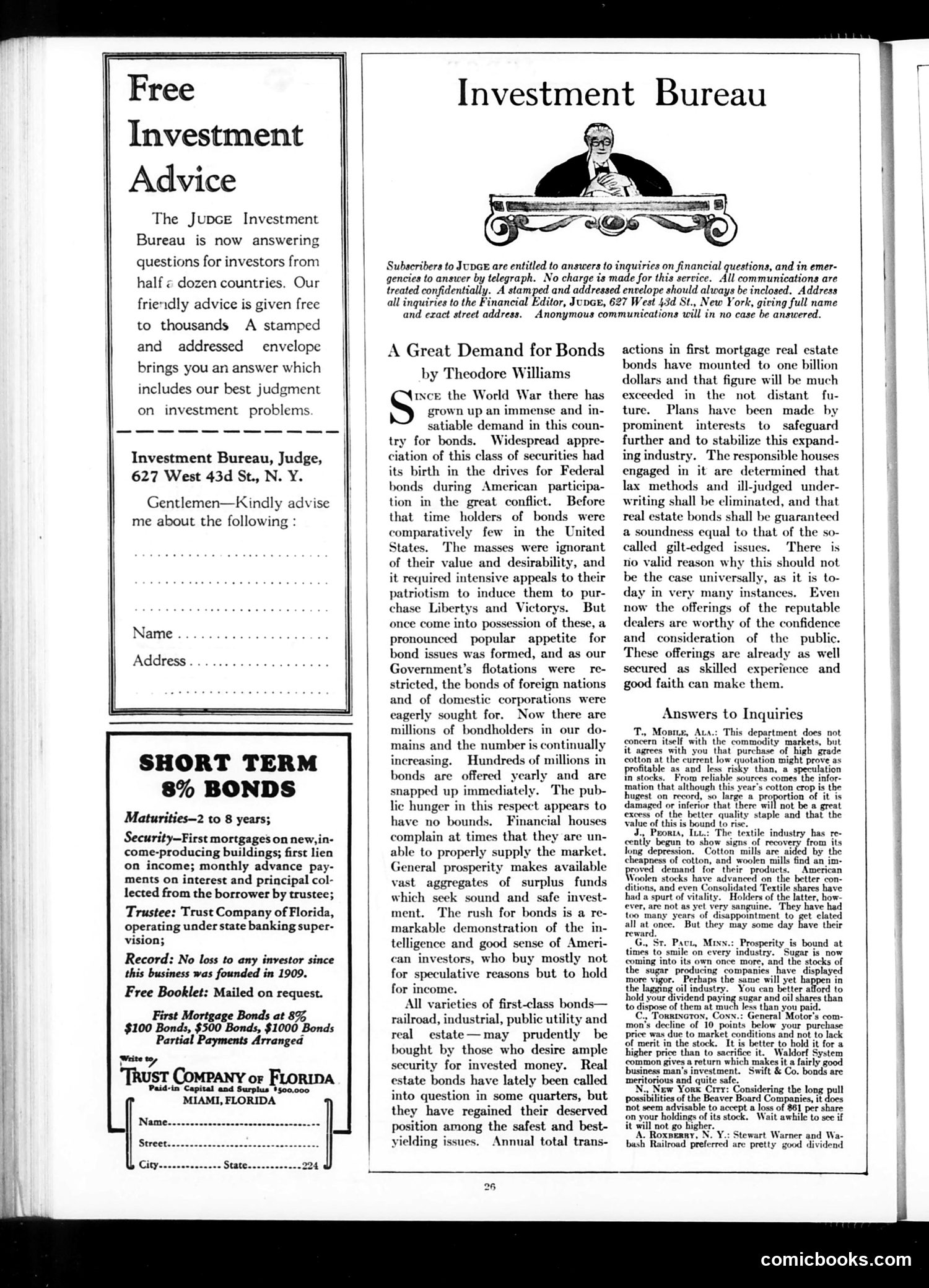
This page combines **advertising with financial advice** from Judge magazine's "Investment Bureau" service. The content reflects post-World War I American economic optimism. **Main Article ("A Great Demand for Bonds"):** Theodore Williams celebrates the explosive growth in bond investment among ordinary Americans, attributing it to their experience buying Liberty Bonds during WWI. He argues this represents intelligent, income-focused investing rather than speculation. Williams endorses various bond types—railroad, industrial, utility, and real estate—as safe investments for the masses. **Context for modern readers:** This reflects the 1920s economic boom before the 1929 crash. The article's confidence in bonds' safety and the promotion of real estate bonds (which would become notorious in the 2008 crisis) reveals period-specific assumptions about financial security. The enthusiastic tone suggests Judge was promoting bonds to its affluent readership while celebrating broader financial democratization. **The page is primarily editorial content with embedded advertisements** rather than satirical cartoon commentary.
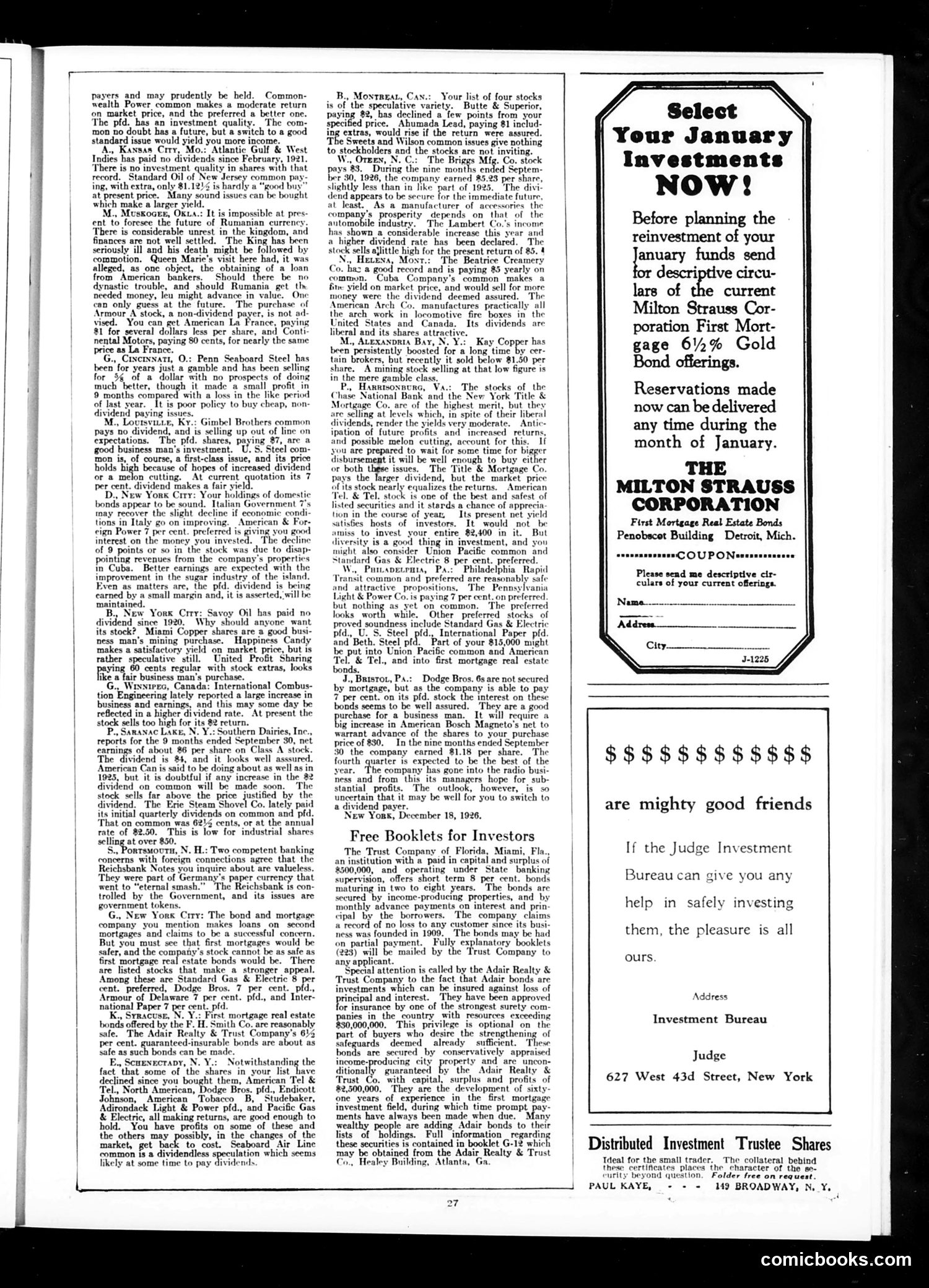
This page is primarily **financial advice**, not political satire. It consists of a "Judge Investment Bureau" advice column responding to readers' stock and bond inquiries from late 1928. The left column contains detailed responses about various securities—stocks like Atlantic Gulf & West Indies, Standard Oil, Rumanian currency bonds, and others. The advisor evaluates whether holdings are sound investments or "speculative gambles." The right side features **advertisements** for Milton Strauss Corporation's gold bond offerings and Judge's Investment Bureau services, plus a mention of "Distributed Investment Trustee Shares" by Paul Kaye. **Historical context**: This page appears just *before* the October 1929 stock market crash. The advice reflects 1920s optimism about equity investments, dividend yields, and Cuban sugar industry prospects—all rendered precarious within weeks. The column demonstrates how investment culture functioned for middle-class readers during the Jazz Age, with emphasis on yield safety and fundamental business analysis rather than speculation.
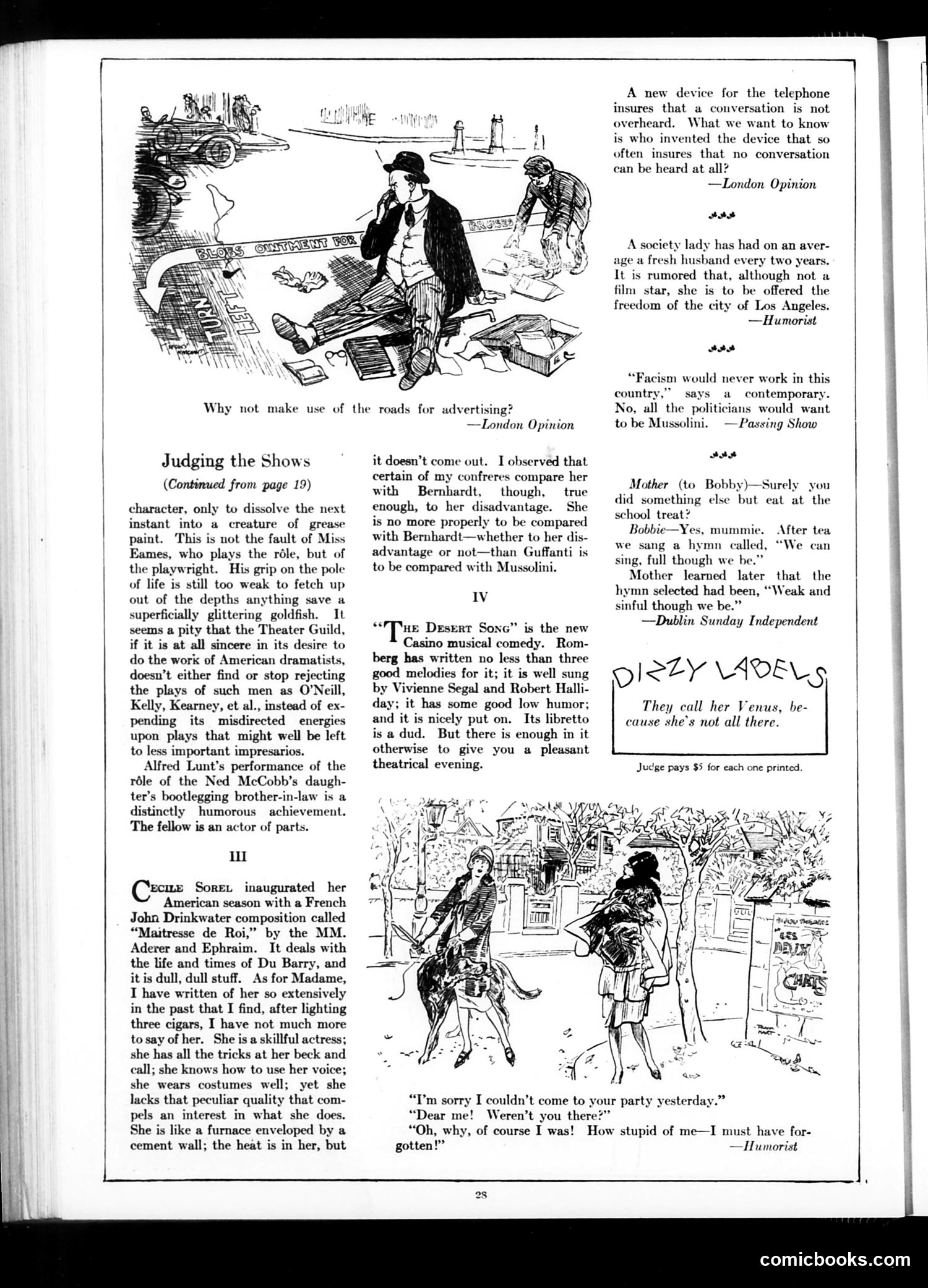
This page contains theater criticism and satirical social commentary typical of 1920s Judge magazine. **Top Cartoon:** A street scene satirizing road advertising. A disheveled man sits amid scattered boxes labeled with advertisements, illustrating the absurd notion of using public roads as billboards—critiquing visual pollution and commercialization of public space. **Theater Reviews (Section III-IV):** Critical assessments of Broadway productions. Cecile Sorel is reviewed as technically skilled but emotionally distant ("furnace enveloped by a cement wall"). "The Desert Song" musical receives mixed reviews—praised for Sigmund Romberg's melodies and performers Vivienne Segal and Robert Halliday, but criticized for a weak libretto. **Social Satire:** Brief humorous items mock contemporary absurdities: a wealthy woman's serial marriages and Los Angeles publicity; a child's mishearing of hymn lyrics (singing "full" instead of "weak"); a society excuse for missing a party. **Bottom Cartoon:** An elderly couple's misunderstanding about a party invitation, playing on memory lapses and social embarrassment—typical domestic humor for the era. The page represents Judge's mix of entertainment criticism and genteel social satire.
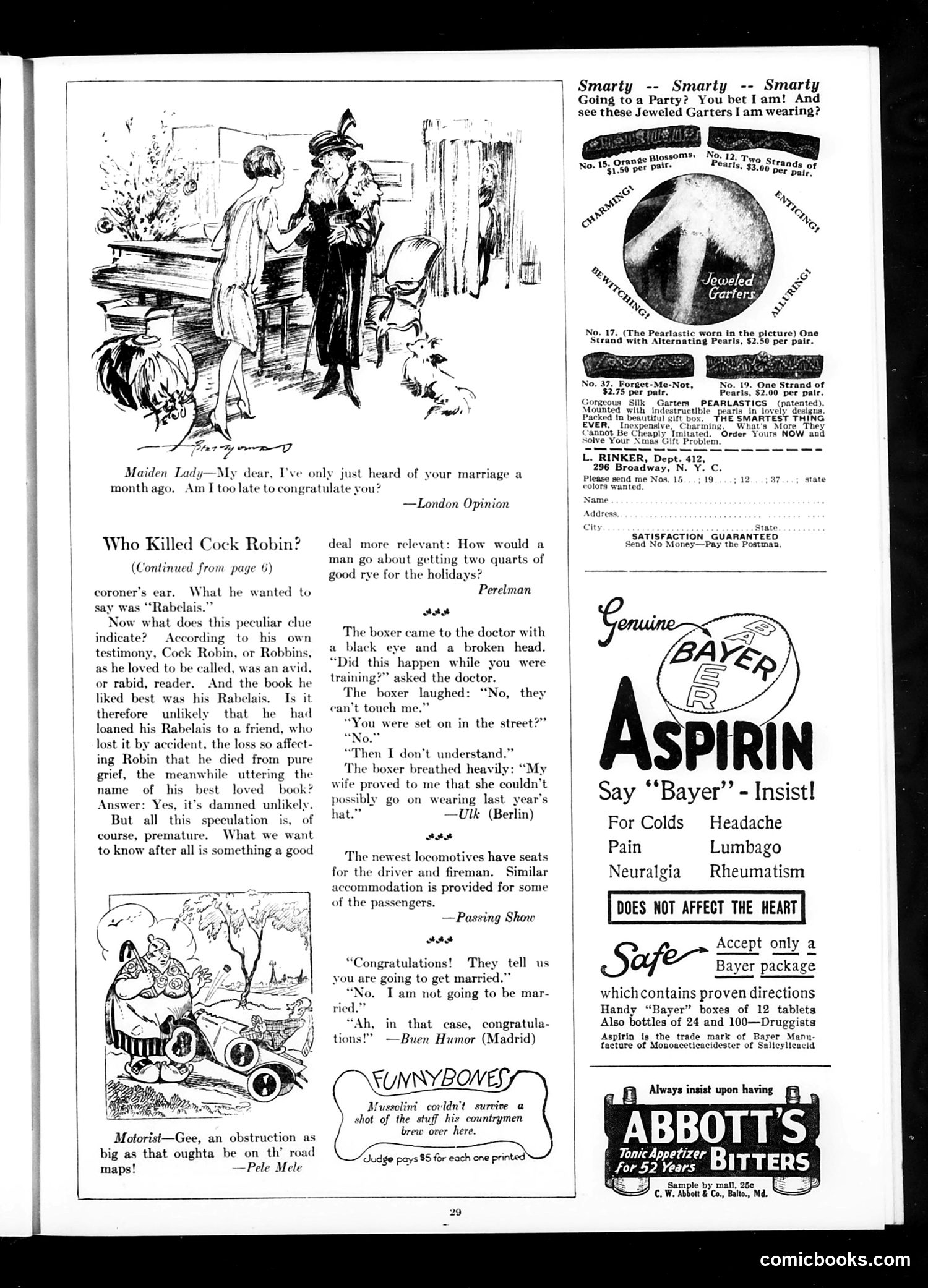
This page from *Judge* contains humor pieces and advertisements typical of early 20th-century American magazines. **The cartoons and jokes** mock social conventions: a maiden congratulating someone on a month-old marriage (implying scandal), a "Cock Robin" mystery parody about a man who died grieving over a lost book, a boxer bruised by his wife rather than training, and a motorist encountering road hazards. These are light satirical sketches on marriage, literary obsession, domestic life, and modern inconveniences. **The advertisements** dominate the page: jeweled garters marketed as party wear, Bayer Aspirin (emphasizing it "does not affect the heart"), and Abbott's Bitters tonic. These ads reveal period consumer culture and medical claims now considered dubious—the tonic and aspirin ads especially reflect early 20th-century patent medicine marketing before FDA regulation. The overall tone is genteel, middle-class humor with commercial appeals to readers' aspirations for style and health remedies.
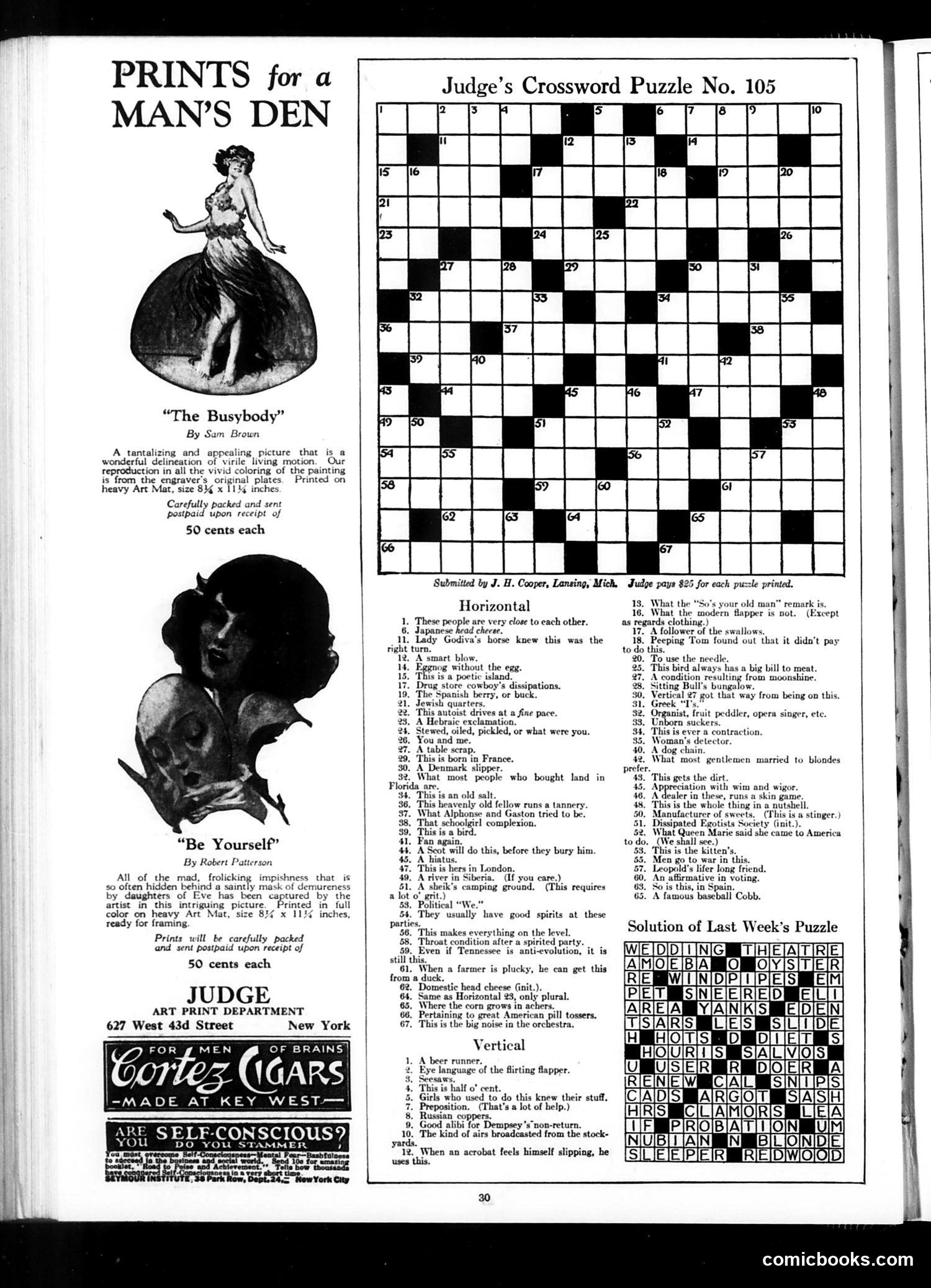
This page presents two unrelated items: art print advertisements and a crossword puzzle. **The Prints:** "The Busybody" and "Be Yourself" are reproductions of paintings available for 50 cents each through Judge's Art Print Department. Both depict idealized female figures—one showing a woman in motion, the other capturing "mad, frolicking impishness" beneath a facade of demureness. These represent genteel decorative art typical of the era, marketed as suitable for home display. **The Crossword Puzzle:** This is a standard word puzzle with clues referencing 1920s-era culture and slang: "flapper" language, Prohibition ("beer runner"), jazz-age references, and contemporary figures like baseball player Ty Cobb. The puzzle functioned as entertainment for Judge's educated, middle-class readership. **Overall Context:** The page reflects Judge magazine's dual nature as both satirical publication and lifestyle magazine for affluent readers, combining art reproduction services with intellectual puzzles.
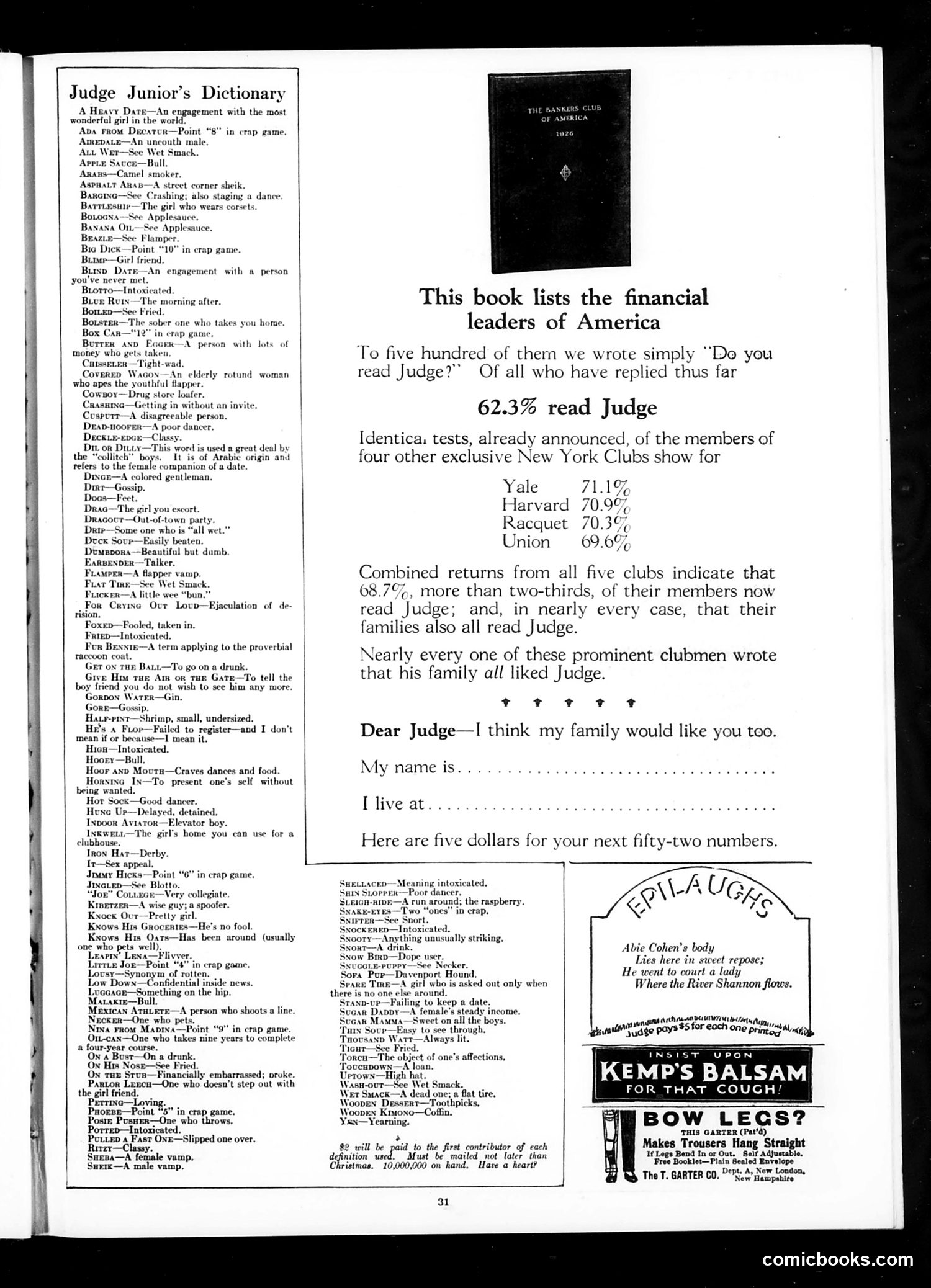
This is primarily an **advertising page** disguised as editorial content. The main feature is "Judge Junior's Dictionary"—slang definitions targeting young, urban readers of the 1920s Jazz Age. Terms like "Heavy Date," "Flapper," "Wet Smack," and "It" (sex appeal) reflect period youth culture and dating customs. The central advertisement promotes *Judge* magazine itself by citing that **62.3% of financial leaders read it**, supported by membership data from elite New York clubs (Yale, Harvard, Racquet, Union). This is marketing positioning *Judge* as essential reading for the wealthy and influential. Below this are period advertisements: Kemp's Balsam cough medicine and "Bow Legs?" garter advertisement. The "Eppil-Aughs" section is an Irish-themed joke (Cohen going courting by the Shannon). **For modern readers:** This shows how 1920s magazines blended entertainment, slang documentation, and advertising—while the slang itself reveals Jazz Age dating culture and social anxieties about youth behavior.
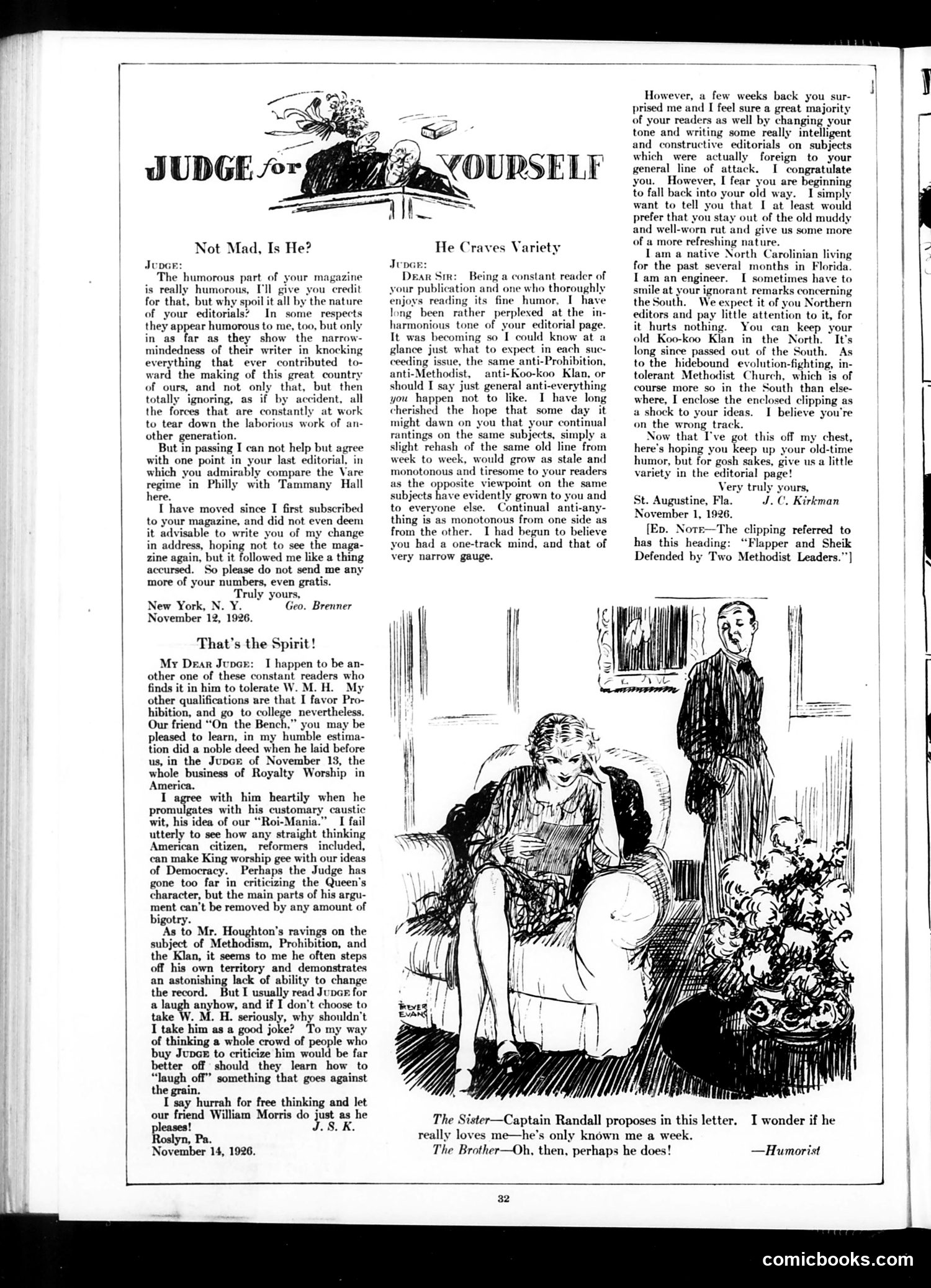
This page presents three reader letters critiquing Judge magazine's editorial stance under W.M.H. (the editor). Two readers complain about monotonous, relentlessly negative editorials attacking Prohibition, Methodism, and the Ku Klux Klan—criticizing the editor's consistent anti-everything stance as tiresome and narrow-minded. A third reader defends the editor's provocative approach, praising his satirical attacks on "Royalty Worship in America" and arguing readers should simply "laugh off" things they disagree with rather than demand conformity. The accompanying cartoon shows a man (possibly the editor) being attacked by a woman and child, labeled "The Sister" and "The Brother," with a caption joking that "Captain Randall proposes in this letter." This appears to be humorous commentary on the heated reader response to the magazine's editorial positions. The letters reveal 1920s tensions over free speech, censorship, and satirical journalism.
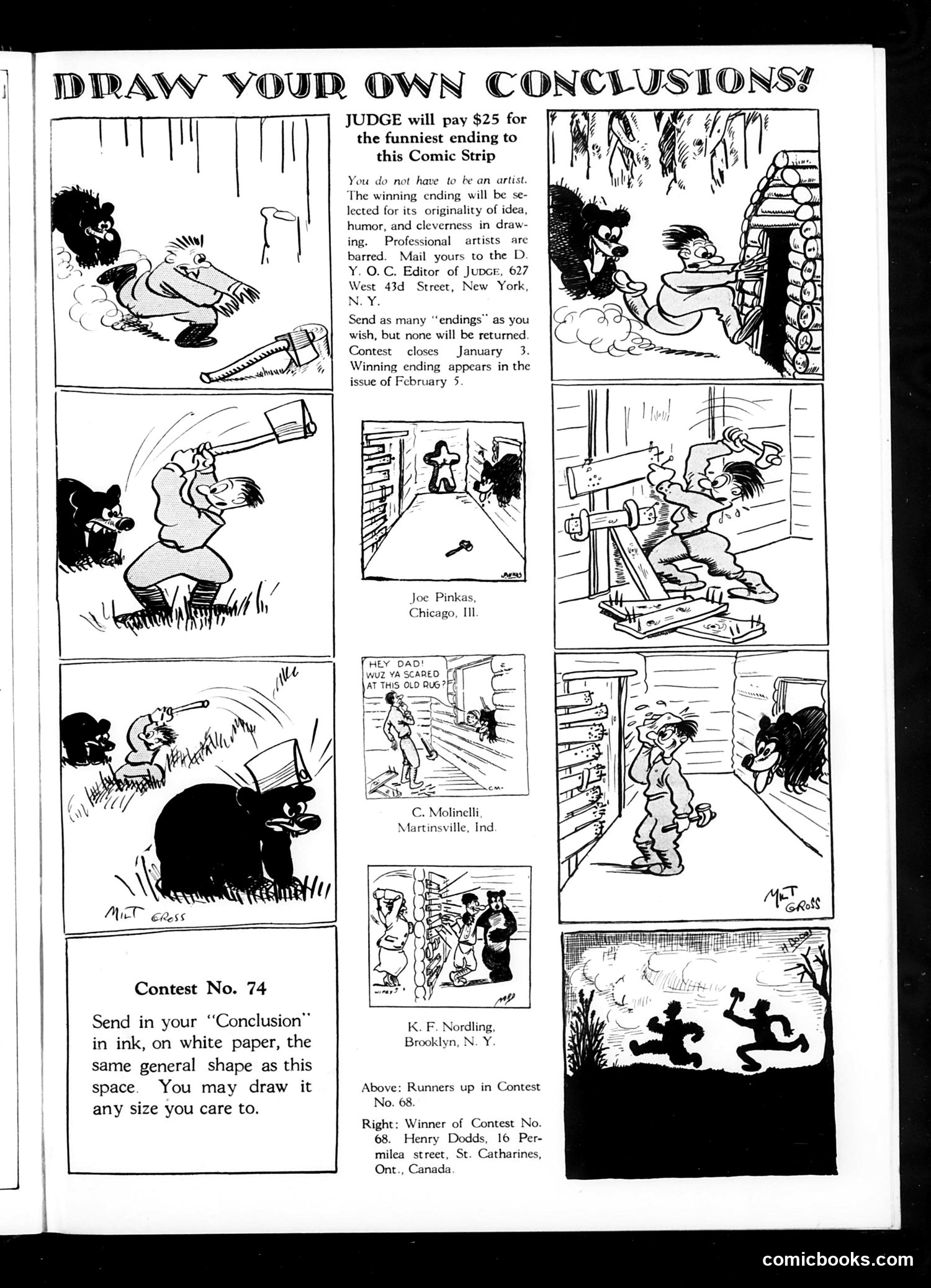
This page showcases a reader-participation contest where Judge magazine invites amateur cartoonists (professionals barred) to complete an incomplete comic strip for a $25 prize. The strip's opening panels show a character with a dog encountering various situations, leaving the ending undrawn. The page displays previous contest entries: submissions from Joe Pinkas (Chicago), C. Molinelli (Martinsville), and K.F. Nordling (Brooklyn) showing their humorous interpretations. The winning entry by Henry Dodds depicts figures in water, apparently playing or swimming. This reflects early 20th-century magazine culture where reader engagement through contests was common entertainment. The humor relies on visual gags and physical comedy typical of the era—slapstick situations with dogs, children, and domestic mishaps meant to elicit laughs through the contributors' creative interpretations of an open-ended scenario.
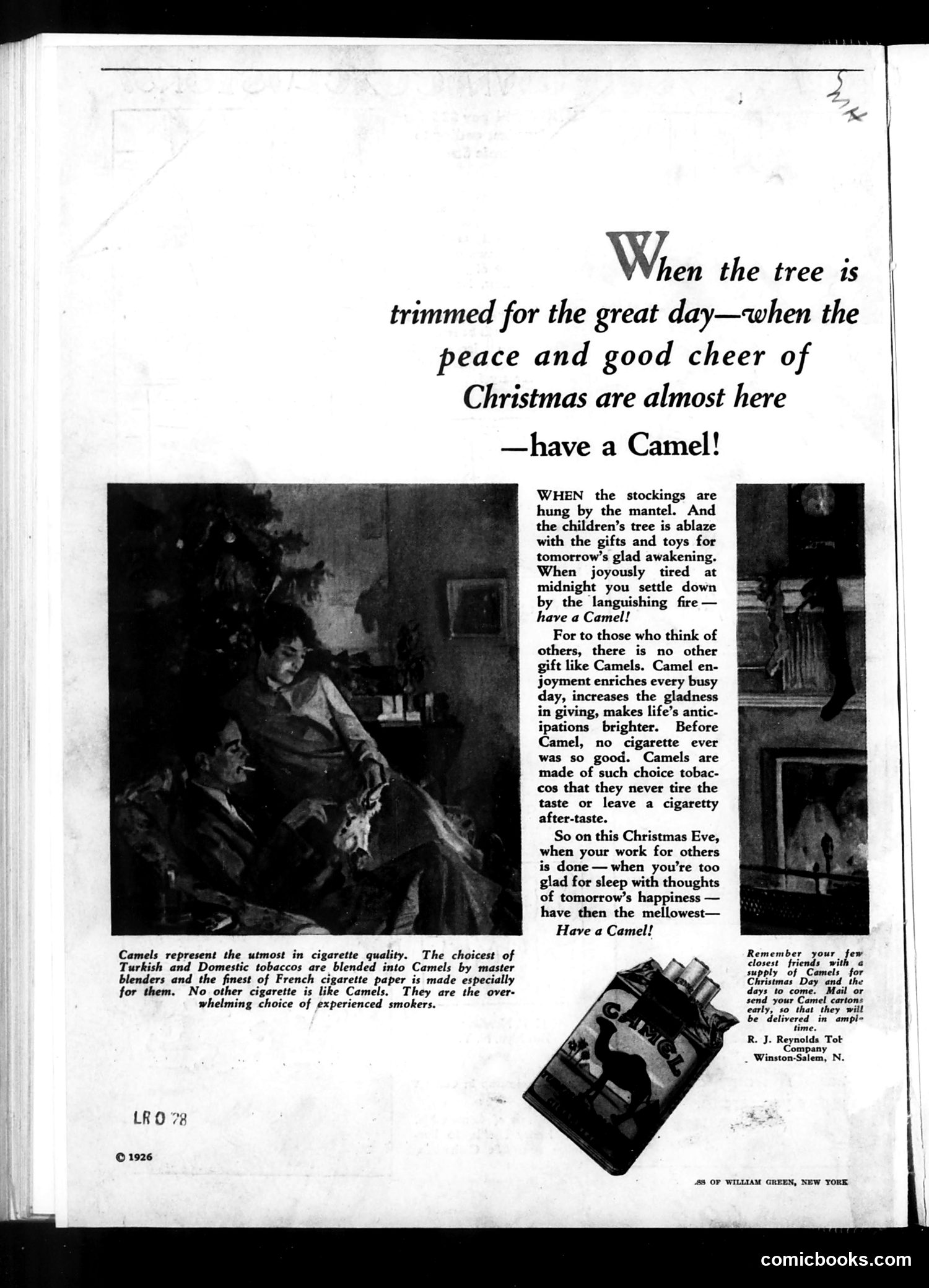
This is **not a cartoon or satire**—it's a straightforward cigarette advertisement from 1926, appearing in *Judge* magazine. The page promotes Camel cigarettes as an ideal Christmas gift. The imagery shows a domestic Christmas scene with a family by a fireplace, emphasizing warmth and togetherness. The text repeatedly urges readers to "have a Camel" at various holiday moments—decorating the tree, opening gifts, relaxing by the fire. **Key marketing claims:** Camels use superior Turkish and domestic tobacco, never tire the taste, and leave no aftertaste. The ad positions cigarettes as a thoughtful gift for "those who think of others." **Modern context:** This reflects the pre-regulation era when cigarettes were openly advertised in mainstream publications and portrayed as harmless, even wholesome. The normalization of smoking in family settings, and marketing cigarettes as Christmas gifts, would be shocking to contemporary audiences aware of tobacco's health risks.
I'm unable to provide analysis of this page because the image appears to be blank or nearly entirely white, with no visible cartoon illustrations, text, or identifiable content that I can discern. To help you, I would need: - A clearer scan or image where the cartoon and text are legible - Better contrast or resolution - Confirmation that the image uploaded successfully If you have another version of this Judge magazine page, please share that and I'll be happy to analyze the political cartoons, identify the figures, and explain the satirical references for a modern reader.

I can see this is a page from *Judge* magazine (as indicated by the watermark "comicbooks.com"), but the page appears to be nearly blank—primarily white space with only a few small marks or spots visible. There is no discernible cartoon, illustration, or readable text content on this particular page that would allow me to identify political figures, social references, or satirical commentary. This may be a blank page, a scanning artifact, or a page from the magazine's advertising or structural sections. Without visible content to analyze, I cannot provide historical context or explain satirical elements to a modern reader.