
Judge, 1926-12-25 · page 28 of 38
Judge — December 25, 1926 — page 28: what you’re looking at
What you’re looking at
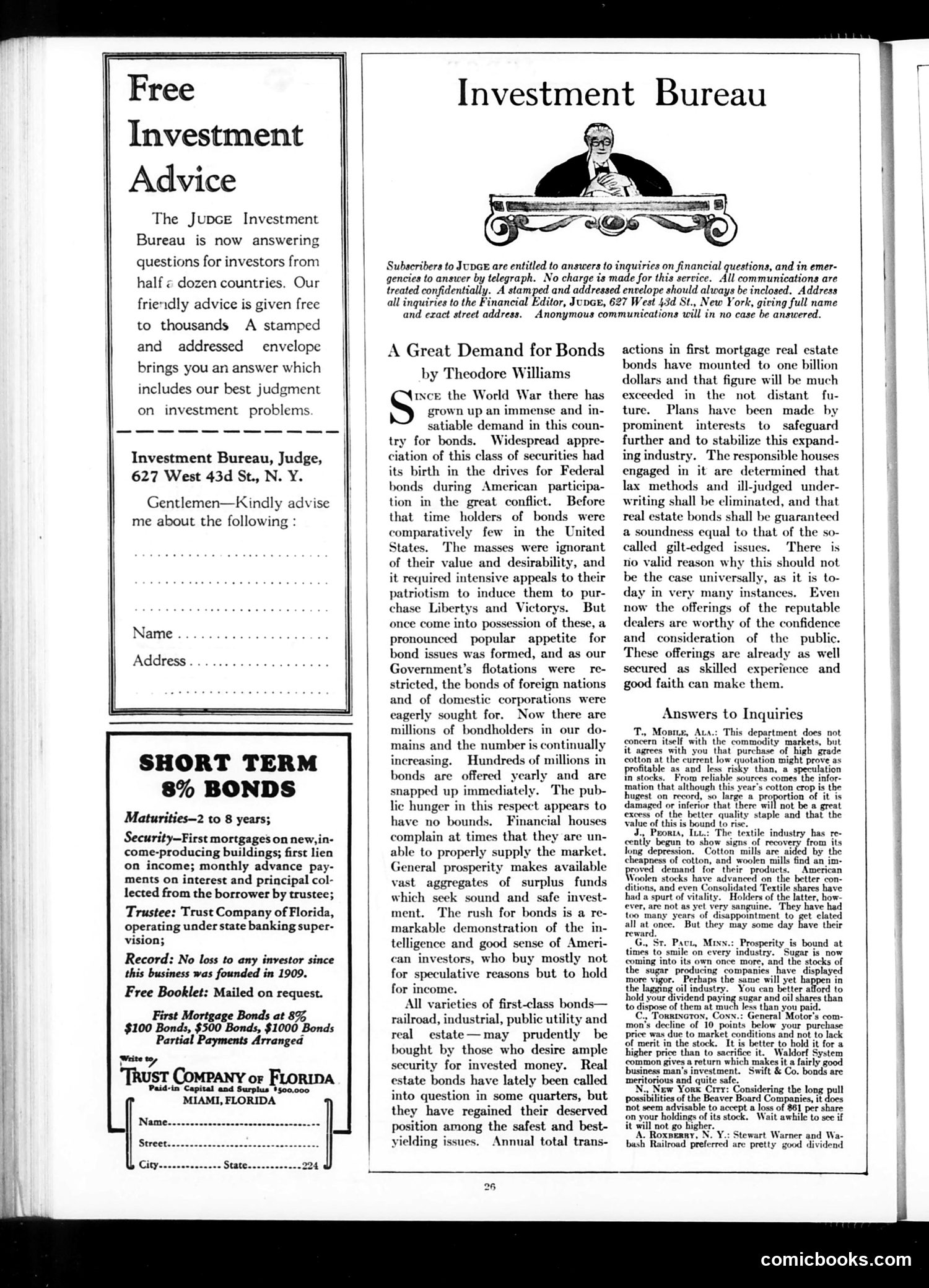
This page combines **advertising with financial advice** from Judge magazine's "Investment Bureau" service. The content reflects post-World War I American economic optimism. **Main Article ("A Great Demand for Bonds"):** Theodore Williams celebrates the explosive growth in bond investment among ordinary Americans, attributing it to their experience buying Liberty Bonds during WWI. He argues this represents intelligent, income-focused investing rather than speculation. Williams endorses various bond types—railroad, industrial, utility, and real estate—as safe investments for the masses. **Context for modern readers:** This reflects the 1920s economic boom before the 1929 crash. The article's confidence in bonds' safety and the promotion of real estate bonds (which would become notorious in the 2008 crisis) reveals period-specific assumptions about financial security. The enthusiastic tone suggests Judge was promoting bonds to its affluent readership while celebrating broader financial democratization. **The page is primarily editorial content with embedded advertisements** rather than satirical cartoon commentary.
📄 Transcribed text from this page (OCR, searchable)
Machine-transcribed from the original scan — historical spelling and the odd misread are preserved.
Free Investment Advice The JupcE Investment Bureau is now answering questions for investors from half « dozen countries. Our friendly advice is given free to thousands A stamped and addressed envelope brings you an answer which includes our best judgment on investment problems Investment Bureau, Judge, 627 West 43d St., N. Y. Gentlemen—Kindly advise me about the following : SHORT TERM 8% BONDS Maturities—2 to 8 years; Security—First mortgages on new,in- come-producing buildings; first lien on income; monthly advance pay- ments on interest and principal col- lected from the borrower by trustee; Trustee: Trust Company of Florida, operating under state banking super- vision; Record: No loss to any investor since this business was founded in 1909. Free Booklet: Mailed on request. First Mortgage Bonds at 8% $100 Bonds, $500 ‘Bonds, $1000 Bonds Partial Payments Arranged Investment Bureau Subscribers to JupcE are entitled to answers to inquiries on financial questions, and in emer- gencies to answer by telegraph. No charge is made for this service. All communications are treated confidentially. A stamped and addressed envelope should always be inclosed. Address all inquiries to the Financial Editor, Juvce, 627 West 43d St., New York, giving full name and exact street address. Anonymous communications will in no case be answered. A Great Demand for Bonds by Theodore Williams Ss the World War there has grown up an immense and in- satiable demand in this coun- try for bonds. Widespread appre- eiation of this class of securities had its birth in the drives for Federal bonds during American participa- tion in the great conflict. Before that time holders of bonds were comparatively few in the United States. The masses were ignorant of their value and desirability, and it required intensive appeals to their patriotism to induce them to pur- chase Libertys and Victorys. But once come into possession of these, a pronounced popular appetite for bond issues was formed, and as our Government’s flotations were _ re- stricted, the bonds of foreign nations and of domestic corporations were eagerly sought for. Now there are millions of bondholders in our do- mains and the number is continually increasing. Hundreds of millions in bonds are offered yearly and are snapped up immediately. The pub- lic hunger in this respect appears to have no bounds. Financial houses complain at times that they are un- able to properly supply the market. General prosperity makes available vast aggregates of surplus funds which seek sound and safe invest- ment. The rush for bonds is a re- markable demonstration of the in- telligence and good sense of Ameri- can investors, who buy mostly not for speculative reasons but to hold for income. All varieties of first-class bonds— railroad, industrial, public utility and real estate—may prudently be bought by those who desire ample security for invested money. Real estate bonds have lately been called into question in some quarters, but they have regained their deserved position among the safest and best- yielding issues. Annual total trans- actions in first mortgage real estate bonds have mounted to one billion dollars and that figure will be much exceeded in the not distant fu- ture. Plans have been made by prominent interests to safeguard further and to stabilize this expand- ing industry. The responsible houses engaged in it are determined that lax methods and ill-judged under- writing shall be eliminated, and that real estate bonds shall be guaranteed a soundness equal to that of the so- called gilt-edged issues. There is no valid reason why this should not be the case universally, as it is to- day in very many instances. Even now the offerings of the reputable dealers are worthy of the confidence and consideration of the public. These offerings are already as well secured as skilled experience and good faith can make them. Answers to Inquiries T., Mone, 4.: This department does not concern itself ‘with the commodity markets, but it agrees with you that purchase of high grade cotton at the current low quotation might prove as profitable as and less risky than, a speculation In stocks. From reliable sources comes the infor- mation that although this year’s cotton crop is the hugest on record, so large a proportion of it is damaged or inferior that there will not be a great excess of the better quality staple and that the value of this is bound to rise J., Peorts, Iut.: The textile industry has re- cenily begun’ to show signs of recovery from its long depression. Cotton mills are aided by the cheapness of cotton, and woolen mills find an im- Proved “demand for their products. American Woolen stocks have advanced on the better con- ditions, and even Consolidated Textile shares have had a spurt of Holders of the latter, how- ever, are not as yet very sanguine. ‘They have had too many years of disappointment to get elated all at once. But they may some day have their rewari _G, St. Paci, M Prosperity. is bound at smile on every industry. Sugar is now coming into its own once more, and the stocks of the sugar producing companies have displayed more vigor. Perhaps the same will yet happen in the lagging oil industry. You can better afford to hold your dividend paying sugar and oil shares than Sof then et iol eer thee you paid. NN.: General Motor's com- i Price was due to market coi of merit in the stock. It is better to hold it for a higher price than to sacrifice it. Waldorf System common gives a return which makes it a fairly good business man’s investment. Swift & Co. bonds are meritorious and quite safe. Nz New Youx Crrr: Considering the long pul possibilities of the Beaver Board Companies, it not seem advisable to accept a loss of $61 per share ‘on your holdings of its stock. Wait awhile to see if | not go higher. . Roxnerry, Y bash Railroad preferred jewart Warner and Wa- e pretty good dividend comicbooks.com