
Judge, 1926-12-25 · page 15 of 38
Judge — December 25, 1926 — page 15: what you’re looking at
What you’re looking at
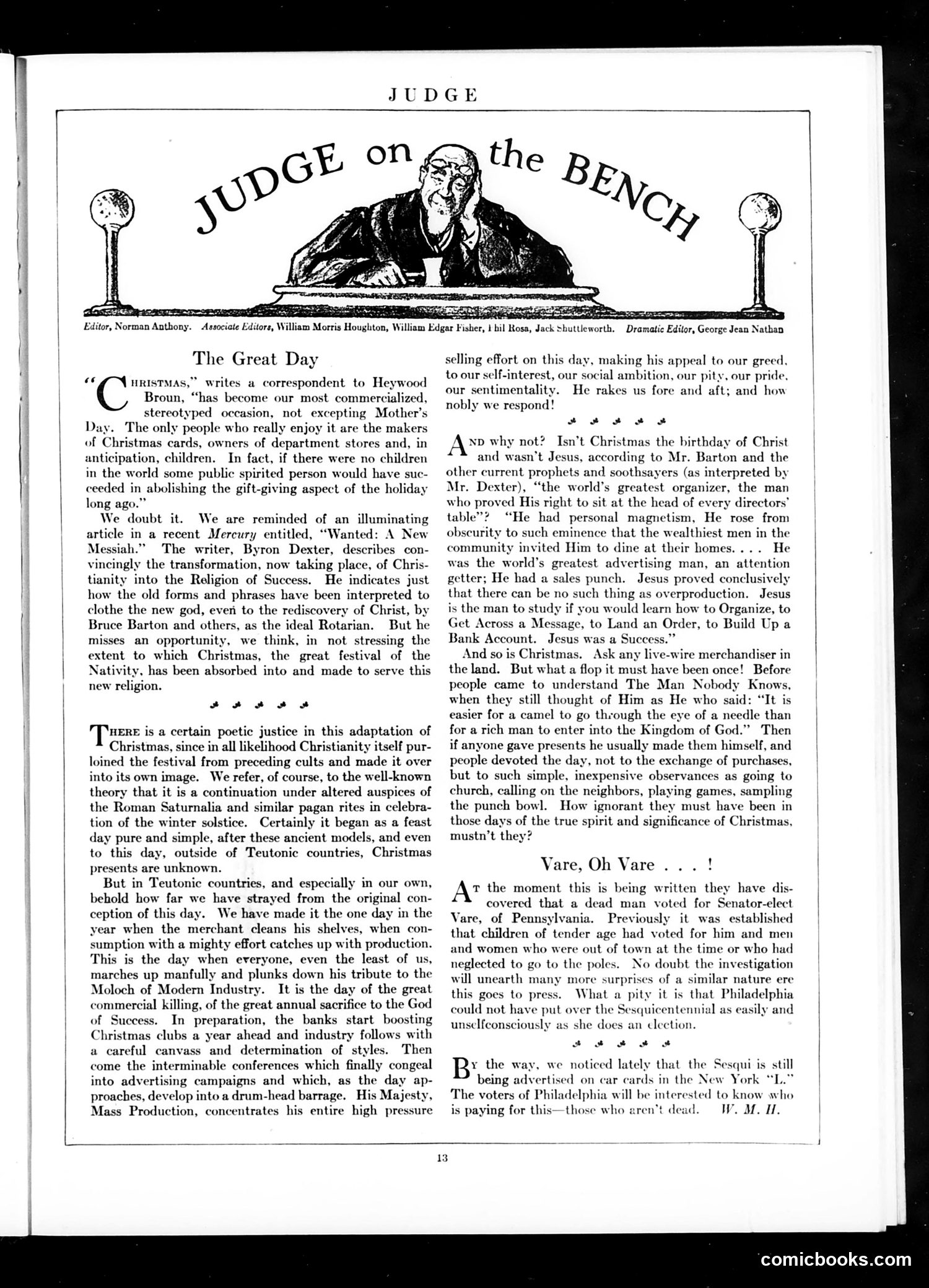
This editorial column satirizes the commercialization of Christmas in modern America. The writer critiques how Christmas has been transformed from a religious observance into a vehicle for consumer capitalism and "the Religion of Success." The satire targets **Bruce Barton** and similar "business gospel" advocates who reinterpret Jesus as the ideal businessman and organizer—a man who mastered "advertising," "sales punch," and "getting across a message." The piece mocks how this theology justifies Christmas as peak commercial season, when industry executes its "drum-head barrage" of advertising to manipulate consumers' "greed, self-interest, social ambition, pity, pride, sentimentality." The irony is sharp: Christmas, supposedly celebrating Christ's birth, has become a corporate holiday where consumers dutifully "plunk down" tribute to "the Moloch of Modern Industry." The author questions whether Jesus—presented as successful salesman—would endorse such naked materialism. This reflects 1920s-30s anxiety about advertising's psychological manipulation and capitalism's colonization of religious meaning.
📄 Transcribed text from this page (OCR, searchable)
Machine-transcribed from the original scan — historical spelling and the odd misread are preserved.
The Great Day “ HRISTMAS,” writes a correspondent to Heywood Broun, “has become our most commercialized, stereotyped occasion, not excepting Mother’s Day. The only people who really enjoy it are the makers of Christmas cards, owners of department stores and, in anticipation, children. In f: if there were no children in the world some public spirited person would have suc- ceeded in abolishing the gift-giving aspect of the holiday long ago.” We doubt it. We are reminded of an illuminating article in a recent Mercury entitled, “Wanted: A New Messiah.” The writer, Byron Dexter, describes con- vincingly the transformation, now taking place, of Chris- tianity into the Religion of Success. He indicates just how the old forms and phrases have been interpreted to clothe the new god, even to the rediscovery of Christ, by Bruce Barton and others, as the ideal Rotarian. But he misses an opportunity, we think, in not stressing the extent to which Christmas, the great festival of the Nativity, has been absorbed into and made to serve this new religion. ese see Taere is a certain poetic justice in this adaptation of Christmas, since in all likelihood Christianity itself pur- loined the festival from preceding cults and made it over into its own image. We refer, of course, to the well-known theory that it is a continuation under altered auspices of the Roman Saturnalia and similar pagan rites in celebra- tion of the winter solstice. Certainly it began as a feast day pure and simple, after these ancient models, and even to this day, outside of Teutonic countries, Christmas presents are unknown. But in Teutonic countries, and especially in our own, behold how far we have strayed from the original con- ception of this day. We have made it the one day in the year when the merchant cleans his shelves, when con- sumption with a mighty effort catches up with production. This is the day when everyone, even the least of u marches up manfully and plunks down his tribute to the Moloch of Modern Industry. It is the day of the great commercial killing, of the great annual sacrifice to the God of Success. In preparation, the banks start boosting Christmas clubs a year ahead and industry follows with a careful canvass and determination of styles. Then come the interminable conferences which finally congeal into advertising campaigns and which, as the day ap- proaches, develop into a drum-head barrage. His Maje Mass Production, concentrates his entire high pressure selling effort on this day, making his appeal to our greed, to our self-interest, our social ambition, our pity, our pride, our sentimentality. He rakes us fore and aft; and how nobly we respond! tt te tt A» why not? Isn’t Christmas the birthday of Christ and n't Jesus, according to Mr. Barton and the other current prophets and soothsayers (as interpreted by Mr. Dexter), “the world’s greatest organizer, the man who proved His right to sit at the head of every directors’ table”? “He had personal magnetism, He rose from obscurity to such eminence that the wealthiest men in the community invited Him to dine at their homes.... He was the world’s greatest advertising man, an attention getter; He had a sales punch. Jesus proved conclusively that there can be no such thing as overproduction. Jesus is the man to study if you would learn how to Organize, to Get Across a Message, to Land an Order, to Build Up a Bank Account. Jesus was a Success.” And so is Christmas. Ask any live-wire merchandiser in the land. But what a flop it must have been once! Before people came to understand The Man Nobody Knows, when they still thought of Him as He who said: “It is easier for a camel to go through the eye of a needle than for a rich man to enter into the Kingdom of God.” Then if anyone gave presents he usually made them himself, and people devoted the day, not to the exchange of purchases, but to such simple, inexpensive observances as going to church, calling on the neighbors, playing games, sampling the punch bowl. How ignorant they must have been in those days of the true spirit and significance of Christmas, mustn’t they? Vare, Oh Vare...! T the moment this is being written they have dis- covered that a dead man voted for Senator-elect Vare, of Pennsylvania. Previously it was established that children of tender age had voted for him and men and women who were out of town at the time or who had neglected to go to the poles. No doubt the investigation will unearth many more surprises of a similar nature ere this goes to press. What a pity it is that Philadelphia could not have put over the Sesquicentennial as easily and unselfconsciously as she does an election. + ft ot 2 ry y the way, we noticed lately that the Sesqui is still being advertised on car cards in the New York “L.” The voters of Philadelphia will be interested to know who is paying for this—those who aren't dead. W. Mf. Hl. 13 comicbooks.com