
Judge, 1926-12-25 · page 21 of 38
Judge — December 25, 1926 — page 21: what you’re looking at
What you’re looking at
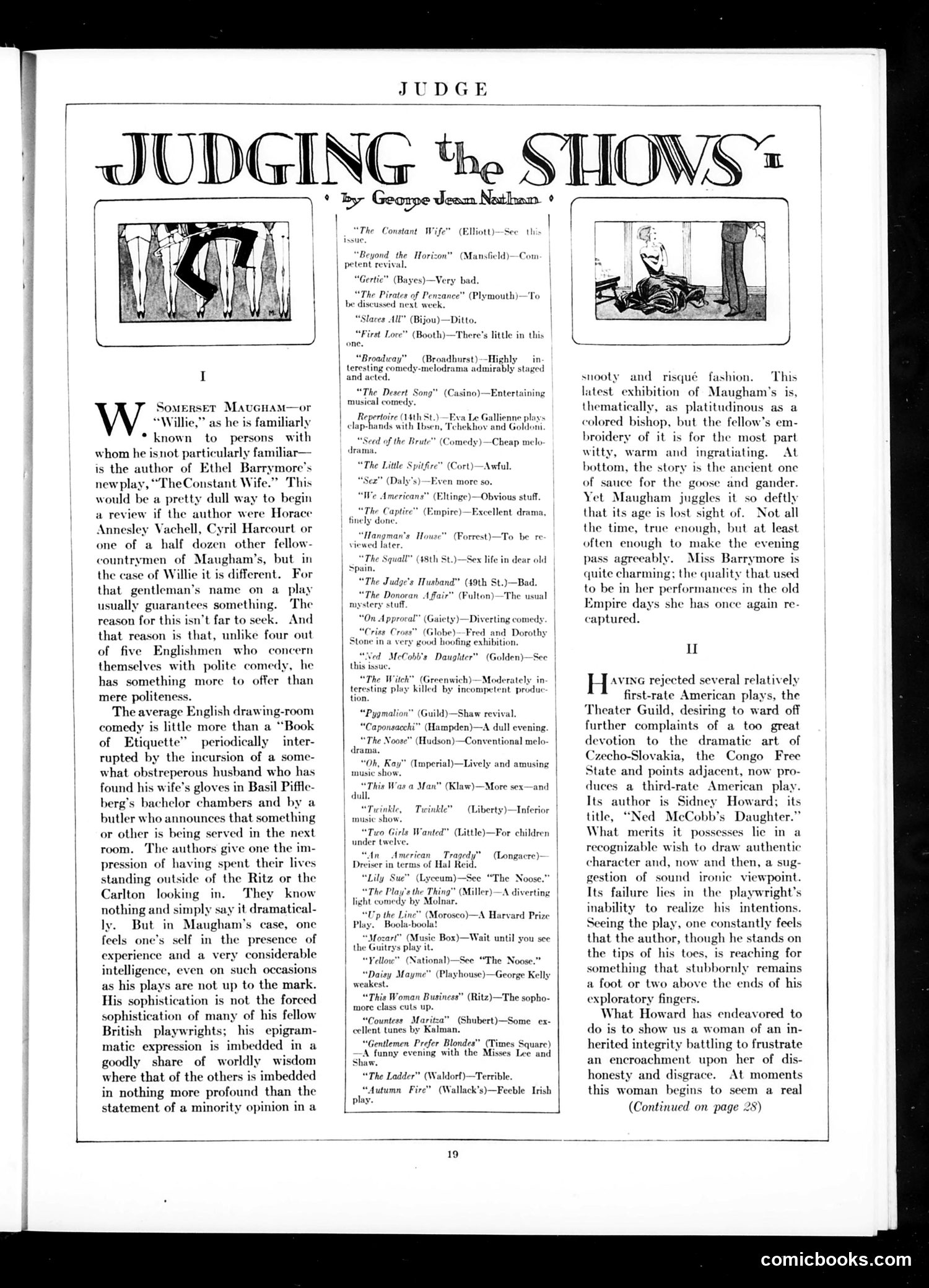
This page from Judge magazine presents theater critic George Jean Nathan's reviews of current Broadway productions. The left column features a lengthy essay praising Somerset Maugham, the British playwright ("Willie"), arguing that unlike most English drawing-room comedies—which Nathan dismisses as shallow, etiquette-focused entertainments written by authors who merely observe high society from outside the Ritz and Carlton hotels—Maugham brings genuine experience and intelligence to his work. The right column and center list brief, often caustic reviews of various contemporary plays, using a rating system of praise or dismissal. Nathan's satire targets both pretentious English playwrights and mediocre American theatrical offerings, while celebrating Maugham's sophistication and worldly wisdom as superior to his peers' forced sophistication and shallow epigrammatic expression.
📄 Transcribed text from this page (OCR, searchable)
Machine-transcribed from the original scan — historical spelling and the odd misread are preserved.
JUDGE JUDGING The SHOWS | ay illie,” as he is familiarly * known to persons with whom he isnot particularly familiar— is the author of Ethel Barrymore's newplay, “TheConstant Wife.” This would be a pretty dull way to begin a review if the author were Horace Annesley Vachell, Cyril Harcourt or one of a half dozen other fellow- countrymen of Maugham’s, but in the case of Willie it is different. For that gentleman’s name on a play usually guarantees something. The reason for this isn’t far to seek. And that reason is that, unlike four out of five Englishmen who concern themselves with polite comedy, he has something more to offer than mere politeness. The average English drawing-room comedy is little more than a “Book of Etiquette” periodically _ inter- rupted by the incursion of a some- what obstreperous husband who has found his wife’s gloves in Basil Piffle- berg’s bachelor chambers and by a butler who announces that something or other is being served in the next room. The authors give one the im- pression of having spent their lives standing outside of the Ritz or the Carlton looking in. They know nothing and simply say it dramatical- ly. But in Maugham’s case, one feels one’s self in the presence of experience and a very considerable intelligence, even on such occasions as his plays are not up to the mark. His sophistication is not the forced sophistication of many of his fellow British playwrights; his epigram- matic expression is imbedded in a goodly share of worldly wisdom where that of the others is imbedded in nothing more profound than the statement of a minority opinion in a eee Geonpe Jeam Nathan ¢ | (Elliott)—See this Constant Wife” yond the Horizon” (Mansficld)—Com Bayes)—Very bad, f Penzance” (Plymouth) —To “Slaves All” “First Love” (Booth) —The one. “Broadway” ter wg comedy-melodrama and acted. | “The Desert Song” (Casino)—Entertaining | musical comedy Eva Le Gi ‘chekh iene plays Joni | Repertoire (14th St. | elapchamads with Ib Seed of the Brut The Litile Spitfire” (Cort)—Awful. Comedy) —Cheap melo ‘Sez" (Daly’s)—Even more so. ¢ Americans” (Eltinge)—Obvious stuff. “The Captire™ finely de “Hangman’s Ho viewed later. “The Squall” (48th St.) (Empire)—Excellent ma, (Forrest)—To be re Sex life in dear old "he Judge's Husband” (49th St.)—Bad. “The Donovan Affair” (Fulton) mystery stuff. “On Approval” (Gaiety)—Diverting comedy Dorothy hoofing exhibition. } MeCobb's Daughter” (Golden)—See this issue. | “The Witch” (Greenwich) —Moderately in teresting play killed by incompetent. produc tion “Pygmalion” ‘aponsacchi” “The Noose” drama. jampden)—A ‘Hudson)—Conventional melo- dull evening. “Oh, Kay” (Imperial)—Lively and amusing | music show. we Was a Man" (Klaw)—More sex—and I. winkle, Twinkle” ie show. Two G under twely (Liberty)—Inferior | ls Wanted” (Little) —For children “An | American Dreiser in terms of Hal Reid. “Lily s (Lyceum)—See “The Noose.” “The Play's the Thing” (Miller) light comedy by Moln p the Line” (Morose Bo b Tragedy" (Longacre) A diverting )—A Harvard Prize Box)—Wait until you see | the Guitrys play it. “Yellow” (National)—See “The Noose.” “Daisy Mayme” (Playhouse)—George Kelly weakest. “This Woman Business” (Ritz)—The sopho- more class cuts up. “Countess. Maritza” (Shubert)—Some ex- cellent tunes by Kalman, Gentlemen Prefer Blondes” (Times $ A funny evening with the Misses Lee and Shaw. “The Ladder” (Waldorf)—Terrible. “Autumn Fire” (Wallack’s play. snooty and risqué fashion, — ‘This latest. exhibition of Maugham’s is, ther ly, as_platitudinous colored bishop, but the fellow’s em- broidery of it is for the most part witty, warm and ingratiating. At bottom, the story is the ancient one of sauce for the goose and gander. Yet Maugham juggles it so deftly that its age is lost sight of. Not all the time, true enough, but at least often enough to make the evening pass agreeably. Miss Barrymore is quite charming; the quality that used to be in her performances in the old Empire days she has once again re- captured. Il H AVING rejected several relatively first-rate American plays, the Theater Guild, desiring to ward off further complaints of a too great devotion to the dramatic art of Czecho-Slovakia, the Congo Free State and points adjacent, now pro- duces a third-rate American play. Its author is Sidney Howard; its title, “Ned MeCobb’s Daughter.” What merits it possesses lie in a recogni ble wish to draw authentic character and, now and then, a sug- gestion of sound ironic viewpoint. Its failure lies in the playwright’s inability to realize his intentions. Seeing the play, one constantly feels that the author, though he stands on the tips of his toes, is reaching for something that stubbornly remains a foot or two above the ends of his exploratory fingers. What Howard has endeavored to do is to show us a woman of an in- herited integrity battling to frustrate an encroachment upon her of dis- honesty and disgrace. At moments this woman begins to seem a real (Continued on page 28) comicbooks.com