
A complete issue · 36 pages · 1926
Judge — May 8, 1926
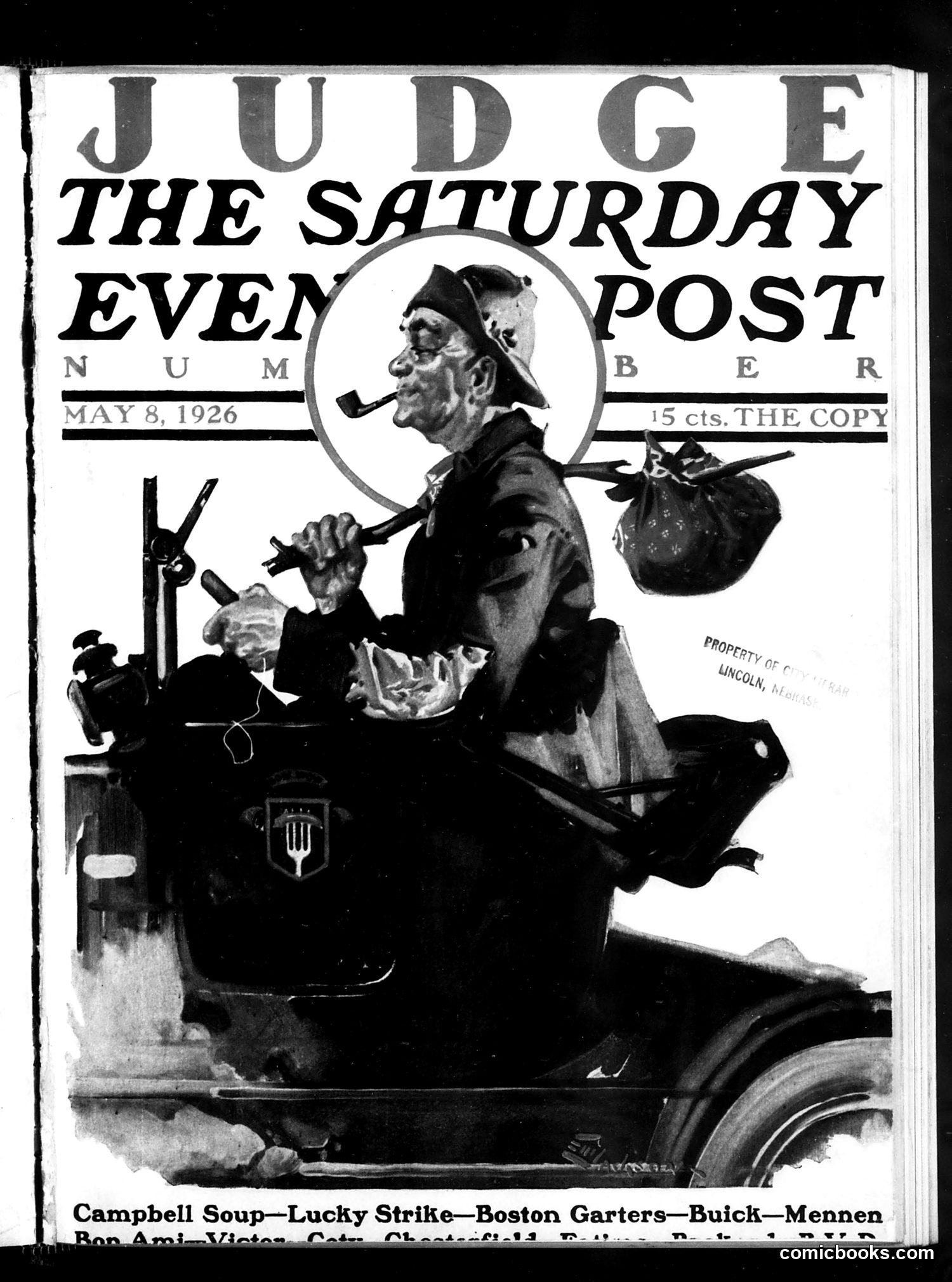
This cover depicts a disheveled judge driving an old automobile, smoking a pipe and appearing to transport various items—including what appears to be a bag of goods. The caricature seems to satirize judicial corruption or malfeasance, presenting a judge conducting illicit activities rather than upholding the law. Given the 1926 Prohibition era context, this likely mocks judges who ignored or participated in bootlegging and illegal alcohol trafficking—widespread problems during that period when organized crime and judicial corruption were rampant. The bottom text lists various entertainment and consumer topics covered in the issue (Campbell Soup, Boston Garters, automobiles, etc.), suggesting this is primarily a satirical humor magazine addressing contemporary social vices and public figures.
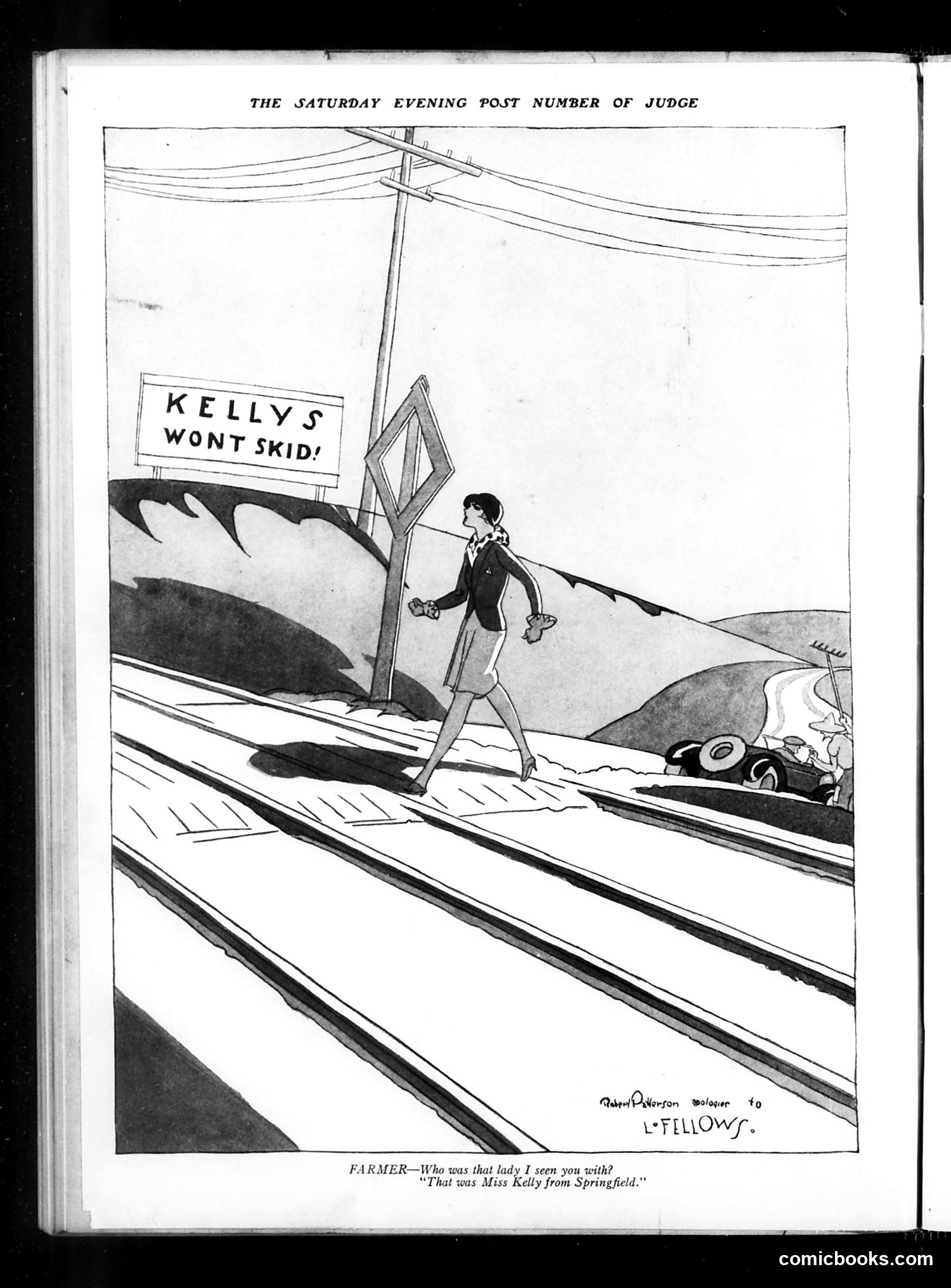
This cartoon from *Judge* magazine appears to be a social commentary about a woman named Kelly from Springfield who "won't skid" — likely a reference to safe driving or avoiding accidents, given the automobile and railroad tracks visible in the scene. The humor seems to play on a contrast: a well-dressed woman stands confidently near a utility pole and train tracks, while a farmer expresses surprise at seeing her there, identifying her as "Miss Kelly from Springfield." The joke likely hinges on Kelly's reputation for safe, cautious behavior ("won't skid") being tested or contradicted by her presence in this potentially dangerous location. The cartoon satirizes either feminine propriety, reckless behavior, or the emerging automobile culture of the early 20th century, though the specific social reference remains somewhat unclear without additional historical context.
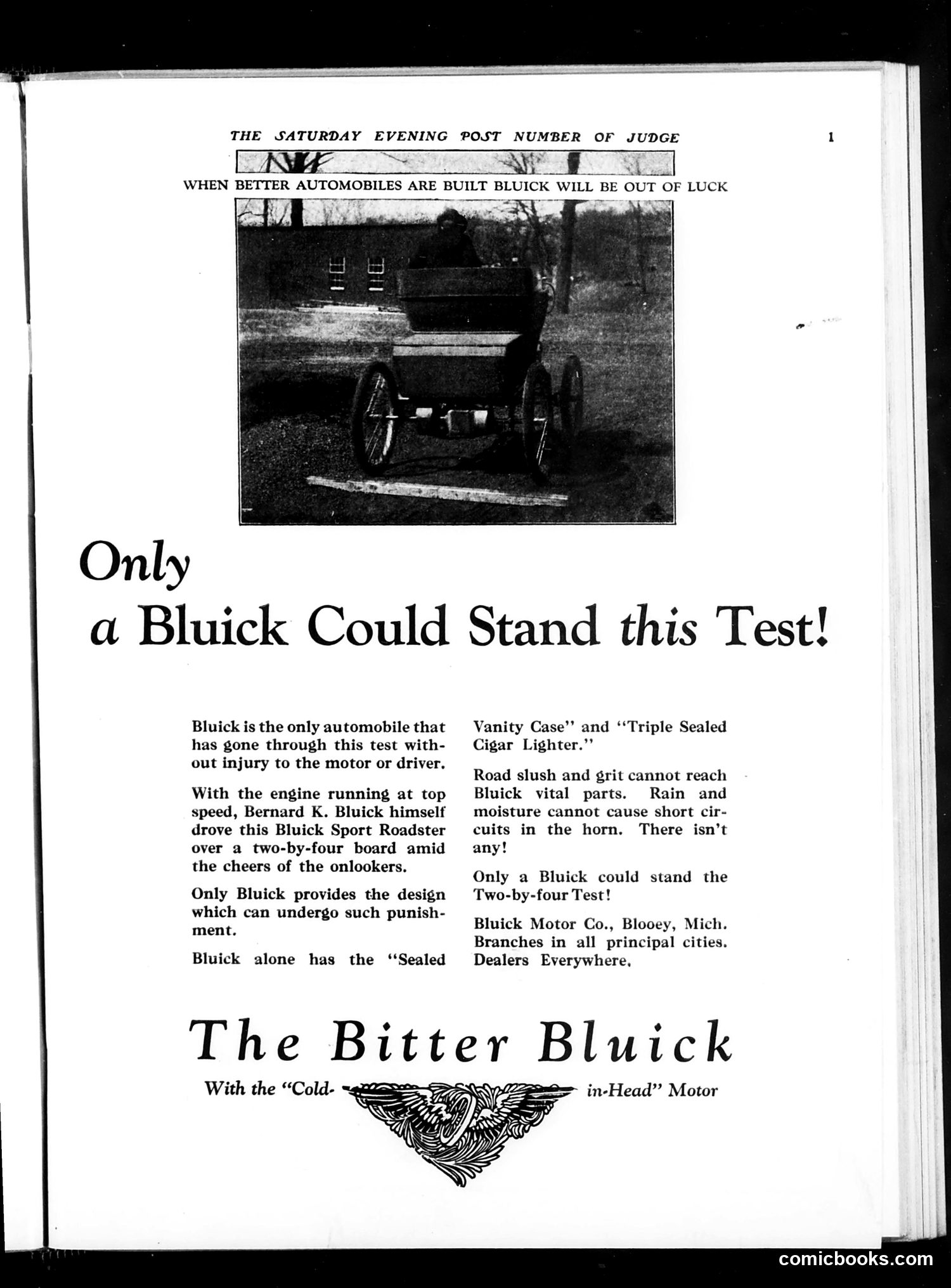
This is primarily a **Buick automobile advertisement**, not satire. The page promotes the Buick Sport Roadster by showcasing its durability. The headline "Only a Bluick Could Stand this Test!" references a publicity stunt where Buick founder Bernard K. Bluick drove a Buick Sport Roadster over a two-by-four board at top engine speed to demonstrate the vehicle's robustness and engineering superiority. The ad emphasizes Buick's sealed design features ("Sealed Vanity Case," "Triple Sealed Cigar Lighter") that protect internal components from road conditions and weather damage—differentiating it from competitors. The tagline "When Better Automobiles Are Built Bluick Will Be Out of Luck" is Buick's famous advertising slogan, suggesting their quality is unmatched. This represents early 1900s automobile marketing focusing on engineering and durability claims.
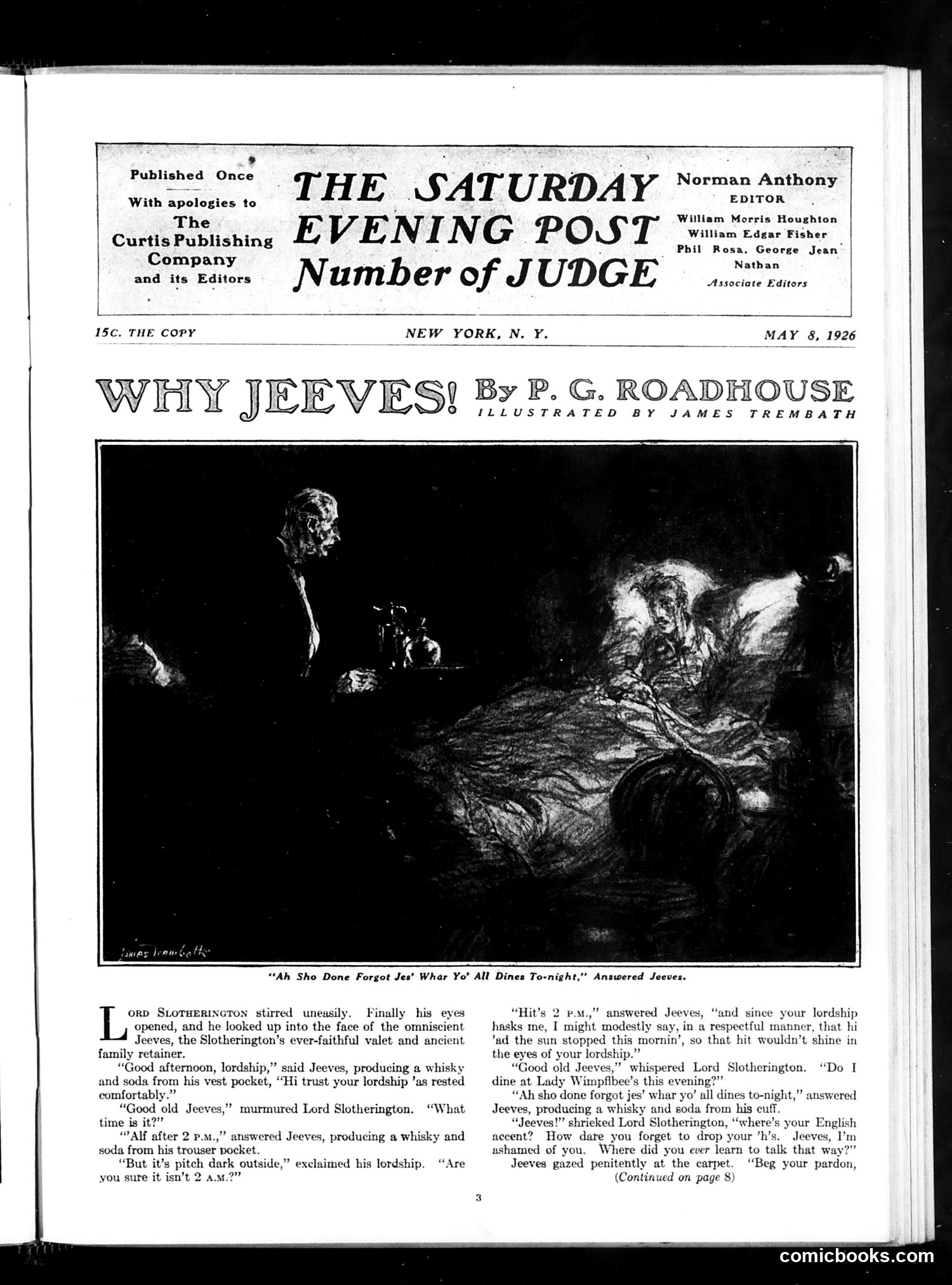
This page features "Why Jeeves!" by P.G. Wodehouse, illustrated by James Trembath. The story depicts a comedic interaction between Lord Slothering and his valet Jeeves in the evening hours. The humor centers on Jeeves's characteristic resourcefulness and refined manner. When Lord Slothering discovers it's past 2 a.m. and complains about the darkness, Jeeves produces whisky and soda from his pocket—a running joke about the valet's seemingly magical ability to produce exactly what's needed. The satire plays on the British class system: the aristocratic employer relies entirely on his servant's competence and discretion, while Jeeves maintains unflappable politeness despite his employer's bewilderment and occasional rudeness. The comedy derives from this reversal of expected authority and dependency within the master-servant relationship.
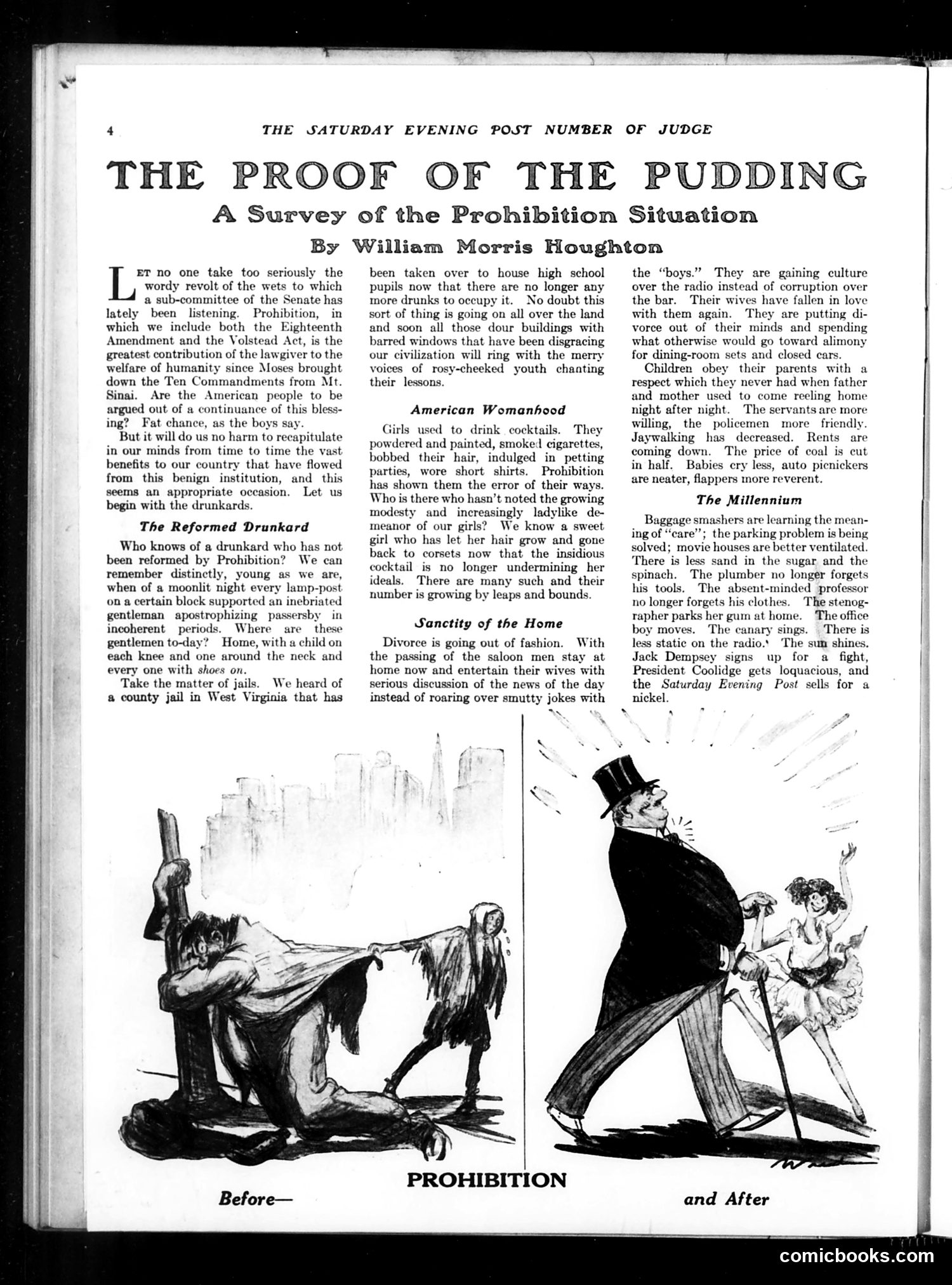
This 1920s *Judge* satire critiques Prohibition's social effects. The article "The Proof of the Pudding" surveys unintended consequences: high school students now drinking cocktails and smoking, girls adopting "increasingly ladylike" behavior through shortened hair and skirts, increased divorce rates, and moral decay. The two contrasting illustrations labeled "Before" and "After" PROHIBITION show a gentleman's transformation: the left depicts a disheveled drunkard in rags; the right shows a well-dressed, top-hatted man with fashionable companions. The satire's irony is biting: Prohibition supposedly reformed drunks and improved morality, yet the text documents society becoming more corrupt and licentious—the "after" appearing superficially refined while underlying social problems worsen.
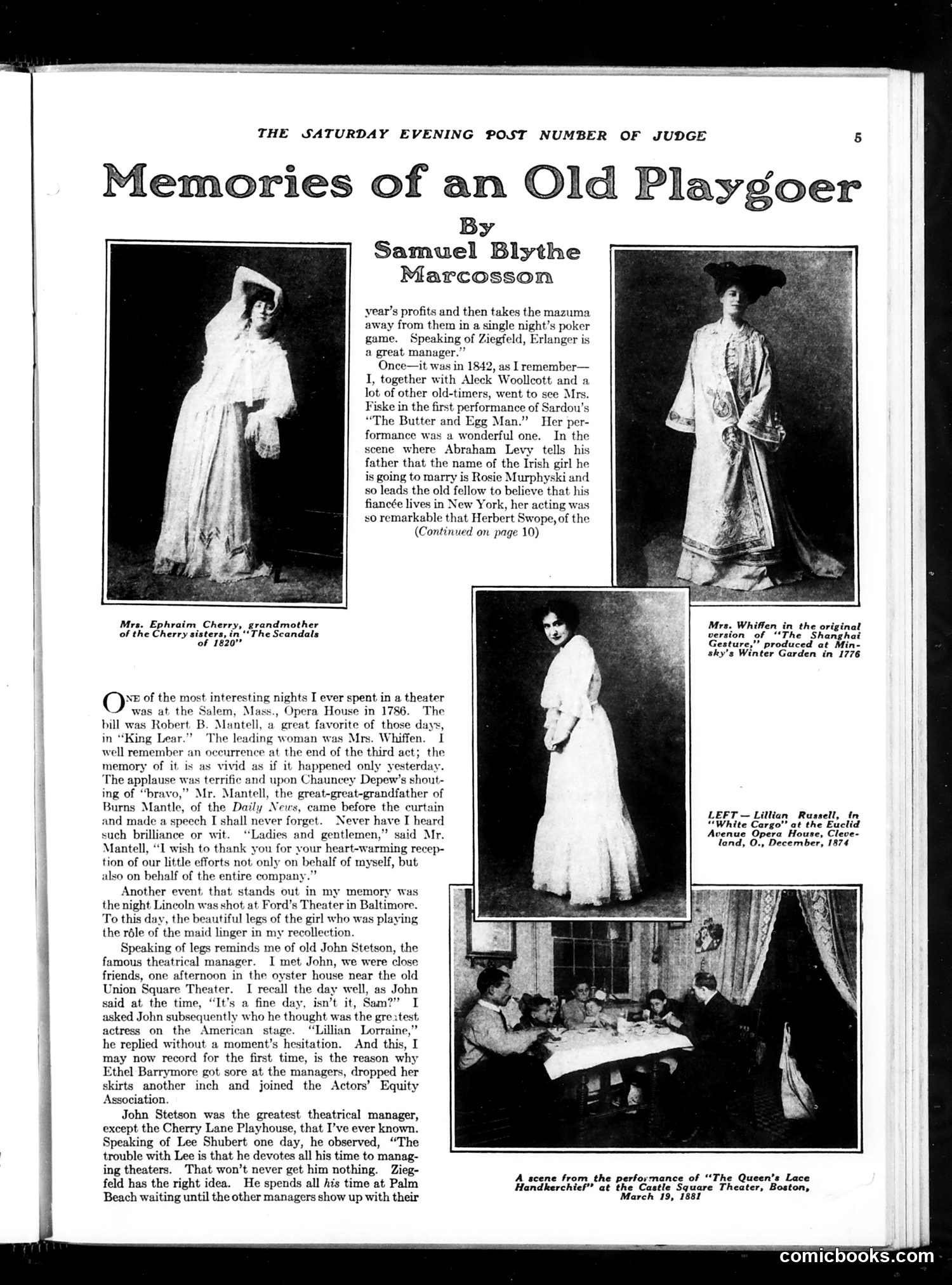
This page is not a political cartoon but rather a nostalgic theatrical memoir. The author recalls his experiences attending performances at various 19th-century American theaters, including the Salem Opera House (1786) and Ford's Theatre in Baltimore. The photographs show actresses in period costume from historical productions: Mrs. Ephraim Cherry as grandmother of the Cherry sisters in "The Scandals" (1825), Mrs. Whiffen in an 1778 opera, and Lillian Russell in a 1874 theatrical production. A scene photo depicts "The Queen's Lace Handkerchief" at Boston's Castle Square Theater. The text primarily celebrates famous theatrical figures and managers like John Stetson, discussing their contributions to American theater rather than making political commentary or satire.
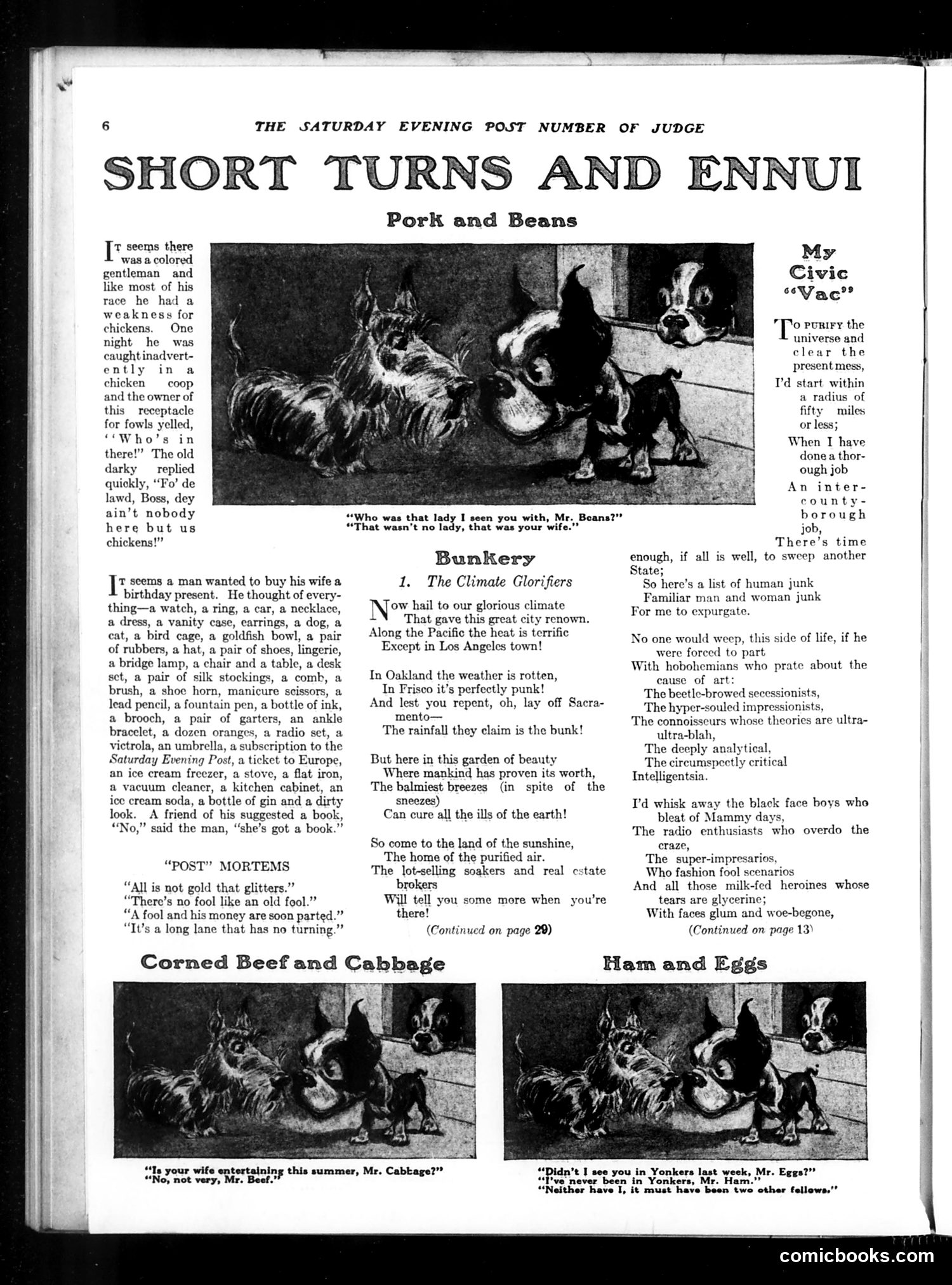
This page contains several interconnected satirical pieces using animal characters as stand-ins for human social types. The opening anecdote about a "colored gentleman" in a chicken coop perpetuates a racist stereotype common to early 20th-century American humor—the caricature of Black people as chicken thieves. The main cartoon series features anthropomorphized animals (beans, beef, cabbage, eggs, ham) discussing their "wives" and social encounters. The humor relies on these food items representing working-class or lower-class human characters, allowing the magazine to mock their relationships and pretensions. The caption "That wasn't no lady, that was your wife" suggests marital discord and class-based humor about the lower classes. The "Bunkery" poem satirizes California real-estate promoters and climate boosters who exaggerate the region's weather benefits to attract settlers and buyers—a common Progressive-era target. It mocks both the grandiose marketing claims and the gullible "lot-selling soakers" promoting them. The "My Civic 'Vac'" section expresses elitist contempt for various cultural movements (secessionists, impressionists) and social types, using dehumanizing language typical of patrician magazine satire of the period.
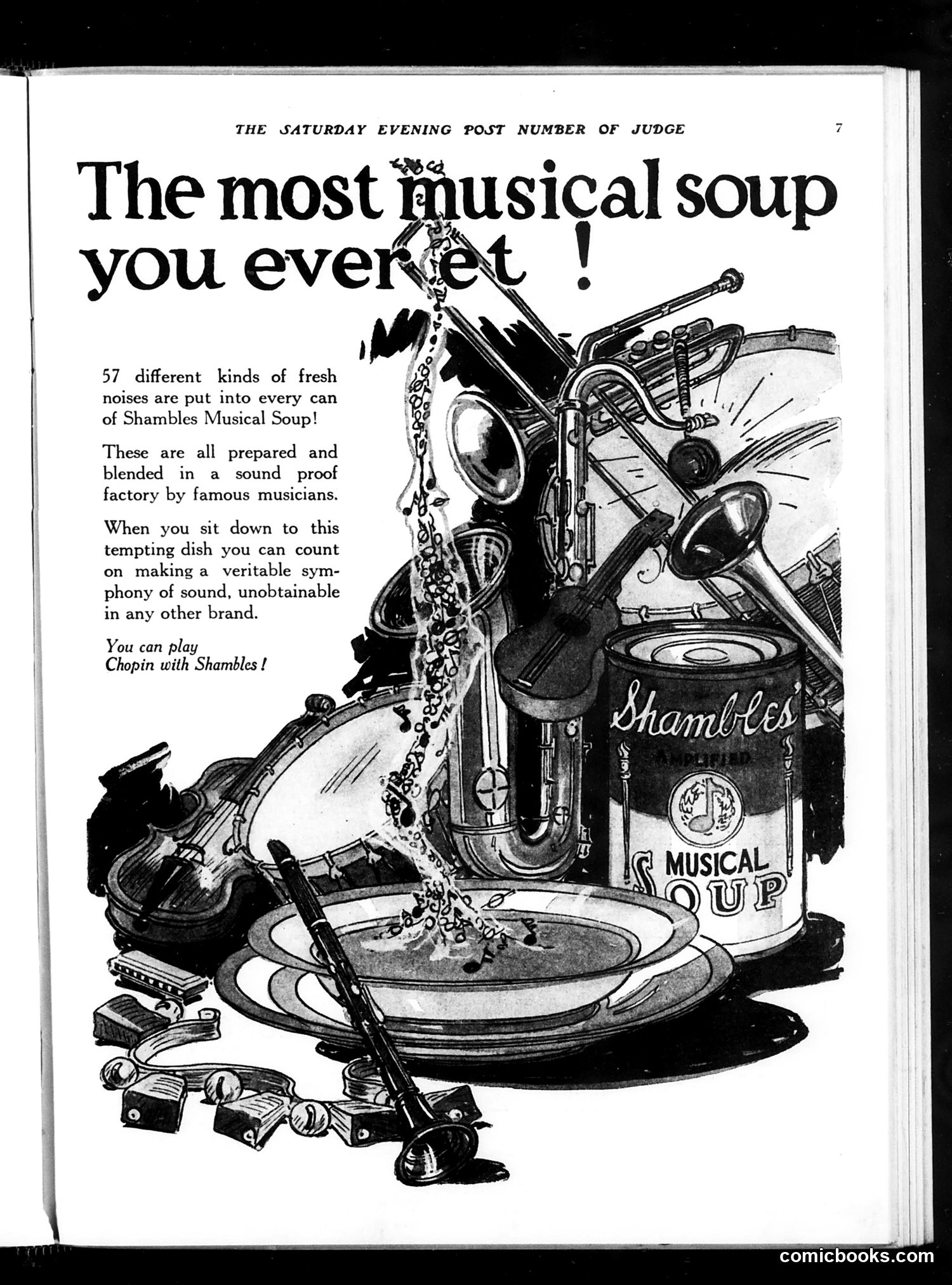
This is a **surreal advertisement** for a fictional product called "Shambles Musical Soup." The page satirizes absurd marketing claims by presenting an impossibly elaborate premise: soup containing 57 different "fresh noises" prepared by famous musicians in a soundproof factory. The humor lies in the exaggeration—suggesting that eating soup produces musical sounds, allowing consumers to "play Chopin with Shambles." The illustration shows musical instruments (saxophone, trumpet, violin, drum) bursting from a soup can, visually reinforcing the ridiculous concept. This appears to be **satirical advertising commentary**—likely mocking real soup advertisements of the era that made grandiose, absurd marketing claims. It's humorous nonsense presented in the style of earnest product advertising, typical of Judge magazine's satirical approach to consumer culture and marketing excess.
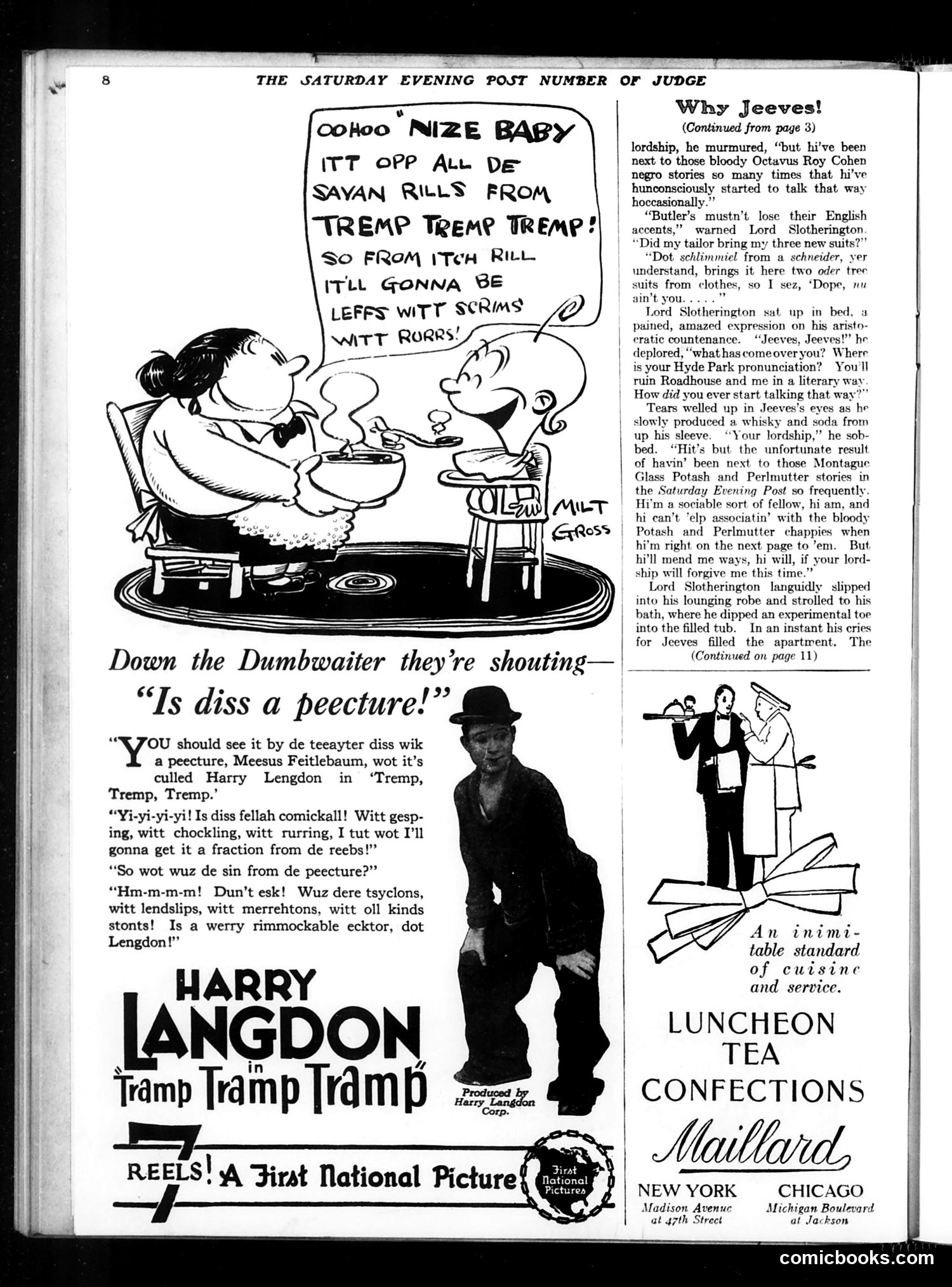
This page combines a **film advertisement** with **satirical fiction**. The **cartoon and ad** promote Harry Langdon's silent film *"Tramp Tramp Tramp"* (First National Pictures). The dialogue mocks working-class Jewish immigrant speech patterns—depicting excited theatergoers with exaggerated Yiddish-inflected English discussing the comedy's slapstick humor ("tsyclons," "lendslips," "merrehtons"—tornadoes, landslips, marathons). This was common 1920s entertainment stereotype humor. The **"Why Jeeves!" article** continues a humorous story about a British nobleman's butler who's unconsciously adopted Yiddish-inflected speech from reading *Saturday Evening Post* stories by Octavus Roy Cohen (a white author famous for comedic "negro stories" and dialect humor). Lord Slotherington is dismayed his proper English butler now sounds like a Jewish immigrant, reflecting period anxieties about cultural assimilation and class boundaries. Both sections reflect 1920s casual ethnic stereotyping presented as sophisticated humor.
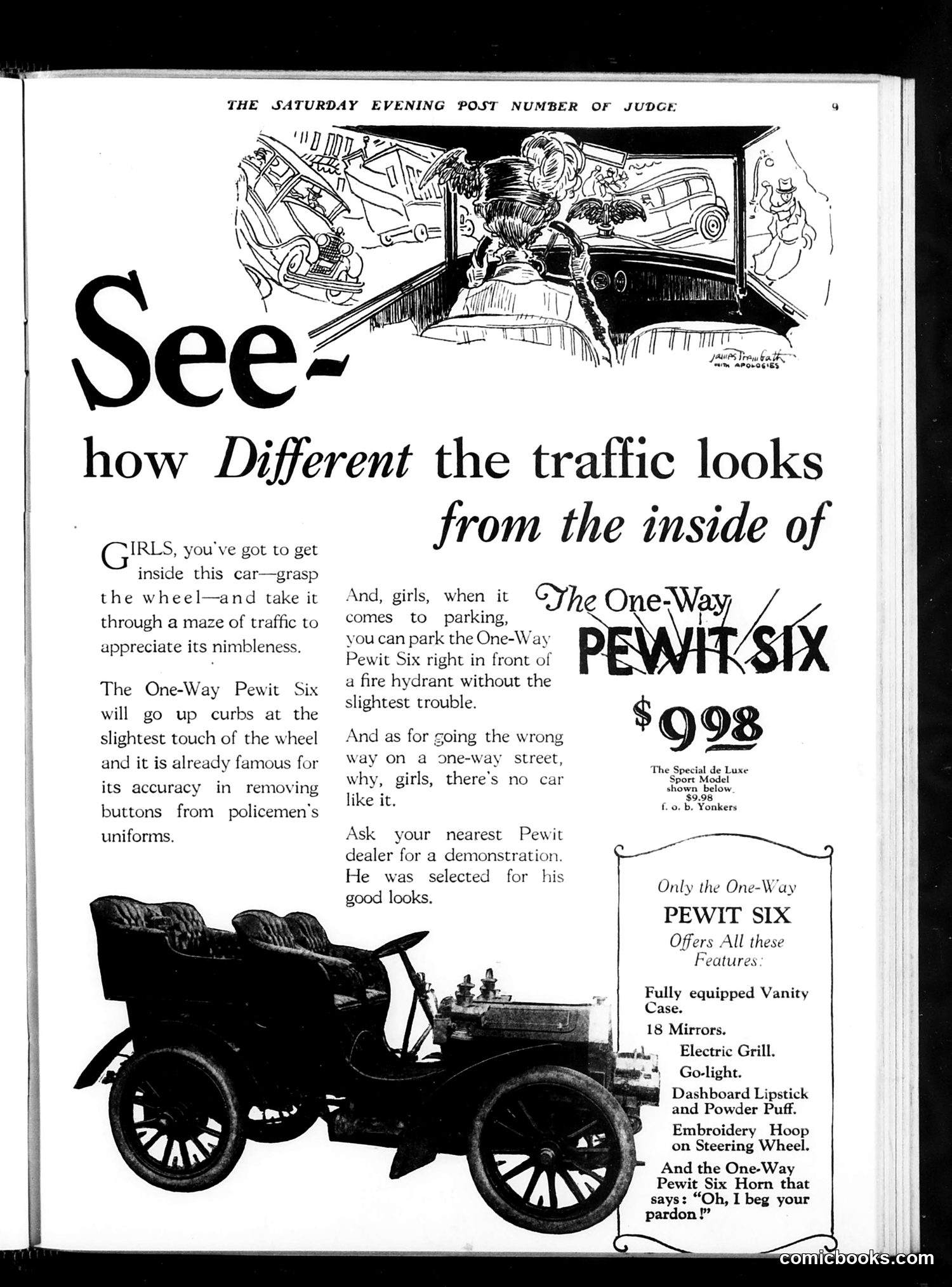
This is a **satirical advertisement** for the fictional "One-Way Pewit Six" automobile, mocking both cars marketed to women and women drivers of the era. The humor targets: 1. **Gender stereotypes**: The ad addresses "girls" and emphasizes frivolous features (vanity case, 18 mirrors, dashboard lipstick, embroidery hoop on steering wheel) rather than mechanical performance—implying women drivers care only about appearance. 2. **Reckless driving stereotypes**: The satire suggests women drivers are incompetent and dangerous—the car can "go up curbs," park illegally in front of fire hydrants, go the wrong way on one-way streets, and "remove buttons from policemen's uniforms" (hitting them). The horn apologetically says "Oh, I beg your pardon!"—mocking supposed female politeness masking poor driving. 3. **Marketing absurdity**: By listing vanity items as car "features," Judge ridicules automobile advertising that condescends to female consumers. The joke assumes readers will recognize the exaggeration as criticism of both sexist car marketing and period anxieties about women drivers.
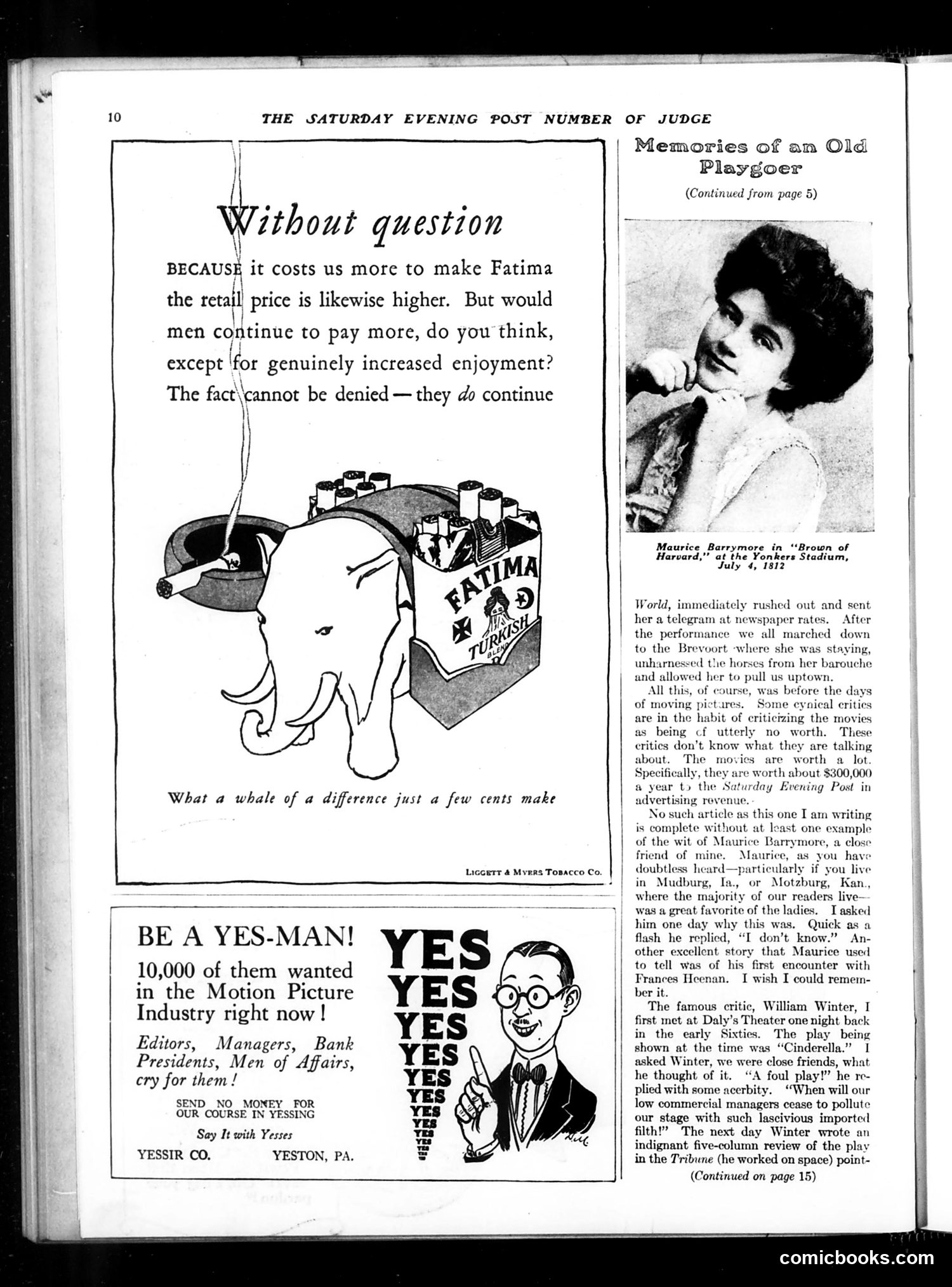
This page contains two distinct pieces: **The Fatima Cigarette Advertisement** (top left): A visual joke suggesting that Fatima Turkish cigarettes cost more than competitors, but men willingly pay the premium because they genuinely enjoy them better. The elephant imagery is unclear but appears decorative to the product branding. **"BE A YES-MAN!" Advertisement** (bottom left): A satirical recruitment ad mocking workplace yes-men—employees who uncritically agree with superiors. It humorously "recruits" 10,000 such people needed in the motion picture industry, addressed to editors, managers, and executives. This satirizes corporate conformity and the lack of honest feedback in hierarchical workplaces. **"Memories of an Old Playgoer"** (right): A nostalgic theatre column recounting anecdotes about actor Maurice Barrymore and critic William Winter from the 1800s, contrasting earlier theatrical culture with contemporary (1910s) motion pictures, which the author defends against dismissive critics. The page reflects early 20th-century advertising and entertainment journalism.
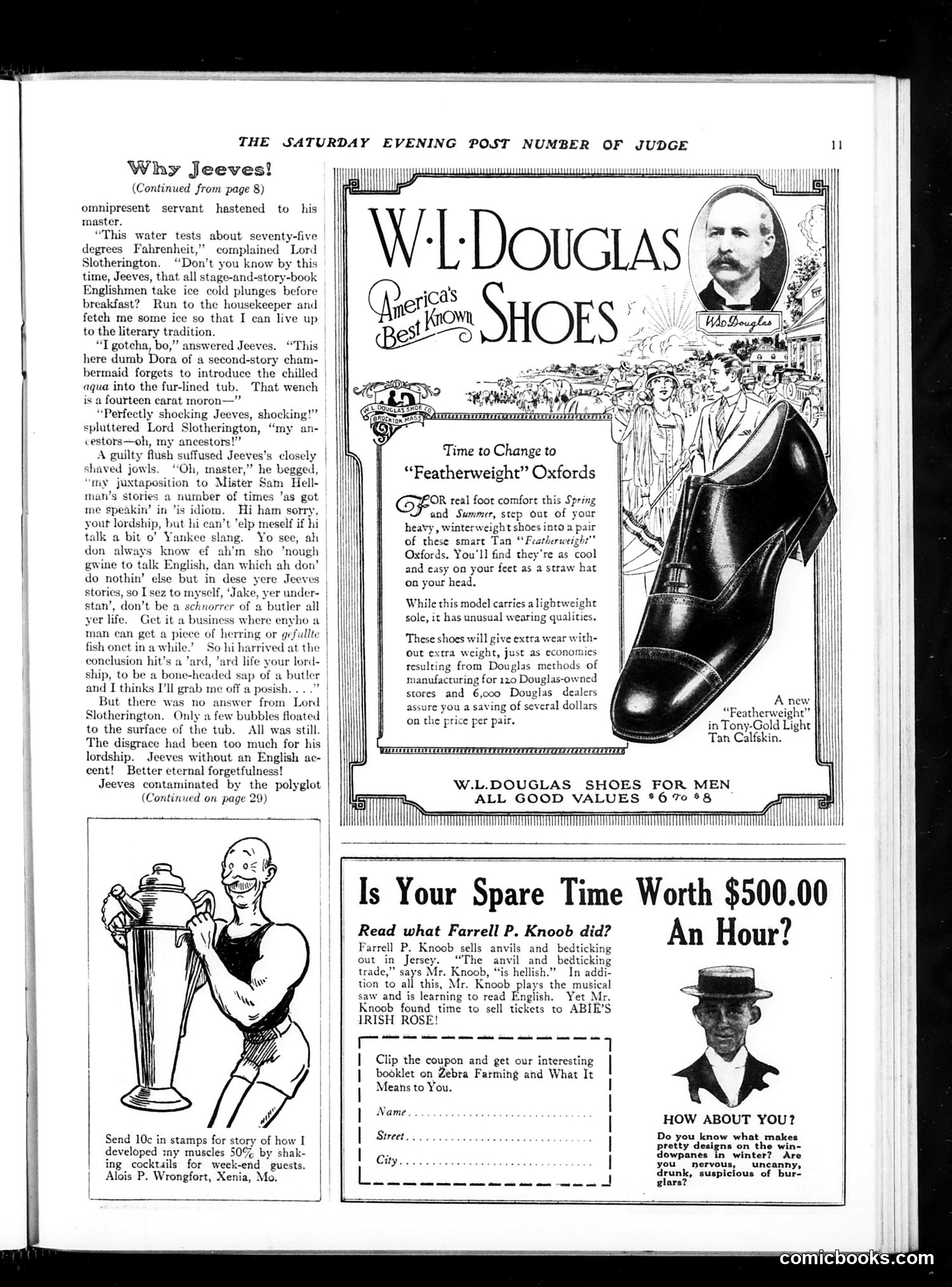
This page contains a serialized fiction story ("Why Jeeves!") mocking British servant stereotypes through exaggerated dialect humor. The protagonist Jeeves, a British butler, comically abandons proper English after exposure to American slang, ultimately horrifying his snobbish employer Lord Slotherington—suggesting cultural contamination anxieties of the era. The **advertising** dominates the page: W.L. Douglas shoes promote "Featherweight Oxfords" for spring comfort, while a separate ad humorously profiles "Farrell P. Knoob," an anvil salesman who somehow finds time to sell tickets to *Abie's Irish Rose* (a popular 1920s Broadway play about Jewish-Irish romance). The bottom ad poses a rhetorical question about "spare time worth $500/hour"—a sales pitch for Zebra Farming instruction, and another unclear ad asking if readers notice "pretty designs" on winter windows (possibly a psychic or superstition-themed pitch). Overall, the page reflects 1920s preoccupations: class anxiety, ethnic humor, consumer culture, and get-rich-quick schemes.
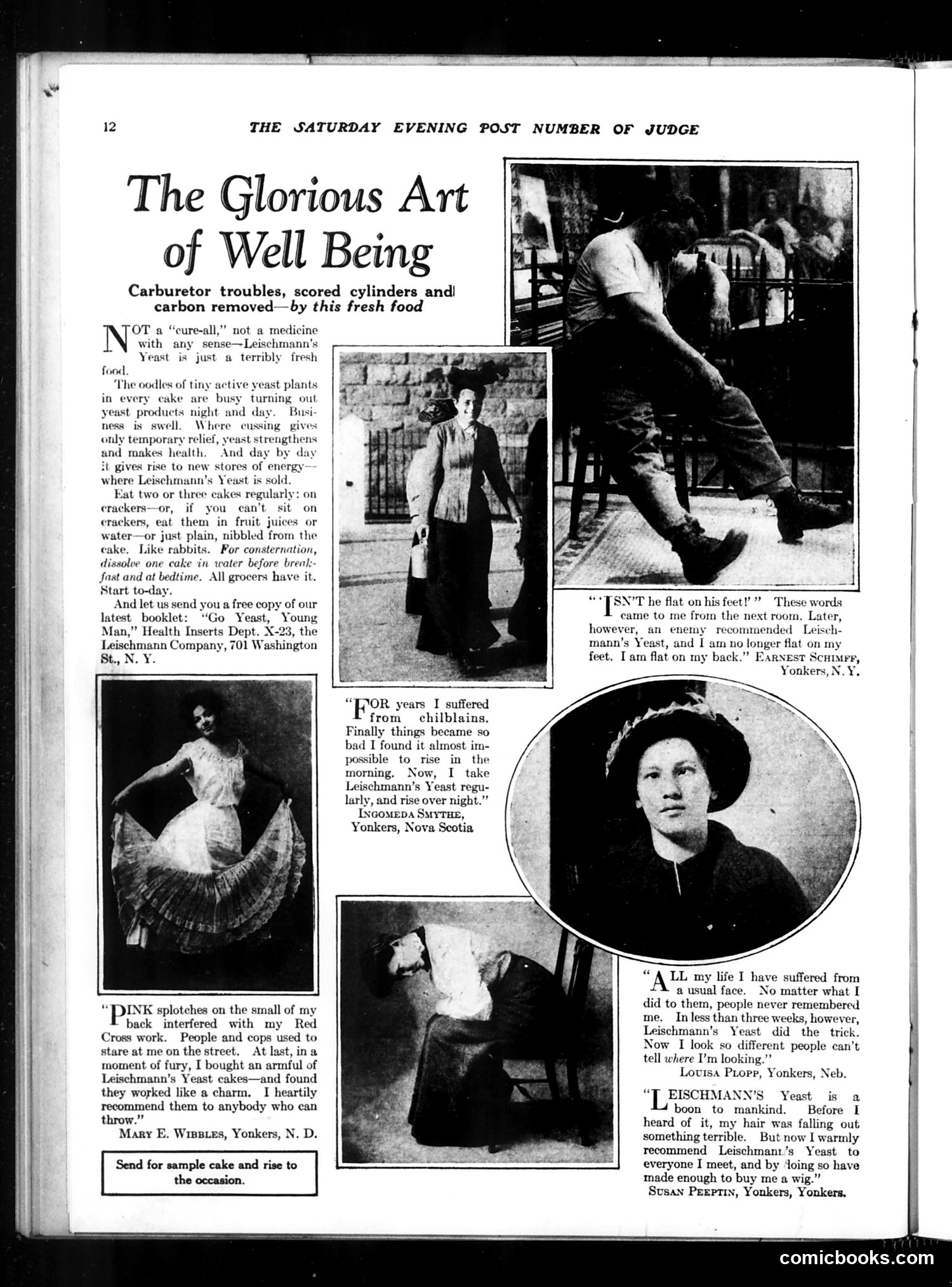
This is a **full-page advertisement**, not satire or editorial content. It promotes Leischmann's Yeast as a general health cure-all for various ailments—carburetor troubles (unclear if literal or metaphorical), chilblains, skin conditions, hair loss, and fatigue. The page uses **testimonials from satisfied customers** (all conveniently from Yonkers, NY) claiming implausible health transformations: one person went from "flat on his feet" to "flat on my back"; another claims yeast made her face so different people can't recognize her. The humor appears **intentional but subtle**—the exaggerated claims and absurd before-and-after scenarios suggest the advertiser knew readers would find the promises ridiculous. This reflects the era's tolerance for wildly unsubstantiated health claims in advertising, before FDA regulations. The page mixes genuine product information with obviously tongue-in-cheek testimonials.
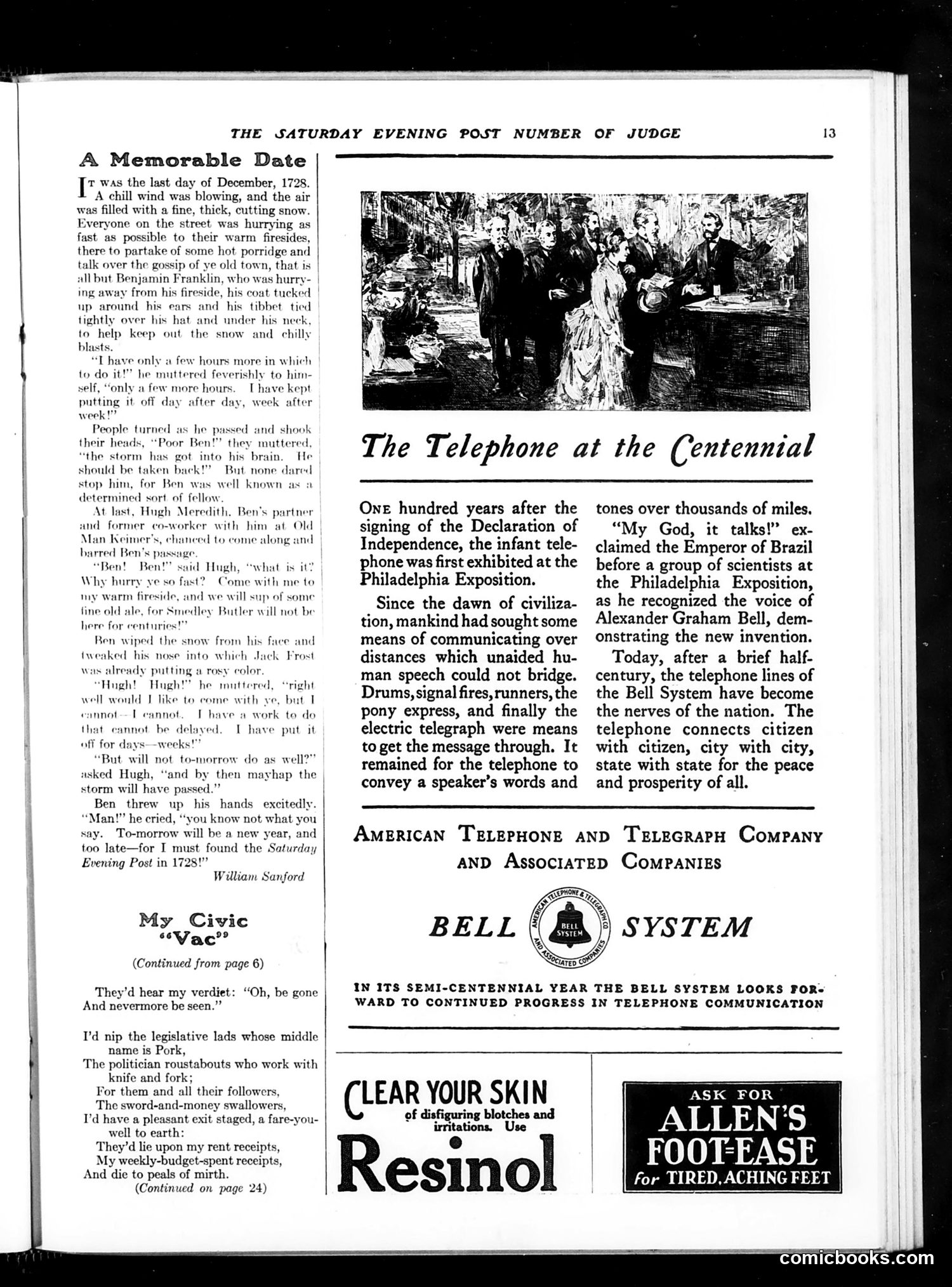
This page contains a humorous short story titled "A Memorable Date," which presents a deliberately anachronistic joke about Benjamin Franklin. The narrative describes Franklin rushing through a December 1728 snowstorm, desperately explaining to his concerned partner Hugh Meredith that he must complete urgent work before the new year arrives—because he needs to "found the Saturday Evening Post in 1728." The satire works through historical inversion: Franklin actually founded the *Saturday Evening Post* in 1729, one year later. The cartoon pokes fun at both the founding myth and perhaps at the magazine's own importance by depicting Franklin in comic desperation to meet an impossible deadline. The page also includes advertisements (Resinol skin cream, Allen's Foot-Ease) and promotional content about the telephone's centennial, celebrating communication technology's progress. The juxtaposition of this earnest corporate messaging with the silly Franklin story creates typical Judge magazine contrast between serious subjects and irreverent humor.
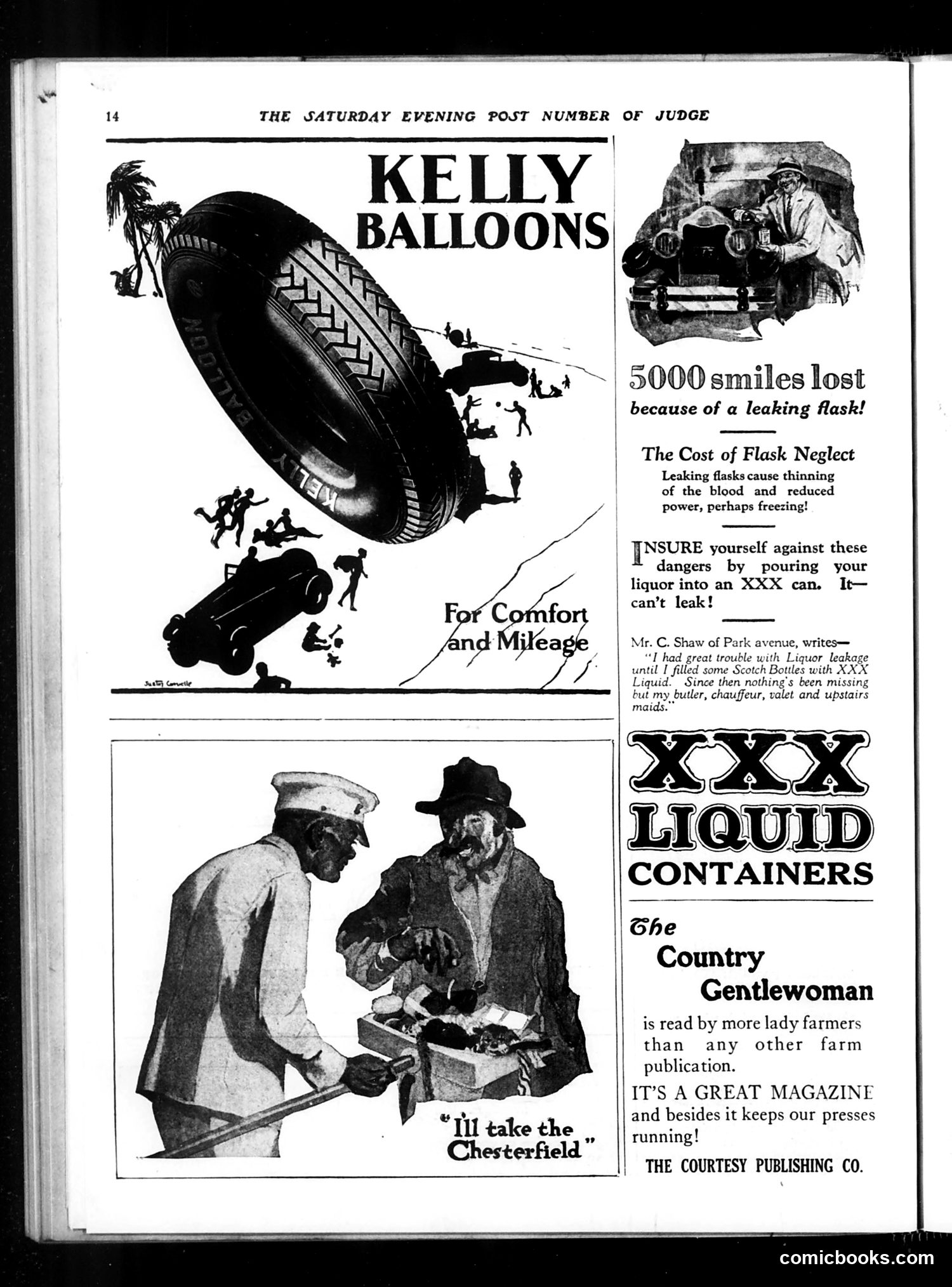
This page contains **advertisements disguised as editorial content**, exploiting Prohibition-era humor (likely 1920s-30s). The Kelly Balloons ad uses a surreal illustration of a giant tire crushing cars and people to suggest that leaking flasks—containers for illegally transported liquor—cause accidents and loss. The humor plays on the double meaning: 5,000 "smiles" (drinks) lost to leakage. The XXX Liquid Containers ad explicitly sells leak-proof bottles for storing liquor, with a testimonial from "Mr. C. Shaw" joking that his servants have disappeared (implying they stole from leaky containers). This is **transparent bootlegging advertising**—selling equipment to transport and store illegal alcohol during Prohibition. The "I'll take the Chesterfield" ad at bottom appears to be a cigarette advertisement unrelated to the liquor theme. The page represents how advertisers coded Prohibition-era bootlegging products in period magazines through double entendre and mock-serious product pitches.
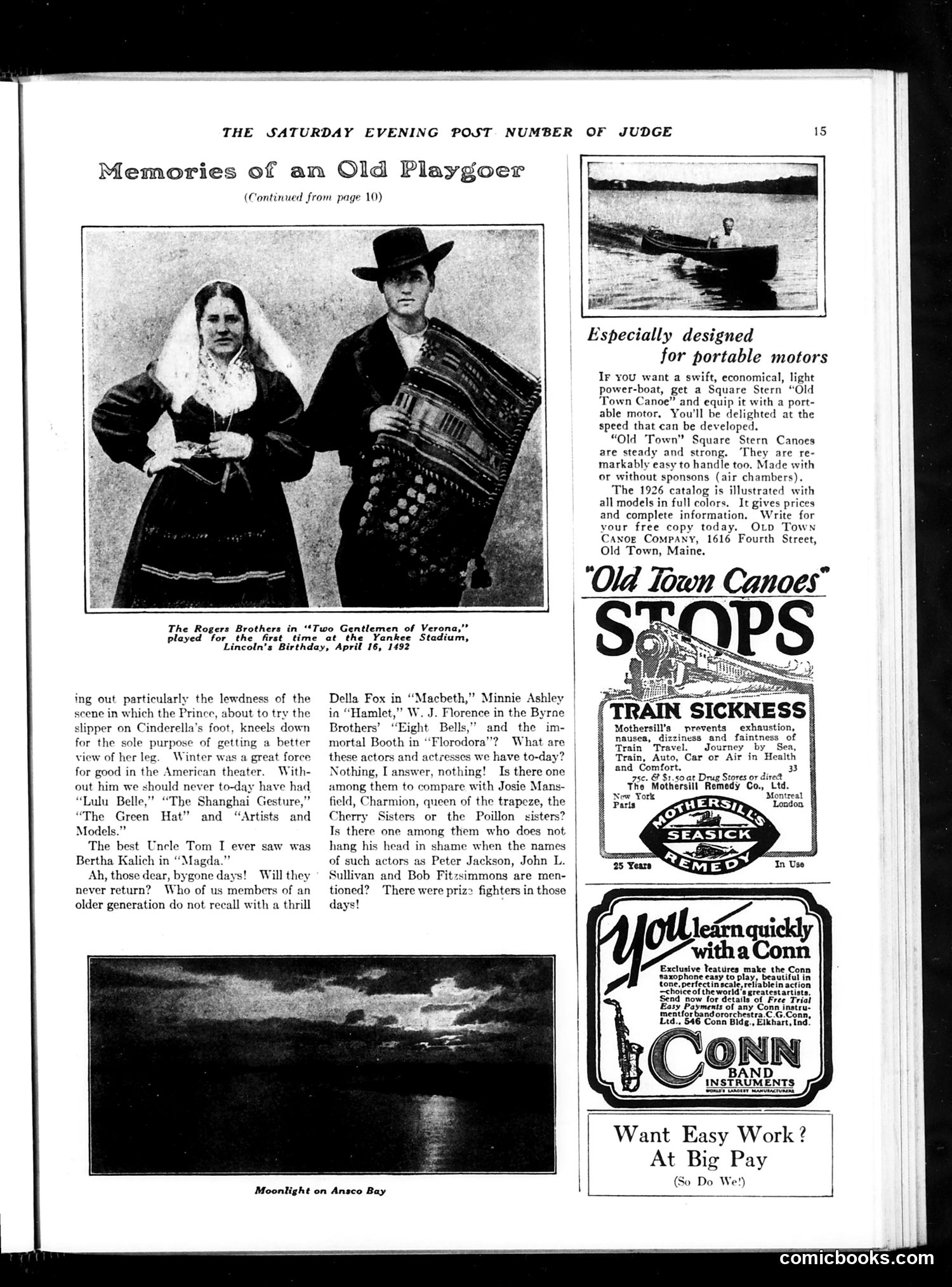
This page features nostalgic theater criticism disguised as satire. The author—identified only as "an old playgoer"—laments the decline of American theater, contrasting celebrated performers of the past (Della Fox, W.J. Florence, the Rogers Brothers) with contemporary actors, whom he dismisses as "nothing." The satire's target is **generational nostalgia itself**. By mixing legitimate theatrical figures with vaudeville performers (Josie Mansfield, the Cherry Sisters) and bizarrely naming prize fighters (John L. Sullivan, Bob Fitzsimmons) as superior to modern actors, the author mocks elderly theatergoers' tendency to romanticize their youth and exaggerate past excellence. The absurd caption dating the Rogers Brothers performance to "1492" at Yankee Stadium signals the piece's tongue-in-cheek nature—this didn't happen. The page is otherwise dominated by **period advertisements** for canoes, motion sickness remedies, band instruments, and employment services, typical of 1920s Judge content.
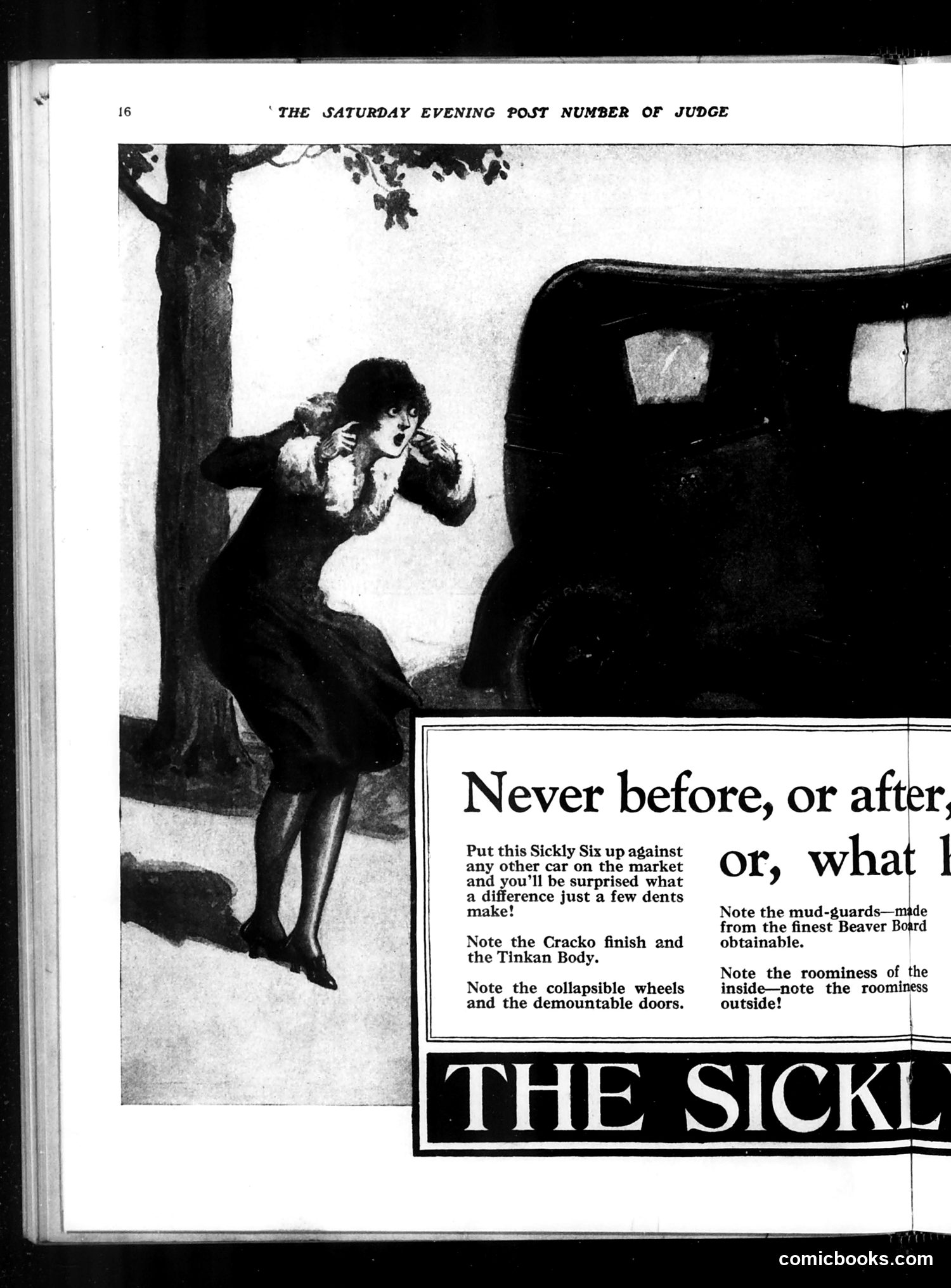
This is an advertisement for "The Sickly Six" automobile, presented as satirical commentary on poor car design. The image shows a woman recoiling in alarm from a decrepit vehicle. The ad mock-praises obviously terrible features: a "Cracko finish" (likely cracked), "Tinkan Body" (thin metal), "collapsible wheels," and "demountable doors" (parts falling off). It sarcastically notes mud-guards made from "Beaver Board" (cheap cardboard material) and jokes that the car is "roomy" both inside and outside—implying the structure is so deteriorated that interior and exterior spaces blend together. The headline "Never before, or after" suggests this car represents the nadir of automobile manufacturing—so bad it will never be matched again. This appears to be Judge magazine's satirical jab at low-quality, cheaply-made automobiles flooding the market, likely from the 1920s-30s era when car manufacturing was rapidly expanding but quality varied wildly.
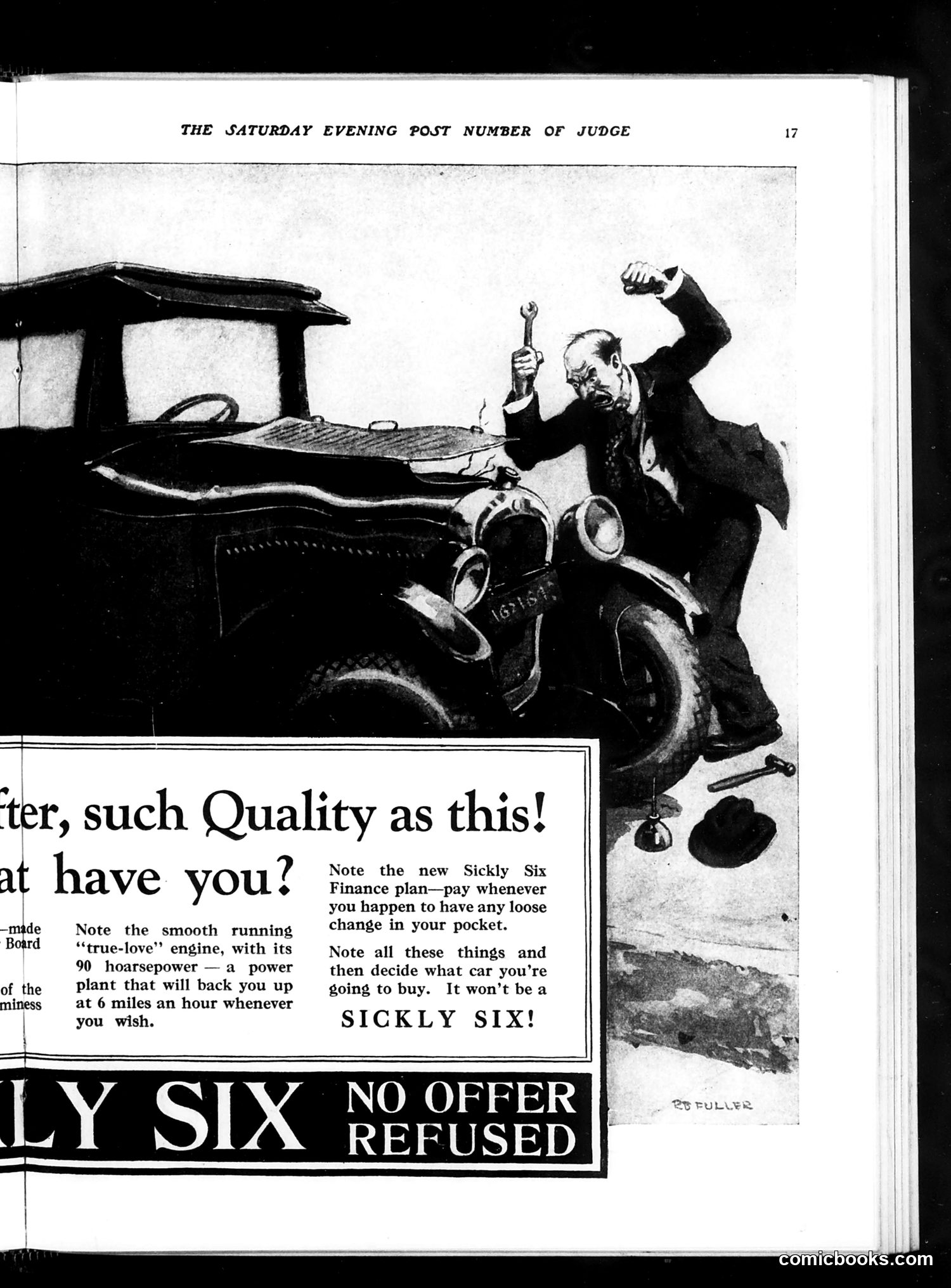
This page is primarily **automobile advertising** for the "Sickly Six" car, presented as satire rather than a political cartoon. The illustration shows a well-dressed man examining a competitor's vehicle with exaggerated disappointment—he holds a wrench and money, appearing to have given up on the rival car. The ad copy humorously disparages an unnamed competitor's automobile (the "Sickly Six") by contrasting it with the advertised car's superior 90-horsepower engine and reliability. The satire targets early automotive marketing: the ad mockingly suggests buyers should "note" various features before deciding what to purchase—a dig at competitors' weak selling points. The tagline "NO OFFER REFUSED" implies the competitor's car is so poor even desperate measures won't save it. This reflects the competitive early 20th-century auto industry, where manufacturers used humor and direct comparison to win market share. The cartoon is commercial satire rather than political commentary.
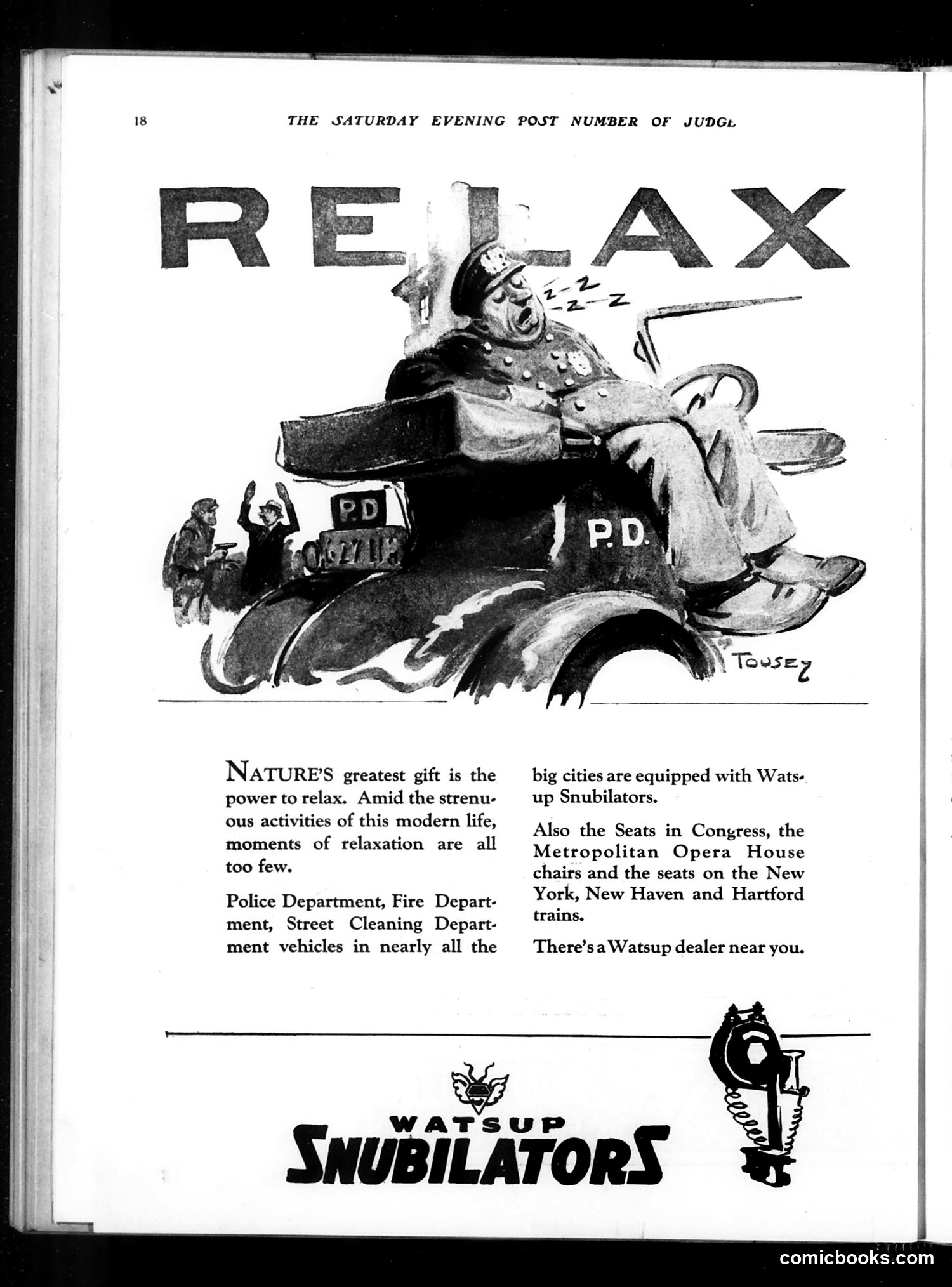
This is primarily a **product advertisement**, not political satire, though it uses humor to promote "Watsup Snubilators." The cartoon shows a sleeping police officer in a vehicle marked "P.D." (Police Department), with "Z-Z-Z" indicating deep sleep. The joke is satirical: the ad claims Snubilators help vehicles from Police, Fire, and Street Cleaning departments stay "equipped" for relaxation—implying these officials are sleeping on the job rather than working. The humor intensifies by listing Congress seats, opera house chairs, and train seats as also having Snubilators, sarcastically suggesting that politicians, wealthy opera-goers, and train passengers all sleep excessively. This is **mock advertising**—the product doesn't actually exist. The satire targets public officials' laziness and the wealthy's leisure, using exaggeration as social commentary on 1920s-era civic negligence and class privilege. The signature "TOUSEZ" indicates the cartoonist.
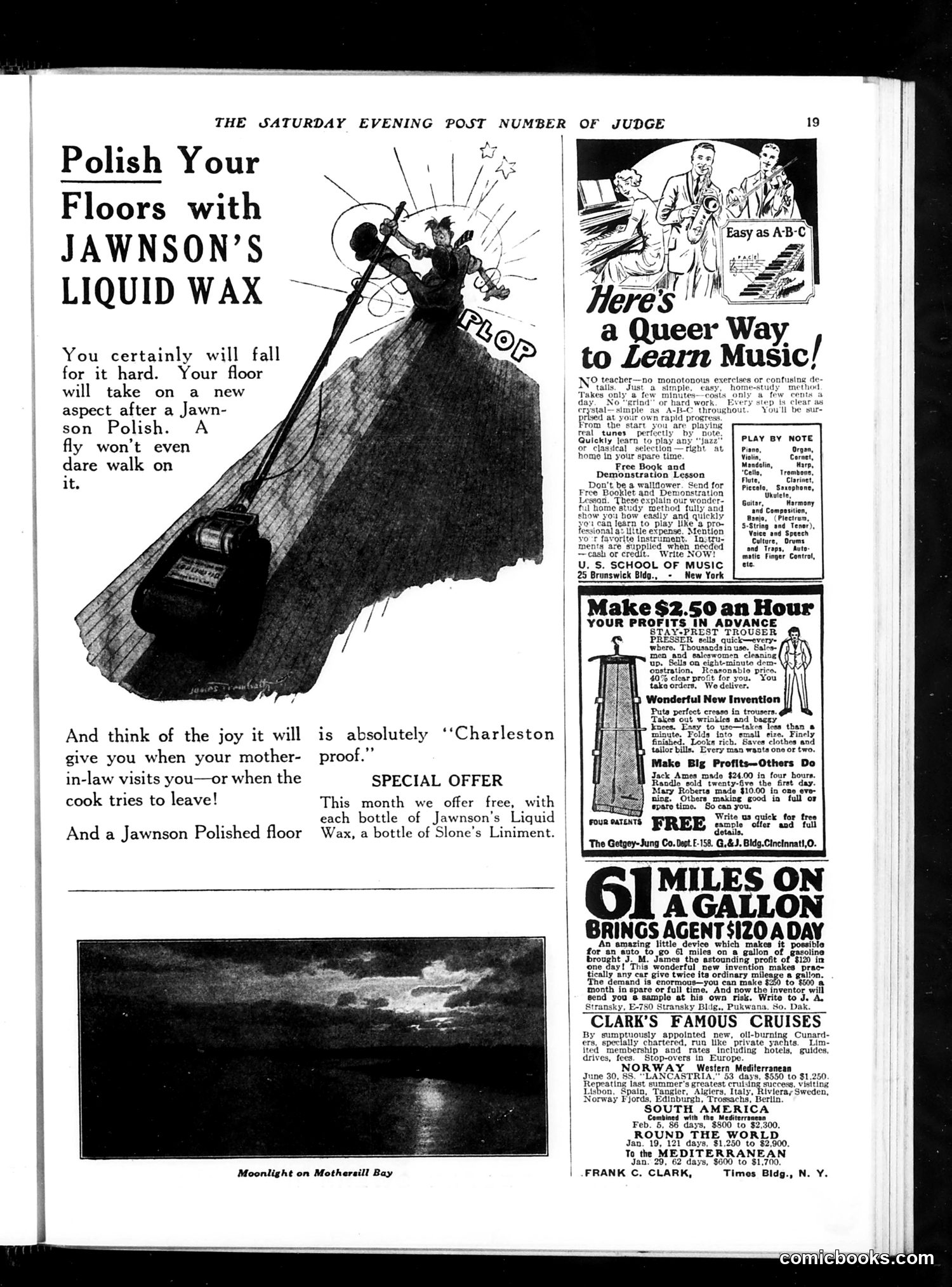
This page is primarily **advertising**, with one main visual element: a cartoon advertisement for Jawnson's Liquid Wax floor polish. The central cartoon shows a couple doing the Charleston—a wildly popular 1920s dance move—on a highly polished floor, with one dancer nearly sliding off due to the slickness. The exaggerated motion and flailing limbs emphasize the floor's extreme shine. The ad's joke: a Jawnson-polished floor is so slippery it's "Charleston proof"—the frantic leg kicks and gyrations of this trendy dance could cause you to slide away. The humor plays on the Charleston's reputation as a raucous, energetic dance that was considered somewhat scandalous by older generations. The copy appeals to domestic pride and social anxiety (impressing your mother-in-law), a standard advertising trope of the era. The remainder of the page contains typical period classified advertisements for self-improvement schemes, invention opportunities, and luxury travel cruises.
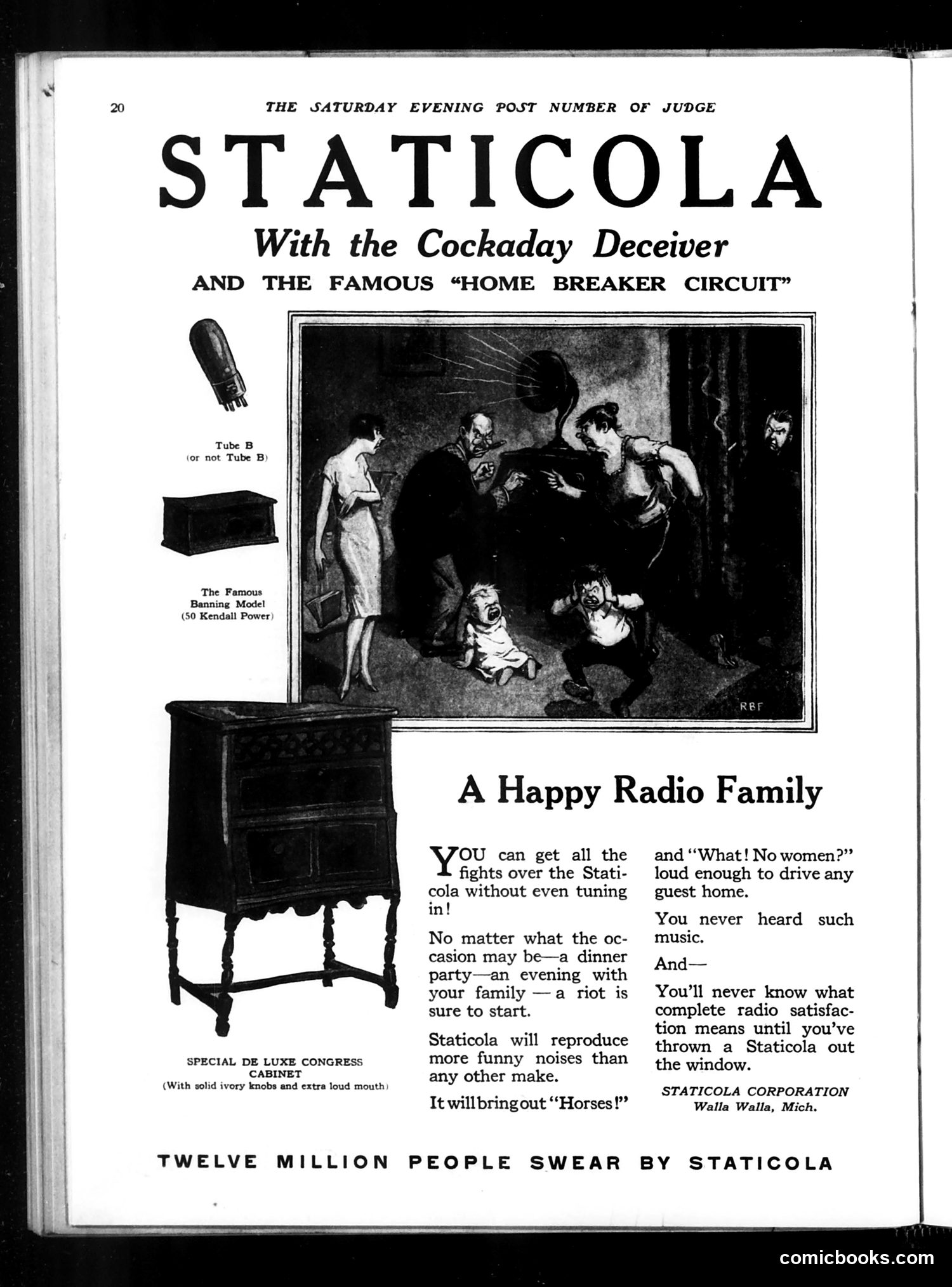
This is a mock advertisement for a fictional "Staticola" radio set, satirizing early radio technology and family dynamics of the era. The humor centers on radios' notorious problems: poor reception, static, and tinny sound quality that made listening unpleasant. The cartoon depicts a chaotic family scene—people arguing and gesturing wildly—suggesting that a malfunctioning radio causes domestic discord rather than entertainment. The ad's claims are absurdly inverted: it "reproduces more funny noises than any other make" (meaning static, not music) and promises fights at dinner parties. The punchline arrives in the tagline: you'll achieve "complete radio satisfaction" only by throwing the device out the window—implying the radio is so terrible that destruction is preferable to use. This satirizes both the frustrations of early wireless technology and period radio advertising's exaggerated promises. The fictional "Walla Walla, Mich." manufacturer and absurd model names ("Cockaday Deceiver," "Home Breaker Circuit") mock the pseudoscientific terminology manufacturers actually employed to sell inferior products.
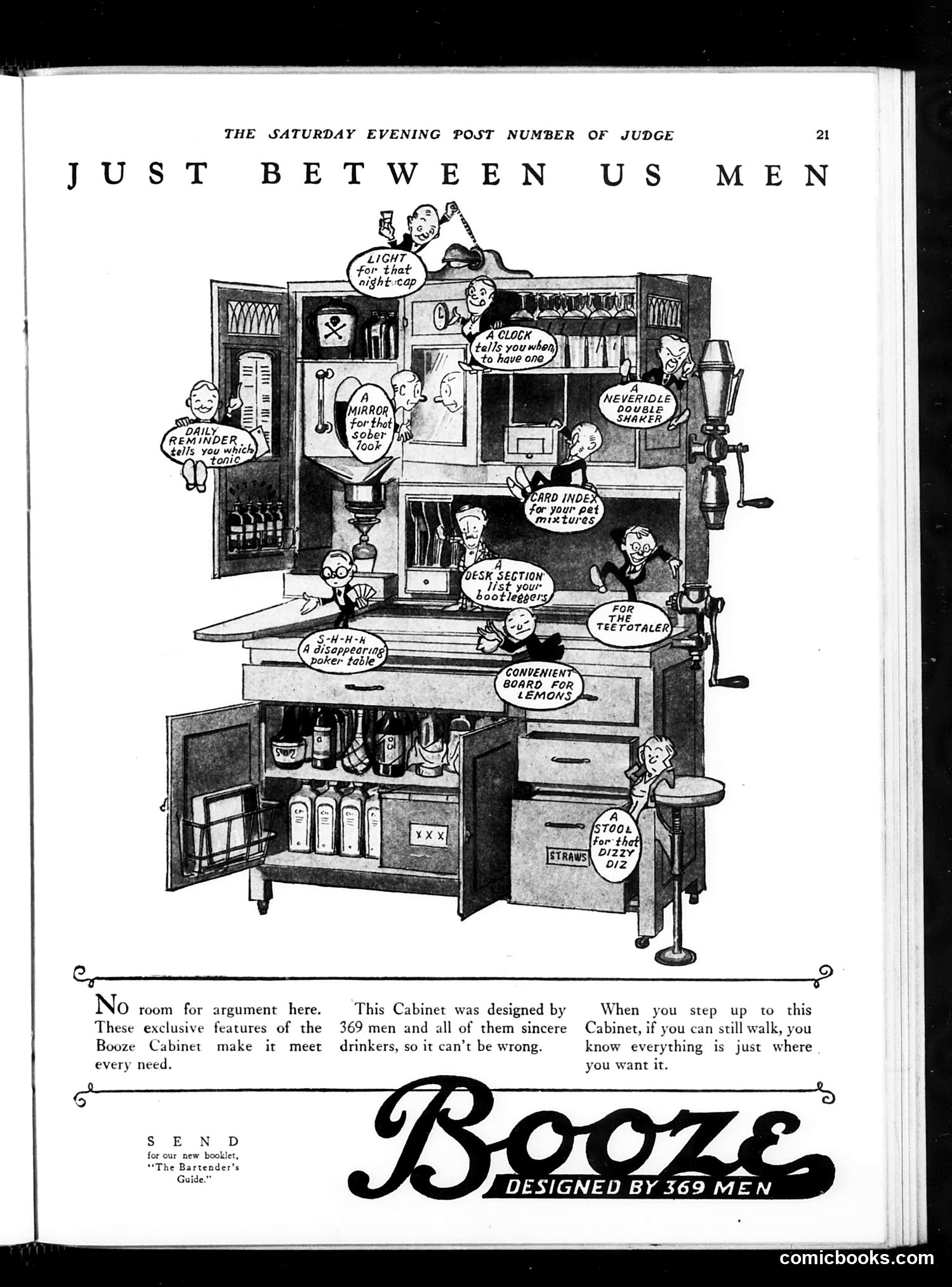
This is a full-page advertisement for a "Booze Cabinet" disguised as satirical commentary on Prohibition era drinking culture. The cartoon depicts an elaborate, multi-compartmented cabinet covered with humorous labels for various drinking accessories and concealment features—"disappearing poker table," "card index for your past mistakes," "clock tells you when to have one," "stool for that dizzy feeling," etc. The satire targets the absurdity of Prohibition-era society: the cabinet was supposedly "designed by 369 men and all of them sincere drinkers, so it can't be wrong." This mocks the contradiction between official anti-alcohol policy and widespread underground drinking culture among men. The headline "Just Between Us Men" emphasizes the secretive, masculine nature of drinking during Prohibition. The ad's humor relies on readers recognizing the gap between public temperance laws and private drinking habits—positioning the cabinet as a practical solution for men navigating this hypocrisy. The magazine is likely from the 1920s Prohibition period.
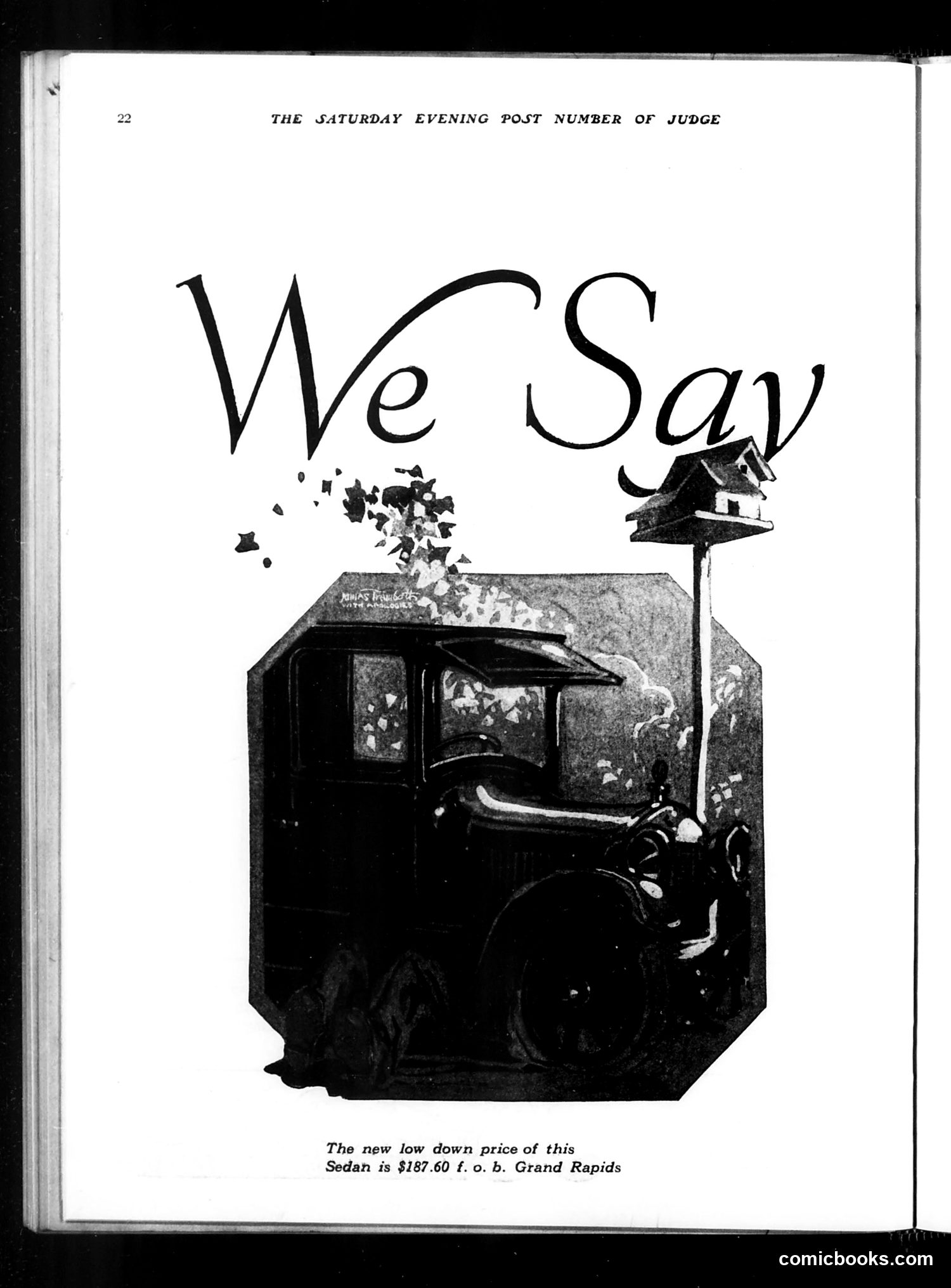
This is primarily an **automobile advertisement**, not a political cartoon. The page features the phrase "We Say" as a headline above an image of a 1920s sedan automobile. The ad announces a remarkably low price of $187.60 for a sedan, f.o.b. (free on board) from Grand Rapids, Michigan. This represents a major price reduction that the manufacturer wishes to emphasize—the visual metaphor of the car "exploding" or bursting suggests the dramatic impact of this price drop on the market. The birdhouse visible in the composition appears decorative rather than satirical. This is straightforward consumer advertising from Judge magazine's commercial pages, highlighting automotive affordability during the 1920s auto boom.
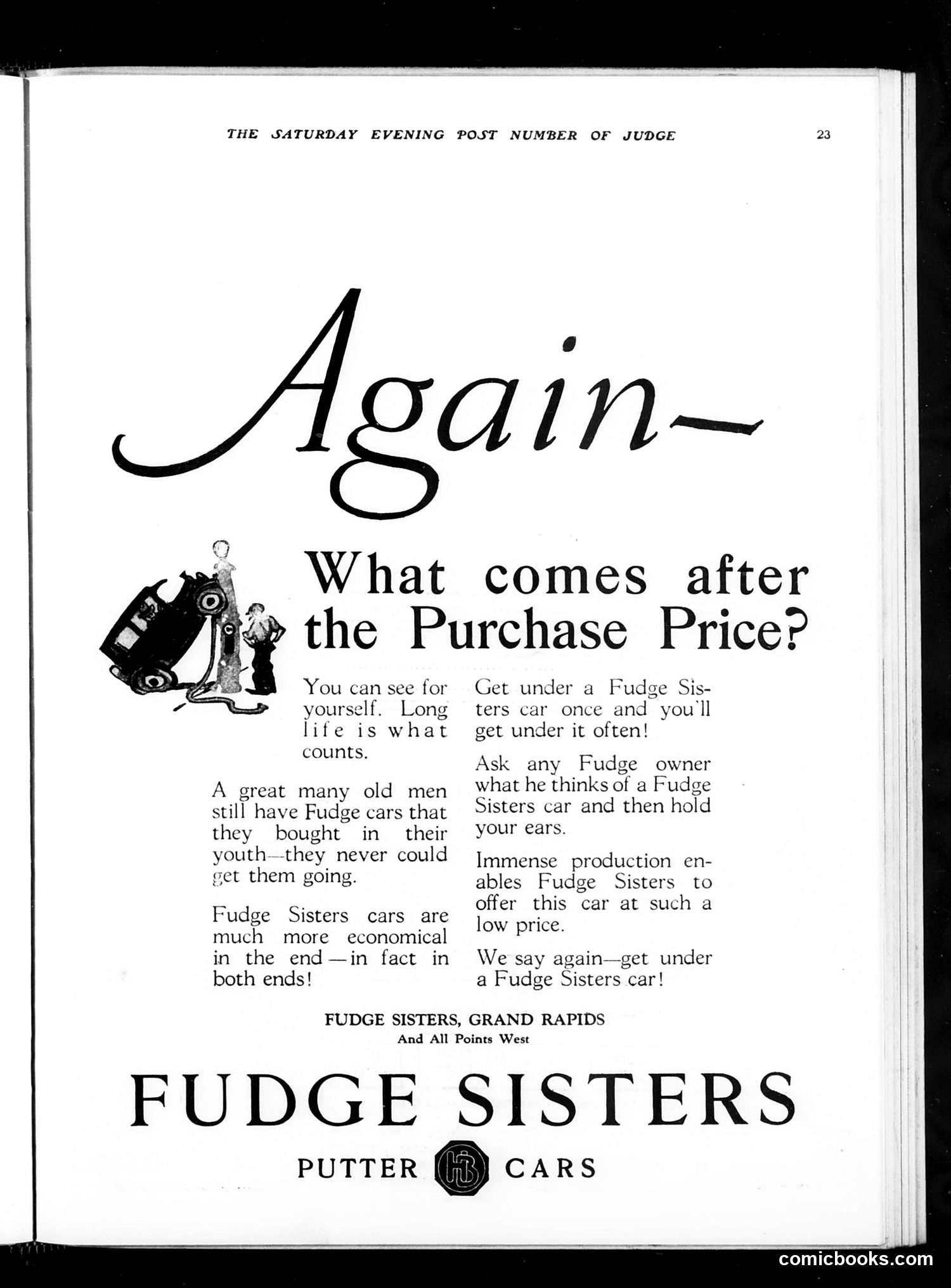
This is primarily a full-page advertisement for Fudge Sisters automobiles, not a political cartoon. The ad uses humor to promote the car's durability and value. The joke centers on wordplay: "get under a Fudge Sisters car" operates on double meaning—both literally (to repair/maintain it) and as slang implying the car breaks down frequently. The ad sarcastically claims old men still own Fudges "they never could get going," suggesting mechanical unreliability. The humor is self-deprecating advertising: rather than hide the car's apparent reputation for needing repairs, Fudge Sisters embraces it. The pitch argues that because the car is so frequently serviced, it lasts longer and proves economical overall—"in both ends" (purchase price and maintenance). The illustration shows a vintage automobile with passengers. This appears to be period advertising humor exploiting a known brand weakness to build brand loyalty through wit rather than denial.
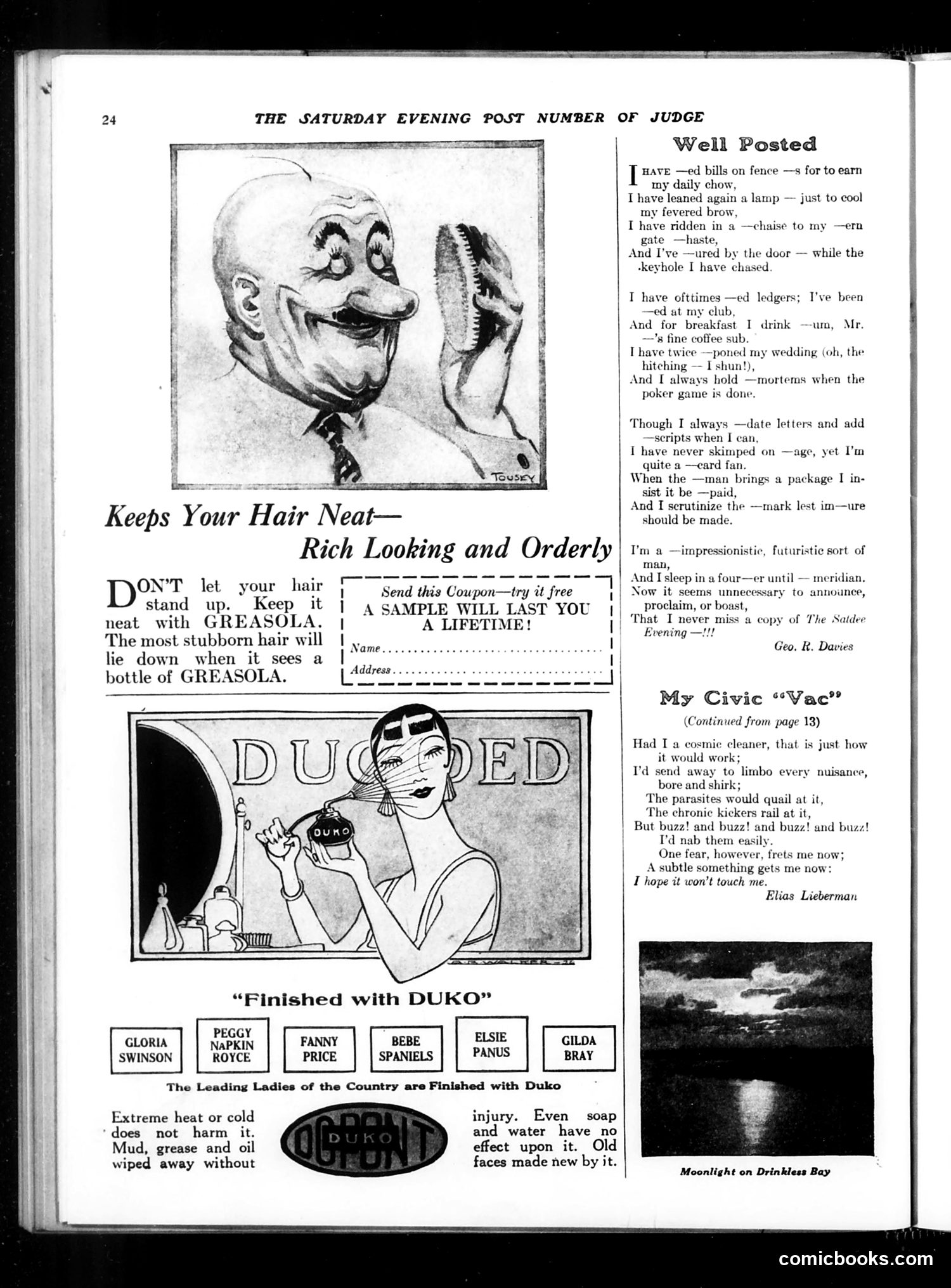
This page contains **primarily advertisements and light satirical verse**, not political cartooning. The main content includes: 1. **"Well Posted"** — A humorous poem by Geo. R. Davies using dashes to obscure words (like Mad Libs), poking fun at a pretentious, self-absorbed man who claims sophistication while admitting to petty habits (reading scandal sheets, obsessing over postage marks). The satire mocks affected mannerisms and social pretension. 2. **Product advertisements** — Greasola hair product and Duko face cream, featuring caricatured faces typical of 1920s advertising. These are straightforward ads with no apparent political content. 3. **"My Civic Vac"** — A continuation of earlier verse (by Elias Lieberman) about a cosmic vacuum cleaner, whimsical rather than satirical. The page is **primarily commercial advertising** rather than editorial cartooning or political satire. The humor is gentle, focused on personal vanities and consumer products rather than social commentary.
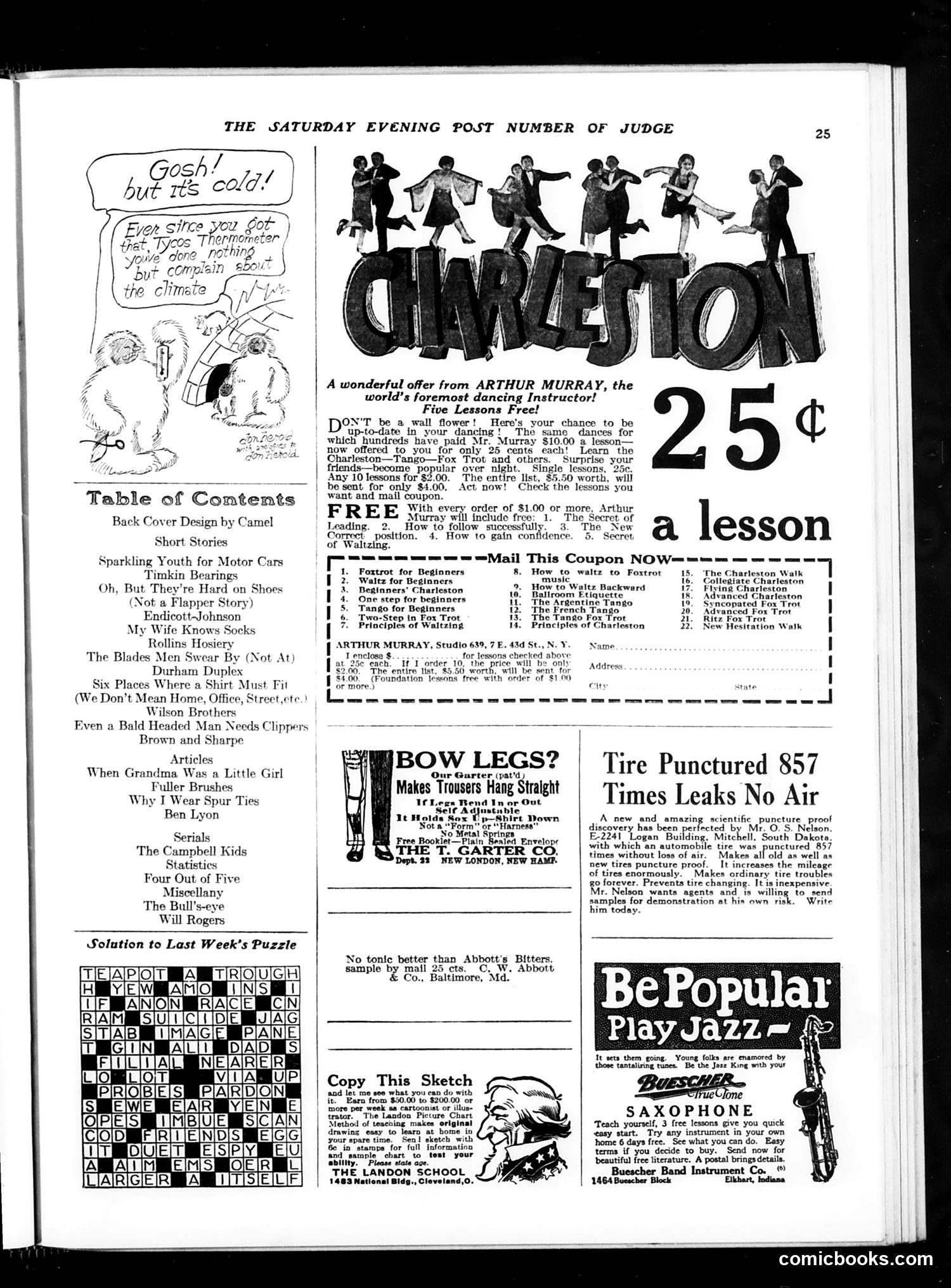
This is primarily a **table of contents and advertisements page** rather than a satirical cartoon page. The upper left contains a small cartoon about cold weather (two figures complaining about the chill), but it's minor. The page's main focus is **1920s consumer advertising**, particularly dance instruction. Arthur Murray's prominent ad offers Charleston, Fox Trot, and Tango lessons for 25 cents—reflecting the era's dance crazes. The Charleston especially was associated with the "Flapper" youth culture of the 1920s-30s. Other ads reflect period concerns: corrective garters for "bow legs," tire puncture-proofing, and saxophone instruction to "play jazz" and "be popular"—all targeting young people interested in modern trends. The table of contents lists short stories and articles typical of the era, including references to "Flapper" culture and consumer goods (automobiles, hosiery, brushes). **Bottom line:** This is an advertising-heavy issue documenting 1920s youth culture, consumerism, and entertainment rather than political satire.
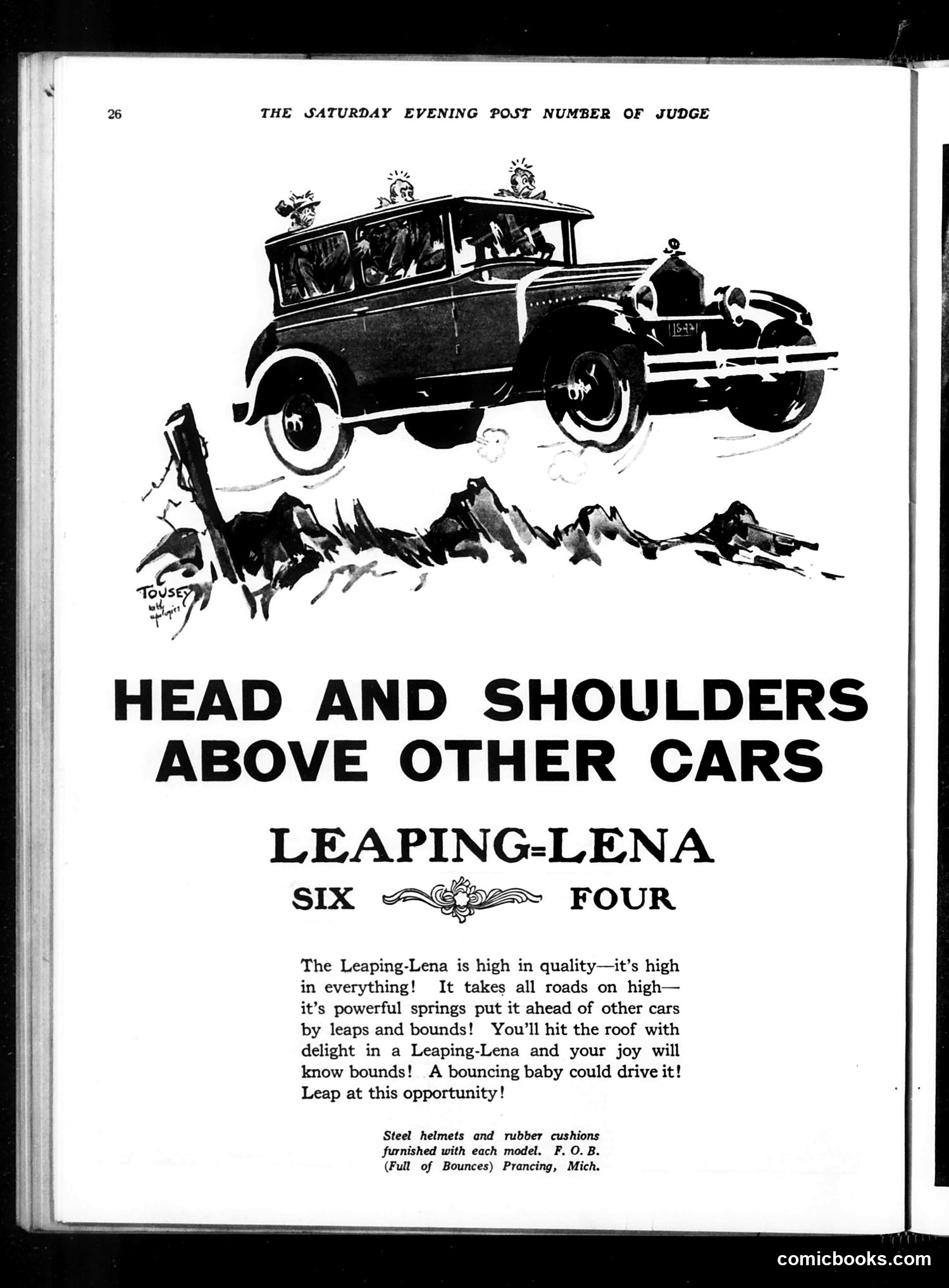
This is a automobile advertisement, not political satire. The page shows a humorous car ad for the "Leaping-Lena Six-Four," featuring an illustration of a vehicle bouncing wildly over rocky terrain with passengers being jostled about. The joke relies on exaggerating the car's suspension system. The ad claims the "powerful springs" make it superior to competitors—it "leaps and bounds" ahead of other cars. The satire is self-directed: the advertiser acknowledges the vehicle bounces so violently that it includes "steel helmets and rubber cushions" as standard equipment and notes the car is based in "Prancing, Mich." (likely fictional). This mockery of poor suspension and rough ride quality is the entire point—the ad humorously admits the car's flaws while playfully marketing them as advantages. It's advertising satire rather than political commentary.
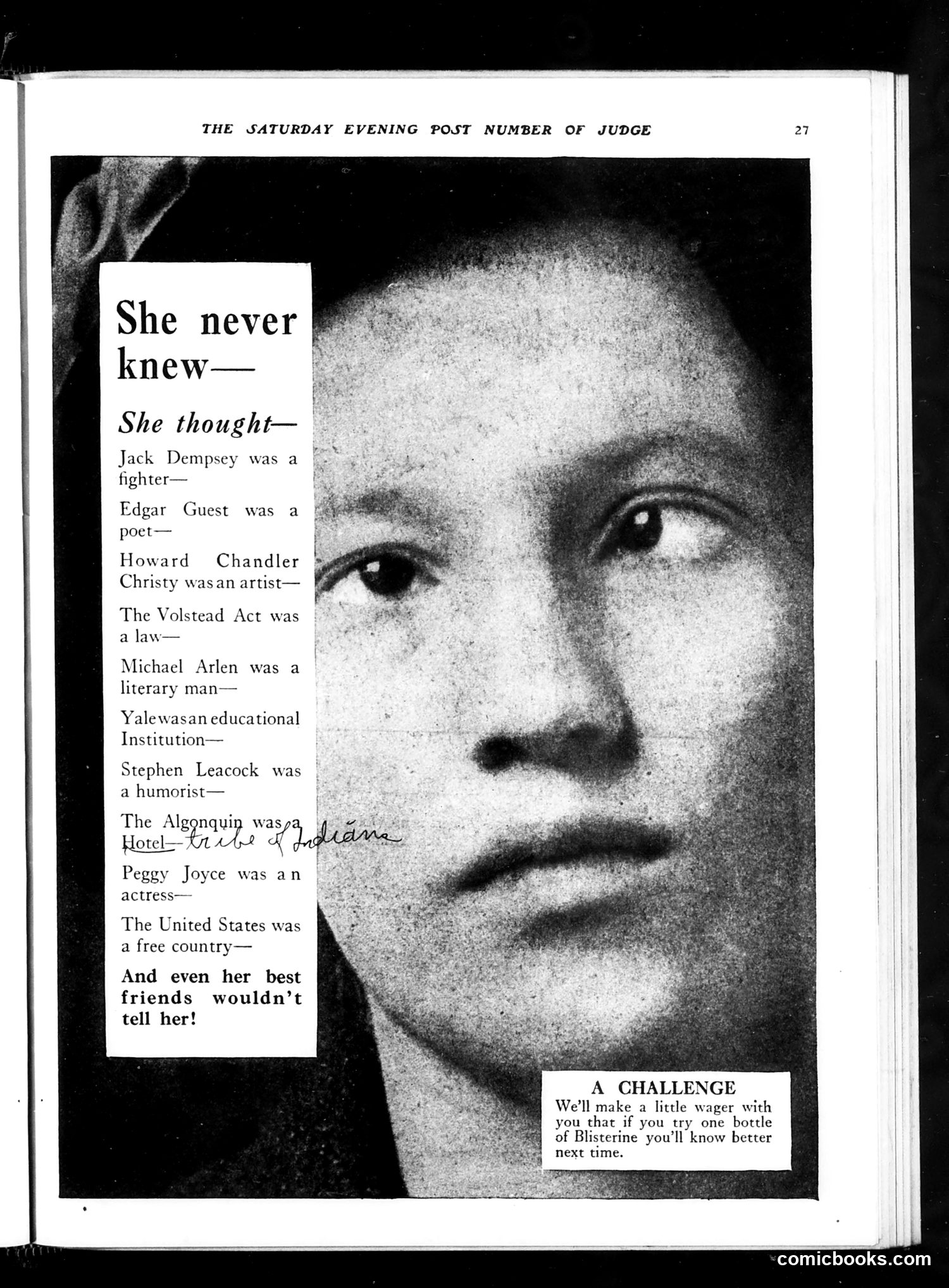
This is a satirical advertisement for Blisterine mouthwash disguised as social commentary. The joke targets a woman (shown in portrait) who holds false beliefs about famous contemporaries and institutions. The satire lists well-known figures—boxer Jack Dempsey, poet Edgar Guest, illustrator Howard Chandler Christy, etc.—and suggests the woman's understanding of them (and American institutions like Yale and the Volstead Act) is completely wrong. The punchline implies her misconceptions are so fundamental that "even her best friends wouldn't tell her." The advertisement then pivots: the "real" problem isn't her ignorance about celebrities—it's presumably her bad breath, which Blisterine will solve. This creates dark humor by elevating a mouthwash problem to the level of profound social delusion, while suggesting her friends' silence stems from embarrassment about her oral hygiene rather than her confused beliefs.
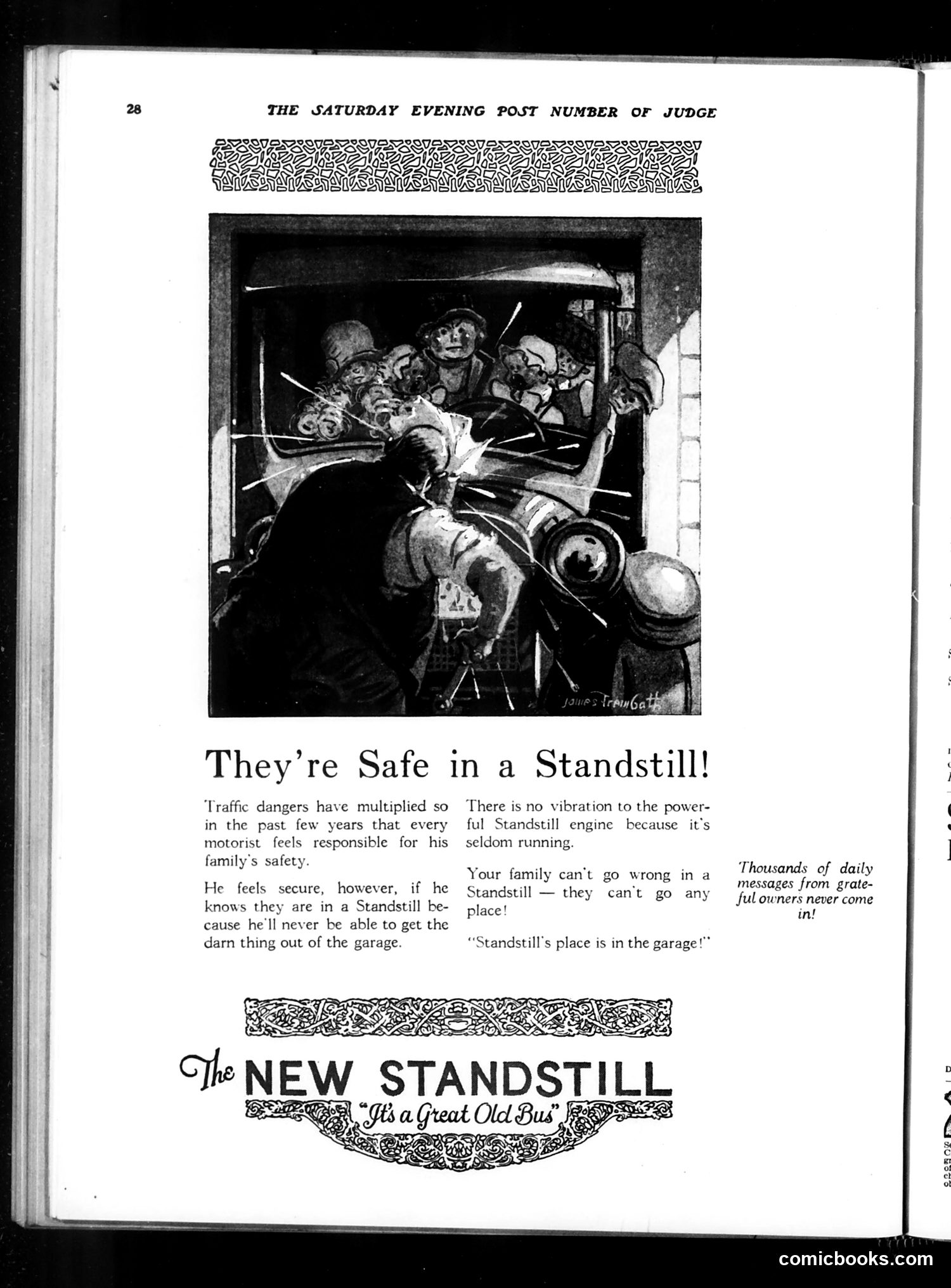
This is a **parody advertisement** for a fictional car called the "Standstill," presented as satirical commentary on automobile safety concerns. The joke is darkly humorous: the ad claims the car is "safe" because it literally doesn't work—the engine rarely runs, it can't leave the garage, and therefore the family can't go anywhere to get into accidents. The satire targets **1920s-30s automobile safety anxiety**. As car ownership exploded and traffic deaths mounted, manufacturers marketed safety features. This ad absurdly takes that logic to its extreme: the only truly "safe" car is one that doesn't function. The illustration shows a car packed with passengers visible through a window, emphasizing the confinement joke. The tagline "Thousands of daily messages from grateful owners never come in!" is particularly biting—owners can't contact the company because they're stuck at home. This is purely **commercial satire**, not political commentary. Judge magazine frequently ran such advertisements mocking contemporary consumer culture and industry claims.
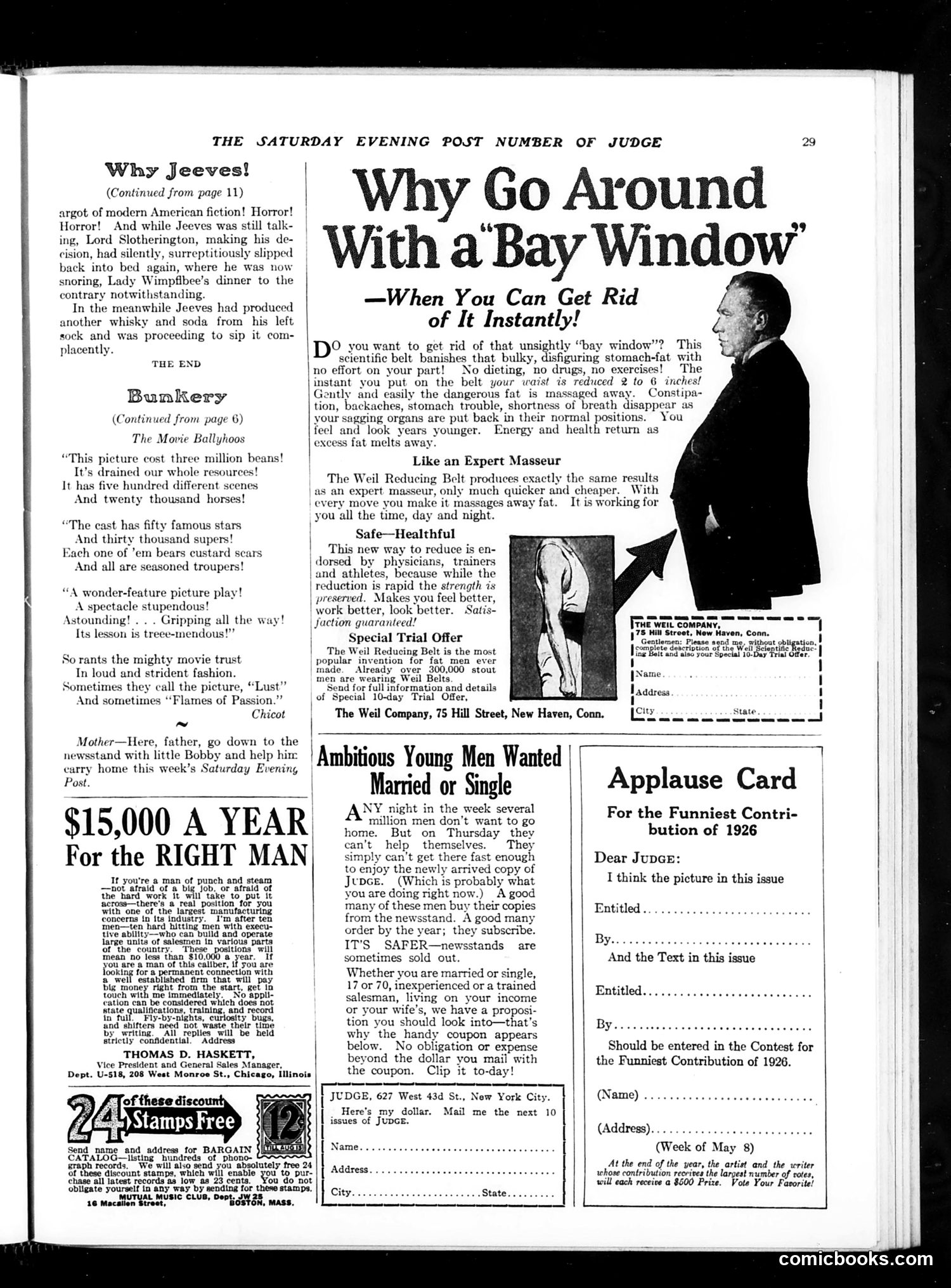
This page contains **advertisements and serialized fiction** typical of 1920s Judge magazine. The main content includes: **"Why Go Around With a Bay Window"** — A weight-loss belt advertisement using dated medical pseudoscience. The term "bay window" was period slang for abdominal fat. The ad promises instant waist reduction without dieting or exercise, endorsed by "physicians and athletes" — a marketing tactic still used today but now heavily regulated. **Job Advertisement** — A $15,000/year sales management position, positioned as exclusive and selective, targeting ambitious men. This wage would be roughly $280,000 in modern money. **Serialized Stories** — "Why Jeeves," "Bunkery," and "Mother" are lighthearted fiction pieces. "Bunkery" satirizes Hollywood's extravagant movie marketing claims about budgets and cast sizes. **"Ambitious Young Men Wanted"** — A newspaper circulation promotion offering financial opportunity. The page reflects 1920s consumer culture: aggressive advertising promising quick fixes, serialized entertainment for sustained readership, and aspiring-businessman targeting. The **satire is gentle**, focusing on Hollywood's inflated claims rather than serious political commentary.
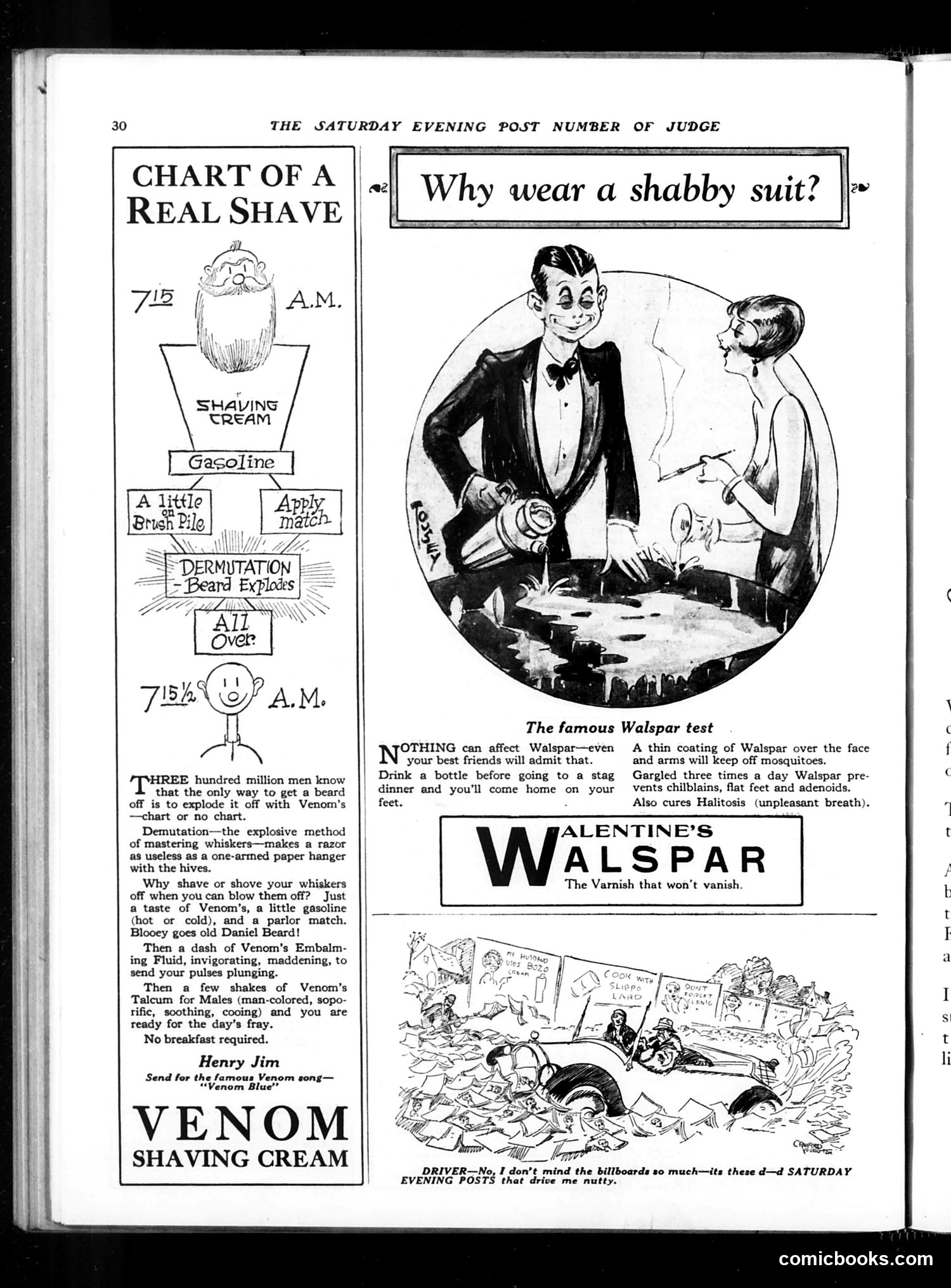
This page consists primarily of **absurdist advertisements** rather than political cartoons. The two fake product ads—Venom Shaving Cream and Walspar Varnish—use **deliberately ridiculous humor**. Venom's "chart" humorously claims shaving requires "explosion" and "demutation," with comically exaggerated consequences. The Walspar test section makes increasingly absurd medical claims (preventing mosquitoes, chilblains, adenoids) that clearly parody overblown product advertising. The single cartoon shows a man in formal wear and a woman in an evening setting, with the caption "Why wear a shabby suit?" This appears to be a straightforward advertisement or lifestyle commentary about maintaining appearance—not satire. The bottom cartoon depicts a frustrated driver surrounded by Saturday Evening Post magazines, complaining they annoy him more than billboards. This satirizes the **magazine clutter** and advertising saturation of the era. Overall, the page reflects **1920s-era advertising absurdism** rather than political satire—Judge magazine's humor relied on exaggerated, nonsensical product claims to mock consumer culture itself.
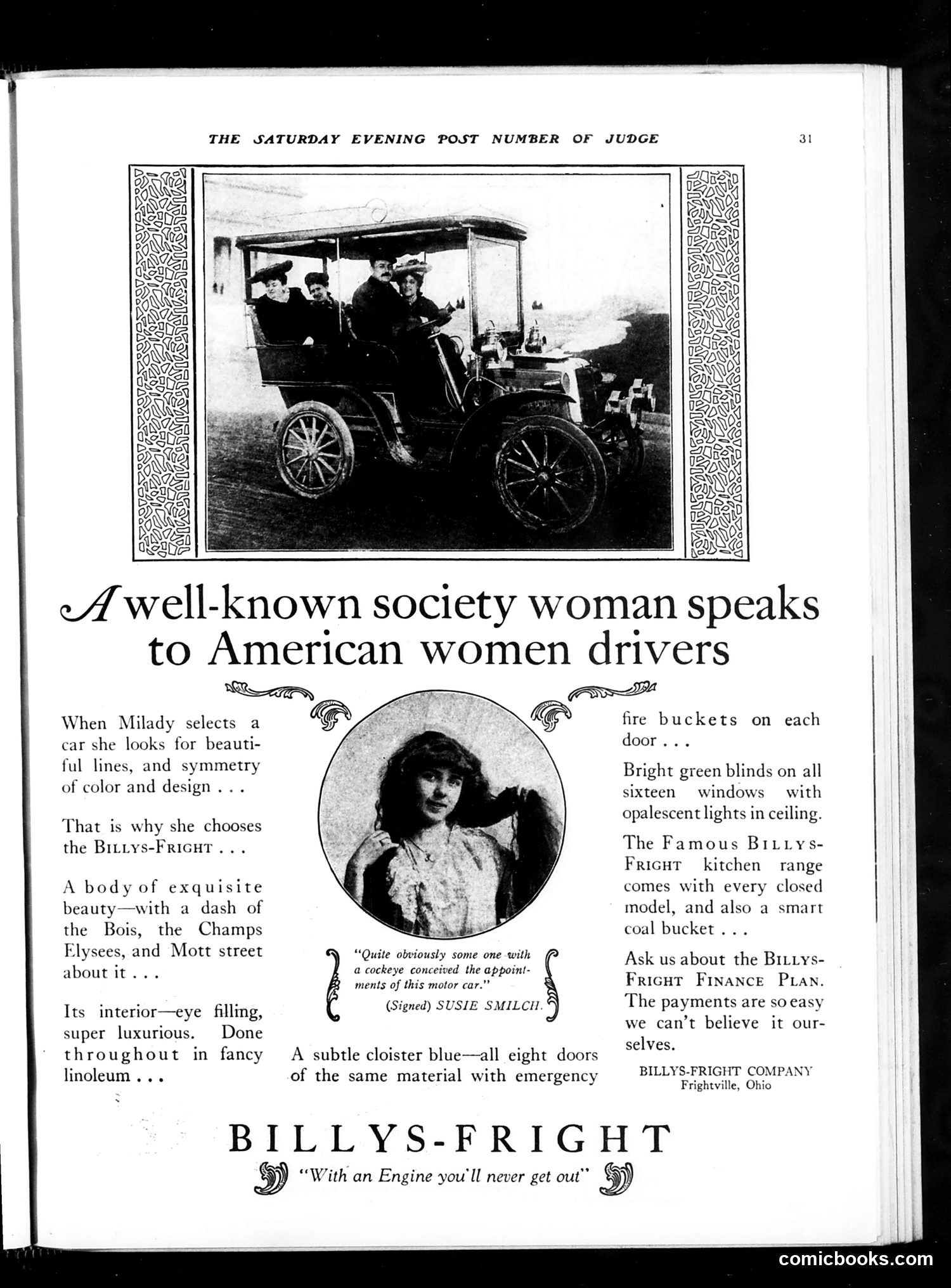
This is primarily an **advertisement**, not political satire. It's a parody car ad for the fictional "Billys-Fright" automobile, featuring a claimed endorsement from "Susie Smilch," presented as a "well-known society woman." The joke mocks both pretentious automotive marketing and snobbish consumer culture. The ad ridiculously describes absurd features—sixteen windows, eight doors, a kitchen range, fire buckets, and linoleum throughout—while using affected language ("dash of the Bois, the Champs Elysees"). The tagline "With an Engine you'll never get out" is a deadpan joke suggesting the car is mechanically unreliable. The satirical point: expensive cars marketed to wealthy women rely on false prestige and ridiculous luxury claims rather than actual quality. The "cockeye" quote and Frightville, Ohio location reinforce that this is obvious nonsense sold through snobbery.
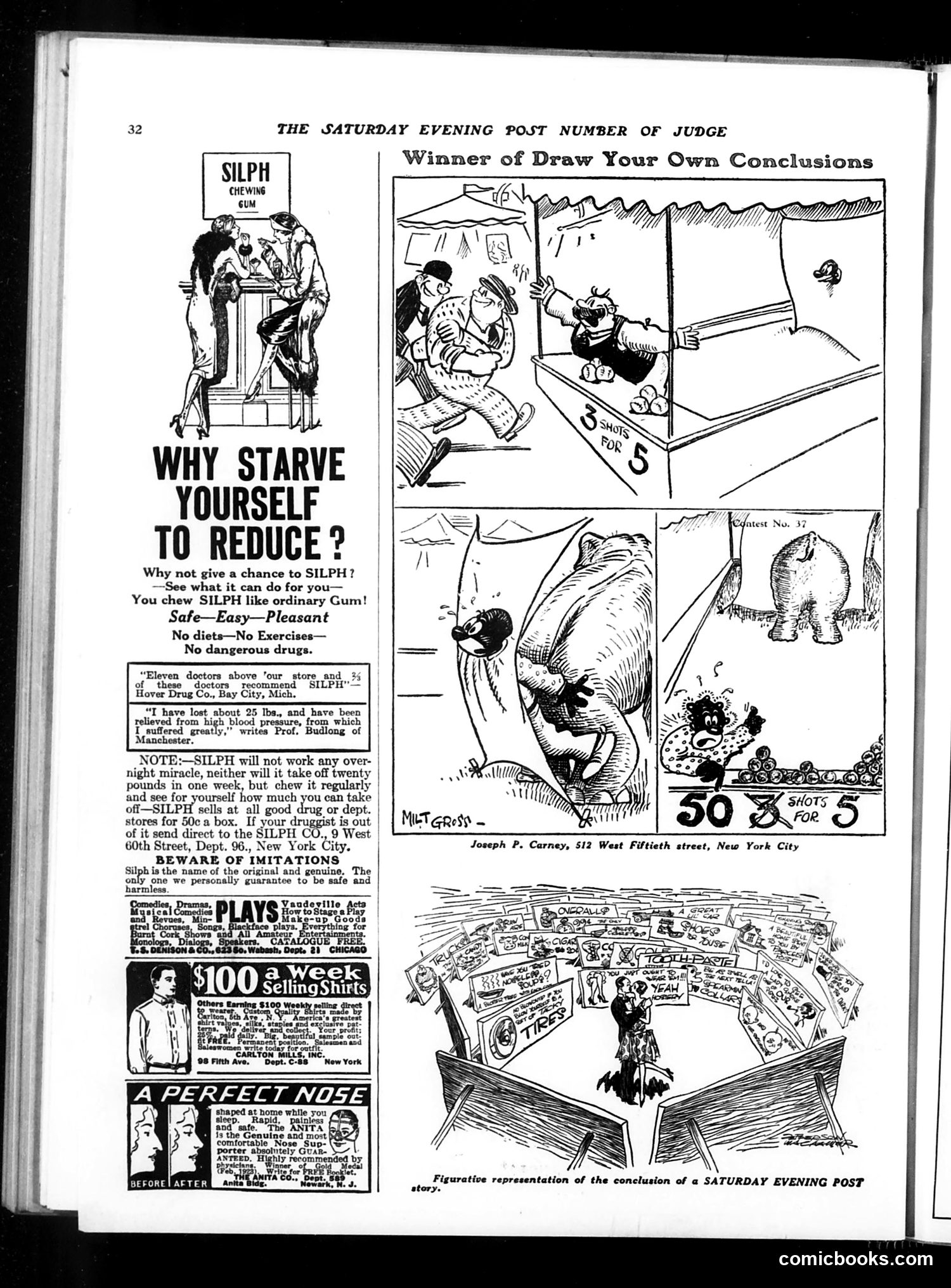
This page features a visual puzzle cartoon where readers must infer a narrative from sequential panels. The top comic shows a baseball game scenario: a batter hits a ball, and subsequent panels depict increasingly absurd consequences—a figure appears to expand or transform grotesquely across the frames. The bottom illustration displays what appears to be a messy, chaotic collection of comic strips or stories spread across a surface, with a figure observing them. The cartoon's title invites readers to create their own interpretation of the story's conclusion. This was a common Judge feature—visual humor requiring audience participation and imagination rather than explicit punchlines. The page is primarily dominated by period advertisements for weight-loss product "Silph" chewing gum, shirts, and cosmetics, which were typical revenue sources for magazines of this era. The juxtaposition of the cartoon above weight-loss advertising suggests ironic commentary on the diet industry's promises.
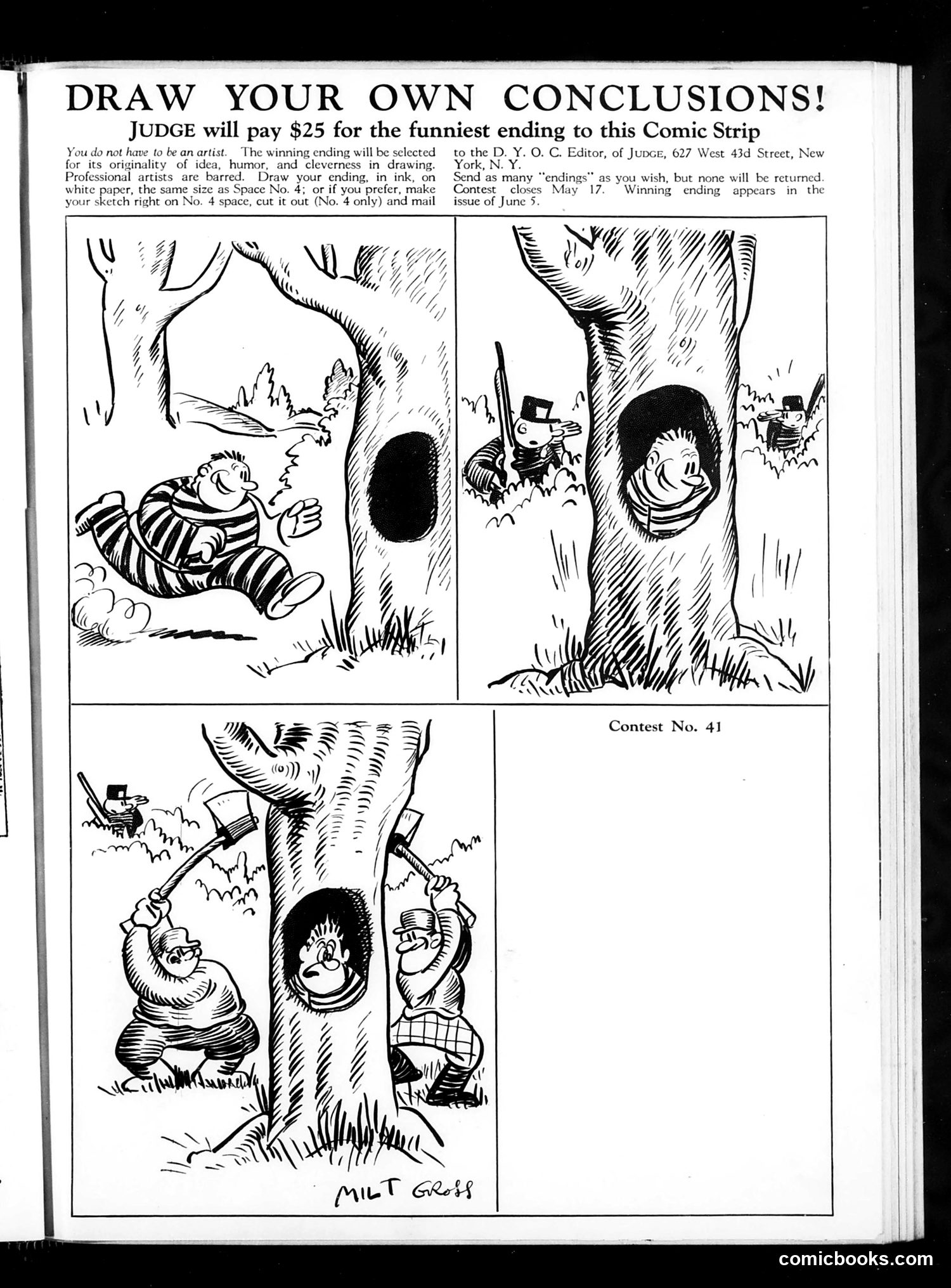
This is a reader-participation contest page from Judge magazine. The three comic panels show a recurring scenario: characters in striped clothing and top hats interacting with tree trunks that have large knotholes serving as faces. The setup appears to be slapstick physical comedy—the characters are climbing, chopping, or otherwise engaging with these anthropomorphized trees. Judge invited readers to submit humorous final panels to complete the strip, offering $25 for the funniest conclusion. The cartoons rely on visual gags and exaggerated character expressions typical of early-to-mid 20th century American humor. The specific identities of the characters are unclear from the image alone, though their formal dress (top hats, striped suits) suggests they may represent generic "everyman" figures or social types common to period satire. This was a common magazine feature—crowdsourcing comic endings allowed Judge to engage readers directly while filling space affordably.
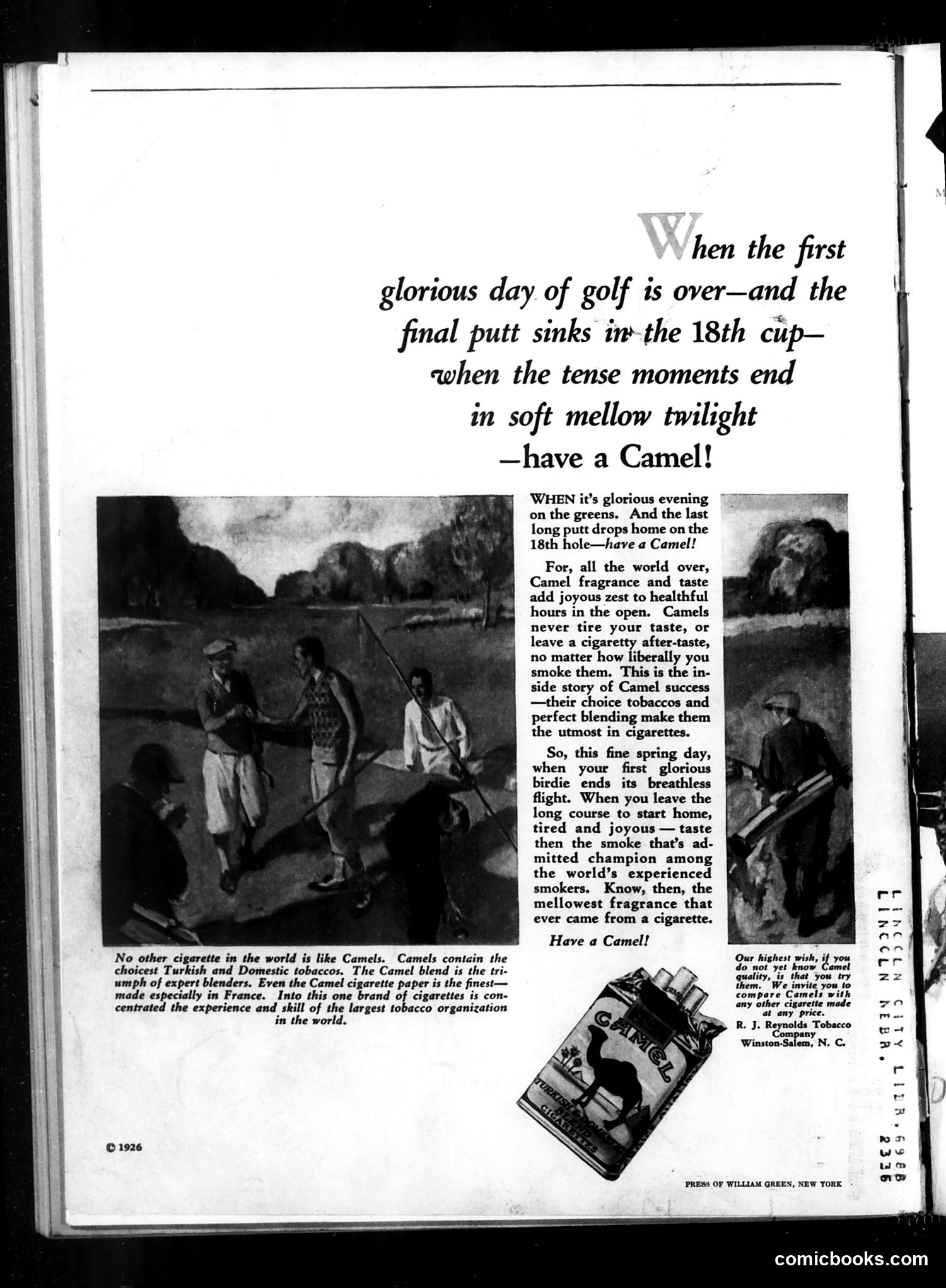
This is **not a cartoon or satire**—it's a straightforward cigarette advertisement disguised as editorial content in *Judge* magazine. The page promotes Camel cigarettes by associating smoking with leisure and athletic achievement. It depicts golfers finishing their round at twilight, framing cigarette smoking as the natural reward for an active day outdoors. The copy emphasizes Camel's "choice tobaccos" and claims superior quality through "expert blending." The advertisement exploits early 20th-century marketing tactics: linking cigarettes to health ("healthful hours"), masculinity (golf), and sophistication (French cigarette paper). R.J. Reynolds Tobacco explicitly invites readers to compare Camels favorably to competitors. This reflects the pre-regulation era when tobacco advertising made health claims freely and appeared in mainstream publications without disclosure requirements. The tone is aspirational rather than satirical.