
Judge, 1926-05-08 · page 6 of 36
Judge — May 8, 1926 — page 6: what you’re looking at
What you’re looking at
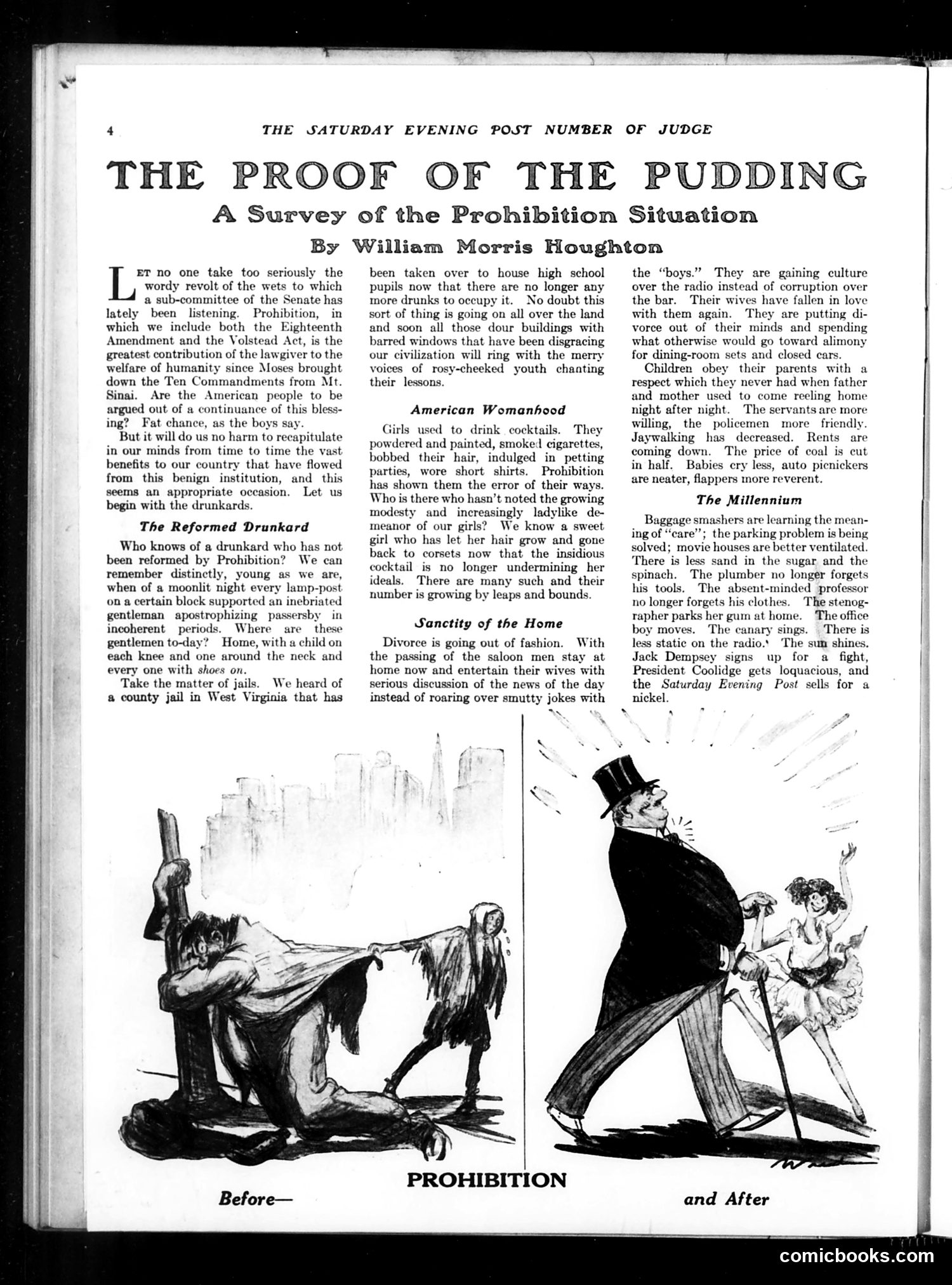
This 1920s *Judge* satire critiques Prohibition's social effects. The article "The Proof of the Pudding" surveys unintended consequences: high school students now drinking cocktails and smoking, girls adopting "increasingly ladylike" behavior through shortened hair and skirts, increased divorce rates, and moral decay. The two contrasting illustrations labeled "Before" and "After" PROHIBITION show a gentleman's transformation: the left depicts a disheveled drunkard in rags; the right shows a well-dressed, top-hatted man with fashionable companions. The satire's irony is biting: Prohibition supposedly reformed drunks and improved morality, yet the text documents society becoming more corrupt and licentious—the "after" appearing superficially refined while underlying social problems worsen.
📄 Transcribed text from this page (OCR, searchable)
Machine-transcribed from the original scan — historical spelling and the odd misread are preserved.
THE SATURDAY EVENING POST NUMBER OF JUDGE THE PROOF OF THE PUDDING A Survey of the Prohibition Situation By William Morris Houghton wordy revolt of the wets to which a sub-committee of the Senate has lately been listening. Prohibition, in which we include both the Eighteenth Amendment and the Volstead Act, is the greatest contribution of the lawgiver to the welfare of humanity since Moses brought down the Ten Commandments from Mt. Sinai. Are the American people to be argued out of a continuance of this bless- ing? Fat chance, as the boys say. But it will do us no harm to recapitulate in our minds from time to time the vast benefits to our country that have flowed from this benign institution, and this seems an appropriate occasion. Let us begin with the drunkards. The Reformed Drunkard Who knows of a drunkard who has not been reformed by Prohibition? We can remember distinctly, young as we are, when of a moonlit night eve: np-post on a certain block supported an inebriated gentleman apostrophizing passersby in incoherent periods. Where are these gentlemen to-day? Home, with a child on each knee and one around the neck and every one with shoes on. Take the matter of jails. We heard of a county jail in West Virginia that has | ET no one take too seriously the Before— been taken over to house high school pupils now that there are no longer any more drunks to occupy it. No doubt this sort of thing is going on all over the land and soon all those dour buildings with barred windows that have been disgracing our civilization will ring with the merry voices of rosy-cheeked youth chanting their lessons. American Womanhood Girls used to drink cocktails. They powdered and painted, smoked cigarettes, bobbed their hair, indulged in petting parties, wore short shirts. Prohibition has shown them the error of their ways. Who is there who hasn’t noted the growing modesty and increasingly ladylike de- meanor of our girls?) We know a sweet girl who has let her hair grow and gone back to corsets now that the insidious cocktail is no longer undermining her ideals. There are many such and their number is growing by leaps and bounds. Sanctity of the Home Divorce is going out of fashion. With the passing of the saloon men stay at home now and entertain their wives with serious discussion of the news of the day instead of roaring over smutty jokes with the “boys.” They are gaining culture over the radio instead of corruption over the bar. Their wives have fallen in love with them again. They are putting di- vorce out of their minds and spending what otherwise would go toward alimony for dining-room sets and closed cars. Children obey their parents with a respect which they never had when father and mother used to come reeling home night after night. The servants are more willing, the policemen more friend Jaywalking has decreased. Ren coming down. The price of coa in half. Babies ery less, auto picnickers are neater, flappers more reverent. The Millennium Baggage smashers are learning the mean- ing of “care”; the parking problem is being ; movie houses are better ventilated. There is less sand in the sugar and the spinach. The plumber no longer forgets his tools. The absent-minded professor no longer forgets his clothes. The stenog- rapher parks her gum at home. The office boy moves. The canary sings. | There is less static on the radio.’ The sun shines. Jack Dempsey signs up for a fight, President Coolidge gets loquacious, and the Saturday Evening Post sells for a nickel. and After comicbooks.com