
A complete issue · 39 pages · 1925
Judge — December 19, 1925
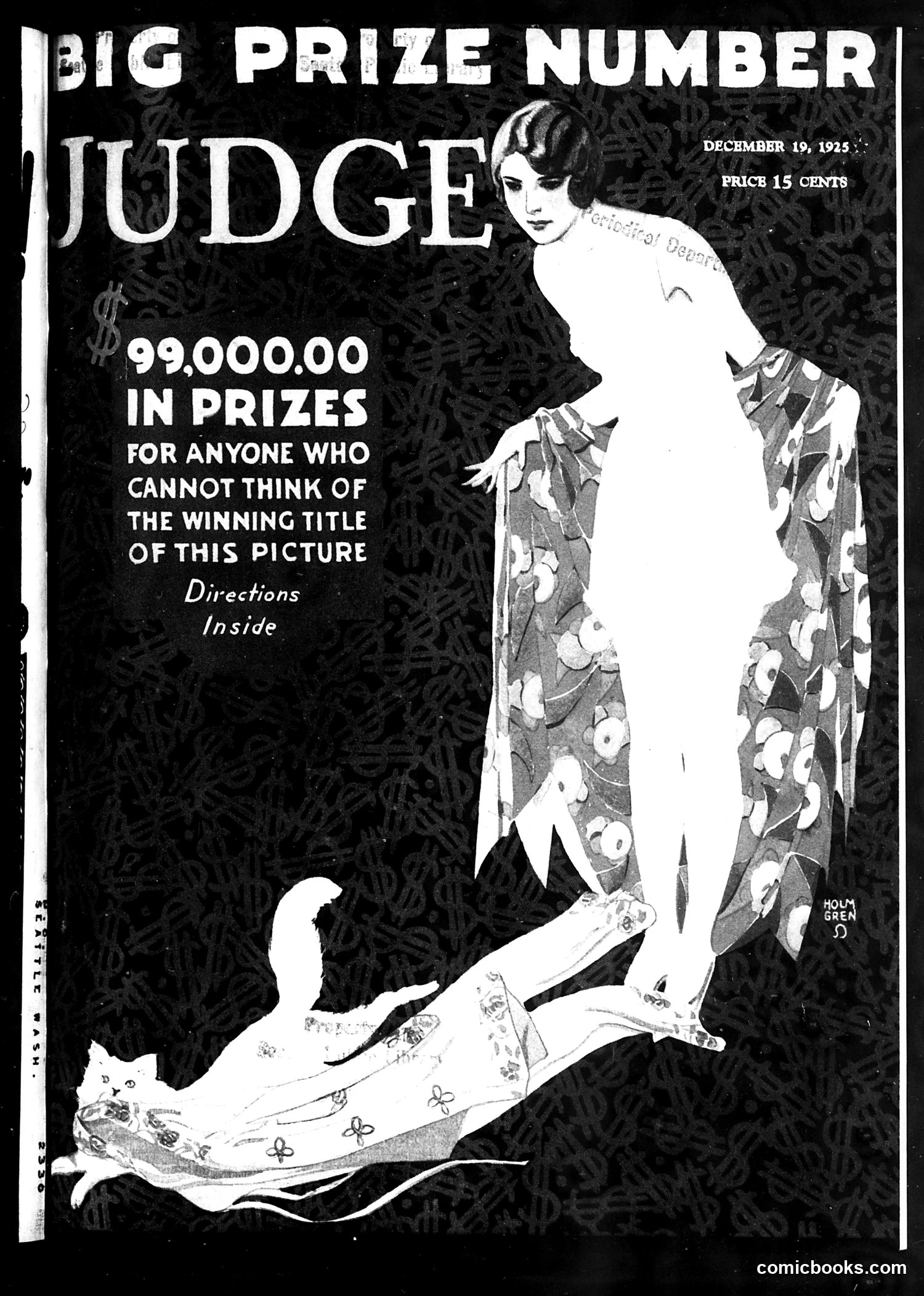
This is a **contest page**, not a political cartoon. Judge magazine is running a "Big Prize Number" competition offering $99,000 in prizes to readers who can suggest a winning title for the picture shown. The image depicts a stylized woman in 1920s fashion (white dress, patterned robe) posed elegantly with a cat at her feet. The illustration is credited to "Houm Green" (artist signature visible). The contest mechanics are straightforward: readers submit title suggestions following printed directions inside the magazine. This was a common promotional strategy for magazines of the era—engaging readers while driving circulation and generating content ideas. The substantial prize amount ($99,000) underscores the magazine's confidence in reader participation and its commercial success during the prosperous 1920s.
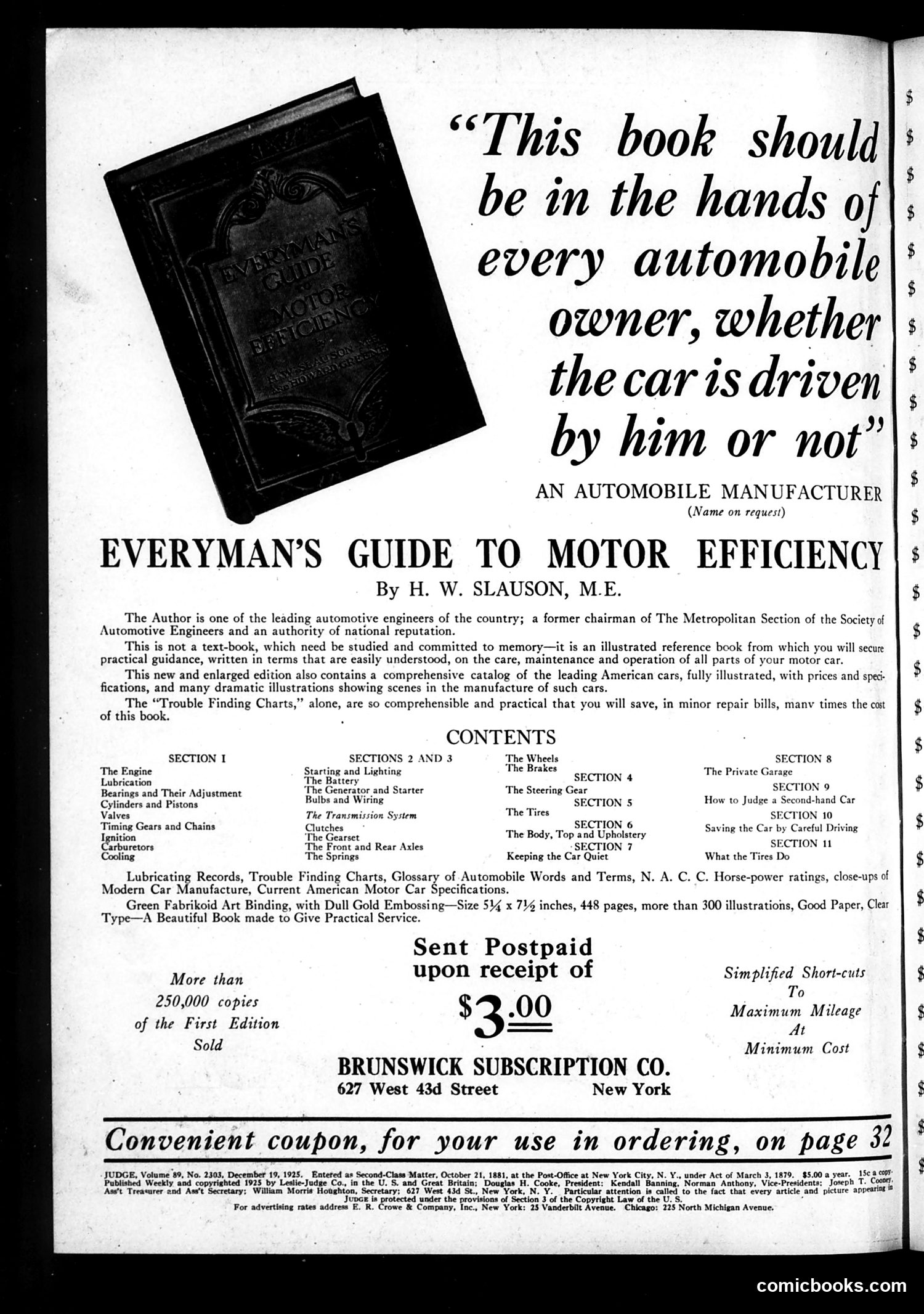
This page is primarily an **advertisement**, not a political cartoon or satire. It promotes "Everyman's Guide to Motor Efficiency" by H.W. Slauson, M.E. The ad features a quote from an unnamed automobile manufacturer endorsing the book as essential for all car owners. The publication promises practical guidance on vehicle maintenance and operation through illustrations, charts, and specifications. The book cost $3.00 and was sold by Brunswick Subscription Co. in New York. The ad emphasizes the book's comprehensiveness—over 300 illustrations, pricing information, and troubleshooting guides—positioning it as a practical reference rather than theoretical textbook. There is no political satire or cartoon content on this page; it represents typical early 20th-century automotive industry advertising.
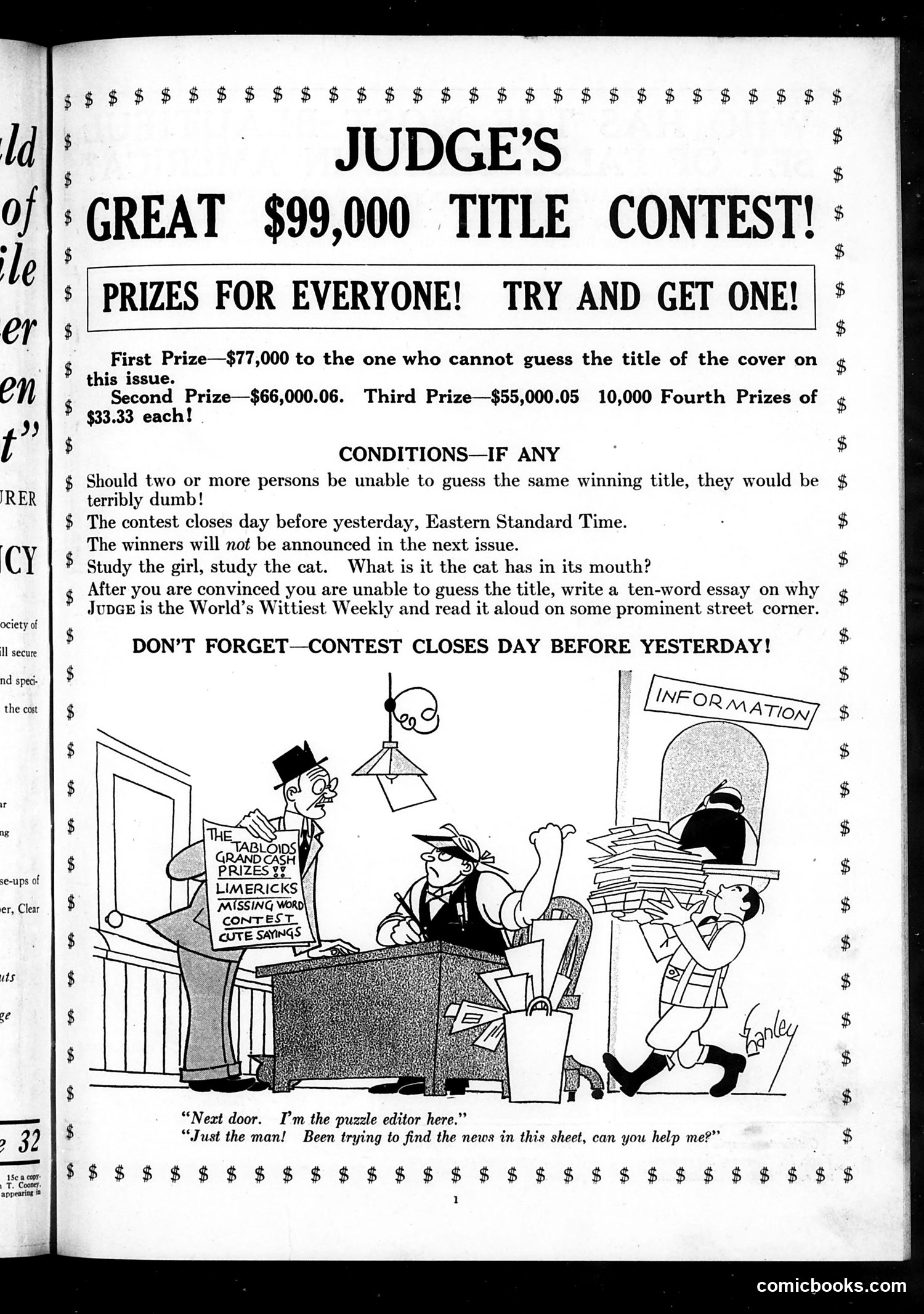
This page is primarily a **contest advertisement**, not political satire. Judge magazine is running a humorous "title guessing" contest with substantial prizes ($77,000 for first place) for readers who cannot guess the magazine's cover title. The cartoon illustrates the contest's absurdity: a harried puzzle editor at his desk is mobbed by contestants demanding help. The sign lists other Judge puzzles ("Grabloids," "Missing Word," "Cute Sayings"), suggesting the magazine regularly ran such contests. The joke targets the **contest-obsessed culture of Depression-era magazines**, which used prize competitions to boost circulation. The cartoon mocks both the publisher's desperation to attract readers and the public's competitive fever for free money—a timely satire of economic anxiety during hard times.
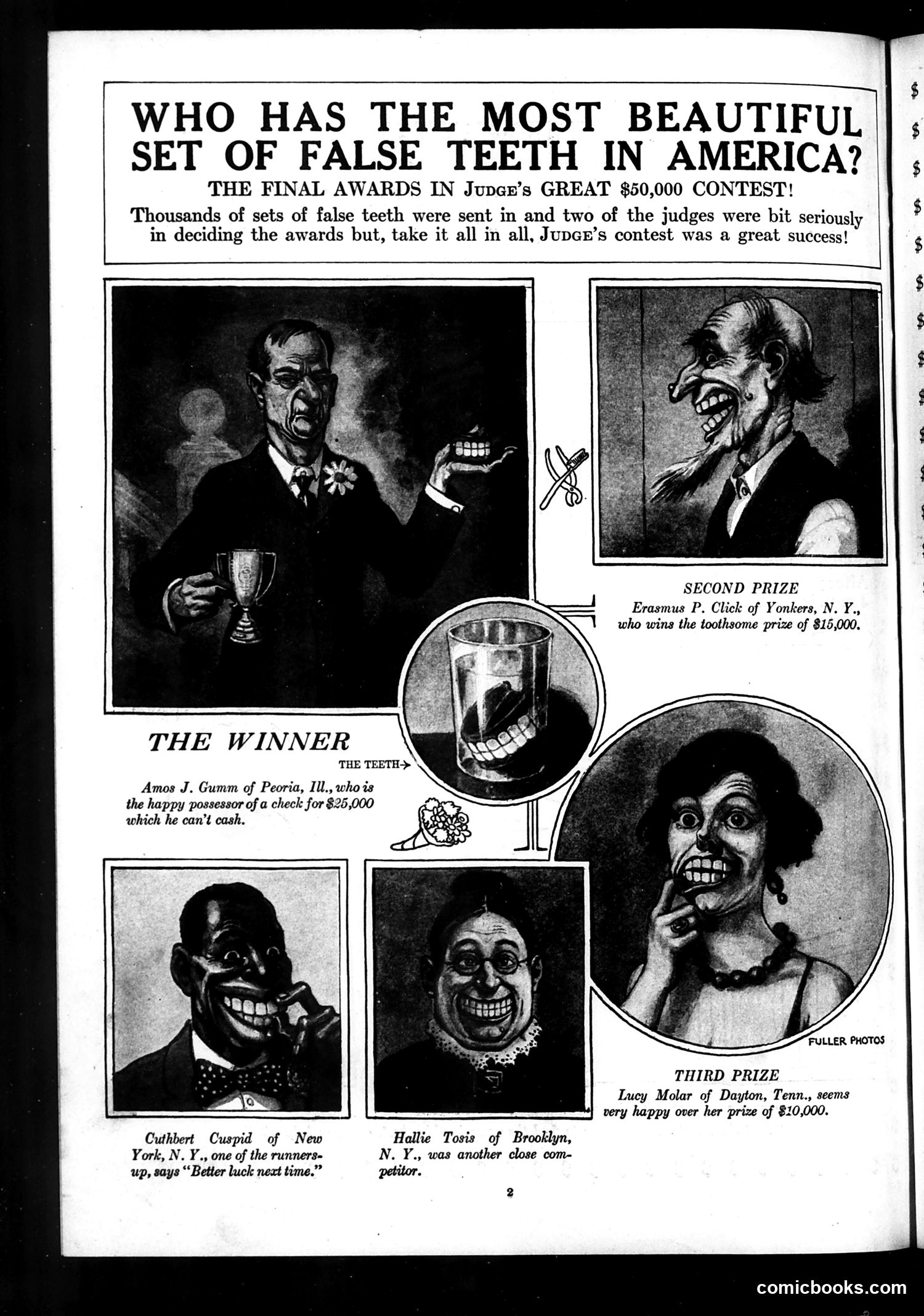
This page satirizes a fictional contest for "the most beautiful set of false teeth in America," awarding $50,000 total in prizes. The satire works through grotesque exaggeration: the winners are shown with wildly distorted, oversized teeth and contorted facial expressions—the opposite of beauty. The joke targets both the vanity of cosmetic dentistry advertising and the absurdity of such competitions. By presenting teeth as simultaneously a matter of competitive pride and obvious monstrosity, Judge mocks both the dental industry's marketing claims and public gullibility. The named winners (Amos J. Gumm, Erasmus P. Click, Lucy Molar, and others) appear to be invented characters, their surnames itself jokes ("Molar," "Click," "Tosis"). This reflects early-20th-century skepticism toward consumer culture and emerging beauty industries.
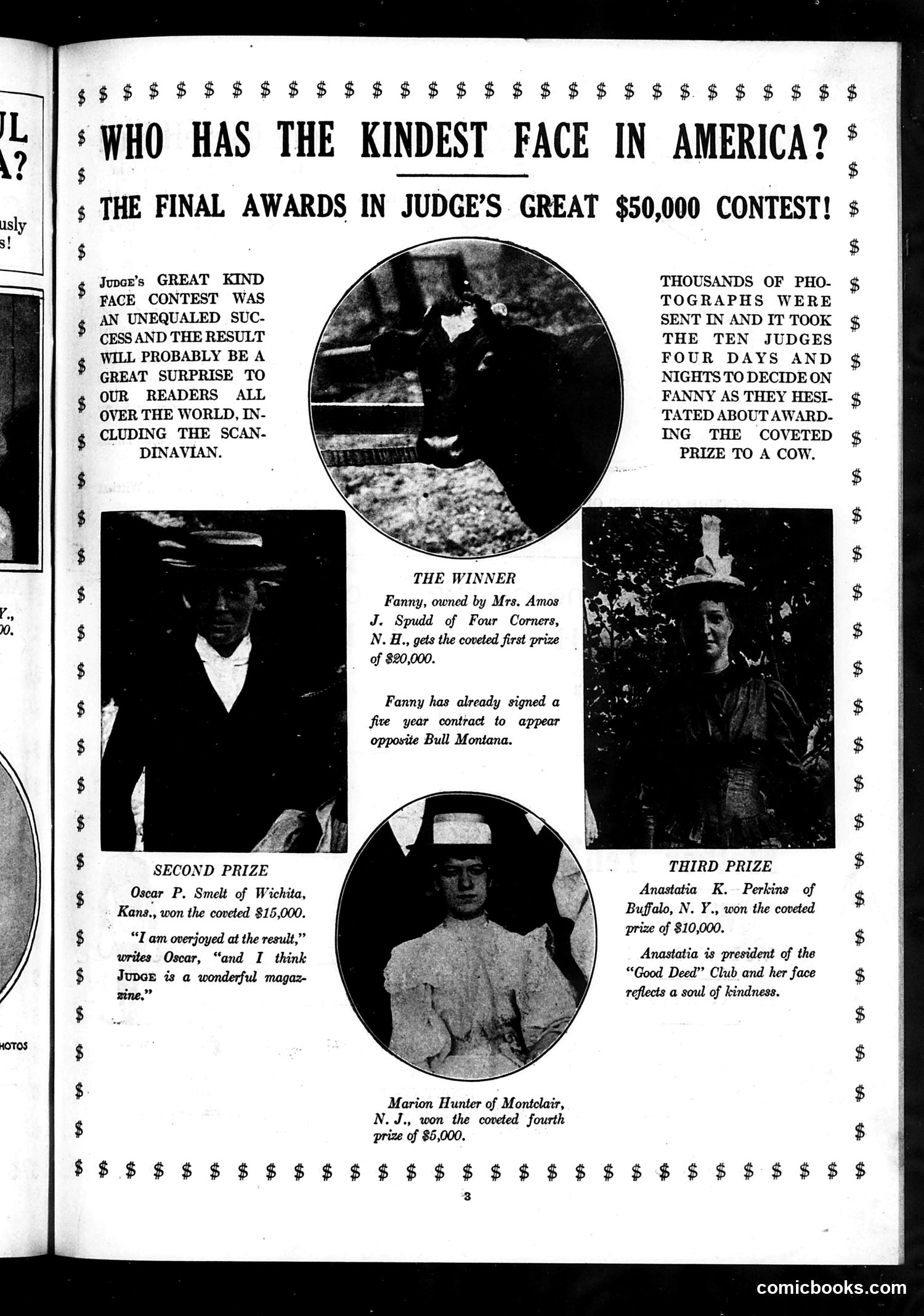
This page announces the results of Judge magazine's "$50,000 contest" to identify America's kindest face. The contest was apparently genuine—thousands of photographs were submitted and evaluated by ten judges over multiple days. **The Winners:** - **First Prize ($20,000):** Fanny, a cow owned by Mrs. Amos J. Spudd of Four Corners, N.H. The joke is that the judges, after extensive deliberation, awarded the prize to a bovine rather than a human—a satirical commentary on human nature or perhaps the judges' absurdity. - **Second Prize ($15,000):** Oscar P. Smelt of Wichita, Kansas - **Third Prize ($10,000):** Anastasia K. Forkshe of Buffalo, N.Y. - **Fourth Prize ($5,000):** Marion Hunter of Montclair, N.J. The humor lies in the cow winning against human competitors.
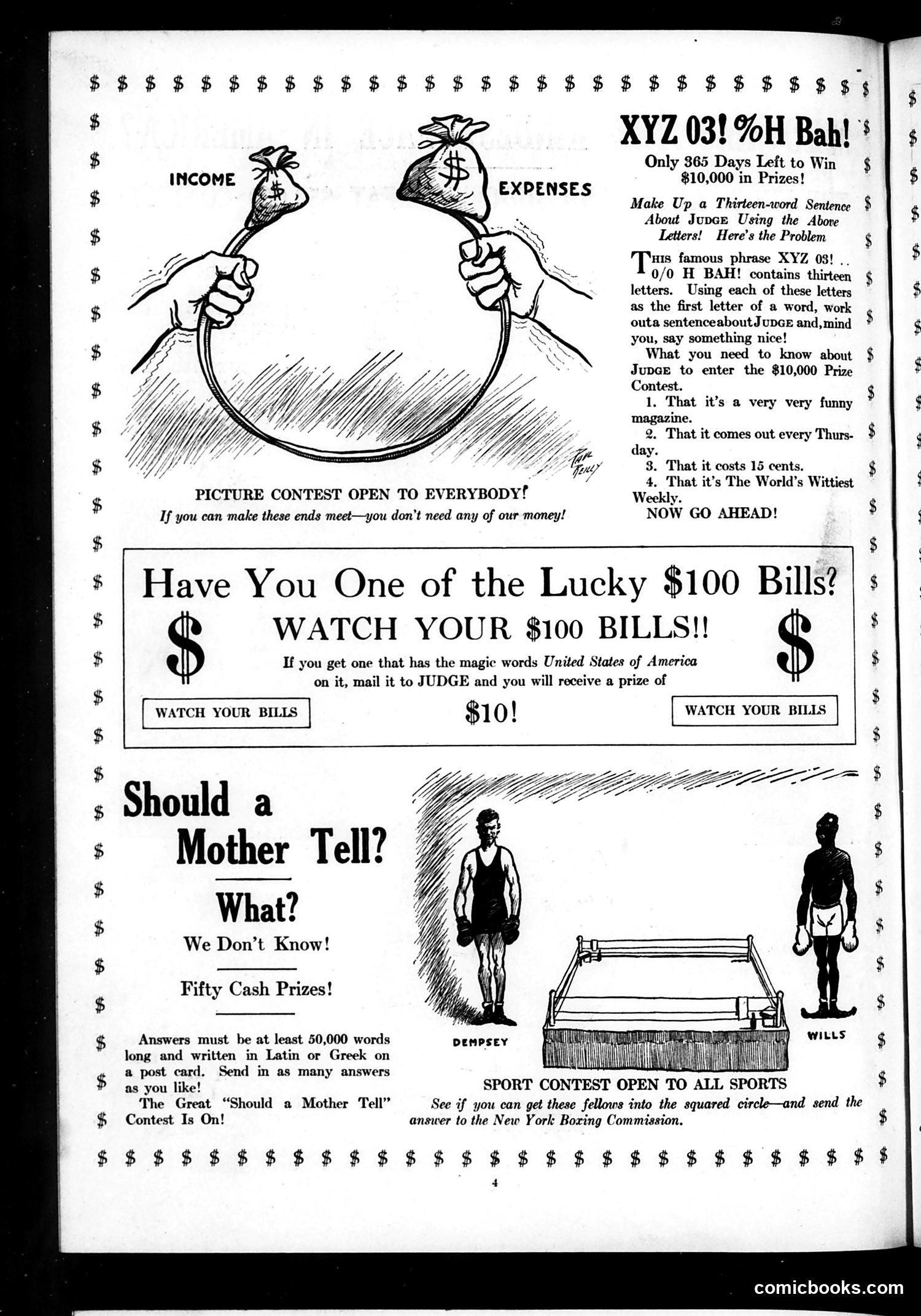
This page is primarily **advertising for contests and contests**, not political satire. It contains four separate prize competitions: 1. **"XYZ 03! %H Bah!"** — A word-game contest using letters from this phrase to create thirteen-word sentences about Judge magazine itself. 2. **"Lucky $100 Bills"** — Readers watch for special $100 bills containing "United States of America" text; winners mail them to Judge for $10 prizes. 3. **"Should a Mother Tell?"** — A contest asking readers to answer an unspecified question in 50,000+ words, offering fifty cash prizes. 4. **"Sport Contest"** — Features boxers (labeled "Dempsey" and "Wills"), asking readers to identify them "in the squared circle" for the New York Boxing Commission. The page uses humor and financial incentives to boost magazine circulation and reader engagement rather than deliver political commentary.
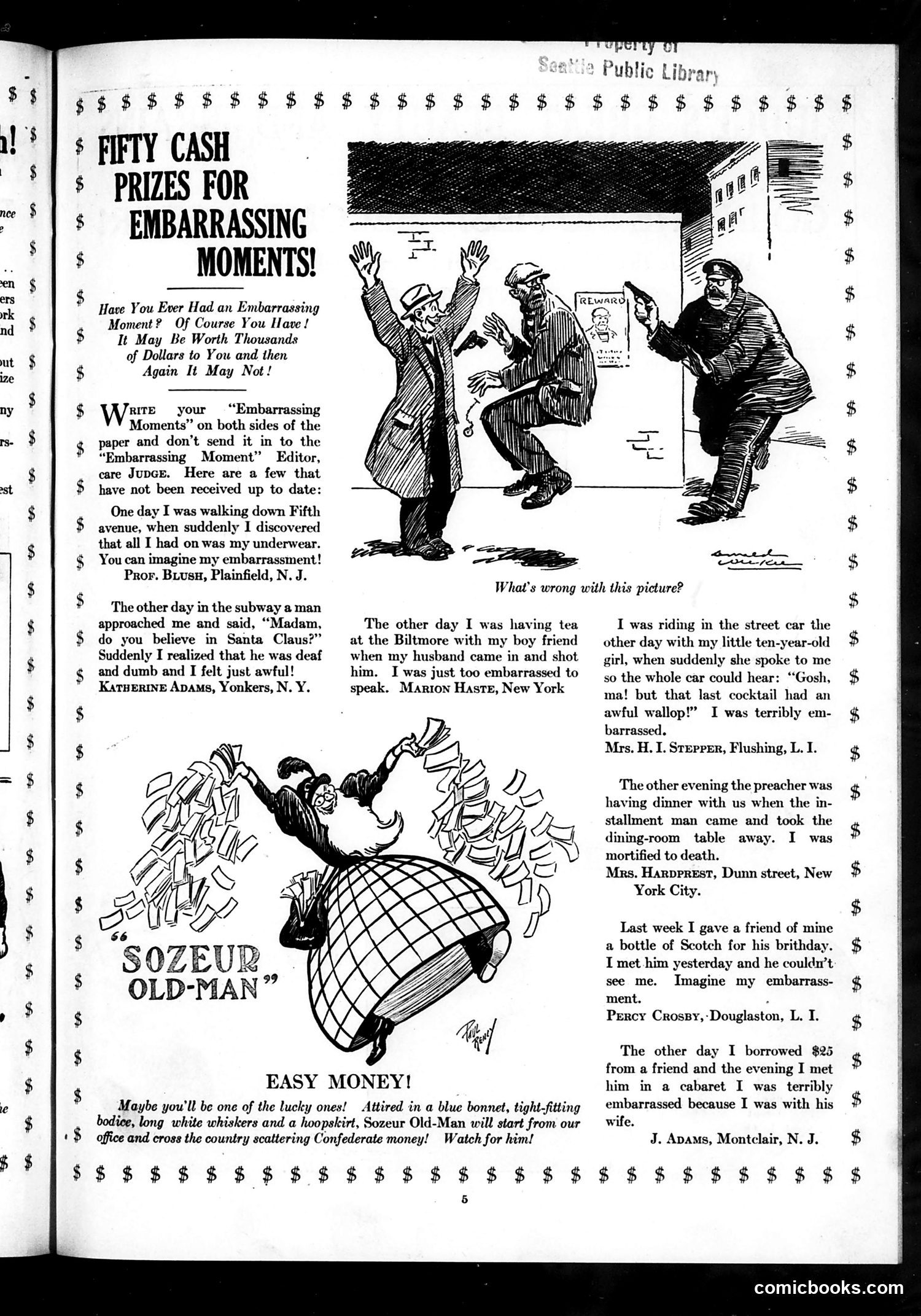
This page is primarily **advertising disguised as entertainment content**. The top cartoon depicts a man being arrested or confronted by police, captioned "What's wrong with this picture?" — likely a visual puzzle for readers. The main feature is a contest soliciting humorous anecdotes about embarrassing situations from readers, with $50 in cash prizes offered. Several submitted stories describe awkward social moments: a woman discovering she wore only underwear in public, someone's gaffe about Santa Claus, and borrowed money misadventures. The lower cartoon shows a man in period costume (possibly meant to evoke the "Sozeur Old-Man" character) surrounded by money, advertising the contest's appeal with "Easy Money!" The satire targets **common human embarrassment** through lighthearted humor rather than political commentary.
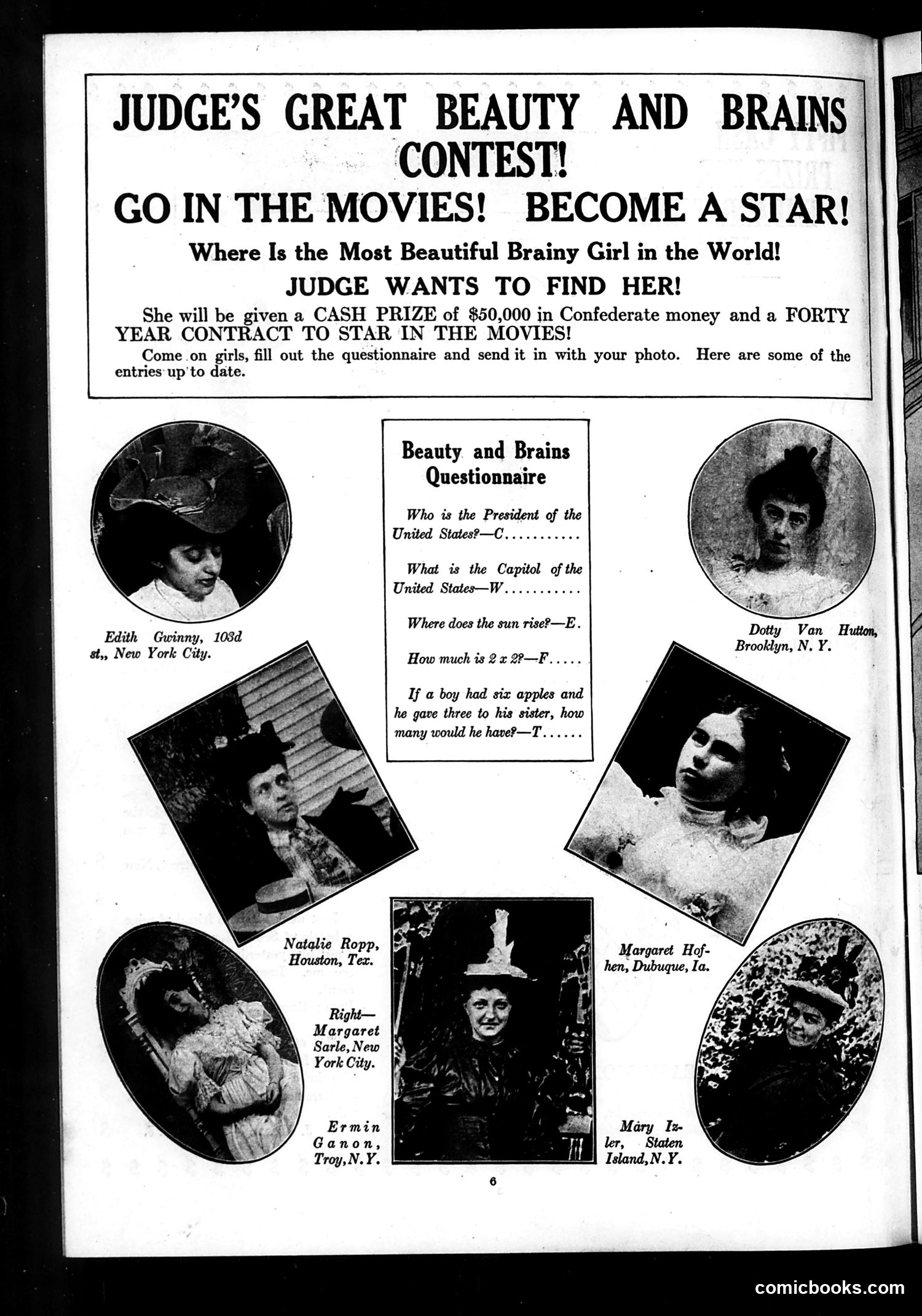
This is a **satirical advertisement** for a fake beauty pageant. The joke hinges on the prize being "$50,000 in **Confederate money**"—worthless currency from the defeated Civil War South. This is the satire's central point: Judge is mocking both beauty pageants and the post-Civil War South simultaneously. The "Beauty and Brains Questionnaire" adds the mockery. The intelligence test includes absurdly simple questions (Who is the President? What is 2+2?) answered by named contestants from various U.S. cities. The implication is that these women are so unintelligent they struggle with elementary-school-level questions—satirizing both the "beauty pageant" industry and perhaps regional stereotypes. The page combines Judge's typical early-20th-century satire: irreverent commentary on American culture wrapped in farcical entertainment, with a pointed jab at Southern economic irrelevance post-Reconstruction.
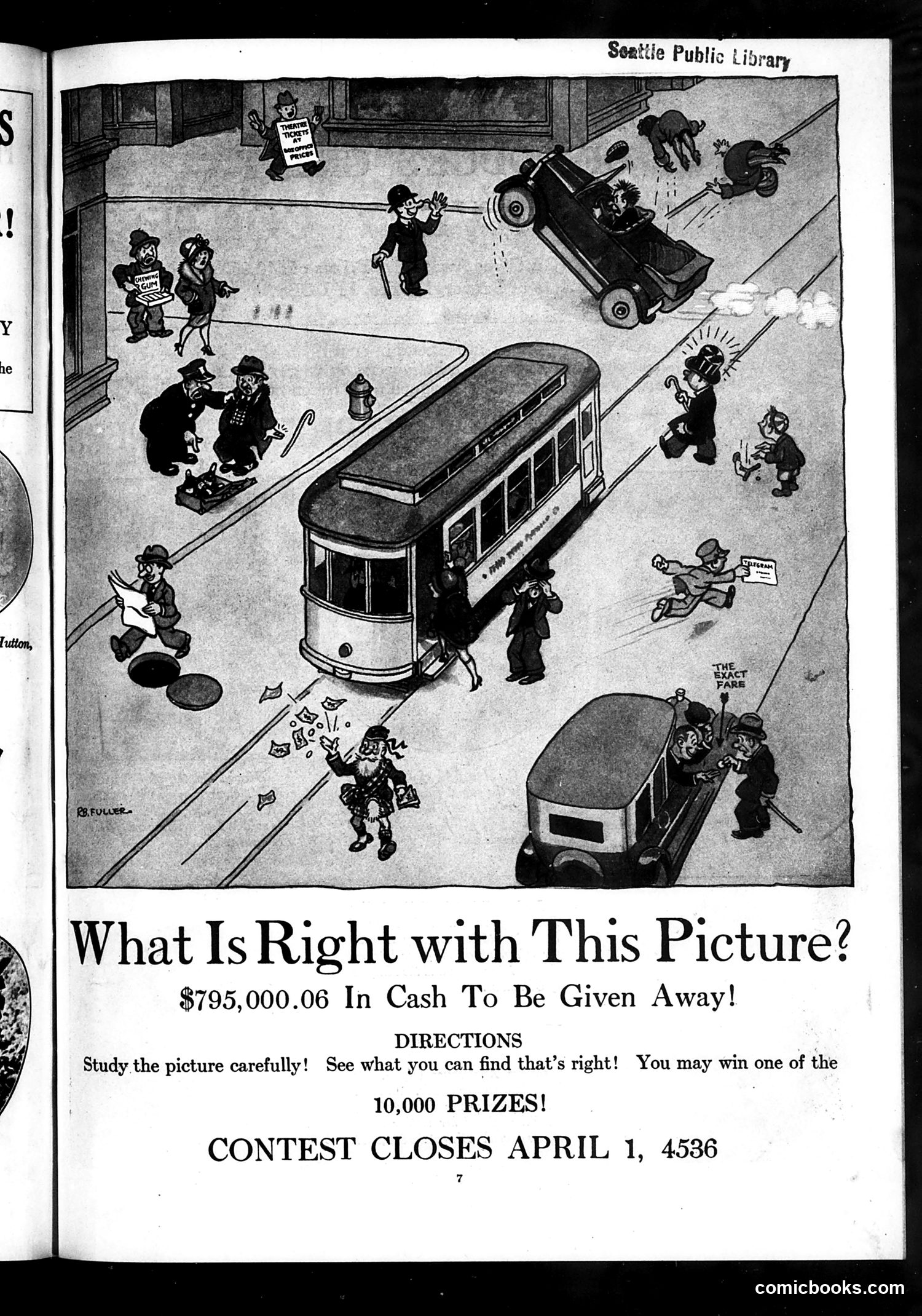
This is a contest page, not political satire. Judge magazine offered readers a puzzle: identify what's "right" (correct or proper) in a chaotic street scene depicting various traffic and safety violations. The bird's-eye view shows a streetcar, automobiles, pedestrians, and figures engaged in dangerous or illicit activities—jaywalking, reckless driving, possibly theft or vandalism. The joke is that readers must spot the *one thing* being done correctly amidst widespread lawlessness and chaos. The massive prize pool ($795,000.06 across 10,000 prizes) reflects 1920s-30s advertising excess. The closing date "April 1, 4536" is absurdist humor. This reflects contemporary concerns about urban disorder, traffic safety, and public behavior during early automobile adoption—common themes in period satirical magazines.
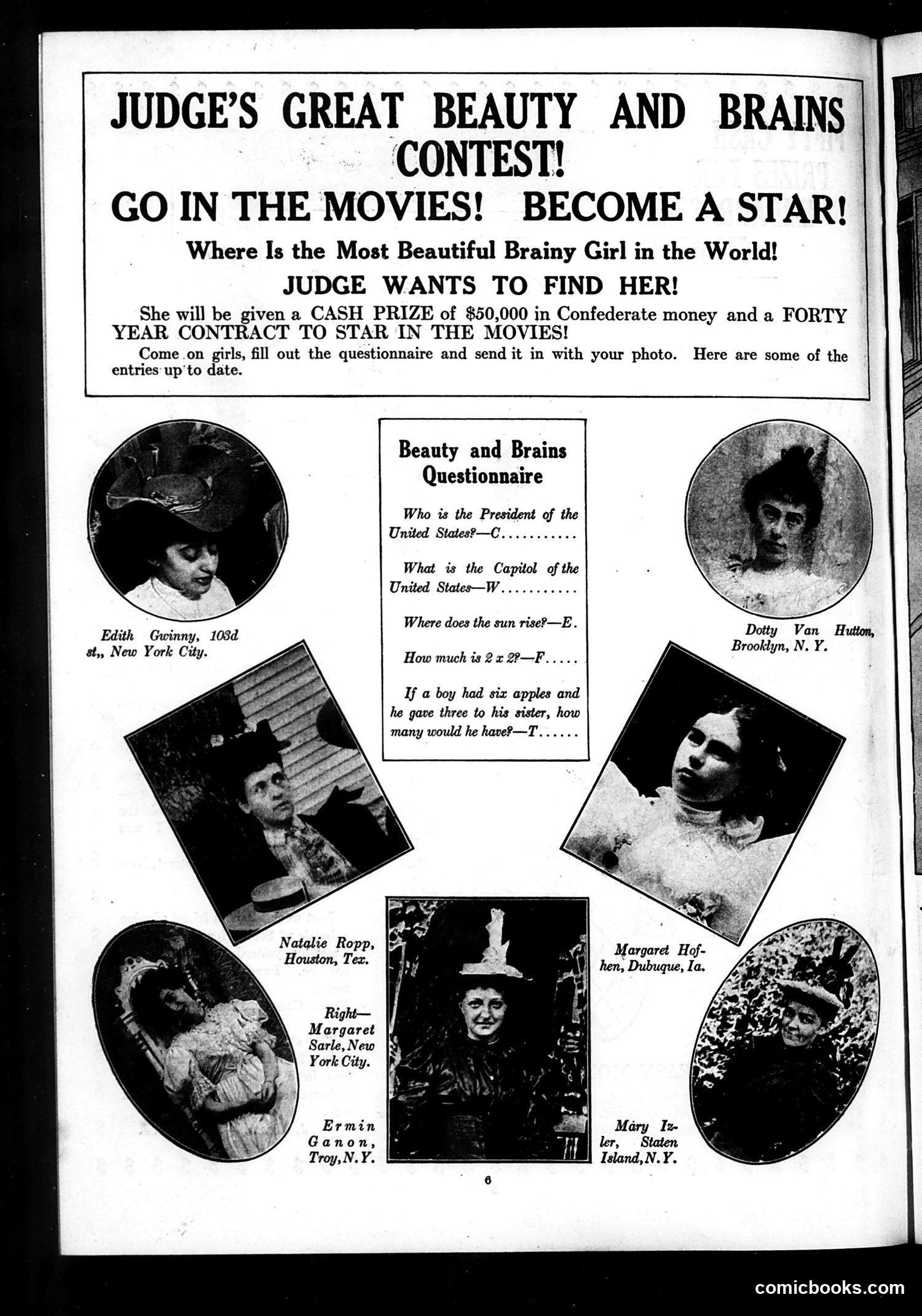
This is a satirical advertisement for a fake beauty pageant. Judge magazine is mocking the emerging film industry's obsession with finding starlets through public contests, while also poking fun at women's intelligence. The humor operates on multiple levels: 1. **The "Confederate money" prize** is the key joke—by 1920s America, Confederate currency was worthless, making the $50,000 prize a cruel punchline about exploitation. 2. **The questionnaire** (asking basic questions like "Who is the President?" and "How much is 2x2?") satirizes how these contests prioritized appearance over actual intelligence, despite marketing themselves as seeking "brainy" girls. 3. The named contestants appear to be real contest entrants, presented for public mockery. The satire targets both the film industry's predatory practices toward women and the absurdity of marketing campaigns that claim to value women's brains while clearly valuing only their appearance.
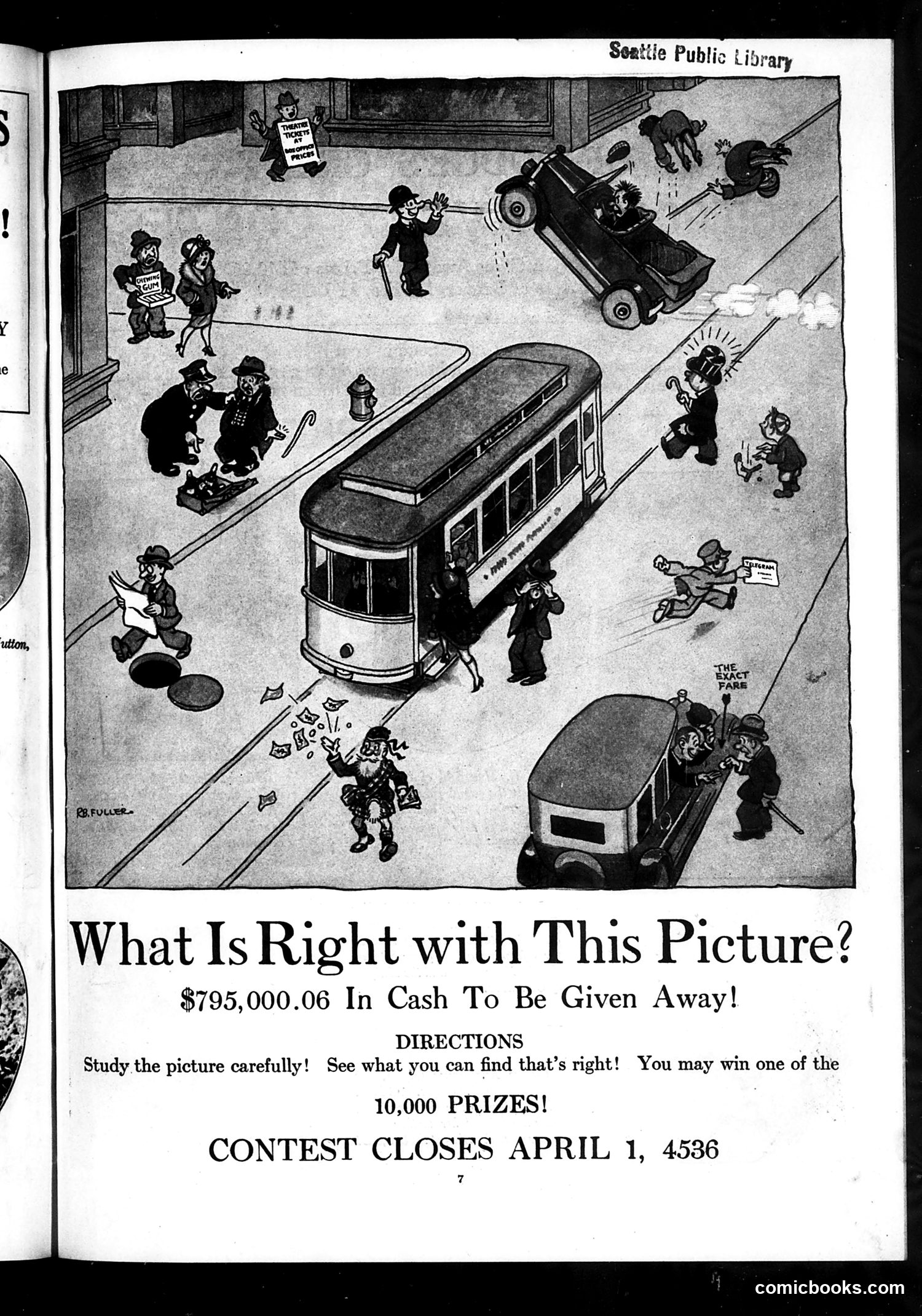
This is a **puzzle/contest advertisement** rather than political satire. Judge magazine is running a "spot the error" game showing a chaotic urban street scene with a streetcar, automobile, pedestrians, and various figures in apparent disarray. Readers are challenged to identify what's "right" (or possibly wrong) with the illustration to win one of 10,000 prizes totaling $795,000.06. The closing date "April 1, 4536" is clearly a joke—an impossibly far future date suggesting this is either humorous or the date itself is part of the puzzle. The cartoon depicts everyday urban life with exaggerated, comedic elements typical of Judge's style, but the satire targets no specific political figure or social movement—it's primarily entertainment and a promotional giveaway for the magazine.
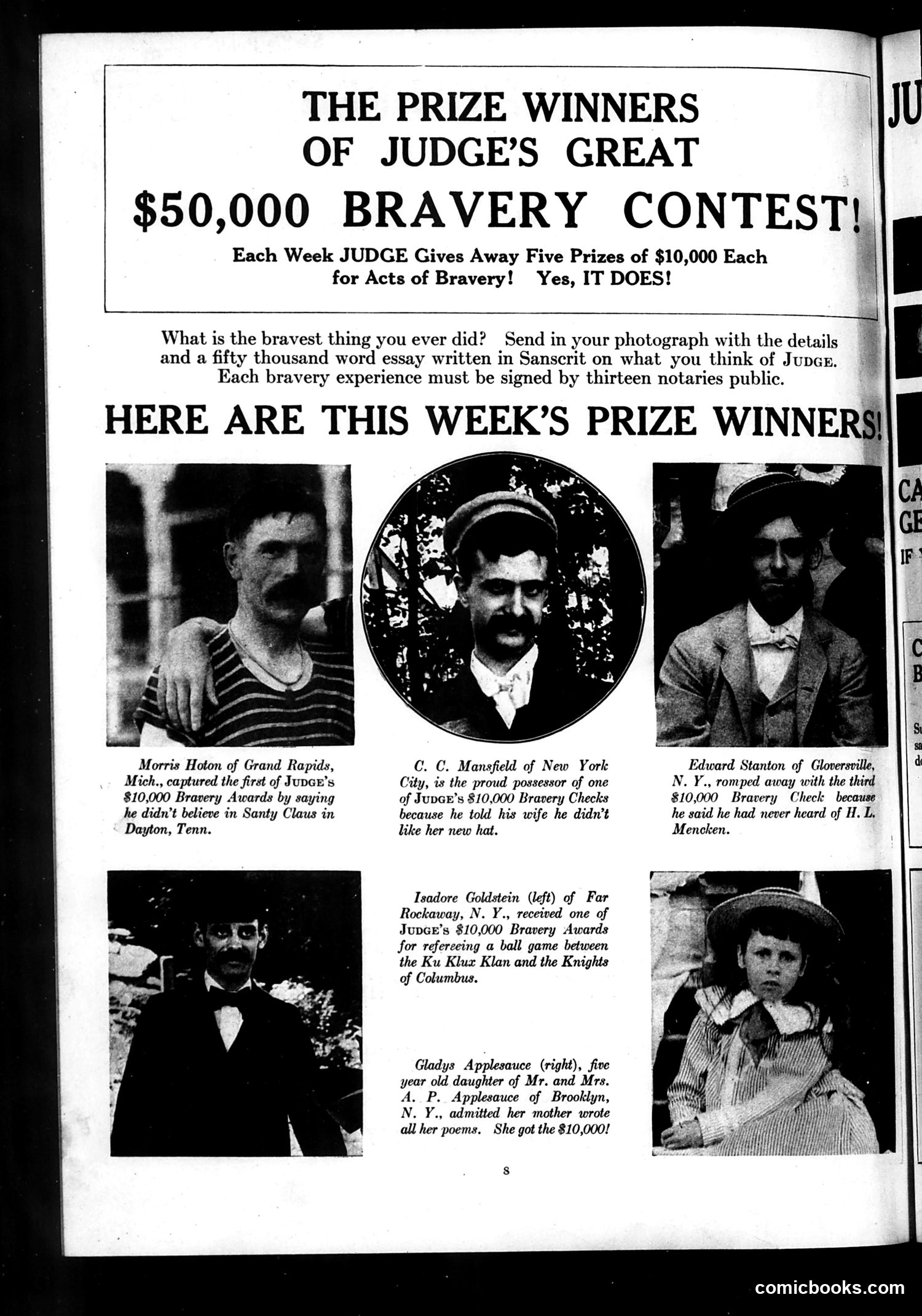
This is a mock advertisement for Judge's satirical "$50,000 Bravery Contest." The humor lies in deliberately absurd definitions of "bravery" that actually describe mundane or ridiculous acts: - Disbelieving in Santa Claus - Telling one's wife you dislike her new hat - Refereeing between the **Ku Klux Klan and Knights of Columbus** (a real Catholic organization)—this is the darkest joke, treating a genuinely dangerous scenario as comic relief - A five-year-old admitting plagiarism - Never hearing of H.L. Mencken (a prominent social critic) The satire mocks both American sensationalism and the triviality of what passes for courage in everyday life. The ridiculous requirements (Sanskrit essays, thirteen notaries) emphasize the absurdity. The Klan reference suggests Judge's audience would find interracial/interfaith conflict darkly amusing rather than genuinely dangerous—reflecting the magazine's era and limitations.
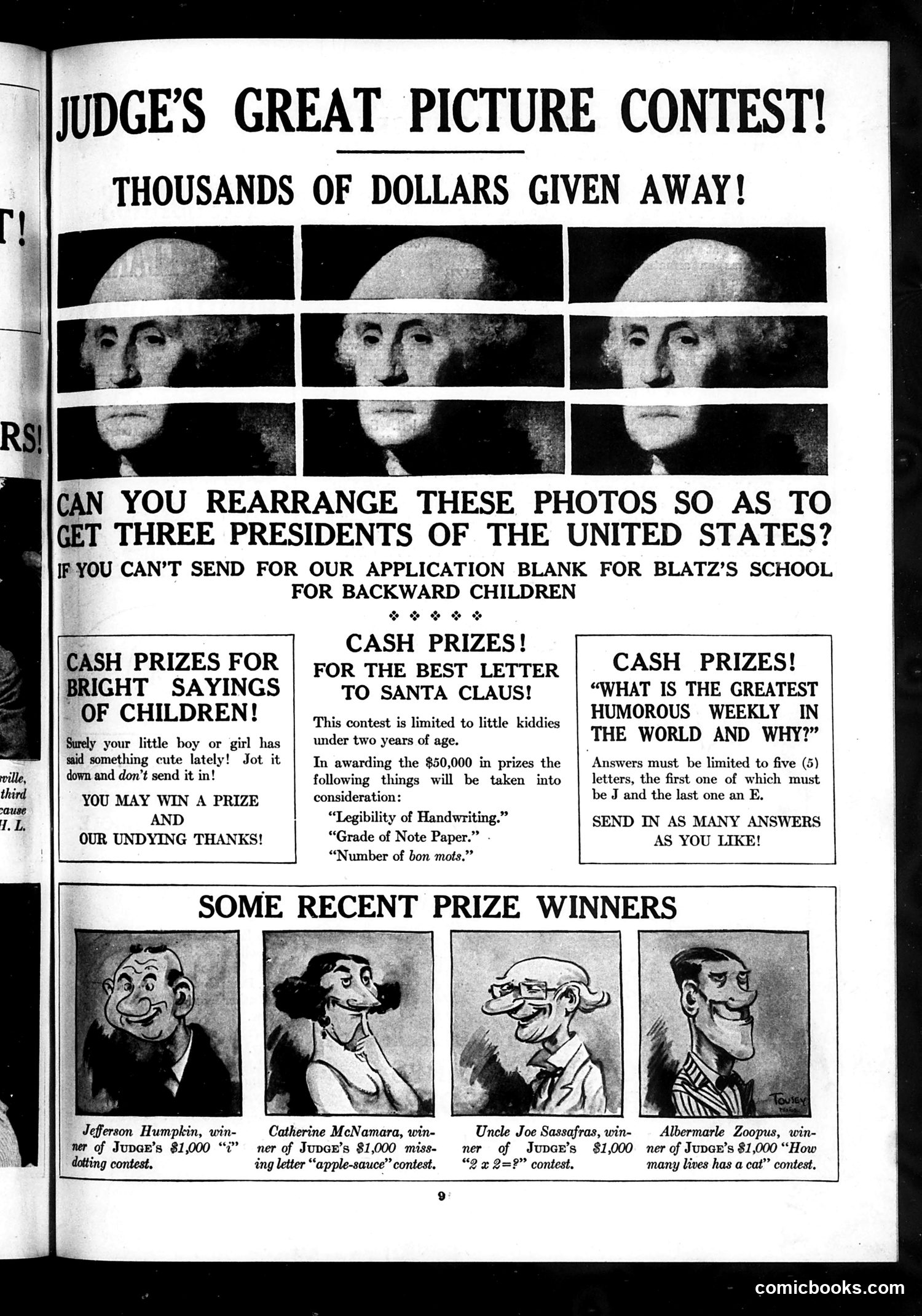
This is a satirical advertisement for Judge magazine's contests. The main joke targets the magazine itself and its readers' intelligence. The centerpiece mocks a "picture puzzle" contest asking readers to rearrange three identical presidential photographs to create three different presidents—an impossible task implying the photos are indistinguishable or that the contest is nonsensical. The cruel punchline suggests contestants who can't solve it should enroll in "Blatz's School for Backward Children." Below are farcical "recent prize winners" with ridiculous names (Jefferson Humpkin, Uncle Joe Sassafras) and absurd contests: a "$1,000 dotting contest," an "apple-sauce" letter contest, and "2+2=2" math puzzle. The satire suggests Judge's own contests are intellectually insulting—designed for children or the mentally deficient—mocking both the magazine's editorial judgment and its audience's gullibility for participating in such frivolous competitions.
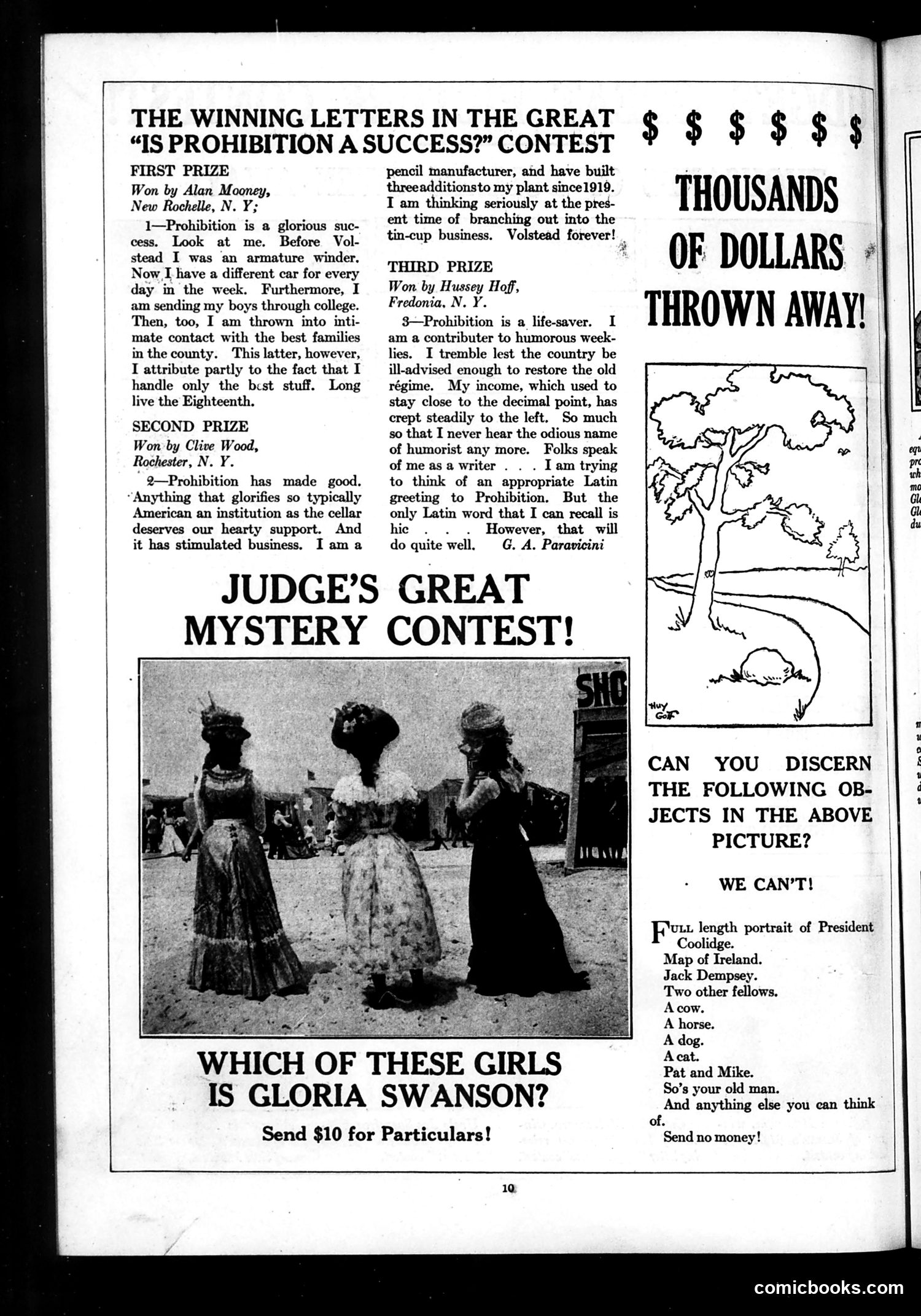
This *Judge* magazine page satirizes Prohibition's claimed success through mock testimonials. Three contest winners ironically describe how Prohibition has enriched them—revealing the satire's actual point: Prohibition created illegal profits. The first winner went from factory worker to owning multiple cars by becoming a bootlegger ("handles only the best stuff"). The second manufactures pencils but jokingly plans a "tin-cup business"—a reference to homeless begging, implying Prohibition's economic chaos. The third is a humorist whose income mysteriously increased since Prohibition, suggesting he profited from satirizing it. The joke: Prohibition's "success" meant criminal enterprise flourished. The Volstead Act (Prohibition's law) nominally failed but enriched those breaking it. The Gloria Swanson mystery contest below is unrelated advertising—a common magazine feature asking readers to identify a hidden celebrity for a prize.
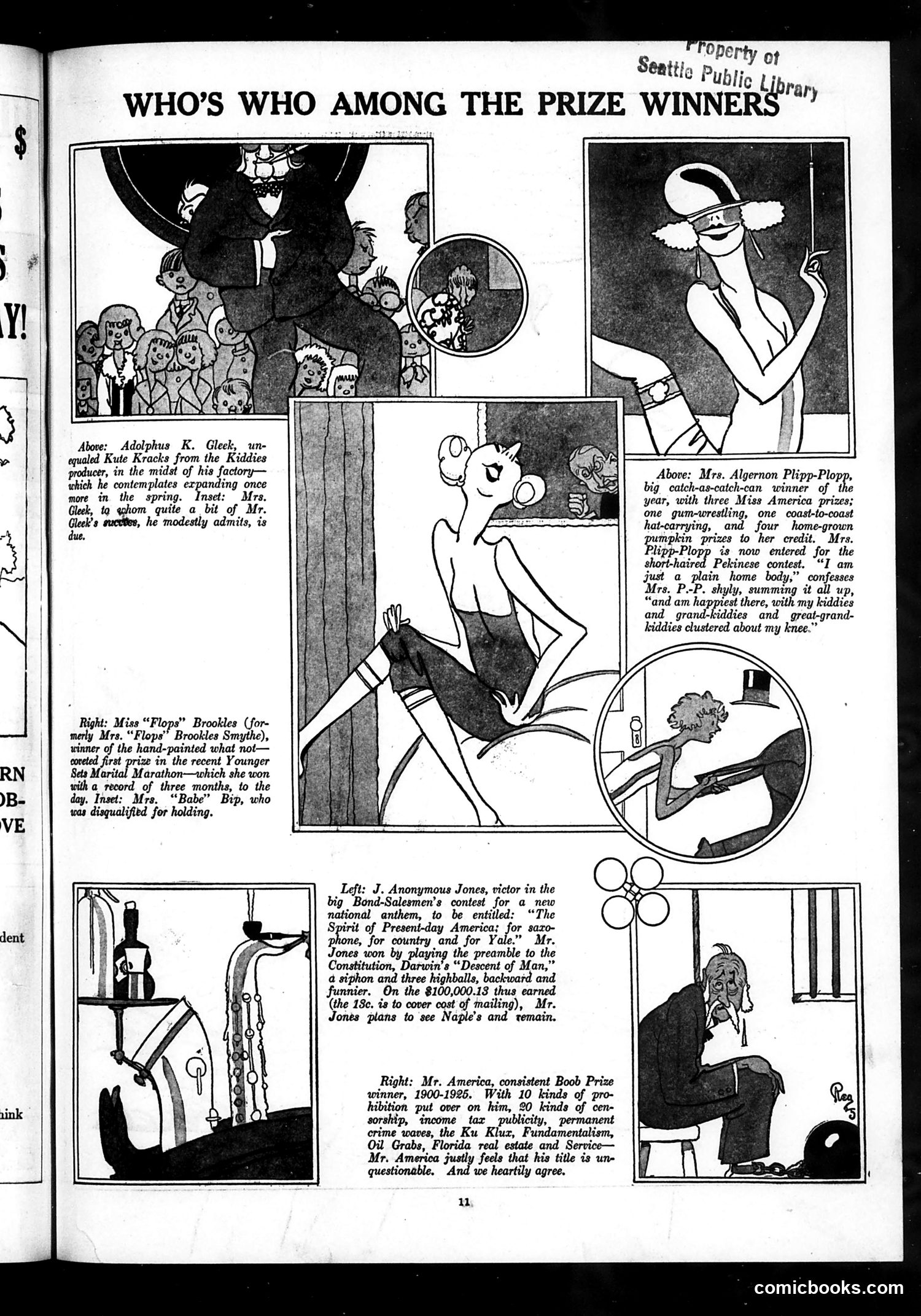
This Judge satire mocks the era's obsession with contests and prizes. Each panel ridicules a different "winner": **Adolphus K. Gleek** manufactures children's jokes ("Kute Kracks"), satirizing mass-produced entertainment and his wife's unacknowledged contribution to his success. **"Flops" Brookles** won a "Marital Marathon"—a thinly-veiled jab at the era's sensationalized endurance contests and frivolous celebrity culture around marriage. **J. Anonymous Jones** won a national anthem contest by randomly mixing the Constitution, Darwin, and cocktails, mocking both artistic judging and pretentious nationalism. **"Mr. America"** is the key target: a consistent "Boob Prize winner" (1900-1926) who profited from financial scams, the KKK, Fundamentalism, and Florida real estate fraud. The satire condemns how American society rewarded charlatans and con artists during the 1920s. The overall point: American culture celebrates the wrong people—hucksters, frauds, and mediocrity.
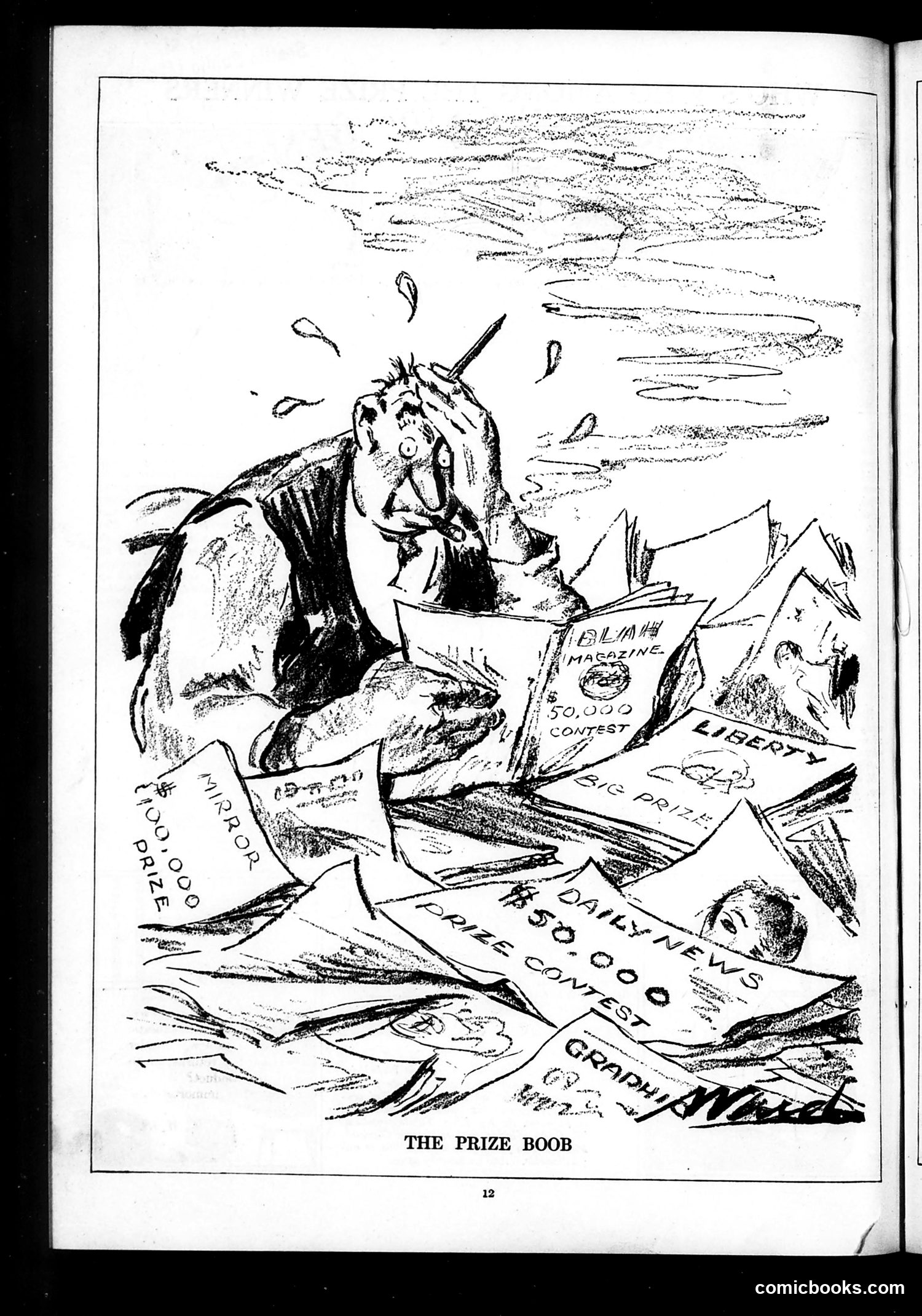
This cartoon satirizes what appears to be a foolish person ("boob" being period slang for idiot) who is literally buried under contest promotions and magazine advertisements. The figure—depicted with an exaggerated, foolish expression—is surrounded by visible text including "OLYMPIAD MAGAZINE," "50,000 CONTEST," "LIBERTY," "BIG PRIZE," "$50 DAILY NEWS PRIZE CONTEST," and "GRAPHIC PRIZE CONTEST." The satire targets people who obsessively chase magazine contests and promotional giveaways, suggesting they're gullible marks for publishers' marketing schemes. The protagonist is literally overwhelmed by—and perhaps won over by—the endless parade of prize contests that magazines used to attract and retain readers. It's a commentary on both consumer credulity and aggressive commercial advertising tactics of the era.
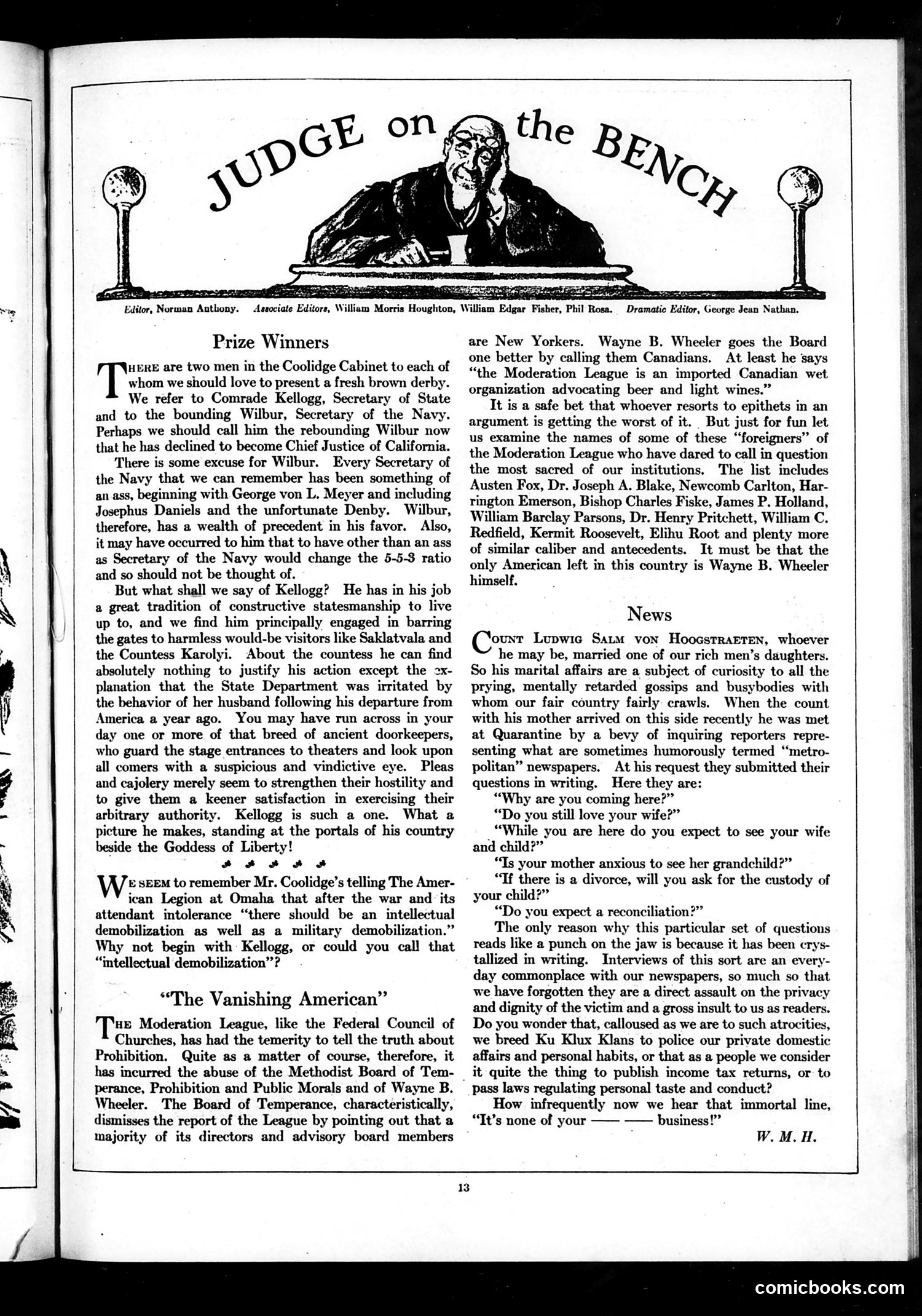
This page from Judge magazine (1920s, during Coolidge presidency) contains political satire on three topics: **"Prize Winners"**: Mocks Secretary of State Frank Kellogg and Secretary of the Navy Wilbur, calling them incompetent. Kellogg is particularly criticized as a petty bureaucrat denying entry to harmless visitors (like Saklatvala and Countess Karolyi) rather than conducting serious diplomacy. The author sarcastically suggests he embodies failed "intellectual demobilization" that Coolidge promised post-WWI. **"The Vanishing American"**: Defends the Moderation League (which questioned Prohibition) against attacks from Wayne B. Wheeler and the Methodist Board of Temperance. Wheeler accused the League of being Canadian and "wet." Judge ridicules this by listing the League's members—prominent Americans like Kermit Roosevelt and Elihu Root—suggesting Wheeler himself is the only un-American figure present. The satire targets Prohibition enforcement zealotry and diplomatic incompetence under Coolidge.
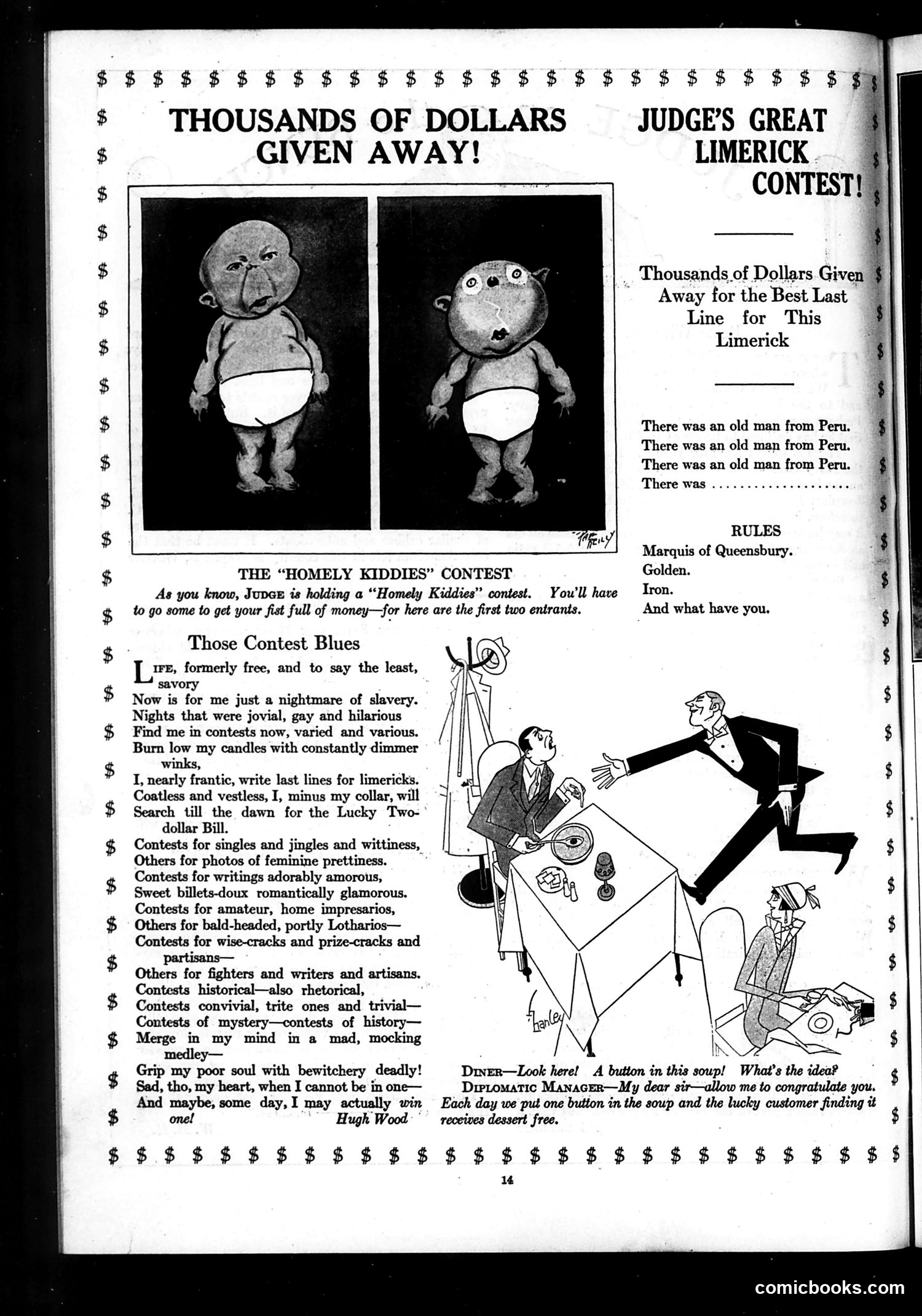
This page showcases Judge magazine's promotional contests circa the 1920s-30s. The "Homely Kiddies" contest features deliberately ugly baby caricatures competing for cash prizes—a tongue-in-cheek humor typical of the era. The accompanying poem "Those Contest Blues" by Hugh Wood satirizes the magazine's contest obsession itself, with a writer exhausted from constantly entering limericks, jingles, and various competitions for meager prizes ("the Lucky Two-dollar Bill"). The right-hand limerick contest invites readers to complete: "There was an old man from Peru..." The "Dinner" vignette at bottom satirizes a restaurant's gimmick: hiding buttons in soup bowls so lucky diners win free dessert—absurdist advertising humor. Overall, the page mocks both Judge's relentless use of contests to boost readership and the public's desperate participation in them. The satire targets Depression-era economic anxiety masked by entertainment culture.
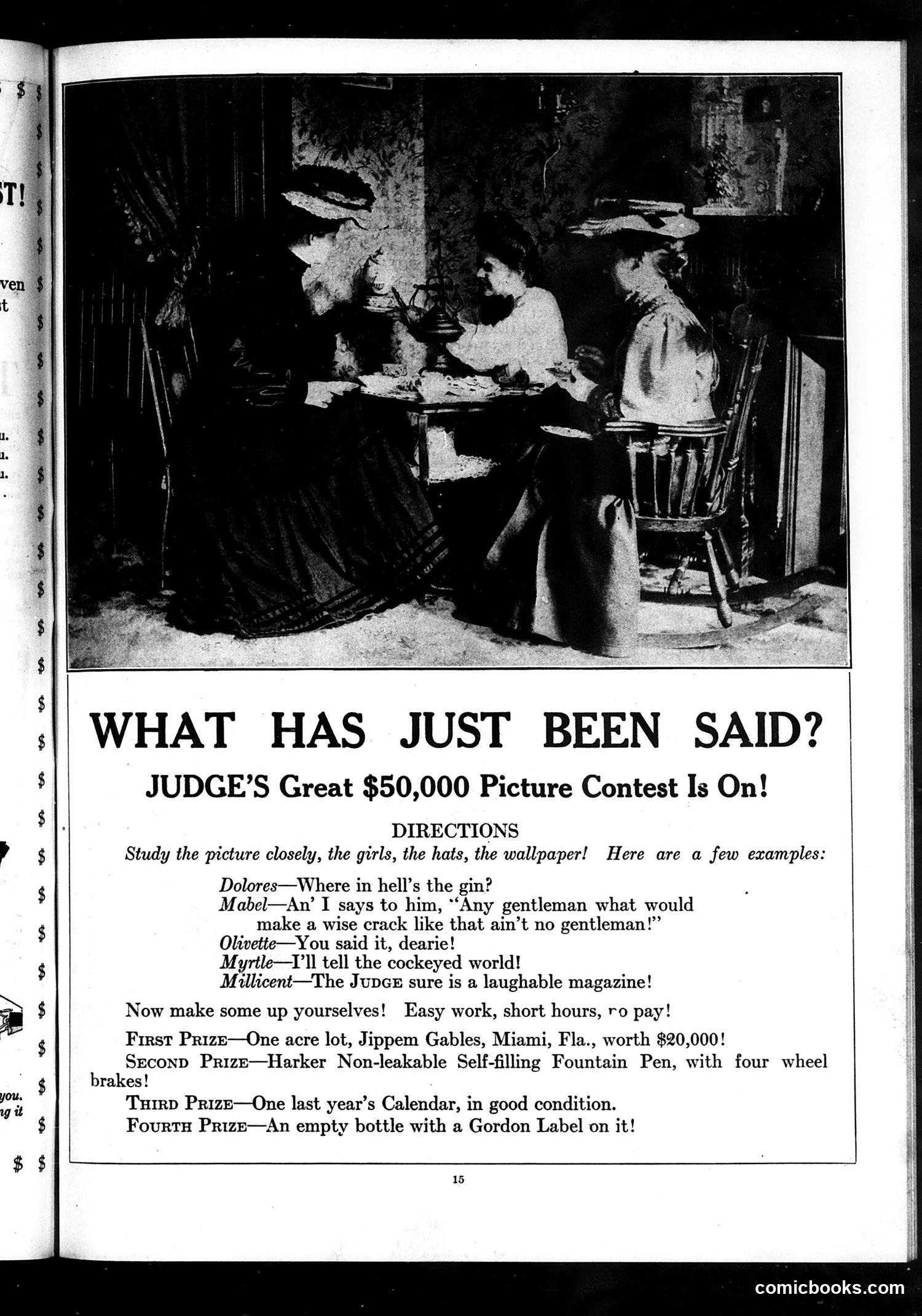
This is a **reader participation contest**, not a political cartoon. Judge magazine presents a black-and-white photograph showing what appears to be women in an interior scene, then challenges readers to caption it—to guess "what has just been said?" The example captions reveal the contest's satirical humor: they feature working-class or "modern woman" dialogue with period slang ("cockeyed world," "dearie"), including references to alcohol ("Where in hell's the gin?") and sarcastic jabs at masculinity and magazine quality. The **prizes are deliberately absurd and satirical**: the "first prize" (an acre in Miami) appears legitimate, but the lower prizes devolve into worthless items—a fountain pen, old calendar, and empty liquor bottle. This mock-serious descent into joke prizes satirizes typical magazine contests. The piece mocks both **Prohibition-era anxieties** (casual drinking references) and emerging **20th-century "modern woman"** culture with frank, slangy speech. Readers were invited to submit their own captions for a contest that was itself partly a joke at the magazine's own expense.
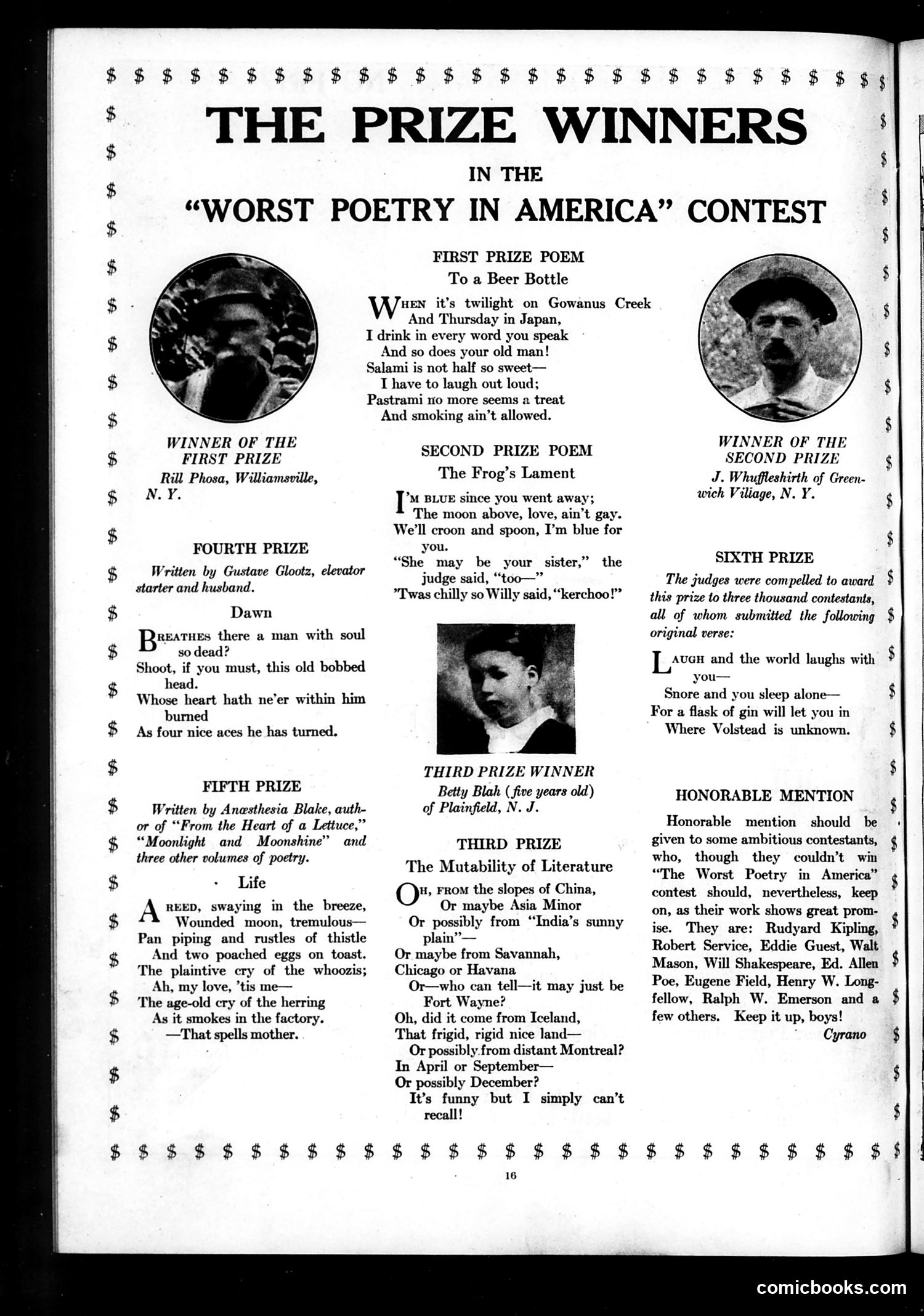
This is a satirical humor piece from *Judge* magazine mocking both bad amateur poetry and established literary pretension. The contest presents genuinely awkward, nonsensical verses as "prize winners"—like a five-year-old's entry and poems with absurd imagery (poached eggs paired with wounded moons). The satire cuts multiple ways: it ridicules amateur poets who submit terrible work seriously, while the "Honorable Mention" section—listing canonical poets like Shakespeare, Kipling, and Poe as those who "couldn't win"—suggests that even great literature might be considered bad depending on judges' standards. The sixth prize's reference to "Volstead" (Prohibition enforcement) adds topical humor about illegal drinking. The overall joke: poetry judgment is subjective and often ridiculous. By treating incompetent verse as prize-worthy, *Judge* deflates literary snobbery and the pretentiousness of poetry contests themselves.
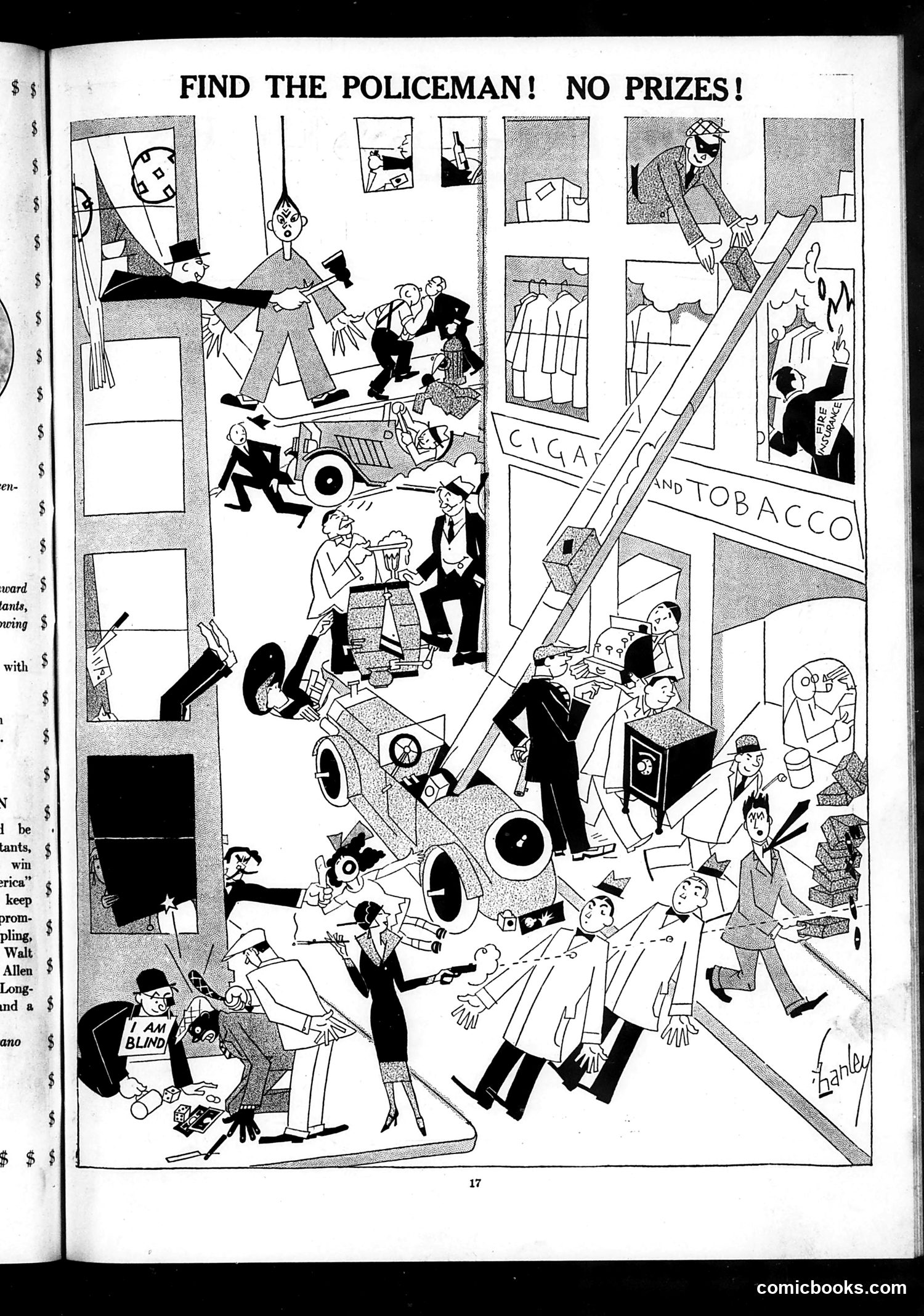
This is a visual puzzle-game where readers must locate a hidden policeman amid a chaotic street scene. The cartoon satirizes urban disorder and lawlessness—a busy street corner shows crowds, vehicles, and commerce (notably a "Cigars and Tobacco" shop) in apparent disarray, with a blind beggar marked "I AM BLIND" visible at lower left. The humor lies in the challenge: finding law and order ("the policeman") proves nearly impossible in this anarchic urban landscape. This likely reflects early 20th-century anxieties about crime, crowded cities, and inadequate police presence. The "no prizes" subtitle adds ironic commentary—even locating authority offers no reward or solution to society's disorder. The puzzle format makes the social critique playful rather than preachy.
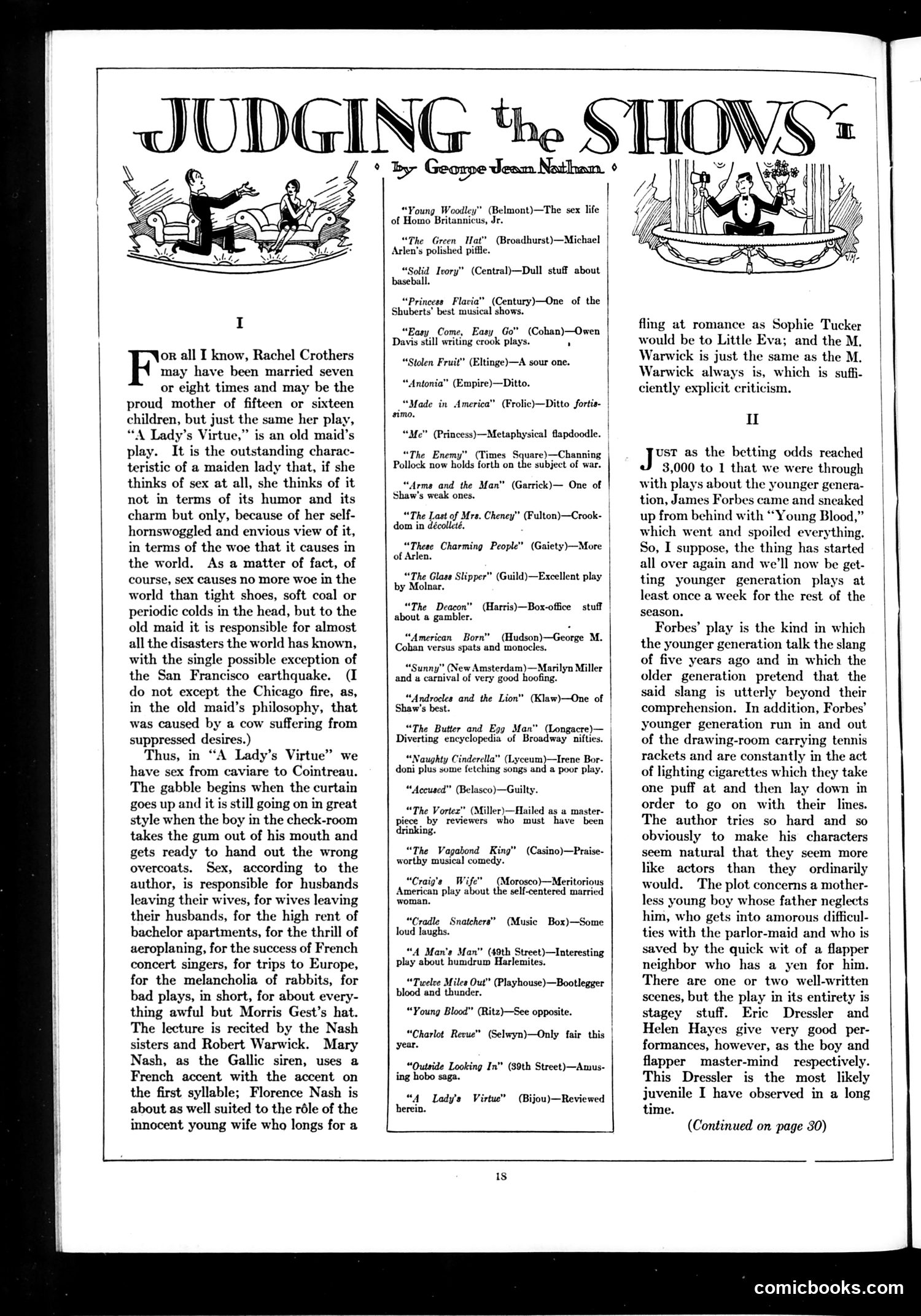
This page features theater critic George Jean Nathan's review of "A Lady's Virtue," a play by Rachel Crothers starring the Nash sisters and Robert Warwick. Nathan mocks the play as embodying "old maid" sensibilities—obsessed with sex as a source of worldly woe rather than humor or charm. He sarcastically argues the author blames sex for everything from broken marriages to bad plays to Chicago's Great Fire. The cartoon's point: Nathan ridicules Crothers' moralistic approach to sexuality on stage. His hyperbolic critique (sex causes "no more woe...than tight shoes") aims to deflate what he sees as prudish, overwrought preaching masquerading as sophisticated theater. The accompanying list of current Broadway shows provides context for competitive theatrical offerings of the era.
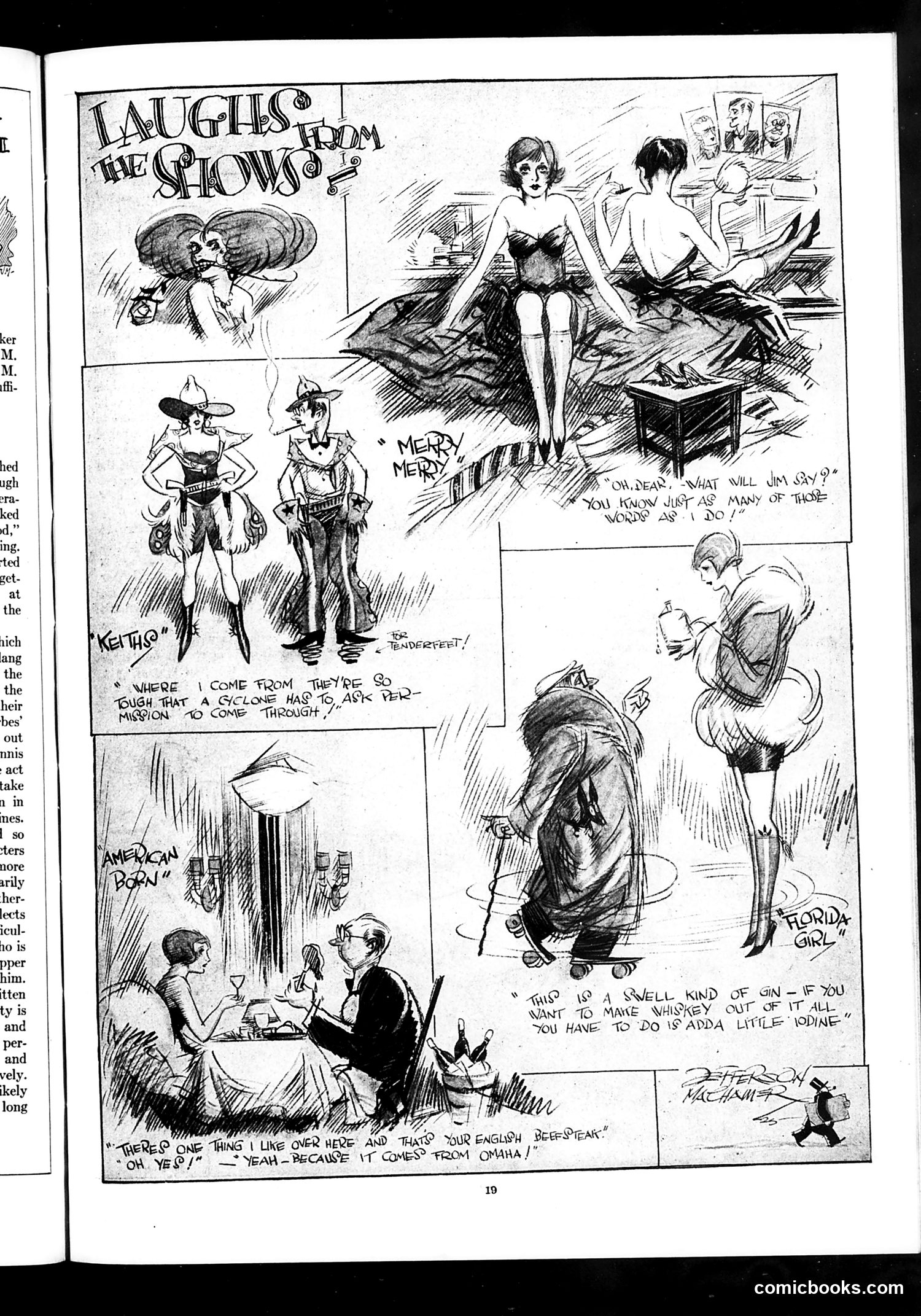
This page presents satirical sketches about immigrants and American culture during the early 20th century. The humor relies on ethnic stereotypes and accent-based comedy common to the era. The main narrative involves characters discussing regional origins and cultural differences. References include "American Born" (contrasting immigrant vs. native identity), "Omaha" (suggesting Midwestern American authenticity), and dialogue about whiskey-making and gin—likely alluding to Prohibition-era bootlegging. The "Ketchup" and "Florida Girl" labeled figures suggest regional American types being mocked. The dialogue emphasizes broken English and malapropisms ("beefsteak" English), portraying immigrants as ignorant outsiders confused by American customs. The overall satire targets immigrant unfamiliarity with American ways while simultaneously mocking American pretensions about sophistication. The sketches exemplify Judge magazine's typical content: class-based and ethnicity-based humor presented as entertainment for mainstream American readers.
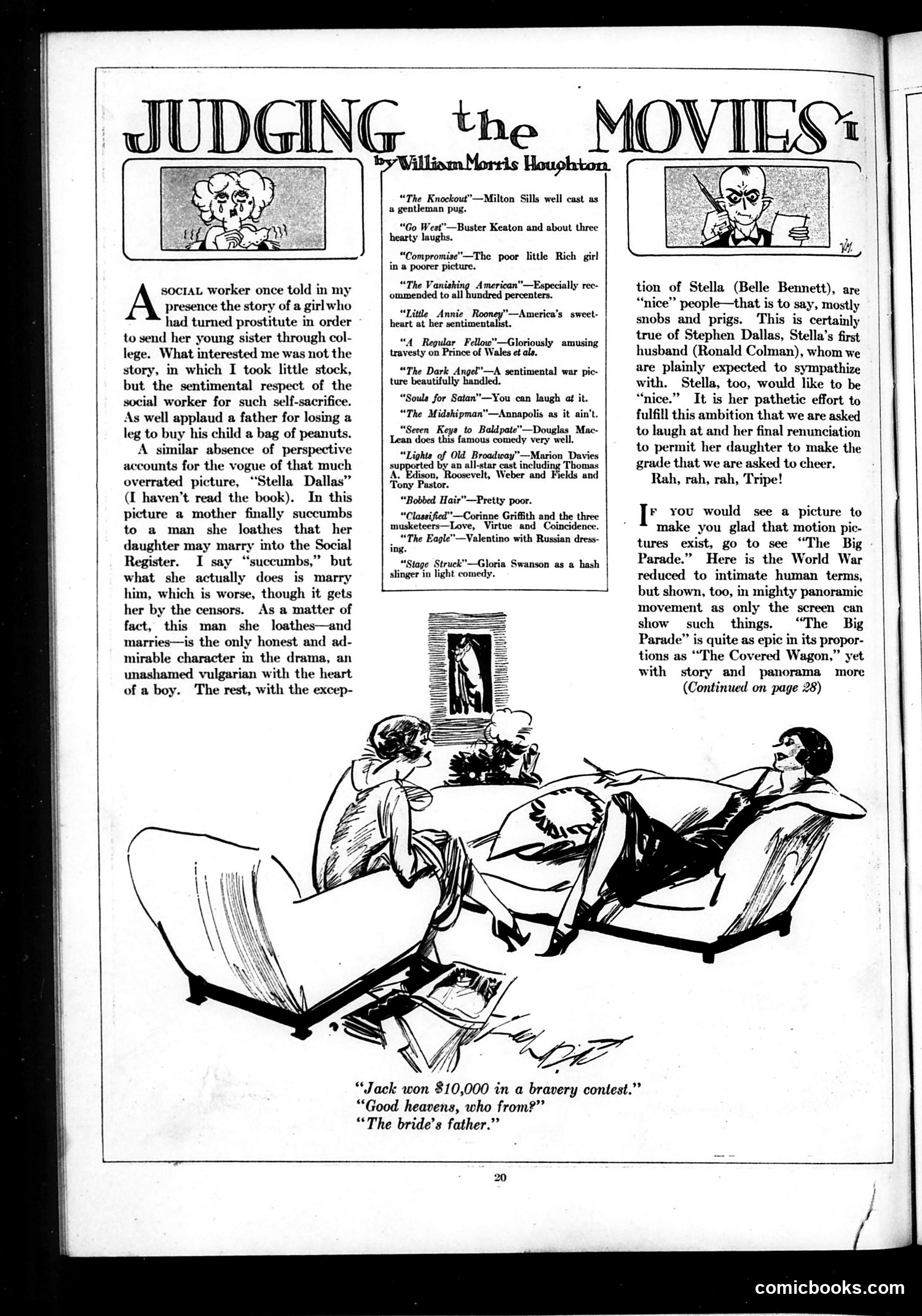
This page contains a film review column critiquing contemporary movies. The main article attacks the sentimentality of "Stella Dallas," a popular film about a working-class mother who sacrifices her reputation by marrying a man she despises so her daughter can marry into the upper class. Houghton argues this narrative celebrates misguided self-sacrifice and class-climbing snobbery rather than genuine virtue. He notes ironically that the only admirable character—the "vulgarian" the mother marries—is portrayed negatively, while the "nice" characters are actually self-serving snobs. The cartoon below depicts two women lounging while discussing a bravery contest winner ("the bride's father"), mocking the film's absurd plot logic. The right column lists brief reviews of other current releases, including mentions of Buster Keaton, Gloria Swanson, and Rudolph Valentino, establishing this as contemporary 1920s criticism.
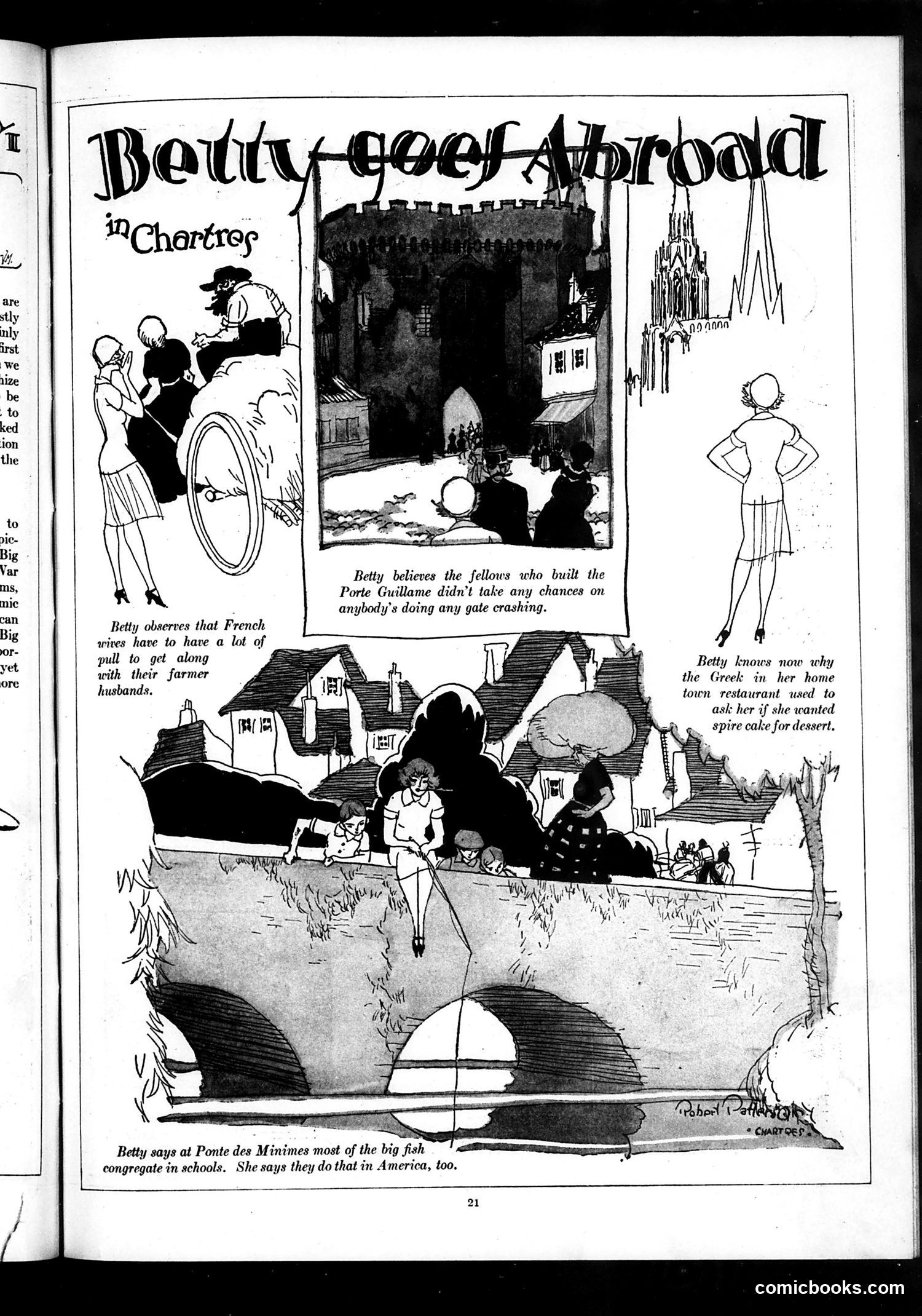
This is a travel humor comic strip following an American woman named Betty touring French locations. The satire relies on fish-out-of-water observations: **The jokes:** - At the Porte Guillame (a medieval fortified gate in Chartres), Betty quips that the narrow gate-opening prevents "gate crashing"—a pun on both literal gate design and the American slang term for sneaking into events uninvited. - Observing French wives must have "pull" to manage farmer husbands—likely satirizing French rural marriage dynamics as requiring political maneuvering. - At a restaurant, a Greek owner asked about spire cake (presumably a local specialty), which Betty now understands was a cultural misunderstanding. - The final panel compares fish congregating in schools at Ponte des Minimes to wealthy people ("big fish") gathering in exclusive American social circles. The strip uses Betty's naive American perspective to gently mock both French culture and American pretension.
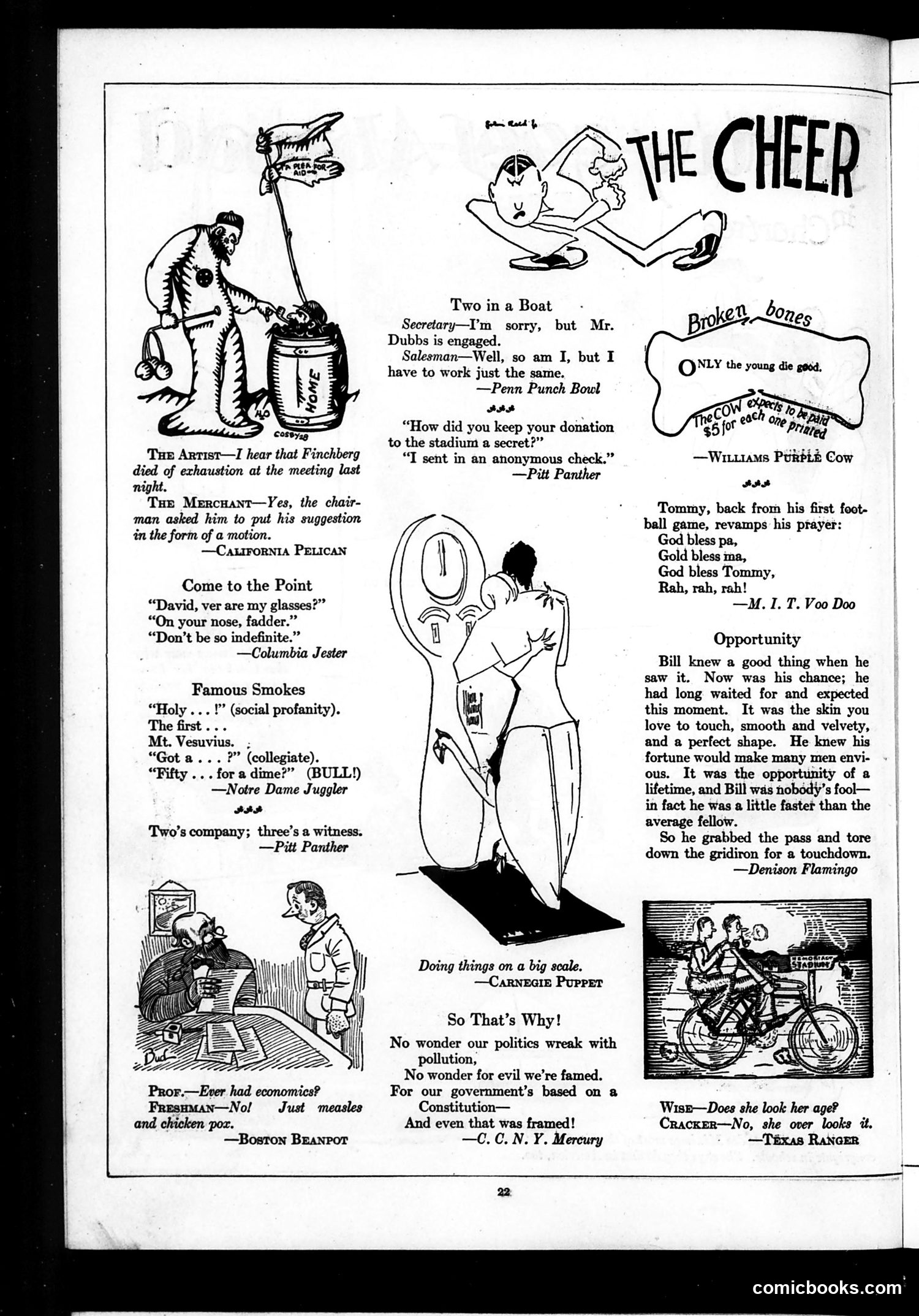
This is a humor page from *Judge* featuring short jokes and cartoons from college publications. The content is mostly collegiate humor with minimal political satire. **Key items:** - **"So That's Why!"** is the main political piece, a cynical joke blaming America's governmental corruption on the Constitution itself being "framed" (a pun on both creation and deception). This critiques systemic corruption as inherent to the system. - Most other content is apolitical college humor: jokes about economics classes, engagements, anonymous donations, football, and dating. - The cartoons appear to be reprints from university humor magazines (Penn Punch Bowl, Notre Dame Juggler, etc.), suggesting *Judge* regularly featured collegiate wit. - One illustration shows a large telephone receiver with a man using it, captioned "Doing things on a big scale"—likely mocking excessive modern technology or communication. The page reflects 1920s-30s humor sensibilities: wordplay, mild social observation, and occasional cynicism about institutions, rather than sharp political commentary.
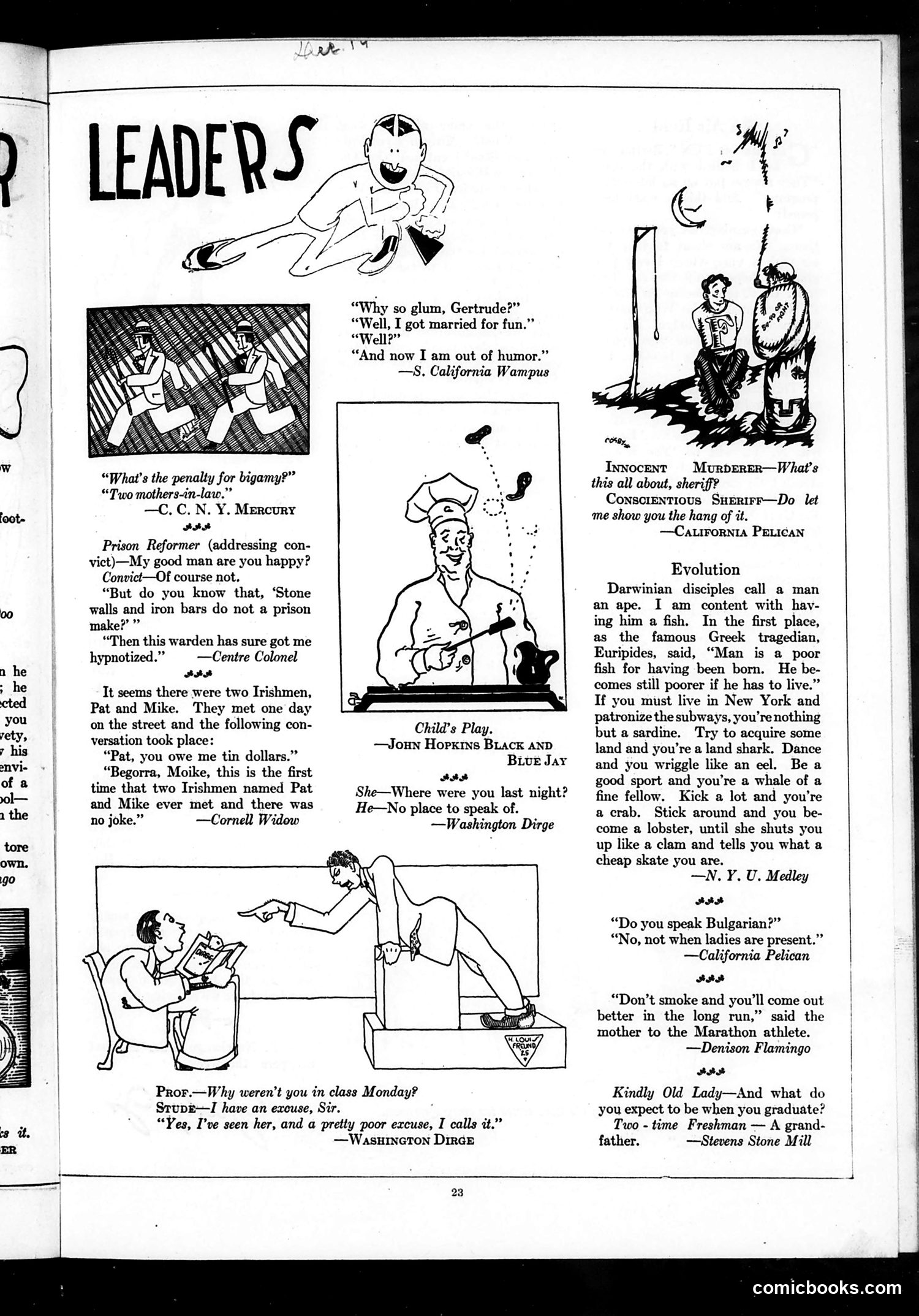
This page collects brief jokes and cartoons from various college humor magazines (Cornell Widow, N.Y.U. Medley, etc.), typical of Judge's format in the early 20th century. **Key content:** The jokes satirize contemporary social situations: bigamy, prison reform, Irish stereotypes, courtship misunderstandings, and academic life. The "Evolution" piece parodies Darwinian theory by humorously comparing modern urban living to fish—New York subway riders are "sardines," dancers "eels," complainers "crabs." This reflects early 20th-century anxieties about industrial city life. **The cartoons** illustrate typical scenarios: a prison reformer's idealism clashing with convict cynicism, a man caught in infidelity, a professor skeptical of student excuses. The humor relies on wordplay, mild social observation, and gentle mockery of contemporary life rather than sharp political commentary. The sourcing from college publications reflects Judge's practice of republishing collegiate humor, making this representative of 1920s-era comedy sensibilities.
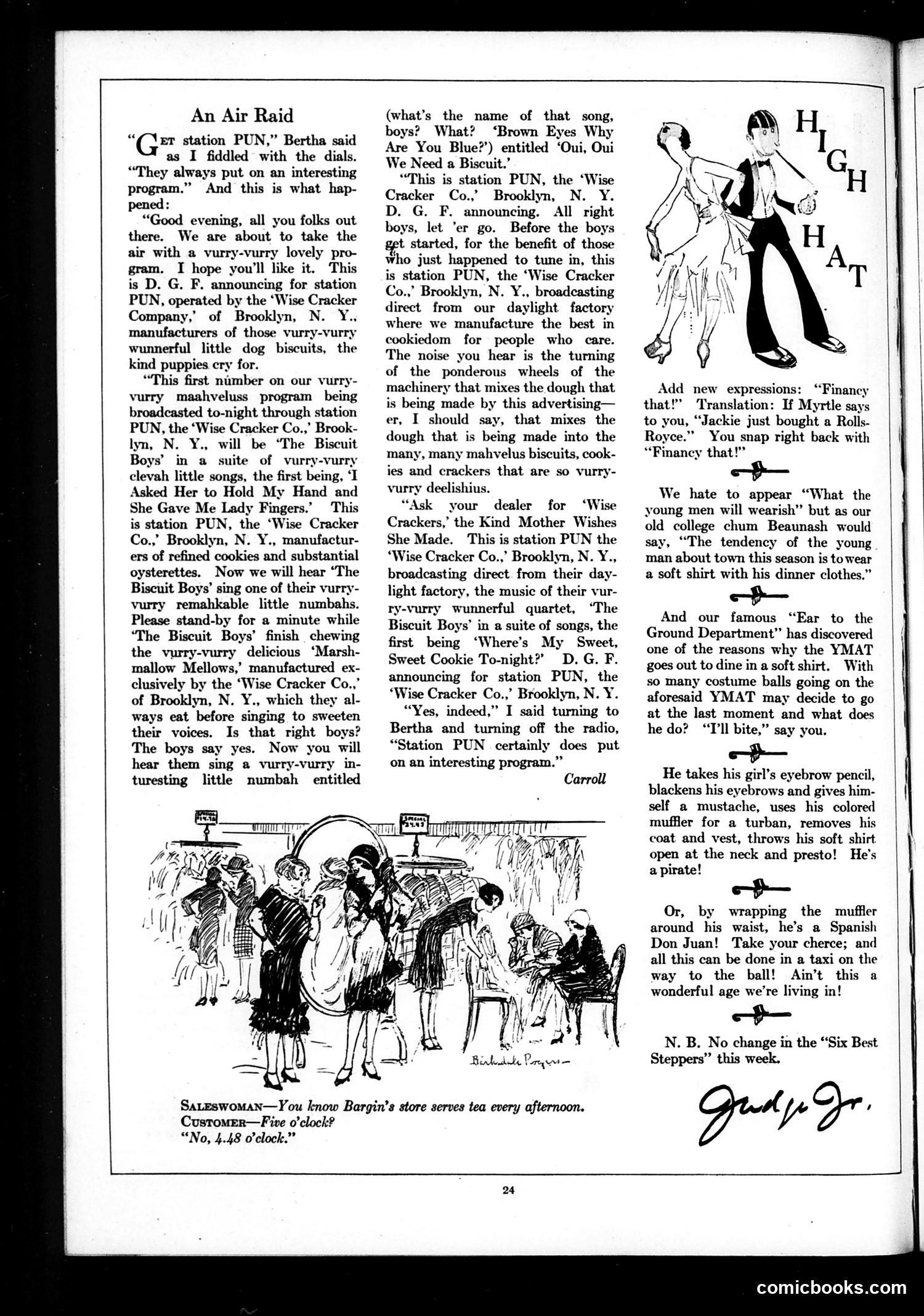
This piece satirizes aggressive radio advertising of the 1920s-30s. The "air raid" is metaphorical: a relentless barrage of product placement from a fictional "Wise Cracker Company" cereal manufacturer broadcasting through station PUN. The humor targets how advertisers interrupt entertainment with repetitive, intrusive commercial messages. The announcer constantly restarts the product name and company details mid-broadcast, acknowledges chewing delays, and admits the "advertising" is disrupting the actual content. His exaggerated accent ("vurry," "mahveluss") parodies affected radio personalities. The bottom panel, about a store clerk's confusing tea time ("4.48 o'clock"), is unrelated humor about absurd customer interactions. The right column's fashion commentary about young men wearing soft shirts is likewise separate contemporary social observation, not connected to the main satire.
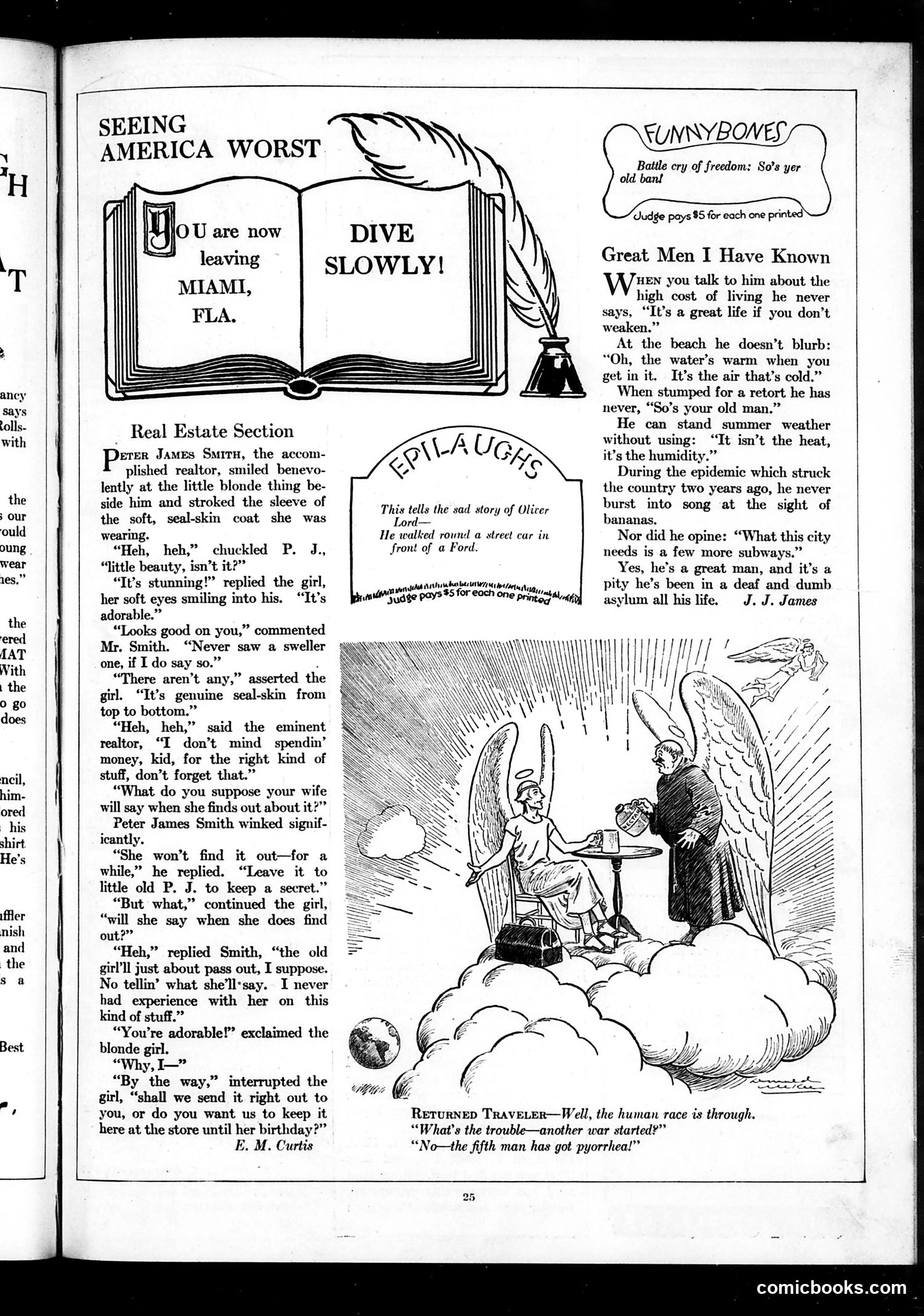
This page contains two distinct satirical pieces: **"Real Estate Section"** (left): A morality tale mocking infidelity among the wealthy. Realtor Peter James Smith flirts with and buys a young blonde woman a luxurious seal-skin coat, assuming his wife won't discover it. The joke's payoff occurs when the girl suggests they deliver it to his home "until her birthday"—implying his wife will inevitably find out, exposing his deception. The satire targets duplicitous wealthy men who believe they can hide affairs and lavish spending. **"Returned Traveler"** (bottom right): A cartoon showing angels or heavenly figures discussing humanity's fate. One concludes "the human race is through," blaming not war but rather that "the fifth man has got pyorrhea" (a gum disease). This absurdist joke satirizes contemporary anxieties about disease and decay, using exaggeration to mock public health concerns of the era. The "Great Men I Have Known" column offers humorous observations about a man notable for *not* using tired clichés.
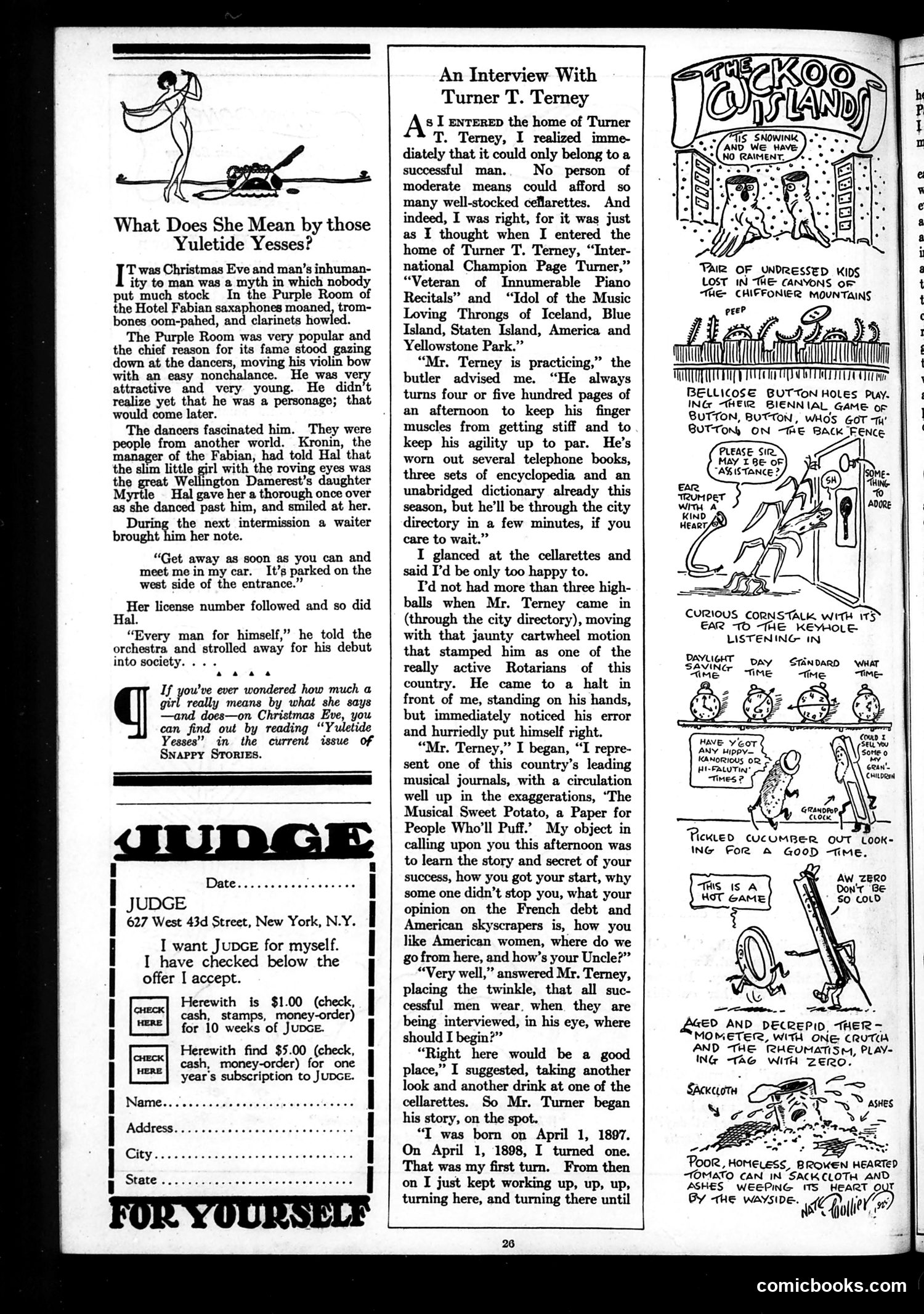
This page contains two unrelated pieces: a short story advertisement and a satirical interview. **"Yuletide Yesses"** advertises a romantic story in *Snappy Stories* magazine, hinting at mysterious female signals during Christmas Eve—a period known for romantic encounters and social license. **"An Interview with Turner T. Terney"** satirizes self-important minor celebrities and hollow success. Terney is a "Page Turner"—someone who turns pages at piano recitals—a genuinely minor profession inflated with absurd titles ("International Champion," "Idol of Music Loving Throngs"). The joke mocks people with trivial accomplishments who act grandiose and surround themselves with status symbols (multiple "cellarettes"—small liquor cabinets). The interviewer from a fictional pretentious magazine asks ridiculous questions about French debt and skyscrapers, highlighting how vapid celebrity interviews are. Terney's cartwheel entrance and standing-on-hands pose mock theatrical pretension. The satire targets America's tendency to celebrate mediocrity and create false celebrities.
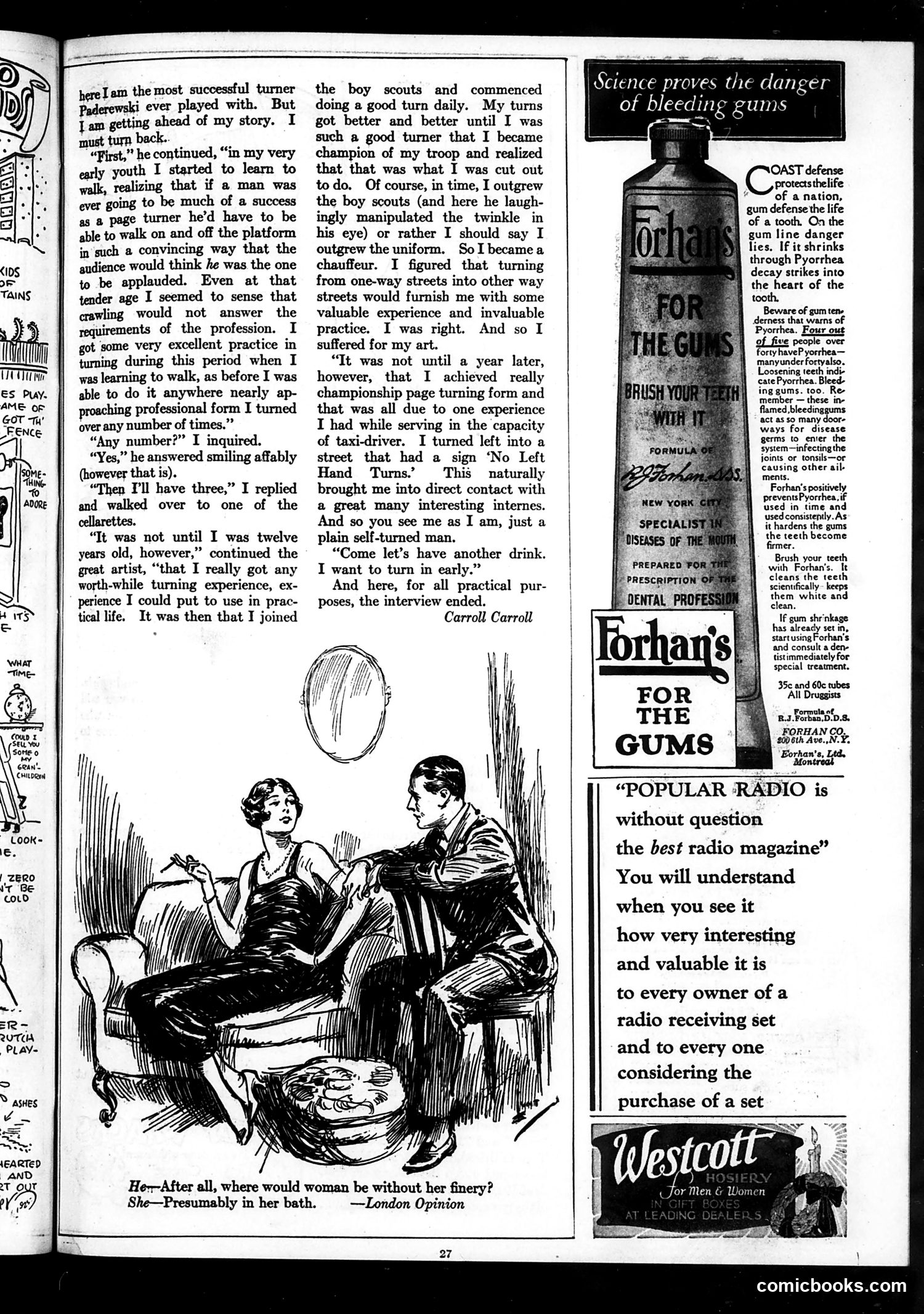
This page contains a humorous interview piece by Carroll Carroll about a professional "page turner"—someone who turns pages for musicians during performances. The satire plays on the phrase "turning" through multiple meanings: literal page-turning, making turns while driving (taxi driver, chauffeur), and idioms like "turning in" (going to bed). The joke relies on treating this minor, invisible profession with mock-seriousness, complete with elaborate origin story, professional development, and hard-won expertise. The cartoon below shows a couple in conversation, with a London Opinion caption making a dated joke about women's vanity regarding cosmetics and bathing. The right side contains period advertisements for Forhan's gum treatment (warning about pyorrhea/gum disease), Popular Radio magazine, and Westcott products—typical early 20th-century advertising content reflecting contemporary health and consumer concerns.
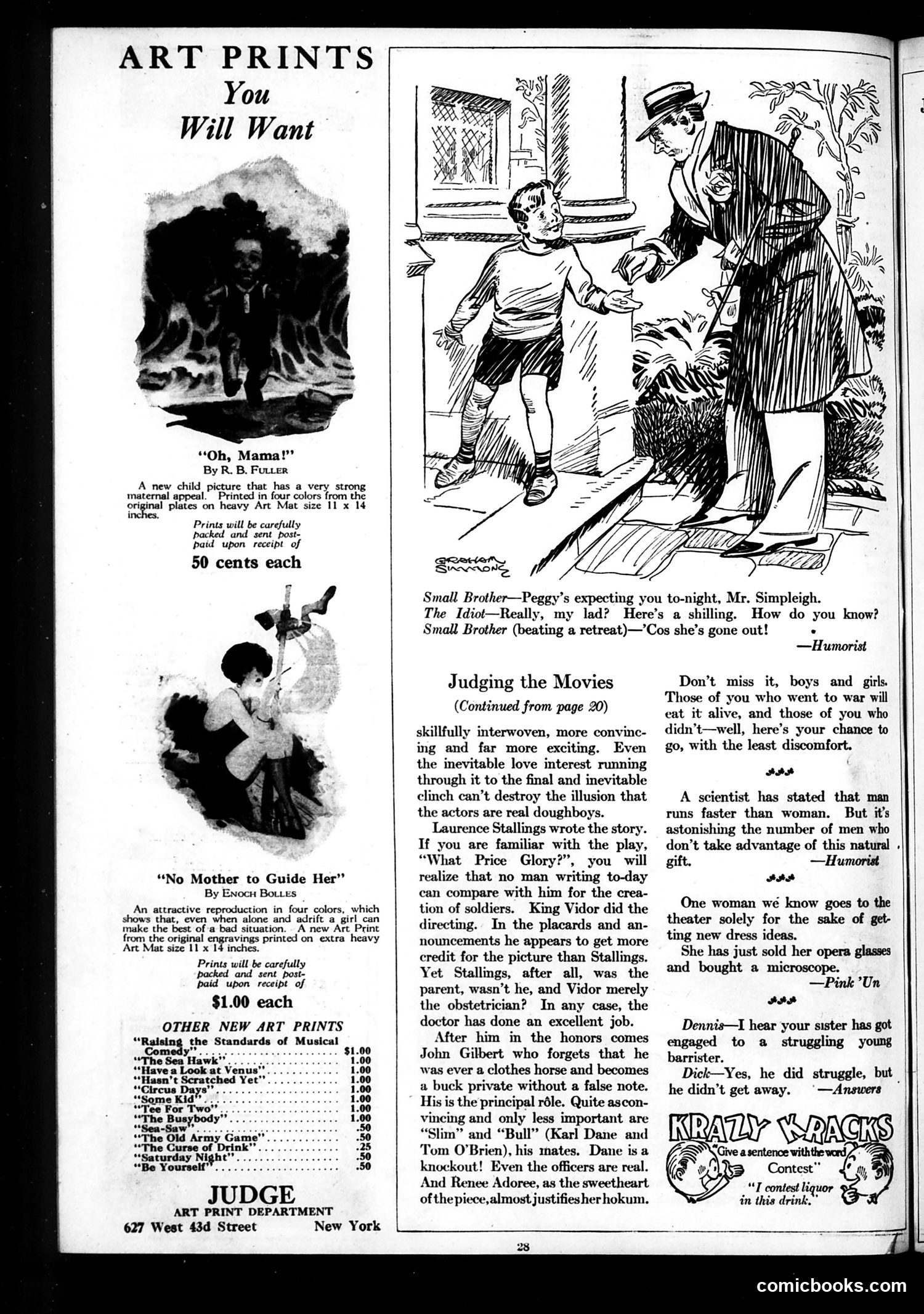
This is primarily an **advertising and humor page** from Judge magazine, likely from the 1920s. **Main Content:** The page advertises art prints for sale, including sentimental domestic scenes like "Oh, Mama!" and "No Mother to Guide Her"—typical Victorian-era imagery marketed to middle-class homes. **The Cartoons:** A small comic strip titled "Small Brother" depicts a child delivering a message to an adult suitor, with the punchline revealing the girl has stood him up ("she's gone out"). It's gentle domestic humor about romantic disappointment. **"Judging the Movies" Section:** This reviews "What Price Glory?"—apparently a WWI military film based on Laurence Stallings' play. The critic praises its authenticity and the performances, particularly John Gilbert's transformation from "clothes horse" (fashion plate/pretty boy) to convincing soldier. The review credits screenwriter Stallings over director King Vidor. **Additional Humor Snippets:** Brief one-liners about gender differences, theater-goers, and romantic entanglements—typical magazine filler humor of the era. The page reflects 1920s middlebrow culture: sentimental domesticity, new cinema appreciation, and light social satire.
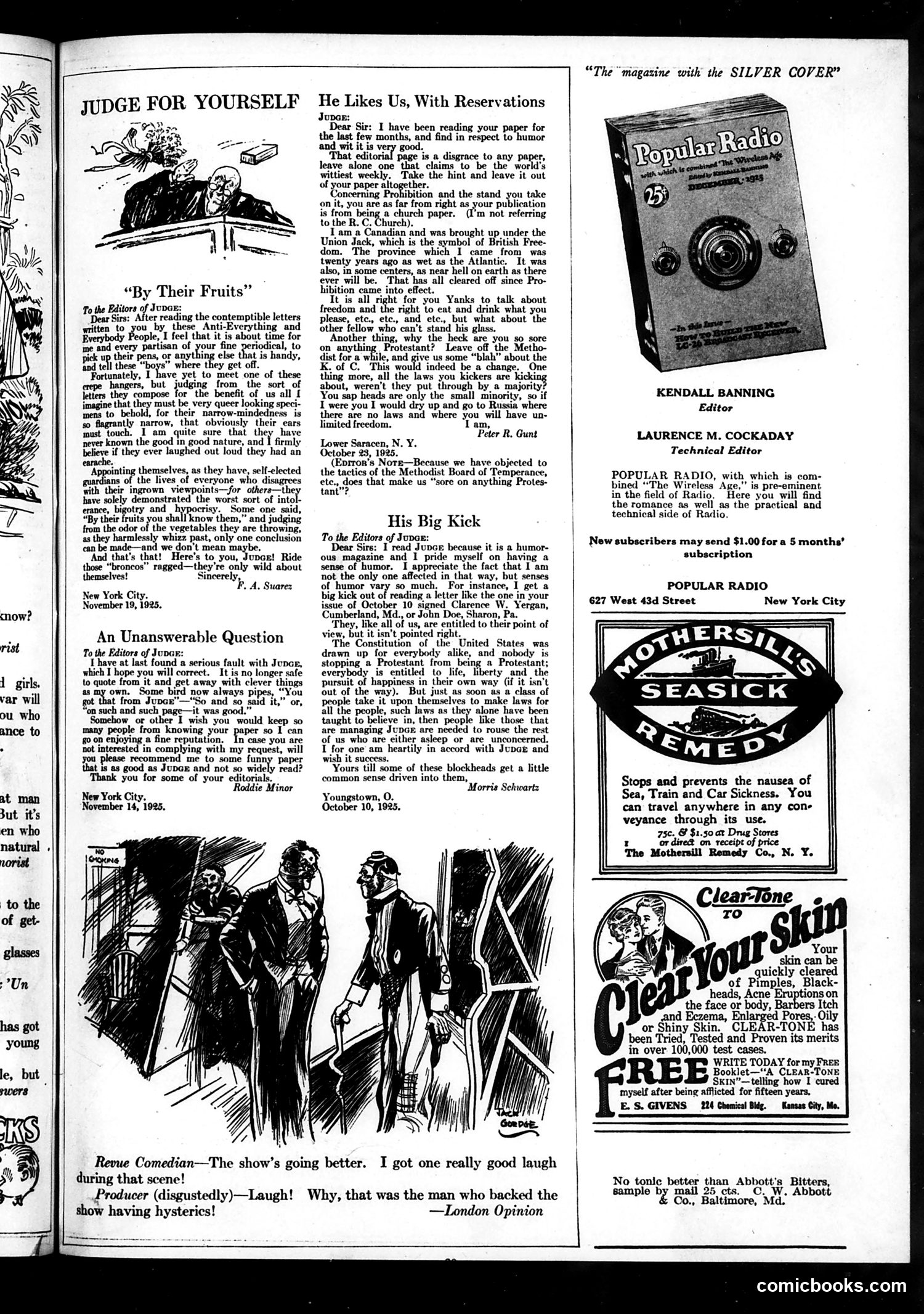
This page from Judge magazine consists primarily of **reader letters** responding to editorial content, rather than standalone political cartoons. The letters reveal contemporary debates: **"By Their Fruits"** defends Judge against "Anti-Everything" critics, using insulting language to dismiss those who disagree with the magazine's positions. **"An Unanswerable Question"** humorously complains that Judge has become too well-known and quotable, ruining the writer's ability to pass off witty remarks as his own. **"He Likes Us, With Reservations"** offers qualified praise while criticizing Judge's editorial page and Protestant-focused satire. The writer—a Canadian—defends Prohibition's effects and challenges American claims about "freedom," arguing the majority supports such laws. The small **cartoon illustration** (lower left) appears to show ordinary people in a theater scene, likely accompanying one of these letters. The page reflects 1920s tensions: Prohibition debates, religious satire, and American exceptionalism—all hot-button issues Judge regularly addressed.
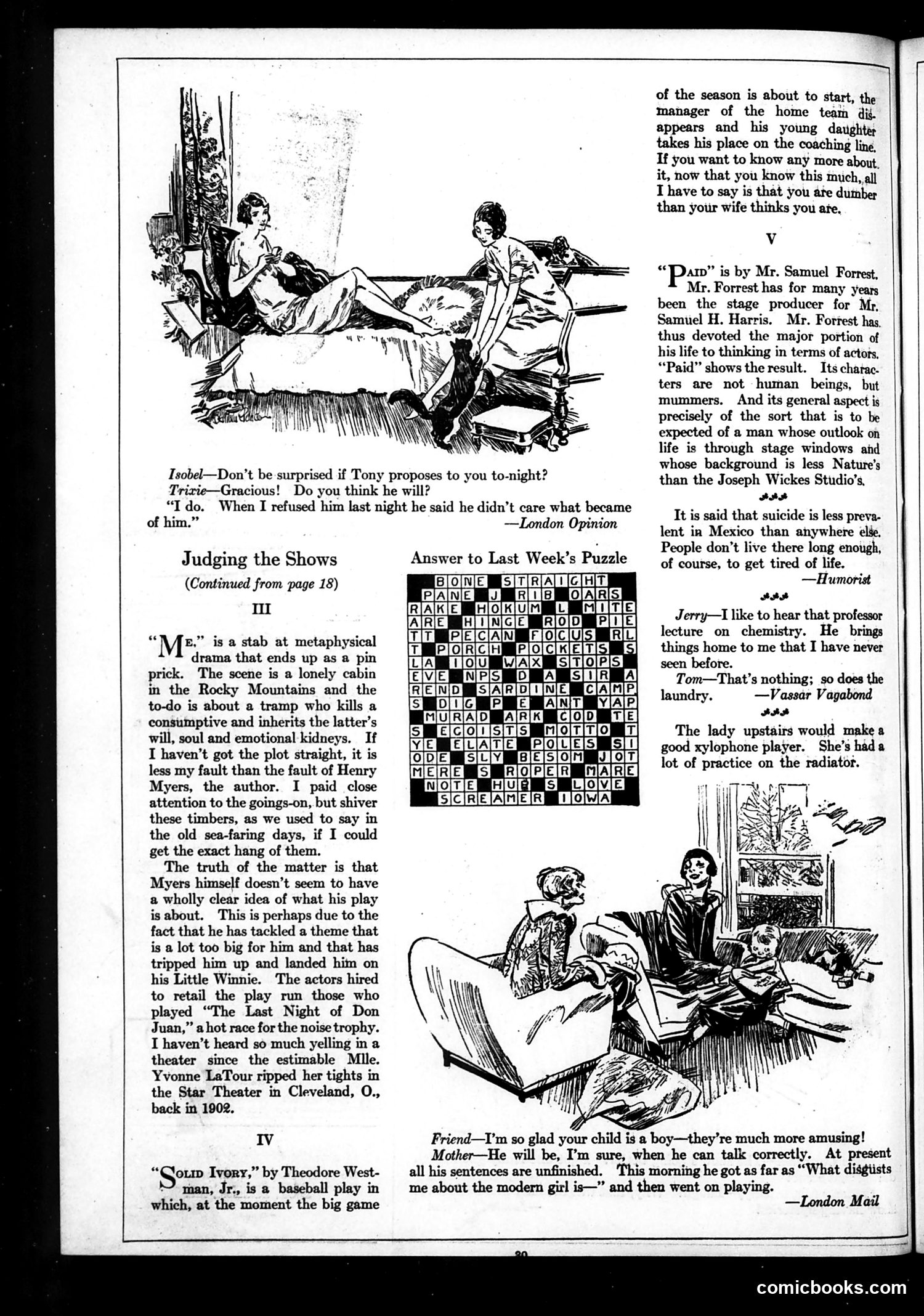
This page contains theater reviews and social humor typical of Judge's satirical content. **Theater Reviews Section:** The main content critiques recent Broadway plays. The reviewer dismissively discusses Henry Myers' play "Me" (a metaphysical drama about a tramp inheriting from a consumptive man) as confused and poorly executed. He also mocks "Storm Ivory," a baseball play where a manager's daughter inexplicably takes his place on the coaching line, and "Paid" by Samuel Forrest, criticizing its characters as artificial "mummers" rather than genuine human beings. **Comic Vignettes:** The page includes several short joke exchanges satirizing contemporary social situations—a marriage proposal based on feigned indifference, observations about chemistry professors, and commentary on modern girls' unfinished sentences. These reflect Judge's focus on middle-class domestic and educational life. **Visual Elements:** Period pen-and-ink illustrations accompany the text, depicting parlor scenes and domestic situations typical of early 20th-century American magazines. The overall tone reflects Judge's role as arbiter of theatrical taste and social observer for educated, affluent readers.
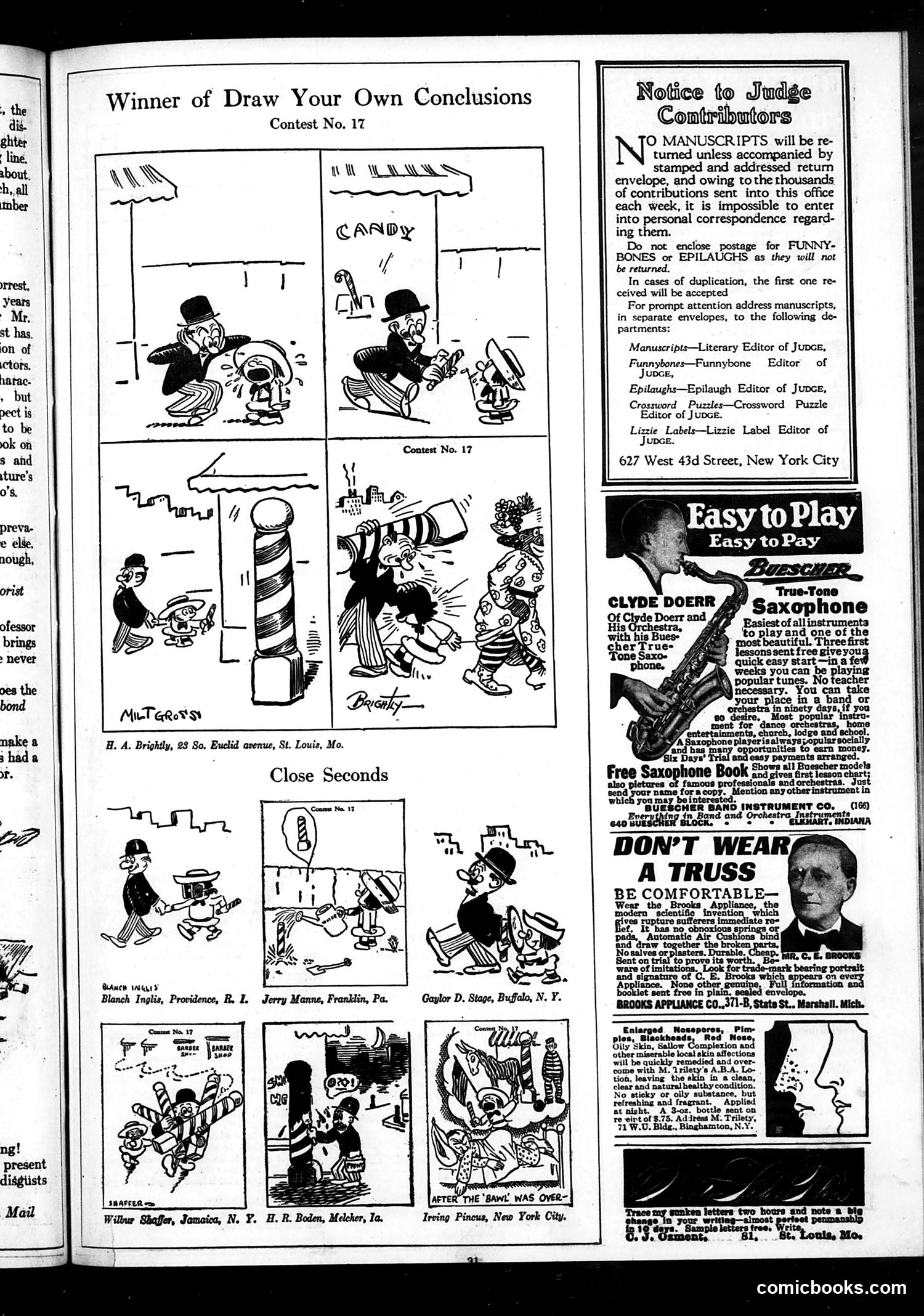
This page features the winner and runners-up of "Draw Your Own Conclusions" Contest No. 17—a visual humor competition where cartoonists submitted punchlines without captions, leaving readers to interpret the joke. The winning cartoon by B.A. Brightly shows two men in top hats at candy stores, apparently drawing opposite conclusions from the same scene—likely a visual pun on differing perspectives. The "Close Seconds" section displays similar wordless comics by other contestants, including scenes of domestic life, urban settings, and everyday situations typical of Judge's satirical humor. The remainder of the page comprises period advertisements (saxophone lessons, medical appliances, truss supports) and contributor guidelines—standard magazine content from this era. Without captions, the cartoons rely on visual gags and situational comedy rather than explicit political commentary, reflecting Judge's emphasis on general satire and everyday absurdist humor.
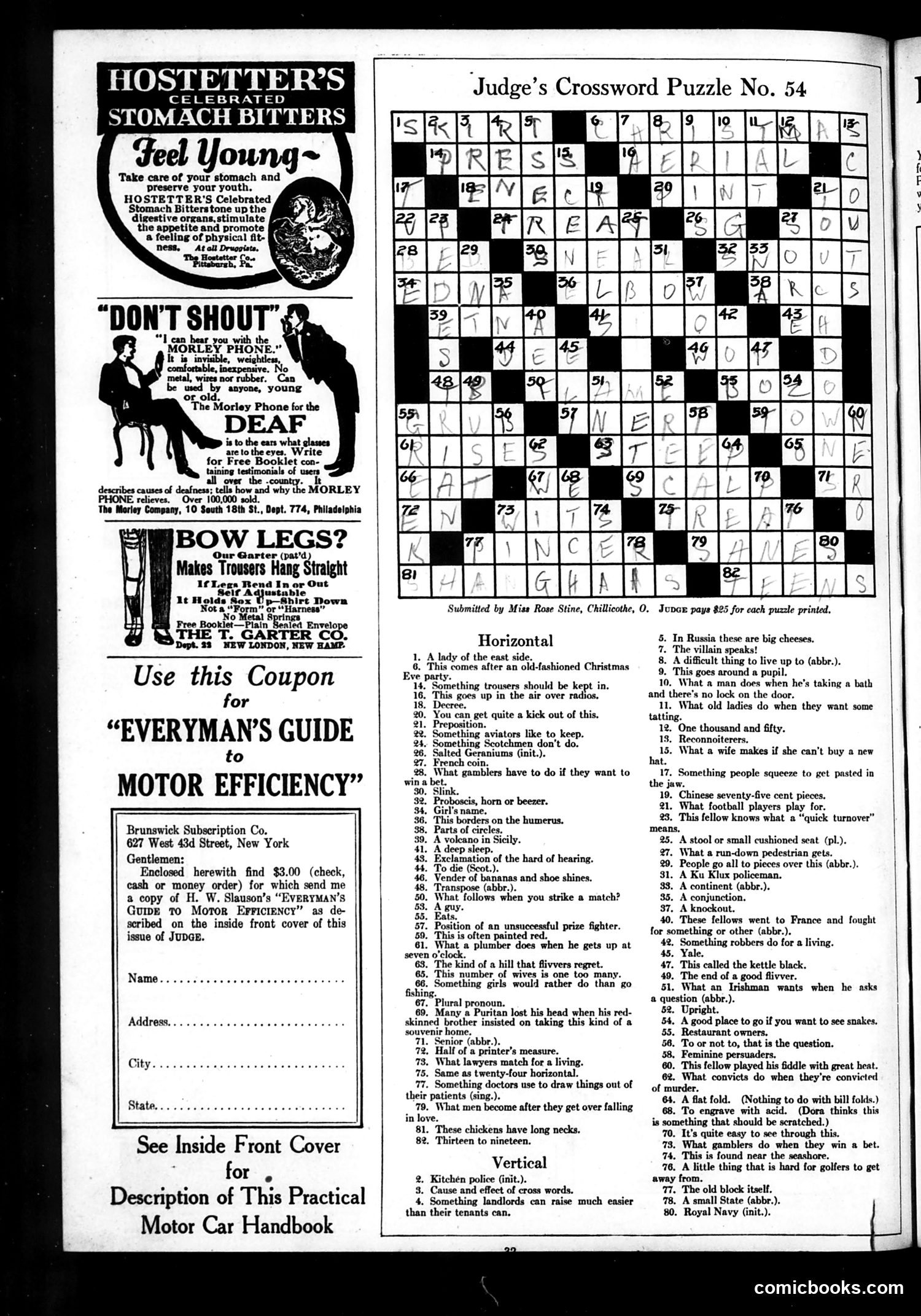
This page is primarily **advertising and a crossword puzzle**, not satire. The advertisements reveal period concerns and products: **"Hostetter's Stomach Bitters"** promises youth and digestive health—a common patent medicine claim of the era. **"The Morley Phone for the Deaf"** offers communication technology specifically marketed to deaf users, described as superior to writing. **"Bow Legs Garter"** addresses a physical concern by keeping trousers straight—reflecting era-specific fashion anxieties. The **crossword puzzle itself contains period humor** in its clues: references to "flivvers" (Model T Fords), Scotsmen, Puritans, and "seventy-five cent pieces" (Chinese currency). Clues about "quick turnovers" and "strike a match" suggest contemporary slang and situations. The page represents ordinary Judge content—mixing practical consumer goods with wordplay—rather than political cartoon satire.
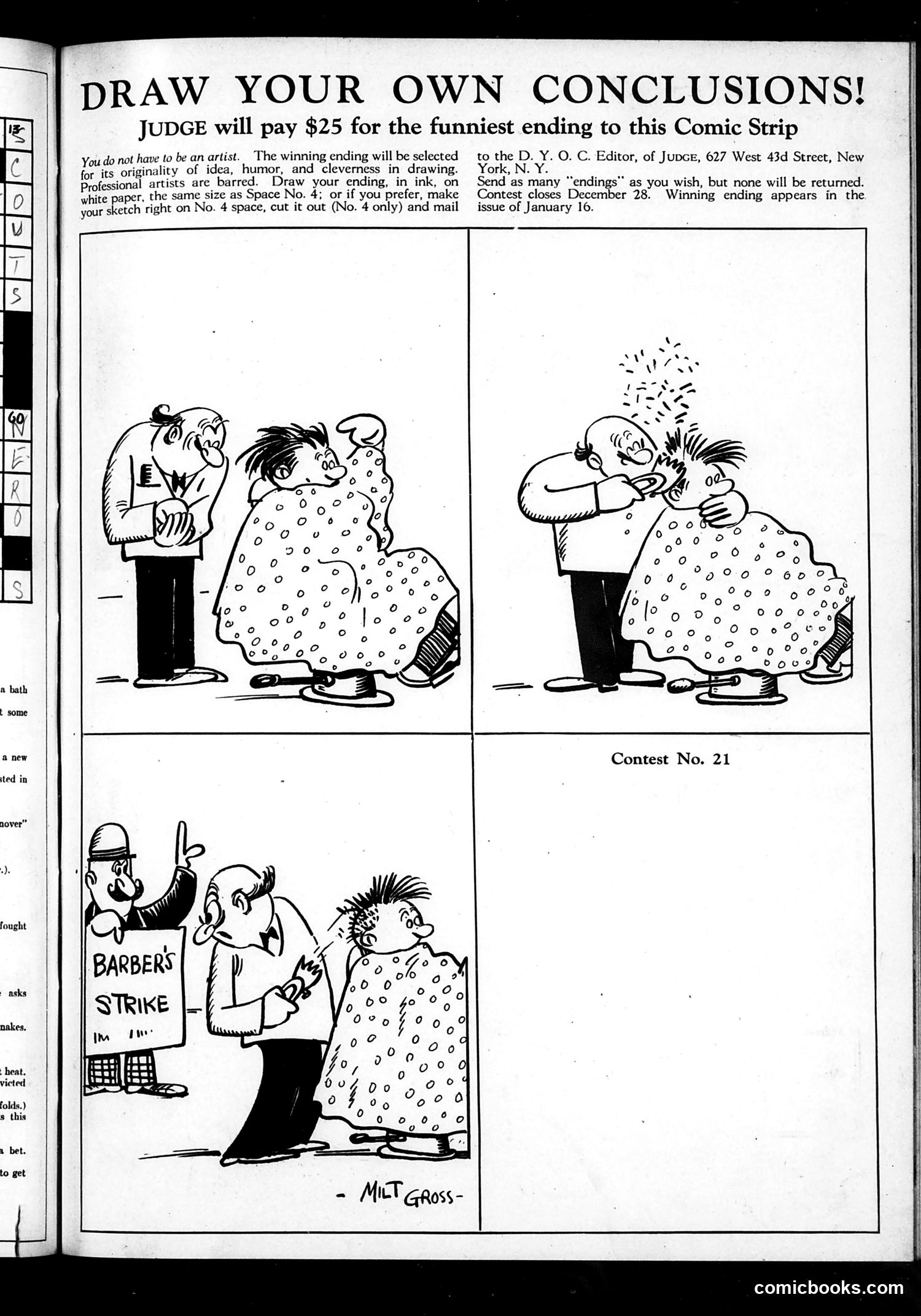
This is a reader-participation contest where Judge magazine invites submissions for comic strip endings. The setup shows a domestic scene: a man presents flowers to a large woman in a polka-dot dress (likely his wife), who appears angry. The third panel, credited to "Milt Gross," shows a barber on strike interrupting the scene, suggesting the man's unkempt appearance may have caused the marital conflict. Readers were asked to draw their own humorous conclusion to this unresolved domestic dispute. The $25 prize (substantial for the era) rewarded originality and cleverness. This reflects Judge's interactive approach to humor—soliciting audience participation while poking fun at everyday marriage tensions and labor disputes (the barber strike reference suggests topical 1920s labor unrest). The contest closes December 28, with results published January 16.
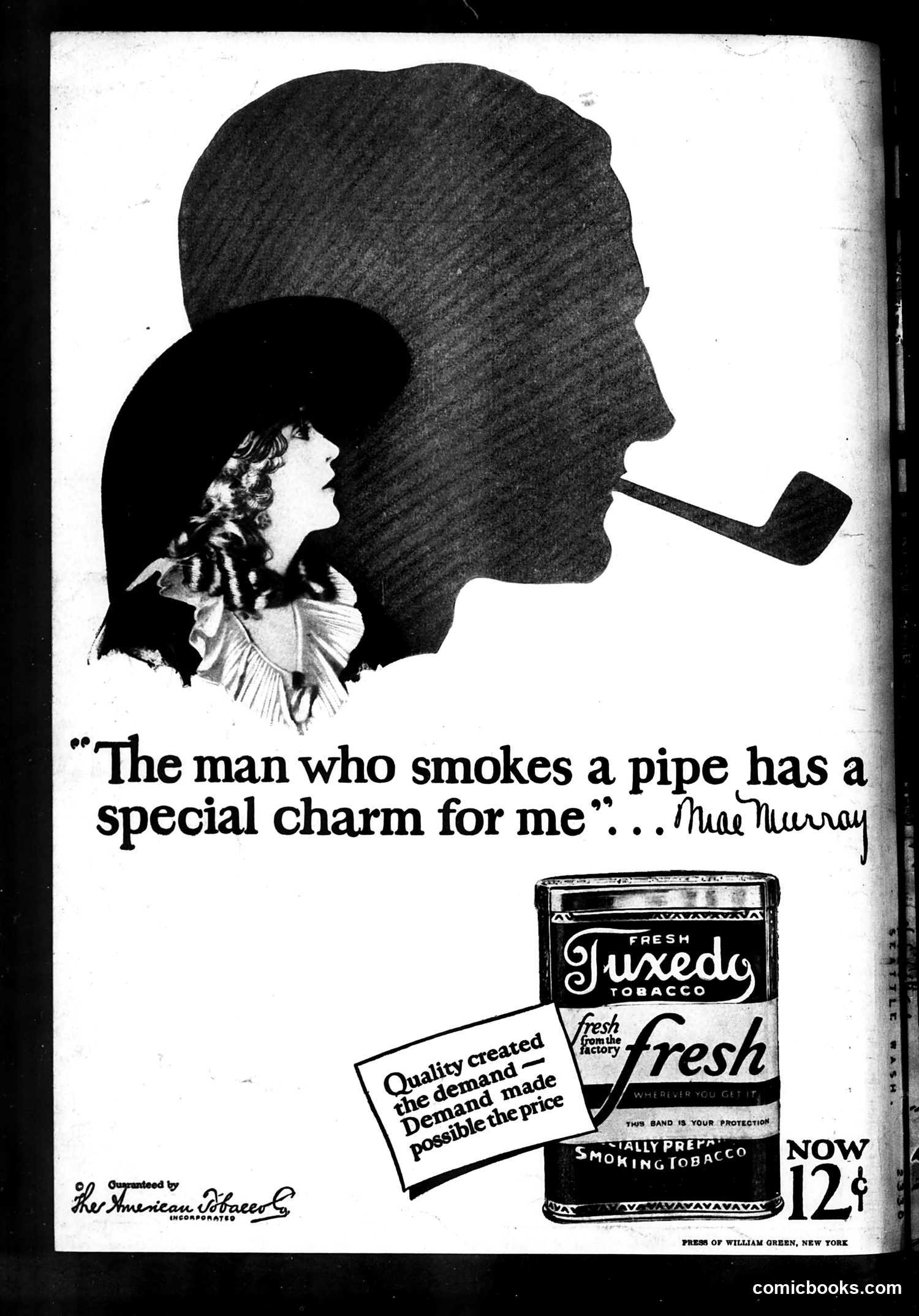
This is a **tobacco advertisement**, not political satire. It features a silhouette of a man smoking a pipe in profile, with a woman's detailed portrait gazing at him admiringly. The quote attributes the endorsement to someone named "Mae Murray" (a silent film actress), claiming pipe smokers possess "special charm." The ad promotes **Tuxedo Tobacco**, priced at 12¢, emphasizing it's "fresh from the factory" and "quality created" to meet demand affordably. A banner claims "This Band is Your Protection." The page uses the appeal of celebrity endorsement and romantic attraction to market smoking—a common advertising tactic of the era before tobacco's health dangers were widely acknowledged. By modern standards, it's notable primarily as a historical artifact of when such advertising was normalized.
I cannot reliably read the specific text or discern clear cartoon imagery in this image. The page appears very dark with low contrast, making it difficult to identify specific figures, captions, or satirical elements with confidence. While there are some visible patterns and possibly decorative elements on the right side, I cannot determine what they depict or how they relate to the OCR text provided (which itself appears fragmentary and unclear). To properly analyze this Judge magazine page as requested, I would need a clearer or higher-contrast version of the image. I can see this is from comicbooks.com, but cannot responsibly identify the cartoon's subjects or satire without being able to read the content clearly.