
Judge, 1925-12-19 · page 34 of 39
Judge — December 19, 1925 — page 34: what you’re looking at
What you’re looking at
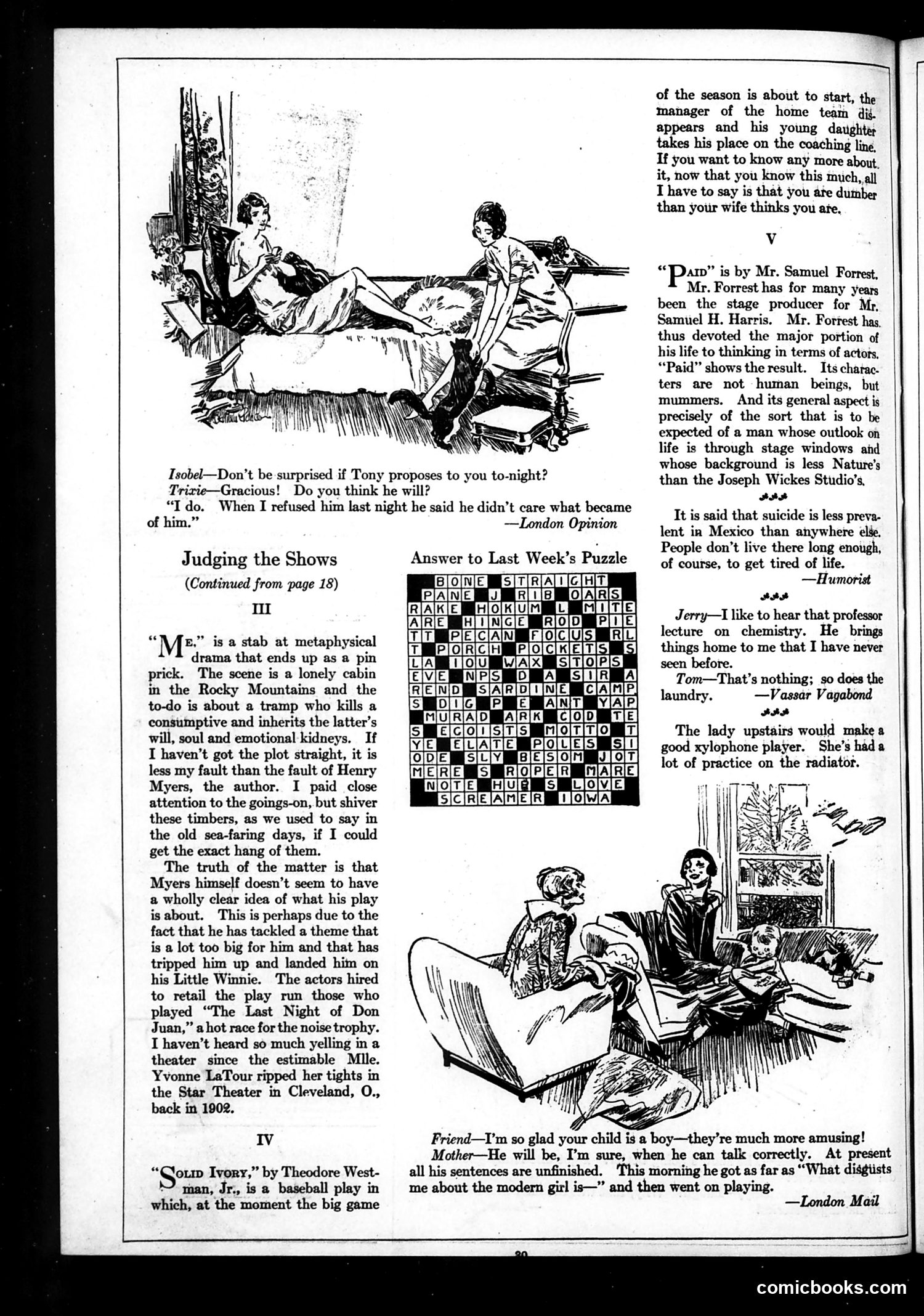
This page contains theater reviews and social humor typical of Judge's satirical content. **Theater Reviews Section:** The main content critiques recent Broadway plays. The reviewer dismissively discusses Henry Myers' play "Me" (a metaphysical drama about a tramp inheriting from a consumptive man) as confused and poorly executed. He also mocks "Storm Ivory," a baseball play where a manager's daughter inexplicably takes his place on the coaching line, and "Paid" by Samuel Forrest, criticizing its characters as artificial "mummers" rather than genuine human beings. **Comic Vignettes:** The page includes several short joke exchanges satirizing contemporary social situations—a marriage proposal based on feigned indifference, observations about chemistry professors, and commentary on modern girls' unfinished sentences. These reflect Judge's focus on middle-class domestic and educational life. **Visual Elements:** Period pen-and-ink illustrations accompany the text, depicting parlor scenes and domestic situations typical of early 20th-century American magazines. The overall tone reflects Judge's role as arbiter of theatrical taste and social observer for educated, affluent readers.
📄 Transcribed text from this page (OCR, searchable)
Machine-transcribed from the original scan — historical spelling and the odd misread are preserved.
Tsobel—Don’t be surprised if Tony proposes to you to-night? Trizie—Gracious! Do you think he will? “I do. When I refused him last night he said he didn’t care what became of him.” Judging the Shows (Continued from page 18) Ii “ME is a stab at metaphysical drama that ends up as a pin prick. The scene is a lonely cabin in the Rocky Mountains and the to-do is about a tramp who kills a consumptive and inherits the latter’s will, soul and emotional kidneys. If I haven’t got the plot straight, it is less my fault than the fault of Henry Myers, the author. I paid close attention to the goings-on, but shiver these timbers, as we used to say in the old sea-faring days, if I could get the exact hang of them. The truth of the matter is that Myers himself doesn’t seem to have a wholly clear idea of what his play is about. This is perhaps due to the fact that he has tackled a theme that is a lot too big for him and that has tripped him up and landed him on his Little Winnie. The actors hired to retail the play run those who played “The Last Night of Don Juan,” a hot race for the noise trophy. I haven’t heard so much yelling in a theater since the estimable Mlle. Yvonne LaTour ripped her tights in the Star Theater in Cleveland, O., back in 1902. IV “Q@\oum Ivory,” by Theodore West- ‘7 man, Jr., is a baseball play in which, at the moment the big game of the season is about to start, the manager of the home team did. appears and his young daughites takes his place on the coaching line, If you want to know any more about. it, now that you know this much, all T have to say is that you are dumber than your wife thinks you ate. Vv “Par” is by Mr. Samuel Forrest, Mr. Forrest has for many years been the stage producer for Mr, Samuel H. Harris. Mr. Forrest has, thus devoted the major portion of his life to thinking in terms of actors, “Paid” shows the result. Its chatac- ters are not human beings, but mummers. And its general aspect is precisely of the sort that is to be expected of a man whose outlook on life is through stage windows aid whose background is less Nature’s than the Joseph Wickes Studio’s, tas is It is said that suicide is less preva- London Opinion lent in Mexico than anywhere elie, People don’t live there long enough, of course, to get tired of life. —Humorist SIs Jerry—I like to hear that professor lecture on chemistry. He brings things home to me that I have never seen before. Tom—That’s nothing; so does the laundry. —Vassar Vagabond FIs The lady upstairs would make a good xylophone player. She’s hada lot of practice on the radiator. Answer to Last Week’s Puzzle Friend—I’m so glad your child is a boy—they’re much more amusing! Mother—He will be, I’m sure, when he can talk correctly. At present all his sentences are unfinished. This morning he got as far as “What disgiists me about the modern girl is—” and then went on playing. —London Mail comicbooks.com