
Judge, 1925-12-19 · page 17 of 39
Judge — December 19, 1925 — page 17: what you’re looking at
What you’re looking at
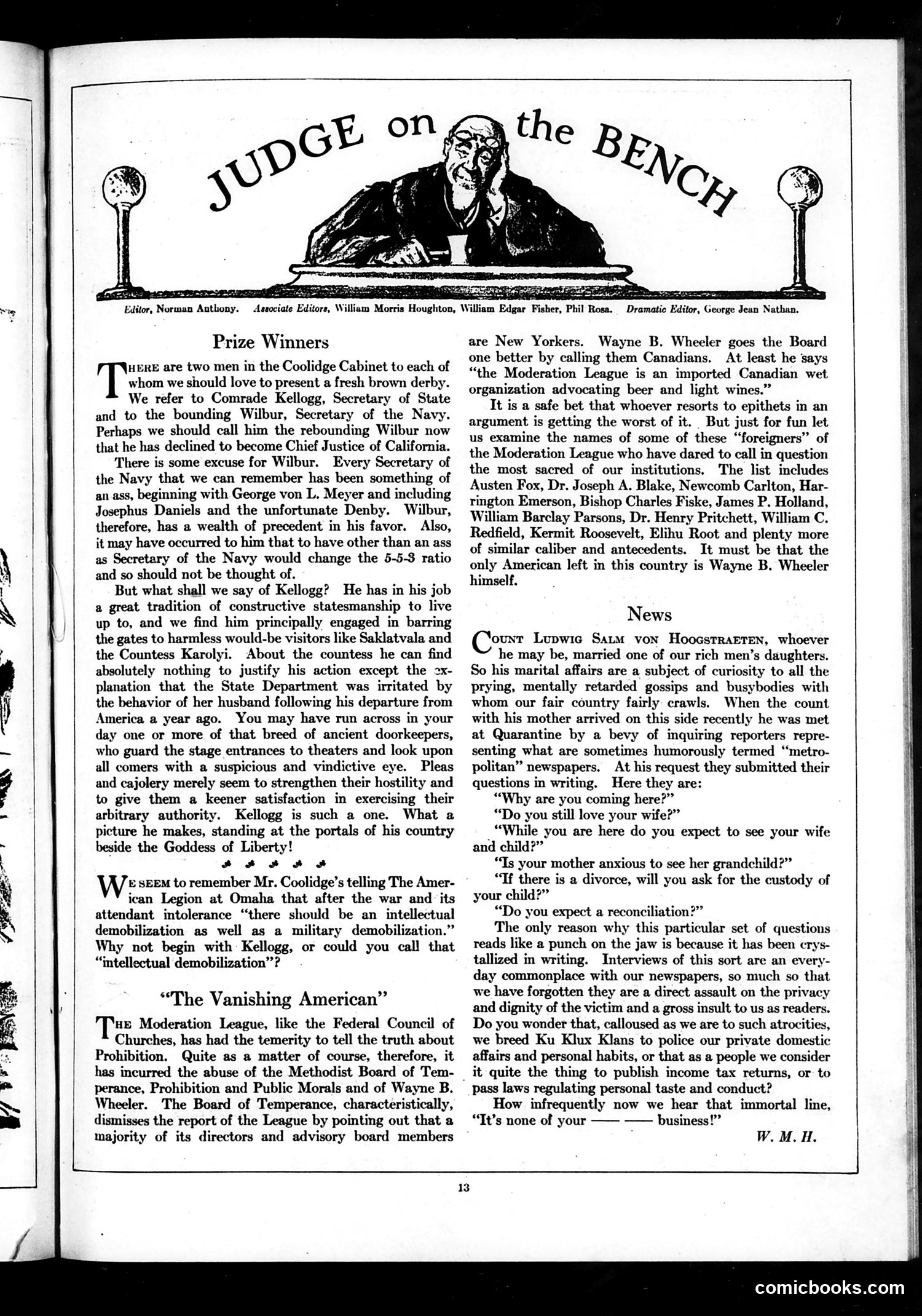
This page from Judge magazine (1920s, during Coolidge presidency) contains political satire on three topics: **"Prize Winners"**: Mocks Secretary of State Frank Kellogg and Secretary of the Navy Wilbur, calling them incompetent. Kellogg is particularly criticized as a petty bureaucrat denying entry to harmless visitors (like Saklatvala and Countess Karolyi) rather than conducting serious diplomacy. The author sarcastically suggests he embodies failed "intellectual demobilization" that Coolidge promised post-WWI. **"The Vanishing American"**: Defends the Moderation League (which questioned Prohibition) against attacks from Wayne B. Wheeler and the Methodist Board of Temperance. Wheeler accused the League of being Canadian and "wet." Judge ridicules this by listing the League's members—prominent Americans like Kermit Roosevelt and Elihu Root—suggesting Wheeler himself is the only un-American figure present. The satire targets Prohibition enforcement zealotry and diplomatic incompetence under Coolidge.
📄 Transcribed text from this page (OCR, searchable)
Machine-transcribed from the original scan — historical spelling and the odd misread are preserved.
Pa Oe Editor, Norman Anthony. Associate Editors, Prize Winners HERE are two men in the Coolidge Cabinet to each of Toston we should love to present a fresh brown derby. We refer to Comrade Kellogg, Secretary of State and to the bounding Wilbur, Secretary of the Navy. Perhaps we should call him the rebounding Wilbur now that he has declined to become Chief Justice of California. There is some excuse for Wilbur. Every Secretary of the Navy that we can remember has been something of an ass, beginning with George von L. Meyer and including Josephus Daniels and the unfortunate Denby. Wilbur, therefore, has a wealth of precedent in his favor. Also, it may have occurred to him that to have other than an ass as Secretary of the Navy would change the 5-5-3 ratio and so should not be thought of. But what shall we say of Kellogg? He has in his job a great tradition of constructive statesmanship to live up to, and we find him principally engaged in barring the gates to harmless would-be visitors like Saklatvala and the Countess Karolyi. About the countess he can find absolutely nothing to justify his action except the 2x- planation that the State Department was irritated by the behavior of her husband following his departure from America a year ago. You may have run across in your day one or more of that breed of ancient doorkeepers, who guard the stage entrances to theaters and look upon all comers with a suspicious and vindictive eye. Pleas and cajolery merely seem to strengthen their hostility and to give them a keener satisfaction in exercising their arbitrary authority. Kellogg is such a one. What a picture he makes, standing at the portals of his country beside the Goddess of Liberty! ee HAS E SEEM to remember Mr. Coolidge’s telling The Amer- ican Legion at Omaha that after the war and its attendant intolerance “there should be an intellectual demobilization as well as a military demobilization.” Why not begin with Kellogg, or could you call that “ntellectual demobilization”? “The Vanishing American” T= Moderation League, like the Federal Council of Churches, has had the temerity to tell the truth about Prohibition. Quite as a matter of course, therefore, it has incurred the abuse of the Methodist Board of Tem- perance, Prohibition and Public Morals and of Wayne B. Wheeler. The Board of Temperance, characteristically, dismisses the report of the League by pointing out that a majority of its directors and advisory board members illiam Morris Houghton, William Edgar Fisher, Phil Rosa. Dramatic Editor, George Jean Nathan. are New Yorkers. Wayne B. Wheeler goes the Board one better by calling them Canadians. At least he says “the Moderation League is an imported Canadian wet organization advocating beer and light wines.” It is a safe bet that whoever resorts to epithets in an argument is getting the worst of it. But just for fun let us examine the names of some of these “foreigners” of the Moderation League who have dared to call in question the most sacred of our institutions. The list includes Austen Fox, Dr. Joseph A. Blake, Newcomb Carlton, Har- rington Emerson, Bishop Charles Fiske, James P. Holland, William Barclay Parsons, Dr. Henry Pritchett, William C. Redfield, Kermit Roosevelt, Elihu Root and plenty more of similar caliber and antecedents. It must be that the only American left in this country is Wayne B. Wheeler himself. News lount Lupwic Satm von HoocstraETeN, whoever he may be, married one of our rich men’s daughters. So his marital affairs are a subject of curiosity to all the prying, mentally retarded gossips and busybodies with whom our fair country fairly crawls. When the count with his mother arrived on this side recently he was met at Quarantine by a bevy of inquiring reporters repre- senting what are sometimes humorously termed “metro- politan” newspapers. At his request they submitted their questions in writing. Here they are: “Why are you coming here?” “Do you still love your wife?” “While you are here do you expect to see your wife and child?” “Is your mother anxious to see her grandchild?” “Tf there is a divorce, will you ask for the custody of your child?” “Do you expect a reconciliation?” The only reason why this particular set of questions reads like a punch on the jaw is because it has been crys- tallized in writing. Interviews of this sort are an every- day commonplace with our newspapers, so much so that we have forgotten they are a direct assault on the privacy and dignity of the victim and a gross insult to us as readers. Do you wonder that, calloused as we are to such atrocities, we breed Ku Klux Klans to police our private domestic affairs and personal habits, or that as a people we consider it quite the thing to publish income tax returns, or to pass laws regulating personal taste and conduct? How infrequently now we hear that immortal line, “It’s none of your —— —— business!” W.M.H. ee comicbooks.com