
Judge, 1925-12-19 · page 24 of 39
Judge — December 19, 1925 — page 24: what you’re looking at
What you’re looking at
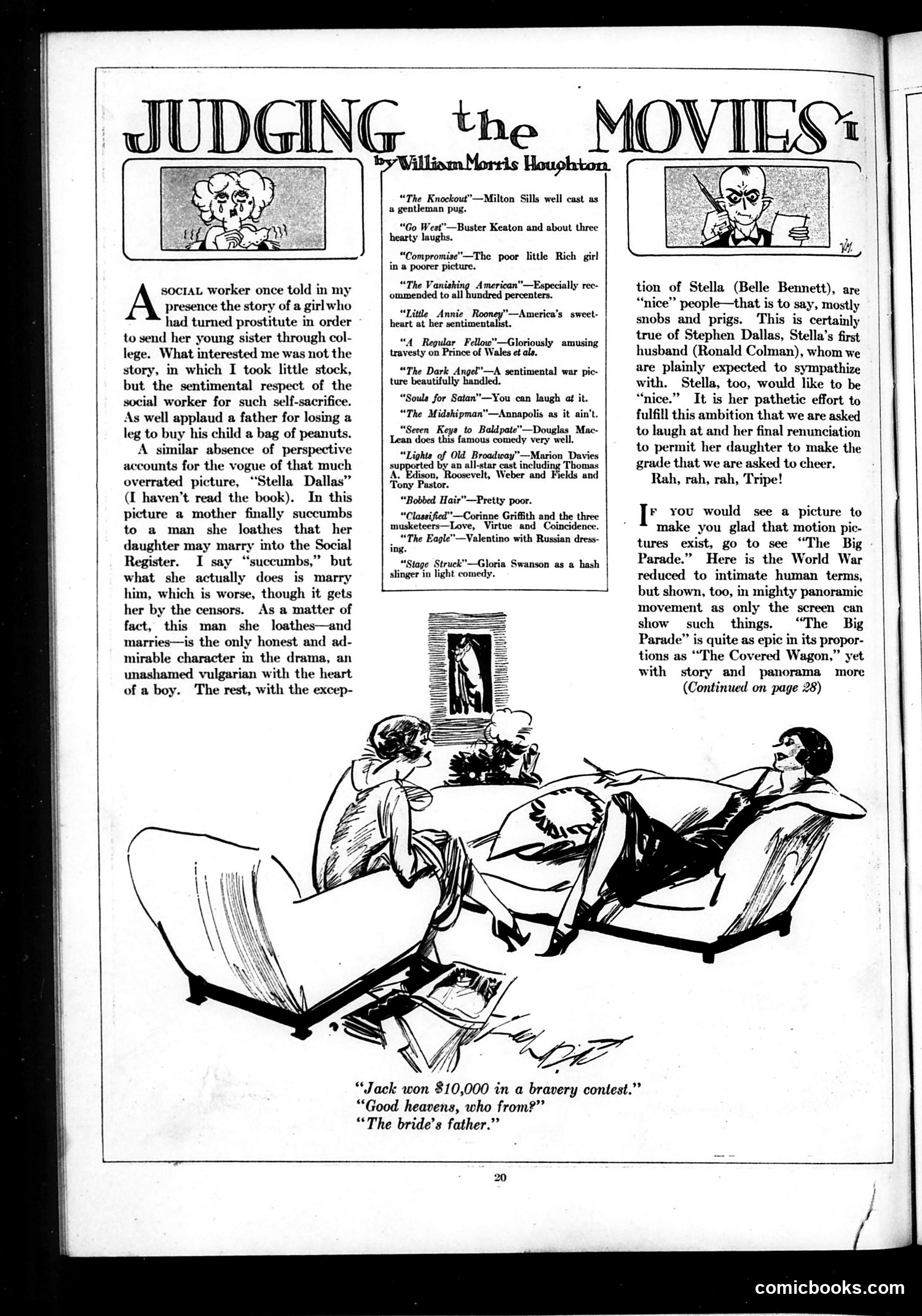
This page contains a film review column critiquing contemporary movies. The main article attacks the sentimentality of "Stella Dallas," a popular film about a working-class mother who sacrifices her reputation by marrying a man she despises so her daughter can marry into the upper class. Houghton argues this narrative celebrates misguided self-sacrifice and class-climbing snobbery rather than genuine virtue. He notes ironically that the only admirable character—the "vulgarian" the mother marries—is portrayed negatively, while the "nice" characters are actually self-serving snobs. The cartoon below depicts two women lounging while discussing a bravery contest winner ("the bride's father"), mocking the film's absurd plot logic. The right column lists brief reviews of other current releases, including mentions of Buster Keaton, Gloria Swanson, and Rudolph Valentino, establishing this as contemporary 1920s criticism.
📄 Transcribed text from this page (OCR, searchable)
Machine-transcribed from the original scan — historical spelling and the odd misread are preserved.
sociAL worker once told in my presence the story of a girlwho had turned prostitute in order to send her young sister through col- lege. What interested me was not the story, in which I took little stock, but the sentimental respect of the social worker for such self-sacrifice. As well applaud a father for losing a leg to buy his child a bag of peanuts. A similar absence of perspective accounts for the vogue of that much overrated picture, “Stella Dallas” (I haven’t read the book). In this picture a mother finally succumbs to a man she loathes that her daughter may marry into the Social Register. I say “succumbs,” but what she actually does is marry him, which is worse, though it gets her by the censors. As a matter of fact, this man she loathes—and marries—is the only honest and ad- mirable character in the drama, an unashamed vulgarian with the heart of a boy. The rest, with the excep- spe Knockout”—Milton Sills well cast as a gentleman pug. “Go West”—Buster Keaton and about three hearty laughs. _ “Compromise”—The poor little Rich girl in a poorer picture. “The Vanishi: American” —Especially rec ommended to all undred percenters. “Little Annie Rooney”—America’s sweet- heart at her sentimentalist. “A Regular Fellow"—Gloriously amusing travesty on Prince of Wales et als. “The Dark geen ce sentimental war pic- ture beautifully handled. “Soule for Satan”—You can laugh at it. “The Midshipman"—Annapolis as it ain't. “Seen Keys to Baldpate”—Douglas M. Lean does this famous comedy very well. “Lights of Old Broadway”—Marion Davies by an all-star cast including Thomas A. Edison, Roosevelt, Weber and Fields and Tonys Pastor. “Bobbed Hair”—Pretty poor. “Classified” —Corinne Griffith and the three musketeers—Love, Virtue and Coincidence. __ “The Eagle”—Valentino with Russian dress- ing. “Stage Struck”—Gloria Swanson as a hash slinger in light comedy. tion of Stella (Belle Bennett), are “nice” ” people—that i is to say, mostly snobs and prigs. This is certainly true of Stephen Dallas, Stella’s first husband (Ronald Colman), whom we are plainly expected to sympathize with. Stella, too, would like to be “nice.” It is her pathetic effort to fulfill this ambition that we are asked to laugh at and her final renunciation to permit her daughter to make the grade that we are asked to cheer. Rah, rah, rah, Tripe! IF you would see a picture to make you glad that motion pic- tures exist, go to see “The Big Parade.” Here is the World War reduced to intimate human terms, but shown, too, in mighty panoramic movement as only the screen can show such things. “The Big Parade” is quite as epic in its propor- tions as “The Covered Wagon,” yet with story and panorama more (Continued on page 28) “Jack won $10,000 in a bravery contest.” “Good heavens, who from?” “The bride’s father.” comicbooks.com