
Judge, 1925-12-19 · page 22 of 39
Judge — December 19, 1925 — page 22: what you’re looking at
What you’re looking at
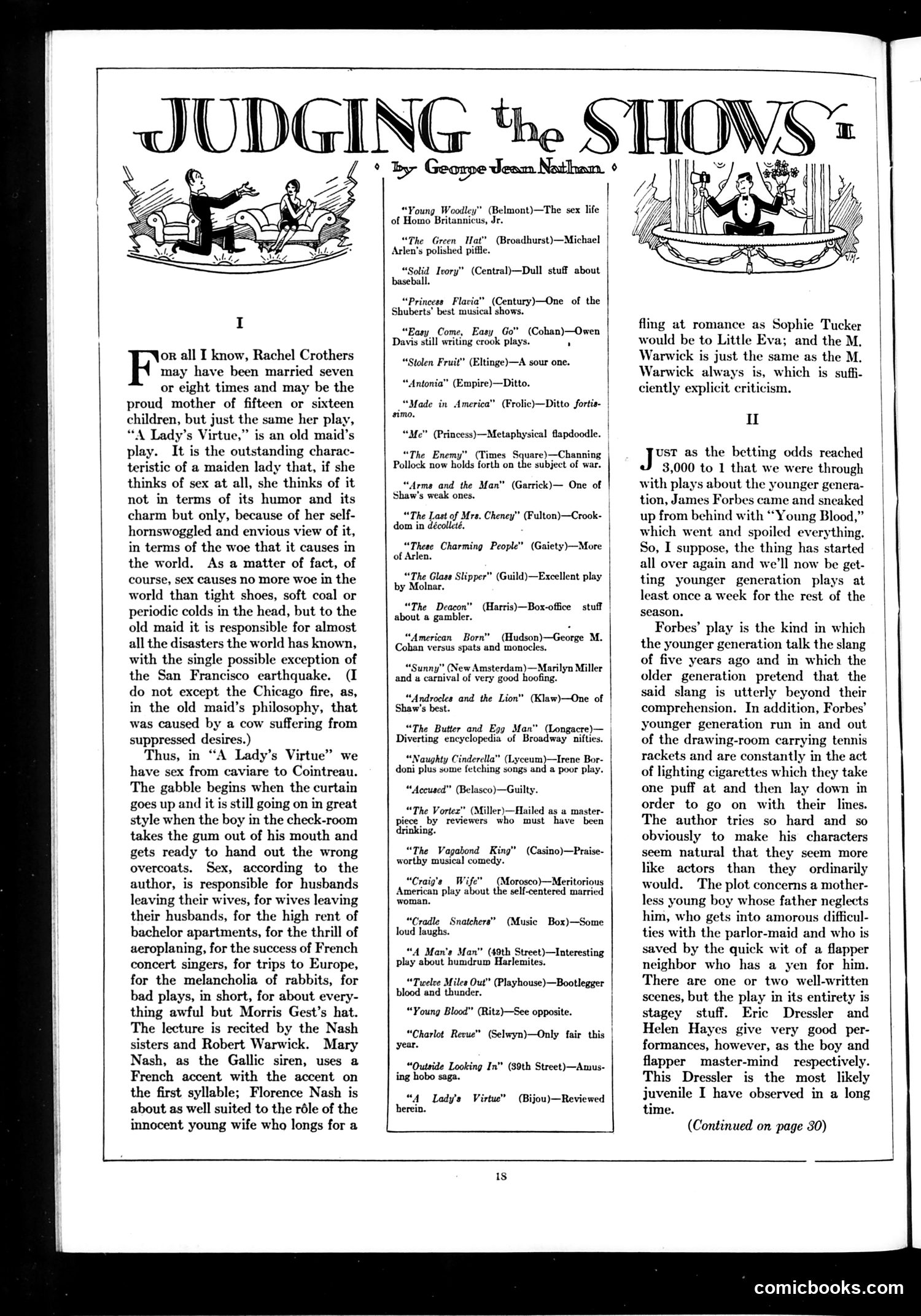
This page features theater critic George Jean Nathan's review of "A Lady's Virtue," a play by Rachel Crothers starring the Nash sisters and Robert Warwick. Nathan mocks the play as embodying "old maid" sensibilities—obsessed with sex as a source of worldly woe rather than humor or charm. He sarcastically argues the author blames sex for everything from broken marriages to bad plays to Chicago's Great Fire. The cartoon's point: Nathan ridicules Crothers' moralistic approach to sexuality on stage. His hyperbolic critique (sex causes "no more woe...than tight shoes") aims to deflate what he sees as prudish, overwrought preaching masquerading as sophisticated theater. The accompanying list of current Broadway shows provides context for competitive theatrical offerings of the era.
📄 Transcribed text from this page (OCR, searchable)
Machine-transcribed from the original scan — historical spelling and the odd misread are preserved.
may have been married seven or eight times and may be the proud mother of fifteen or sixteen children, but just the same her play, “A Lady’s Virtue,” is an old maid’s play. It is the outstanding charac- teristic of a maiden lady that, if she thinks of sex at all, she thinks of it not in terms of its humor and its charm but only, because of her self- hornswoggled and envious view of it, in terms of the woe that it causes in the world. As a matter of fact, of course, sex Causes no more woe in the world than tight shoes, soft coal or periodic colds in the head, but to the old maid it is responsible for almost all the disasters the world has known, with the single possible exception of the San Francisco earthquake. (I do not except the Chicago fire, as, in the old maid’s philosophy, that was caused by a cow suffering from suppressed desires.) Thus, in “A Lady’s Virtue” we have sex from caviare to Cointreau. The gabble begins when the curtain goes up and it is still going on in great style when the boy in the check-room takes the gum out of his mouth and gets ready to hand out the wrong overcoats. Sex, according to the author, is responsible for husbands leaving their wives, for wives leaving their husbands, for the high rent of bachelor apartments, for the thrill of aeroplaning, for the success of French concert singers, for trips to Europe, for the melancholia of rabbits, for bad plays, in short, for about every- thing awful but Morris Gest’s hat. The lecture is recited by the Nash sisters and Robert Warwick. Mary Nash, as the Gallic siren, uses a French accent with the accent on the first syllable; Florence Nash is about as well suited to the réle of the innocent young wife who longs for a FP: all I know, Rachel Crothers by Geonrpe Jeom Nathan “Young Woodley” (Belmont)—The sex life of Homo Britannicus, Jr. “The Green Hat” Arlen’s polished pifile. “Solid Ieory” baseball. (Broadhurst)—Michael (Central)—Dull stuff about “Princess Flavia” (Century)—One of the Shuberts’ best musical shows. “Easy Come, Easy Go” (Cohan)—Owen Davis still writing crook plays. ‘ “Stolen Fruit” (Eltinge)—A sour one. “Antonia” (Empire)—Ditto. “Made in America” simo. “The Enemy” Pollock now holds forth on the subject of war. “Arma and the Man" (Garrick)— One of Shaw's weak ones. “The Last of Mrs. Cheney” (Fulton)—Crook- dom in décolleté. “These Charming People” (Gaiety)—More of Arlen. “The Glase Slipper” (Guild)—Excellent play by Molnar. “The Deacon” about a gambler. (Harris)—Box-office stuff “American Born” (Hudson)—George M. Coban versus spats and monocles. “Sunny” (New Amsterdam)—Marilyn Miller and u carnival of very good hoofing. Shaw's best. “The Butter and Egg Man” (Longacre)— Diverting encyclopedia of Broadway © nifties. “Naughty Cinderella” (Lyceum)—Irene Bor- doni plus some fetching songs and a poor play. “Accused” (Belasco)—Guilty. “The Vortex” (Miller)—Hailed as a master- piece by reviewers who must have been drinking. “The Vagabond King” (Casino)—Praise- worthy musical comedy. “Craig's Wife" —(Morosco)—Meritorious American play about the self-centered married woman. “Cradle loud laughs. Snatchers” (Music Box)—Some “A Man's Man” (49th Street)—Interesting play about humdrum Harlemites. blood and thunder. “Young Blood” (Ritz)—See opposite. “Charlot Revue” year. “Outside Looking In” (89th Street)—Amus- ing hobo saga. “4 Lady's Virtue” (Bijou)—Reviewed herein. (Frolic)—Ditto fortis. | i] “Me” (Princess) Metaphysical flapdoodle. (Times Square)—Channing | “Androcles and the Lion” (Klaw)—One of | “Twelve Miles Out” (Playhouse)—Bootlegger (Selwyn)—Only fair this | NG ‘be SHOW. fling at romance as Sophie Tucker would be to Little Eva; and the M. Warwick is just the same as the M. Warwick alway » Which is suffi- ciently explicit criticism. I ust as the betting odds reached 3,000 to 1 that we were through with plays about the younger genera- tion, James Forbes came and sneaked up from behind with “Young Blood,” which went and spoiled everything. So, I suppose, the thing has started all over again and we'll now be get- ting younger generation plays at least once a week for the rest of the season. Forbes’ play is the kind in which the younger generation talk the slang of five years ago and in which the older generation pretend that the said slang is utterly beyond their comprehension. In addition, Forbes’ younger generation run in and out of the drawing-room carrying tennis rackets and are constantly in the act of lighting cigarettes which they take one puff at and then lay down in order to go on with their lines. The author tries so hard and so obviously to make his characters seem natural that they seem more like actors than they ordinarily would. The plot concerns a mother- less young boy whose father neglects him, who gets into amorous difficul- ties with the parlor-maid and who is saved by the quick wit of a flapper neighbor who has a yen for him. There are one or two well-written scenes, but the play in its entirety is stagey stuff. Eric Dressler and Helen Hayes give very good per- formances, however, as the boy and flapper master-mind _ respectively. This Dressler is the most likely juvenile I have observed in a long time. (Continued on page 30) comicbooks.com