
A complete issue · 36 pages · 1924
Judge — July 19, 1924
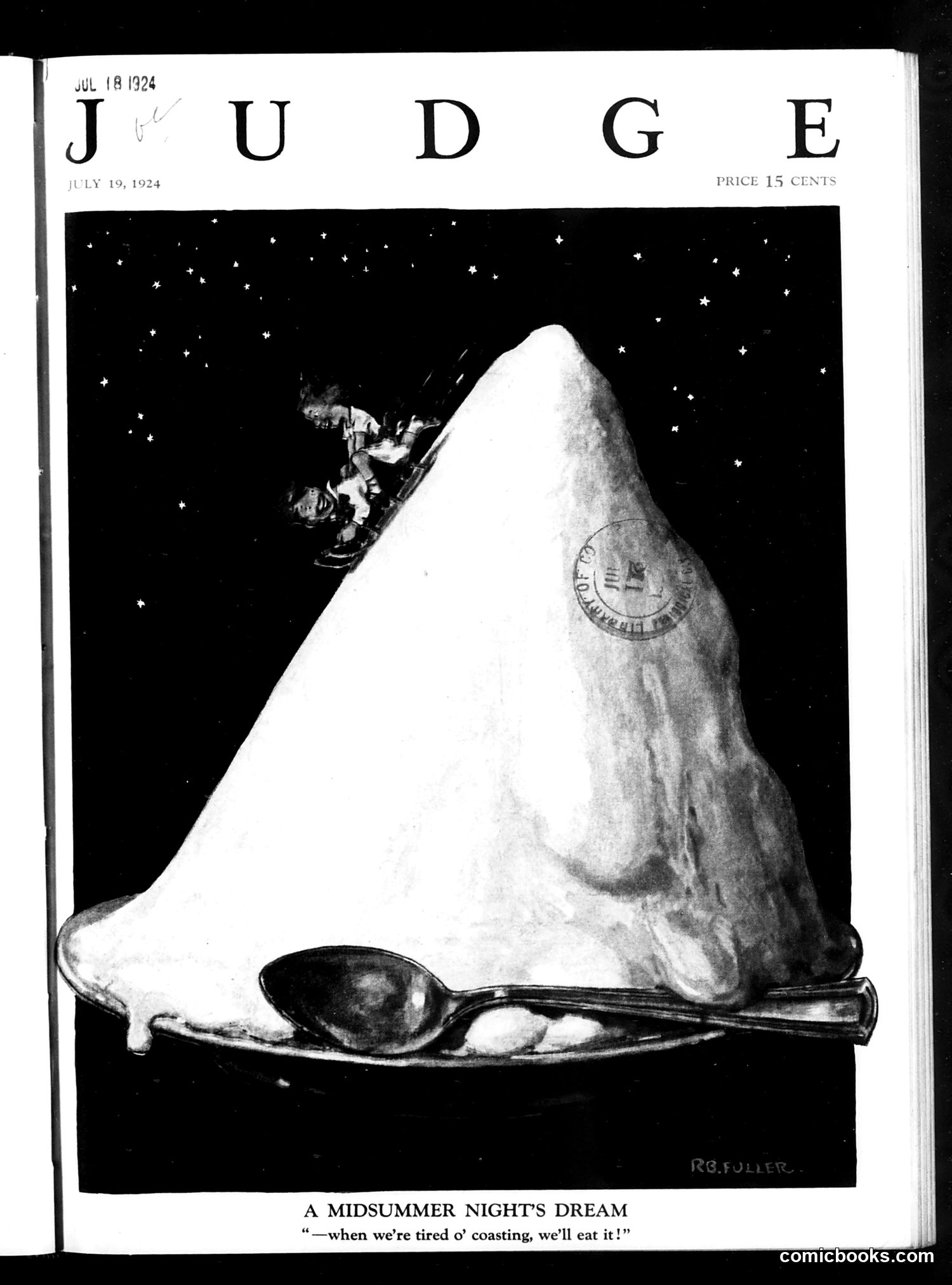
This cartoon depicts two figures atop a large cone-shaped dessert (appears to be a frozen pudding or ice cream mold) against a starry night sky. The caption reads: "—when we're tired o' coasting, we'll eat it!" The satire likely references the wealthy leisure activities of the 1920s—"coasting" refers to idle pleasure-seeking or wealthy indulgence during summer. The enormous dessert represents excess and indulgence. The romantic nighttime setting parodies Shakespeare's "A Midsummer Night's Dream," suggesting the fantasy or dreams of affluent Americans during the prosperous Jazz Age. The artwork is credited to R.G. Fuller. The magazine cost 15 cents and was dated July 19, 1924.
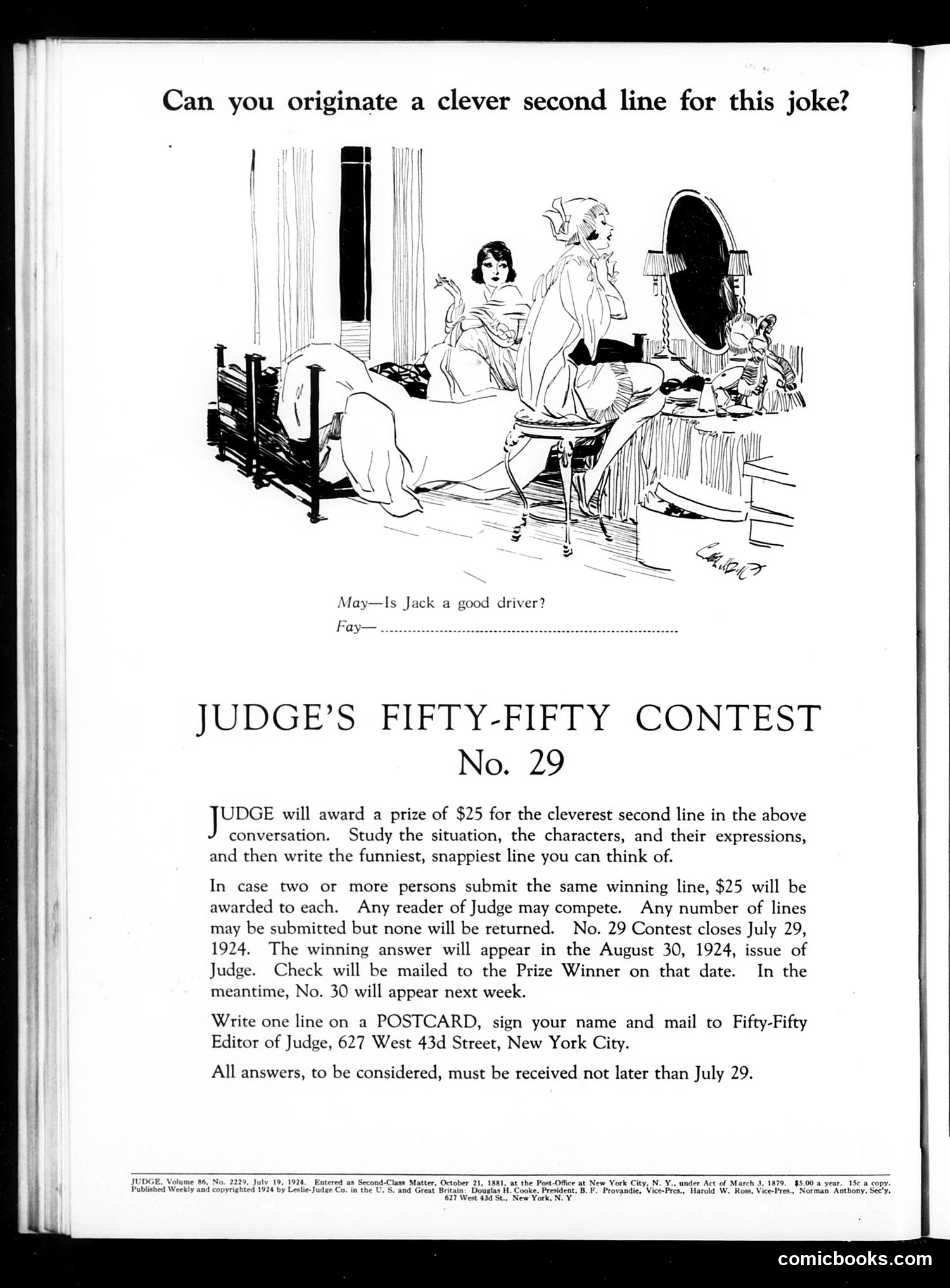
This page presents "Judge's Fifty-Fifty Contest No. 29," a reader participation feature. The cartoon shows a bedroom scene with three women and a man in bed with his head under covers—apparently caught in a compromising situation. The setup line reads: "May—Is Jack a good driver?" Readers were invited to submit clever second-line answers for a $25 prize. The humor relies on the visual innuendo: the implication that "Jack" is skilled at "driving" (maneuvering) in intimate contexts, playing on double meaning. This represents typical 1920s magazine humor—risqué but not explicit by modern standards—targeting adult readers with suggestive jokes about infidelity and sexual conduct. The contest format encouraged reader engagement with the magazine.
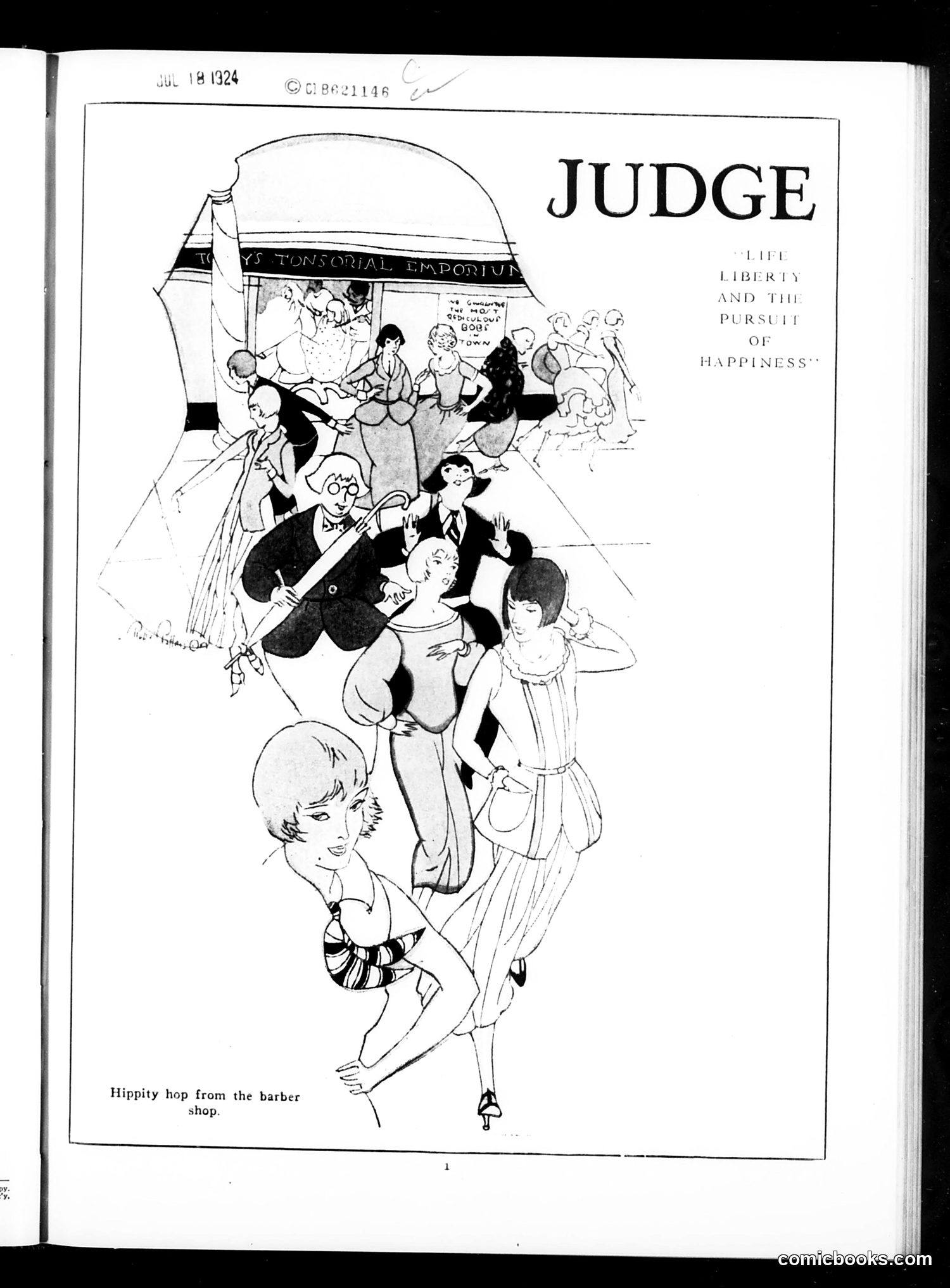
This cover satirizes 1920s social life and morality. The illustration depicts young people in fashionable attire emerging from what appears to be a speakeasy or nightclub (marked "SONSORIAL EMPORIUM"—likely a euphemistic reference). The caption "Hippy hop from the barber shop" suggests these revelers are pretending their outing is innocent, when their behavior clearly violates Prohibition-era social norms. The title "JUDGE: Life, Liberty and the Pursuit of Happiness" ironically echoes the Declaration of Independence while depicting youth flouting laws and conventional morality. The satire targets the disconnect between official values and actual behavior during Prohibition, mocking both the young people's hypocrisy and society's failure to enforce standards.
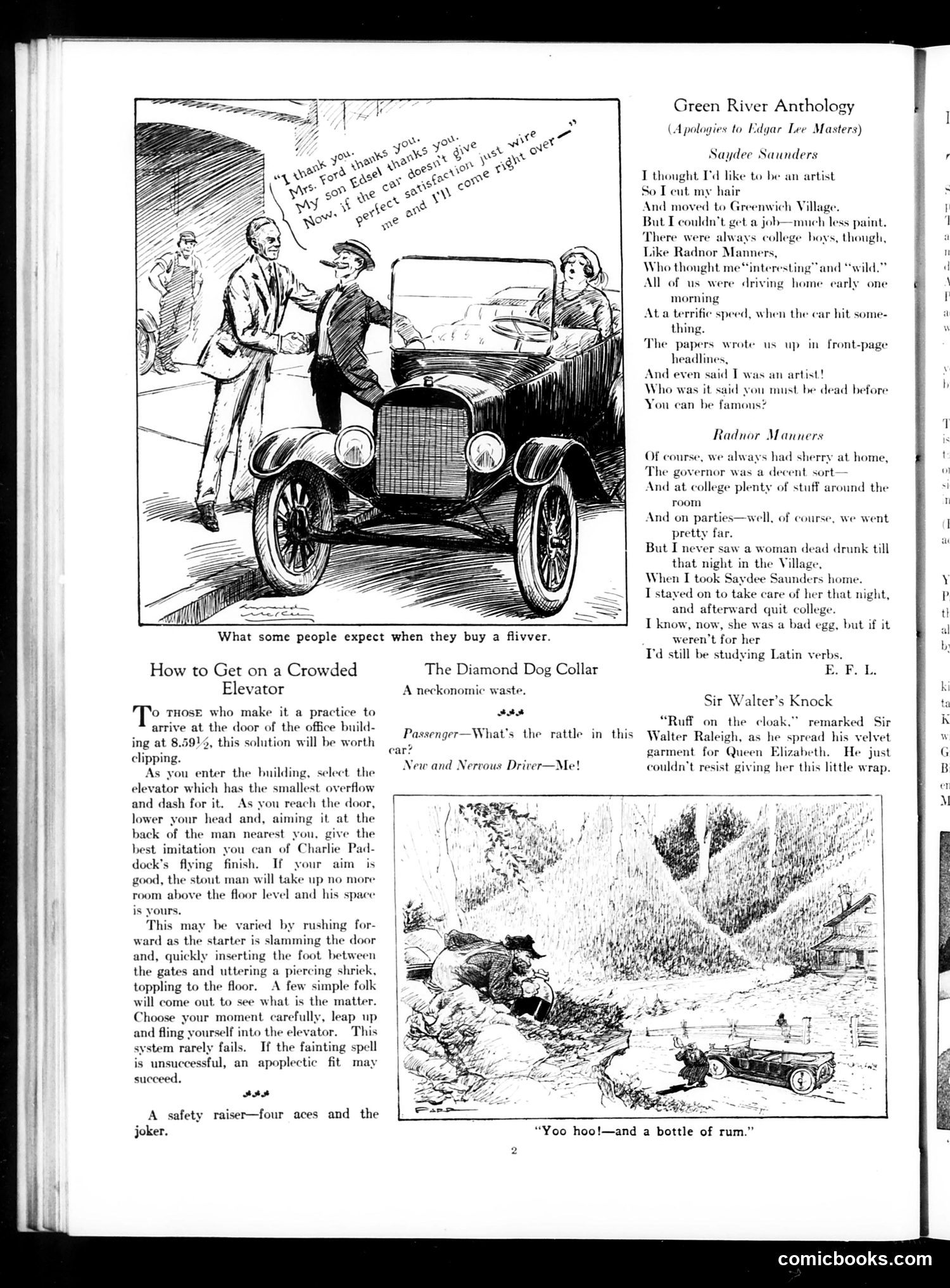
**Top Cartoon: "What some people expect when they buy a flivver"** This satirizes the Model T Ford ("flivver" was slang for cheap cars). The cartoon shows a wealthy man in formal dress being served by a uniformed chauffeur—depicting absurdly unrealistic expectations for an affordable automobile. The humor derives from the contrast between the car's actual modest nature and fantasies of luxury service. This reflects early 1920s American car culture, when mass-produced vehicles were transforming society but buyers sometimes harbored inflated expectations. **Lower Content: Practical Humor** "How to Get on a Crowded Elevator" offers tongue-in-cheek advice about mimicking Charlie Chaplin's physical comedy to squeeze into overstuffed elevators—referencing the popular silent-film star.
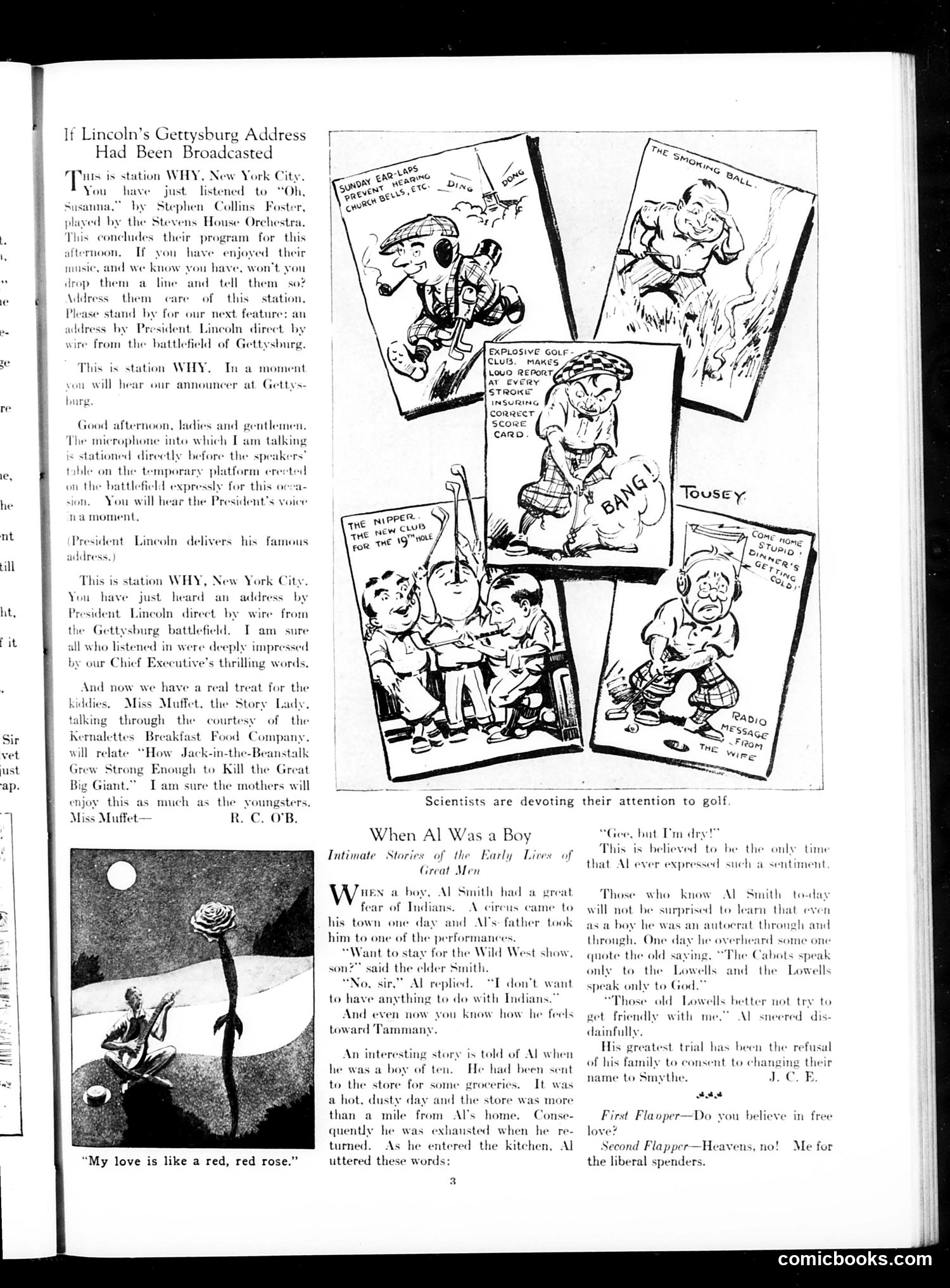
This Judge magazine page satirizes early 20th-century American pastimes and celebrity culture. The central cartoon panel mocks golf's popularity among scientists and intellectuals, depicting them playing rather than pursuing serious work—labeled "Scientists are devoting their attention to golf." The surrounding vignettes appear to parody radio broadcasting and mass media entertainment, showing various figures engaged in leisure activities with labels like "The Nipper Club" and "Radio Rescue." The "When Al Was a Boy" section profiles an early American figure (likely Al Smith, given context), presenting anecdotes about his youth. The humor relies on period-specific references to entertainment, radio programming, and social anxieties about Americans prioritizing recreation over productive work—concerns typical of early 1920s satirical commentary.
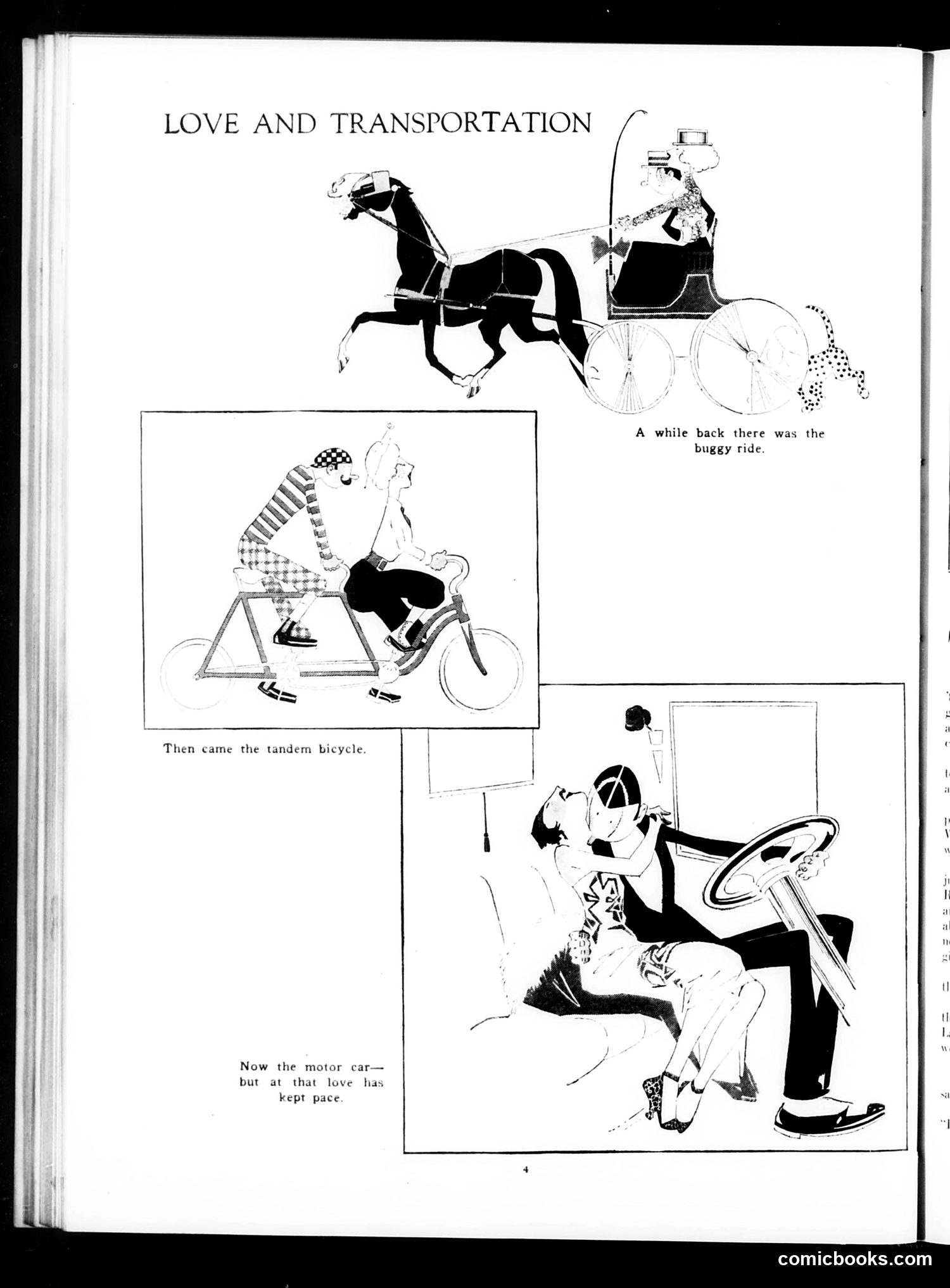
This page satirizes the evolution of courtship transportation methods in early 20th-century America. The progression shows: 1. **Horse-drawn buggy**: Traditional romance ("a while back there was the buggy ride") 2. **Tandem bicycle**: Couples pedaling together, representing the bicycle craze era 3. **Motor car**: Modern automobiles replacing older transportation The joke's point: as technology advances, the romantic experience changes. The motor car caption states it "kept pace" with love—suggesting automobiles have become the new venue for courtship, replacing horses and bicycles. This reflects anxieties and humor about modernization's impact on traditional romance. The cartoon mocks how each generation adopts current technology for dating, implying automobiles represent progress but also changing social dynamics around courtship and intimacy.
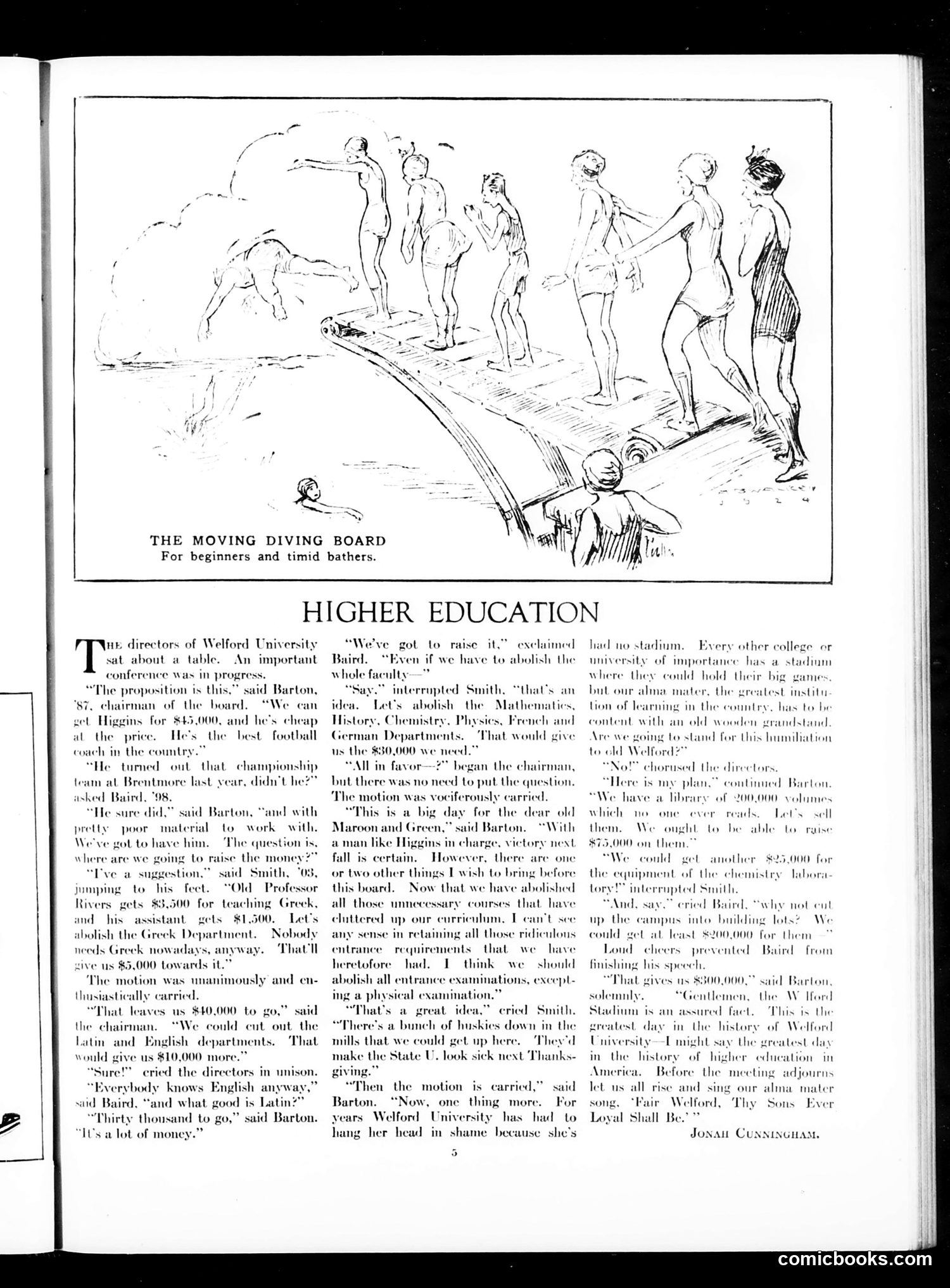
This satirical article mocks university administrators' misplaced priorities through a fictional board meeting at Welford University. The directors debate funding a football coach while systematically dismantling academic departments. **The joke:** To pay for a championship football coach, they progressively abolish Greek, Latin, English, Mathematics, History, Chemistry, Physics, French, and German departments—eliminating "unnecessary courses" and entrance requirements. They then plan to sell the library's 200,000 volumes and subdivide the campus to fund a stadium. **The satire targets:** Early 20th-century American higher education's emphasis on athletics and fundraising over academics. Universities were increasingly commercializing, prioritizing football revenue and facilities while cutting classical education. **The cartoon above** shows a "moving diving board"—a plank on wheels for "beginners and timid bathers"—a visual pun on educational institutions becoming dangerously unstable. The piece argues that by chasing money and sports glory, universities abandon their educational mission and standards, becoming intellectually hollow institutions.
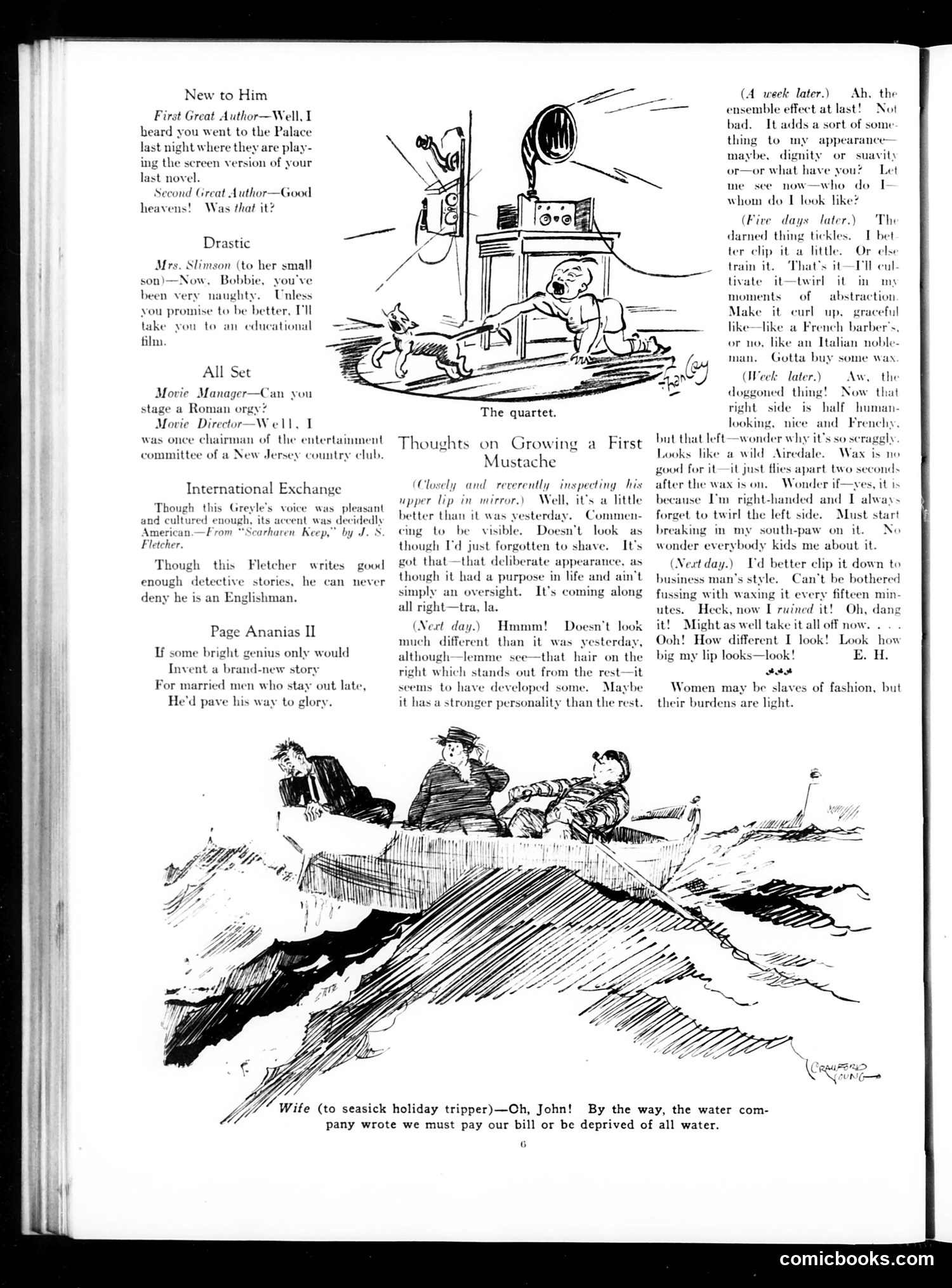
This page contains several satirical humor pieces typical of early 20th-century Judge magazine: **"New to Him"**: Mocks self-important authors who haven't seen film adaptations of their own work—suggesting either indifference or that the adaptation was so poor they didn't recognize it. **"Drastic"**: A mother threatens her misbehaving son with an "educational film" as punishment, satirizing the era's view of educational content as tedious. **"All Set"**: A movie director claims qualification to stage a Roman orgy based solely on chairing a New Jersey country club entertainment committee—absurdist humor about unqualified people in film. **"The Quartet" and "Thoughts on Growing a First Mustache"**: Humorous monologues depicting vanity and indecision, with the mustache piece showing a man obsessively monitoring facial hair growth, constantly changing his mind about styling it. **Bottom cartoon**: A seasick husband is warned by his wife that the water company demands payment or they'll lose water service—dark humor about misfortune during vacation. The page emphasizes contemporary concerns: cinema's newness, parenting anxieties, and everyday vanities.
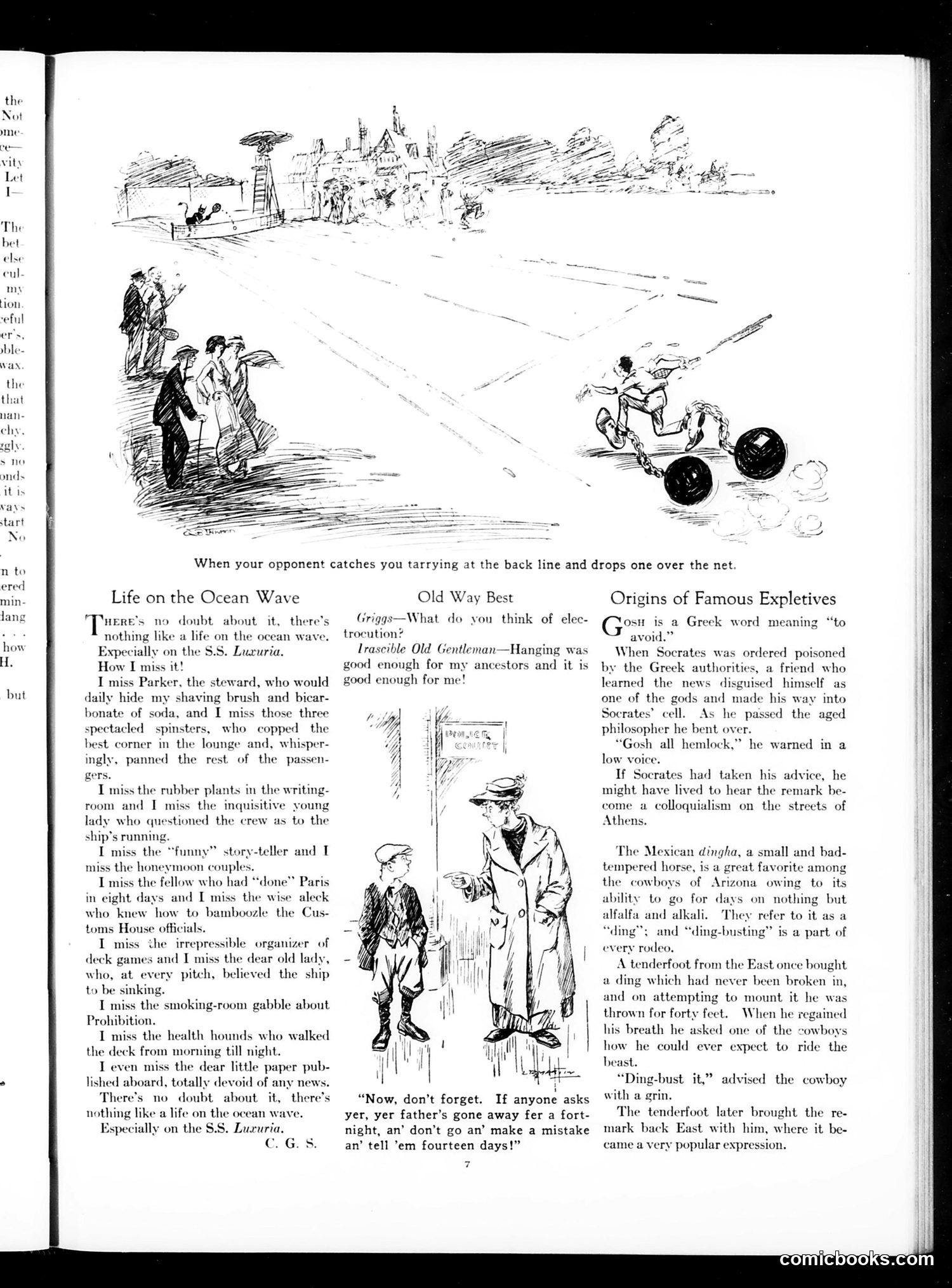
This page contains three distinct humorous pieces typical of early 20th-century American satire: **Top cartoon**: A tennis joke about a player caught near the net when opponent hits a drop shot over—visual humor requiring no political context. **"Life on the Ocean Wave"**: A nostalgic monologue by C.G.S. about missing ship life aboard the S.S. Luxuria. The satire gently mocks ocean liner passengers—hypochondriacs, busybodies, pretentious travelers, and know-it-alls. The humor lies in the contradiction: the narrator claims to miss this annoying cast of characters and the ship's trivial bulletin despite professing to enjoy ocean travel. **"Origins of Famous Expletives"**: Mock-etymologies humorously "explaining" mild curses ("gosh," "ding-bust") through fabricated classical and cowboy origins. This is pure wordplay satire, creating absurd backstories for common expressions to amuse readers. None of these pieces contain overt political commentary—they're social humor targeting passenger-ship culture and linguistic whimsy.
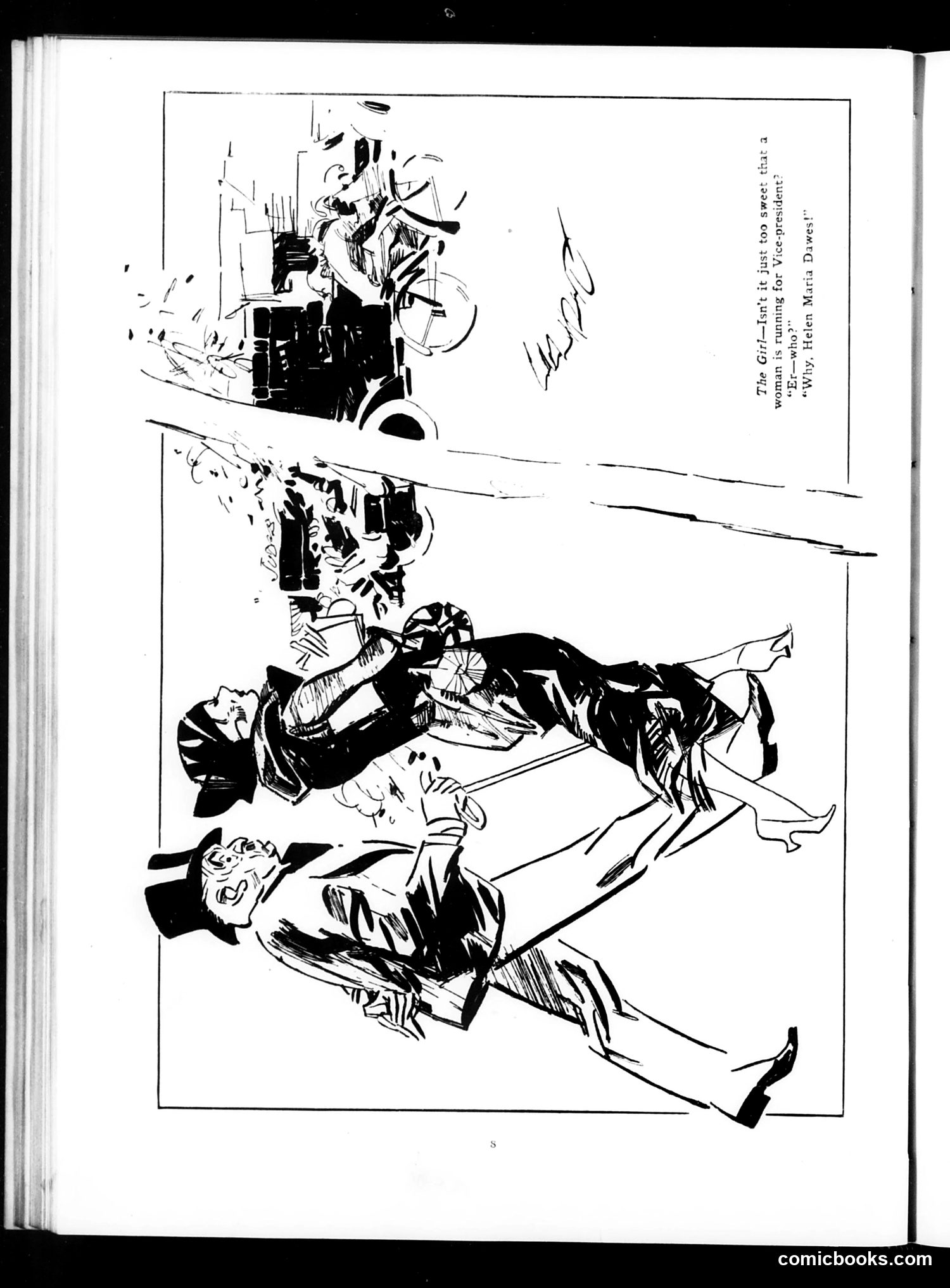
This page contains two cartoon panels rotated 90 degrees. The top panel depicts chaotic mechanical destruction—gears, springs, and debris exploding outward. The bottom panel shows two men in formal dress appearing to be thrown or knocked backward by force. The caption text (partially visible on the right) references "The 67th-Enth list to spare that's a woman is running for President?" with mention of "Why, Helen Drew!" Without the complete caption text legible in this image, the exact political reference remains unclear. However, the juxtaposition of mechanical chaos with displaced formal figures suggests satire about a political campaign or candidacy, likely mocking either the candidate or the disruption caused by their campaign. The "Helen Drew" reference may identify the satirical target, though the broader context and date needed for full interpretation aren't available here.
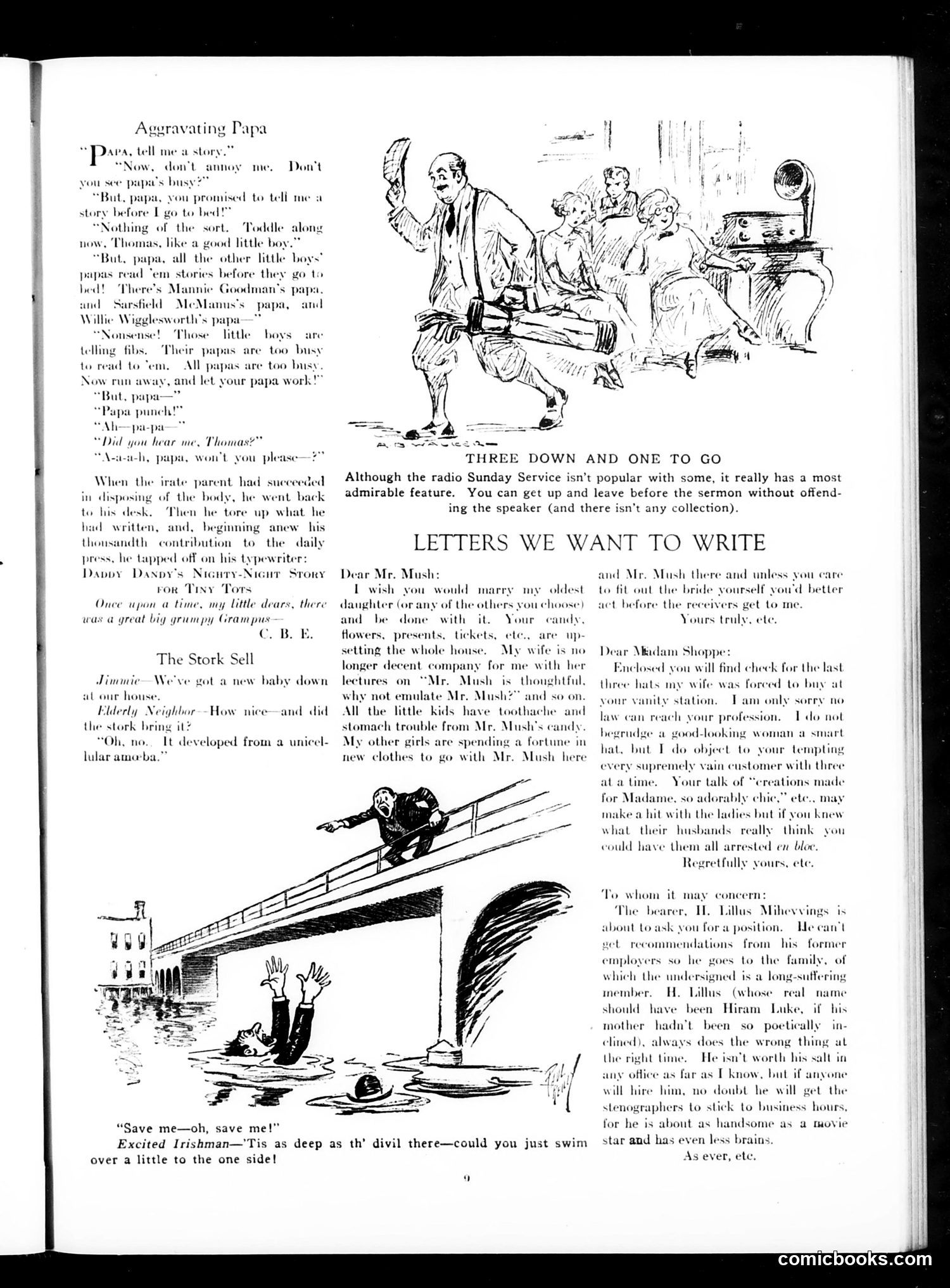
**Top story:** A father repeatedly rebuffs his son Thomas's requests for a bedtime story, claiming he's too busy working. The irony: when the father finally sits down at his typewriter to work, he instead writes "Dappy Danny's Nursery Rhyme Story for Tiny Tots"—a children's story. The satire targets busy fathers who prioritize work over family time, yet waste time on trivial tasks. **"The Stork Sell":** A brief joke where a neighbor asks if the stork delivered a new baby. The father's reply—that it "developed from a unicellular amoeba"—mocks modern scientific knowledge. It's a lighthearted jab at fathers who've abandoned traditional stork explanations for their children. **"Letters We Want to Write":** Humorous complaint letters from wives and husbands about suitors and spouses spending money on gifts, clothes, and luxuries. These satirize courtship excess and marital financial strain. **Radio Service note:** Jokes that radio sermons allow listeners to leave before the collection plate passes—a dig at churches.
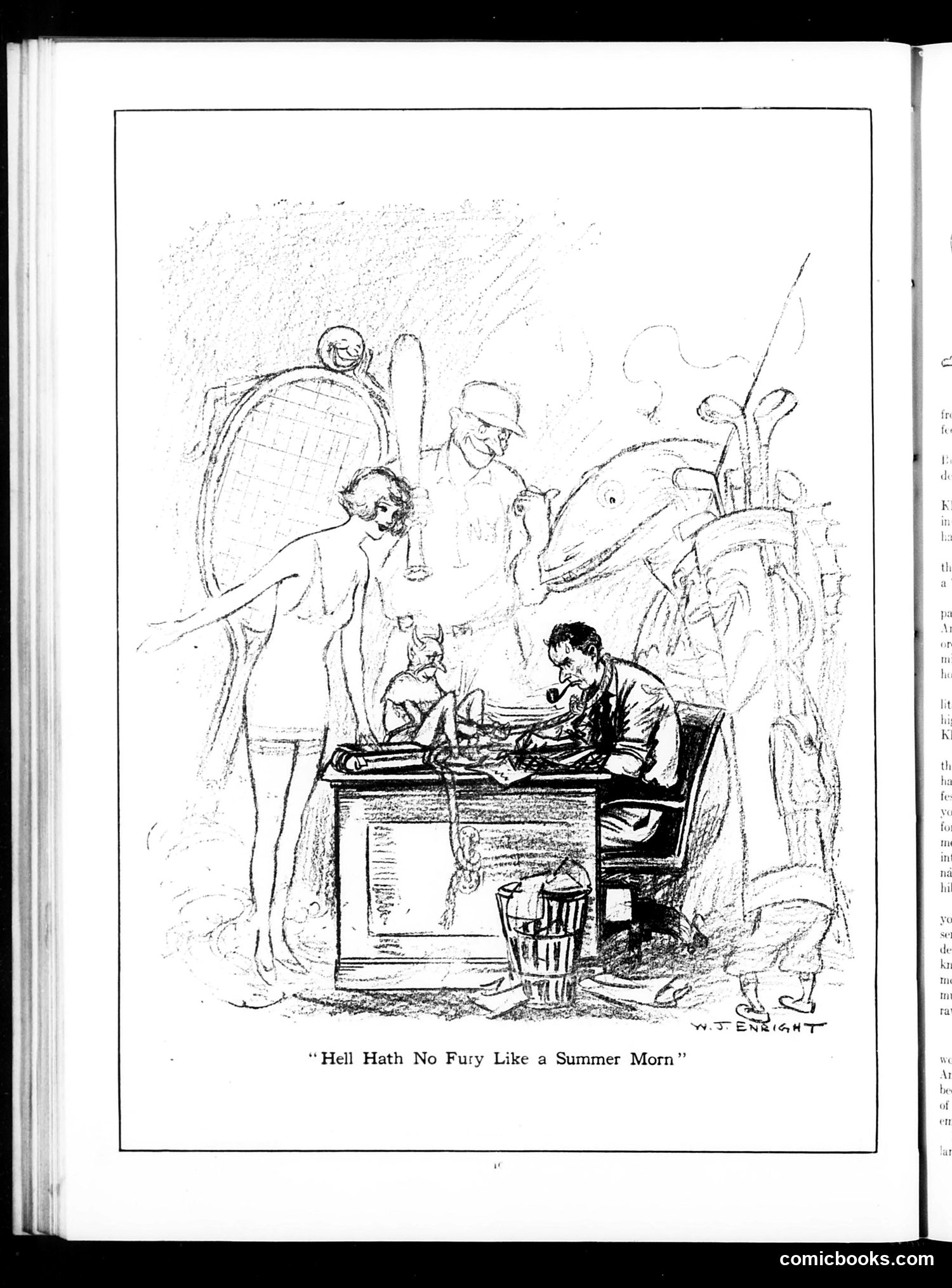
This Judge cartoon satirizes domestic life during hot summer weather. A man sits at a desk working while his wife (standing, partially undressed from heat) looms over him with evident frustration. Children and other figures surround them in a sweltering interior, with exaggerated heat lines indicating oppressive temperature. The caption plays on Shakespeare's "Hell hath no fury like a woman scorned," but applies it to summer discomfort instead. The joke suggests that a wife's irritability during unbearable summer heat—when homes lacked air conditioning—rivals any theatrical rage. The cartoon mocks both the physical misery of summer and the domestic tensions it creates, portraying the husband as stoically enduring his wife's heat-induced bad temper while trying to work.
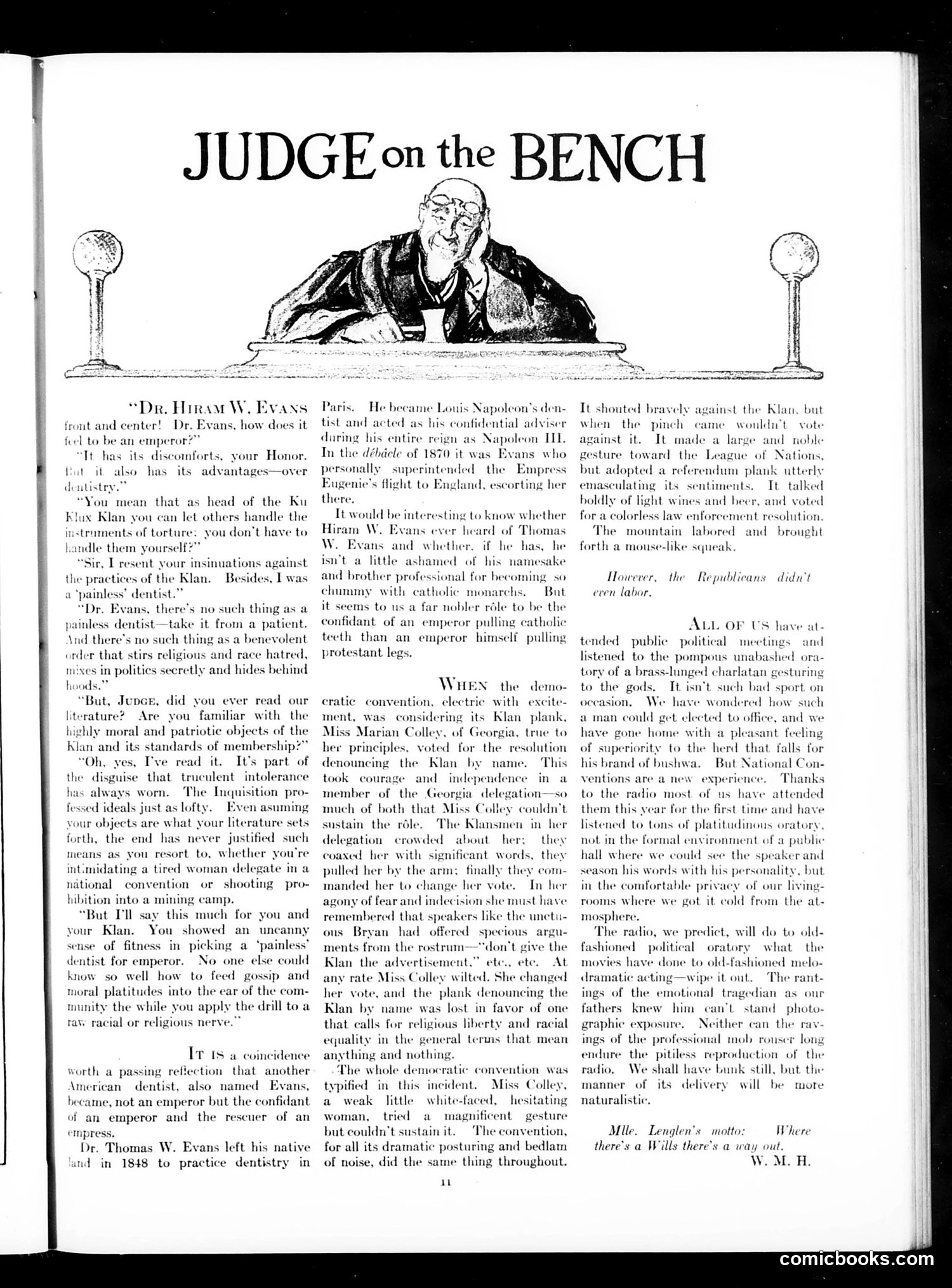
This satirical piece presents a judge interrogating **Dr. Hiram W. Evans**, the Imperial Wizard of the Ku Klux Klan, comparing his dentistry background to his role leading an organization promoting racial and religious hatred under a veneer of "moral" principles. The cartoon draws a parallel to **Dr. Thomas W. Evans**, a real historical figure who was Napoleon III's dentist and confidant—positioning Evans as choosing to serve a tyrannical political leader rather than his own interests. The text then shifts to criticize the **1924 Democratic National Convention**, where Georgia delegate **Miss Marian Colley** initially voted to denounce the Klan by name but buckled under intimidation from Klan members in her delegation, changing her vote. The satire condemns both the Klan's thuggish tactics and the Democratic Party's failure to take a principled stand against it, instead adopting vague language about "religious liberty" that meant nothing. The piece exposes how institutions—whether parties or conventions—compromised their stated values when confronted with organized intimidation.
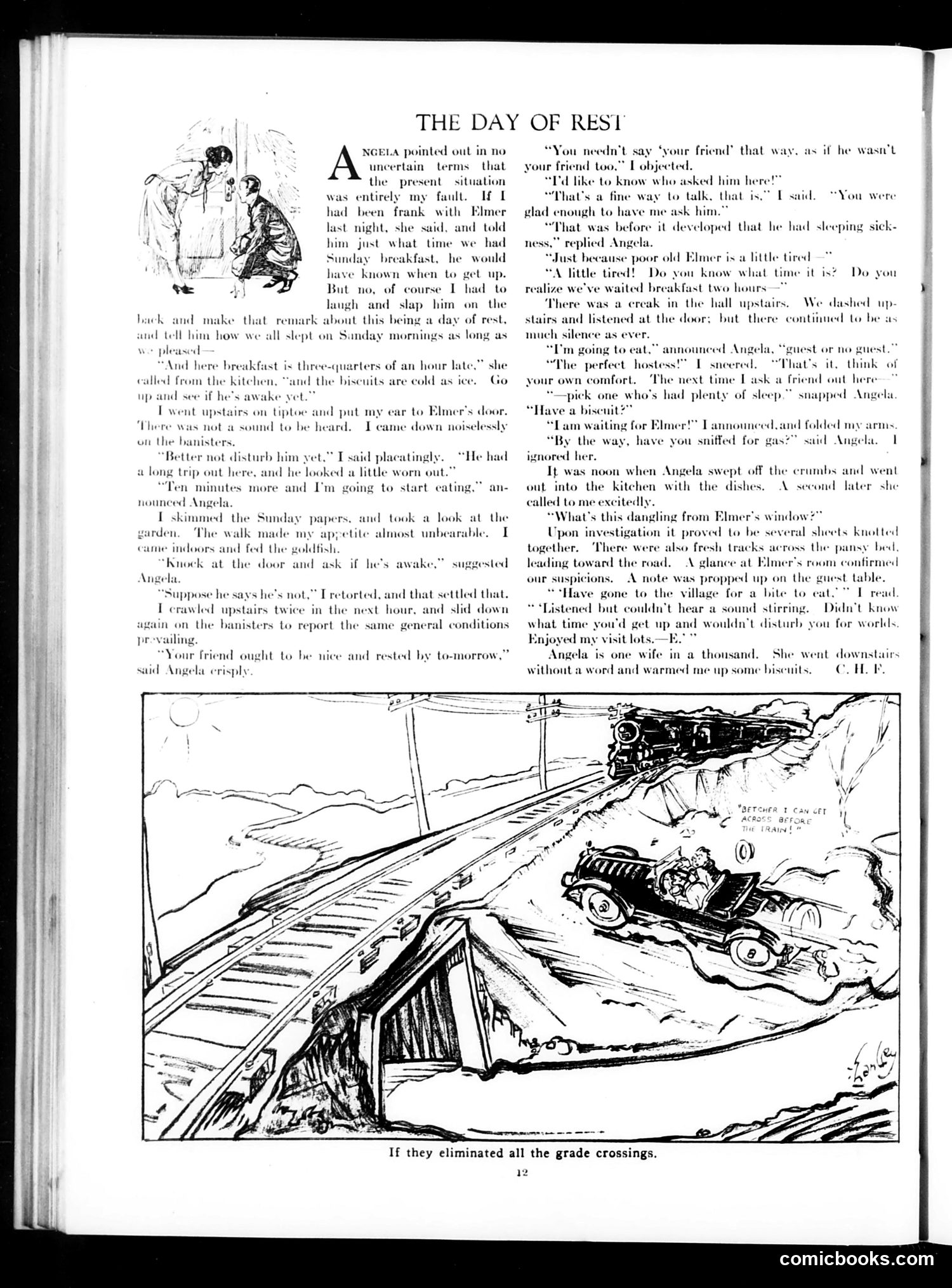
This domestic comedy satirizes the conflict between a wife's expectations and a husband's desire for rest. Angela expects her husband to wake promptly for Sunday breakfast, but Elmer—described as tired from "a long trip"—oversleeps. Angela grows increasingly irritated as breakfast gets cold and she waits two hours. The satire targets the Victorian ideal of "rest day" as contradictory: Sunday is supposedly for relaxation, yet wives maintained rigid schedules that denied husbands actual rest. Elmer ultimately escapes by sneaking out via knotted sheets (a humorous reference to elopement clichés) to get food elsewhere. The cartoon below titled "If they eliminated all the grade crossings" appears unrelated—a separate satirical commentary on railroad safety, showing a train and automobile collision scenario. The piece mocks both domestic nagging and the hollow promise of leisure time in early 20th-century American life.
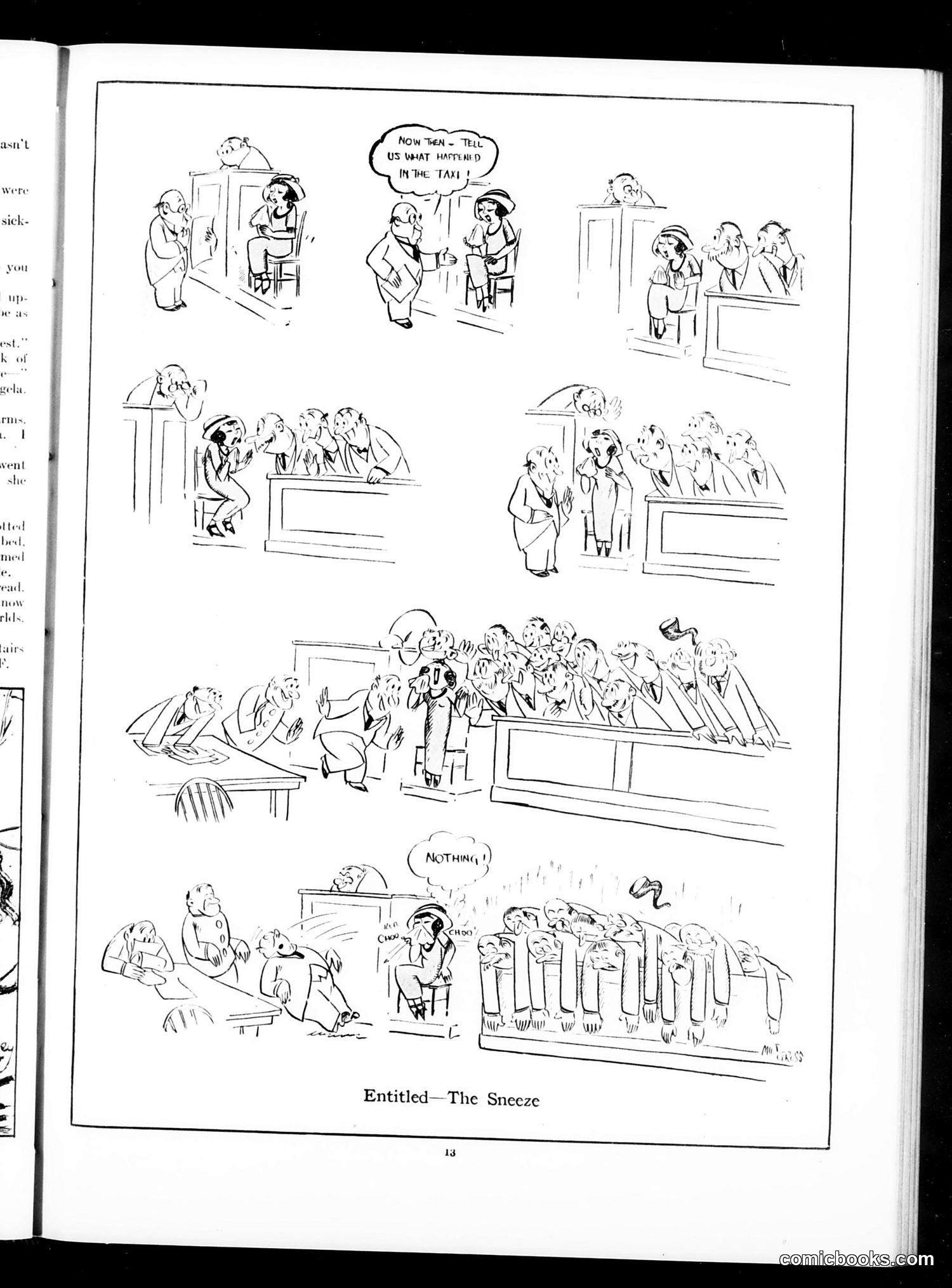
This is a multi-panel satirical cartoon titled "The Sneeze" showing a cascading chain-reaction sequence in what appears to be a courtroom or formal institutional setting. The joke depicts a single person sneezing, which triggers an increasingly chaotic domino effect: the sneeze spreads contagiously through the room, causing successive groups of people to sneeze uncontrollably until the entire assembly descends into pandemonium. The final panel shows "Nothing!" — suggesting the original sneeze accomplished absolutely nothing despite its massive consequences. The satire likely critiques institutional inefficiency, bureaucratic absurdity, or how minor incidents in formal settings (government, courts, etc.) cause disproportionate disruption. The cartoon mocks the vulnerability of supposedly dignified institutions to trivial disturbances, playing on Judge magazine's characteristic irreverent humor toward American authority figures and systems.
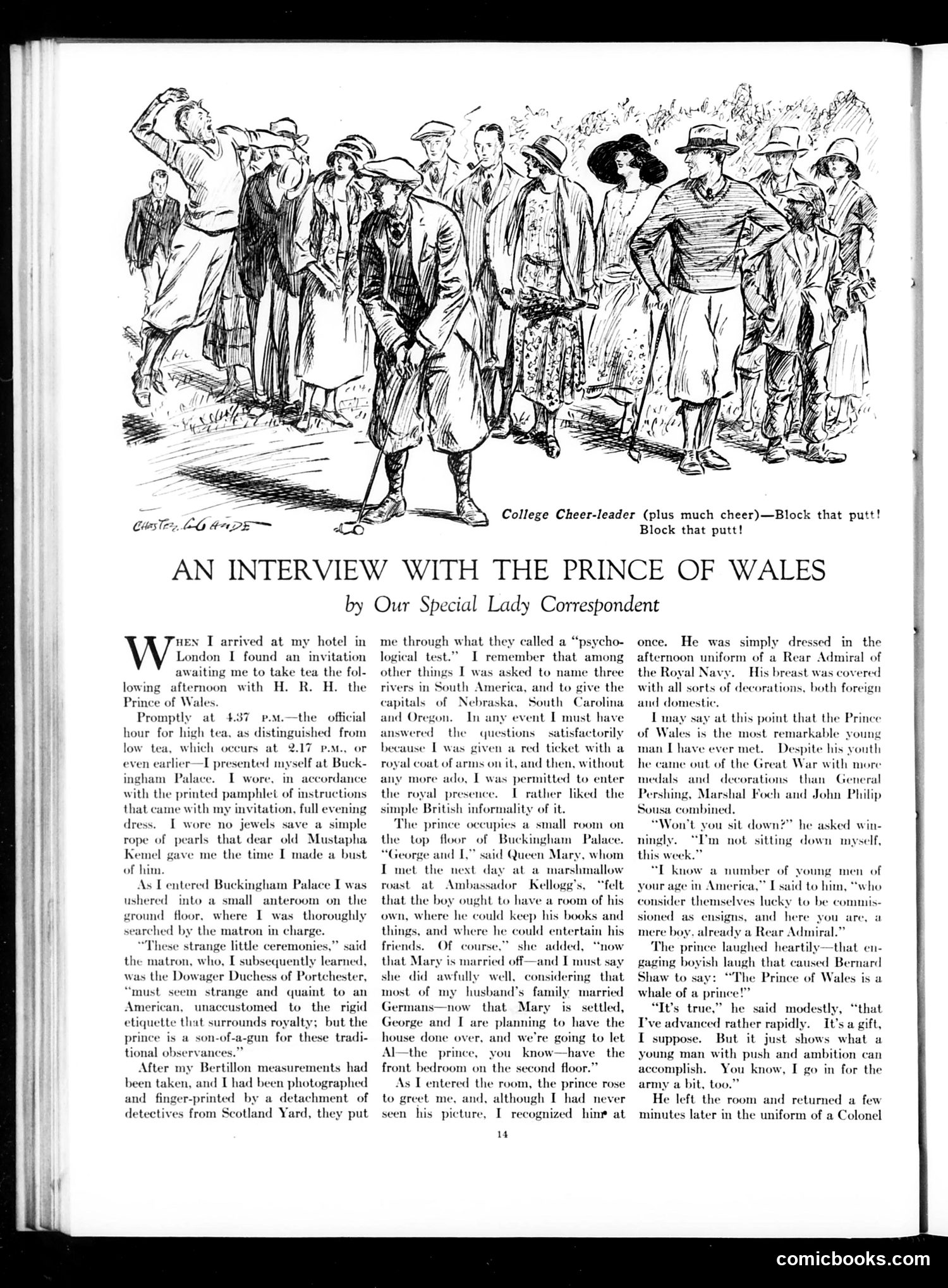
This is a humorous piece mocking both the Prince of Wales (later Edward VIII) and American social pretensions. The cartoon above depicts a college cheerleader leading a crowd—"Block that putt!"—establishing a tone of absurdist American casualness. The satire works on multiple levels: The correspondent's visit to Buckingham Palace is laden with exaggerated security procedures (fingerprinting by Scotland Yard, "psychological tests" asking nonsensical questions about Nebraska capitals). Queen Mary's casual remarks about her daughter marrying Germans and redecorating the palace undercut royal dignity. Most pointedly, the Prince is portrayed as absurdly decorated—covered in medals despite his youth, outranking Pershing and Foch—yet comically modest about his "advancement," attributing it to personal "push and ambition" like an American self-made man. The joke targets both British royal pretension and American naïveté about aristocratic life.
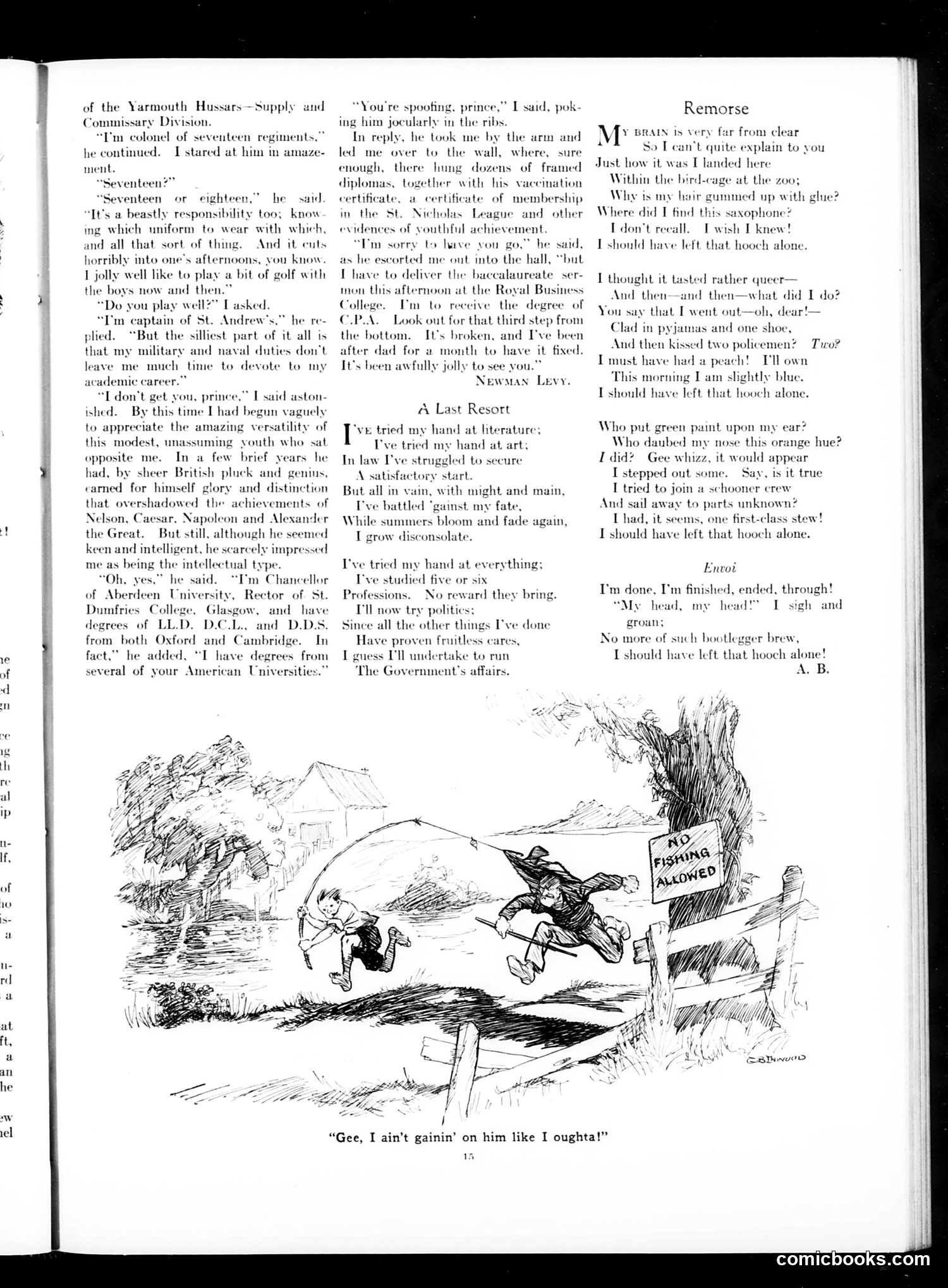
This page contains two distinct pieces of satire: **"A Last Resort" (top narrative)**: A humorous story mocking British academic and military pretension. The narrator meets a young man claiming to simultaneously hold numerous military commissions, university positions, and degrees from Oxford, Cambridge, and American universities. The joke satirizes the absurdity of one person accumulating such an implausible collection of titles and credentials—suggesting either massive self-aggrandizement or outright lying. The protagonist's final resort is running for political office, implying that politics requires no actual qualifications. **Bottom cartoon**: Depicts a figure being chased away from a "No Fishing Allowed" sign, with the caption "Gee, I ain't gainin' on him like I oughta!" This appears to be a simple visual joke about pursuing someone or something in a forbidden area. **Right-side poems** ("Remorse" and "Envoi"): Hangover-themed verses chronicling a drunken night's misadventures—kissing policemen, wearing pajamas, painting one's face—all blamed on consuming "hooch" (alcohol, likely referencing Prohibition-era drinking).
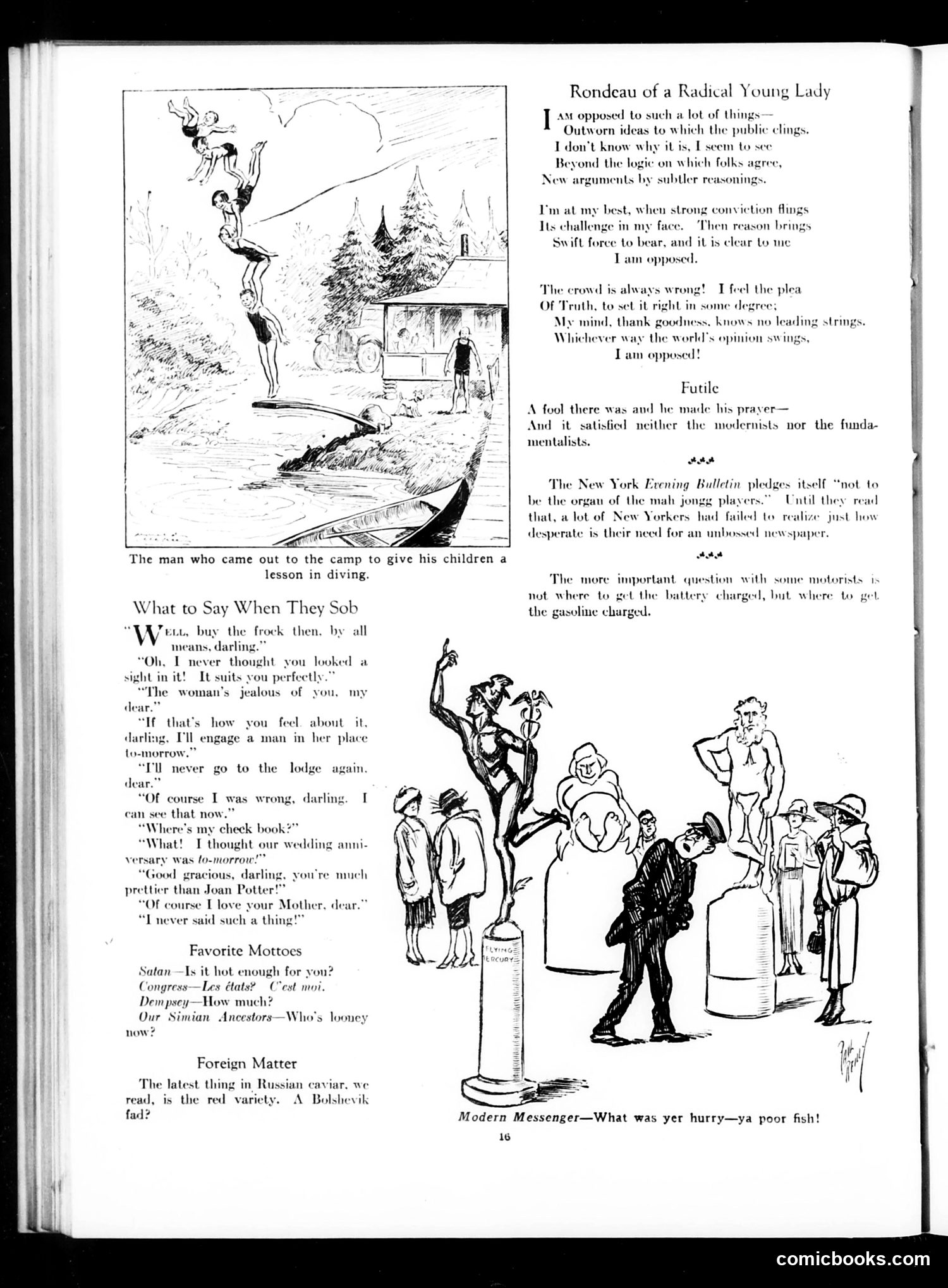
This page contains several satirical pieces mocking contemporary social attitudes circa the 1920s. **"Rondeau of a Radical Young Lady"** ridicules fashionable young women who adopt contrarian political positions without genuine conviction. The poem satirizes their reflexive opposition to mainstream ideas and tendency to champion unpopular causes to appear intellectually superior—critiquing performative radicalism rather than substantive thought. **"Futile"** mocks religious extremism, suggesting that moderate faith satisfies neither modernists nor fundamentalists, implying both camps are unreasonable. **Miscellaneous jabs** include mockery of the New York Evening Bulletin's self-promotion, motorists' priorities, and reference to "Bolshevik" caviar, reflecting post-Russian Revolution American anxieties. **"What to Say When They Sob"** presents cynical marital dialogue where husbands manipulate wives through flattery and appeasement—satirizing both masculine deception and female vanity in marriage. The overall tone is conservative social satire targeting modern pretension, radical politics, and gender relations.
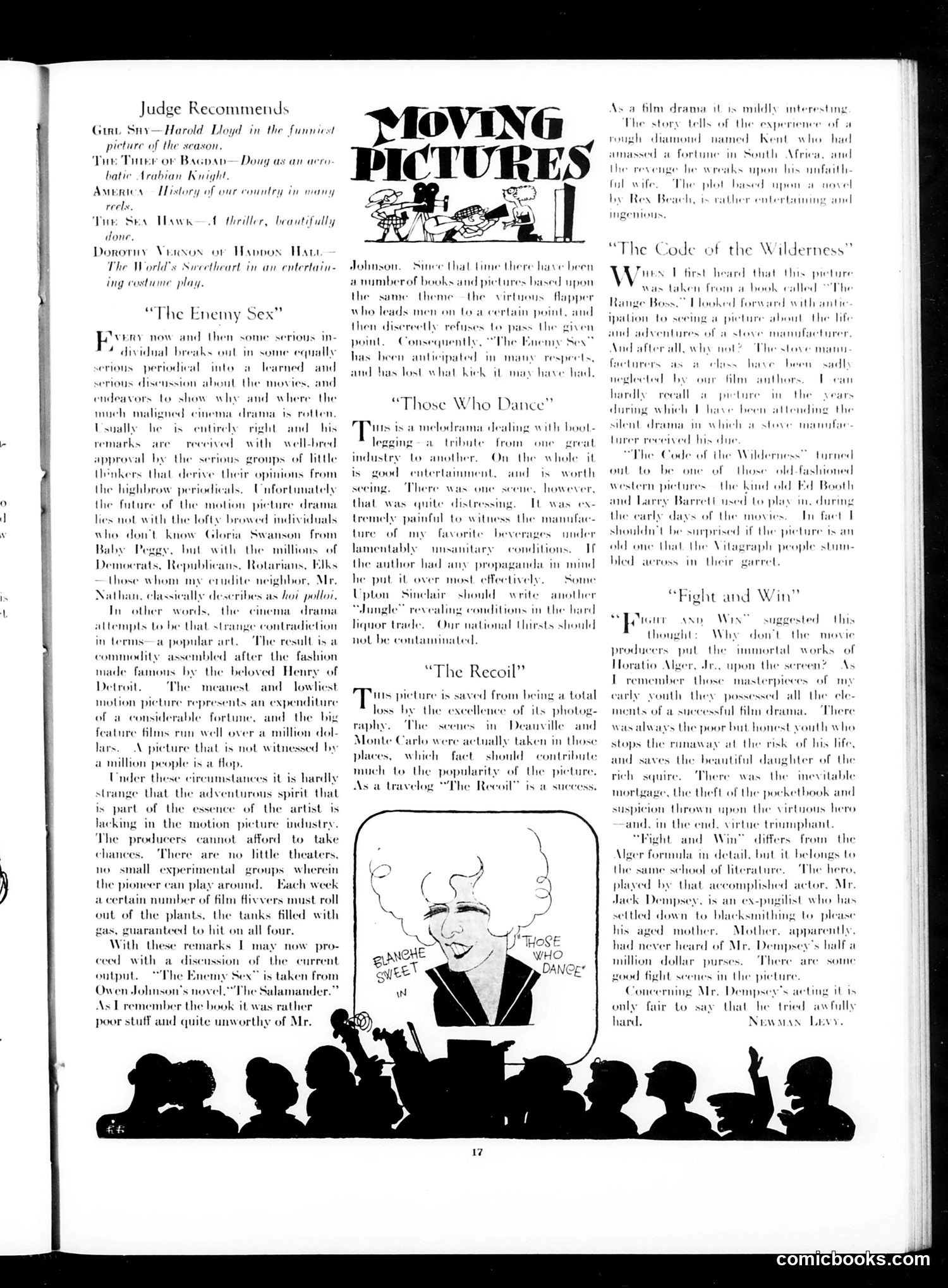
This page from *Judge* magazine reviews recent films. The main cartoon depicts a theater audience member's head in a thought bubble labeled "Those Who Dance," referencing one of the reviewed films—a melodrama about bootlegging during Prohibition. The satirical context: The reviews criticize American cinema's commercial constraints. The critic argues that Hollywood films lack artistic merit because studios cannot afford experimentation; they must produce profitable "hits" reliably, turning movies into manufactured commodities rather than art. References to "hoi polloi" (common people) versus highbrow audiences underscore tensions between artistic integrity and mass entertainment. The bootlegging film's heavy-handed portrayal of alcohol production apparently offended the critic, who sarcastically suggests Upton Sinclair-style exposé journalism would better serve national interests than propaganda in movies. Overall, the page reflects 1920s anxieties about cinema's aesthetic legitimacy amid commercial pressures and Prohibition-era social debates.
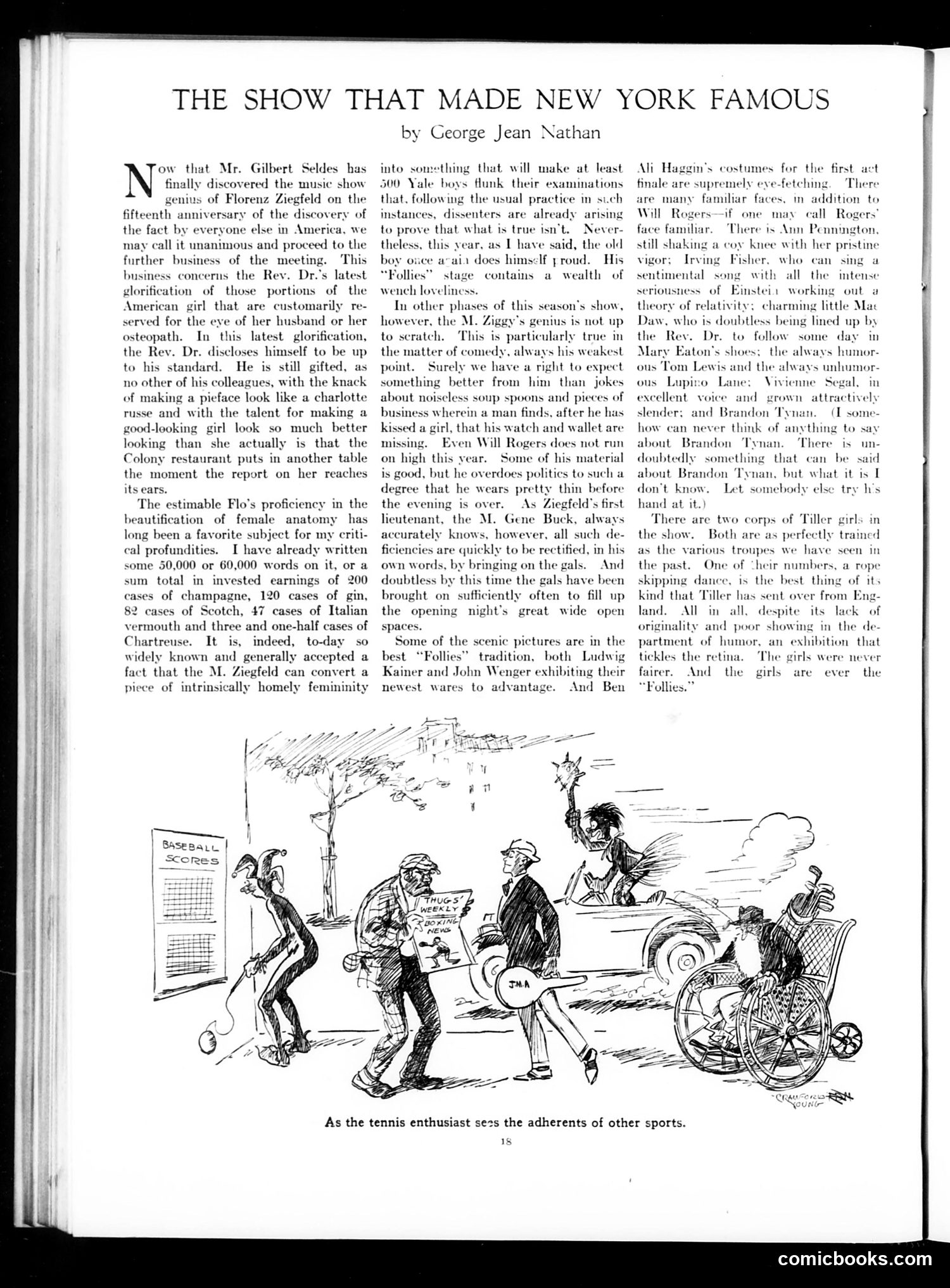
This page reviews the Ziegfeld Follies, the famous Broadway revue known for elaborate staging and beautiful showgirls. Critic George Jean Nathan praises producer Florenz Ziegfeld's talent for making women appear more attractive through costume and presentation, but criticizes the comedy material as weak. The cartoon below depicts a tennis enthusiast dismissing other sports—baseball, motorcycles, bicycles, and automobiles—as inferior. This satirizes the pretentiousness of tennis as a fashionable sport among New York's elite, mocking how enthusiasts ignore or look down upon more popular pastimes. Nathan names performers including Will Rogers (comedian), Ann Pennington, and Irving Fisher. The piece celebrates the Follies' visual spectacle while suggesting its humor relies too heavily on clichéd jokes about soup spoons and theft, with only the chorus girls' appearance saving the show.
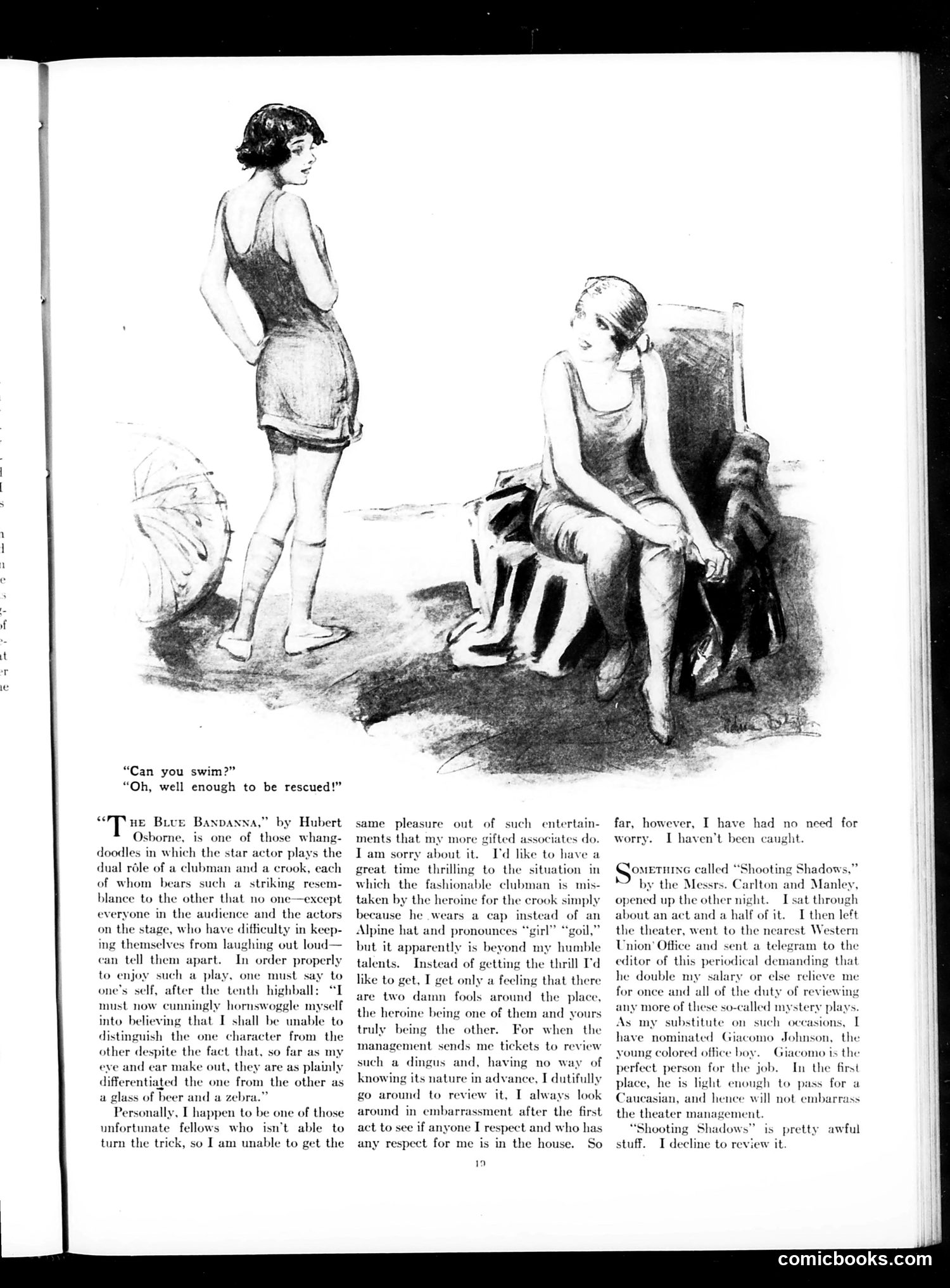
This page from *Judge* magazine contains theater criticism disguised as satire. The cartoon shows two women at a beach; the caption "Can you swim?" / "Oh, well enough to be rescued!" mocks a flirtatious social convention—women feigning helplessness to attract male attention. The accompanying text reviews two plays. The critic savagely mocks "The Blue Bandanna," a melodrama where an actor plays dual roles (clubman and crook) so similar that only alcohol-induced delusion lets audiences suspend disbelief. He ridicules the plot's absurdity: the heroine mistakes one for the other merely because of hat and accent differences. He then dismisses "Shooting Shadows" as equally terrible "mystery play" garbage, sarcastically proposing to replace himself with a young Black office worker, mocking both the play's quality and—in a deeply racist aside—suggesting any unqualified person could do his job. This casual racism was typical of 1920s *Judge* humor. The satire targets theatrical mediocrity and audience gullibility.
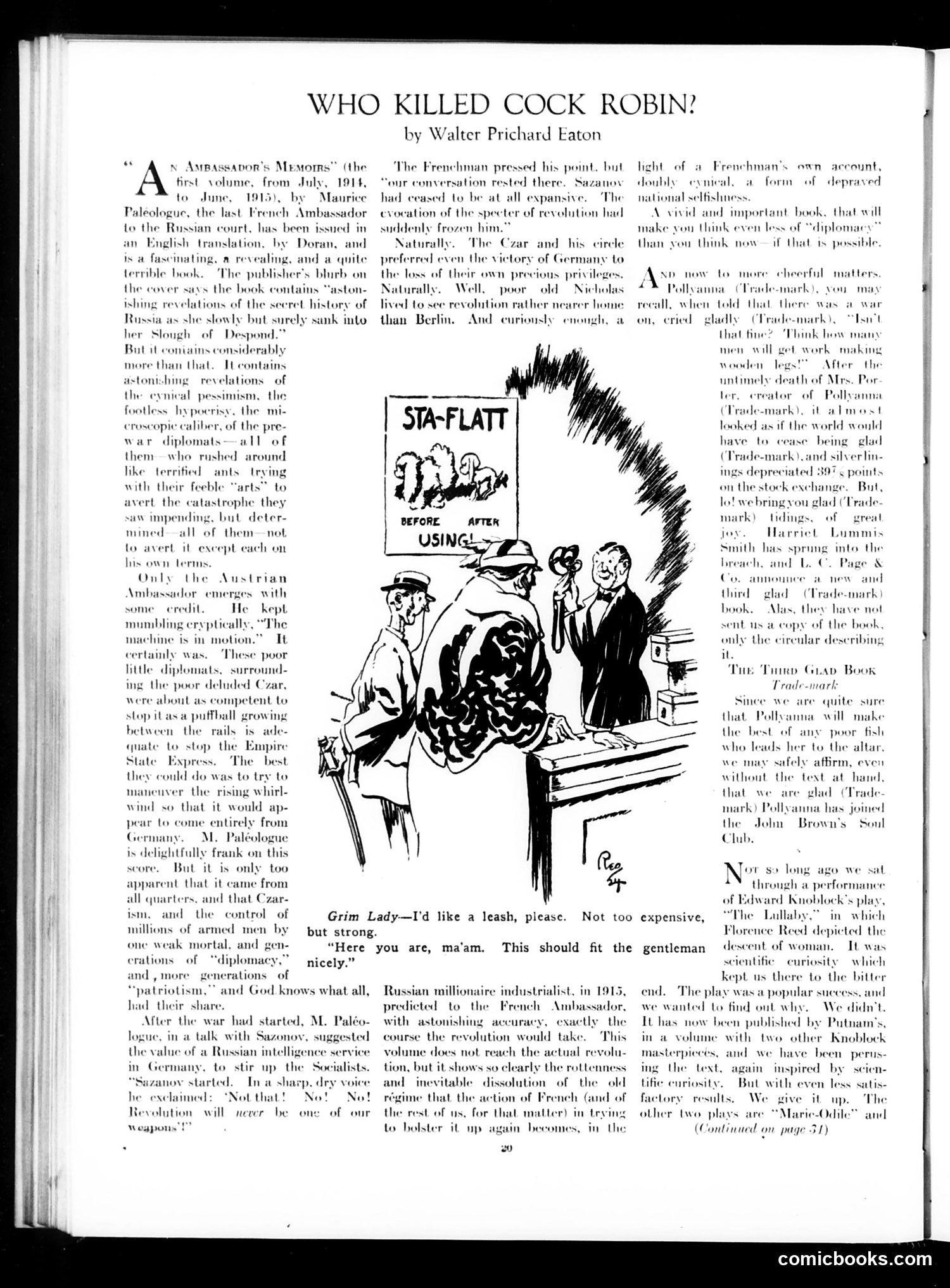
This page contains two separate pieces. The main article discusses Maurice Paleologue's French ambassador memoirs (1914-1915), revealing pre-WWI diplomatic incompetence. The satire targets European diplomats as ineffectual ("puffballs") unable to prevent catastrophe, while the Russian Tsar and his circle prioritized preserving privileges over preventing revolution—ironically achieved anyway. The piece criticizes their cynical refusal to support socialist movements that might destabilize Germany. Below is an unrelated cartoon and brief advertisement. The cartoon depicts a woman asking for a "leash" (with Sta-Flatt product reference), appearing to be a vintage product advertisement rather than political commentary. The page ends with promotional discussion of "Pollyanna" trademark merchandise, indicating commercial content mixed with editorial matter typical of Judge magazine's format.
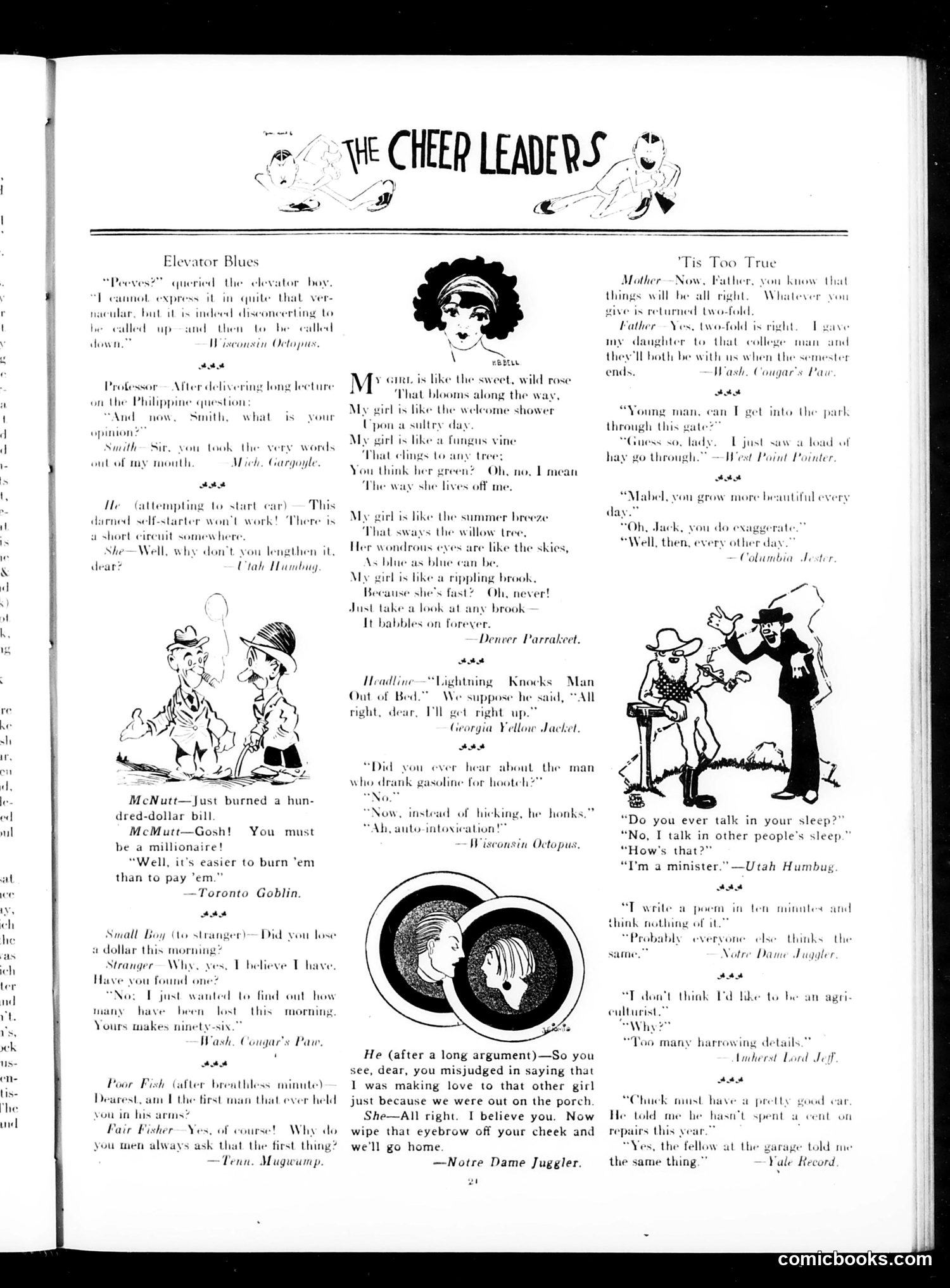
This is a collection of brief jokes and comic vignettes typical of early 20th-century American humor magazines. The page contains no overtly political content, but rather social satire targeting everyday situations and relationship dynamics. Notable items include: - **"Elevator Blues"**: Office worker frustration with elevator service - **The poem about "My girl"**: A young man compares his girlfriend to nature (rose, shower, breeze) before revealing the punchline—she's parasitic ("the way she lives off me") and incessant as a babbling brook - **The car starter joke**: Mild marital conflict humor - **The intoxication jokes**: References to Prohibition-era "hooch" and gasoline drinking - **Relationship humor**: Multiple jokes about courtship, arguing couples, and exaggeration The cartoons depict generic "types" (small boys, professors, couples) rather than specific political figures. The satire targets universal human foibles—cheapness, vanity, laziness, courtship anxieties—rather than current events.
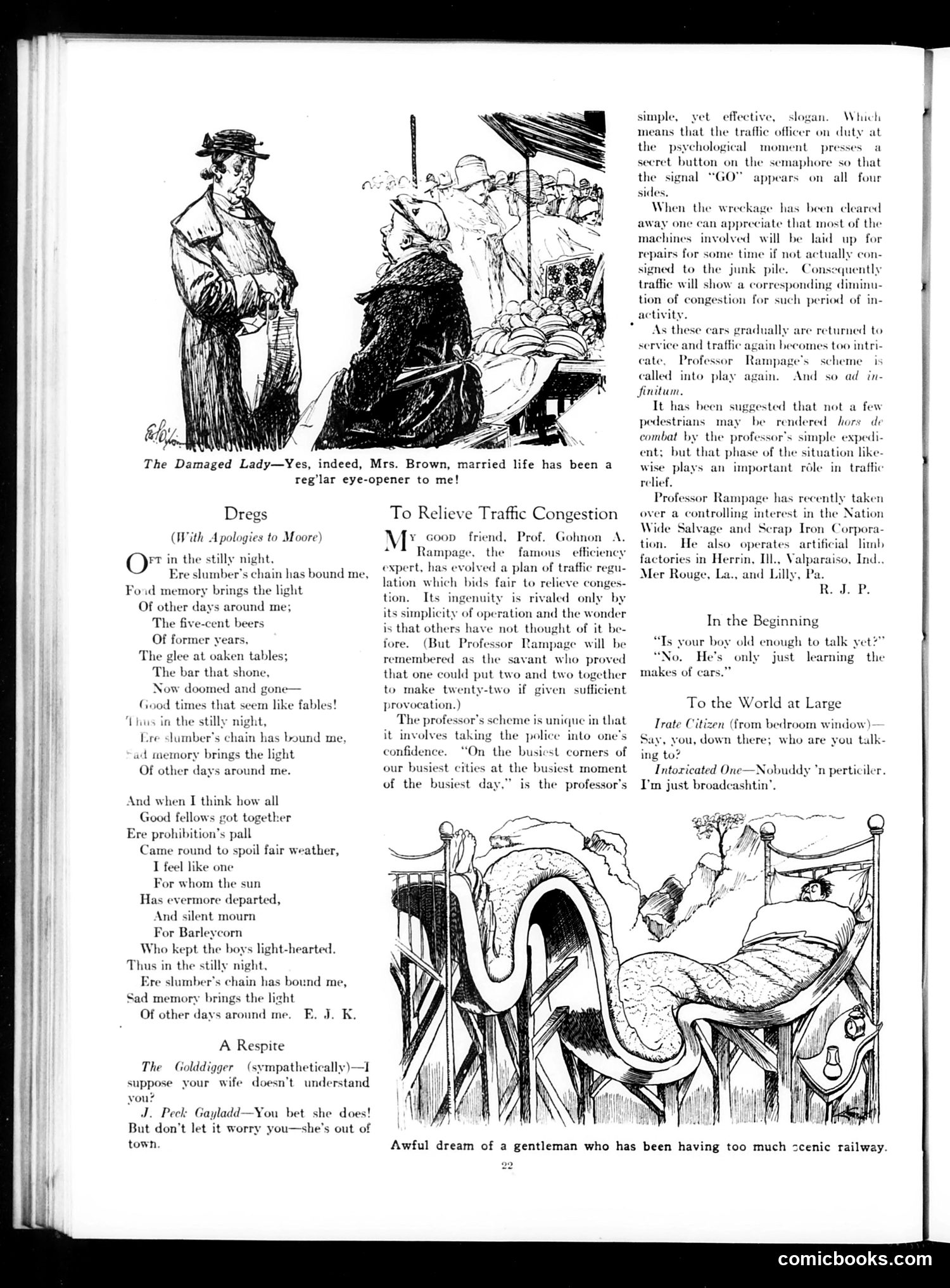
This page contains multiple satirical pieces reflecting early 20th-century American concerns: **"The Damaged Lady"** cartoon mocks marriage's disillusionment through a woman's complaint to her friend. **"Dregs"** is a poem lamenting Prohibition's impact, personifying alcohol ("Barleycorn") and nostalgically recalling pre-Prohibition bar culture. The repeated refrain emphasizes loss of social fellowship. **"To Relieve Traffic Congestion"** satirizes Professor Rampage's absurd traffic solution: having police simultaneously signal "GO" on all four sides of intersections, creating massive collisions. The satire mocks both the "expert" and suggests traffic planners use impractical schemes. The darkly comic note that this generates scrap iron business (with factories for artificial limbs) implies mass casualties—a biting critique of ineffective municipal governance. **"A Respite"** jokes that a man welcomes his wife's absence because she "understands" him too well. **Lower cartoons** humorously depict a child learning car makes and a drunk "broadcasting" loudly. The page reflects post-WWI American anxieties about Prohibition, urbanization, and modern life's chaos.
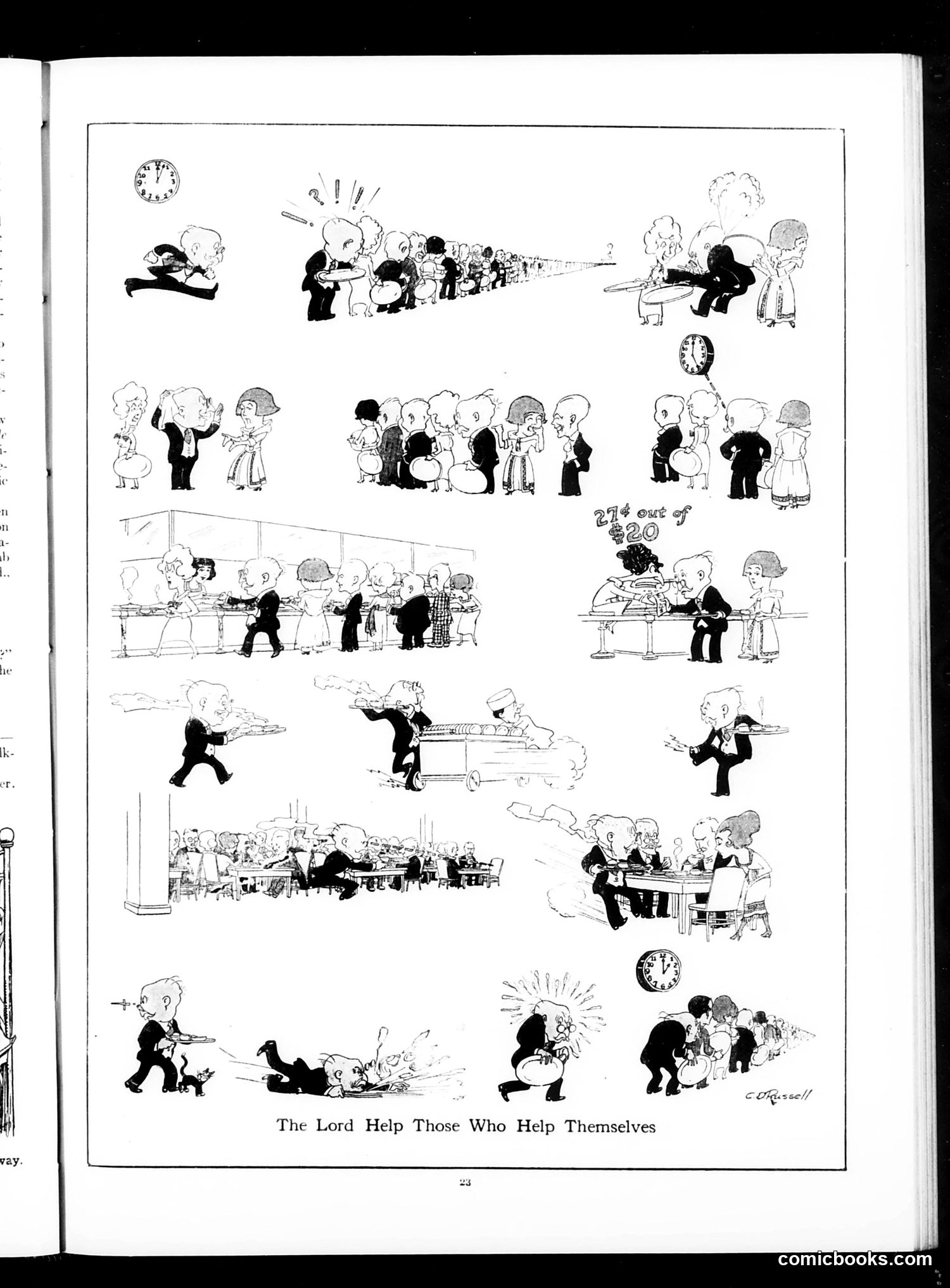
This is a multi-panel satirical cartoon depicting a business or political figure (shown in black suit) throughout his day, from morning to evening. The sequence shows him: - Starting his day energetically - Conducting various transactions and meetings - Managing crowds of people - Operating what appears to be a food service or business establishment - Engaging in increasingly aggressive or questionable dealings - Ending with apparent confrontation or chaos The title, a play on the proverb "God helps those who help themselves," suggests ironic commentary on self-made success or aggressive capitalism. The figure's escalating activities—presented as "helping himself"—appear satirical commentary on ruthless business practices or exploitation during the period when *Judge* magazine published this. The cartoon criticizes behavior presented as self-advancement through questionable means.
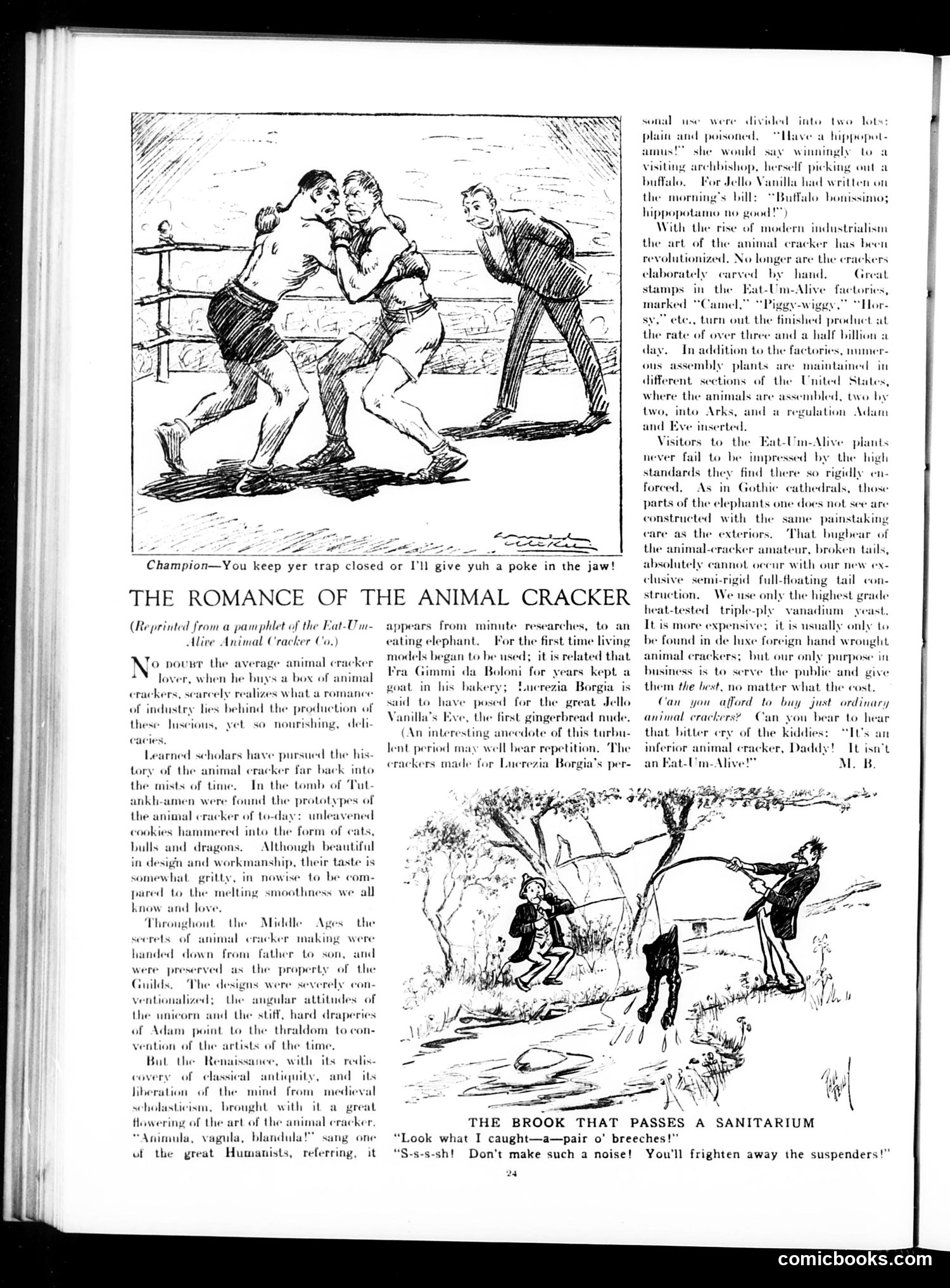
This is a humorous mock-serious article parodying the advertising and industrial boosterism popular in early 20th-century America. The text uses grandiose language ("Animula, vagula, blandula!") and false historical claims to satirize how manufacturers marketed ordinary products—here, animal crackers—as products of refined craftsmanship and tradition. The joke targets corporate propaganda: the piece invents an elaborate fake history (crackers in Tutankhamun's tomb, Renaissance origins) and pretends mass-produced items are made with artisanal care. The reference to "heat-tested triple-ply vanadium yeast" mocks technical jargon used to justify premium pricing. The two illustrations provide comic relief: boxers fighting and two figures by a brook catching "breeches"—visual gags disconnected from the text, typical of *Judge*'s irreverent style. The satire warns readers against believing manufacturers' inflated claims about ordinary consumer goods.
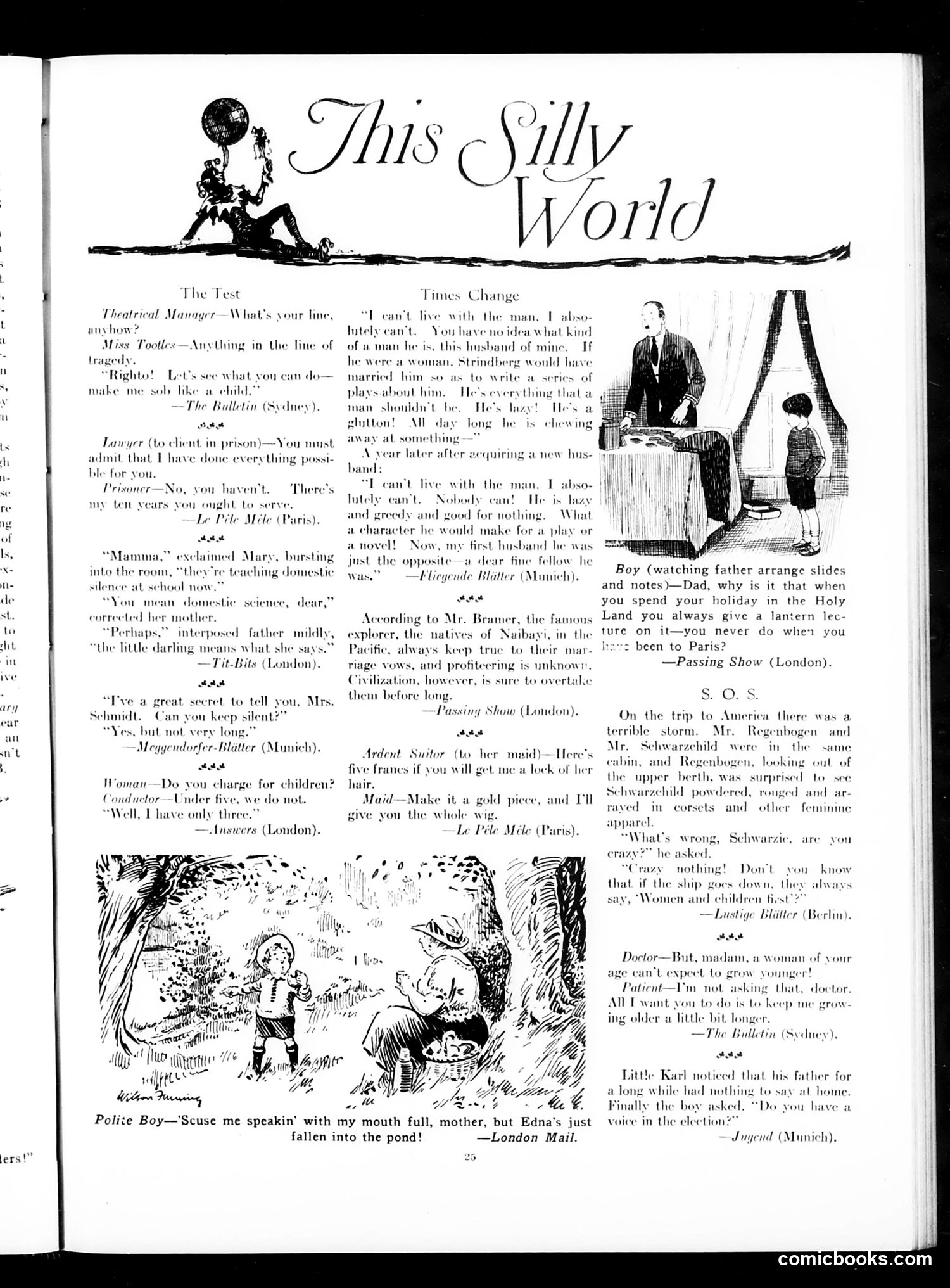
This page collects short humorous anecdotes from various international publications, satirizing human behavior and social conventions of the early 20th century. **Key satirical targets:** - **"Times Change"**: Mocks women's inconstancy in marriage—a woman complains bitterly about her husband, then after divorcing him, romanticizes him to her new husband. The satire suggests women are unreliable judges of character. - **"Ardent Suitor"**: Makes light of sexual pursuit and bribery; the maid's demand for payment escalates the absurdity. - **"Polite Boy"**: Dark humor—the child prioritizes manners over reporting an emergency (sister drowning), mocking rigid propriety. - **Colonial/civilization references**: One item jokes that "savage" Pacific islanders are faithful until "civilization" corrupts them—ironic commentary on Western superiority claims. - **Gender stereotypes**: Multiple pieces reinforce period assumptions about women's irrationality, vanity, and domestic incompetence. The overall tone is lighthearted mockery of universal human follies, presented without the crude caricature sometimes found in period satire.
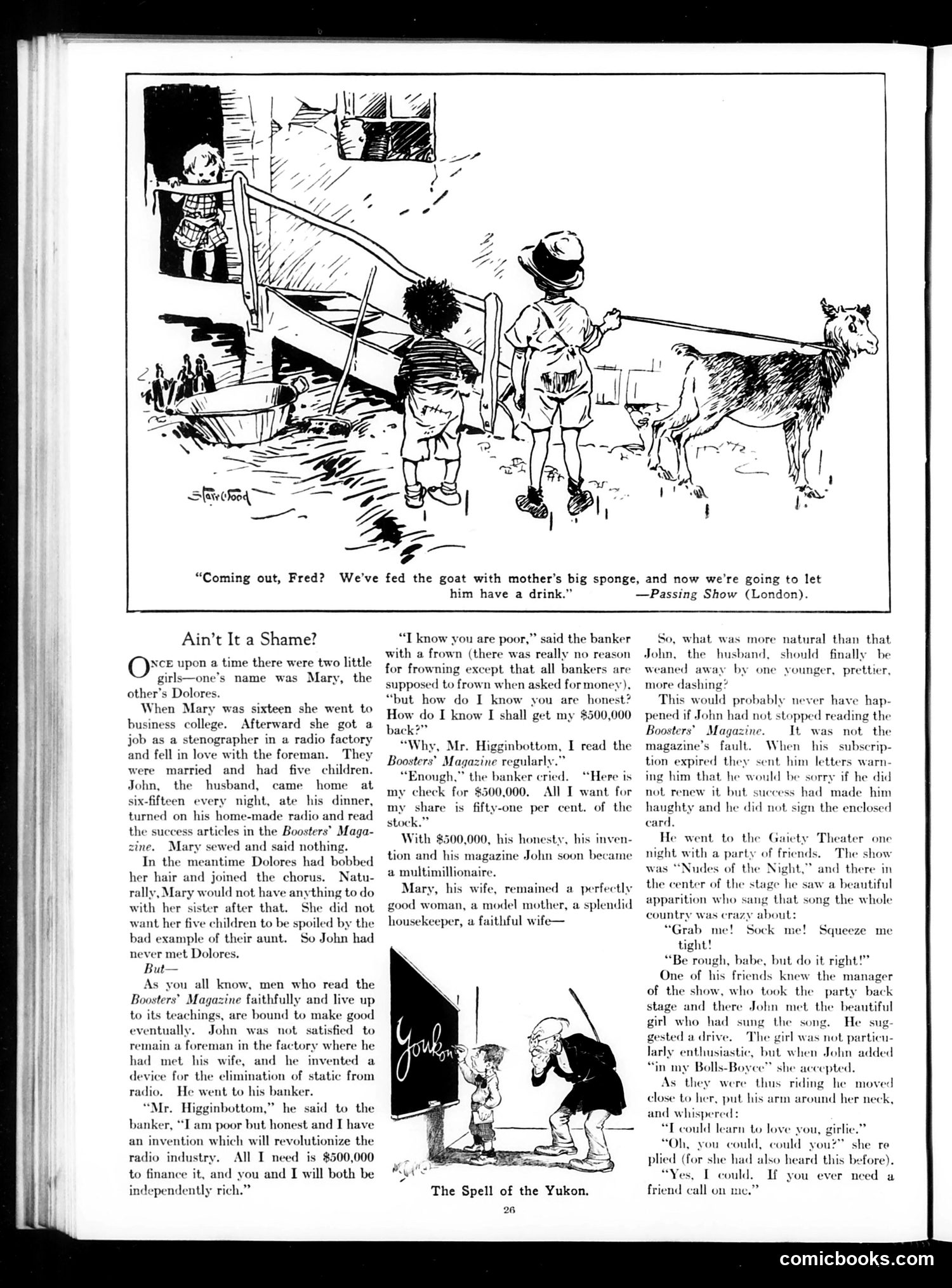
This page from *Judge* magazine contains two separate satirical pieces mocking American materialism and morality circa 1920s. **"Ain't It a Shame?"** tells a cautionary tale contrasting two sisters: Mary, who marries a factory foreman and lives respectably, versus Dolores, a chorus girl. John, Mary's husband, invents a radio device and becomes a multimillionaire—but only after visiting a banker who immediately funds him upon learning John reads *Boosters' Magazine*, a publication promoting success through honesty. The satire lies in the irony: John's sudden wealth and success make him morally corrupt. He abandons his faithful wife to pursue the glamorous Dolores at a theater, seducing her with promises of his Rolls-Royce. The joke criticizes how wealth undermines the very values (*Boosters'* Magazine's teachings) that supposedly created it. The top cartoon, credited to the London *Passing Show*, depicts children feeding a goat mother's sponge before giving it alcohol—a simple absurdist joke about childhood mischief.
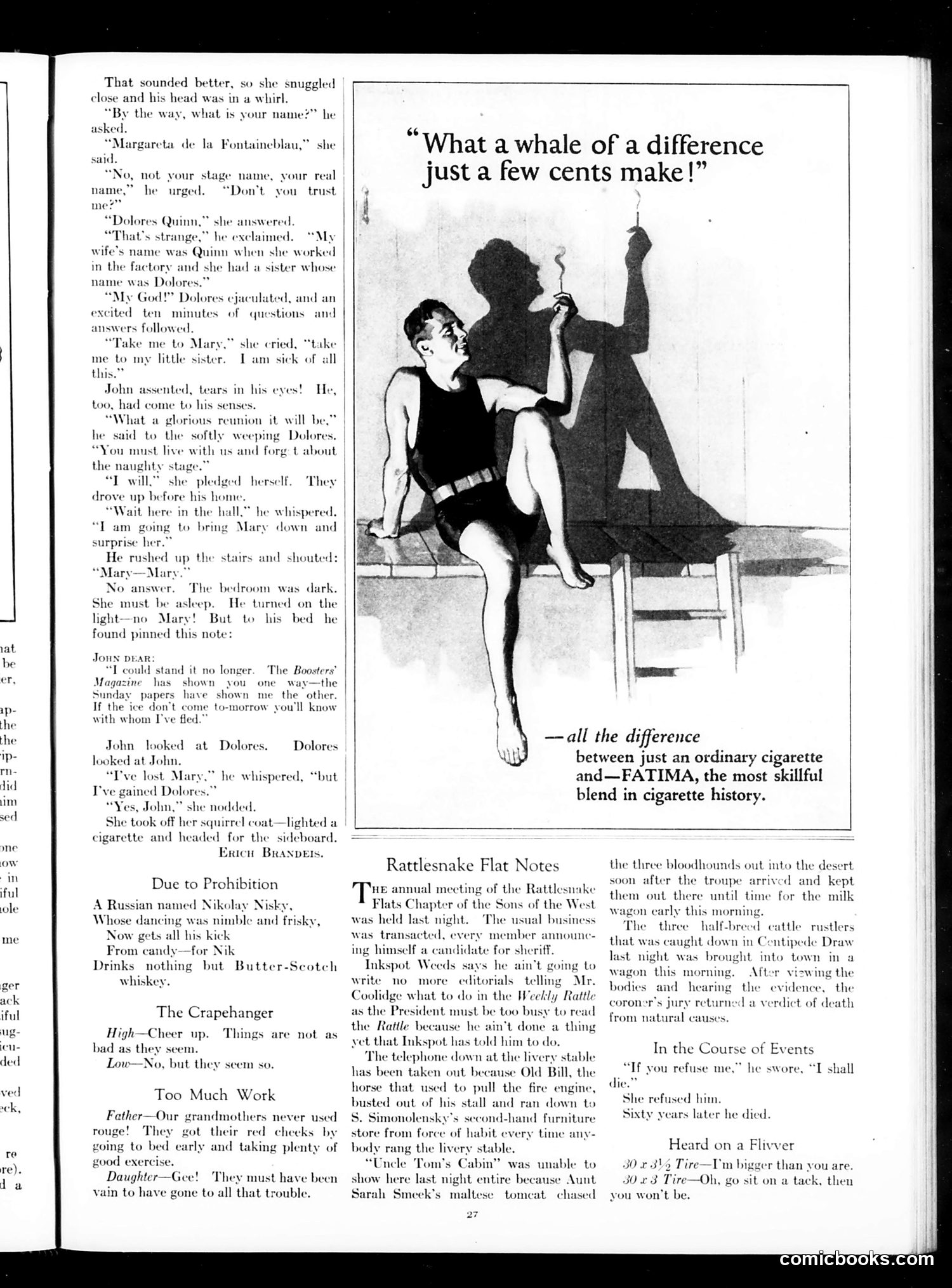
This page contains multiple satirical pieces typical of Judge magazine's format. The main narrative (left column) tells of a man who discovers his lost wife has become a stage performer under an assumed name—a melodramatic tale mocking theatrical pretense and marital infidelity. The punchline: when reunited, she immediately abandons him for another man anyway, undermining the supposed "glorious reunion." The large **Fatima cigarette advertisement** (center-right) uses a couple in a suggestive pose to sell cigarettes, claiming superior "blending"—typical early 20th-century tobacco marketing with sexual innuendo. Below are brief humorous items: - A Prohibition-era joke about a Russian dancer now drinking "Butter-Scotch whiskey" for kicks - Short witty exchanges mocking pretension and work - Rural satirical notes from "Rattlesnake Flat" poking fun at small-town life and amateur theater The page exemplifies Judge's blend of domestic comedy, advertising, and social satire aimed at urban readers.
This page from *Judge* magazine combines advertising with technical education. The left column features a **coupon-based service** where readers can request free automotive advice from the magazine's Motor Department—a practical reader service, not satire. The main article, "Harnessing the Lightning," explains automobile **ignition systems** to a general audience using an accessible water-pipe analogy. The author compares electrical current flow to water pressure, making the technical concept of high-voltage spark plugs understandable. This reflects the 1920s context when automobiles were still relatively new and mysterious to many Americans. The piece emphasizes that while power transmission lines carry massive voltage over long distances, car engines use similarly high voltage (10,000-20,000 volts) in miniature form to ignite fuel mixture. The water analogy—comparing a mountain reservoir's tremendous pressure through a needle-point opening to the ignition system—makes physics accessible. This is **educational content**, not satirical commentary. It represents *Judge's* broader mission as a magazine serving educated readers interested in technology and current affairs.
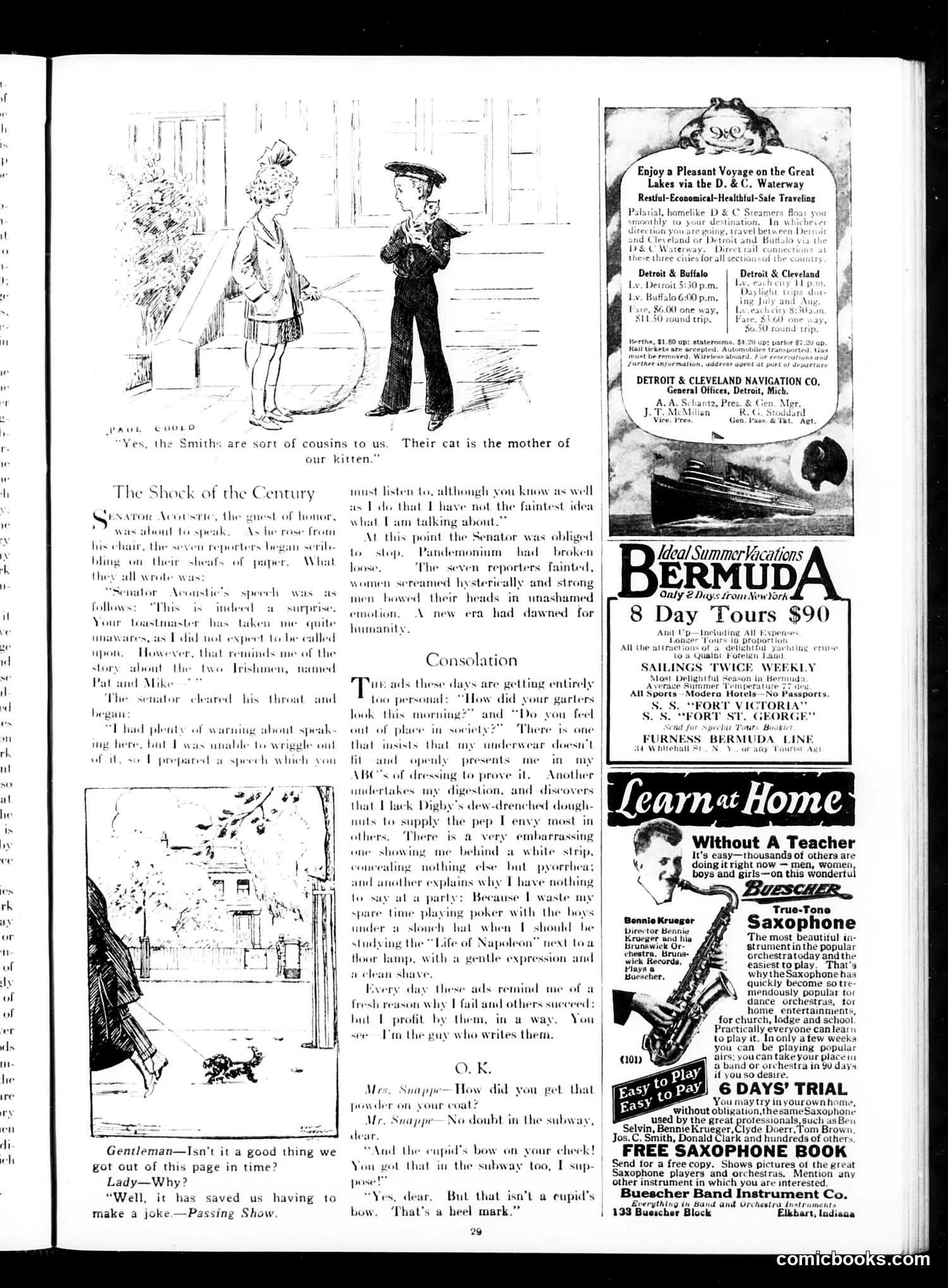
The main cartoon satirizes Senator Acoustie's (likely a generic invented name rather than a real person) attempt to deliver a prepared speech at a formal dinner. The joke rests on his admission that he has "not the faintest idea what I am talking about"—revealing his speech is entirely empty rhetoric. The satire targets politicians who speak authoritatively without substance. When the Senator makes this candid confession, the seven reporters present faint and women scream "hysterically," treating his honesty as shocking and unprecedented. The humor lies in the implication that such transparent admission of meaningless speech is so rare among politicians that it constitutes "the shock of the century." Below is a brief joke about a couple's misadventure in the subway, playing on double entendres about physical marks. The page is primarily advertisement-heavy, with travel and musical instruction ads dominating the right side.
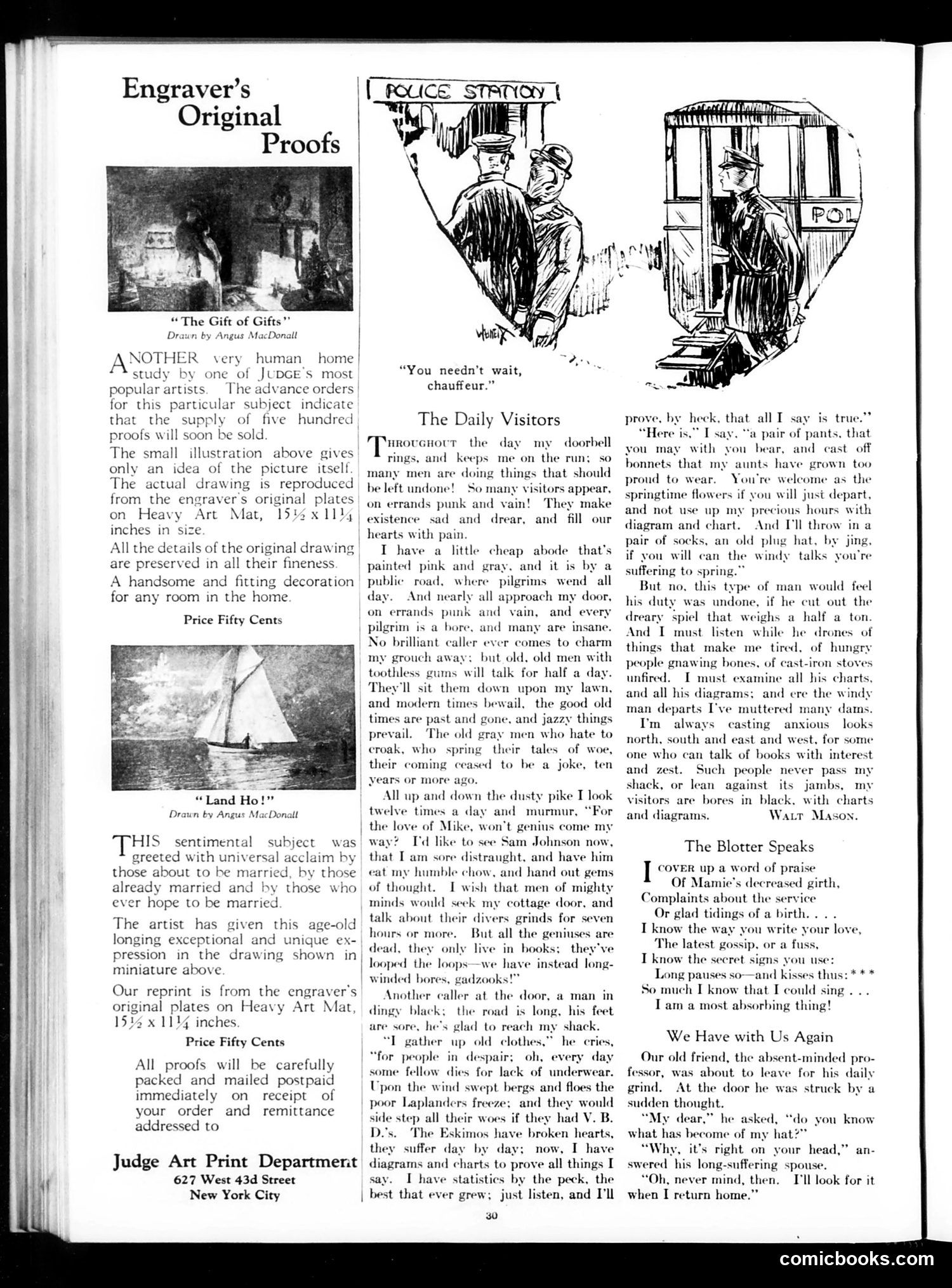
This satirical piece depicts the frustrations of a householder constantly interrupted by various uninvited visitors traveling a rural road past his home. The narrator complains that instead of attracting brilliant minds, he's plagued by: - Nostalgic elderly men boring him with tales of "the good old days" - Desperate salesmen hawking underwear with dubious claims (references to "V.B.D.'s" - a real underwear brand) - Religious or charitable solicitors with charts and statistics The humor targets turn-of-the-century American rural life, where isolation made one's home a convenient stopping point for transients, peddlers, and bores. The cartoons show a policeman stopping someone at a station and the householder's exasperated dismissals. It's satire on the lack of privacy, the prevalence of door-to-door sales, and the obligation to hear out persistent visitors—a very different era before gatekeeping technology.
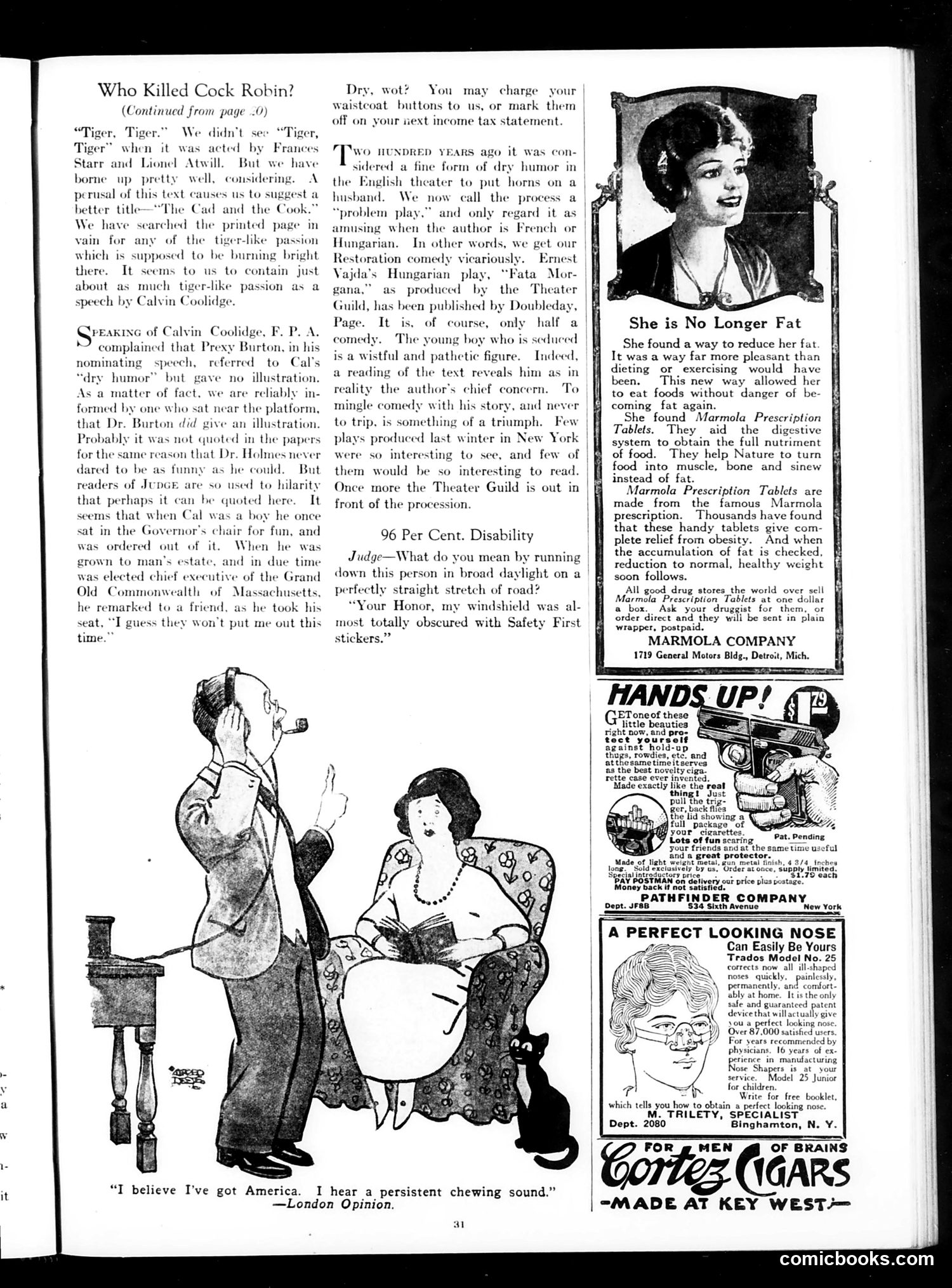
This page contains theatrical criticism and period advertisements. **Main Cartoon:** The illustration shows a man at a telephone appearing distressed while a woman sits nearby with a black cat. The caption references a "persistent chewing sound," satirizing American consumerism or perhaps a specific contemporary nuisance—the context isn't fully clear from the visible text. **Theatrical Content:** Judge critiques recent stage productions, particularly mocking a play called "Tiger, Tiger" for lacking passion, and commenting on Calvin Coolidge's dry demeanor. The magazine uses theater reviews to make social commentary about contemporary taste and notable figures. **Advertisements:** The page is dominated by period ads including weight-loss tablets (Marmola), a novelty toy gun, a nose-shaping device, and cigars—reflecting 1920s consumer culture and dubious health products now recognized as ineffective or harmful. The overall tone blends theatrical snark with commercial promotion typical of Judge magazine's format.
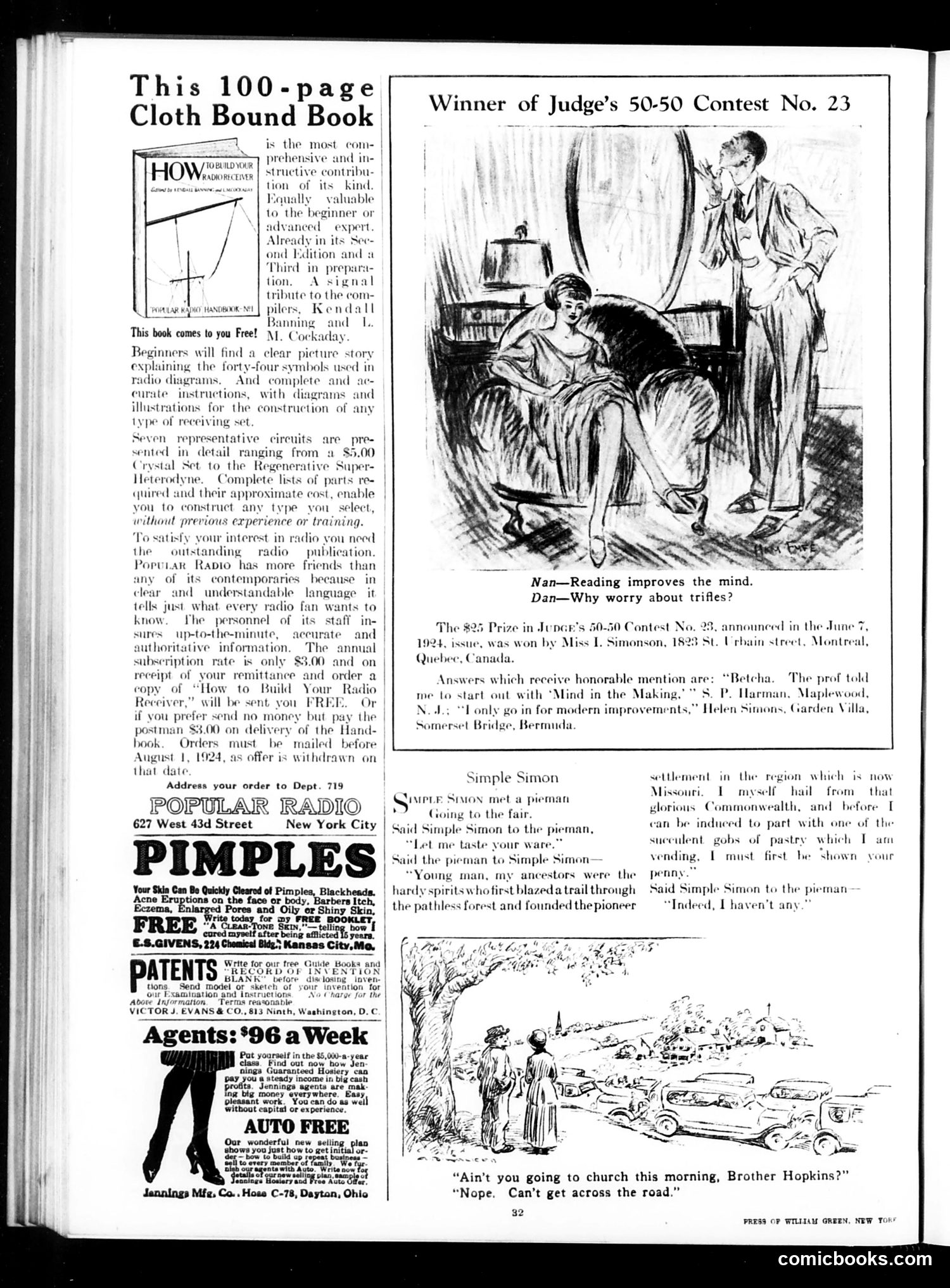
This page is primarily **advertising**, with two minor comic elements: **The Cartoons:** The two small illustrated jokes—"Nan and Dan" (top right) and "Brother Hopkins" (bottom)—are gentle domestic humor typical of 1920s magazines. They mock trivial concerns: a woman's worry about "trifles," and a man unable to attend church because he "can't get across the road" (likely a muddy street or flooded area). These aren't political satire but light social observation. **The Main Content:** The page is dominated by advertisements for radio equipment, acne treatments, patent services, and hosiery sales—reflecting 1920s consumer culture. There's also a "Simple Simon" poem (nursery rhyme adaptation) that won Judge's "50-50 Contest No. 23." The winner, Miss I. Simonson of Montreal, apparently submitted this sentimental piece about pioneering ancestors. **Historical Context:** The prevalence of radio-building advertisements reflects the early 1920s radio boom, when home receivers were novel, DIY projects. This is a **typical Judge page** of the era—mixed entertainment and advertising rather than pointed political commentary.
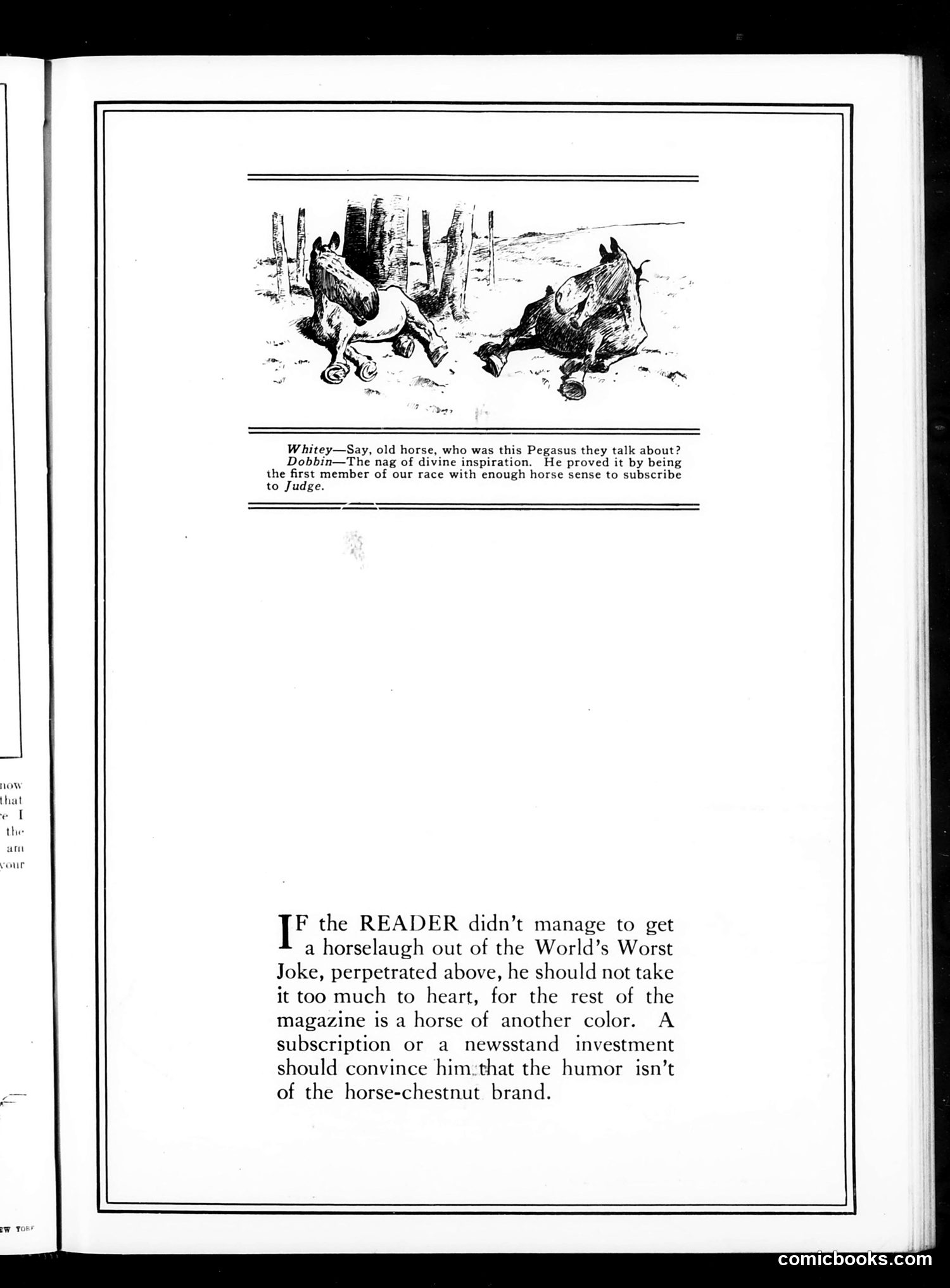
This is a self-promotional advertisement for *Judge* magazine disguised as a joke. Two horses named Whitey and Dobbin discuss Pegasus, the mythical winged horse from Greek mythology symbolizing divine inspiration and poetry. The punchline: Pegasus proved his "horse sense" by subscribing to *Judge*—a circular compliment suggesting the magazine itself is divinely inspired. The text below acknowledges this is the "World's Worst Joke" but uses it as a hook to pitch subscriptions. The phrase "horse of another color" (meaning something different) and "horse-chestnut brand" (a reference to the tired joke "Why did the horse cross the road?") are puns reinforcing the horse theme while admitting the humor is corny. Essentially, *Judge* is self-consciously making a bad joke to advertise itself—betting that readers will subscribe to prove the rest of the magazine is actually funny.
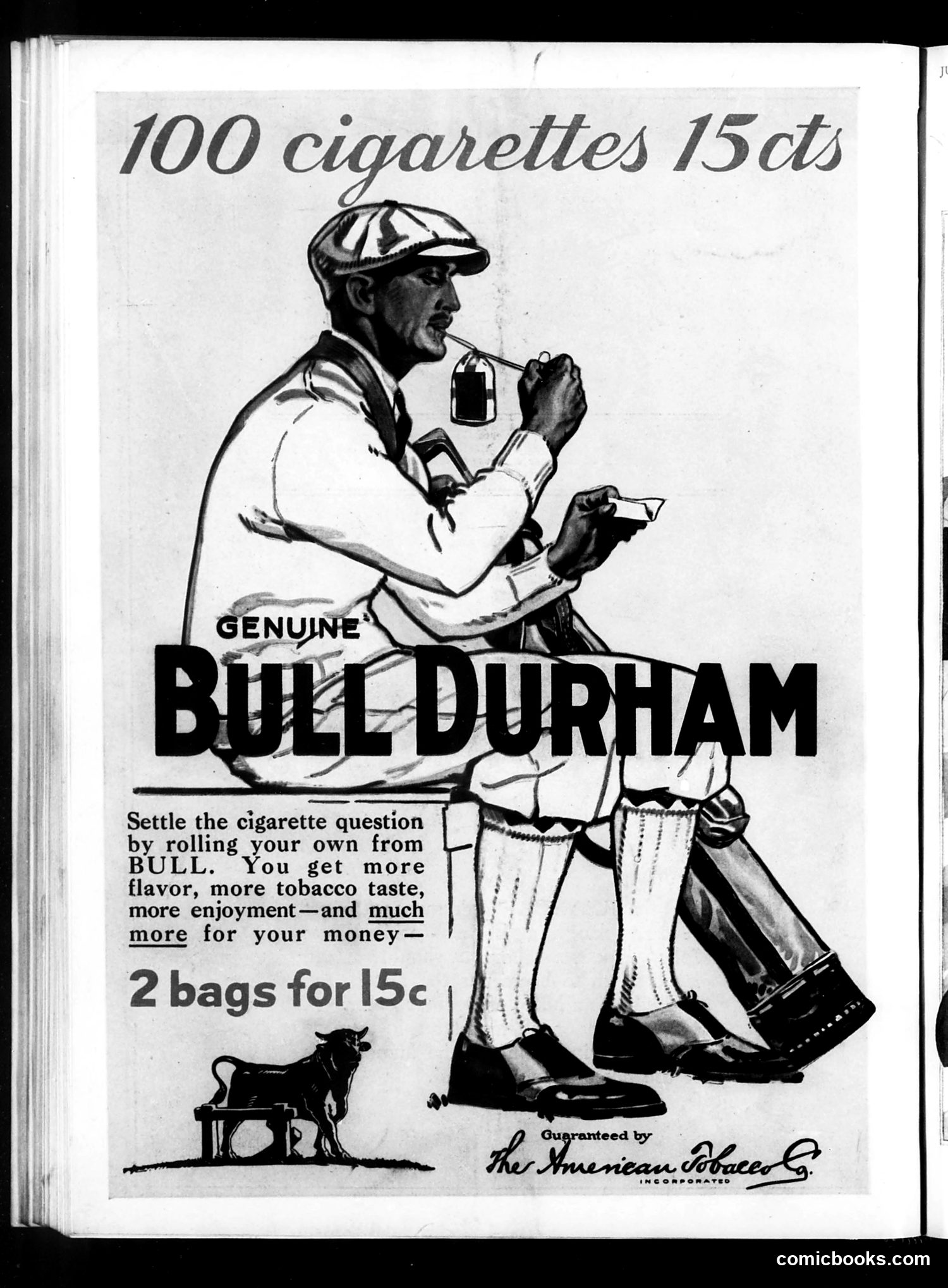
This is a **cigarette rolling tobacco advertisement**, not political satire. The page promotes Bull Durham brand loose tobacco for hand-rolling cigarettes at 15 cents per 100-cigarette supply (2 bags for 15 cents). The imagery depicts a working-class man—likely a laborer or athlete based on his cap and athletic pose—demonstrating the product's appeal to economical consumers. The bull mascot (lower left) was Bull Durham's trademark. The pitch emphasizes value and quality: rolling your own cigarettes yields "more flavor, more tobacco taste, more enjoyment—and much more for your money" compared to manufactured cigarettes. This reflects early 20th-century marketing when hand-rolling tobacco was marketed as economical and superior. There is no political commentary visible—this is straightforward product advertising in a magazine known for satire.