
Judge, 1924-07-19 · page 9 of 36
Judge — July 19, 1924 — page 9: what you’re looking at
What you’re looking at
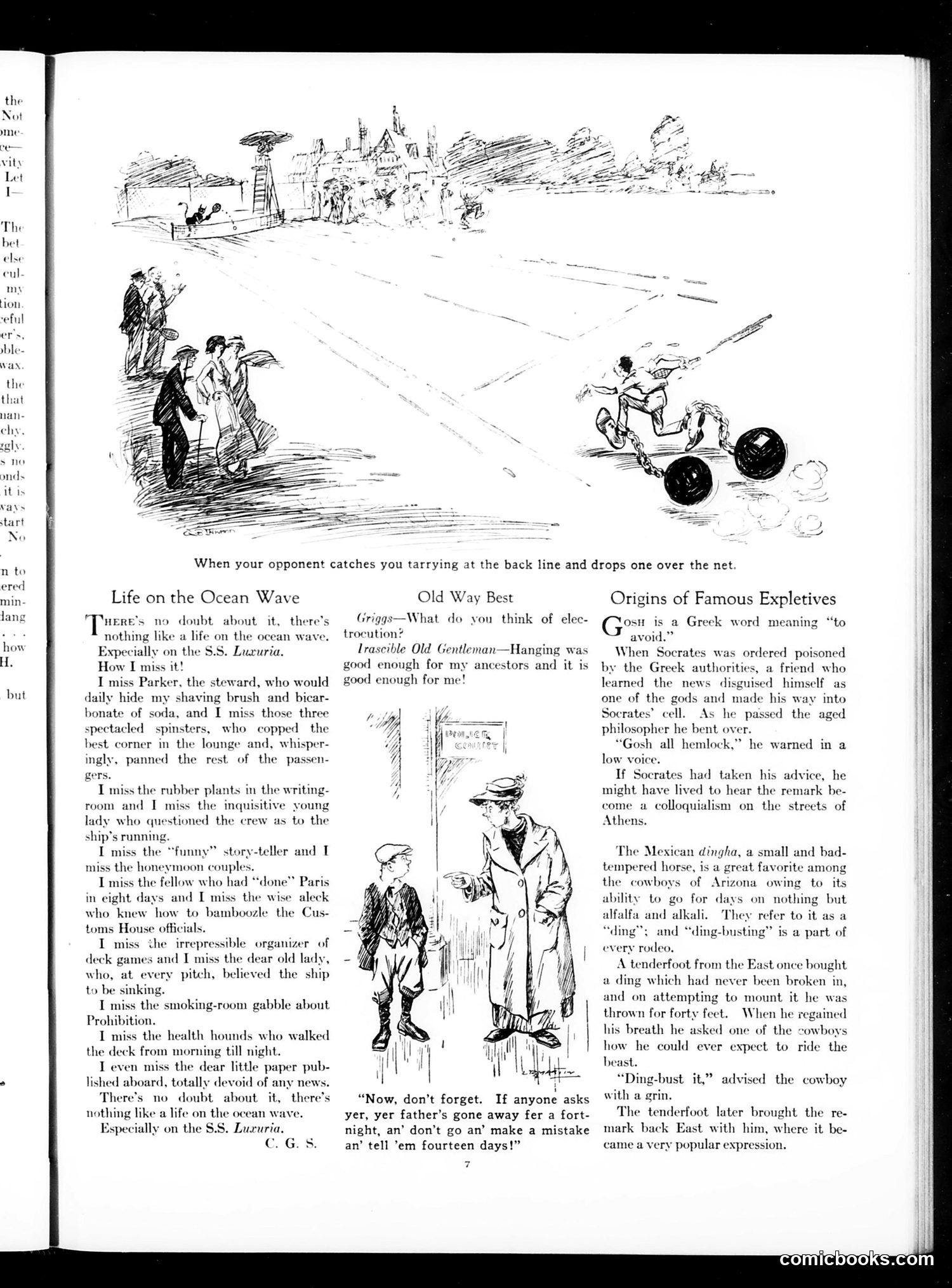
This page contains three distinct humorous pieces typical of early 20th-century American satire: **Top cartoon**: A tennis joke about a player caught near the net when opponent hits a drop shot over—visual humor requiring no political context. **"Life on the Ocean Wave"**: A nostalgic monologue by C.G.S. about missing ship life aboard the S.S. Luxuria. The satire gently mocks ocean liner passengers—hypochondriacs, busybodies, pretentious travelers, and know-it-alls. The humor lies in the contradiction: the narrator claims to miss this annoying cast of characters and the ship's trivial bulletin despite professing to enjoy ocean travel. **"Origins of Famous Expletives"**: Mock-etymologies humorously "explaining" mild curses ("gosh," "ding-bust") through fabricated classical and cowboy origins. This is pure wordplay satire, creating absurd backstories for common expressions to amuse readers. None of these pieces contain overt political commentary—they're social humor targeting passenger-ship culture and linguistic whimsy.
📄 Transcribed text from this page (OCR, searchable)
Machine-transcribed from the original scan — historical spelling and the odd misread are preserved.
mie ve vity Let 1 The bet else cul ms ‘ion eful ers ble- WAN the that nan chy. gly sno pnds it ts ered min When your opponent catches you tarrying at the back line and drops one over the net. Life on the Ocean Wave 'T'uere’s no doubt about it, there’s nothing like a life on the ocean wave. Expecially on the S.S. Luxuria. How I miss it! I miss Parker, the steward, who would daily hide my shaving brush and bicar- bonate of soda, and I miss those three spectacled spinsters, who copped the best corner in the lounge and, whisper- ingly, panned the rest of the passen- gers. I miss the rubber plants in the writing- room and I miss the inquisitive young lady who questioned the crew as to the ship’s running. I miss the “funny” story-teller and I miss the honeymoon couples. I miss the fellow who had “done” Paris in eight days and I miss the wise aleck who knew how to bamboozle the Cus- toms House officials. I miss the irrepressible organizer of deck games and I miss the dear old lady, who, at every pitch, believed the ship to be sinking. I miss the smoking-room gabble about Prohibition. I miss the health hounds who walked the deck from morning till night. I even miss the dear little paper pub- lished aboard, totally devoid of any news. There’s no doubt about it, there’s nothing like a life on the ocean wave. Especially on the 8.8. Lururia. Cc. GS. Old Way Best Griggs—What do you think of elec- trocution? Trascible Old Gentleman—Hanging was good enough for my ancestors and it is good enough for me! “Now, don’t forget. If anyone asks yer, yer father’s gone away fer a fort- night, an’ don’t go an’ make a mistake an’ tell ’em fourteen days!” Origins of Famous Expletives osu is a Greek word meaning “to avoid.” When Socrates was ordered poisoned by the Greek authorities, a friend who learned the news disguised himself as one of the gods and made his way into Socrates’ cell. As he passed the aged philosopher he bent over. “Gosh all hemlock,” he warned in a low voice. If Socrates had taken his advice, he might have lived to hear the remark be- come a colloquialism on the streets of Athens. The Mexican dingha, a small and bad- tempered horse, is a great favorite among the cowboys of Arizona owing to. its ability to go for days on nothing but alfalfa and alkali. They refer to it as a “ding”; and “ding-busting” is a part of every rodeo. A tenderfoot from the East once bought a ding which had never been broken in, and on attempting to mount it he was thrown for forty feet. When he regained his breath he asked one of the cowboys how he could ever expect to ride the beast. “Ding-bust it,” advised the cowboy with a grin. The tenderfoot later brought the re- mark back East with him, where it be- came a very popular expression.