
Judge, 1924-07-19 · page 22 of 36
Judge — July 19, 1924 — page 22: what you’re looking at
What you’re looking at
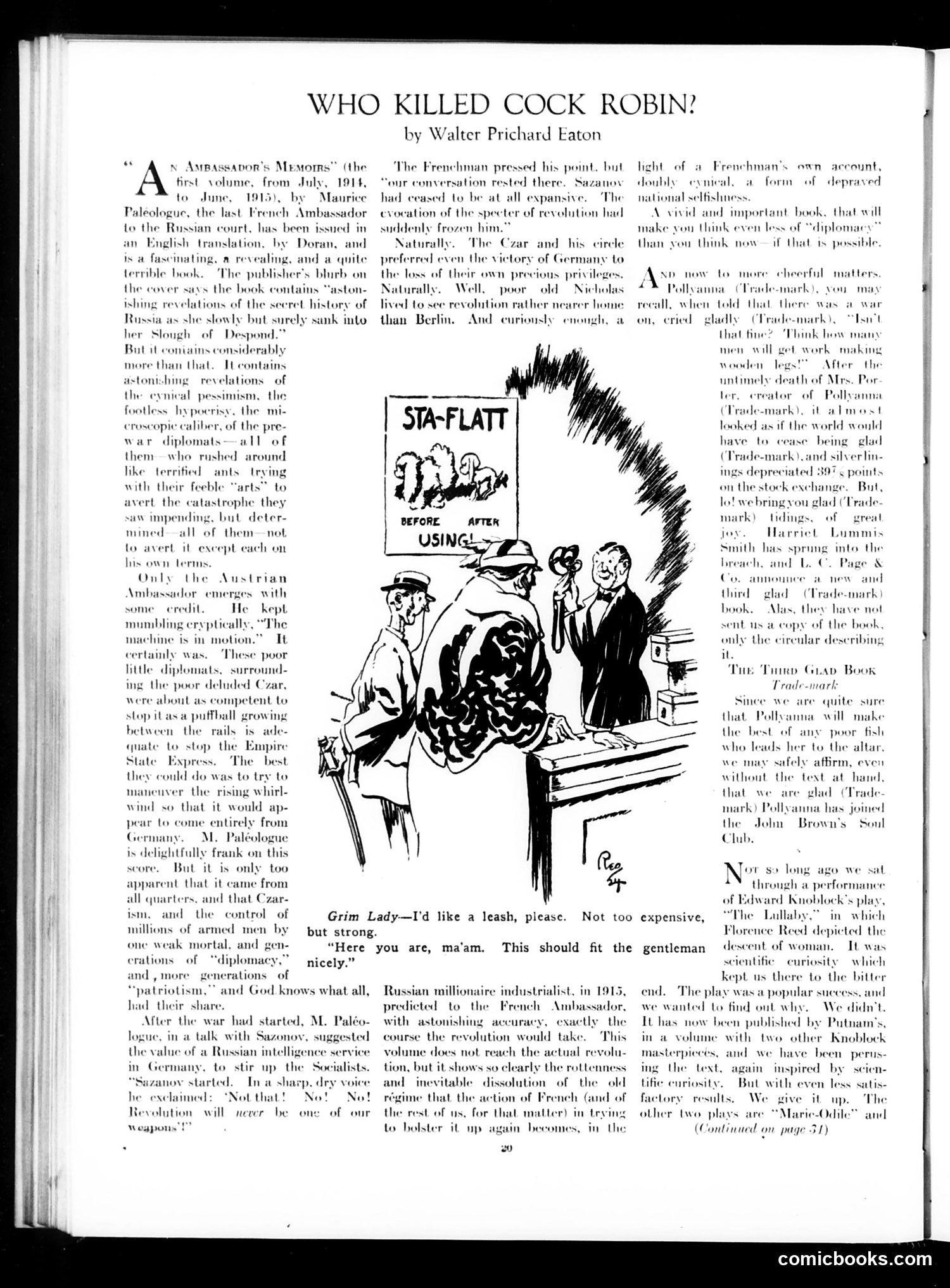
This page contains two separate pieces. The main article discusses Maurice Paleologue's French ambassador memoirs (1914-1915), revealing pre-WWI diplomatic incompetence. The satire targets European diplomats as ineffectual ("puffballs") unable to prevent catastrophe, while the Russian Tsar and his circle prioritized preserving privileges over preventing revolution—ironically achieved anyway. The piece criticizes their cynical refusal to support socialist movements that might destabilize Germany. Below is an unrelated cartoon and brief advertisement. The cartoon depicts a woman asking for a "leash" (with Sta-Flatt product reference), appearing to be a vintage product advertisement rather than political commentary. The page ends with promotional discussion of "Pollyanna" trademark merchandise, indicating commercial content mixed with editorial matter typical of Judge magazine's format.
📄 Transcribed text from this page (OCR, searchable)
Machine-transcribed from the original scan — historical spelling and the odd misread are preserved.
6 nN Awpassavor's Memorrs” (the A first volume, from July, 1914, to dune, 1915), by Maurice Paleologue, the last French Ambassador to the Russian court. has been issued in an English translation, by Doran, and Is a fascinating, a revealin; terrible book. T! the cover and a quite » publisher's blurb on ys the book contains “aston- ishin, ‘lations of the secret history: of y sank into Russia as she slowly but s1 her Sh But it coniains considerably igh of Despond.” IL contains. astonishing revelations of more than that the eynical pessimism. the footless hypocrisy. the mi- croscopic caliber, of the pre- war diplomats—all of them who rushed around like terrified ants trying with their feeble “arts” to avert the catastrophe they saw impending, but deter- all of them— not mined to avert it except each on his own Lerms. Only the Austrian Ambassador emerges with sume eredit. He kept mumbling cryptically, “The ort certainly was. ‘These poor little diplomats. surround- ing the poor deluded Czar, machine is in motion. were about as competent to stop itasa puffball growing between the rails is ade- quate to stop the Empire State Express. The best they could do was to try to maneuver the rising whirl- wind so that it would ap- pear to come entirely from Germany. M. Paléologue is delightfully frank on this But it is only too ent that it came from ters. and that Czar- ism, and the control of millions of armed men by — put strong. one weak mortal, and gi erations of “diplomacy and, more generations of “patriotism,” and God. knows what all, had their share. After the war had started, logue, in a talk with Sazonov nicely.” M. Paléo- sted sug; the value of a Russian intelligence service in Germany, to stir up the Socialists. “Sazanoy started. Ina sharp, dry v obthat! No! Revolution will never be one of our he exclaimed : Wegpons'!” Grim Lady—I'd like a leash, please. “Here you are, ma’am. WHO KILLED COCK ROBIN? by Walter Prichard Eaton The Frenchman pressed his point. but ‘our conversation rested there. Sazanov had ceased to be at all expansive. The evocation of the specter of revolution had widdenly frozen’ hitt Naturally. ‘The Czar and his. circle preferred even (he vielory of Germany to the loss of their own precious privileges. Naturally. Well, poor old Nieh« lived to see revolution rather nearer home. than Berlin. And curiously enongh, a o BEFORE AFTER USING € Not too This should fit the Russian millionaire industrialist. in 1915, predicted to the French Ambassador, ly the This with astonishing accuracy, exe course the revolution would tak ual re volume does not reach the n, but it shows so clearly the rotlenness dd inevitable dissolution of the old régime that the action of Preneh (and of the rest of us. for that matter) in teying to bolster it up again becomes, in the wv light of a Frenchman's own account, doubly eynieal. a form of depraved national selfishness. A vivid and important 1 ke that will liplomacy” make you think even less of than you think now — if that is possible A xp now to more cheerful matters a Pollyanna (Prade-mark), vou may Hl, when told that there was a re ar on, cried gladly (Prac: that tine? ‘Phink how many mark), Psn't men will get work making After the untimely death of Mrs. Por ter, creator of Pollyanr wooden leg le-mark), it almost looked as if the world would have to cease being glad (Trade-mark).and silver lin- ings depree on the stock exch; ted 397 ¢ points re. But, lo! we bring you glad (‘Trade mark) tidings, of |g al joy Harriet) Lummis Smith has sprung into the Page & Co. amonnee a new and third glad | (‘Prade-mark book. Alas, they have not sent us a copy of the book, breach. and Lb. ¢ only the cireular describing il. The Thirp Grav Book Trade-mark Since we are quite sure that) Pollyanna will) make the best of any poor fish who leads her to the altar, we may safely affirm, even without the text’ at hand, that we are glad (Trade mark) Pollyanna has joined the John Brown's Soul Club, or so long ago we sat 4° through a performance of Edward Knoblock’s play, expensive, “The Lullaby.” in’ which Florence Reed depicted the - Tt was scientific curiosity which kept us there to the bitter end. ‘The play was a popular success, and We did't. It has now been published by Putnam's, in a volume with two other Knoblock descent of wor gentleman we wanted to find ont why. masterpieces, and we have been perus- ing the text, again inspired by scien- tifie curiosity, But with even less satis- factory results. We give it up. ‘The other two plays are “Marie-Odile™ and (Continued on page 31) comicbooks.com