
Judge, 1924-07-19 · page 16 of 36
Judge — July 19, 1924 — page 16: what you’re looking at
What you’re looking at
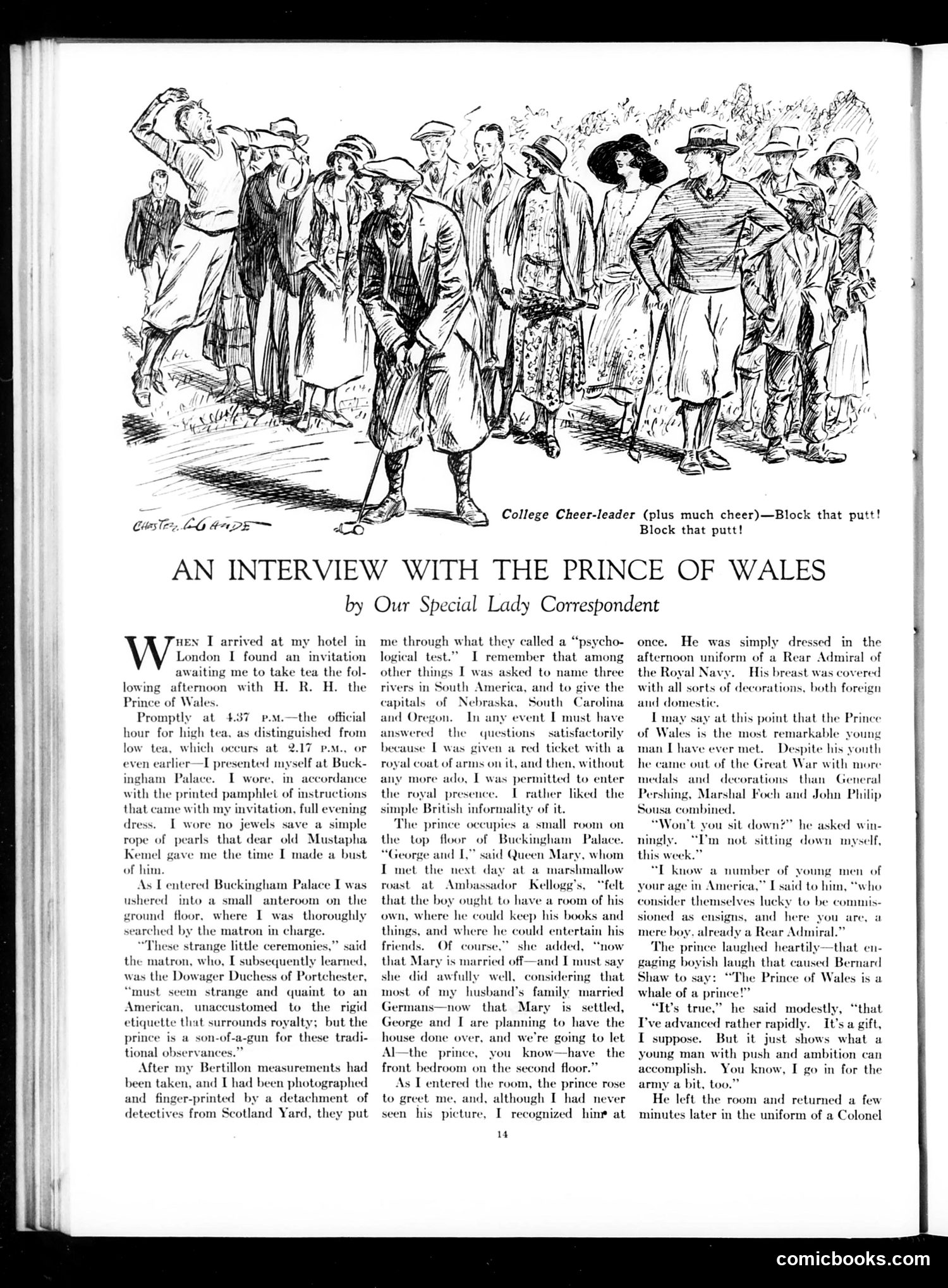
This is a humorous piece mocking both the Prince of Wales (later Edward VIII) and American social pretensions. The cartoon above depicts a college cheerleader leading a crowd—"Block that putt!"—establishing a tone of absurdist American casualness. The satire works on multiple levels: The correspondent's visit to Buckingham Palace is laden with exaggerated security procedures (fingerprinting by Scotland Yard, "psychological tests" asking nonsensical questions about Nebraska capitals). Queen Mary's casual remarks about her daughter marrying Germans and redecorating the palace undercut royal dignity. Most pointedly, the Prince is portrayed as absurdly decorated—covered in medals despite his youth, outranking Pershing and Foch—yet comically modest about his "advancement," attributing it to personal "push and ambition" like an American self-made man. The joke targets both British royal pretension and American naïveté about aristocratic life.
📄 Transcribed text from this page (OCR, searchable)
Machine-transcribed from the original scan — historical spelling and the odd misread are preserved.
College Cheer-leader (plus much cheer)—Block that putt! Block that putt! AN INTERVIEW WITH THE PRINCE OF WALES by Our Special Lady Correspondent HEN I arrived at my hotel in London I found an invitation awaiting me to take tea the fol- lowing afternoon with H. R. H. the Prince of W: Promptly hour for high t low tea, which o 4.37 as distinguished from p.M.—the official curs at 2.17 P.M. or I presented myself at Buck- ingham Palace. I wore, in accordance with the printed pamphlet of instructions that came with my invitation, full evening dress. I wore no jewels save a simple rope of pearls that dear old Mustapha Kemel gave me the time I made a bust of him. As Lentered Buckingham Palace I was ushered into a small anteroom on the ground floor, where I was thoroughly ched by the matron in charge. These strange little ceremonie: the matron, who, [ subsequently le: was the Dowager Duchess of Portchester, “must seem strange and quaint to an American, unaccustomed to the rigid etiquette that surrounds royalty; but the prince is a son-of-a-gun for these tradi- tional observances.” even earlier After my Bertillon measurements had been taken, and I had been photographed and finger-printed by a detachment of detectives from Scotland Yard, they put me through what they called a “psycho- logical test.” I remember that among other things I was asked to name three rivers in South America, and to give the capitals of Nebraska, South Carolina and Oregon. In any event I must have answered the questions _ satisfactorily because [was given a red ticket with a royal coat of arms on it, and then, without any more ado, I was permitted to enter the royal presence. [rather liked the simple British informality of it. The prince occupies a small room on the top floor of Buckingham Palace. “George and 1,” said Queen Mary, whom I met the next day at a marshmallow roast. at) Ambassador Kellogg's, “felt that the boy ought to have a room of his own, where he could keep his books and things, and where he could entertain his friends. she added, “now that Mary is married off—and I must say she did awfully well, considering that most of my husband’s family married Germans—now that Mary is. settled, George and I are planning to have the house done over, and we're going to let Al—the prince, you know—have the front bedroom on the second floor.” As I entered the room, the prince rose to greet me, and, although I had never seen his picture, I recognized hing at Of course,” 4 once. He was simply dressed in the afternoon uniform of a Rear Admiral of the Royal Navy. with all sorts of decorations, both foreign and domestic, I may say at this point that the Prince of Wales is the most remarkable young man I have ever met. Despite his youth he came out of the Great War with more medals and decorations than General Pershing, Marshal Foch and John Philip Sousa combined. His breast was covered Won't you sit down?” he asked win- ningly. “I'm not sitting down myself, this week.” “LE know a number of young men of your age in America,” [said to him, “who consider themselves lucky to be commis- sioned as ensigns, and here you are, a mere bo: Admiral.” The prince laughed heartily—that en- gaging boyish laugh that caused Bernard “The Prince of Wales is a he said modestly, “that I've advanced rather rapidly. It’s a gift, I suppose. But it just shows what a young man with push and ambition can accomplish. You know, I go in for the army a bit, too.” He left the room and returned a few minutes later in the uniform of a Colonel comicbooks.com