A complete issue · 36 pages · 1924
Judge — July 12, 1924
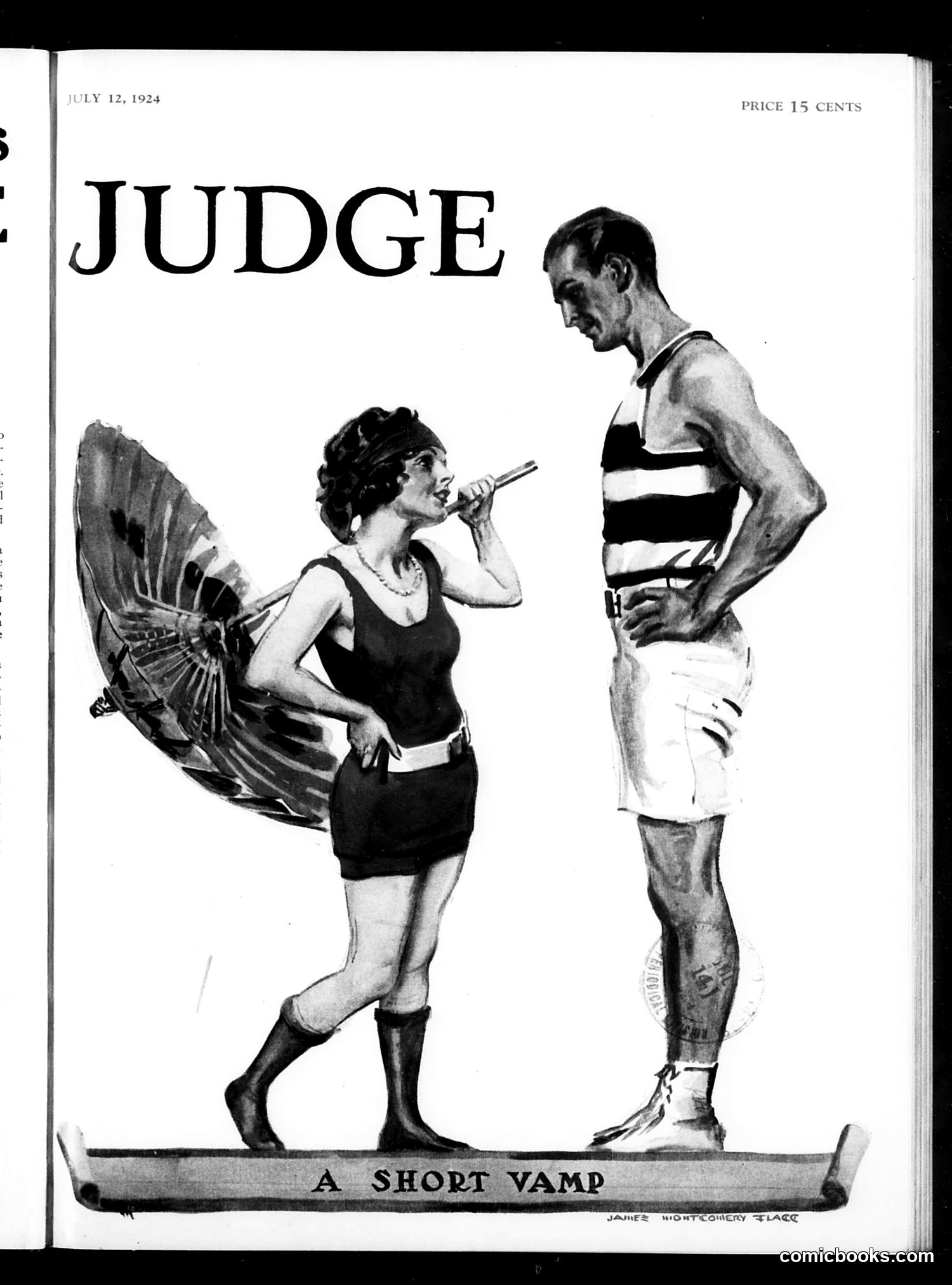
This Judge magazine cover from July 12, 1924 satirizes the "vamp" — a seductive female character type popular in 1920s cinema and culture. The cartoon depicts a woman in a bathing suit with a large decorative fan, striking a sultry pose while smoking, facing an athletic man in striped swim attire. The satire likely mocks the exaggerated flirtation tactics of the era's "vamp" archetype — the seductive woman who manipulates men. The title "A Short Vamp" may pun on her abbreviated bathing costume or the brevity of her seduction attempt. The artist James Montgomery Flagg captures the period's fascination with modern female sexuality and changing gender dynamics during the Jazz Age, when women's fashion and behavior were becoming increasingly daring and unconventional.
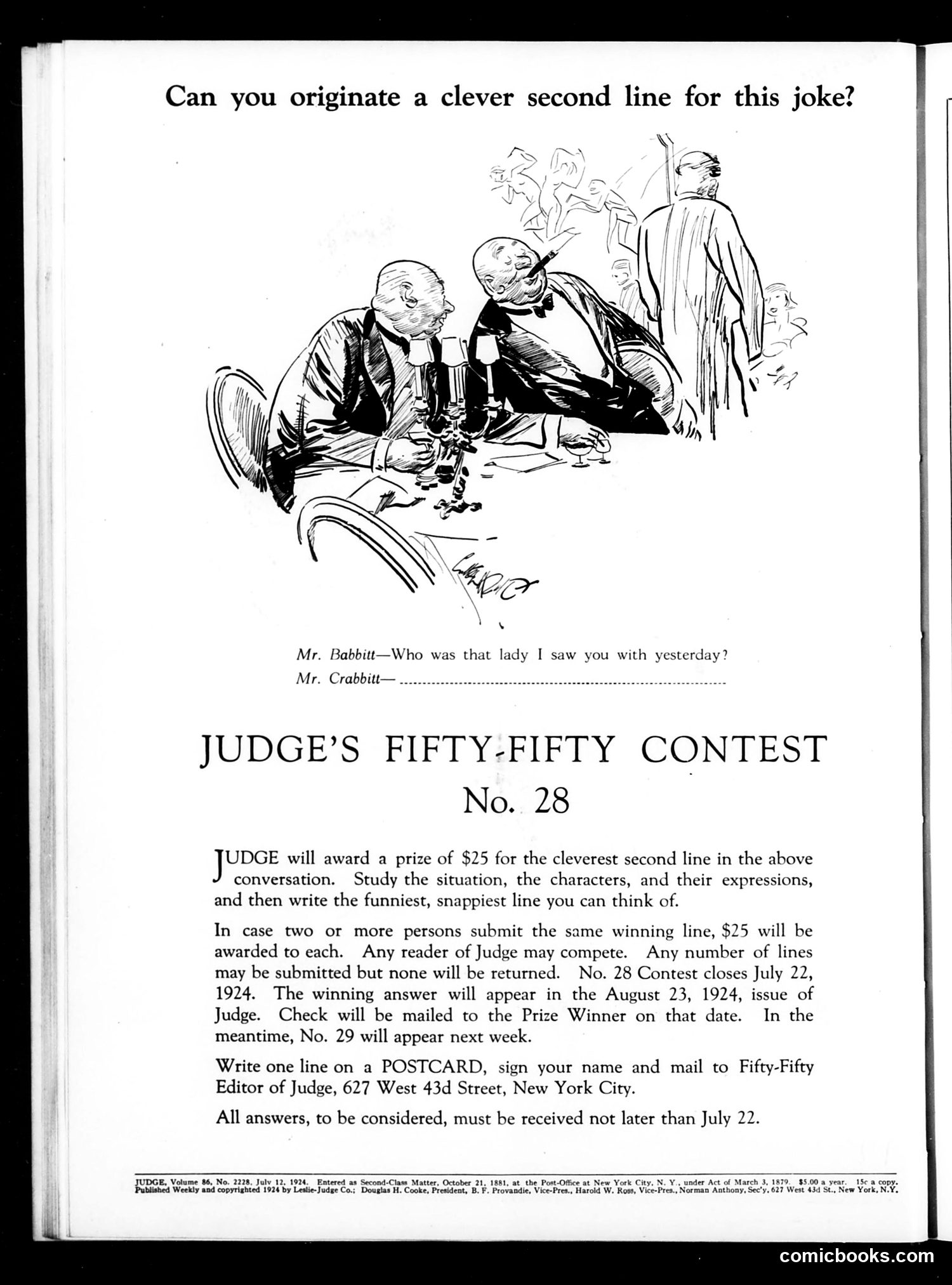
This page presents a humor contest where readers submit punchlines. The cartoon shows two men at what appears to be a bar or social setting. Mr. Rabbit asks Mr. Crabbit, "Who was that lady I saw you with yesterday?" This references a famous vaudeville joke setup from the early 20th century, typically answered with "That was no lady, that was my wife"—a stock joke mocking wives. Judge invites readers to supply an original, clever second line for $25 prize money. The setup likely plays on infidelity humor common to 1920s entertainment. The contest closes July 22, 1924, with winners announced in the August 23 issue. The page itself is primarily a contest announcement rather than editorial content.
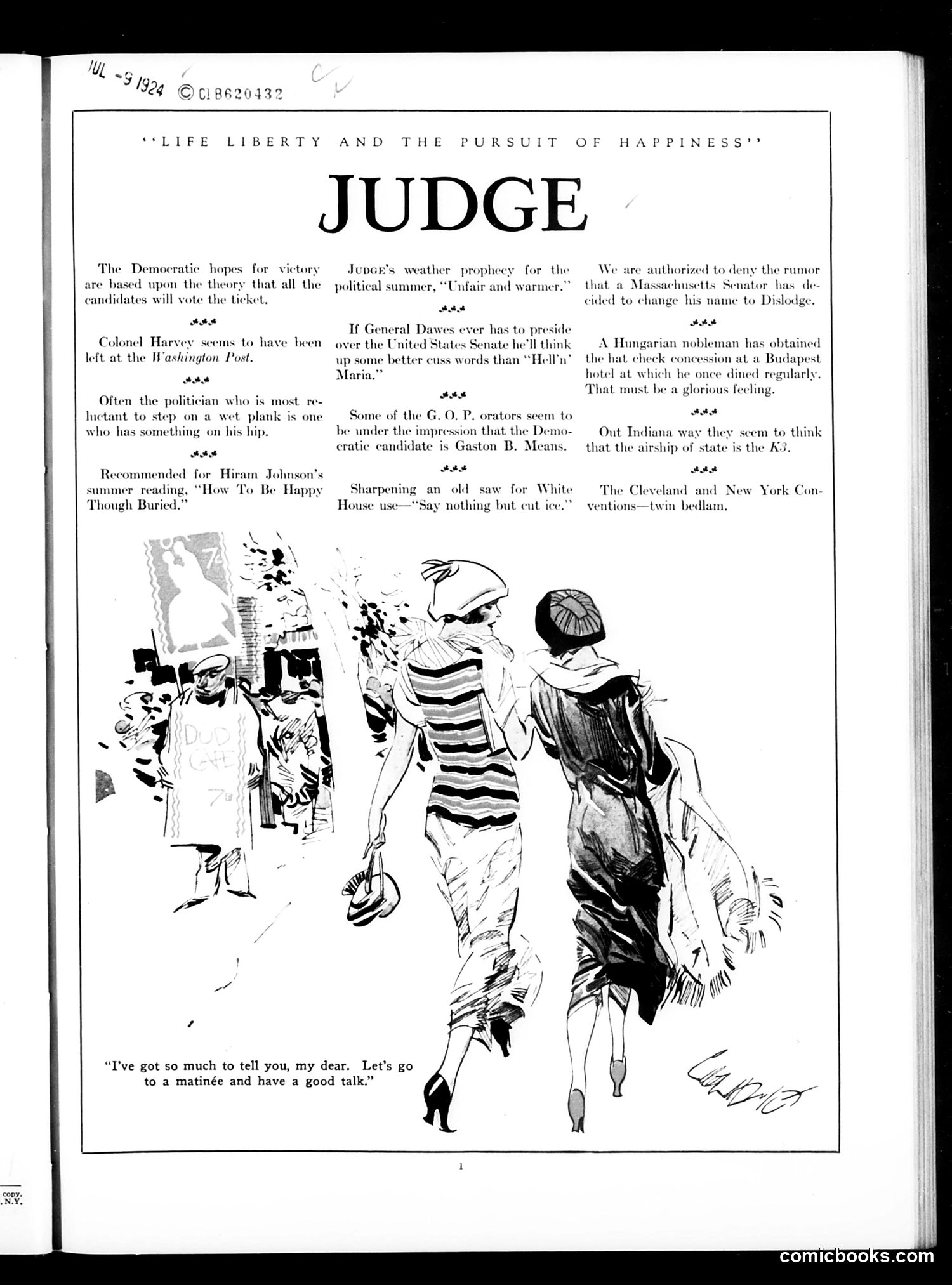
This page from Judge magazine presents political commentary and satirical observations from the 1924 election period. The main cartoon depicts two fashionably dressed women heading to a matinee, with one saying "I've got so much to tell you, my dear. Let's go to a matinee and have a good talk." The accompanying text includes various political jabs: references to Democratic electoral hopes, Colonel Harvey at the Washington Post, Republican candidates (possibly including Gaston Means), and commentary on Senator and state politics. The satire targets politicians' tendency toward self-promotion and the superficiality of political discourse. The image of women escaping to entertainment rather than engaging seriously with politics reflects 1920s social attitudes about gender and civic participation.
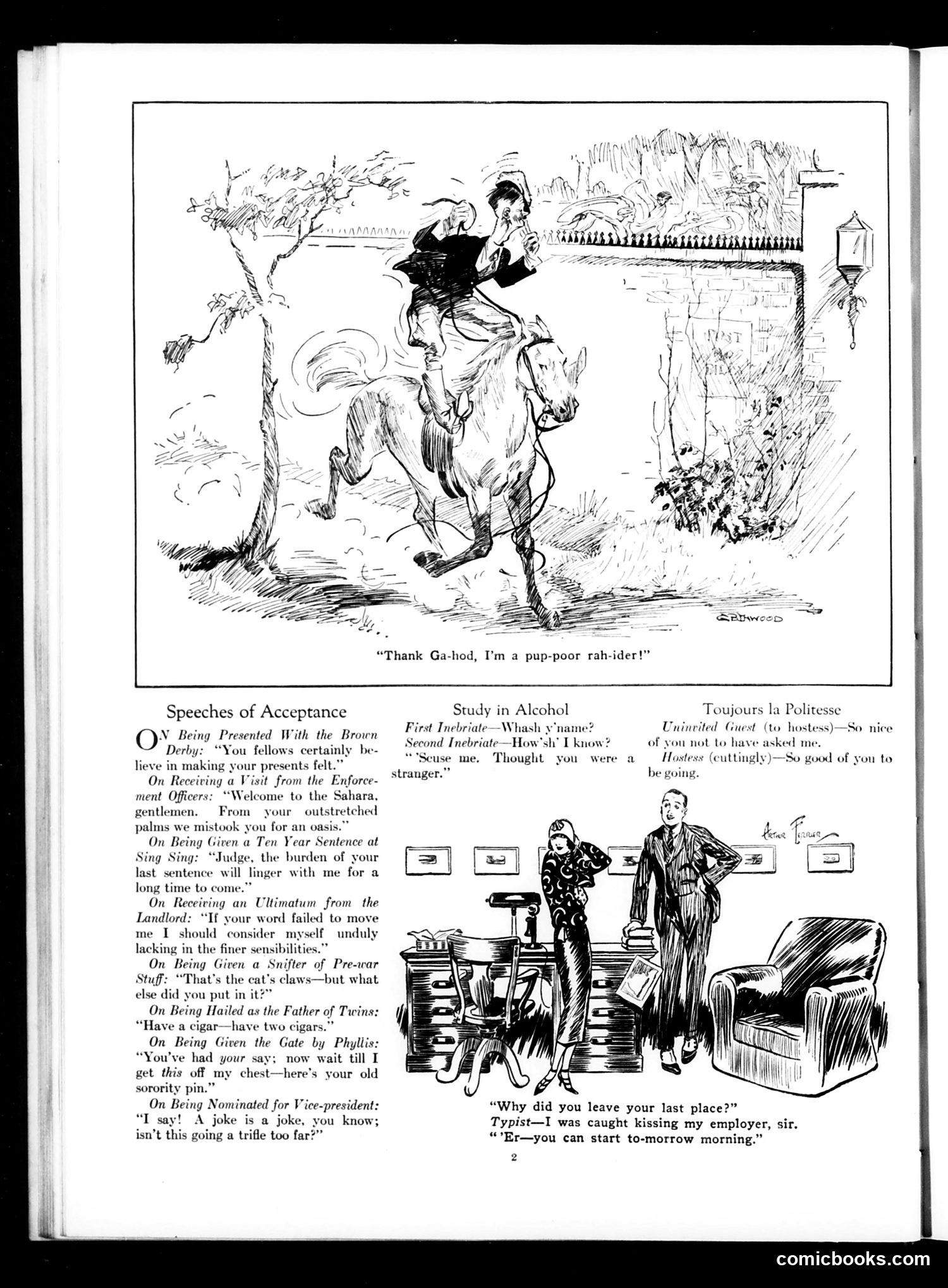
**Main Cartoon:** A poorly dressed rider on a horse appears panicked, exclaiming "Thank Ga'-hod, I'm a pup-poor rah-rider!" The sketch satirizes an incompetent horseman, likely mocking someone of low social status attempting to perform above their station. **"Speeches of Acceptance"** section contains humorous mock-acceptance speeches for various honors (Brown Derby winner, visit from officers, ten-year sentence, etc.). These satirize pompous acceptance speeches through absurdist humor—treating ridiculous scenarios with false dignity. **"Study in Alcohol"** and **"Toujours la Politesse"** are brief joke exchanges about employment, featuring typical workplace or social humor. The page exemplifies Judge's satirical approach: mocking social pretension, incompetence, and formal conventions through exaggerated illustrations and absurdist humor.
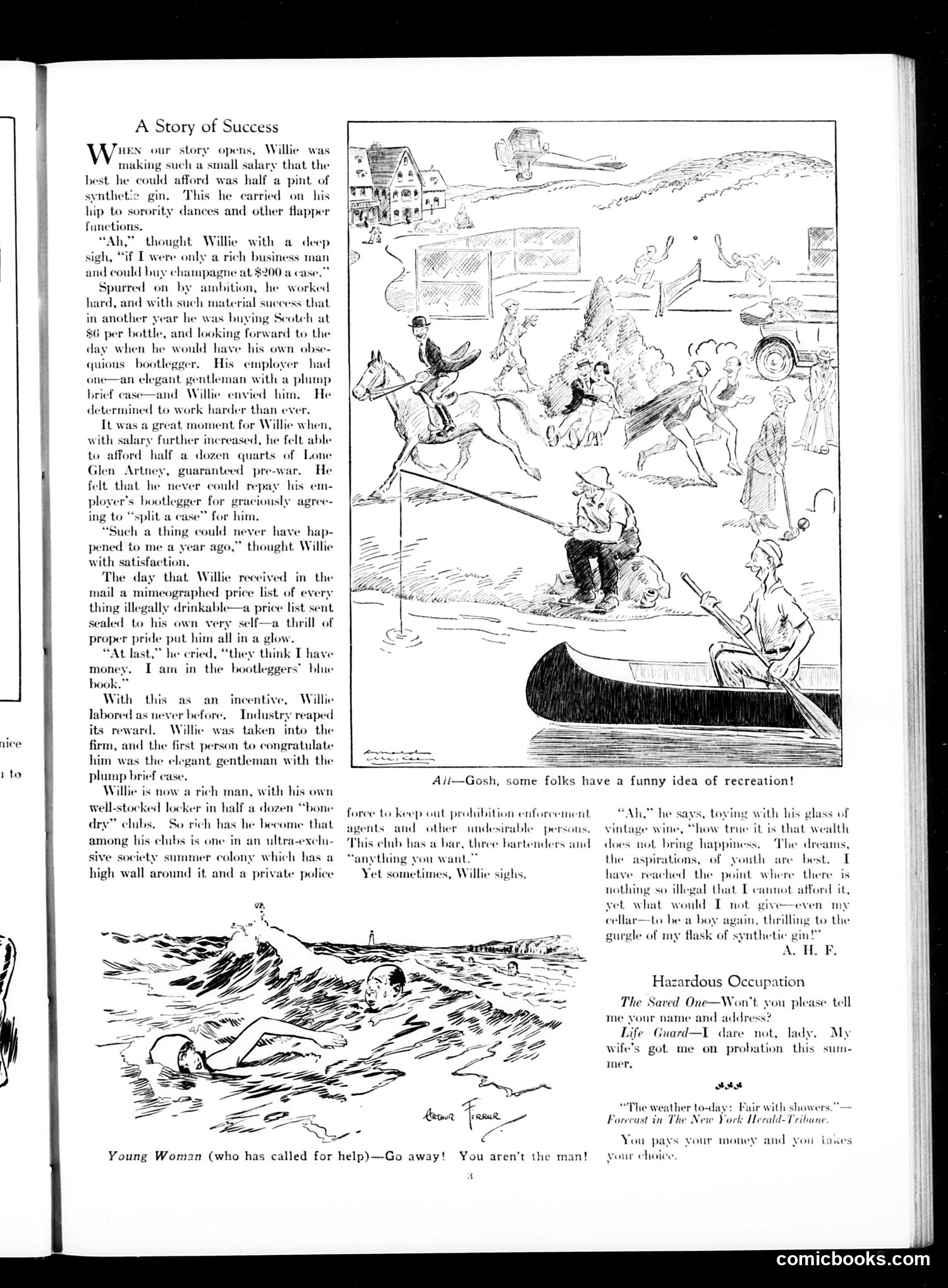
This is a satirical narrative about Willie, an ambitious working-class man who desires wealth. The story mocks his get-rich-quick mentality: he works hard, saves money buying cheap Scotch whisky, and dreams of business ownership. The main cartoon depicts Willie at what appears to be a golf club or leisure venue—visualizing his fantasies of wealth and status. The satire lies in the gap between his aspirations and reality: despite his efforts, he remains trapped in working-class circumstances, spending his meager savings on alcohol rather than genuine investment. The piece critiques both Willie's unrealistic ambitions and the social systems that make genuine class mobility difficult. The final section, "Hazardous Occupation," shifts to unrelated satirical content about a life guard's risky job.
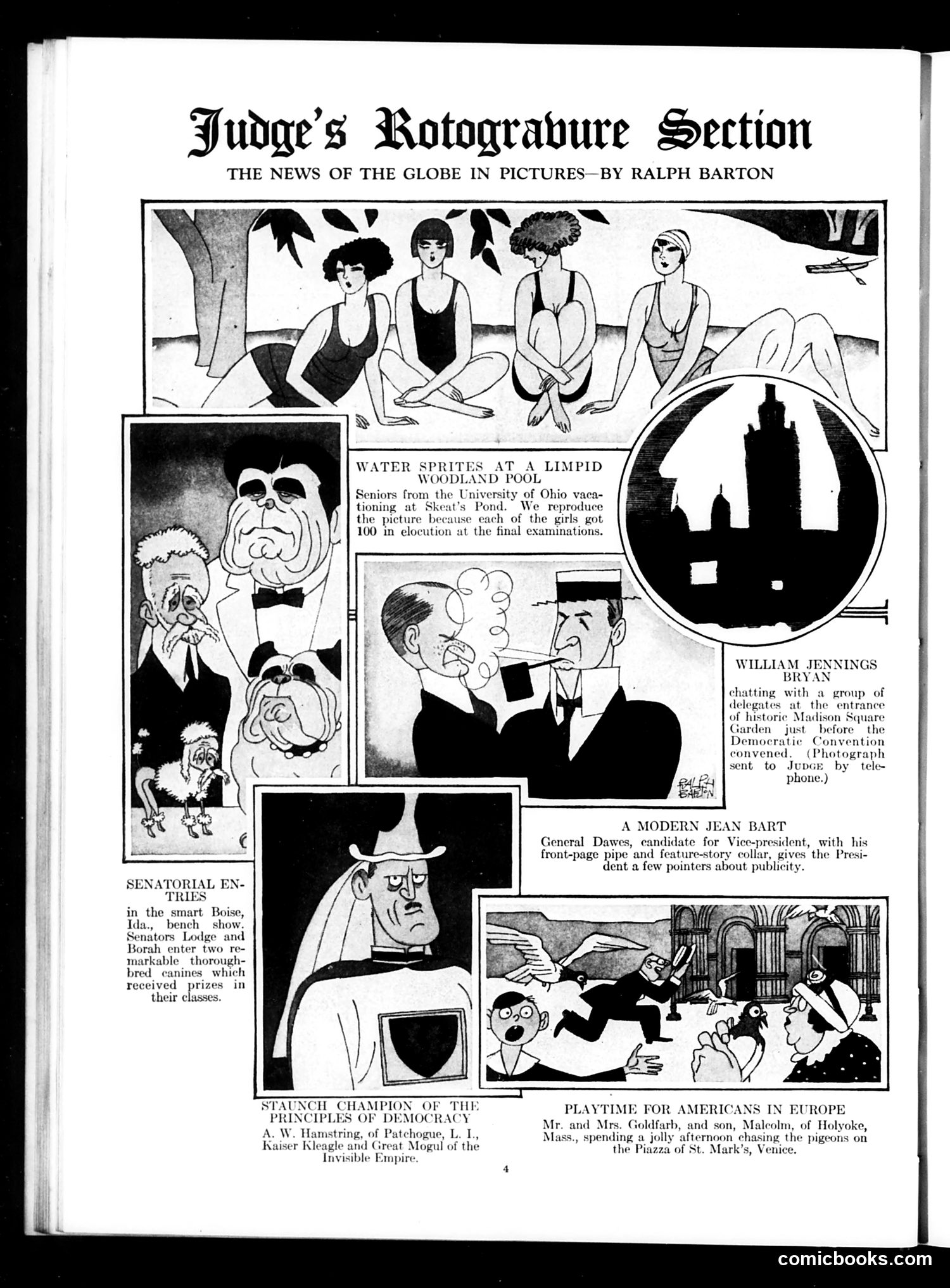
This page combines social commentary with light satirical content from the 1920s era: **"Senatorial Entries"** (left): Caricatures of senators at a dog show in Boise, Idaho, comparing politicians to bulldogs—a common trope suggesting politicians are stubborn or ugly. **"Water Sprites at a Limpid Woodland Pool"**: Photographs of University of Ohio seniors swimming, captioned as achieving "100 in elocution"—likely mocking academic pretension. **"A Modern Jean Bart"**: General Dawes, Vice-Presidential candidate, with a pipe, receiving publicity tips—satirizing political image-making. **"Staunch Champion of Democracy"**: A.W. Hamstring of Patchogue, L.I., humorously posed with Kaiser Kiegle, suggesting ironic patriotic posturing. **"Playtime for Americans in Europe"**: Americans feeding pigeons at St. Mark's Square, Venice—documenting leisure travel.
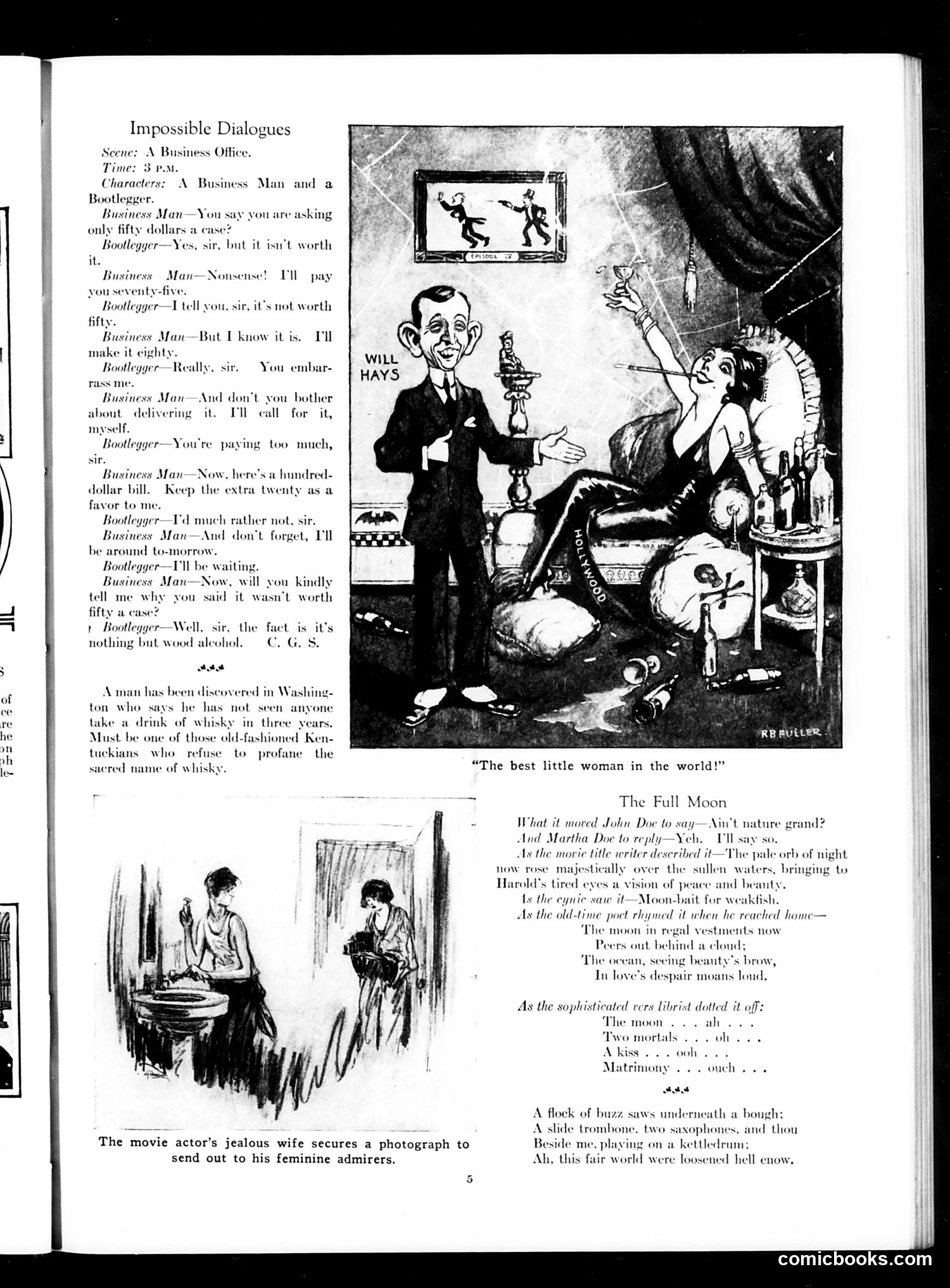
This Judge page satirizes **Prohibition-era absurdities** through two main pieces: **Top cartoon**: A businessman and bootlegger negotiate over illegal alcohol. The joke inverts expectations—the bootlegger insists the price is too low, while the businessman keeps raising his offer. The punchline reveals the bootleg liquor is "nothing but wood alcohol," a poisonous substitute that killed many during Prohibition. The satire mocks both the bootlegger's false modesty and the businessman's desperation to buy dangerous contraband, highlighting how Prohibition created criminal markets and poisoned citizens. **Bottom section**: "The Full Moon" parodies different literary responses to the same scene—from sentimental movie titles to cynical observations to affected modernist poetry. The final stanza mocks jazz-age bohemianism and romance, suggesting romantic sentiments ring hollow in a degraded world. Both pieces satirize 1920s social pretense and the failures of Prohibition policy.
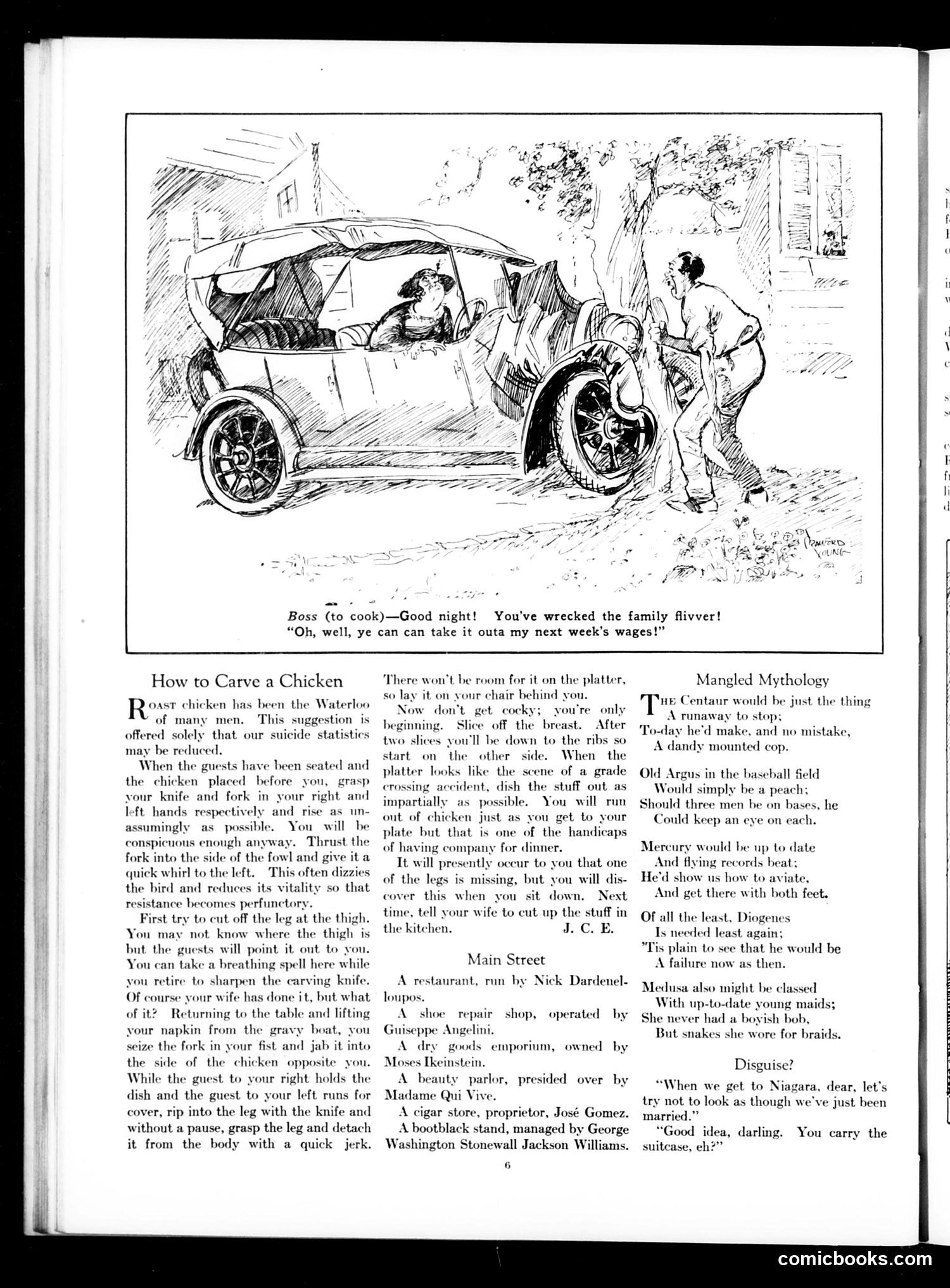
**Top Cartoon - "The Wrecked Flivver":** A man tells his cook that he's destroyed the family car (a "flivver"—slang for a cheap automobile, likely a Model T Ford), then casually says she can deduct it from her wages. The satire targets employers' casual exploitation of working-class servants, treating significant property damage as merely a payroll deduction. It's darkly humorous about class relations and wage abuse. **Text Content:** The page includes humorous instructional pieces: "How to Carve a Chicken" (satirizing domestic dining etiquette disasters) and "Main Street" (listing immigrant and ethnic business owners with stereotypical names suggesting ethnic diversity in American towns). "Mangled Mythology" offers light verse about Greek mythological figures adapted to modern (early 20th-century) life—mostly wordplay without sharp political edge. The overall tone reflects early-20th-century satirical humor targeting domestic life, class dynamics, and assimilating immigrant communities.
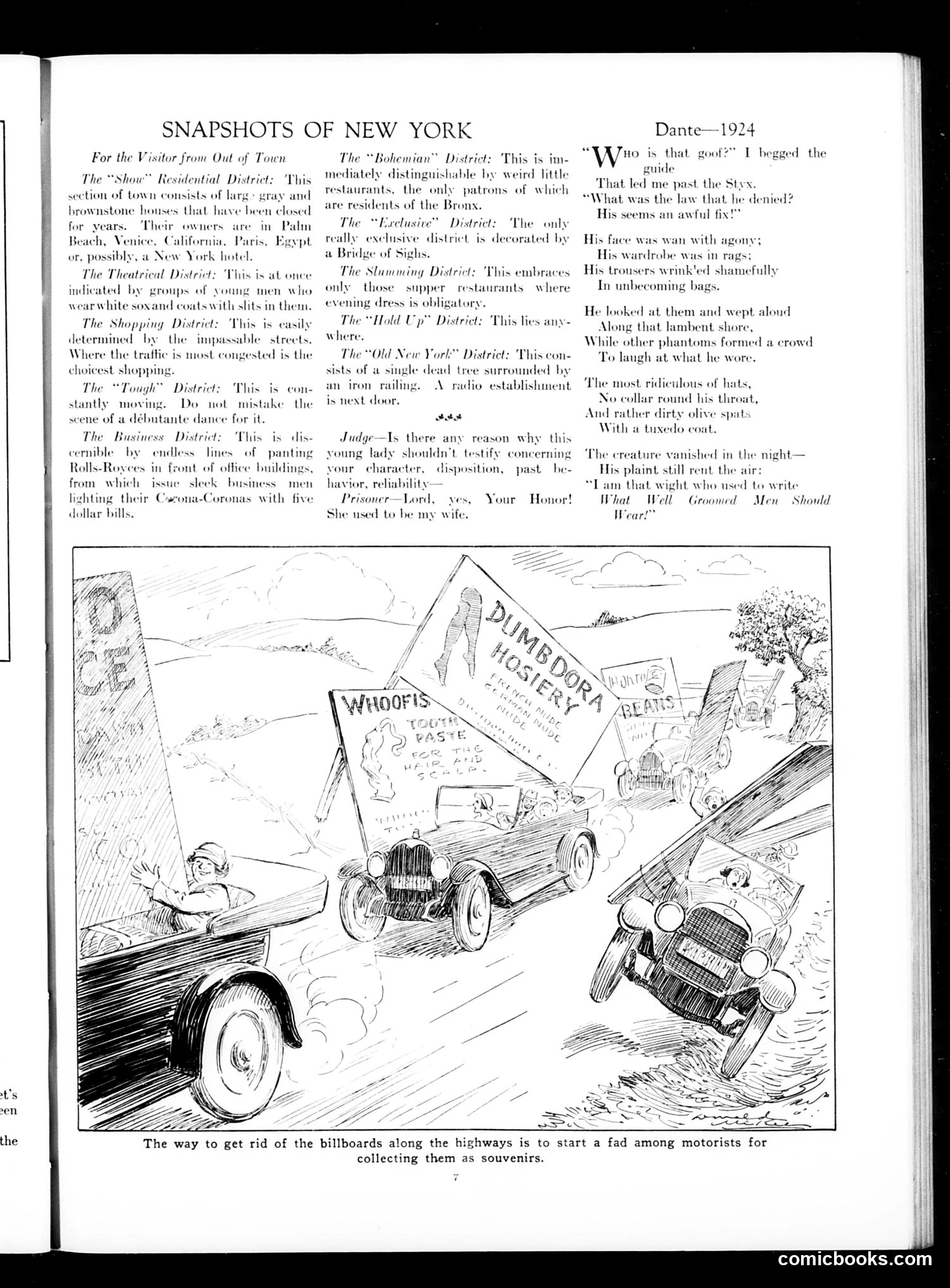
This page contains two separate pieces of satire: **Upper section**: A humorous guide describing New York neighborhoods by their defining characteristics—the "Show" district (wealthy absentees), "Shopping" district (congested streets), "Tough" district (constantly moving), and "Bohemian" district (patronized by Bronx residents). The satire mocks class distinctions and New York stereotypes. **Lower cartoon**: Depicts motorists collecting roadside billboards as souvenirs, treating them as collectible items. This is satirical commentary on 1920s advertising excess and highway billboard proliferation—a genuine social complaint of the era. The joke suggests the absurd solution of turning billboard-collecting into a fad to clear highways. **Bottom section**: An unrelated joke about a judge and a prisoner (his ex-wife) and a separate poem about a dandy in the afterlife lamenting his disheveled appearance—both conventional magazine filler content. The page reflects 1920s anxieties about commercialization, class, and advertising's visual pollution.
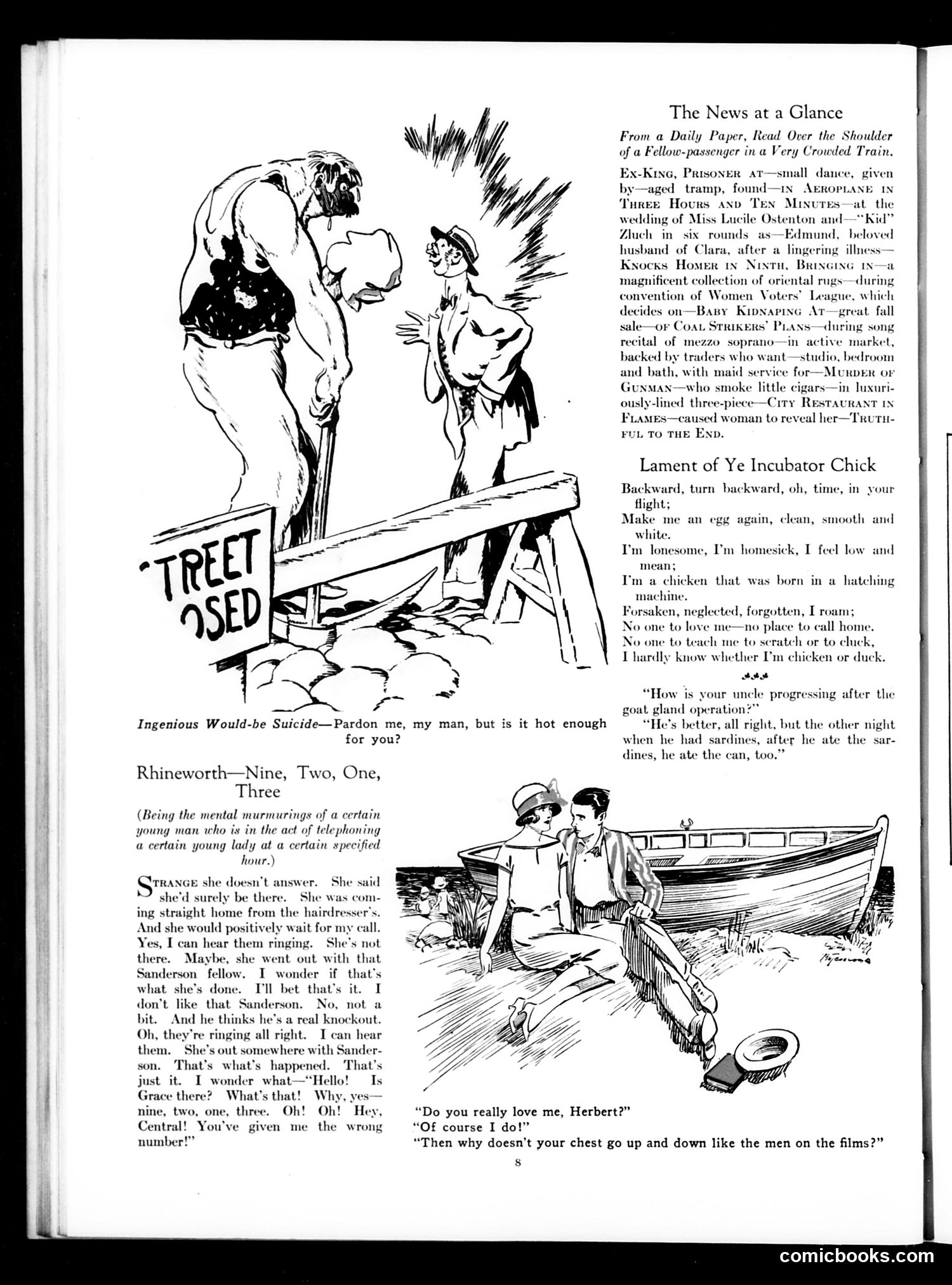
This page from *Judge* magazine contains several satirical pieces mocking early 20th-century life: **"The News at a Glance"** parodies newspaper headlines by presenting them as overheard fragments in a crowded train—jumbled, sensational, and absurd. The joke is how modern news feels disjointed and overwhelming. **"Lament of Ye Incubator Chick"** criticizes mechanized farming and industrial efficiency. The chick, born in a machine rather than naturally, laments lacking maternal care and natural instincts—a commentary on technology replacing tradition. **"Rhineworth—Nine, Two, One, Three"** satirizes anxious courtship via telephone, depicting a young man's paranoid spiral while calling his girlfriend. The humor lies in his irrational jealousy and the technological awkwardness of phone romance. **"Ingenious Would-be Suicide"** appears to joke darkly about someone attempting suicide by heat exposure—unclear without full context. The bottom cartoon about goat gland operations references a real 1920s-30s fad where surgeons implanted goat glands claiming to restore youth and virility—mocked here as absurd quackery.
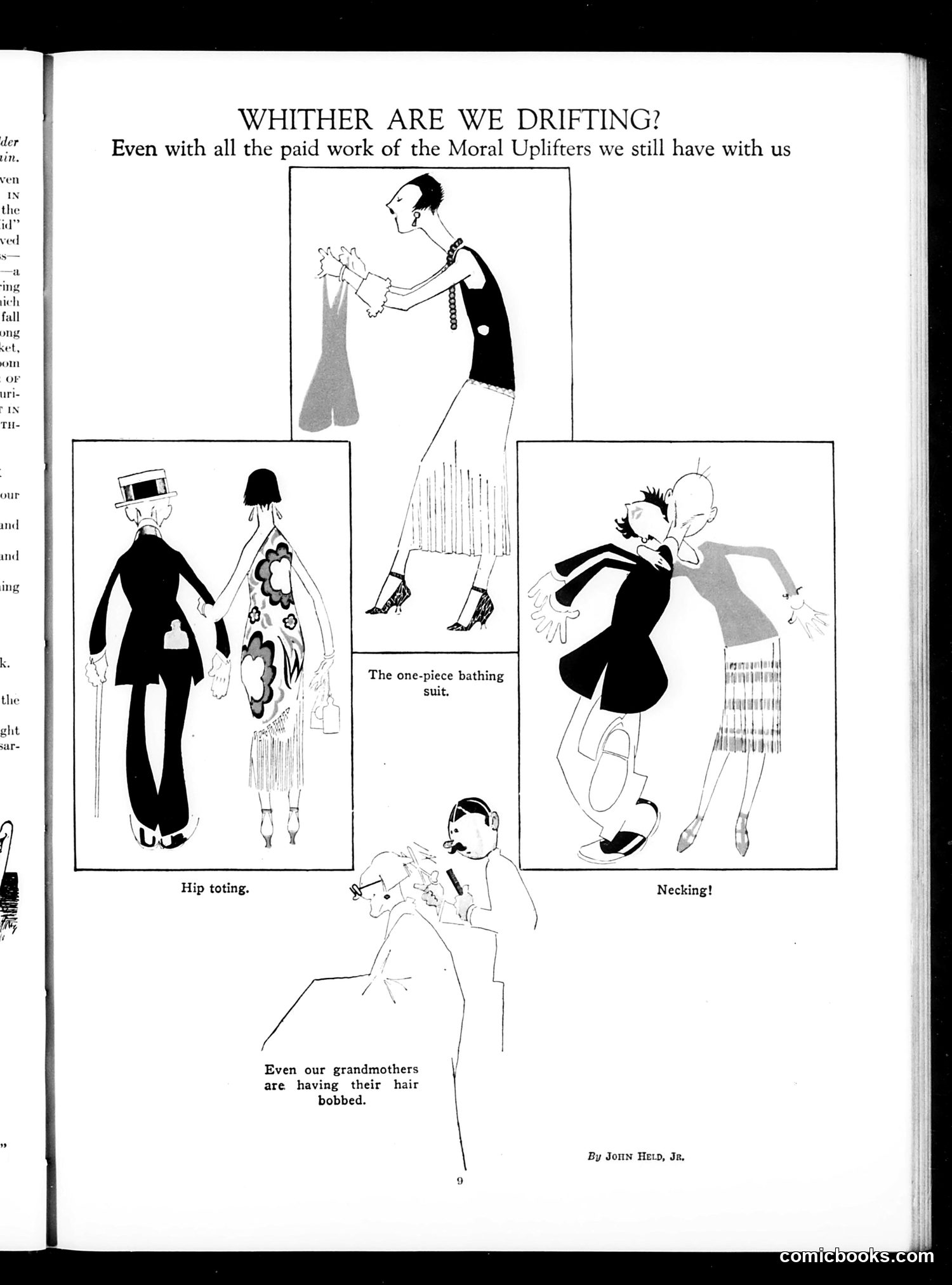
This satirical cartoon by John Held Jr. critiques perceived moral decline in 1920s America. The heading "Whither Are We Drifting?" sarcastically notes that despite efforts by "Moral Uplifters" (conservative reformers), society continues adopting scandalous fashions and behaviors. The four illustrated panels mock contemporary concerns: the one-piece bathing suit (considered indecent exposure), "hip toting" (carrying liquor during Prohibition), "necking" (physical affection between unmarried couples), and bobbed hair on older women (considered unfeminine and rebellious). The cartoon reflects the culture war between traditionalists and the modern "Jazz Age" youth. Held's illustrations deliberately exaggerate the fashions to ridicule both the styles themselves and the hand-wringing moral panic they provoked. The satire targets both progressive behavior and conservative anxiety equally, capturing the generational clash defining the 1920s.
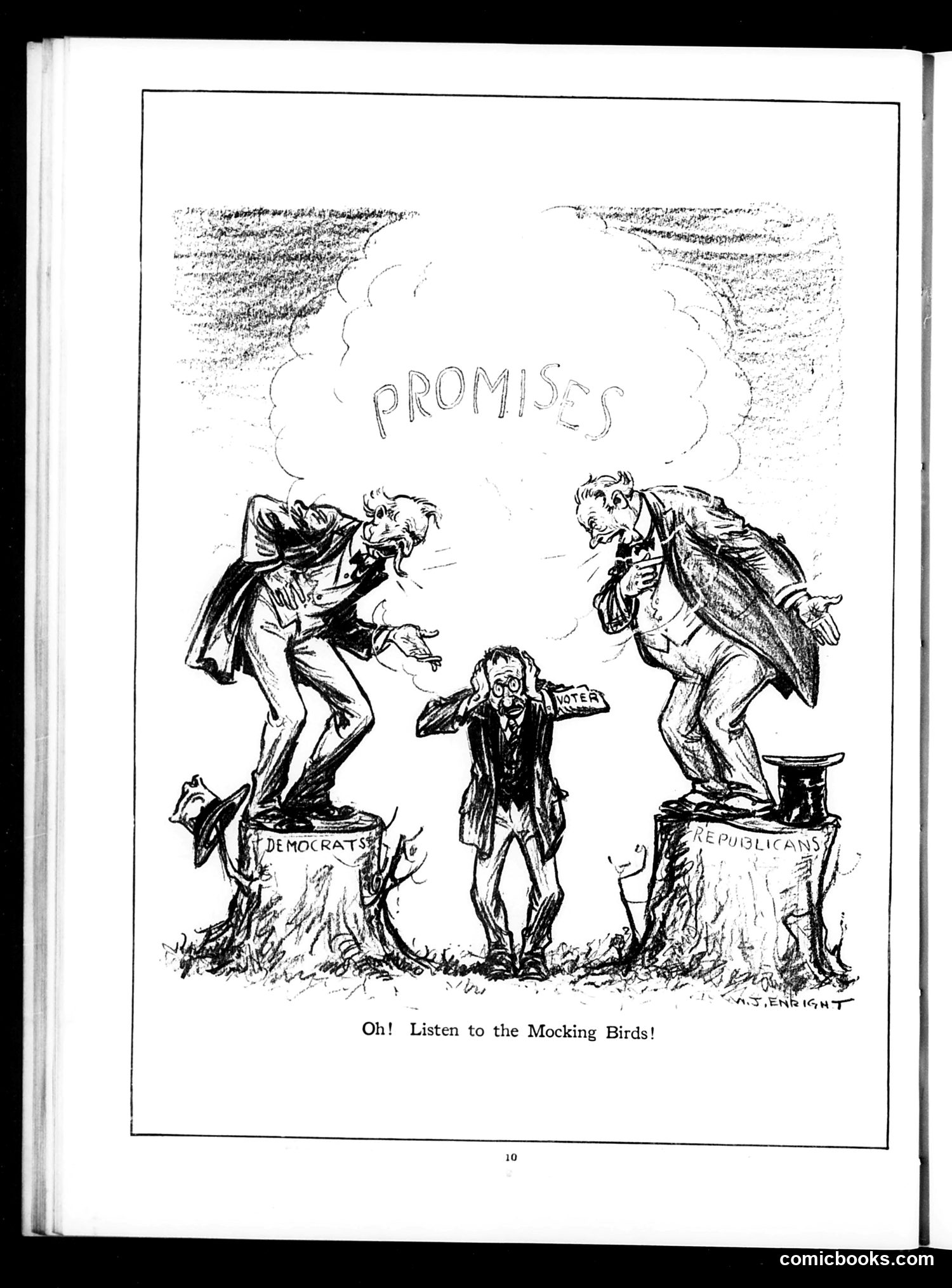
This Judge magazine cartoon satirizes partisan political promises. Two figures labeled "Democrats" and "Republicans" stand on pedestals, each gesturing dramatically toward a cloud labeled "Promises." Between them stands a smaller, distressed figure labeled "Voter," with arms raised in apparent frustration or resignation. The title "Oh! Listen to the Mocking Birds!" suggests both parties are mockingly repeating empty campaign pledges. The cartoon's point: voters are caught between two groups making hollow promises, neither truly committed to delivering. The "mocking birds" metaphor indicates the politicians are simply parroting rhetoric without substance. The satire critiques the cynical nature of political campaigning and voter gullibility during election cycles—a timeless critique applicable across American political history.
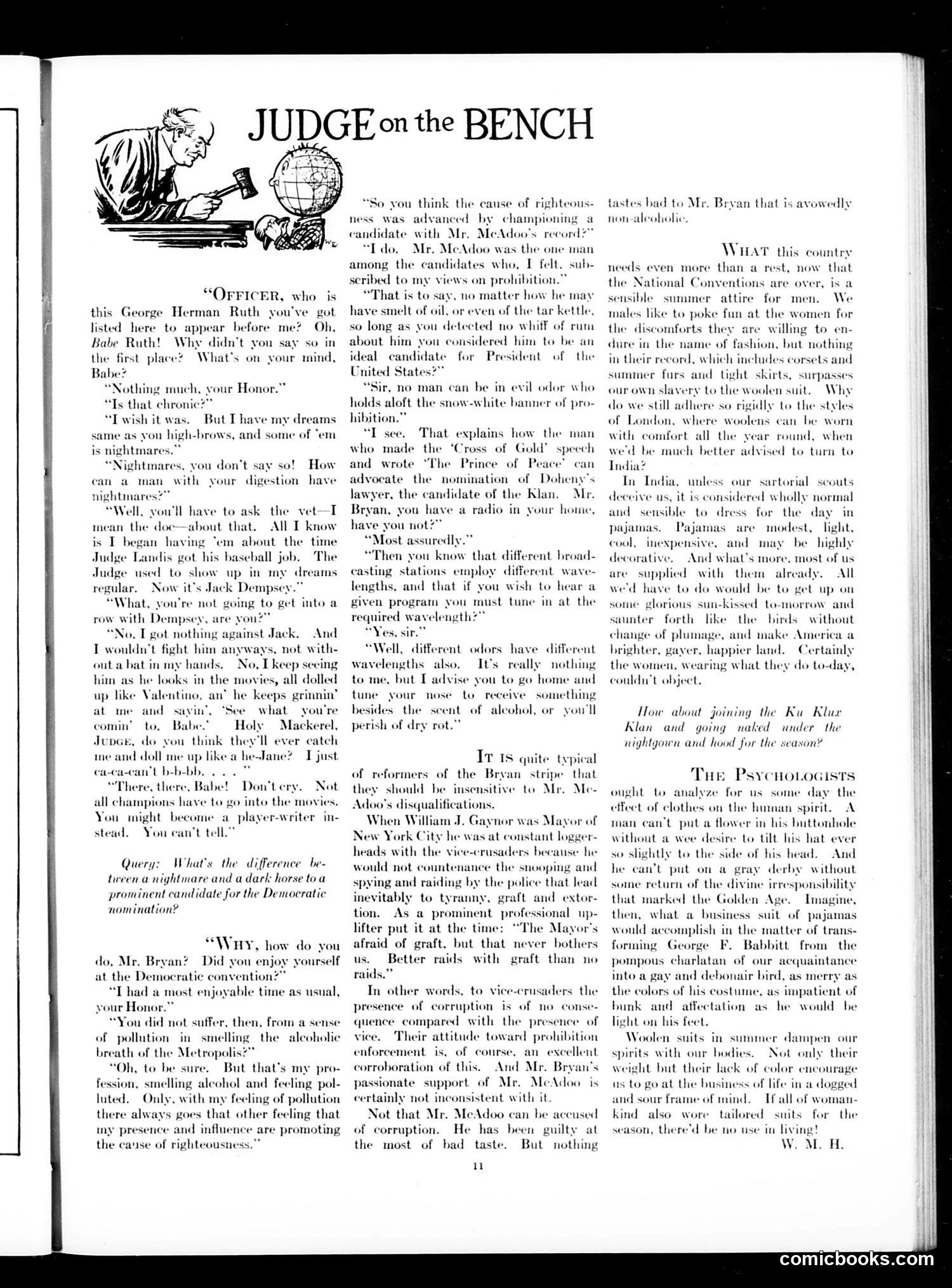
This satirical dialogue mocks William Jennings Bryan's hypocrisy regarding Prohibition. Bryan, a famous temperance advocate (known for the "Cross of Gold" speech), championed William McAdoo as a Democratic presidential candidate solely because McAdoo supported Prohibition—despite McAdoo's ties to oil magnate Harry Sinclair (Teapot Dome scandal). The judge's "radio wavelengths" metaphor is the joke's centerpiece: just as radio stations require tuning to specific frequencies, different "odors" (moral/ethical failings) exist at different "wavelengths." Bryan, obsessed with alcohol's "stench," ignores McAdoo's corruption entirely. The cartoon also references Judge Landis (baseball) and Jack Dempsey (boxer), contemporary celebrities, plus Mayor Gaynor, to illustrate how professional reformers tolerate graft if their pet cause is advanced. The satire targets self-righteous single-issue activists who ignore broader corruption when it serves their agenda.
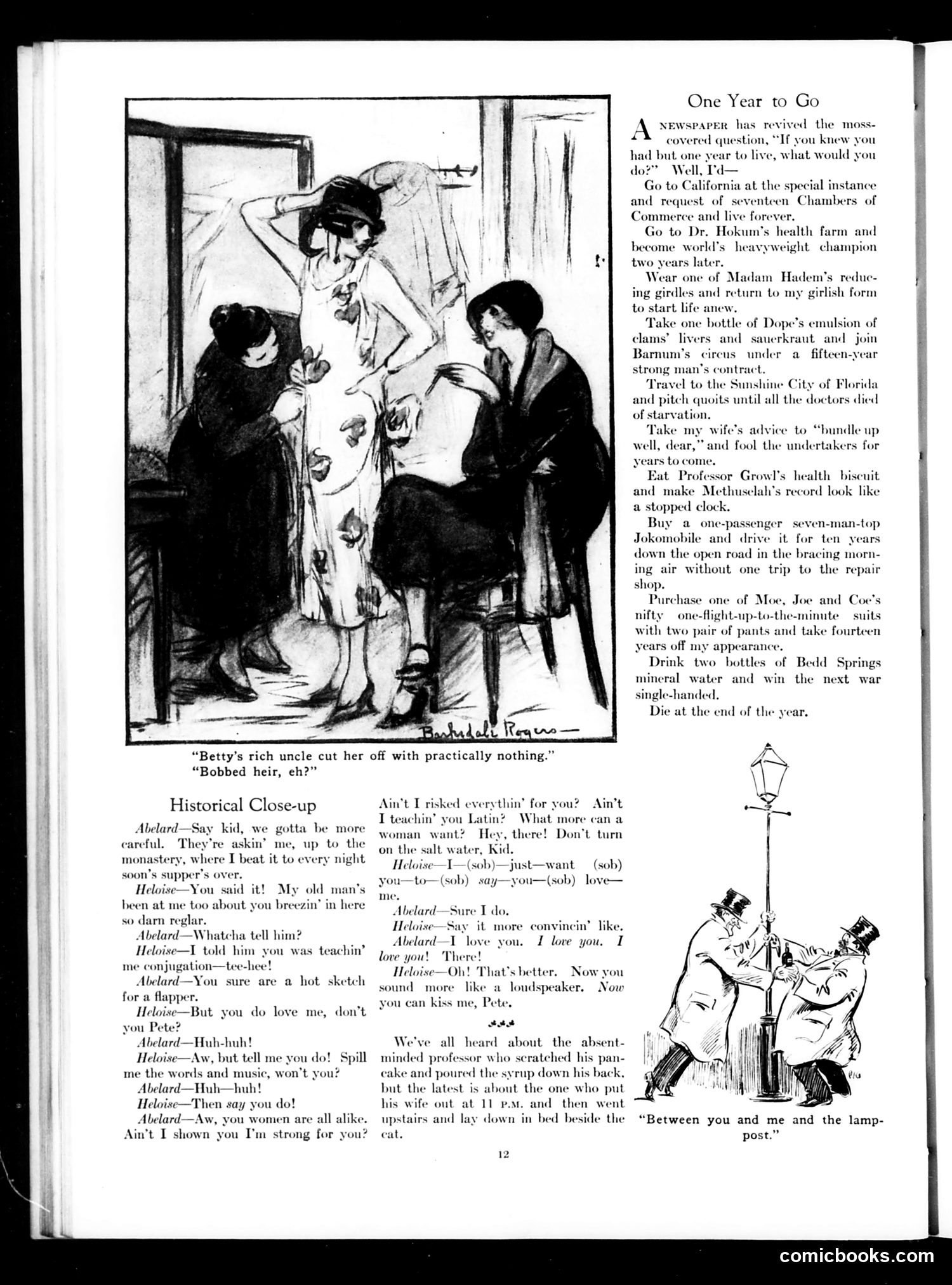
This page contains two distinct pieces of 1920s satirical content: **"Historical Close-up"** modernizes the medieval romance of Abelard and Heloise as a contemporary flapper-era couple. The satire mocks 1920s dating culture: "Abelard" (called "Pete") is an emotionally evasive young man who deflects his girlfriend's pleas for verbal affirmation of love with practical arguments ("Ain't I risked everything for you?"). Heloise's complaint that he won't simply say "I love you" satirizes male emotional unavailability. The dialogue parodies flapper speech and the era's casual attitude toward propriety—she jokes about telling her father he's teaching her "conjugation." **"One Year to Go"** is a humorous advice column responding to "If you knew you had one year to live, what would you do?" The answers satirize contemporary fads and products: health farms, reducing girdles, patent medicines, automobiles, and dubious commercial panaceas. The final suggestion—"Die at the end of the year"—is darkly comic understatement. Both pieces lampoon 1920s consumer culture and social pretensions.
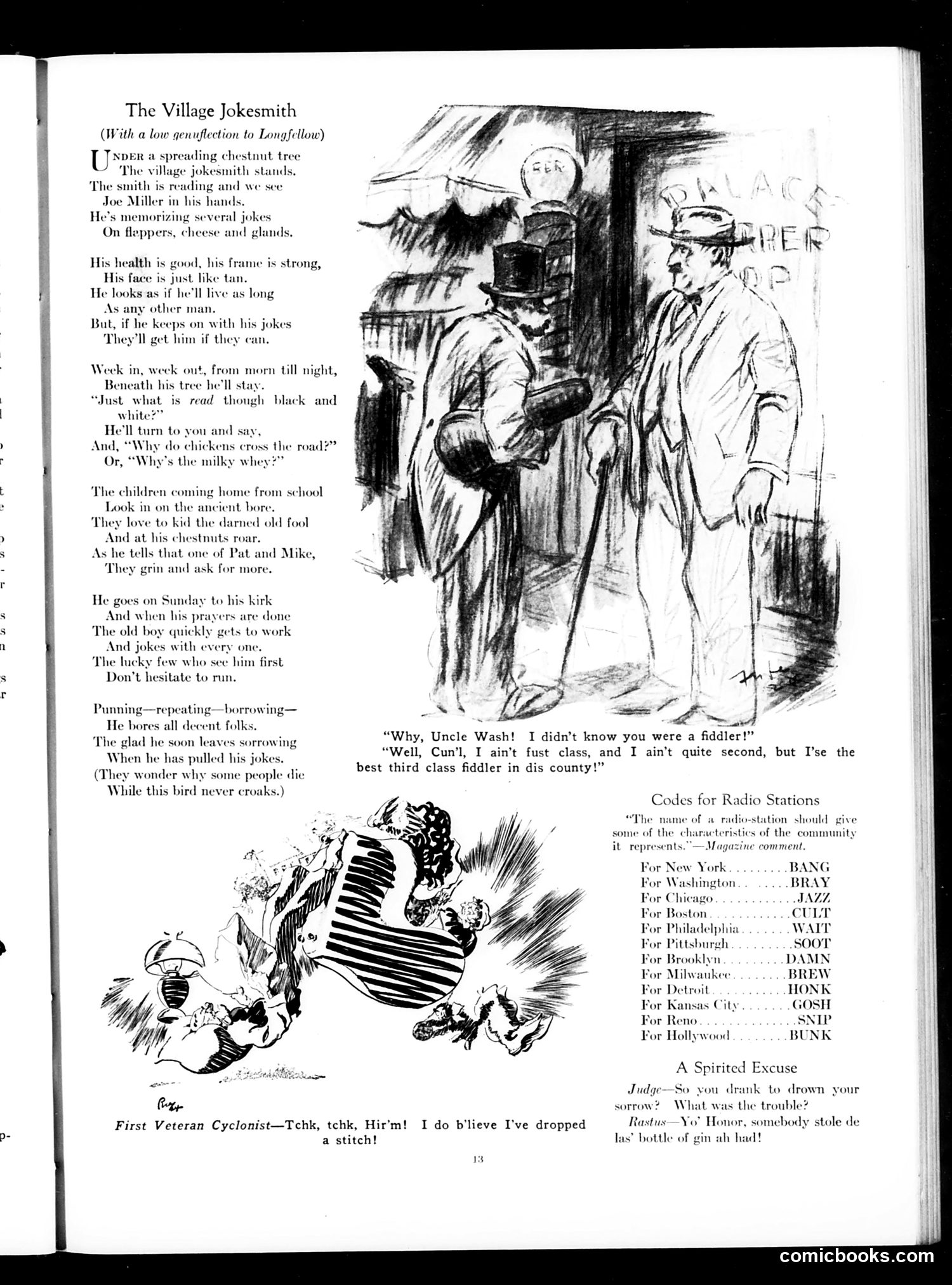
**"The Village Jokesmith"** is a humorous poem mocking a tired archetype: the relentless, boring storyteller who endlessly repeats worn-out jokes—puns, the "why did the chicken cross the road" joke, Pat-and-Mike stories. The poem, styled after Longfellow, portrays this man as a village fixture who compulsively tells jokes despite boring everyone. The satire targets people who mistake memorized humor for wit and fail to recognize their audience's suffering. The cartoon shows two men in conversation, illustrating how the jokesmith's terrible jokes persist. **"First Veteran Cyclist"** shows a slapstick joke about cycling accidents. The **"Codes for Radio Stations"** section appears to be satire assigning acronymic station call letters that mockingly characterize American cities (BANG for New York, BRAY for Washington, JAZZ for Chicago, etc.). **"A Spirited Excuse"** presents a racial stereotype dialogue where a Black man blames stolen gin for drunkenness—period humor reflecting the magazine's casual racism.
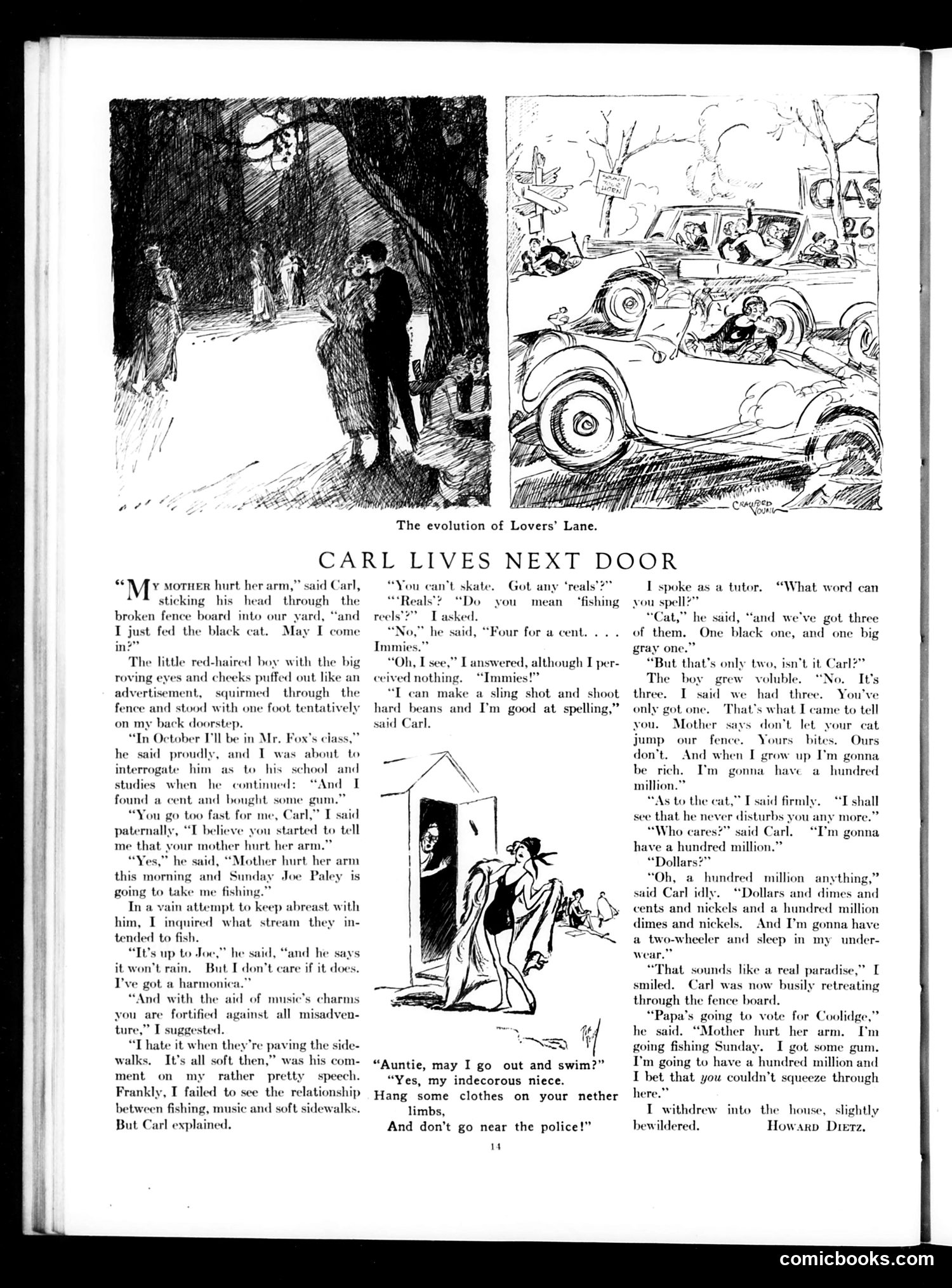
This is a humorous domestic sketch by Howard Dietz about a precocious, stream-of-consciousness neighborhood boy. Carl represents the archetypal early 20th-century American child—energetic, ambitious, and utterly disorganized in thought. The satire targets childhood innocence and ambition. Carl's rapid topic-shifting (mother's injury, fishing, the cat, spelling, presidential politics, his future wealth) illustrates how children process the adult world without logic. His boasts—becoming rich, owning a two-wheeler, beating a cat in a fence-jumping contest—reveal innocent materialism and competitiveness. The reference to Coolidge (likely Calvin Coolidge) grounds it in a specific era. Carl's scrambled priorities (his father voting, neighborhood cats, owning "a hundred million" of anything) mock both childish naïveté and adult preoccupations. The humor is gentle domesticity rather than sharp satire—an affectionate portrait of boyish chaos.
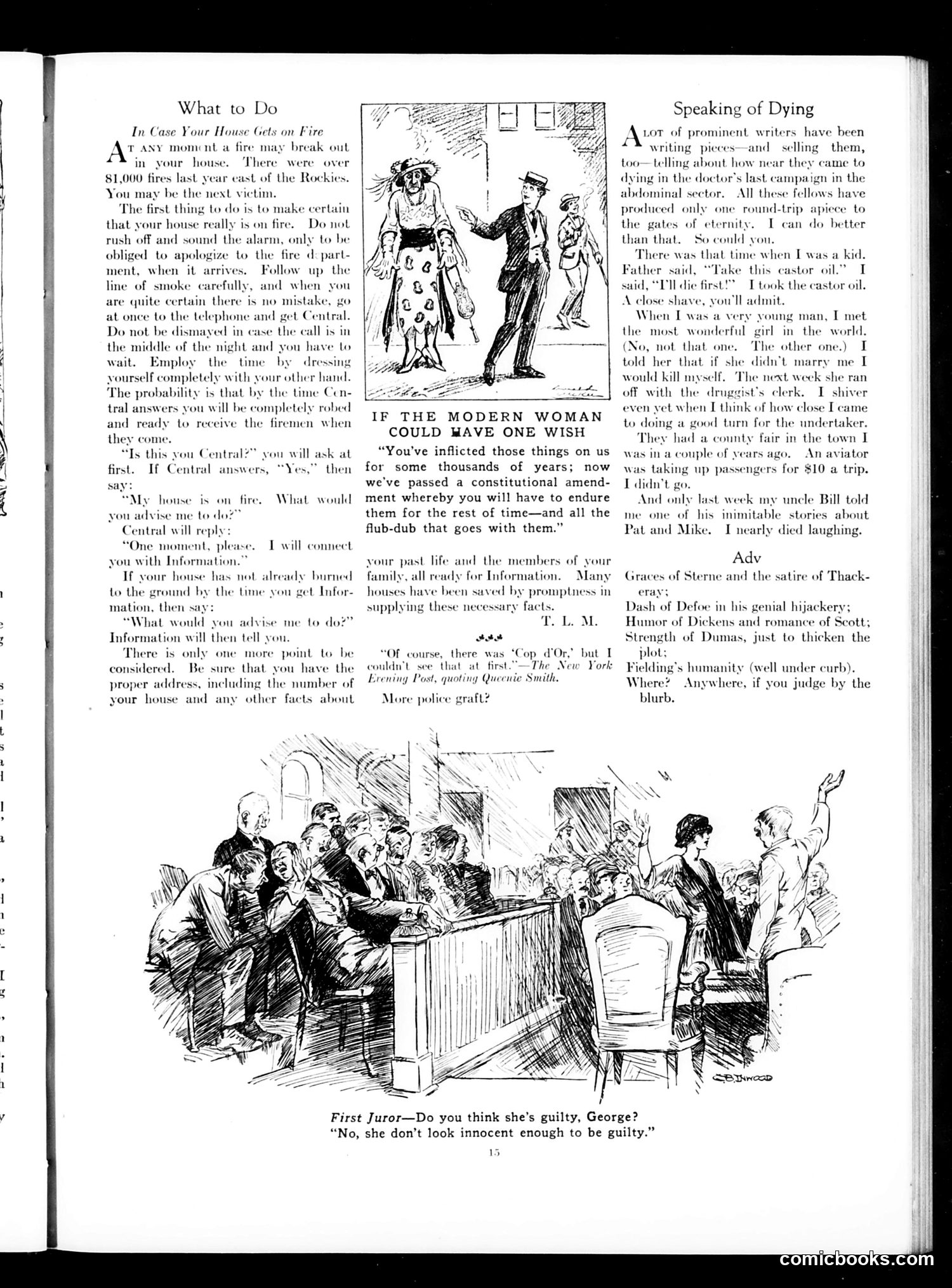
This page contains three distinct pieces of satirical content: **"What to Do in Case Your House Gets on Fire"**: A humorous advice column mocking bureaucratic absurdity. It satirizes the inefficiency of calling Central (the telephone operator) to report a fire—suggesting you'll be fully dressed before getting through to emergency services. The joke targets the slowness of early telephone systems. **"If the Modern Woman Could Wave One Wish"**: A cartoon responding to women's recent constitutional amendment (likely the 19th, granting voting rights). A woman tells a man he must now endure restrictions "for the rest of time" as women have endured them—a sarcastic comment on gender equality and male resistance to women's newfound rights. **"Speaking of Dying"**: A humorous essay mocking the trend of prominent writers publishing near-death experience narratives. The author humorously catalogs his own close calls (castor oil, romantic rejection, a county fair aviation stunt) as satirical commentary on this literary fad. **Bottom cartoon**: A courtroom joke about jury bias—a juror dismisses a defendant because she "doesn't look innocent enough to be guilty," revealing absurd prejudgment.
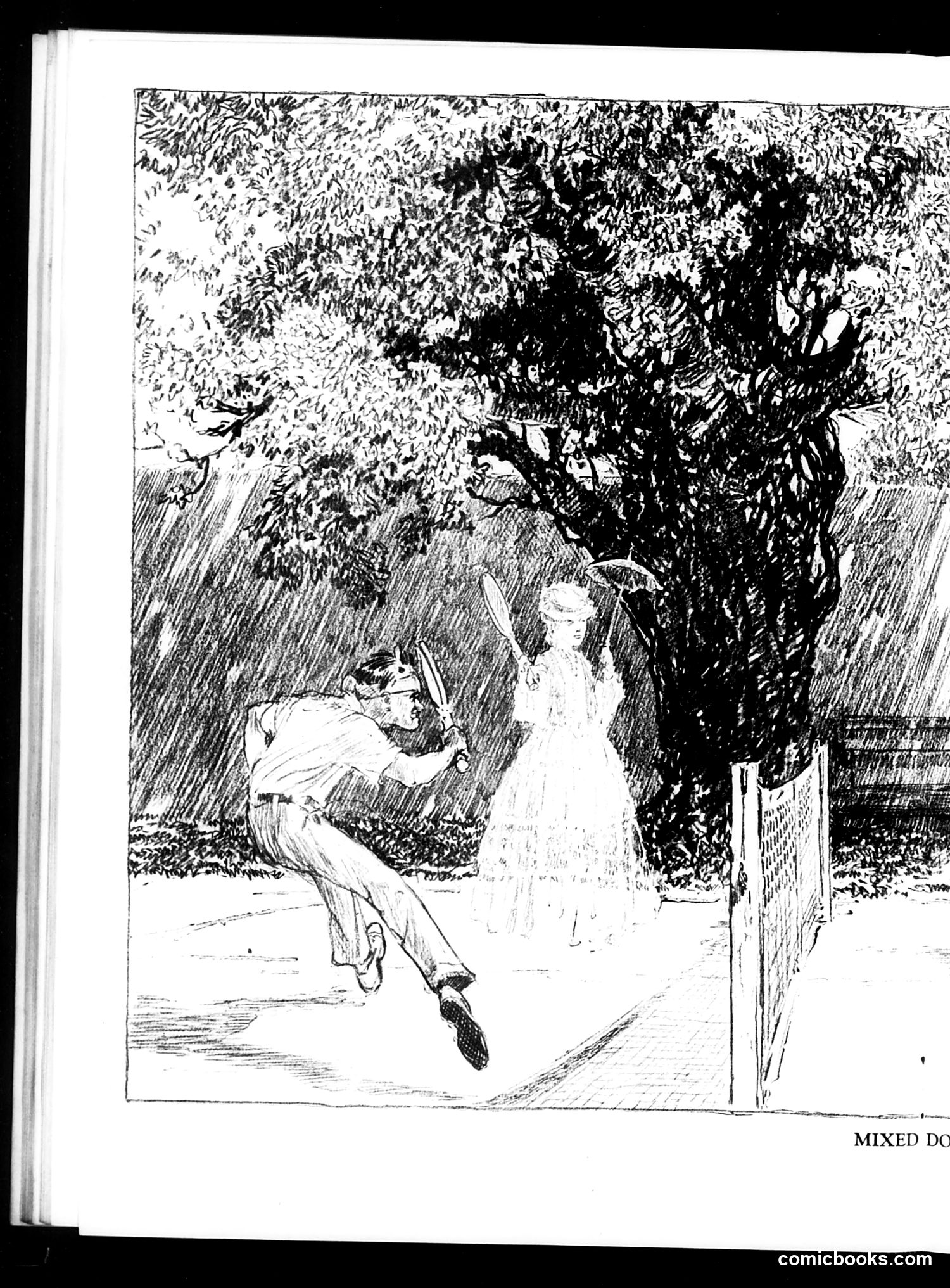
This appears to be a pen-and-ink illustration from Judge magazine showing two figures in a garden or park setting. A man in light clothing reclines or leans back dramatically, while a woman in a white dress stands nearby holding what appears to be a parasol or umbrella. Dense foliage and trees frame the scene above. The partial text "MIXED DO" at bottom right is cut off, making the specific satirical point unclear. Without the complete caption or article text, I cannot definitively identify the figures or explain the intended social or political commentary. The scene suggests romantic or social interaction, possibly satirizing courtship customs or gender relations of the era, but this remains speculative without full context.
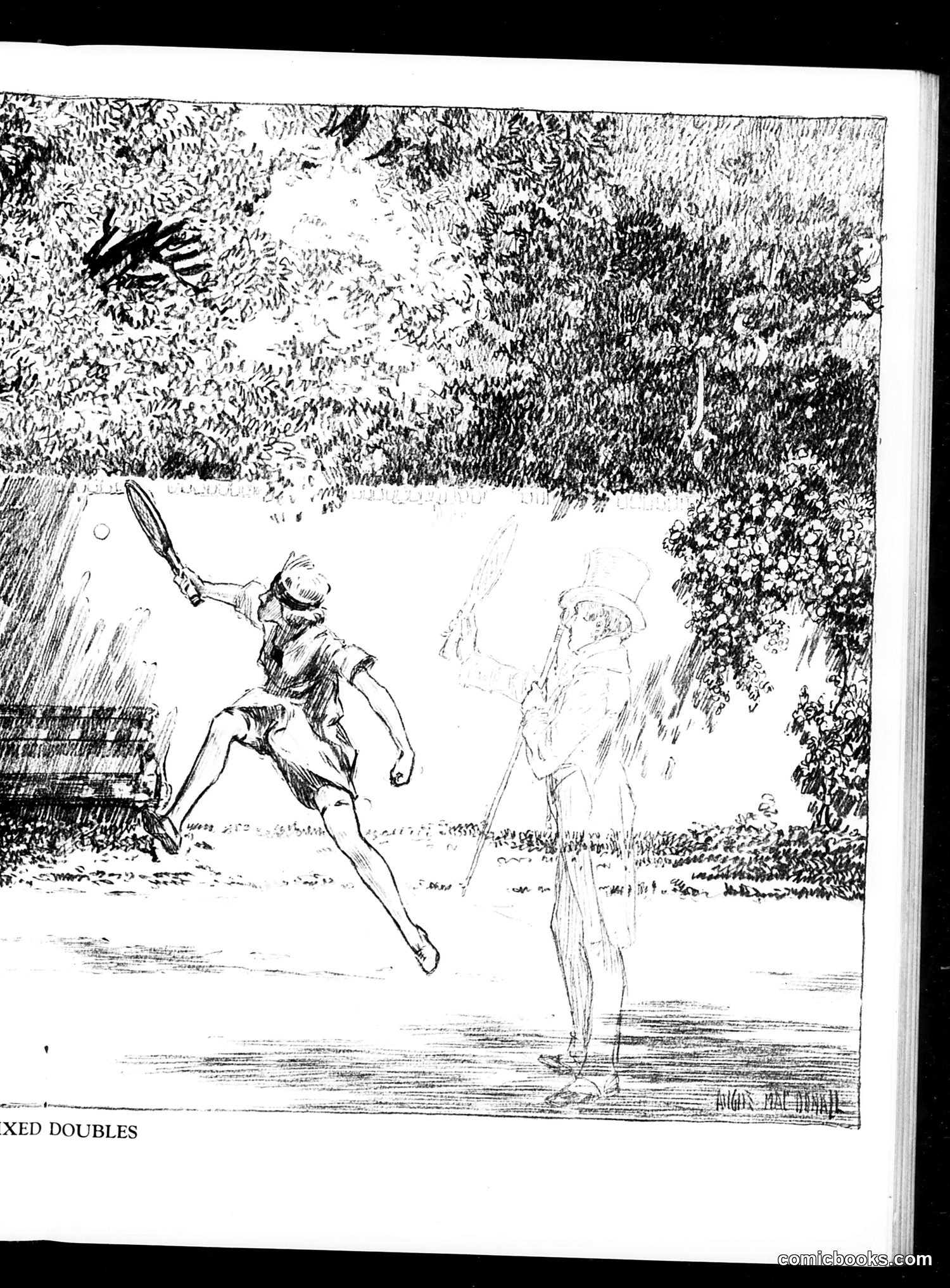
This appears to be a tennis illustration from *Judge* magazine, showing two players in mixed doubles play on a court bordered by trees and flowering vines. The sketch is rendered in pen-and-ink style with crosshatching. The title "MIXED DOUBLES" likely references the tennis format combining male and female players. Without clearer OCR text or visible captions identifying the specific figures, the cartoon's satirical point is unclear—though *Judge* often used sports scenes to comment on social dynamics, gender relations, or contemporary athletic trends of the era. The illustration's style and subject matter suggest early-to-mid 20th century publication, when mixed-gender tennis was a notable social development worth satirizing in a humor magazine.
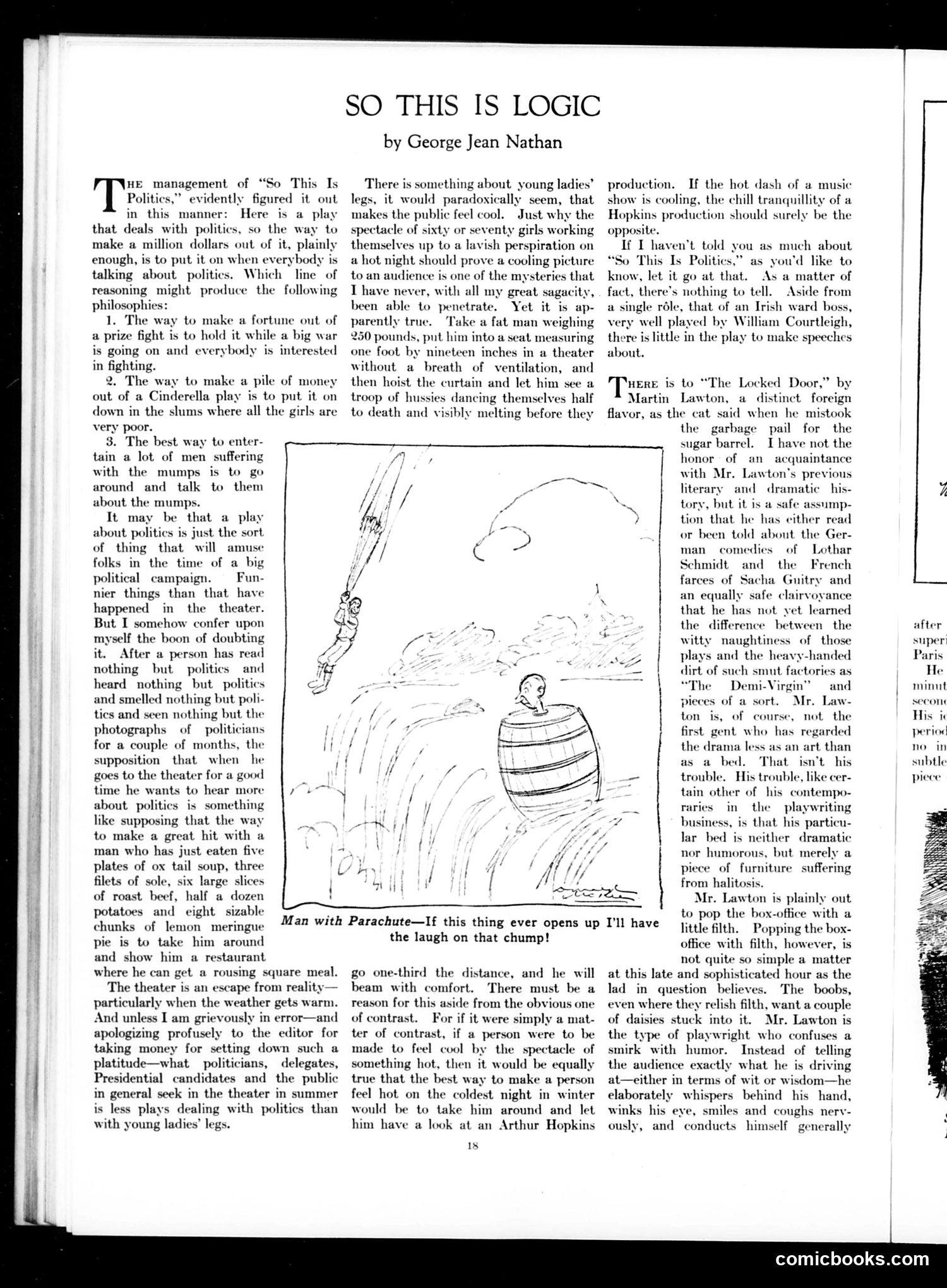
This is a theater criticism essay sarcastically attacking the logic of producing a play called "So This Is Politics" during an election season. Nathan argues that audiences seeking theater as an escape from everyday life would be the *last* people wanting to see a political play—just as a man stuffed with heavy food wouldn't want to visit a restaurant. The accompanying cartoon shows a man dangling from a parachute above another man sitting in a barrel, captioned "Man with Parachute—If this thing ever opens up I'll have the laugh on that chump!" This visual metaphor reinforces Nathan's absurdist point about illogical reasoning. Nathan then pivots to reviewing "The Locked Door" by Martin Lawton, praising William Courtleigh's performance as an Irish ward boss while finding little else noteworthy in the production. The criticism ultimately mocks both the play's conception and theatrical management's faulty decision-making.
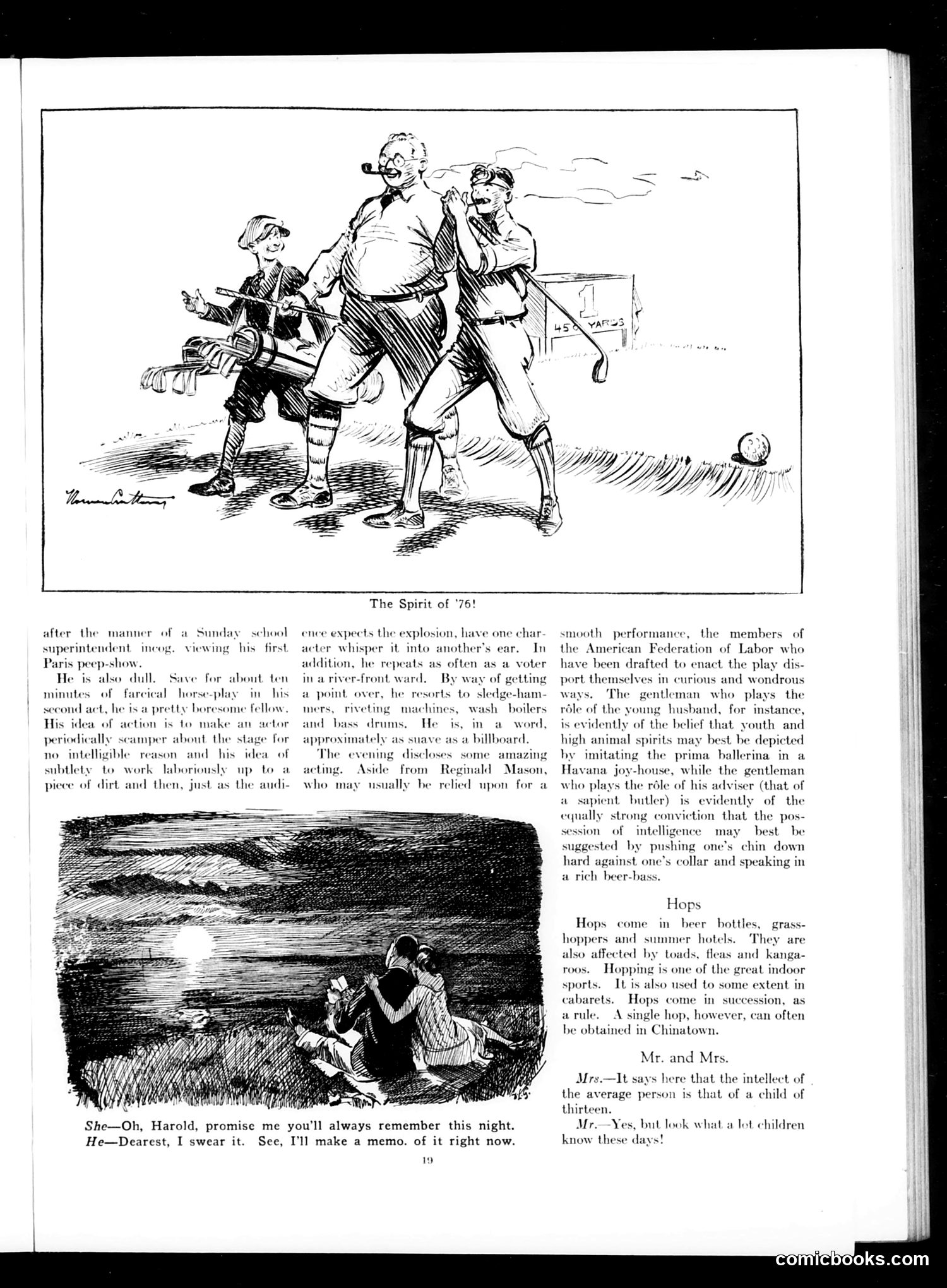
This page satirizes a theatrical production about American independence ("The Spirit of '76") performed by members of the American Federation of Labor. The cartoon critiques the play's quality and the actors' abilities. The top illustration shows three men performing clumsily on stage—depicting the supposedly poor acting by labor union members cast in leading roles. The text mocks the superintendent/director as dull and the production as reliant on slapstick ("sledge-hammers, riveting machines, wash boilers") rather than genuine artistry. The satire suggests that casting working-class laborers in a patriotic historical drama produces amateurish, undignified results. The characters perform with exaggerated physical comedy rather than skill—one mimics a cabaret dancer, another speaks in an affected "beer-bass" voice. The lower cartoon is unrelated domestic humor about memory and modern intelligence. The page ridicules both labor activism in arts and cultural pretension generally.
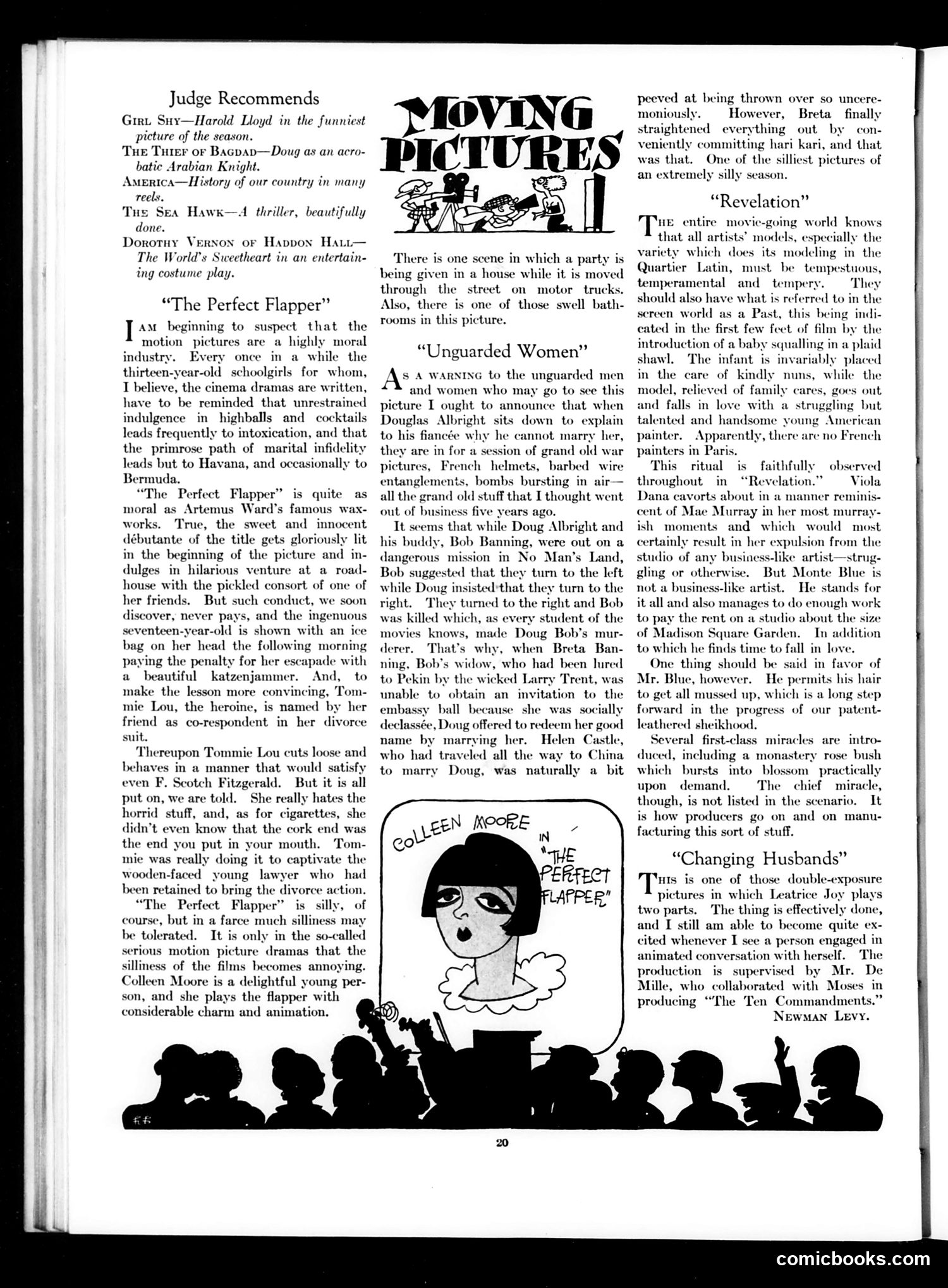
This page reviews several silent films from the early 1920s, offering moral commentary typical of the era. **The Main Cartoon**: Features Colleen Moore, star of "The Perfect Flapper," illustrated in period style with the film's title in a speech bubble below her silhouette. **Key Context for Modern Readers**: The reviews mock films that moralize about youth behavior—particularly young women drinking cocktails and smoking—while depicting these vices in detail. The critic notes the irony: "The Perfect Flapper" shows a teenage girl getting drunk at roadhouses, then punishes her with a hangover, supposedly teaching a lesson. The reviews reference silent film stars (Harold Lloyd, Douglas Fairbanks, Colleen Moore) and contemporary anxieties about "flappers" (liberated young women of the 1920s). References to Havana, Bermuda, and China reflect exotic locations used in melodramatic plots. **The Satire's Point**: Judge ridicules both filmmakers for heavy-handed moralizing and audiences for accepting such transparent "lessons" as genuine moral instruction rather than entertainment justifying risqué content.
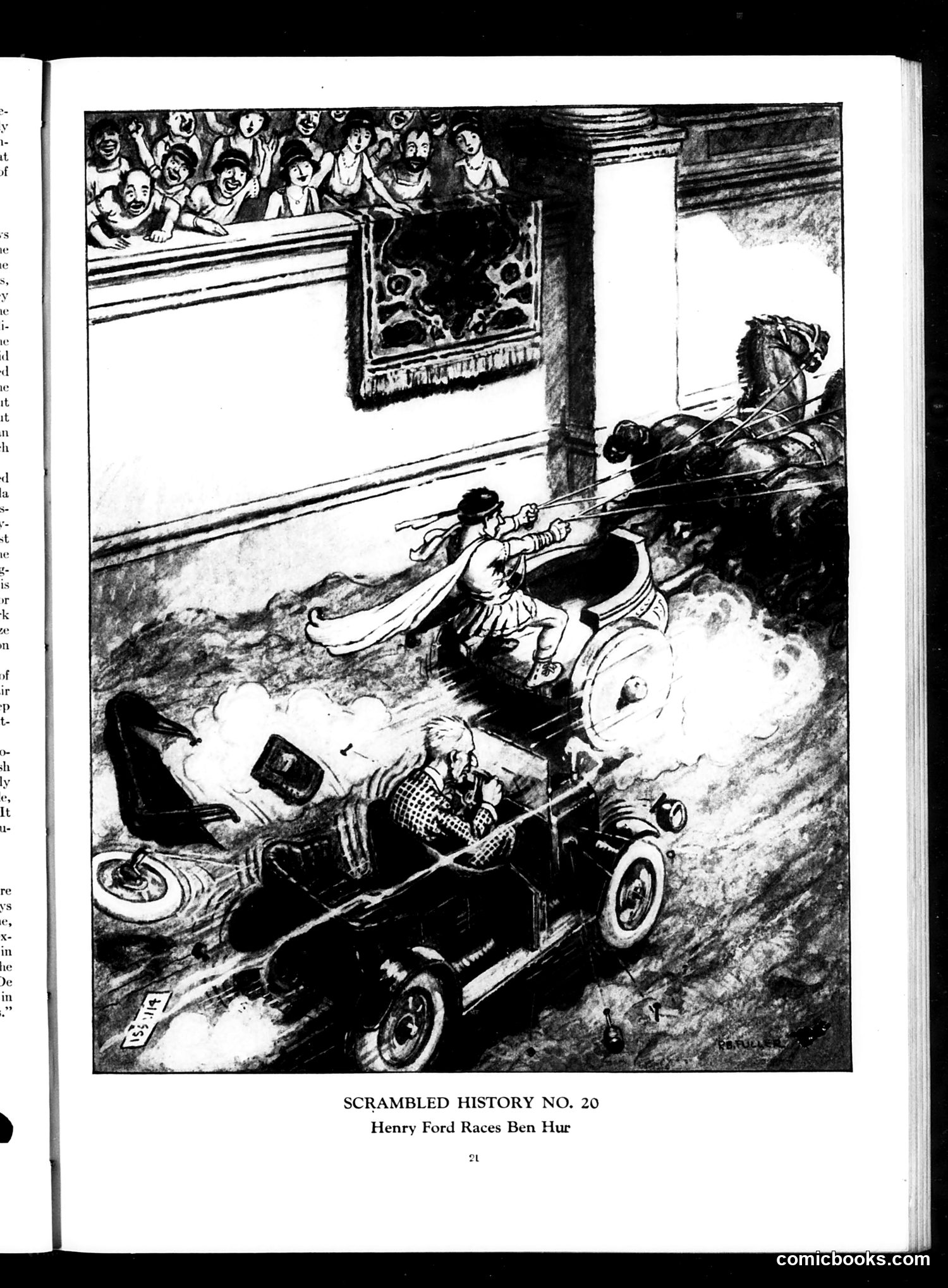
This is a humorous illustration depicting Henry Ford (identifiable by the early automobile he's driving) in a chariot race against Ben Hur, the legendary Roman character. The image appears to be satirizing Ford's prominence and modern industrial success by comically placing him in a classical historical scenario. The joke likely plays on contrasting Ford's contemporary mass-production automobile technology with ancient Roman chariot racing—suggesting Ford's modern innovations are so impressive they could compete with historical legend. The crowds watching from above appear amused by this anachronistic clash of eras. The "Scrambled History" series format suggests Judge magazine regularly reimagined historical events with contemporary figures inserted for comedic effect. This capitalizes on Ford's celebrity status in the 1920s-30s as America's most famous industrialist.
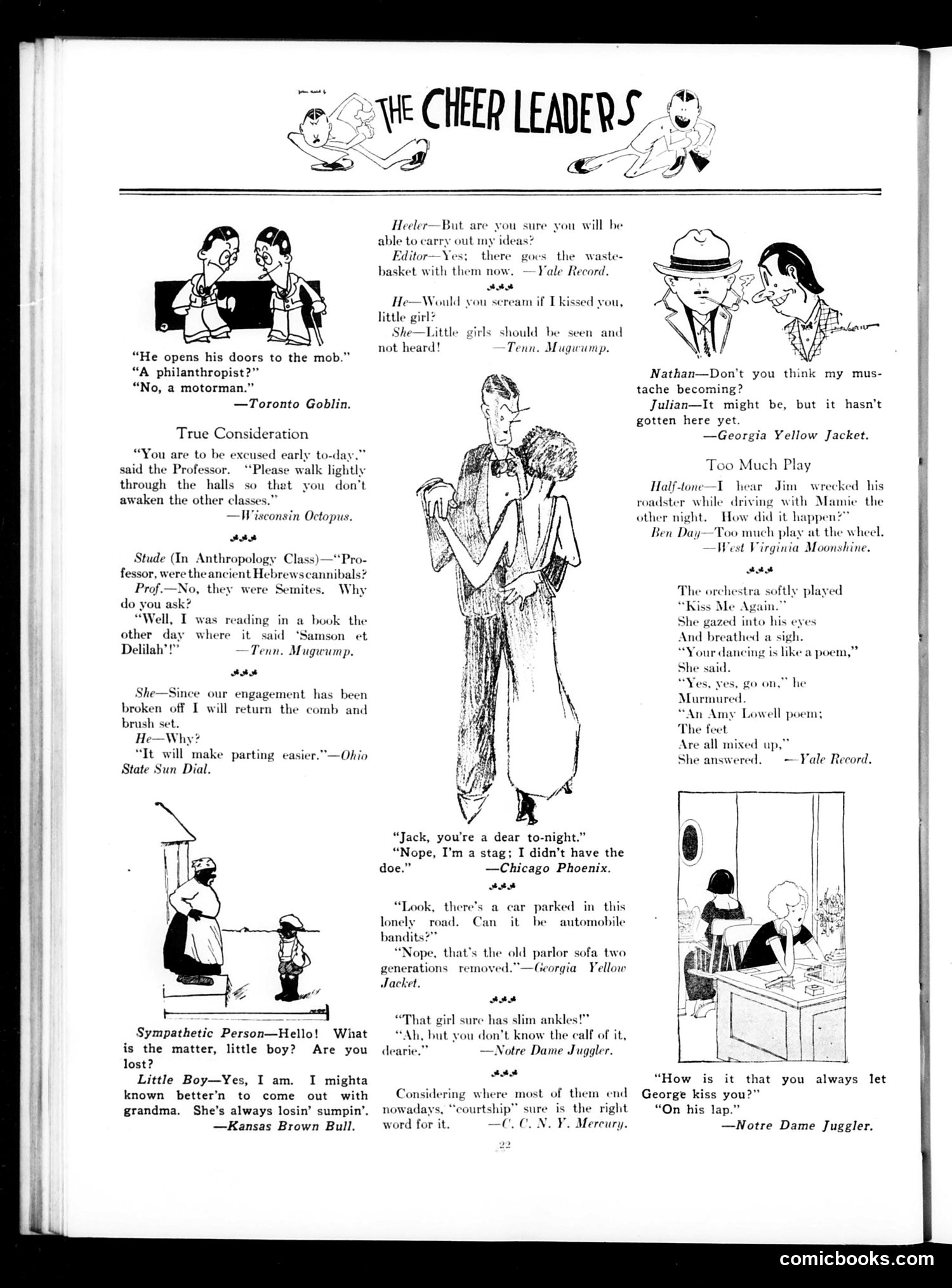
This page collects humorous quips and jokes from various college newspapers, arranged around illustrated vignettes. The content satirizes early 20th-century college and courtship culture. Key jokes target: 1. **Class dynamics**: A professor excuses a student early so others won't wake; a student confuses "Semites" with "cannibals" after misreading "Samson et Delilah." 2. **Courtship customs**: A woman returns engagement gifts ("the comb and brush set"); a man claims to be a "stag" (dateless) rather than a paid escort; a motorman is sardonically called a "philanthropist" for opening doors. 3. **Reckless youth**: A boy wrecked his car "too much play at the wheel" while with a girl. 4. **Dating behavior**: A woman asks if a man will "scream if I kissed you"; another references sitting "on his lap." The humor assumes readers recognize college life, courtship etiquette, and the tension between propriety and youthful behavior typical of the Jazz Age era.
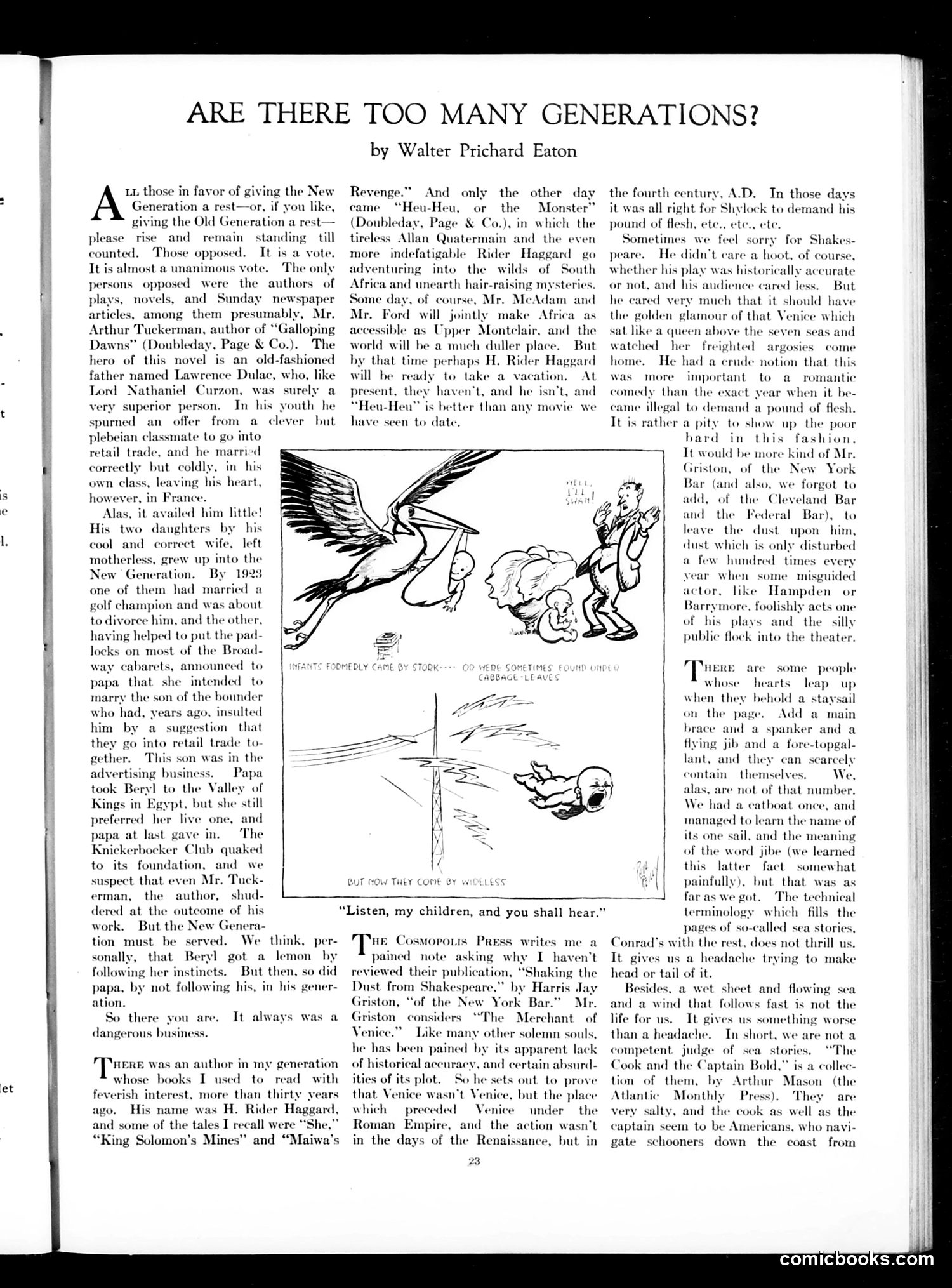
This essay by Walter Prichard Eaton critiques contemporary literature's obsession with generational conflict. Eaton argues there are "too many generations" — meaning too many novels and plays centered on intergenerational conflict between the "Old Generation" and "New Generation." The cartoons illustrate the absurdity: the top shows a stork delivering babies labeled "expect comedy by stock," while the lower depicts someone falling from a cliff, captioned "but how they come by wheelies" — visualizing how each generation keeps arriving and creating new dramatic friction. Eaton specifically mocks authors like Arthur Tuckerman (*Galloping Dawns*) and H. Rider Haggard (*Heu-Heu*) for constantly rehashing generational tensions. He uses the example of Shakespeare's *Merchant of Venice*, arguing that great art transcends historical accuracy — the play's "golden glamour" matters more than whether Shylock's pound-of-flesh demand was historically accurate. The satire targets how popular entertainment exploits generational conflict as an easy dramatic formula rather than exploring deeper themes.
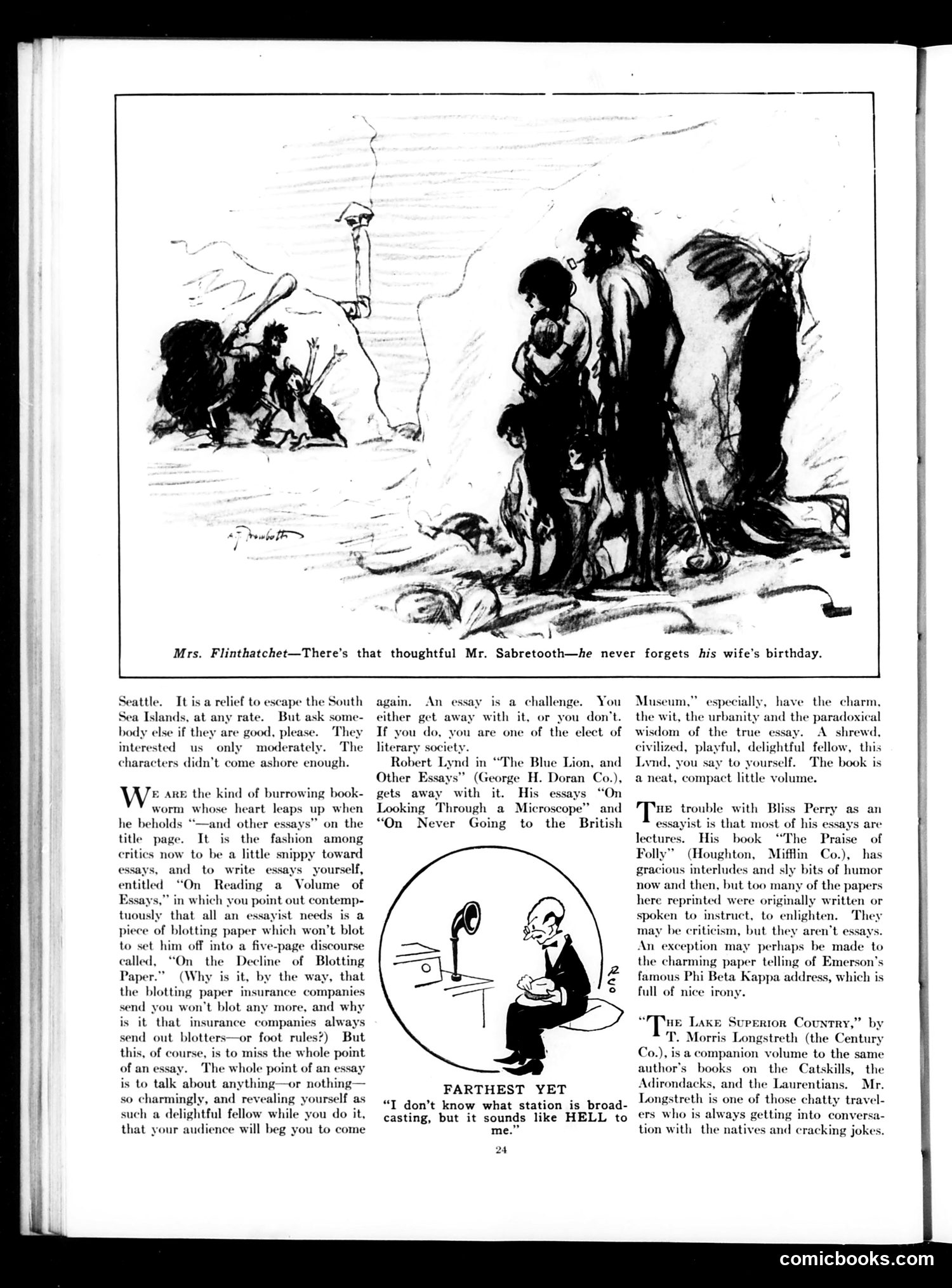
This page contains a book review section and two separate cartoons. **Top cartoon**: Shows a woman (Mrs. Flintthatchet) speaking to a man, referencing Mr. Sabretooth's thoughtfulness in remembering his wife's birthday. The satire appears to mock either the rarity of husbands remembering such occasions, or possibly the absurdity of someone named "Sabretooth" being considerate—playing on the incongruity between the brutish name and domestic sentiment. **Bottom cartoon ("Farthest Yet")**: A man listening to a radio complains that he doesn't know which station is broadcasting, but it "sounds like HELL to me." This satirizes early radio's poor quality and unclear reception—a common complaint during radio's early broadcast era. The joke's "farthest yet" title suggests this represents an extreme nadir in radio listening experience. The page's main content is a literary essay review section discussing books by Robert Lynd, Bliss Perry, and T. Morris Longstreth, praising essay-writing as an art form.
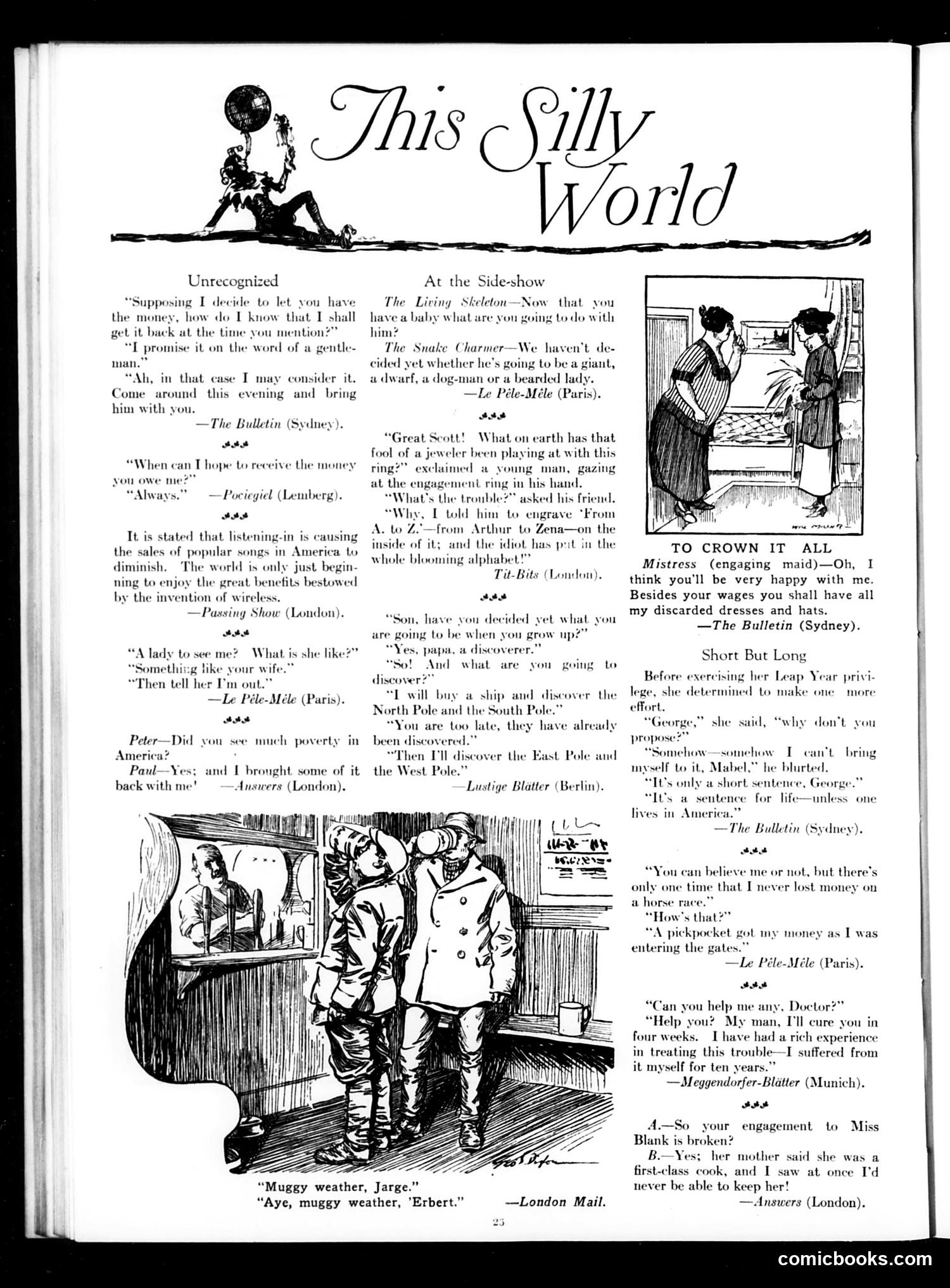
This page collects brief humorous anecdotes reprinted from international publications, using comedy to mock human folly and social absurdities. **Key satirical points:** - **Money & class**: Wealthy lenders demand a "gentleman" vouch for poor borrowers' reliability—mocking how arbitrary financial trust depends on social standing rather than actual character. - **Marriage**: Multiple jokes target matrimonial disappointment—wives' inferiority, broken engagements due to women's competence (a cook too good to "keep"), and men's reluctance to propose. - **Ambition as delusion**: A child dreams of polar exploration, unaware poles are already discovered, satirizing youthful naïveté and empty aspiration. - **Wireless technology**: A brief jab suggesting radio's (then-new) benefit is overstated—it merely reduces sheet-music sales. - **Poverty & immigration**: A quip about returning from America with "poverty" mocks both American poverty and immigrants' financial struggles. The cartoons and sourcing from Sydney, Paris, London, and Berlin newspapers reflect Judge's international scope and appeal to educated, cosmopolitan readers enjoying sophisticated, worldly humor.
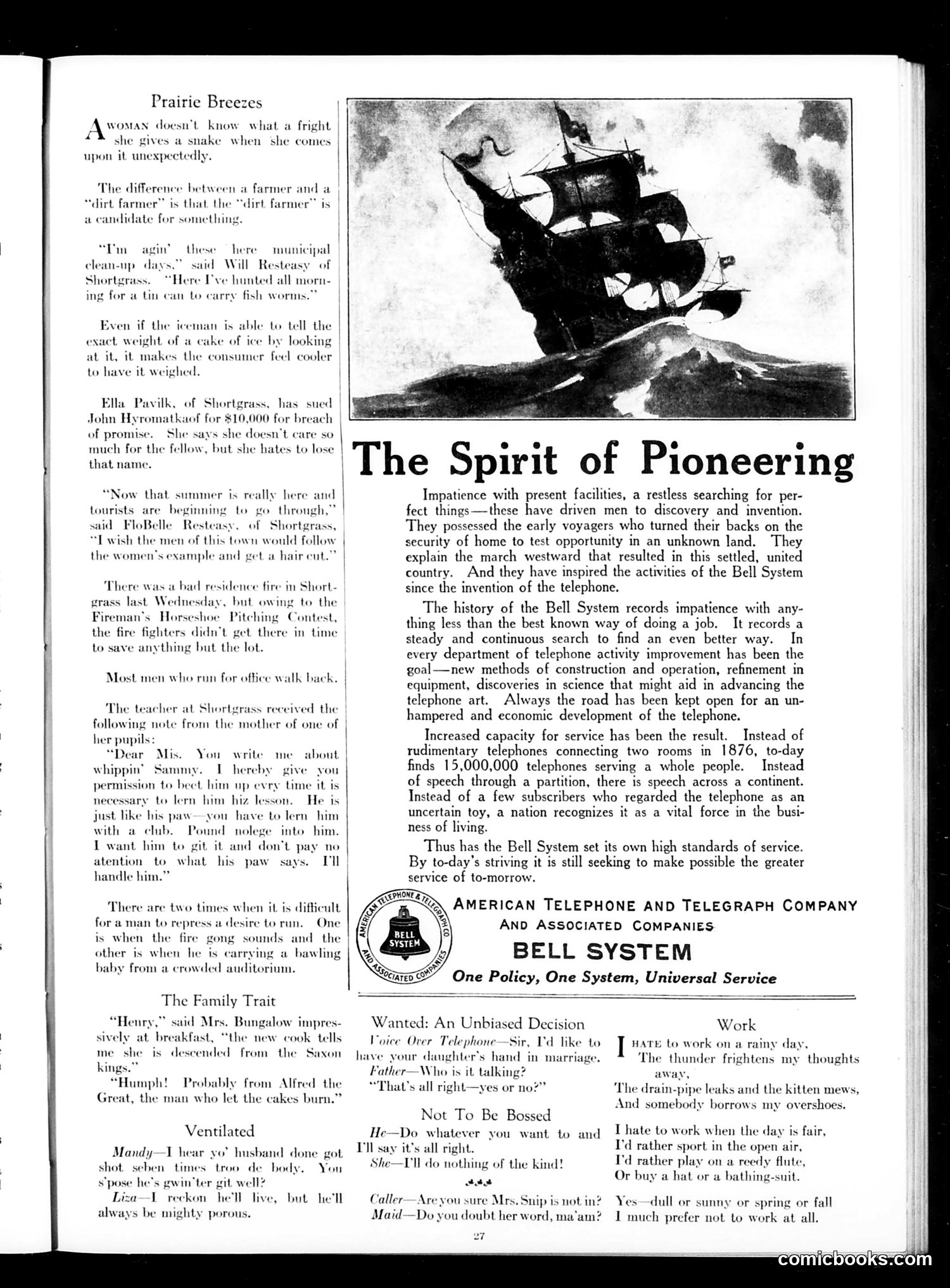
This Judge page contains rural humor sketches ("Prairie Breezes") from small-town America, followed by a substantial Bell System advertisement. The sketches satirize rural life and character through anecdotes about Shortgrass residents—a "dirt farmer" is someone running for office; a woman suing for breach of promise over losing the man's surname; a fireman's horseshoe contest delaying fire response. The humor relies on rural dialect and perceived backwardness (the parent's note using non-standard English; the "porous" shooting victim). The Bell advertisement positions the telephone company as embodying American pioneer spirit—restless innovation improving civilization. It frames telephone expansion (1876 to present: 15,000,000 phones) as fulfilling manifest destiny ideals. The juxtaposition is notable: rural-humor content sits beside corporate messaging about progress, suggesting tension between "old" America (rural, folksy, static) and "modern" America (technological, connected, advancing).
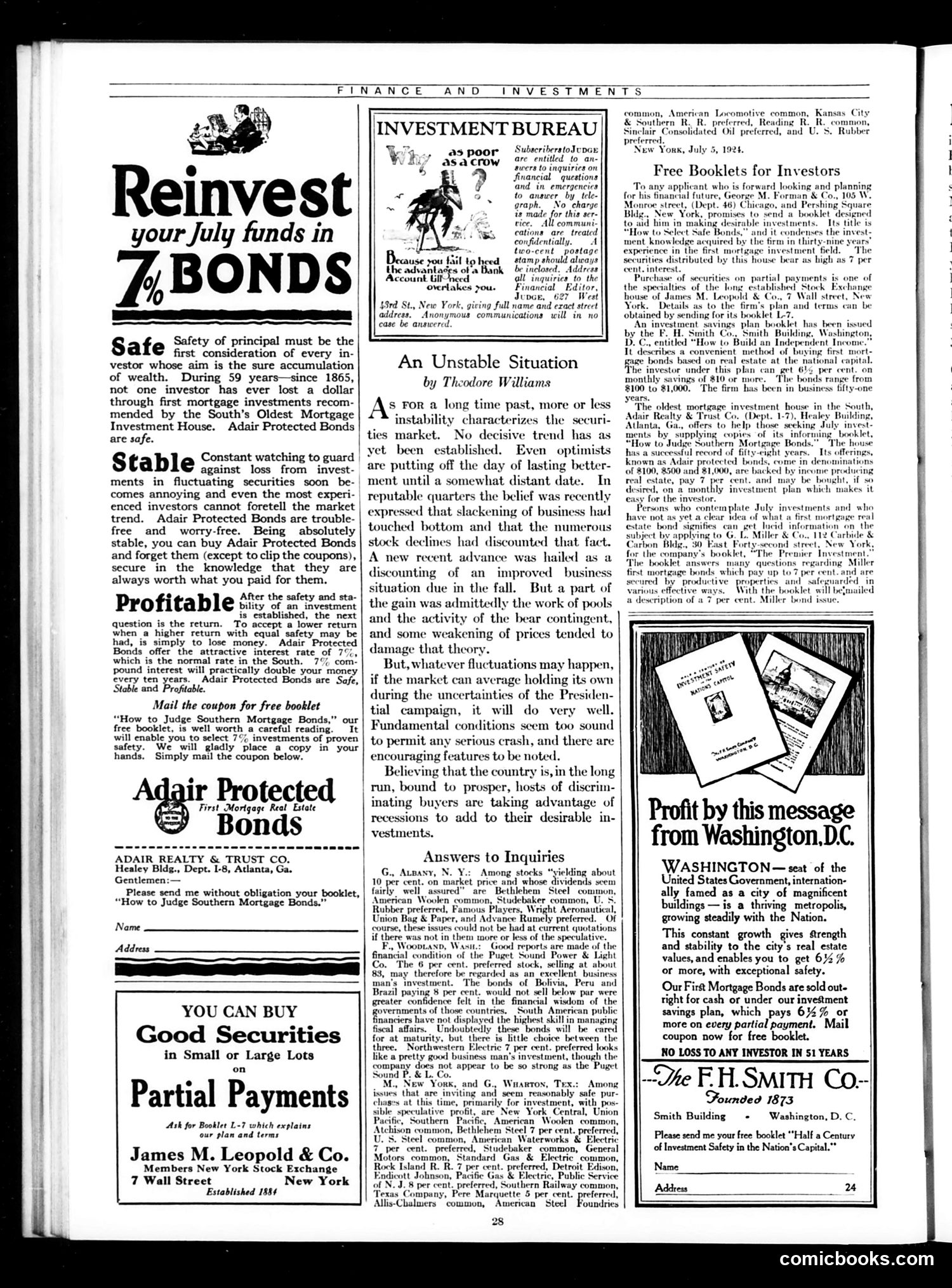
This page is primarily **financial advertising**, not political satire. It contains investment product pitches from Adair Realty & Trust Co., James M. Leopold & Co., and F.H. Smith Co., promoting bonds and securities to American investors. The one substantive article, "An Unstable Situation" by Theodore Williams, discusses **stock market volatility** during what appears to be a U.S. Presidential election period. Williams argues that despite current market uncertainty and trading by "pools" (coordinated investor groups) and "bear contingent" (those betting on price declines), fundamental economic conditions remain sound enough to weather the political campaign. The cartoon imagery in the "Investment Bureau" section appears decorative rather than satirical—showing a figure examining investments. **Context for moderns**: This reflects early 20th-century investment anxiety about market manipulation by insider groups and uncertainty tied to electoral politics.
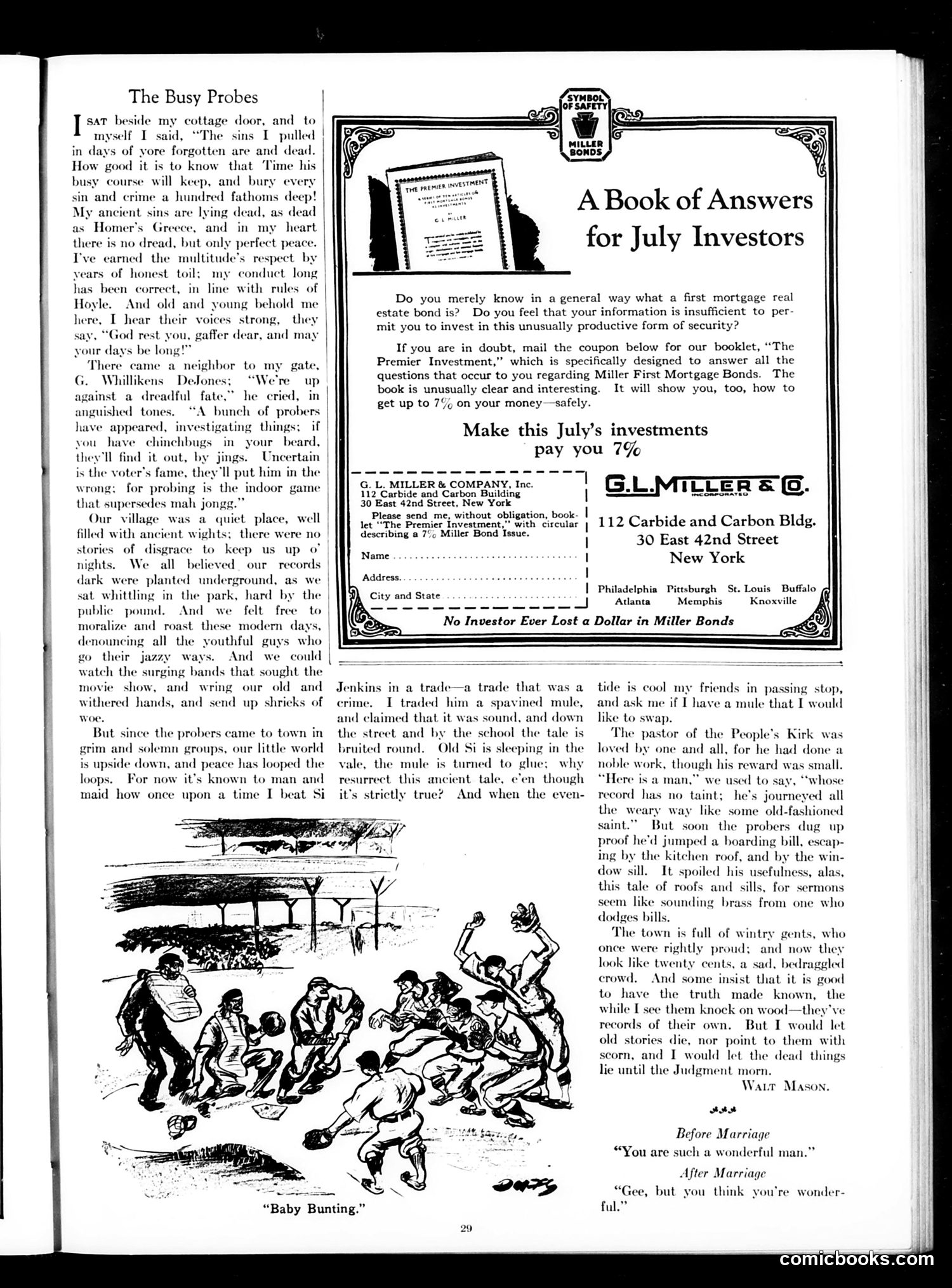
This page contains two distinct elements: **Left side ("The Busy Probes")**: A narrative poem satirizing congressional investigations (likely the "Red Scare" probes of the 1920s). The story depicts how investigators arriving in a small town disrupt community peace by dredging up minor past indiscretions—a traded spavined mule, a pastor's unpaid boarding bill. The satire criticizes how probes destroy reputations over trivial infractions and create paranoia, turning respectable citizens into social pariahs. The underlying critique: overzealous investigations sacrifice innocent people's dignity for political purposes. **Right side**: A full-page advertisement for G.L. Miller & Company's investment bonds, promising 7% returns. This juxtaposes earnestly with the left's social critique—an ironic placement suggesting financial institutions profit while investigative fervor destabilizes society. **"Baby Bunting" illustration** (bottom left): Shows children playing, possibly contrasting innocent youth with the adult world's destructive probing above. The page essentially critiques 1920s government overreach and its collateral damage.
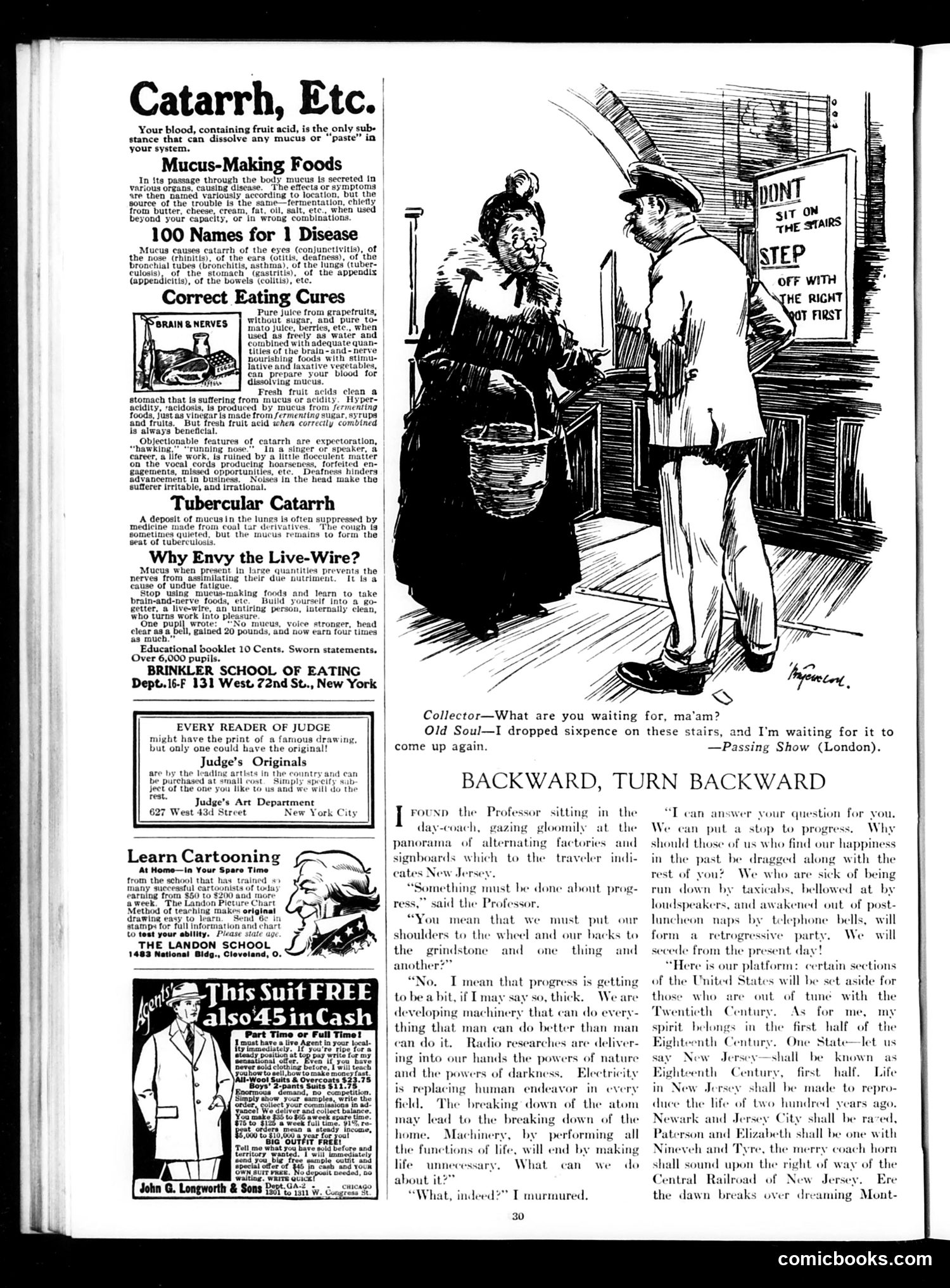
This page features a satirical dialogue between a Professor and an unnamed passenger on a train passing through New Jersey. The Professor espouses a pro-technology, pro-progress ideology typical of early 20th-century modernism—celebrating machinery, radio research, atomic physics, and electricity as inevitable forces that will eventually replace human labor entirely. The cartoon's satire lies in the Professor's blind faith in progress. The passenger, identified as "Old Soul," represents skepticism toward this relentless mechanization. His closing murmur—"What, indeed?"—suggests resigned bewilderment at being dragged into a future he didn't ask for. The title, borrowing from a sentimental poem about nostalgia, ironically frames the tension between those clinging to the past and those evangelizing an uncertain technological future. The joke targets both the Professor's utopian naïveté and society's anxiety about automation's social costs during this period of rapid industrialization.
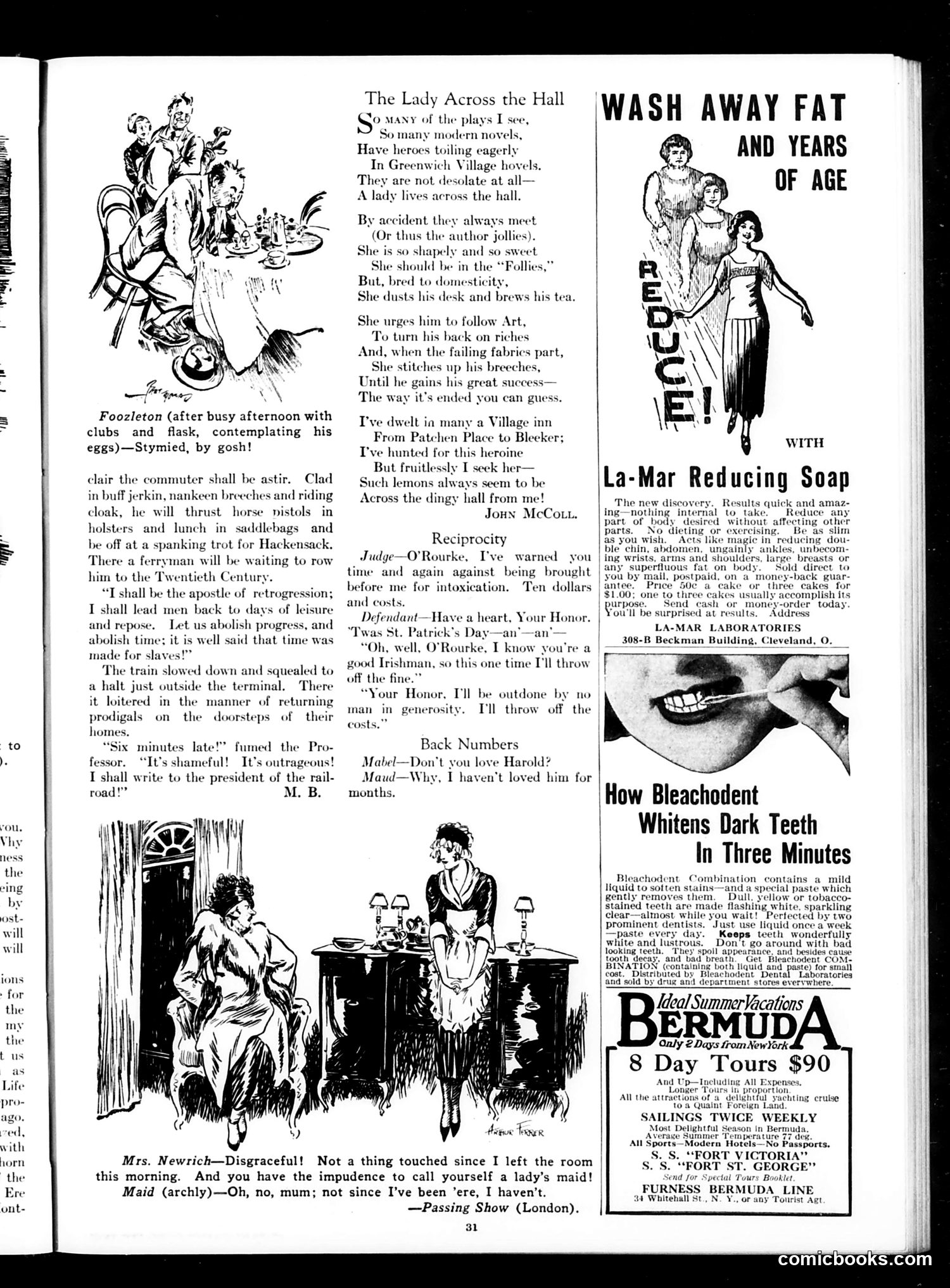
This page contains primarily **literary and humorous content** rather than political cartoons. **"The Lady Across the Hall"** (by John McColl) is a poem satirizing a recurring trope in modern fiction and plays. It mocks authors who repeatedly feature the same character type: an impoverished but virtuous woman living across the hall from a struggling artist in Greenwich Village. She's beautiful, domestic, and selflessly supports his artistic ambitions—mending his clothes, brewing tea, encouraging him toward greatness. McColl's point: this heroine is a literary cliché he's "hunted for" in real Village life but never found. Real women don't conform to this romantic fantasy. The cartoon illustrations show typical domestic scenes from such narratives. The remaining content consists of **period advertisements** for reducing soap, bleach toothpaste, and Bermuda vacation tours—typical commercial matter from early 20th-century magazines. These have no satirical intent; they're straightforward product pitches targeting readers concerned with appearance and leisure travel.
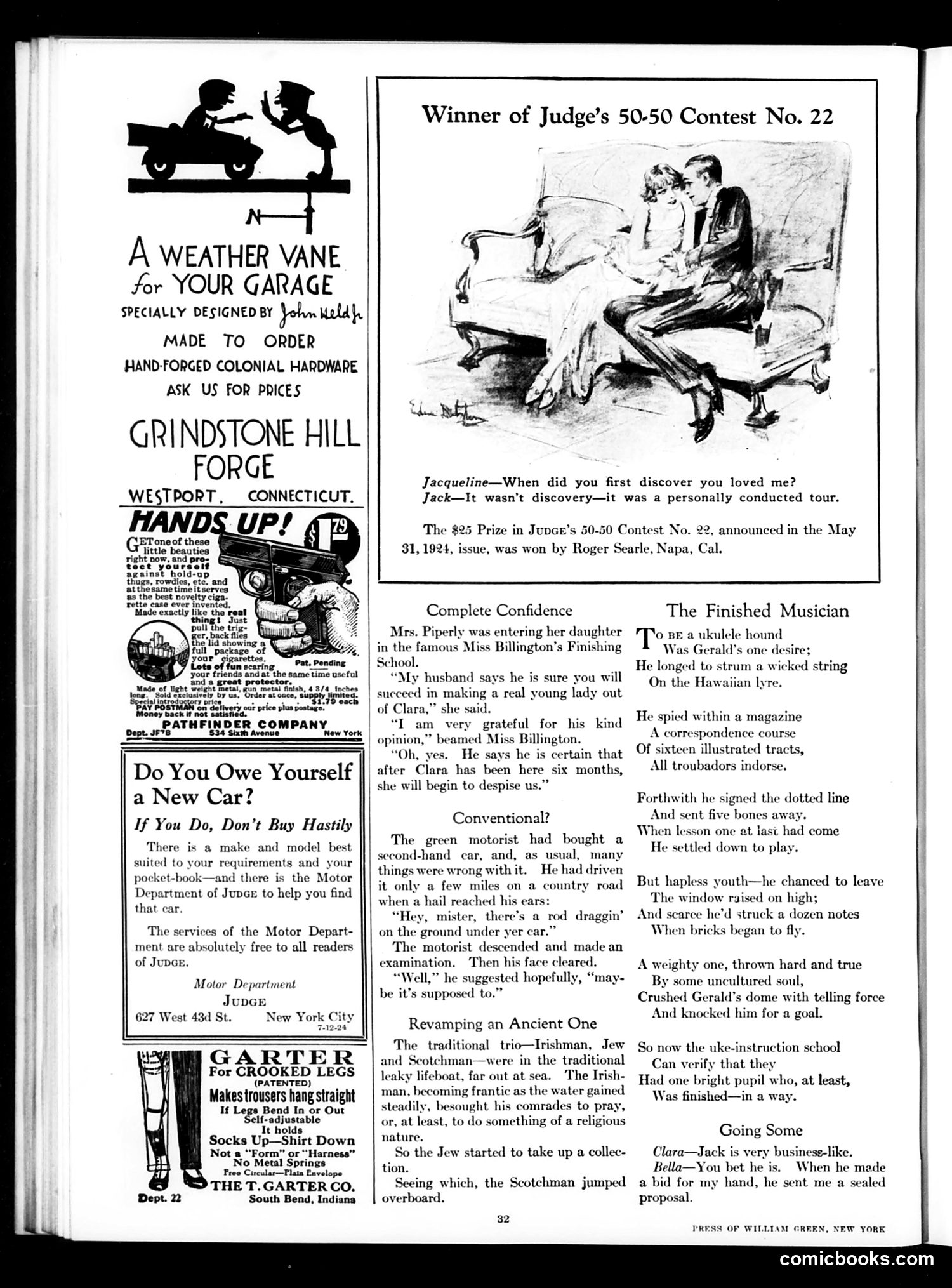
This is primarily an **advertising and humor page** from Judge magazine (1924). The content includes: **Advertisements:** A weather vane from Grindstone Hill Forge, novelty cigarette cases, motor department advice, and medical devices (garters for crooked legs). **Humor sections:** - **Contest winner**: A couple's joke about discovery versus a "conducted tour" of love - **Finishing school joke**: Parents expect their daughter will despise them after refinement - **Car humor**: A naive driver accepts a dragging rod as "supposed to" - **Ethnic joke**: The traditional "Irishman, Jew, Scotchman" trio — a common format where the Scotsman jumps overboard to avoid donating to collection - **"Finished Musician"**: A long poem mocking someone learning ukulele through mail-order course, ending when neighbors throw bricks at his terrible playing - **Dating joke**: A businessman proposes by sealed proposal The page reflects 1920s attitudes: class anxieties, ethnic stereotyping, and consumer culture. The ukulele reference captures the instrument's 1920s fad status.
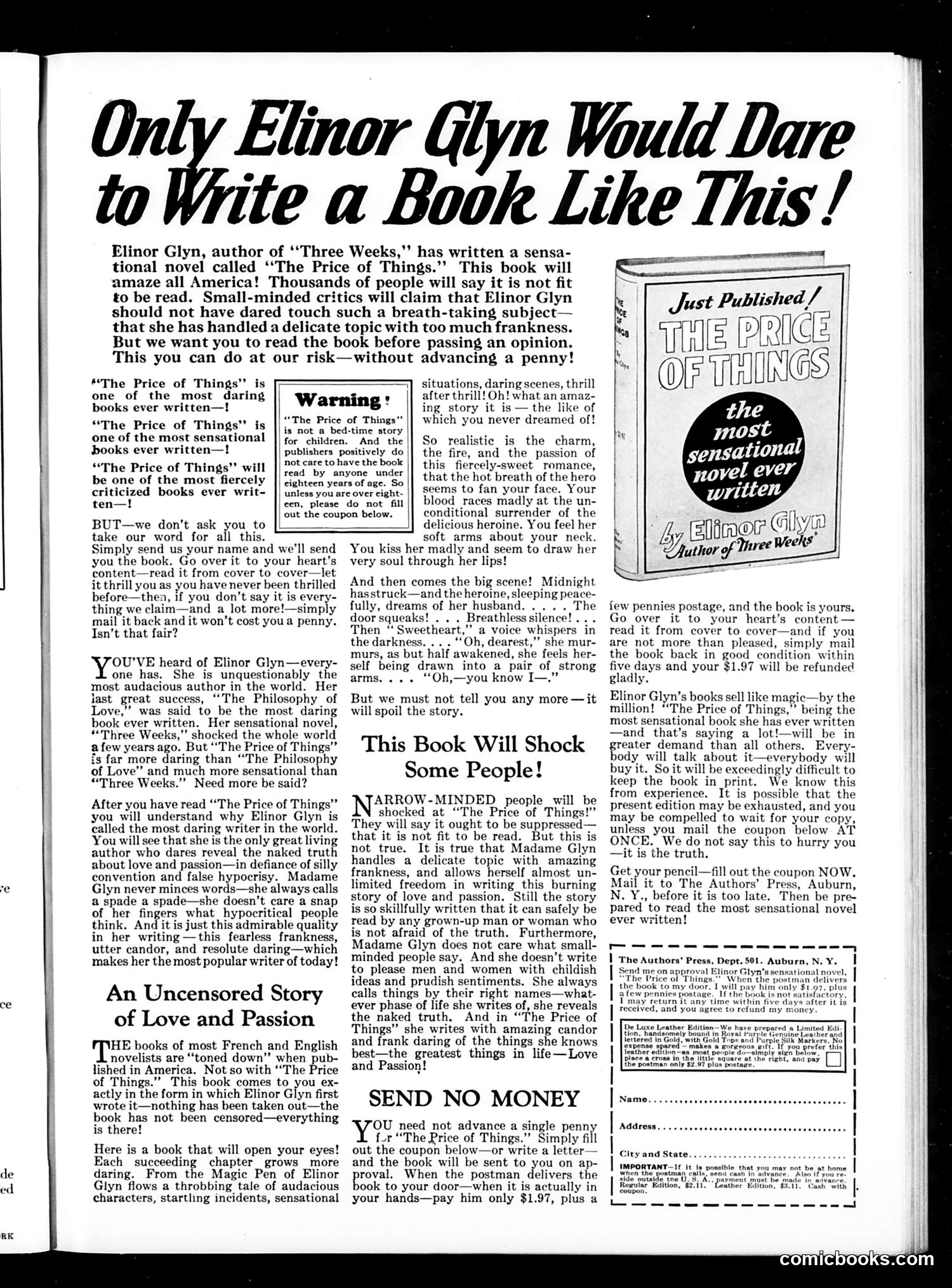
This page is primarily **advertising disguised as editorial content** for Elinor Glyn's novel "The Price of Things," published in the early 20th century. **The Context:** Elinor Glyn was a real British novelist famous for sexually explicit works like "Three Weeks" (1907). Her books were considered scandalous for frankly depicting passion and romance. "The Price of Things" continued this reputation. **The Satire/Marketing Strategy:** The page mockingly presents the book as so daring that it requires warnings—it's "not for children," promises to "shock some people," and emphasizes it's "uncensored." This faux-controversy is itself the advertisement. By claiming the book is forbidden or dangerous, the publisher makes it irresistible to readers seeking transgressive content. **The Joke:** The magazine simultaneously warns readers away while enticing them with promises of thrills and "naked truth about love and passion." The breathless description of scenes—"Your blood races madly"—uses the very sensationalism it claims to caution against. This represents early 20th-century marketing exploiting moral anxiety to drive book sales.