
Judge, 1924-07-12 · page 26 of 36
Judge — July 12, 1924 — page 26: what you’re looking at
What you’re looking at
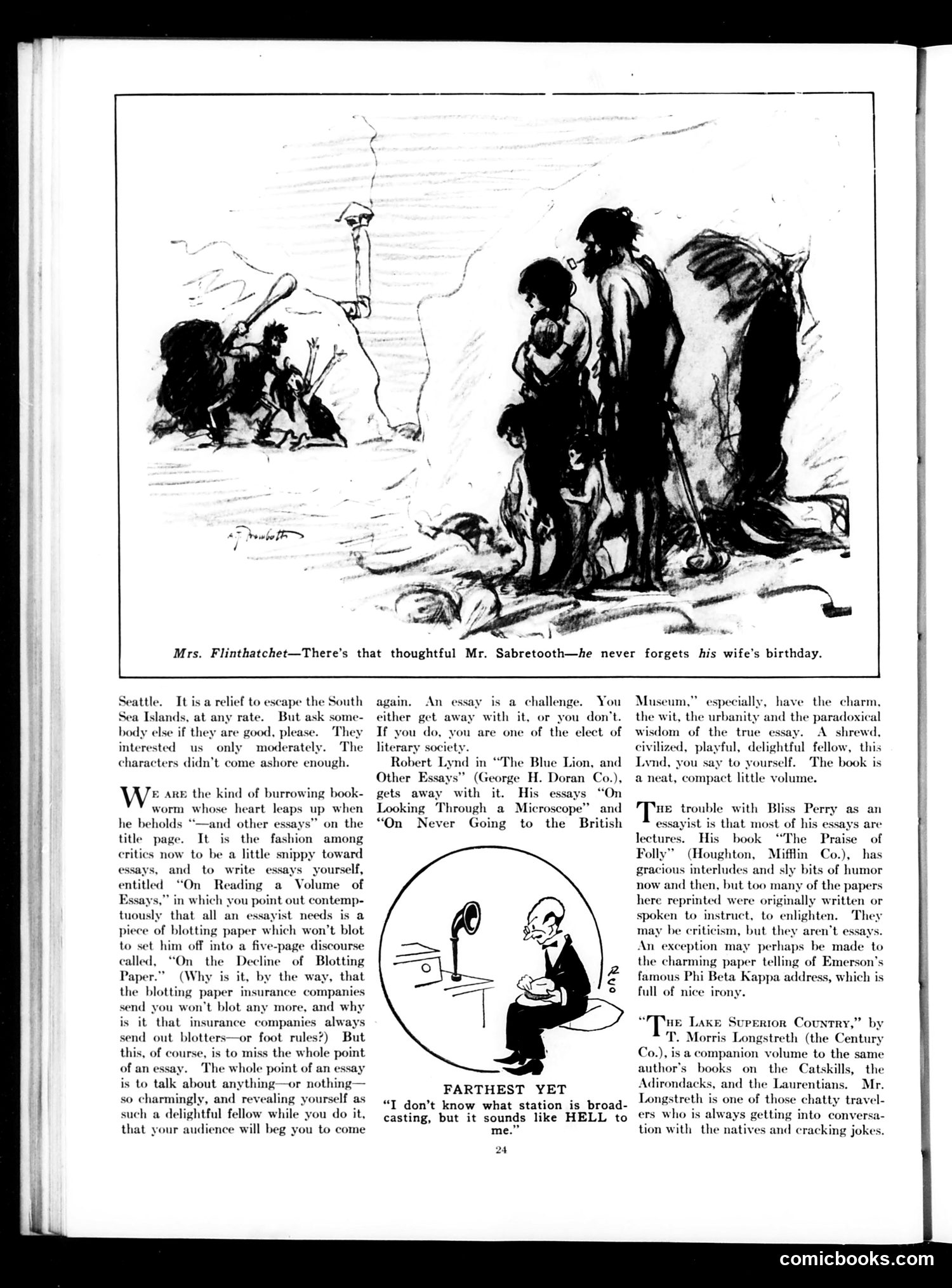
This page contains a book review section and two separate cartoons. **Top cartoon**: Shows a woman (Mrs. Flintthatchet) speaking to a man, referencing Mr. Sabretooth's thoughtfulness in remembering his wife's birthday. The satire appears to mock either the rarity of husbands remembering such occasions, or possibly the absurdity of someone named "Sabretooth" being considerate—playing on the incongruity between the brutish name and domestic sentiment. **Bottom cartoon ("Farthest Yet")**: A man listening to a radio complains that he doesn't know which station is broadcasting, but it "sounds like HELL to me." This satirizes early radio's poor quality and unclear reception—a common complaint during radio's early broadcast era. The joke's "farthest yet" title suggests this represents an extreme nadir in radio listening experience. The page's main content is a literary essay review section discussing books by Robert Lynd, Bliss Perry, and T. Morris Longstreth, praising essay-writing as an art form.
📄 Transcribed text from this page (OCR, searchable)
Machine-transcribed from the original scan — historical spelling and the odd misread are preserved.
47> deubefa—> / It is a relief to escape the South ands, at any rate. But ask some- body else if they are good, please. ‘They interested us only moderately. The characters didn’t come ashore enough. W: = ARE the kind of burrowing book- worm whose heart leaps up when he beholds “—and other essays” on the title page. It is the fashion among critics now to be a little snippy toward essays, and to write essays yourself, entitled “On Reading a Volume of Essays,” in which you point out contemp- tuously that all an essayist needs is a piece of blotting paper which won't blot to set him off into a five-page discourse called, “On the Decline of Blotting Paper.” (Why is it, by the way, that the blotting paper insurance companies send you won't blot any more, and why is it that insurance companies always send out blotters—or foot rules?) But this, of course, is to miss the whole point of an essay. ‘The whole point of an essay is to talk about anything—or nothing— so charmingly, and revealing yourself as such a delightful fellow while you do it, that your audience will beg you to come again. An essay is a challenge. You either get away with it, or you don’t. If you do, you are one of the elect of literary society. Robert Lynd in “The Blue Lion, and Other Essays” (George H. Doran Co.), gets away with it. His es “On Looking Through a Microscope” and “On Never Going to the British FARTHEST YET “I don’t know what station is broad- casting, but it sounds like HELL to me.” 24 Museum,” especially, have the charm, the wit, the urbanity and the paradoxical wisdom of the true essay. A. shrewd, civilized, playful, delightful fellow, this Lynd, you say to yourself. The book is a neat, compact little volume. 1é trouble with Bliss Perry as an essayist is that most of his essays are lectures. His book “The Praise of Folly” (Houghton, Mifflin Co.), has gracious interludes and sly bits of humor now and then, but too many of the papers here reprinted were originally written or spoken to instruct, to enlighten. They may be criticism, but they aren’t essays. An exception may perhaps be made to the charming paper telling of Emerson's famous Phi Beta Kappa address, which is full of nice irony. Tr Lake Superior Country,” by T . Morris Longstreth (the Century Co.), is a companion volume to the same author's books on the Catskills, the Adirondacks, and the Laurentians. Mr. Longstreth is one of those chatty travel- ers who is always getting into conversa- tion with the natives and cracking jokes. comicbooks.com