
Judge, 1924-07-12 · page 25 of 36
Judge — July 12, 1924 — page 25: what you’re looking at
What you’re looking at
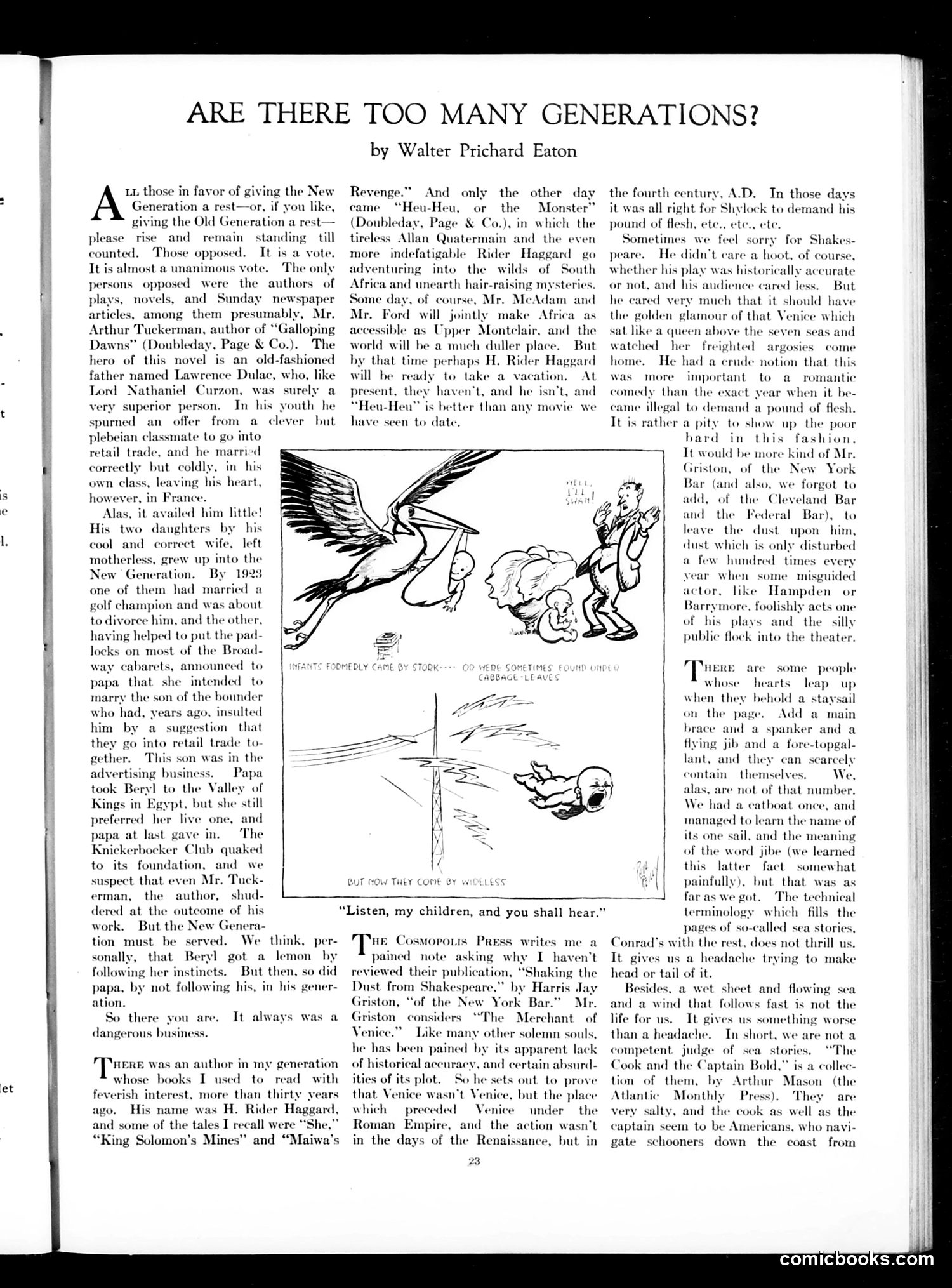
This essay by Walter Prichard Eaton critiques contemporary literature's obsession with generational conflict. Eaton argues there are "too many generations" — meaning too many novels and plays centered on intergenerational conflict between the "Old Generation" and "New Generation." The cartoons illustrate the absurdity: the top shows a stork delivering babies labeled "expect comedy by stock," while the lower depicts someone falling from a cliff, captioned "but how they come by wheelies" — visualizing how each generation keeps arriving and creating new dramatic friction. Eaton specifically mocks authors like Arthur Tuckerman (*Galloping Dawns*) and H. Rider Haggard (*Heu-Heu*) for constantly rehashing generational tensions. He uses the example of Shakespeare's *Merchant of Venice*, arguing that great art transcends historical accuracy — the play's "golden glamour" matters more than whether Shylock's pound-of-flesh demand was historically accurate. The satire targets how popular entertainment exploits generational conflict as an easy dramatic formula rather than exploring deeper themes.
📄 Transcribed text from this page (OCR, searchable)
Machine-transcribed from the original scan — historical spelling and the odd misread are preserved.
| | i [ those in favor of giving the New Generation a rest—or, if you like, giving the Old Generation a rest— please rise and standing till counted. Those opposed. It is a vote. It is almost a unanimous vote. The only persons opposed were the authors of plays, novels, and Sunday newspaper ticles, among them presumably, Mr. Arthur Tuckerman, author of “Galloping Dawns” (Doubleday, Page & Co.). The hero of this novel is an old-fashioned father named Lawrence Dulac, who, like Lord Nathaniel Curzon, was surely a very superior person. In his youth he spurned an offer from a clever but plebeian classmate to go into remain ARE THERE TOO MANY GENERATIONS? by Walter Prichard Eaton Revenge.” And only the other day came “Heu-Heu, or the Monster” (Doubleday, Page & Co.), in which the tireless Allan Quatermain and the even more indefatigable Rider Haggard go adventuring into the wilds of South Africa and unearth hair-raising mysteries. Some day, of course, Mr. McAdam and Mr. Ford will jointly make Africa as accessible as Upper Montclair, and the world will be a much duller pl But by that time perhaps H. Rider Haggard will be ready to take a vacation. At present, they haven't, and he isn't, and “Heu-Heu™ is better than any movie we have n to date, the fourth century, A.D. In those days it was all right for Shylock to dernand his pound of flesh, ete., ete., ete. Sometimes we feel sorry for Shakes- peare. He didn’t care a hoot, of course, whether his play was historically accurate or not, and his audience cared less. But he cared very much that it should have the golden glamour of that Venice which sat like a queen bove the seven seas and freighted argosies a crude notion that this important. to a romantic comedy than the exact year when it be- came illegal to demand a pound of flesh. It is rather a pity to show up the poor hard in this fashion. watched her He hac more come home, was retail trade, and he marricd correctly but coldly, in his own class, leaving his heart, however, in France. Alas, it availed him little! His two daughters by his cool and correct wife, left motherless, grew up into the New Generation. By 19 one of them had married a golf champion and was about to divorce him, and the other, having helped to put the pad- locks on most of the Broad- way cabarets, announced to papa that she intended to marry the son of the bounder who had, years ago, insulted him by a suggestion that they go into retail trade to. gether. This son was in the advertising business. Papa took Beryl to the Valley of Kings in Egypt, but she still preferred her live one, and papa at last gave in. ‘The Knickerbocker Club quaked to its foundation, and we suspect that even Mr. Tuck- erman, the author, shud- It would be more kind of Mr. Griston, of the New York Bar (and also, we forgot to add, of the Cleveland Bar and the Federal Bar), to leave the dust. upon him, dust whieh is only disturbed a few hundred times every year when some misguided actor, like Hampden or Barrymore, foolishly acts one of his plays andthe. silly public flock into the theater, Puere are whose some people leap up when they behold a staysail on the page. Add a main brace and a spanker and a flying jib and a fore-topgal- lant, and they can scarcely themselves. We, alas, are not of that number. We had a catboat once, and mang hearts contain Ito learn the name of its one sail, and the meaning of the word jibe (we learned this latter fact somewhat painfully), but that was as far as we g The technical dered at the outcome of his work, But the New Genera- tion must be served. We think, per- sonally, that Beryl got a lemon by following her instincts. But then, so did papa, by not following his, in his gener- ation. So there you are. dangerous business. It always was a HERE was an author in my generation whose books I with feverish interest, more than thirty years ago. His name was H. Rider Haggard, and some of the tales I recall were “She,” “King Solomon’s Mines” and “Maiwa’s used to read “Listen, my children, and you shall hear.” T = Cosmopoiis Press writes me a pained note asking why I haven't reviewed their publication, “Shaking the Dust from Shakespeare,” by Harris Jay i “of the New York Bar.” Mr, “The Merchant of Like many other solemn souls, y its apparent lack of historical accuracy, and certain absurd- ities of its plot. So he sets out. to prove that Venice wasn't Venice, but the place which Ven under — the Roman Empire, and the action wasn't in the days of the Renaissance, but in considers Griston Venice.” he has been pained by preceded 23 which fills the pages of so-called sea stories, I's with the rest, does not thrill us, It gives us a headache trying to make head or tail of it. Conrs Besides, a wet sheet and flowing sea and a wind that follows fast is not the life for us. It gives us something worse than a heads In short, we are not a competent judge of sea stor “The Cook and the Captain Bold,” is a collec- tion of them, by Arthur Mason (the Atlantic Monthly They are very salty, and the cook as well as the Press). captain seem to be Americans, who navi- gate schooners down the coast from