
Judge, 1924-07-12 · page 15 of 36
Judge — July 12, 1924 — page 15: what you’re looking at
What you’re looking at
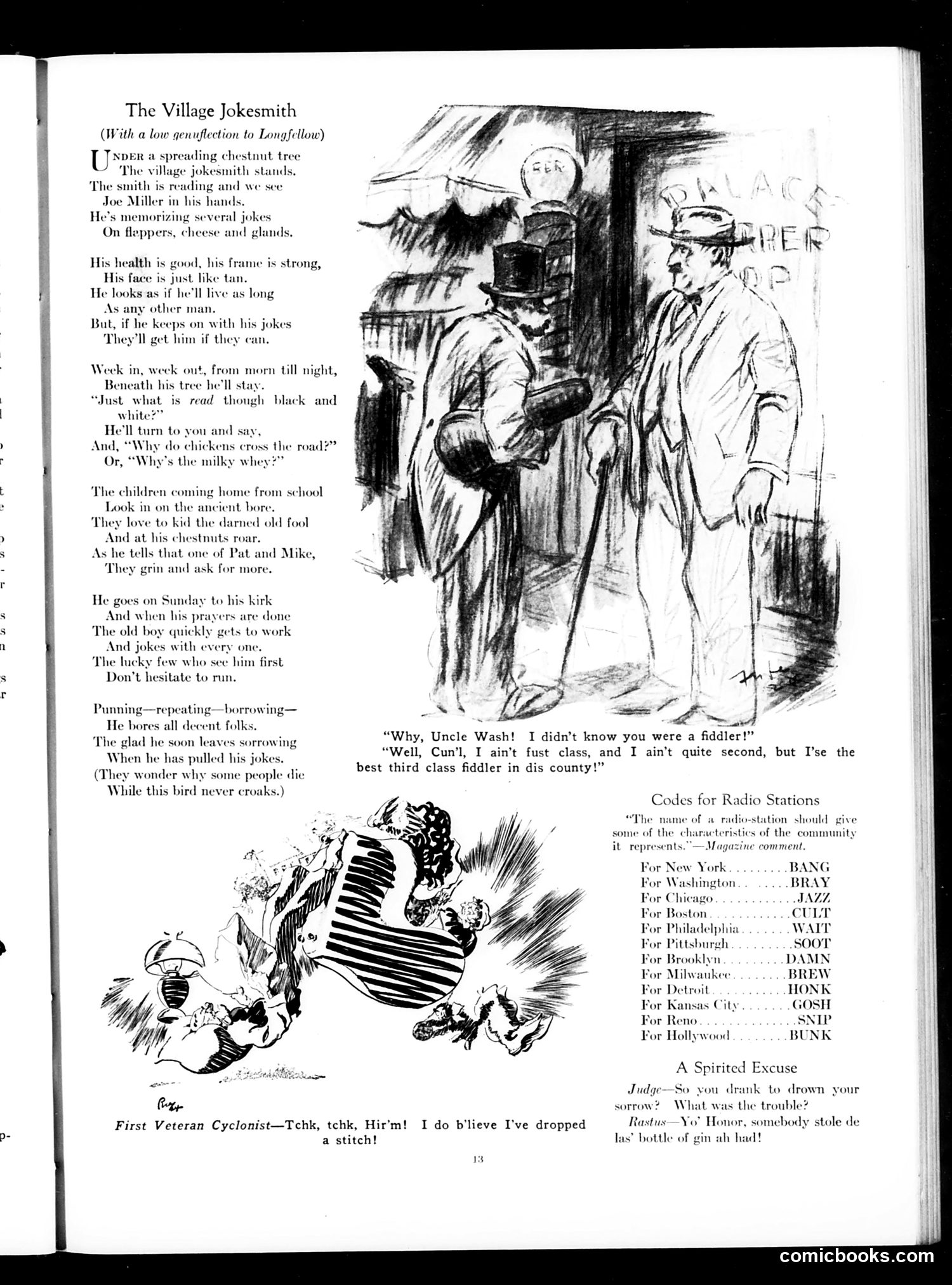
**"The Village Jokesmith"** is a humorous poem mocking a tired archetype: the relentless, boring storyteller who endlessly repeats worn-out jokes—puns, the "why did the chicken cross the road" joke, Pat-and-Mike stories. The poem, styled after Longfellow, portrays this man as a village fixture who compulsively tells jokes despite boring everyone. The satire targets people who mistake memorized humor for wit and fail to recognize their audience's suffering. The cartoon shows two men in conversation, illustrating how the jokesmith's terrible jokes persist. **"First Veteran Cyclist"** shows a slapstick joke about cycling accidents. The **"Codes for Radio Stations"** section appears to be satire assigning acronymic station call letters that mockingly characterize American cities (BANG for New York, BRAY for Washington, JAZZ for Chicago, etc.). **"A Spirited Excuse"** presents a racial stereotype dialogue where a Black man blames stolen gin for drunkenness—period humor reflecting the magazine's casual racism.
📄 Transcribed text from this page (OCR, searchable)
Machine-transcribed from the original scan — historical spelling and the odd misread are preserved.
The Village Jokesmith (With a low qenuflection to Longfellow) DER a spreading chestnut tree The village jokesmith stands. k mith is reading and we see Fs Miller in his hands. | He’s memorizing several jokes i On fleppers, cheese and glands. ij His health is good, his frame is strong, k His face is just like tan. He looks as if he'll live as long As any other man, But, if he keeps on with his jokes f 4 They'll get him if they ean. | Week in, week out, from morn till night, i Beneath his tree he'll stay. “Just what is read though black and white?” He'll turn to you and say, And, “Why do chickens cross the road?” Or, “Why's the milky whey?” The children coming home from school Look in on the ancient bore. They love to kid the darned old fool And at his chestnuts roar. As he tells that one of Pat and Mike, They grin and ask for more. He goes on Sunday: to his kirk And when his prayers are done The old boy quick! to work And jokes with every one. The lucky few who see him first Don’t hesitate to run. Punning—repeating—borrowing— He bores all decent folks. . #3 The glad he soon leaves sorrowing “Why, Uncle Wash! I didn’t know you were a fiddler! , When he has pulled his jokes. “Well, Cun’l, I ain't fust class, and I ain’t quite second, but I’se the best third class fiddler in dis county!” (They wonder why some people die While this bird never croaks.) Codes for Radio Stations -station should give of the characteristics of the community it represents.” —Magazine comment. For New York BANG Por Washington BRAY For Chicago For Boston For Philadelphia For Pittsburgh For Brooklyn For Milwaukee For Detroit For Kansas City For Reno For Hollywood A Spirited Excuse Judge—So you drank to drown your sorrow? What was the trouble? First Veteran Cyclonist—Tchk, tchk, Hir’m! I do b'lieve I've dropped Rastus—Yo" Honor, somebody stole de a stitch! las’ bottle of gin ah had! 13 comicbooks.com