
Judge, 1924-07-12 · page 22 of 36
Judge — July 12, 1924 — page 22: what you’re looking at
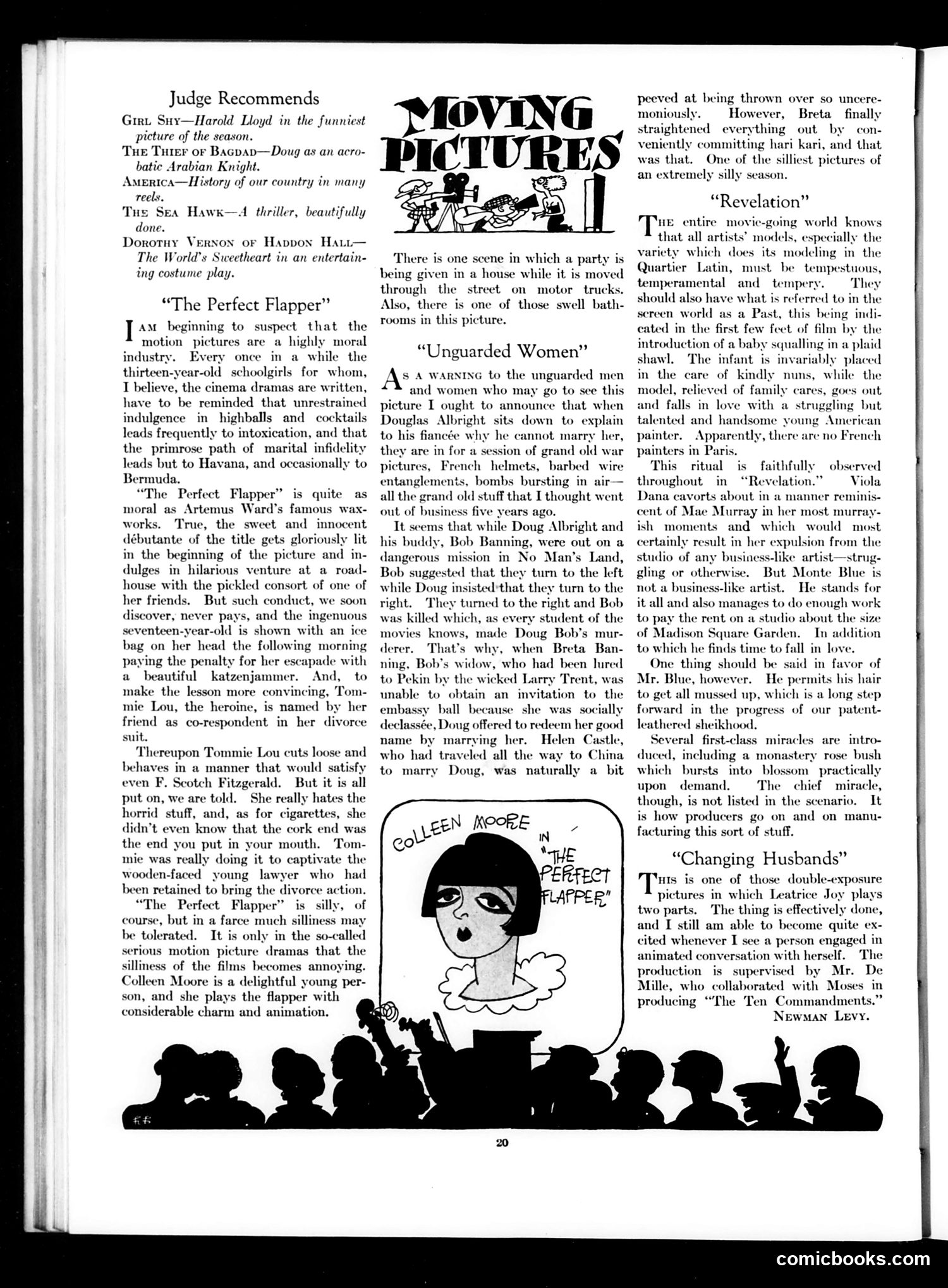
What you’re looking at
This page reviews several silent films from the early 1920s, offering moral commentary typical of the era. **The Main Cartoon**: Features Colleen Moore, star of "The Perfect Flapper," illustrated in period style with the film's title in a speech bubble below her silhouette. **Key Context for Modern Readers**: The reviews mock films that moralize about youth behavior—particularly young women drinking cocktails and smoking—while depicting these vices in detail. The critic notes the irony: "The Perfect Flapper" shows a teenage girl getting drunk at roadhouses, then punishes her with a hangover, supposedly teaching a lesson. The reviews reference silent film stars (Harold Lloyd, Douglas Fairbanks, Colleen Moore) and contemporary anxieties about "flappers" (liberated young women of the 1920s). References to Havana, Bermuda, and China reflect exotic locations used in melodramatic plots. **The Satire's Point**: Judge ridicules both filmmakers for heavy-handed moralizing and audiences for accepting such transparent "lessons" as genuine moral instruction rather than entertainment justifying risqué content.
📄 Transcribed text from this page (OCR, searchable)
Machine-transcribed from the original scan — historical spelling and the odd misread are preserved.
Judge Recommends Girt Suy—Harold Lloyd in the funniest picture of the season. Tue Tuer or Bacpap—Doug as an acro- batic Arabian Knight. America—History of our country in many reels. Tu done. Dorotuy V oy oF Happon Hatt— The World's Sweetheart in an entertain- ing costume play. “The Perfect Flapper” Am. beginning to suspect that the motion pictures are a highly moral industry. Every once in a while the thirteen-year-old schoolgirls for whom, I believe, the cinema dramas are written, have to be reminded that unrestrained indulgence in highballs and cocktails leads frequently to intoxication, and that the primrose path of marital infidelity le but to Havana, and occasionally to Bermuda. “The Perfect Flapper” is quite as moral as Artemus Ward’s famous wax- works. True, the sweet and innocent débutante of the title gets gloriously lit in the beginning of the picture and in- dulges in hilarious venture at a road- house with the pickled consort of one of her friends. But such conduct, we soon discover, never pays, and the ingenuous seventeen-year-old is shown with an ice bag on her head the following morning paying the penalty for her escapade with beautiful katzenjammer. And, to make the lesson more convincing, Tom- mie Lou, the heroine, named by her friend as co-respondent in her divorce suit. Thereupon Tommie Lou cuts loose and beh: in a manner that would satisfy even F, Scotch Fitzgerald. But it is all put on, we are told. She really hates the horrid stuff, and, as for cigarettes, she didn’t even know that the cork end was the end you put in your mouth. Tom- mie was really doing it to captivate the wooden-faced young lawyer who 1 been retained to bring the divorce action. “The Perfect Flapper” is silly, of course, but in a farce much silliness may be tolerated. It is only in the so-called serious motion picture dramas that the silliness of the films becomes annoying. Colleen Moore is a delightful young per- son, and she plays the flapper with considerable charm and animation. cA Hawk—A thriller, beautifully one scene in which a party is being given in a house while it is moved through the street on motor trucks. Also, there is one of those swell bath- rooms in this picture. “Unguarded Women” AS A WARNING to the unguarded men and women who may go to see this picture I ought to announce that when Douglas Albright sits down to explain to his fiancée why he cannot marry her, they are in for a session of grand old war pictures, French helmets, barbed wire entanglements, bombs bursting in air— all the grand old stuff that I thought went out of business five years ago. It seems that while Doug Albright and his buddy, Bob Banning, were out on a dangerous mission in No Man’s Land, Bob suggested that they turn to the left while Doug insisted*that they turn to the right. They turned to the right and Bob was killed which, as every student of the movies knows, made Doug Bob's mur- That’s why, when Breta Ban- ning, Bob’s widow, who had been lured to Pekin by the wicked Larry Trent, was unable to obtain an invitation to the embassy ball because she was. socially declassée, Doug offered to redeem her good name by marrying her. Helen Castle, who had traveled all the way to China to marry Doug, was naturally a derer. peeved at being thrown over so uncere- moniously, However, Breta finally straightened everything out by con- veniently committing hari kari, and that was that. One of the silliest pictures of an extremely silly season. “Revelation” TH entire movie-going world knows that all artists’ models, especially the variety which does its modeling in the Quartier Latin, must be tempestuous, temperamental and tempery. They should also have what is referred to in the sereen world a Past, this being indi- cated in the first few feet of film by the introduction of a baby squalling in a plaid shawl. The infant is invariably placed in the care of kindly nuns, while the model, relieved of family cares, gocs out and falls in love with a struggling but talented and handsome young American painter. Apparently, there are no French painters in Paris. This ritual is faithfully observed throughout in “Revelation.” Viola Dana cavorts about in a manner reminis- cent of Mae Murray in her most murra; ish moments and which would most certainly result in her expulsion from the studio of any business-like artist—strug- gling or otherwise. But Monte Blue is not a business-like artist. He stands for it all and also manages to do enough work to pay the rent on a studio about the siz of Madison Square Garden. In addition to which he finds time to fall in love. One thing should be said in favor of Mr. Blue, however. He permits his hair all mussed up, which is a long step ard in the progress of our patent- leathered sheikhood. lass miracles are intro- duced, including a monastery rose bush which bursts into blossom practically upon demand. The chief miracle, though, is not listed in the scenario. It is how producers go on and on manu- facturing this sort of stuff. “Changing Husbands” one of those double-exposure in which Leatrice Joy plays The thing is effectively done, T picture: two parts and I still am able to become quite ex- cited whenever I see a person engaged in animated conversation with herself. The production is supervised by Mr. De Mille, who collaborated with Moses in producing “The Ten Commandments.” Newman Levy. comicbooks.com