
Judge, 1924-07-12 · page 20 of 36
Judge — July 12, 1924 — page 20: what you’re looking at
What you’re looking at
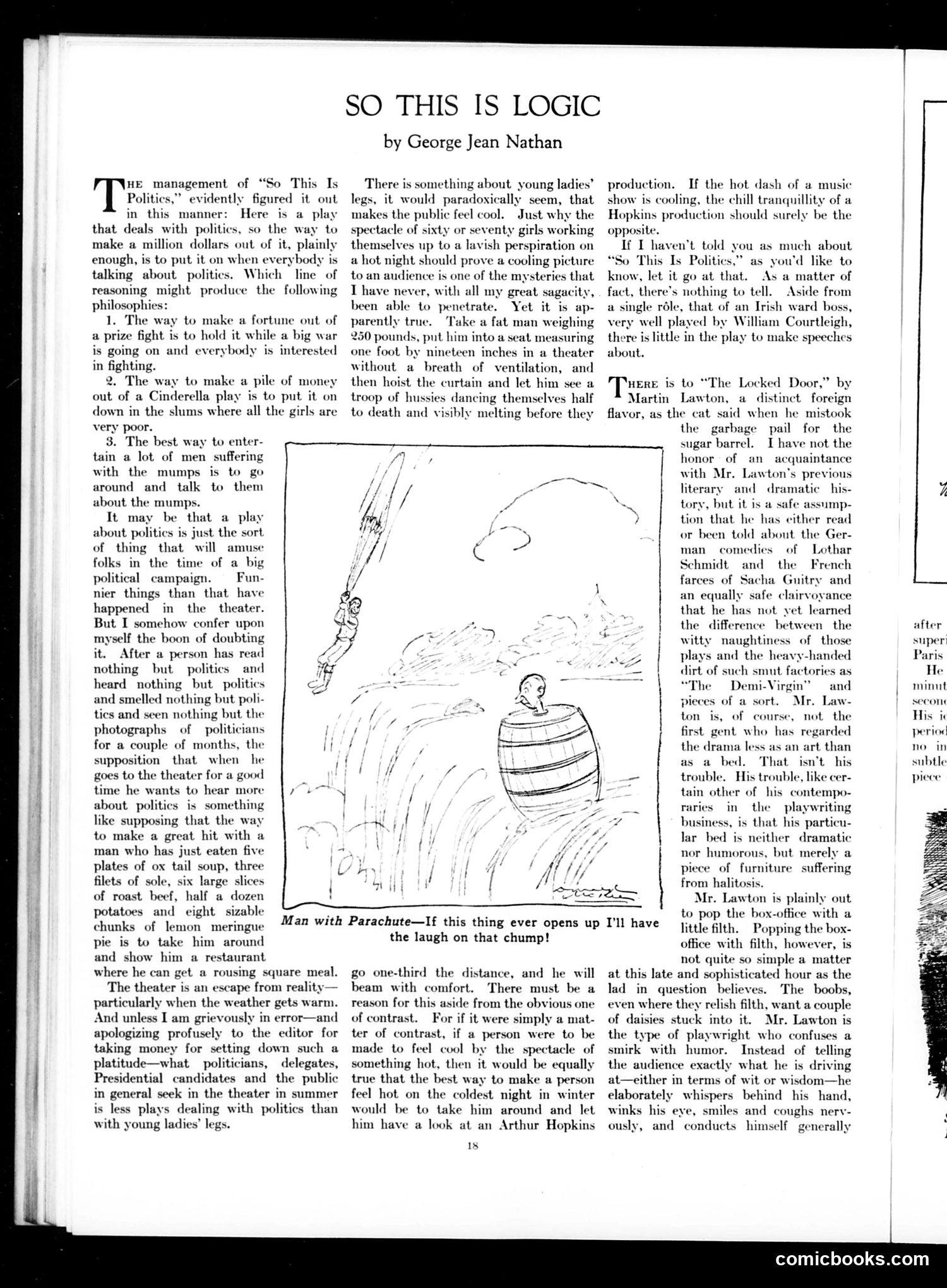
This is a theater criticism essay sarcastically attacking the logic of producing a play called "So This Is Politics" during an election season. Nathan argues that audiences seeking theater as an escape from everyday life would be the *last* people wanting to see a political play—just as a man stuffed with heavy food wouldn't want to visit a restaurant. The accompanying cartoon shows a man dangling from a parachute above another man sitting in a barrel, captioned "Man with Parachute—If this thing ever opens up I'll have the laugh on that chump!" This visual metaphor reinforces Nathan's absurdist point about illogical reasoning. Nathan then pivots to reviewing "The Locked Door" by Martin Lawton, praising William Courtleigh's performance as an Irish ward boss while finding little else noteworthy in the production. The criticism ultimately mocks both the play's conception and theatrical management's faulty decision-making.
📄 Transcribed text from this page (OCR, searchable)
Machine-transcribed from the original scan — historical spelling and the odd misread are preserved.
HE management of “So This Is Politics,” evidently figured it out in this manner: Here is a play that deals with polities, so the way to make a million dollars out of it, plainly enough, is to put it on when everybody is talking about politics. Which line of reasoning might produce the following philosophies: 1. The way to make a fortune out of a prize fight is to hold it while a big war is going on and everybody is interested in fighting. 2. The way to make a pile of money out of a Cinderella play is to put it on down in the slums where all the girls are very poor. 3. The best way to enter- tain a lot of men suffering with the mumps is to go around and talk to them about the mumps. It may be that a play about politics is just the sort of thing that will amuse folks in the time of a big political campaign. Fun- nier things than that have happened in the theater. But I somehow confer upon myself the boon of doubting it. After a person has read nothing but politics and eg heard nothing but politics C and smelled nothing but poli- tics and seen nothing but the photographs of _ politicians for a couple of months, the supposition that when he goes to the theater for a good time he wants to hear more about politics is something like supposing that the way to make a great hit with a man who has just eaten five plates of ox tail soup, three filets of sole, six large slices of roast beef, half a dozen potatoes and eight sizable chunks of lemon meringue pie is to take him around and show him a restaurant where he can get a rousing square meal. The theater is an escape from reality— particularly when the weather gets warm. And unless I am grievously in error-—and apologizing profusely to the editor for taking money for setting down such a platitude—what politicians, delegates, Presidential candidates and the public in general seek in the theater in summer is less plays dealing with politics than with young ladies’ legs. SO THIS IS LOGIC by George Jean Nathan There is something about young ladies’ legs, it would paradoxically seem, that makes the public feel cool. Just why the spectacle of sixty or seventy girls working themselves up to a lavish perspiration on a hot night should prove a cooling picture to an audience is one of the mysteries that I have never, with all my great sagacity, been able to penetrate. Yet it is ap- parently true. Take a fat man weighing 250 pounds, put him into a seat measuring one foot by nineteen inches in a theater without a breath of ventilation, and then hoist the curtain and let him see a troop of hussies dancing themselves half to death and visibly melting before they production. If the hot dash of a music show is cooling, the chill tranquillity of a Hopkins production should surely be the opposite. If I haven't told you as much about “So This Is Politics,” as you'd like to know, let it go at that. As a matter of fact, there’s nothing to tell. Aside from a single réle, that of an Irish ward boss, very well played by William Courtleigh, there is little in the play to make speeches about. Tere is to “The Le Door,” by Martin Lawton, a distinct foreign flavor, as the cat said when he mistook the garbage pail for the sugar barrel. Thave'riotithe honorof an. ‘equaintance with Mr. Lawton’s: previous literary and dramatic _his- ‘ tory, but it is a safe assump- y} tion that he has either read or been told about the Ger- man comedies of Lothar Schmidt and the French farces of Sacha Guitry and an'equally’éafe ‘clairvoyance that he has not yet learned the difference between the witty ‘naughtiness of those pl and the heavy-handed dirt of such smut factories as “The Demi-Virgin” — and pieces of a sort. Mr. Law- ton is, of course, not the first gent who has regarded the drama less as an art than as a bed. That isn’t his trouble. His trouble, like taincother’of his ‘contempo: raries. in the playwriting business; is that his particu- | lar bed is neither dramatic nor humorous, but merel piece of furniture suffe from halitosis. Mr. Lawton is plainly out cer- ing Man with Parachute—If this thing ever opens up I'll have the laugh on that chump! go one-third the distance, and he will beam with comfort. There must be a reason for this aside from the obvious one of contrast. For if it were simply a mat- ter of contrast, if a person were to be made to feel cool by the spectacle of something hot, then it would be equally true that the best way to make a person feel hot on the coldest night in winter would be to take him around and let him have a look at an Arthur Hopkins 18 to pop the box-office with a little filth. Popping the box- office with filth, however, is not quite so simple a matter at this late and sophisticated hour as the lad in question believes. The boobs, even where they relish filth, want a couple of daisies stuck into it. Mr. Lawton is the type of playwright who confuses a smirk with humor. Instead of telling the audience exactly what he is driving at—either in terms of wit or wisdom—he elaborately whispers behind his hand, winks his eye, smiles and coughs nerv- ously, and conducts himself generally after super Paris He minut secon His iv period no in subtle piece comicbooks.com