
A complete issue · 37 pages · 1924
Judge — June 14, 1924
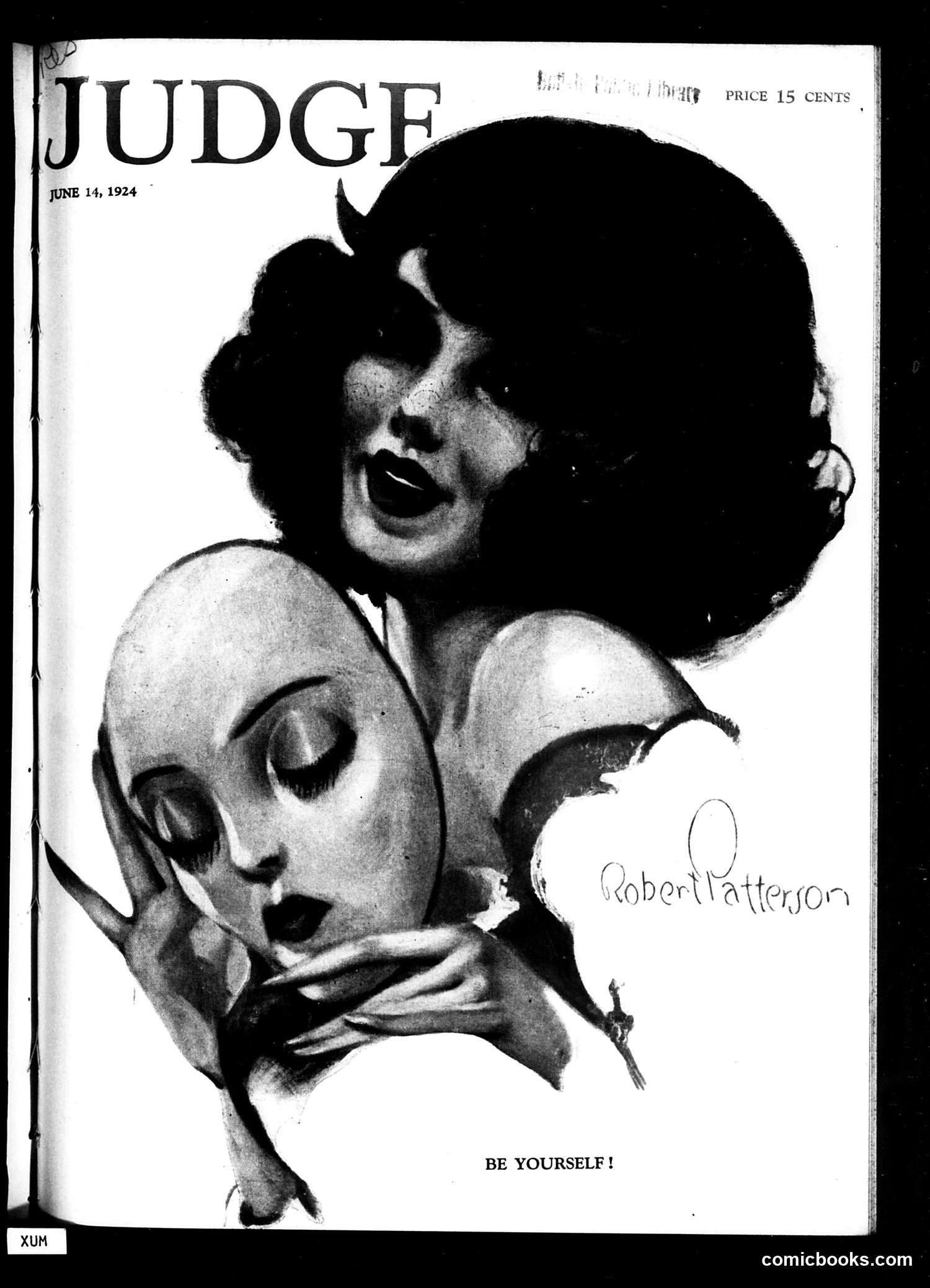
This cover by Robert Patterson illustrates the caption "BE YOURSELF!" through a surreal image of a woman with two faces—one masked or artificial-looking (bottom), one more expressive (top). The satire likely critiques the performance of identity and social conformity in 1920s American culture, particularly regarding women's roles and self-presentation. During this era, "being yourself" was increasingly valued in modernist thought, yet social expectations for women remained rigid. The dual-faced imagery suggests the tension between authentic self-expression and societal demands for proper feminine behavior and appearance. The masks and theatrical quality emphasize how identity itself was performative in Jazz Age society.
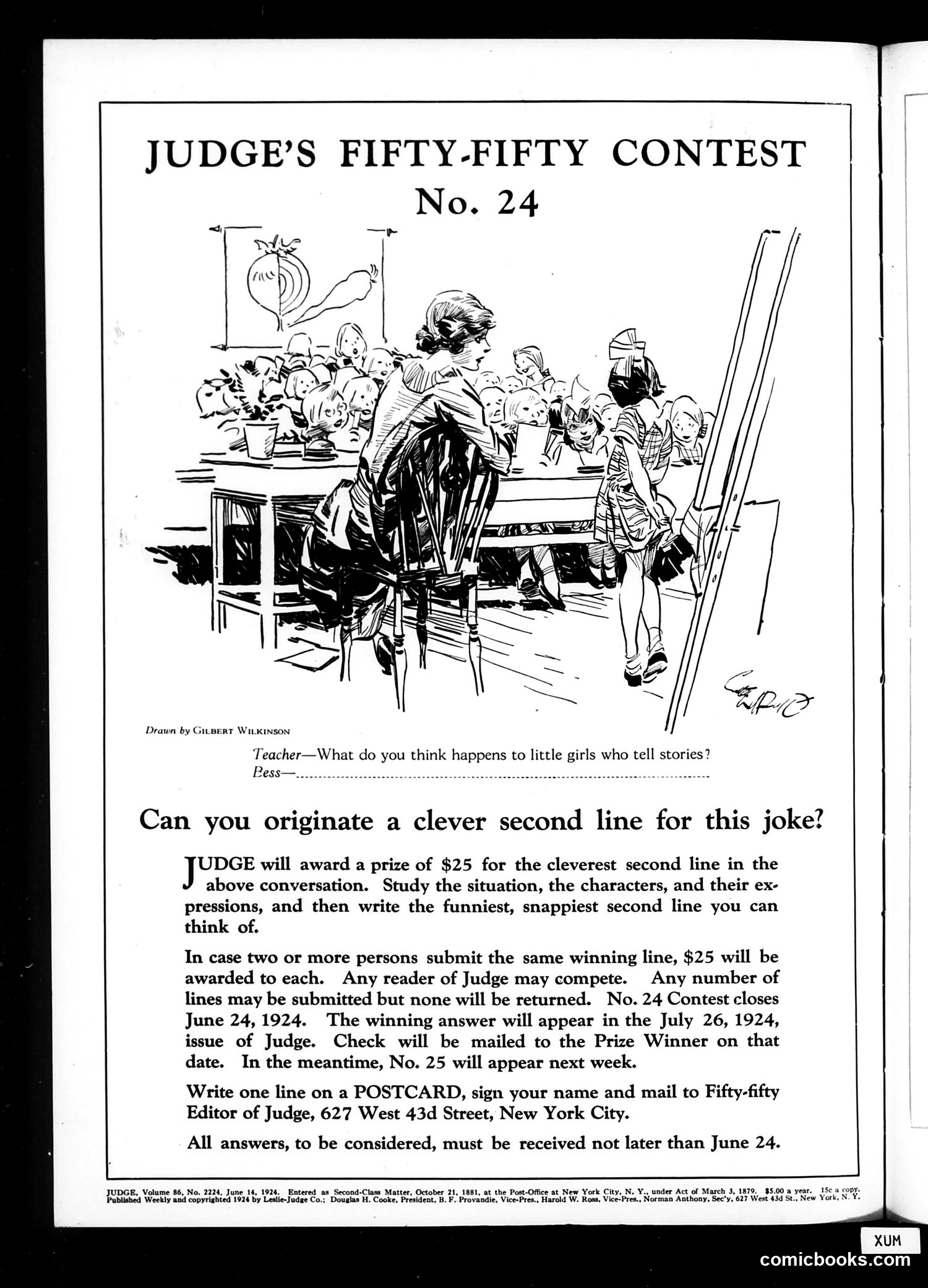
This page features a "Fifty-Fifty Contest" — a reader submission contest offering $25 for the cleverest second line to complete a joke. **The Cartoon:** A teacher asks a student: "What do you think happens to little girls who tell stories?" The setup invites readers to supply a humorous punchline (the "Bess" character's response is blank). **Context for Modern Readers:** This reflects early 20th-century moral instruction about children's honesty. The joke likely references traditional punishments for lying — perhaps parental discipline or supernatural consequences. The cartoon depicts a classroom setting with an engaged teacher and attentive students, typical of how Judge magazine featured family-friendly content alongside satirical commentary. The contest format was a popular engagement strategy for Judge magazine during this period.
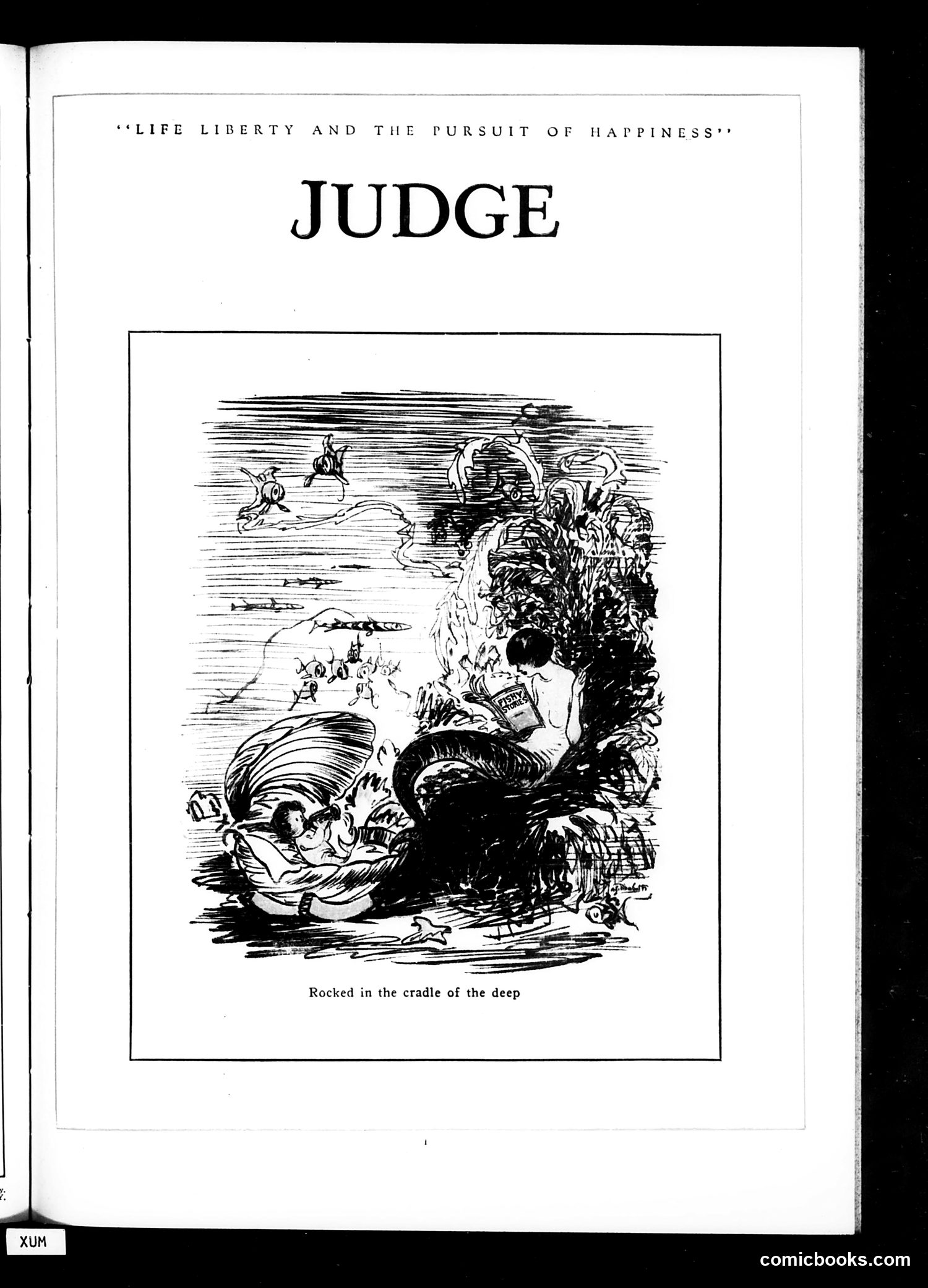
This page appears to be a chapter or section title from a serialized story or narrative in Judge magazine, titled "JUDGE" with the epigraph "LIFE LIBERTY AND THE PURSUIT OF HAPPINESS" at the top. The illustration shows a grotesque figure—likely representing an allegorical or satirical character—reclining in what appears to be a cradle or vessel labeled "Rocked in the cradle of the deep." The dense, dark imagery with swirling forms suggests turbulent waters or chaos. Without additional context about the specific issue date or surrounding content, the exact political or social reference remains unclear. The maritime/drowning imagery may reference contemporary political turmoil or social upheaval, but the specific target of satire cannot be definitively identified from this page alone.
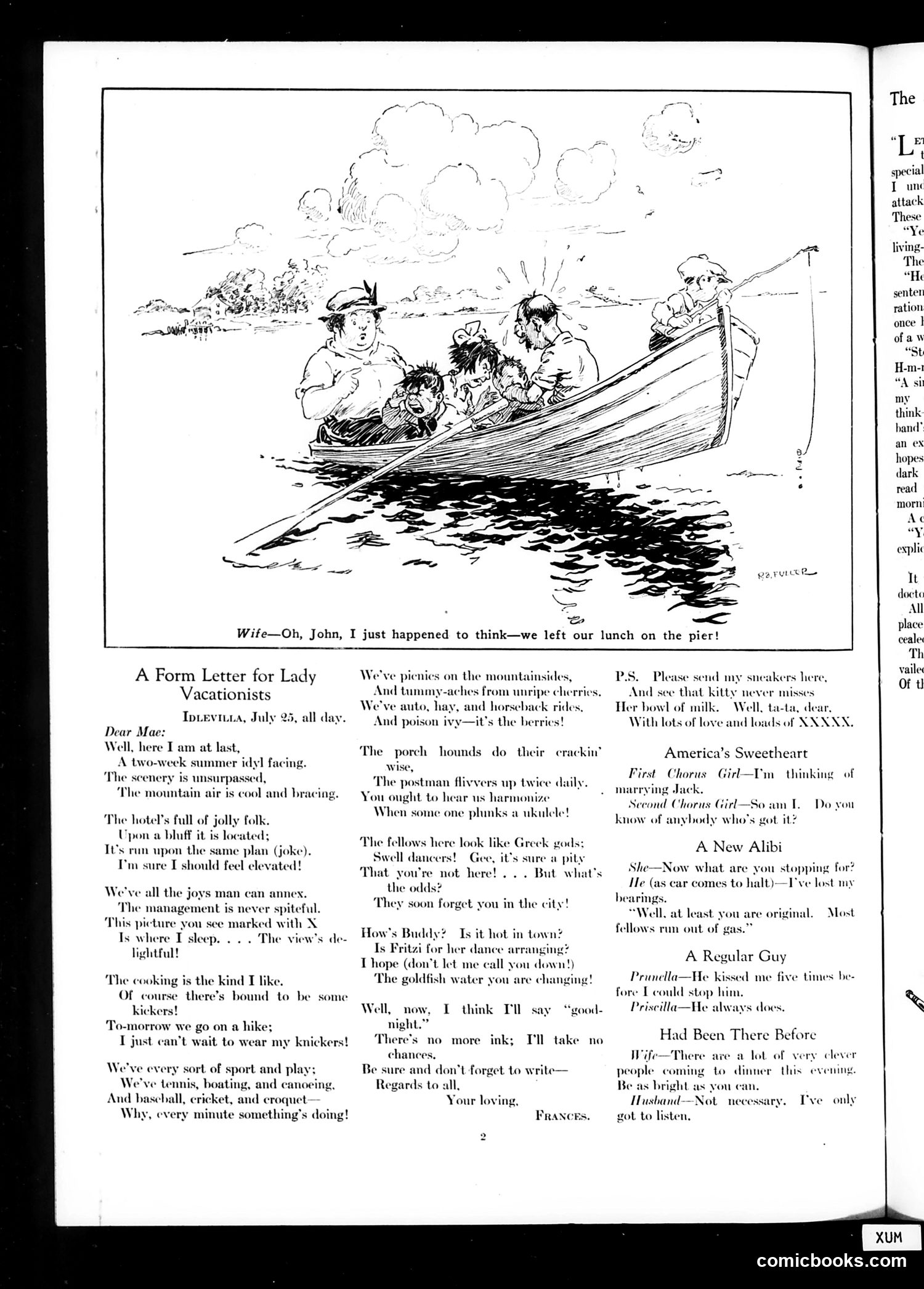
The main cartoon shows a boating scene with a caption: "Wife—Oh, John, I just happened to think—we left our lunch on the pier!" This is a straightforward domestic humor joke about an absent-minded family outing gone wrong—no political satire here. The remainder of the page consists of humorous letters and verses from vacationing readers, including "A Form Letter for Lady Vacationers" from Idleville, plus satirical short pieces titled "America's Sweetheart," "A New Alibi," "A Regular Guy," and "Had Been There Before." These are social satire targeting relationship dynamics and romantic situations, but contain no identifiable political references or caricatures of specific public figures. The page is primarily light domestic and romantic humor.
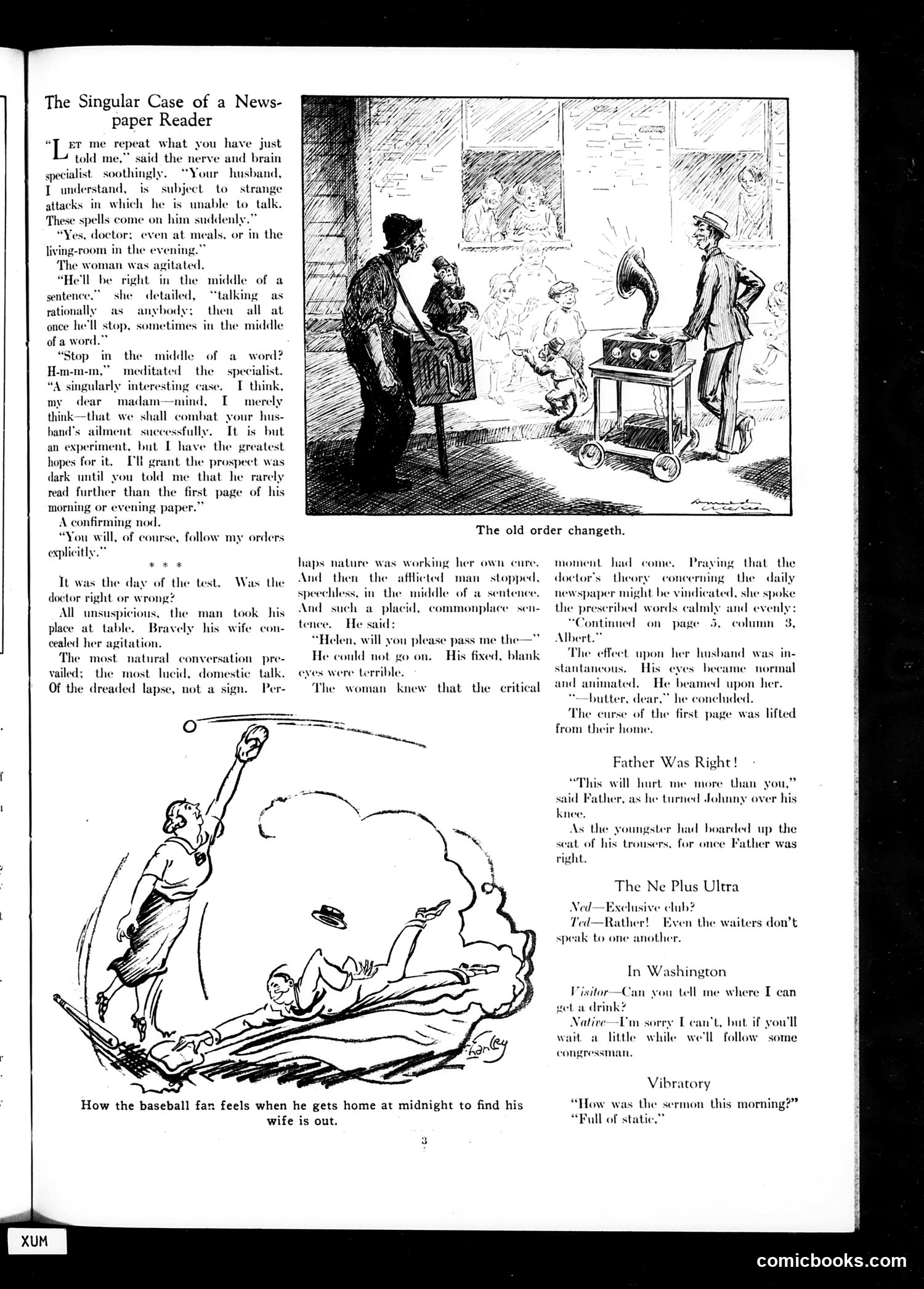
This page contains three distinct humorous pieces: 1. **"The Singular Case of a Newspaper Reader"** (top): A doctor treats a husband unable to talk during newspaper attacks. The satire mocks men's obsessive newspaper reading—they become so absorbed they cannot converse, rendering them essentially mute to their families. 2. **"The old order changeth"** (top cartoon): Shows a vendor replacing newspapers with what appears to be radio or broadcast equipment, suggesting emerging media technology is displacing traditional newspapers as the dominant information source. 3. **"How the baseball fan feels when he gets home at midnight to find his wife is out"** (bottom): A comedic illustration of a man's exaggerated emotional distress upon discovering his absence, satirizing domestic role reversal and men's emotional dependency. The overall theme critiques modern masculine behavior and media consumption.
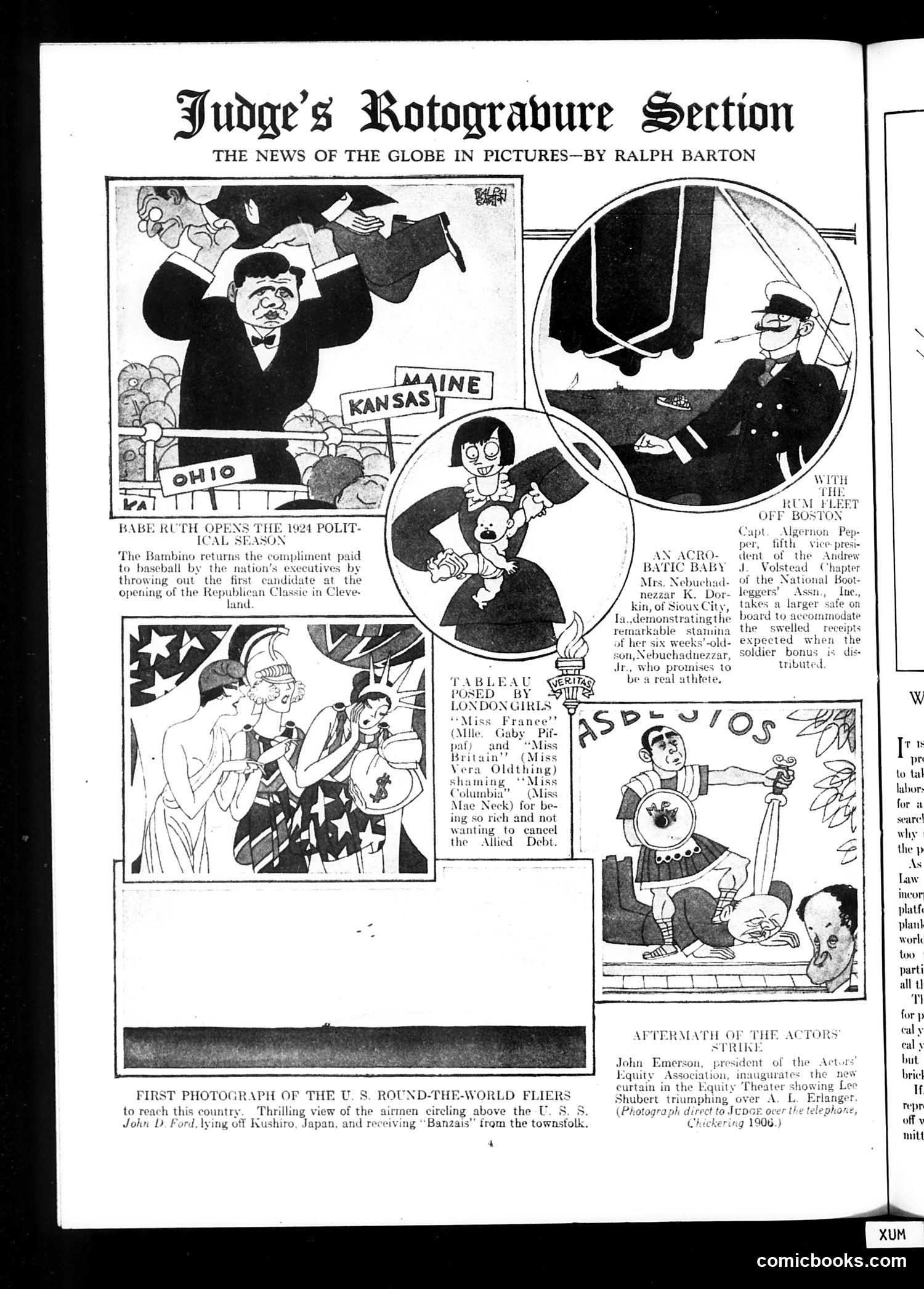
This page contains three main cartoons by Ralph Barton satirizing 1924 American political and cultural events: 1. **"Babe Ruth Opens the Political Season"**: A caricature shows a figure juggling state names (Ohio, Kansas, Maine), satirizing Republican Party executives' campaign strategy of using baseball celebrity Babe Ruth to promote their candidate at the Republican Convention in Cleveland. 2. **"Tableau Posed by London Girls"**: British women demonstrate wartime sacrifice through theatrical performance, positioning themselves as morally superior regarding Allied war debt repayment. 3. **"Aftermath of the Actors' Strike"**: John Emerson's Equity Association confrontation is depicted with physical comedy, showing theatrical conflict during labor disputes. The bottom section shows the U.S. round-the-world flight achievement, celebrating American technological advancement.
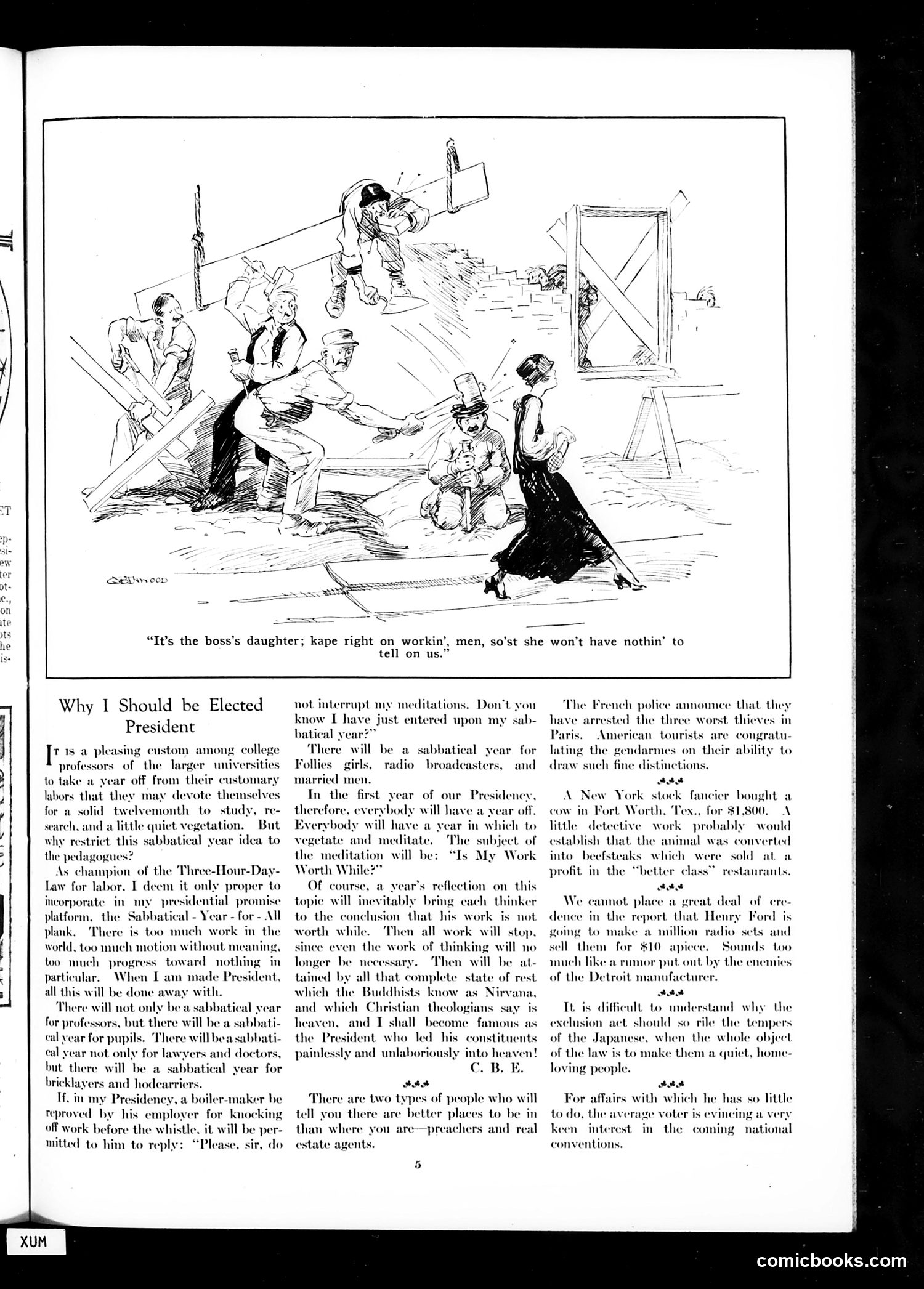
**The Cartoon:** The top illustration depicts construction workers continuing their labor while the boss's daughter walks through the site. The caption jokes that men should keep working so "she won't have nothin' to tell on us"—suggesting workplace anxiety about being reported for slacking off to authority. **The Main Article:** "Why I Should be Elected President" is a satirical proposal by an unnamed writer (signed C.B.E.) advocating for universal "sabbatical years"—extended paid time off for all workers, not just professors. The satire mocks progressive labor reform rhetoric by extrapolating it to absurd conclusions: if everyone takes a year off to meditate on whether their work matters, productivity collapses and society achieves Buddhist "Nirvana." **The Point:** The piece satirizes both labor activists pushing the "Three-Hour-Day-Law" and idealistic reformers, suggesting their proposals would destroy the work ethic. It's anti-labor movement satire typical of Judge's conservative stance during the early 20th-century labor reform debates. **The Shorter Items:** Brief satirical notes mock the French police, stock speculation, and Japanese immigration exclusion policies—typical period commentary.
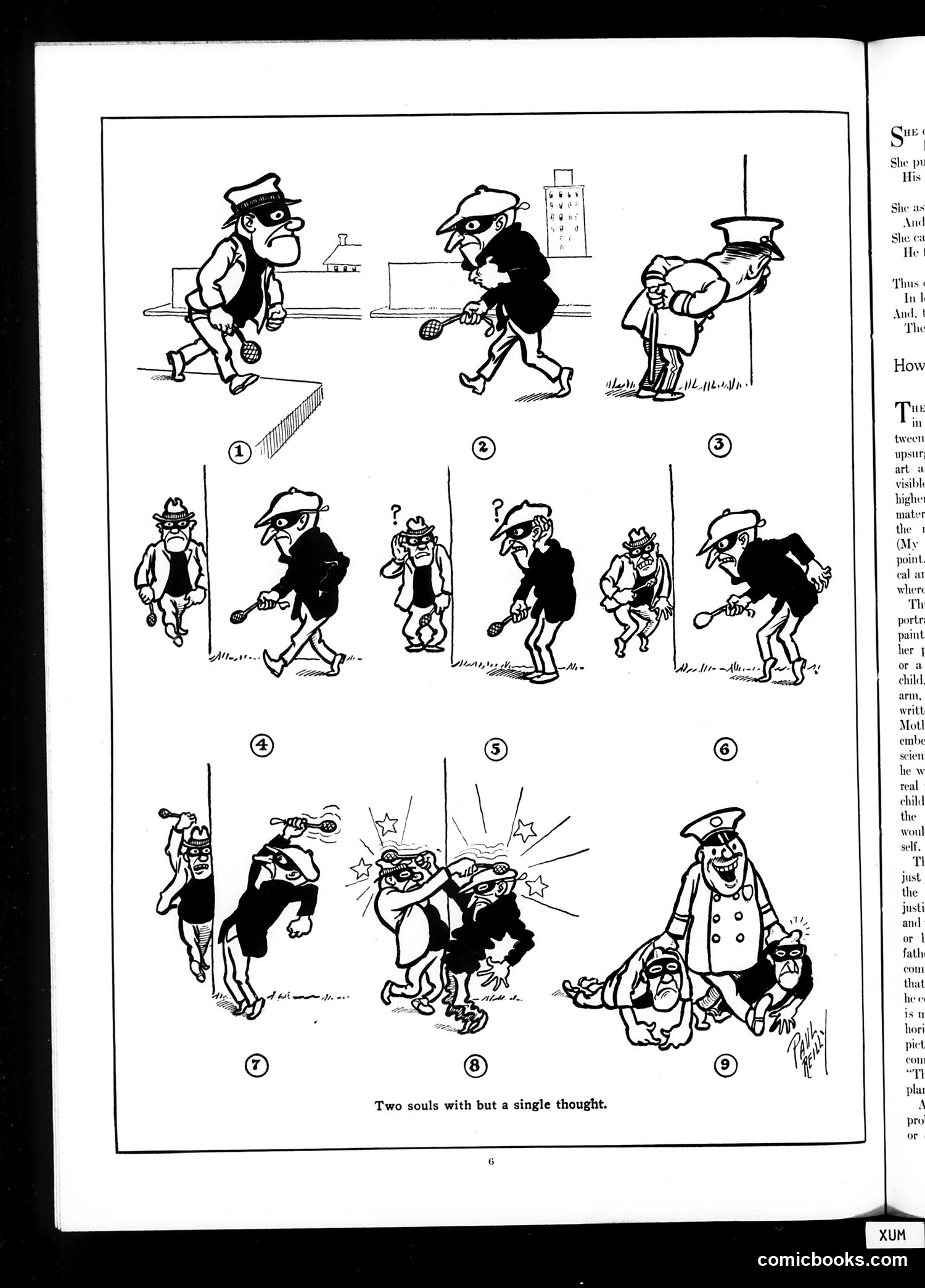
This is a nine-panel satirical comic strip depicting two characters—appearing to be police officers or authority figures in caps—engaged in various comedic situations. The title, a famous phrase about romantic couples sharing one mind, is applied ironically here to show the two figures as perfectly synchronized in their incompetence or foolishness. The panels progress through escalating chaos: they start confused, continue misunderstanding situations, and culminate in physical comedy and slapstick violence. The satire appears to target bureaucratic bumbling or institutional incompetence—the officers repeatedly fail to handle situations correctly, working in perfect but useless unison. The accompanying text on the right is partially illegible but discusses artistic representation and portraiture, though its connection to the strip remains unclear from the visible portions.
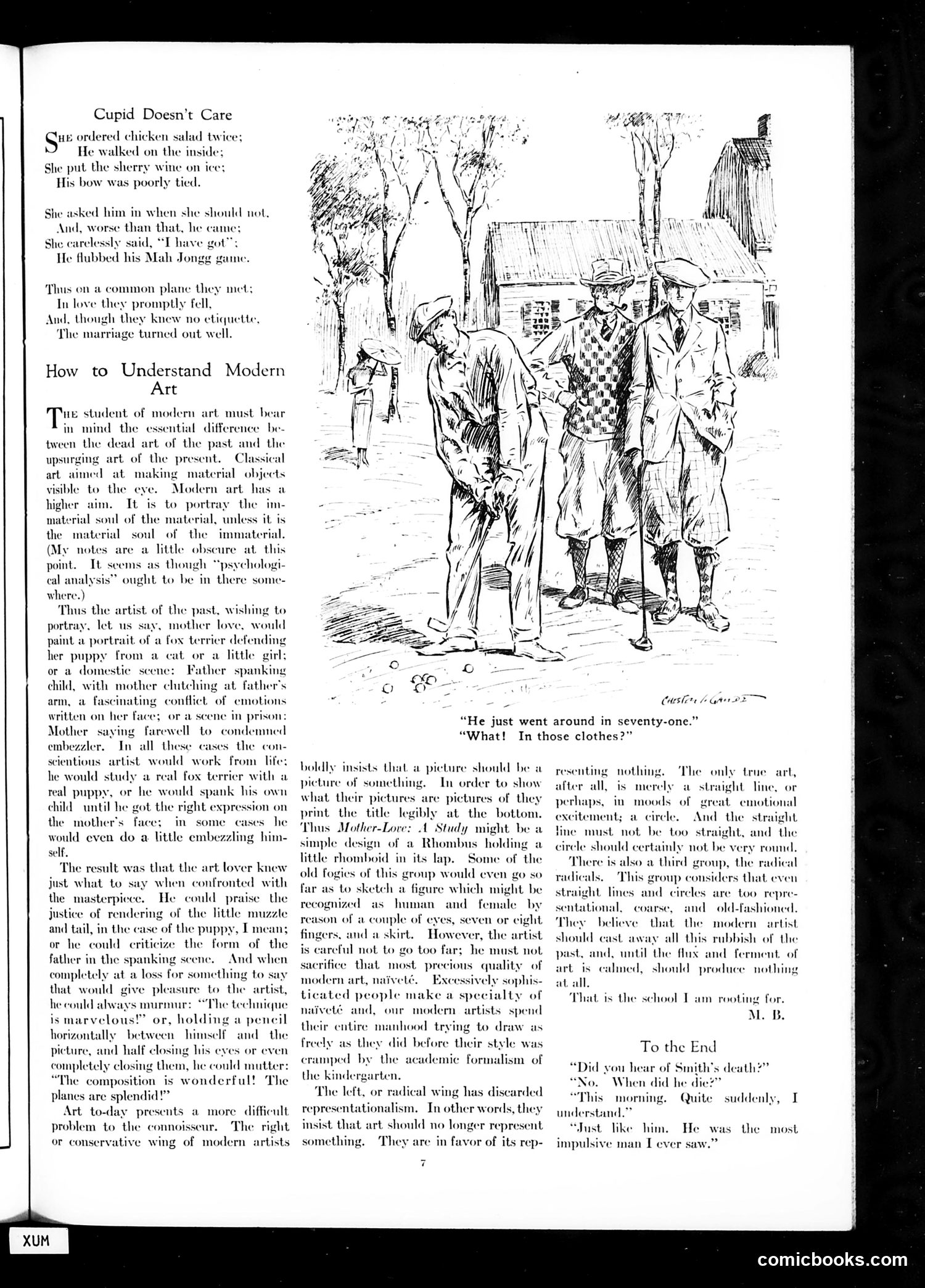
This page contains two satirical pieces mocking early 20th-century artistic and social trends. **"Cupid Doesn't Care"** is a humorous poem about a couple who violate social etiquette—she serves sherry incorrectly, he walks on the wrong side, neither knows Mah Jongg—yet their marriage succeeds anyway. The joke satirizes rigid social rules by suggesting love transcends proper manners. **"How to Understand Modern Art"** is the more pointed satire. It mocks the pretentiousness surrounding modernist art movements. The author ridicules both "conservative" modernists (who paint recognizable objects like "a Rhombus holding a little rhomboid") and "radical" modernists (who reject representation entirely, favoring only straight lines and imperfect circles). The piece lampoons art criticism itself—the pseudo-intellectual jargon ("the planes are splendid!") collectors use when confronting incomprehensible work. The satire suggests modernism is either childishly simple or deliberately obscurantist, designed to confuse rather than enlighten.
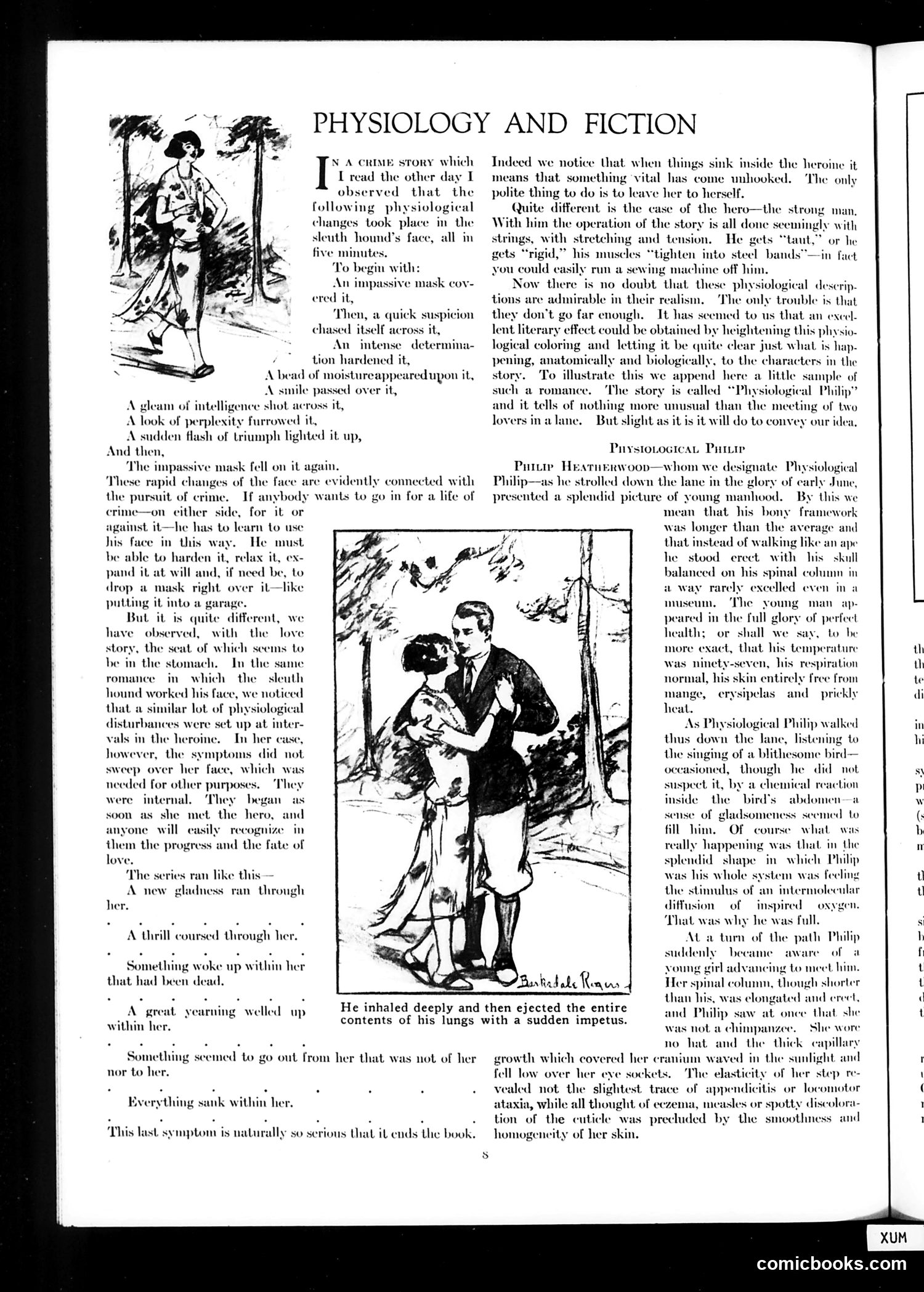
This is a literary satire mocking the overwrought physiological descriptions in contemporary crime and romance fiction. The author ridicules how crime stories obsessively catalog a detective's facial expressions (suspicion, determination, triumph) during investigations, while romance novels describe heroines' *internal* physical sensations (yearning, sinking feelings) since their faces must remain composed for "other purposes." The piece then proposes an absurd solution: include *even more* clinical physiological detail. The accompanying story excerpt, "Physiological Philip," demonstrates this through hilariously pedantic descriptions of a young man—noting his skeleton's exact proportions, his 97-degree temperature, and absence of mange—as he meets a lover in a lane. The satire targets pretentious literary realism and the pseudo-scientific language writers used to convey emotion and character, exposing how such excessive anatomical cataloging becomes ridiculous rather than sophisticated.
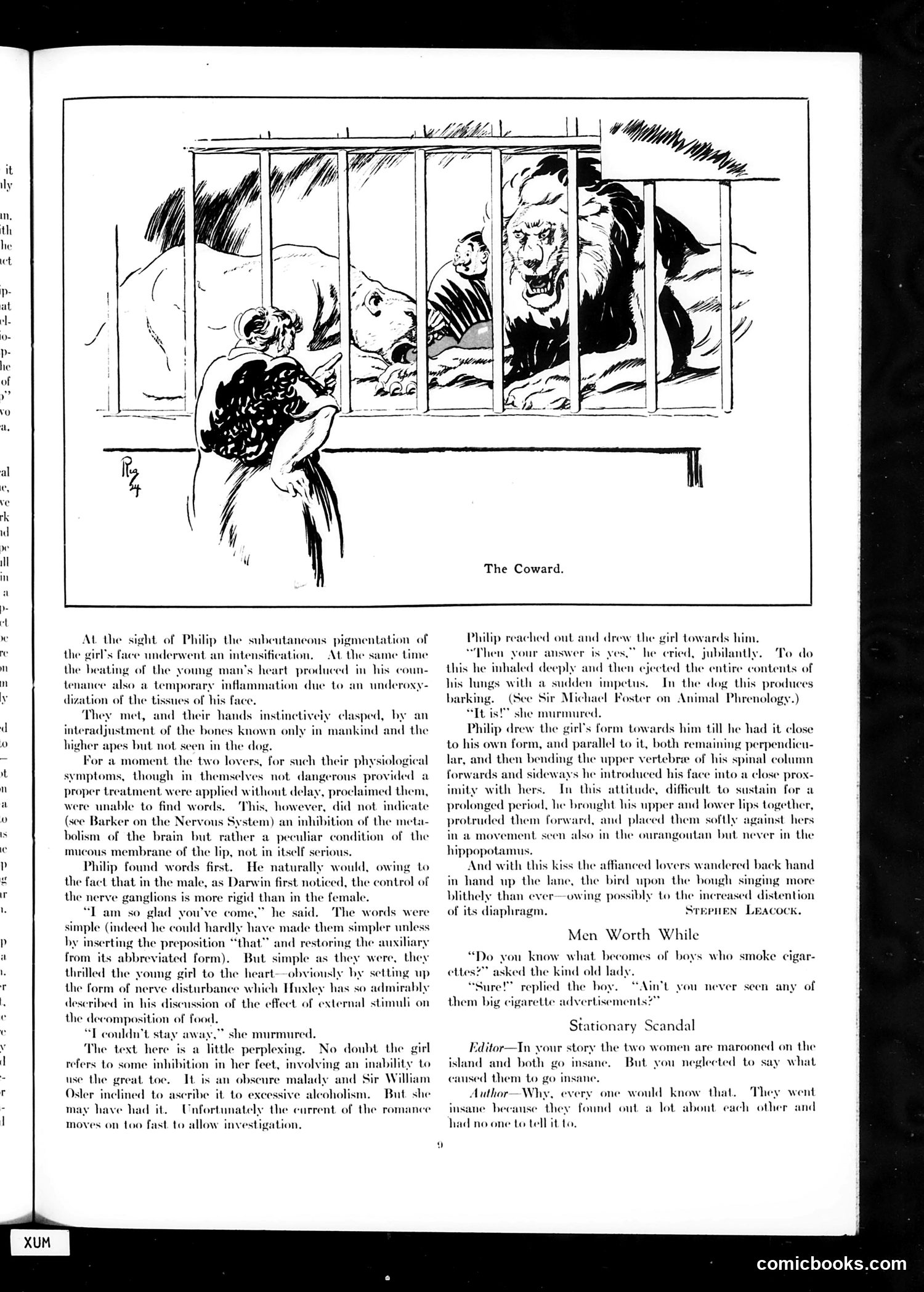
**The Main Cartoon**: Shows a woman viewing caged lions/large cats through a window. The title suggests irony—the woman, not the animals, represents cowardice (she won't approach them). **The Surrounding Text**: A lengthy satirical story mocking pseudo-scientific Victorian prose. It describes a romantic encounter between Philip and a girl in absurdly technical language, citing real scientists (Darwin, Huxley, Michael Foster) to explain ordinary human gestures—blushing, hand-holding, kissing—as if they were complex biological phenomena. The humor lies in the contrast between flowery romance and overwrought scientific jargon. **The Shorter Pieces**: Two brief humorous exchanges: - "Men Worth While" jokes about cigarette advertising warnings - "Stationary Scandal" makes a joke about women gossiping when isolated The overall page satirizes both sentimental Victorian romance writing and the era's tendency to justify everything through pseudo-scientific authority, treating simple human emotion as medical mystery.
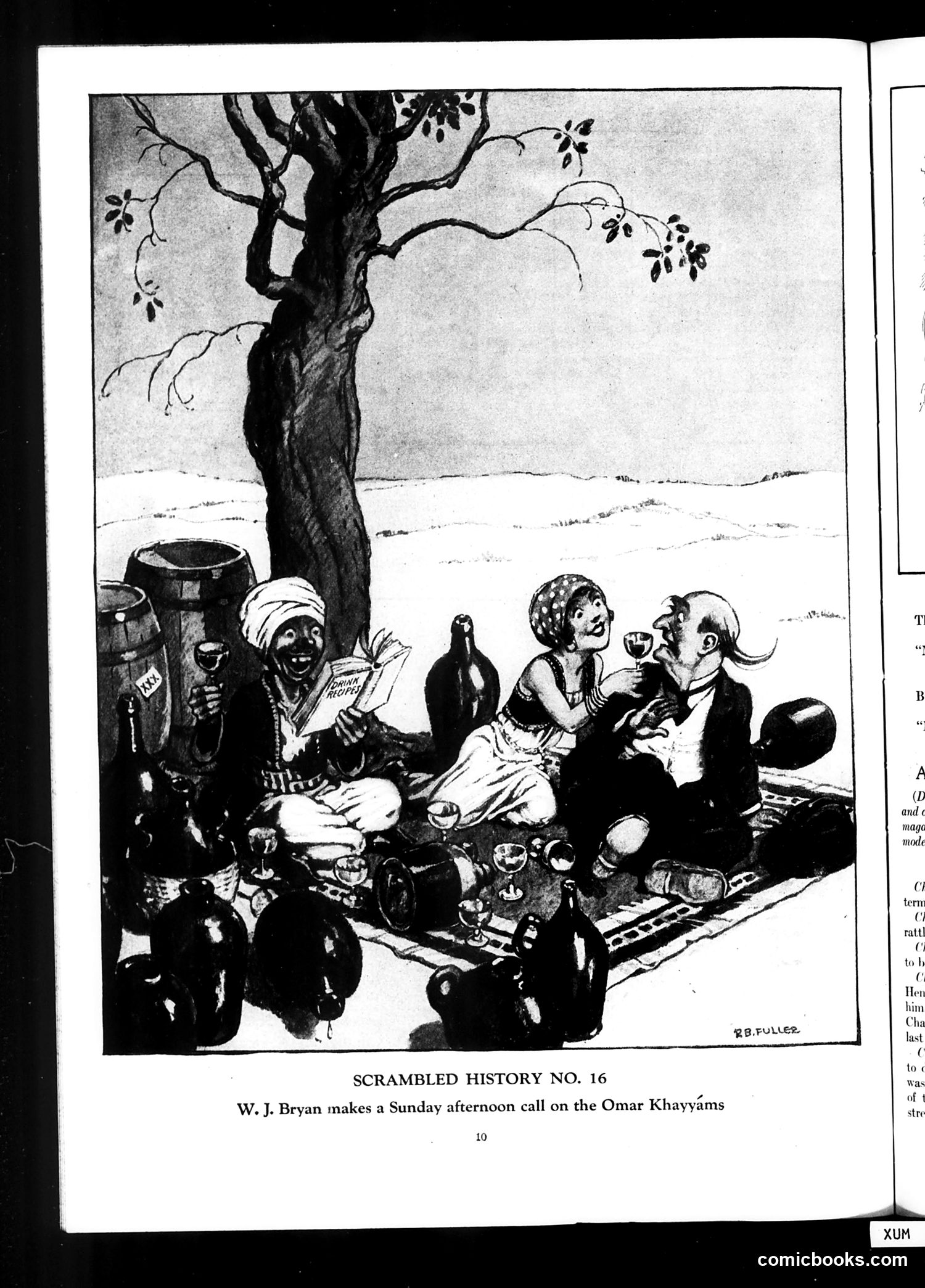
This is a satirical cartoon by B. Fuller titled "W. J. Bryan makes a Sunday afternoon call on the Omar Khayyams." The humor appears to juxtapose William Jennings Bryan (the famous politician and three-time presidential candidate) with the "Omar Khayyams"—likely a reference to the Persian poet Omar Khayyam, known for his hedonistic poetry about wine and pleasure. The cartoon depicts a social gathering under a tree with people drinking and enjoying themselves, suggesting Bryan—a known prohibitionist and moral reformer—is incongruously visiting a bohemian or dissolute social group. The satire mocks either Bryan's moral crusades or the irony of such contrasting lifestyles meeting. The "Scrambled History" series format indicates these are humorous, invented historical scenarios rather than actual events.
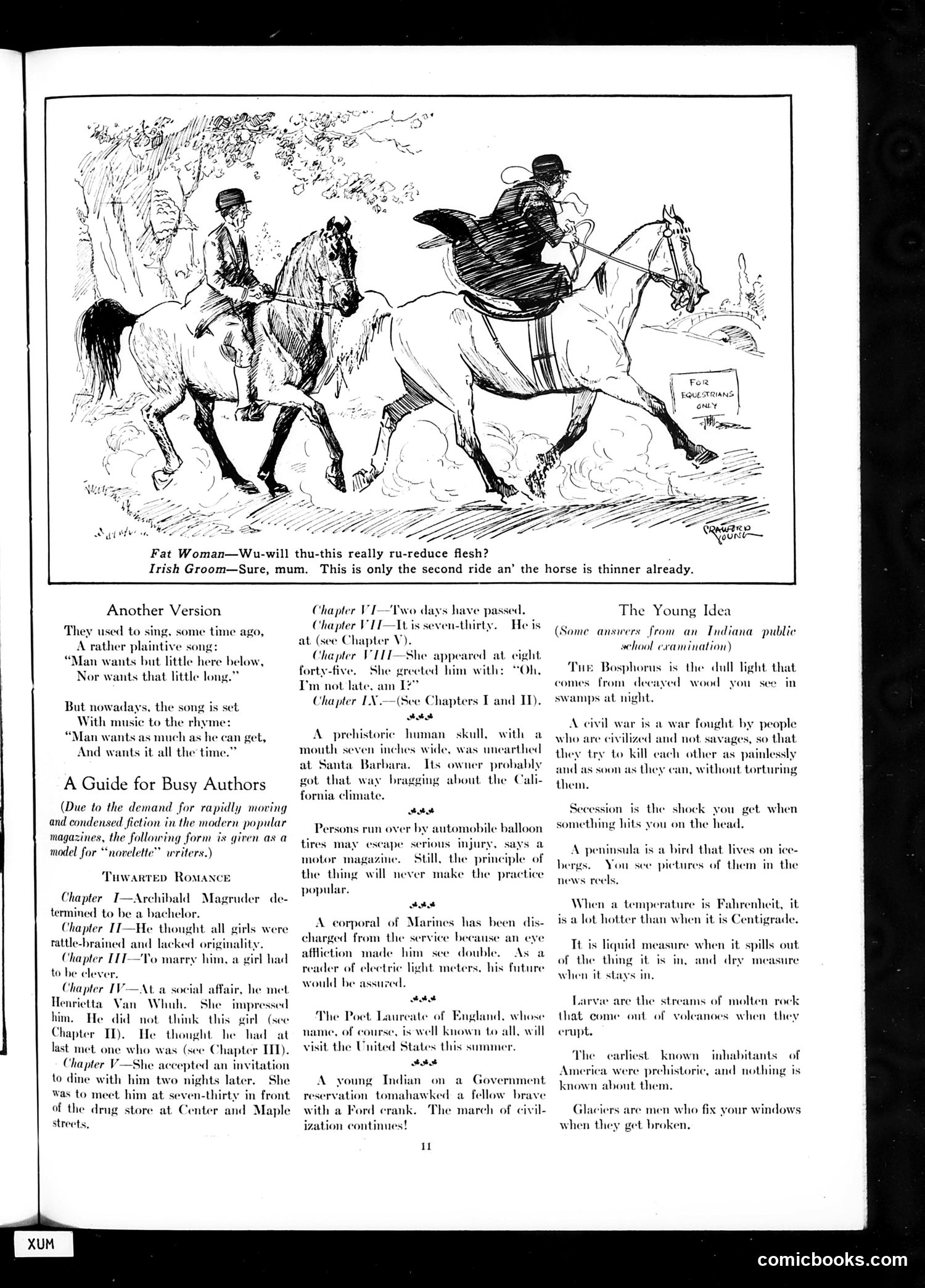
**The Main Cartoon:** A fat woman on horseback asks an Irish groom if the ride will reduce her weight. He replies the horse is already thinner after just the second ride—a joke about her excessive weight literally wearing down the animal. **"Another Version":** A brief satire contrasting old versus modern values. The traditional song claimed men want little in life; the updated version suggests modern men are greedy, wanting "as much as he can get, / And wants it all the time." **"A Guide for Busy Authors":** Mockery of formulaic novelette fiction in popular magazines. The satirical "Twanged Romance" template shows how predictable these stories are: bachelor changes mind about marriage after meeting a woman, they plan a date, she arrives late—then returns to his original misogynistic views (the circular joke). **"The Young Idea":** Humorous collection of schoolchildren's exam answers, featuring absurd definitions: bosphorus as "dull light" from swamps, civil war defined by civilized killing methods, larvae as "streams of molten rock." The page mixes social satire with humor at the expense of weight, gender stereotypes, literary mediocrity, and childhood ignorance.
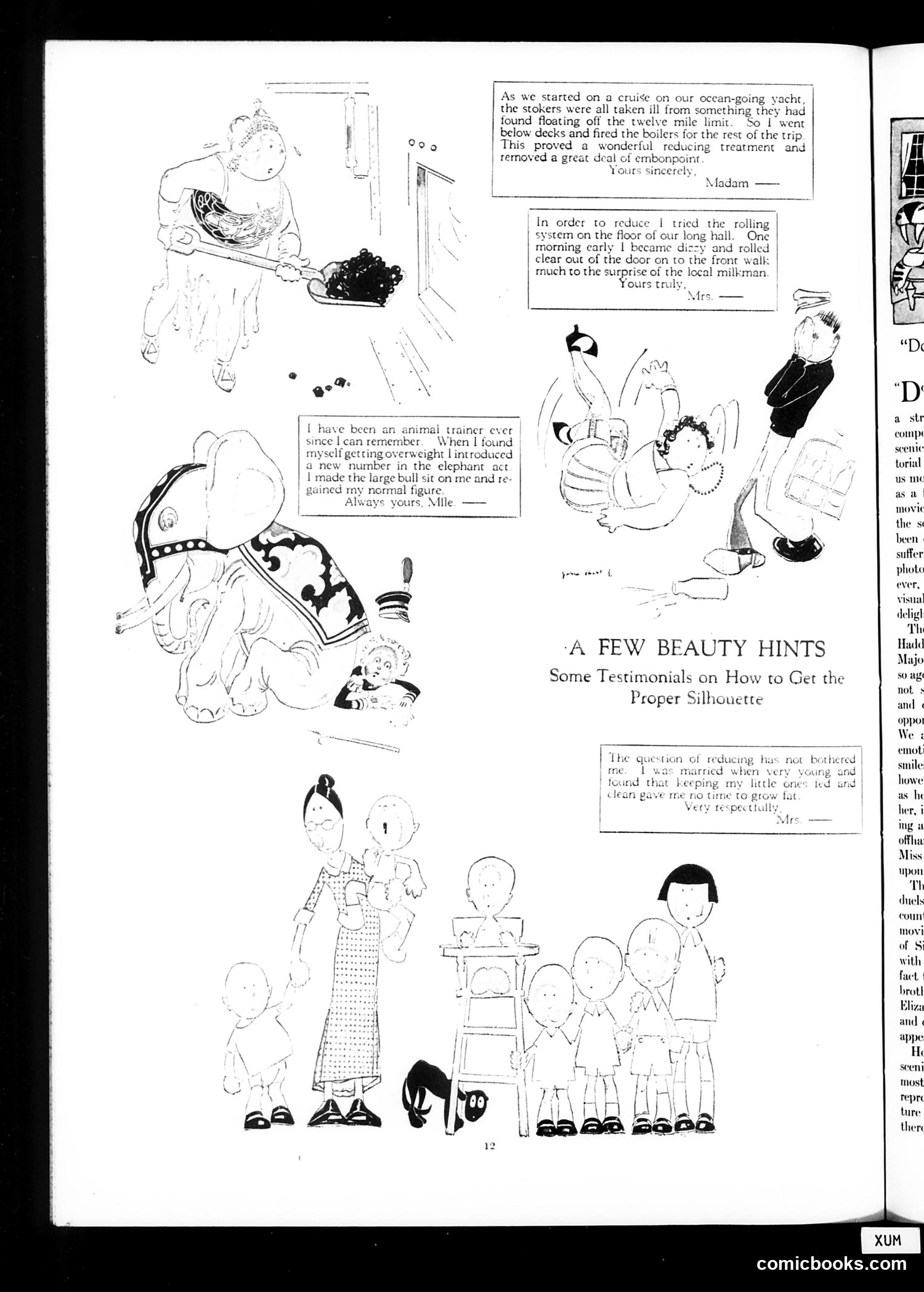
This page satirizes 1920s women's obsession with weight loss and achieving the fashionable "proper silhouette" (the slender flapper ideal). The humor comes from absurd testimonials describing ridiculous "reducing treatments": - A woman who fires yacht boilers below deck, experiencing extreme heat as weight-loss - Another who attempts rolling exercises on a hall floor and accidentally rolls out onto the street - An animal trainer who has an elephant sit on her to regain her "normal figure" The satire mocks both the desperation of women to conform to beauty standards and the absurdity of fad diets/exercise crazes. By presenting these obviously dangerous or humiliating methods seriously, as if they're legitimate beauty advice, Judge ridicules the beauty industry and society's unrealistic expectations. The accompanying illustrations of women in various states of physical struggle reinforce the satirical point: the lengths women will go to achieve fashionable thinness are ridiculous and potentially harmful.
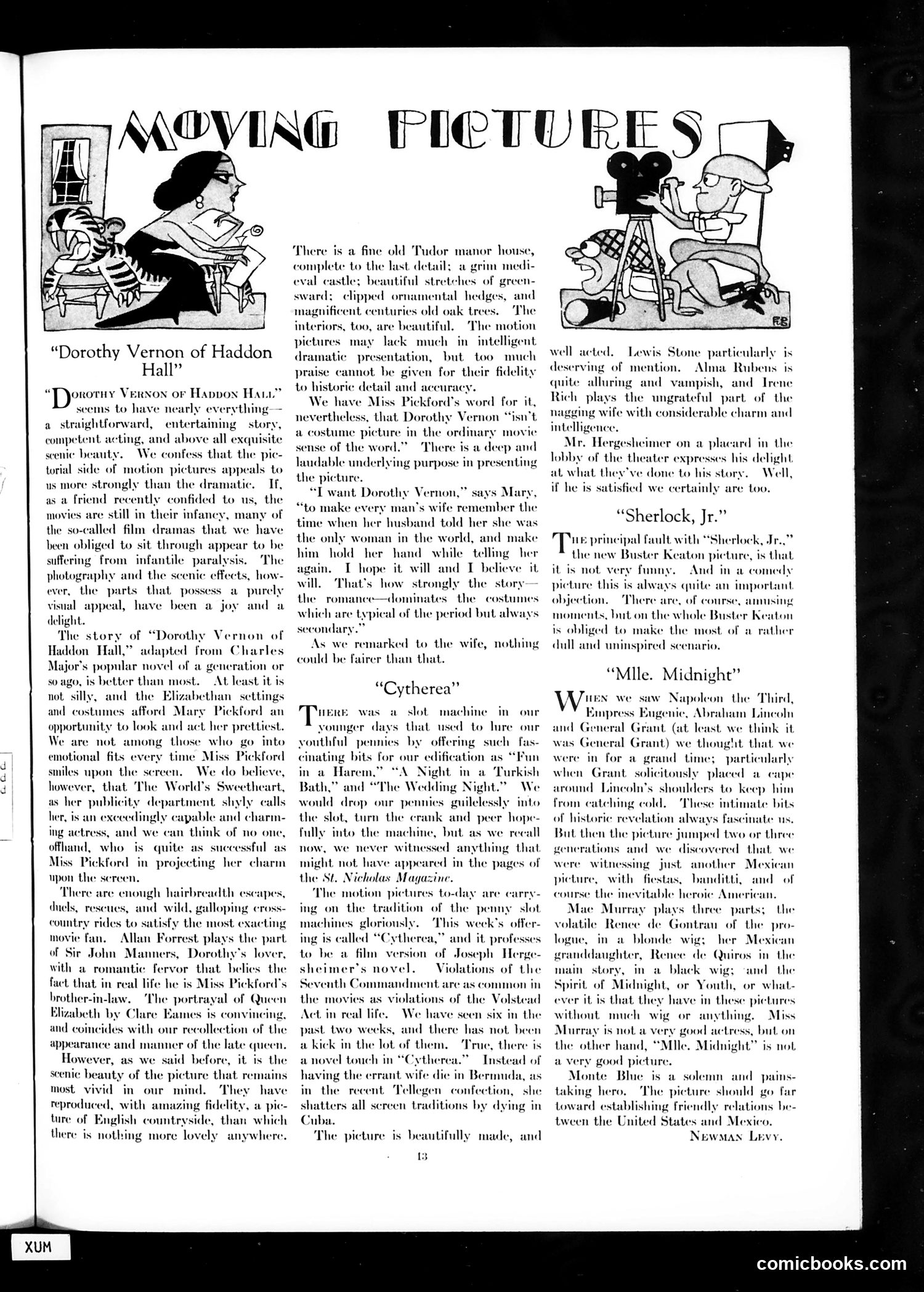
This page reviews three motion pictures for a 1920s audience: **"Dorothy Vernon of Haddon Hall"**: Stars Mary Pickford in a period romance adapted from a popular novel. The critic praises the film's visual beauty—Elizabethan costumes, Tudor manor houses, and English countryside scenery—over its dramatic merit. The reviewer admits motion pictures are still crude as storytelling but excel at "purely visual appeal." Pickford is acknowledged as a capable actress, though the critic resists the industry's hyperbolic promotion of her as "The World's Sweetheart." **"Sherlock Jr."** and **"Mlle. Midnight"**: Receive brief dismissive mentions, with the Buster Keaton film criticized for lacking humor and intelligent scenario. **"Cytherea"**: Compared sarcastically to penny-slot machines that showed titillating scenes ("Fun in a Harem," "Turkish Bath"). The critic suggests modern motion pictures perpetuate this tradition of displaying sensation over substance. The overall satire targets Hollywood's emphasis on spectacle and romance over meaningful drama.
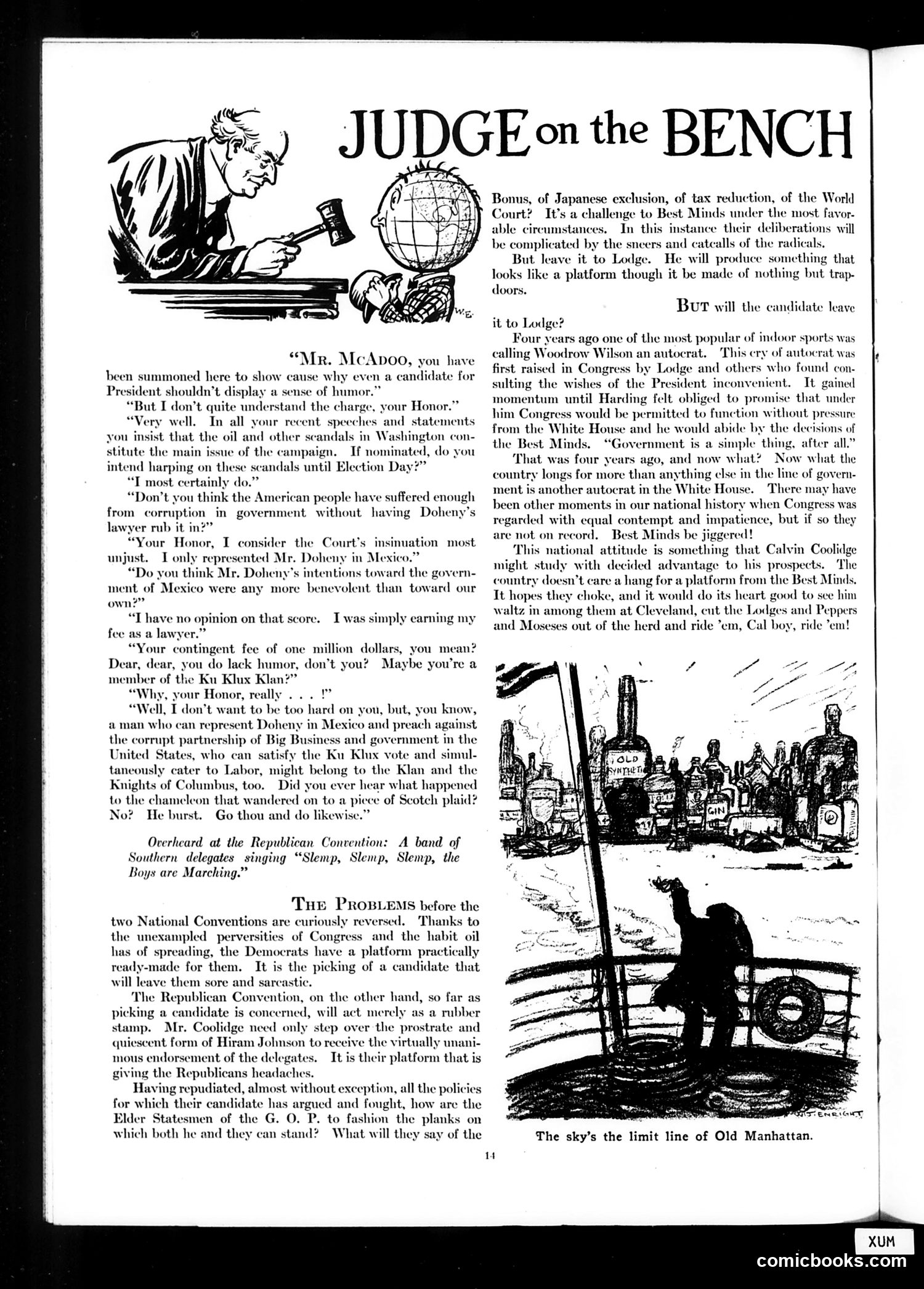
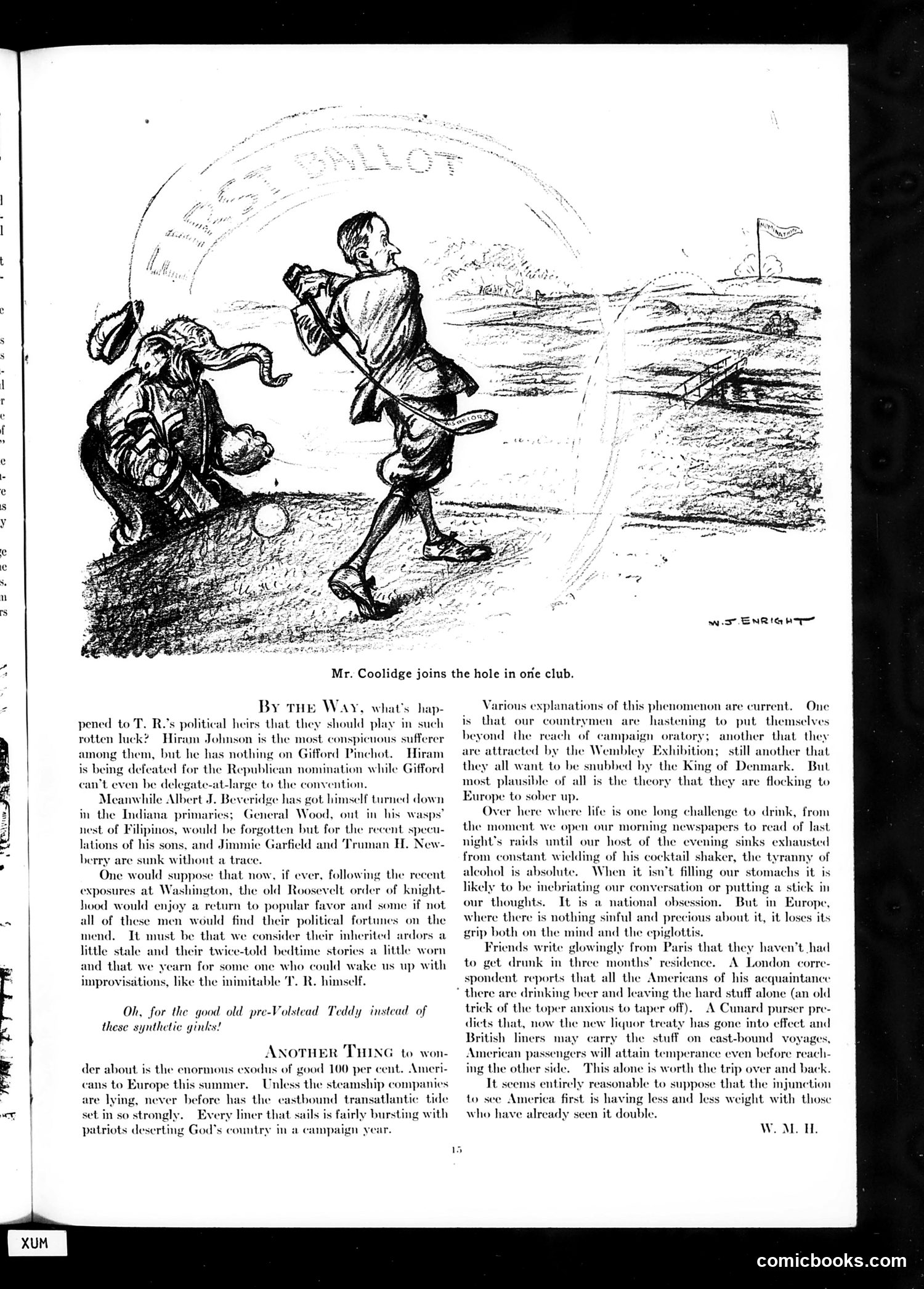
This 1924 page satirizes Republican Convention politics and the candidacy of William Gibbs McAdoo (referenced as "Mr. McApoo"). **The Main Cartoon** depicts a judge questioning McAdoo about his hypocrisy: he criticizes government corruption and business influence while simultaneously taking a $1 million fee from oil magnate Harry Sinclair (Doheny reference—the Teapot Dome scandal). The judge sarcastically suggests McAdoo might also belong to the Ku Klux Klan, given his contradictory positions appealing to both Labor and Big Business simultaneously. **The Larger Political Point**: The text critiques Republican Senator Henry Cabot Lodge's platform-building abilities and notes an ironic reversal—four years prior, Republicans attacked President Wilson as an "autocrat"; now the country wants a strong executive again. The satire suggests the GOP, led by figures like Lodge and Calvin Coolidge, offers nothing substantive—merely "trapdoors." **Historical Context**: This reflects genuine 1924 tensions: the Teapot Dome scandal, McAdoo's complicated role as Wilson's Treasury Secretary, and Republican Convention divisions over whether to nominate Coolidge or others.
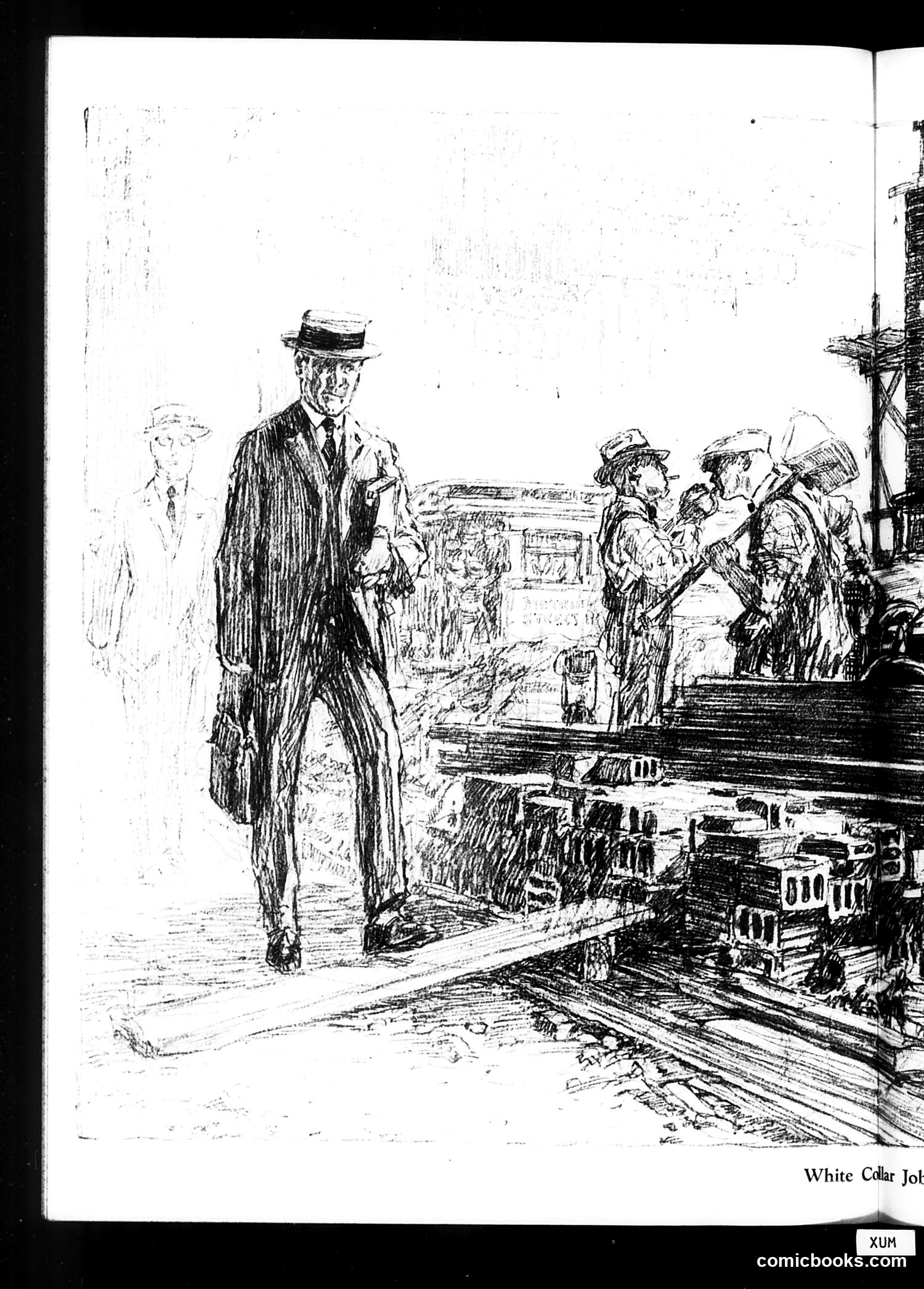
This sketch depicts a well-dressed man in a suit and boater hat—representing a white-collar professional or businessman—standing among what appears to be dock workers or laborers. The contrast in dress and demeanor suggests satire about class distinctions or the perceived superiority of office workers versus manual laborers. The setting appears to be a dock or industrial site, with cargo and workers visible. The title "White Collar Job" likely plays on the contemporary class anxiety of the era—possibly mocking either the pretensions of office workers or commenting on economic conditions where such "respectable" jobs carried status despite uncertain circumstances. Without additional context, the specific satirical target remains unclear, though the cartoon clearly examines American class divisions and labor.
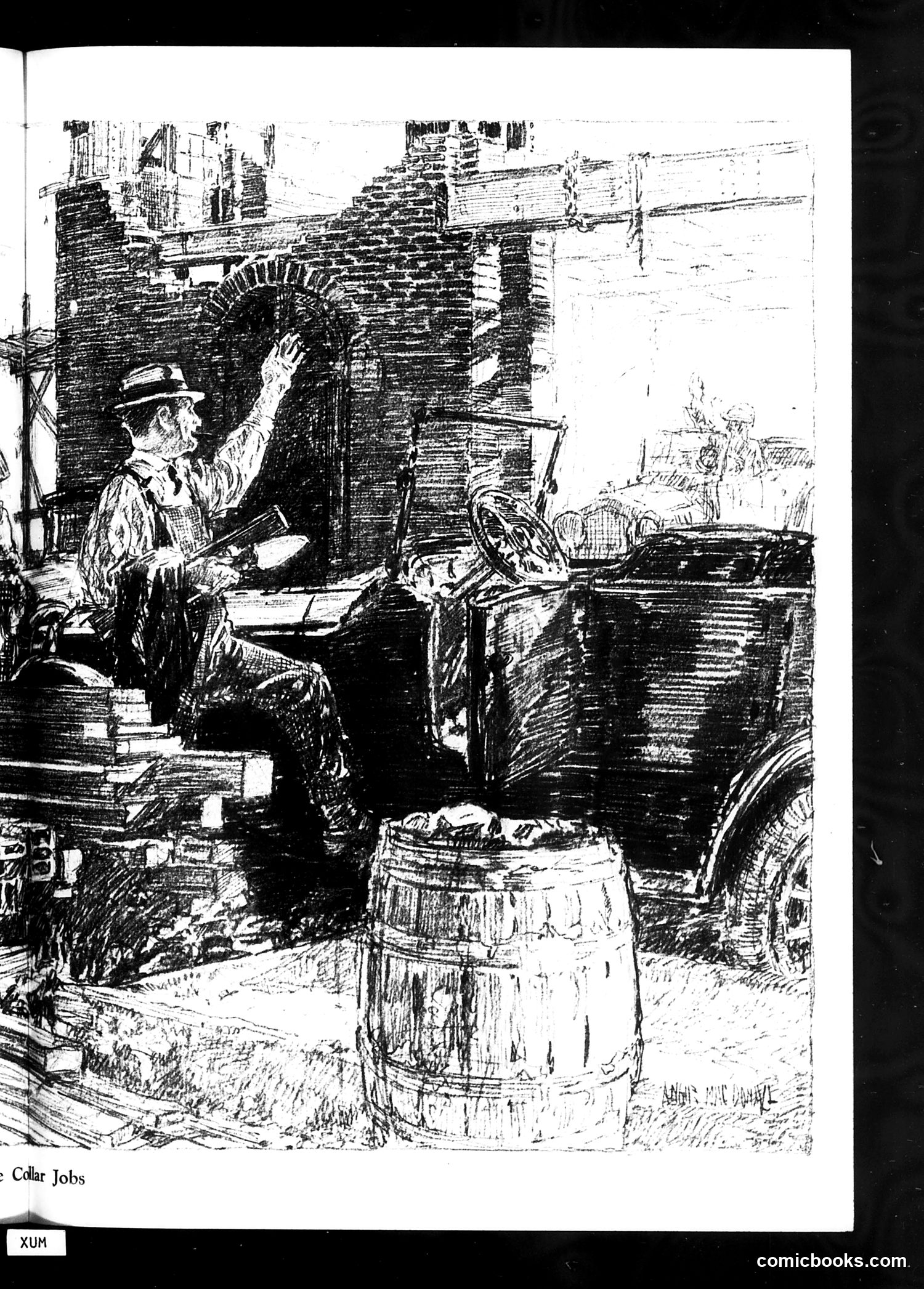
This sketch depicts a working-class man in a basement or cellar setting, surrounded by barrels and basic tools. The title "Cellar Jobs" suggests commentary on lower-class labor or underground work. The figure appears to be engaged in manual labor—possibly barrel-making, storage work, or similar trades performed in cellars, which were common working-class occupations in the late 19th/early 20th century. The detailed cross-hatching emphasizes the rough, unglamorous nature of the work. The satire likely critiques either the difficult conditions of such labor, the social stratification between classes, or possibly references Prohibition-era activities (if dated post-1920). Without additional context from the magazine's date or surrounding articles, the specific satirical target remains unclear.
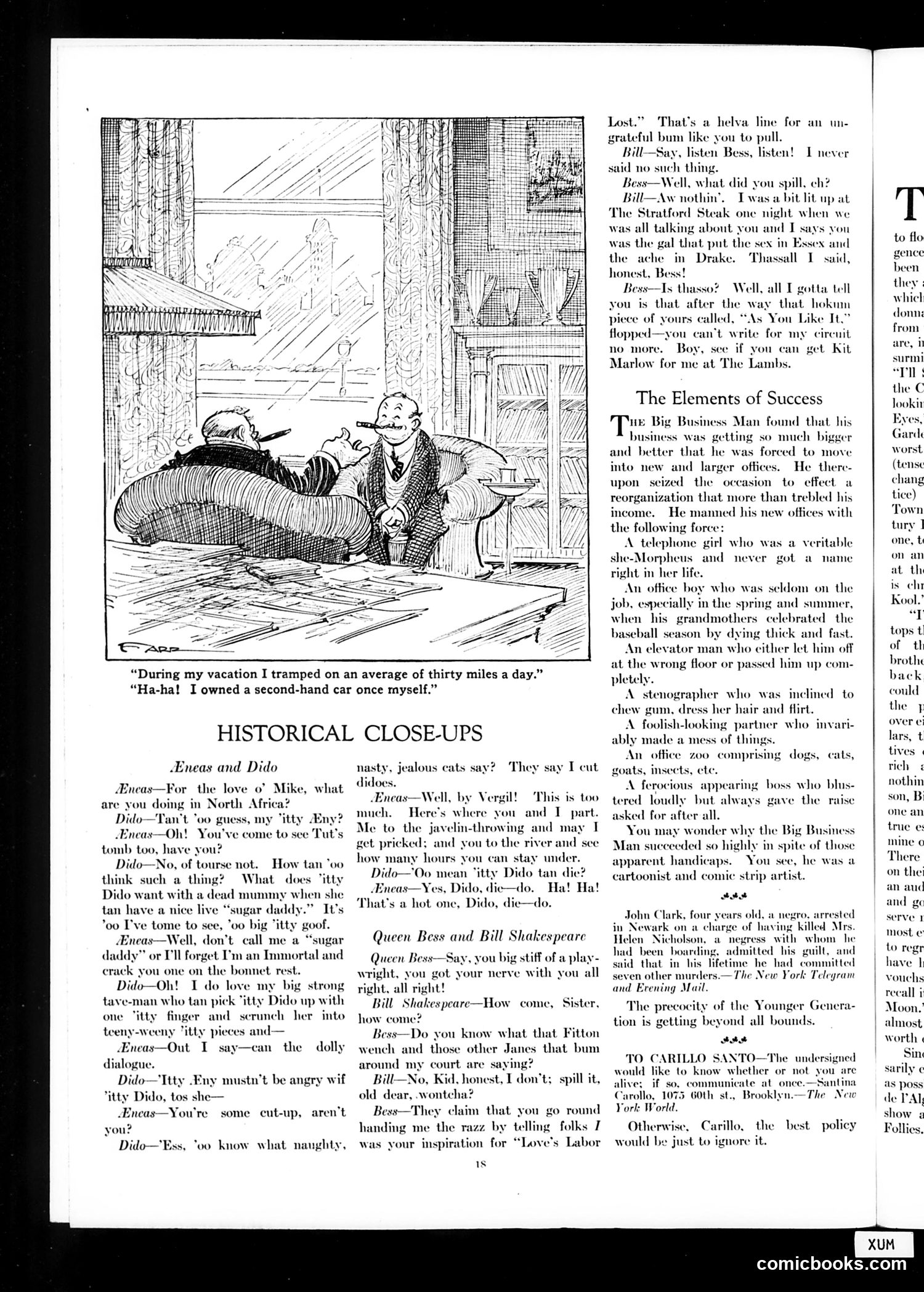
The main cartoon depicts two men in conversation—one bragging about walking 30 miles daily during vacation, the other sardonically responding that he once owned a secondhand car. The joke satirizes exaggeration: the first man's boast about strenuous hiking is undercut by the implication that owning a cheap, unreliable used car was equally burdensome and unrewarding. It's gentle satire about vacation bragging. The "Historical Close-Ups" section parodies classical literature through comedic dialogue. "Eneas and Dido" renders Virgil's tragic romance as crude vaudeville banter with exaggerated ethnic accents. "Queen Bess and Bill Shakespeare" depicts Elizabeth I confronting Shakespeare about whether she inspired "Love's Labour Lost"—he admits court gossip about her love life influenced it, provoking her fury. The page also includes filler content: "The Elements of Success" mocks incompetent office workers, and a crime brief mentions a child's arrest. The humor relies on period-specific references and assumes readers knew classical literature and Elizabethan history.
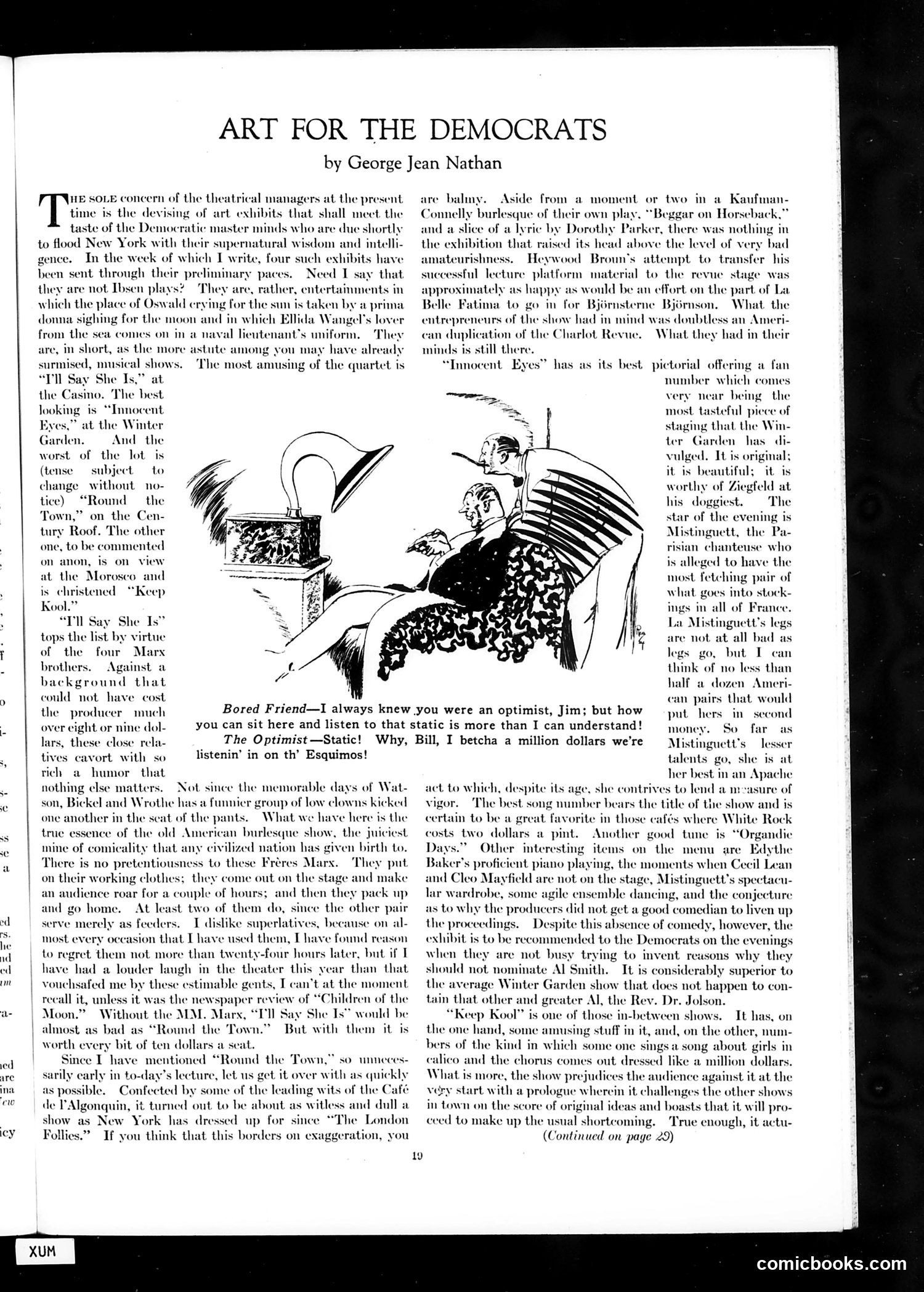
This is George Jean Nathan's theater criticism disguised as political satire. Writing as the Democrats prepare to govern New York, Nathan reviews four new theatrical productions, sarcastically suggesting they're tailored to Democratic tastes. The cartoon depicts a "Bored Friend" and "The Optimist" debating the quality of a radio broadcast—likely satirizing the emerging radio medium's poor entertainment value. Nathan's main targets are specific shows: he praises the Marx Brothers in "I'll Say She Is" as genuinely funny burlesque performers, contrasts this with the aesthetically ambitious but witless "Round the Town" (performed at the Century Roof), and criticizes "Innocent Eyes" and another unnamed show. The satire operates on two levels: mocking Democratic patrons' supposed tastes while also using them as cover for legitimate theater criticism. References to Heywood Broun, Dorothy Parker, and Kaufman-Connelly place this among New York's literary intelligentsia debates. The piece treats political authority cynically—implying Democrats and their "supernatural wisdom" deserve only mediocre entertainment.
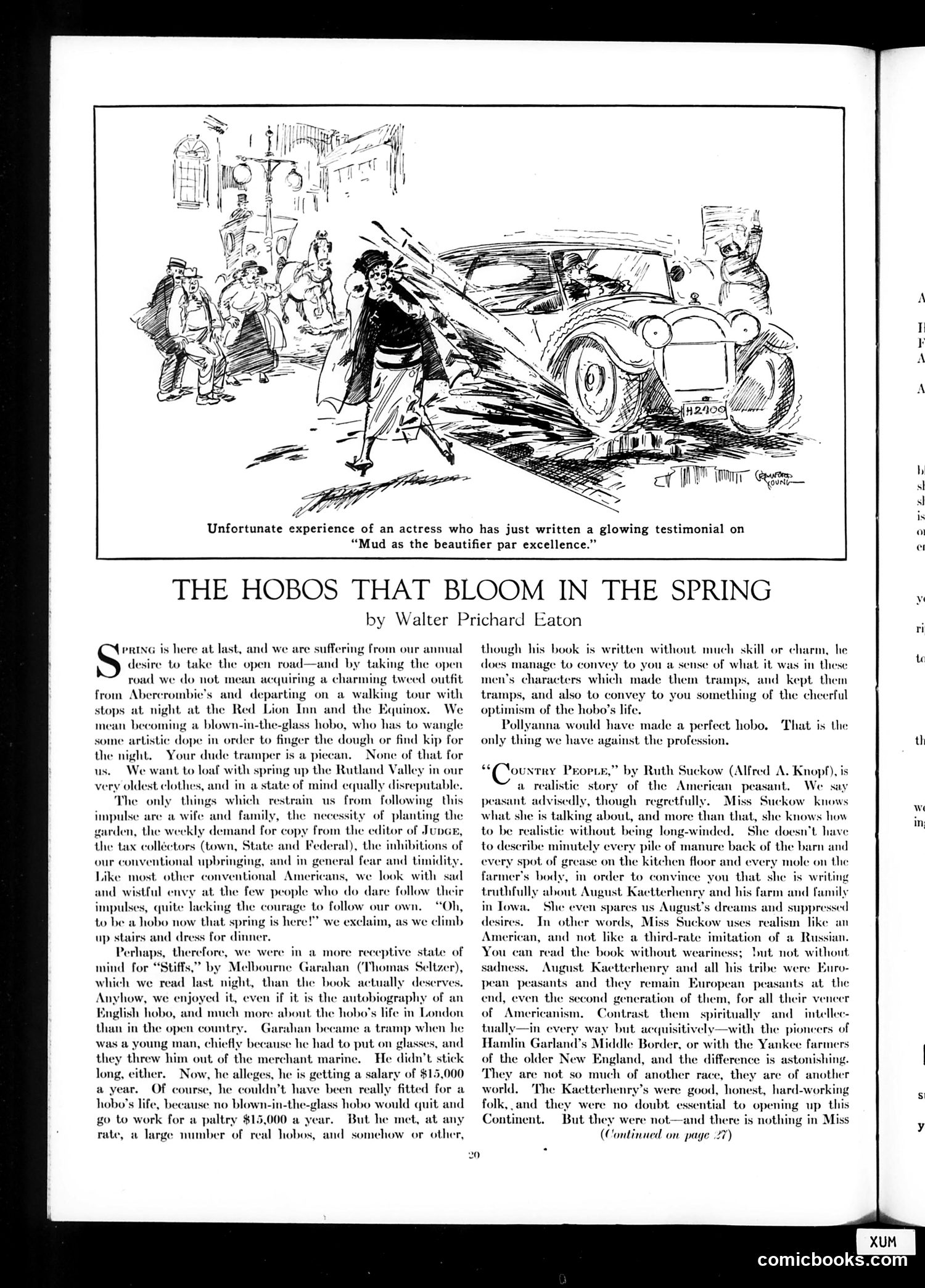
**The Cartoon:** A woman stands covered in mud beside a wrecked automobile, while onlookers gather. The caption explains she had just written a glowing testimonial endorsing "mud as the beautifier par excellence"—and this accident demonstrates the ironic consequences of that endorsement. **The Joke:** This is a straightforward visual pun satirizing celebrity product endorsements. The actress promoted mud as a cosmetic aid, but was then literally and messily "muddied" by a car crash. It mocks both the absurdity of endorsing dubious beauty products and the gap between celebrities' polished public claims and unglamorous reality. **Historical Context:** This reflects early 20th-century skepticism toward advertising testimonials from entertainers—a practice already viewed as ridiculous. The automobile crash adds modern technological humor typical of Judge magazine's era. The page's main article discusses hobo literature, unrelated to the cartoon above it.
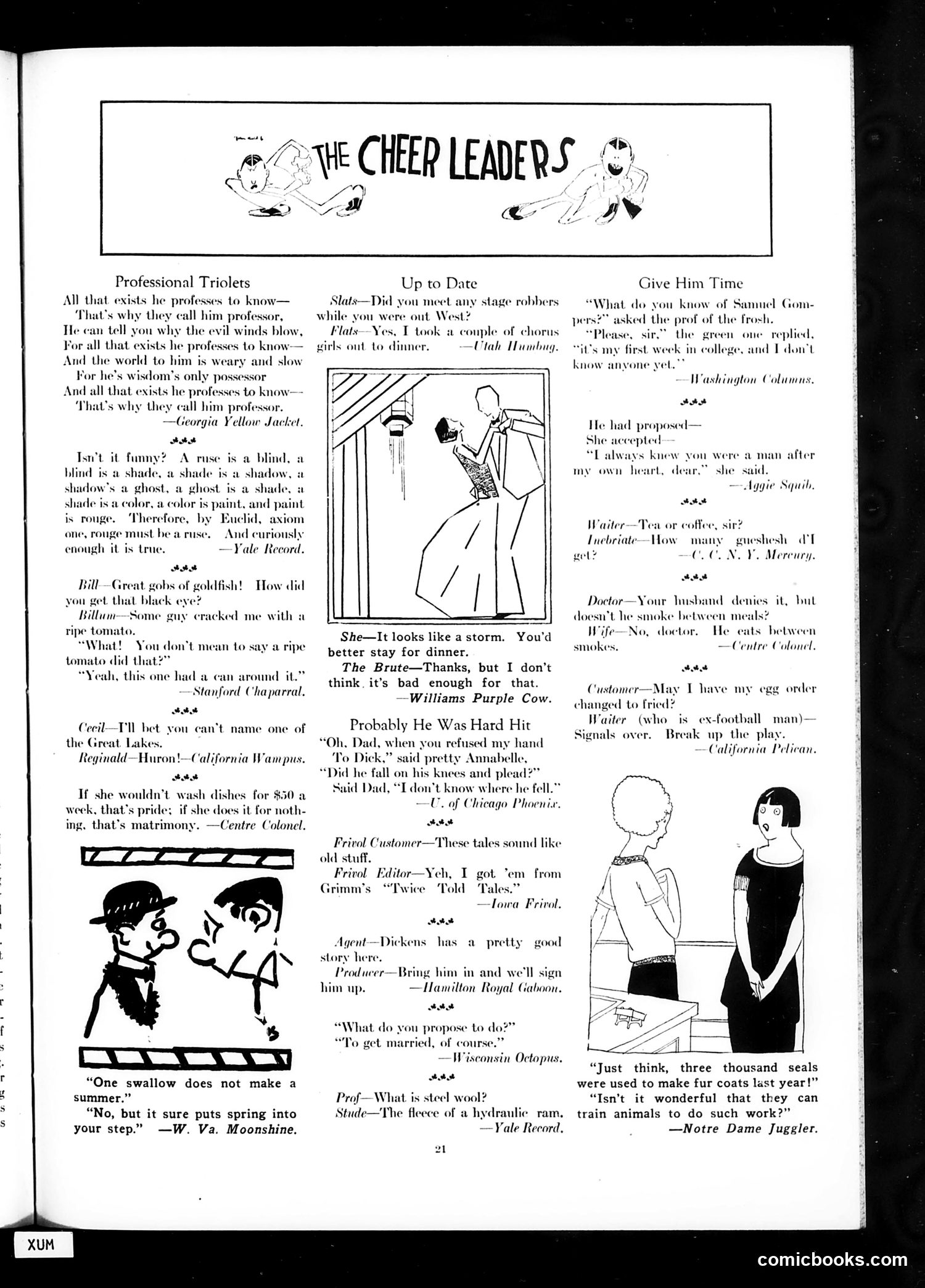
This is a humor page from Judge featuring short jokes and comic verses collected from college humor magazines. The page's title, "The Cheer Leaders," appears to frame these as the liveliest submissions from various university publications. The content reflects early 20th-century college life and social attitudes: jokes about professors' pomposity, romantic encounters, marriage, and gender roles (wives doing housework). One piece mocks a professor asking a freshman about Samuel Gompers—likely referencing labor union leadership, a contemporary political concern. The humor is largely pun-based wordplay ("ruse is a blind") and situational comedy (a man hit by a tomato "with a can around it"). The cartoon shows a couple where the woman warns of a storm; the man agrees to stay for dinner only if conditions worsen—satirizing masculine reluctance toward domestic commitment. The page reflects period assumptions about courtship, class, and education while showcasing the competitive humor culture among American colleges.
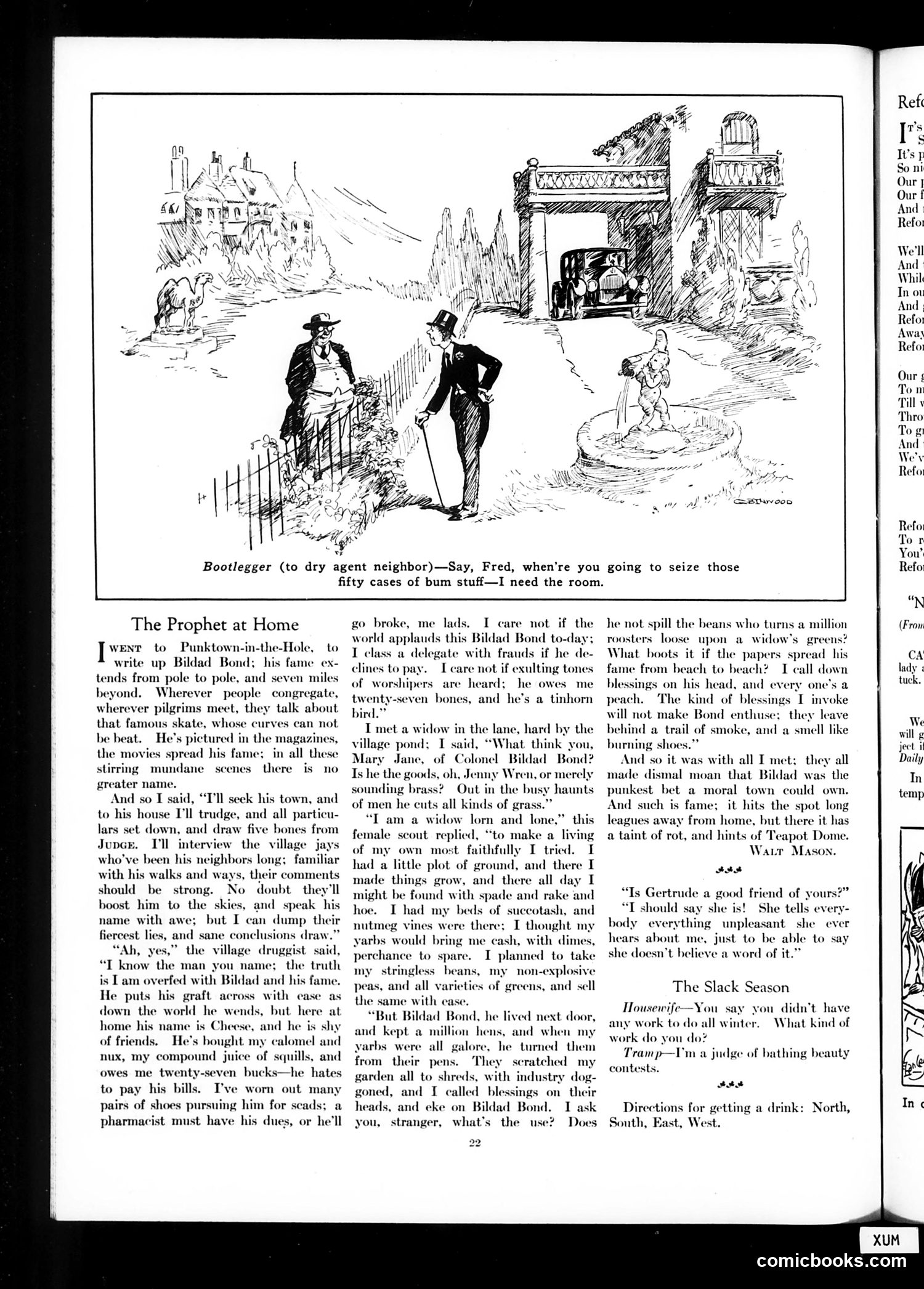
The top cartoon satirizes Prohibition-era bootlegging. A bootlegger asks his "dry agent neighbor" (a federal Prohibition enforcement officer) when he'll seize illegal alcohol so the bootlegger can make room for fresh contraband. The joke exposes the corruption and collusion between bootleggers and supposedly-enforcing agents—suggesting they're complicit rather than adversarial. The main story, "The Prophet at Home," mocks hypocrisy through Colonel Bildad Bond, a famous public figure celebrated in magazines and movies. A journalist investigating his reputation discovers locals view him quite differently: he's a deadbeat who owes money, his animals destroy neighbors' gardens, and he's generally disliked. The satire contrasts public image with private reality—a common Judge theme criticizing celebrated figures who behave unethically in their communities. The shorter pieces ("The Slack Season," "Directions for getting a drink") are brief humor items unrelated to the main content.
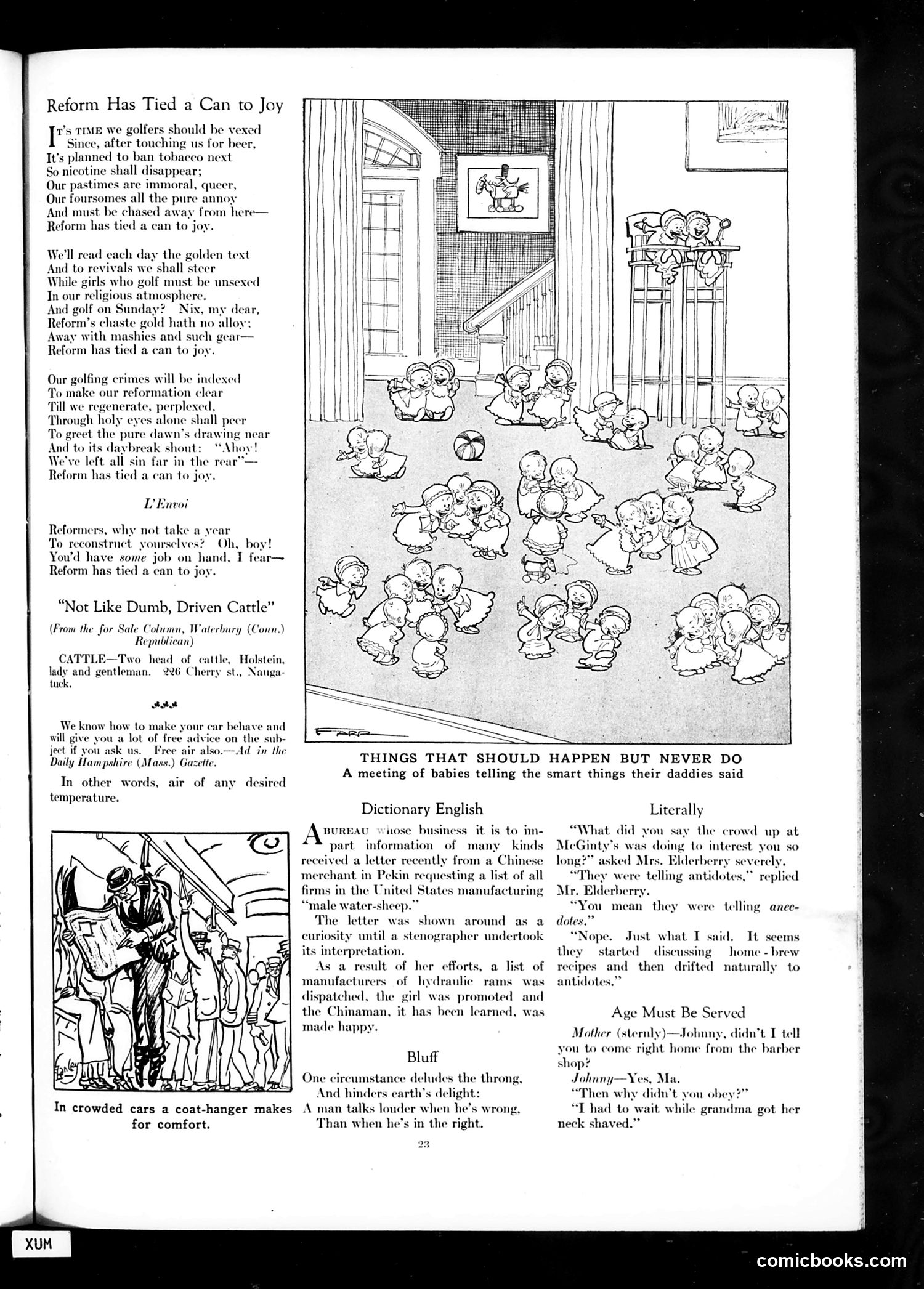
This page satirizes Progressive Era reform movements of the early 20th century. The main poem mocks reformers who sought to eliminate "immoral" leisure activities—particularly golf, tobacco, and Sunday recreation—in the name of moral improvement. The poem's speaker, a golfer, complains that reformers are systematically banning pleasures: tobacco is "planned to ban," golf on Sundays is prohibited, and even golf itself is deemed "immoral" and must be "chased away." The repeated refrain "Reform has tied a can to joy" expresses frustration that well-intentioned reformers are eliminating harmless enjoyments in pursuit of moral purity. The accompanying illustration shows babies at play, captioned "A meeting of babies telling the smart things their daddies said"—a humorous commentary on reform rhetoric that appears disconnected from reality. The satire suggests that reform movements, however noble-sounding, often restrict ordinary people's innocent pleasures without legitimate justification.
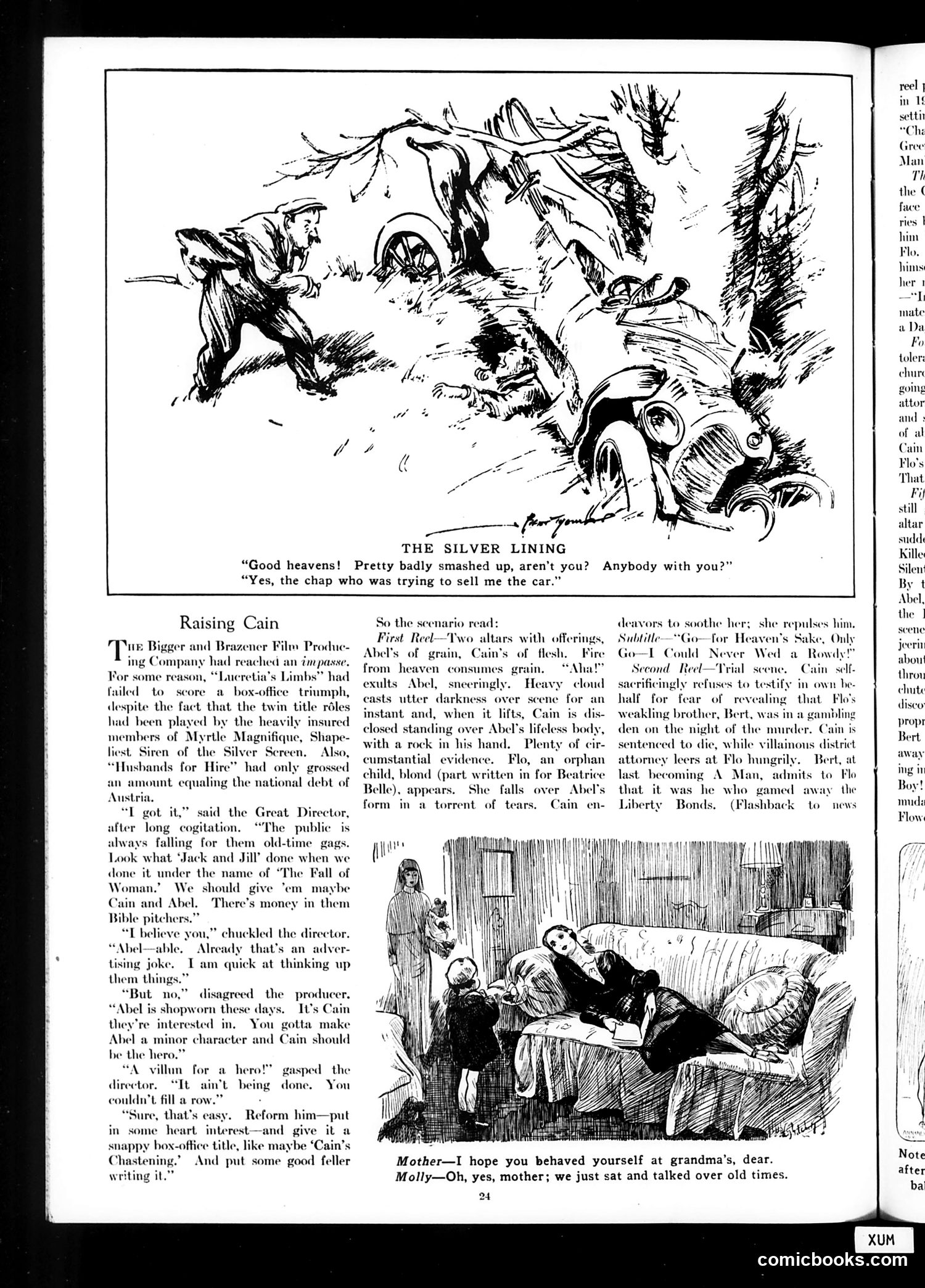
**Top Cartoon**: A simple gag about a car accident. One damaged driver asks another if he's hurt; the reply jokes that the real victim is "the chap who was trying to sell me the car"—implying the salesman got what he deserved. This reflects early 20th-century skepticism of aggressive automobile salesmen. **Main Article**: A satire of film industry desperation. A struggling production company decides to remake the biblical story of Cain and Abel as a box-office draw, betting audiences will pay to see "Bible pitches." The joke targets both Hollywood's shameless recycling of material and the era's attempt to legitimize lowbrow entertainment through classic sources. The producer proposes making Cain—the murderer—the protagonist if they "reform him," mocking the industry's willingness to corrupt any story for profit.
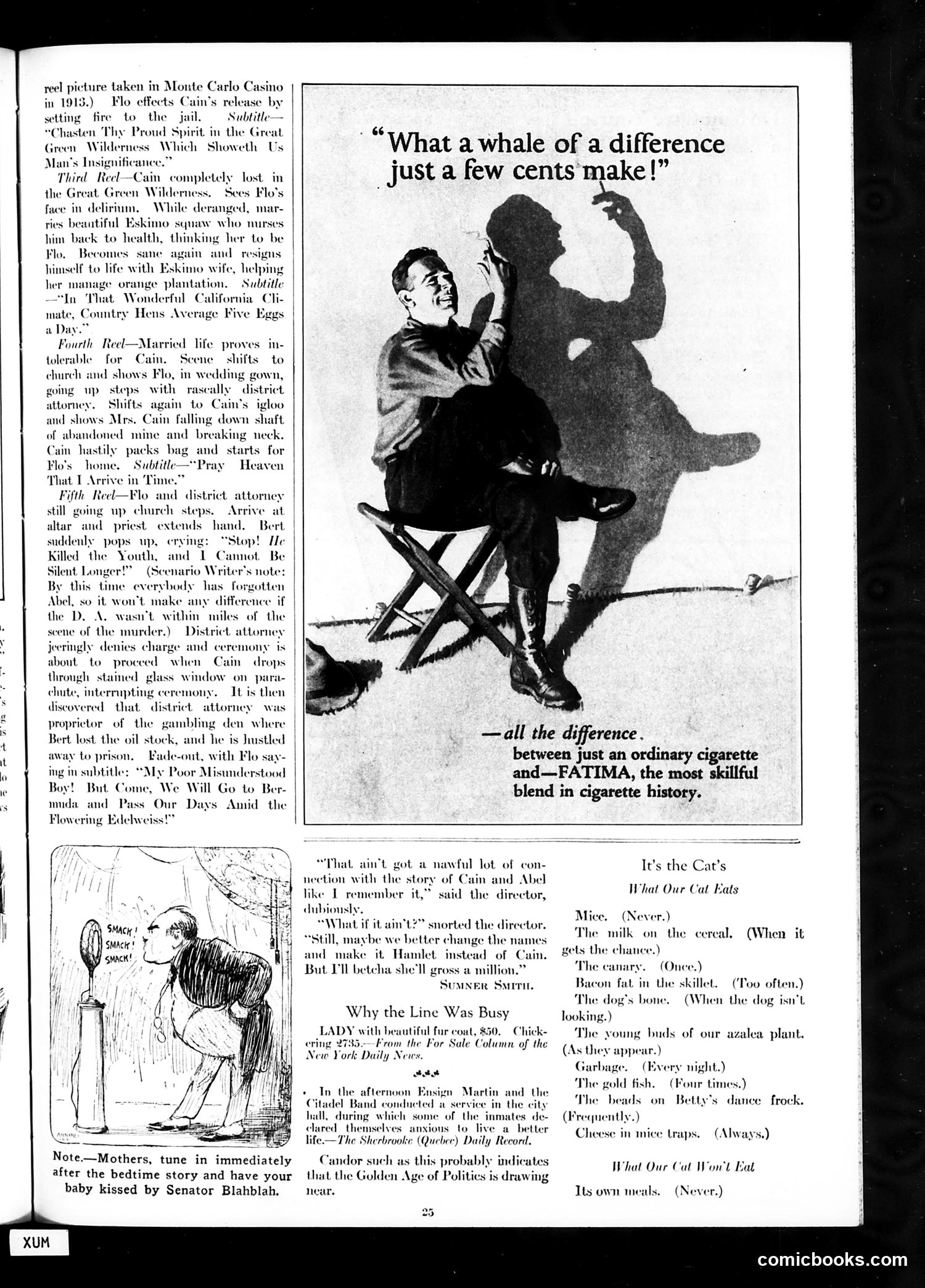
This page primarily features a **Fatima cigarette advertisement** disguised as entertainment content. The large central image shows a man in a chair being kicked by a caricatured figure (appearing to be a racial stereotype), with the tagline "What a whale of a difference just a few cents make!" promoting Fatima as "the most skillful blend in cigarette history." The surrounding text describes a film synopsis for what appears to be a comedic retelling of the biblical Cain and Abel story, with plot complications involving characters named Flo and Bert. A note sarcastically suggests mothers have their babies "kissed by Senator Blahblah" after the bedtime story—likely satirizing politicians' insincere appeals to family values. The page also includes humorous lists ("It's the Cat's What Our Cat Eats/Won't Eat") offering absurdist domestic observations typical of Judge's satirical style. Overall, this represents early 20th-century advertising integration within entertainment media, mixed with social and political satire.
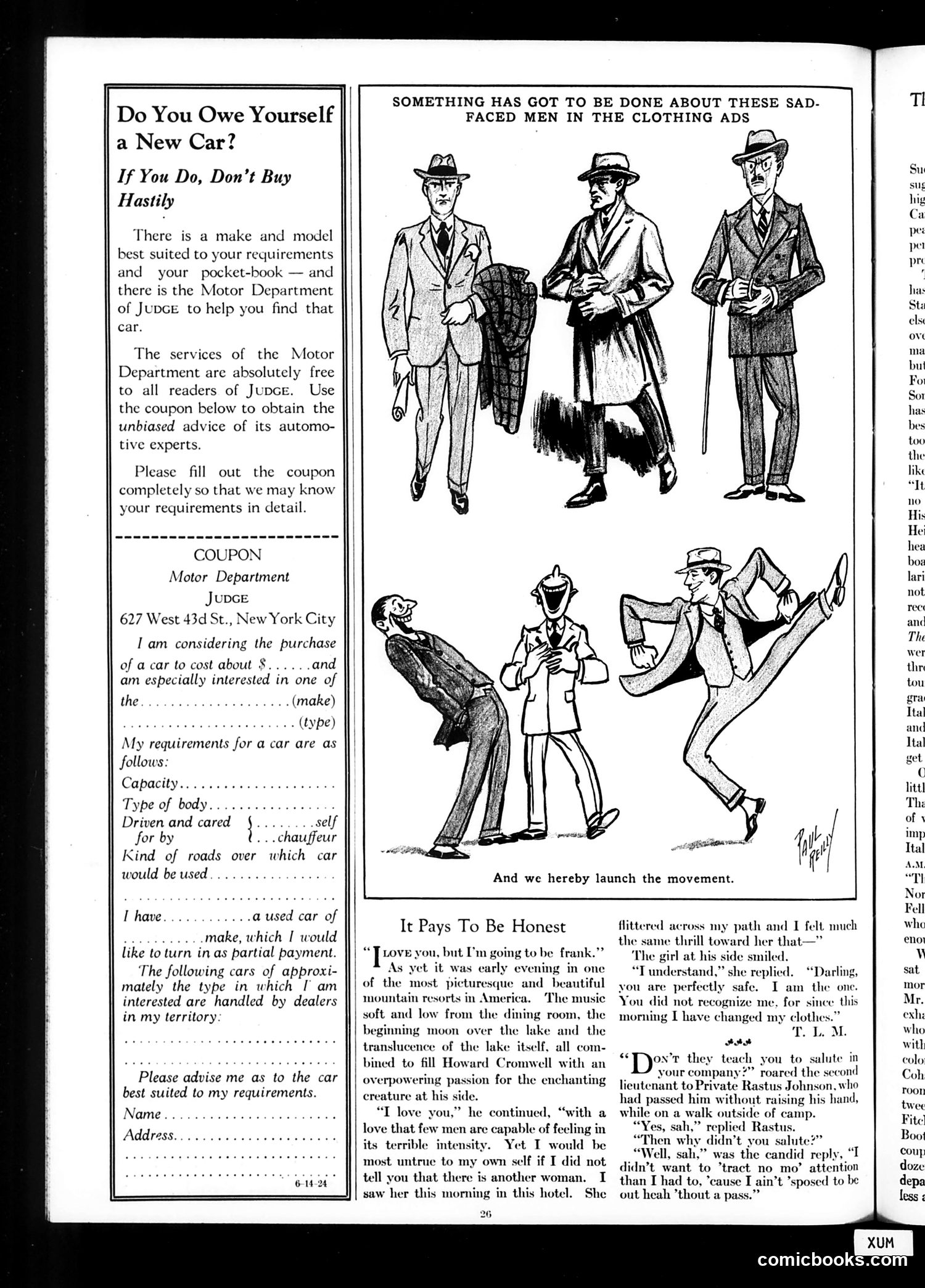
This Judge magazine page contains three distinct pieces: **Left side:** A car-buying advice service. Judge's Motor Department offers free automotive expertise to help readers choose appropriate vehicles within their budget—essentially an early consumer guidance column presented as a public service. **Main cartoon:** Satirizes the uniformly "sad-faced men" appearing in men's clothing advertisements of the era. The cartoon shows five dejected, mournful male figures in various suits and hats, then declares "And we hereby launch the movement"—launching a satirical campaign to address this peculiar advertising trend. The joke: why do clothing ads consistently depict miserable men? The satire criticizes the disconnect between the product (fashionable clothing) and the emotional tone (melancholy) used to sell it. **Bottom right:** Two brief humorous stories: one about a romantic couple where the woman reveals she changed clothes since morning (wordplay on "recognition"), and another about a Black soldier avoiding saluting to stay inconspicuous while out-of-bounds.
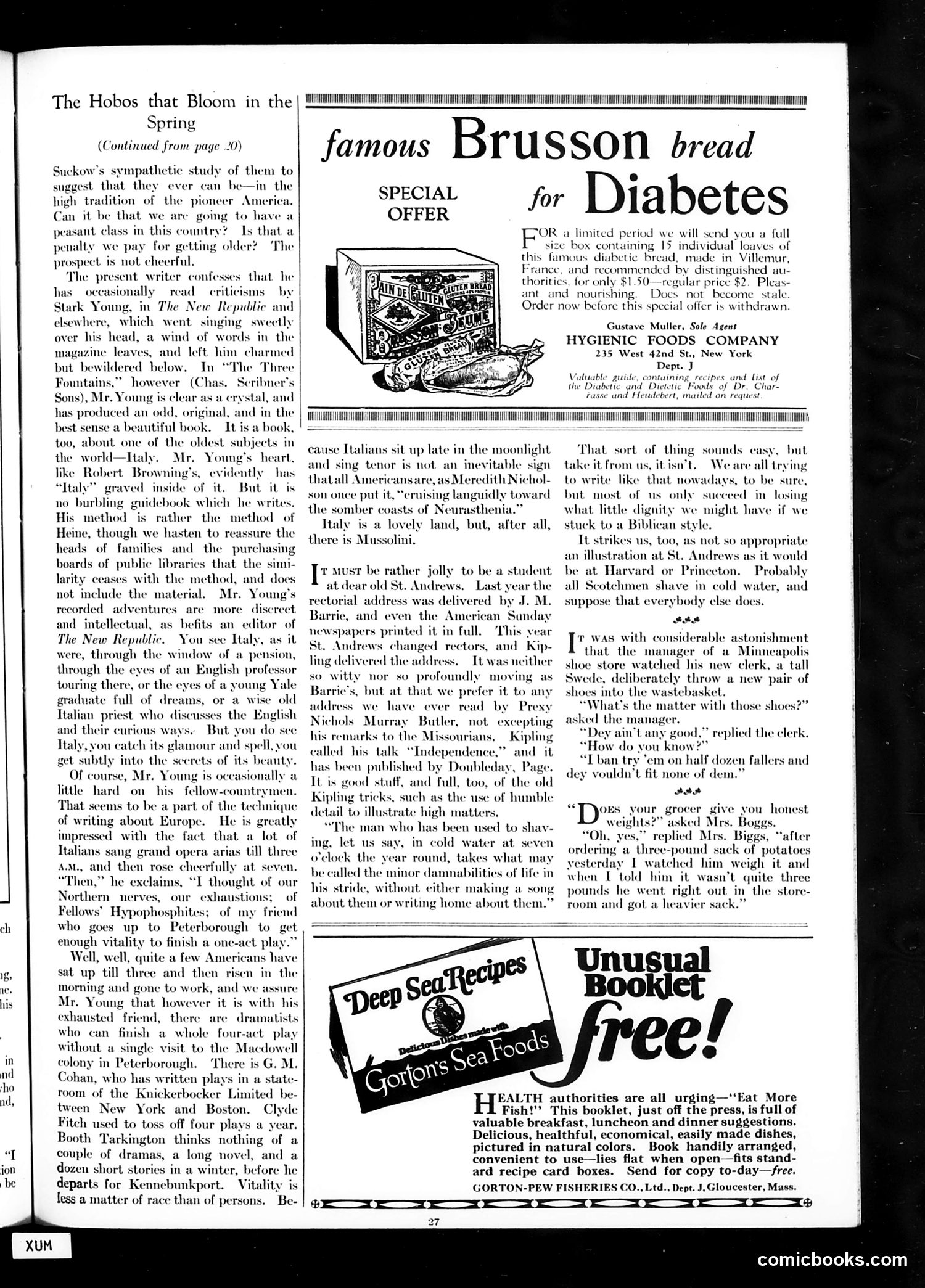
This page is primarily **literary criticism and advertising**, not political cartoons. The main text discusses Ruth Suckow's sympathetic portrayal of hobos and praises Charles Young's travel book about Italy ("The Three Fountains"). The critic notes Young writes with elegance despite occasionally being hard on Americans for their exhaustion and lack of vitality—contrasting them with Italians who work and sing opera with vigor. The satire is gentle: Young romanticizes Italian life while the critic gently mocks American intellectuals' obsession with rest cures and the Macdowell Colony (a famous artists' retreat), listing prolific American writers who produced voluminously without such retreats. The page ends with advertisements, including a dubious "Brusson bread for Diabetes" (a questionable medical claim by modern standards) and a recipe booklet. **The satire targets**: American cultural anxiety about vitality and overwork, plus the pretension of European travel writing.
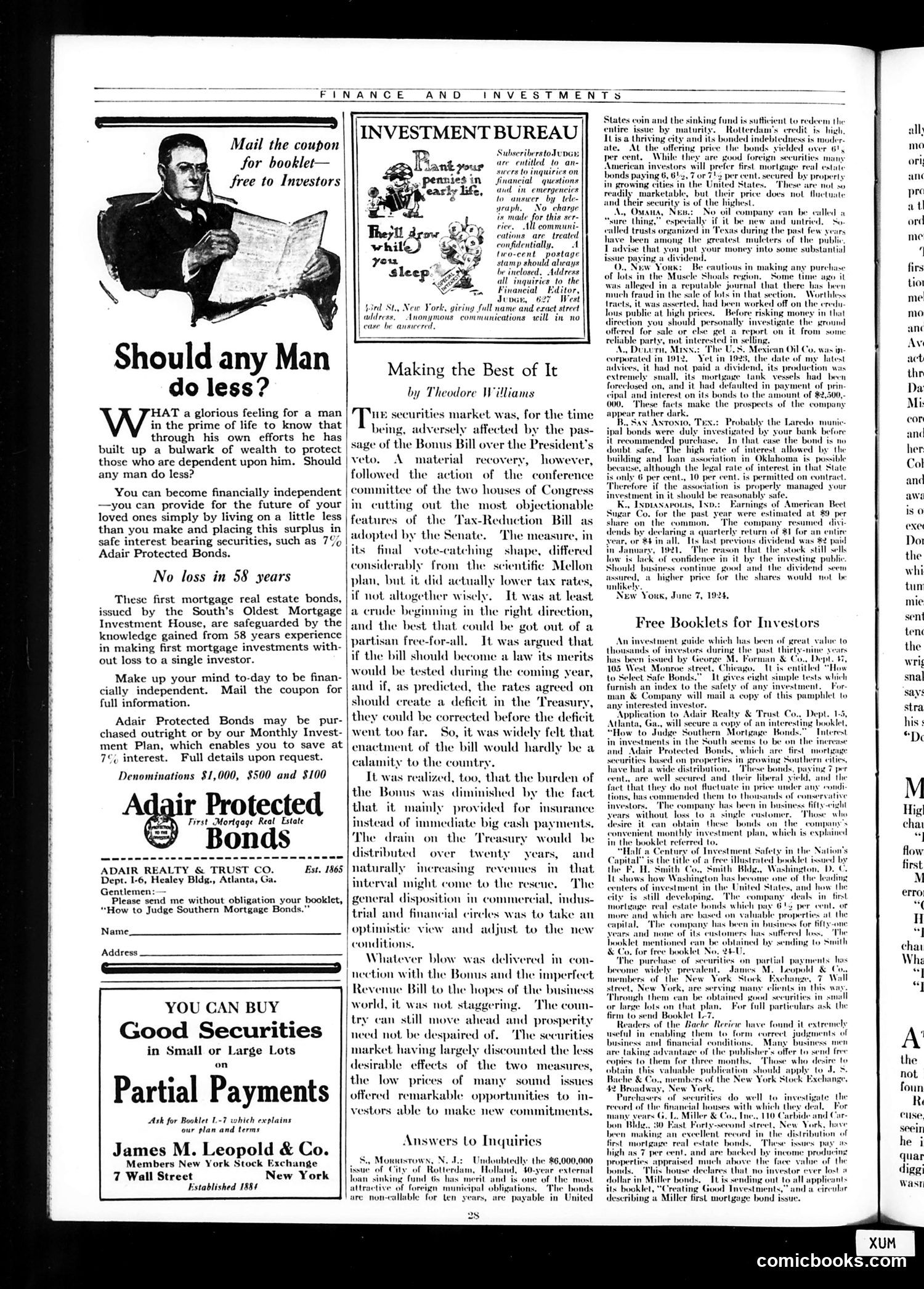
This page is primarily **financial advertising** rather than political satire. The dominant content features investment solicitations from companies like Adair Realty Trust Co. and James M. Leopold & Co., offering bonds and securities to readers. The single cartoon—"Should any Man do less?"—depicts a well-dressed man reading investment literature. It's not satirical but rather **persuasive advertising**: the image and headline appeal to masculine pride and responsibility, arguing that self-respecting men in their prime should invest in bonds to protect their families' futures. The accompanying article "Making the Best of It" by Theodore Williams discusses post-war economic conditions, including the Bonus Bill's passage over the President's veto and subsequent tax-reduction measures. It reflects optimism about economic recovery. The page reflects **1920s investment culture**: faith in securities markets, emphasis on middle-class wealth-building, and the assumption that prudent financial planning was a moral duty of respectable men.
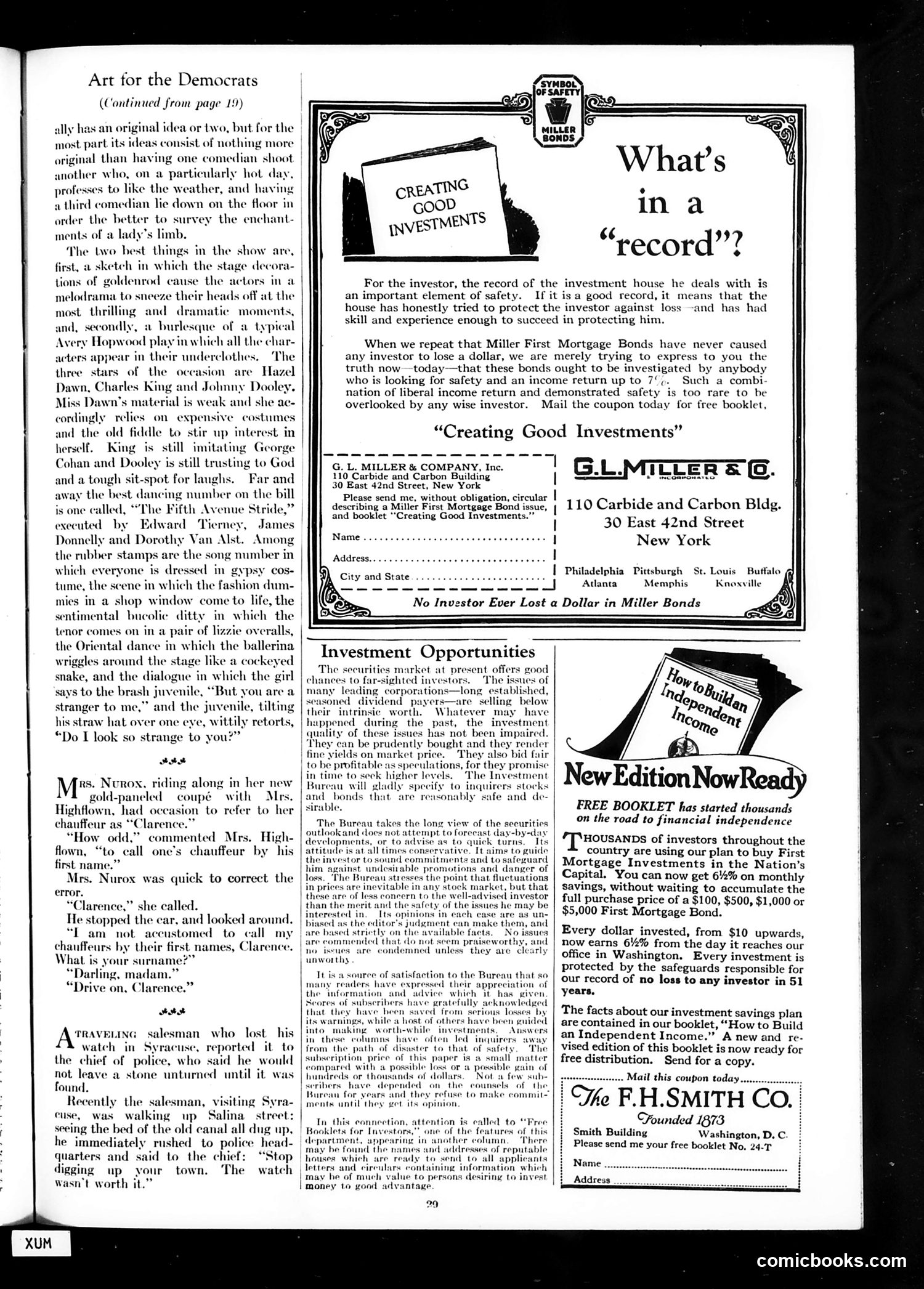
This page combines satirical commentary with period advertising. The main content critiques a Democratic Party theatrical production, offering harsh reviews of performers like Hazel Dawn and Charles King, mocking their reliance on tired comedic tropes (sneezing fits, burlesque, slapstick). The humor also includes a brief anecdote about Mrs. Nurox inadvertently calling her chauffeur by his first name, then discovering his surname is actually "Darling"—satirizing wealthy society women's obliviousness to their servants' identities. The bulk of the page comprises advertisements for investment products: Miller First Mortgage Bonds and F.H. Smith Company's "How to Build an Independent Income" booklet. These ads emphasize safety and reliable returns, typical of early-20th-century financial marketing. The page reflects Judge's dual nature: satirical commentary on contemporary culture and entertainment alongside commercial advertising targeted at affluent readers seeking investment opportunities.
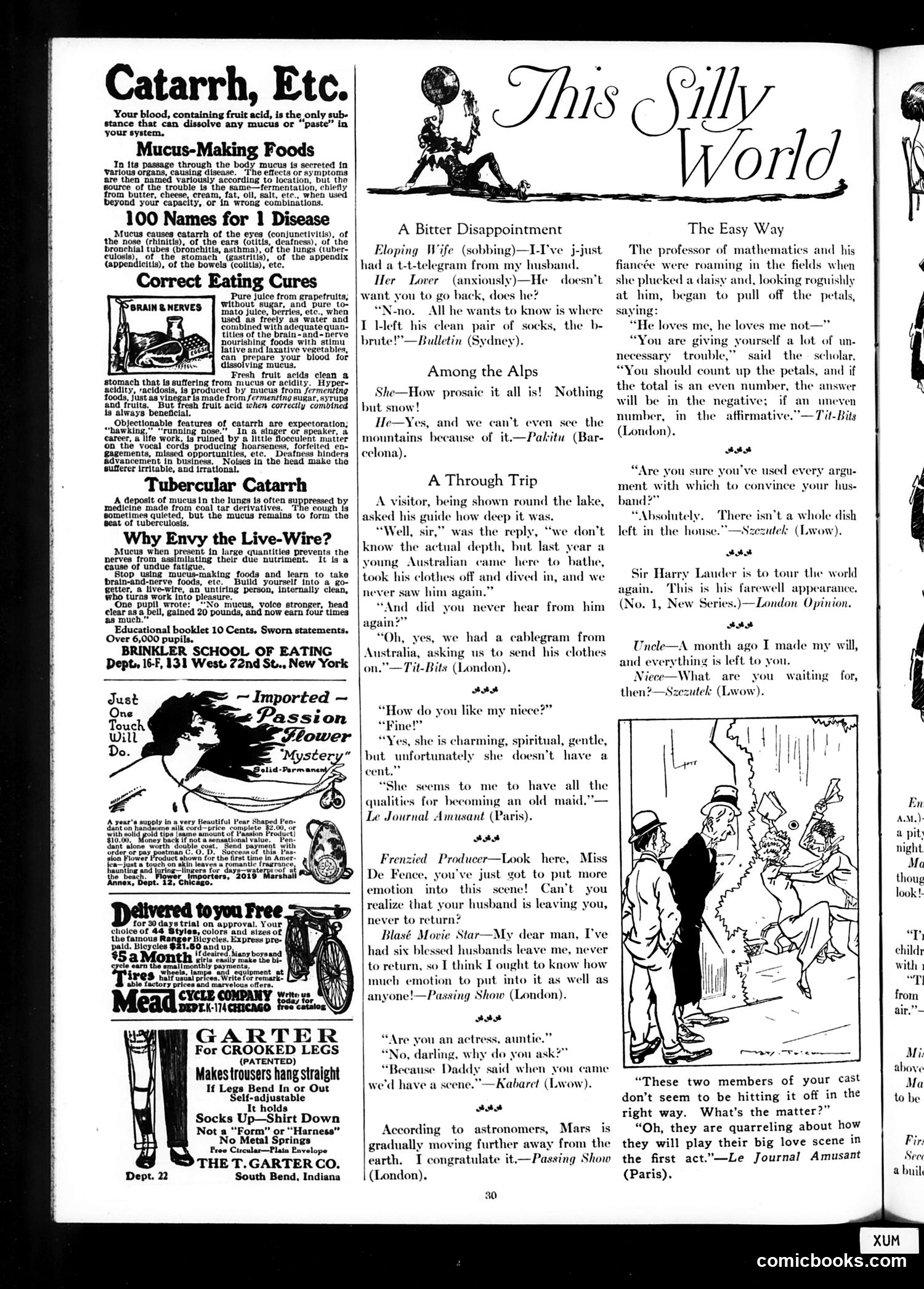
This page is primarily **advertising and humor columns**, not political satire. The left side features health-related advertisements (for eating schools, medical treatments, and orthopedic devices—common early 20th-century pitches). The right side, titled "This Silly World," contains **brief comedic anecdotes** mocking domestic situations: - A wife disappointed her husband left via telegram—but only asking about his socks (satirizing male indifference) - Couples in romantic settings complaining about mundane details (the Alps lacking views, guides giving literal answers) - A comment about an actress's poor stage chemistry These are gentle, universal humor pieces about marriage, romance, and social awkwardness—not political commentary. The cartoons show domestic disputes and mismatched couples. The overall page reflects early-to-mid 20th century attitudes toward gender relations and humor conventions, focusing on relatability rather than satire of specific public figures or events.
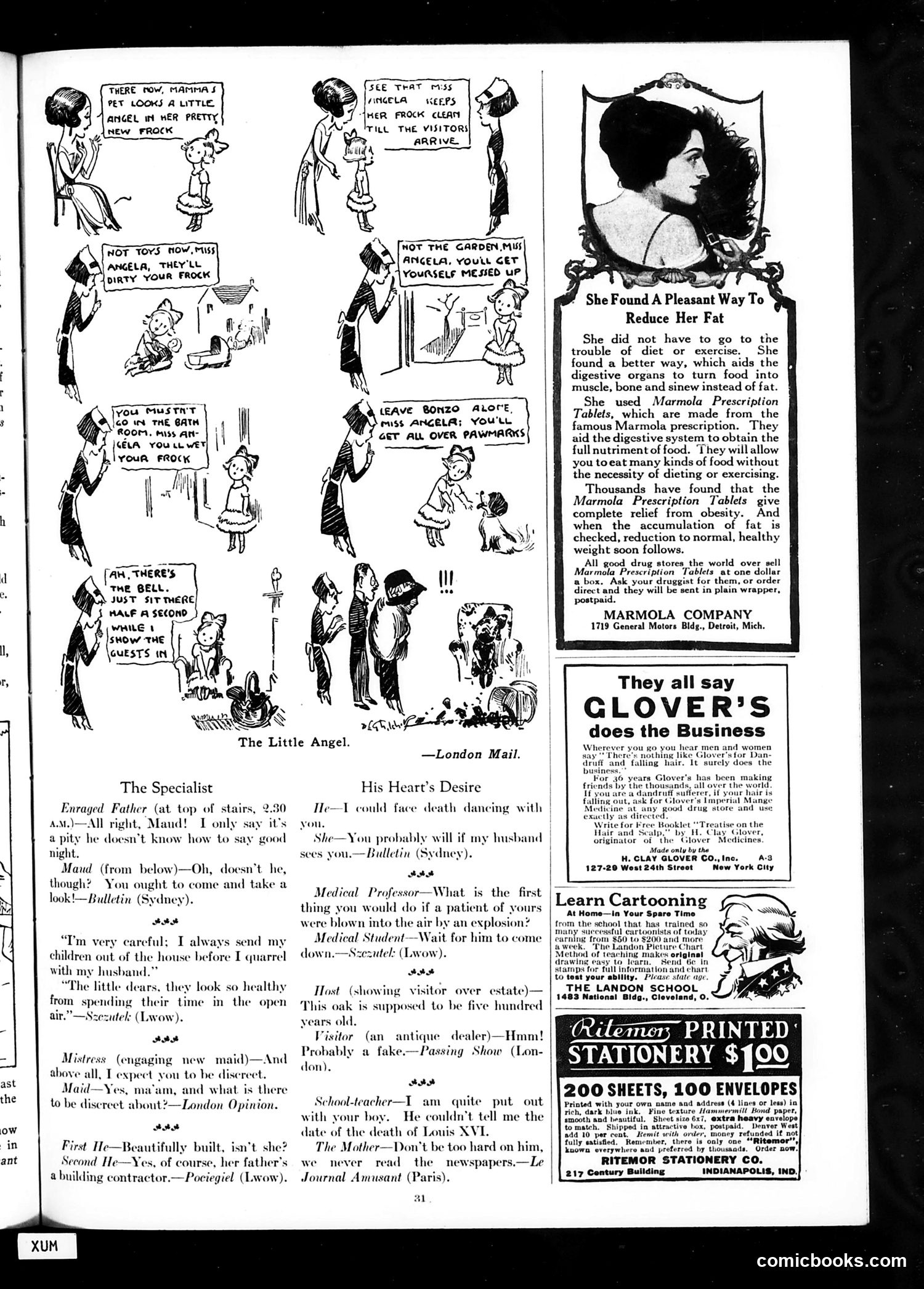
This page contains multiple unrelated comic strips and advertisements typical of early 20th-century satirical magazines. **"The Little Angel"** (top left) depicts a mother instructing her daughter Angela to keep her dress clean for visitors—a gentle satire on class-conscious parenting and children's obedience to social propriety. **"The Specialist" and other joke sections** below feature brief humorous anecdotes about domestic life, marriage, and social awkwardness—common humor topics of the era. The page is primarily **advertising-driven**, featuring prominent ads for: - **Marmola Prescription Tablets** (weight-loss medication) - **Glover's** (hair/scalp treatment) - **Learn Cartooning** (correspondence course) - **Printed Stationery** (office supplies) These ads reflect period concerns: obesity treatments, hair loss remedies, and vocational self-improvement—targets for magazine readers seeking solutions to personal concerns. The layout is typical of Judge's mix of light satirical humor with commercial pitches to middle-class audiences.
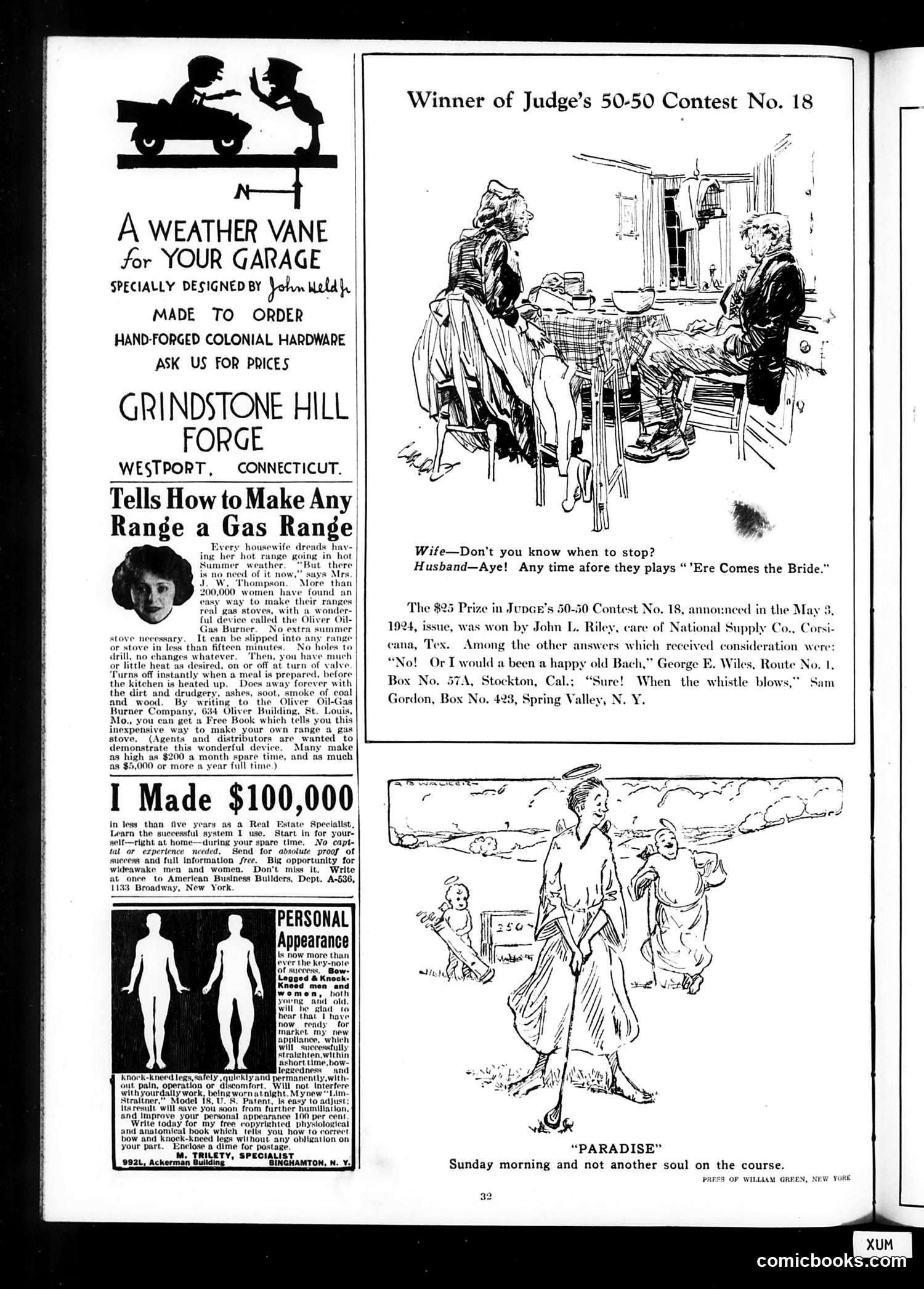
This page from Judge magazine (circa 1924) is primarily **advertising content** with a small cartoon insert. The main cartoon, titled "Winner of Judge's 50-50 Contest No. 18," depicts a domestic scene where a husband and wife are at what appears to be a social gathering or theater. The husband says he'll stop drinking "any time afore they plays 'Ere Comes the Bride'"—a reference to the wedding march. The joke's humor derives from suggesting he'll remain intoxicated through the entertainment until that particular song plays, implying both his current inebriation and the cultural significance of that musical cue. The page also features period advertisements for a weather vane, gas range conversion, real estate courses, and a leg-straightening device—typical commercial pitches in 1920s magazines. The secondary cartoon, "Paradise," shows a woman on a golf course alone, presumably enjoying solitude—a commentary on the emerging leisure activities available to women in the post-WWI era.
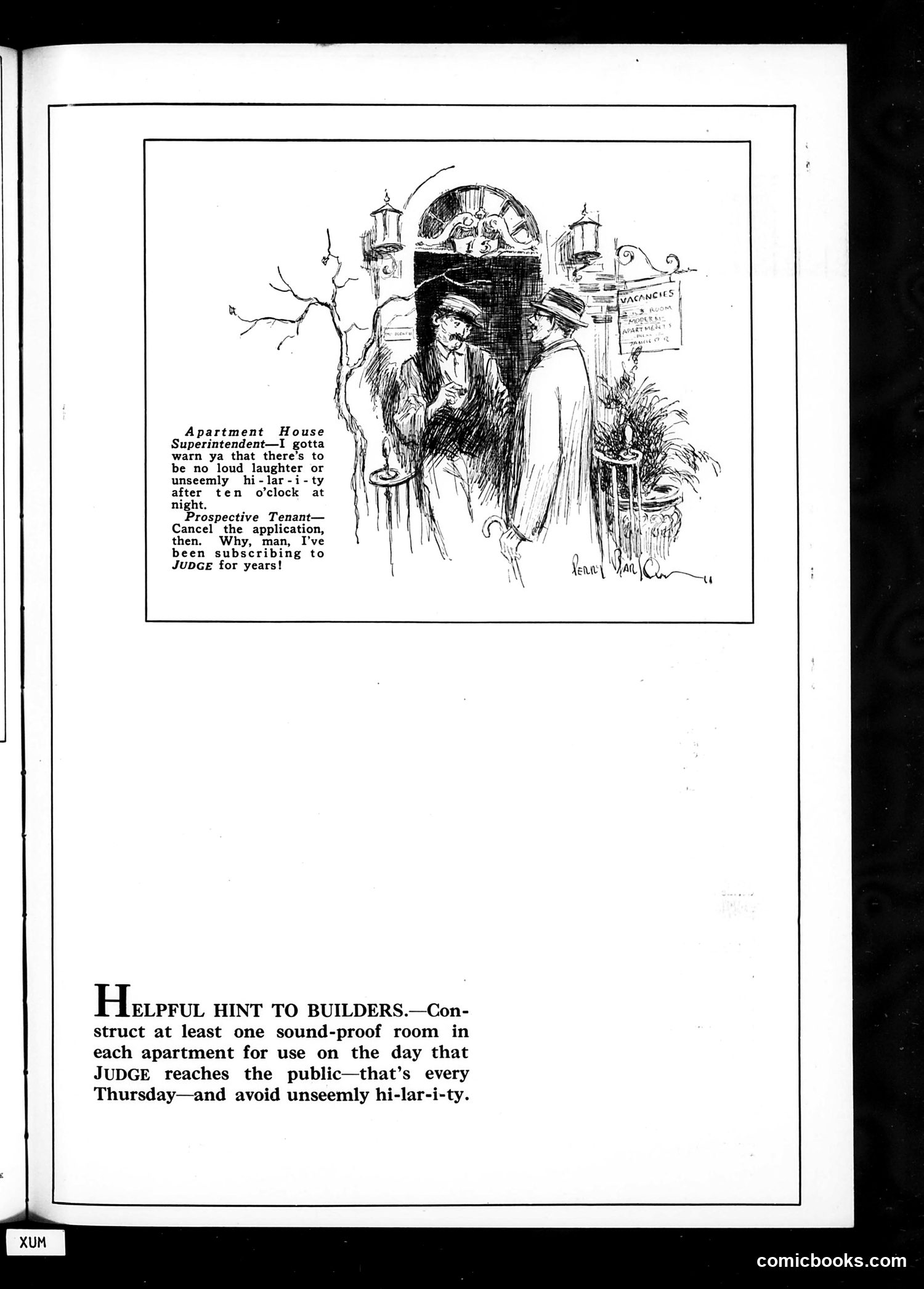
This is a self-promotional cartoon from *Judge* magazine (a satirical weekly published Thursdays). The joke plays on the magazine's reputation for humor: an apartment superintendent warns a prospective tenant about noise restrictions after 10 p.m. The tenant cancels, claiming he's a long-time *Judge* subscriber—implying the magazine is so funny he'll inevitably laugh loudly and violate the rules. The "Helpful Hint to Builders" at the bottom extends the gag sarcastically, suggesting apartment builders should soundproof rooms specifically for Thursdays (when *Judge* publishes) so residents' uncontrollable laughter doesn't disturb neighbors. It's essentially *Judge* boasting about its own comedic quality through self-deprecating humor—a common advertising strategy for the era.
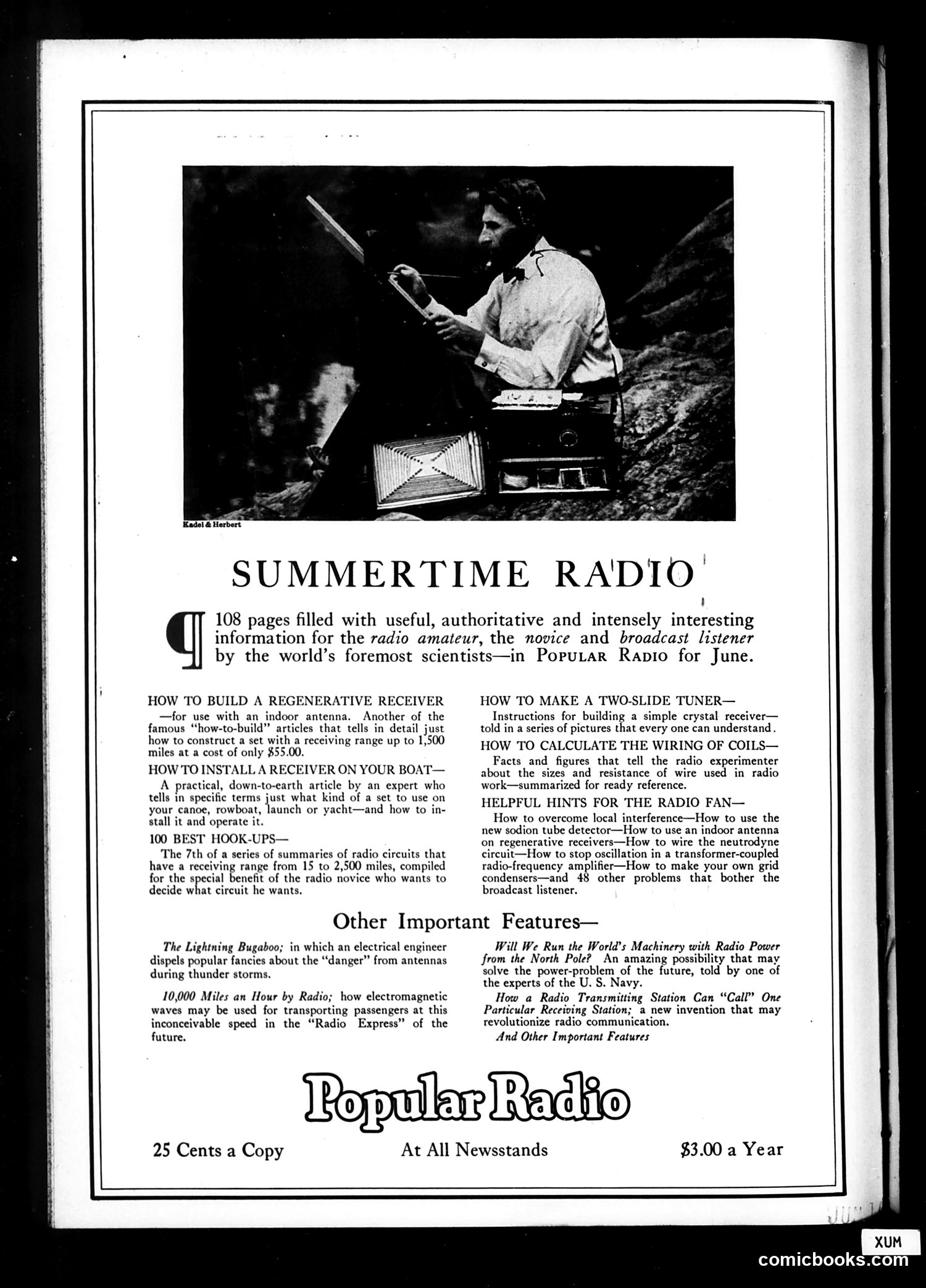
This is primarily a **magazine advertisement**, not a political cartoon. It promotes the June issue of *Popular Radio* magazine. The image shows a man operating early radio equipment outdoors at night, illustrating the "radio amateur" hobby. The advertisement highlights 108 pages of technical content for radio enthusiasts of the 1920s era, when amateur radio was a growing hobbyist movement. Key features advertised include DIY receiver-building instructions, circuits with ranges up to 2,500 miles, and articles on practical applications like boat installation. The futuristic "Other Important Features" reveal period optimism about radio technology—including speculative pieces on transmitting power from the North Pole and using radio waves for transportation. At 25 cents per copy or $3 yearly, this represents mainstream popular science publishing aimed at the expanding radio hobbyist demographic of the era. The content reflects genuine technical interest rather than satire.

I can see this is a page from *Judge* magazine (as indicated by the comicbooks.com watermark and "XUM" identifier), but the image is almost entirely black or severely degraded, making it impossible to discern any cartoon illustrations, text, or satirical content with confidence. The right edge shows faint outlines of what might be decorative patterns or figures, but they're too obscured to identify specific political references, caricatures, or the intended satire. Without legible text or clear imagery, I cannot accurately explain the cartoon's meaning, identify the subjects, or contextualize the joke for a modern reader. A clearer scan would be needed to provide meaningful analysis.