
Judge, 1924-06-14 · page 22 of 37
Judge — June 14, 1924 — page 22: what you’re looking at
What you’re looking at
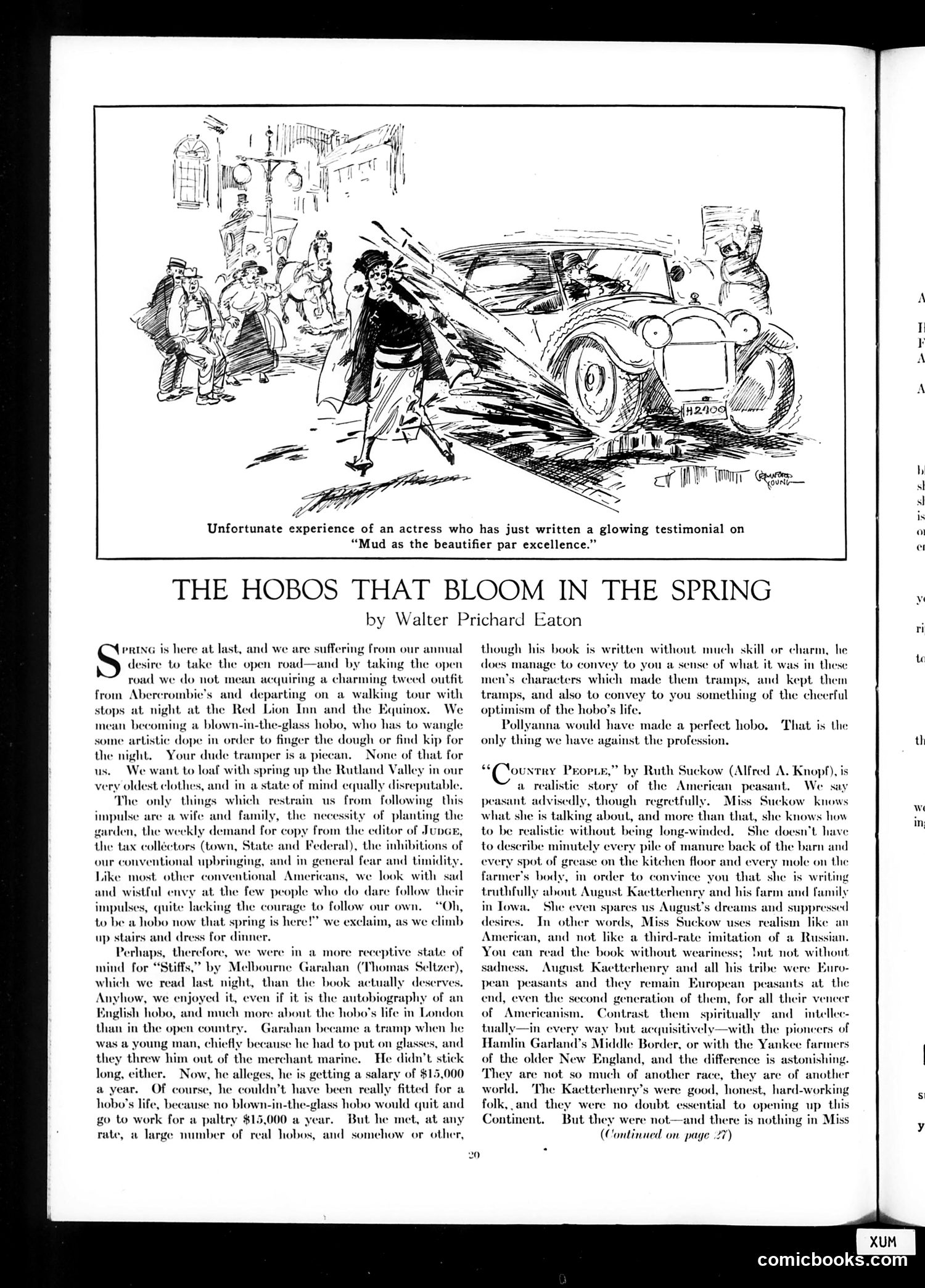
**The Cartoon:** A woman stands covered in mud beside a wrecked automobile, while onlookers gather. The caption explains she had just written a glowing testimonial endorsing "mud as the beautifier par excellence"—and this accident demonstrates the ironic consequences of that endorsement. **The Joke:** This is a straightforward visual pun satirizing celebrity product endorsements. The actress promoted mud as a cosmetic aid, but was then literally and messily "muddied" by a car crash. It mocks both the absurdity of endorsing dubious beauty products and the gap between celebrities' polished public claims and unglamorous reality. **Historical Context:** This reflects early 20th-century skepticism toward advertising testimonials from entertainers—a practice already viewed as ridiculous. The automobile crash adds modern technological humor typical of Judge magazine's era. The page's main article discusses hobo literature, unrelated to the cartoon above it.
📄 Transcribed text from this page (OCR, searchable)
Machine-transcribed from the original scan — historical spelling and the odd misread are preserved.
iii i Unfortunate experience of an actress who has just written a glowing testimonial on “Mud as the beautifier par excellence.” THE HOBOS THAT BLOOM IN THE SPRING by Walter Prichard Eaton PRING is here at last, and we are suffering from our annual S desire to take the open road—and by the open road we do not mean acquiring a charming tweed outfit from Abercrombie’s and departing on a walking tour with stops at night at the Red Lion Inn and the Equinox. We mean becoming a blown-in-the-glass hobo, who has to wangle some artistic dope in order to finger the dough or find kip for the night. Your dude tramper is a piecan. None of that for us. We want to loaf with spring up the Rutland Valley in our very oldest clothes, and in a state of mind equally disreputable. The only which re impulse are a wife and rain us from following this ‘amily, the necessity of planting the garden, the weekly det vd for copy from the editor of Jupce, the tax collectors (tov and Federal), the inhibitic our conventional upbringing, and in general fear and timid Like most other conventional Americans, we look with sad and wistful envy at the few people who do dare follow their impulses, qu cing the courage to follow our own. “Oh, to be a hobo now that spring is here!” we exclaim, as we climb up stairs and dress for dinner. Perhaps, therefore, we were in a more recep mind for “Stiffs,” by Melbourne Garahan (Thi which we read last night, than the book actually deserves. Anyhow, we enjoyed it, even if it is the autobiography of an English hobo, and much more about the hobo’s life in London than in the open country. Garahan became a tramp when he was a young man, chiefly because he had to put on gla they threw him out of the merchant marine. He didn’ rither. Now, he alleges, he is getting a Of course, he couldn’t have been really fitted for a . because no blown-in-the-glass hobo would quit and go to work for a paltry $15,000 a year. But he met, at any rate, a large number of real hobos, and somehow or other, though his book is written without much skill or charm, he does manage to convey to you a sense of what it was in these men’s characters which made them tramps, and kept them tramps, and also to convey to you something of the cheerful optimism of the hobo’s life. Pollyanna would have made a perfect hobo. only thing we have against the profession. That is the “Counter, Prope,” by Ruth Suckow (Alfred A. Knopf), is a realistic story of the Ame pasant, peasant y, though regretfully. what she is t king about, and more than t tlistic without being long-winded. She doesn’t have ribe minutely every pile of manure back of the barn and ¥y spot of grease on the kitchen floor and every mole on the farmer's boily., in ‘ondertoxconvince you that she out August Kui Shiavevent spares. In other words, Suckow knows , she knows how is writing erhenry and his farm and family m of a Russian. an read the book without w but not without s. August Kactterh and all his tribe were Euro- ts and they remain European peasants at the end, even the second generation of them, for all their veneer of Americ Contrast. them spiritually and intellee- tually—in every way but acqu Iy—with the pioneers of Hamlin Garland’s Middle Borde er, or with the Yankee farmers of the older New England, and the difference They are not so much of another race, world. The Kactterhenry’: folk, and they were Continent. nism, astonishing. they are of another 's were good, honest, hard-working no doubt essential to opening up this But they were not—and there is nothing in Miss (Continued on page 27) th wi in; XUM comicbooks.co