
Judge, 1924-06-14 · page 21 of 37
Judge — June 14, 1924 — page 21: what you’re looking at
What you’re looking at
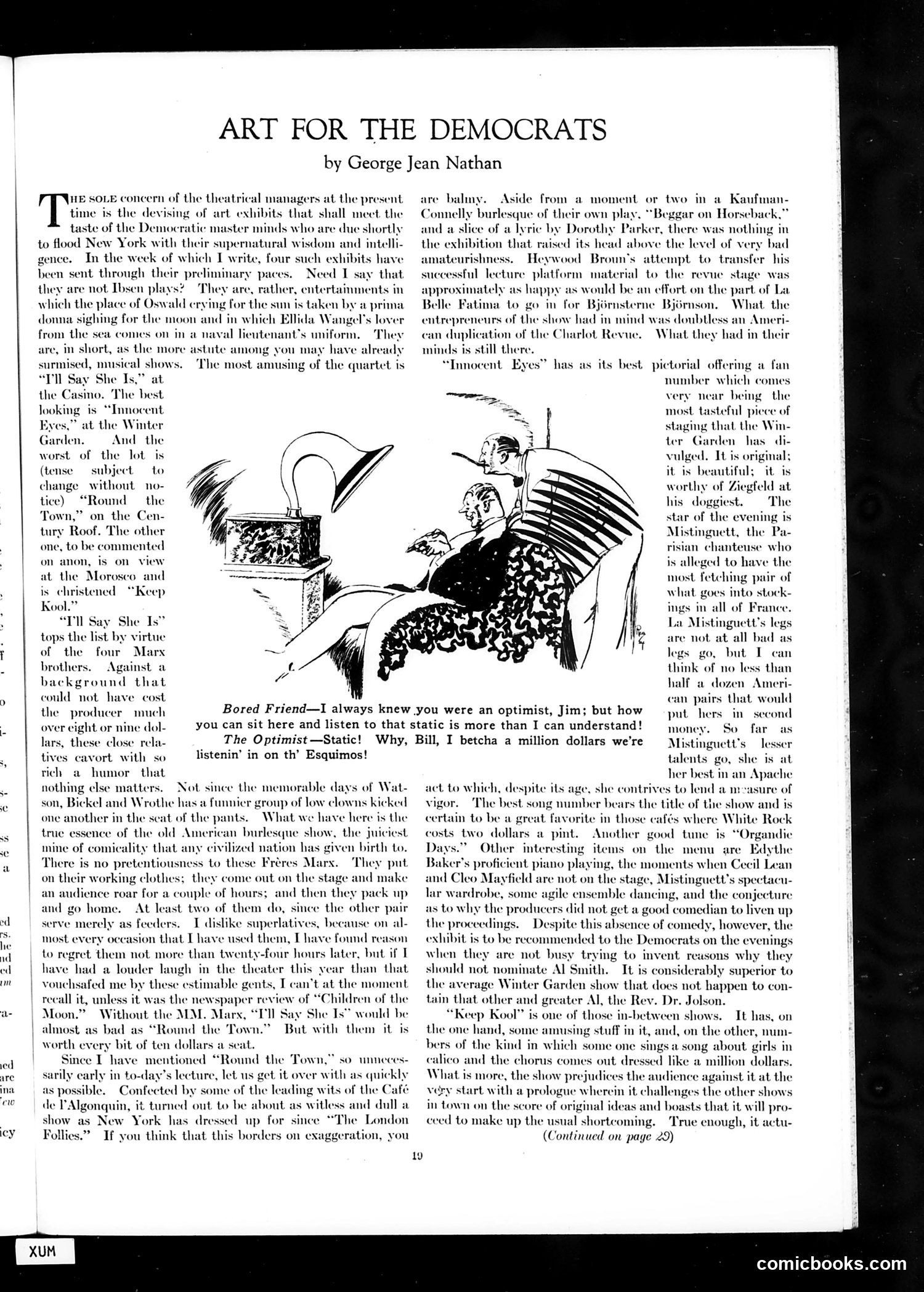
This is George Jean Nathan's theater criticism disguised as political satire. Writing as the Democrats prepare to govern New York, Nathan reviews four new theatrical productions, sarcastically suggesting they're tailored to Democratic tastes. The cartoon depicts a "Bored Friend" and "The Optimist" debating the quality of a radio broadcast—likely satirizing the emerging radio medium's poor entertainment value. Nathan's main targets are specific shows: he praises the Marx Brothers in "I'll Say She Is" as genuinely funny burlesque performers, contrasts this with the aesthetically ambitious but witless "Round the Town" (performed at the Century Roof), and criticizes "Innocent Eyes" and another unnamed show. The satire operates on two levels: mocking Democratic patrons' supposed tastes while also using them as cover for legitimate theater criticism. References to Heywood Broun, Dorothy Parker, and Kaufman-Connelly place this among New York's literary intelligentsia debates. The piece treats political authority cynically—implying Democrats and their "supernatural wisdom" deserve only mediocre entertainment.
📄 Transcribed text from this page (OCR, searchable)
Machine-transcribed from the original scan — historical spelling and the odd misread are preserved.
ART FOR THE DEMOCRATS by George Jean Nathan HE SOLE concern of the theatrical managers at the present time is the devising of art exhibits that shall meet. the taste of the Democratic master minds who are due shortly to flood New York with their supernatural wisdom and intelli- gence. In the week of which I write, four such exhibits have been sent through their preliminary paces. Need I say that they are not Ibsen plays? They are, rather, entertainments in which the place of Oswald crying for the sum is taken by a prima donna sighing for the moon and in which Ellida Wangel’s lover They are, in short, as the more astute among you may have already surmised, musical shows. The most amusing of the quartet is “TI Say She Is,” at the Casino. The best looking is “Innocent from the sea comes on in a naval lieutenant’s uniform, I at the Winter Garde And the worst. of the lot is (tense subject to change without no- tice) “Round — the Town,” on the Cen- tury Roof. The other one, to be commented view at the Morosco and on anon, is on is christened Kool.” “Tl Say She Is” tops the list by virtue of the four Marx brothers. Against a background that could not have cost the producer much over cight or nine dol- these close rela- tives cavort with so rich a humor that nothing else matters. The Optimist —Static! listenin’ in on th’ Esquimos! Not since the memorable days of Wat- son, Bickel and Wrothe has a funnier group of low clowns kicked one another in the seat of the pants. What we have here is the true essence of the old American burlesque show, the juiciest inine of comicality that any civilized nation has given birth to. ed are icy There is no pretentiousness to these Fréres Mars. ‘They put | on their working clothes; they come out on the stage and make an audience roar for a couple of hours; and then they pack up and go home. At least two of them do, since the other pair serve merely as feeders. I dislike superlatives, because on al- most every occasion that I have used them, [have found reason to regret them not more than twenty-four hours later, but if I have had a louder laugh in the th ur than that vouchsafed me by these estimable gents, I can’t at the moment recall it, unless it was the newspap of “Children of the Moon.” Without the MM. Mars She Is" would he almost as bad as “Round the Town.” But with them it is worth every bit of ten dollars a seat. Since I have mentioned “Round the Town,” so umveces- sarily early in to-day’s lecture, let us get. it over with as quickly as possible. Confected by some of the leading wits of the ¢ de Algonquin, it turned out to be about as witless and dull a show as New York has dressed up for since “The Follies.” London If you think that this borders on exaggeration, you Bored Friend—I always knew you were an optimist, Jim; but how you can sit here and listen to that static is more than I can understand! Why, Bill, I betcha a million dollars we're are balmy. Aside from a moment or two in a Kaufman- Connelly burlesque of their own play, “Beggar on Horseback,” and a slice of a lyric by Dorothy Parker, there was nothing in the exhibition that raised its head above the level of very bad amateurishness. Heywood Broun’s attempt to transfer his successful lecture platform material to the revue stage was approximately as happy as would be an effort on the part of La Belle Fatima to go in for Bjirnsterne Bjérnson. What the entrepreneurs of the show had in mind was doubtless an Ameri- can duplication of the Charlot Revue. What they had in their minds is still there. “Innocent Ey ss” has as its best pictorial offering a fan number which comes very near being the most tasteful piece of staging that the Win- ter Garden has di- vulged. It is original; it is beautiful; it is worthy of Ziegfeld at his doggiest. — The star of the evening is Mistinguett, the Pa- risian chanteuse who is alleged to have the most fetching pair of what goes into stock: ings in all of Fra La Mistinguett’s legs are not at all bad as legs go, but I can think of no less than half a dozen Ameri- can pairs that would put hers in second money. So far Mistinguett’s | talents she is at her best in an Apache act to which, despite its age, she contrives to lend a m-vasure of vigor. The best song number bears the title of the show and is certain to be a great favorite in those cafés where White Rock costs two dollars a pint. Another good tune is “Organdie Days.” Other interesting items on the menu are Edythe Baker's proficient piano playing, the moments when Cecil Lean and Cleo M d are not on the stage, Mistinguett’s spectacu- lar wardrobe, some agile ensemble dancing, and the conjecture as to why the producers did not get a good comedian to liven up the proceedings. Despite this absence of comedy, however, the exhibit is to be recommended to the Democrats on the evenings when they are not busy trying to invent reasons why they should not nominate Al Smith. It is considerably superior to the average Winter ‘den show that does not happen to con- tain that other ter Al, the Rev. Dr. Jolson. ” is one of those in-between shows. It has, on the one hand, some amusing stuff in it, and, on the other, num- bers of the kind in which some one sings a song about girls in calico and the chorus comes out dressed like a million dollars. What is more, the show prejudices the audienc as sser gainst it at the very start with a prologue wherein it challenges the other shows in town on the score of original ideas and boasts that it will pro- ceed to make up the usual shortcoming. True cnough, it actu- (Continued on page 29) comicbooks.com