
Judge, 1924-06-14 · page 10 of 37
Judge — June 14, 1924 — page 10: what you’re looking at
What you’re looking at
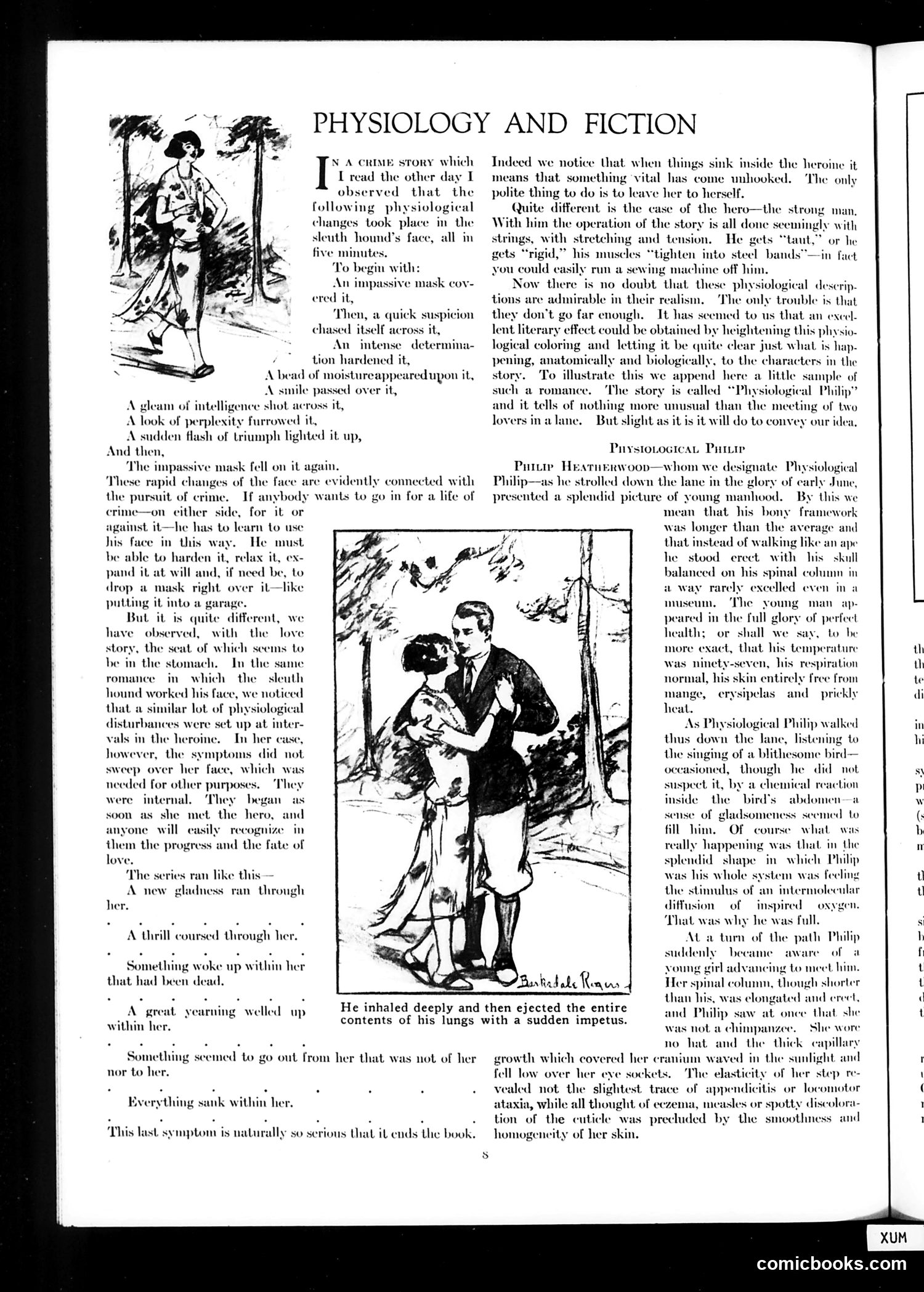
This is a literary satire mocking the overwrought physiological descriptions in contemporary crime and romance fiction. The author ridicules how crime stories obsessively catalog a detective's facial expressions (suspicion, determination, triumph) during investigations, while romance novels describe heroines' *internal* physical sensations (yearning, sinking feelings) since their faces must remain composed for "other purposes." The piece then proposes an absurd solution: include *even more* clinical physiological detail. The accompanying story excerpt, "Physiological Philip," demonstrates this through hilariously pedantic descriptions of a young man—noting his skeleton's exact proportions, his 97-degree temperature, and absence of mange—as he meets a lover in a lane. The satire targets pretentious literary realism and the pseudo-scientific language writers used to convey emotion and character, exposing how such excessive anatomical cataloging becomes ridiculous rather than sophisticated.
📄 Transcribed text from this page (OCR, searchable)
Machine-transcribed from the original scan — historical spelling and the odd misread are preserved.
N A CRIME story which I read the other day I observed that the following physiological changes took place in the sleuth hhound’s face, all in five minutes. To begin with: An impassive mask cov- ered it, Then, a quick suspicion chased itself across it, An intense determina- ‘ tion hardened it, A bead of moistureappeared upon it, ‘A smile passed over it, A gleam of intelligence shot across it, A look of perplexity furrowed it, A sudden flash of triumph lighted it up, And then, The impassive mask fell on it again. These rapid changes of the face are evidently connected with the pursuit of crime. If anybody wants to go in for a life of crime—on either side, for it or against it—he has to learn to use his face in this way. He must be able to harden it, relax it, ex- pand it at will and, if need be, to drop a mask right over it—like putting it into a garage. But it is quite different, we obser with the love y, the seat of which seems to be in the stomach. In the same romance in’ which the sleuth hound worked his face, we noticed that a similar lot of physiological disturbances were set up at inter- vals in the heroine. In her case, however, the symptoms did not sweep over her face, which was needed for other purposes. The were internal. ‘They began as soon as she met the hero, and anyone will easily recognize in them the progress and the fate of ‘The series ran like this — A new gladness ran through her. A thrill coursed through her. Something woke up within her that had been dead. A great’ yearning welled up within her. Something seemed to go out from her that was not of her nor to her. Everything sank within her. ‘This last symptom is naturally so serious that it ends the book. PHYSIOLOGY AND FICTION He inhaled deeply and then ejected the entire contents of his lungs with a sudden impetus. Indeed we notice that when things sink inside the heroine it means that something ‘vital has come unhooked. ‘The only polite thing to do is to leave her to herself, Quite different is the case of the hero—the strong man, With him the operation of the story is all done seemingly with strings, with stretching and tension. He gets or he gets “rigid,” his muscles “tighten into steel bands”—in fact you could easily run a sewing machine off him. Now there is no doubt that these physiological descrip. tions are admirable in their realism. The only trouble is that they don’t go far enough. It has seemed to us that an excel- lent literary effect could be obtained by heightening this physio- logical coloring and letting it be quite clear just w is hap- pening, anatomically and biologically, to the characters in the story. To illustrate this we append here a little sample of such a romance. The story is called “Physiological Philip” and it tells of nothing more unusual than the meeting of two lovers inalane. But slight as it is it will do to convey our idea, Pnystovocican Purr Putt HeatueERwoop—whom we designate Physiological Philip—as he strolled down the lane in the glory of early June, presented a splendid picture of young manhood. By this we mean that his bony framework was longer than the average and that instead of walking like an ape le stood erect’ with his skull balanced on his spinal column in a way rarely excelled even in a museum, The young man ap- peared in the full glory of perfect health; or shall we say, to be more exact, that his temperature was ninety-seven, his respiration normal, his skin entirely free from mange, erysipelas and _ prickly Physiological Philip walked down the lane, listening to iging of a blithesome bird— sioned, though he did not suspeet it, by a chemical reaction inside the bird's abdomen—a sense of gladsomeness scemed to fill him, Of course what was really happening was that in the splendid shape in’ which Philip was his whole system was fecli the stimulus of an intermolecular diffusion of — inspired — oxyget ‘That was why he was full. Ata turn of the path Philip suddenly became aware of a young girl advancing to meet him. Her spinal columm, though shorter than his, was clongated and erect, and Philip saw at once that she was not a chimpanzee. no hat and the thick capillary growth which covered her cranium waved in the sunlight and fell low over her eye sockets. The elasticity of her step re- vealed not the slightest. tr of appendicitis or locomotor ataxia, while all thought of eczema, measles or spotty discolora- tion of the cuticle was precluded by the smoothness and homogeneity of her skin. She wore comicbooks.com