
Judge, 1924-06-14 · page 9 of 37
Judge — June 14, 1924 — page 9: what you’re looking at
What you’re looking at
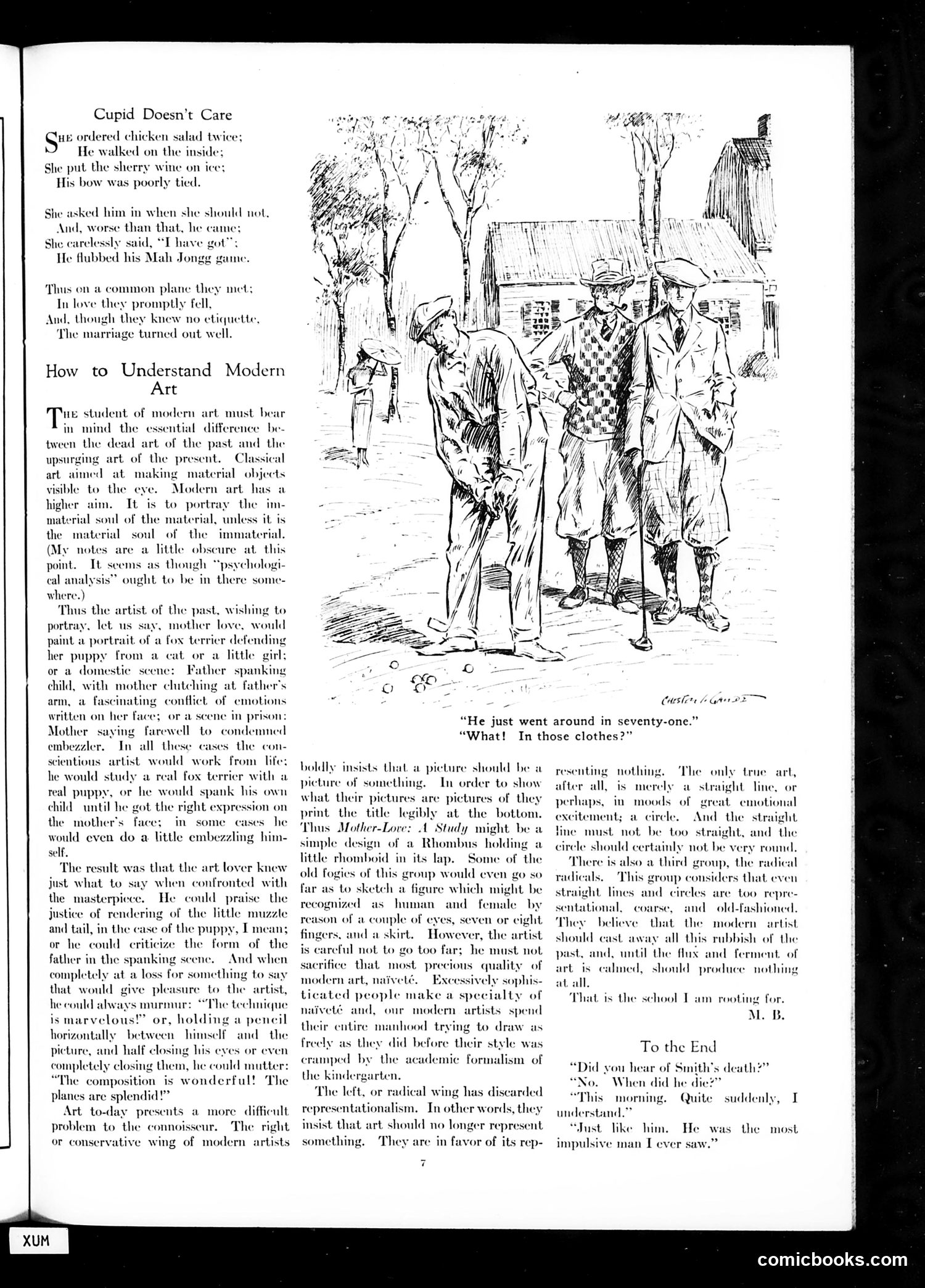
This page contains two satirical pieces mocking early 20th-century artistic and social trends. **"Cupid Doesn't Care"** is a humorous poem about a couple who violate social etiquette—she serves sherry incorrectly, he walks on the wrong side, neither knows Mah Jongg—yet their marriage succeeds anyway. The joke satirizes rigid social rules by suggesting love transcends proper manners. **"How to Understand Modern Art"** is the more pointed satire. It mocks the pretentiousness surrounding modernist art movements. The author ridicules both "conservative" modernists (who paint recognizable objects like "a Rhombus holding a little rhomboid") and "radical" modernists (who reject representation entirely, favoring only straight lines and imperfect circles). The piece lampoons art criticism itself—the pseudo-intellectual jargon ("the planes are splendid!") collectors use when confronting incomprehensible work. The satire suggests modernism is either childishly simple or deliberately obscurantist, designed to confuse rather than enlighten.
📄 Transcribed text from this page (OCR, searchable)
Machine-transcribed from the original scan — historical spelling and the odd misread are preserved.
Cupid Doesn’t Care Sv ordered chicken salad twice w He walked on the inside She put the sherry wine on i His bow was poorly tied. She asked him in when she should not, And, worse than that, he came; She carelessly said, “T have got”: He flubbed his Mah Jongg game. Thus on a common plane they met; In love they promptly fell, And, though they knew no etiquette, The marriage turned out well. How to Understand Modern Art ue student of modern art: must bear in mind the essential difference be- tween the dead art of the past and the upsurging art of the present. Classical art aimed at making material objects visible to the eye. Modern art has a higher aim. It is to portray the im- material soul of the material, unless it is the om soul of the immaterial. (My notes are a little obscure at this point. It seems as though “psychologi- cal analysis” ought to be in there some- where.) Thus the artist of the past, wishing to portray, let us say, mother love, would paint a portrait of a fox terrier defending her puppy from a cat or a little girl; or a domestic scene: Father spanking child, with mother chitching at father’s arm, a fascinating conflict of emotions written on her Cay Mother say embezz! or a scene in prison: ig farewell to condemned In all these cases the con- scientious artist. would work from life: he would study a real fox terrier with a real puppy, or he would spank his own child until he got the right expression on the mother’s face; in some would even do a little embezzling him- self. The result was that the art lover knew just what to say when confronted with the masterpiece. He could praise the justice of rendering of the little muzzle and tail, in the case of the puppy, I mean; or he could criticize the form of the father in the spanking scene. And when completely at a loss for something te that would » pleasure to the he could always murmur: cases he st, The technique is marvelous!” or, holding a pencil horizontally between himself and the picture, and half closing his eves or even completely closing them, he could mutter: “The composition is wonderful! The planes are splendid!” Art to-day presents a more difficult problem to the connoisseur. The right or conservative wing of modern artists Cuslin / Gane “He just went around in seventy-one.” “What! boldly insists that a picture should be a picture of something. In order to show what their pictures are pictures of they print the title legibly at the bottom. Thus Mother-Love: A Study might be a simple design of a Rhombus holding a little rhomboid in its lap. Some of the old fogies of this group would even go so far as to sketch a figure which might be recognized as human and female by reason of a couple of eyes, seven or cight fingers, and a skirt. However, the artist ii reful not to go too he must not sacrifice thal most precious quality of modern art, naivelé. Excessively sophis- icated people make a specialty of and, our modern artists spend their entire manhood trying to draw as freely as they did before their style was the academic formalism of the kindergarten, The left, or radical wing has discarded representationalism. In other words, they insist that art should no longer represent something. They are in favor of its rep- cramped by In those clothes?” resenting nothing. The only true art, afte a straight line, or perhaps, in moods of great emotional xcitement; a circle. And the straight 1¢ must not be too st ty and the circle should certainly not be very round. all, is merely There is also a third group, the radical radicals. This group considers that even straight lines and circles are too repre- sentational, coarse, and They that the modern artist should cast away all this rubbish of the past. and, until the flux and ferment. of art is calmed, should) produce nothing at all. That is the school Tam rooting for. M. B. old-fashioned. believ To the End “Did you hear of Smith's death?” “No. When did he di “This morning. Quite understand.” “Just like him. He was iinpulsive mun Tever saw.” suddenly, I the most comicbooks.com