
A complete issue · 36 pages · 1923
Judge — July 21, 1923
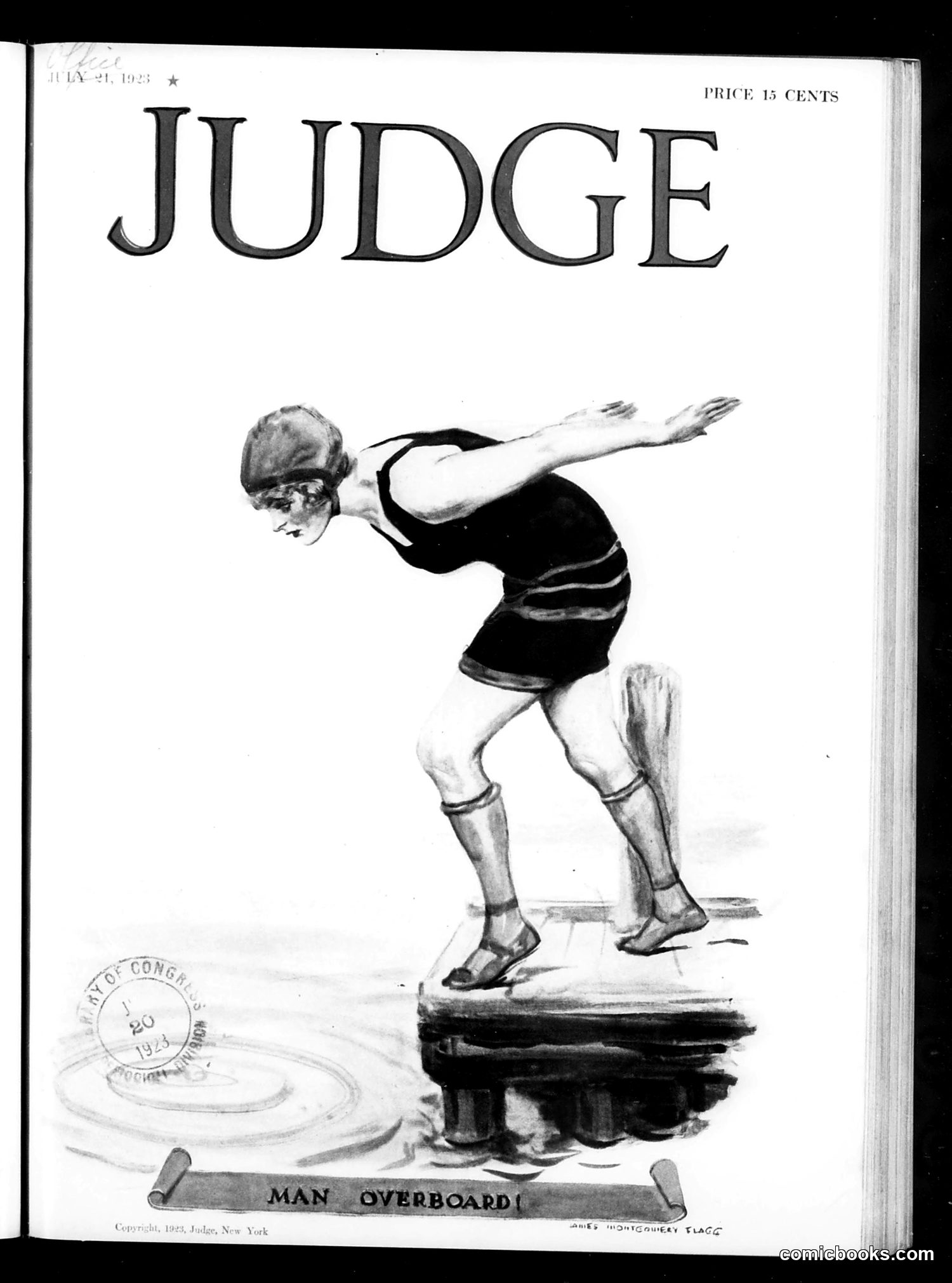
This cover depicts a man diving or falling forward from a diving board, titled "Man Overboard!" The illustration is a satirical commentary on political or economic instability—likely referencing either a public figure or broader social upheaval of the 1920s era. The "overboard" metaphor typically signified someone losing control, falling from power, or abandoning ship during crisis. Without additional context from the magazine's interior, the specific target isn't entirely clear, though 1924 was marked by political transitions and economic concerns in America. The athletic, dynamic illustration style was typical of Judge's visual satire. The composition emphasizes the dramatic fall, reinforcing the sense of loss of control or unexpected downfall the cartoonist intended to convey.
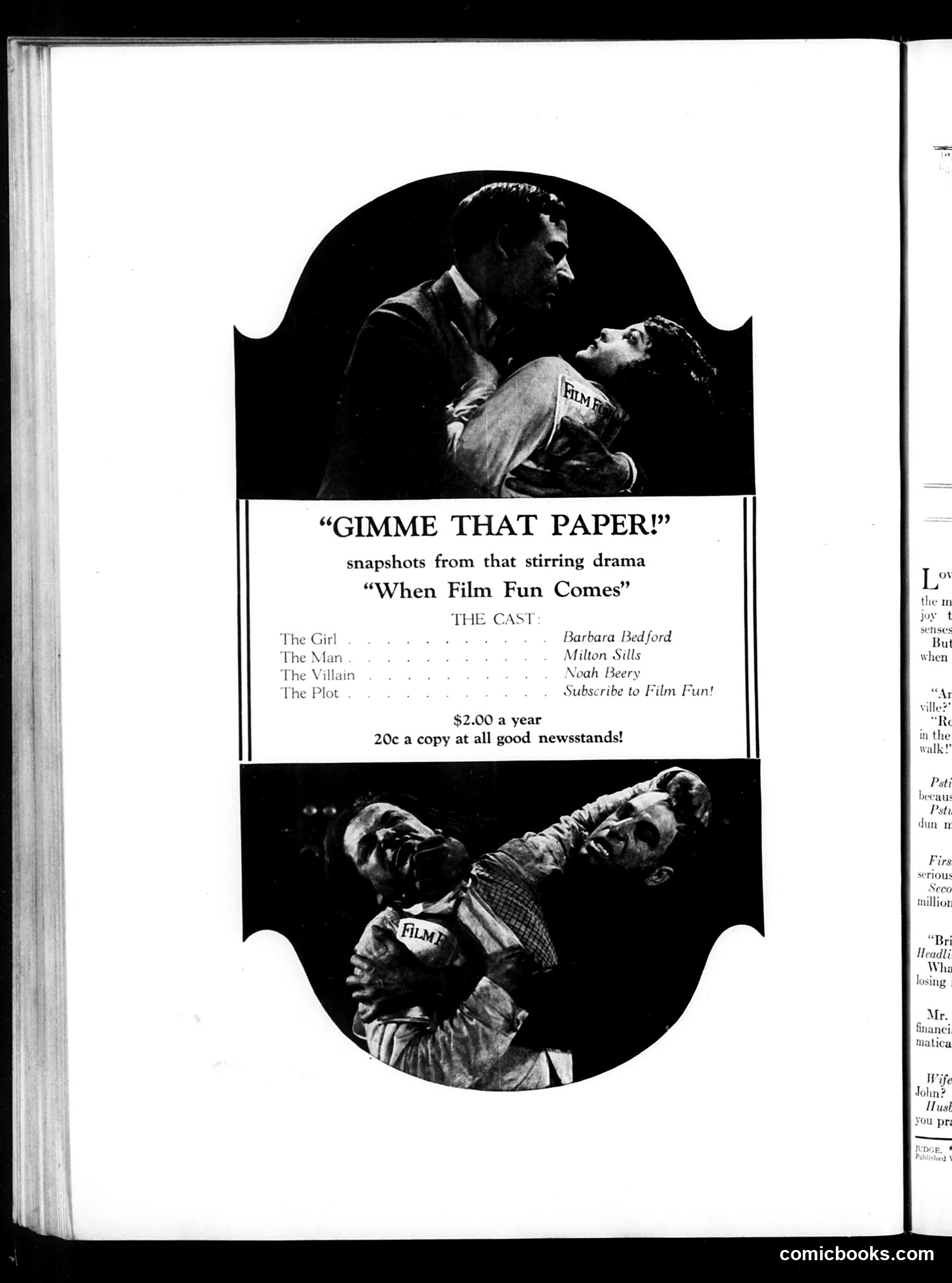
This is primarily **advertising content**, not a political cartoon. The page promotes a magazine called "Film Fun" with the headline "Gimme That Paper!" featuring snapshots from a film called "When Film Fun Comes." The cast list includes Barbara Bedford, Milton Sills, and Noah Beery. The advertisement emphasizes Film Fun's affordability ($2.00 yearly subscription, 20 cents per copy at newsstands) and uses dramatic black-and-white film stills to attract readers. The two photos show what appear to be dramatic scenes from the silent film being promoted. This represents early 20th-century fan magazine marketing, targeting audiences eager for cinema content and celebrity gossip during Hollywood's silent era.
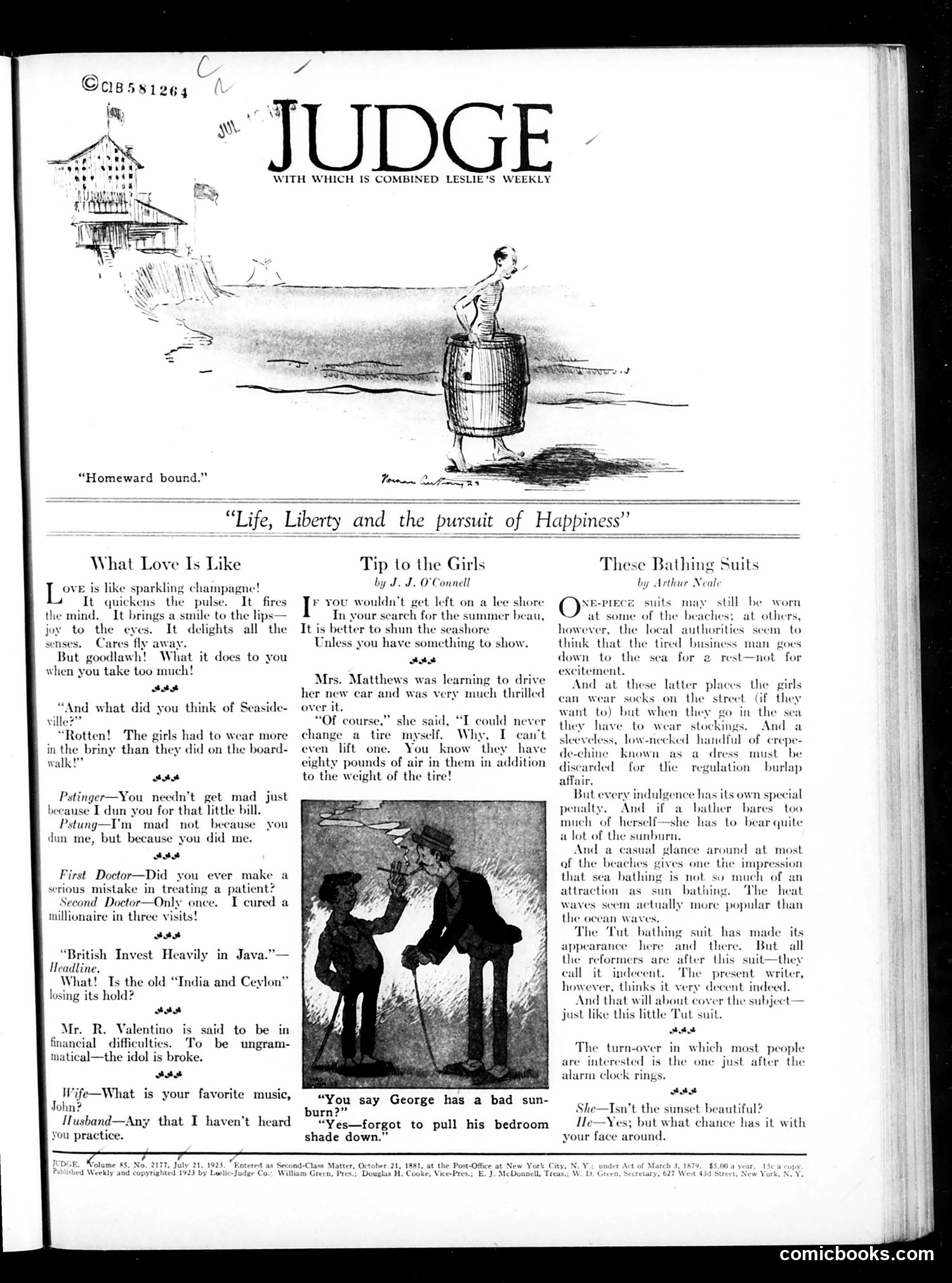
The main cartoon depicts a man standing inside a large barrel, gazing toward a distant house. The caption "Homeward bound" is ironic—the figure appears trapped or confined rather than freely traveling home. This likely satirizes economic hardship or financial constraint preventing someone from returning home. Given Judge's 1920s publication date and the barrel imagery, it may reference post-WWI economic difficulties, Prohibition-era financial struggles, or the general economic anxiety of the period. The man's wistful expression contrasts with his literal confinement, suggesting the satirical point: desires for home and normalcy are thwarted by external circumstances beyond individual control. The barrel could represent financial limitations, debt, or other societal constraints keeping working people immobilized.
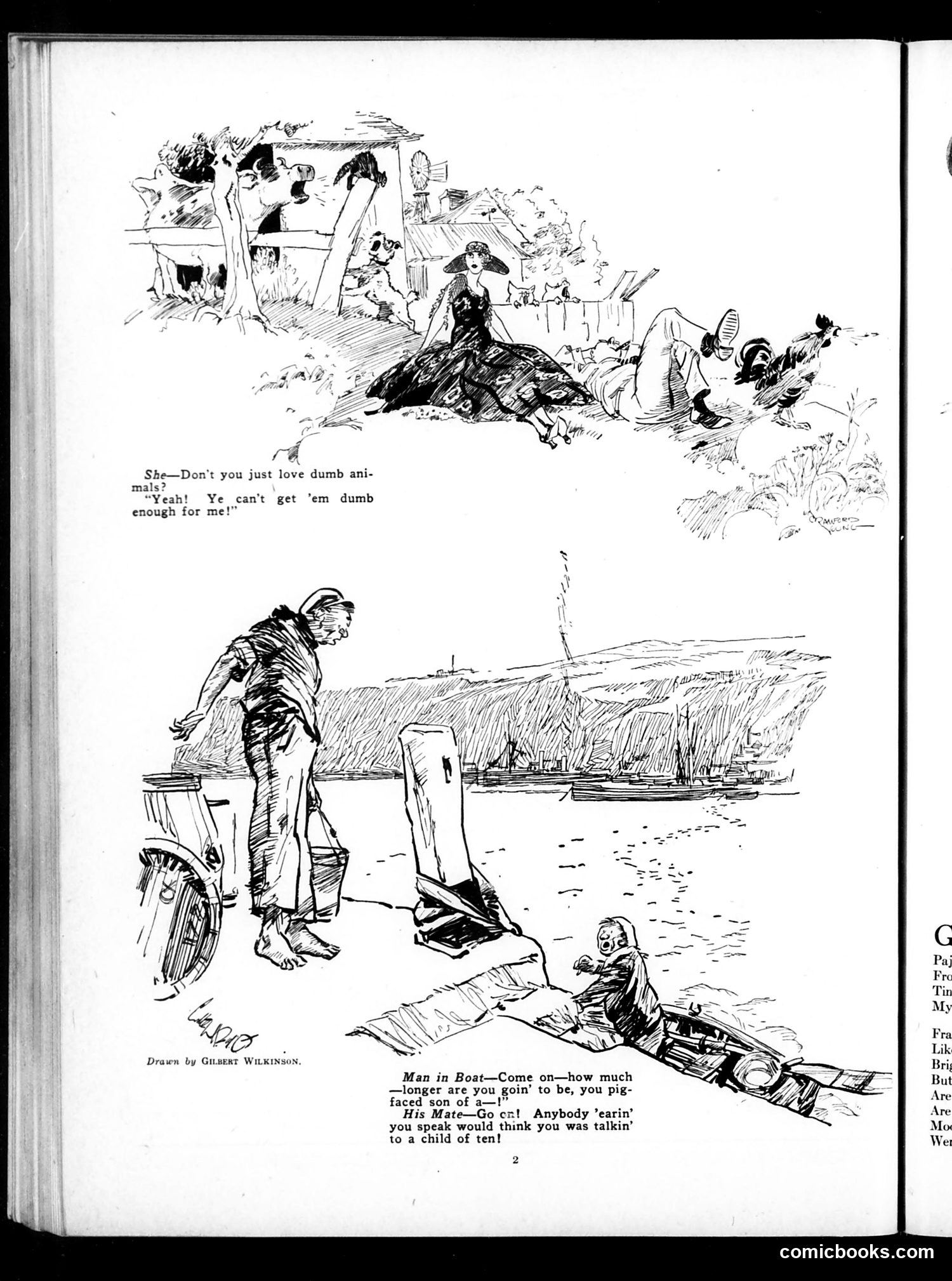
This page contains two separate cartoons by Gilbert Wilkinson satirizing rural/working-class speech and behavior. **Top cartoon:** A woman complains about acquiring "dumb animals," saying "Ye can't get 'em dumb enough for me!" The scene shows a farmyard with various people and animals, mocking rustic dialect and the difficulty of finding sufficiently unintelligent livestock or perhaps servants. **Bottom cartoon:** A man in a boat addresses another man on shore using exaggerated dialectal speech ("How much longer ye goin' to be, you pig-faced son of a—!"). His companion responds in equally crude vernacular. The cartoon ridicules working-class waterfront speech patterns and manners. Both cartoons employ heavy dialect humor and class-based mockery typical of early 20th-century American satire, presenting rural/working-class figures as crude and intellectually inferior for comedic effect.
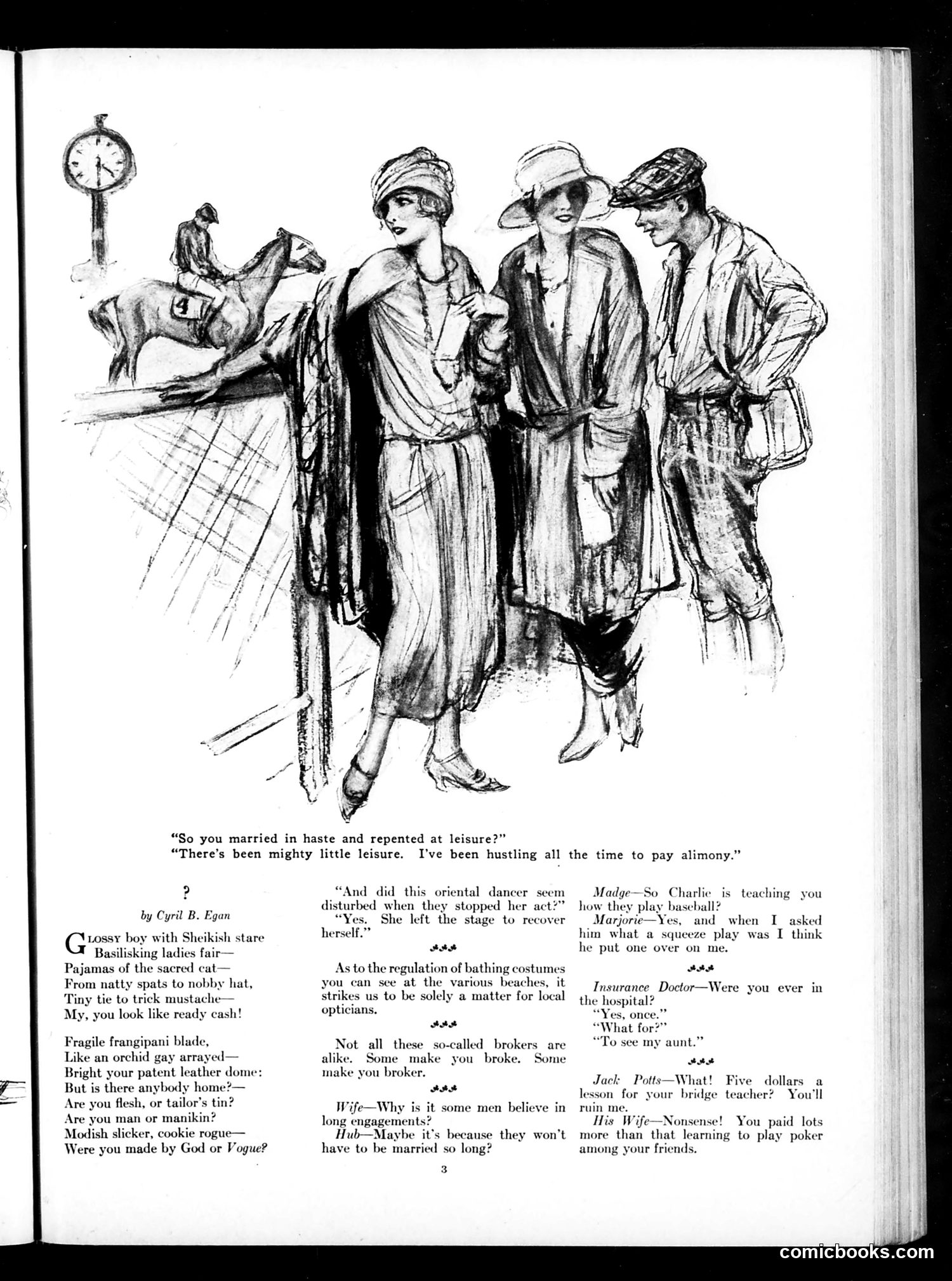
This page from *Judge* magazine features a satirical cartoon about marriage and divorce. The illustration shows three fashionably dressed women and a man at what appears to be a social gathering, with a horse and rider visible in the background (suggesting an upscale venue). The accompanying text mockingly addresses the opening line: "So you married in haste and repented at leisure?" The response reveals marital discord—the speaker has spent time "hustling all the time to pay alimony," suggesting divorce and financial obligation. The lower section contains humorous vignettes about social issues: bathing costume regulations, dubious financial brokers, and long engagements. The overall tone satirizes modern urban life, financial instability, and marital instability among the wealthy class during what appears to be the early 20th century.
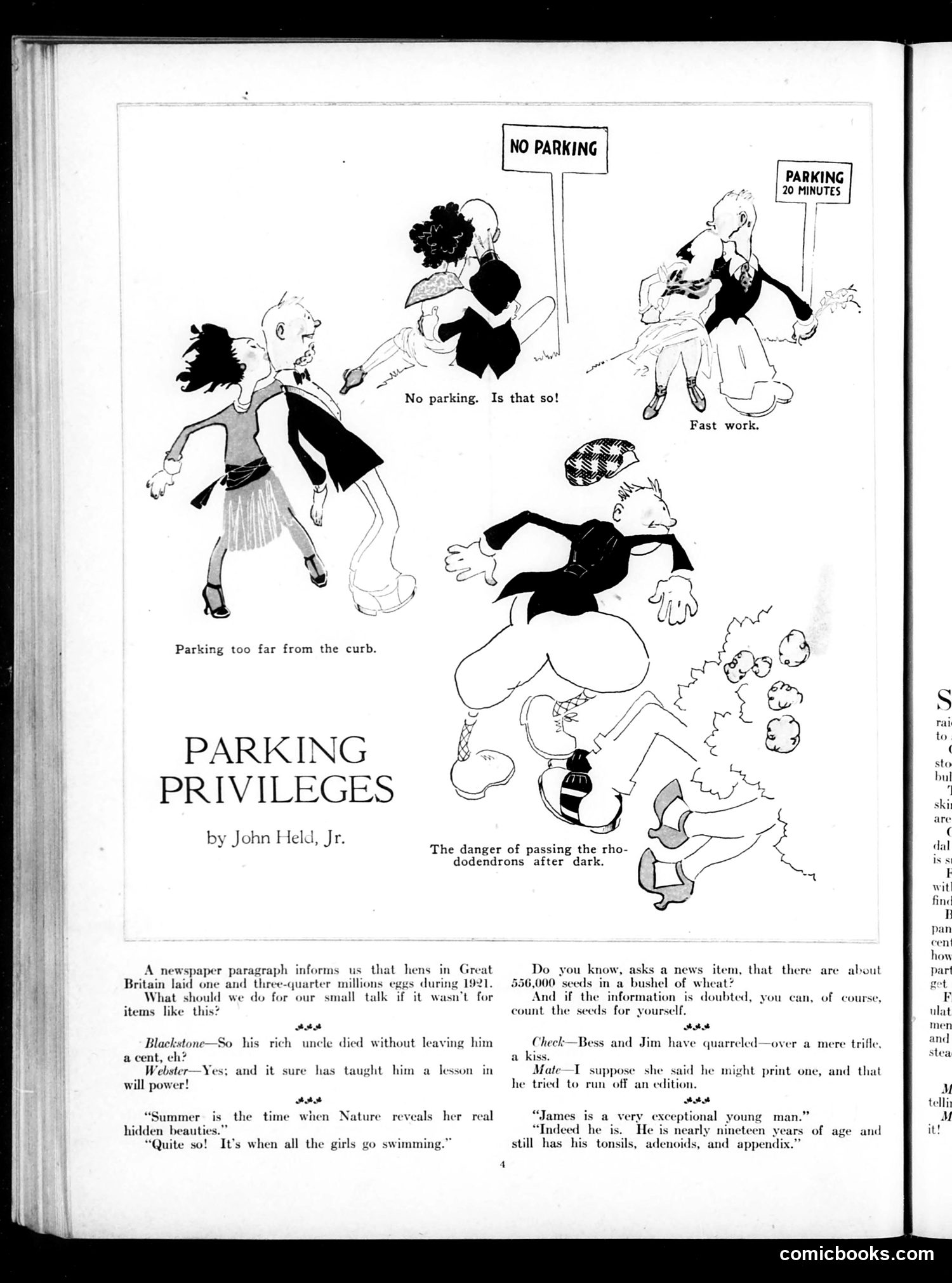
This satirical cartoon mocks the social chaos created by new automobile parking regulations. The illustration shows various characters violating parking rules with humorous consequences: - A couple parks illegally ("too far from the curb"), resulting in physical comedy - Someone misreads "No Parking" as permission - Another character attempts rapid parking to beat time restrictions - The bottom scene depicts dangerous nighttime traffic hazards The cartoon's humor relies on depicting parking violations as absurdly consequence-laden—physical mishaps, confusion, and danger. This suggests early 1920s urban frustration with increasingly strict automobile parking ordinances in American cities. Held's distinctive style (exaggerated figures, dynamic compositions) emphasizes the social disruption caused by modern traffic management, presenting parking regulations as an unwelcome imposition on leisure and mobility.
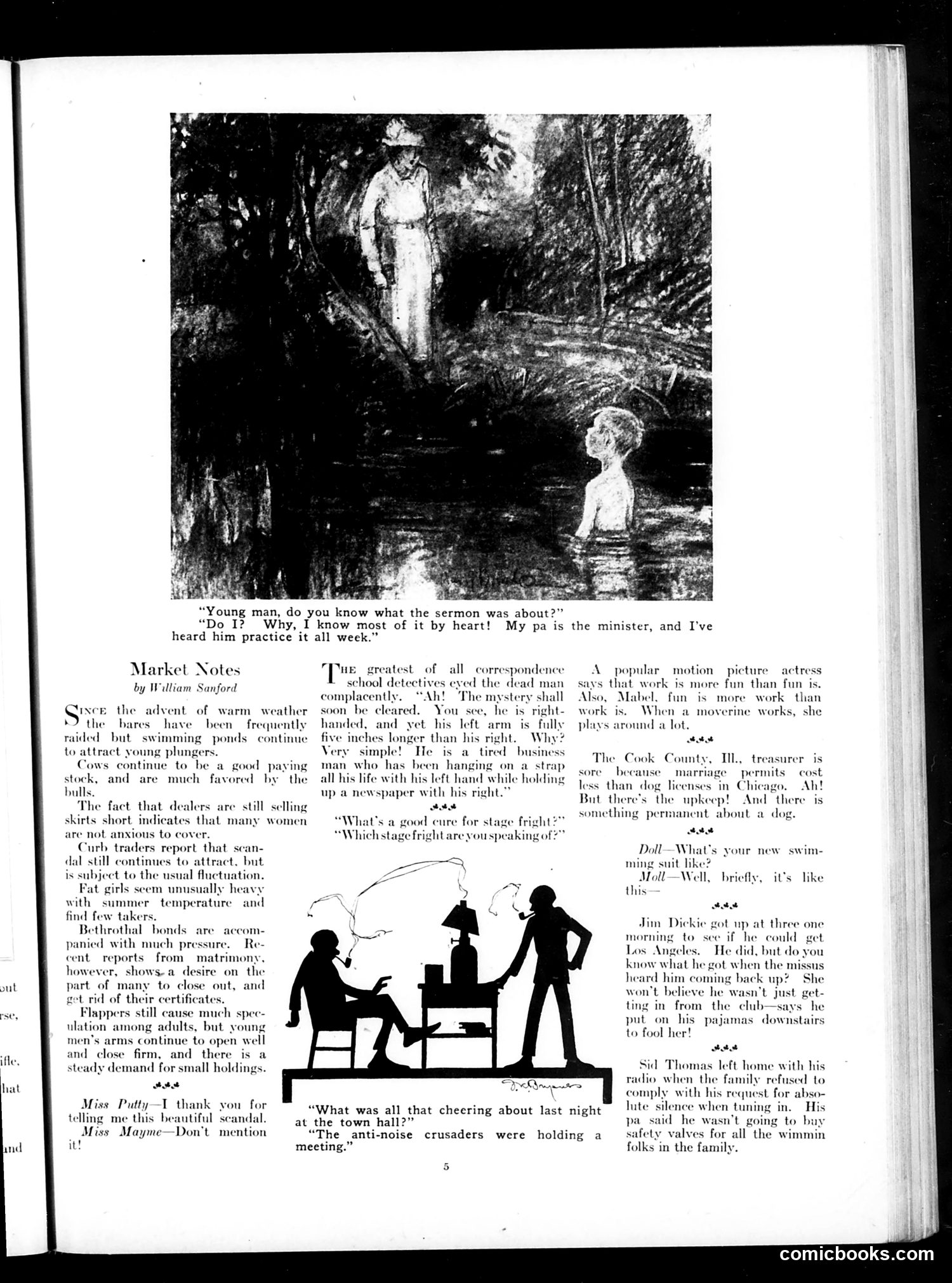
This page from Judge magazine (circa 1920s based on references) contains satirical commentary on contemporary social trends rather than partisan politics. **The main cartoon** depicts silhouettes of three figures—two seated, one standing—at what appears to be a town meeting. The caption mocks "anti-noise crusaders" holding a meeting, which is itself ironic since meetings generate noise. **"Market Notes" section** offers lighthearted social satire: swimming pools attract "young plungers"; women's short skirts indicate reluctance to cover; "scandal" fluctuates like stock prices; flappers cause concern among adults; and marriage bonds involve "pressure" while people seek to "close out" their certificates—treating matrimony as a financial transaction. **Other jokes** satirize modern life: a motion picture actress who finds work more fun than fun; a treasurer's complaint that dog licenses cost more than marriage permits (implying dogs are more valuable); and a husband pretending to arrive home from a radio broadcast rather than admitting he was listening to the radio all night. The humor reflects post-WWI anxieties about changing social norms, particularly regarding women's liberation and modern technology's disruption of family life.
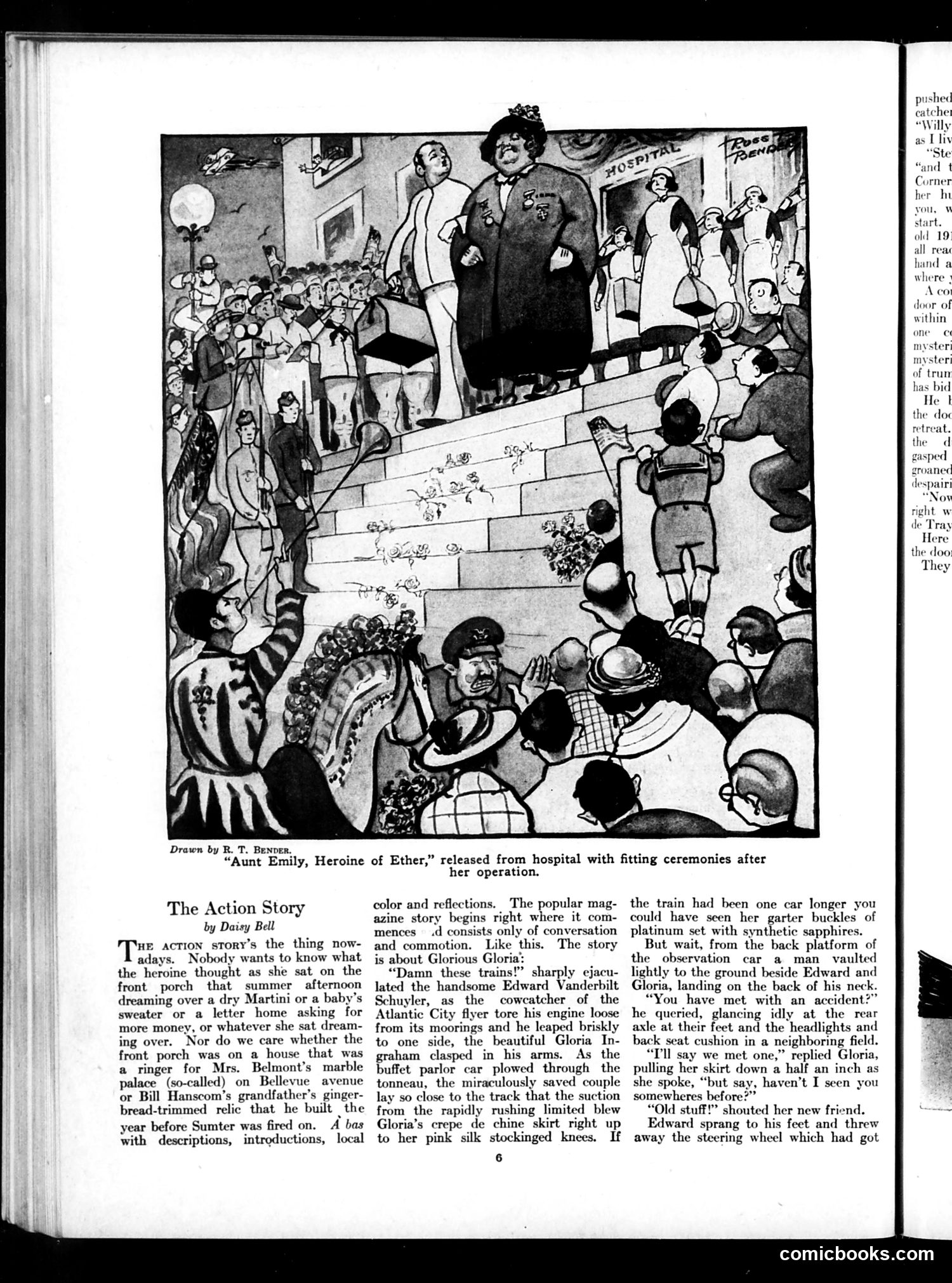
This page satirizes the formulaic "action story" genre popular in early 20th-century magazines. The author Daisy Bell mockingly critiques how modern stories have abandoned psychological depth—what characters think or feel, descriptions of settings—in favor of pure sensationalism and rapid-fire dialogue. The accompanying illustration by R.T. Bender depicts the absurd climax: a train accident where the beautiful Gloria is miraculously rescued by handsome Edward Vanderbilt Schuyler, observed by crowds. The satire intensifies with the sample story text, which piles on melodramatic clichés: aristocratic names, implausibly timed rescues, and oddly specific details (platinum garters with "synthetic sapphires") designed to titillate rather than inform. The joke is that in pursuing pure action and novelty, such stories become ridiculous—prioritizing brief skirt-lifting moments and convenient coincidences over narrative coherence or character development. It's a critique of sensationalism masquerading as modern storytelling.
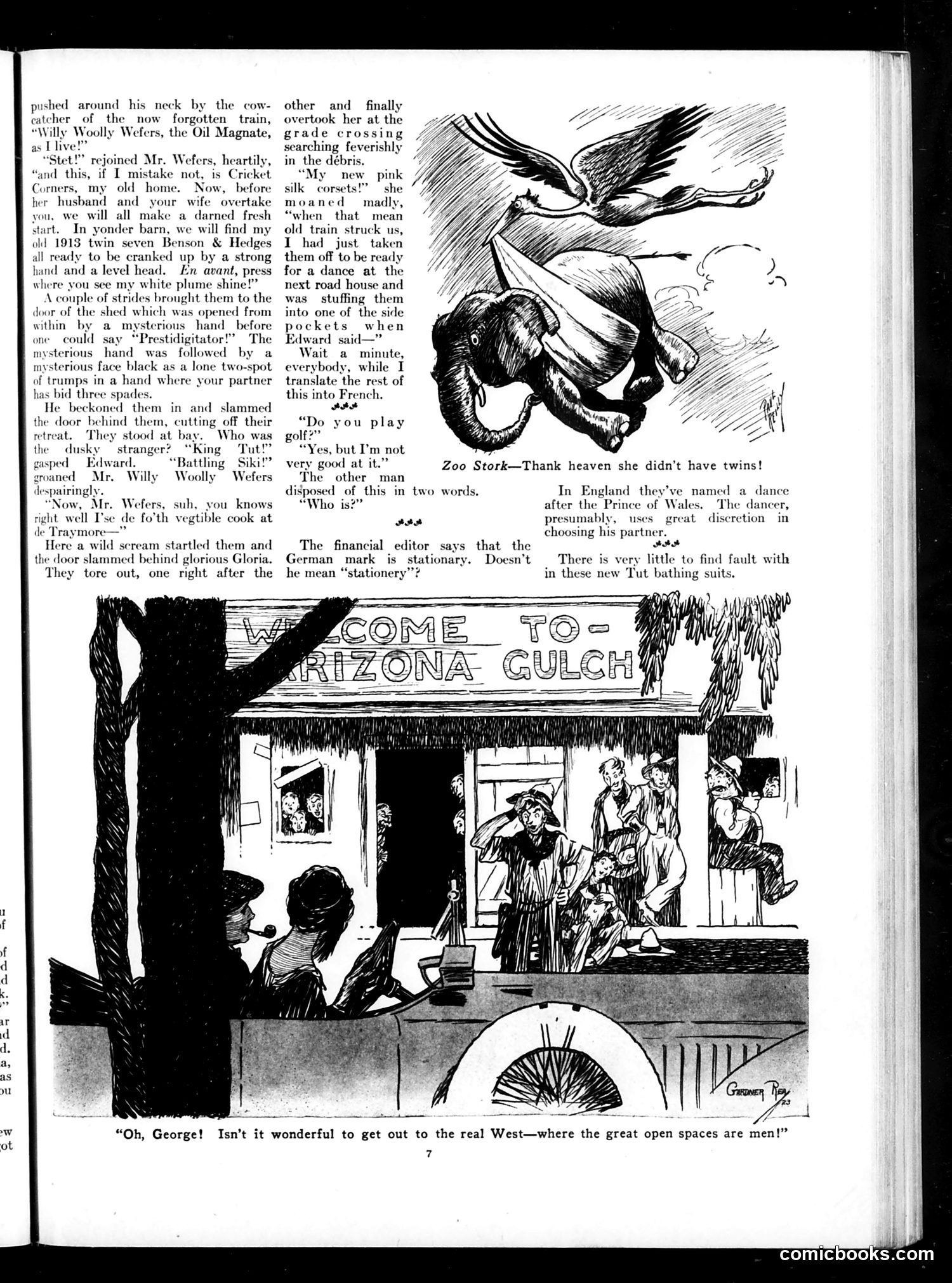
This page contains satirical fiction and cartoons from *Judge* magazine. The main narrative follows "Willy Woolly Wefers," an oil magnate, returning to his childhood home "Cricket Corners" with companions. The story uses exaggerated dialect and slapstick humor typical of early 20th-century satire—including a mysterious figure opening a barn door and a woman named Gloria losing her corset to a train. The bottom cartoon depicts tourists at an "Arizona Gulch" establishment, with the caption mocking tourists' romanticized views of the American West as a masculine frontier. The page also includes brief satirical quips: one about England naming a dance after the Prince of Wales (implying the dancer needs discretion choosing partners—likely referencing scandals), and commentary on the German mark's economic stagnation. The humor relies on period-specific references (1913 automobiles, "Tut" bathing suits) and social attitudes now unfamiliar, making the satire's targets difficult to fully appreciate today.
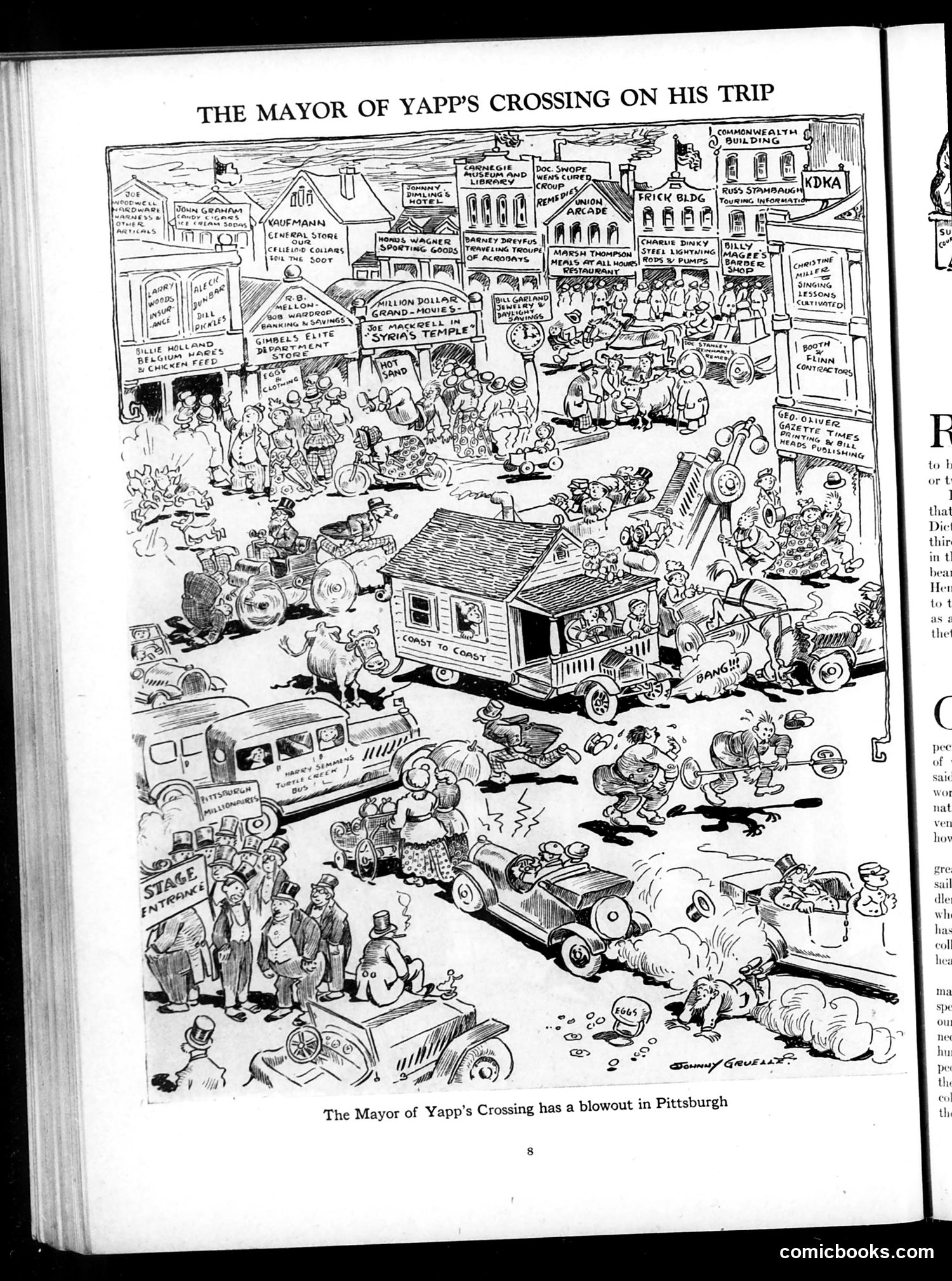
This is a crowded, chaotic cartoon depicting a small-town mayor's visit to Pittsburgh. The scene shows the fictional "Mayor of Yapp's Crossing" arriving in the big city, where his modest entourage and vehicle are overwhelmed by Pittsburgh's urban hustle—multiple cars, crowds, tall buildings, and commercial establishments. The satire mocks the contrast between rural small-town life (represented by the quaint "Yapp's Crossing") and modern industrial Pittsburgh. The joke appears to be in the "blow out"—both literally (a tire puncture) and figuratively (the overwhelming chaos of city life). Local Pittsburgh businesses and landmarks are labeled throughout, suggesting this cartoon appeared in a Pittsburgh publication. The cartoon pokes fun at rural simplicity colliding with urban complexity, a common satirical theme in early-20th-century American humor magazines.
This page from *Judge* magazine contains three editorial pieces satirizing American society circa the 1920s. **"Is There a Doctor in the Audience?"** mocks Edward Bok's $100,000 prize for a practical plan to end war through international cooperation. The satire suggests such a plan is politically impossible in the U.S. Senate, sardonically proposing a secondary prize for whoever can successfully deliver Senator Hiram Johnson's cooperation—comparing political negotiation to difficult childbirth. **"Young Man, Go Work"** criticizes Harvard graduates for avoiding manual labor and trades, choosing only white-collar careers. The editorial argues that history's greatest industrialists and inventors started as laborers, not office workers. It warns that without young Americans entering necessary trades, the country will need to import foreign workers again. **"A Wreath of Tears"** comments on General Gouraud's emotional reaction upon seeing the Statue of Liberty during a recent visit. While acknowledging reporters likely exaggerated the scene, the piece accepts that emotional responses to the statue are genuinely human and understandable.
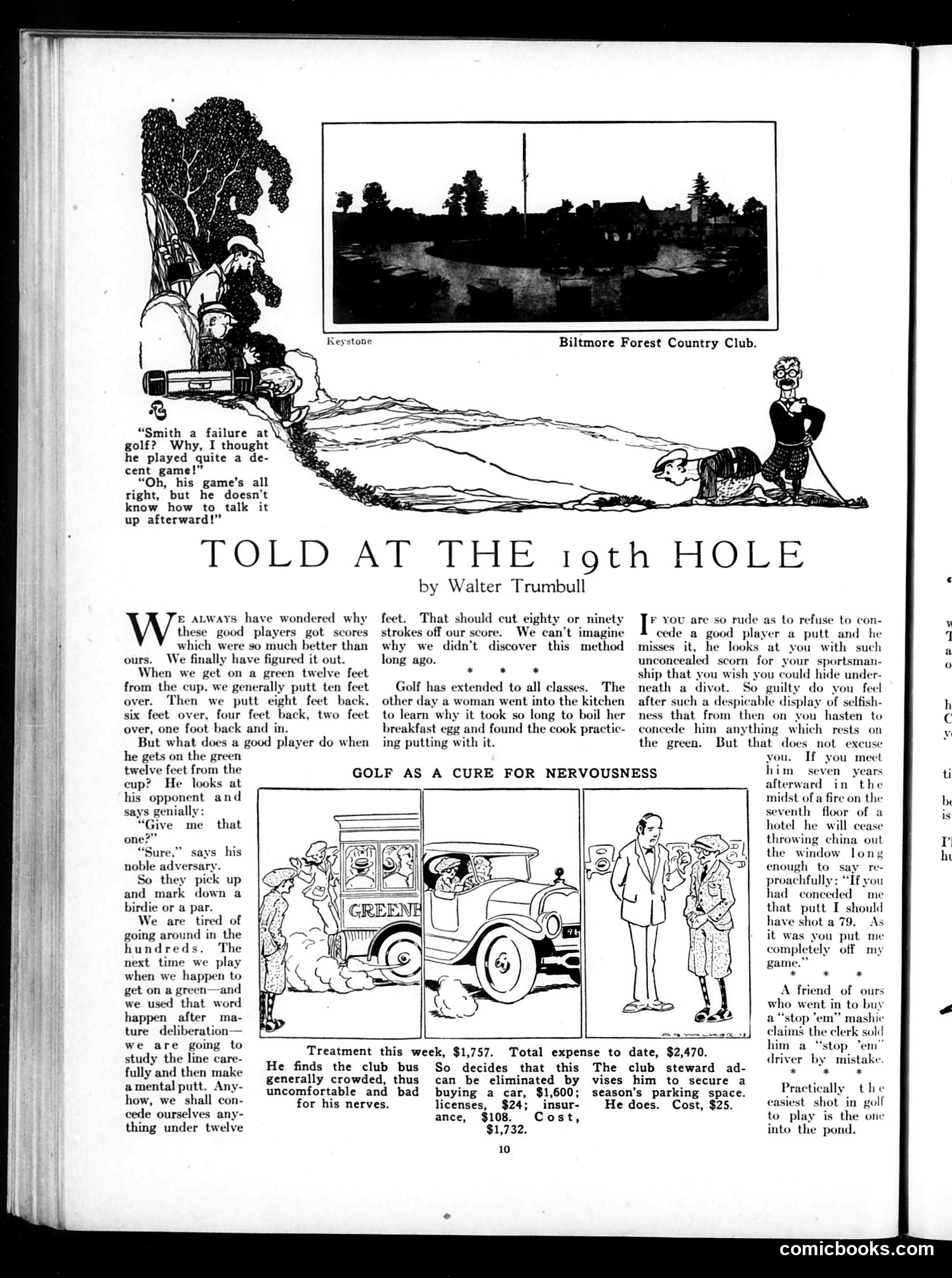
This page satirizes golf culture and player psychology circa the 1920s-30s. The main cartoon mocks how skilled golfers succeed through *psychological manipulation* rather than actual skill: they simply declare their poor shots as good ones, and opponents concede out of social pressure and fear of appearing unsportsmanlike. The "Golf as a Cure for Nervousness" section ridicules the expense and obsession surrounding the sport. A man spends $1,732 on a car and parking to avoid crowded buses at his country club—an absurd solution to a minor inconvenience. The accompanying illustrations show a nervous patient being "treated" by purchasing increasingly costly golf equipment and memberships. Additional jokes reference class mobility (golf extending "to all classes"), servants imitating their employers' hobbies, and the social shame of refusing to concede putts to fellow players. The satire targets both golf's pretensions as a gentleman's game and the era's conspicuous consumption among the wealthy.
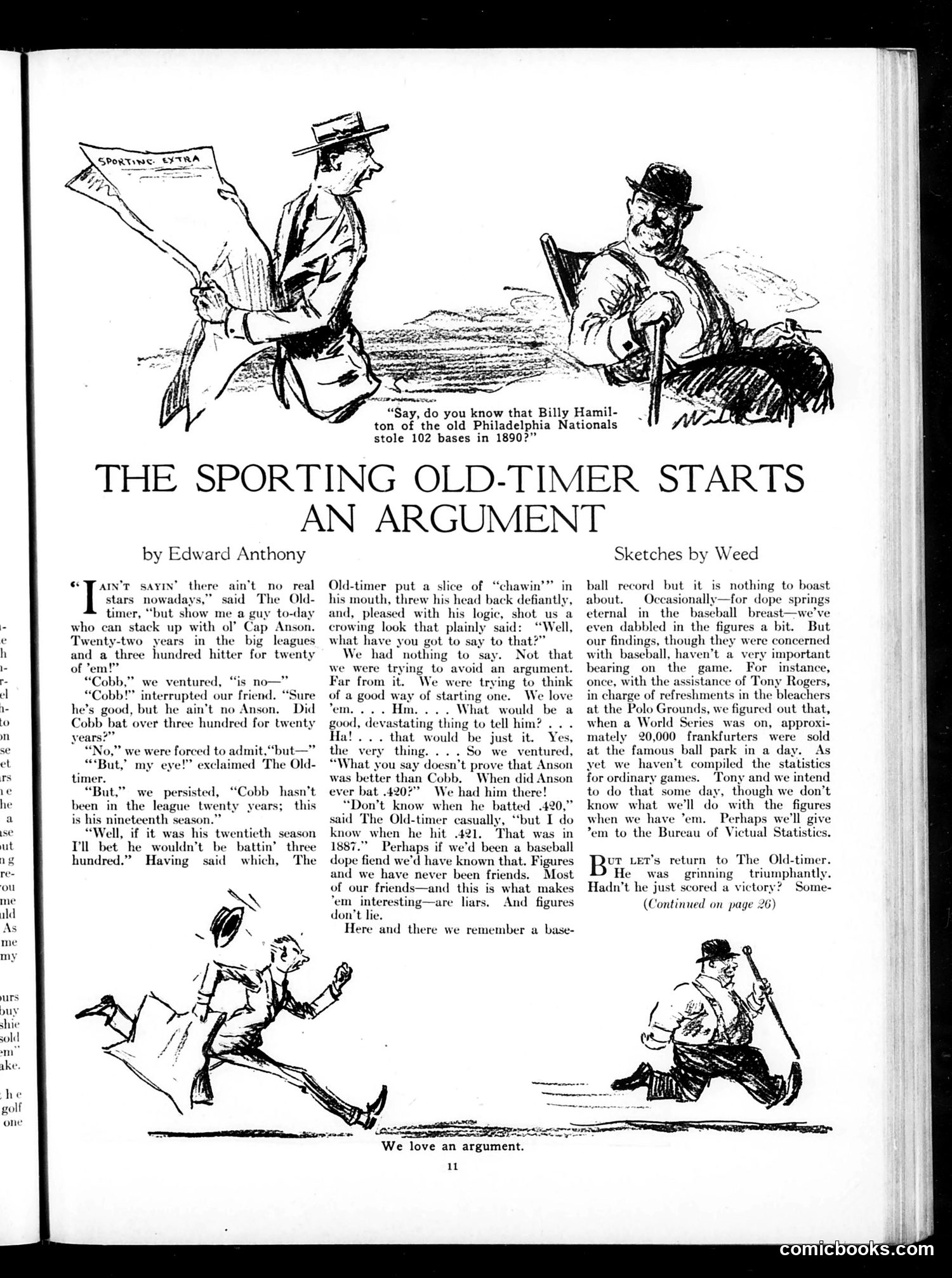
This article satirizes baseball fans who rely on outdated statistics and nostalgia rather than facts. The "Old-timer" character defends Cap Anson (a real 19th-century player) as superior to Ty Cobb, citing Anson's longevity and batting average. When challenged on specifics, he either deflects or produces dubious claims (batting .421 in an unspecified year). The satire targets how such arguments proceed: the old-timer treats vague memories and unverifiable "facts" as conclusive, then declares victory regardless. The author mock-admits they're equally unreliable with statistics—casually mentioning they once calculated frankfurter sales at the Polo Grounds but never knew what to do with the data. The cartoon captures the pointlessness and enjoyment of sports arguments among fans: it's not about truth-seeking but about the pleasure of debate itself. The final caption, "We love an argument," reveals the joke: these discussions are performative and self-perpetuating.
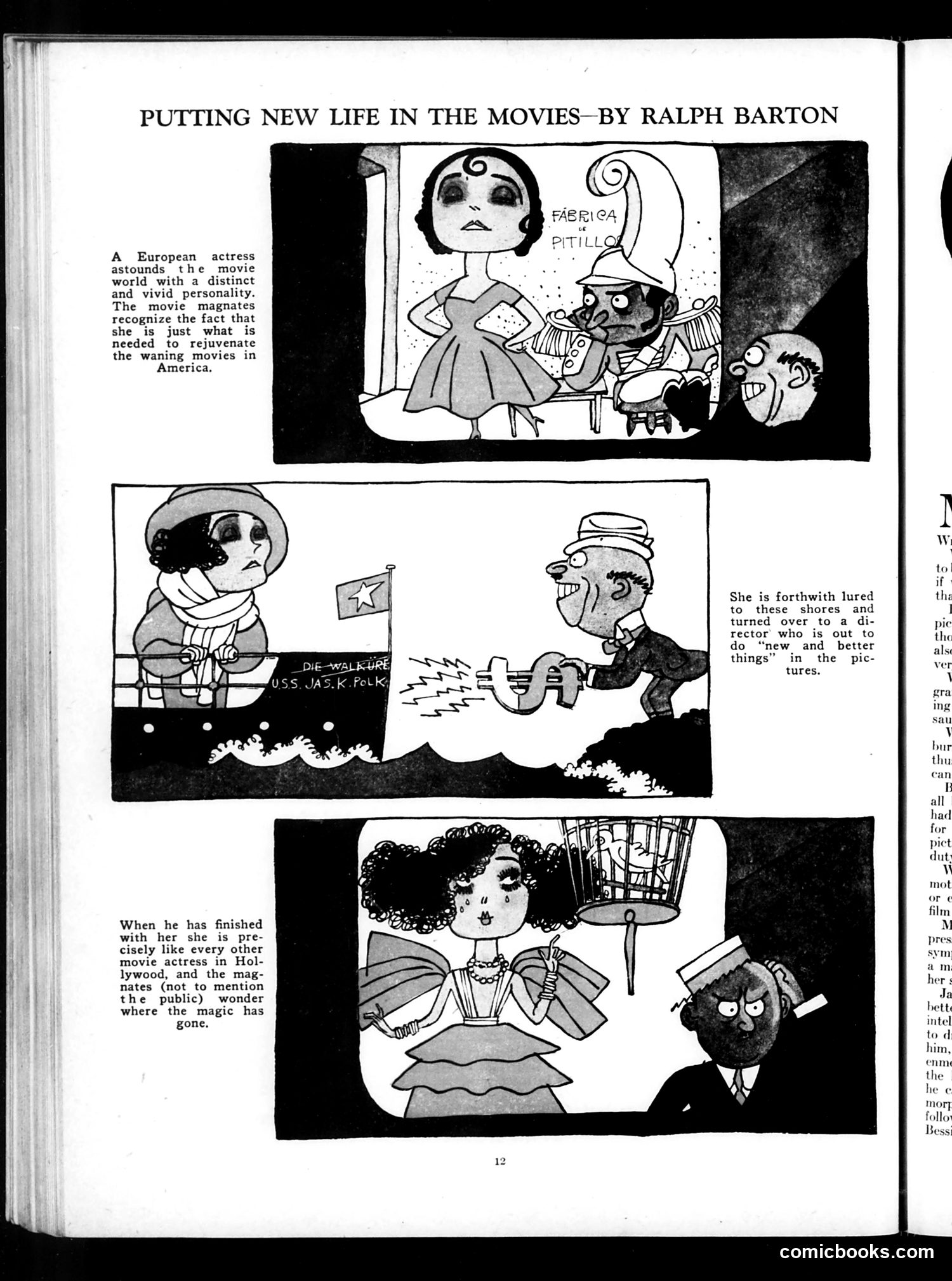
This three-panel satirical comic critiques Hollywood's treatment of foreign actresses. The narrative shows: 1. **Top panel**: A European actress with distinctive personality arrives, exciting studio executives who believe she'll revitalize declining American cinema. 2. **Middle panel**: She's handed to a director tasked with making her conform to Hollywood standards (shown as a machine-like process). 3. **Bottom panel**: After the director finishes "improving" her, she becomes indistinguishable from every other Hollywood actress—the "magic" is gone. The satire targets Hollywood's standardization machine: studios acquired talented foreign performers specifically for their uniqueness, then systematized them into generic starlets, destroying what made them valuable. The joke is the paradox of hiring someone *because* they're different, then immediately erasing that difference. This reflects 1920s anxieties about commercialism homogenizing artistic talent.
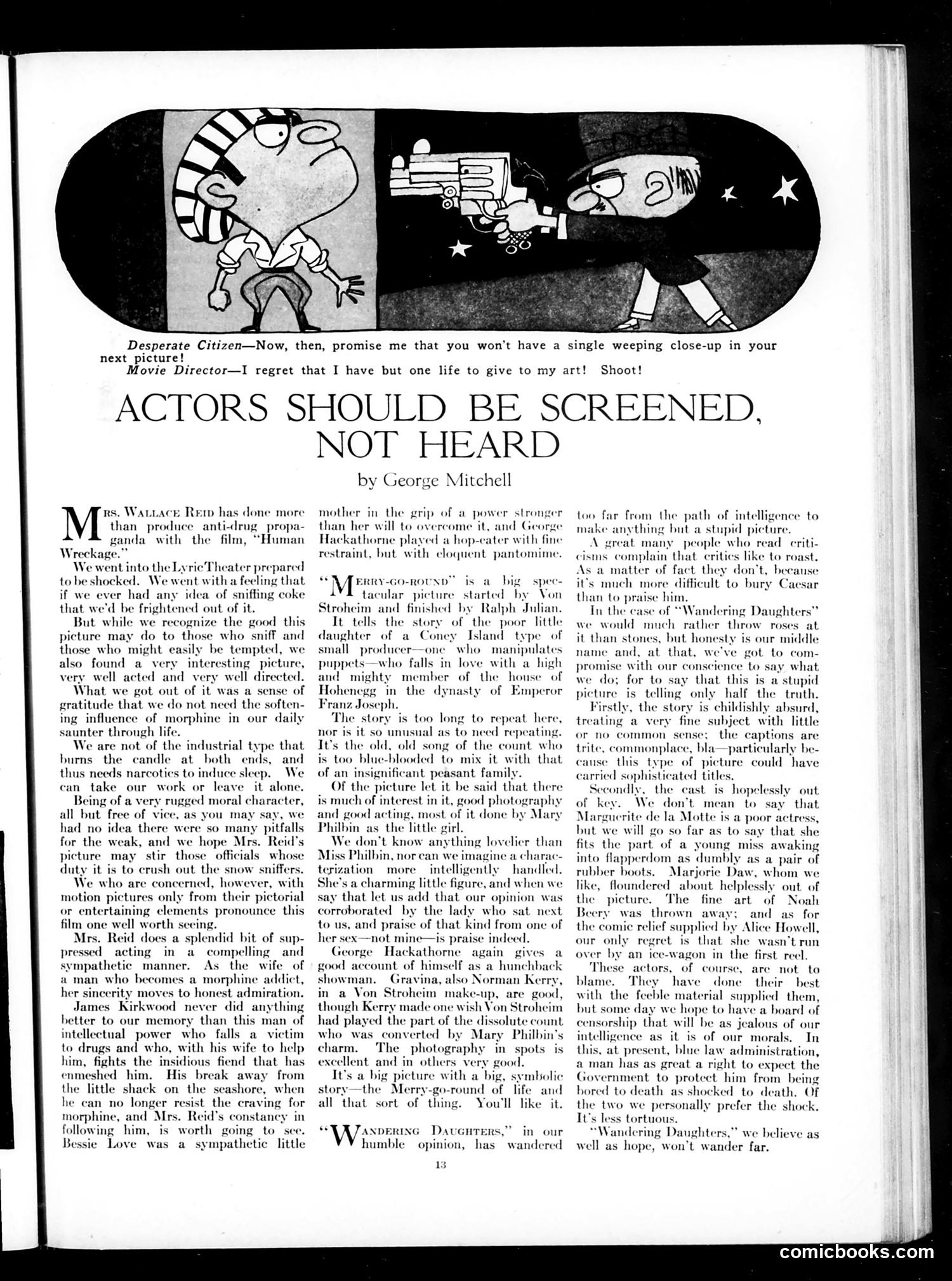
The cartoon shows a film director and desperate citizen negotiating over movie content. The citizen pleads for no "weeping close-ups" in the next picture; the director responds with theatrical self-sacrifice, declaring he has "but one life to give to my art" before shooting the citizen. **The satire:** This mocks early cinema's melodramatic excess—particularly the emotional manipulation through close-ups pioneered by filmmakers. The exaggerated response satirizes filmmakers' pretentious commitment to "art" over audience preferences or restraint. The article below, "Actors Should Be Screened, Not Heard," critiques silent film acting and filmmaking choices. It reviews recent films including Wallace Reid's drug-awareness picture "Human Wreckage" and a Von Stroheim production, praising some performances while criticizing overwrought storytelling and excessive length. **Context:** This reflects 1920s debates about cinema's artistic legitimacy and whether emotional manipulation constituted genuine artistry or mere hokum.
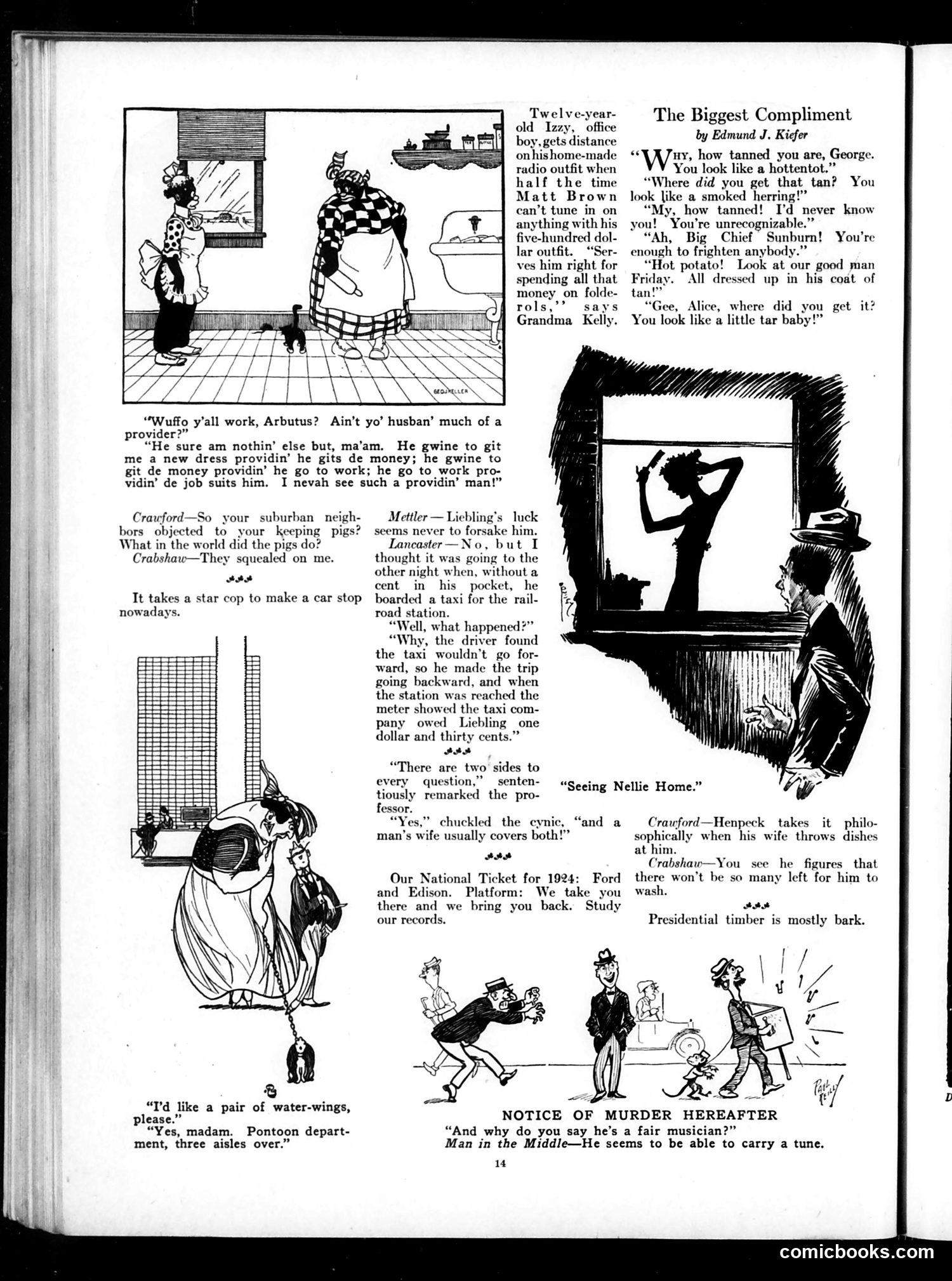
This page from Judge contains several short humor pieces typical of 1920s American satire: **"The Biggest Compliment"** mocks the era's tanning craze by collecting increasingly insulting comparisons to tanned skin—"hottentot," "smoked herring," "tar baby"—treating darkened complexion as comical ugliness. This reflects deeply racist attitudes of the period. **Marriage/domestic humor** dominates multiple pieces: a wife's circular logic about her husband's employment, a henpecked husband accepting dish-throwing, and a joke about wives covering "both sides" of any question. **Other gags** include: a boy's homemade radio outperforming an expensive store-bought one; suburban pig-keeping causing neighbors to "squeal"; a taxi driver reversing direction to run the meter backward; and a 1924 election joke endorsing Ford and Edison based on their transportation reliability. The overall tone reflects 1920s middle-class anxieties about technology, gender roles, and consumerism, with casual racism embedded in the humor.
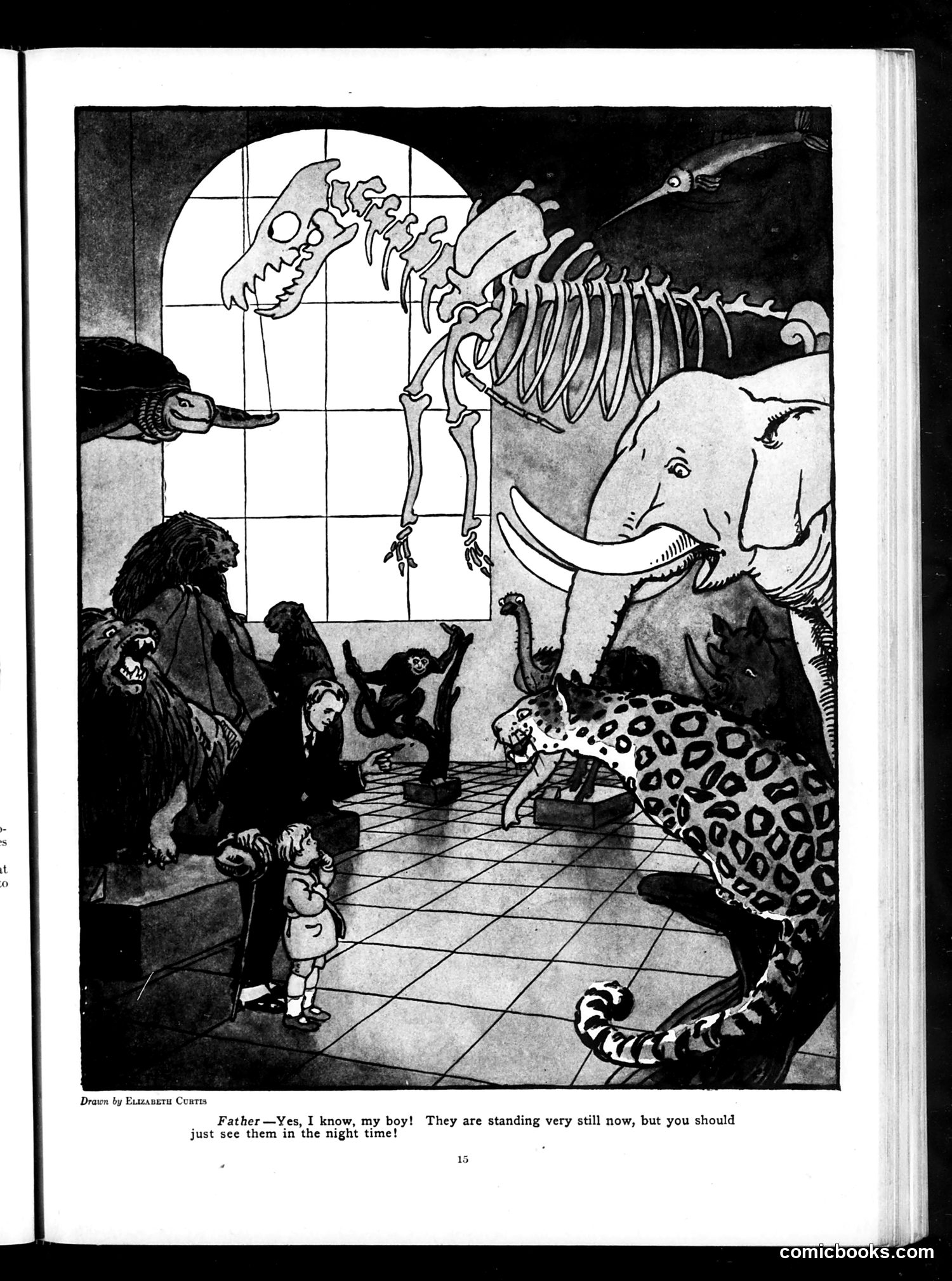
This illustration by Elizabeth Curtis depicts a surreal museum or exhibition scene featuring various exotic animals—an elephant, leopard, fish, monkeys, and other creatures—arranged around a small child and adult figure on a checkered floor, with a skeletal anatomy diagram on the wall behind. The caption reads: "Father—Yes, I know, my boy! They are standing very still now, but you should just see them in the night time!" The joke appears to reference a common Victorian-era attraction: **taxidermy museums or natural history displays**. The father's comment suggests the animals appear lifelike during the day but seem to animate or come alive at night—a humorous play on the uncanny quality of realistic taxidermy specimens. This reflects period anxieties about artificial representations of nature and the "living dead" quality of preserved animals.
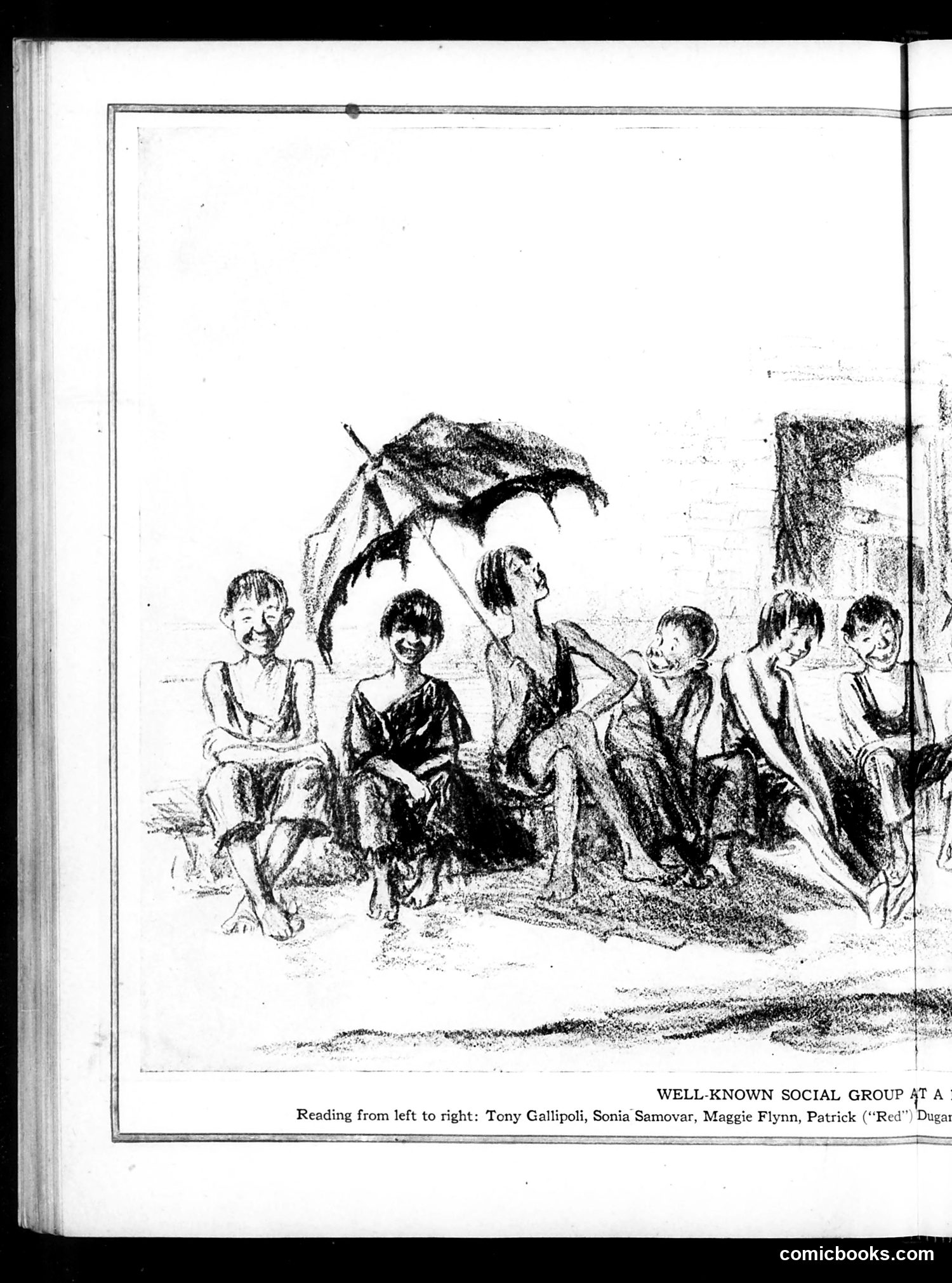
This appears to be a sketch depicting a "well-known social group" of children in what seems to be an impoverished urban setting. The caption identifies them by name: Tony Gallipoli, Sonia Samovar, Maggie Flynn, and Patrick ("Red") Dugan. The names suggest ethnic diversity—Italian, Russian, Irish, and Irish heritage respectively—reflecting the immigrant communities in early 20th-century American cities. The crude clothing and barefoot appearance, combined with the umbrella shelter, suggest poverty. Judge magazine, a satirical publication, likely used such scenes to comment on urban poverty, immigration, or social conditions of the era. The satire probably critiques either the living conditions of immigrant populations or contemporary attitudes toward them, though without additional context or a visible publication date, the specific point remains unclear.
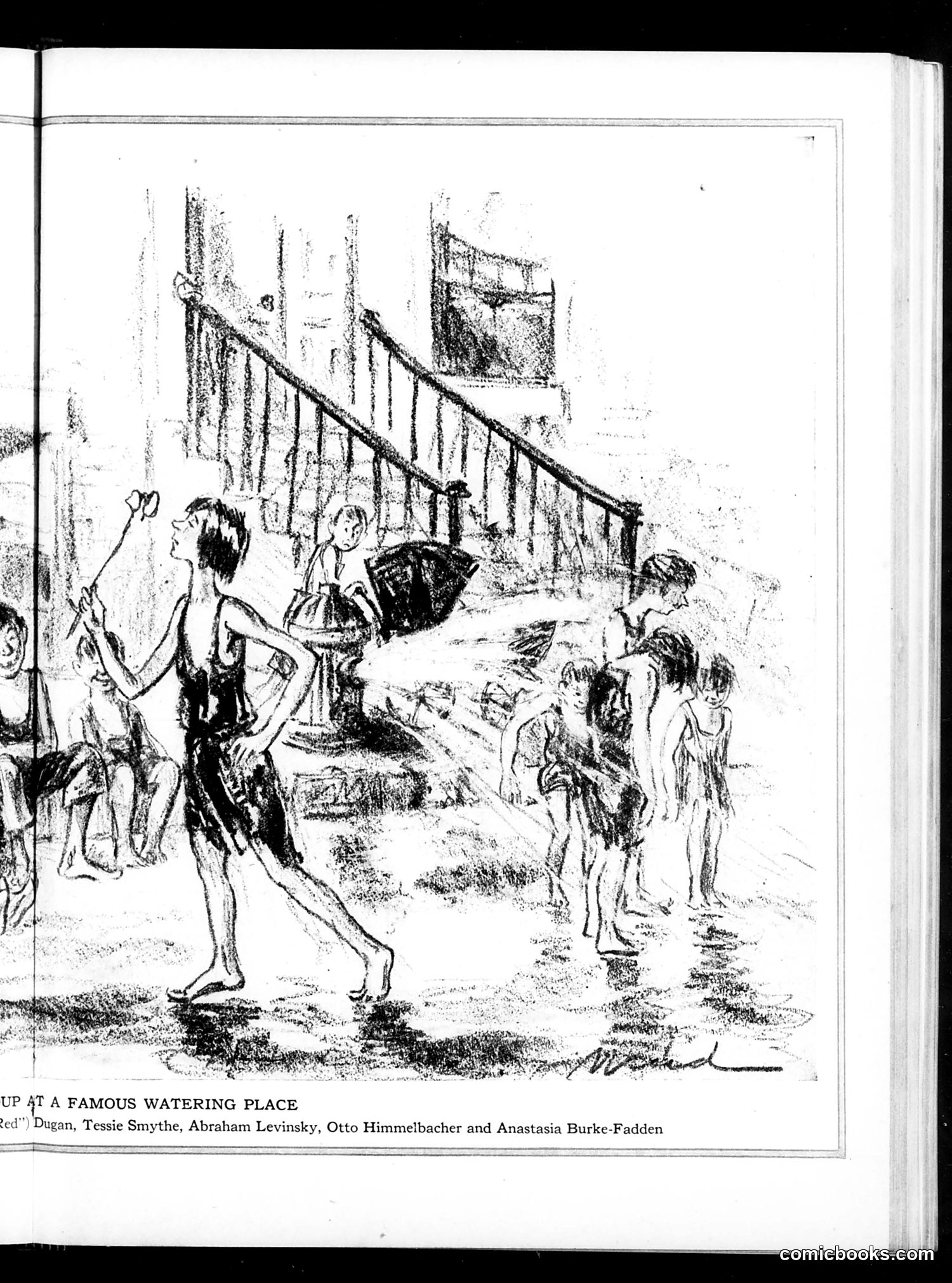
This sketch depicts children at a beach or resort ("watering place"). The visible figures appear to represent different ethnic stereotypes through their surnames: "Dugan" (Irish), "Tessie Smythe" (Anglo), "Abraham Levinsky" (Jewish), "Otto Himmelbacher" (German), and "Anastasia Burke-Fadden" (mixed Irish-English). The satire likely mocks the mixing of different immigrant and ethnic groups at fashionable vacation destinations—a social anxiety of the era. By listing children with distinctly different ethnic surnames playing together, the cartoon probably comments on either the democratization of leisure spaces or anxieties about cultural assimilation in early 20th-century America. The humor trades on ethnic caricature, common in period Judge magazine illustrations.
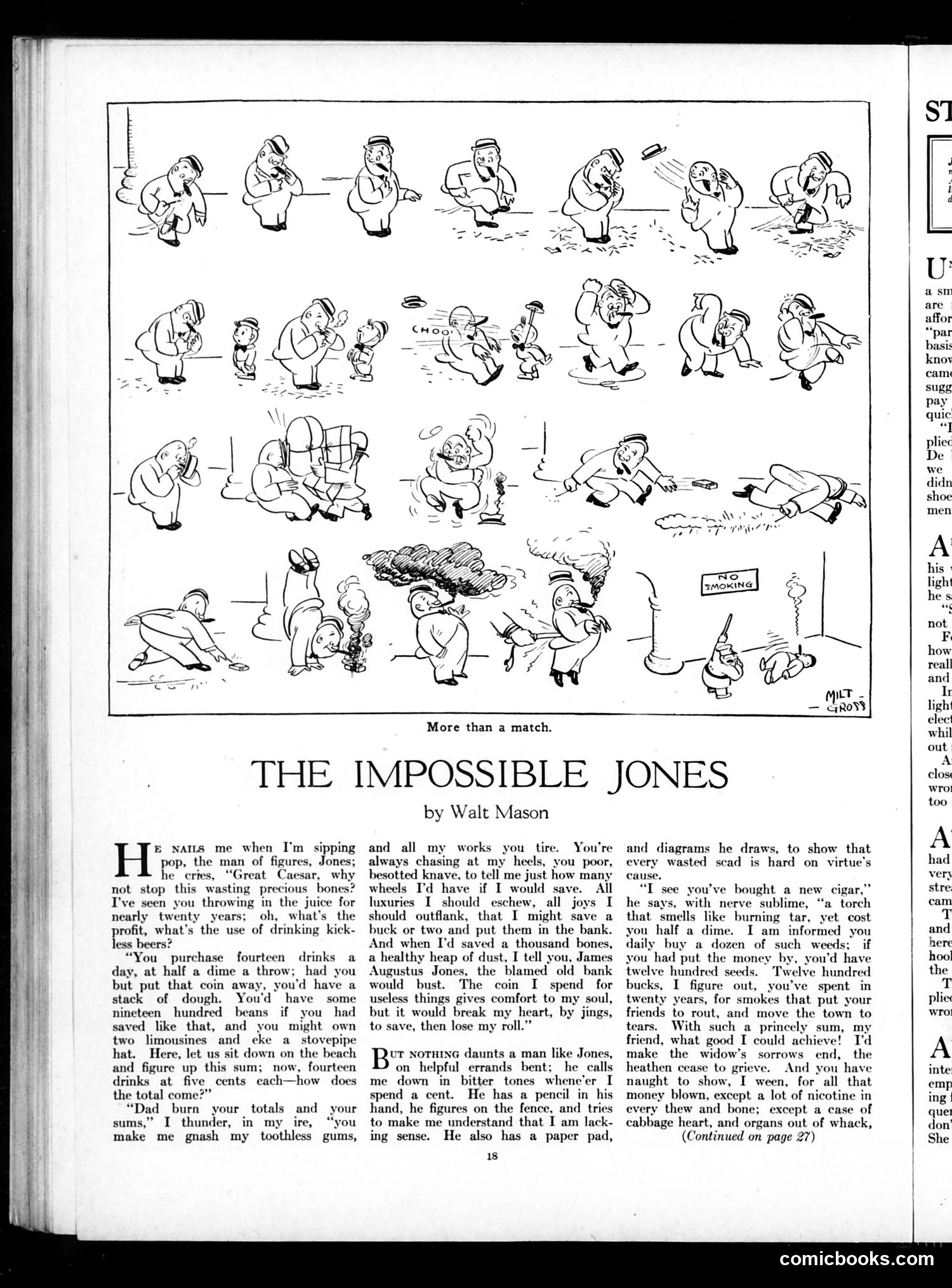
This is a humorous story-comic about a persistent financial scold named Jones who constantly badgers the narrator about his wasteful spending habits. The strip illustrates their interactions through sequential cartoon panels showing Jones lecturing the narrator about his various indulgences—fourteen daily drinks at five cents each, a new cigar costing half a dime, small luxuries that Jones argues should be saved instead. The satire targets the era's moralizing about personal finance and self-denial. Jones represents the type of relentless budgeting enthusiast who calculates compound savings, drawing diagrams to prove how accumulated pennies could build wealth. The narrator, while acknowledging Jones's mathematical logic, rebels against the joyless accumulation, arguing that spending on small comforts gives life meaning—especially when banks fail anyway ("the blamed old bank would bust"). The joke reflects early 20th-century tensions between Victorian thrift ideology and emerging consumer culture, gently mocking both the sanctimonious financial adviser and the spendthrift's rationalizations.
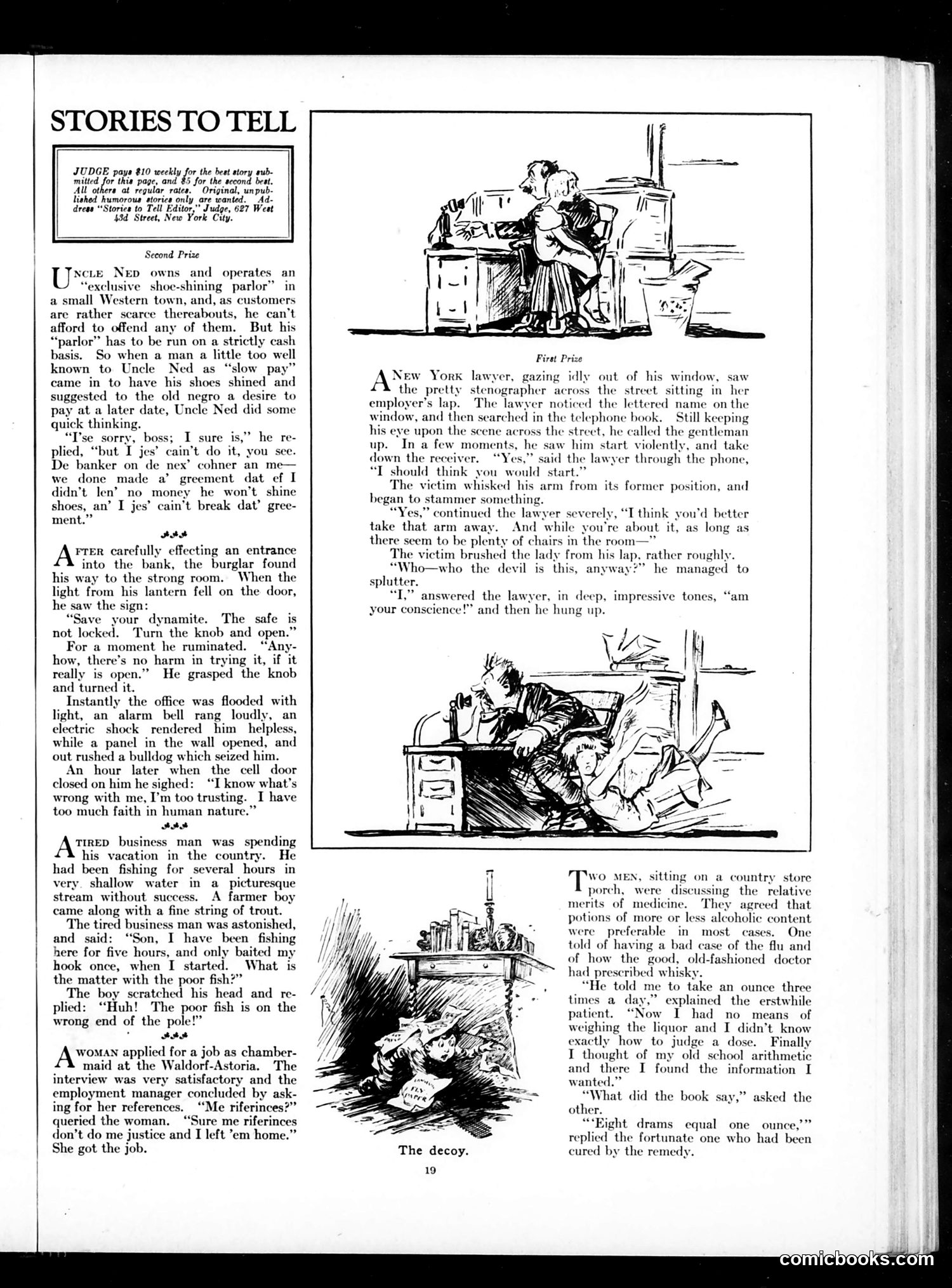
This page from *Judge* magazine presents humorous short stories submitted by readers, competing for cash prizes. The stories satirize human nature and social behavior: 1. **"Uncle Ned's Agreement"**: A Black shoe-shiner deflects a customer's request for credit by claiming a pact with a neighboring banker. The humor relies on a now-offensive stereotype of Black dialect and subservience, typical of early 20th-century American comedy. 2. **"The Bank Burglar"**: A thief is undone by trusting a sign saying the safe is unlocked—he's captured by traps. The irony: his downfall comes from *believing* honesty exists, when he should expect deception. 3. **"Wrong End of the Pole"**: A businessman fails at fishing while a farm boy succeeds, suggesting rural common sense outmatches urban sophistication. 4. **"The Lawyer's Conscience"**: A lawyer tricks a man into releasing a stenographer from his lap by posing as his conscience via telephone—satirizing workplace propriety and masculine behavior. 5. **"Medicine Merits"**: Two men debate alcohol's medicinal value (a Prohibition-era reference). These represent gentle satirical humor about business, morality, and class differences.
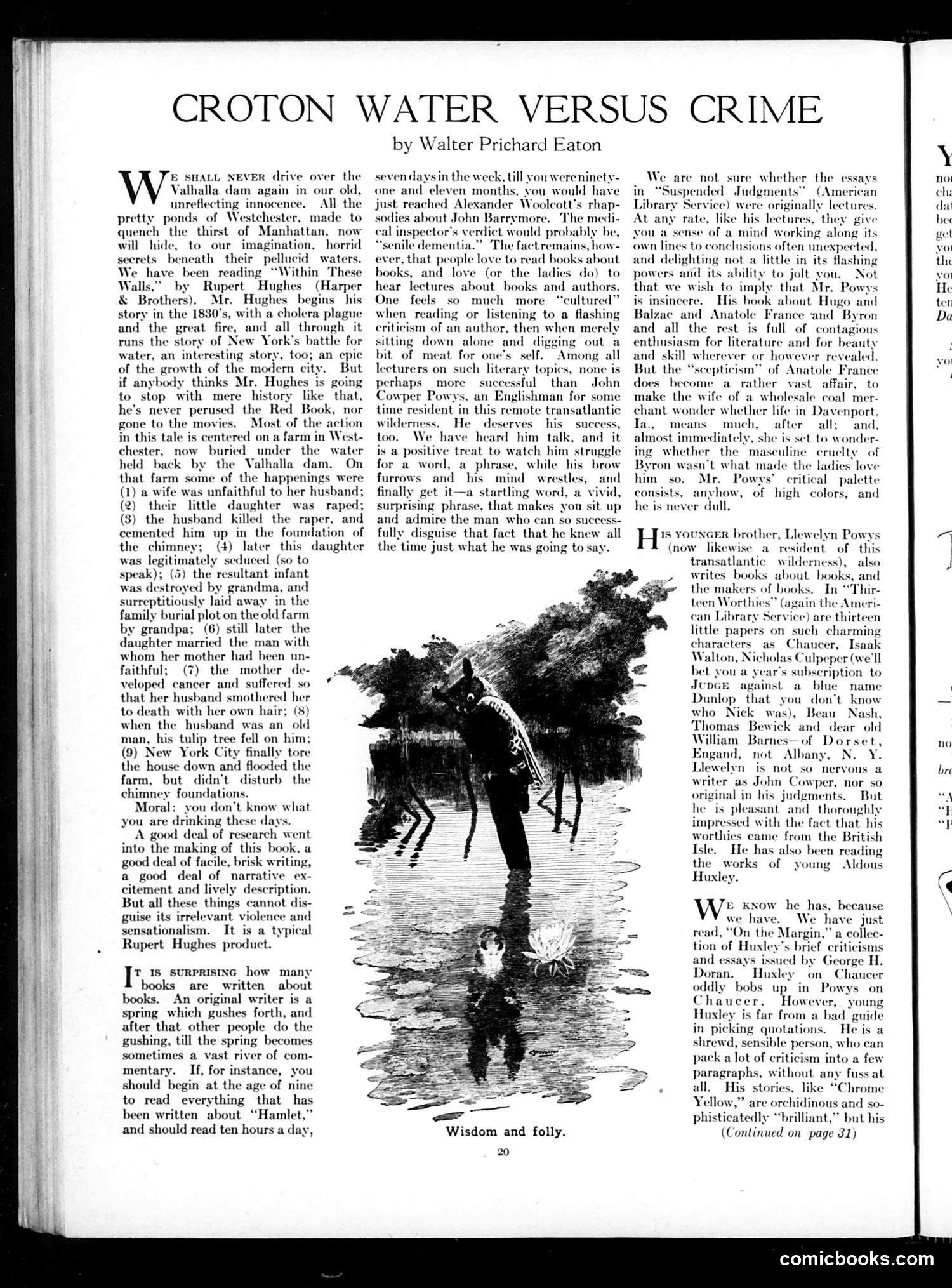
This page reviews Rupert Hughes' novel *"Within These Walls,"* set partly on a Westchester farm now submerged beneath the Croton Aqueduct (New York City's water supply). The satirist mocks Hughes' sensationalism by cataloging the melodramatic crimes buried literally under Manhattan's drinking water: rape, murder, infanticide, mercy killing, and more—all stacked atop each other across generations on one farm. The cartoon ("Wisdom and folly") depicts a figure wading through murky water, visualizing the reviewer's darkly comic point: New Yorkers unknowingly consume water hiding these fictional horrors. The satire targets both Hughes' overwrought plotting and the public's appetite for lurid crime stories disguised as serious literature. The page also praises literary critic John Cowper Powys for making book discussion entertaining—contrasting thoughtful engagement with mere sensationalism.
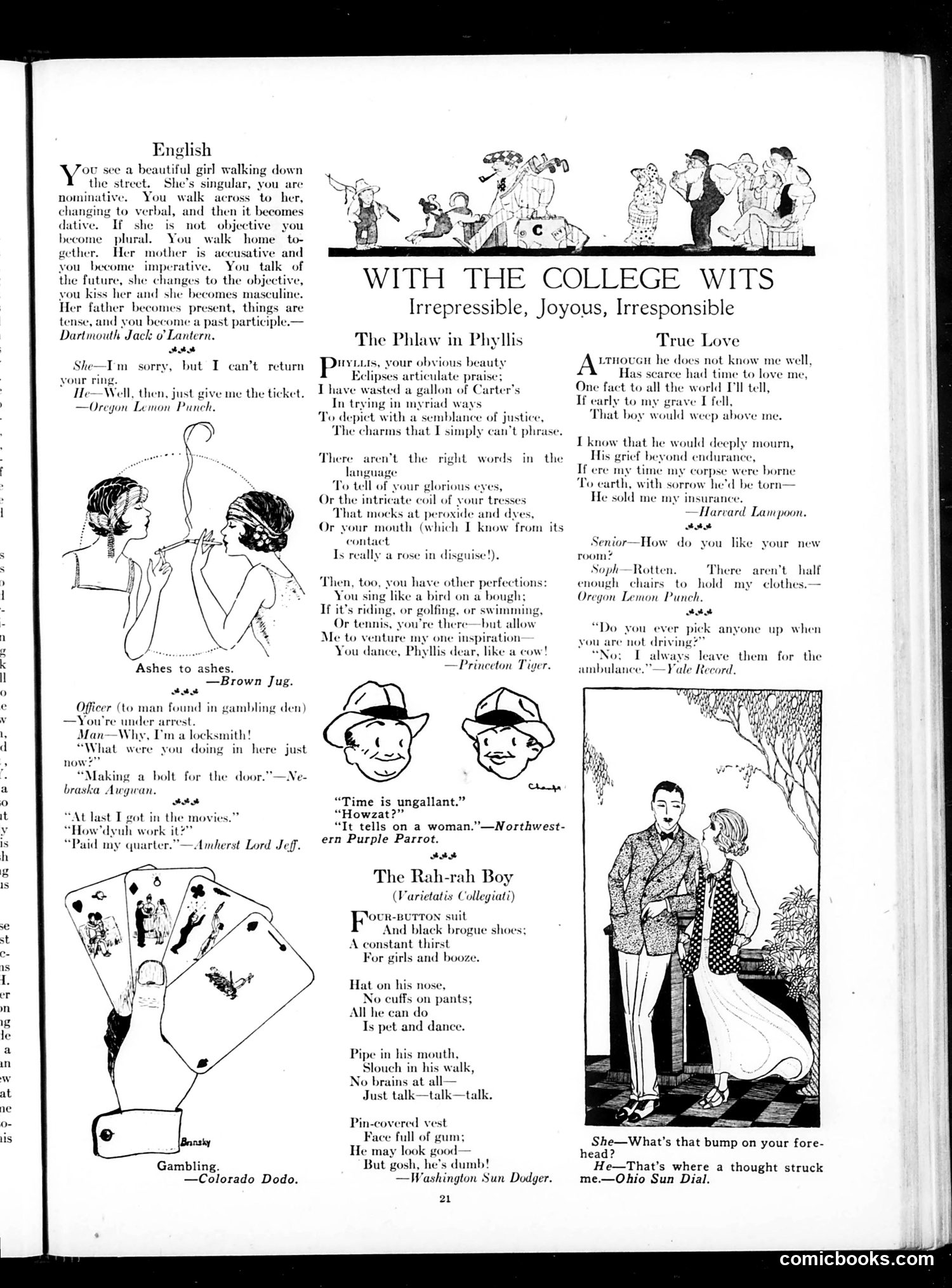
This page collects humorous verses and jokes from various college humor magazines (Oregon Lemon Punch, Harvard Lampoon, Yale Record, etc.), satirizing early 20th-century college life and courtship. The main targets are **college stereotypes**: the overly poetic suitor ("The Phlaw in Phyllis"), the sentimental romantic ("True Love"), and especially the **"Rah-rah Boy"**—a caricature of the anti-intellectual college athlete obsessed with popularity, drinking, and dancing while possessing "no brains at all." The crude drawings of men in hats emphasize this type's simplistic nature. Other jokes mock college romance conventions: a girl's materialistic refusal of a ring, awkward dormitory life, and the obliviousness of the dating scene. The opening "English" piece uses grammar puns to mock the linguistic transformation of courtship. The satire assumes readers recognize these as familiar college archetypes—particularly the hollow, image-obsessed athlete/socialite who represents everything serious students supposedly reject.
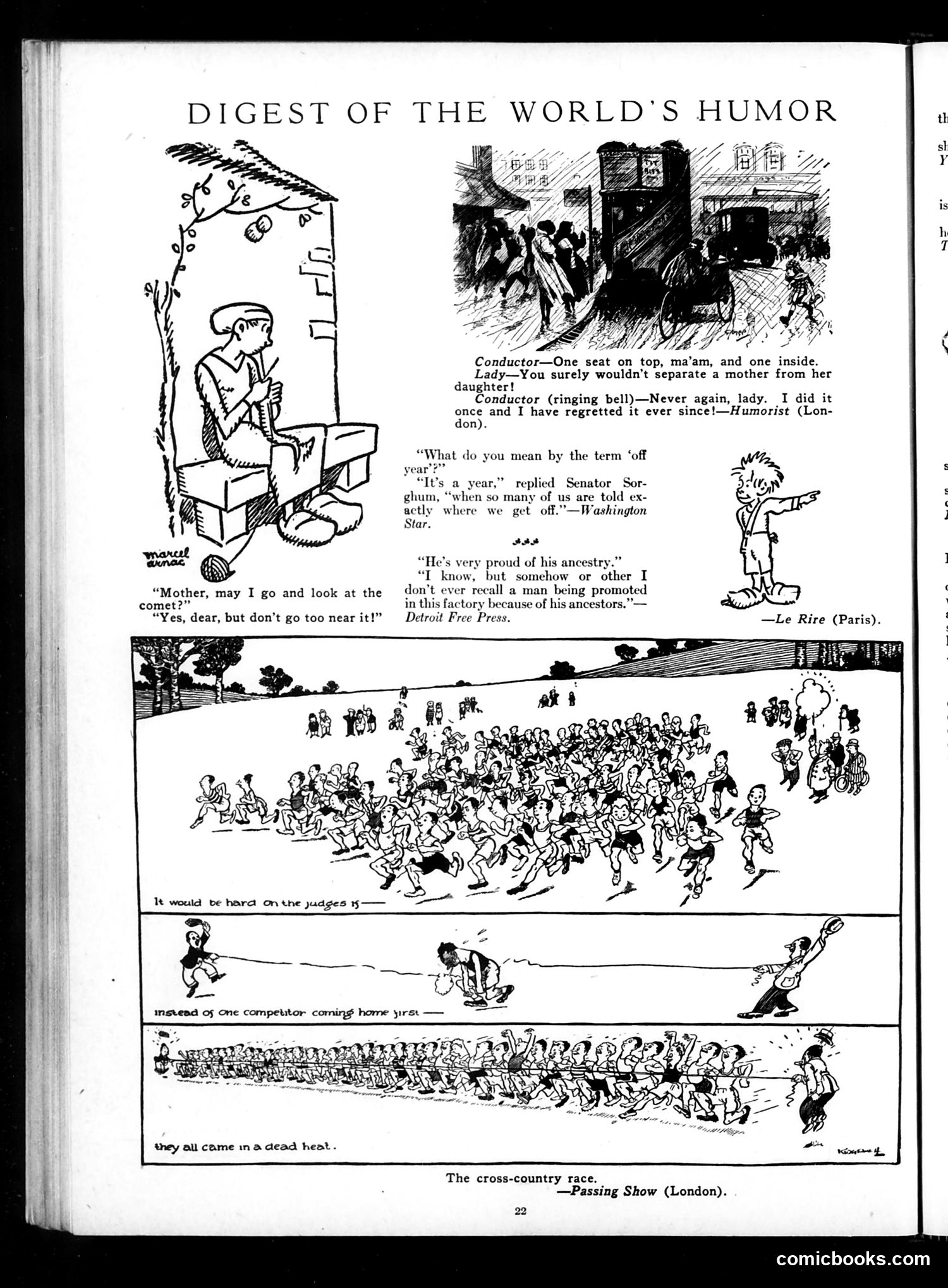
This page from *Judge* magazine collects international humor pieces. The content reflects early 20th-century social attitudes: **Top section:** A mother warns her child not to approach a comet—likely referencing Halley's Comet (visible 1910), which sparked public anxiety about catastrophic collisions. **Middle jokes:** A conductor regrets separating a mother and daughter on a bus, satirizing rigid transit rules. A senator's comment about being "told where we get off" is political wordplay about losing elections. A factory manager dismisses ancestry as irrelevant to promotion—mocking class pretension amid industrial-age meritocracy concerns. **Bottom cartoon:** "The cross-country race" humorously depicts a chaotic mass foot race ending in a "dead heat" (tie), with competitors arriving as one confused mob—absurdist visual humor about competitive chaos and undefined outcomes. The page showcases *Judge*'s model of reprinting humor from international sources, emphasizing universal comedic themes: parental concern, bureaucratic absurdity, social hierarchy, and physical comedy.
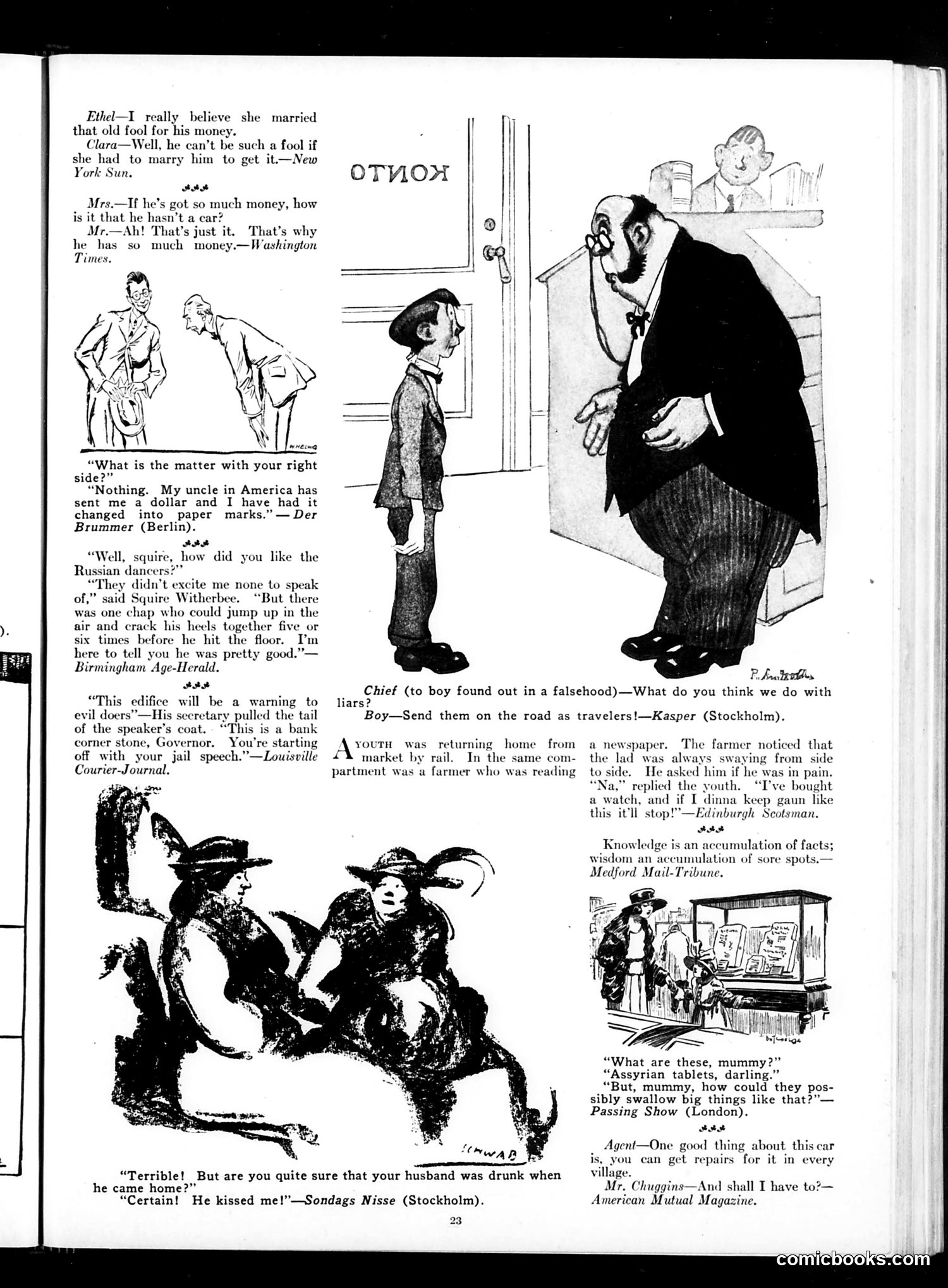
This page contains miscellaneous jokes and cartoons from various international publications, compiled in Judge's typical format. The content is primarily **linguistic and observational humor** rather than political satire. Key items include: - **Exchange jokes** about wealth and marriage (New York Sun, Washington Times) — poking fun at fortune-hunting and financial paradoxes - **Currency humor** (Der Brummer, Berlin) — referencing post-WWI German hyperinflation, where American dollars converted to worthless paper marks - **Immigrant/regional dialect humor** — the Scottish farmer joke uses heavy accent for comedic effect - **A moral cartoon** about punishment for lying (Kasper, Stockholm) — suggesting liars are sent out as traveling salesmen - **A car repair joke** (American Mutual Magazine) — suggesting new cars constantly need repairs The page primarily reflects **period attitudes toward foreign customs, economic instability, and emerging automobile culture**. The humor is gentle and observational rather than cutting political commentary.
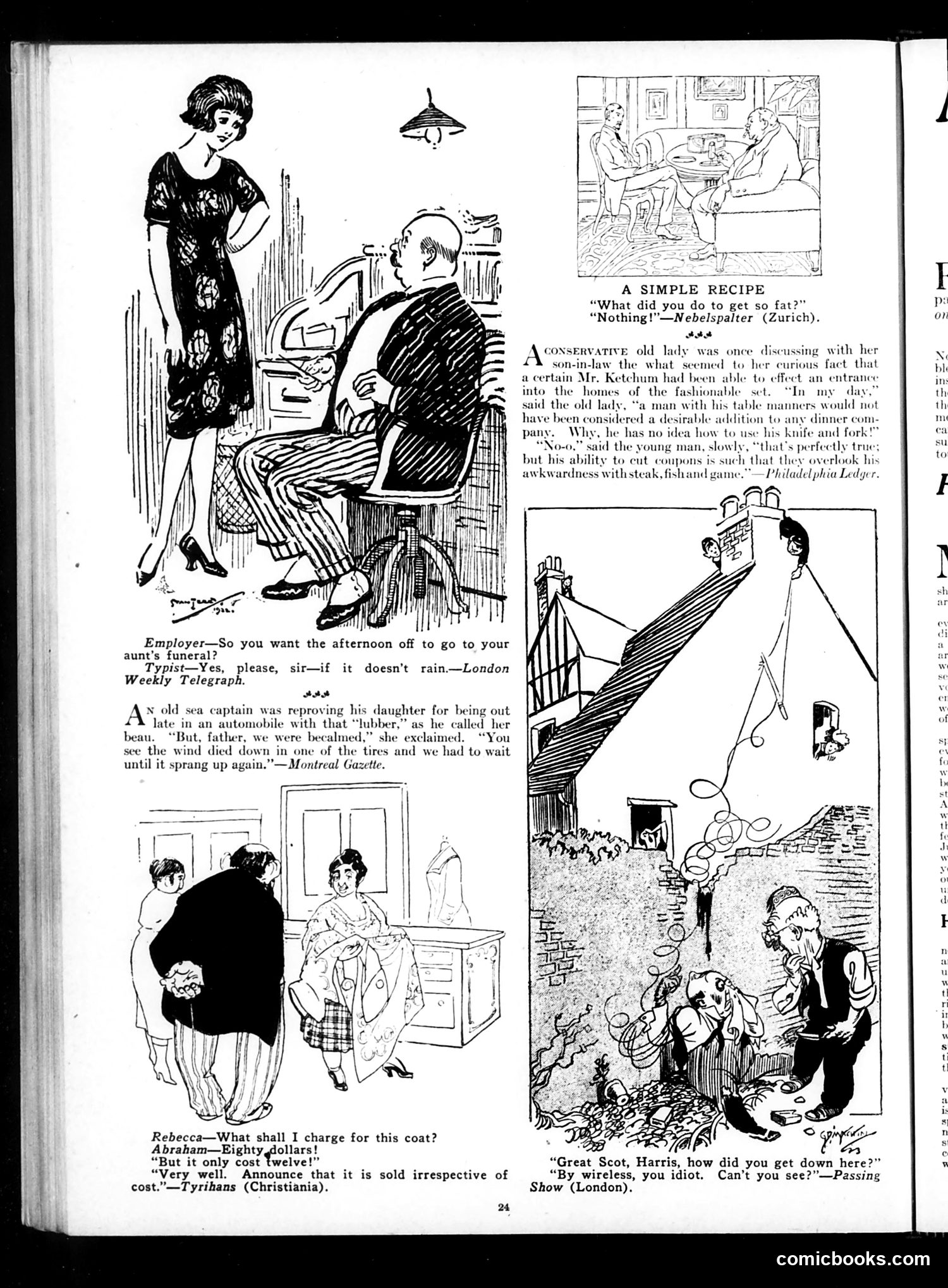
This page contains five short satirical jokes typical of early 20th-century humor: 1. **"Simple Recipe"**: A woman's weight gain is attributed to doing "nothing"—satirizing idle wealthy women. 2. **Ketchum anecdote**: Mocks social climbing. A crude nouveau-riche man gains fashionable society access through wealth (cutting coupons/dividend checks) despite terrible table manners. The joke: money trumps refinement. 3. **Typist's funeral excuse**: Dark humor about a worker's conditional mourning—she'll attend only if weather permits, suggesting minimal commitment to her aunt. 4. **Sea captain's daughter**: She misunderstands "becalmed" (no wind) as a tire deflation, confusing nautical and automobile terminology. Gentle mockery of women's mechanical ignorance. 5. **Wireless/coat pricing**: Two separate jokes: one about wireless technology's absurdity, another about marking up merchandise enormously from cost. The page reflects period attitudes toward class, gender, and technology with light social satire rather than sharp political commentary.
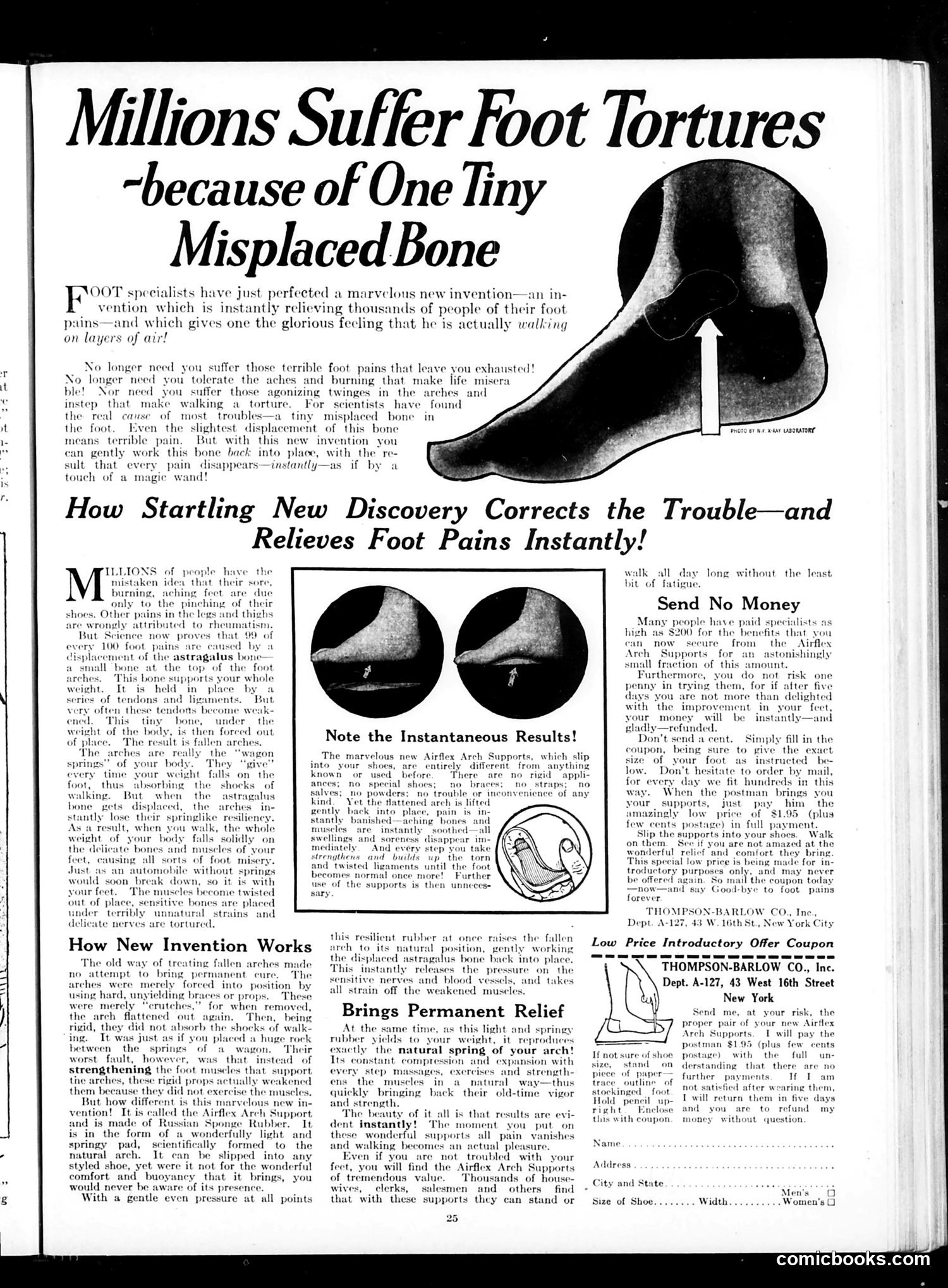
This page is primarily a **product advertisement**, not satirical content. It promotes the "Airflex Arch Support," a rubber foot insert marketed by the Thomson-Barlow Company. The advertisement employs pseudo-scientific rhetoric common to early 20th-century medical marketing. It claims that "millions suffer foot tortures" due to a single misplaced bone, and promises that this new invention provides "instantaneous" pain relief. The language—"touch of a magic wand," "marvelous new invention"—uses hyperbolic marketing typical of the era. The diagrams show foot anatomy and the product's positioning. The text contrasts the new "light rubber" approach with older rigid arch supports, claiming Airflex uniquely allows natural muscle strengthening while supporting the arch. This reflects the period's common practice of running medical product advertisements in magazines like *Judge*, often making exaggerated health claims that would be considered fraudulent by modern standards. The page demonstrates how vintage magazines blended humor/satire with credulous medical advertising.
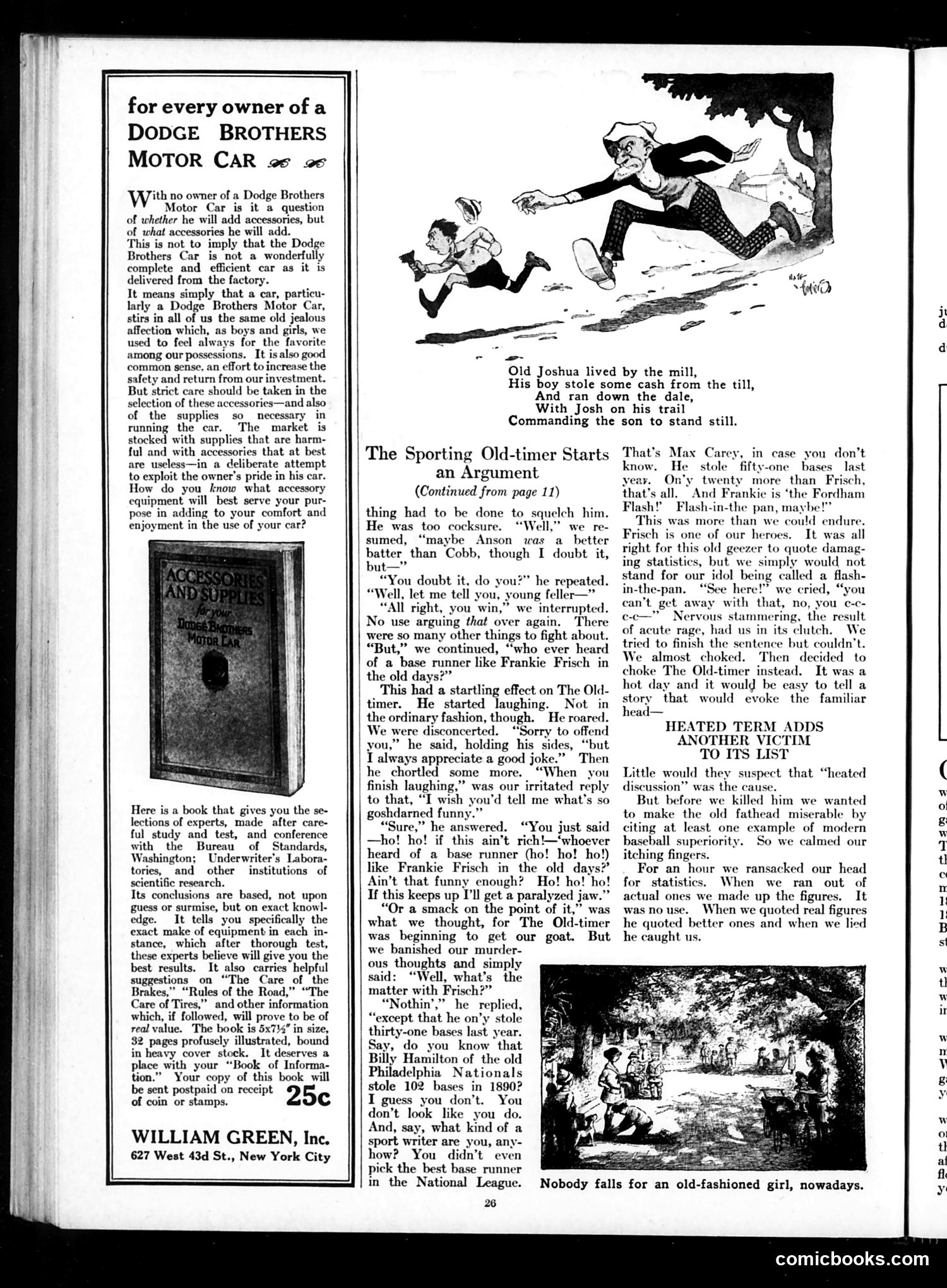
This page contains **one major cartoon** and a **serialized story** from Judge magazine. **The Cartoon:** Shows a man chasing a boy down a hill, illustrating a simple limerick about "Old Joshua" whose son steals money from a mill till and flees. **The Story:** "The Sporting Old-timer Starts an Argument" depicts a generational clash about baseball. Young men debate whether Ty Cobb or Cap Anson was the better batter, and whether Frankie Frisch was an exceptional base-runner. An elderly man repeatedly insists the "old days" were superior. The humor centers on the old-timer's stubborn nostalgia and his irritating habit of dismissing modern players while romanticizing past ones—a timeless social satire about how each generation views its predecessors. The **Dodge Brothers advertisement** promotes automotive accessories, emphasizing expert-vetted products over inferior market options.
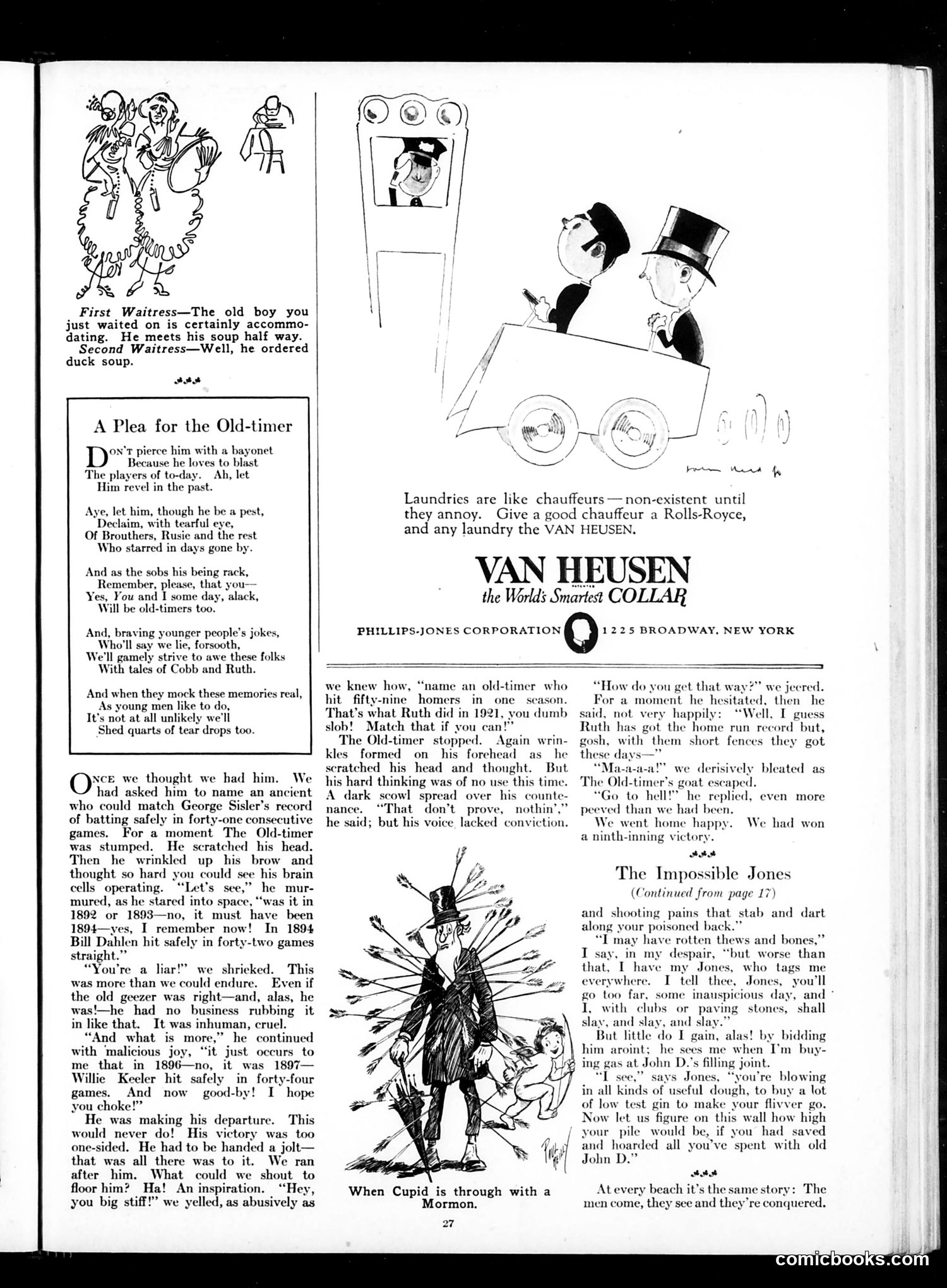
This page contains three distinct pieces of 1920s humor: **Top left:** A brief joke about an elderly diner who "meets his soup halfway"—he's so stooped with age he leans down toward the bowl rather than lifting it to his mouth. **"A Plea for the Old-timer":** A sentimental poem defending elderly men who constantly reminisce about baseball players from the 1890s (Brouthers, Rusie, Cobb, Ruth). The joke satirizes nostalgia itself—the plea ironically acknowledges old-timers are annoying bores, yet asks younger people to tolerate them since they too will become insufferable nostalgists. **Center narrative:** An anecdote where young people attempt to "floor" (embarrass) an old baseball enthusiast by challenging him with obscure records. When he surprisingly knows the answers and mentions Ruth's 59 home runs (1921) and Keeler's hitting streak, they accuse him of lying—but he's correct, frustrating them. **Right side:** A Van Heusen collar advertisement featuring a chauffeur joke, and the beginning of "The Impossible Jones," an unrelated serialized story. The unifying theme mocks generational conflict around aging and memory.
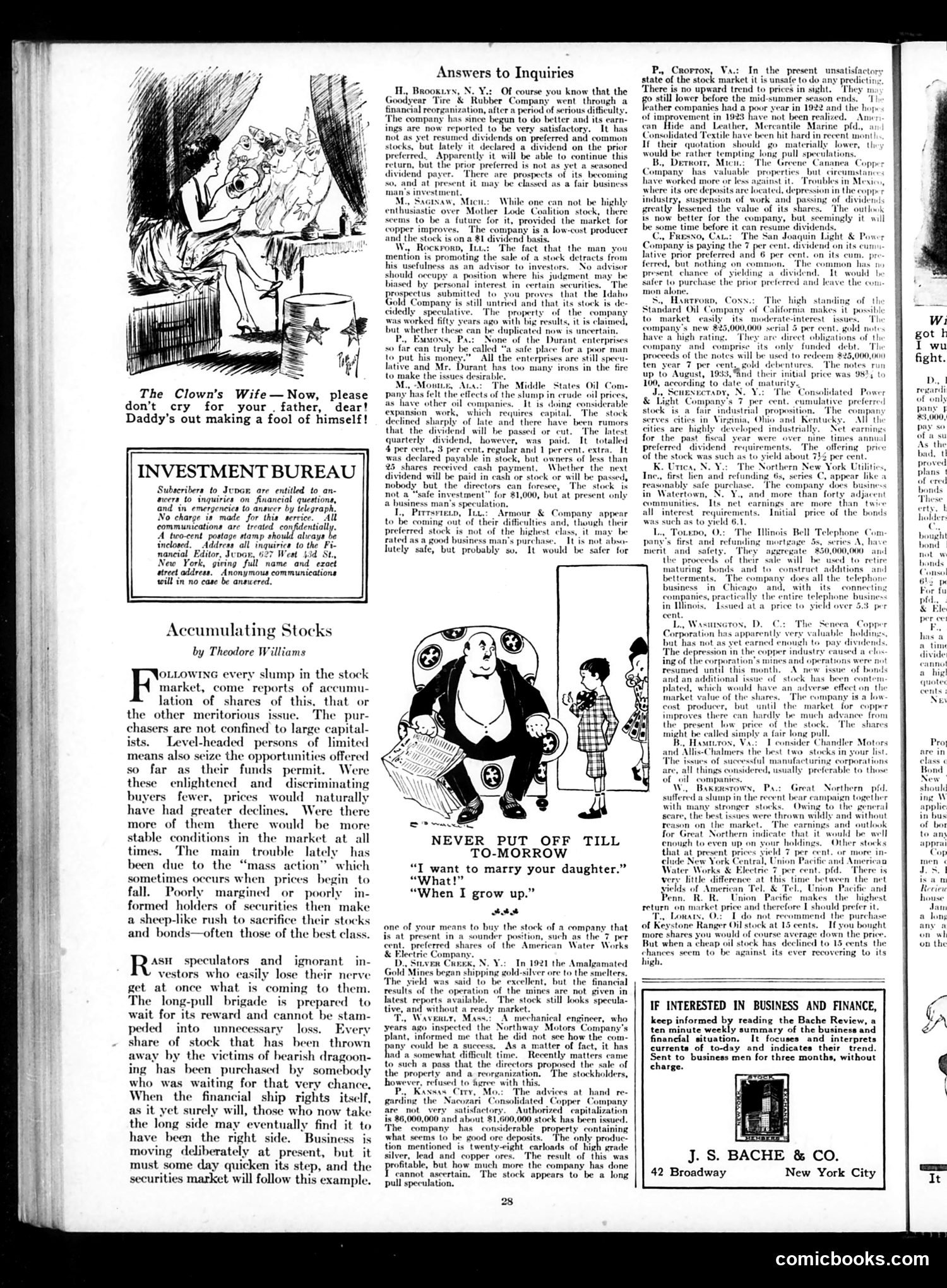
This satirical cartoon warns against stock market speculation during economic downturns. The image shows a woman comforting a crying child, telling her not to worry about "Daddy"—he's outside "making a fool of himself." The joke targets men who engage in reckless stock trading, particularly during market slumps. During such periods, Judge notes, poorly-informed investors panic-sell quality securities at depressed prices, while speculators exploit the chaos. The accompanying article by Theodore Williams explains that "rash speculators and ignorant investors" lose nerve and stampede into selling, whereas patient, disciplined investors wait for recoveries. The cartoon's humor lies in depicting the speculator as literally foolish—abandoned by his family while he ruins their finances through ill-advised market gambling. The overall message: speculation is a fool's game that harms families. The "Investment Bureau" section reinforces this by providing serious financial guidance to counter such reckless behavior.
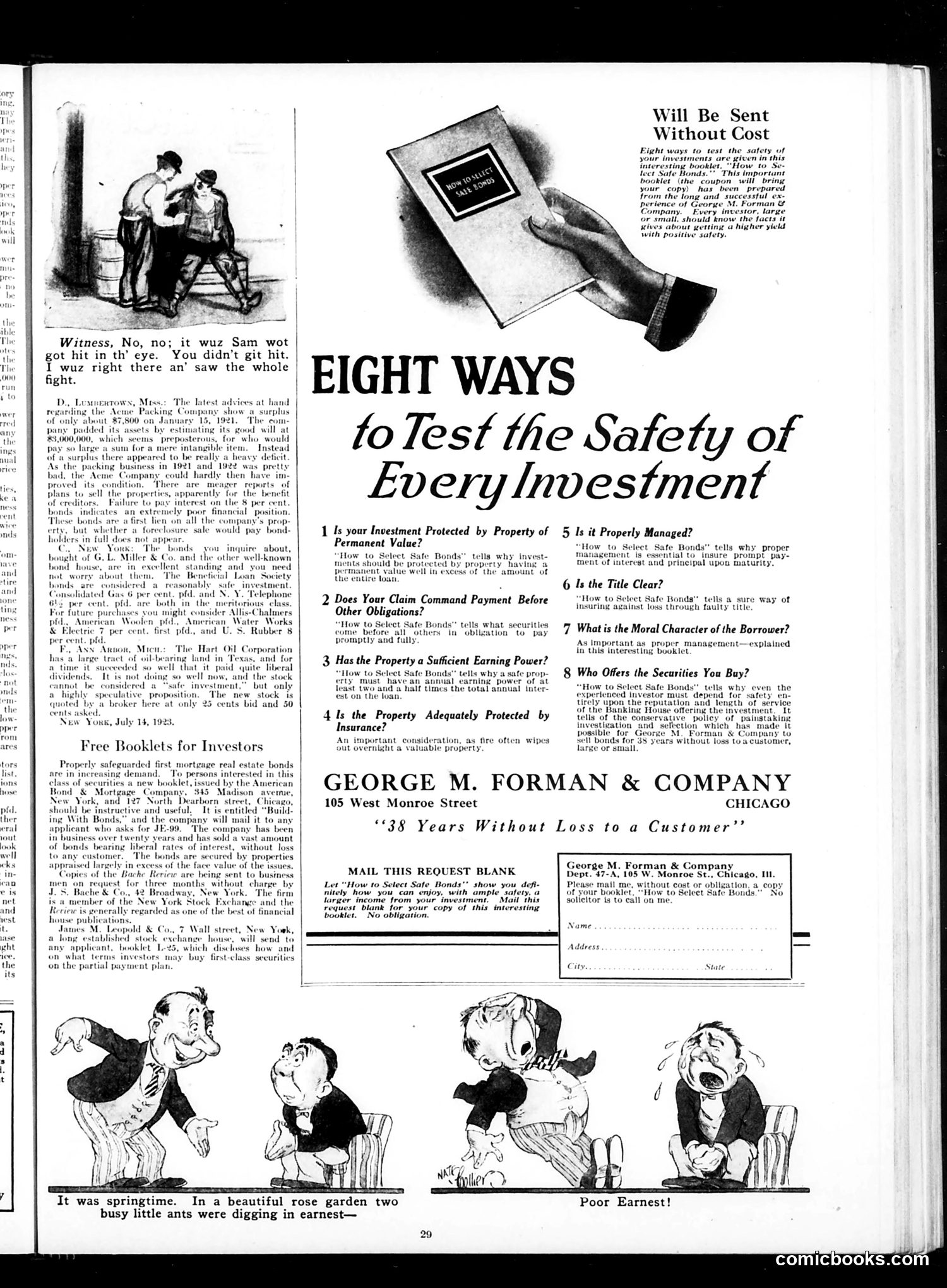
This page is primarily **financial advertising** for George M. Forman & Company, a bond investment firm claiming "38 Years Without Loss to a Customer." The main content presents "Eight Ways to Test the Safety of Every Investment"—a how-to guide for evaluating bonds, addressing investor concerns about securing reliable income. This reflects **early 1920s anxiety** about investment safety following market volatility. The satirical elements are minimal but telling: - **Top left cartoon**: Two working-class figures discussing a street fight ("it wuz Sam wot got hit in th' eye"), suggesting everyday people's concerns contrast with investor sophistication - **Bottom cartoon** ("Poor Earnest"): Shows what appears to be a man being repeatedly struck or failed—a visual pun about investment risk and poor choices The page's tone reveals the era's **marketing strategy**: reassuring nervous small investors through detailed safety criteria while subtly mocking those who make poor financial decisions. The emphasis on "proper management" and "moral character of the borrower" reflects post-WWI skepticism about financial institutions.
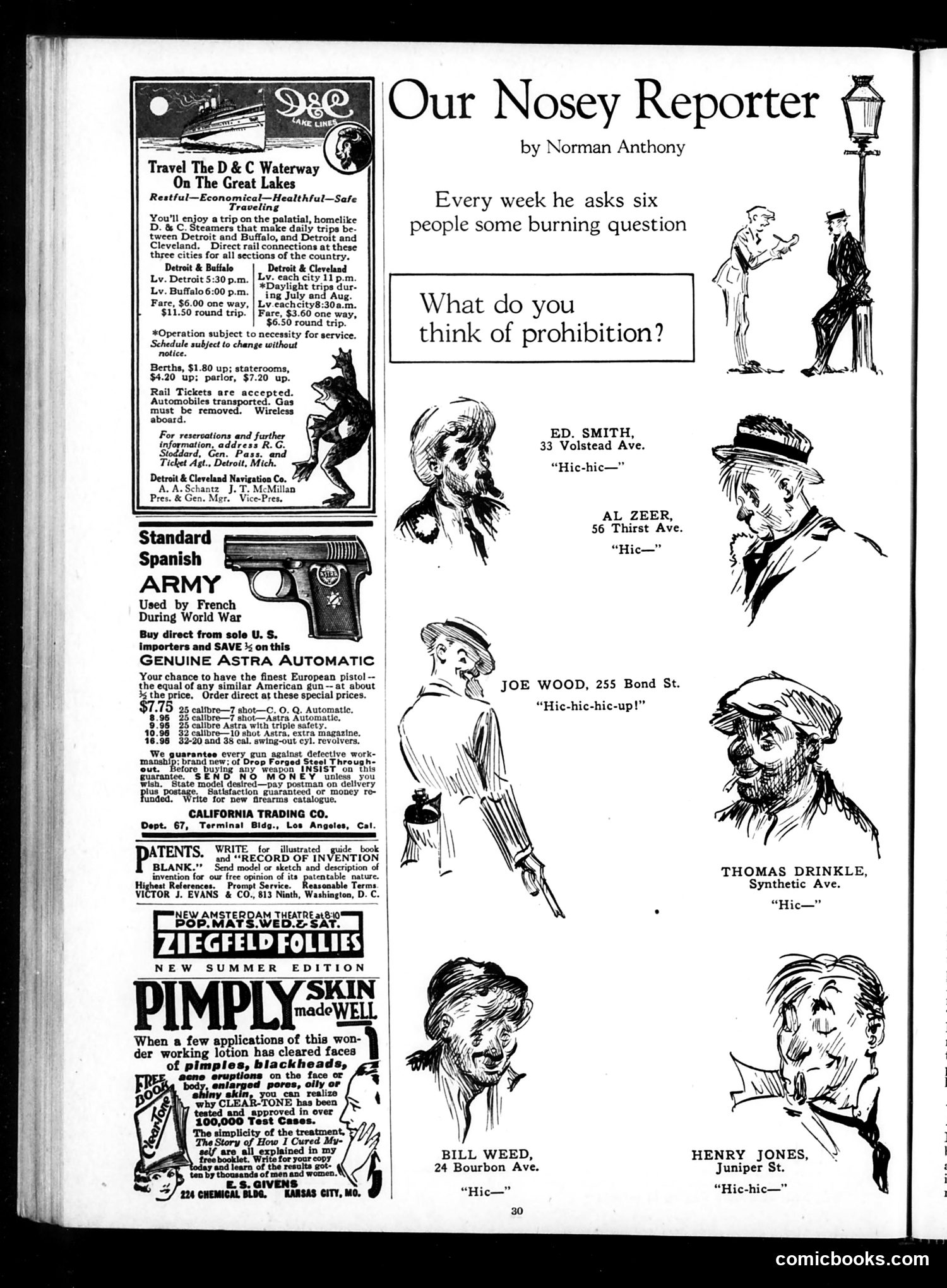
This is a humor column by Norman Anthony asking six ordinary people: "What do you think of prohibition?" The joke is clear from the respondents' names and their identical answers of "Hic—" (the sound of hiccups). All six men listed—Ed Smith, Al Zeer, Joe Wood, Thomas Drinkle, Bill Weed, and Henry Jones—have names that are transparent puns on drinking and intoxication: "Al Zeer" (all beer), "Joe Wood," "Thomas Drinkle" (drink), "Bill Weed," etc. Their uniform response of hiccuping is the satirical punchline: despite Prohibition (the 1920 constitutional ban on alcohol), these men are clearly drunk, suggesting the law is utterly ineffective. The cartoon mocks Prohibition's failure by implying ordinary citizens continue drinking openly and unrepentantly, indifferent to the legal ban. The page's advertisements for firearms and other products are unrelated commercial content.
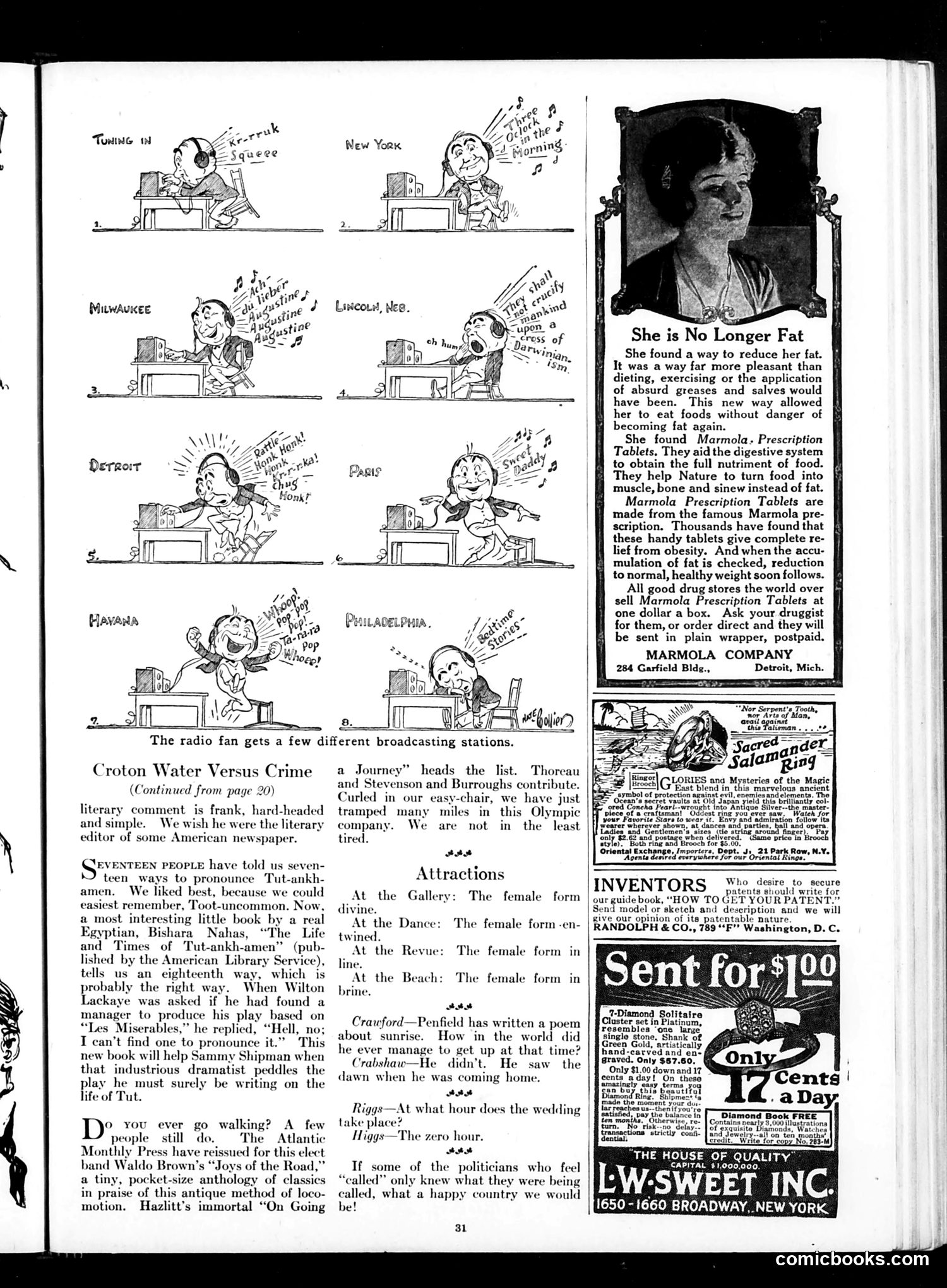
This page contains **literary commentary and advertisements** rather than political cartoons. The top cartoon strip shows radio broadcasters in different cities (Tunis, New York, Milwaukee, Lincoln, Detroit, Havana, Paris, Philadelphia) all receiving the same signal—a mild joke about radio's standardizing effect on entertainment. The main text discusses literary matters: praising frank book criticism, debating pronunciation of "Tutankhamun" (timely, given King Tut's tomb discovery in 1922), and celebrating a reissue of essays celebrating walking—a nostalgic appeal to simpler times. The "Attractions" section is satirical social commentary: it jokes that entertainment venues all feature "the female form" in different contexts (gallery, dance, revue, beach)—poking fun at how women's bodies are the primary draw across entertainment venues. The page is primarily filled with **advertisements** for weight-loss tablets (Marmola), jewelry, and patent services—typical Judge magazine content mixing humor with commercial interests.
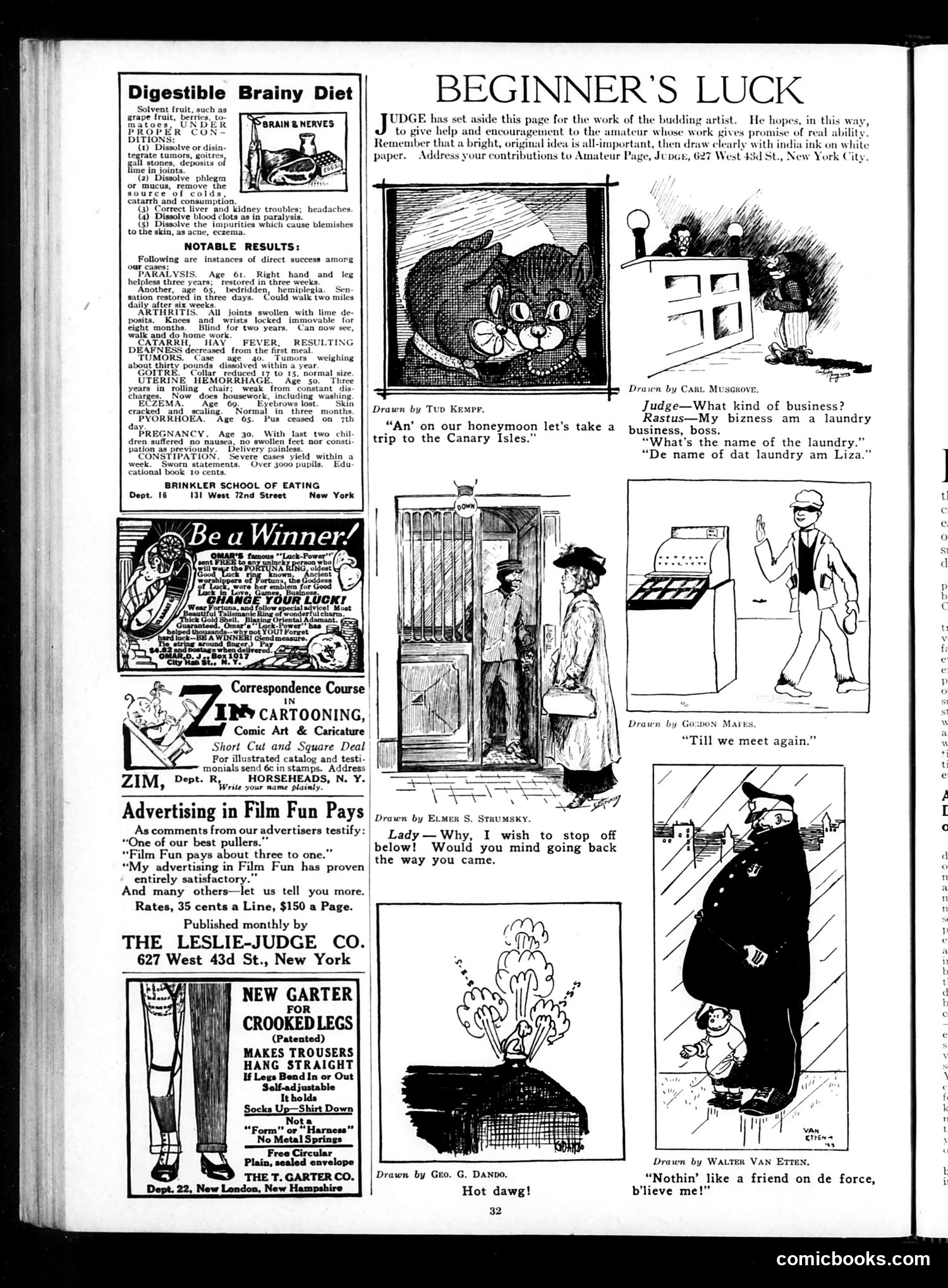
This is Judge magazine's section showcasing amateur cartoonists' work. The page contains four single-panel gag cartoons with racial stereotypes typical of early 20th-century American humor: 1. **Laundry business joke**: Uses dialect humor with a Black character ("Rastus") naming his laundry after a woman ("Liza")—the joke relies on racist stereotyping. 2. **Hotel scene**: A woman asks a doorman to reverse direction, presented as humorous. 3. **Laundry delivery**: A man departing with laundry, captioned "Till we meet again." 4. **Police officer scene**: Features dialect humor ("Nothin' like a friend on de force") with apparent racial caricature. The page demonstrates Judge's role encouraging amateur artists while reflecting period conventions: crude racial caricatures, heavy dialect spelling, and humor based on ethnic stereotypes. These cartoons would be considered offensive today but represent standard magazine content of that era. The surrounding advertisements address various health products and self-improvement courses.
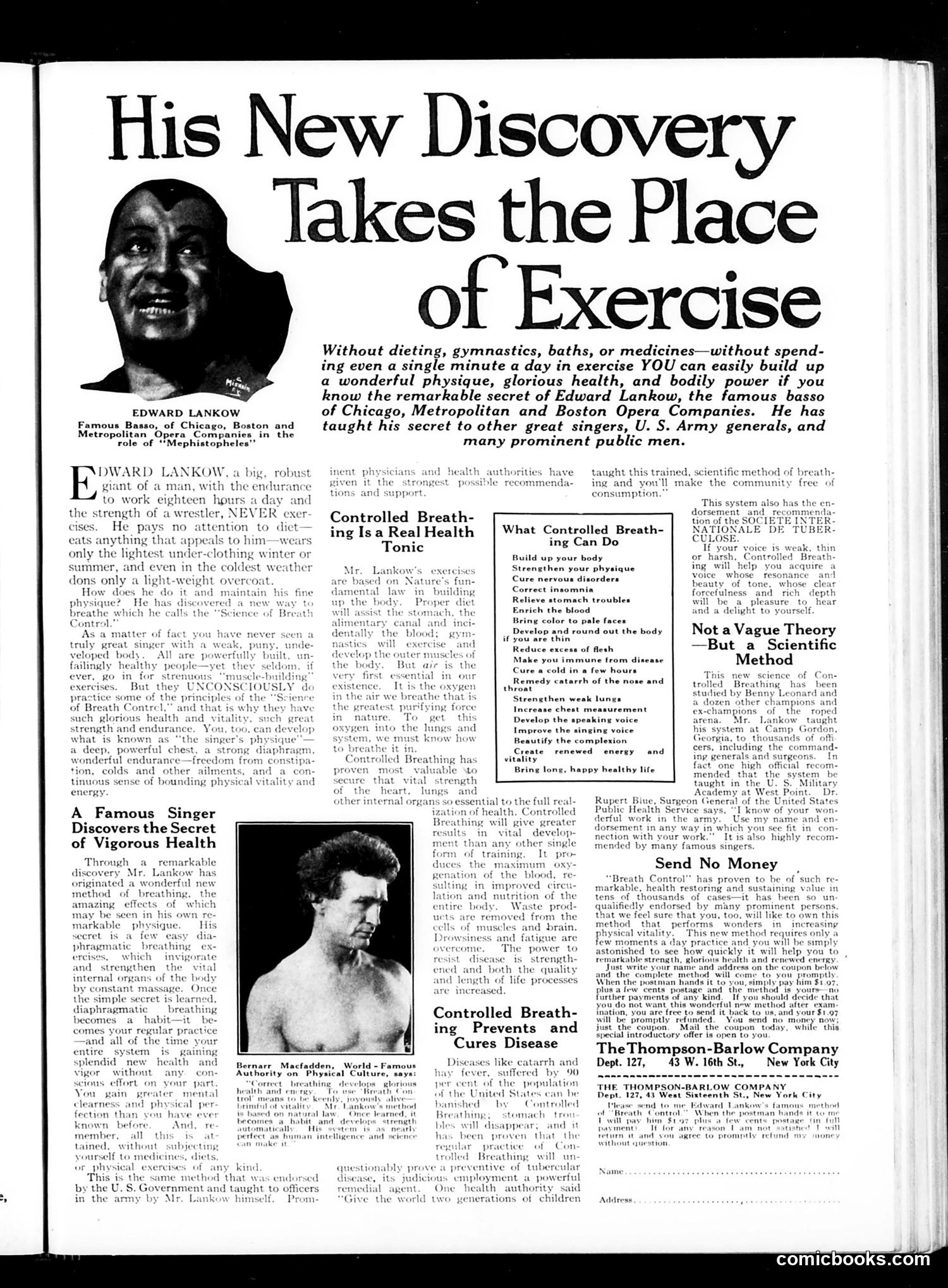
This page is primarily **advertising disguised as editorial content** for a "Breath Control" health method promoted by Edward Lankow, a famous opera singer. **The Figures:** Edward Lankow is presented as a real person—a celebrated basso from Chicago and the Metropolitan Opera—whose purported discovery of "controlled breathing" supposedly replaces the need for exercise, diet, or medicine. **The Claim:** The advertisement promises that simple daily breathing exercises will build physique, cure disease (consumption, catarrh, insomnia), improve singing voice, and provide vigor—without any other effort. **Why This Matters to Modern Readers:** This represents a common **early-20th-century health-scam tactic**: using a celebrity endorsement and pseudoscientific claims to sell a mail-order "method" requiring minimal investment. The language mimics legitimate medical authority while making wildly exaggerated promises. The coupon at bottom ("Send No Money") is a classic direct-mail manipulation technique. For Judge's satirical audience, this likely mocked both the gullibility of health-fad consumers and the proliferation of dubious mail-order remedies marketed to the public.
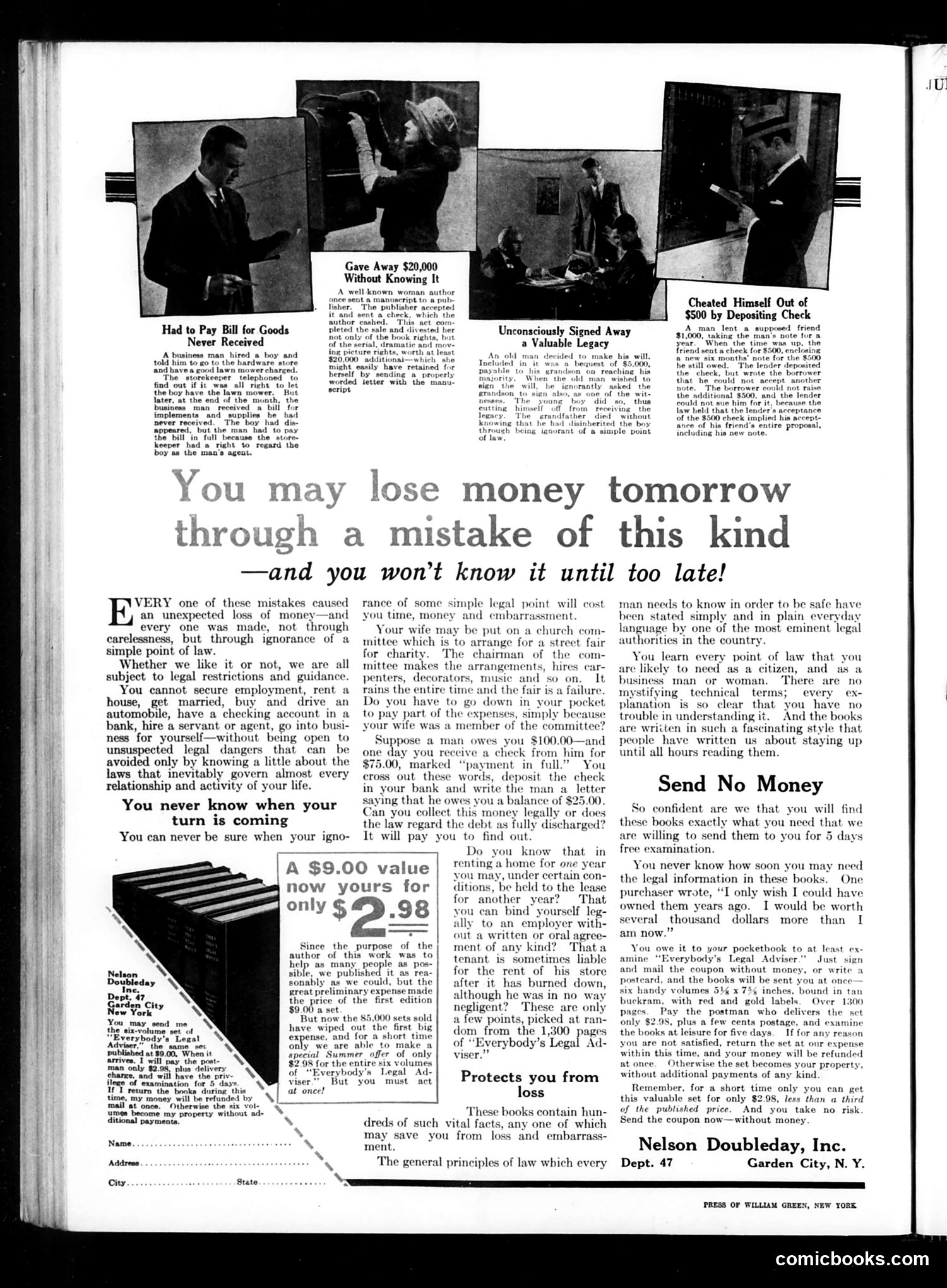
This is primarily an **advertisement for a legal self-help book set** ("Everybody's Legal Adviser"), disguised as educational content. The page presents four cautionary tales—a woman unknowingly gave away $20,000 through careless manuscript handling; a businessman paid for goods never received because a boy acted as his agent; a man lost a valuable inheritance through unclear will language; and someone forfeited $500 by depositing a check marked "payment in full." **The satire's point:** Ordinary people constantly face legal pitfalls from ignorance of basic law—employment, contracts, property, agency, marriage. The message is that without legal knowledge, you'll lose money "tomorrow" without realizing it "until too late." The ad then sells the solution: a $9.00 six-volume legal reference set for $2.98, positioning legal literacy as essential middle-class self-protection. This reflects early 20th-century anxiety about navigating increasingly complex commercial and legal systems without professional help.