
Judge, 1923-07-21 · page 22 of 36
Judge — July 21, 1923 — page 22: what you’re looking at
What you’re looking at
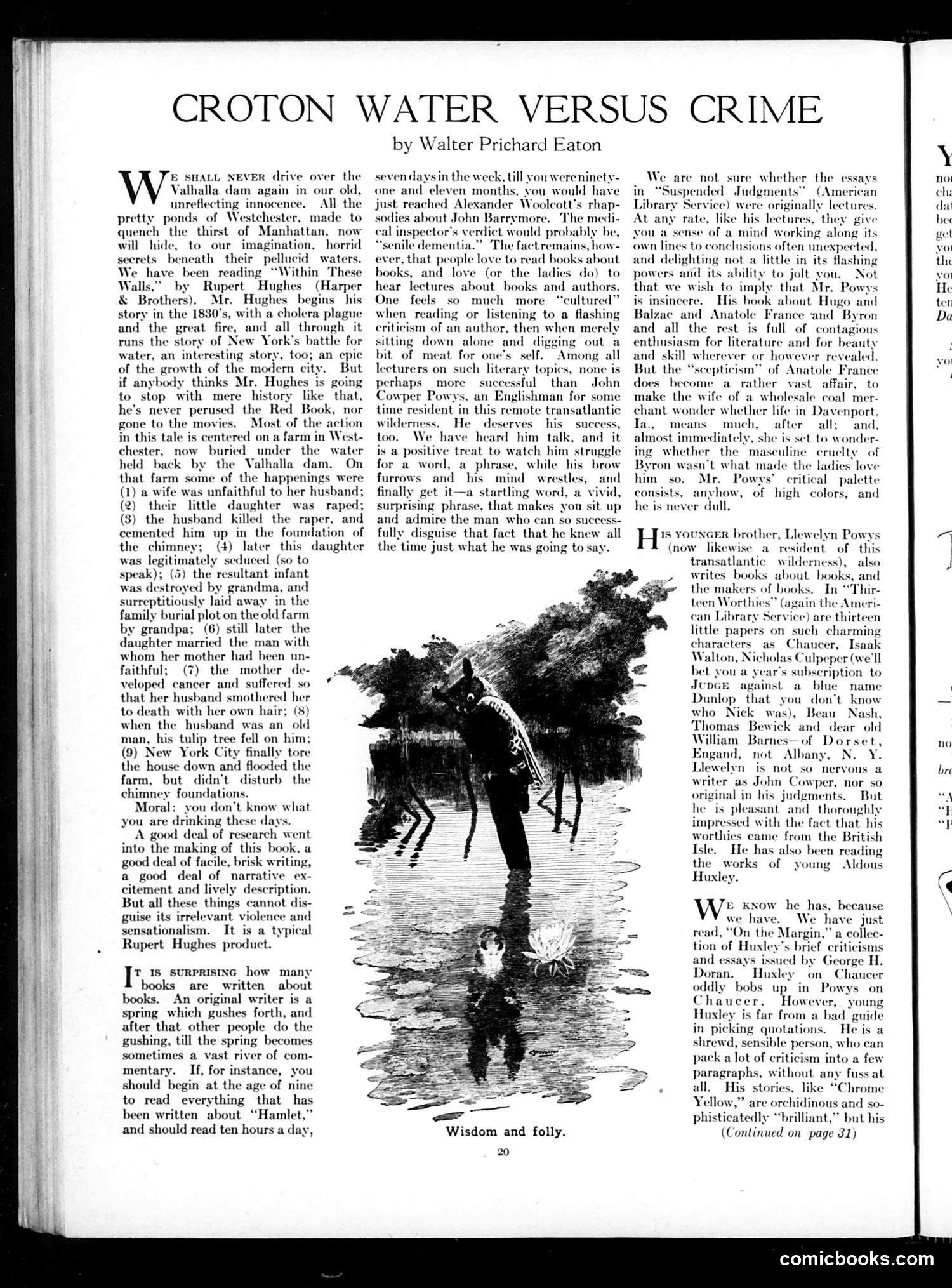
This page reviews Rupert Hughes' novel *"Within These Walls,"* set partly on a Westchester farm now submerged beneath the Croton Aqueduct (New York City's water supply). The satirist mocks Hughes' sensationalism by cataloging the melodramatic crimes buried literally under Manhattan's drinking water: rape, murder, infanticide, mercy killing, and more—all stacked atop each other across generations on one farm. The cartoon ("Wisdom and folly") depicts a figure wading through murky water, visualizing the reviewer's darkly comic point: New Yorkers unknowingly consume water hiding these fictional horrors. The satire targets both Hughes' overwrought plotting and the public's appetite for lurid crime stories disguised as serious literature. The page also praises literary critic John Cowper Powys for making book discussion entertaining—contrasting thoughtful engagement with mere sensationalism.
📄 Transcribed text from this page (OCR, searchable)
Machine-transcribed from the original scan — historical spelling and the odd misread are preserved.
CROTON WATER VERSUS CRIME "' ' Je SHALL NEVER drive over the Valhalla dam again in our old, unreflecting innocence. All the pretty ponds of Westchester, made to quench the thirst of Manhattan, now will hide, to our imagination, horrid secrets beneath their pellucid waters. We have been reading “Within These Wal by Rupert Hughes (Harper & Brothers). Mr. Hughes begins his story in the 1830's, with a cholera plague and the great fire, and all through it runs the story of New York's battle for water, an interesting story, too; an epic of the growth of the modern c But if anybody thinks Mr. Hughes is going to stop with mere history like that, he’s never perused the Red Book, nor gone to the movies. Most of the action in this tale is centered on a farm in West- chester, now buried under the water held back by the Valhalla dam. On that farm some of the happenings were (1) a wife was unfaithful to her husband; (2) their little daughter was raped; (3) the husband killed the raper, and cemented him up in the foundation of the chimney; (4) later this daughter was legitimately seduced (so to pak); (5) the resultant infant destroyed by grandma, and surreptitiously laid away in the family burial plot on the old farm by grandpa; (6) still later the daughter married the man with whom her mother had been un- faithful; (7) the mother de- veloped cancer and suffered. so that her husband smothered her to death with her own hair; (8) when the husband was an old man, his tulip tree fell on him; (9) New York City finally tore the house down and flooded the farm, but didn’t disturb the chimney foundations. Moral: you don’t know what you are drinking these days. A good deal of research went into the making of this book, a good deal of facile, brisk writing, a good deal of narrative ex- citement and lively description. cannot dis- guise its irrelevant violence and sensationalism. It is a typical Rupert Hughes product. T IS SURPRISING how many books are written about books. An original writer is a spring which gushes forth, and after that other people do the spring becomes sometimes a vast river of com- mentary. If, for instance, you should begin at the age of nine to read everything that has been written about “Hamlet,” and should read ten hours a day, by Walter Prichard Eaton seven days in the week, till you wereninet one and eleven months, you would have just reached Alexander Woolcott’s rhap- sodies about John Barrymore. The medi- cal inspector's verdict would probably be, “senile dementi. The factremains, how- ever, that people love to read books about books, and love (or the ladies do) to hear lectures about books and authors. One feels so much more “cultured” when reading or listening to a flashing criticism of an author, then when merely sitting down alone and digging out a bit of meat for one’s self. Among all lecturers on such literary topics, none is perhaps more successful. than John Cowper Pov an Englishman for some time resident in this remote transatlant wilderness. He deserves his success, too. We have heard him talk, and it is a positive treat to watch him struggle for a word, a phrase, while his brow furrows and his mind wrestles, and finally get it—a startling word, a vivid, surprising phrase, that makes you sit up and admire the man who can so su fully disguise that fact that he knew the time just what he was going to say. Wisdom and folly. 20 We are not sure whether the essays in “Suspended Judgments” (American Library Service) were originally lectures. At any rate, like his lectures, they give you a sense of a mind working along its own lines to conclusions often unexpected, and delighting not a little in its flashing powers and its ability to jolt you. Not that we wish to imply that Mr. Powys is insincere. His book about Hugo and Balzac and Anatole France and Byron and all the rest is full of contagious enthusiasm for literature and for beauty and skill wherever or however rev But the “scepticism” of Anatole France does become a rather vast affair, to make the wife of a wholesale coal mer- chant wonder whether life in Davenport, Ta... means much, after all; and, almost immediately, she is set to wonder- ing whether the masculine cruelty of Byron wasn’t what made the ladies love him so. Mr. Powys’ critical palette consists, anyhow, of high colors, and he is never dull. YOUNGER brother, Llewelyn Powys (now likewise a resident of this transatlantic wilderness), also writes books about books, and the makers of books. In “Thir- again the Ameri- can Library Service) are thirteen little papers on such charming characters as Chaucer, Isaak Walton, Nicholas Culpeper (we'll bet you a r’s subscription to Jen against a blue name Dunlop that you don’t know who Nick was), Beau Nash, Thomas Bewick and dear old William Barnes—of Dorset, ngand, not Albany, N.Y. Llewelyn is not so nervous a i ohn Cowper, nor so nal in his judgments. But he is pleasant and. thoroughly impressed with the fact that his worthies came from the British Isle. He has also been reading the works of young Aldous Huxley. We know he has, because w e have. We have just read, “On the Margin, tion of Huxle and essays issued by George H. Doran. Huxley on Chaucer oddly bobs up) in Powys on Chaucer. However, young Huxley is far from a bad guide in picking quotations. He is a shrewd, sensible person, who can pack a lot of criticism into a few paragraphs, without any fuss at all. His stories, like “Chrome Yellow,” are orchidinous and so- phisticatedly “brilliant,” but his (Continued on page 31) comicbooks.com no chi dai be get yor the yor He ter Da yo no bre