
Judge, 1923-07-21 · page 3 of 36
Judge — July 21, 1923 — page 3: what you’re looking at
What you’re looking at
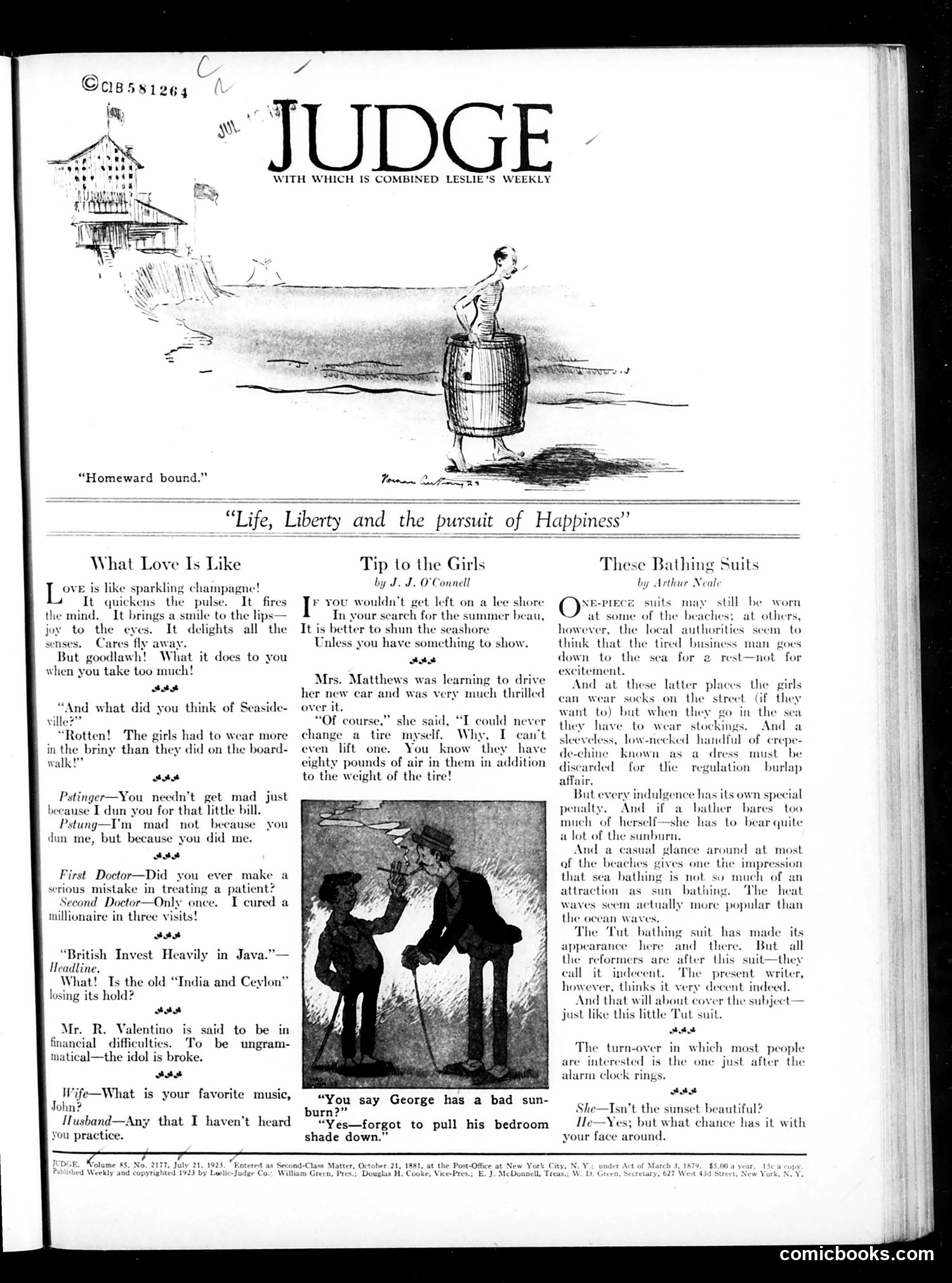
The main cartoon depicts a man standing inside a large barrel, gazing toward a distant house. The caption "Homeward bound" is ironic—the figure appears trapped or confined rather than freely traveling home. This likely satirizes economic hardship or financial constraint preventing someone from returning home. Given Judge's 1920s publication date and the barrel imagery, it may reference post-WWI economic difficulties, Prohibition-era financial struggles, or the general economic anxiety of the period. The man's wistful expression contrasts with his literal confinement, suggesting the satirical point: desires for home and normalcy are thwarted by external circumstances beyond individual control. The barrel could represent financial limitations, debt, or other societal constraints keeping working people immobilized.
📄 Transcribed text from this page (OCR, searchable)
Machine-transcribed from the original scan — historical spelling and the odd misread are preserved.
fF ‘JUDGE WITH WHICH IS COMBINED “Homeward bound.” What Love Is Like [0° 5s like sparkling champagne! 4 It quickens the pulse. It fires It brings a smile to the lips— to the ¢ It delights all the Cares fly away. But goodlawh! What it does to you when you take too much! tae “And what did you think of Seaside- the mind. joy senses. “Rotten! The girls had to wear more in the briny than they did on the board- walk!” tae Pstinger—You needn't get mad just because I dun you for that little bill. Pstung—I'm mad not because you dun me, but because you did me. tae First Doctor—Did you ever make a serious mistake in treating a patient? Second Doctor—Only once. I cured a nillionaire in three visits! toe “British Invest Heavily in Java.”— Headline. What! Is the old “India and Ceylon” losing its hold? toe Mr. R. Valentino is financial difficulties. To matical—the idol is broke. Daal de What is your favorite music, John? Husband—. you practi said to be in be ungram- Any that I haven’t heard LESLIE’S WEEKLY Tip to the Girls by J. J. O'Connell I’ you wouldn't get left on a lee shore In your search for the summer beau, It is better to shun the seashore Unless you have something to show. Fas Mrs. Matthews was learning to drive her new car and was very much thrilled over it. “Of course,” she said, “I could never change a tire myself. Why, I. can't even lift one. You know they have cighty pounds of air in them in addition to the weight of the tire! “You say George has a bad sun- burn?” “Yes—forgot to pull his bedroom shade down.’ pursuit of Happiness” by Arthur Neal Over = suits sull at some of the however, the local authorities seem to think that the tired business man goes down to the for 2 for excitement. And at these latter places the girls can wear socks on the street (if they want to) but when they go in the sea they have to wear stockings. And a ss, low-necked handful of crepe- known must be for burlap be worn sea rest—not as a dress tlie regulation But every indulgence has its own special penalty. And if a bather bares too much of herself—she has to bear quite a lot of the sunburn. And a casual glance around at most af the beaches gives one the impression that sea bathing is not so much of an attraction sun bathing. The heat waves seem actually more popular than the ocean waves. The Tut bathi appearance here the reformers are r this suit—they call it) indecent. The present writer, however, thinks it very decent indeed. And that will about cover the subject— just like this little Tut suit. eed as has made its there. But all The turn-over in which most people are interested is the one just after the alarm clock rings. She—Isn’t the sunset beautiful? He—Yes; but what chance has it with comicbooks.com